Remission and Recurrence of Hyperthyroid Graves’
Disease during and after Methimazole Treatment When
Assessed by IgE and Interleukin 13
ICHIRO KOMIYA, TAKASHI YAMADA, AKIRA SATO, TSUYOSHI KOUKI, TAKESHI NISHIMORI, AND
NOBUYUKI TAKASU
Second Department of Internal Medicine (I.K., T.K., N.T.), University of the Ryukyus School of Medicine, Okinawa
903-0215; Department of Medicine (T.Y., T.N.), Kashiwa City Hospital, Chiba 277-0825; and Department of Medicine (A.S.), Dokkyo Koshigaya Hospital, Dokkyo University School of Medicine Koshigaya, Saitama 343-8555, Japan
We analyzed the relationship between serum IgE concentra-tions and the remission or recurrence of Graves’ disease. One hundred seven patients with Graves’ disease were treated with methimazole (MMI). Serum IgE concentration greater than 170 IU/ml was found in 41 of 107 untreated patients (38.3%). However, the presence of TSH-binding inhibiting im-munoglobulin or thyroid-stimulating antibody did not corre-late with the IgE concentrations. Remission was found in 20 of 41 patients with elevated IgE concentrations (48.8%) after 18 months of MMI treatment, as opposed to 53 of 66 patients with normal concentrations (80.3%) (Pⴝ0.0014). MMI treat-ment was discontinued in 73 patients who were followed for 26 – 48 months. The recurrence of Graves’ disease was found in 13 patients, whereas the remaining 60 were still in remission.
The rate of long-standing remission was lower in patients with elevated than normal IgE concentration (34.1%vs.69.7%,Pⴝ 0.0007). We also analyzed serum levels of interleukin (IL)-13. Although IL-13 was not detected in all patients, the detection rate was higher in patients without remission and in those with recurrence than in those with long-standing remission (47.1%, 38.5%, and 13.3%, respectively;Pⴝ0.0012). More pa-tients with elevated IgE were positive for allergic diseases and for family history of allergic diseases in their first-degree rel-atives. We conclude that the elevation of IgE and the higher detection rate of IL-13 are associated with both remission and recurrence of Graves’ disease. (J Clin Endocrinol Metab86: 3540 –3544, 2001)
P
REVIOUS STUDIES HAVE found that 30 – 40% of hy-perthyroid patients with Graves’ disease have an ele-vation of serum IgE concentrations (ⱖ170 IU/ml) (1). In contrast, the prevalence of IgE elevation was significantly less in autoimmune Hashimoto’s thyroiditis (1). Interest-ingly, decreases in TSH-binding inhibiting immunoglobulin (TBII) and thyroid-stimulating antibody (TSAb) in response to antithyroid drugs were less pronounced in patients with than without IgE elevation (1). However, the role on IgE in autoimmune Graves’ disease is not known.Quite interestingly, interleukin (IL)-4 and IL-13 in the lungs of asthmatic patients stimulate IgE secretion (2–5). It has also been shown that IL-13 stimulates secretion of IgG, IgM, and IgE (6). Thus, one may expect an elevation of IL-4 and/or IL-13 in patients with Graves’ disease who have an increase in IgE synthesis. Although abnormalities of intra-thyroidal lymphocytes are not reflected in circulating lym-phocytes (7, 8), circulating IL-4 and/or IL-13 may stimulate the synthesis of IgE as well as IgG (TBII or TSAb). To better define the role of ILs in the pathophysiology of Graves’ disease, we measured circulating ILs (IL-4, IL-6, IL-10, and IL-13) and analyzed the relationship between IL concentra-tions and the remission or recurrence of Graves’ disease during and after the discontinuation of methimazole (MMI) treatment.
Patients and Methods
One hundred seven patients with Graves’ disease (17 men and 90 women, ages 17– 67) were treated with MMI for 18 months. Thirty-four of 107 patients were in a euthyroid state; however, because of continuous elevation of thyroglobulin (Tg), TBII, and/or TSAb concentrations, MMI treatment could not be discontinued as reported previously (group I) (9, 10). In the remaining 73 patients (groups II and III), MMI treatment was discontinued because of normalization in serum concentrations of T4,
Tg, TBII, and TSAb (9, 10); those patients were followed for 26 – 48 months. During follow-up, the recurrence of Graves’ disease was noted in 13 patients within 8 –26 months after MMI withdrawal (group III), whereas the remaining 60 patients were still euthyroid at 26 – 48 months (group II). Patients who had allergy to MMI were excluded from this study, because MMI treatment could not be continued for a long period. We analyzed the presence of allergic diseases (atopy, allergic rhinitis, and asthma) in patients with Graves’ disease and allergic diseases and autoimmune thyroid disorders (AITDs) in their first-degree relatives.
Serum T4, TSH, TBII, TSAb, Tg, and IgE concentrations were
mea-sured monthly (1, 9, 10). IFN-␥and IL-4, IL-6, IL-10, and IL-13 concen-trations were measured at the time of MMI treatment, at the time of recurrence, or at the latest follow-up. The detection limit for TSH was 0.02 mU/liter. Concentrations of IgE and cytokines were confirmed by ELISA (Mitsubishi Kagaku Bio-Chemical Laboratory Inc., Tokyo, Japan). Fresh sera from hyperthyroid patients were used for cytokine measure-ment. A normal IgE concentration was defined as less than 170 IU/ml, because mean serum IgE level was 61.6 IU/ml (range, 27.54 –138.34) obtained from 43 normal subjects without history of allergic diseases and negative for specific antibodies against 16 common antigens (1, 11). The intra- and interassay coefficients of variation for IgE were 7.2% (n⫽8) and 6.8% (n⫽8), respectively. The minimal detectable levels were 1.56 pg/ml for IFN-␥, 15 pg/ml for IL-4, 0.15 pg/ml for IL-6, 0.5 pg/ml for IL-10, and 3.12 pg/ml for IL-13. The intra-assay coefficients of variation for IFN-␥, IL-4, IL-6, IL-10, and IL-13 were 4.5% (n⫽6), 3.9% (n⫽8), 2.9% (n ⫽ 20), 4.5% (n⫽ 16), and 4.1% (n ⫽ 6), respectively. The interassay coefficients of variation for IFN-␥, IL-4, IL-6, IL-10, and IL-13 Abbreviations: AITD, Autoimmune thyroid disorder; IL, interleukin;
IL4R, IL-4 receptor; IFN-␥, interferon␥; MMI, methimazole; TBII, TSH-binding inhibiting immunoglobulin; Tg, thyroglobulin; TSAb, thyroid-stimulating antibody;
were 5.7% (n⫽6), 6.7% (n⫽8), 10.9% (n⫽20), 7.8% (n⫽16), and 5.0% (n⫽6), respectively. Serum T4, T3, TBII, TSAb, and Tg concentrations
were measured as reported previously (1). Under normal conditions, TBII is less than 10% and TSAb is less than 180% (12). Statistical analysis was performed by ANOVAs,2test with Yate’s correction, or Fisher’s
exact probability test using StatView software (SAS Institute, Inc., Cary, NC). APvalue less than 0.05 was considered statistically significant.
Results
Remission and recurrence rates during and after MMI treatment in Graves’ disease with or without IgE elevation
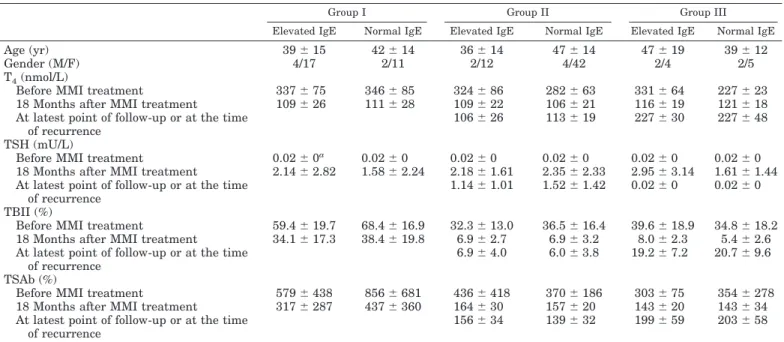
The elevation of serum IgE was found in 41 of 107 un-treated hyperthyroid patients with Graves’ disease (38.3%) (Table 1). After 18 months of treatment, concentrations of T4, TSH, TBII, TSAb, and Tg normalized in 73 of 107 patients (68.2%, remission; groups II and III). Furthermore, the re-mission occurred in 20 of 41 patients with elevated concen-trations of IgE (48.8%) and in 53 of 66 patients with normal IgE concentrations (80.3%, P ⫽ 0.0014) (Table 1). During follow-up (26 – 48 months), 60 of 73 patients had a long-standing remission (group II). The long-long-standing remission rate was significantly lower in patients with elevated than normal IgE (34.1%vs.69.7%,P⫽0.0007). However, no dif-ference in the recurrence rate was seen between group III patients with elevated IgE and with normal IgE (30.0%vs.
13.2%,P⫽0.1721), because of the limited number of patients (Table 1).
TBII (or TSAb) and IgE levels during and after MMI treatment in patients with Graves’ disease
As shown in Table 2, 34 patients without remission (group I) were euthyroid after 18 months of treatment. However, TBII and/or TSAb did not normalize regardless of the IgE level. In 60 patients with long-standing remission for the follow-up period (group II), TBII and TSAb normalized, but not IgE concentrations in the majority of those patients (Table 3). Recurrence was found in 13 patients within 8 –24 months after discontinuation of MMI treatment (group III). As
ex-pected, concentrations of T4, TBII, and TSAb were increased at the time of recurrence (Table 2).
IFN-␥and ILs in sera of patients with Graves’ disease during and after MMI treatment
IFN-␥was detected in only four patients with elevated IgE concentrations, whereas IL-4 was not detected in any patients at any time of follow-up. The detection rate of IL-6 varied from 85–100%. IL-10 was detected in all patients studied at any time of follow-up. We analyzed the concentration of IL-6 and IL-10 quantitatively, and no specific relationship was found in IL-6 and IL-10 concentrations between patients with normal and those with elevated IgE concentrations (data not shown). Recurrence did not induce any significant changes in IL-6 concentrations, as was the case with IL-10, except the highest IL-10 concentration was found at recurrence (data not shown).
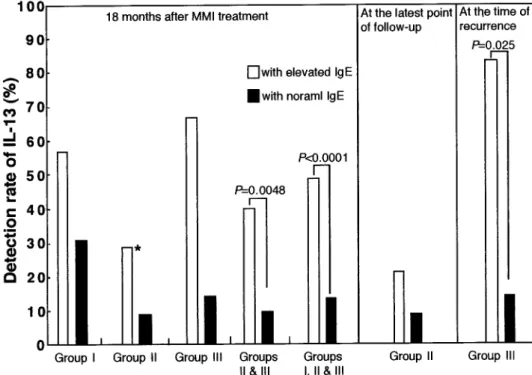
The detection rate of IL-13 varied from 8.7– 83.3%, and in all patients studied the detection rate of IL-13 was higher in those with elevated IgE than with normal IgE (P⬍0.0001) (Fig. 1). The detection rate was higher in patients with ele-vated than normal IgE in each group, but statistical signif-icance was found only for group III patients (P⫽0.025). The detection rate of IL-13 in patients with remission (groups II and III) was higher in those with elevated than normal IgE (P⫽0.0048, Fig. 1). Moreover, the detection rate was lower in patients with long-standing remission than in those with-out remission and with recurrence (13.3%, 38.5%, and 47.7%, respectively;P⫽0.0012).
Presence of allergic diseases in patients with Graves’ disease and allergic diseases and AITDs in their first-degree relatives
More patients with elevated IgE were positive for allergic diseases, and for family history of allergic diseases and AITDs in the first-degree relatives (Table 4). Compared with patients with normal IgE, those with elevated IgE had high frequency of allergic diseases (P⫽0.0017) and family history of allergic diseases (P⬍ 0.0001). Allergic rhinitis was the most frequent both in patients with elevated IgE (29.3%) and in the first-degree relatives of those with elevated IgE (41.5%). However, we could not find that attack of allergic rhinitis preceded the recurrence of Graves’ disease.
Discussion
The study indicates that 38.3% of patients with Graves’ disease have elevated serum IgE concentrations (ⱖ170 IU/ ml). If an IgE concentration of 100 IU/ml or greater was considered abnormal, then 50% of patients with untreated Graves’ disease had abnormal concentrations of IgE. This high prevalence of elevated concentrations of IgE was com-parable with that found in patients with bronchial asthma (70%) (13). Our previous study indicated that the decrease in TBII that occurred in response to antithyroid drug treatment was less pronounced in patients with elevated than normal IgE (1). In concordance with this, we found that normaliza-tion of TBII and/or TSAb during 18 months of treatment occurred less frequently in patients with elevated IgE than TABLE 1. Remission and recurrence rates during and after MMI
treatment in Graves’ disease with or without IgE elevation Patients with elevated IgE Patients with normal IgE P( 2 )a Group I No. of patients 21 13 Groups II and III
No. of patients 20 53 Remission rate 48.8% (20/41) 80.3% (53/66) 0.0014 (10.196) Group II No. of patients 14 46 Remission rate (long-standing) 34.1% (14/41) 69.7% (46/66) 0.0007 (11.573) Group III No. of patients 6 7 Recurrence rate 30.0% (6/20) 13.2% (7/53) 0.1721 (1.780) Values are expressed as number or percentage.
a2test between patients with and without elevated IgE. MMI was discontinued in 73 of 107 patients. They were then followed for more than 26 months. Recurrence was found in 13 of 73 patients (17.3%). Group I, Without remission during 18-month treatment; Group II, without recurrence during 26- to 48-month follow-up; Group III, with recurrence during 26- to 48-month follow-up.
with normal IgE. As a result, the rate of remission (normal-ization of T4, TSH, Tg, TBII, and TSAb) was lower in the patients with elevated than normal IgE. Interestingly, it was reported that allergic rhinitis could be an aggravating factor of Graves’ disease and increased eosinophils could be a pre-dictive indicator of recurrence of Graves’ disease (14). Al-lergic response should be considered as a cofactor to change the process of Graves’ disease. Thus, in addition to IgG-TBII (TSAb), IgE-TBII (TSAb) should be included in the evaluation of Graves’ disease.
The most likely hypothesis is that intrathyroidal lympho-cytes affect the synthesis of TBII, TSAb, and IgE. We mea-sured peripheral IFN-␥, a marker for Th-1 cells, after 18 months of treatment in patients with Graves’ disease. Al-though three of four patients who had detected IFN-␥were without remission, no conclusion can be made. We also mea-sured peripheral IL-4 concentrations at the time of remission and recurrence because it is a marker for Th-2 cells and stimulates IgE secretion (15, 16). Unfortunately, IL-4 was not detected at any time in any patients. Peripheral IL-6 and IL-10
concentrations were measured after 18 months of treatment, at remission, or at recurrence. These ILs were detected in the majority of patients, but no correlation was found among patients without remission, with remission, or with recur-rence. Finally, we measured peripheral IL-13, which also is a marker for Th-2 cells and has modulating activities on many cell types, including stimulation of IgE secretion (2, 6). It is not possible to quantify the role of IL-13 in the autoim-mune process of Graves’ disease, because its measurement using patient’s sera is impaired by poor sensitivity. It may be more important to measure intrathyroidal concentration of IL-13. However, the detection rate of IL-13 did provide qual-itative information. For example, the rate of detectable IL-13 was higher 1) in patients who did not have than did have remission, 2) at the time of recurrence than at the time of remission, and 3) in patients with elevated than normal IgE concentration. Thus, the most plausible explanation is that IL-13 is secreted from Th-2 cells and has functions to stim-ulate B cells to secrete TBII, TSAb, and IgE. Additional stud-ies are required to confirm this concept.
TABLE 2. Clinical parameters during and after MMI treatment in patients with Graves’ disease
Group I Group II Group III
Elevated IgE Normal IgE Elevated IgE Normal IgE Elevated IgE Normal IgE Age (yr) 39⫾15 42⫾14 36⫾14 47⫾14 47⫾19 39⫾12
Gender (M/F) 4/17 2/11 2/12 4/42 2/4 2/5
T4(nmol/L)
Before MMI treatment 337⫾75 346⫾85 324⫾86 282⫾63 331⫾64 227⫾23 18 Months after MMI treatment 109⫾26 111⫾28 109⫾22 106⫾21 116⫾19 121⫾18 At latest point of follow-up or at the time
of recurrence
106⫾26 113⫾19 227⫾30 227⫾48 TSH (mU/L)
Before MMI treatment 0.02⫾0a 0.02⫾0 0.02⫾0 0.02⫾0 0.02⫾0 0.02⫾0
18 Months after MMI treatment 2.14⫾2.82 1.58⫾2.24 2.18⫾1.61 2.35⫾2.33 2.95⫾3.14 1.61⫾1.44 At latest point of follow-up or at the time
of recurrence
1.14⫾1.01 1.52⫾1.42 0.02⫾0 0.02⫾0 TBII (%)
Before MMI treatment 59.4⫾19.7 68.4⫾16.9 32.3⫾13.0 36.5⫾16.4 39.6⫾18.9 34.8⫾18.2 18 Months after MMI treatment 34.1⫾17.3 38.4⫾19.8 6.9⫾2.7 6.9⫾3.2 8.0⫾2.3 5.4⫾2.6 At latest point of follow-up or at the time
of recurrence
6.9⫾4.0 6.0⫾3.8 19.2⫾7.2 20.7⫾9.6 TSAb (%)
Before MMI treatment 579⫾438 856⫾681 436⫾418 370⫾186 303⫾75 354⫾278 18 Months after MMI treatment 317⫾287 437⫾360 164⫾30 157⫾20 143⫾20 143⫾34 At latest point of follow-up or at the time
of recurrence
156⫾34 139⫾32 199⫾59 203⫾58 Data are reported as the mean⫾SDor number. Group I, Without remission during 18-month treatment; Group II, without recurrence during 26- to 48-month follow-up; Group III, with recurrence during 26- to 48-month follow-up.
aThe detection limit for TSH was 0.02 mU/L.
TABLE 3. Profile of serum IgE levels before, during, and after MMI treatment in patients with Graves’ disease
Group I Group II Group III
Elevated IgE Normal IgE Elevated IgE Normal IgE Elevated IgE Normal IgE IgE (IU/mL)
Before MMI treatment 916⫾970 48⫾35 620⫾936 55⫾41 1780⫾1975 76⫾38 18 Months after MMI treatment 740⫾938 31⫾22 256⫾156a 43⫾38 877⫾1296 57⫾32
P(pairedttest)b 0.0176 0.0810 0.1794 0.6594 0.2429 0.0712
At latest point of follow-up or at the time of recurrence
260⫾191c 42⫾41 797⫾1087 67⫾38
Data are reported as the mean⫾SD. Group I, Without remission during 18-month treatment; Group II, without recurrence during 26- to 48-month follow-up; Group III, with recurrence during 26- to 48-month follow-up.
aP⫽0.0029vs.Group I with elevated IgE.
bPvalue is between before MMI and 18 months after MMI treatment in each group. cP⫽0.2831vs.Group III with elevated IgE (ANOVA).
An elevation in IgE concentration is thought to be linked with hereditary abnormalities (17, 18). Human IL-4 operates through the IL-4 receptor (IL4R), thereby modulating IgE production and Th-2 inflammatory reaction (19). As is the case with IL-4, IL-13 operates through the IL-13R to stimulate IgE production and Th-2 inflammatory reactions. Moreover, IL-13R and IL4R share a common component in IL4R␣(2, 6) that is crucial for IL-4 (or IL-13) binding and signal trans-duction. Gain-in-function mutations in IL4R␣have been re-ported to be associated with atopy or asthma patients with elevated IgE concentrations (20, 21). These might be present in Graves’ patients with elevated IgE, even if peripheral IL-13 or IL-4 were within normal range or not detected. Additional experiments are required to analyze gain-in-function muta-tions in IL4R␣in the patients with Graves’ disease.
Acknowledgments
Received October 26, 2000. Accepted April 9, 2001.
Address all correspondence and requests for reprints to: Ichiro Komiya, M.D., Associate Professor of Internal Medicine, Second De-partment of Internal Medicine, University of the Ryukyus School of Medicine, 207 Uehara, Nishihara, Okinawa 903-0215, Japan. E-mail: [email protected]. ac.jp.
References
1.Sato A, Takemura Y, Yamada T, et al.1999 A possible role of immunoglobulin
E in patients with hyperthyroid Graves’ disease. J Clin Endocrinol Metab 84:3602–3605
2.Zurawski G, de Vries JE1994 Interleukin 13, an interleukin 4-like cytokine that acts on monocytes and B cells, but not on T cells. Immunol Today 15:19 –26 3.Yssel H, Abbal C, Pe`ne J, Bousquet J1998 The role of IgE in asthma. Clin Exp
Allergy 28:104 –109
FIG. 1. The detection rate of serum IL-13 in patients with Graves’ disease after MMI treatment (䡺, patients with elevated IgE;f, patients with normal IgE). Statistical analysis was per-formed by2test with Yate’s correction or Fisher’s exact probability test. *,P⫽ 0.0012,2⫽9.261vs.groups I and III (2⫻3 contingency table).
TABLE 4. Frequencies of allergic diseases in patients with Graves’ disease and allergic diseases and AITD in their first-degree relatives
Groups I, II, and III Group I Group II Group III
Elevated IgE Normal IgE Elevated IgE Normal IgE Elevated IgE Normal IgE Elevated IgE Normal IgE Patients with Graves’ disease
Atopy 9.8% (4/41) 3.1% (2/65) 9.5% (2/21) 7.7% (1/13) 7.1% (1/14) 2.2% (1/45) 16.7% (1/6) 0% (0/7) Allergic rhinitis 29.3% (12/41) 4.6% (3/65) 23.8% (5/21) 0% (0/13) 35.7% (5/14) 4.4% (2/45) 33.3% (2/6) 14.3% (1/7) Asthma 9.8% (4/41) 0% (0/65) 9.5% (2/21) 7.7% (1/13) 7.1% (1/14) 0% (0/45) 16.7% (1/6) 0% (0/7) Either of above 41.5% (17/41) 7.7% (5/65) 9.5% (7/21) 7.7% (1/13) 42.9% (6/14) 6.6% (3/45) 66.7% (4/6) 14.3% (1/7) Pa 0.0017 0.1164 0.0037 0.1026 First-degree relatives Atopy 12.3% (5/41) 3.1% (2/65) 9.5% (2/21) 15.4% (2/13) 14.3% (2/14) 0% (0/45) 16.7% (1/6) 0% (0/7) Allergic rhinitis 41.5% (17/41) 1.6% (1/65) 38.1% (8/21) 0% (0/13) 42.9% (6/14) 2.2% (1/45) 50.0% (3/6) 0% (0/7) Asthma 29.3% (12/41) 0% (0/65) 33.3% (7/21) 0% (0/13) 7.1% (1/14) 0% (0/45) 66.7% (4/6) 0% (0/7) Either of above 70.7% (29/41) 4.6% (3/65) 76.2% (16/21) 15.4% (2/13) 50% (7/14) 2.2% (1/45) 100% (6/6) 0% (0/7) Pa ⬍0.0001 0.0011 ⬍0.0001 0.0436 Graves’ 4.9% (2/41) 1.6% (1/65) 4.8% (1/21) 0% (0/13) 0% (0/14) 2.2% (1/45) 16.7% (1/6) 0% (0/7) Hashimoto 9.8% (4/41) 6.2% (4/65) 14.3% (3/21) 7.7% (1/13) 14.2% (2/14) 6.7% (3/45) 0% (0/6) 0% (0/7) Either of above 14.6% (6/41) 6.2% (4/65) 14.3% (3/21) 7.7% (1/13) 14.2% (2/14) 6.7% (3/45) 16.7% (1/6) 0% (0/7) Pa 0.1802 ⬎0.9999 0.5833 0.4615
Data are reported as percentage (n). Group I, Without remission during 18-month treatment; Group II, without recurrence during 26- to 48-month follow-up; Group III, with recurrence during 26- to 48-month follow-up.
4.van der Pouw Kraan TCTM, van der Zee JS, Boeije LCM, De Groot ER, Stapel
SO, Aarden LA1998 The role of IL-13 in IgE synthesis by allergic asthma
patients. Clin Exp Immunol 111:129 –135
5.Pe`ne J, Rousset F, Brie`re F, et al.1988 IgE production by normal human
lymphocytes is induced by interleukin 4 and suppressed by Interferons␥and
␣and prostaglandin E2. Proc Natl Acad Sci USA 85:6880 – 6884
6.de Vries JE1998 The role of IL-13 and its receptor in allergy and inflammatory responses. J Allergy Clin Immunol 102:165–169
7.Wheetman AP, McGregor AM1984 Autoimmune thyroid disease:
develop-ments in our understanding. Endocr Rev 5:309 –355
8.DeGroot LJ, Quintans J1989 The cause of autoimmune thyroid disease.
Endocr Rev 10: 537–562
9.Yamada T, Koizumi Y, Sato A, et al.1984 Reappraisal of the 3,5,3⬘
-triiodo-thyronine-suppression test in the prediction of long-standing outcome of an-tithyroid drug therapy in patients with hyperthyroid Graves’ disease. J Clin Endocrinol Metab 58:676 – 680
10. Aizawa T, Ishihara M, Koizumi Y, et al.1990 Serum thyroglobulin
concen-tration as an indicator for assessing thyroid stimulation in patients with Graves’ disease during antithyroid drug therapy. Am J Med 89:175–180
11. Shimazu S, Enomoto M1995 Normal serum total IgE concentration in normal
subjects [in Japanese]. Allergy Immunol 2:62– 67
12. Takasu N, Oshiro C, Akamine H, et al.1997 Thyroid-stimulating antibody
and TSH-binding inhibitor immunoglobulin in 277 Graves’ patients and in 686 normal subjects. J Endocrinol Invest 20:452– 461
13. Burrows B, Martinez FD, Halonen M, Barbee RA, Cline MG1989 Association
of asthma with serum IgE levels and skin-test reactivity to allergens. N Engl J Med 320:271–277
14. Hidaka Y, Amino N, Iwatani Y, Itoh E, Matsunaga M, Tamaki H1993
Recurrence of thyrotoxicosis after attack of allergic rhinitis in patients with Graves’ diseases. J Clin Endocrinol Metab 77:1667–1770
15. Del Prete G, Maggi E, Parronchi P, et al.1988 IL-4 is an essential factor for the IgE synthesis inducedin vitroby human T cell clones and their superna-tants. J Immunol 140:4193– 4198
16. Kallmann BA, Hu¨ther M, Tubes M, et al.1997 Systemic bias of cytokine
production toward cell-mediated immune regulation in IDDM and toward humoral immunity in Graves’ disease. Diabetes 46:237–243
17. Marsh DG1997 Approaches toward the genetic analysis of complex traits:
asthma and atopy. Am J Respir Crit Care Med 156:S133–S138
18. Hopkin J1990 A genetic approach to atopy. Eur Respir J. 3:851– 852
19. Hakonarson H, Maskeri N, Carter C, Grunstein MM1999 Regulation of
TH1-and TH2-type cytokine expression TH1-and action in atopic asthmatic sensitized airway smooth muscle. J Clin Invest 103:1077–1087
20. Mitsuyasu H, Izuhara K, Mao XQ, et al.1998 Ile50Val variant IL4R␣
up-regulates IgE synthesis and associates with atopic asthma. Nat Genet 19: 119 –120
21. Khurana-Harshey GK, Friedrich MF, Esswein LA, Thomas ML, Chatila TA
1997 The association of atopy with a gain-of-function mutation in the␣subunit of the interleukin-4 receptor. N Engl J Med 337:1720 –1725
The Foundation for Advanced Education in the Sciences, Inc. at the National Institutes of Health presents:
A Review of Endocrinology: Diagnosis and Treatment October 17–21, 2001
Bethesda, Maryland
Organizers: Derek LeRoith, M.D., Ph.D., Stephen Marx, M.D., Lynnette Nieman, M.D., and Nicolas Sarlis, M.D., Ph.D.
Participants will receive up-to-date, state-of-the-art information on clinical endocrinology, with an emphasis on pathophysiology, diagnosis and treatment. Detailed lectures and case studies will review: diabetes; thyroid function and diseases; disorders of calcium regulation; disorders on the adrenal cortex, growth and reproduction; and reproductive endocrinology. Lecturers include leading endocrinologists from the National Institutes of Health and other renowned institutions.
The course is intended both for physicians who are preparing for the endocrinology subspecialty board examination and for those certified in endocrinology who wish to keep abreast of current advances in the field.
Tuition for the course is $700 for physicians and $375 for residents and fellows who verify their status. For more information and a course brochure contact: FAES, One Cloister Court, #230, Bethesda, Maryland 20814-1460; Phone: (301) 496-7975; fax: (301) 402-0174; E-mail: [email protected].
The NIH/FAES is accredited by the Accreditation Council for Continuing Medical Education to sponsor continuing medical education for physicians. The NIH/FAES designates this education activity for a maximum of 40 hours in category 1 credit towards the AMA Physician’s Recognition Award. Each physician should claim only those hours of credit that he/she actually spent in the educational activity.