EUR 24915 EN - 2011
Preparation and Certification of the
Isotopic Reference Material IRMM-049d
R. Jakopi
č
, R. Eykens, F. Kehoe,H. Kühn, S. Richter, A. Verbruggen, Y. Aregbe
The mission of the JRC-IRMM is to promote a common and reliable European measurement system in support of EU policies.
European Commission Joint Research Centre
Institute for Reference Materials and Measurements
Contact information
Address: Retieseweg 111, B2440 Geel, Belgium E-mail: [email protected] Tel.: +32 14 571 617 Fax: +32 14 571 548 http://irmm.jrc.ec.europa.eu/ http://www.jrc.ec.europa.eu/ Legal Notice
Neither the European Commission nor any person acting on behalf of the Commission is responsible for the use which might be made of this publication.
Europe Direct is a service to help you find answers to your questions about the European Union
Freephone number (*): 00 800 6 7 8 9 10 11
(*) Certain mobile telephone operators do not allow access to 00 800 numbers or these calls may be billed. A great deal of additional information on the European Union is available on the Internet. It can be accessed through the Europa server http://europa.eu/
JRC66016 EUR 24915 EN ISBN 978-92-79-20992-5 (print) ISBN 978-92-79-20993-2 (online) ISSN 1018-5593 (print) ISNN 1831-9424 (online) doi:10.2787/49209
Luxembourg: Publications Office of the European Union © European Union, 2011
Reproduction is authorised provided the source is acknowledged
European Commission
IRMM information
REFERENCE MATERIALS
Preparation and Certification of the
Isotopic Reference Material IRMM-049d
IRMM-049d
R. Jakopi
č
, R. Eykens, F. Kehoe, H. Kühn, S. Richter, A. Verbruggen, Y. Aregbe
European Commission, Joint Research Centre
Institute for Reference Materials and Measurements Retieseweg 111
2440 Geel, Belgium
Disclaimer
Certain commercial equipment, instruments, and materials are identified in
this report to specify adequately the experimental procedure. In no case does such identification imply
recommendation or endorsement by the European Commission, nor does it imply that the material or
1 Contents
Contents 1
Summary 2
Introduction 2
Preparation of the 242Pu Isotopic Reference Material 2
Preparation of a stock 242Pu solution 2
Purification of a stock 242Pu solution 2
Dilution and ampouling of 242Pu solution 2
Plutonium isotopic composition of IRMM-049d 3
Certification of 242Pu amount content of IRMM-049d 4
Conclusion 6
Acknowledgment 6
2 Summary
A highly enriched 242Pu Isotopic Reference Material (IRMM-049d) has been prepared and certified for the 242Pu isotope amount content. The certified value of 3.666 8(18) ⋅10-7 mol 242Pu per g of solution was established by Isotope Dilution Mass Spectrometry (IDMS). The plutonium isotopic composition was determined by Thermal Ionization Mass Spectrometry (TIMS) and calibration of these measurements by means of synthetic mixtures.
The IRMM-049d Isotopic Reference Material is supplied in a glass ampoule with a screw cap seals containing about 10 mL of 5 molּL-1 nitric acid with plutonium. The
content of each ampoule is approximately 1 mg 242Pu.
This Isotopic Reference Material is the product of a systematic IRMM programme to supply Isotopic Reference Materials of various isotopes at different concentrations.
Introduction
IRMM produces and provides solutions of enriched uranium and plutonium isotopes designed for mass-spectrometric isotope dilution measurements of nuclear materials. For the measurement of plutonium, the isotope 242Pu is valuable as a spike because this isotope is usually found only as a minor component in plutonium of the nuclear fuel cycle.
The original certified spike of this isotope was approaching exhaustion and therefore it was decided to replace it by preparing a new stock of the source material and certifying the isotope amount content by IDMS using a 239Pu spike. A concentration of ca. 0.1 mg/g solution was chosen and deemed to be convenient for many types of measurements of plutonium.
Preparation of the
242Pu Isotopic Reference Material
Preparation of a stock 242Pu solution
A 242Pu stock solution was prepared by dissolving plutonium metal (BC 975B) of a French (CETAMA) origin in 5 molּL-1 HNO3 (p.a., Merck, Darmstadt). This stock
solution containing about 614 mg 242Pu was purified as described in the following.
Purification of a stock 242Pu solution
The plutonium solution was evaporated to dryness and dissolved in 24 mL 2 molּL-1
HNO3. To achieve valency homogenisation in the Pu+4 state, 4 mL 1.25 molּL-1 FeCl2 was added to convert all Pu to Pu+3 valency state. Subsequently, 12 mL 1 molּL-1
NH2OHּHCl and 12 mL 1 molּL -1
NaNO2 were added. Finally, 52 mL concentrated nitric acid (65%, Merck, Darmstadt) was added to obtain a Pu+4 8 molּL-1 HNO3
solution.
Two glass columns with a diameter of 2.5 cm and a height of 15 cm were used in parallel and were filled with Bio-Rad AG1-X4 (100-200 mesh) resin in chloride form for the purification. The plutonium solution was transferred onto the columns. After both columns were washed with 350 mL 8 molּL-1 HNO3, Pu was eluted from the
column with 1 L of 0.35 molּL-1 HNO3.
Dilution and ampouling of 242Pu solution
The eluted Pu fractions were combined, evaporated to dryness and dissolved in 61.44 g 5 molּL-1 HNO3 to obtain a 10 mg Pu per g solution. From that purified Pu
solution, a 10.46 g fraction was taken into a flask and diluted to 1007.1 g with 5 molּL-1 HNO3 to obtain the final concentration of the 242Pu of 0.1 mg Pu per g
solution. This solution was dispensed into 93 screw-cap glass ampoules providing
3 Plutonium isotopic composition of IRMM-049d
The isotopic composition of plutonium was established by measuring isotope abundance ratios on an ampoule of the IRMM-049d on a Triton TIMS (Thermo Fisher Scientific Inc., USA).
Prior to mass spectrometry measurements a chemical separation was performed to obtain a purified Pu solution (RM WI/0352: Separation and purification of plutonium samples for measurements of isotopic ratios by TIMS). The purified fraction of Pu was prepared in 1 molּL-1 HNO3. About 50 ng of Pu solution was put on an
evaporation filament using a transfer pipette and dried by passing an electrical current through the filament.
A magazine was loaded with six filaments of IRMM-049d and nine filaments of IRMM-290/A3 plutonium isotopic reference material for the calibration of the mass spectrometer for mass fractionation. The isotopic composition of the samples was measured using the total evaporation technique on a Triton TIMS (RM WI/0360: Measurement of Plutonium isotopic ratios by TIMS_TRITON). The measurement was continued until the sample has been exhausted. This is done in order to minimize mass fractionation effects.
Figure 1: Purification of Pu stock solution by anion exchange. The observed Pu isotope ratios were corrected for mass fractionation by measuring the IRMM-290/A3 isotopic standard on the same magazine applying the same procedure. The correction factor (K) for mass fractionation was calculated from nine replicate measurements of IRMM-290/A3 and was determined to be
K242/239 = 0.99983(20). Correction factors for all other Pu isotope ratios were derived
from K242/239 and were in the range of 0.99972 - 1.0001 with a relative standard
4
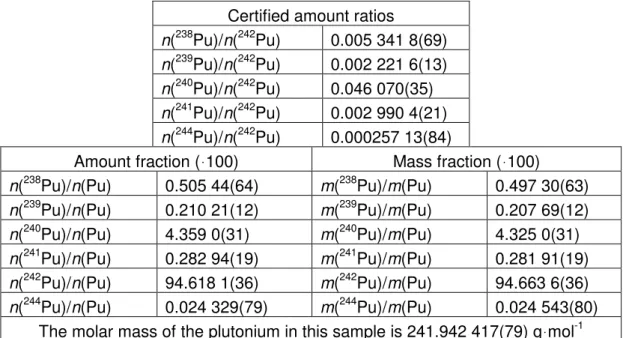
The certified values for the plutonium isotope ratios are listed in Table 1 and are valid for 1 July 2010. The expanded uncertainties were estimated according to the ISO Guide to the Expression of Uncertainty in Measurement (GUM). They apply to the last two digits of the value.
The main components to the final uncertainty are the IRMM-290/A3 plutonium isotopic standard and the K-factor for the respective isotope ratio.
Table 1: Isotope amount ratios and isotopic composition of plutonium in IRMM-049d valid for 1 July 2010. Expanded uncertainties are given in brackets (coverage factor k=2).
Certified amount ratios
n(238Pu)/n(242Pu) 0.005 341 8(69)
n(239Pu)/n(242Pu) 0.002 221 6(13)
n(240Pu)/n(242Pu) 0.046 070(35)
n(241Pu)/n(242Pu) 0.002 990 4(21)
n(244Pu)/n(242Pu) 0.000257 13(84)
Amount fraction (ּ100) Mass fraction (ּ100)
n(238Pu)/n(Pu) 0.505 44(64) m(238Pu)/m(Pu) 0.497 30(63)
n(239Pu)/n(Pu) 0.210 21(12) m(239Pu)/m(Pu) 0.207 69(12)
n(240Pu)/n(Pu) 4.359 0(31) m(240Pu)/m(Pu) 4.325 0(31)
n(241Pu)/n(Pu) 0.282 94(19) m(241Pu)/m(Pu) 0.281 91(19)
n(242Pu)/n(Pu) 94.618 1(36) m(242Pu)/m(Pu) 94.663 6(36)
n(244Pu)/n(Pu) 0.024 329(79) m(244Pu)/m(Pu) 0.024 543(80) The molar mass of the plutonium in this sample is 241.942 417(79) gּmol-1
Certification of
242Pu amount content of IRMM-049d
The certification of the plutonium amount content of Isotopic Reference Material IRMM-049d was achieved by IDMS. Six ampoules of IRMM-049d were randomly selected from the batch. The plutonium solution in IRMM-049d was split over two vials of IRMM-1027m (239Pu) for IDMS analysis. IRMM-1027m is a large-sized dried spike in which approximately 2 mg Pu and 50 mg U, enriched to 20 % 235U, per g solution are dried into individual vials. The enriched 239Pu in this spike has been certified from the mass of pure plutonium metal and verified by IDMS [1]. The spike is primarily designed for measurement of U and Pu amount contents in solutions of spent nuclear fuel but the certification of the 239Pu amount content renders it highly suitable for the IDMS measurement of 049d. Furthermore by using IRMM-1027m the certification of IRMM-049d becomes part of the ongoing compatibility study inter-linking selected IRMM plutonium spikes on a metrological basis applying state-of-the art measurement procedures [2]. In total 12 blend mixtures were prepared.
The series of 12 blend mixtures described above were used to assess the homogeneity of the plutonium and to certify the amount content of 242Pu in IRMM-049d. The blend mixtures were heated to dryness and then chemically conditioned. Pu fractions were separated by the standard anion exchange method (RM WI/0354: Separation and purification of uranium and plutonium mixtures for measurements of isotopic ratios by TIMS). The excess of uranium in the mixed U/Pu spike IRMM-1027m means that extra separation steps were needed before the measurement of
5
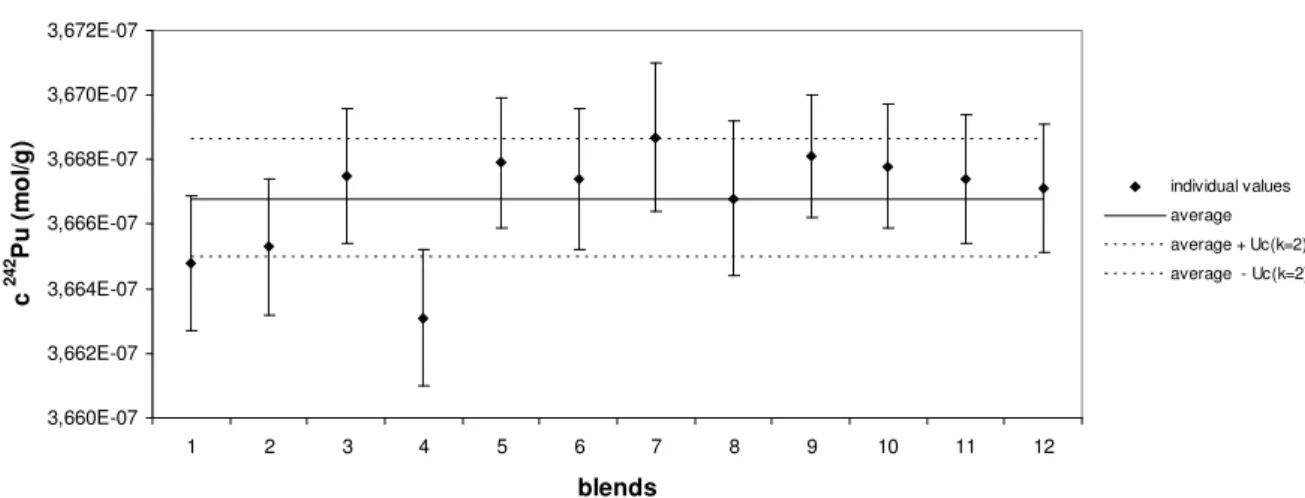
the Pu isotope ratios. Three consecutive separations for each blend mixture were performed in order to obtain a purified Pu fraction and to avoid interferences with uranium coming from IRMM-1027m in mass spectrometric measurements. Three magazines were loaded with four filaments for each blend; the remaining positions were filled by IRMM-290/A3 standards. The plutonium isotope ratios n(239Pu)/n(242Pu) were measured on the Triton TIMS [3] applying a total evaporation technique. The results of these IDMS measurements for the 242Pu amount content are given in Figure 2. IRMM-049d 242Pu (mol/g) 3,660E-07 3,662E-07 3,664E-07 3,666E-07 3,668E-07 3,670E-07 3,672E-07 1 2 3 4 5 6 7 8 9 10 11 12 blends c 2 42 P u ( m o l/ g ) individual values average average + Uc(k=2) average - Uc(k=2)
Figure 2: The amount content of 242Pu in blends of IRMM-049d measured by IDMS (with expanded uncertainties, coverage factor k=2).
Using the 239Pu spike (IRMM-1027m), the 242Pu amount content in IRMM-049d can be determined by IDMS through a measurement of the isotope ratio R(b) =
n(239Pu)/n(242Pu) in a blend via the following equation:
(
)
(
)
) ( 1 ) ( ) ( ) ( ) ( ) ( ) ( , , 239 242 y R x R b R b R y R x m y m y Pu c x Pu c ⋅ − − ⋅ ⋅ = , wherec(242Pu, x): amount content of 242Pu in the IRMM-049d
c(239Pu, y): amount content of 239Pu in the spike m(x): mass of the IRMM-049d
m(y): mass of the spike
R(b): isotope amount ratio n(239Pu)/n(242Pu) of the blend
R(x): isotope amount ratio n(239Pu)/n(242Pu) of the unspiked IRMM-049d
R(y): isotope amount ratio n(239Pu)/n(242Pu) of the spike
The certified value for the 242Pu amount content was calculated as the mean value of twelve certification measurement results and is 3.666 8(18) ּ10-7 molּg-1. The
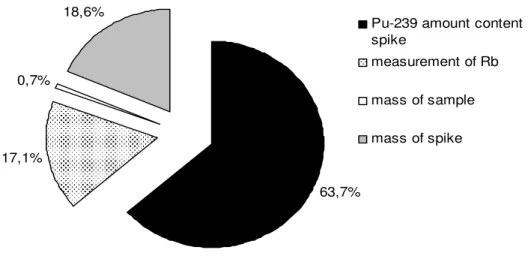
expanded uncertainty with a coverage factor k=2 is given in parentheses and corresponds to a level of confidence of about 95 % estimated according to the ISO Guide to the Expression of Uncertainty in Measurement (GUM). It applies to the last two digits of the value. The major component to the expanded uncertainty comes from the spike isotopic reference material IRMM-1027m. Figure 3 shows the relative contribution of the main uncertainty components to the overall uncertainty of the certified value in IRMM-049d.
6
63,7% 17,1%
0,7%
18,6%
Pu-239 amount content in the spike
measurement of Rb mass of sample mass of spike
Figure 3: The uncertainty budget of the major components for 242Pu amount content in IRMM-049d.
The value of the plutonium isotopic amount content in IRMM-049d is traceable to the SI via the certified IRMM-1027m spike reference material in combination with identification and quantification of the sources of uncertainties for IDMS according to the ISO Guide to the Expression of Uncertainty in Measurement (GUM) [4].
Conclusion
A new 242Pu Isotopic Reference Material (IRMM0-49d) has been prepared and certified for its 242Pu amount content. The certified value of 3.666 8(18) ⋅10-7 mol 242
Pu per g of solution was established by Isotope Dilution Mass Spectrometry (IDMS) and is metrologically traceable to the SI. IRMM-049d extends the inter-calibration campaign using state-of-the art measurement procedures to underpin the confidence in the use of IRMM isotopic plutonium reference materials for nuclear material and environmental sample measurements.
Acknowledgment
The authors would like to thank Dr. Roger Wellum for the certification file review.
References
[1] A. Verbruggen et al., Preparation and certification of IRMM-1027m, Large-Sized Dried (LSD) spike, EUR 24119 EN – 2009;
http://www.irmm.jrc.be/reference_materials_catalogue/catalogue/IRMM_certificates_ and_reports/eur_24119_1027m_report.pdf
[2] R. Jakopič et al., J Radioanal Nucl Chem 286 (2010) 449–454.
[3] S. Richter, A. A. Goldberg (2003), Int J Mass Spectrom, 229 (2003) 181-197. [4] International Organization for Standardization, Guide to the Expression of Uncertainty in Measurement, ISO, ISBN 52-67-10188-9, Geneva, Switzerland 199
EUR 24915 EN – Joint Research Centre – Institute for Reference Materials and Measurements
Title: Preparation and Certification of the Isotopic Reference Material IRMM-049d
Author(s): R. Jakopič, R. Eykens, F. Kehoe, H. Kühn, S. Richter, A. Verbruggen, Y. Aregbe
Luxembourg: Publications Office of the European Union 2011 – 6 pp. – 21.0 x 29.7 cm
EUR – Scientific and Technical Research series – 1018-5593 (print), 1831-9424 (online) ISBN 978-92-79-20992-5 (print)
ISBN 978-92-79-20993-2 (online) doi:10.2787/49209
Abstract
A highly enriched 242Pu Isotopic Reference Material (IRMM-049d) has been prepared and certified for the 242Pu isotope amount content. The certified value of 3.666 8(18) ⋅10-7 mol 242Pu per g of solution was established by Isotope Dilution Mass Spectrometry (IDMS). The plutonium isotopic composition was determined by Thermal Ionization Mass Spectrometry (TIMS) and calibration of these measurements by means of synthetic mixtures. The IRMM-049d Isotopic Reference Material is supplied in a glass ampoule with a screw cap seals containing about 10 mL of 5 molּL-1 nitric acid with plutonium. The content of each ampoule is approximately 1 mg 242Pu. This Isotopic Reference Material is the product of a systematic IRMM programme to supply Isotopic Reference Materials of various isotopes at different concentrations.
How to obtain EU publications
Our priced publications are available from EU Bookshop (http://bookshop.europa.eu), where you can place an order with the sales agent of your choice.
The Publications Office has a worldwide network of sales agents. You can obtain their contact details by sending a fax to (352) 29 29-42758.