Association for Information Systems
AIS Electronic Library (AISeL)
PACIS 2015 Proceedings
Pacific Asia Conference on Information Systems
(PACIS)
2015
Explaining Physicians’ Acceptance and Resistance
to the NHI Pharmacloud: A Theoretical Model and
Empirical Test
Pi-Jung Hsieh
Chia Nan University of Pharmacy & Science, [email protected]
Hui-Min Lai
Chienkuo Technology University, [email protected]
You-Li Hong
Chia Nan University of Pharmacy & Science, [email protected]
Follow this and additional works at:
http://aisel.aisnet.org/pacis2015
This material is brought to you by the Pacific Asia Conference on Information Systems (PACIS) at AIS Electronic Library (AISeL). It has been accepted for inclusion in PACIS 2015 Proceedings by an authorized administrator of AIS Electronic Library (AISeL). For more information, please [email protected].
Recommended Citation
Hsieh, Pi-Jung; Lai, Hui-Min; and Hong, You-Li, "Explaining Physicians’ Acceptance and Resistance to the NHI Pharmacloud: A Theoretical Model and Empirical Test" (2015).PACIS 2015 Proceedings. 247.
EXPLAINING PHYSICIANS’ ACCEPTANCE AND RESISTANCE
TO THE NHI PHARMACLOUD: A THEORETICAL MODEL AND
EMPIRICAL TEST
Pi-Jung Hsieh, Department of Hospital and Health Care Administration, Chia Nan University
of Pharmacy & Science, Tainan, Taiwan, R.O.C., [email protected]
Hui-Min Lai, Department of Information Management, Chienkuo Technology University,
Changhua, Taiwan, R.O.C., [email protected]
You-Li Hong, Department of Hospital and Health Care Administration, Chia Nan University
of Pharmacy and Science, Tainan, Taiwan, R.O.C., [email protected]
Abstract
The PharmaCloud allows physicians to streamline many of their healthcare processes and ensure patient safety in a more efficient and cost-effective manner. Despite its great potential, however, there are gaps in our understanding of how physicians evaluate change in relation to the PharmaCloud and why they decide to resist it. Thus, this study develops an integrated model to explain physicians’ intention to use the PharmaCloud and their intention to resist it. A field survey was conducted in Taiwan to collect data from physicians. Structural equation modeling (SEM) using the partial least squares (PLS) method was employed to test the research model. The results show that physicians’ resistance to the use of the PharmaCloud is the result of regret avoidance, inertia, perceived value, transition costs, and perceived threat. Information quality, system quality, and service quality are shown to have positive and direct effects on physicians’ intention to use the PharmaCloud. Our study illustrates the importance of incorporating user resistance in technology acceptance studies in general and health technology usage studies in particular, providing grounds for a model of resistance that can serve as the starting point for future research in this relatively unexplored yet potentially fertile area of research.
1
INTRODUCTION
Cloud computing provides a facility with access to shared resources and a common infrastructure in a ubiquitous and pervasive manner, offering services on demand over the network to perform operations that meet changing needs in healthcare applications (Nur & Moon 2012). In addition, it provides one of the most promising opportunities to reduce treatment costs within healthcare (Mathew 2013). Since 1995, the National Health Insurance (NHI) program has been providing comprehensive healthcare coverage for the majority of Taiwan’s 23 million inhabitants. Patients tend to visit several hospitals throughout their lives, and “hospital shopping” has become relatively common in this country. For this reason, the NHI intends to build a health platform whereby everyone’s drug records will be stored in an NHI PharmaCloud. Patients’ drug-related information stored on the NHI PharmaCloud will allow more efficient access for hospitals across Taiwan. However, for the benefits of this form of health information technology (IT) to materialize, physicians must first accept and adopt the NHI PharmaCloud to the extent that they obtain patient’s previous medication records and provide healthcare from the NHI PharmaCloud.
The information system (IS) literature has focused on IT use as a means of realizing the value of new IT investments (Ajzen 1985; Davis 1989; Taylor & Todd 1995; DeLone & McLean 1992, 2003). A number of preceding studies on IS usage measures have identified some critical factors. However, user resistance is unavoidable, and may cause performance to be lower than expected. As a result of such resistance, organizations often suffer failure in new IT investments (Norzaidi et al. 2008). One point of great resistance to the adoption of cloud computing in health IT has to do with patient information security and privacy (Mathew 2013). While some of the resistance can be explained in terms of individual or environmental factors, however, it must also be considered that system design and function play a role (Cenfetelli 2004). In fact, user resistance demonstrates asymmetric behaviors typical of inhibitors because its presence hurts IS usage, but lack of resistance does not necessarily enhance IS usage (Cenfetelli 2004). Thus, there is a need to investigate the critical factors that stimulate technology acceptance and resistance, as well as to examine the relationship between intention to use and resistance to using the NHI PharmaCloud.
Prior research on IS usage has largely ignored the problem of user resistance, and prior research on user resistance has been limited. Cenfetelli’s (2004) dual-factor model therefore provides a theoretical bridge to link research on IS usage and resistance to use within an integrated model (Bhattacherjee & Hikmet 2007). Cenfetelli’s (2004) study was motivated by the observation that extant theories of IS usage, such as DeLone and McLean’s IS success model (DeLone & Mclean 1992, 2003), have focused almost exclusively on users’ positive (enabling) perceptions related to IS usage while ignoring negative (inhibiting) perceptions that may hinder it. Although Cenfetelli (2004) did not identify any specific inhibitors of IS usage, based on our literature review, the status quo bias perspective provides a set of useful theoretical explanations for the desire to maintain the current status or situation as perceptions inhibiting IS usage(Kim & Kankanhalli 2009).
According to Cenfetelli’s (2004) dual-factor model of IS usage, we propose that a user’s intention to use the NHI PharmaCloud is based on both the traditional enablers of IS usage—such as the system quality, information quality, and service quality—and inhibitors such as sunk costs, regret avoidance, inertia, perceived value, transition costs, and perceived threat. From a practical standpoint, understanding why physicians resist or use the NHI PharmaCloud and how such resistance is manifested in their subsequent behavior can help governmental agencies and healthcare administrators to devise appropriate intervention strategies that will minimize user resistance and its effects on healthcare policy. Therefore, our study objectives are as follows: (a) to investigate whether user resistance significantly affects physician behavioral intentions regarding use of the NHI PharmaCloud; (b) to investigate whether intentions of use significantly affect physician resistance to use of the NHI PharmaCloud; (c) to clarify which enablers are more influential on the decision to use the NHI PharmaCloud; and (d) to clarify which inhibitors are more influential on the decision to resist the NHI PharmaCloud.
2
BACKGROUND
According to the 2014 Healthcare Information and Management Systems Society (HIMSS) Analytics Cloud Survey, 92% of healthcare providers see the value of cloud services for their organizations now and in the future (HIMSS Analytics, 2014). Despite emerging interest in the field of medical informatics and studies that have identified the application of the merits of the health cloud service (Piette et al. 2011; Kim & Kim, 2012; Botts et al. 2012; Nur & Moon 2012; Jaswanth et al. 2013; Kaur & Chana 2014), only a limited understanding of physician behavior exists in relation to the PharmaCloud. In addition, despite the importance of understanding and managing user resistance for the success of new IT implementation (Joshi 1991; Kim & Kankanhalli 2009), few studies have proposed theoretical explanations of user acceptance and resistance. Thus, the current problem may relate to the lack of a generalized theory of user resistance or lack of grounding within an established stream of research. In the next subsection, we attempt to build such a research framework while grounding it in the IS acceptance and resistance to change literatures.
2.1 The NHI PharmaCloud System
Health IT, such as the PharmaCloud system, has the potential to improve patient care quality by increasing care coordination, eliminating errors, and reducing medical costs. This is because most patients visit several hospitals in a lifetime, and “hospital shopping” in Taiwan is relatively common. Furthermore, because there is no sharing of healthcare information between medical institutions, patient are prone to receive repeated medication, which may lead to drug overdose or adverse drug interaction. To avoid repeated prescription of medication by the physician and repeated intake of drugs by the patient, the NHI applied cloud computing technology to build the NHI PharmaCloud in July 2013. This is a patient-centered medication information system where medication information is updated on a rolling daily basis, allowing authorized medical practitioners to view real-time medication records with the patient’s consent. With this system, physicians can check patients’ outpatient and inpatient prescription records in the preceding 3 months when giving a prescription or providing a drug consultation. Thus, the major aims of the NHI PharmaCloud include the following: (a) offering comprehensive medication information to authorized healthcare professionals in order to provide patients with high-quality care, (b) to prevent accidental duplication of prescriptions and prescription fraud, (c) to protect patients from drug interactions and dosage errors, and (d) to reduce the cost of drug expenditure. Thus, hospitals have increasingly implemented the NHI PharmaCloud to make decisions regarding individual patient care. Because of its rapidly increasing use, the NHI PharmaCloud has recently become the focus of the NHI, as well as hospital managers and clinicians. At the stage of post-implementation, physicians cannot choose whether to adopt the NHI PharmaCloud, but they can show resistance in doing so. Therefore, physicians’ acceptance of and support for the NHI PharmaCloud is particularly critical in Taiwan.
2.2 Information Technology Acceptance and Resistance
When a new IT is implemented, users may decide to adopt or to resist it based on the evaluation of the change associated with the new situation (Joshi 2005). In particular, health IT has great potential to improve quality of care and patient safety, but this benefit is not always being realized because many health IT efforts encounter difficulty or fail. Many of these failures and problems can be traced back to user resistance (Bartos et al. 2011). Resistance is not quite equivalent to non-usage, because non-usage may imply that potential adopters are simply unaware of a new IT or are still evaluating the technology prior to its adoption; in contrast, resistance implies that the new IT has been considered and rejected by these users (Bhattacherjee & Hikmet 2007). User resistance is often marked by open hostility toward the change agents or covert behaviors to stall or undermine change; non-usage does not generally engender such outcomes. Furthermore, user resistance does not necessarily end at implementation. It includes a broad spectrum of behaviors, ranging from active resistance such as vandalism to more passive resistance such as apathy (Kane & Labianca, 2011). Although the more active resistance are less likely to continue after a health IT is successfully implemented, the more passive resistance such as
apathetic are liable to persist. Accordingly, we adopt the term user resistance as passive forms—an individual’s preference to avoid working with a new health IT despite the need and opportunity to do so—to describe a specific type of post-adoption resistance. However, IS acceptance and resistance must be examined jointly within a common theoretical model because user resistance is clearly a barrier to IS usage (Cenfetelli 2004). Thus, leaders in health IT and administration face the problem of what to do about user resistance.
Although technology acceptance and resistance represent valuable perspectives, prior studies almost exclusively focus on users’ positive beliefs regarding health IT. Thus, Cenfetelli’s (2004) dual-factor model proposed that while IT adoption is best predicted by enablers, IT rejection tends to be best predicted by inhibitors. Enablers are those external beliefs (e.g., information, system, service quality) regarding the design and functionality of a new system that either encourage or discourage usage, depending on valence. Cenfetelli (2004) defined inhibitors that discourage IS usage when present but do not necessarily favor usage when absent. This asymmetric effect implies that inhibitors are not quite the opposite of enablers, but are instead qualitatively distinct constructs that are independent of but may coexist with enablers. Inhibiting perceptions can be further distinguished from enabling perceptions by having differing antecedents and consequent effects. Inhibitors should differ from enablers in their effects on consequent variables such as user resistance. Thus, Cenfetelli’s (2004) contended that IT rejection is best predicted by inhibitor rather than enabler. However, Cenfetelli’s (2004) model did not mention any specific inhibitor of IS usage; resistance to use fits the classic definition of an inhibitor and reflects similar idealized behavior. In the medical informatics context, Bhattacherjee and Hikmet (2007) and Hsieh (2015) drew upon Cenfetelli’s dual-factor model of IS usage to explain users’ resistance to healthcare information. The principal findings of this study supported Cenfetelli’s model. Thus, Cenfetelli’s dual-factor model of IS usage provides a theoretical bridge that links health IT acceptance and resistance in an integrated model.
2.2.1 DeLone & McLean’s IS Success Model
DeLone and McLean’s (1992) IS success model is based on Shannon and Weaver’s (1949) communication theory and Mason’s (1978) information influence theory. They suggested six dimensions that could be used to measure the IS success model, as follows: system quality, information quality, system use, user satisfaction, individual impact, and organizational impact. Shortly after the publication of Delone and McLean’s IS success model, IS researchers began proposing modifications. Accepting the authors’ call for “further development and validation,” Pitt et al. (1995) added the service quality of the IT department to the IS success model. The service quality of the IT department is a measurement of post-service regarding the information recipient users and human service quality that staff members offers through the information systems (Kettinger & Lee 1994; Pitt et al. 1995). While the IS success model initially focused on the success of traditional IS, recent research has applied it to understanding Web applications. Based on prior studies, DeLone and McLean (2003) extended and streamlined the original model by combining the individual and organizational impacts as one success dimension, called “net benefits,” and adding another quality dimension called “service quality.” The result is an updated model that is particularly applicable to assessing the success of information systems in the Internet environment. This updated model consists of six dimensions: (1) information quality, (2) system quality, (3) service quality, (4) use/intention to use, (5) user satisfaction, and (6) net benefits. According to Cenfetelli’s dual-factor perspective, DeLone and McLean’s updated IS success model has focused on users’ enabling perceptions related to IS usage (e.g., its system, information, and service quality) (Cenfetelli 2004). Past studies have used DeLone and McLean’s updated IS success model to address the concern for successful health IT implementation/use, conceptualizing and empirically examining important model antecedents/constructs, system quality, information quality, and service quality (Su et al. 2009; Lau 2011; Bossen et al. 2013). Thus, we propose that physicians’ intention to use a new IS such as the NHI PharmaCloud is based on both the traditional enablers of IS usage and the system, information, and service quality of the NHI PharmaCloud.
2.2.2 The Status Quo Bias Theory
The status quo bias (SQB) theory aims to explain people’s preference for maintaining their current status or situation, rather than switching to a new (potentially superior) course of action (Samuelson & Zeckhauser 1988). It implies that the individual has the opportunity and even the need, but consciously circumvents using the system. Thus, SQB theory provides a set of useful theoretical explanations for understanding the impact of incumbent IS use as an inhibitor of new technology acceptance or adoption (Kim & Kankanhalli 2009). Samuelson and Zeckhauser (1988) described SQB explanations in terms of three main categories: (a) psychological commitment stemming from misperceived value costs, regret avoidance, or a drive for consistency; (b) cognitive misperceptions in the presence of inertia and perceived value; and (c) rational decision making in the presence of transition costs and perceived threat. The first explanation is based on psychological commitment, which may be due to incorrectly factoring in sunk costs, striving for cognitive consistency in decision making, attempting to maintain one’s social position, attempting to avoid regret that might result from making a bad decision, or desiring to maintain a feeling of being in control (Kim & Kankanhalli 2009; Polites & Kankanhalli 2012). SQB may also be the result of cognitive misperceptions related to loss aversion. Kahneman and Tversky (1984) showed that individuals weigh losses heavier than gains in making decisions. They labelled this phenomenon loss aversion. According to the loss aversion perspective employed in an IS context, Polites and Kankanhalli (2012) defined inertia as user attachment to and persistence in using an incumbent IS even if there are better alternatives or incentives to change. Perceived value refers to whether the benefits derived are worth the costs incurred in changing from the status quo to the new IS implementation. If the perceived value of the change is low, individuals are likely to exhibit greater resistance to use. Thus, individual’s inertia and perceived value contribute to cognitive misperceptions of loss aversion. From the rational decision making viewpoint, transient costs include the time and the effort required to adapt to a new situation. For example, when the time and effort required to learn another new IS are perceived as being high, individuals will be more likely to stick with the status quo. Perceived threats are identified by expressions such as “the perception of a dangerous situation” (Marakas & Hornik 1996). For example, users resist changes that they believe will cause loss of status, loss of revenue, or loss of control over their work. In the IS context, the SQB theory is relevant, since it can provide theoretically driven explanations of new IS-related change evaluation and the reasons for user resistance. Thus, the SQB perspective provides a set of useful theoretical explanations for understanding the impact of maintaining their current status as inhibitors (e.g., sunk costs, regret avoidance, inertia, perceived value, transition costs, and perceived threat).
3
RESEARCH MODEL
Based on the above discussion, we make use of the dual-factor model of IS usage as an important theoretical foundation in the IS usage literature to integrate and add to relevant concepts from DeLone and McLean’s updated IS success model and SQB theory to explain physician acceptance of and resistance to NHI PharmaCloud implementation. Thus, we propose that physicians’ intention to use the NHI PharmaCloud is based on two opposing forces, namely enabling and inhibiting perceptions. In terms of the enabling perceptions, we propose that physicians’ intention to use the NHI PharmaCloud is based on the traditional enablers of IT usage, their perceived system, information, and service quality of IS usage (Davis 1989). In the inhibiting perceptions, following the SQB perspective, we extend the causes of user resistance to include psychological commitment (e.g., sunk costs and regret avoidance), cognitive misperceptions (e.g., inertia and perceived value), and rational decision making (e.g., transition costs and perceived threat) into six inhibitors to provide higher explanatory power and a more precise understanding of user resistance antecedents. Similar to e-commerce, the NHI PharmaCloud is a platform for delivering services, and activities are performed online and processed virtually. Personal contact is absent and can raise doubts as to whether the requested information exchanges have been correctly processed. Thus, the introduction of the NHI PharmaCloud often engenders significant changes in a physician’s existing work process. If such change is of a sufficiently high magnitude, given the natural human proclivity to oppose change, many physicians will tend to resist the NHI PharmaCloud,
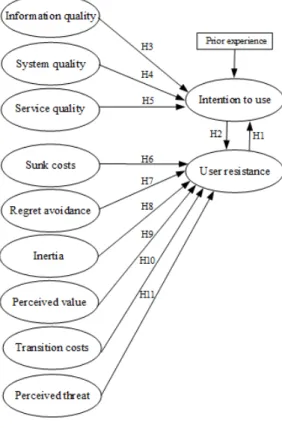
resulting in lower intention to use. However, a review of the literature indicates that no previous studies have addressed the relationship between IS acceptance and resistance. Thus, we also examine the relationship between intention to use and resistance to use. In addition, studies found target system experience to be a control variable because the extent of one's familiarity with the target system may affect reactions to a specific IT application (Barnes 2011). Hence, this study controls for the prior experience with cloud computing technology on intension to use, and therefore controls this factor in our study. Figure 1 provides a diagram of the proposed research model that details its various dimensions and the development of the theoretical arguments.
Figure 1. Research Framework
Norzaidi et al. (2008) proposed an examination of the relationship between user usage and resistance. The introduction of a new IT often engenders significant changes in a user’s existing work process. Thus, when usage is mandatory, the physicians who first refused to use the PharmaCloud query may finally come to use it because they do not have any alternative ways to accomplish their job tasks. For example, if a perceived task requires physicians to download patient’s drug-related data to the computerized physician order entry system, they will use it to complete the task. Moreover, there are circumstances in which physicians may use the system voluntarily, but stop using it after a while. Another factor that probably causes user resistance to the PharmaCloud query is a prior bad experience. Physicians may feel comfortable because the NHI PharmaCloud could offer benefits they expect; however, if it fails to provide useful information or the system always crashes, then they may not use it. Prior studies have provided support for the negative effect of resistance on IS usage (Poon et al. 2004; Spil et al. 2004; Bhattacherjee & Hikmet 2007). Thus, we suggest the following hypotheses:
H1.User resistance has a negative effect on intention to use. H2. Intention to use has a negative effect on user resistance.
According to DeLone and McLean’s updated IS success model (DeLone & McLean 1992; 2003), they suggested that information, system, and service quality affects user usage. Information quality is measured in terms of completeness, accuracy, personalization, and relevance in a Web-based environment (DeLone & McLean 2003). System quality refers to the quality of the IS itself (DeLone &
McLean 2003). It incorporates the desired characteristics of a Web-based environment, including availability, response time, usability, and reliability (DeLone & McLean 2003; Wang et al. 2007). Service quality is the quality of the services provided by IT units or those outsourced to service providers; it is measured by assurance, responsiveness, empathy, and dependability (DeLone & McLean 2003). Prior studies have used DeLone and McLean’s updated IS success model to address the concern for the use of health IT for conceptualizing and empirically examining important model antecedents/constructs, system quality, information quality, and service quality (Su et al. 2009; Petter & Fruhling 2011; Lau 2011; Bossen et al. 2013). Thus, we suggest the following hypotheses:
H3. Information quality has a positive impact on the use of the NHI PharmaCloud. H4. System quality has a positive impact on the use of the NHI PharmaCloud. H5. Service quality has a positive impact on the use of the NHI PharmaCloud.
According to the concept of psychological commitment, sunk costs may lead to user resistance. Because users do not want to forgo their past investment in the status quo (Kim & Kankanhalli 2009). The greater the investment in the status quo alternative is, the more strongly it will be retained (Samuelson & Zeckhauser 1988). In addition, when users find themselves in the unpleasant position of regretting the outcomes of past decisions, such lessons of experience teach them to avoid regrettable consequences if possible (Samuelson & Zeckhauser 1988). As Kahneman and Tversky (1982) argued, physicians feel stronger regret for bad outcomes that are the consequence of new IT than for similar bad consequences resulting from the status quo. Hence, regret avoidance is likely to have a direct impact on user resistance. Thus, we suggest the following hypotheses:
H6. Sunk costs have a positive a positive effect on user resistance. H7. Regret avoidance has a positive a positive effect on user resistance.
According to the concept of cognitive misperceptions, users persist in employing an incumbent IS either because this is what they have always done in the past or because it may be too stressful or emotionally taxing to change (Polites & Karahanna 2012). In other words, inertia will result in lowered usage intentions. Furthermore, perceived value concerns whether the benefits derived are worth the costs incurred in changing from the status quo to implement the new IT (Kim & Kankanhalli 2009). If the perceived value of the change is low, physicians are likely to exhibit greater resistance to the implementation of the new IT. Conversely, if the perceived value is high, physicians are likely to exhibit lower resistance to the implementation of the new health IT. Therefore, we suggest the following hypotheses:
H8. Inertia has a positive a positive effect on user resistance. H9. Perceived value has a negative effect on user resistance.
According to the concept of rational decision making, transition costs include time, transient expenses, and permanent losses associated with the change (Kim & Kankanhalli 2009). As the time, transient expenses, and permanent losses increase, users are more likely to demonstrate reluctance concerning the implementation of the new IT because they are motivated to cut their losses (Kahneman & Tversky 1979). Hence, transition costs are likely to have a direct impact on user resistance. Users resist change if they expect it to threaten the status quo, such as in a potential loss of power or control over strategic organizational resources. Thus, perceived threat increases the anticipation of negative outcomes, leading to an unfavorable attitude that typically results in a negative effect on a user’s intention to use (Lapointe & Rivard 2005; Bhattacherjee & Hikmet 2007). Thus, we propose the following hypotheses:
H10. Transition costs have a positive effect on user resistance. H11.Perceived threat has a negative effect on user resistance.
4
RESEARCH METHOD
4.1 Questionnaire Development
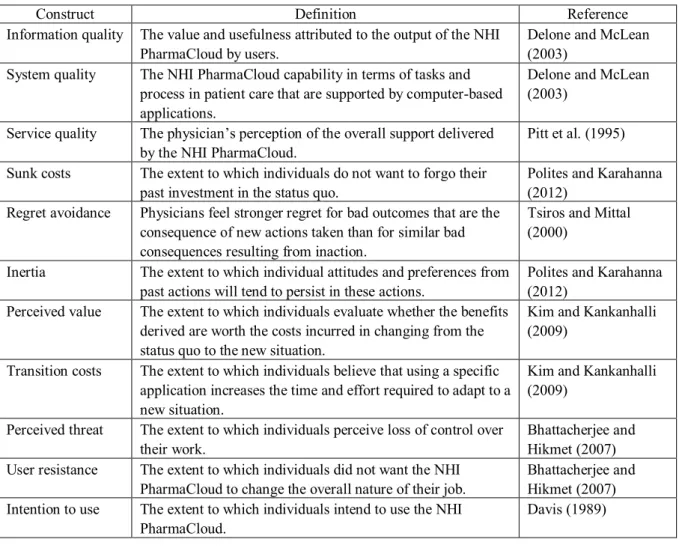
All measures of each construct in Fig. 1 were adopted from previous studies and were measured using a 7-point Likert scale; the anchors ranged from strongly agree to strongly disagree. Although the instrument had been validated by previous studies, we examined it to ensure that the content validity and reliability were within an acceptable range. We conducted pretests by requesting several physicians and information management professors to evaluate the instruments. To ensure validity and reliability, a pilot test was conducted with samples of representative respondents. Table 1 presents the construct definitions and sources. We conducted structural equation modeling (SEM) using PLS estimations for data analysis because the partial least squares (PLS) method involves minimal sample size and residual distribution requirements for model validation (Chin et al., 2003).
Construct Definition Reference
Information quality The value and usefulness attributed to the output of the NHI PharmaCloud by users.
Delone and McLean (2003)
System quality The NHI PharmaCloud capability in terms of tasks and process in patient care that are supported by computer-based applications.
Delone and McLean (2003)
Service quality The physician’s perception of the overall support delivered by the NHI PharmaCloud.
Pitt et al. (1995) Sunk costs The extent to which individuals do not want to forgo their
past investment in the status quo.
Polites and Karahanna (2012)
Regret avoidance Physicians feel stronger regret for bad outcomes that are the consequence of new actions taken than for similar bad consequences resulting from inaction.
Tsiros and Mittal (2000)
Inertia The extent to which individual attitudes and preferences from past actions will tend to persist in these actions.
Polites and Karahanna (2012)
Perceived value The extent to which individuals evaluate whether the benefits derived are worth the costs incurred in changing from the status quo to the new situation.
Kim and Kankanhalli (2009)
Transition costs The extent to which individuals believe that using a specific application increases the time and effort required to adapt to a new situation.
Kim and Kankanhalli (2009)
Perceived threat The extent to which individuals perceive loss of control over their work.
Bhattacherjee and Hikmet (2007) User resistance The extent to which individuals did not want the NHI
PharmaCloud to change the overall nature of their job.
Bhattacherjee and Hikmet (2007) Intention to use The extent to which individuals intend to use the NHI
PharmaCloud.
Davis (1989)
Table 1. Construct of Definitions and Sources 4.2 Sample and Data Collection
The target participants were physicians in Taiwan. Because the resources necessary to use the NHI PharmaCloud system differ among hospitals, we classified the medical institutions into three categories (i.e., medical centers, regional hospitals, and local hospitals) and four locations (i.e., north, central, south, and east) for the sampling. Twelve medical institutions were successfully contacted to secure their collaboration. A total of 240 questionnaires were distributed through an administrator of the hospital,
and 190 were returned. We collected questionnaires from four medical centers, four regional hospitals, and four local hospitals; after discarding 11 incomplete questionnaires, 179 were available for analysis.
5
RESEARCH RESULTS
5.1 Respondent Characteristics
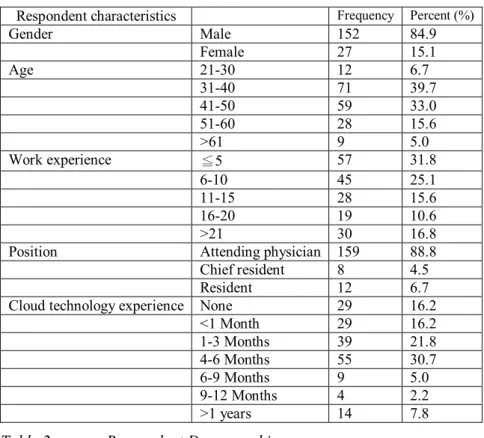
The 179 valid responses constituted a response rate of 74.58%. Demographics for the physicians are presented in Table 2. Most of the questionnaire respondents were men (84.9%) between the ages of 31 and 40 years (39.7%). Approximately 68.2% of the respondents possessed more than 5 years of work experience, and 88.8% were attending physicians (Table 2).
Respondent characteristics Frequency Percent (%)
Gender Male 152 84.9 Female 27 15.1 Age 21-30 12 6.7 31-40 71 39.7 41-50 59 33.0 51-60 28 15.6 >61 9 5.0 Work experience ≦5 57 31.8 6-10 45 25.1 11-15 28 15.6 16-20 19 10.6 >21 30 16.8
Position Attending physician 159 88.8
Chief resident 8 4.5
Resident 12 6.7
Cloud technology experience None 29 16.2
<1 Month 29 16.2 1-3 Months 39 21.8 4-6 Months 55 30.7 6-9 Months 9 5.0 9-12 Months 4 2.2 >1 years 14 7.8
Table 2. Respondent Demographics
5.2 Reliability and Validity Analysis
Reliability and validity were assessed for the model. This research assessed convergent validity using the three following criteria: minimum item loading (λ) of 0.6 (Chin et al., 1997), minimum composite reliability (CR) of 0.8, and average variance extracted (AVE) for a construct larger than 0.5 (Fornell & Larcker 1981). In this study, the construct reliabilities were all greater than 0.90. In terms of the convergent validity, the item loadings were all greater than 0.60, and the AVE ranged from 0.64 to 0.95. For discriminant validity, the square root of the AVE for a construct should be greater than its correlations with other constructs. These results indicated that the reliability, convergent validity, and discriminant validity were at an acceptable level, as reported in Table 3. Multiple regression analysis was conducted to assess the effects of 11 predictor variables on the usage intention for the NHI PharmaCloud system. None of the variance inflation factors (VIFs) were greater than 5, which indicated that there was no serious multicollinearity problem (Hair et al. 1992; Henseler & Fassott 2005).
Construct Item loading CR AVE Correlation IQ SyQ SeQ SC RA IN PV TC PT US UR IQ .86- .91 .95 .79 .89 SyQ .69- .85 .91 .64 .55 .80 SeQ .93- .97 .97 .89 .51 .56 .94 SC .92- .98 .95 .90 -.21 -.02 -.16 .95 RA .84- .90 .91 .77 -.06 -.07 -.13 .28 .88 IN .93- .95 .98 .89 -.01 -.09 -.16 .28 .49 .94 PV .77- .93 .82 .79 .21 .16 .09 -.09 -.50 -.48 .89 TC .67- .92 .92 .74 -.20 -.01 -.08 .27 .53 .48 -.57 .86 PT .94- .98 .98 .93 -.10 -.10 .09 .14 .43 .54 -.56 .54 .96 US .91- .93 .96 .86 .58 .49 .44 -.12 - .29 -.25 .23 -.29 -.18 .93 UR .96- .98 .98 .95 -.18 -.05 -.03 .06 .56 .54 -.54 .59 .57 -.36 .97
Note: Leading diagonal shows the square root of AVE of each construct
Information quality (IQ), System quality (SyQ), service quality (SeQ), Sunk costs (SC), Regret avoidance (RA), Inertia (IN), Perceived value (PV), Transition costs (TC), Perceived threat (PT), Intention to use (US), User resistance to use (UR)
Table 3. Reliability and Validity of the Scale 5.3 Hypothesis Testing
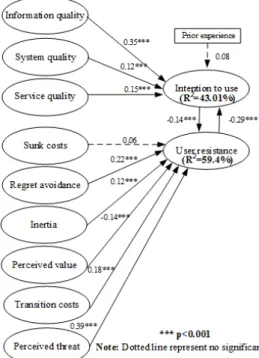
The structural model was used to examine the causal structure of the proposed model. The standardized PLS path coefficients and explained variances for the research model are presented in Fig. 2. In general, the statistical testing conclusions partially supported the research model. Intention to use the NHI PharmaCloud was predicted positively by information quality (β=0.35, standardized path coefficient, p<0.001), system quality (β=0.12, p<0.001), and service quality (β=0.15, p<0.001), and negatively by user resistance (β= -0.29, p<0.001). Together, these variables explained 43.01% of the variance of intention to use. As a result, hypotheses 1, 3, 4, and 5 were all supported. User resistance was positively predicted by regret avoidance (β=0.22, p<0.001), inertia (β=0.12, p<0.001), transition costs (β=0.18, p<0.001), and perceived threat (β=0.39, p<0.001), and negatively by perceived value (β= -0.14, p<0.001) and intention to use (β= -0.14, p<0.001). Together, these variables explained 59.4% of the variance of user resistance. These findings validated hypotheses 2, 7, 8, 9, 10, and 11, respectively. However, the effect of sunk costs on user resistance was non-significant, such that Hypothesis H6 was not supported. Furthermore, prior experience had non-significant correlation with intention to use.
6
DISCUSSION
In this empirical study, we analyzed physicians’ acceptance of and resistance to the NHI PharmaCloud. First, we analyzed the relationship between three enablers (information, system, and service quality) and intension to use. Second, we analyzed six inhibitors (sunk costs, regret avoidance, inertia, perceived value, transition costs, and perceived threat) and user resistance. Third, we analyzed the relationship between intension to use and user resistance. In the proposed models, the explained variance ( 2
R =0.59)
appeared to be superior to the results of prior studies (Bhattacherjee & Hikmet 2007) in explaining physician resistance to using the health IT. This implies that the proposed model could be a robust research model for predicting physicians’ intention to use a similar health IT.
Our study confirmed that the relationship between intention to use and user resistance had a significant negative effect. This result coincided with the findings of previous studies on health IT adoption (Bhattacherjee & Hikmet 2007). As such, higher user resistance will reduce a physician’s intention to use the NHI PharmaCloud. Among the enablers under study, information, system, and service quality are determinants in physician usage intentions. These findings are consistent with the results obtained by Su et al. (2009) and Petter and Fruhling (2011). In other words, the effects of these enablers were significant in explaining physicians’ acceptance behavior by conforming to the work of Delone and McLean (2003), who maintained that the relative importance of information, system, and service quality in predicting usage intention varies across behaviors and situations. In particular, information quality is a strong predictor of intention to use. It appear that this factor has a substantial influence on whether or not physicians are satisfied with the system and likely to use the NHI PharmaCloud in the future. A plausible explanation for this particular information system is that the physicians are capturing patients’ drug records to aid in medical decision making. Consequently, the NHI should pay more attention to the stability, information provided, information integration ability, and flexibility of the PharmaCloud in order to improve the perceived usefulness of the NHI PharmaCloud among users.
Among the inhibitors under study, our research confirmed that physician resistance to use was caused by regret avoidance, inertia, perceived value, transition costs, and perceived threat. Perceived threat is most influential in the decision to resist use of the NHI PharmaCloud. This result coincided with the findings of previous studies on IS adoption (Bhattacherjee & Hikmet 2007). This threat represented physicians’ fear of loss of control over their work due to the work-related changes imposed by the NHI PharmaCloud. This study indicates the salience of regret avoidance in determining user resistance. This implies that physicians find themselves in the unpleasant position of regretting the outcomes of past decisions. Such lessons of experience teach them to avoid regrettable consequences if possible; this will make them more likely to resist use of the NHI PharmaCloud based on perceptions of high regret avoidance. These results are consistent with those of previous research (Kim & Kankanhalli 2009). The study also found that the perceived value of a change reduces physician resistance to new IT. These results are consistent with those of previous research (Joshi 1991; Kim & Kankanhalli 2009), indicating that changes where the costs exceed the benefits (e.g., there is low perceived value) are likely to be resisted. Inertia has a direct positive effect on physician resistance to use, meaning that higher inertia results in higher resistance to using the NHI PharmaCloud. Further, perceived transition costs increase user resistance to using a health cloud. These findings support the results of previous studies (Kim & Kankanhalli 2009); moreover, the results related to transition costs can perhaps be explained from the SQB perspective. Transition costs represent rational decision making on the part of the individual. This rationalization of the costs of transition from the incumbent system, even in the absence of a known alternative, can lead to resistance. However, in our research, sunk costs did not significantly affect usage intention.
As Polites and Kankanhalli (2012) suggested, although the SQB perspective represents a comprehensive set of theoretical explanations that account for status quo bias, not all explanations are present in a specific context. In particular, physician usage behavior has certain differences from typical user behavior, including the following factors: (a) in healthcare, the NHI PharmaCloud is not only a type of service, but also represents a lifesaving mechanism; and (b) the NHI PharmaCloud is not a simple
activity, but rather a socioeconomic interactive process between healthcare organizations and the environment in which they operate. Physicians are generally not responsible for selecting a software system; rather, the NHI and a hospital’s IT department would typically make such decisions and physicians are simply required to carry out health care using the system provided to them. Physicians’ concerns about the adequate functioning of an IS application (e.g., patient’s drug-related information query) are likely to inhibit the diffusion of information, such as in the NHI PharmaCloud. Therefore, sunk costs do not influence physician resistance to using the NHI PharmaCloud.
6.1 Implications for Research
This research study offers several implications and contributions for other researchers. A primary contribution has to do with combining technology acceptance and resistance theories to examine how users assess overall change related to a new IT. According to the dual-factor perspective, by making use of the DeLone and McLean’s updated IS success model to integrate and add to relevant concepts from SQB theory, the study contributes by operationalizing and testing the developed model through a survey methodology, which has little precedence in user resistance literature. Hence, we provide theoretical insights for researchers that may assist in encouraging physicians to use a new health IT. Second, enablers and inhibitors have not been clearly defined or measured in prior research. Thus, we contribute to both IS research and the dual-factor theoretical perspective by explicitly conceptualizing and measuring individual-level enablers and inhibitors. Our study confirms that information, system, and service quality are critical factors for facilitating intention to use the new technology. Meanwhile, our study also confirms that regret avoidance, inertia, perceived value, transition costs, and perceived threat are critical inhibitors for facilitating physicians’ resistance to use the new technology. This finding could interest and encourage researchers who are developing an IS acceptance and resistance model. Future research should aim at identifying additional incumbent system constructs and theorizing on the interplay between incumbent system and new system cognition and behaviors. The dual-factor perspective provides a set of theoretical explanations that can be further leveraged to identify such additional constructs and relationships. This study has a third key theoretical implication in terms of SQB theory. This theory was developed for planning bias toward maintaining the status quo in human decision making and behavior. Since then, it has been applied to explain human decision making in the IS field (Kim & Kankanhalli 2009; Polites & Kankanhalli 2012). As an extension of previous research, this study has demonstrated how SQB theory can be applied in health IT research to explain physician resistance to new health IT–related change. Thus, this reliable and valid instrument provides an effective tool for researchers to measure user behavior, as well as to explain, justify, and compare differences in study results.
6.2 Implications for Practice
The results of this study offer suggestions to management about how to alleviate user resistance in PharmaCloud implementation. First, higher levels of perceived information, system, and service quality will encourage physicians to develop a more positive attitude toward the PharmaCloud. The PharmaCloud should be designed in a more user-friendly manner that is consistent with current needs. Physicians who are able to use the system with ease, as well those who can retrieve patients’ drug-related data as required, are more likely to develop a positive attitude toward the system, thereby encouraging them to use the PharmaCloud. The NHI and hospital managers should focus more on (a) creating an environment that ensures physicians have a positive attitude toward the PharmaCloud and (b) providing adequate resources for physicians who use the PharmaCloud. Second, the NHI and hospital manager should be aware of the critical effect of inhibitors on user resistance. Managers can attempt to reduce regret avoidance, inertia, transition costs, and perceived threat by enhancing users’ favorable opinions toward new IT-related change. In particular, since resistance to use is caused by perceived threat on the part of the physician, hospital managers and the NHI should try to uncover threats that are salient to their user population and assess their relative importance. Thus, hospital managers and the NHI should identify and quantify such threats by communicating openly and honestly with physicians
via focus groups or anonymous surveys, and make good-faith efforts to alleviate those threats before initiating job process change. Third, hospital managers should aim to increase the perceived value of change to reduce user resistance. To increase the perceived value, the advantages of the PharmaCloud from the viewpoint of the physician should be emphasized. Furthermore, most health IT designs tend to focus on system considerations, such as new functionalities and connectivity, rather than user considerations such as the system’s impact on users’ healthcare behaviors and potential user resistance. A better understanding of user resistance to health IT may help in the design of better systems that are both functionally good and acceptable to their targeted user population.
7
LIMITATIONS AND CONCLUSION
The limitations of our findings should be acknowledged. The first limitation of our study is our choice of constructs, which was based on the prior literature and our own observation of physician behavior at our study site. There may be other enablers or inhibitors of IS usage that were not included in this study and can form the subject of future research. Further, there may be additional predictors of resistance beyond sunk costs, regret avoidance, inertia, perceived value, transition costs, and perceived threat, that should be examined in future research. The identification and validation of such constructs will also help advance our preliminary model of health IT resistance. Second, the relevance of this study is confined to the NHI PharmaCloud behavior of a general population, namely physicians. The findings and implications drawn from this study cannot readily be generalized to other groups such as those of pharmacists or patients. A study targeting pharmacists or patients, who might have different information needs and different levels of computing support and abilities, could provide different results. Future research could focus on accumulating further empirical evidence and data to overcome the limitations of this study.
In conclusion, this study presented a theoretical model of health IT usage by synthesizing the technology acceptance and resistance to change literatures, and linking these two literatures using a dual-factor model of IS usage. The research model was empirically validated using a survey of physicians’ usage of the
NHI
PharmaCloud in a hospital setting. Thus, this study contributes to the existing body of knowledge in terms of narrowing the research gap by examining the causal relationships between intention to use and resistance to using the NHI PharmaCloud in Taiwan. The novelty of this study is that it provides a holistic perspective of the critical factor (e.g., enablers and inhibitors) that influence technological intention to use and resistance to using new health IT. The findings supported our initial expectation that physicians’ intention to use the NHI PharmaCloud is predicted by both enabling (e.g., information, system, and service quality) and inhibiting (e.g., regret avoidance, inertia, perceived value, transition costs, and perceived threat) perceptions, although one inhibitor may be less salient to predicting resistance to use. We offered implications regarding medical practice and academic research based on our findings. We hope that this study will stimulate future interest in the health IT resistance phenomenon and motivate researchers to examine this unexplored yet potentially fertile area of research in greater depth.References
Ajzen, I. (1985). From intentions to actions: A theory of planned behaviour. In Action-Control: From Cognition to Behavior (Kuhl, J., and Beckmann, J. Ed.), p. 11-39, Heidelberg Germany: Springer. Barnes, S.T. (2011). Understanding use continuance in virtual worlds: Empirical test of a research model.
Information and Management, 48, 313-319.
Bartos, C.E., Butler, B.S. and Crowley, R.S. (2011). Ranked levels of influence model: Selecting influence techniques to minimize IT resistance. Journal of Biomedical Informatics, 44, 497-504. Bhattacherjee, A. and Hikmet, N. (2007). Physicians’ resistance toward healthcare information
technology: A theoretical model and empirical test. European Journal of Information Systems, 16 (6), 725-737.
Bossen, C., Jensen, L.G. and Udsen, F.W. (2013). Evaluation of a comprehensive EHR based on the DeLone and McLean model for IS success: Approach, results, and success factors. International Journal of Medical Informatics, 82(10), 940-953.
Botts, N.E., Horan, T.A. and Thoms, B.P. (2012). Health ATM personal health cyberinfrastructure for Underserved Populations. American Journal of Preventive Medicine, 40 (5S2), S115-S12.
Cenfetelli, RT. (2004). Inhibitors and enablers and dual factor concepts in technology usage. Journal of the Association of Information Systems, 5 (11–12), 472–492.
Chin, W. W., Gopal, A. and Salisbury, W. D. (1997). Advancing the theory of adaptive structuration: The development of a scale to measure faithfulness of appropriation. Information Systems
Research, 8 (44), 342-367.
Chin, W.W., Marcolin, B.L. and Newsted, P.R. (2003). A partial least squares latent variable modeling approach for measuring interaction effects: results from a monte carlo simulation study and an electronic-mail emotion/adoption study.Information Systems Research, 14 (2), 189-217. Davis, F.D. (1989). Perceived usefulness, perceived ease of use, and user acceptance of information
technology. Management information System Quality, 13 (3), 319-340.
Delone, W.H. and Mclean, E.R. (1992) Information systems success: The quest for the dependent variable. Information Systems Research, 3(1), 60-95.
Delone, W.H. and Mclean, E.R. (2003) The Delone and Mclean model of information systems success: A ten-year update. Journal of Management Information Systems, 19 (4), 9-30. Fornell, C. and Larcker, D.F. (1981). Structural equation models with unobservable variables and
measurement error: Algebra and statistics. Journal of Marketing Research, 18 (3), 382-388. Hair, J.F., Anderson, R.E., Tatham, R.L. and Black, W.C. (1992). Multivariate Data Analysis with
Readings,. 3nd Edition. Macmillan, New York.
Henseler, J. and Fassott, G. (2005). Testing moderating affects in PLS path models: An illustration of available procedures, 4th International Symposium on PLS and Ralted Method, Barceiona. Hsieh, P.J. (2015). Healthcare professionals’ use of health clouds: Integrating technology acceptance
and status quo bias perspective. International Journal of Medical Informatics, 84 (7), 512-523. HIMSS Analytics. (2014). 2014 HIMSS Analytics Cloud Survey.
http://www.himssanalytics.org/about/NewsDetail.aspx?nid=82161.
Jaswanth, N., Durga, J. and Kumar, D.K. (2013). Migrating health care by analysing MYTHS in cloud technology. Oriental Journal of Computer Science & Technology, 6 (1), 49-54.
Joshi, K. (1991). A model of users’ perspective on change: The case of information systems technology implementation. MIS Quarterly, 15(2) 229-242.
Joshi, K. (2005). Understanding user resistance and acceptance during the implementation of an order management system: A case study using the equity implementation model, Journal of Information Technology Case and Application Research, 7 (1), 6-20.
Kahneman, D. and Tversky, A. (1979). Prospect theory: An analysis of decision under risk. Econometrica, 47, 263-281.
Kane, G.C. and Labianca, G. (2011). IS avoidance in health-care groups: A multilevel investigation. Information Systems Research, 22 (3), 504-522.
Kaur, P.D. and Chana, I. (2013). Cloud based intelligent system for delivering health care as a service. International Journal of Information Management, 113 (1), 346-359.
Kettinger, J.W. and Lee, L.L. (1994). Perceived service quality and user satisfaction with the information services function. Decision Sciences, 25 (5), 737-766.
Kim, H.W. and Kankanhalli, A. (2009). Investigating user resistance to information systems implementation: A status quo bias perspective. MIS Quarterly, 33 (3), 567-582.
Kim, T.W. and Kim, H.C. (2012). A healthcare system as a service in the context of vital signs: Proposing a framework for realizing a model. Computers and Mathematics with Applications, 64 (5), 1324-1332.
Lapointe, L. and Rivard, S. (2005). A multiple model of resistance to information technology implementation. MIS Quarterly, 29 (3), 461-491.
Lau, F., Price, M. and Keshavjee, K. (2011). From benefits evaluation to clinical adoption: Making sense of health information system in Canada. Healthcare Quarterly, 14 (1), 39-45.
Mason, R. O. (1978). Measuring information output: A communication systems approach. Information & Management, 1 (5), 219–234.
Marakas, G. M., and Hornik, S. (1996). Passive resistance misuse: Overt support and covert recalcitrance in IS implementation. European Journal of Information Systems, 5(3), 208-219. Mathew, S. (2013). Cloud computing: A new foundation towards health care. International Journal of
Innovative Technology and Exploring Engineering, 3 (2), 118-121.
Norzaidi, M.D., Chong, S.C., Mural, R. and Intan Salwani, M. (2008a). Intranet usage and managers’ performance in the port industry. Industrial Management and Data Systems, 107 (8), 1227-1250. Nur, F.N. and Moon, N.N. (2012). Health care system based on cloud computing. Asian Transactions
on Computers, 2 (5), 9-11.
Petter, S. and Fruhling, A. (2011). Evaluating the success of an emergency response medical information system. International Journal of Medical Informatics, 80, 480-489.
Piette, J.D., Mendoza-Avelares, M.O., Ganser, M., Mohamed, M., Marinec, N. and Krishnan, S. (2011). A preliminary study of a cloud-computing model for chronic illness self-care support in an underdeveloped country. American Journal of Preventive Medicine, 40 (6), 629-632.
Pitt, L.F., Watson, R.T. and Kavan, C.B. (1995). Service quality: a measure of information systems effectiveness. MIS Quarterly, 19 (2), 209–221.
Polites, G.L., and Karahanna, E. (2012). Shackled to the status quo: The inhibiting effects of
incumbent system habit, switching costs, and inertia on new system acceptance. MIS Quarterly, 36 (1), 21-42.
Poon, E.G., Blumenthal, D., Jaggi, T., Honour, M.M., Bates, D.W. and Kaushal, R. (2004). Overcoming barriers to adopting and implementing computerized physician order entry systems in U.S. hospitals. Health Affairs, 24 (4), 184-190.
Samuelson, W. and Zeckhauser, R. (1988). Status quo bias in decision making. Journal of Risk and Uncertainty, (1), 7-59.
Shannon, C. E. and Weaver, W. (1949). The mathematical theory of communication. Urbana. IL: University of Illinois Press.
Spil, T.A.M., Schuring, R.W. and Michel-Verkerke, M.B. (2004). Electronic prescription system: Do the professional USE IT. International Journal of Healthcare Technology Management, 6 (1), 32-55.
Su, Y.Y., Win, K.T., Fulcher, J. and Chiu, H.C. (2009). Measuring end-users’ opinions for establishing a user centered Electronic Health Record (EHR) system from the perspective of nurses. Journal of Theoretical and Applied Electronic Commerce Research, 4 (2), 55-63.
Tsiros, M. and Mittal, V. (2000). Regret: A model of its antecedents and consequences in consumer decision making. Journal of Consumer Research, 26, 401-17.
Taylor, S. and Todd, P. (1995). Decomposition and crossover effects in the theory of planned
behavior: A study of consumer adoption intention. International Journal of Research in Marketing, 12 (2), 137-155.