Performance of different bread wheat varieties
for yield and yield attributes under diallel
combinations
Ayaz Khan
Agricultural Research Station, 17200, Chitral, Pakistan
a r t i c l e i n f o
Article history:Received 20 January 2016 Accepted 19 February 2016 Available online 12 March 2016 Keywords: Bread wheat Grain Molecular marker Treatments Breeding program
a b s t r a c t
The present research work was conducted during winter 2013e14 and 2014e15 at Agri-cultural Research Station, Chitral-Pakistan. Objectives of the present research was to determine the mean performance and correlations of parents, direct and reciprocal crosses in bread wheat varieties for different yield components under 6X6 diallel combinations. Days to heading of parents exhibited highly significant differences for plant height, grains per spike, grain weight per spike, 100-grain weight and grain yield while significant for days to heading and days to maturity and non significant for biological yield. Both direct and reciprocal crosses showed highly significant differences for all the studied traits. Correla-tions of grain yield with 100-grain weight of parents was significant and positive while grains per spike and grain yield with plant height of direct crosses was significant and positive and grain yield with biological yield of reciprocal crosses was highly significant and positive. Maximum days to heading of parent (Dirk), direct cross (NR-218 X Dirk), reciprocal cross (Pirsabaq-2013 X Dirk) and difference were 171 days, 170 days and 172 days, and 6 days, respectively. Parent (Dirk), direct (NR-218 X Dirk) cross, reciprocal cross (Dirk X pirsabaq-2013) and difference were 190 days, 184 days, 189 days and 7 days, respectively. Maximum 138.97 cm, 115.00 cm and 129.17 cm plant height was recorded by parent (Dirk), direct cross (NR-218 X Dirk) and reciprocal cross (Pirsabaq-2013 X Dirk) while the maximum difference was 25.1 cm. Parent (N-46), direct cross (NR-218 X N-46), reciprocal cross (N-46 X Dirk) and difference for grains per spike was 61 grains, 66 grains, 71 grains and 22 grains and was maximum. Recorded maximum grain weight per spike of parent (Fakhr e Sarhad), direct cross (Dirk X Pirsabaq-2013), reciprocal cross (Fakhr e Sarhad X Pirsabaq-2013) and difference were 3.33 g, 4 g, 5 g and 3 g, respectively. Parent (Dirk), direct cross (Dirk X N-46), reciprocal cross (Fakhr e Sarhad X Pirsabaq-2013) and difference for 100-grain weight was 9 g, 6 g, 7 g and 2 g and was maximum. Maximum biological yield for parents (NR-218), direct cross (NR-218 X Dirk), reciprocal cross (Fakhr e Sarhad X Dirk) and difference were 1.1001 kg/Plot, 0.6853 kg/Plot, 1.15 kg/Plot and 0.8147 kg/Plot, respectively. The recorded maximum grain yields for parent (Suliman-96), direct cross (Dirk X N-46), reciprocal cross (Dirk X NR-218) were 1.0175 kg/Plot, 0.575 kg/Plot, 1.405 kg/Plot and 0.895 kg/Plot, respectively.
©2016 Agricultural University of Georgia. Production and hosting by Elsevier B.V. This is an open access article under the CC BY-NC-ND license (http://creativecommons.org/licenses/ by-nc-nd/4.0/).
E-mail address:[email protected].
Peer review under responsibility of Journal Annals of Agrarian Science.
Available online at
www.sciencedirect.com
ScienceDirect
journal homepage:http://www.journa ls.elsevier.com /a nnals-of-agrarian- science
http://dx.doi.org/10.1016/j.aasci.2016.03.001
1512-1887/©2016 Agricultural University of Georgia. Production and hosting by Elsevier B.V. This is an open access article under the CC BY-NC-ND license (http://creativecommons.org/licenses/by-nc-nd/4.0/).
Introduction
Bread wheat (TriticumaestivumL.) belongs to family gramineae, the most consumable, important and popular family of the plant kingdom. Wheat is the most important food grain of Pakistan and is the rich source of energy and protein for the world population [1]. Based on consumption, wheat comes first in Pakistan followed by rice and maize, respectively. Area and production of wheat in 2011e12, 2012e13, 2013e14 was 8649.8, 8660.2, 9199.3 thousand hectares and 23473.4, 24211.4, 25979.4 thousand tones [2], respectively showing that both area and production from 2011 to 2014 increased gradually.
As more than 70 percent of population in Pakistan depends on dairy and crop farming, for which grain and forage yield become emerging problems especially in cold winter when the availability of forage become scarce and the life of livestock can hear the signals of danger. In order to solve these prob-lems plant breeder must struggle for both grain as well as forage yield in wheat breeding program. Both grain and plant height are important objectives for any wheat breeding pro-gram because grain provides energy, protein and dietary fiber in human nutrition while height can increase the straw yield which becomes the important forage for livestock. Increase in plant height can increase the forage production in wheat crop. Selection of varieties for breeding program with maximum plant height can improve grain and forage production in wheat. Therefore, breeding for plant height as well as grain yield are the foremost challenges for wheat breeder.
Plant height, number of grains per spike, grain weight per spike, 100-grain weight, biological yield and grain yield contribute equally to average grain yield of wheat crop. When, both direct and reciprocal crosses showed better performance over parents for a particular trait shall be selected and for-warded to the next generation of selection. In order to improve
a specific wheat trait, plant breeder shall focus on varieties showing better crossing combinations for a desired trait in parents involved in crossing program.
Using morphological attributes like plant height, awned, awnless and partially awned as markers in the F1wheat pop-ulations, selection process can easily be handled by wheat breeders because traits with different morphological attri-butes can be distinguished easily from other traits both in direct as well as in reciprocal combinations. Genetic variation can be estimated using morphological and molecular markers in wheat varieties [3]. Correlation analysis can direct the attention of wheat breeder in the desired direction for a spe-cific trait either in positive or in negative. Positive and signif-icant correlations suggest that increase in one trait will ultimately increase the magnitude of other trait. Highly sig-nificant differences among wheat genotypes while grain yield were positively and significantly correlated with grains per spike and 100-grain weight were reported [4]. Phenotypic correlations of plant height with grains per spike and 100-grain weight were significant and positive [5]. Keeping in view the problems of grain and forage yield, crosses among six varieties including varieties with maximum plant height were under taken under diallel combinations for various yield and yield components, the present study was conducted with the aim to determine mean performance, Lsd and Pearson's cor-relations for different yield components in parents, direct and reciprocal crosses.
Objectives and methods
The study was conducted during winter 2013e14 and
2014e15 in the experimental plots of Agricultural Research Station, Chitral (Pakistan). Six wheat varietiesviz., NR-218,
Table 1eMeans squares of parents, direct and reciprocal crosses for days to heading (DTH), days to maturity (DTM), plant height (PH), grains per spike (GPS), grains weight per spike (GWPS), 100-grains weight (100-GW), biological yield (BY) and grain yield (GY) in different bread wheat varieties under diallel combinations.
SOV D.F Days to heading Days to maturity Plant height (cm) Grains per spike Grain weight per spike (g) 100-Grain weight (g) Biological yield (kg/Plot) Grain yield (kg/p lot) Replications (Parents) 2 58.3889 6.1667 86.72 0.500 1.409 8.71 0.08834 0.03895 Parents 5 35.1222* 75.333* 1246.52** 145.967** 1.1667* 8.400** 0.08638NS 0.07152** Error 10 8.9222 21.300 19.57 24.967 0.26667 9.696 0.0785 0.00102 Total 17 Replications (Direct Crosses) 2 6.6889 0.8667 5.585 1.422 3.040 1.651 0.00103 0.07042 Direct Crosses 14 30.4252** 12.7714** 259.975** 306.994** 1.37143** 2.08571** 0.09569** 0.07675** Error 28 0.4984 1.2238 3.098 3.708 8.217 4.144 0.00250 0.01292 Total 44 Replications (Reciprocal Crosses) 2 20.2667 2.4667 93.087 19.289 6.640 2.072 0.00021 8.009 Reciprocal Crosses 14 19.5143** 27.1048** 463.534** 102.641** 2.65714** 1.57143** 0.41313** 0.38809** Error 28 3.1238 2.2286 29.001 29.527 2.125 5.717 0.00013 5.453 Total 44
*, **¼Significant at 5% and 1% Level of Significance. NS¼Non Significant.
Dirk, Pirsabaq-2013, N-46, Fakhr e Sarhad and Suliman-96 were crossed in all possible direct and reciprocal combina-tions in winter 2013e14. Experiment including six parents, fifteen direct and fifteen reciprocal crosses were laid out in Randomized Complete Block Design with three replications in winter 2014e15. Row length and spacing were kept 2 m and 0.30 m, respectively. Data were recorded on days to heading, days to maturity, plant height, grains per spike, grain weight per spike, 100-grain weight, biological yield and grain yield. Standard agronomic practices were followed during all growing season. Statistical analysis for ANOVA, LSD and Pearson's correlation were conducted by using Sta-tistix8.1, software for statistical analysis in Agricultural Research. The significance of correlations was determined by using r-table[6].
Results and analysis
Days to heading
The individual analysis of variance showed that parents were significant while direct and reciprocal crosses were highly significant for days to heading (Table 1). Highly significant differences for days to heading in durum wheat were also
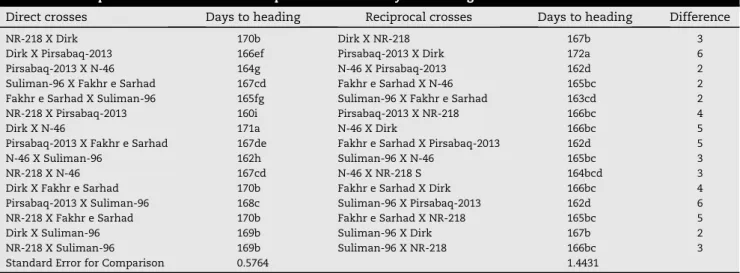
reported[7]. The presence of difference for days to heading showed that some parents, direct and reciprocal crosses pro-duced heads early while others late which gives an idea for the identification of early and late maturing varieties and crosses for the inclusion in crossing and selection to the next gener-ations. Minimum (162) days to heading were recorded by parent (Pirsabaq-2013) while maximum (171) were recorded by parent (Dirk) (Table 2). Direct crosses of NR-218 X Pirsabaq-2013 and NR-218 X Dirk recorded minimum (160) and maximum (170) days to heading while reciprocal crosses of N-46 X Pirsabaq-2013 and Pirsabaq-2013 X Dirk recorded mini-mum (162) and maximini-mum (172) days to heading (Table 3). Minimum[2]difference of days to heading were recorded by direct cross of N-46 X Pirsabaq-2013 and reciprocal cross of Pirsabaq-2013 X N-46 while maximum [6]by direct cross of 2013 X Dirk and reciprocal cross of Dirk X
Pirsabaq-2013 (Table 3). Minimum (62) and maximum (71) days to
heading were recorded by durum wheat varieties Leliso and Yererin Ethopia[7].
Days to maturity
Individual analysis of variance of parents showed significant differences while direct and reciprocal crosses showed highly significant differences for days to maturity (Table 1).
Table 2eMean performance of parents for days to heading (DTH), days to maturity (DTM), plant height (PH), grains per spike (GPS), grains weight per spike (GWPS), 100-grains weight (100-GW), biological yield (BY) and grain yield (GY) in different bread wheat varieties used in diallel combinations.
Parents Days to heading Days to maturity Plant height (cm) Grains per spike Grains weight per spike (g) 100-grain weight (g) Biological yield (kg/Plot) Grain yield (kg/Plot)
NR-218 169ab 190a 116.09b 57a 2.333cd 5 1.1001a 1.0000a
Dirk 171a 190a 138.97a 47b 3.000abc 9 0.6668a 0.6134d
Pirsabaq-2013 162c 177b 82.45e 44b 2.000d 6 0.6304a 0.8368c
N-46 167abc 184ab 94.14d 61a 3.667a 6 0.7104a 0.9335b
Fakhr e Sarhad 165bc 182ab 94.93d 57a 3.333ab 4 0.7701a 0.9902ab Suliman-96 162c 181b 107.80c 47b 2.667bcd 6 0.7335a 1.0175b Standard error for
comparison
2.4389 3.7683 3.6119 4.0798 0.4216 0.2288 0.0260
Table 3eMean performance of direct and reciprocal crosses for days to heading in bread wheat under diallel combinations.
Direct crosses Days to heading Reciprocal crosses Days to heading Difference
NR-218 X Dirk 170b Dirk X NR-218 167b 3
Dirk X Pirsabaq-2013 166ef Pirsabaq-2013 X Dirk 172a 6
Pirsabaq-2013 X N-46 164g N-46 X Pirsabaq-2013 162d 2
Suliman-96 X Fakhr e Sarhad 167cd Fakhr e Sarhad X N-46 165bc 2 Fakhr e Sarhad X Suliman-96 165fg Suliman-96 X Fakhr e Sarhad 163cd 2 NR-218 X Pirsabaq-2013 160i Pirsabaq-2013 X NR-218 166bc 4
Dirk X N-46 171a N-46 X Dirk 166bc 5
Pirsabaq-2013 X Fakhr e Sarhad 167de Fakhr e Sarhad X Pirsabaq-2013 162d 5
N-46 X Suliman-96 162h Suliman-96 X N-46 165bc 3
NR-218 X N-46 167cd N-46 X NR-218 S 164bcd 3
Dirk X Fakhr e Sarhad 170b Fakhr e Sarhad X Dirk 166bc 4
Pirsabaq-2013 X Suliman-96 168c Suliman-96 X Pirsabaq-2013 162d 6 NR-218 X Fakhr e Sarhad 170b Fakhr e Sarhad X NR-218 165bc 5
Dirk X Suliman-96 169b Suliman-96 X Dirk 167b 2
NR-218 X Suliman-96 169b Suliman-96 X NR-218 166bc 3
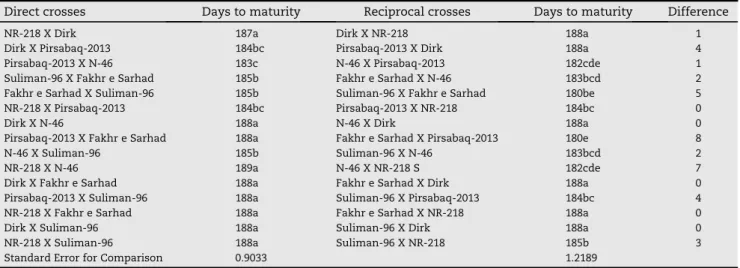
The presence of significant and highly significant variations for days to maturity showed that parents and both crosses matured on different dates which suggest plant breeder in selection of early and late maturing parents and crosses. Significant difference for days to maturity in durum wheat was also investigated [7]. Parents Pirsabaq-2013 and Dirk recorded minimum (177) and maximum (190) days to maturity (Table 2). Similarly, direct cross of Dirk X Pirsabaq-2013 and reciprocal cross of NR-218 X N-46 recorded mini-mum (184) and maximini-mum (189) days to maturity (Table 4). Minimum (0) difference in days to maturity were recorded by direct cross of Suliman-96 X Fakhr e Sarhad and Fakhr e
Sarhad X Suliman-96while maximum [8] difference were
recorded by direct cross of NR-218 X N-46 and reciprocal
cross of N-46 X NR-218 (Table 4). Minimum (130) and
maximum (137) days to maturity were recorded by durum wheat varieties CD86772 and Leliso in Ethopia[7]. Correla-tion analysis of parents for days to maturity with days to heading were non significant and positive (Table 11). Days to maturity of direct crosses showed highly significant and
positive correlation with days to heading (Table 12).
Similarly, correlation of days to maturity with days to heading was highly significant and positive (Table 13). Non significant correlations of days to maturity with days to heading were investigated earlier[7].
Plant height (cm)
The separate analysis of variance of parents, direct and reciprocal crosses were highly significant that showed the presence of genetic variations among parents and both type of crosses for plant height (Table 1). Highly significant variations for plant height were reported in bread wheat of Pakistan
[6,8e11]. Minimum (82.45 cm) and maximum (138.97 cm) plant height were reported by parents Pirsabaq-2013 and Dirk (Table
2). Minimum (84.94 cm) and maximum (115.00 cm) plant
height for direct crosses of NR-218 X Suliman-96 and NR-218 X Dirk were measured while minimum (84.66 cm) and maximum (129.16 cm) were measured for reciprocal crosses of Fakhr e Sarhad X Pirsabaq-2013 and Pirsabaq-2013 X Dirk (Table 5). Direct and reciprocal crosses of Pirsabaq-2013 X N-46 and N-46 X Pirsabaq-2013 measured minimum (0.42 cm)
Table 4eMean performance of direct and reciprocal crosses for days to maturity in bread wheat under diallel combinations.
Direct crosses Days to maturity Reciprocal crosses Days to maturity Difference
NR-218 X Dirk 187a Dirk X NR-218 188a 1
Dirk X Pirsabaq-2013 184bc Pirsabaq-2013 X Dirk 188a 4
Pirsabaq-2013 X N-46 183c N-46 X Pirsabaq-2013 182cde 1
Suliman-96 X Fakhr e Sarhad 185b Fakhr e Sarhad X N-46 183bcd 2 Fakhr e Sarhad X Suliman-96 185b Suliman-96 X Fakhr e Sarhad 180be 5 NR-218 X Pirsabaq-2013 184bc Pirsabaq-2013 X NR-218 184bc 0
Dirk X N-46 188a N-46 X Dirk 188a 0
Pirsabaq-2013 X Fakhr e Sarhad 188a Fakhr e Sarhad X Pirsabaq-2013 180e 8
N-46 X Suliman-96 185b Suliman-96 X N-46 183bcd 2
NR-218 X N-46 189a N-46 X NR-218 S 182cde 7
Dirk X Fakhr e Sarhad 188a Fakhr e Sarhad X Dirk 188a 0
Pirsabaq-2013 X Suliman-96 188a Suliman-96 X Pirsabaq-2013 184bc 4 NR-218 X Fakhr e Sarhad 188a Fakhr e Sarhad X NR-218 188a 0
Dirk X Suliman-96 188a Suliman-96 X Dirk 188a 0
NR-218 X Suliman-96 188a Suliman-96 X NR-218 185b 3
Standard Error for Comparison 0.9033 1.2189
Table 5eMean performance of direct and reciprocal crosses for plant height in bread wheat under diallel combinations.
Direct crosses Plant height (cm) Reciprocal crosses Plant height (cm) Difference
NR-218 X Dirk 115.00a Dirk X NR-218 120.60abc 5.60
Dirk X Pirsabaq-2013 99.99c Pirsabaq-2013 X Dirk 129.16a 29.17 Pirsabaq-2013 X N-46 95.26ef N-46 X Pirsabaq-2013 95.68hi 0.42 Suliman-96 X Fakhr e Sarhad 85.55ij Fakhr e Sarhad X N-46 103.97fgh 18.42 Fakhr e Sarhad X Suliman-96 93.19fg Suliman-96 X Fakhr e Sarhad 124.74ab 31.55 NR-218 X Pirsabaq-2013 85.61hi Pirsabaq-2013 X NR-218 111.12def 25.51
Dirk X N-46 103.43b N-46 X Dirk 119.49bcd 16.06
Pirsabaq-2013 X Fakhr e Sarhad 75.52k Fakhr e Sarhad X Pirsabaq-2013 84.66j 9.14 N-46 X Suliman-96 92.80fg Suliman-96 X N-46 101.25ghi 8.45
NR-218 X N-46 96.66de N-46 X NR-218S 114.07cde 17.41
Dirk X Fakhr e Sarhad 95.69ef Fakhr e Sarhad X Dirk 107.12efg 11.43 Pirsabaq-2013 X Suliman-96 88.27gh Suliman-96 X Pirsabaq-2013 94.64i 6.37 NR-218 X Fakhr e Sarhad 90.50fg Fakhr e Sarhad X NR-218 96.67hi 6.17 Dirk X Suliman-96 99.27c Suliman-96 X Dirk 113.55cde 14.28 NR-218 X Suliman-96 84.94j Suliman-96 X NR-218 109.97efg 25.03
difference in plant height while maximum (25.51 cm) differ-ence in plant height were measured by direct and reciprocal crosses of Fakhr e Sarhad X Suliman-96 and Suliman-96 X Fakhr e Sarhad, respectively (Table 5). Previous study showed that minimum (60 cm) and maximum (98 cm) plant height were measured for genotypes D88678 and Chakwal-86under control conditions in Faisalabad-Pakistan (12). Previous find-ings showed that the range for plant height was measured
64.57e120.17 cm in seventy wheat genotypes at Nuclear
Institute of Agriculture and Biology (NIAB), Faisalabad-Pakistan[10]. Similar study on plant height among hundred genotypes showed that genotypes Punjab-85 measured maximum (102.13 cm) and BACANORA measured minimum (58.60 cm) plant height[8]. Correlations of parents showed that plant height was non significant and positive with days to heading and days to maturity (Table 11). Similarly, correla-tions of direct crosses showed that plant height was non sig-nificant and positive with days to heading and days to maturity (Table 12). Also, correlation of reciprocal crosses showed that plant height was significant and positive with days to heading while non significant and positive with days to maturity (Table 13). Previous studies on correlations showed that plant height were significant and positive with flag leaf area, spikelet per spike, grains per spike, 1000-grain weight and grain yield per plant in Faisalabad-Pakistan[5]. Also, plant height was non significant and positive with grains per spike and 1000-grain weight in wheat under rain fed conditions[9].
Grains per spike
Analysis of variance reveals that parents, direct and reciprocal crosses showed highly significant differences for grains per spike (Table 1) showing that grains per spike were different in numbers in parents, direct and reciprocal cross. Highly sig-nificant difference was also reported in 55 diallel crosses in wheat in Faisalabad-Pakistan[5]. Grains per spike in the F5 generations were highly significant in wheat[13]. Number of grains per spike was reported highly significant in wheat under rain fed condition[9]. Highly significant difference in
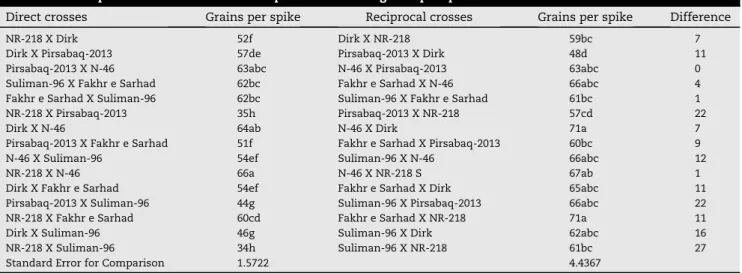
bread wheat for number of grains per spike was also investi-gated[8]. Parents Pirsabaq-2013 and N-46 recorded minimum (44) and maximum (61) grains per spike (Table 2). Direct crosses of NR-218 X Pirsabaq-2013 and NR-218 X N-46 recorded minimum (35) and maximum (66) grains per spike (Table 6). Minimum (48) and maximum (71) grains per spike were re-ported by reciprocal crosses of Pirsabaq-2013 X Dirk and N-46 X Dirk (Table 6). Minimum (0) difference in grains per spike were exhibited by direct cross of Pirsabaq-2013 X N-46 and reciprocal cross of N-46 X Dirk while maximum (22) difference in grains per spike were recorded by direct cross of NR-218 X Pirsabaq-2013 and reciprocal cross of Pirsabaq-2013 X NR-218 (Table 6). Minimum (32) were recorded by wheat variety Faisalabad-86 under drought stress and maximum (63) grains per spike were recorded by Inqilab-91 under control condition in Faisalabad-Pakistan[12]. Crosses Wafaq X Khattakwal and
Takbeer X Ghaznavi-98 recorded minimum (50) and
maximum (75) grains per spike in F5 wheat population in Peshawar valley-Pakistan[13]. Among hundred wheat germ-plasms, minimum (50.02) and maximum (67.58) grains per spike were recorded by wheat germplasms AS-2002-WD-97603 and Galvez-Juncoin Faisalabad-Pakistan [8]. Correla-tions of grains per spike of parents were non significant and positive with days to heading and days to maturity but non significant and negative with plant height (Table 11). Simi-larly, correlations of grains per spike with days to heading and plant height were non significant and positive but non sig-nificant and negative with days to maturity of direct crosses (Table 12). In reciprocal crosses, correlations of grains per spike with days to heading, days to maturity and plant height were non significant and negative (Table 13). Phenotypic cor-relations of grains per spike with 100-grain weight was non significant and positive but with grain yield per plant was highly significant and positive[5]. Correlations of grains per spike with 100-grain weight and grain yield was significant and positive but non significant and positive with straw yield
[12]. Grains per spike of direct crosses showed highly signifi-cant phenotypic correlations with spike length and spikelets per spike under normal sowing while reciprocal crosses exhibited highly significant and positive correlations with
Table 6eMean performance of direct and reciprocal crosses for grains per spike in bread wheat under diallel combinations.
Direct crosses Grains per spike Reciprocal crosses Grains per spike Difference
NR-218 X Dirk 52f Dirk X NR-218 59bc 7
Dirk X Pirsabaq-2013 57de Pirsabaq-2013 X Dirk 48d 11
Pirsabaq-2013 X N-46 63abc N-46 X Pirsabaq-2013 63abc 0
Suliman-96 X Fakhr e Sarhad 62bc Fakhr e Sarhad X N-46 66abc 4 Fakhr e Sarhad X Suliman-96 62bc Suliman-96 X Fakhr e Sarhad 61bc 1 NR-218 X Pirsabaq-2013 35h Pirsabaq-2013 X NR-218 57cd 22
Dirk X N-46 64ab N-46 X Dirk 71a 7
Pirsabaq-2013 X Fakhr e Sarhad 51f Fakhr e Sarhad X Pirsabaq-2013 60bc 9
N-46 X Suliman-96 54ef Suliman-96 X N-46 66abc 12
NR-218 X N-46 66a N-46 X NR-218 S 67ab 1
Dirk X Fakhr e Sarhad 54ef Fakhr e Sarhad X Dirk 65abc 11 Pirsabaq-2013 X Suliman-96 44g Suliman-96 X Pirsabaq-2013 66abc 22 NR-218 X Fakhr e Sarhad 60cd Fakhr e Sarhad X NR-218 71a 11
Dirk X Suliman-96 46g Suliman-96 X Dirk 62abc 16
NR-218 X Suliman-96 34h Suliman-96 X NR-218 61bc 27
spike length and significant with spikelets per spike under normal plantings[14].
Grains weight per spike (g)
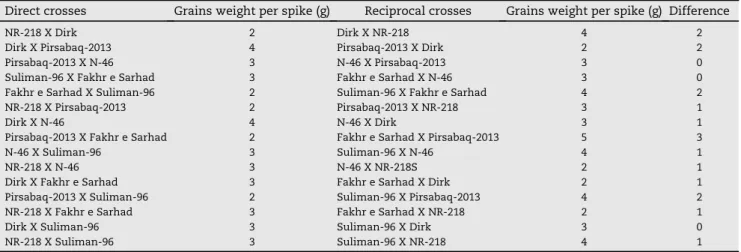
Analysis of variance showed that grains weight per spike of parents, direct and reciprocal crosses were highly significant (Table 1) suggesting that variations exist among parents, direct and reciprocal crosses for grain weight per spike. Highly significant differences in grain weight per spike were observed in F5 wheat population in Peshawar-Pakistan [13]. Parent Pirsabaq-2013 and Fakhr e Sarhad recorded minimum (2 g) and maximum (3.33 g) grain weight per spike (Table 2). Direct crosses of NR-218 X Dirk and Dirk X Pirsabaq-2013 recorded minimum (2 g) and maximum (4 g) grain weight per spike (Table 7). Reciprocal crosses of Pirsabaq-2013 X Dirk and Fakhr e Sarhad X Pirsabaq-2013 recorded minimum (2 g) and maximum (5 g) grain weight per spike (Table 7). Minimum (0 g) difference were observed in the direct cross of Pirsabaq-2013 X N-46 reciprocal cross of N-46 X Pirsabaq-2013 while maximum
(3 g) were observed by the direct cross of Fakhr e Sarhad X Pirsabaq-2013 and reciprocal cross of Pirsabaq X Fakhr e Sar-had (Table 7). Similar previous study showed that Wafaq X khattakwal recorded minimum (1.85 g) while Takbeer X Ghaznavi-98 recorded maximum (2.92 g) grain weight per spike[13]which oppose the present research work. Correla-tions of parents showed that grain weight per spike was non significant and positive with days to heading, plant height and grains per spike while non significant and negative with days to maturity (Table 11). Correlations of direct crosses showed that grains weight per spike was non significant and positive with days to heading, plant height and grain per spike while non significant and negative with days to maturity (Table 12). Correlations of reciprocal crosses showed that grain weight per spike was non significant and negative with days to heading, days to maturity, plant height and grains per spike (Table 13). In F5wheat populations, study showed that grains weight per spike was highly significant and positive with 1000-grain weight, biological yield, harvest index and 1000-grain yield
[13].
Table 7eMean performance of direct and reciprocal crosses for grains weight per spike in bread wheat under diallel combinations.
Direct crosses Grains weight per spike (g) Reciprocal crosses Grains weight per spike (g) Difference
NR-218 X Dirk 2 Dirk X NR-218 4 2
Dirk X Pirsabaq-2013 4 Pirsabaq-2013 X Dirk 2 2
Pirsabaq-2013 X N-46 3 N-46 X Pirsabaq-2013 3 0
Suliman-96 X Fakhr e Sarhad 3 Fakhr e Sarhad X N-46 3 0
Fakhr e Sarhad X Suliman-96 2 Suliman-96 X Fakhr e Sarhad 4 2
NR-218 X Pirsabaq-2013 2 Pirsabaq-2013 X NR-218 3 1
Dirk X N-46 4 N-46 X Dirk 3 1
Pirsabaq-2013 X Fakhr e Sarhad 2 Fakhr e Sarhad X Pirsabaq-2013 5 3
N-46 X Suliman-96 3 Suliman-96 X N-46 4 1
NR-218 X N-46 3 N-46 X NR-218S 2 1
Dirk X Fakhr e Sarhad 3 Fakhr e Sarhad X Dirk 2 1
Pirsabaq-2013 X Suliman-96 2 Suliman-96 X Pirsabaq-2013 4 2
NR-218 X Fakhr e Sarhad 3 Fakhr e Sarhad X NR-218 2 1
Dirk X Suliman-96 3 Suliman-96 X Dirk 3 0
NR-218 X Suliman-96 3 Suliman-96 X NR-218 4 1
Table 8eMean performance of direct and reciprocal crosses for 100-grains weight in bread wheat under diallel combinations.
Direct crosses 100-Grain weight (g) Reciprocal crosses 100-Grain weight (g) Difference (g)
NR-218 X Dirk 5 Dirk X NR-218 6 1
Dirk X Pirsabaq-2013 6 Pirsabaq-2013 X Dirk 5 1
Pirsabaq-2013 X N-46 5 N-46 X Pirsabaq-2013 5 0
Suliman-96 X Fakhr e Sarhad 5 Fakhr e Sarhad X N-46 6 1
Fakhr e Sarhad X Suliman-96 6 Suliman-96 X Fakhr e Sarhad 5 1
NR-218 X Pirsabaq-2013 4 Pirsabaq-2013 X NR-218 6 2
Dirk X N-46 6 N-46 X Dirk 5 1
Pirsabaq-2013 X Fakhr e Sarhad 5 Fakhr e Sarhad X Pirsabaq-2013 7 2
N-46 X Suliman-96 4 Suliman-96 X N-46 5 1
NR-218 X N-46 4 N-46 X NR-218S 5 1
Dirk X Fakhr e Sarhad 5 Fakhr e Sarhad X Dirk 7 2
Pirsabaq-2013 X Suliman-96 6 Suliman-96 X Pirsabaq-2013 5 1
NR-218 X Fakhr e Sarhad 6 Fakhr e Sarhad X NR-218 6 0
Dirk X Suliman-96 6 Suliman-96 X Dirk 6 0
100-Grain weight (g)
Analysis of variance reveals that parents, direct and reciprocal crosses exhibited highly significant differences for 100-grain weight (Table 1). Previous finding showed that 100-grain weight exhibited highly significant difference in wheat geno-types [5,8e10]. In F5 wheat populations 1000-grain weight showed non significant difference[13]. Minimum (4 g) and maximum (9 g) 100-grain weight were exhibited by parents
Fakhr e Sarhad and Dirk (Table 2). Minimum (4 g) and
maximum (6 g) 100-grain weight were recorded by direct crosses of NR-218 X Pirsabaq-2013 and Dirk X N-46, respec-tively (Table 8). Minimum (5 g) and maximum (7 g) 100-grain weight were reported by reciprocal crosses of Pirsabaq-2013 X Dirk and Fakhr e Sarhad X Pirsabaq-2013, respectively (Table 8). Minimum (0 g) difference in 100-grain weight was recorded by direct and reciprocal crosses of Pirsabaq-2013 X N-46 and N-46 X Pirsabaq-2013 (Table 8). Maximum (2 g) dif-ference in 100-grain weight was recorded by direct and reciprocal crosses of Pirsabaq-2013 X NR-218 and NR-218 X Pirsabaq-2013 (Table 8). Mean 1000-grain weight in 55 diallel crosses were 37.964 g [5] in the previous study in wheat. Faisalabad-86 recorded minimum (2.7 g) while D-91641 recorded maximum (5.6 g) 100-grain weight under control condition[12]. In F5wheat population, minimum (31 g) and maximum (40 g) 1000-grain weight were reported by Tatara X
Iqbal and Takbeer X Iqbal [13]. Wheat germplasm Daya-8
recorded minimum (45.33 g) and maximum (54.67 g) were re-ported by Zamindar-80 among the evaluation of hundred
wheat germplasms [8]. Range of 1000-grain weight was
32.3e56.92 g found in the last study of wheat germplasm[10]. Correlations of parents showed that 100-grain weight was non significant but positive with days to heading, days to maturity, plant height and grain weight per spike while non significant but negative with grains per spike (Table 11). Correlations of direct crosses showed that 100-grain weight was non signifi-cant but positive with days to heading, days to maturity, plant height, grains per spike and grain weight per spike (Table 12). Correlations of reciprocal crosses showed that 100-grain weight was non significant and negative with days to head-ing, days to maturity, plant height and grains per spike while
non significant but positive with grain weight per spike (Table 13). Phenotypic correlations of 1000-grain weight with grain yield per plant were highly significant[5]. Significant correla-tions of 1000-grain weight with grain yield per plant were also investigated [12]. Non significant correlations of 100-grain weight with biological yield, harvest index and grain yield per hectares were also reported[9,13]. Correlations of 1000-grain weight were significant with plant height while non significant and negative with number of productive tillers per plant, number of spikelets per spike, spike length and number of grains per spike[10].
Biological yield (kg/Plot)
Separate analysis of variance for biological yield showed non significant difference for parents and highly significant dif-ferences for both direct and reciprocal crosses (Table 1). This suggests that direct and reciprocal crosses confirm the pres-ence of variations for biological yield. Research findings in the
F5 wheat population showed that genotypes showed non
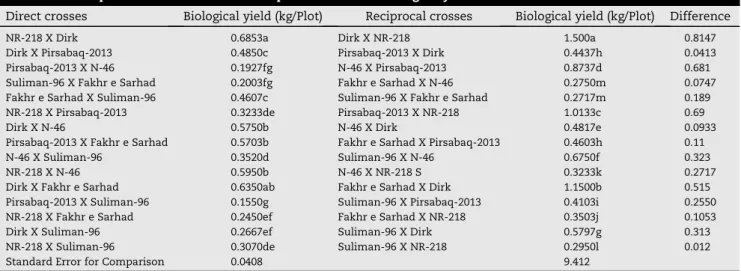
significant difference for biological yield [13]. Minimum (0.6304 kg/Plot) and maximum (1.1001 kg/Plot) biological yield were produced by parents Pirsabaq-2013 and NR-218 (Table 2). Direct crosses of Pirsabaq-2013 X Suliman-96 and NR-218 X Dirk exhibited minimum (0.1550 kg/Plot) and maximum (0.6853 kg/Plot) biological yield (Table 9). Minimum (0.2717 kg/ Plot) and maximum (1.15 kg/Plot) biological yield was revealed by reciprocal crosses of Suliman-96 X Fakhr e Sarhad and Fakhr e Sarhad X Dirk (Table 9). Minimum (0.012 kg/Plot) dif-ference in biological yield were displayed by direct and reciprocal crosses of NR-218 X Suliman-96 and Suliman-96 X NR-218, respectively (Table 9). Maximum (0.8147 kg/Plot) dif-ference in biological yield were displayed by direct and reciprocal crosses of NR-218 X Dirk and Dirk X NR-218, respectively (Table 9). Similar values for biological yield were also in record[13]. Pearson's correlations of parents showed that biological yield recorded non significant but positive correlations with days to heading, days to maturity, plant height and grains per spike while non significant and negative with grain weight per spike and 100-grain weight (Table 11). Correlations of direct crosses showed that biological yield was
Table 9eMean performance of direct and reciprocal crosses for biological yield in bread wheat under diallel combinations.
Direct crosses Biological yield (kg/Plot) Reciprocal crosses Biological yield (kg/Plot) Difference
NR-218 X Dirk 0.6853a Dirk X NR-218 1.500a 0.8147
Dirk X Pirsabaq-2013 0.4850c Pirsabaq-2013 X Dirk 0.4437h 0.0413 Pirsabaq-2013 X N-46 0.1927fg N-46 X Pirsabaq-2013 0.8737d 0.681 Suliman-96 X Fakhr e Sarhad 0.2003fg Fakhr e Sarhad X N-46 0.2750m 0.0747 Fakhr e Sarhad X Suliman-96 0.4607c Suliman-96 X Fakhr e Sarhad 0.2717m 0.189 NR-218 X Pirsabaq-2013 0.3233de Pirsabaq-2013 X NR-218 1.0133c 0.69
Dirk X N-46 0.5750b N-46 X Dirk 0.4817e 0.0933
Pirsabaq-2013 X Fakhr e Sarhad 0.5703b Fakhr e Sarhad X Pirsabaq-2013 0.4603h 0.11
N-46 X Suliman-96 0.3520d Suliman-96 X N-46 0.6750f 0.323
NR-218 X N-46 0.5950b N-46 X NR-218 S 0.3233k 0.2717
Dirk X Fakhr e Sarhad 0.6350ab Fakhr e Sarhad X Dirk 1.1500b 0.515 Pirsabaq-2013 X Suliman-96 0.1550g Suliman-96 X Pirsabaq-2013 0.4103i 0.2550 NR-218 X Fakhr e Sarhad 0.2450ef Fakhr e Sarhad X NR-218 0.3503j 0.1053 Dirk X Suliman-96 0.2667ef Suliman-96 X Dirk 0.5797g 0.313 NR-218 X Suliman-96 0.3070de Suliman-96 X NR-218 0.2950l 0.012
non significant but positive with days to heading, days to maturity, plant height, grains per spike and grain weight per spike while non significant but negative with 100-grain weight (Table 12). Correlations of reciprocal crosses showed that biological yield exhibited non significant but positive correla-tions with days to heading, days to maturity, plant height and 100-grain weight while non significant but negative with grains per spike and grain weight per spike (Table 13). Pear-son's correlations was non significant with harvest index and grain yield per hectare in the F5wheat population[13].
Grain yield (kg/Plot)
Separate analysis of variance showed that parents, direct and reciprocal crosses exhibited highly significant differences for grain yield (Table 1) suggesting the presence of variations. Grain yield per plant was highly significant in wheat were
reported by different researchers [5,9,10,13]. Minimum
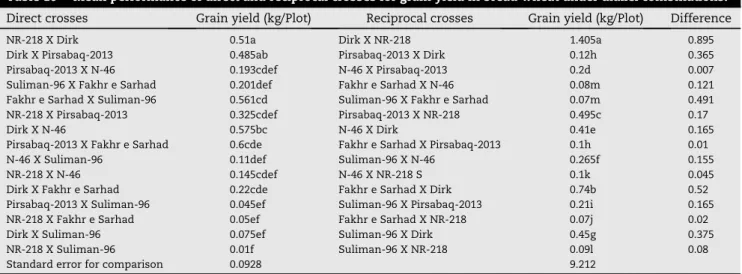
(0.6134 kg/Plot) and maximum (1.0175 kg/Plot) were recorded by parents Dirk and Suliman-96 (Table 2). Direct crosses of Pirsabaq-2013 X Suliamn-96 and Dirk X N-46 recorded mini-mum (0.045 kg/Plot) and maximini-mum (0.575 kg/Plot) grain yield (Table 10). Reciprocal crosses of Fakhr e Sarhad X NR-218 and Dirk X NR-218 recorded minimum (0.07 kg/Plot) and maximum (1.405 kg/Plot) grain yield (Table 10). Minimum
(0.007 kg/Plot) difference in grain yield were recorded by direct and reciprocal crosses of Pirsabaq-2013 X N-46 and N-46 X Pirsabaq-2013 (Table 10). Maximum (0.895 kg/Plot) difference in grain yield were recorded by direct and reciprocal crosses of NR-218 X Dirk and Dirk X NR-218 (Table 10). Mean values (25.204 g) of grain yield per plant were also reported[5]. Wdk-85 recorded minimum (5.00) under drought stress and Chakwal-86 recorded maximum (10.9 g) grain yield per plant under control condition was reported[12]. Range of yield per plant was 5.67e36.45 g in the wheat germplasm in Faisalabad-Pakistan [10]. Grain yield of parents showed significant but negative correlation with 100-grain weight while non signifi-cant and positive with grain per spike and biological yield and non significant but negative with days to heading, days to maturity, plant height and grain weight per spike (Table 11). Grain yield of direct crosses exhibited positive and significant correlations with plant height while non significant and pos-itive with grains per spike, grain weight per spike, 100-grain weight and biological yield and non significant and negative with days to heading and days to maturity (Table 12). Grain yield showed highly significant and positive correlations with biological yield while non significant and positive with days to heading, days to maturity, plant height, grain weight per spike and 100-grain weight (Table 13). Correlations of grain yield per plant were significant with straw weight in wheat [12].
Table 10eMean performance of direct and reciprocal crosses for grain yield in bread wheat under diallel combinations.
Direct crosses Grain yield (kg/Plot) Reciprocal crosses Grain yield (kg/Plot) Difference
NR-218 X Dirk 0.51a Dirk X NR-218 1.405a 0.895
Dirk X Pirsabaq-2013 0.485ab Pirsabaq-2013 X Dirk 0.12h 0.365 Pirsabaq-2013 X N-46 0.193cdef N-46 X Pirsabaq-2013 0.2d 0.007 Suliman-96 X Fakhr e Sarhad 0.201def Fakhr e Sarhad X N-46 0.08m 0.121 Fakhr e Sarhad X Suliman-96 0.561cd Suliman-96 X Fakhr e Sarhad 0.07m 0.491 NR-218 X Pirsabaq-2013 0.325cdef Pirsabaq-2013 X NR-218 0.495c 0.17
Dirk X N-46 0.575bc N-46 X Dirk 0.41e 0.165
Pirsabaq-2013 X Fakhr e Sarhad 0.6cde Fakhr e Sarhad X Pirsabaq-2013 0.1h 0.01
N-46 X Suliman-96 0.11def Suliman-96 X N-46 0.265f 0.155
NR-218 X N-46 0.145cdef N-46 X NR-218 S 0.1k 0.045
Dirk X Fakhr e Sarhad 0.22cde Fakhr e Sarhad X Dirk 0.74b 0.52 Pirsabaq-2013 X Suliman-96 0.045ef Suliman-96 X Pirsabaq-2013 0.21i 0.165 NR-218 X Fakhr e Sarhad 0.05ef Fakhr e Sarhad X NR-218 0.07j 0.02
Dirk X Suliman-96 0.075ef Suliman-96 X Dirk 0.45g 0.375
NR-218 X Suliman-96 0.01f Suliman-96 X NR-218 0.09l 0.08
Standard error for comparison 0.0928 9.212
Table 11eCorrelations (Pearson's) of parents for yield and yield attributes in different bread wheat varieties used in diallel combinations. Examples Days to heading Days to maturity Plant Height (cm) Grains per spike
Grains weight per Spike (g) 100-Grains Weight (g) Biological Yield (kg/Plot) Days to maturity 0.3575 Plant height (cm) 0.5623 0.6254
Grains per spike 0.3686 0.2122 0.1519 Grains weight per
spike (g) 0.2078 0.0699 0.1091 0.3670 100-grain weight (g) 0.3318 0.3082 0.6494 0.4534 0.000 Biological yield (kg/ Plot) 0.0329 0.4035 0.1990 0.0040 0.2163 0.2609
Grain yield (kg/Plot) 0.5742 0.1205 0.5208 0.3724 0.0484 0.7906* 0.1649 *¼Significant at 5% Level of Significance.
Phenotypic correlations of yield per plant was highly signifi-cant and positive with number of productive tillers per plant, number of spikelets per spike and number of grains per spike while significant with spike length and significant but nega-tive with plant height[14].
Conclusion
It was concluded from the present research that parents showed highly significant differences for plant height, grains per spike, grain weight per spike, 100-grain weight and grain yield while significant differences for days to heading, days to maturity and non significant differences for biological yield. Both direct and reciprocal crosses showed highly significant differences for all the studied traits. Maximum days to head-ing recorded by parents were 171 days, by direct crosses were 170 days and by reciprocal crosses were 172 days and the difference of 6 days were recorded. Maximum days to matu-rity of parents, direct crosses, reciprocal crosses and differ-ence were 190 days, 189 days and 188 days and 7 days. Parents, direct, reciprocal crosses and difference measured maximum plant height of 139.97 cm, 115.00 cm, 129.16 cm and 25.51 cm, respectively. Maximum grains per spike of parents, direct, reciprocal crosses and difference were 61, 66, 71 and 22 grains, respectively. Parents, direct, reciprocal crosses and difference for grain weight per spike were 3.33 g, 4 g, 5 g and 3 g, respectively. 100-grain weight of parents, direct, reciprocal crosses and difference were 9 g, 6 g, 7 g and 2 g and was
maximum. Maximum biological yield of parents, direct, reciprocal crosses and difference were 1.1001 kg/Plot, 0.6853 kg/Plot, 1.15 kg/Plot and 0.8147 kg/Plot, respectively. Parents, direct, reciprocal crosses and difference for grain yield were 1.0175 kg/Plot, 0.575 kg/Plot, 1.405 kg/Plot and 0.895 kg/Plot and was maximum. Significant and positive correlations of grain yield with 100-grain weight of parents were recorded. Significant and positive correlations of grains per spike with plant height and grain yield with plant height were recorded by direct crosses. Reciprocal crosses showed highly significant and positive correlations of grain yield with biological yield.
r e f e r e n c e s
[1] H.H. Saleem, B.A. Ali, T. Huang, D. Qin, X. Wang, Q. Xie, Use of random amplified polymorphic DNA analysis for economically important food crops, J. Integr. Plant Biol. 49 (12) (2007) 1670e1680.
[2] Anonymous, Beaurue of Agricultural Statistics. Government of Pakistan, Ministry of Food Agriculture and Livestock (Econ. Wing), Shaheed-e-Millat Secretariat, 8th Floor, Islamabd-Pakistan, 2015.
[3] M.R. Naghavi, S.R. Montared, A.H. Ahkami,
M.A. Ombidbakhsh, Genetic variations of durum wheat land races using morphological and protein markers, Int. J. Biol. Life Sci. 1 (2) (2009) 68e70.
[4] G.M. Subhani, M.A. Chowdhry, Correlations and path coefficient analysis in bread wheat under normal and drought stress conditions, Pak. J. Biol. Sci. 3 (2000) 70e72.
Table 12eCorrelations (Pearson's) of Direct Crosses in bread wheat for different yield and yield attributes.
Examples Days to heading Days to maturity Plant Height (cm) Grains per spike
Grains weight per Spike (g) 100-grains weight (g) Biological Yield (kg/Plot) Days to maturity 0.7322** Plant height (cm) 0.3150 0.0154
Grains per spike 0.1103 0.1465 0.3261 Grains weight per
spike (g) 0.2637 0.0529 0.2931 0.3872 100-grain weight (g) 0.4109 0.0707 0.2620 0.3075 0.1774 Biological yield (kg/ Plot) 0.2816 0.2315 0.4234 0.2356 0.0432 0.0918
Grain yield (kg/Plot) 0.0032 0.1663 0.4990* 0.2325 0.1290 0.2157 0.5077 *,**¼Significant at 5% and 1% Level of Significance.
Table 13eCorrelations (Pearson's) of reciprocal crosses in bread wheat for different yield and yield Attributes.
Examples Days to heading Days to maturity Plant Height (cm) Grains per spike
Grains weight per Spike (g) 100-grains weight (g) Biological Yield (kg/Plot) Days to maturity 0.6250** Plant height (cm) 0.5047* 0.3204
Grains per spike 0.3216 0.0106 0.3384 Grains weight per
spike (g) 0.3945 0.4623 0.2946 0.0793 100-grain weight (g) 0.213 0.1210 0.3328 0.0504 0.1049 Biological yield (kg/ Plot) 0.1346 0.3597 0.1393 0.0900 0.0203 0.2470
Grain yield (kg/Plot) 0.2151 0.4566 0.2625 0.0966 0.0525 0.2927 0.9072** *,**¼Significant at 5% and 1% Level of Significance.
[5] M. Kahif, I. Khaliq, Heritability, correlation and path coefficient analysis for some metric traits in wheat, Int. J. Agric. Biol. 6 (1) (2004) 138e142.
[6] K. Gomez, A. Gomez, Statistical Procedures for Agricultural Research, Second Ed., An Int. Rice Res. Ins. Book, 1984. [7] M. Abinasa, A. Ayana, G. Bultosa, Genetic Variability,
heritability and trait associations in durum wheat (Triticumturgidum L. Var. durum) genotypes, Afr. J. Agric. Res. 6 (17) (2011) 3972e3979. Available online at:http://www. academicjournals.org/AJAR.
[8] R. Maqbool, M. Sajjad, I. Khaliq, A. Reham, A.S. Khan, S.H. Khan, Morphological diversity and trait association in bread wheat (TriticumaestivumL.), Am-Euras. J. Agric. Environ. Sci. 8 (2) (2010) 216e224.
[9] Z. Akram, S. Ajmal, M. Munir, Estimation of correlation coefficient among some yield parameters of wheat under rainfed conditions, Pak. J. Bot. 40 (4) (2008) 1777e1781. [10] Y. Ali, B.M. Atta, J. Akhter, P. Monneveux, Z. Lateef, Genetic
Variability, association and diversity studies in wheat
(TriticumaestivumL.) germplasm, Pak. J. Bot. 40 (5) (2008) 2087e2097.
[11] M. Akbar, M.A. Khan, A. Rehman, N. Ahmad, Heterosis and heterobeltiosis for improvement of wheat grain yield, J. Agric. Res. 45 (2) (2007) 87e94.
[12] M. Saleem, Response of durum and bread wheat genotypes to drought stress: biomass and yield components, Asian J. Plant Sci. 2 (3) (2003) 290e293.
[13] M.A. Khan, T. Malik, S.J. Abbas, Z. Abbas, A. Khan, M. Malik, S. Asghar, Study of genetic variability and correlation among various traits of F5 wheat (TriticumaestivumL.) populations, Int. Res. J. Agric. Sci. Soil Sci. 1 (8) (2011) 344e348. Available online:http://www.interesjournals.org/IRJAS.
[14] B. Ahamd, I.H. Khalil, M. Iqbal, H. Rahman, Genotypic and phenotypic correlations among yield components in bread wheat under normal and late plantings, Sarhad J. Agric. 26 (2) (2010) 259e265.