Continuous auditing: Developing automated audit systems for
fraud and error detections
Gregorius Rudy Antonio
11
Surabaya University, Kalirungkut Street, Surabaya, 60293, East Java, Indonesia
A R T I C L E I N F O Article history: Received 13 February 2014 Revised 8 April 2014 Accepted 16 April 2014 JEL Classification: M42 Key words: Continuous Auditing, Benford’s Law, Audit Systems, Fraud. DOI: 10.14414/jebav.14.170112 A B S T R A C T
Indonesian Institute of Certified Public Accountants, American Institute of Certified Public Accountants and the Canadian Institute of Chartered Accountants(SAS 99 sec 110, par 2) establishes auditors’ responsibility to plan and perform the audit to obtain reasonable assurance about whether the financial statements are free of material mis-statement, whether caused by error or fraud to plan and perform audits to provide a reasonable assurance that the audited financial statements are free of material fraud. This study proposed the development of Automated Audit System model to assist auditors in bridging them to the challenges in detecting fraud. This approach firstly provides a framework to have better understanding about the business process and data structures of information systems which is required in establishing an effective audit program. These ingredients are mapped in the audit process, including audit objectives, internal control and audit rules by using the Use-Case Diagram, Data Flow Diagram and Entity Relationship Diagram. Second, this study employs Ben-ford’s Law and Automatic Transaction Verification for the detection of anomalies and irregularities to design the framework. It also presents a systematic case study of ac-tual continuous auditing in department stores that using ERP systems. It is expected to detect frauds and errors. It proves that Continuous Audit and Benford Law can establish strong framework in Automated Audit Systems for Fraud Detections and finally provide a big contribution to internal control and company policies.
A B S T R A K
Indonesian Institute of Certified Public Accountants, American Institute of Certified Public Accountants and the Canadian Institute of Chartered Accountants(SAS 99 sec 110, par 2) menetapkan tanggung jawab auditor, yaitu merencanakan dan melaksana-kan audit untuk meyakinmelaksana-kan bahwa laporan keuangan bebas dari salah saji materi, yang disebabkan oleh kekeliruan maupun kecurangan dalam merencanakan dan me-laksanakan audit yang bebas dari kecurangan. Penelitian ini mengusulkan pengem-bangan model Automated Audit System untuk auditor dalam mengatasi kecurangan. Pertama, pendekatan ini menyediakan kerangka kerja untuk memiliki pemahaman yang lebih baik tentang proses bisnis dan struktur data sistem informasi yang dibu-tuhkan dalam membangun sebuah program audit yang efektif. Semua aspek ini dipetakan dalam proses audit, termasuk tujuan audit, pengendalian internal, dan aturan pemeriksaan dengan menggunakan Use-Case Diagram, Data Flow Diagram, dan Entity Relationship Diagram. Kedua, penelitian ini menggunakan Benford’s Law and Automatic Transaction Verification untuk mendeteksi anomali dan penyimpan-gan untuk rancanpenyimpan-gannya. Di sini juga disajikan sebuah studi kasus yang sistematis dari audit kontinu di department store yang menggunakan sistem ERP. Ini diharap-kan dapat mendeteksi penipuan dan kesalahan. Ini membuktidiharap-kan bahwa Continuous Audit and Benford Law dapat membangun kerangka yang kuat dalam Automated Audit Systems untuk deteksi kecurangan dan akhirnya memberikan kontribusi yang besar terhadap pengendalian internal dan kebijakan perusahaan.
1. INTRODUCTION
Traditional audit has been obsolete so that there are three facts that show or at least support it. First, that we have entered the era of technology where every aspect of life has been dominated by technol-ogy and even harder to find the aspects of life that do not have the technology. Business has also ex-perienced a fundamental transformation into the digital age (Majdalawieh & Zaghloul 2008, Vasar-helyi & Greenstein 2003). Second, now, almost all the transactions handled by the technology and even most transactions done automatically without involving humans as well as the data storage and documents themselves have been made in elec-tronic forms (Rezaee et al. 2000, Zhao and Yen 2004). The third, the Enterprise Resource Planning (ERP) has been widely used (Prouty 2011) so the activity, and the data become large and complex as well as scattered everywhere. All these facts give hard pressure on the traditional audit existence that relied solely on manual.
Fraud trend analysis conducted by the UK’s Fraud Prevention Service from 2007 to 2011, shows a significant increase in amount of 27.84 % (CIFAS 2011). Surely, this will give greater emphasis to the auditors. Enron, WorldCom, and other scandals make regulators parties find a way to suppress fraud. AICPA in SAS 99 (2002), the Indonesian In-stitute of Certified Public Accountants (2011) in Auditing Standards Section 110 emphasizes the need for responsibility of auditors in minimizing fraud. Aware of the limitations of traditional audit in dealing with such pressures, then the Panel on Audit Effectiveness (2000, p.172) points out:
“The challenge for the auditing profession will be to develop new approaches to auditing to meet the demands for any new information and to adapt to changes in the accounting model. These new approaches may include some form of continuous auditing and require new tools and skills, with greater emphasis on the use of technology-driven analytical and di-agnostic procedures”
The need of high-quality audits, coupled with an increasingly large electronic all data which can be geographically dispersed and does not have the audit trails, followed by increasing fraud makes the traditional audit hard to achieve audit quality de-sired. The limited resources of human and funds make conventional methods are not able to provide answers to the audit requirements of the Real Time, Scope and Lack of Resources in detecting fraud and errors (Vasarhelyi & Greenstein (2003), Rezaee et al. (2000)).
This study focuses on the development of a model of Automated Audit System that can bridge the above challenges to be faced by auditors in de-tecting fraud and errors. So the research question can be described as follows: 1. How to establish a conceptual model to bridge the semantic gap, which occurs between the auditors to audit the environment to form an audit rule? How to build a model of Automated Audit System that can answer today are challenges in detecting fraud?
The study tries to improve the effectiveness and efficiency of the audit. Through the Continu-ous Auditing, audit can be performed not only par-tial and real-time but with limited resources, also so that audit quality can be achieved. It also improves the quality of audit in producing financial state-ments that are free from material misstatement and fraud. This study is limited to the data or pattern that has been known by the auditor in detecting anomalies and or fraud. Yet, an unknown pattern that has never happened or that has not been mapped will not be detected. Therefore, research on Fuzzy Logic that enables the system to detect a new pattern that has not been found or mapped will be very useful further research.
2. THEORETICAL FRAMEWORK AND HY-POTHESIS
Continuous Auditing
In Indonesian Institute of Certified Public ants, the Canadian Institute of Chartered Account-ants (CICA) and the American Institute of Char-tered Accountants (AICPA), Continuous Auditing, it is stated that “a methodology that enables inde-pendent auditors to provide written assurance on a subject matter using a series of auditors’ reports issued simultaneously with, or a short period of time after, the occurrence of events underlying the subject matter” (CICA, 1999).
Kogan et al. (2010) argue that first research on Continuous Auditing was from Groomet and Murthy (1989), Vasarhelyi, and Halper (1991). They are trying to build Continuous Auditing architec-ture with a modern approach by incorporating em-bedded audit modules as well as control and su-pervision layers. The research on Continuous Au-diting research have grown rapidly both from a technical aspects (Pathak 2005, Orman 2001, Kogan et al. 1999, Woodroof & Searcy 2001, Rezaee et al. 2002, Murthy 2004, Murthy and Groomer 2004), and economic aspect, and have a big impact on the world of practical auditing (Alles et al. (2002), Kneer (2003), Elliott (2002), Vasarhelyi (2002), Searcy et al. (2004)).
It can be concluded that the Continuous Audit-ing definitely always improves itself through tech-nology enhancement and adjustments to the needs of auditors in achieving audit objectives. This study focuses on the technical aspects of building a framework in Continuous Auditing; while other aspects of it can be investigated in future research. Design of Continuous Auditing
Arens et al. (2012) proposed a gradually step in the implementation of Continuous Auditing wherein test of controls and substantive test build as an in-tegral part in the system. Systematic procedures required to produce an optimal Continuous Audit-ing. Designing Continuous Auditing starts from establishing audit program, business processes to be audited, the audit objectives, the key controls for each audit objective and necessary audit rules. The audit program was established with the help of systems analysts and conceptual models in concep-tual models, the auditor can use the Use-Case Dia-gram to understand business processes and map out an audit plan into key business processes care-fully and completely (Li et al. (2007), Olsen (2012)).
Use-Case Diagram (UCD) is used to map key
business processes to the data through the Data Flow Diagram (DFD). Lastly, the DFD will identify data model and establish the rules-related audit through Entity Relationship Diagram (ERD). Last of all these rules will be compared with the operat-ing system and software that are used in order to establish an audit module. In addition, audit mod-ules that will assist auditors in monitoring critical processes and create audit reports. This systematic procedure can be drawn as shown in Figure 1.
In achieving audit adequacy, the auditor must understand about assertions (Arens et al. (2012)). International Auditing Standards (IAS) and U.S. Auditing Standards (GAAS) divide assertion into three categories: (1) Assertions about classes of transactions and events on the audited period, (2) assertions about the ending balance at the end of the period, (3) Assertions about presentation and disclosure. Basically, this assertion can be classified as shown in Table 1.
Having identified the relevant assertions, the auditor can develop audit objectives of each cate-gory of assertions. The purpose of the audit is al-ways followed and closely related to the assertion. The reason why the auditor used the purpose of
Figure 1
Systematic Continuous Auditing Procedures
Source: Li et al. (2007), p.5.
Table 1
Management Assertions for Each Category of Assertions (Arens et al. (2012)) Assertions About Classes of
Transactions and Events Account Balances Assertions About Presentation and Disclosure Assertions About
Occurrence Existence Occurrence and rights and obligations
Completeness Completeness Completeness
Accuracy Valuation and allocation Accuracy and valuation
Classification Classification and understandability
Cutoff Rights and obligations
auditing not the assertion is to provide a frame-work for auditors to be able to collect sufficient relevant evidence and decide the proper evidence.
This study will be identifying the rules, busi-ness processes, information systems and the struc-ture as well as the flow of data by mapping to get a complete and comprehensive picture. This study will also build a conceptual model to bridge the semantic gap so that it can be established required audit program that will eventually build the audit rules.
Fraud
SAS 99 and Indonesian public accountant profes-sional standards 316 defines fraud as an intentional act that results in a material misstatement in the financial statements that is the subject of the audit. There are two types of misstatements that the audi-tor may consider as fraud, first, misstatements aris-ing from fraudulent financial reportaris-ing and misap-propriation of assets. Second, misstatements result-ing from fraudulent financial reportresult-ing that can be either intentional misstatement or omission of a number or disclosures in financial statements de-signed to deceive financial statement users where the effect causes the financial statements are not presented in accordance with generally accepted accounting principles.
However misstatements arising from misap-propriation of assets involve the theft of assets of an entity in which the impact of the theft causes the financial statements are not presented, in all mate-rial respects, in accordance with GAAP. This study will clarify whether an anomaly is included in the category of fraud or not in accordance with the applicable rules.
The Use of Benford's Law to Detect Fraud
SAS No. 99 has set the accounting profession to seek analytical tools and methods for detecting the fraud audit. In particular, SAS No. 99 (paragraph 28) reaffirmed for SAS 56 requires auditors to use analytical procedures at the planning stage of the audit in order to identify the existence of, and the transactions or unusual events (AICPA 2002).
Benford's law has been shown to be effective as analytical procedures in detecting fraud and errors (Durtschi et al. 2004, Albertch 2010, Diekmann and Jann 2010, Nigrini 2000). Benford's Law (Benford 1938) is a law that indicates a pattern of frequency of occurrence of a digit. If the numbers are not ma-nipulated, the frequency of occurrence of the ex-pected frequency would like Benford's law itself.
Thus, the Benford’s law can be used as an ana-lytical tool to detect anomalies which when investi-gated further anomalies will detect fraud. Benford’s law will support effective audit quality and effi-cient in finding fraud as it can meet standardized by SAS 107, AU Sec 312 regarding risk analysis, SAS 111, AU Sec 350 of the sampling approach and SAS 99, AU Sec 316 regarding the requirements of fraud (Overhoff,2011). This study will examine whether there are anomalies in the data to be com-pared with the definition of fraud as has been clari-fied in the previous step.
Models of Automated Continuous Transaction Verification Environment (ACTVE)
This model facilitates the examination of transac-tions efficiently and in real time. This model sig-nificantly reduces examination time, especially at the time of data integrity checking (Spelt & Blasters 1997) and provides real-time confirmation of the
Figure 2
items identified by the auditor to examine the transaction and how to access both within the or-ganization and outside with entities outside the organization (Dull et al. 2006).
Basically, this model will provide two advan-tages: first, it is to improve the timeliness and breadth of information that is audited and the sec-ond is the accuracy of the identification of issues that need to be audited. Implementation ACTVE on Con-tinuous Auditing is based on the identification of business rules and policies in the transaction integ-rity inspection and validity of data and transactions.
Every transaction that is input or there will be checked against the rules and policies, including the audit rules that apply when there is a violation and will be marked as an exception. Any exception will trigger the alarm system Continuous Auditing, which will result in a report to the appropriate au-thorities. This study will examine whether there is an anomaly in the transaction or process to be compared with the definition of fraud as has been clarified in the previous step.
Continuous Auditing for Fraud Detection
Continuous Auditing models must be able to per-form optimal detection to meet the real-time and efficient criteria. Data detection can be provided by Automatic Data Monitoring and Analytical as well as Benford’s law, while transaction detection can be performed ACTVE so Continuous Auditing is to be formed as in Figure 2.
RESEARCH METHOD
This study uses a case study either descriptive or explanatory. The descriptive method explains the condition of the company in relation to establish a Continuous Auditing model, including the level of technology, databases and information systems. Explanatory method used to describe how the components of company like rules, company poli-cies, and audit rules relating to Analytical Monitor-ing, Benford’s Law and Automatic Transaction Verification intertwined in searching for the opti-mization of fraud detection.
Yin (2009) identified a case study is an empiri-cal inquiry to investigate the facts in the context, especially when the boundaries between fact and context are not clearly visible. Then, it is stated that the unique strength of the case study is its ability to handle a variety of evidence (documents, question-naire, interview and observation) so that it can be done construct development. Explanatory case studies examine the data in detail and tightly at both the surface and deep level to explain the
phe-nomena in the data.
Based on such inspection, pattern matching can be used to investigate a particular phenomenon in the very complex case (McDonough and McDonough, (1997), Krathwohl (1993)). Although the document analysis and observation are the main source of information, this study also col-lected information from interviews, document analysis from business process mapping, Standard Operating Procedure (SOP), internal control, busi-ness rules, audit rules, a document that is used to structure the data.
Observations made on the overall activity of the company begin taking delivery of materials to production to finished goods warehouse. Observa-tions were also carried out to check whether docu-mentation has been compiled in accordance with that occur in the field and to gather information that cannot be documented as informal informa-tion, which is common. Interviews were conducted with a semi-structured approach begins with a se-ries of questions and expanded as needed. This study will examine the data by extracting data from the database and mapping to existing data tables. Chen and Leitch (1998) propose to use the Entity Relationship Diagram and Computer-Aided Soft-ware Engineering (CASE) as auditor facility in re-viewing this case.
Source of Data
This study was conducted at Department Store KKK. A department store has been chosen because de-partment stores grow so rapidly in Asia (Nielsen (2010)). Another reason, this company has con-straints in human resource and budget that make the audit becoming difficult as well as having a great risk (Protivity, (2006)) and susceptible to fraud (Deloitte 2008, Shih et al. (2011), Daily (2012), Kroll, (2012)). A department store has been established since 1978, and employed 240 employees. The De-partment Store has the following specifications: 1. The building area of about 9,000 m2 2. Employees are divided into two shifts
3. Department (divided by-product class) 127 unit 4. Having 21 Cashiers
5. Data processing has been using the integrated software with the Microsoft SQL Server data-base.
6. The sales data in 2011 around Rp. 292.000.000.000, 1.962.789 invoice with detailed transaction records of 3.927.121 records
7. Data purchases in 2011 was as much as 10.879 invoice with transaction detail records: 125.283 records
4. DATA ANALYSIS AND DISCUSSION Business Process
In performing an audit, auditor must understand the business processes in order to create an effec-tive audit program. The auditor should also exam-ine the rules, policies and the environment. In gen-eral, the systems analyst will use a use case model, to perform requirements analysis, process models to map business processes and data models to map database (Li et al. (2007)).
Use Case
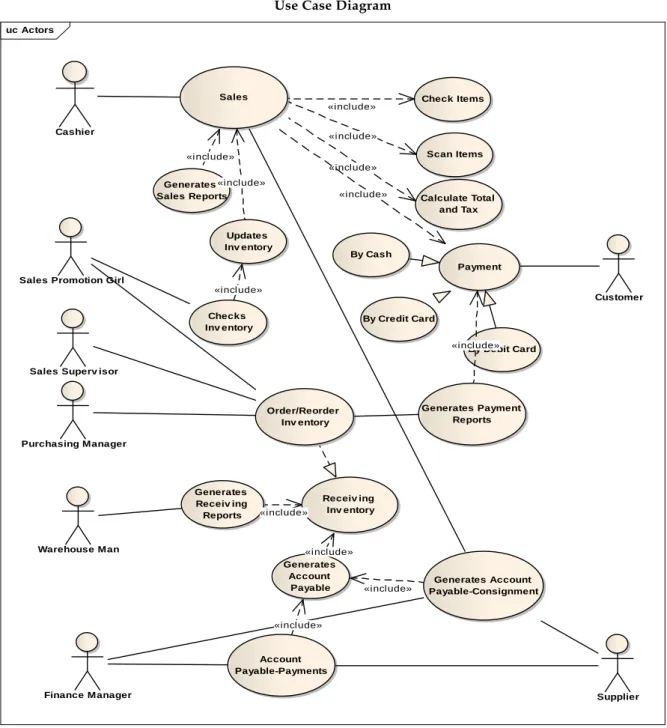
Use Case for Department Store-KKK can be de-scribed as in Figure 3. Basically, the cashier will
make sales and do the acceptance of money from customers. Acceptance of this money will be in cash, debit card or credit card. Sales inputted by cashier will update the inventory file and sales file. The inventory file will be monitored by the Sales Promotion Girl of each department to determine the order to the supplier.
Before the order to the supplier, orders must be authorized by the Supervisor and the Purchase. When a supplier sent the goods, warehouse will receive them and at this point the inventory file will be updated. Account Payable file will be updated when the item sold because the entire sale is con-signment.
Figure 3 Use Case Diagram uc Actors
Cashier
Sales Check Items
Scan Items Calculate Total and Tax Payment By Cash By Debit Card By Credit Card Customer Generates Sales Reports Updates Inv entory Checks Inv entory Sales Promotion Girl
Order/Reorder Inv entory Purchasing Manager Generates Payment Reports Supplier Receiv ing Inv entory Generates Receiv ing Reports Warehouse Man Generates Account
Payable Payable-ConsignmentGenerates Account
Account Payable-Payments Finance Manager
Sales Superv isor
«incl ude» «i nclude» «i nclude» «include» «i ncl ude» «include» «i ncl ude» «include» «i nclude» «incl ude» «incl ude» «include»
Data Flow Diagram
Use Case Model Diagram illustrates how a system interacts and how the system responds so this model is treated as a "Black Box" (Li et al. (2007)). And To be able to explain in detail to establish an audit program, Data Flow Diagram is the right tool to use (Whitten (2005)). Use Case diagram above (Figure 3) can basically be divided into two esses: (1) the purchase process and, (2) sales proc-ess. So from this use case can be drawn two DFD. Purchase can be seen in Figure 4 and DFD-Sales can be seen in Figure 5.
Entity Relationship Diagram (ERD)
To be able to perform effectively continuous audit, the auditor needs to perform the mapping of the database and the most effective methods used (Whitten, 2005) is the Entity Relationship Diagram. Entity Relationship Diagram gives a clear picture of the fields contained in the table contained in the database at the same time the relation. By looking at the field and the relationship of an auditor is able to make an effective audit program. ERD's depart-ment store purchase system it can be seen in Figure 6 and ERD sale it can be seen in Figure 7.
Audit Program
From the DFD, ERD and the audit assertion can be established an effective audit program. Each
proc-ess in the DFD reflects the activity that has a risk and required necessary control and audit objects to secure it.
Audit Program and Audit Findings-Purchase In DFD-Purchase, there are four main processes: (1) prepare the purchasing plan, (2) place the Purchase Order (PO), (3) Receive Inventory, (4) Pay Vendor (see Table 2 – 5 in Appendices). Therefore, the audit program will be adjusted to the process, and con-tinuous auditing can be performed. Findings of continuous auditing will be compared to the tradi-tional audit findings so can determine the effective and efficient of continuous auditing.
Audit Program and Audit Findings-Sales
In DFD-Sales, there are four main processes: (1) create invoice, (2) apply payment, (3) collection of sales, and (4) correction of sales receipt per Cashier (see Table 6 – 9 in Appendices). So the audit pro-gram will be adjusted to the process, and continu-ous auditing can be performed. Findings of con-tinuous auditing will be compared to the tradi-tional audit findings so can determine the effective and efficient of continuous auditing.
Implementation of continuous audit increases the effectiveness and efficiency of audit. That in-crease 8.222 findings that cannot be found by tradi-tional audit or there is an increase of 249% in
find-Figure 4
ings. The largest increase findings occurred in the create invoice, 2.392 findings. After thorough inves-tigation, the cause of the large difference is mainly due to the number of COGS is zero or null caused by calculation or weakness of the software used as well as negligence of employees. While the largest increase in percentage occurred in the process of prepare purchasing plan, 1334% due to the late of making purchasing plan. After doing the investiga-tion, it is known to cause of the delay is employee's indiscipline.
Traditional audit never touches the user au-thorization of transactions (Table 10) although this will put the company to the high risk. From the investigation founded that the main problems in authorization caused by the weakness of the soft-ware used that allow delete the user even still has the transactions.
Benford Law
Benford’s Law - Purchasing
Putting Benford Law to purchase on the digits 1 shows the results as in Figure 8. Examination showed normality except the digit 2 is slightly
higher so happened to nine digits. Check 2 digits of Benford is shown in figure 9 shows where the area is more abnormalities. And investigations on the above data indicate an error in the preparation department of 35, 12, 74, 14, 6 and 89. These errors are all mistake in inputting the price due to human error and lack of clarity in current prices. This error occurs in five suppliers are: K0060, V0014, D0034, D006, D0065. Benford’s Law – Vendor Payment
Putting Benford’s Law to vendor payment on the digits 1 shows the results as in Figure 10. Examina-tion of the data shows normalcy. And it is consistent with the results of Continuous Audit findings that show at least the vendor payment process. It is as mentioned above due to that supplier payment process is implemented and controlled by the owner. Benford’s Law – Sales
Putting Benford’s Law on the sales data of digits 1 and digits 2 shows the results as in figure 11 and figure12. The examination was conducted at the numbers that are not normal and investigation shows that most errors occur in department 35 and
Figure 6
the error is caused by inputting the incorrect selling price of the 14 inventories.
Continuous Auditing and Benford Analysis The results of the Continuous Audit and Analysis Benford coupled to see if there are similar findings.
Data analysis can be described as the Venn diagram as in Figure 13.
Comparing CA and Benford analysis needed to find the same findings found by both methods, 469 findings. So CA itself can find 11.048 and Benford’s analysis contributes 834 findings that cannot be
Table 10
Summary of Authorization Violation
Findings (records) No. Process
CA MA
Difference (records)
1 Prepare Purchasing Plan(table 1) 124 0 124
2 Place Purchasing Order(table 2) 3 0 3
3 Receive Inventory(table 3) 5 0 5
4 Pay Vendor(table 4) 0 0 0
Total Findings - Purchase 132 0 132
5 Create Invoice(table 5) 543 0 543
6 Apply Payments(table 6) 0 0 0
7 Collection of Payments & Correction of Collection of Payment
per Cashier(table 7) 274 0 274
Total Findings - Sales 817 0 817
Total Findings 949 0 949
Figure 8
Benford Law 1 digit – Purchase
Figure 9
Benford Law 2 digit – Purchase
Figure 10
examined by continuous auditing. The investiga-tion explains that the findings nominated by errors from human errors in inputting the data. So that coupled the continuous auditing and Benford’s analysis will strengthen the framework of audit in achieving the quality of audit in fulfill the real time, scope and resource constraint.
5. CONCLUSION, IMPLICATION, SUGGES-TION AND LIMITASUGGES-TIONS
Traditional Audit has faced enormous challenges when dealing with technology. In that case, com-munication speed, the amount of data, electronic storage media, as well as the complexity of the business activity lead the conventional audit not easily to achieve the desired quality of the audit. Further, it is exacerbated by the demands of real-time, broad scope and limited resources lead to a traditional audit judged to be obsolete. Continuous auditing try to assist auditors in facing the above challenges, especially in finding errors and fraud.
The design of continuous auditing begins with mapping business processes. The use case diagram is
a right tool to map the business processes within a unit. It can describe the processes more detail as well as the relationships among the elements in a business. By using the use case, the DFD can be established so the data flow from one element to another can be identified deeply. Continuous Auditing will be re-lated to the database then ERD can be a best tool to map the data structure. With mapping throughout the business, audit program, which is the machine of continuous auditing, will be identified, and continu-ous auditing framework can be optimized.
With the implementation of Continuous Audit, it can contribute 11.517 findings comprising 4.650 findings on the process of buying and 6.887 find-ings in selling process. Continuous Audit gives additional findings that cannot be found by the internal audit team using traditional audit is equal to 8.222 findings, and these findings are very sig-nificant. Even the user authorization process, which is not audited by the internal audit team, Continu-ous Audit, donated 949 findings, where this contri-bution is very important contricontri-bution since this risk is categorized to extremely highly risk for the
com-Benford Law 1 digit – Sales Benford Law 1 digit – Sale
Figure 13
Venn diagram: Continuous Auditing and Benford Analysis
pany. This proves CA will make an audit more efficient and more effective.
Application of Benford analysis has made an audit more effective. This is proven by the discov-ery of 834 findings that cannot be pointed out with Continuous Audit and shows 469. It was found also that support or strengthen the findings of the con-tinuous audit. This proves strongly that coupled continuous audit with Benford analysis will make an audit more efficient and more effective.
Further research can be done by applying Fuzzy Logic in Continuous Auditing so fraud pat-terns and anomalies that are not defined or identi-fied by the auditor will be able to be detected. Thus, it will provide protection and detection more accu-rate for the auditor.
REFERENCES
Albrecht Conan C 2010, ‘Fraud and Forensic Ac-counting In a Digital Environment, White Pa-per for The Institute for Fraud Prevention’, viewed May 5, 2012<www.theifp.org/ re-search-grants/IFP-Whitepaper-4.pdf>.
Alles MG, Kogan A, Vasarhelyi, & Wu, J 2006, ‘Continuous data level auditing: business process based analytic procedures in an un-constrained data environment, Working Pa-pers, Rutgers Business School.
Alles, MG, Kogan, A and Vasarhelyi, 2008, ‘Putting continuous auditing theory into practice: les-sons from two pilot implementations’, Journal of Information Systems, Vol. 22 No. 2, pp. 195-214. American Institute of Certified Public Accountants
2002, Statement on Auditing Standards no. 99: Consideration of fraud in a financial statement audit, AU Section 316, New York, pp. 168. Andreas Diekmann and Ben Jann 2010, ‘Benford’s
Law and Fraud Detection: Facts and Legends’,
German Economic Review 11(3): pp. 397–401.
Arens, Alvin A, Elder, Randal J, Beasley Mark 2012, Auditing and Assurance Services, 14/E, Pren-tice Hall.
Belkauoi A Riahi & Picur RD 2000, ’Understanding Fraud In The Accounting Environment’, Mana-gerial Finance, Vol. 26 Iss: 11 pp. 33 – 41. Benford, F 1938, ‘The Law Of Anomalous
Num-bers’, Proceedings Of The American Philosophical Society, vol. 78, pp. 551-572.
Carslaw, C 1988, ‘Anomalies In Income Numbers: Evidence Of Goal Oriented Behavior’, The Ac-counting Review, Vol. 63, No. 2, pp. 321-327. CICA/AICPA 1999, ‘Continuous auditing’,
Re-search Report, Toronto, Canada: The Canadian Institute of Chartered Accountants.
CIFAS, 2012, 2011 Fraud Trends: Fraud Levels Surge Upwards, viewed 28 April 2012, http://www.cifas.org.uk/annualfraudtrends-jantwelve.
Dailly, Richard 2012, ‘Fraud in India Manufactur-ing and EngineerManufactur-ing sector’, Global Fraud Report 2011-2012.
Dalal, C 1999, ‘Using an Expert System In An dit: A Case Study of Fraud Detection’, IT Au-dit, pp. 2.
Deloitte 2008, ‘Ten Things About Financial State-ment Fraud: A Review Of SEC EnforceState-ment Releases, Deloitte Forensic Center.
Dull, Richard B, David P, Tegarden & Lydia LF Schleifer 2006, ‘ACTVE: A Proposal for an Automated Continuous Transaction Verifica-tion Environment’, Journal of Emerging Tech-nologies in Accounting, pp. 81-96.
Durtschi Cindy, Hillison William & Pacini Carl 2004, ‘The Effective Use of Benford’s Law to Assist in Detecting Fraud in Accounting Data’, Journal of Forensic Accounting, Vol.V(2004), pp. 17-34. Flowerday S, Blundell, A & Solms R Von 2006,
‘Con-tinuous Auditing Technologies And Models: A Discussion, Computers & Security’, pp. 325-331. Gogi Overhoff 2011, ‘The Impact And Reality Of
Fraud Auditing Benford’s Law: Why And How To Use It’, 22nd Annual ACFE Fraud Conference
and Exhibition, ACFE.
Groomer SM & Murthy US 1989, ‘Continuous Au-diting Of Database Applications: An Embed-ded Audit Module Approach’, Journal of Infor-mation Systems, pp. 53-69.
Institut Akuntan Publik Indonesia 2011, Tanggung jawab dan fungsi auditor indenpenden, Stan-dar Pedoman Akuntan Publik, StanStan-dar Audit-ing Seksi 110.
Kneer Dan C 2003, ‘Continuous Assurance: We are Way Overdue’,Information System Control Jour-nal, 2003.
Kogan Alexander, Vasarhelyi Miklos.G, & Wu, Jia, 2010, ‘Analytical Procedures for Continuous Data Level Auditing: Continuity Equations’, Working Papers, Rutgers Business School. Krathwohl 1993, ’Methods Of Educational And
Social Research: An Integrated Approach’, New York, Longman.
Kroll 2012, Kroll Global Fraud Report 2011 2012, viewed April 25, 2012 http://is2.lse.ac.uk/ asp/aspecis/20080120.pdf.
Kuhn Randel J & Sutton Steve G 2006, ‘Learning From Worldcom: Implications For Fraud Detec-tion Through Continuous Assurance’, Journal of Emerging Technologies in Accounting, 3, pp. 61-80.
Kuhn Randel J & Sutton Steve G 2010, ‘Continu-ous Auditing In ERP System Environments: The Current State and Future Directions’,
Journal of Information Systems, Vol. 24 No. 1,
pp. 91-112.
Li, Shing-Han, Huang, Si Ming & Lin, YCG 2007, ‘Developing A Continuous Auditing Assis-tance System Based On Information Process Models’, Journal of Computer Information Sys-tems, pp. 2-13.
Majdalawieh, Munir, Zaghloul & Issam, 2009, ‘Para-digm shift in information systems auditing’, Managerial Auditing Journal, 24, pp. 352 – 367. Marks, Norman, 2010, ‘Continuous Auditing
Reex-amined’, Isaca Journal, Volume 1, pp. 1 - 5. Marasco, Jim, 2011, Is your organization susceptible
to fraud?, viewed 25 April 2012, http://www.efprotenberg.com/whats-new-articles-publications-susceptible-to-fraud. McCarthy WE 1979, ‘An Entity-Relationship View
of Accounting Models’, The Accounting Review, October 1979, pp. 667-86.
McDonough, J and McDonough, S 1997, ‘Research Methods for English Language Teachers’, Lon-don: Arnold.
Nielsen, 2010, ‘Retail and Shopper Trends Asia Pa-cific 2010: The latest in retailing and shopper trends for the FMCG industry.
Nigrini, MJ & Mittermaier LJ 1997, ‘The Use Of Benford’s Law As An Aid In Analytical Proce-dures Auditing’ A Journal of Practice and Theory, pp. 52-67.
Olsen DH 2012, ‘Enhancing Integrity by Integrating Business Rules, Triggers, and Active Database Techniques,’ IACIS, viewed 28 April 2012 <http://www.iacis.org/iis/2002_iis
/PDF%20Files/ OlsenyYatsenko.pdf>.
Orman LV 2011, ‘Database Audit and Control Strategies’, Information Technology and Manage-ment, 2, 2001, pp. 27-51.
Pathak J, Chaouch B, Sriram RS 2005,’Minimizing Cost of Continuous Audit: Counting and Time Dependent Strategies’, Journal of Account and Public Policy, 24:1, pp. 61-69.
Peslak, Alan R 2005, ‘Incorporating Business Proc-esses and Functions: Addressing the Missing Element in Information Systems Education’,
Journal of Computer Information Systems, 2005,
pp. 56-61.
Protivity, 2006, The Latest In Retailing And Shop-per Trends For The FMCG Industry: The Latest In Retailing and Shopper Trends For The FMCG Industry, Protivity Inc.
Prouty, Kevin, 2011, ERP in Manufacturing 2011:
Defining the ERP strategy, Aberdeen Group.
Rezaee, Z, Ford W & Elam R 2000, ‘Real-time ac-counting systems’, Internal Auditor, pp. 63-67. Searcy D, Woodroof J & Behn B 2002, ‘Continuous
Audit: The Motivations, Benefits, Problems, and Challenges Identified by Partner of a Big 4 Accounting Firm’, Proceedings of the 36th Hawaii International Conference on System Sciences. Shih, KH, Cheng CC & Wang YH 2011, ‘Financial
Information Fraud Risk Warning For Manufac-turing Industry -Using Logistic Regression And Neural Network’, Romanian Journal of Eco-nomic Forecasting.
Spelt David and Balsters Herman 1997, ‘Automatic Verification of Transactions on an Object-Oriented Database’, Proceedings of the Workshop
on Database Programming Languages (DBPL),
Es-tes, Springer.
Sutton, SG 2006, ‘Enterprise Systems and The Shaping of Accounting Systems: A Call of Re-search’, International Journal of Accounting In-formation Systems, Vol. 7, pp. 1-6.
Swanborn, P 2010, Case Study Research: What, Why
and How?’ Sage, Englewood Cliffs, CA.
The Panel on Audit Effectiveness 2000, ‘Report and Recommendations’, Exposure Draft - May 31, 2000, Stamford, Public Oversight Board.
Vasarhelyi MA & Halper FB 1991, ‘The Continuous Audit of Online Systems, Auditing: A Journal of Practice and Theory’, pp. 10.
Vasarhelyi, MA, & Greenstein, M 2003, ‘Underlying Principles of the Electronization of Business: A Research Agenda’, International Journal of Ac-counting Information Systems, 4, pp. 1-25. Watson, DM 2003, ’Cultural Dynamics of Corporate
Fraud, Cross Cultural Management’, Interna-tional Journal, 10, pp. 40 – 54.
Whitten JL, Bentley LD & Dittman KC 2005, System
Analysis and Design Methods, McGraw Hill.
Yin
, Robert K 2009, Case Study Research: Design and Methods, 4th, SAGE Publications, Inc.Zhao, Ning; Yen, David C, Chang I-Chiu 2004, ‘Au-diting in the E-Commerce Era’, Information Man-agement & Computer Security’, 12, p. 389-400. ACKNOWLEDGEMENT
Note: a part of this article titled “Continous Audit-ing, Developing Automated Audit of The Systems for Fraud and Error Delections”, was also pub-lished in the proceedings 3rd International Confer-ence on Business and Business and Banking (ICBB), 5-7 February 2014, in Pattaya, Thailand.
APPENDICES
Table 2
Audit Program and Findings-Prepare Purchasing Plan
Risk Purchasing Plan made by people who do not have authorization, exceeding budget and made late over a specified date
Findings (Records)
No. Auditing Objects Assertions Key Control Auditing Rules
CA TA
1 Purchasing Plan must be made by authorized users
Occurrence Check if the user exists in user file
Check if the user exists in user file for the past transactions
<Nouser> in <UserName> exist in <User>
<Nouser> in <Purchas-ingPlan> exist in <User>
3 121
0 0
2 Purchasing Plan does not exceed budget
Allocation Check whether the total dollars purchas-ing plan has exceeded a predetermined budget
Check if there is a total of nominal of a pur-chasing plan has ex-ceeded a predeter-mined budget and if exists check, whether there is an authoriza-tion.
<Total> in <Detail Pur-chasing Plan> add with <TotalYearToDate> in <Purchasing Plan> is greater than <Total> in <Budget>
If <Total> in <Detail Pur-chasing Plan> add with <TotalYearToDate> in <Deatil Purchasing Plan> is greater than <Total> in <Budget> check <otorisasi> 342 0 56 0 3 Purchasing Plan made late over a determined date
Occurrence 1. Check if there is purchasing plan made late over a determined date
2. Check if there is purchasing plan made on Monday
<Date> in <Purchasing Plan> is not <Monday> Check < Date> in <Pur-chasing Plan> each <De-partment> is not Monday
1321
31
57
0
4 All Purchasing Plan are recorded and no duplicate document number
Completeness
Reliability
Check if all purchasing plan are recorded in Purchasing File Check if there is dupli-cate Purchasing Plan number
<NoPP> is sequence of <Purchasing Plan> Check Duplicate <NoPP> in <Purchasing Plan>
63
27
11
Table 3
Audit Program and Findings-Place Purchasing Order
Risk Purchasing Order made by people who do not have authorization, exceeding budget and made not appropri-ate with Purchasing Plan
Findings (records)
No. Auditing Objects Assertions Key Control Auditing Rules
CA TA
1 Purchasing Order must be made by authorized users
Occurrence Check if the user exists in user file
Check if the user exists in user file for the past transactions
1. <Nouser> in <User-Name> exist in <User> 2. <Nouser> in <De-tailPO> exist in <User>
1
2
0
0
2 Purchasing Order does not exceed budget
Allocation Check whether the total dollars purchas-ing plan has exceeded a predetermined budget
Check if there is a total of nominal of a pur-chasing plan has ex-ceeded a predeter-mined budget and if exists check, whether there is an authoriza-tion.
<Total> in <Purchasing Order> add with <To-talYearToDate> in <Detail Purchasing Order> is greater than <Total> in<Budget>
If <Total> in <Purchasing Order > add with <To-talYearToDate> in <Detail Purchasing Order> is greater than <Total> in <Budget> check <authori-zation> 211 2 64 2 3 Purchase Order is not appropriate with authorized purchasing plan
Occurrence Check if there is pur-chasing order is not equal with authorized purchasing plan
<StockCode>, <Quantity>, <Price> in <Purchasing Order> is equal with <StockCode>, < Quantity >, <Price> in <Purchasing Plan>
921 127
4 All Purchasing Order are recorded and no duplicate document number
Completeness
Reliability
Check if all purchasing order are recorded in Purchasing File Check if there is dupli-cate Purchasing order number
<NoPO> is sequence of <Purchasing Order> Check Duplicate <NoPO> in <Purchasing Order>
256
13
34
Table 4
Audit Program and Findings-Receive Inventory
Risk Receiving made by people who do not have authorization, exceeding budget and made not appropriate with Purchasing Order
Temuan (records)
No. Auditing Objects Assertions Key Control Auditing Rules
CA TA
1 Receiving Report must be made by authorized users
Occurrence Check if the user exists in user file
Check if the user exists in user file for the past transactions
<Nouser> in <User-Name> exist in <User> <Nouser> in <Receiving Report> exist in <User>
1 4 0 0 2 Receiving Report is not appropriate with authorized Purchase Order
Occurrence Check if there is receiv-ing report is not equal with authorized pur-chasing order
<StockCode>, <Quan-tity>, <Price> in <Pur-chasing Order> is equal with <StockCode>, <Quantity>, <Price> in <Purchasing Order>
26 0
3 Receiving Report made late over a determined date
Occurrence Check if there is receiv-ing report made over a determined date in Purchase Order
<Date> in <Receiving Report> is not greater than <DateSent> in <Pur-chase Order>
736 231
4 Inventory has value 0
Valuation Check if there is inven-tory has 0 value
<PricePokok> in <Sediaan> is null or 0
121 0
5 All Receiving Re-port are recorded and no duplicate document number
Completeness
Reliability
Check if all receiving report are recorded in Purchasing File Check if there is dupli-cate receiving report number
<InvNo> is sequence of <Receiving Report> Check Duplicate <InvNo> in <Receiving Report>
311
42
132
Table 5
Audit Program and Findings–Pay Vendor Risk Payment to vendor more than the inventory sold or the inventory received
Temuan (records)
No. Auditing Objects Assertions Key Control Auditing Rules
CA TA
1 Vendor Payment must be made by authorized users
Occurrence Check if the user exists in user file
Check if the user exists in user file for the past transactions <Nouser> in <UserName> exist in <User> <Nouser> in <Payable> exist in <User> 0 0 0 0 2 Payments to Ven-dors must be no larger than it should be paid Accuracy, Right and Obligation, Classification, Cut off
Check whether there is a payment that greater than the total of proper Purchase Order which has been adjusted to the quantity of stocks received in Receiving Report
<Total> in <payable> is not greater than <Price> in <PO> X <Quantity> in <Receiving Report> 14 0 3 Payments to Con-signment Vendors must be no larger than it should be paid Accuracy, Right and Obligation, Classification, Cut off
Check whether there is a payment that greater than the total of proper Purchase Order which has been adjusted to the quantity of stocks in sales invoice
<Total> in <Payable> is not greater than <Price> in <PO> X <Quantity> in <Sales Detail>
of<Consignment Sup-plier>
73 0
4 All payable are recorded and no duplicate docu-ment number
Completeness
Reliability
Check if all payment are recorded in Pay-able File
Check if there is dupli-cate payable number
<NoPay> is sequence of <Payable> Check Duplicate <NoPay> in <Payable> 5 3 5 3
Table 6
Audit Program and Findings-Create Invoice
Risk Invoice created by users who are not authorized and there are selling with unauthorized loss
Temuan (records)
No. Auditing Objects Assertions Key Control Auditing Rules
CA TA
1 Invoice must be made by author-ized users
Occurrence Check if the user exists in user file
Check if the user exists in user file for the past transactions
<NoKasir> in <User-Name> exist in <User> <Nouser> in < SalesDetail > exist in <User> 532 11 0 0 2 Every sales has a
profit expect there is authorization
Valuation Check if there is a lower selling Price than Cost of goods sold, if exist there is an authorization.
<Price> in <SalesDetail> is lower than <COGS> in <Inventory> and check <UserIDKor> in <Inven-tory> exist in
<User1:PriceChang>
452 0
3 COGS equal to 0 Accuracy Check if there are sales that have a zero or null HPP
<COGS> in <SalesDetail> is equal with 0
1023 0
4 All Invoice are recorded and no duplicate docu-ment number
Completeness Check if all Invoice are recorded in Sales File Check if there is dupli-cate Invoice number
<InvNo> is sequence of <Sales>
Check Duplicate <InvNo > in <Sales> 784 189 475 124 Table 7
Audit Program and Findings-Customer Payment Risk Customer payment received is not as it should be
Temuan (records)
No. Auditing Objects Assertions Key Control Auditing Rules
CA TA
1 Payment must be equal with the in-voice
Accuracy Check if there is a payment that is not equal with the invoice
<Total> in <Payment> is not Equal with <Total> in <Sales>
Table 8
Audit Program and Findings-Collection of Payments & Correction of Collection of Payment per Cashier Risk Cash Receipted from the sale over the tolerance Rp. 50,000 of the total sales made for each cashier.
Temuan (records)
No. Auditing Objects Assertions Key Control Auditing Rules
CA TA
1 Collection of Pay-ments must be made by author-ized users
Occurrence Check if the user exists in user file
Check if the user exists in user file for the past transactions
<Nouser> in <UserName> exist in <User>
<Nouser> in <Pem-bayaran> exist in <User>
532 11
0 0
2 Cash Receipted from the sale over the tolerance Rp. 50,000 of the total sales made for each cashier.
Accuracy Check if there is a cashier deposit that is not the same with cash register sales
<ExCash> in <Deposit> is not equal with ( Rp. 50.000 + <SalesDateCashier>r> in <Deposit>)
2634 1934
3 Every cash excess has been inputted
Accuracy, Classification
Check if there is excess cash that has not been inputted cashier at the corrections
(Sum<total> in <Sales> each Cahier) - < Sales-DateCashier > in < De-posit > is equal with <To-tal> in <CashierCorrec-tion>
65 0
4 All collection of customer payments are recorded and no duplicate document number
Completeness Check if all Invoice are recorded in Sales File Check if there is dupli-cate Invoice number
<NoDeposit> is sequence of <Deposit>
Check Duplicate <NoDe-posit> in <De<NoDe-posit> 423 49 0 0 Table 9 Findings Summary Findings (records) No. Process CA MA Difference (records) Difference (%)
1 Prepare Purchasing Plan(table 1) 1908 133 1775 1334.5
2 Place Purchasing Order(table 2) 1406 227 1179 519.3
3 Receive Inventory(table 3) 1241 394 847 214.9
4 Pay Vendor(table 4) 95 8 87 1087.5
Total Findings - Purchase 4650 762 3888 510.24
5 Create Invoice(table 5) 2991 599 2392 399.33
6 Apply Payments(table 6) 162 0 162 N/A
7 Collection of Payments & Correction of Collection of Payment per Cashier(table 7)
3714 1934 1780 92.04
Total Findings - Sales 6887 2553 4334 169.76