1. General
description
The LPC185x/3x/2x/1x are ARM Cortex-M3 based microcontrollers for embedded applications. The ARM Cortex-M3 is a next generation core that offers system
enhancements such as low power consumption, enhanced debug features, and a high level of support block integration.
The LPC185x/3x/2x/1x operate at CPU frequencies of up to 180 MHz. The ARM Cortex-M3 CPU incorporates a 3-stage pipeline and uses a Harvard architecture with separate local instruction and data buses as well as a third bus for peripherals. The ARM Cortex-M3 CPU also includes an internal prefetch unit that supports speculative
branching.
The LPC185x/3x/2x/1x include up to 1 MB of flash and 136 kB of on-chip SRAM, 16 kB of EEPROM memory, a quad SPI Flash Interface (SPIFI), a State-configurable Timer/PWM (SCTimer/PWM) subsystem, two High-speed USB controllers, Ethernet, LCD, an external memory controller, and multiple digital and analog peripherals.
For additional documentation related to the LPC18xx parts, see Section 17 “References”.
2. Features and benefits
Processor core
ARM Cortex-M3 processor (version r2p1), running at CPU frequencies of up to
180 MHz.
ARM Cortex-M3 built-in Memory Protection Unit (MPU) supporting eight regions.
ARM Cortex-M3 built-in Nested Vectored Interrupt Controller (NVIC).
Non-maskable Interrupt (NMI) input.
JTAG and Serial Wire Debug, serial trace, eight breakpoints, and four watch points.
Enhanced Trace Module (ETM) and Enhanced Trace Buffer (ETB) support.
System tick timer.
On-chip memory
Up to 1 MB on-chip dual bank flash memory with flash accelerator.
16 kB on-chip EEPROM data memory.
136 kB SRAM for code and data use.
Multiple SRAM blocks with separate bus access.
64 kB ROM containing boot code and on-chip software drivers.
64 bit+ 256 bit of One-Time Programmable (OTP) memory for general-purpose
use.
a high-frequency crystal. The second PLL can be used with the High-speed USB, the third PLL can be used as audio PLL.
Clock output.
Configurable digital peripherals:
State Configurable Timer/PWM (SCTimer/PWM) subsystem on AHB.
Global Input Multiplexer Array (GIMA) allows to cross-connect multiple inputs and
outputs to event driven peripherals like timers, SCTimer/PWM, and ADC0/1.
Serial interfaces:
Quad SPI Flash Interface (SPIFI) with 1-, 2-, or 4-bit data at rates of up to
52 MB per second.
10/100T Ethernet MAC with RMII and MII interfaces and DMA support for high
throughput at low CPU load. Support for IEEE 1588 time stamping/advanced time stamping (IEEE 1588-2008 v2).
One High-speed USB 2.0 Host/Device/OTG interface with DMA support and
on-chip high-speed PHY (USB0).
One High-speed USB 2.0 Host/Device interface with DMA support, on-chip
full-speed PHY and ULPI interface to an external high-speed PHY (USB1).
USB interface electrical test software included in ROM USB stack.
Four 550 UARTs with DMA support: one UART with full modem interface; one
UART with IrDA interface; three USARTs support UART synchronous mode and a smart card interface conforming to ISO7816 specification.
Up to two C_CAN 2.0B controllers with one channel each.
Two SSP controllers with FIFO and multi-protocol support. Both SSPs with DMA
support.
One Fast-mode Plus I2C-bus interface with monitor mode and with open-drain I/O
pins conforming to the full I2C-bus specification. Supports data rates of up to
1 Mbit/s.
One standard I2C-bus interface with monitor mode and standard I/O pins.
Two I2S interfaces with DMA support, each with one input and one output.
Digital peripherals:
External Memory Controller (EMC) supporting external SRAM, ROM, NOR flash,
and SDRAM devices.
LCD controller with DMA support and a programmable display resolution of up to
1024H 768V. Supports monochrome and color STN panels and TFT color panels;
supports 1/2/4/8 bpp Color Look-Up Table (CLUT) and 16/24-bit direct pixel mapping.
SD/MMC card interface.
Eight-channel General-Purpose DMA controller can access all memories on the
AHB and all DMA-capable AHB slaves.
Up to 164 General-Purpose Input/Output (GPIO) pins with configurable
pattern of input states of a group of GPIO pins.
Four general-purpose timer/counters with capture and match capabilities.
One motor control PWM for three-phase motor control.
One Quadrature Encoder Interface (QEI).
Repetitive Interrupt timer (RI timer).
Windowed watchdog timer.
Ultra-low power Real-Time Clock (RTC) on separate power domain with 256 bytes
of battery powered backup registers.
Event recorder with three inputs to record event identification and event time; can
be battery powered.
Alarm timer; can be battery powered.
Analog peripherals:
One 10-bit DAC with DMA support and a data conversion rate of 400 kSamples/s.
Two 10-bit ADCs with DMA support and a data conversion rate of 400 kSamples/s.
Up to eight analog channels total. Each analog input is connected to both ADCs.
Unique ID for each device.
Power:
Single 3.3 V (2.4 V to 3.6 V) power supply with on-chip internal voltage regulator for
the core supply and the RTC power domain.
RTC power domain can be powered separately by a 3 V battery supply.
Four reduced power modes: Sleep, Deep-sleep, Power-down, and Deep
power-down.
Processor wake-up from Sleep mode via wake-up interrupts from various
peripherals.
Wake-up from Deep-sleep, Power-down, and Deep power-down modes via
external interrupts and interrupts generated by battery powered blocks in the RTC power domain.
Brownout detect with four separate thresholds for interrupt and forced reset.
Power-On Reset (POR).
Available in LQFP208, LBGA256, LQFP144, and TFBGA100 packages.
3. Applications
Industrial RFID readers
Consumer e-Metering
Name Description Version LPC1857FET256 LBGA256 Plastic low profile ball grid array package; 256 balls; body 17 17 1 mm SOT740-2 LPC1857JET256 LBGA256 Plastic low profile ball grid array package; 256 balls; body 17 17 1 mm SOT740-2 LPC1857JBD208 LQFP208 Plastic low profile quad flat package; 208 leads; body 28 28 1.4 mm SOT459-1 LPC1853FET256 LBGA256 Plastic low profile ball grid array package; 256 balls; body 17 17 1 mm SOT740-2 LPC1853JET256 LBGA256 Plastic low profile ball grid array package; 256 balls; body 17 17 1 mm SOT740-2 LPC1853JBD208 LQFP208 Plastic low profile quad flat package; 208 leads; body 28 28 1.4 mm SOT459-1 LPC1837FET256 LBGA256 Plastic low profile ball grid array package; 256 balls; body 17 17 1 mm SOT740-2 LPC1837JET256 LBGA256 Plastic low profile ball grid array package; 256 balls; body 17 17 1 mm SOT740-2 LPC1837JBD144 LQFP144 Plastic low profile quad flat package; 144 leads; body 20 20 1.4 mm SOT486-1 LPC1837JET100 TFBGA100 Plastic thin fine-pitch ball grid array package; 100 balls; body 9 9 0.7 mm SOT926-1 LPC1833FET256 LBGA256 Plastic low profile ball grid array package; 256 balls; body 17 17 1 mm SOT740-2 LPC1833JET256 LBGA256 Plastic low profile ball grid array package; 256 balls; body 17 17 1 mm SOT740-2 LPC1833JBD144 LQFP144 Plastic low profile quad flat package; 144 leads; body 20 20 1.4 mm SOT486-1 LPC1833JET100 TFBGA100 Plastic thin fine-pitch ball grid array package; 100 balls; body 9 9 0.7 mm SOT926-1 LPC1827JBD144 LQFP144 Plastic low profile quad flat package; 144 leads; body 20 20 1.4 mm SOT486-1 LPC1827JET100 TFBGA100 Plastic thin fine-pitch ball grid array package; 100 balls; body 9 9 0.7 mm SOT926-1 LPC1825JBD144 LQFP144 Plastic low profile quad flat package; 144 leads; body 20 20 1.4 mm SOT486-1 LPC1825JET100 TFBGA100 Plastic thin fine-pitch ball grid array package; 100 balls; body 9 9 0.7 mm SOT926-1 LPC1823JBD144 LQFP144 Plastic low profile quad flat package; 144 leads; body 20 20 1.4 mm SOT486-1 LPC1823JET100 TFBGA100 Plastic thin fine-pitch ball grid array package; 100 balls; body 9 9 0.7 mm SOT926-1 LPC1822JBD144 LQFP144 Plastic low profile quad flat package; 144 leads; body 20 20 1.4 mm SOT486-1 LPC1822JET100 TFBGA100 Plastic thin fine-pitch ball grid array package; 100 balls; body 9 9 0.7 mm SOT926-1 LPC1817JBD144 LQFP144 Plastic low profile quad flat package; 144 leads; body 20 20 1.4 mm SOT486-1 LPC1817JET100 TFBGA100 Plastic thin fine-pitch ball grid array package; 100 balls; body 9 9 0.7 mm SOT926-1 LPC1815JBD144 LQFP144 Plastic low profile quad flat package; 144 leads; body 20 20 1.4 mm SOT486-1 LPC1815JET100 TFBGA100 Plastic thin fine-pitch ball grid array package; 100 balls; body 9 9 0.7 mm SOT926-1 LPC1813JBD144 LQFP144 Plastic low profile quad flat package; 144 leads; body 20 20 1.4 mm SOT486-1 LPC1813JET100 TFBGA100 Plastic thin fine-pitch ball grid array package; 100 balls; body 9 9 0.7 mm SOT926-1 LPC1812JBD144 LQFP144 Plastic low profile quad flat package; 144 leads; body 20 20 1.4 mm SOT486-1 LPC1812JET100 TFBGA100 Plastic thin fine-pitch ball grid array package; 100 balls; body 9 9 0.7 mm SOT926-1
T y pe numb e r Fl as h tot a l Fl as h ba nk A Fl as h ba nk B To ta l S R A M LCD Ethernet USB0 (Ho s t, D evice, USB1 (Ho s t, D evice)/ UL PI inter face Motor control PW M QEI AD C c h annels T e mpera ture ra nge [1 GPI O
LPC1857FET256 1 MB 512 kB 512 kB 136 kB yes yes yes yes/yes yes yes 8 F 164
LPC1857JET256 1 MB 512 kB 512 kB 136 kB yes yes yes yes/yes yes yes 8 J 164
LPC1857JBD208 1 MB 512 kB 512 kB 136 kB yes yes yes yes/yes yes yes 8 J 142
LPC1853FET256 512 kB 256 kB 256 kB 136 kB yes yes yes yes/yes yes yes 8 F 164
LPC1853JET256 512 kB 256 kB 256 kB 136 kB yes yes yes yes/yes yes yes 8 J 164
LPC1853JBD208 512 kB 256 kB 256 kB 136 kB yes yes yes yes/yes yes yes 8 J 142
LPC1837FET256 1 MB 512 kB 512 kB 136 kB no yes yes yes/yes yes yes 8 F 164
LPC1837JET256 1 MB 512 kB 512 kB 136 kB no yes yes yes/yes yes yes 8 J 164
LPC1837JBD144 1 MB 512 kB 512 kB 136 kB no yes yes yes/yes yes no 8 J 83
LPC1837JET100 1 MB 512 kB 512 kB 136 kB no yes yes yes/no no no 4 J 49
LPC1833FET256 512 kB 256 kB 256 kB 136 kB no yes yes yes/yes yes yes 8 F 164
LPC1833JET256 512 kB 256 kB 256 kB 136 kB no yes yes yes/yes yes yes 8 J 164
LPC1833JBD144 512 kB 256 kB 256 kB 136 kB no yes yes yes/yes yes no 8 J 83
LPC1833JET100 512 kB 256 kB 256 kB 136 kB no yes yes yes/no no no 4 J 49
LPC1827JBD144 1 MB 512 kB 512 kB 136 kB no no yes no/no yes no 8 J 83
LPC1827JET100 1 MB 512 kB 512 kB 136 kB no no yes no/no no no 4 J 49
LPC1825JBD144 768 kB 384 kB 384 kB 136 kB no no yes no/no yes no 8 J 83
LPC1825JET100 768 kB 384 kB 384 kB 136 kB no no yes no/no no no 4 J 49
LPC1823JBD144 512 kB 256 kB 256 kB 104 kB no no yes no/no yes no 8 J 83
LPC1823JET100 512 kB 256 kB 256 kB 104 kB no no yes no/no no no 4 J 49
LPC1822JBD144 512 kB 512 kB 0 kB 104 kB no no yes no/no yes no 8 J 83
LPC1822JET100 512 kB 512 kB 0 kB 104 kB no no yes no/no no no 4 J 49
LPC1817JBD144 1 MB 512 kB 512 kB 136 kB no no no no/no yes no 8 J 83 LPC1817JET100 1 MB 512 kB 512 kB 136 kB no no no no/no no no 4 J 49 LPC1815JBD144 768 kB 384 kB 384 kB 136 kB no no no no/no yes no 8 J 83 LPC1815JET100 768 kB 384 kB 384 kB 136 kB no no no no/no no no 4 J 49 LPC1813JBD144 512 kB 256 kB 256 kB 104 kB no no no no/no yes no 8 J 83 LPC1813JET100 512 kB 256 kB 256 kB 104 kB no no no no/no no no 4 J 49 LPC1812JBD144 512 kB 512 kB 0 kB 104 kB no no no no/no yes no 8 J 83 LPC1812JET100 512 kB 512 kB 0 kB 104 kB no no no no/no no no 4 J 49
(1) Not available on all parts. See Table 2.
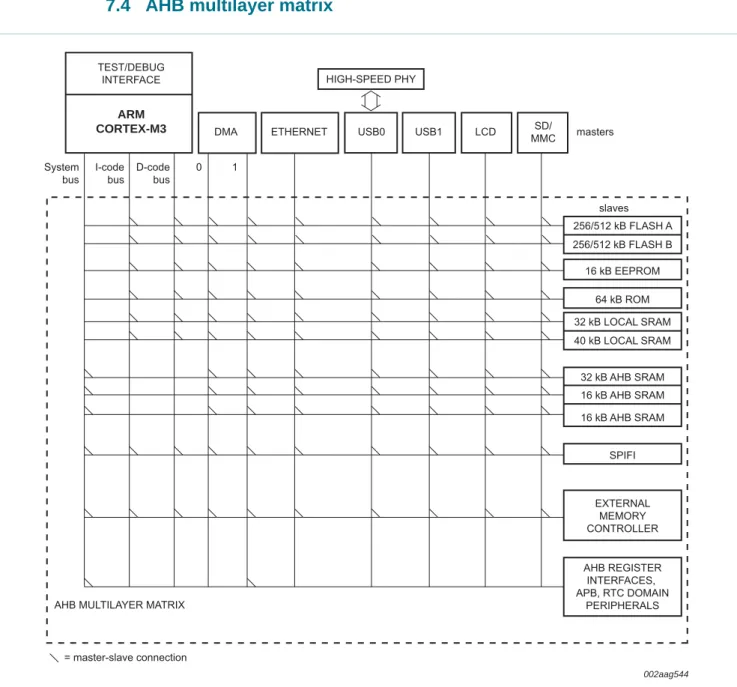
Fig 1. LPC185x/3x/2x/1x block diagram ARM
CORTEX-M3 TEST/DEBUG
INTERFACE
I-code
bus bus D-code bus system
DMA ETHERNET(1) 10/100 MAC IEEE 1588 USB1(1) HOST/ DEVICE HIGH-SPEED USB0(1) HOST/ DEVICE/ OTG LCD(1) SD/ MMC EMC HIGH-SPEED PHY 32 kB AHB SRAM 16 kB + 16 kB AHB SRAM SPIFI HS GPIO SCT 64 kB ROM
AHB MULTILAYER MATRIX LPC185x/3x/2x/1x 32 kB LOCAL SRAM 40 kB LOCAL SRAM 002aah225 slaves masters WWDT USART0 UART1 SSP0 I2C0 C_CAN1 I2S0 I2S1 MOTOR CONTROL PWM(1) TIMER3 TIMER2 USART2 USART3 SSP1 RI TIMER QEI(1) GIMA
BRIDGE 0 BRIDGE 1 BRIDGE 2 BRIDGE 3 BRIDGE
10-bit ADC0 10-bit ADC1 C_CAN0 I2C1 10-bit DAC BRIDGE RGU CCU2 CGU CCU1 ALARM TIMER CONFIGURATION REGISTERS OTP MEMORY EVENT ROUTER POWER MODE CONTROL
12 MHz IRC EVENT MONITOR RTC POWER DOMAIN BACKUP REGISTERS RTC OSC RTC slaves = connected to DMA TIMER0 TIMER1 SCU GPIO PIN INTERRUPTS GPIO GROUP0 INTERRUPT GPIO GROUP1 INTERRUPT 512/256 kB FLASH A 512/256 kB FLASH B 16 kB EEPROM ETM
6.2 Pin description
On the LPC185x/3x/2x/1x, digital pins are grouped into 16 ports, named P0 to P9 and PA to PF, with up to 20 pins used per port. Each digital pin can support up to eight different digital functions, including General-Purpose I/O (GPIO), selectable through the SCU registers.
The pin name is not indicative of the GPIO port assigned to it.
The parts contain two 10-bit ADCs (ADC0 and ADC1). The input channels of ADC0 and
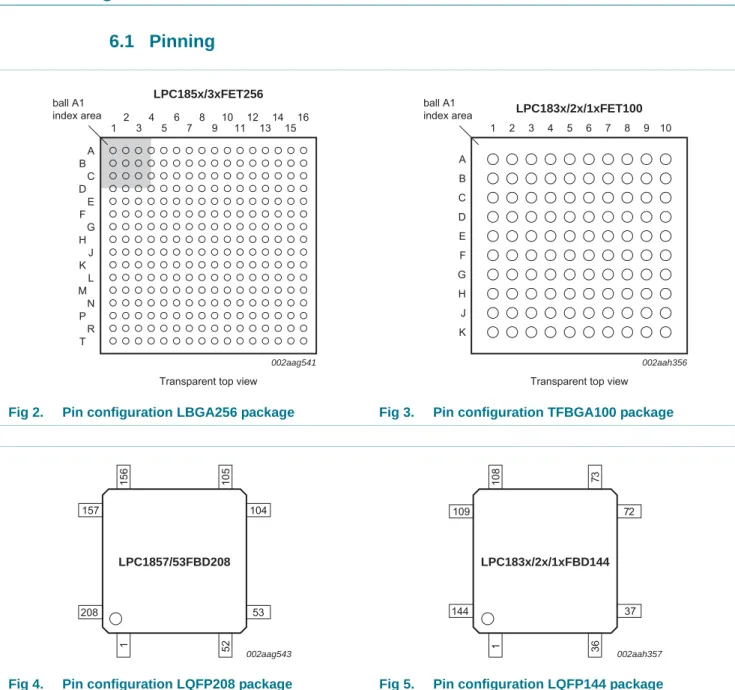
Fig 2. Pin configuration LBGA256 package Fig 3. Pin configuration TFBGA100 package
002aag541
LPC185x/3xFET256
Transparent top view T R P N M L J G K H F E D C B A 2 4 6 8 10 12 13 14 15 16 1 3 5 7 9 11 ball A1 index area 002aah356 LPC183x/2x/1xFET100
Transparent top view J G K H F E D C B A 2 4 6 8 10 1 3 5 7 9 ball A1 index area
Fig 4. Pin configuration LQFP208 package Fig 5. Pin configuration LQFP144 package
LPC1857/53FBD208 104 1 52 156 105 53 157 208 002aag543 LPC183x/2x/1xFBD144 72 1 36 108 73 37 109 144 002aah357
Pin name LBGA25 6 TF BGA 100 LQ FP14 4 LQ FP20 8 Rese t st ate [1 ] Ty p e Description
Multiplexed digital pins
P0_0 L3 G2 32 47 [2] N;
PU
I/O GPIO0[0] — General purpose digital input/output pin. I/O SSP1_MISO — Master In Slave Out for SSP1.
I ENET_RXD1 — Ethernet receive data 1 (RMII/MII interface). - R — Function reserved.
- R — Function reserved. - R — Function reserved.
I/O I2S0_TX_WS — Transmit Word Select. It is driven by the master and received by the slave. Corresponds to the signal WS in the I2S-bus specification.
I/O I2S1_TX_WS — Transmit Word Select. It is driven by the master and received by the slave. Corresponds to the signal WS in the I2S-bus specification.
P0_1 M2 G1 34 50 [2] N;
PU
I/O GPIO0[1] — General purpose digital input/output pin. I/O SSP1_MOSI — Master Out Slave in for SSP1.
I ENET_COL — Ethernet Collision detect (MII interface). - R — Function reserved.
- R — Function reserved. - R — Function reserved.
ENET_TX_EN — Ethernet transmit enable (RMII/MII interface).
I/O I2S1_TX_SDA — I2S1 transmit data. It is driven by the transmitter and read by the receiver. Corresponds to the signal SD in the I2S-bus specification.
P1_0 P2 H1 38 54 [2] N;
PU
I/O GPIO0[4] — General purpose digital input/output pin. I CTIN_3 — SCTimer/PWM input 3. Capture input 1 of timer 1. I/O EMC_A5 — External memory address line 5.
- R — Function reserved. - R — Function reserved.
I/O SSP0_SSEL — Slave Select for SSP0. - R — Function reserved.
P1_1 R2 K2 42 58 [2] N; PU
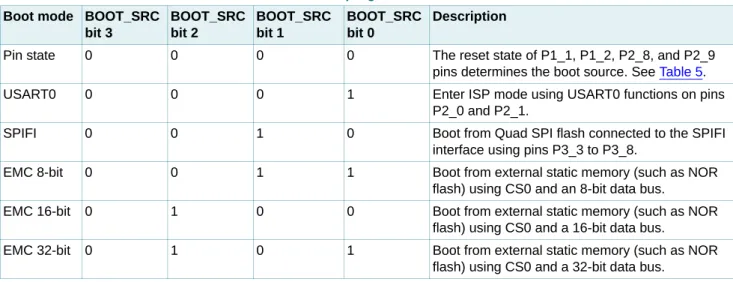
I/O GPIO0[8] — General purpose digital input/output pin. External boot pin (see Table 5).
O CTOUT_7 — SCTimer/PWM output 7. Match output 3 of timer 1.
I/O EMC_A6 — External memory address line 6. - R — Function reserved.
- R — Function reserved.
I/O SSP0_MISO — Master In Slave Out for SSP0. - R — Function reserved.
I/O EMC_D13 — External memory data line 13.
P1_2 R3 K1 43 60 [2] N;
PU
I/O GPIO0[9] — General purpose digital input/output pin. External boot pin (see Table 5).
O CTOUT_6 — SCTimer/PWM output 6. Match output 2 of timer 1.
I/O EMC_A7 — External memory address line 7. - R — Function reserved.
- R — Function reserved.
I/O SSP0_MOSI — Master Out Slave in for SSP0. - R — Function reserved.
I/O EMC_D14 — External memory data line 14.
P1_3 P5 J1 44 61 [2] N;
PU
I/O GPIO0[10] — General purpose digital input/output pin. O CTOUT_8 — SCTimer/PWM output 8. Match output 0 of timer
2.
- R — Function reserved.
O EMC_OE — LOW active Output Enable signal.
O USB0_IND1 — USB0 port indicator LED control output 1. I/O SSP1_MISO — Master In Slave Out for SSP1.
- R — Function reserved.
O SD_RST — SD/MMC reset signal for MMC4.4 card.
P1_4 T3 J2 47 64 [2] N;
PU
I/O GPIO0[11] — General purpose digital input/output pin. O CTOUT_9 — SCTimer/PWM output 9. Match output 3 of timer
3.
- R — Function reserved.
O EMC_BLS0 — LOW active Byte Lane select signal 0. O USB0_IND0 — USB0 port indicator LED control output 0. I/O SSP1_MOSI — Master Out Slave in for SSP1.
P1_5 R5 J4 48 65 [2] N; PU
I/O GPIO1[8] — General purpose digital input/output pin. O CTOUT_10 — SCTimer/PWM output 10. Match output 3 of
timer 3.
- R — Function reserved.
O EMC_CS0 — LOW active Chip Select 0 signal.
I USB0_PWR_FAULT — Port power fault signal indicating overcurrent condition; this signal monitors over-current on the USB bus (external circuitry required to detect over-current condition).
I/O SSP1_SSEL — Slave Select for SSP1. - R — Function reserved.
O SD_POW — SD/MMC card power monitor output.
P1_6 T4 K4 49 67 [2] N;
PU
I/O GPIO1[9] — General purpose digital input/output pin. I CTIN_5 — SCTimer/PWM input 5. Capture input 2 of timer 2. - R — Function reserved.
O EMC_WE — LOW active Write Enable signal. - R — Function reserved.
O EMC_BLS0 — LOW active Byte Lane select signal 0. - R — Function reserved.
I/O SD_CMD — SD/MMC command signal.
P1_7 T5 G4 50 69 [2] N;
PU
I/O GPIO1[0] — General purpose digital input/output pin. I U1_DSR — Data Set Ready input for UART1.
O CTOUT_13 — SCTimer/PWM output 13. Match output 3 of timer 3.
I/O EMC_D0 — External memory data line 0.
O USB0_PPWR — VBUS drive signal (towards external charge pump or power management unit); indicates that VBUS must be driven (active HIGH). Add a pull-down resistor to disable the power switch at reset. This signal has opposite polarity compared to the USB_PPWR used on other NXP LPC parts. - R — Function reserved.
- R — Function reserved. - R — Function reserved.
P1_8 R7 H5 51 71 [2] N; PU
I/O GPIO1[1] — General purpose digital input/output pin. O U1_DTR — Data Terminal Ready output for UART1. O CTOUT_12 — SCTimer/PWM output 12. Match output 3 of
timer 3.
I/O EMC_D1 — External memory data line 1. - R — Function reserved.
- R — Function reserved. - R — Function reserved.
O SD_VOLT0 — SD/MMC bus voltage select output 0.
P1_9 T7 J5 52 73 [2] N;
PU
I/O GPIO1[2] — General purpose digital input/output pin. O U1_RTS — Request to Send output for UART1.
O CTOUT_11 — SCTimer/PWM output 11. Match output 3 of timer 2.
I/O EMC_D2 — External memory data line 2. - R — Function reserved.
- R — Function reserved. - R — Function reserved.
I/O SD_DAT0 — SD/MMC data bus line 0.
P1_10 R8 H6 53 75 [2] N;
PU
I/O GPIO1[3] — General purpose digital input/output pin. I U1_RI — Ring Indicator input for UART1.
O CTOUT_14 — SCTimer/PWM output 14. Match output 2 of timer 3.
I/O EMC_D3 — External memory data line 3. - R — Function reserved.
- R — Function reserved. - R — Function reserved.
I/O SD_DAT1 — SD/MMC data bus line 1.
P1_11 T9 J7 55 77 [2] N;
PU
I/O GPIO1[4] — General purpose digital input/output pin. I U1_CTS — Clear to Send input for UART1.
O CTOUT_15 — SCTimer/PWM output 15. Match output 3 of timer 3.
I/O EMC_D4 — External memory data line 4. - R — Function reserved.
- R — Function reserved. - R — Function reserved.
P1_12 R9 K7 56 78 [2] N; PU
I/O GPIO1[5] — General purpose digital input/output pin. I U1_DCD — Data Carrier Detect input for UART1. - R — Function reserved.
I/O EMC_D5 — External memory data line 5. I T0_CAP1 — Capture input 1 of timer 0. - R — Function reserved.
- R — Function reserved.
I/O SD_DAT3 — SD/MMC data bus line 3.
P1_13 R10 H8 60 83 [2] N;
PU
I/O GPIO1[6] — General purpose digital input/output pin. O U1_TXD — Transmitter output for UART1.
- R — Function reserved.
I/O EMC_D6 — External memory data line 6. I T0_CAP0 — Capture input 0 of timer 0. - R — Function reserved.
- R — Function reserved.
I SD_CD — SD/MMC card detect input.
P1_14 R11 J8 61 85 [2] N;
PU
I/O GPIO1[7] — General purpose digital input/output pin. I U1_RXD — Receiver input for UART1.
- R — Function reserved.
I/O EMC_D7 — External memory data line 7. O T0_MAT2 — Match output 2 of timer 0. - R — Function reserved.
- R — Function reserved. - R — Function reserved.
P1_15 T12 K8 62 87 [2] N;
PU
I/O GPIO0[2] — General purpose digital input/output pin. O U2_TXD — Transmitter output for USART2.
- R — Function reserved.
I ENET_RXD0 — Ethernet receive data 0 (RMII/MII interface). O T0_MAT1 — Match output 1 of timer 0.
- R — Function reserved.
I/O EMC_D8 — External memory data line 8. - R — Function reserved.
P1_16 M7 H9 64 90 [2] N; PU
I/O GPIO0[3] — General purpose digital input/output pin. I U2_RXD — Receiver input for USART2.
- R — Function reserved.
I ENET_CRS — Ethernet Carrier Sense (MII interface). O T0_MAT0 — Match output 0 of timer 0.
- R — Function reserved.
I/O EMC_D9 — External memory data line 9.
I ENET_RX_DV — Ethernet Receive Data Valid (RMII/MII interface).
P1_17 M8 H10 66 93 [3] N;
PU
I/O GPIO0[12] — General purpose digital input/output pin. I/O U2_UCLK — Serial clock input/output for USART2 in
synchronous mode. - R — Function reserved.
I/O ENET_MDIO — Ethernet MIIM data input and output. I T0_CAP3 — Capture input 3 of timer 0.
O CAN1_TD — CAN1 transmitter output. - R — Function reserved.
- R — Function reserved.
P1_18 N12 J10 67 95 [2] N;
PU
I/O GPIO0[13] — General purpose digital input/output pin. I/O U2_DIR — RS-485/EIA-485 output enable/direction control for
USART2.
- R — Function reserved.
O ENET_TXD0 — Ethernet transmit data 0 (RMII/MII interface). O T0_MAT3 — Match output 3 of timer 0.
I CAN1_RD — CAN1 receiver input. - R — Function reserved.
I/O EMC_D10 — External memory data line 10.
P1_19 M11 K9 68 96 [2] N;
PU
I ENET_TX_CLK (ENET_REF_CLK) — Ethernet Transmit Clock (MII interface) or Ethernet Reference Clock (RMII interface).
I/O SSP1_SCK — Serial clock for SSP1. - R — Function reserved.
- R — Function reserved. O CLKOUT — Clock output pin. - R — Function reserved.
O I2S0_RX_MCLK — I2S receive master clock.
P1_20 M10 K10 70 100 [2] N; PU
I/O GPIO0[15] — General purpose digital input/output pin. I/O SSP1_SSEL — Slave Select for SSP1.
- R — Function reserved.
O ENET_TXD1 — Ethernet transmit data 1 (RMII/MII interface). I T0_CAP2 — Capture input 2 of timer 0.
- R — Function reserved. - R — Function reserved.
I/O EMC_D11 — External memory data line 11.
P2_0 T16 G10 75 108 [2] N;
PU
- R — Function reserved.
O U0_TXD — Transmitter output for USART0. See Table 4 for ISP mode.
I/O EMC_A13 — External memory address line 13.
O USB0_PPWR — VBUS drive signal (towards external charge pump or power management unit); indicates that VBUS must be driven (active HIGH). Add a pull-down resistor to disable the power switch at reset. This signal has opposite polarity compared to the USB_PPWR used on other NXP LPC parts. I/O GPIO5[0] — General purpose digital input/output pin. - R — Function reserved.
I T3_CAP0 — Capture input 0 of timer 3. O ENET_MDC — Ethernet MIIM clock.
P2_1 N15 G7 81 116 [2] N;
PU
- R — Function reserved.
I U0_RXD — Receiver input for USART0. See Table 4 for ISP mode.
I/O EMC_A12 — External memory address line 12.
I USB0_PWR_FAULT — Port power fault signal indicating overcurrent condition; this signal monitors over-current on the USB bus (external circuitry required to detect over-current condition).
I/O GPIO5[1] — General purpose digital input/output pin. - R — Function reserved.
I T3_CAP1 — Capture input 1 of timer 3. - R — Function reserved.
P2_2 M15 F5 84 121 [2] N; PU
- R — Function reserved.
I/O U0_UCLK — Serial clock input/output for USART0 in synchronous mode.
I/O EMC_A11 — External memory address line 11.
O USB0_IND1 — USB0 port indicator LED control output 1. I/O GPIO5[2] — General purpose digital input/output pin. I CTIN_6 — SCTimer/PWM input 6. Capture input 1 of timer 3. I T3_CAP2 — Capture input 2 of timer 3.
O EMC_CS1 — LOW active Chip Select 1 signal.
P2_3 J12 D8 87 127 [3] N;
PU
- R — Function reserved.
I/O I2C1_SDA — I2C1 data input/output (this pin does not use a specialized I2C pad).
O U3_TXD — Transmitter output for USART3. See Table 4 for ISP mode.
I CTIN_1 — SCTimer/PWM input 1. Capture input 1 of timer 0. Capture input 1 of timer 2.
I/O GPIO5[3] — General purpose digital input/output pin. - R — Function reserved.
O T3_MAT0 — Match output 0 of timer 3.
O USB0_PPWR — VBUS drive signal (towards external charge pump or power management unit); indicates that VBUS must be driven (active HIGH). Add a pull-down resistor to disable the power switch at reset. This signal has opposite polarity compared to the USB_PPWR used on other NXP LPC parts.
P2_4 K11 D9 88 128 [3] N;
PU
- R — Function reserved.
I/O I2C1_SCL — I2C1 clock input/output (this pin does not use a specialized I2C pad).
I U3_RXD — Receiver input for USART3. See Table 4 for ISP mode.
I CTIN_0 — SCTimer/PWM input 0. Capture input 0 of timer 0, 1, 2, 3.
I/O GPIO5[4] — General purpose digital input/output pin. - R — Function reserved.
O T3_MAT1 — Match output 1 of timer 3.
I USB0_PWR_FAULT — Port power fault signal indicating overcurrent condition; this signal monitors over-current on the USB bus (external circuitry required to detect over-current condition).
P2_5 K14 D10 91 131 [3] N; PU
- R — Function reserved.
I CTIN_2 — SCTimer/PWM input 2. Capture input 2 of timer 0. I USB1_VBUS — Monitors the presence of USB1 bus power.
Note: This signal must be HIGH for USB reset to occur. I ADCTRIG1 — ADC trigger input 1.
I/O GPIO5[5] — General purpose digital input/output pin. - R — Function reserved.
O T3_MAT2 — Match output 2 of timer 3.
O USB0_IND0 — USB0 port indicator LED control output 0.
P2_6 K16 G9 95 137 [2] N;
PU
- R — Function reserved.
I/O U0_DIR — RS-485/EIA-485 output enable/direction control for USART0.
I/O EMC_A10 — External memory address line 10. O USB0_IND0 — USB0 port indicator LED control
output 0.
I/O GPIO5[6] — General purpose digital input/output pin. I CTIN_7 — SCTimer/PWM input 7.
I T3_CAP3 — Capture input 3 of timer 3.
O EMC_BLS1 — LOW active Byte Lane select signal 1.
P2_7 H14 C10 96 138 [2] N;
PU
I/O GPIO0[7] — General purpose digital input/output pin. ISP entry pin. If this pin is pulled LOW at reset, the part enters ISP mode or boots from an external source (see Table 4 and Table 5).
O CTOUT_1 — SCTimer/PWM output 1. Match output 3 of timer 3.
I/O U3_UCLK — Serial clock input/output for USART3 in synchronous mode.
I/O EMC_A9 — External memory address line 9. - R — Function reserved.
- R — Function reserved.
O T3_MAT3 — Match output 3 of timer 3. - R — Function reserved.
P2_8 J16 C6 98 140 [2] N; PU
- R — Function reserved. External boot pin (see Table 5) O CTOUT_0 — SCTimer/PWM output 0. Match output 0 of timer
0.
I/O U3_DIR — RS-485/EIA-485 output enable/direction control for USART3.
I/O EMC_A8 — External memory address line 8. I/O GPIO5[7] — General purpose digital input/output pin. - R — Function reserved.
- R — Function reserved. - R — Function reserved.
P2_9 H16 B10 102 144 [2] N;
PU
I/O GPIO1[10] — General purpose digital input/output pin. External boot pin (see Table 5).
O CTOUT_3 — SCTimer/PWM output 3. Match output 3 of timer 0.
I/O U3_BAUD — Baud pin for USART3.
I/O EMC_A0 — External memory address line 0. - R — Function reserved. - R — Function reserved. - R — Function reserved. - R — Function reserved. P2_10 G16 E8 104 146 [2] N; PU
I/O GPIO0[14] — General purpose digital input/output pin. O CTOUT_2 — SCTimer/PWM output 2. Match output 2 of timer
0.
O U2_TXD — Transmitter output for USART2. I/O EMC_A1 — External memory address line 1. - R — Function reserved. - R — Function reserved. - R — Function reserved. - R — Function reserved. P2_11 F16 A9 105 148 [2] N; PU
I/O GPIO1[11] — General purpose digital input/output pin. O CTOUT_5 — SCTimer/PWM output 5. Match output 3 of timer
3.
I U2_RXD — Receiver input for USART2. I/O EMC_A2 — External memory address line 2. - R — Function reserved.
- R — Function reserved. - R — Function reserved.
P2_12 E15 B9 106 153 [2] N; PU
I/O GPIO1[12] — General purpose digital input/output pin. O CTOUT_4 — SCTimer/PWM output 4. Match output 3 of timer
3.
- R — Function reserved.
I/O EMC_A3 — External memory address line 3. - R — Function reserved.
- R — Function reserved. - R — Function reserved.
I/O U2_UCLK — Serial clock input/output for USART2 in synchronous mode.
P2_13 C16 A10 108 156 [2] N;
PU
I/O GPIO1[13] — General purpose digital input/output pin. I CTIN_4 — SCTimer/PWM input 4. Capture input 2 of timer 1. - R — Function reserved.
I/O EMC_A4 — External memory address line 4. - R — Function reserved.
- R — Function reserved. - R — Function reserved.
I/O U2_DIR — RS-485/EIA-485 output enable/direction control for USART2.
P3_0 F13 A8 112 161 [2] N;
PU
I/O I2S0_RX_SCK — I2S receive clock. It is driven by the master and received by the slave. Corresponds to the signal SCK in the I2S-bus specification.
O I2S0_RX_MCLK — I2S receive master clock.
I/O I2S0_TX_SCK — Transmit Clock. It is driven by the master and received by the slave. Corresponds to the signal SCK in the I2S-bus specification.
O I2S0_TX_MCLK — I2S transmit master clock. I/O SSP0_SCK — Serial clock for SSP0.
- R — Function reserved. - R — Function reserved. - R — Function reserved.
P3_1 G11 F7 114 163 [2] N; PU
I/O I2S0_TX_WS — Transmit Word Select. It is driven by the master and received by the slave. Corresponds to the signal WS in the I2S-bus specification.
I/O I2S0_RX_WS — Receive Word Select. It is driven by the master and received by the slave. Corresponds to the signal WS in the I2S-bus specification.
I CAN0_RD — CAN receiver input.
O USB1_IND1 — USB1 Port indicator LED control output 1. I/O GPIO5[8] — General purpose digital input/output pin. - R — Function reserved.
O LCD_VD15 — LCD data. - R — Function reserved.
P3_2 F11 G6 116 166 [2] OL;
PU
I/O I2S0_TX_SDA — I2S transmit data. It is driven by the
transmitter and read by the receiver. Corresponds to the signal SD in the I2S-bus specification.
I/O I2S0_RX_SDA — I2S Receive data. It is driven by the transmitter and read by the receiver. Corresponds to the signal SD in the I2S-bus specification.
O CAN0_TD — CAN transmitter output.
O USB1_IND0 — USB1 Port indicator LED control output 0. I/O GPIO5[9] — General purpose digital input/output pin. - R — Function reserved. O LCD_VD14 — LCD data. - R — Function reserved. P3_3 B14 A7 118 169 [4] N; PU - R — Function reserved. - R — Function reserved.
I/O SSP0_SCK — Serial clock for SSP0. O SPIFI_SCK — Serial clock for SPIFI. O CGU_OUT1 — CGU spare clock output 1. - R — Function reserved.
O I2S0_TX_MCLK — I2S transmit master clock.
I/O I2S1_TX_SCK — Transmit Clock. It is driven by the master and received by the slave. Corresponds to the signal SCK in the I2S-bus specification.
P3_4 A15 B8 119 171 [2] N; PU
I/O GPIO1[14] — General purpose digital input/output pin. - R — Function reserved.
- R — Function reserved.
I/O SPIFI_SIO3 — I/O lane 3 for SPIFI. O U1_TXD — Transmitter output for UART1.
I/O I2S0_TX_WS — Transmit Word Select. It is driven by the master and received by the slave. Corresponds to the signal WS in the I2S-bus specification.
I/O I2S1_RX_SDA — I2S1 Receive data. It is driven by the transmitter and read by the receiver. Corresponds to the signal SD in the I2S-bus specification.
O LCD_VD13 — LCD data.
P3_5 C12 B7 121 173 [2] N;
PU
I/O GPIO1[15] — General purpose digital input/output pin. - R — Function reserved.
- R — Function reserved.
I/O SPIFI_SIO2 — I/O lane 2 for SPIFI. I U1_RXD — Receiver input for UART1.
I/O I2S0_TX_SDA — I2S transmit data. It is driven by the
transmitter and read by the receiver. Corresponds to the signal SD in the I2S-bus specification.
I/O I2S1_RX_WS — Receive Word Select. It is driven by the master and received by the slave. Corresponds to the signal WS in the I2S-bus specification.
O LCD_VD12 — LCD data.
P3_6 B13 C7 122 174 [2] N;
PU
I/O GPIO0[6] — General purpose digital input/output pin. - R — Function reserved.
I/O SSP0_SSEL — Slave Select for SSP0.
I/O SPIFI_MISO — Input 1 in SPIFI quad mode; SPIFI output IO1. - R — Function reserved.
I/O SSP0_MISO — Master In Slave Out for SSP0. - R — Function reserved. - R — Function reserved. P3_7 C11 D7 123 176 [2] N; PU - R — Function reserved. - R — Function reserved.
I/O SSP0_MISO — Master In Slave Out for SSP0.
I/O SPIFI_MOSI — Input 0 in SPIFI quad mode; SPIFI output IO0. I/O GPIO5[10] — General purpose digital input/output pin. I/O SSP0_MOSI — Master Out Slave in for SSP0. - R — Function reserved.
P3_8 C10 E7 124 179 [2] N; PU
- R — Function reserved. - R — Function reserved.
I/O SSP0_MOSI — Master Out Slave in for SSP0. I/O SPIFI_CS — SPIFI serial flash chip select.
I/O GPIO5[11] — General purpose digital input/output pin. I/O SSP0_SSEL — Slave Select for SSP0.
- R — Function reserved. - R — Function reserved.
P4_0 D5 - 1 1 [2] N;
PU
I/O GPIO2[0] — General purpose digital input/output pin. O MCOA0 — Motor control PWM channel 0, output A. I NMI — External interrupt input to NMI.
- R — Function reserved. - R — Function reserved. O LCD_VD13 — LCD data.
I/O U3_UCLK — Serial clock input/output for USART3 in synchronous mode.
- R — Function reserved.
P4_1 A1 - 3 3 [5] N;
PU
I/O GPIO2[1] — General purpose digital input/output pin.
O CTOUT_1 — SCTimer/PWM output 1. Match output 3 of timer 3.
O LCD_VD0 — LCD data. - R — Function reserved. - R — Function reserved. O LCD_VD19 — LCD data.
O U3_TXD — Transmitter output for USART3.
I ENET_COL — Ethernet Collision detect (MII interface). AI ADC0_1 — ADC0 and ADC1, input channel 1. Configure the
pin as GPIO input and use the ADC function select register in the SCU to select the ADC.
P4_2 D3 - 8 12 [2] N;
PU
I/O GPIO2[2] — General purpose digital input/output pin.
O CTOUT_0 — SCTimer/PWM output 0. Match output 0 of timer 0.
O LCD_VD3 — LCD data. - R — Function reserved. - R — Function reserved. O LCD_VD12 — LCD data.
P4_3 C2 - 7 10 [5] N; PU
I/O GPIO2[3] — General purpose digital input/output pin.
O CTOUT_3 — SCTimer/PWM output 3. Match output 3 of timer 0.
O LCD_VD2 — LCD data. - R — Function reserved. - R — Function reserved. O LCD_VD21 — LCD data.
I/O U3_BAUD — Baud pin for USART3. - R — Function reserved.
AI ADC0_0 — ADC0 and ADC1, input channel 0. Configure the pin as GPIO input and use the ADC function select register in the SCU to select the ADC.
P4_4 B1 - 9 14 [5] N;
PU
I/O GPIO2[4] — General purpose digital input/output pin.
O CTOUT_2 — SCTimer/PWM output 2. Match output 2 of timer 0.
O LCD_VD1 — LCD data. - R — Function reserved. - R — Function reserved. O LCD_VD20 — LCD data.
I/O U3_DIR — RS-485/EIA-485 output enable/direction control for USART3.
- R — Function reserved.
AO DAC — DAC output. Configure the pin as GPIO input and use the analog function select register in the SCU to select the DAC.
P4_5 D2 - 10 15 [2] N;
PU
I/O GPIO2[5] — General purpose digital input/output pin.
O CTOUT_5 — SCTimer/PWM output 5. Match output 3 of timer 3.
O LCD_FP — Frame pulse (STN). Vertical synchronization pulse (TFT). - R — Function reserved. - R — Function reserved. - R — Function reserved. - R — Function reserved. - R — Function reserved.
P4_6 C1 - 11 17 [2] N; PU
I/O GPIO2[6] — General purpose digital input/output pin.
O CTOUT_4 — SCTimer/PWM output 4. Match output 3 of timer 3.
O LCD_ENAB/LCDM — STN AC bias drive or TFT data enable input. - R — Function reserved. - R — Function reserved. - R — Function reserved. - R — Function reserved. - R — Function reserved. P4_7 H4 - 14 21 [2] O; PU O LCD_DCLK — LCD panel clock.
I GP_CLKIN — General-purpose clock input to the CGU. - R — Function reserved.
- R — Function reserved. - R — Function reserved. - R — Function reserved.
I/O I2S1_TX_SCK — Transmit Clock. It is driven by the master and received by the slave. Corresponds to the signal SCK in the I2S-bus specification.
I/O I2S0_TX_SCK — Transmit Clock. It is driven by the master and received by the slave. Corresponds to the signal SCK in the I2S-bus specification.
P4_8 E2 - 15 23 [2] N;
PU
- R — Function reserved.
I CTIN_5 — SCTimer/PWM input 5. Capture input 2 of timer 2. O LCD_VD9 — LCD data.
- R — Function reserved.
I/O GPIO5[12] — General purpose digital input/output pin. O LCD_VD22 — LCD data.
O CAN1_TD — CAN1 transmitter output. - R — Function reserved.
P4_9 L2 - 33 48 [2] N;
PU
- R — Function reserved.
I CTIN_6 — SCTimer/PWM input 6. Capture input 1 of timer 3. O LCD_VD11 — LCD data.
- R — Function reserved.
I/O GPIO5[13] — General purpose digital input/output pin. O LCD_VD15 — LCD data.
P4_10 M3 - 35 51 [2] N; PU
- R — Function reserved.
I CTIN_2 — SCTimer/PWM input 2. Capture input 2 of timer 0. O LCD_VD10 — LCD data.
- R — Function reserved.
I/O GPIO5[14] — General purpose digital input/output pin. O LCD_VD14 — LCD data.
- R — Function reserved. - R — Function reserved.
P5_0 N3 - 37 53 [2] N;
PU
I/O GPIO2[9] — General purpose digital input/output pin. O MCOB2 — Motor control PWM channel 2, output B. I/O EMC_D12 — External memory data line 12. - R — Function reserved.
I U1_DSR — Data Set Ready input for UART1. I T1_CAP0 — Capture input 0 of timer 1. - R — Function reserved.
- R — Function reserved.
P5_1 P3 - 39 55 [2] N;
PU
I/O GPIO2[10] — General purpose digital input/output pin. I MCI2 — Motor control PWM channel 2, input.
I/O EMC_D13 — External memory data line 13. - R — Function reserved.
O U1_DTR — Data Terminal Ready output for UART1. Can also be configured to be an RS-485/EIA-485 output enable signal for UART1.
I T1_CAP1 — Capture input 1 of timer 1. - R — Function reserved.
- R — Function reserved.
P5_2 R4 - 46 63 [2] N;
PU
I/O GPIO2[11] — General purpose digital input/output pin. I MCI1 — Motor control PWM channel 1, input.
I/O EMC_D14 — External memory data line 14. - R — Function reserved.
O U1_RTS — Request to Send output for UART1. Can also be configured to be an RS-485/EIA-485 output enable signal for UART1.
I T1_CAP2 — Capture input 2 of timer 1. - R — Function reserved.
P5_3 T8 - 54 76 [2] N; PU
I/O GPIO2[12] — General purpose digital input/output pin. I MCI0 — Motor control PWM channel 0, input.
I/O EMC_D15 — External memory data line 15. - R — Function reserved.
I U1_RI — Ring Indicator input for UART1. I T1_CAP3 — Capture input 3 of timer 1. - R — Function reserved.
- R — Function reserved.
P5_4 P9 - 57 80 [2] N;
PU
I/O GPIO2[13] — General purpose digital input/output pin. O MCOB0 — Motor control PWM channel 0, output B. I/O EMC_D8 — External memory data line 8.
- R — Function reserved.
I U1_CTS — Clear to Send input for UART1. O T1_MAT0 — Match output 0 of timer 1. - R — Function reserved.
- R — Function reserved.
P5_5 P10 - 58 81 [2] N;
PU
I/O GPIO2[14] — General purpose digital input/output pin. O MCOA1 — Motor control PWM channel 1, output A. I/O EMC_D9 — External memory data line 9.
- R — Function reserved.
I U1_DCD — Data Carrier Detect input for UART1. O T1_MAT1 — Match output 1 of timer 1.
- R — Function reserved. - R — Function reserved.
P5_6 T13 - 63 89 [2] N;
PU
I/O GPIO2[15] — General purpose digital input/output pin. O MCOB1 — Motor control PWM channel 1, output B. I/O EMC_D10 — External memory data line 10. - R — Function reserved.
O U1_TXD — Transmitter output for UART1. O T1_MAT2 — Match output 2 of timer 1. - R — Function reserved.
P5_7 R12 - 65 91 [2] N; PU
I/O GPIO2[7] — General purpose digital input/output pin. O MCOA2 — Motor control PWM channel 2, output A. I/O EMC_D11 — External memory data line 11. - R — Function reserved.
I U1_RXD — Receiver input for UART1. O T1_MAT3 — Match output 3 of timer 1. - R — Function reserved.
- R — Function reserved.
P6_0 M12 H7 73 105 [2] N;
PU
- R — Function reserved.
O I2S0_RX_MCLK — I2S receive master clock. - R — Function reserved.
- R — Function reserved.
I/O I2S0_RX_SCK — Receive Clock. It is driven by the master and received by the slave. Corresponds to the signal SCK in the I2S-bus specification.
- R — Function reserved. - R — Function reserved. - R — Function reserved.
P6_1 R15 G5 74 107 [2] N;
PU
I/O GPIO3[0] — General purpose digital input/output pin. O EMC_DYCS1 — SDRAM chip select 1.
I/O U0_UCLK — Serial clock input/output for USART0 in synchronous mode.
I/O I2S0_RX_WS — Receive Word Select. It is driven by the master and received by the slave. Corresponds to the signal WS in the I2S-bus specification.
- R — Function reserved.
I T2_CAP0 — Capture input 2 of timer 2. - R — Function reserved.
- R — Function reserved.
P6_2 L13 J9 78 111 [2] N;
PU
I/O GPIO3[1] — General purpose digital input/output pin. O EMC_CKEOUT1 — SDRAM clock enable 1.
I/O U0_DIR — RS-485/EIA-485 output enable/direction control for USART0.
I/O I2S0_RX_SDA — I2S Receive data. It is driven by the transmitter and read by the receiver. Corresponds to the signal SD in the I2S-bus specification.
- R — Function reserved.
I T2_CAP1 — Capture input 1 of timer 2. - R — Function reserved.
P6_3 P15 - 79 113 [2] N; PU
I/O GPIO3[2] — General purpose digital input/output pin.
O USB0_PPWR — VBUS drive signal (towards external charge pump or power management unit); indicates that VBUS must be driven (active HIGH). Add a pull-down resistor to disable the power switch at reset. This signal has opposite polarity compared to the USB_PPWR used on other NXP LPC parts. - R — Function reserved.
O EMC_CS1 — LOW active Chip Select 1 signal. - R — Function reserved.
I T2_CAP2 — Capture input 2 of timer 2. - R — Function reserved.
- R — Function reserved.
P6_4 R16 F6 80 114 [2] N;
PU
I/O GPIO3[3] — General purpose digital input/output pin.
I CTIN_6 — SCTimer/PWM input 6. Capture input 1 of timer 3. O U0_TXD — Transmitter output for USART0.
O EMC_CAS — LOW active SDRAM Column Address Strobe. - R — Function reserved. - R — Function reserved. - R — Function reserved. - R — Function reserved. P6_5 P16 F9 82 117 [2] N; PU
I/O GPIO3[4] — General purpose digital input/output pin.
O CTOUT_6 — SCTimer/PWM output 6. Match output 2 of timer 1.
I U0_RXD — Receiver input for USART0.
O EMC_RAS — LOW active SDRAM Row Address Strobe. - R — Function reserved. - R — Function reserved. - R — Function reserved. - R — Function reserved. P6_6 L14 - 83 119 [2] N; PU
I/O GPIO0[5] — General purpose digital input/output pin. O EMC_BLS1 — LOW active Byte Lane select signal 1. - R — Function reserved.
I USB0_PWR_FAULT — Port power fault signal indicating overcurrent condition; this signal monitors over-current on the USB bus (external circuitry required to detect over-current condition).
- R — Function reserved.
P6_7 J13 - 85 123 [2] N; PU
- R — Function reserved.
I/O EMC_A15 — External memory address line 15. - R — Function reserved.
O USB0_IND1 — USB0 port indicator LED control output 1. I/O GPIO5[15] — General purpose digital input/output pin. O T2_MAT0 — Match output 0 of timer 2.
- R — Function reserved. - R — Function reserved.
P6_8 H13 - 86 125 [2] N;
PU
- R — Function reserved.
I/O EMC_A14 — External memory address line 14. - R — Function reserved.
O USB0_IND0 — USB0 port indicator LED control output 0. I/O GPIO5[16] — General purpose digital input/output pin. O T2_MAT1 — Match output 1 of timer 2.
- R — Function reserved. - R — Function reserved.
P6_9 J15 F8 97 139 [2] N;
PU
I/O GPIO3[5] — General purpose digital input/output pin. - R — Function reserved.
- R — Function reserved.
O EMC_DYCS0 — SDRAM chip select 0. - R — Function reserved.
O T2_MAT2 — Match output 2 of timer 2. - R — Function reserved.
- R — Function reserved.
P6_10 H15 - 100 142 [2] N;
PU
I/O GPIO3[6] — General purpose digital input/output pin. O MCABORT — Motor control PWM, LOW-active fast abort. - R — Function reserved.
O EMC_DQMOUT1 — Data mask 1 used with SDRAM and static devices.
- R — Function reserved. - R — Function reserved. - R — Function reserved. - R — Function reserved.
P6_11 H12 C9 101 143 [2] N; PU
I/O GPIO3[7] — General purpose digital input/output pin. - R — Function reserved.
- R — Function reserved.
O EMC_CKEOUT0 — SDRAM clock enable 0. - R — Function reserved.
O T2_MAT3 — Match output 3 of timer 2. - R — Function reserved.
- R — Function reserved.
P6_12 G15 - 103 145 [2] N;
PU
I/O GPIO2[8] — General purpose digital input/output pin.
O CTOUT_7 — SCTimer/PWM output 7. Match output 3 of timer 1.
- R — Function reserved.
O EMC_DQMOUT0 — Data mask 0 used with SDRAM and static devices. - R — Function reserved. - R — Function reserved. - R — Function reserved. - R — Function reserved. P7_0 B16 - 110 158 [2] N; PU
I/O GPIO3[8] — General purpose digital input/output pin. O CTOUT_14 — SCTimer/PWM output 14. Match output 2 of
timer 3.
- R — Function reserved. O LCD_LE — Line end signal. - R — Function reserved. - R — Function reserved. - R — Function reserved. - R — Function reserved. P7_1 C14 - 113 162 [2] N; PU
I/O GPIO3[9] — General purpose digital input/output pin. O CTOUT_15 — SCTimer/PWM output 15. Match output 3 of
timer 3.
I/O I2S0_TX_WS — Transmit Word Select. It is driven by the master and received by the slave. Corresponds to the signal WS in the I2S-bus specification.
O LCD_VD19 — LCD data. O LCD_VD7 — LCD data. - R — Function reserved.
P7_2 A16 - 115 165 [2] N; PU
I/O GPIO3[10] — General purpose digital input/output pin. I CTIN_4 — SCTimer/PWM input 4. Capture input 2 of timer 1. I/O I2S0_TX_SDA — I2S transmit data. It is driven by the
transmitter and read by the receiver. Corresponds to the signal SD in the I2S-bus specification.
O LCD_VD18 — LCD data. O LCD_VD6 — LCD data. - R — Function reserved.
I U2_RXD — Receiver input for USART2. - R — Function reserved.
P7_3 C13 - 117 167 [2] N;
PU
I/O GPIO3[11] — General purpose digital input/output pin. I CTIN_3 — SCTimer/PWM input 3. Capture input 1 of timer 1. - R — Function reserved. O LCD_VD17 — LCD data. O LCD_VD5 — LCD data. - R — Function reserved. - R — Function reserved. - R — Function reserved. P7_4 C8 - 132 189 [5] N; PU
I/O GPIO3[12] — General purpose digital input/output pin. O CTOUT_13 — SCTimer/PWM output 13. Match output 3 of
timer 3.
- R — Function reserved. O LCD_VD16 — LCD data. O LCD_VD4 — LCD data.
O TRACEDATA[0] — Trace data, bit 0. - R — Function reserved.
- R — Function reserved.
AI ADC0_4 — ADC0 and ADC1, input channel 4. Configure the pin as GPIO input and use the ADC function select register in the SCU to select the ADC.
P7_5 A7 - 133 191 [5] N; PU
I/O GPIO3[13] — General purpose digital input/output pin. O CTOUT_12 — SCTimer/PWM output 12. Match output 3 of
timer 3.
- R — Function reserved. O LCD_VD8 — LCD data. O LCD_VD23 — LCD data.
O TRACEDATA[1] — Trace data, bit 1. - R — Function reserved.
- R — Function reserved.
AI ADC0_3 — ADC0 and ADC1, input channel 3. Configure the pin as GPIO input and use the ADC function select register in the SCU to select the ADC.
P7_6 C7 - 134 194 [2] N;
PU
I/O GPIO3[14] — General purpose digital input/output pin. O CTOUT_11 — SCTimer/PWM output 1. Match output 3 of timer
2.
- R — Function reserved.
O LCD_LP — Line synchronization pulse (STN). Horizontal synchronization pulse (TFT).
- R — Function reserved.
O TRACEDATA[2] — Trace data, bit 2. - R — Function reserved.
- R — Function reserved.
P7_7 B6 - 140 201 [5] N;
PU
I/O GPIO3[15] — General purpose digital input/output pin. O CTOUT_8 — SCTimer/PWM output 8. Match output 0 of timer
2.
- R — Function reserved.
O LCD_PWR — LCD panel power enable. - R — Function reserved.
O TRACEDATA[3] — Trace data, bit 3. O ENET_MDC — Ethernet MIIM clock. - R — Function reserved.
AI ADC1_6 — ADC1 and ADC0, input channel 6. Configure the pin as GPIO input and use the ADC function select register in the SCU to select the ADC.
P8_0 E5 - - 2 [3] N; PU
I/O GPIO4[0] — General purpose digital input/output pin. I USB0_PWR_FAULT — Port power fault signal indicating
overcurrent condition; this signal monitors over-current on the USB bus (external circuitry required to detect over-current condition).
- R — Function reserved.
I MCI2 — Motor control PWM channel 2, input. - R — Function reserved.
- R — Function reserved. - R — Function reserved.
O T0_MAT0 — Match output 0 of timer 0.
P8_1 H5 - - 34 [3] N;
PU
I/O GPIO4[1] — General purpose digital input/output pin. O USB0_IND1 — USB0 port indicator LED control output 1. - R — Function reserved.
I MCI1 — Motor control PWM channel 1, input. - R — Function reserved.
- R — Function reserved. - R — Function reserved.
O T0_MAT1 — Match output 1 of timer 0.
P8_2 K4 - - 36 [3] N;
PU
I/O GPIO4[2] — General purpose digital input/output pin. O USB0_IND0 — USB0 port indicator LED control output 0. - R — Function reserved.
I MCI0 — Motor control PWM channel 0, input. - R — Function reserved.
- R — Function reserved. - R — Function reserved.
O T0_MAT2 — Match output 2 of timer 0.
P8_3 J3 - - 37 [2] N;
PU
I/O GPIO4[3] — General purpose digital input/output pin. I/O USB1_ULPI_D2 — ULPI link bidirectional data line 2. - R — Function reserved.
O LCD_VD12 — LCD data. O LCD_VD19 — LCD data. - R — Function reserved. - R — Function reserved.
P8_4 J2 - - 39 [2] N; PU
I/O GPIO4[4] — General purpose digital input/output pin. I/O USB1_ULPI_D1 — ULPI link bidirectional data line 1. - R — Function reserved.
O LCD_VD7 — LCD data. O LCD_VD16 — LCD data. - R — Function reserved. - R — Function reserved.
I T0_CAP0 — Capture input 0 of timer 0.
P8_5 J1 - - 40 [2] N;
PU
I/O GPIO4[5] — General purpose digital input/output pin. I/O USB1_ULPI_D0 — ULPI link bidirectional data line 0. - R — Function reserved.
O LCD_VD6 — LCD data. O LCD_VD8 — LCD data. - R — Function reserved. - R — Function reserved.
I T0_CAP1 — Capture input 1 of timer 0.
P8_6 K3 - - 43 [2] N;
PU
I/O GPIO4[6] — General purpose digital input/output pin. I USB1_ULPI_NXT — ULPI link NXT signal. Data flow control
signal from the PHY. - R — Function reserved. O LCD_VD5 — LCD data.
O LCD_LP — Line synchronization pulse (STN). Horizontal synchronization pulse (TFT).
- R — Function reserved. - R — Function reserved.
I T0_CAP2 — Capture input 2 of timer 0.
P8_7 K1 - - 45 [2] N;
PU
I/O GPIO4[7] — General purpose digital input/output pin.
O USB1_ULPI_STP — ULPI link STP signal. Asserted to end or interrupt transfers to the PHY.
- R — Function reserved. O LCD_VD4 — LCD data.
O LCD_PWR — LCD panel power enable. - R — Function reserved.
- R — Function reserved.
P8_8 L1 - - 49 [2] N; PU
- R — Function reserved.
I USB1_ULPI_CLK — ULPI link CLK signal. 60 MHz clock generated by the PHY.
- R — Function reserved. - R — Function reserved. - R — Function reserved. - R — Function reserved.
O CGU_OUT0 — CGU spare clock output 0. O I2S1_TX_MCLK — I2S1 transmit master clock.
P9_0 T1 - - 59 [2] N;
PU
I/O GPIO4[12] — General purpose digital input/output pin. O MCABORT — Motor control PWM, LOW-active fast abort. - R — Function reserved.
- R — Function reserved. - R — Function reserved.
I ENET_CRS — Ethernet Carrier Sense (MII interface). - R — Function reserved.
I/O SSP0_SSEL — Slave Select for SSP0.
P9_1 N6 - - 66 [2] N;
PU
I/O GPIO4[13] — General purpose digital input/output pin. O MCOA2 — Motor control PWM channel 2, output A. - R — Function reserved.
- R — Function reserved.
I/O I2S0_TX_WS — Transmit Word Select. It is driven by the master and received by the slave. Corresponds to the signal WS in the I2S-bus specification.
I ENET_RX_ER — Ethernet receive error (MII interface). - R — Function reserved.
I/O SSP0_MISO — Master In Slave Out for SSP0.
P9_2 N8 - - 70 [2] N;
PU
I/O GPIO4[14] — General purpose digital input/output pin. O MCOB2 — Motor control PWM channel 2, output B. - R — Function reserved.
- R — Function reserved.
I/O I2S0_TX_SDA — I2S transmit data. It is driven by the
transmitter and read by the receiver. Corresponds to the signal SD in the I2S-bus specification.
I ENET_RXD3 — Ethernet receive data 3 (MII interface). - R — Function reserved.
P9_3 M6 - - 79 [2] N; PU
I/O GPIO4[15] — General purpose digital input/output pin. O MCOA0 — Motor control PWM channel 0, output A. O USB1_IND1 — USB1 Port indicator LED control output 1. - R — Function reserved.
- R — Function reserved.
I ENET_RXD2 — Ethernet receive data 2 (MII interface). - R — Function reserved.
O U3_TXD — Transmitter output for USART3.
P9_4 N10 - - 92 [2] N;
PU
- R — Function reserved.
O MCOB0 — Motor control PWM channel 0, output B. O USB1_IND0 — USB1 Port indicator LED control output 0. - R — Function reserved.
I/O GPIO5[17] — General purpose digital input/output pin. O ENET_TXD2 — Ethernet transmit data 2 (MII interface). - R — Function reserved.
I U3_RXD — Receiver input for USART3.
P9_5 M9 - 69 98 [2] N;
PU
- R — Function reserved.
O MCOA1 — Motor control PWM channel 1, output A.
O USB1_PPWR — VBUS drive signal (towards external charge pump or power management unit); indicates that VBUS must be driven (active HIGH). Add a pull-down resistor to disable the power switch at reset. This signal has opposite polarity compared to the USB_PPWR used on other NXP LPC parts. - R — Function reserved.
I/O GPIO5[18] — General purpose digital input/output pin. O ENET_TXD3 — Ethernet transmit data 3 (MII interface). - R — Function reserved.
O U0_TXD — Transmitter output for USART0.
P9_6 L11 - 72 103 [2] N;
PU
I/O GPIO4[11] — General purpose digital input/output pin. O MCOB1 — Motor control PWM channel 1, output B. I USB1_PWR_FAULT — USB1 Port power fault signal
indicating over-current condition; this signal monitors over-current on the USB1 bus (external circuitry required to detect over-current condition).
- R — Function reserved. - R — Function reserved.
I ENET_COL — Ethernet Collision detect (MII interface). - R — Function reserved.
PA_0 L12 - - 126 [2] N; PU - R — Function reserved. - R — Function reserved. - R — Function reserved. - R — Function reserved. - R — Function reserved.
O I2S1_RX_MCLK — I2S1 receive master clock. O CGU_OUT1 — CGU spare clock output 1. - R — Function reserved.
PA_1 J14 - - 134 [3] N;
PU
I/O GPIO4[8] — General purpose digital input/output pin. I QEI_IDX — Quadrature Encoder Interface INDEX input. - R — Function reserved.
O U2_TXD — Transmitter output for USART2. - R — Function reserved. - R — Function reserved. - R — Function reserved. - R — Function reserved. PA_2 K15 - - 136 [3] N; PU
I/O GPIO4[9] — General purpose digital input/output pin. I QEI_PHB — Quadrature Encoder Interface PHB input. - R — Function reserved.
I U2_RXD — Receiver input for USART2. - R — Function reserved. - R — Function reserved. - R — Function reserved. - R — Function reserved. PA_3 H11 - - 147 [3] N; PU
I/O GPIO4[10] — General purpose digital input/output pin. I QEI_PHA — Quadrature Encoder Interface PHA input. - R — Function reserved. - R — Function reserved. - R — Function reserved. - R — Function reserved. - R — Function reserved. - R — Function reserved.
PA_4 G13 - - 151 [2] N; PU
- R — Function reserved.
O CTOUT_9 — SCTimer/PWM output 9. Match output 3 of timer 3.
- R — Function reserved.
I/O EMC_A23 — External memory address line 23. I/O GPIO5[19] — General purpose digital input/output pin. - R — Function reserved. - R — Function reserved. - R — Function reserved. PB_0 B15 - - 164 [2] N; PU - R — Function reserved.
O CTOUT_10 — SCTimer/PWM output 10. Match output 3 of timer 3.
O LCD_VD23 — LCD data. - R — Function reserved.
I/O GPIO5[20] — General purpose digital input/output pin. - R — Function reserved. - R — Function reserved. - R — Function reserved. PB_1 A14 - - 175 [2] N; PU - R — Function reserved.
I USB1_ULPI_DIR — ULPI link DIR signal. Controls the ULP data line direction.
O LCD_VD22 — LCD data. - R — Function reserved.
I/O GPIO5[21] — General purpose digital input/output pin. O CTOUT_6 — SCTimer/PWM output 6. Match output 2 of timer
1. - R — Function reserved. - R — Function reserved. PB_2 B12 - - 177 [2] N; PU - R — Function reserved.
I/O USB1_ULPI_D7 — ULPI link bidirectional data line 7. O LCD_VD21 — LCD data.
- R — Function reserved.
I/O GPIO5[22] — General purpose digital input/output pin. O CTOUT_7 — SCTimer/PWM output 7. Match output 3 of timer
1.
- R — Function reserved. - R — Function reserved.
PB_3 A13 - - 178 [2] N; PU
- R — Function reserved.
I/O USB1_ULPI_D6 — ULPI link bidirectional data line 6. O LCD_VD20 — LCD data.
- R — Function reserved.
I/O GPIO5[23] — General purpose digital input/output pin. O CTOUT_8 — SCTimer/PWM output 8. Match output 0 of timer
2. - R — Function reserved. - R — Function reserved. PB_4 B11 - - 180 [2] N; PU - R — Function reserved.
I/O USB1_ULPI_D5 — ULPI link bidirectional data line 5. O LCD_VD15 — LCD data.
- R — Function reserved.
I/O GPIO5[24] — General purpose digital input/output pin. I CTIN_5 — SCTimer/PWM input 5. Capture input 2 of timer 2. - R — Function reserved.
- R — Function reserved.
PB_5 A12 - - 181 [2] N;
PU
- R — Function reserved.
I/O USB1_ULPI_D4 — ULPI link bidirectional data line 4. O LCD_VD14 — LCD data.
- R — Function reserved.
I/O GPIO5[25] — General purpose digital input/output pin. I CTIN_7 — SCTimer/PWM input 7.
O LCD_PWR — LCD panel power enable. - R — Function reserved.
PB_6 A6 - - - [5] N;
PU
- R — Function reserved.
I/O USB1_ULPI_D3 — ULPI link bidirectional data line 3. O LCD_VD13 — LCD data.
- R — Function reserved.
I/O GPIO5[26] — General purpose digital input/output pin. I CTIN_6 — SCTimer/PWM input 6. Capture input 1 of timer 3. O LCD_VD19 — LCD data.
- R — Function reserved.
AI ADC0_6 and ADC1 — ADC0, input channel 6. Configure the pin as GPIO input and use the ADC function select register in the SCU to select the ADC.