1.0 Introduction
The University is committed to promoting the health, safety and well-being of its employees, students, visitors and contractors, as well as providing a safe and healthy building environment in which to conduct activities, in accordance with the University of Calgary Occupational Health & Safety Policy.
The University of Calgary is committed to the protection of University workers, students, and contractors from occupational hazards, including the potential health risks associated with mercury.
The University will meet or exceed the legislated requirements of the Alberta Occupational Health and Safety Act, Regulation and Code and the Environmental Protection Acts.
The University has developed and implemented a comprehensive Mercury Abatement Program, to provide an overview of the presence and effects of mercury in the workplace, environment and its impact on human health. The program identifies where mercury is used, and identifies ways to eliminate the hazards of mercury by substitute with mercury-free products and equipment, thereby reducing the potential for exposures.
The Mercury Abatement Program includes the following elements: • Risk Assessment;
• Elimination & Risk Control; • Risk Control;
• Mercury Spills; and
• Mercury Thermometer Exchange Initiative.
2.0 Risk Assessment
Mercury and its compounds exist in three general forms: Elemental (or metallic).
Inorganic. Mercury can combine with other elements (mainly chlorine, sulfur, and oxygen) to form inorganic mercury compounds.
Organic. Mercury may combine with carbon or carbon-containing substances to form organic mercury compounds. These organic compounds are further divided between alkyl (carbon-chain) and aryl (aromatic ring) groups
Mercury is the only metal that is liquid (pure mercury is a silvery-white liquid metal) at ordinary temperatures. It is a heavy metal (“a cup of mercury is nearly fourteen times heavier than a cup of water”). Mercury is an element in the earth's crust and cannot be created or destroyed. It is a rather poor conductor of heat as compared with other metals but is a fair conductor of electricity.
Mercury is used in amalgams, barometers, thermometers, diffusion pumps, batteries, electric switches,
MERCURY ABATEMENT
PROGRAM
Section: Hazard Identification and Risk Control Date of Issue: 2007.02.14
Issued By: Environment, Health &Safety
Part: Elimination Revision #: 01
Revision Date: 2012-05-09
2.1 Environmental Concerns
Mercury enters the environment by being released into the atmosphere. This release may be accidental or on purpose by human activities or by discharge into the sewer.
When mercury falls in rain or snow, it may flow into bodies of water like lakes and streams. When it falls out of the air as dry deposition, it may eventually be washed into those bodies of water by rain. Bacteria in soils and sediments convert mercury to methylmercury. In this form, it is taken up by tiny aquatic plants and animals. Fish that eat these organisms build up methylmercury in their bodies. As ever-bigger fish eat smaller ones, the
methylmercury is
concentrated further up the food chain. This process is called "bioaccumulation".
2.2 Toxicity
All forms of mercury are toxic to both humans and wildlife. The degree of toxicity is just a matter of dose absorbed, inhaled, and/or ingested. Mercury is corrosive to the skin, eyes and mucous membranes, and can cause severe nausea, vomiting, abdominal pain, kidney damage, and death. Depending on the type of mercury and dose, symptoms may appear relatively quickly (acute disease) or take a number of years for symptoms to appear (chronic disease). Adverse mercury exposures typically result in long-term disability and death.
2.3 Occupational Exposure
Most mercury exposures occur by the inhalation of vapours, direct skin contact or eating food/drinking water contaminated with mercury. In Alberta, the Occupational Exposure Limit (OEL) for mercury is: *Mercury, as Hg in: 8-hour
Occupational Exposure Limit (mg/m3)
15-minute or ceiling Occupational Exposure Limit
(mg/m3)
*Alkyl compounds 0.01 0.03
*Aryl compounds 0.1 -
*Inorganic compounds (including metallic mercury)
0.025 -
2.2.1 Short Term Exposure
Harmful effects due to short-term exposure to elemental mercury are rarely seen, because of strict controls used in workplaces where mercury exposure might occur. Historically, short-term exposures to high concentrations of mercury vapour have caused harmful effects in the nervous, digestive and respiratory systems, and the kidneys. In most cases, exposure occurred when mercury was heated. 2.2.3 Long Term Exposure
The harmful effects of long-term exposure to elemental mercury impact the nervous system, liver, kidneys, coordination and mental abilities. Elemental mercury is excreted from the body slowly. It has an elimination half-life of 40-60 days. Most elemental mercury is excreted in exhaled air, and small amounts in the feces and urine. Very small amounts can be eliminated in sweat, saliva and milk. In pregnant women, elemental mercury can be transferred to the developing child.
In the 1800’s hat makers were exposed to mercury during the wool felting process. The strange and unpredictable behaviour of Lewis Carroll’s “Mad Hatter” in Alice of Wonderland was a portrayal of hat makers who had gone “mad” from mercury poisoning.
3.0 Elimination and Control Strategies
3.1 EliminationThe University of Calgary recognizes that the preferred method to control the exposure of toxic mercury is to eliminate its use. The ultimate goal of the mercury abatement program is the elimination of mercury containing material.
Environment, Health & Safety recommends that mercury use at the University of Calgary be discontinued entirely due to the ease with which mercury is spilled, the difficulty of ensuring complete cleanup, the curiosity factor of a room temperature liquid metal, and the known health risks. This includes both mercury-containing compounds as well as equipment such as thermometers.
Before the next thermometer or manometer is purchased, the following questions should be asked: Does the device contain mercury?
If so,
Does it have to be mercury? Is there a potential exposure risk?
How much does it cost for the spill clean up compared to how much it cost for the mercury-free item?
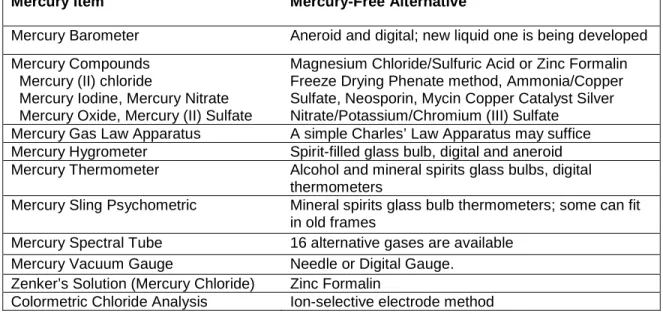
Table 1: Laboratory Alternatives to Mercury Use
Mercury Item Mercury-Free Alternative
Mercury Barometer Aneroid and digital; new liquid one is being developed Mercury Compounds
Mercury (II) chloride Mercury Iodine, Mercury Nitrate Mercury Oxide, Mercury (II) Sulfate
Magnesium Chloride/Sulfuric Acid or Zinc Formalin Freeze Drying Phenate method, Ammonia/Copper Sulfate, Neosporin, Mycin Copper Catalyst Silver Nitrate/Potassium/Chromium (III) Sulfate
Mercury Gas Law Apparatus A simple Charles’ Law Apparatus may suffice Mercury Hygrometer Spirit-filled glass bulb, digital and aneroid Mercury Thermometer Alcohol and mineral spirits glass bulbs, digital
thermometers
Mercury Sling Psychometric Mineral spirits glass bulb thermometers; some can fit in old frames
Mercury Spectral Tube 16 alternative gases are available Mercury Vacuum Gauge Needle or Digital Gauge.
Zenker’s Solution (Mercury Chloride) Zinc Formalin
Colormetric Chloride Analysis Ion-selective electrode method 3.1.1 Exchange Initiative
Eliminating even small amounts of mercury has a beneficial effect on the environment, and reduces the potential for human mercury poisoning. A mercury thermometer contains about 0.5-1.5 grams of mercury. One gram of mercury can contaminate a twenty-acre lake with enough mercury to cause public advisories (warnings) limiting the consumption of fish caught in the lake.
The University of Calgary is committed to eliminating non-essential uses of mercury and mercury-containing products. Removing mercury thermometers is a responsible action to protect the environment while continuing to serve the needs of the campus community. Mercury-free thermometers provide comparable accuracy and do not compromise teaching, research or patient care in any way. See 10.1.1 Mercury Thermometer Exchange Initiative Bulletin for more information.
See 10.1.2 Mercury Thermometer Exchange Formto exchange your mercury thermometers with mercury-free alternatives.
3.2 Risk Control
The University of Calgary recognizes that some research activities may require mercury use and handling. These activities must be conducted in accordance with the Code of Practice for Mercury-Containing materials or equipment in Research.
Principal Investigators are responsible for the identification and implementation of controls such as engineering, administrative and/or personal protective equipment to protect workers from mercury contamination. In accordance with the Code of Practice, a spill kit for mercury as well as written
procedures for mercury spill clean-up must be available. Supervisors must train workers on the hazards of mercury and the correct procedure to clean up mercury spills.
See 10.3 Code of Practice for Research Activities with Mercury
4.0 Emergency Spill Response Procedure
Mercury spills must be properly cleaned up because liquid mercury gives off toxic vapours under ambient conditions. Mercury vapours enter the body through the lungs where it may then be distributed throughout the body. As a result, mercury spills must be cleaned up as soon as possible.
See 10.1.3 Mercury Spill Kit Requirements and Procedures
*In the event of an accidental spill that occurs in a public area, on carpet, and/or in a large quantity, stop work and contact Environment, Health & Safety @ 220-5333.
5.0 Personal Protective Equipment (PPE)
Mercury vapours released from a broken thermometer do not present an immediate health hazard. Workers will not have to be evacuated from the room; however it is important to clean up a broken thermometer properly so that individuals in the area are not exposed to mercury vapours over a long period of time. Chemical safety goggles, chemical protective gloves, coveralls, boots, and/or other chemical protective clothing may be required.
If engineering controls and work practices are not effective in controlling exposure to this material, then suitable personal protection equipment, including approved respiratory protection, must be worn. Appropriate equipment must be available for use in emergencies such as spills or fire. NIOSH
recommends a chemical cartridge respirator to protect against mercury compounds for mercury vapour concentrations up to 0.5 mg/m3. Cartridges designed specifically for use around mercury are also available for supplier such as 3M.
6.0 Waste Transport & Disposal
All mercury and mercury contaminated materials must be disposed of and transported appropriately by Hazardous Materials Services in accordance with University of Calgary Hazardous Waste protocols and Transportation of Dangerous Goods (TDG) requirements.
Improper disposal of mercury and mercury contaminated items will affect the environment. Mercury that is placed in the regular garbage may be inadvertently released into the environment, either by incineration or landfill. Mercury can seep into the groundwater; mercury vapours can be released into the air.
In addition to the toxic hazards of mercury, there are also significant costs (often up to 10 times the original cost of the mercury item) for disposal and spill cleanup.
7.0 Documentation
Environment, Health & Safety will retain the current copy of the Mercury Abatement Program. A copy of the Mercury Abatement Program (including occupational exposure assessments) must be available to affected workers and government officers, on request.
8.0 Program Review and Audit
The goal of the program review is to continuously improve the Mercury Abatement Program.
Environment, Health & Safety will audit and review the program regularly. The evaluation will include a review of the written program, inventory records, safe work instructions, training (including record keeping), and the occupational hygiene assessments.
9.0 References and Additional Resources
Alberta Occupational Health & Safety Act, Regulation & Code http://employment.alberta.ca/SFW/307.html Canadian Centre for Occupational Health & Safety
http://www.ccohs.ca/oshanswers/chemicals/chem_profiles/mercury/
Health Care without Harm http://www.noharm.org/all_regions/issues/toxins/mercury/ Mercury in the Environment http://www.pollutionprobe.org/report/mercuryprimer.pdf University of Bristol, School of Chemistry, The Karen Wetterhahn Story
http://www.chm.bris.ac.uk/motm/dimethylmercury/dmmh.htm
University of Calgary Hazardous Materials Services http://www.ucalgary.ca/hazmat/ U.S. Environmental Protection Agency http://www.epa.gov/mercury/index.htm
10.0 Appendix
10.1 Communication and Information
10.1.1 Safety Bulletin – Mercury Thermometer Exchange Initiative 10.1.2 Mercury Thermometer Exchange Form
10.1.3 Safety Bulletin – Mercury Spill Clean-up Kit Requirements and Procedure 10.2 Code of Practice for Research Activities involving Mercury
Eliminating even small amounts of mercury has a beneficial effect on the environment, and reduces the potential for human mercury poisoning. A mercury thermometer contains about 0.5-1.5 grams of mercury. One gram of mercury can contaminate a twenty-acre lake with enough mercury to cause public advisories (warnings) limiting the consumption of fish caught in the lake.
The University of Calgary is committed to eliminating non-essential uses of mercury and mercury-containing products. Removing mercury thermometers is a responsible action to protect the environment while continuing to serve the needs of the campus community. Mercury-free thermometers provide comparable accuracy and do not compromise teaching, research or patient care in any way. MERCURY THERMOMETER EXCHANGE INITIATIVE
The Mercury Thermometer Exchange Initiative not only educates the University community about the environmental and public health effects of mercury, it also provides participants with the opportunity to be part of the solution to the mercury problem.
As part of the Mercury Exchange Initiative, only mercury thermometers in good condition can be exchanged. Mercury thermometers that are broken or unusable are not eligible for exchange. Broken thermometers must be disposed of appropriately in accordance with the University Hazardous Waste disposal procedures.
Mercury thermometers will be exchanged for mercury-free alternative thermometers as specified in the exchange ratio:
• 3 Mercury Thermometers FOR 1 Enviro-Safe Thermometer* • 5 Mercury Thermometers FOR 1 Digital Thermometer*
*The Mercury Thermometer Abatement form lists the choices available for mercury-free thermometer alternatives.
See 10.1.2 Mercury Thermometer Exchange Form
For all mercury thermometer exchanges a Mercury Thermometer Exchange form must be completed. Hazardous Materials Services must authorize and sign the mercury thermometers for disposal on the pick-up day. Laboratories can send in the attached form to Environment, Health & Safety via fax 282-1332 or interdepartmental mail. EH&S will exchange the mercury thermometers for the mercury-free alternatives as indicated.
Laboratories interested in participating in the mercury thermometer exchange program or that would like to pursue different options or alternatives are encouraged to contact Environment, Health & Safety at [email protected] .
10.1.1
MERCURY THERMOMETER EXCHANGE
INITIATIVE
Section: Hazard Identification and Risk Control Date of Issue: 2007.02.14
Issued By: Environment, Health &Safety
Part: Elimination Revision #: 01
Revision Date: 2013-01-21
Mercury thermometers will be exchanged for mercury-free alternative thermometers as specified in the exchange ratio:
• 3 Mercury Thermometers FOR 1 Enviro-Safe Thermometer* • 5 Mercury Thermometers FOR 1 Digital Thermometer* Mercury Free
Thermometers*
VWR Cat # Range Resolution Features Exchange Ratio ENVIRO-SAFE Thermometer (maximum 20/year) 89095-604 –10 to 260°C ±1°, ±1.5° above 105°C, ± 2° above 200°C Nontoxic liquid, NIST standard 3:1 LOLLIPOP DIGITAL Thermometer (maximum 10/year) 15551-004 -58 to 572oF (- 50oC to 300oC) 0.1o from -19.9 to 199.9o, otherwise 1o Waterproof, Shockproof, Certificate of Calibration 5:1
Hazmat Pickup Only:
HazMat Name: Phone Number: Date of Pick-up:
# of Mercury Thermometers (in good condition) disposed of: Comments:
Eligible for the following # of thermometers in accordance with the exchange ratio:
3:1 EnviroSafe: 5:1 Digital:
HazMat Signature: Laboratory Only:
# Mercury Free thermometers Desired in Exchange:
________ Enviro-Safe Thermometer(s) ________ Lollipop Digital Thermometer(s) Once HazMat has picked up, complete the above portion and fax (403-284-1332) or send via interdepartmental mail to Environment, Health & Safety.
Environment, Health & Safety only: Thermometers # of Mercury Thermometers Approved for Exchange (Total) #of Mercury Free Thermometers Given (Total)
Comments Date EH&S Initial
Enviro-Safe Lollipop Digital
10.1.2
MERCURY THERMOMETER EXCHANGE
FORM
Name: Date:
Bulding & Room #: Department:
Mercury spills must be properly cleaned up because the liquid mercury gives off toxic vapours under ambient conditions. Mercury vapours enter the body through the lungs where it may then be distributed throughout the body. Mercury spills must be cleaned up as soon as possible.
The amount of mercury vapours released from a broken thermometer does not present an immediate health hazard. Workers will not have to be evacuated from the room; however it is important to clean up a broken thermometer properly so that individuals in the area are not exposed to mercury vapours over a long period of time.
MERCURY SPILL KIT REQUIREMENTS • protective gloves,
• protective shoe covers,
• mercury suction pump or disposable pipettes to recover small droplets, • MerconVap™ liquid or equivalent decontaminant,
• sponge/rags/paper towels, • plastic trash bag/ziploc,
• sealed plastic vial with for recovered mercury.
Special mercury spill kits are available from a chemical supply companies. If a spill kit is purchased, follow the manufacturer's instructions.
MERCURY SPILL CLEAN UP PROCEDURES
1. Initial response, isolate the area. Wear protective gloves and shoe covers. (CAUTION: Mercury has a very strong affinity for gold. Removal of all gold rings before a mercury clean up is strongly advised!) Most mercury spills do not pose a high and immediate risk. Isolate the spill area with barricade tape to prevent foot traffic through the spill area.
2. All contaminated clothing and footwear must be removed and placed in a plastic bag for
permanent disposal. Contaminated clothing and footwear can spread the mercury around making the spill clean-up more difficult. Mercury-contaminated items cannot be washed in a washing machine since the mercury may contaminate the machine and/or pollute sewage.
3. If there are any broken pieces of glass or sharp objects, pick them up with tongs and with care. Place all broken objects on a paper towel. Fold the paper towel and place in a zip lock bag or plastic container with a lid.
4. Consolidate the larger pools and droplets of metallic mercury together. DO NOT use a broom to clean up mercury as it will break the mercury into smaller droplets and spread them. Pick up the pool with a Pasteur pipette or a mercury suction pump. For small droplets, use commercial mercury spill sponges or Mercon Vap™.
5. If mercury has spilled down a drain, isolate the sink by placing an out of order sign on it. Contact Campus Infrastructure for a plumber to be dispatched to check the sink drain and plumbing. Mercury may lodge in the plumbing and can cause future problems. If discharged, it can cause
10.1.3
MERCURY SPILL CLEAN UP KIT AND
PROCEDURE
Section: Rules and Procedures Date of Issue: 2007.02.14
Issued By: Environment, Health &Safety
Part: Procedures Revision #: 01
Revision Date: 2012-05-09
7. To check for missed drops of mercury, turn off the lights in the laboratory and with a flashlight shine the light in the area of the spill. Any remaining drops of mercury will shine brightly. 8. After the liquid mercury has been picked up decontaminate all surfaces with an appropriate kit. 9. If a mercury thermometer snaps in two and the bulb is intact, dispose of the thermometer as
hazardous waste. All mercury waste, contaminated items and materials used in the clean-up (including gloves) must be disposed of appropriately as hazardous waste through Hazardous Materials Services.
For large volume mercury spills, the University of Calgary has a special mercury vacuum available for use (DO NOT use a regular vacuum as it will redistribute mercury into the air and increase exposure).
Vacuum all areas where mercury was spilled paying particular attention to corners, cracks, depressions and creases in flooring or table tops. Call Environment, Health & Safety (403-220-6345) for the mercury vacuum to be delivered or picked up.
*In the event of an accidental spill that occurs in a public area, on carpet, and/or of a large quantity, stop work and contact Environment, Health & Safety @ 403-220-5333.
The following elements are required for the selection, use, care and maintenance of research materials and equipment containing mercury.
RESPONSIBILITIES
Environment, Health & Safety (EH&S) is a resource for all members of the University community for any matters concerning health, safety and the environment at the. EH&S is the liaison between supervisors and the regulators and can provide the current information needed to keep in compliance with the appropriate legislation.
Supervisors must implement a hazard control plan in work areas that informs and trains workers concerning the hazards that are present in the area; retain training records and all documentation; implement the rules and standards of the University of Calgary and the Alberta Occupational Health and Safety Act, Regulation & Code; and ensure the availability and proper use of appropriate personal protective equipment and relevant health and safety reference materials.
Workers must follow all health and safety standards, rules and regulations, report all hazardous conditions to the supervisor immediately and wear or use prescribed protective equipment. TRAINING
All workers must have documented safe work instruction from their supervisor on the hazards of mercury, control measures and how to clean up mercury spills if they occur. The documentation must be retained for possible inspection.
HAZARD COMMUNICATION AND HAZARD ASSESSMENT
Mercury is very toxic (inhalation, skin absorption, sensitizer, reproductive hazard). Mercury is also very corrosive. When mercury is exposed to air, it gives off vapors that, under some circumstances, can build up in indoor air at high enough concentrations to pose health risks to occupants. Air vapors from spilled mercury can also eventually settle onto water, increasing the mercury levels in fish. Therefore, it is important to clean up mercury spills properly and to report them to EH&S and/or your supervisor. During a mercury spill, the mercury breaks into tiny beads that roll, and can easily become trapped in small cracks in the surface. A mercury spill can be cleaned with minimal effort, if the proper instructions are followed.
See 10.1.2 Safety Bulletin Mercury Spill Kit Requirements and Clean Up Procedures
The supervisor must provide support and training to anyone who handles mercury or cleans up mercury spills. The supervisor must also provide appropriate controls, personal protective equipment (PPE) and protective clothing to protect the worker from mercury exposure.
10.2
CODE OF PRACTICE
FOR
RESEARCH ACTIVITIES INVOLVING MERCURY
Section: Hazard Identification and Risk Control Date of Issue: 2007.02.14
Issued By: Environment, Health &Safety
Part: Risk Control Revision #: 01
Revision Date: 2012-05-09
ELIMINATION AND CONTROL MEASURES
All reasonable efforts must be made to use elimination/substitution and/or other controls to reduce exposure to mercury.
Before handling and using mercury, it is important that engineering controls (fumehood and local exhaust systems) are operating effectively. Follow appropriate handling precautions as indicated on the Material Safety Data Sheet. Personal protective equipment requirements and appropriate personal hygiene must also be followed.
Workers must be trained properly on the hazards of mercury and its safe use. Unprotected persons should avoid all contact with mercury including contaminated equipment. Maintenance and emergency personnel should be advised of potential hazards.
Aviod generating mercury vapours and mists. Prevent the release of vapour into the air. Use the smallest possible amounts in an area with local exhaust ventilation. When handling large quantities, closed handling systems should be used.
Do not heat mercury in other than a closed system. Mercury thermometers should not be used in ovens or hot water baths; alternative thermometers, alcohol or digital, should be used instead.
See 10.1.1 Mercury Thermometer Exchange Initiative
Do not use mercury with incompatible materials such as oxidizing agents. Never return contaminated material into its original container. Use work surfaces that can easily be decontaminated.
DEFINITIONS
Hazard – means a situation, condition, process, material or thing that may be cause of an injury or illness to a worker.
Supervisor – means the individual that directs or oversees a person, group, department, organization, or operation from the University of Calgary.
Worker – means any person engaged in work at the University of Calgary, including employees, contracted workers, volunteers, and graduate students.
REFERENCES
Alberta Occupational Health & Safety Act, Regulations & Code http://employment.alberta.ca/SFW/307.html