Package-Based Software Development
Merijn de Jonge
Department of Mathematics and Computer Science,
Eindhoven University of Technology, P.O. Box 513,
5600 MB Eindhoven, The Netherlands
[email protected]
Abstract
The main goal of component-based software engineering is to decrease development time and development costs of software systems, by reusing prefabricated building blocks. In this paper we focus on software reuse within the im-plementation of such component-based applications, and on the corresponding software development process. As it turns out, achieving effective reuse practice between the components of a single application and between the com-ponents of multiple applications has serious effects on the complexity of the software development process.
While software reuse demands for separation (of reusable blocks), the software development process de-mands for integration. Consequently, achieving optimal software reuse practice and an efficient development pro-cess are goals that seem hard to unite.
In this paper we discuss how these goals can be com-bined. We propose techniques that promote fine-grained software reuse across system, group, and institute bound-aries, as well as integrated development of component compositions. The paper describes these techniques and demonstrates how they can be used in practice.
1
Introduction
Component-based software engineering (CBSE) aims at accelerating software development and decreasing devel-opment costs, by building software systems from prefabri-cated building blocks (components). According to the def-inition of Szyperski [16], components are binary, indepen-dently deployable building blocks, that can be composed by third parties. At the heart of CBSE lies software reuse, i.e., the use of existing artifacts for the construction of software. In this paper we focus on the implementation and de-velopment process of such components. The central ques-tion is: how to establish effective reuse practice between the components of component-based software systems?
The goal of our research is to develop techniques that can improve the practice of software reuse within the com-ponents that form component-based systems. We are not only interested in software reuse within a single applica-tion, but (especially) in software reuse across distinct ap-plications. Furthermore, we are interested in extending the reuse scope from single product/group reuse to multi prod-uct/group reuse, crossing organization boundaries.
Improving reuse practice demands fine-grained reuse [9]. That is, if a component contains potential reusable functionality, then that functionality should not be combined with other functionality, but constitute a separate reusable component. Composition with other functionality should be delayed in the development process. Thus, from a reuse perspective: ‘composition comes last’.
However, as we will see in Section 2, the complexity of the development process of a software system increases with the number of components involved. Typical ment tasks, such as integration testing, combined develop-ment of different parts of a system (i.e., crosscutting devel-opment), and software building, then become complicated activities. Obviously, the software development process benefits from a small number of components, each offering much functionality. Thus, from a development perspective: ‘composition comes first’.
Both contradicting demands make achieving an opti-mal reuse practice hard, because, with current development techniques, they cannot be combined. This paper offers techniques that combine fine-grained software reuse and integrated component development. As a result, software reuse is promoted due to many small-sized components, without affecting the software development process, which still permits components to be developed together, rather than in isolation.
The key ingredients of our approach are: i) source tree composition, a technique to assemble the source modules of components, and ii) integrated package development, which allows multiple components to be developed simultane-ously in the context of different component-based software
systems. These techniques together form an instantiation of the CBSE paradigm, which we called called ‘package-based software development’.
The paper is structured as follows. In Section 2 we mo-tivate the need for package-based software development. In Section 3 we describe the ideas and concepts of source tree composition. In Section 4 we address automated source tree composition. In Section 5 we discuss the package develop-ment cycle, and we explain how developdevelop-ment of multiple packages can be combined. In Section 7 we demonstrate how package-based software development works in prac-tice. Finally, in Section 8 we summarize our approach and discuss related work.
2
Motivation
The implementation of a software system is most often contained in a set of source files, which are structured in a directory hierarchy. It is common practice to use a Software Configuration Management (SCM) system to keep track of changes made to these files, and to manage different varia-tions of the software system. This structuring of source files in directories, and the use of SCM systems during develop-ment, influences the reusability of software, as well as the complexity of the software development process. Below we will discuss these effects.
Software development is simplified when the develop-ment processes of the subparts of a software system are integrated, rather than isolated. This is because activities like testing, debugging, software building, and configura-tion management do not need to be performed separately for each subsystem, but can be performed on a complete system. Structuring the implementation of all subsystems in a single directory hierarchy (using a single SCM system) is therefore usually the preferred approach when developing a software system.
However, a source file that is contained in one directory hierarchy is difficult to reuse in another, without having to reuse all files contained in that directory hierarchy. For soft-ware reuse it is therefore preferable to organize all reusable parts separately. This reduces coupling between parts re-sulting from implicit dependencies (such as directory refer-ences) and from tangling of subsystems (for instance due to combined build actions and compile-time configuration).
If, for the sake of reuse, the implementation of a system is structured in separate directory hierarchies (using multi-ple SCM systems), the development process gets compli-cated. For instance, how can we easily run integration tests after making a change in some of these hierarchies? How to apply and keep track of changes across these hierarchies (so called crosscutting changes)? How to keep track of which source files constitute a system? How to build/compile the system from its source files?
Things get more complicated if we consider developing multiple software systems. How to prevent that a system breaks when some shared source files are being developed for the sake of another system? How to assemble, build, and test an arbitrary number of systems? How to define the exact ingredients of each software system? How to manage different versions of source files effectively?
Reuse across group and institute boundaries further com-plicate the software development process. How to develop source files simultaneously by different groups? How to reuse source files without access to a SCM system? How to assemble systems when their ingredients are spread across multiple organizations? How to assemble systems from source files, developed at different institutes using different development tools?
Thus, reuse across system, group, and institute bound-aries, complicates the development process of component-based systems significantly. On the one hand, this is be-cause it demands that the implementation is organized in separate directory hierarchies, on the other hand because it requires organizational flexibility in structuring SCM sys-tems and in providing access to source files.
Package-based software development strives to improve this situation by: i) introducing the notion of source code components (i.e., building blocks at the source code level in the form of directory hierarchies); ii) using source tree com-position as accompanying comcom-position technique, which merges multiple source code components into single di-rectory hierarchies; iii) distinguishing deployment and de-velopment mode of components; iv) proposing an explicit release management for deployed components; v) allow-ing combined development of components in development mode vi) allowing multiple SCM systems to be jointly used. The main effects of these techniques are that i) fine-grained software reuse is promoted; ii) development of components can take place in the context of real software systems; iii) multiple SCM systems can be jointly used, wherever they are located; and iv) access to a SCM system is only required when developing a component.
3
Source tree composition
Source tree composition [8] is a key ingredient of package-based software development. In this section we discuss techniques and concepts of source tree composition.
3.1
Description
We define a source tree as a directory hierarchy taining all source files of a software (sub) system. It con-tains implementation files, files containing build instruc-tions (such as Makefiles), configuration files (such as Au-toconfconfiguration scripts), documentation etc.
We define a source code component as a source tree with a standardized build interface and a standardized configu-ration interface. A build interface defines the steps needed to build/compile the component. A configuration interface defines compile-time variability of the component.
Source tree composition is a systematic technique to assemble source trees from reusable source components. Source tree composition yields a self-contained source tree, with integrated build and configuration processes (we call this a software bundle). Self-containteness of a source tree means that all required source code is included. That is, the reused source components are included, as well as the source components that are required by them. The inte-grated build and configuration processes serve to combine the individual build/configuration processes of all included components. Hence, it requires only a single build action to build all the individual components together. Likewise, configuration of the complete system is driven by a single configuration process.
The primary goal of source tree composition is to pro-mote source code reuse. This is achieved by:
Combining the advantages of separate components (reuse) and of monolithic components (ease of use). Source tree composition provides a systematic way of assembling (small) reusable components to form large software systems. On the one hand, the reused compo-nents remain reusable outside the system, on the other hand, the system can be managed as a unit (i.e., system configuration, building, and deployment can be per-formed for the complete system, rather then for com-ponents individually).
Promoting fine-grained software reuse. By mak-ing it easy to manage large amounts of components, source tree composition promotes development of small reusable components, which, in turn, help to pre-vent code duplication [9].
Promoting collaborative software development. By making it easy to integrate third-party software, devel-oping software collaboratively becomes more attrac-tive. Standardized build and configuration interfaces, and a systematic composition technique help to ac-complish this.
Explicitly defined software dependencies. Source tree composition requires that dependencies between source code components are defined explicitly (see be-low). This prevents entangling of source components and therefore increases a component’s reusability. Being portable across SCM systems. In practice, software is often entangled in a specific SCM sys-tem [14, 1]). Standardized build and configuration
in-terfaces, and packages as unit of distribution (see be-low) help to increase a component’s reusability by re-moving such dependencies.
3.2
Concepts
Source tree composition is a technique to integrate source files, build processes, and configuration processes. Below we will discuss the concepts that lie at the heart of source tree composition.
Build interface Source tree composition requires that components implement a standardized build interface, con-sisting of build actions. Build actions include actions for compilation (all), installation (install), and packag-ing (dist). Not surprisingly, these actions easily map to make [6] targets. The purpose of a build interface is to stan-dardize the process of software building to a fixed sequence of build actions. Source tree composition constructs a build process that integrates the build processes of all components in a bundle. This makes building the system as easy as building a single component. A composite build process is formed by composing the build actions for the constituent components sequentially.
Configuration interface A source component has a stan-dardized configuration interface. The purpose of this inter-face is to reduce the configuration effort of multiple com-ponents by making configuration a uniform activity. A con-figuration interface consists of concon-figuration parameters, which may either be dependency parameters, or variabil-ity parameters. Dependency parameters serve to explicitly define component dependencies (see below). Variability pa-rameters serve to bind compile-time variability of a compo-nent. Configuration parameters can either be bound during source tree composition, or at compile-time.
Component dependencies Source code components may depend on other source components. Source tree composi-tion requires that such dependencies are defined explicitly via configuration interfaces. For instance, if a component A requires (reuses) another component B, then A’s configu-ration interface should contain a dependency parameter for component B. This parameter can be bound during source tree composition, in case B is integrated in the composite source tree, or at compile-time otherwise. Part of source tree composition is calculating the transitive closure of all reused source components. This results in a dependency graph, depicting all needed source code components (rep-resented as nodes), and all reuse relations (rep(rep-resented as edges). If a dependency cannot be resolved, a dependency parameter is added to the configuration interface of the bun-dle, which can be bound at compile-time
package identification name=autobundle version=0.5 location=http://www.cwi.nl/˜mdejonge/downloads/ info=http://www.cwi.nl/˜mdejonge/autobundle/ description=’automated source tree composition’
keywords=reuse, component-based, composition configuration interface
debug ’toggle debug support’ requires
stratego 0.7.1 with optimization=speed gpp 2.3
sglr 3.7 graphviz 1.8.6
Figure 1. An example package definition
Build order Due to component dependencies, the build order of a composite source tree is significant. That is, a component cannot be built unless all components it depends on have been built. Consequently, software building can-not be performed in arbitrary order. A dependency graph contains all information about component dependencies. It therefore serves to determine the proper build order, by ar-ranging the nodes in the graph linearly during a bottom-up traversal. The composite build process that is constructed as part of source tree composition respects this order.
Component configuration If a source code component reuses another, it may enforce a particular configuration of the reused component. This way a component can be adapted for specific needs. This is accomplished by binding (some of) the parameters of a component’s configuration interface. Since a single component can be reused by multi-ple components, multimulti-ple parameter bindings may exist for a single component. As part of source tree composition, all bindings for each component are collected and combined to form a (partial) configuration of a component. Parameters that remain unbound become part of the configuration inter-face of the composite source tree. These can then be bound at compile-time.
Source code packages A source code package is a ver-sioned release of a source code component. To promote reuse across institute boundaries we propose source code packages as unit of distribution because: i) they are not de-pendent on an SCM system and therefore easily reusable in different organizations; ii) thanks to versioning, different versions of a component can be distinguished and can co-exist. Therefore, source tree composition uses packages as unit of reuse. That is, source trees are assembled from the source components that are packed in source packages.
Package definitions Characteristics of source packages are captured in package definitions (see Figure 1). A pack-age definition contains sections that describe a packpack-age.
The ‘identification’ section defines the name and version of the package, specifies the location where the package can be downloaded, and briefly describes the package by way of a short description and a list of keywords. This section also contains a URL to documentation about the package.
The ‘configuration interface’ section defines variability parameters. For instance, the package definition in Figure 1, defines the variability parameter ‘debug’ that can be bound to ‘on’ or ‘off’ to toggle generation of debug information.
The ‘requires’ section defines package dependencies, which correspond to reuse relations. The dependencies de-fined in this section constitute the dependency parameters of a component’s configuration interface. Dependencies are expressed as a triple containing: i) the name of the required package, ii) its version number, and iii) a possible empty list of configuration parameter bindings. For instance, the autobundle package of Figure 1 reuses amongst others, ver-sion 0.7.1 of the stratego package. The autobundle package enforces a special configuration of this package by binding the configuration parameter ‘optimization’ to ‘speed’.
4
Automated source tree composition
Source tree composition can be automated, such that, af-ter selecting packages of need, a composite source tree is generated from these selected packages and those that are required by them.
4.1
Autobundle
We implemented source tree composition in the tool au-tobundle. This tool produces a software bundle contain-ing a top-level configuration and build procedure, and a list of bundled packages with download locations.
The generated bundle does not contain the source trees of individual packages yet, but rather the toolcollectthat can collect the packages and integrate them in the generated bundle automatically. To obtain and integrate the software packages, the generated build interface of a bundle contains the build action collectto download and integrate the source trees of all packages.
The generated bundle is driven by make [6] and of-fers a standardized build interface. The build interface and corresponding build instructions are generated by auto-conf [10] and automake [11]. The tool autoconf
generates software configuration scripts and standardizes compile-time software configuration. The toolautomake
provides a standardized set of build actions by generating Makefiles from abstract build process descriptions. Cur-rently we require that these tools are also used by bundled
packages, but they are not essential for the concept of source tree composition.
After the packages are automatically collected and inte-grated, the top-level build and configuration processes take care of building and configuring the individual components in the correct order.
4.2
Package repositories
Given a set of packages,autobundlesynthesizes the transitive closure of all needed packages, yielding a depen-dency graph (see Section 3). The dependepen-dency graph is con-structed according to the information contained in package definitions. In order forautobundleto be able to access package definitions, they are stored in central places, called package repositories.
A package repository is a collection of package defini-tions. Wheneverautobundleencounters a package de-pendency (i.e., for each entry in the ‘requires’ section of a package definition), it accesses the package repository to read the package definition for that package.
There is no restriction on the number of package reposi-tories to be used. If multiple reposireposi-tories are used, they can be ordered using a package search path. This path defines the order in whichautobundlesearches package reposi-tories. It enablesautobundleto unambiguously select a package definition, in case duplicates exist.
Observe that a package repository defines an explicit reuse scope (i.e., every package for which the package def-inition can be accessed byautobundleis a candidate for reuse). The use of multiple package repositories allows a precise definition of the reuse scope. For instance, it al-lows to define reuse scopes for world-wide, institute-wide, or group-wide software reuse.
4.3
Online package bases
The package definitions in a package repository also serve to generate web-forms for online package selection and package querying from. These generated web-forms are called online package bases.1
From an online package base, a composite source tree can be obtained by first selecting the packages of need, and then pressing the ‘bundle’ button. Pressing this button instructsautobundle to produce the intended software bundle as a gzipped tar file.
Online package bases also serve to easily select partic-ular package versions, to view package definitions, and to inspect dependency graphs. The latter are generated on re-quest for arbitrary component compositions.
1For an example, see the Online Package Base, which is located at
http://www.cwi.nl/˜mdejonge/package-base.
5
Integrated package development
Automated source tree composition simplifies assem-bling software systems from individual source code com-ponents. It yields composite source trees containing the complete implementation of a system, as well as integrated build and configuration processes. These composite source trees are now ready for deployment: they can be packaged, transfered to a target machine, installed, and used.
Thus, thanks to source tree composition, a composite software system can be handled as a unit at deployment time. In this section we describe how a composition of components can also be handled as a unit at development time. As we already pointed out in Section 2, this would im-prove development practice of component-based software systems. This is because the development—integration— test cycle is shortened, crosscutting development is permit-ted, system-wide development (within development envi-ronment) is allowed, and, in case of simultaneous develop-ment of a component in multiple systems, inconsistencies can be signaled soon.
5.1
Package development cycle
Recall from Section 3, that a source code package is a unit of reuse. It is a versioned release of a piece of source code, together with a build and configuration process. Pack-ages can be developed, maintained, and released individu-ally. They are independent of a particular SCM system, and can be developed by different groups at different institutes. The development cycle of an individually developed source code package can be characterized as follows:
1. Make the desired changes to a source code package; 2. Test the changed implementation (this can can be seen
as a form of unit testing);
3. On success, increase the package’s version number; 4. Release the changed package.
From this development cycle, we see that it does not include integration testing. That is, packages are tested in isolation, not in the context of a software system. If we do consider integration testing in a systematic way, source tree compo-sition can be used as part of an extended development cycle: 5. Select the packages that form a target software system; 6. Bundle the selected packages and those that are
re-quired by them withautobundle; 7. Unpack the generated software bundle;
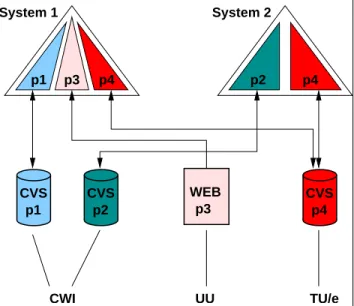
CVS CVS p2 CVS p1 p4 p3 p4 UU p2 p4 p1 System 1 System 2 TU/e CWI WEB p3
Figure 2. An example of package develop-ment in two distinct software systems.
9. Configure it using the generated configuration process; 10. Build the bundle using the generated build process; 11. Test the application to see whether the changed
pack-age functions as intended.
If multiple packages are developed simultaneously, steps 1– 4 have to be performed for each of them. Steps 5–11 have to be executed for integration testing whenever one or more packages have changed.
Observe that, assuming an SCM system is in use, changes cannot be made to the composite system. This is because the composite system is assembled from source code packages only, which (by definition) are independent of an SCM system. Consequently, if integration fails, indi-vidual packages have to be modified in isolation again, by reiterating the development cycle at step 1.
The above clearly demonstrates that having truly reusable source code packages seriously complicates the de-velopment process of component-based applications.
5.2
Integrated package development cycle
The previous section demonstrated that the package de-velopment cycle, as a consequence of having truly reusable source code components, is too complex. Even with the help of automated source tree composition, which auto-mates software assembly, the development cycle is not very practical. What’s more, one could argue that integration testing should not be performed after package release, as we suggested in Section 5.1, but before. This suggests that
the presented development cycle is not only complex, but also has serious deficiencies.
To improve this situation, we propose to collapse the de-velopment cycle of individual packages, and to integrate them in steps 5–11. That is, we propose integrated devel-opment of individual source code packages in the context of composite software systems. In the perspective of soft-ware developers, this implies that package boundaries be-come less visible, enabling transparent development across package boundaries.
Integration of package development cycles should fulfill the following requirements:
Integration should preserve component structure. That is, although less visible for a developer, the structure in source components remains existent;
Integrating multiple SCM systems should be possible; Easy switching between development and deployment of packages should be supported (see below);
Collaborative software development (by multiple groups or institutes) should be supported;
Ability to simultaneously develop a source code com-ponent in multiple software systems.
Figure 2 shows an example of integrated package develop-ment. This figure shows two systems composed of 4 dif-ferent source code components (p1–p4). The components p1, p2, and p4 are obtained from an SCM system (CVS in this example). They are being developed in the context of system 1 and system 2. Component p4 is developed simul-taneously in the context of both systems. System 1 also contains component p3 in the form of a released package that is obtained from a web-site. The components are devel-oped at three different institutes (CWI, UU, and TU/e). The CWI components are developed by two different groups, each having a separate SCM system.
The key ideas of our approach can be summarized as: Components can be developed/maintained in the con-text of a (real) software system. For instance, p1, p3, and p4 are under development. They can be developed and tested in the context of system 1 and system 2; Component development and deployment can be com-bined. For instance, p1 and p4 in system 1 are under development, while p3 is being deployed;
One can easily switch between component develop-ment and component deploydevelop-ment. Once made our changes to p1, verified that it operates correctly, we can release it, and use (i.e., deploy) the freshly released version. On the other hand, if p3 also needs modifi-cation, we switch to development mode, and obtain a version from its corresponding SCM system;
Crosscutting development is easy. Because p1, p3, and p4 are under development, and merged in a single source tree, a developer can easily make changes any-where in these components. Once he is done, changes are automatically committed to the right SCM system; Components can be developed simultaneously in the context of different systems. For instance, p4 is being developed in the context of both systems. If changes are made in the context of system 1, they also become available in the context of system 2. If a change to the shared component p4 in the context of system 1 breaks system 2, this can soon be discovered and solved. Such inconsistencies might be discovered much later if com-ponents were developed in isolation;
Collaborative software development is promoted. Software systems can be assembled from packages originating from multiple SCM systems, located at dif-ferent institutes. Third party software, for which no ac-cess to the corresponding SCM system exists, can also be integrated in the form of released packages.
6
Implementation
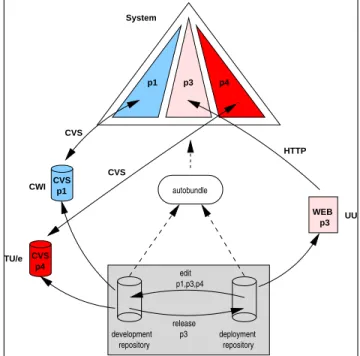
In order to integrate the package development cycles of multiple packages, we need to be able to assemble compos-ite source trees from individual source packages, which may be obtained from a web site or from an SCM system. The packages may be located at different institutes and in dif-ferent SCM systems. Clearly, this is a form of source tree composition which can be performed byautobundle. To that end, we made use of several special features of source tree composition/autobundle, and we made a small ex-tension to the package definition format. In addition, we de-veloped two extra tools for switching between development and deployment mode. These features, the modified pack-age definition format, and the two additional tools are dis-cussed below. Figure 3 shows the architecture for package-based software development, whereautobundleis used to integrate package development cycles.
Supporting multiple download protocols In order to combine component deployment (by downloading pack-ages from Internet), and component development (by ob-taining the sources of a package from an SCM system, we need to support different download protocols. The standard download protocol used byautobundle, is theHTTP pro-tocol. It is intended for component deployment, and can be specified in the location field of a package definition:
location=http://www.cwi.nl/package-base
In addition to theHTTP protocolautobundlealso sup-ports theCVS[2] protocol. This is used for component de-velopment by obtaining sources files from aCVSrepository:
WEB p3 CVS p4 CVS p1 TU/e UU p3 repository CWI release autobundle edit p3 p4 p1 p1,p3,p4 System CVS CVS HTTP development deployment repository
Figure 3. Architecture for integrated package development with autobundle.
location=cvs://cvs.cwi.nl/cvs-repository
The collecttool (see Section 3), that is used to obtain and integrate the sources of a software bundle, interprets these entries, and, depending on the protocol, downloads a package from the web, or performs a ‘checkout’ of a head revision of aCVSrepository.
It is not difficult to add support for additional protocols. Only a change to the tool collectis required. For in-stance, we recently added support for SubVersion [5] (the successor of CVS).
Multiple download locations To support component de-velopment as well as component deployment, autobun-dleneeds to know the location of a package’s SCM system (for development) and its download location (for deploy-ment). In order to be able to switch between component development and component deployment, both download locations have to be captured in a package definition. To that end, we slightly extended the syntax of package def-initions and introduced the notion of ‘primary’ and ‘sec-ondary’ package locations:
location
primary=http://www.cwi.nl/package-base secondary=cvs://cvs.cwi.nl/CVS
If a component is used (deployed), the primary location field points to the HTTP location, while the secondary lo-cation field points to the SCM system. If a component is
being developed, both fields are swapped: the primary field now points to the SCM system, the secondary points to the
HTTPlocation.
Package search path As we already pointed out in Sec-tion 3, autobundlecan use multiple package reposito-ries. The list of repositories that autobundlesearches for package definitions is called the ‘package search path’.
In order to switch between component deployment and component development, we will use (at least) two pack-age repositories (see Figure 3).2 The first package
repos-itory contains ordinary package definitions for component deployment. We call it the ‘deployment (package) repos-itory’. The second repository has highest priority and is used to store package definitions for packages under devel-opment. It is called the ‘development (package) repository’. Since the development repository has highest priority,
autobundlewill search that repository first when look-ing for package definitions. Before switchlook-ing to develop-ment mode, a package definition is copied from the deploy-ment repository to the developdeploy-ment repository, and both lo-cation fields in the package definition are swapped. When switching back to deployment mode, the package definition from the development repository is removed. However, if the package is released, the package definition is moved back to the deployment repository, after updating version information and swapping the location fields.
Observe that the deployment repository is only modified due to package releases. This repository may therefore be globally accessible and be used by multiple people/projects. The development repository however, is modified as a re-sult of package development. This repository thus contains state information (which packages are under development), which makes it developer-specific. It should therefore be stored in a private location.
Tool integration We have shown how source tree com-position can be used to integrate the development cycle of multiple packages. The toolautobundleis used to merge source trees contained in source packages. Two package repositories are used to store package definitions for deployed packages as well as for packages under devel-opment. Thecollecttool is used to obtain a component from Internet or from an SCM system. Finally,CVSis used bycollectto obtain a package from aCVSrepository.
With these tools, a developer can switch between devel-opment and deployment mode of components. To make switching more easy, we integrated these tools in two addi-tional tools. The first tool (edit) turns a number of pack-ages into development mode. The second tool (release) turns packages into deployment mode.
2More repositories can be used if desired (see Section 4.2), but in this paper we only consider two package repositories.
The edit tool puts a given set of packages into de-velopment mode by obtaining a head revision of the pack-ages from the correspondingCVSrepositories. To that end,
editperforms the following tasks: i) it copies the pack-age definitions to the development packpack-age repository; ii) it swaps the values of the two location fields in each package definition; iii) it removes the packages from the composite source tree; iv) it uses autobundle to obtain a new bundle based on the development packages; v) it uses collect
to obtain the sources of the packages that are now under development from the correspondingCVSrepositories.
Uncommitted changes from a previous development cy-cle are saved in a copy of a previously checked-out version (see below). If such a copy exists,collectwill restore it and merges any changes that have been made ever since.
Thereleasetool switches a set of packages into de-ployment mode. It performs the following actions. i) if not all changes to a package were committed to the SCM system, it makes a copy of the checked-out version, and checks a fresh version out (this ensures that only committed changes go into a new release, but also that uncommitted changes will not be lost); ii) it increases the version number of the package; iii) it makes a new distribution of the pack-age; iv) it releases the package by uploading it to theHTTP
location; v) it moves the package definition from the devel-opment to the deployment repository; vi) it uses autobundle to obtain a new bundle based on the deployment packages; v) it usescollectto obtain the sources of the packages from theirHTTP locations.
Observe that it is possible to change a package to devel-opment mode at any time. If changes were made to a pack-age, these are saved in a copy of the checked-out version before unpacking a released package.
7
Package development: an example
Figure 3 depicts integrated package development with
autobundle, the deployment and development reposito-ries, and the toolseditandrelease. Below we describe the development cycles that are depicted in the figure.
We start by configuring a package search path using the environment variable PACKAGE SEARCH PATH. Un-der Unix that can be done with
> PACKAGE_SEARCH_PATH=\ ${HOME}/cvs-packages:\ /opt/package-base
> export PACKAGE_SEARCH_PATH
Here we use $ HOME /cvs-packages as development repository and/opt/package-baseas deployment repos-itory. Theautobundletool is then used to assemble the initial system (System 1 in Figure 2).
This command creates a software bundle from the pack-age p1, and the packpack-ages p3 and p4, which are re-quired by p1. Initially, the development repository
$ HOME /cvs-packages is empty. Hence, the bundle only contains deployed packages usingcollect.
The next step is to obtain and integrate the sources of these packages.
> ./collect
Obtaining a distribution of "p1" via HTTP Obtaining a distribution of "p3" via HTTP Obtaining a distribution of "p4" via HTTP
This yields a composite source tree and an integrated build environment for the three packages. Configuring, building, and testing of the composite system can, thanks to the gen-erated build environment, be performed for the system as a whole, rather than for the packages separately.
Now suppose that we want to develop this system and that we need to make a crosscutting change in all three pack-ages. To that end, we use theedittool to turn these pack-ages into development mode.
> edit p1 p3 p4 Obtaining p1 from CVS Obtaining p3 from CVS Obtaining p4 from CVS
As a result of this command, the packages are now obtained from CVS. For instance, if the package definition for p1
contains ‘cvs.cwi.nl:/CVS’ as location field, then the source code of p1 is obtained by running the command
cvs -d cvs.cwi.nl:/CVS checkout p1
Now that we have obtained the source code for the three packages, we can start developing by editing the source code anywhere in he composite source tree. All ordinary
CVScommands can be used in the root of the source tree, or in any subdirectory in order to commit changes, incorporate changes made by others, undo changes etc. For instance, suppose that file ‘f.c’ in package p3 is modified by another developer. We can merge his changes into the composite source tree by issuing the command:
> cvs update
cvs update: Updating p1 cvs update: Updating p3 U p3/f.c
cvs update: Updating p4
This example shows that a developer can manage the source tree as a unit, while in fact he is operating on three compo-nents hosted in (possibly) three distinct CVS repositories. All CVS commands work by accessing the specific CVS
repository that hosts a particular package. Hence, the struc-ture in packages remains in tact, although developers can make changes easily anywhere across package boundaries. Furthermore, since we have all source at our disposal, de-velopment tools can be used for system-wide dede-velopment.
For instance, an integrated development environment can be used for doing the actual development; integration tests and code analysis can be performed on the system as a whole.
After the changes to a package have been made and have been committed to theCVS repository, the package can be released with thereleasecommand. For instance, to re-lease the package p3, we can issue the command
> release p3
Obtaining a distribution of "p3" via HTTP
This command will check whether all changes made to p3 have been committed. If not, a copy of the checked-out ver-sion is saved and a fresh verver-sion is obtained from theCVS
repository. This is because a release should only contain committed changes, but uncommitted modifications must not be thrown away. As pointed out earlier, therelease
command then makes a new release of the package and re-places the checked-out version by the new created release. This yields the situation as depicted in Figure 3, where p1 and p4 are being developed, while p3 is being deployed. As a consequence, changes made afterwards to p3 will no longer be committed to theCVSrepository, because p3 is in deployment mode now.
If, after release, the development of p3 continues, the
edit command is used again to switch to development mode. If a copy exists of a checked-out version of p3, due to uncommitted changes at a previous development cycle, it will be restored byedit. This copy is brought up-to-date by merging in the changes made to p3 after the copy was made. Thus, the uncommitted changes to p3 are not lost, and development of p3 can continue after releasing p3.
8
Concluding remarks
This paper addresses the software development process of component-based software systems as well as the prac-tice of software reuse within the implementation of such systems. We argued that, software reuse practice affects the complexity of the software development process because of contradicting demands: while software reuse demands for separation of reusable artifacts (i.e., composition comes last), the development process demands for their integration (i.e., composition comes first).
Contributions In order to combine effective software reuse practice and efficient software development, we pro-posed package-based software development. Package-based software development introduces the notion of implementation-level components, called source code com-ponents, which are distributed in the form of SCM system-independent packages. Source code components help to im-prove reuse practice, because they offer a disciplined way to structure reusable functionality in fine-grained reusable
components. We proposed source tree composition as ac-companying composition technique. It serves to assemble single directory hierarchies containing the full implemen-tation of component-based systems. Source tree composi-tion therefore offers the ability to benefit from integrated development of component compositions. To allow reuse across system, group, and institute boundaries, we extended source tree composition to support integration of multiple SCM systems, and combined development and deployment of source components. This allows for an integrated pack-age development cycle of packpack-ages hosted at distinct SCM systems in the context of different software systems.
Discussion Package-based software development and the tools that support it, are still subject of research. Conse-quently, they suffer from several limitation, most notably: i) multiple types of SCM systems (for instance CVS and
SUBVERSION) cannot be jointly used; ii) there is a need
to support more SCM systems in addition toCVSand SUB
-VERSION; iii) the component structuring is not completely
hidden for a developer, because he/she needs to be aware of which components are under development. Currently, it is the developer’s responsibility to switch between de-ployment and development mode. Additional tool support should improve this situation in the future.
Related work SCM support for component-based soft-ware development is addressed by [12, 17]. They analyze requirements of configuration management in a component-based software development process. They focus on single SCM systems, and composition of SCM systems is there-fore not addressed. Also, managing reuse across project, group, and institute boundaries is not discussed.
A promising SCM system supporting crosscutting de-velopment of components and collaborative software devel-opment across project and institute boundaries isSTELLA
-TION [3, 4]. We have plans to incorporate and use it for further research on packaged-based software development.
Software Release Management (SRM) is concerned with making software available to users [7]. SRM is concerned with software deployment only, not with combined devel-opment and deployment of components as we are. A com-bination of both is discussed in [15]
Koala is a software component model in which (like we) packages are used to structure source code compo-nents [13]. Koala packages are independently developed by development teams using distinct SCM systems. The model does not support composition of SCM systems, nor combined development of package compositions.
Availability autobundle is free software and can be downloaded from http://www.cwi.nl/ ˜mdejonge/autobundle/
References
[1] M. Cagan and A. Wright. Untangling configuration manage-ment. In J. Estublier, editor, Software Configuration
Man-agement, volume 1005 of Lecture Notes in Computer Sci-ence, pages 35–52. Springer-Verlag, 1995.
[2] P. Cederqvist et al. Version Managemetn with CVS, 2002. Available athttp://www.cvshome.org.
[3] M. C. Chu-Carroll. Supporting distributed collaboration through multidimensional software configuration manage-ment. In Tenth International Workshop on Software
Con-figuration Management (SCM-10), 2001.
[4] M. C. Chu-Carroll, J. Wright, and D. Shields. Supporting aggregation in fine grained software configuration manage-ment. In Proceedings: Tenth Symposium on Foundations of
Software Engineering, pages 99–108. ACM Press, 2002.
[5] B. Collins-Sussman, B. Fitzpatrick, and M. Pilato. Sub-version: The definitive guide, 2003. Available athttp: //subversion.tigris.org.
[6] S. I. Feldman. Make – A program for maintaining computer programs. Software – Practice and Experience, 9(3):255– 265, Mar. 1979.
[7] A. Hoek van der and A. Wolf. Software release management for component-based software. Software – Practice and
Ex-perience, 33(1):77–98, Jan. 2003.
[8] M. de Jonge. Source tree composition. In C. Gacek, editor,
Proceedings: Seventh International Conference on Software Reuse, volume 2319 of Lecture Notes in Computer Science,
pages 17–32. Springer-Verlag, Apr. 2002.
[9] M. de Jonge. To Reuse or To Be Reused: Techniques for
Component Composition and Construction. PhD thesis, Faculty of Natural Sciences, Mathematics, and Computer Science, University of Amsterdam, Jan. 2003.
[10] D. Mackenzie and B. Elliston. Autoconf: Generating auto-matic configuration scripts, 1998.
[11] D. Mackenzie and T. Tromey. Automake, 2001. Available athttp://www.gnu.org/manual/automake/. [12] H. Mei, L. Zhang, and F. Yang. A software configuration
management model for supporting component-based soft-ware development. ACM SIGSOFT Softsoft-ware Engineering
Notes, 26(2):53–58, 2001.
[13] R. van Ommering. Configuration management in com-ponent based product populations. In Tenth International
Workshop on Software Configuration Management (SCM-10). University of California, Irvine, 2001.
[14] R. van Ommering, F. van der Linden, J. Kramer, and J. Magee. The Koala component model for consumer elec-tronics software. IEEE Computer, 33(3):78–85, Mar. 2000. [15] S. Sowrirajan and A. Hoek van der. Managing the evolu-tion of distributed and interrelated components. In B. West-fechtel and A. Hoek van der, editors, Software Configuration
Management, volume 2649 of Lecture Notes in Computer Science, pages 217–230. Springer-Verlag, 2003.
[16] C. Szyperski. Component Software: Beyond Object-Oriented Programming. Addison-Wesley, 1999.
[17] L. Zhang, H. Mei, and H. Zhu. A configuration manage-ment system supporting component-based software devel-opment. In Proceedings of the 25th Annual International
Computer Software and Applications Conference (COMP-SAC’01), pages 25–30. IEEE Computer Society Press, 2001.