REGULARITY OF THE SOLUTION OF ELLIPTIC PROBLEMS WITH PIECEWISE ANALYTIC
DATA,
Ih THE TRACE SPACESAND APPLICATION TO THE BOUNDARY VALUE PROBLEMS
WITH NONHOMOGENEOUS BOUNDARY
CONDITIONS*
I.
BABUKAf
AND B. Q. GUOAbstract. Thispaper analyzesthe tracespacesofthe weighted space
(fl)
introducedby BabukaandGuo [SIAMJ. Math. Anal.,19 (1988),pp.172-203].
Keywords, ellipticequation withpiecewise analyticdata,Dirichletproblem,cornersingularities
AMS(MOS)subject classifications. 35B65,35D10,35G15,35J05
1. Introduction. Elliptic boundary value problems with piecewise analytic data
aretypical inmanyfieldsof applications, for example,instructuralmechanics.These problems are then numerically analyzed in engineering by the finite-elementmethod. The design andperformance ofanumerical method directly dependson theclass of problemstowhich it is oriented.Thesmallerthe class is, themoreeffectivethenumerical method can be.
Hence,
it isimportanttocharacterizemathematicallya(minimal) classthat encompasses virtually all practicalproblemsin a field ofapplications. The space
3(II)
is such a class. In [4],[5a],
and [5b] it has been shown that ifthe solution belongs to the space3(1-1),
then the h-p versionof the finite-elementmethodhas anexponential rate of convergence. The h-p version uses properly refined mesh and a
high degree of elements in contrast to the usual h-versionthat uses only low-degree elements.Forthe surveyof various theoretical and practical aspects ofthe h-pversion werefer the readerto
1]
andthe references giventherein.In
[3]
the spaces(l-l)
have beenanalyzed. Ithas been shownthat thesolutionofthe elliptic boundaryvalue problems withpiecewise analytic databelongsto these spaces.
The present paper elaborates in detail on thestructure of thetraces offunctions
of
(1).
The results give easycharacterization ofthecasewhen the solutionbelongs to3(fl).
In 2 wegive the preliminaries and basic definitions. Section3 defines themodel problem of second-order elliptic partial differentialequations. Section 4
intro-duces the space oftracesofu s
(fl)
on theboundary0fl. Itisalsoshownthatthesetraces can be extended into
(fl).
2. Preliminaries. LetflcR
2,
(xl,x2)
xbeasimply-connected, boundeddomain withthe boundary 01"1F
U
1
’i.
F
are analytic simple arcs called edges,’,
{(p,(s),,())
s [= [-1,1]},
where p(sc), ffi() are analytic
functions
on [and >,>0. Byr,
wedenote the open arc,i.e., the image ofI
(-1, 1).
LetA,
i=1,..,
M,
be thevertices * Receivedbythe editors April6, 1988; acceptedfor publication October 11, 1988."
Institute for Physical Science andTechnology, UniversityofMaryland, College Park, Maryland20742. Theworkof this authorwassupported bythe Office of NavalResearchunder contract N00014-85-K-0169. tEngineeringMechanicsResearch Corporation,Troy,Michigan.The workofthisauthorwassupported bythe National Science Foundation under grant DMS-85-16191 duringastayattheInstitute forPhysical ScienceandTechnology,University ofMaryland, CollegePark, Maryland20742.764 I. BABUKA AND B. Q. GUO
of
II
andF
AiAi+l, i.e., the edgeF islinking theverticesA
andA+I.
Forsimplicitywe will also write
A1
AM+I.
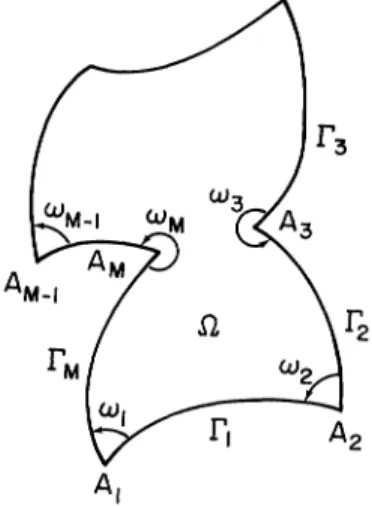
An example ofthe domainII
under consideration isgiven in Fig. 2.1. By to, i-1,...,
M,
we denote the internal angles ofII
atA.
We willassumethat0<
toi=<
2,r. Wewill also consider the casewhentwo edgescoincide. Then weunderstand themin a "two-sided" sense. If all edges are straight lines thenwe callthe domain
II
astraightpolygon.Otherwise wespeak aboutacurvilinearpolygon. If0<toi<2r, 1,’’.,M,
we speak about a Lipschitzian domain. Let us assumethatF
F
()U
F()
whereF(
U
o
,
F(1)
F-
F(),
(a)
U
o’’,
whereQissome subsetofthe set{1,
2,..,
M}
M
andQ’= M
Q.
We assume for simplicity that fl is a simply-connected domain. The results we
present herearealsovalidwhen flis ann-connected,boundeddomain and itsboundary iscomposed of n-cues.
Denote I
{x]-I
<x<1};
wealso writeI={Xl,
X2]--I
<X<
1,X2=0}c
2whennomisunderstandingcan occur.
By
L2(),
Lp(), L2(I), Lp(I),
the usual spaces of p-integrable, 1<
p<
,
func-tions on or I are denoted. By
Hm(),
Hm(I),
m0 integer, we denote the usualSobolev space offunctions with square integrable derivatives of order less than or
equalto m onfl(respectively,
I).
The spaceH()
isfurnished withtheusual normL2(
0llm
where a
(a, a2),
a
0 integer, 1,2,a]
a
+
a2, and DuOx
Fuhermore, we let
As
usual, we writeH()
H(n)
{u
eHi(n) ].
0 onF<)}.
Inan analogouswaywe defineH(I)
byDu
u=
du/dx
.
By
(x)=dist(x,
As)=]x-AsJ,
xe,
je, we denote the Euclidean distance between the point x and theveex
As,
Fl(X)=x+l,
r(x)=x-1,
xL Let(1,"
",3M)
(respectively,(,
32))
be an M-tuple of real numbers 0<
<
1,A3
A
A
1,.
,
M. Wewrite O<
<
O2 (respectively,/3</3)
ifal< fli <
O2 (respectively,fli
</3i), i=1,..,
M. For any integerfl, we writefl
+
k {ill+
k,. .,/3M+
k}
suchthat and M
/(x)--
II
Ir,(x)l
’/,
i=1 2 i=1By
C(I’I),
C(fi),
C(I),
C([),
j>=Ointeger we will denote the set ofall functionswith continuousj-derivatives ongl,
fi,/,
/,
furnished withthe usual norm[[.
[["
c(). LetH"(gl),
m ->t_->O integers, be the completion of theset ofall infinitelydifferentiable functions under thenorm
k=m
Ilull,’(m
Ilull
=
k=l for1_>-1, k=mIlull,,(.)
E
II%/lDulll
=
L2(fl) k=OIfm 1=0 we will write
H
’=
L(fl).
Analogously as beforewe definelulz.’(m
X II%lDulll =
Lz()"In asimilar way
H’I(I)
is definedIlull,’(,)
Ilull
=
.’-(i)+E
II%+-llDulll(,)
for lN 1,k=l k=m
ilull=
Hr’o(I)--E
II%+lOul
k=0Furthermore we introducethe space
(fl),
l=>0 integer that will.play animportant rolein this paper:(’)
{U
It/E H’/([),
for any k >-I,
II+_,loul
(.)<--
Cdk-t(k-l)
!,
I1
k. c>0.
d ->_ 1independent ofk},
where C and d may dependon u. Ifwe wish to emphasize the dependence on d we will write
t,d(f/).
Analogously for -> 0 integer(I)={ulu
H’t(
I),
for any k>-1,II$+_,u<)ll
<,<= Cd’-(k
l)!, C>
0,d>=
1independent ofk}.
Furthermore, forj 1,2,
ip(ll)
{u
Hi(II)IID"u(x)l
<--lal
k=j- 1,j,..,
C> O,
d-_> 1independent ofk},
(I)
{u
eHI(I)I lu()(x)l-<
ClP+l_+/2(x)l-dkk!,
766
.
BABUKA AND B. Q. GUOLety
U
io=Pi.
Then we defineHk-1/E(y),
k_-> 1 (respectively,H3-1/2"l-1/2(’y),
k l
1)
integersasfollows" for any eH-a/(y)
(respectively,H-l/U’t-/(y))
there existsfe
H()
(respectively,H’*(O))
such thatfir
.
We define thenIIIIH-,,=<>
(respectively,inf
Ilfll-m
(respectively,Ilfll
By
-/(),
IN
1, we will denote the set ofthe traces on T offunctions from thespace
().
Let
F
be anedge of;
thenby the assumption thereexists a one-to-onemappingm
ofI ontoF
which is analytic. IfF
is a straight line, then we will assumethatm
isthelinearmapping. Letu be defined on
F, U(x)
u(m(x))
be defined onL Thenwe define
H(F)=(ulUHm(I)),
IlUllH’(r,--II UII-(I)
In the same way we define the spaces
H"(F,),
3(Fi),
(r,).
Let us remarkthat, as we defined it,I1"
[[q(r,
depends on the mapping mi, i.e., it depends on theparameterizationofthearc
F.
Nevertheless the spaceH"I(F)
doesnotdoas wellas(F)
(see
Lemma4.6)
but3(F)
couldbe dependentonmi. Letusnow state some lemmas thatwillbeused later.LEMMA 2.1. Wehave
H’2(a)
with thecontinuous injection. See Lemma7 of[2].
LEMMA 2.2. Letu
H’2(f).
Then(2.1)
(i)
(ii) Let
u(A)
O, 1,.,
M. Then(2.2)
See Lemma 8 of
[2].
I.uA 2.3.
(al=(a)
.a
(a=+(a,
0<+<1,arbitrary.
See Theorems 2.2 and 2.3 of
[4].
LZMMA2.4. Letu
(f),
j >--_0; then u is analyticon-
t.J
iM=l
Ai,LZMMA2.5. Letr#1 and
F(x),
0<
x<
oe isdefined
byF(x)=
f( t)
dtfor
r>1,F(x)
f( t)
dtfor
r<
1.x-F_x_
<- x xf) dx. r-1 e>O Then See Theorem 330 of[7].
3. The model problem and its properties. Let fl be the curvilinear or straight polygon and let L be astrongly elliptic operator
2 2
L(u)
,
(ai,
j(x)ux,)xj +
E
bi(x)ux,
+
c(x)u
i,j=l i=1
where
ai3(x)=
aj,i(x), bi(x),c(x)
are analytic functions on 12 and for any and any x f let2
E
a,,j(i>-to(
+ )
i,j=l
with/Zo >
0.Let
B(u,
v)
be a continuous bilinear form onH(12)
H(I):
We assumethat
i,j=l i=1
inf sup
IlUlIttl(II) [I/3IIHI(I/)__.
u_H(D)
andfor any ve
H(O),
v 0IB(u, v)l
tZl>Osup
[B(u, v)l
>
O.u.H(D)
Assumenowthat
gtqa 3/2-1(Fl),
I= O, l,fe(fl)
and considertheboundaryvalueproblem
(3.1a)
Luf
onfl,(3.1b)
u=gtJonF
(,
Ougill
onF(1)(3.1c)
wherewe denoted by
n
theconormal inthe usual sense. The solution ofourproblemisunderstood in the usual sense. Thenwe have Theorem3.1.
TEOREM 3.1. There exists unique solution Uo
Hl(fl) of
theproblem(3.1).
See Lemma 3.1of
[3].
Letus mention some theorems addressing regularity of the solution Uo.
THEOREM3.2. Thereexists0<-
<
1, 1,,
M,
dependingontheproblem (i.e., operatorL,
w,etc.),
such thatif
f
(),
g[l]
E/2-1(F(l)),
O,1,/<fl
<1, thenUo().
Proofis given in
[3].
THEOREM 3.3. Let f be a curvilinear) polygon (instead
of
straight polygonas inTheorem
3.2)
andlet the assumptionsof
Theorem 3.2 hold. Then Uo(f).
Proofof the theorem is givenin
[4].
We have seen in [4], [5a], and [5b] that when the solution u ofthe problem
(3.1a)-(3.1c)
belongs to the class3(f)
then the h-p version of the finite-element method converges exponentially.Theorems 3.1 and 3.2 show that it is important to develop practical characteri-zationsof spaces
/2-(F),
0, 1,which canbeeasilyused in concrete cases toverify whether the inputdata, i.e.,gt
belongtothedesired space. Wewillelaborate on this inthe nextsection.768
.
BABUKA AND B. Q. GUO4. Tracesand extensions of weighted Sobolevspaces. Characterization of thespaces
/2-(F).
Inthis section we willelaborateonthecharacterizationofthe space/2-t(1-’),
0,1, whichleadsto aneasyverification inthe concretecases of applications. LEMMA4.1.
Let/3
(1, 2),
0<
<
1/2
and gH’(I).
en
(i) g
C([)
andIIllcO(r>
CllgllA,’(,);
(ii)[g(x)-g(-1)l
Cl/2_o(x)llg[l,k(i>,
Ig(x)-g(1)l
where Cis a constant independent
of
g(x)(but
dependsonfl).
Proo
Obviously,g(x)
g(
t)[
g’(r)
dr(4.1)
g,2(,)(,)
d,(B(,))
-2d,Ilgll
u.’(l)(o(z))
-2drwhichshows that g iscontinuous on Using the imbeddingtheorem on
(-,
)=
I’,
we have(4.2)
and weget immediately
Ilgll
C(I)Cllgll
Further,
(4.1)
immediately leadsto (ii).LEMMA 4.2. Let
fl
(ill,/32),
1/2
</3<
1 and gH’2(I).
Then(i) g
C(I)
andwhereCis a constant independent
of
g(x).Proof
Using(4.1),
we getIg(x)
g(t)l
,x
g’() d andg’
----<
C[[g’(0)l
/Ilg"
Inthelastinequality weusedLemma2.5 and the factthat
1/2
</3 <1. The lemmanowLEMMA 4.3. Letg
,d(I),
0</3<
1. Thenfor
k>1Ig(k)(x)l
_<_C(k_,/2+o(x))-’(d,)kkt
where
dl=
"I’d, )’>1 is independentof
g, k, d, and Cdepends on,
but is independentofg, k.
Proof.
LetI’
(-1/2, 1/2).
Thenfor
any k->- 1 we haveIIg(k)llH,(r,)-- C(dp(-))-k-k!
dkwhere/3
max(/3,/32).
Henceby the imbeddingtheorem,we haveIg(0)l
__<Cdklk!
where
dl
-->
yd, y>
-1(1/2)
>
1. Further, for k>-1, we have thatig,(x)l
<__igk(0)[
/g(k+l)(t)
dt_-<
Ig(0)l+
(g(k+l)(t))2p213+k(t)
dt*-+k(t)
dt --1<-
Cdk![1
+
/_,/(x)]
<-CriCk!
(k-/2+
(x))-’
COROLLARY 4.4. Letg
1(I),
0</3
<1. Theng1(I).
COROLLARY4.5. Letg2o(I),
0</3
<1. Thenfor
k>-2Ig(x)l
<_-andg
(I).
LEMMA4.6. Let
m(x)
bea one-to-onemapof
IontoI,
letm(x)
be analyticon[,
and letIm’(x)l
>
0, x[. Assumethatg(I),j=
1,2, anddefine
v(x)=g(m(x)). Then v(I),
j 1,2.Proof.
Becausem(x)
isanalytic on I it canbe extended into the complex plane C on I=(z=x+iyl-l-8<x<l+,,lyl<8}, 8>0,m(z)
is a one-to-one mapping of[8
onto*=I,,
’>0 andIm’(z)l>ao>O,
z[.
Now let j=l andXoI.
Thenfor k>--1
Ig(xo)l
<__ andtheseriesg’(x)=
E
g(k+l)(Xo)(X--Xo)
k 1k=0 k!
is absolutely convergent for
Ix-xol
a((Xo)/dl),
a<1. Hence alsog’(z)=
2
g(k+l)(Xo)(Z--XO)kk
k=O
convergesand
Ig’(z)l-<-
Cat+/(Xo)
forIZ-Xol
<-a(cI’(Xo)/d)
where Cisindependent ofXo.Hence g(z) is aholomorphicfunctionandv(z)=
g(m(z)) is holomorphic,too.UsingCauchy’s theoremwe get immediately that for k
=>
1Iv)(x)l
<Cd4,-;
_
770 I. BABUKA AND B. Q. GUO
Remark 4.1. Lemma 4.6 shows that the space
(I)
is invariant withrespect to ananalyticmapping. Usingtheformulaof the nth derivative ofacomposite function(see
formula 0.430 of[8])
we can also show that(I)
is an invariant space withrespect to an analytic mapping
m(x)
as in Lemma4.6.Let
F
be an analyticarc.Thenwecould definethe spaces(F)
and(F)
withrespectto thelengthinstead as we did in 2 by usinga specificmapping. Thesetwo
definitions are then equivalent by Lemma4.6 and Remark 4.1.
LEMMA 4.7. Let
M(x),
xR2,
M(x)= (Ml(x),
M2(X))
be a one-to-one mappingof
onto andIJ-l
_-< tz on,
whereJis the Jacobianof
the mapping.Assume that M(x)
canbe analytically extendedon l){x
R21
dist(x, f)
<- 8}
sothat it isaone-to-one mapping
of
fi
ontofi*,
f*
,.
Let u(f),
j 1,2,v(M(x))
u(x).
Thenv().
The proofisanalogous tothat ofLemma4.6, however,we mustapply the theory oftwo complexvariables.
LZMMA4.8. Letg
(I),
0</3 <
1,j 1,2. Theng(I),
O<fi<l,
+
e, e>
O arbitrary.Proof.
Let us consider only the case j 1. The casej 2 is analogous. Because for k=>lwe get
Ig()(x)l
Cdkk!(k+13_l/2(X))
-1(g(k)(X))2p2k+fi_l(X)
dx<= Cdk(k!)
(I)fi_/3_1/2(X
dx--1
C(e)dEk(k)
2.
WeseethatLemma2.3 hasacompletelyanalogousversionfortherelationbetween
(I)
and(I).
THEOREM 4.1. Let u
H+2’2(),
kO,
andFi
be a straight line edgeof
andUlr
g.en
we have the following: (i) For<
,,
fl+
<
1 andk 0g,
HI’I(F,),
,
(,,1, ,,2),
,.
>
0.
,.
,._.-.
1).
1.
and
withC independent
of
k and d>- 1. (ii) For 0<
fl,, fl,+l<
1/2,
k>=
1g
H(F),
Hk+,2rFg,e
,
,)
flid
e(fli+-l+1/2
1),
j=l 2,(iii)
Vu()
and,,(r,),
r,
+
1.
flid(fli+-Proof
Withoutany loss ofgeneralitywe can assumethatFi
1-’1
andlPl
{Xl,X21X
I,
x20},
A(-1,
0), A2(1, 0),
/
(/3a, fl).
Let k>_- 0 and Vk
(oku/oxk)k+.
Then for k_->2,II
I1(
-i,/CI)k+
+
k D-i,/CI)k+,_l
/--.2(fl) L:(,O.)
Using Lemma2.2, we get for k 1
BecauseofLemma2.1 u
C(I)),
andhence vo(Ai) 0, 1,2.Hence,
using Lemma 2.2,we getIVol.m
<-and hence forall k
=>
0(4.3)
where C is independent of k. Thereforeby the imbedding theorem
Vk
C(fi),
k_->1.Letus nowshow that
Vk(A)
0, 1,2, k 1.Assumeonthecontrary thatv(A)
>
O. Thenbecause VkC(fi)
we havev(x)>e>O
forlx-Al<,
>0. Hence for k=>
2 where>=
e2
f
fdP2--2
dx=O dx=2v2
dxand we have the desired contradiction. For k 1 we use Lemma2.2 and get
O0>
0213_1
dx>82
022
dxIfu
(f)
then we get from(4.3)
for k=>OIIv,
llw,)-
<Cdklk!.
Wehave
gk(xl)=Oku/oxkIr
k>0.=Thengk(xl)=d-lk+ (X)Vk(X)lr
=d-k+(xl)vk(x)
wherewe wrote-1
k+(Xl)
andVk(Xl)
insteadof -1k+(Xl,
0)
andVk(Xl,0).
Assumefirstthat
1/2<fll,fl2<l.
Letdo={min=3,...,4
dist(A,F,)}
4-2.
Then we have for xeFt,
(Xl)
-<-
(Xl)d
-,
and hence forj 1,2,..,
k+
1,j_,+,lg{J)(Xl)l
2dx,
<=
Cj2j-l+,[lvj-,I
"
2
s+j
-,+
-2--1
772 i. BABUKA AND B. Q. GUO
Using Lemma2.5,thefactthatj 1,.
,
k+
1,Vj_l(Ai)
0, 1,2 andthat/3
fll +
1>
1/2,
weget for somedl
<
1_+lg(x,)]
dx, Cd,_15,_
--1
By
(4.3)
and the imbedding theorem we havefor 1<
p<
andj 1,..,
k+
1 Hence forj=I,...,
k+1,because-fl
>-,
we getL2q(I)
--1 -1
Because byLemma 2.1
we get
Ilgl]
L=r,<Hence we have proven (i) and (iii) for
1/2</3i,/3i+1
<
1 and k->0.Assume
now that0</31,/32
<
1/2.
Wewill proceed analogously as before. Forj->2,we haveI
2 (j) 2 2 --2(I)j-E+lg (Xl)l
dXl
<Cj2dXl
j-2+I[IVj-ll
2-2+j-1 +
dpj+lvj_l
2]
--1 <-Cd-(2_+,_(v_(x))2
dx
-1wherewe onceused Lemma2.5 andthe factthat -1
+/,-
>-1/2.
Hence,
using(4.3)
and realizing that -1
+/-/
>-1/2,
we getanalogously as before for j 2,..., k+
1%-=/1 Ig
><x,)l
=
dx,Cd
u+=,=,
Letus provenowthatWehave
vo(A1)= vo(A=)=0,
andhenceg,2
dx=< Cdff
=
[=[vgl=+lvol=
-=+1]
dxdff
2 2Ivl
=
dx--1 -1
wherewe have again used Lemma2.5. Because 0<
<)
andweproceedasbefore and (ii) and (iii) follow easily.
Remark 4.2. In the
proof
of Theorem 4.1 it has been assumed thatfl,
(fl+_
-,
1),respectively,fl.
(+-1
+,
1),
i.e., oftheopeninteal.Theproofdoesnot hold forthe closed inteal. Ithas been assumed in Lemma 4.9 that the edge
F
of the domain was straight. Let us now assume thatF=
re(I)
where m=(,
)
areLEMMA 4.9. Let the edge
F
of
the domainbe analytic. Thenpart (iii)of
Theorem4.1 holds.
Proof.
By Lemma2.3, u(l).
LetM(sc)
(p(:), p(sc)),sc
I,
be themappingofI onto
F1.
Then we defineThen the mapping
M(,)=(M(,),M2(,))
is analytic onI=
(,
-1
< <
1+
,
]
< ),
>
0,J]
<
,
]J-]
<
onI
(where
JistheJacobianof the mapping) and maps
I
onto the(open)
neighborhoodS*
ofF.
Denoting*=S*,
T=M-I(*),
we see thatr(x)=u(M-(x))
is defined onT,
and r(T)
by usingLemma4.7.Hence r+(T),
e>
0arbitrary,byLemma2.3. Hence for<
fl,fl+
<
1 wegetby Theorem 4.1(iii)gi()
V(,
0)
,(i)
fli,(fli+j-1
+
e--
),
j 1 2.Because e
>
0 is arbitrary,id
(fli+-l-, ).
Analogously for0<fli,fl+l
<,
gi(),(I), ,.j
(fli+j-1
+,
1).
LEMA4.10.
Letg(I),O<<,O<2<l, g2(I),)<<l,O<2<
1. Let S{
r,0 0<
0<
2,
0<
r<
}
where r,O)
arepolar coordinates with respect to(-
1,O)
and( r)
r.Define
Ui(r,
O)=
gi(-l+
r),
V(r,
O)=
O[g,(-l+
r)-g(-1)](by Theorems 3.1,3.2, gi
C(),
i=1,2, and hence gi(-1) is welldefined). Thenu,, v,
U2,
V2
I(S),
1-.
Proofi
Assume
first that0<,<
andg,(I).
Setfl=,+
andU,=
g(-1
+
r).
Thenfor k 2r
rd dO<= Cdk(k!)
2.
Henceby Theorem 1.1 of
[4]
we have fork_->2,[a[
kV,16.+ - ll
Cdgk!.
Furthermore,
Hence, U,
(S).
Nowlet<
1
<1. Setfl
,-.
As before,we have for k2 sk
Ork]
(r-2+)2r
dr dOCdk(k)
2and weget
UI
’(s<
m-Hence,
U
e(S).
LetusnowconsiderthefunctionV(r, 0).
Thenasbefore
774 I. BABUKA AND B. Q. GUO Furthermore, using Lemma2.5 and k->2, we get
[ OVI
r-2(rk-2+p)2r
dr dO/8-lgl
r-2(r-2+#)
2ar
0ar,,
/
rdrdOCdkll.(k-1)
2 IlSlk-2+fllllL2(l)
2Cd](k
).
Inthe last inequalitywe usedthe fact that
Ig(-’(0)l
Cd(k)
andrealizing that
aV/(ar
-
d0)
=0 for kj2 we have for}a}=
k2 Fuhermore for0<
1
<
andI*
(-
1,0)
we havev,
’(s
c[
g’
,/11L(,*
+
II(g,
()
g,(-
1))_,/
L(,*]
<
c[llg1’a, L(,*
+
(g,() g,(-1cllg,
ll.’(,).
In the last inequality we have used once more Lemma 2.5 and the fact that Quite analogouslywe prove
tat
Lh 4.11. Letg
(I),
0<
+().
Proo
For k 1, --1g(’(6_)
(’-’_,++
ax
-1 !=0 NCdk
(g(O
((k
l)2
dx /=0J
-1Cd2k
(gO)
+,_((k_/)t)2
dx+(g)E_(k)2
dx /=1 --1 Cd(g’YCZ+,_,((k-
))
dx+(g’)}(kY
dxCd’(k)
1=1wherewehave used Lemma2.5 inthe above inequality. Fuhermore,
v2dx
g2@
vdxCIIgll%i’,
by Lemma4.1.LEMMA 4.12. Let
ge(I),.g(+l)=0,1/2<<l,
0<T<1/2,
v=gP_v.
Thenfor
fi+y>
1,ve93+_(I)
andfor+y<l,
ve93+(I).
Proo
(a) Assume
first that+
T>
1. Thenfor k 2(V(k))2++,-2
&<=
Cd2(g(/))uu-,-(-,)+k+g+,-2((k-
1)1)
&
--1 /=2 --1
+(k)
g*}_2dx+((k-1))
2g’2}_
dx --1Cd2k
(g(1))2}+,_2((k_/))2
dx I=2+(k)
g’_
dxInthe lastinequality, Lemma 2.5 has beenused. Because
by,the
imbedding theoremIg’(0)l
cllgl}(
and using Lemma2.5 once moreyields-
1>-,
we get’(I)
"
-1 -1Hence,
Furthermore, as before 1(v(k))Zk+g+V_
2dx <--_Cdk(k!)
2.
J
Vt2(+T_
dx<CI
g-’==r-,
dx<-CIIgll=,,
<o. --1 --1 13 Because gC(),
vL2(I),.
(b)
Now assumethat/3
+
T<
1. Thenfor k=>
2 weget exactly as beforethatFurthermore,
(V(k))2)i+fi
+")’--2dx<Cd21
k(k!)
.
-1 Vt2dx<C g2^2_r_dx+
--1 --1 --1=<
Cg"
(I)--T+Because -3’
+
1>
fi
by ourassumption we see thatv’2
dx<-Cllglli.
-1Using Lemma4.2, we also get
LEMMA4.13. Let 12 beacurvilinearpolygonwith theverticesAi, 1,.
.,
M. Let u(12)
and wbesuch thatIU"
wl--<
c-.+1
!d",
776 I. BABUgKA AND B. Q. GUO
Proof.
For k->2,al
k,we haveIDllvl20l_+a
dx<= Cd=kIok-’ullO’wl
.2_2+
e
dx /=0 <-Cd
E
((l+ 1)!
D- ul:(I)_:_,+
dx I=0 k <-Cd
k((l+
1)!)2((k
1+/)!)2_<
Cdk-2((k_2)!)2.
I=0 Furthermore,Ill
lDll)12
dxC[fflDltl[21wl2
dxqIgl
lul2lDIwl2
dx]
<00 becausebyLemma 2.1 ueC(fi).
It isvery easyto provethe followinglemma.
LEMMA 4.14. Let
ge?3(I),
0</<1/2.
Thenv=gPef:3}(I)
andv(+l)=0.
LetgeOl,(I),
1/2</<1;
thenv=gPe}(I)
andv(+l)
=0.Proof.
The statement thatve3(I)
canbe directly verified. By Lemma 4.1 v is continuousonf.
Ifv(-1)
#0,thenv2(x)
>
e>
0forallIx
+
11
<
,
Hence,
g2
(v-1)2
>=
^2
( ),0</3<1/2
The proof of the eq-l, which contradicts the assumption that ge3 Isecond part of the lemma is analogous.
LEMMA4.15. Letue
3(1)),
0</3 <1 andu=0atAi.
Thenu
-1 The proof follows easily using Lemma 2.2.THEOREM 4.2. Let 12 be a straightpolygon with the edges
F,
i-1,...,M,
andletg e
(F1),
0<,
<1/2,
fl,fl +1/2,
i=1,2(respectively,g e3(F1),
1/2</
<1,fl
=/3,-1/2,
1,2)
andg(A) O, 1,2. Then there is u such that (i) ue3(12),
with 0<
fl
<
1,j 3," ",M,
arbitrary; (ii)U[r,=gandulr=Oforj=2,...,M.
M
Proof.
LetO
H,=3
xA[
2,
x e1) Denoteff
g/O.Then
obviouslyg
e3}(F1)
(respectively,
g
e3}(F1)).
Now select 0< y<1/2
such that 0</3+
y<1/2
(respectively,0</3
+
y,- 1<
1/2).
Denoteff
I-I=l
Ix
A,I
-,_
where y (yl, 72,0,...,0).
By Lemmas4.1 and 4.2(A)-0,
i=1,2. Using Lemma4.11(and 4.12)
we see thate
3}+y(I)
(respectively,ff
e3+v_1(I)).
Let UeH
I(I)),
AU 0and U onF1
and U 0 onF,
j 2,,
M.FunctionU
exists and is uniquely determined. To see this consider q(x), x eF1, peC(F1),
(p(x) Ifor
Ix- AI
-<e/2,i-1,2 andp(x)=Ofor]x-Ail>e,i=1,2 withesufficiently small. WedefineU--
UI--
U2
where AUi=0,
UieH(I)),
i=1,2,Ullr--(1-q),
U21rl--,o
andU=0
onF
s,j=2,...,M. Because
h=(1-o)eC(F1)
and hi(x)=0 forobviously exists.
By
Lemma 4.10 there exists WeHI()
such thatW]rl
h2=o,
andWlrj=0,
j 2,.. ",M.
Hence,
U2
exists too. Function U has the following properties" (i) AU=0.(ii)
U]r,
,
Ulrj
0,j 2,...,M. (iii) is analyticonF
(not
onF1).
(iv) In
.a-tqfl{xllx-Al<,},
i=1,2, with t sufficientlysall,
there isW
such that
W
e3}(t2i,),
where/3i
=/
+
3’+1/2
(respectively,/
fl
+
3’-1+1/2)
andWlr,na,., ft.
(This followsfrom Lemma4.10.)
Bythe selection of yi we
have/3-
>
1/2,
i=1,2. Nowusing the samearguments
asinthe proofofTheorem2.1 in
[4],
weconclude that U(12),
where/ffi
=/3+
y+1/2
(respectively,/3
=/1
+ Y,-1/2),
i=1,2, and 1>/
>
1/2.
By
Lemma 4.13 we see that uOvU
(12)
where fl,,
+1/2
(respectively, /3ifl-1/2),
1,2 and0<
flj<
1 arbitrary for j 3,..,
M. In addition,Ulr
g andulrj=0,
j=2,...,M.
Let us outline the main idea of the assertion that
U(f).
LetS.,=
{ri,
0i[0<
ri<
8,0<0i < to}
fq12 where(r, 0)
arethe polarcoordinates withthe origin inA.
We select8
<
1 suchthatS.2,
f’)Sj,2j
for <-j. Using Theorems5.7.1,5.7.1’, and 6.6.1 of [8], we conclude similarly, as in the proof of Theorem 2.1 of[3],
that U(-u/M_-I
Si,i/4
due to the analyticity of onF-UI
Si,i/4.
Hence we haveto prove only that U
(Si.,/4).
Let
o C(+),
o(r)=l
for0_-<r=<1/2,
o(r)=0
forx=>l,tp,(r)
qo(r/2t,)=q(r).Denote v qU. Then v canbe understood to be defined onthe infinite sector
Q
{(r,
O,)lO<r,<,O<O,<o}
when extended by zero outside ofS,,
and we haveNow weprove that
g(S,a,/)
asin[3].
Remark 4.3. We have assumed that either
1/2</
<
1. Obviously Theorem4.2 is correct ifJ(F1)
only inthe neighborhood ofA1
and(F1)
in the neighborhood ofA:.
Theorem 4.1 leads easily to the nexttheorem.
TrEOREM 4.3. Let 12 beastraightpolygon with theedges Fi, 1,
,
Mandletg
,
(,)
/,
(/,,1,
fl,,2),
0<
fli,1,fl,,2 <
1/2
--/,1-’-i,1--1/2, --/,2--i,2-t"
1/2,
iQc{1,...,M}or
g fli,1,
fli,2 <
1,fl,l=/,,1-1/2, fl.2=/,,2-1/2,
iQc(1,...,M}.Further,letgbecontinuouson y
U
,o,.
Theng/2(y) where/
max(/-1.2,
for
A
),if
1 Qore
Qthenwedefine
fl-1.2
O,respectively,fl.l
O)
and0<
fl
<1arbitrarily
for
Ai
:
7.Proof.
Becauseg is continuous on y we can construct apolynomial Pon12 such that g-P 0 atA.
Then we can apply Theorem 4.2. l-]Remark 4.4. It is obvious how the theorem may be modified when g
(F),
respectively, g
(F)
in the neighborhood ofA
only. See also Remark 4.3. Remark4.5. Theorems4.1 and 4.3 arecomplementary,which isanalogoustothe theorems oftrace andextension in usual Sobolevspaces
onsmoothdomain. Namely,F
ifg
,(,),
0</,a<1/2
(respectively,g
.(F),
1/2<a<
1)j 1,2, thenwehaveanextension
byfunction G(f),/3
fl,,1
+,
fl,+lfl,.2
+
-
(spectively,
fl,
,.1
_1/2
i+1
i.2--1/2),
and if G(I)
thenG[r,
g,+(Ii),
for
1/2
</3,,/3,+1<
1 (respectively, g,+(F,),
/3,.1
fl,+1/2,
fl,,2
fl,+l+1/2
for 0<
778 I. BABU;KA AND B. Q. GUO
THEOREM
4.4..,Let
12 be astraight
polygon with the edges Fi, i=1,.-.,M,
andletg93(F),
0<3,<1/2,
i=1,2,i=fli+1/2,
i=1,2(respectively, g(F),
1/2</,
<
1,fl
fl-1/2,
i=1,2).
Then there is usuch thatwe havethefollowing" (i) u2)(1))
with 0<
flj <1,j-3,..,
Marbitrary.(ii)
Ulr
‘=
gandUlr
j=O,
j=2,..,
M.Proof
By Lemma 4.14,=g4(r),
respectively,2)(F1)
and(A,)=0,
i=2,3,and hence by Theorem4.2there is v23(1)
such that v onF1
and v=0 onFj,j 2,,
M. By Lemma4.15thefunctionV(I)-1has thedesiredproperties. [3Theorem4.4leads immediatelyto Theorem4.5.
THEOREM4.5. Letf be astraightpolygon with theedges
F,
1,...,M,
and let i), ]i(i,1, i,2),
0<
3i,1, 3i,2<
1/2
fl-i.l
i.,
+1/2,
fl-/.2=/i.2+1/2,
Qc {1,M}
org6
2),(r,),
fl,(fl,.1, fl,.2),
1/2
<
i.1,fli.2
(1,fl,l=/,,1-1/2,
fl,2=/,.2-1/2,
ieO{1,’..,M}.Let
y=U,Q,. en
z(y)
where,=max(,_l.2,,.1),_
A,_
y (ifi-lq orQ
when wedefine
-1.
O,
respectively,.1
O)
and 0<
i
<
1 arbitrarilyfor
AT.
Remark 4.6. Itis obvious how Theorem4.4 has tobemodifiedwheng
(F),
respectively, g
(F)
in the neighborhood ofA
only. See Remark4.3.Theorems 4.3 and 4.5 give the characterization ofthe boundary conditions that guarantees that thesolution ofanelliptic paialdifferential equationof secondorder
withanalyticcoefficients on a domainfl withpiecewise analytic boundarybelongsto
(fl)
or()
(see
Theorems 3.2 and3.3).
Intheconcrete casestheseconditions are usually very easyto check. Letusstate auseful lemma that characterizes the space
(I)
(respectively,(I)).
LEMMA4.16. Let
a=
{z
x+
iylx
I, lyl
p(x),
>O)
and
G(z)
be a holomorphicfunction
on12
such thatfor
/2--(/21, /22)Letg(x) Re
G(z)[x
orImG(z)[I.
Thenfor
u,>
-1/2+
(j1),/,
+
u,>1/2+
(j1),
0</,
<
1, i=l,2, j=0,1,2
g(x)6
?O(I).
Proof
Bythe Cauchy formulawe have for k>
0Ig)(x)/__<
C4,(x)(4,(x))-k!
-.
Hence,
O,_l+t]g(k)(x)
dx<=(Ck!
aOv+/_ dx<=(Cld
!)2
-1
and hence forui
>
--12,
gH(I).
Thelemmaisproved forj 1. Theproof
of thecase j 0 isanalogous.Letusconsider nowthecase j 2.Weseethatfor,i+/3>
andk-> 2,_+
a
g*)(x)
ax<=(Ck!a-)
_+_+
dx<(Cldkkl)
2Fuhermore,if
v>,
then also gHi(I).
Instead of
G(z)l
C(Re
z)
we can assume that]G(z)-P(z)l
C(Re
z)
where
P(z)
is apolynomial.Lemma 4.16 isvery useful in practice. For example, if g is analytic on
F
then g(x) can beextendedinto someneighborhood of andtherefore g(I).
Lemma 4.16characterizes very well the structure of the spaces(1)
(respectively,(1)).
LEPTA4.17. Let
g(I),
0<<.
en
thereexists a>0 such that g can be analytically extendedonto and(z)-g(-1)-g(1),(1-x)
(x+l)2,
C+/_(Rex)
(g C
([)
by Theorem3.1).
Proof.
Since g(I)
we haveby Lemma4.3 for k_->1[gk)(X)l
<_Hencethe series
g’(x)
E
g(k+l)(Xo)(X--Xo)kkl,
XoeI k=Ois absolutely convergent for
Ix-Xol
<=1/2(dP(Xo)/d),
and hence alsoO’(z)=
Z
g+l)(xo)(Z-Xo)
1k=O k!
converges for
Iz
Xol<1/2(P(Xo)/d)
andIG’(z)I<=Cp
-
+l/2(XO),
X0 Re(z),
and C isindependent ofXo, whichyields the lemma. [3
Sofar we have assumedthat12is astraight polygon. Wedid not excludethecase where the internal angle is 2r; i.e., we did not exclude the slit domain. Let us now consider the curvilinear polygon andassume that it is a Lipschitziandomain. Letus
prove first Lemma 4.18.
LEMMA 4.18. Let
[’--{Xl,X2l-l<xl<l,O<x2<h(x),h(x)>o(Xl+l),
h(-1)=0,
a>0}.
Assume that q,(x,x2) is an analyticfunction
on S= {Xl,x21
(Xl
+ 1)2+ x-<-4}
such thatwehave the following"(i)
ff/(Xl,
h(x,)) 0;(ii)
Od//OXl(X, O) >
a> O,
-1<- Xl<-1.Define
F1
{X1,
X21-1
<
xl<
1,x20},
F2
{x,
x21-1
<
X<
1,x_h(x)},
and let T fl(q$1 where$1
{
r,0[0
<0<
27r,0<
r<
1}
wherer,
O)
are
polar
coordi-nateswith respectto
(-1,
0)
andT*=
$1-T. Letg2)(F1),
0<fl <1/2,/31
=/32(respec-tively,
g2=(F1),
1/2</3,<1,/31
=f12),
g,(-1)=0, i=1,2 and ep=r. Then there exists780
.
BABUKA AND B. Q. GUO(respectively,
V2
8(
T),
V*2
(
T*),
1/2)
suchthatV
g, andV*
g,onF1
and
V,
V*i
=0 onF2CI
.
Proof.
Leto(r, 0)
(r, O)/r.
Then(r, 0)
O(Xl)
is analyticonF1
and(Xl)>
6>0; hence-l(x)
is analytic onx
too. In addition, =0 onF2.
Furthermore,IDO(Xl,X2)l
<-Clal
!-Ildl’l
by Cauchy’s theorem on the theory of two complex variables. Define1
glo-l(Xl).
Thenffl
e(F)
andby Lemma4.11there existsU1
on
S1
such thatU1
e($1),
=/+1/2
andUllrl
1.
Now defineV1
UI.
UsingLemma 4.13, we conclude that
Vle(T)
(respectively,(T*)),
Vllr,=gl
andVIlF2
0. The proof that V2has desired propertiesis analogous.LEMMA4.19. Let {Xl,
x2[-1
<
Xl<
1,hi(x1)<
x2< hE(X), hl(Xl) < -a(Xl
+
1),
hE(X)> a(xl+l),
a>0, hi(-1)=0, hi(Xl) analyticfunctions
onI,
i-1,2} andri
{x,
x21-1
<
x
<
1,x2h,(x)},
a.
=aN
S.,
S,,={r,
OlO<O<=2mO<r<rt,q>O},
where
(r, O)
arepolarcoordina.tes
with the origin at(-1,
0). Letg e}(F1),
0</3 (respectively, g2e}(F1),
1/2</3i
< 1),/31
=/32.,
gi(-1)=0 and let r. Then thereexist rl>
0 and V e(’
rl),
VI
e(’
),
--
1/2
q-E, E>
0 arbitrary (respectively, V2(On),
V2
(l-l*n),
=
-1/2+
e)
such thatV[rlnfi,
g, andV[r2nfi,
=0.Proof
Becausehl(Xl)
is analytic on I it can be analytically extended ontoI
{-1
6<
Xl<
1+
6}.
Thenthe mapping M"(Xl,
x2)
-
(Yl,
Y2),
Yl Xl, Y2 x2-hl(Xl)
isanalytic on
n,
r/=6/2
andM(fn)=
12n. For r/1 sufficiently small we haveS.,
F*
U
F*
whereF*
{Yl,
Y2l-1
<
Yl<
--1+
r/,y_0},
F2*
{y,Y21-1
<
y<-1+
g/a, Y2h*(y)=
h2(yl)-h(yl)},and
h2(Yl) > al(Yl+ 1).
In addition, it is easy to see thatIJI,
IJ-1l
</x<
a, where J isthe Jacobian of the mapping M. Because
h*(yl)
is analytic on -1<-Yl
-< -1+
1
we define O(yl,Y2)=-y2+ h2*(yl)
andO(Yl, Y2)
has the properties in Lemma4.18. Now using Corollaries 4.4, 4.5,gle}(F1),
g2e}(F1),
and hence using Lemma 4.6,gl(M-l(y))ly2=o
t(F1
*
),
g2(M-l(y))ly2__oe
}(F*).
Using Lemmas 4.8 and 4.18,weobtain functions
Va
andV*
(respectively,V2
andV2)on
nf’lS2
(respectively,ln*
f’!S,),
which belong to3}+/2(12
nf-IS,)
(respectively,23}+,/2(1*
nf’lS,)).
Now whenwe use Lemmas 4.7 and 2.3, ourlemma follows. [qThe lemma leads to the following theorem.
THEOREM4.6. Theorems 4.3 and4.5 hold also
for
aLipschitziancurvilinearpolygon whenfli
are replacedbyfl +
e, e>
0 arbitrary.Proof
Becausetheedgesare analyticcurves andg are analytic onF
(but
notonF)
we show similarly(as
in the proof of Theorem4.1)
that the solution u of theLaplace equationbelongs to
23+(f).
This can be done identically as inthe proofs. of Theorems 3.3 and 3.4 of[6], showing that u+(tq).
[3Remark4.7. Comparing the respective theorems for straight andcurvilinear poly-gons, we see thatin the latter case we lose slightly in the regularity. It is not known
whether this loss canbe removed.
REFERENCES
I.BABUKA,Thep andh-pversionofthefiniteelementmethod;thestateofthe art, in "FiniteElements, TheoryandApplications," D. L.Dwyer, M. Y. Hussaini,andR. G.Voigt,eds., SpringeroVerlag, Berlin, NewYork, 1988,pp. 199-239.
[2] I. BABUKAANDM. R. DORR, Errorestimatesforthecombinedh andpversionofthefiniteelement
method, Numer.Math., 37(1981),pp. 257-277.
[3] I.BABU,KAANDB.Q.Guo,Regularityofthesolutionofellipticproblemswith piecewiseanalyticdata.
Part1:Boundary value problemsforlinearellipticequationofthesecondorder,SIAMJ.Math.Anal.,
19 (1988),pp. 172-203.
[4]
.,
Theh-pversionoffiniteelementmethod withcurvedboundary, SIAM J.Numer.Anal.,25(1988),pp. 837-861.
[5a] B. Q.GUOANDI.BABUKA, Theh-pversionoffiniteelementmethod,part 1: thebasic approximation
results,Comp.Mech., (1986),pp.21-41.
[Sb]
.,
Theh-pversionoffiniteelementmethod,part 2:general results and applications,Comp.Mech.,(1986),pp. 203-220.
[6] I. S. GRADSHTEYNANDI.M.RYZHIK,TablesofIntegrals,SeriesandProducts,AcademicPress, New
York, 1980.
[7] G.H.HARDY,J. E.LITTLEWOOD,ANDG.POLYA,Inequality,Secondedition, Cambridge University
Press,London, 1952.