by
Ehsan ARABNEJAD
MANUSCRIPT-BASED THESIS PRESENTED TO ÉCOLE DE
TECHNOLOGIE SUPÉRIEURE IN PARTIAL FULFILLMENT FOR THE
DEGREE OF DOCTOR OF PHILOSOPHY
Ph.D.
MONTREAL, JANUARY 24, 2018
ÉCOLE DE TECHNOLOGIE SUPÉRIEURE
UNIVERSITÉ DU QUÉBEC
BY THE FOLLOWING BOARD OF EXAMINERS
Mr. Mohamed Cheriet, Thesis Supervisor
Department of génie de la production automatisée, École de technologie supérieure
Ms. Sylvie Ratté, President of the Board of Examiners
Department of génie logiciel et des technologies de l’information, École de technologie supérieure
Mr. Luc Duong, Member of the jury
Department of génie logiciel et des technologies de l’information, École de technologie supérieure
Mr. Ching Yee Suen, External Independent Examiner
Department of computer science and software engineering , Concordia university
THIS THESIS WAS PRESENTED AND DEFENDED
IN THE PRESENCE OF A BOARD OF EXAMINERS AND THE PUBLIC ON JANUARY 16, 2018
years. You have set an example of excellence as a researcher, mentor and instructor. I would like to thank my thesis committee members for all of their guidance through this process; your discussion and feedback have been absolutely invaluable. I would especially like to thank my amazing family for the love, support, and constant encouragement I have gotten over the years. I would also like to thank my friends and my colleagues from Synchromedia Lab.
This research was realized thanks to financial support of the Natural Science and Engineering Research Council of Canada (NSERC).
RÉSUMÉ
La compréhension de l’image documentaire (DIU) a attiré beaucoup d’attention et est devenue l’un des domaines de recherche actifs. Bien que le but ultime de DIU soit d’extraire des infor-mations textuelles d’une image de document, de nombreuses étapes sont impliquées dans un tel processus tel que la catégorisation, la segmentation et l’analyse de mise en page. Toutes ces étapes sont nécessaires pour obtenir un résultat précis à partir de la reconnaissance de caractères ou de la reconnaissance de mots d’une image de document. L’une des étapes importantes dans DIU est la catégorisation d’image de document (DIC) qui est nécessaire dans de nombreuses situations telles que l’image de document multi-script ou multi-polices ou multi-langue. Cette étape fournit des informations utiles pour le système de reconnaissance et aide à réduire son erreur en permettant d’incorporer un système de reconnaissance optique de caractères (OCR) ou un système de reconnaissance de mots (WR) spécifique à une catégorie. Cette recherche se concentre sur le problème de DIC dans différents niveaux de script, de style et de langage et établit un cadre pour la représentation flexible et l’extraction de caractéristiques qui peuvent être adaptées à de nombreux problèmes DIC. Les méthodes actuelles pour DIC ont de nom-breuses limitations et inconvénients qui limitent l’utilisation pratique de ces méthodes. Nous proposons des nouvelles méthodes de catégorisation de l’image de document en fonction de la représentation des patches et la «Non-negative Matrix Factorization (NMF)».
De nombreuses méthodes existent pour l’identification par script de l’image du document, mais peu d’entre elles ont abordé le problème dans les manuscrits imprimés et elles ont beaucoup de limites et d’inconvénients. Par conséquent, notre premier objectif est d’introduire une nouvelle méthode pour l’identification des manuscrits anciens. La méthode proposée est basée sur une représentation de patches dans laquelle les patches sont extraits à l’aide de la carte squelette d’une image de document. Cette représentation surmonte la limitation des méthodes actuelles sur le niveau spécifique de mise en page. Le schéma proposé d’extraction de caractéristiques basé sur la «Projective Non-negative Matrix Factorization (PNMF)» est robuste contre les vari-ations de bruit et d’écriture et peut être utilisé pour différents scripts. La méthode proposée est plus performante que les méthodes de pointe et peut être appliquée à différents niveaux de mise en page.
Les méthodes actuelles d’identification de police de caractères (ou style d’écriture) sont prin-cipalement proposées pour être appliquées sur une image de document imprimée à la machine et beaucoup d’entre elles ne peuvent être utilisées que pour une niveau de mise en page spéci-fique. Par conséquent, nous proposons une nouvelle méthode pour l’identification de police et de style des manuscrits imprimés et manuscrits basés sur la représentation de patch et «Non-negative Matrix Tri-Factorization (NMTF)». Les images sont représentées par des patches superposés qui ont obtenus à partir des pixels de premier plan. La position de ces patches est
définie en fonction de la carte du squelette afin de réduire le nombre de patches. NMTF est utilisée pour apprendre les bases de chaque police de caractères (ou style), puis ces bases sont utilisées pour classer une nouvelle image basée sur de erreur de représentation minimale. La méthode proposée peut facilement être étendue à des nouvelles polices de caractères car les bases de chaque police de caractères sont apprises séparément des autres polices de caractères. Cette méthode est testée sur deux bases de données de manuscrits anciens et imprimés à la machine et les résultats ont confirmé sa performance par rapport aux méthodes de pointe. Enfin, nous proposons une nouvelle méthode pour l’identification de la langue de document basée sur la représentation de patch et Non-negative Matrix Tri-Factorization (NMTF). Les méthodes d’identification du langage sont basées sur des données textuelles obtenues par le moteur OCR ou des données d’images par codage et comparaison avec des données textuelles. La méthode basée sur le moteur OCR nécessite beaucoup de traitement et la méthode basée sur l’image actuelle ne s’applique pas aux scripts cursifs tels que l’Arabe. La représentation du patch fournit le composant du script Arabe (lettres) qui ne peut pas être extrait simplement par des méthodes de segmentation. NMTF est utilisé pour l’apprentissage du dictionnaire et la génération de «codebook» qui seront utilisés pour représenter l’image du document avec un histogramme. La méthode proposée est testée sur deux séries de manuscrits ancients et imprimés et comparée aux caractéristiques n-gram obtenues (basées sur le texte) et aux carac-téristiques de textures et de codebook (basées sur l’image) pour valider la performance. Les méthodes proposées sont robustes a la variation des écritures, les changements dans le polices de caractères (ou style d’écriture) et la présence de dégradation. Elles sont aussi flexi-bles quant aux différents niveaux de mise en page (d’une ligne de texte à un paragraphe). Les méthodes de cette recherche ont été testées sur des ensembles de manuscrits et imprimés à la machine et comparées à des autres méthodes. Toutes les évaluations montrent l’efficacité, la robustesse et la flexibilité des méthodes proposées pour la catégorisation de l’image de doc-ument. Comme mentionné précédemment, les stratégies proposées fournissent un cadre pour une représentation efficace et flexible et une extraction de caractéristiques pour la catégorisa-tion d’images de documents. Ce cadre de travail peut être appliqué à différents niveaux de mise en page, les informations provenant de différents niveaux de mise en page peuvent être fusionnées et mélangées et ce cadre peut être étendu à des situations plus complexes et à des problems différentes.
Mots-clés: Catégorisation d’image de document, Clustering, Non-Negative Matrix Factoriza-tion, Identification de script, Identification de police de caracterés, Identification de langage de document
ABSTRACT
Document image understanding (DIU) has attracted a lot of attention and became an of active fields of research. Although, the ultimate goal of DIU is extracting textual information of a document image, many steps are involved in a such a process such as categorization, segmen-tation and layout analysis. All of these steps are needed in order to obtain an accurate result from character recognition or word recognition of a document image. One of the important steps in DIU is document image categorization (DIC) that is needed in many situations such as document image written or printed in more than one script, font or language. This step pro-vides useful information for recognition system and helps in reducing its error by allowing to incorporate a category-specific Optical Character Recognition (OCR) system or word recog-nition (WR) system. This research focuses on the problem of DIC in different categories of scripts, styles and languages and establishes a framework for flexible representation and feature extraction that can be adapted to many DIC problem. The current methods for DIC have many limitations and drawbacks that restrict the practical usage of these methods. We proposed an efficient framework for categorization of document image based on patch representation and Non-negative Matrix Factorization (NMF). This framework is flexible and can be adapted to different categorization problem.
Many methods exist for script identification of document image but few of them addressed the problem in handwritten manuscripts and they have many limitations and drawbacks. Therefore, our first goal is to introduce a novel method for script identification of ancient manuscripts. The proposed method is based on patch representation in which the patches are extracted using skeleton map of a document images. This representation overcomes the limitation of the cur-rent methods about the fixed level of layout. The proposed feature extraction scheme based on Projective Non-negative Matrix Factorization (PNMF) is robust against noise and handwriting variation and can be used for different scripts. The proposed method has higher performance compared to state of the art methods and can be applied to different levels of layout.
The current methods for font (style) identification are mostly proposed to be applied on machine-printed document image and many of them can only be used for a specific level of layout. Therefore, we proposed new method for font and style identification of printed and hand-written manuscripts based on patch representation and Non-negative Matrix Tri-Factorization (NMTF). The images are represented by overlapping patches obtained from the foreground pixels. The position of these patches are set based on skeleton map to reduce the number of patches. Non-Negative Matrix Tri-Factorization is used to learn bases from each fonts (style) and then these bases are used to classify a new image based on minimum representation error. The proposed method can easily be extended to new fonts as the bases for each font are learned separately from the other fonts. This method is tested on two datasets of machine-printed and
ancient manuscript and the results confirmed its performance compared to the state of the art methods.
Finally, we proposed a novel method for language identification of printed and handwritten manuscripts based on patch representation and Non-negative Matrix Tri-Factorization (NMTF). The current methods for language identification are based on textual data obtained by OCR en-gine or images data through coding and comparing with textual data. The OCR based method needs lots of processing and the current image based method are not applicable to cursive scripts such as Arabic. In this work we introduced a new method for language identification of machine-printed and handwritten manuscripts based on patch representation and NMTF. The patch representation provides the component of the Arabic script (letters) that can not be extracted simply by segmentation methods. Then NMTF is used for dictionary learning and generating codebooks that will be used to represent document image with a histogram. The proposed method is tested on two datasets of machine-printed and handwritten manuscripts and compared to n-gram features (text-based), texture features and codebook features (image-based) to validate the performance.
The above proposed methods are robust against variation in handwritings, changes in the font (handwriting style) and presence of degradation and are flexible that can be used to various levels of layout (from a textline to paragraph). The methods in this research have been tested on datasets of handwritten and machine-printed manuscripts and compared to state-of-the-art methods. All of the evaluations show the efficiency, robustness and flexibility of the proposed methods for categorization of document image. As mentioned before the proposed strategies provide a framework for efficient and flexible representation and feature extraction for docu-ment image categorization. This frame work can be applied to different levels of layout, the information from different levels of layout can be merged and mixed and this framework can be extended to more complex situations and different tasks.
Keywords: Document image categorization, Clustering, Non-negative Matrix Factorization, Script identification, Font identification, Language identification
INTRODUCTION . . . 1
0.1 Document image understanding . . . 1
0.2 Writing system . . . 2
0.3 Calligraphy, Style and Font . . . 5
0.4 Language . . . 7
0.5 Problem statement . . . 8
0.6 Contribution . . . 10
0.7 Context of the thesis . . . 12
0.8 Outline of the thesis . . . 15
LITERATURE REVIEW . . . 17
1.1 Script identification methods . . . 17
1.2 Style identification methods . . . 24
1.3 Language identification methods . . . 28
1.4 Discussion . . . 30
CHAPTER 2 GENERAL METHODOLOGY . . . 33
2.1 Research Objectives . . . 33
2.1.1 Objective 1: to propose a new method for robust script identification of ancient manuscripts . . . 34
2.1.2 Objective 2: to introduce a new method for flexible style and font identification of document images . . . 35
2.1.3 Objective 3: to propose a new method for accurate language identification of printed/ancient manuscripts . . . 35
2.2 General approach . . . 36
2.2.1 Script identification . . . 37
2.2.2 Font and style identification . . . 38
2.2.3 Language identification . . . 39
CHAPTER 3 ARTICLE I - PSI: PATCH-BASED SCRIPT IDENTIFICATION USING NON-NEGATIVE MATRIX FACTORIZATION . . . 41
3.1 Introduction . . . 42
3.2 Related Work . . . 45
3.3 Motivation . . . 47
3.4 Notation . . . 48
3.5 Non-Negative Matrix Factorization (NMF) . . . 49
3.5.1 Background . . . 49
3.6 Patch-based Script Identification Using NMF . . . 52
3.6.1 Pre-processing . . . 52
3.6.3 Feature extraction - dimensionality reduction . . . 54 3.6.4 Clustering . . . 61 3.6.5 Classification . . . 61 3.7 Experimental Results . . . 61 3.7.1 Database . . . 62 3.7.2 Experimental Results . . . 62 3.7.3 Parameter comparison . . . 66
3.7.4 Robustness against noise . . . 69
3.8 Conclusion . . . 70
CHAPTER 4 ARTICLE II - PFSI: PATCH-BASED ARABIC SCRIPT FONT AND STYLE IDENTIFICATION USING NON-NEGATIVE MATRIX FACTORIZATION . . . 73
4.1 Introduction . . . 74
4.2 Arabic Script . . . 76
4.3 Related Work . . . 77
4.4 Motivation . . . 80
4.4.1 Non-Negative Matrix Factorization (NMF) . . . 82
4.4.1.1 Background . . . 82
4.5 Patch-based Font and Style Identification Using NMF . . . 84
4.5.1 Pre-processing . . . 84 4.5.2 Patch extraction . . . 85 4.5.3 Feature extraction . . . 87 4.5.4 Classification . . . 89 4.6 Experimental Results . . . 90 4.6.1 Database . . . 90 4.6.2 Experimental Results . . . 91 4.6.3 Font Identification . . . 92 4.6.4 Style Identification . . . 94 4.7 Conclusion . . . 95
CHAPTER 5 ARTICLE III - PBLI: PATCH-BASED ARABIC SCRIPT LANGUAGE IDENTIFICATION USING NON-NEGATIVE MATRIX FACTORIZATION . . . 97 5.1 Introduction . . . 98 5.2 Related Works . . . .101 5.2.1 Bag-of-words model . . . .101 5.2.2 n-gram . . . .102 5.2.3 clustering . . . .102
5.2.4 Language Identification in Literatures . . . .103
5.2.5 Non-Negative Matrix Factorization (N-NMF) . . . .105
5.3 Motivation . . . .108
5.4 Proposed Method . . . .109
5.4.2 Patch extraction . . . .110
5.4.3 Feature Extraction - dimensionality reduction . . . .111
5.5 Experimental Results . . . .112
5.5.1 Database . . . .113
5.5.2 Experimental Results . . . .114
5.6 Conclusion . . . .121
CHAPTER 6 GENERAL DISCUSSION . . . .123
6.1 Script identification . . . .123
6.2 Font and style identification . . . .124
6.3 Language identification . . . .125
6.4 Limitation . . . .126
6.5 Future Work . . . .126
CONCLUSION AND RECOMMENDATIONS . . . .127
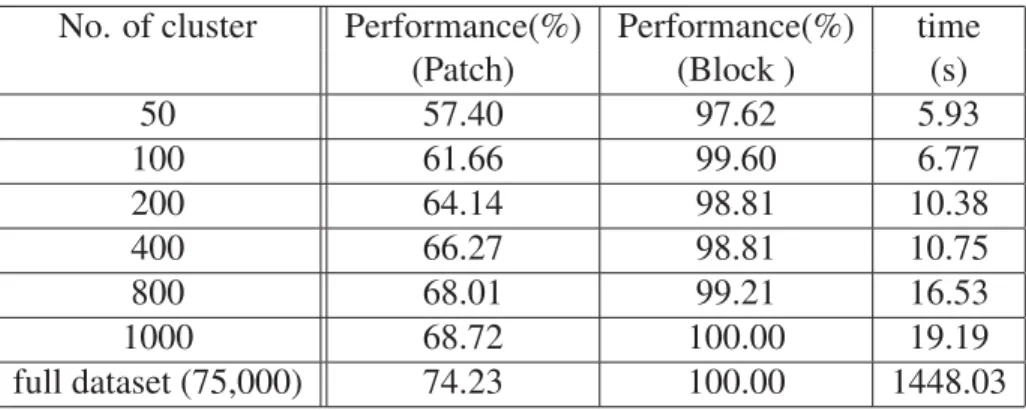
Table 3.1 Performance of algorithm with different numbers of clusters in high-dimensional space (dimension of 1089) with 170,000 patches as test
set, 75,000 patches used for cluster learning . . . 65
Table 3.2 Performance of algorithm with different numbers of clusters in low-dimensional space (200 bases for PNMF) with 170,000 patches as test set, 75,000 samples for PNMF learning and cluster learning. . . 65
Table 3.3 Performance of algorithm with different numbers of clusters using SURF features (94,000 samples as test , 62,000 samples for cluster learning . . . 66
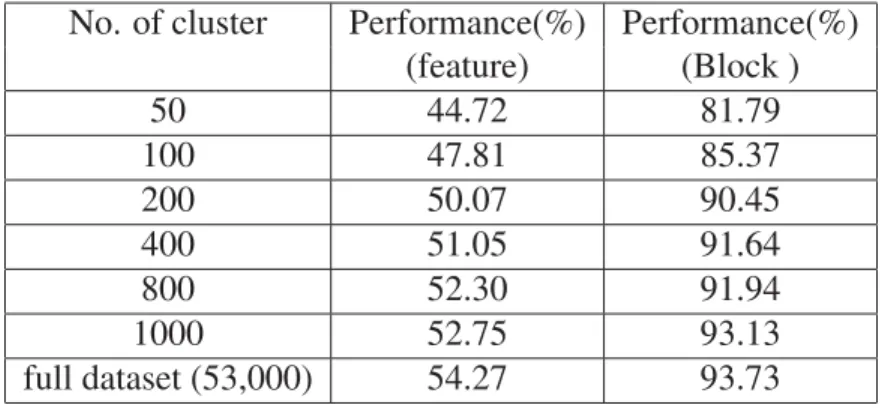
Table 3.4 Performance of algorithm with different numbers of clusters with SIFT features using 80,000 samples as test, 53,000 samples for cluster learning . . . 66
Table 3.5 Performance comparison of 3 script identification method (correct classification) . . . 66
Table 4.1 Confusion table of font identification (in percent) . . . 92
Table 4.2 Confusion table of font identification with the added transformations (in percent) . . . 93
Table 4.3 Confusion table of Font identification with the higher level of added transformation (in percent) . . . 94
Table 4.4 Confusion table of style identification (in percent) . . . 95
Table 4.5 Accuracy comparison of font and style identification . . . 96
Table 5.1 languages and labels used in first set of experiments. . . .114
Table 5.2 languages and labels used in second set of experiments . . . .114
Table 5.3 Performance of different algorithms on synthetic dataset (sentence length : 300 characterts) . . . .120
Figure 0.1 Writing systems and sample scripts . . . 3
Figure 0.2 Cyrillic script letters . . . 4
Figure 0.3 Different shapes of Letters (without dot) used in Arabic script . . . 5
Figure 0.4 Hebrew script letters . . . 5
Figure 0.5 Some examples of different a) Arabic fonts, b) Arabic styles . . . 7
Figure 2.1 proposed framework and its application in different problems . . . 37
Figure 3.1 Writing systems and scripts of world . . . 42
Figure 3.2 Levels of information: part of image, image block (blue rectangle), image patches (red rectangles), center of the patches (green circles) . . . 50
Figure 3.3 Flowchart of the proposed method . . . 52
Figure 3.4 Keypoints detected by Skeleton method (left), SIFT method (middle) and SURF method (right) . . . 54
Figure 3.5 Occurrence of similar connected components in a sample document image for handwriting . . . 55
Figure 3.6 Original image and its reconstructions using 10, 40 and 150 bases obtained by NMF . . . 58
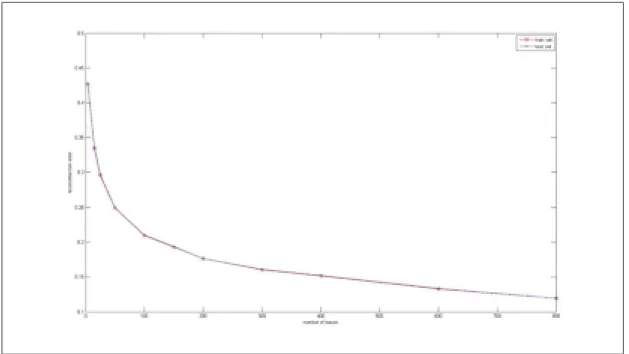
Figure 3.7 Average representation error for the train set and the test set with different number of bases (EUD objective function) . . . 59
Figure 3.8 Average representation error for train set with different number of bases for KLD objective function . . . 59
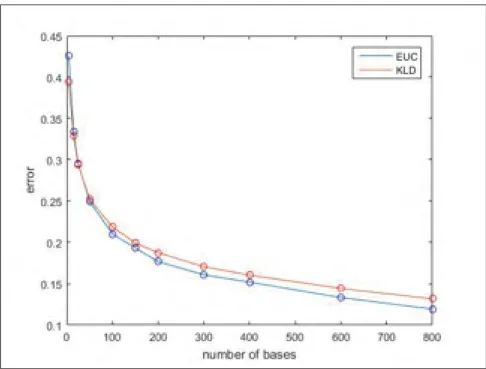
Figure 3.9 Comparison of representation error for EUD and KLD objective function measured by Euclidean distance . . . 60
Figure 3.10 Comparison of representation error for two objective function in patch level, left) EUD objective function, right) KLD objective function . . . 60
Figure 3.11 Result of classification with different numbers of bases
(Dimension) and clusters . . . 64
Figure 3.12 Time complexity of algorithm with different number of bases (Dimension) and clusters . . . 64
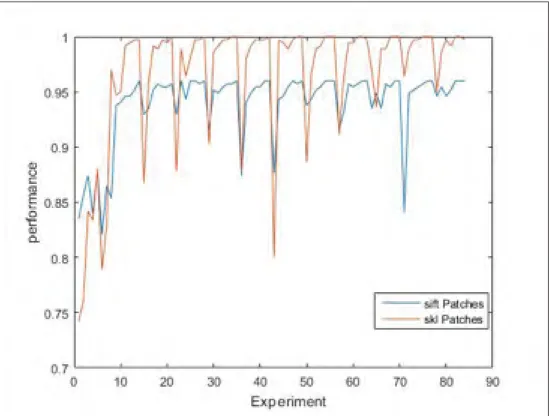
Figure 3.13 Comparison of performances of SIFT patches and Skeleton patches by different number of bases and clusters . . . 67
Figure 3.14 100 cluster centers obtained in low-dimensional space, shown in high-dimensional space . . . 67
Figure 3.15 400 cluster centers obtained in low-dimensional space, shown in high-dimensional space . . . 68
Figure 3.16 Pre-processing of image for keypoint extraction in the presence of noise, left) lower level of noise, right) higher level of noise . . . 70
Figure 3.17 Representation and reconstruction of noisy patches with different number of bases . . . 71
Figure 4.1 Different shapes of Letters used in Arabic script . . . 77
Figure 4.2 Some examples of Arabic font . . . 78
Figure 4.3 Flowchart of proposed method . . . 85
Figure 4.4 top) Skeleton map, bottom) sample keypoints and the corresponding patches . . . 87
Figure 4.5 Examples of few different Arabic fonts in ALPH-REGIM dataset . . . 91
Figure 4.6 Examples of different Arabic handwriting styles. . . 91
Figure 4.7 (top) Original image and (bottom) transformed image (perspective transform) . . . 93
Figure 5.1 Flowchart of proposed method . . . .107
Figure 5.2 50 cluster centers obtained by Left) kmeans, right) NMTF with 100 bases . . . .109
Figure 5.3 Sample image and keypoints extracted from the skeleton map . . . .110
Figure 5.5 Cluster centers obtained by (left) Kmeans , (right) NMTF . . . .113
Figure 5.6 Language Identification Accuracy using Bigram and Unigram
representation on the sentence length of 200 characters . . . .115
Figure 5.7 Language Identification Accuracy using Bigram and Unigram
representation on the sentence length of 500 characters . . . .115
Figure 5.8 Language Identification Accuracy using Bigram and Unigram
representation on the sentence length of 200 characters (6
langauges) . . . .116
Figure 5.9 Language Identification performance using Bigram and Unigram
representation on the sentence length of 500 characters(6
langauges) . . . .116
Figure 5.10 Classification result using Bigram feature for text-based method
and NMTF (proposed method) and kmeans for image-based
methods(sentence length: 300 characters) . . . .118
Figure 5.11 Classification result with mapping from patch representation to
ED Euclidean Distance
KLD Kullbacl-Liebeller Divergence
NMF Non-negative Matrix Factorization
PNMF Projective Non-negative Matrix Factorization
NMTF Non-negative Matrix Tri-Factorization
SVM Support Vector Machine
KAS K-Adjacent Segments
LDA Linear Discriminant Analysis
SOM Self Organizing Map
SIFT Scale Invariant Feature Transform
SURF Speeded Up Robust Features
SKL Skeleton
BOW Bag Of Words
MLP Multi Layer Perceptron
ART Adaptive Resonance Theory
LFDF Light Field Distortion Feature
GMM Gaussian Mixture Model
EDMS Edge Direction Matrix
EDM Edge Directional Map
BEMD Bi-dimensional Empirical Mode Decomposition
IMF Intrinsic Mode Function
LBP Local Binary Pattern
GLCM Gray Level Co-occurrence Matrix
TAS Three Adjacent Segments
OFR Optical Font Recognition
OCR Optical Character Recognition
Invention of paper is one of the most important steps in the history of mankind and since the invention it is used in many situations. By the invention of the computer and dominance of the digital world, the electronic documents are substituting the paper-based documents by many reasons, such as easy sharing, easy searching or better preservation. Although, digital paper is the preferred mean in many situations, human used and still is using paper in many aspects of his life such as books, letters, mails and many others. Text recognition systems have been introduced and used in many areas such as posts, libraries and banks for automation. From another point of view, there are many sources of information such as ancient manuscripts and historical books available and many libraries own huge number of ancient manuscripts from different time-lines and periods. Many of these sources are converted to digital format (image) but in order to facilitate the usage, automatic document understanding methods are needed. Different countries or regions use different scripts and there are countries that have more than one official script which are used in different regions or territories. The books are written in different scripts, font or writing styles and also different languages. Some scripts are shared be-tween different languages and influences of different cultures and languages that have common script can be seen in different styles of handwriting and different fonts for printing.
In this multi-scripts, multi-fonts and multi-languages world , adapting one recognition engine to all of these variations is not efficient and a specific system is needed that selects the proper recognition engine based on the type of a document image. Different scripts use different symbols, might be written in different directions, use different shapes of the characters that might change their shapes or the connections between them according to the handwriting style
(font) in a document image. Also, the interpretation of recognized characters or words is based on the language of that document image.
In this thesis, we focus on the task of document image categorization. Although, the main goal of document image understanding is obtaining textual information of a document image, the recognition systems need a lot of information for accurate results. Many of this information are related to the type of document image. In an example scenario for manual using of DIU system, many questions should be answered by the user in order to obtain the desired output. Such questions are, what is the script of the document image, what is the handwriting style of document image or what font is used to print that document image and what is the language of the document image. All of these answers have important and critical roles in automatic understanding of document image.
0.2 Writing system
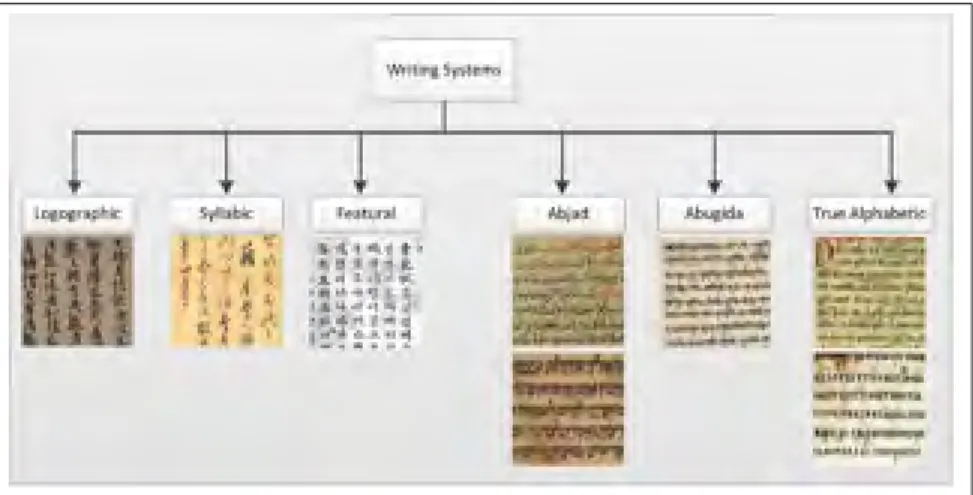
A writing system or script is a tool to express concepts in a language and uses graphical shapes and symbols to represent elements and statements. Each script or writing system has a set of defined elements and each element is assigned with special meaning and role for writing in a language. Some writing systems have same origin but evolutions and changes of them during the time make them different. Writing systems of the world can be categorized into different groups. In Daniels & Bright (1996), writing systems, their features, differences and similarities are introduced and discussed. Writing systems can be divided into 6 main groups which is illustrated in Figure 0.1.
Logographic: The main example of this writing system is Chinese script in which each char-acter (symbol) represents a single word or more.
Syllabic:The main example of this writing system is Japanese script and in this script a set of writing symbols represent syllables and words are made up of these syllables.
True Alphabetic: The main example of this writing system is Latin script and the elements of this system are called letters and each letter is roughly a phoneme of corresponding spoken languages.
Abjad: The main examples of this writing system are Arabic and Hebrew and each symbol is consonant. In most of cases the vowels (short vowels that are small symbols) are omitted and the reader should understand the proper vowels based on the context. These scripts are written from right to left.
Abugida: The main example of this writing system is Brahmic family of script in which the unit of the script is sequence of consonant-vowel (each unit consist of a consonant and a vowel).
Featural: The main example of this writing system is Korean script in which the symbols are the elements that make up the phoneme.
Figure 0.1 Writing systems and sample scripts
Document scripts
Latin script: Latin script is composed of 26 letters and some extra symbols are added in different languages that use Latin alphabets. The letters are written in isolated forms but the
cursive style is invented by writing sequence of connected letters but the global shape of the letters generally do not change.
Cyrillic Script:This script is inspired from the capital Greek alphabets and introduced in east Europe. This script is the base of Slavic languages and Russian. The uppercase and lowercase of the letters are not much different compared to Latin script. The Cyrillic letters are shown in Figure 0.2.
Figure 0.2 Cyrillic script letters
Arabic Script: Arabic script is composed 28 letters and it is shared between different lan-guages therefor few other letters introduced to adapt it to different lanlan-guages. This script is cursive and the letters attach to each other to create words. Each letter in this script can be written in two or four forms depending on the position in the word, the preceding and succeed-ing letters. Arabic letters and their different shapes are shown in Figure 0.3.
Hebrew Script: The Hebrew alphabet also known as block script is used to write Hebrew languages. This script belongs to the family of Abjad writing system and has 22 letters which 5 of these letters have different forms if they are used as the last letter of a word. Similar to Arabic, Hebrew is written from right to left but the letters are written in isolated forms. The present Hebrew which is also known as square script is derived from Aramic alphabets. The example of Hebrew script is shown in Figure 0.4.
Figure 0.3 Different shapes of Letters (without dot) used in Arabic script
Figure 0.4 Hebrew script letters
0.3 Calligraphy, Style and Font
Calligraphy is the art of writing and it can be found in all cultures. In some cultures calligraphy has a deep connection with paintings and its development is along with paintings. Some scripts such as Arabic is used in many countries and the influence of different cultures (that used
Arabic script) is seen in art of calligraphy. Calligraphy and writing style has a close connection in Arabic script. Many styles invented for different usages and many peoples improved the appearances of these styles from the artistic point of view. With the invention of printing many type sets and in digital form various fonts are designed and used. Although, these concepts (Calligraphy, Style and Font) are appeared in all of scripts, the focus of this thesis is on the fonts and styles related to Arabic Script. Some famous Arabic writing styles are as follows:
Koufi style:As one of the earliest writing styles used for writing many books, this style consist of mostly straight or angled parts and very few curves. The long and continuous horizontal and vertical strokes are the main features of this style.
Naskh style: This style was introduced to remove the errors and ambiguities of Koufi style by adding dots and incorporating diacritics. The main features of Naskh are proportionality and scale which are considered in designing the letters. This writing style is one of the most legible and most used styles.
Tholoth style:This writing style is mostly used for artistic purposes and it seems to be similar to some other styles such as Naskh. This style has some distinctive features such as elongated forms for some letters or very shallow and open curves (circles). In this style some words are written with overlap (in artistic forms) which makes the reading of text a bit difficult.
Taliq style:This style is one of the first styles from Persian cultures. In this style the words are written with a lot of overlap and in different shapes but the writers should follow some basic rules. This style has many curves so lots of combination can be created to write with this style. One of the main features of this style is curved text lines.
Nastaliq style: This style is the most famous writing style in Persian culture, also known as Farsi style in some countries. This style is invented by combination of Naskh and Taliq and has many circles and the most of the letters are written based on curves.
In recent years, various fonts or type sets are designed for printing in Arabic script. One direc-tion for designers was developing fonts with the aim of fast producdirec-tion without considering the details of the Arabic script and another direction was to design the fonts that follow the same rules and writing purposes of famous Arabic styles. Some examples of famous Arabic writing styles and Arabic fonts are shown in Figure 0.5.
a) font b) style
Figure 0.5 Some examples of different a) Arabic fonts, b) Arabic styles
0.4 Language
Written language is a system of symbols and rules used by a group of humans for communica-tion. Human invented script to preserve and transfer knowledge and then the scripts are adapted to the different languages. Arabic script is one of well known script and by the interaction be-tween different cultures, it was selected by many nations and adapted to other languages such as Persian, Othoman-Turkish and etc. Although, there are many scripts that shared between different languages, the focus of this thesis is on languages that share Arabic script. Some example languages that use Arabic script are Arabic language(s), Persian (Farsi) language, Othoman-Turkish and Urdu. Although, these languages had and have many influences on each other, they have many differences.
0.5 Problem statement
Categorization of document image is a very challenging problem and these challenges are related to many sources. Some of the challenges are general and will be faced in any catego-rization systems and some others are related to the specific problem of categocatego-rization.
General challenges
Layout: Document images have very different types of layout that changes from simple to very complex structure. The complex layout is mostly appeared in handwritings or ancient manuscripts. One of the needed information before designing and using a categorization sys-tem is the level of the layout. Most of the proposed methods are based on the assumption that the layout analysis of the image is done with 100% accuracy and all of the models are built based on this assumption. From the layout analysis point of view, accurate layout anal-ysis needs a lot of information such as the script which determines the constraints of creating document image such as writing direction or in-word space vs between words spaces.
Handwriting variation: Unless the book that written by trained writer whom they follow specific rules and specific style, the variation is high in the writings even between writings of an individual. It is not possible to find two writers with similar handwriting. Hand writing variability is very high between different persons writings but it is also significant (from the recognition point of view) between writings of of one person. More precisely, the handwriting of people differs on the following points: The spacing between words and the direction of the lines that gives the basic structure of the document. Most often the lines are expected to be horizontal, but they can have an increasing or a decreasing slope.
Noise and degradation: Due to aging and bad maintenance, ancient documents are often in degraded condition. The color change of the paper and diffusion of ink in the paper are
the results of aging and disintegration of page, shears and stain as physical damage are the results of bad maintenance. In many situations, new degradation such as the bleed-through and deformations are also appeared after digitization process. Skew, scale and other distortions might be imposed to document image during digitization.
Pre-processing and feature extraction: Different types of features are extracted and used for document image categorization. Some features or methods are inspired from other fields. For-example texture features that are used for categorization, have no direct relation to the components of the document image so analyzing the results are very difficult. From another point of view, in order to prepare data for feature extraction and classification, many pre-processing steps are needed to remove unrelated variations. These steps highly depend on the layout and level of layout that should be extracted and also depends on the category.
Specific challenges
Challenges in script and language identification: The challenge for script identification is dealing with different fonts and styles. Other than handwriting variation that can be slight or hight variation for individuals, the font and style will change the nature of the document image hugely so the features should be robust against these variations and should be generalizable to other styles and fonts.
Challenges in language identification: The methods for language identification of document images are based on one idea, labeling components of the document image and then creating histogram from these labeled components. In text based methods, all complex steps of docu-ment image understanding (binarization, segdocu-mentation and recognition) should to be applied on an image to obtain these labels. In image based methods, the current coding procedure are not applicable to some scripts (especially cursive scripts) because of complexities in finding the components of those scripts.
Different nature of categories and related information: For any categorization task differ-ent levels of information is needed for accurate classification. For example, for script iddiffer-enti- identi-fication the assumption is that shapes of components are different for different languages and the features are extracted for this purpose. But if we consider font or style difference and other variations, this cannot be simply implemented and used for categorization. So at each level of categorization some variations are related to the classes and some are not so it is very difficult to design features that could be used for any task of document image categorization.
0.6 Contribution
Past research on categorization of document image established many methods for different categorization systems applied at different levels. The critical parts of such a system are rep-resentations and features that are informative, robust and relevant to the task of categorization. Many representations and features are proposed in literature and yet most of them cannot be used in real applications and practical situations. Therefore,the main goal of this thesis is to propose a framework for efficient document image categorization. This will be done by designing novel methods for script, style and language identification in a framework that can also be adapted to more complex problems.
First, this research focuses on the problem of script identification of ancient manuscripts which differentiates writing systems using the elements of scripts. Current methods are proposed mostly for machine-printed document image and many of them ignore the components of the scripts (in global methods) or ignore redundancy of information for extracting the correct in-formation (in local methods). The efficient representation and feature extraction framework is proposed based on patch representation and automatic feature learning. It will be shown in the experimental section that the proposed method is robust and flexible and improve the performance of categorization.
Secondly, this research will focus on the problem of font and style identification of Arabic script. Many features are proposed for this task but the focus of current methods is toward very constrained situation where the level of identification is known and fixed. The global features ignore the local properties of the fonts and the local features are not robust and can only be applied on few classes of the scripts. The efficient patch-based representation with automatic feature extraction is proposed to solve this problem in a broader levels of layout. This representation and the corresponding features are evaluated in experimental parts to show their robustness and performance for the problem of style identification.
Finally, this research will focus on the problem of language identification in Arabic script lan-guages. The main idea of language identification is to assign labels to the components of the script and then obtain a representation that shows the frequency of occurrences of those compo-nents. This process is done through two approaches, a recognition system with high accuracy or a recognition with consistent error (not random) and a coding scheme that assigns group labels to image components and compare these codings with textual data. The first approach needs application of many complex steps toward recognition and the second approach is not applicable on some scripts such as cursive script. The effective patch-based representation is adapted to this problem by proposing a novel method for language identification of Arabic script languages. In the experiments, this method is compared to the n-gram features extracted from textual data and the results show the strength and performance of the proposed method. This thesis will provide a framework for representation and feature extraction of document image toward the categorization problem (initially for Script, Style and Language) that can be adapted to more complex problems such as content-based document image categorization.
0.7 Context of the thesis
This section details the scientific context of this thesis. The methodologies for document im-age categorization systems are inspired from several fields such as computer vision. During our research, we were interested in proper representation that could be used for different cate-gorization applications and a set of features that can be extracted from document image in an automatic way and used for different tasks.
One main area that limits the capability and applicability of current methods is representa-tion. Most of categorization methods are proposed with an assumption about the specific level of layout of the target image so the steps of algorithms such the representation and feature extraction will be limited based on that assumption.
Different scripts and writing systems have different elements and incorporate different con-straints and rules for writing. Some scripts are composed of isolated letters and there are no connections between letters and in cursive style of these scripts, writing the connected sequence of letters, the shapes of the letters do not globally change. Some scripts are cursive in nature and the letters should be attached to create words and the shape of the letter should be altered according to the position in the word and also the preceding and succeeding letters. In some script the notion of character or letter does not exist and each component is a word or more. In some script the writing direction is left to right while in other scripts the writing direction is right to left or top to bottom.
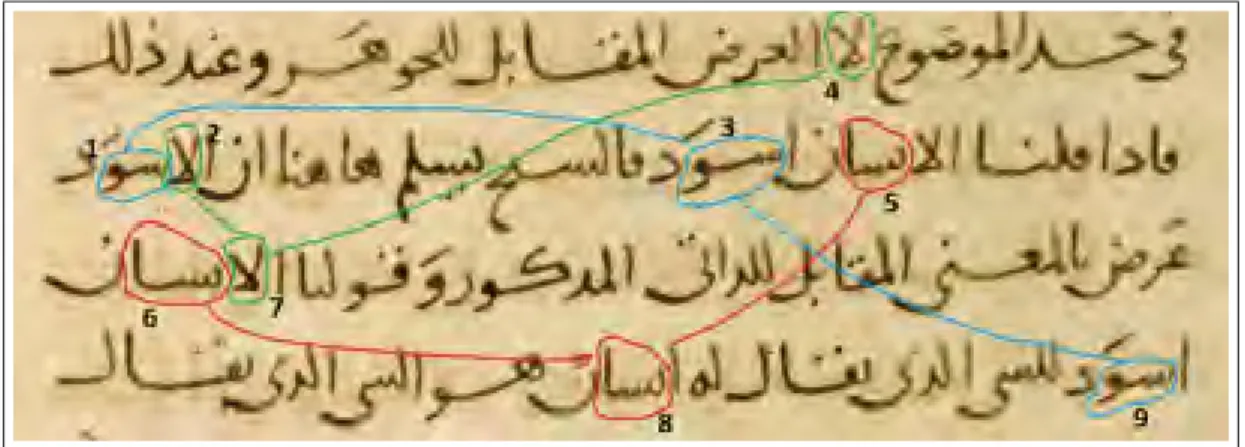
One of the most efficient way of representing the components of different scripts in an un-constrained layout is using image patches. Patch-based image representation is used in many applications and strength and performance of this representation is confirmed by many experi-ments in many different situations. The patch representation gives us the flexibility of skipping the complex step of lyout analysis and also the potential to overcome many limitations that are
imposed on current methods. Image patches are robust against noise, degradation and discon-tinuity in textual objects and can be extracted efficiently.
Some of successful methods for object retrieval are based on keypoints detector and descriptor and these methods combined with BOW model are used successfully in many applications. Unlike natural image that the position of the objects and location of keypoints are unknown, in document image we roughly have the position of keypoints i.e. foreground pixels that can be obtained by binarization methods. From another point of view, document images contain highly redundant information and this information can be used for extracting the correct in-formation. Unlike the keypoint detectors that mostly work based on corner detection and can estimate the scale of the corner ponits, we use global properties of document image to deter-mine the patch size. The global properties of document image such as average text height, average stroke-width and void space between text lines are used for this purpose.
The next step of the process is feature extraction, obtaining an abstract descriptor that should be robust to unwanted variations. For the current methods, the features or descriptors are designed based on few observations so they might not reflect the true nature of data. Here, we are interested in automatic feature extraction methods where the features are learned from the variations in data and the redundancy in data is exploited for obtaining robustness and generalization power.
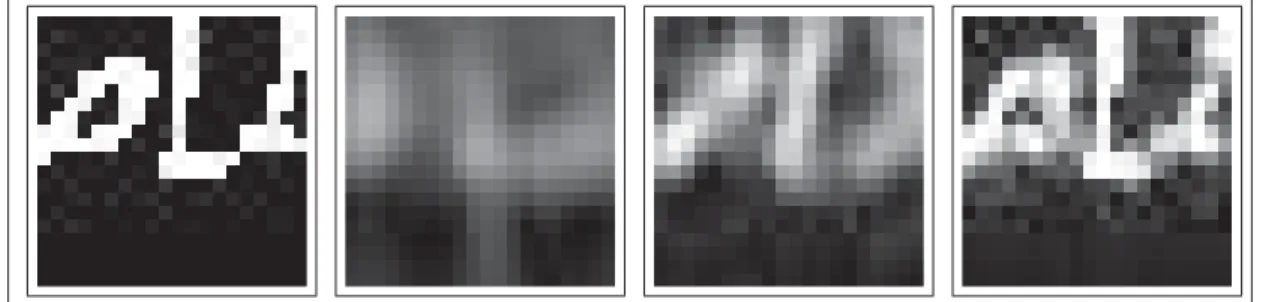
The aim of Non-Negative Matrix Factorization is factorizing data matrix as a product of two matrices with the non-negativity constraint. This constraint is observed in many real data and also have physical interpretation that shows the presence or absence of objects as the components of more complex objects. These two matrices are interpreted as a basis matrix and a coefficient matrix which the basis matrix contains the building blocks of the objects and coefficient matrix contains the contribution of those building blocks. Two properties of NMF are low rank approximation and collaborative learning that means the number of bases are
less than dimensionality of data so noise can be eliminated and collaborative learning helps to retrieve the correct and accurate information.
Although, the above strategy seems very promising for script identification, it is not applicable for the style or font identification in a specific script. As it is observed in the previous figures, shape of letters in different styles have global similarity but they are different in very fine details. The motivation for style identification is that if the bases that obtained from the other styles are used to represent the patches of specific fonts, the error of representation will be higher compared to the situation if the correct bases are used. Although, NMF seems very suitable for this application the bases that obtained from data of different fonts are very local and could be similar but in different order. NMTF as the generalization of NMF to three matrices can be used here. The motivation for this method is that tri-factorization method extract bases from patches of different font and then use these bases to recreate some elements of the fonts (as cluster centers). As this combination is different for each font, the bases are specializes toward that font and these bases will be more discriminant.
Although, some languages use same script, the structures of the languages and their roots are different so the elements of the scripts are used differently. If the textual information of document image is available, the simple way for language identification is creating histogram of the objects (n-gram features) and then useing them for this purpose. In the absence of textual information, the most effective model is bag of visual words in which the aim is to find some common objects between differnt classes and then use a representation based on those objects for classification. Image patches can be considered roughly as equivalent of textual objects (i.e. letters if selected correctly) and most of the concepts for textual data can be transferred to image domain by patch representation.
In BOW approach, image will be modeled by a histogram that shows the frequency of appear-ance of some objects or words in that image. The main part of this approuch is obtaining this
set of words or keywords that is called dictionary learning. Most of keypoints or keywords detector are based on finding all of the words from the data and using clustering to create key-words or dictionary. This dictionary will be used for representation of elements of document image. Unlike natural images that can have infinite number of words, document images are composed of few objects and while the shapes of these objects have variation (due to being handwritten or having distortion or different font), they are similar at the abstract level . Simple clustering methods are proposed to cluster samples or features but bi-clustering method are proposed to cluster data simultaneously so these methods are able to find the interrelation between samples and features and they provide better clustering results. Non-Negative Matrix Tri-Factorization is inspired from the relation of NMF and clustering methods and proposed to exploit this relation. In a very simple interpretation, NMTF is projecting data to a low-dimensional space and provides the abstract representation for data and then explores that space to find relevant clusters. The cluster centers or keywords obtained by NMTF are more accurate and better representative compared to simple clustering method such as kmeans.
0.8 Outline of the thesis
The introduction chapter contains the general context of the thesis. Chapter 1 contains the re-viewed state of the art methods with the highlights on limitation and drawbacks of the current methods. In Chapter 2 the general methodology with the objectives of the thesis are mentioned. The framework for script identification, style (font) identification and language identification are then described. The next three chapters present the methods proposed and developed in this thesis and the corresponding results. Chapter 3 presents the first journal article, script identi-fication method. Chapter 4 presents the second journal article, a style identiidenti-fication method. Chapter 5 presents the third journal article, a language identification method. Then, Chap-ter 6 provides the general discussion that highlights the improvements that achieved with the
proposed methods and discuss the drawbacks. Finally, the general conclusion summarizes the work presented in this thesis with a glimpse of the future perspectives.
identification.
As mentioned before, script is defined as the graphic form of the writing system used to write statements that refers to a particular way of writing and the set of characters used in it. A script may be used by only one language or may be shared by many languages, sometimes with slight variations from one language to other. Some languages even use different scripts at different points of time and space. Therefore, in this multilingual and multi-script world, OCR systems need to be capable of recognizing characters irrespective of the script in which they are written. Manual identification of the documents scripts may be tedious and time-consuming. Therefore, automatic script recognition techniques are necessary to identify the script in the input document and then redirect it to the appropriate character recognition module. A script recognizer is also useful in reading multi-script documents in which different paragraphs, text blocks, text lines, or words in a page are written in different scripts. For scripts used by only one language, script identification itself accomplishes language identification. For scripts shared by many languages, script recognition acts as the first level of classification, followed by language identification within the script.
1.1 Script identification methods
Different script can be separated by means of specific spatial distribution of characters and visual attributes which differentiate them. The first step of script identification is extracting useful features from a set of document images and the second step is using these features to classify the document images. These approaches may be divided into two categories based on the type of the features:
- Structure-based methods:
Structure, connection and writing style of different scripts are good features to differentiate between scripts. In most of these methods, connected components (continuous runs of
pixels) are analyzed based on their shapes, structure and morphological characteristics to produce discriminant features.
- Visual appearance-based methods:
Difference of the shape of individual character, grouping of character into word and group-ing of word into sentences can be tracked without really analyzgroup-ing the pattern of characters in the documents. So, several features are proposed to describe the visual appearance of script in a region.
Based on the level of applying a method inside document, the script identification methods may be classified into different groups: a) page wise b) paragraph wise-block wise c) text line wise d) word wise
Structure-based method
In Pal & Chaudhuri (2001) the script identification method for printed English, Chinese, Ara-bic, Devnagari and Bangla text lines is proposed. To separate Devnagari and Bangla from the other script they used the headline features that show the long horizontal line in horizontal projection profile. The position of this longest run is used to separate Arabic from Devnagari and 6 Bangla. They use zone-wise features to separate Bangla and Devnagari and number of vertical run to separate Chinese from Arabic and English.
In Ablavsky & Stevens (2003) a script identification method to separate degraded printed Cyril-lic and Latin is proposed based on subsets. After pre-processing and binarization, the Cartesian moments features are extracted from connected components and normalized to obtain scale in-variant features. Hu moments are used to compensate for changes in the rotation. The other features such as curvature, holes, the length of the major and minor axis, eccentricity, elonga-tion convexity and co-occurrence features are also extracted and the subset selecelonga-tion algorithm of RELIEF-F is used to find the most discriminant features.
In Palet al.(2003) the authors proposed a hierarchical script identification method for Indian Documents. Their features are headlines, horizontal projection profile, water reservoir princi-ple based features, left and right profiles and features based on jump discontinuity.
In Shijian & Chew Lim (2007) a component vector of size 10 that contains number of vertical cut for each connected component is used for script identification. The components of 1 to 8 of these vectors are number of vertical cut of connected component. The 9th and 10th elements are constructed by counting number of vertical cut lying above and below the connected 7 component center. The cosine similarity is used to measure the angle between query and reference component vector.
In Hangarge & Dhandra (2008) two sets of global and local features and decision tree strategy are used for script identification. The global features are stroke density, pixel density and local features are aspect ratio, eccentricity, extent and directional profile densities.
In Chanda et al. (2009) the word-wise script identification method for 3 classes of Sinhala, Tamil and English texts is proposed using structural, topological and water reservoir principle features. They proposed a set of 8 features that include right convexity feature, bottom, left and right reservoir based feature, size dissimilarity of loop, position and size of dots, top reser-voir and distribution of vertical stroke feature. Given a training dataset, RBF kernelled SVM classifier is used to classify new image.
In Padma & Vijaya (2009) the text-line-wise script identification method for Telugu, Hindi and English scripts is proposed. In their method, after pre-processing and top and bottom projection profile, a set of features are extracted and analyzed based on the script to find the ranges of the features in mentioned scripts. To classify new image, this set of features is extracted and the script is classified based on the ranges that those features lie. The rejection strategy is used to separate scripts other than mentioned scripts.
In Rezaee et al. (2009)(Rezaee, Geravanchizadeh et Razzazi, 2009), the authors proposed a
and segmentation to text line and words, the distribution of horizontal projection for each script is calculated. According to their observation, the Latin and Persian words or text lines have different distribution while the former has almost uniform distribution, the latter has normal distribution.
In Aithal et al. (2010) the authors proposed a Textline-wise trilingual script identification method based on horizontal projection profile for separating Kannada, Hindi and English scripts. The feature that they used is based on the first and second maxima of horizontal projection. They proposed the ruled based classifiers that separate the mentioned scripts in 2 steps. In the first step the first maximum is compared to 1.5 times of the second maximum to separate Hindi from others. In the next step they calculated the mean of projection profile between first and second maximum and find the value of point after maximum in horizontal projection profile. Comparing these two values and defining the ranges for features, Kannada and English can be recognized from each other.
In Chanda et al. (2010) the authors proposed the method for script identification method for Chinese, Japanese and Korean script. They used chain-code histogram-based features inspired from the observation that the difference of Han based scripts such as Chinese, Japanese and Korean have the dissimilarities that can only be found in small part of the characters. In their method after computing the bounding box and dividing it into some blocks, each block is described by a vector of size 4 that contain frequency of chain code. The feature vector for each character in bounding box is concatenation of all features obtained from correspond blocks. These features are normalized by dividing by the maximum value and dimension is reduced by down sampling with Gaussian filters. The classifier that they used is SVM with Gaussian kernel.
In Gopakumaret al.(2010) the zone-based script identification method is proposed to separate South-Indian, English and Hindi script. For each text line, 3 groups of features are extracted in 3 steps. At first, 9 features are extracted from text line and then the text line is divided into 3 horizontal zone and for each zone the set 9 of features are extracted and for each text-line
Euler number is computed. To increase the classification rate, the most prominent features are selected from the whole set of 32 features. SVM and K-NN classifiers are used for the classification of new document images.
In Royet al.(2010) the script identification method at word level for separating printed Kan-nada and Devnagari documents mixed with printed/handwritten English numeral is proposed. The main steps are, pre-processing and layout analysis for line-wise and word-wise segmen-tation using horizontal and vertical projection. A set of features form connected components are obtained by concatenation some features such as average aspect ratio, distribution of pixel around the center of mass. They use K-NN to classifying new features. 10
In Khoddami & Behrad (2010) the script identification method for separating Farsi and Latin script is proposed based on curvature scale space. Each connected component is represented as a planar curve and evolved by convolving with 1-D Gaussian Kernel iteratively. At each iteration, curvature of the evolved curve is calculated and a histogram of positions that curva-ture becomes zero versus the variance of the Gaussian Kernel is depicted until there is no zero crossing. The histogram is renormalized to become robust against scale, noise and orientation change. Their features are set of 10 measurements from the difference and ratios and a set of extra 5 features to deal with round shapes. K-NN Classifier with hierarchical distance measure is used to classify new connected component.
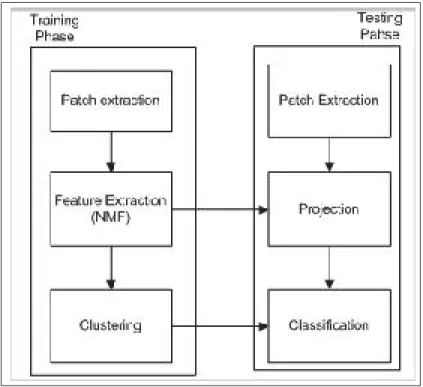
In Marinaiet al. (2010) the authors proposed a script identification method based on bag of characters and SOM for separating Cyrillic, Latin and Greek scripts. The main steps of learning phase are extraction of symbols/characters, representation with feature vectors, vector quanti-zation by applying clustering, representation of symbols with index of cluster and representing a document image with weighted frequencies of symbols. For each symbol (connected compo-nent) a feature vector that describes the distribution of pixels is calculated and Self Organizing Map (SOM) is used for clustering and vector quantization. For new Image, the symbols are ex-tracted and indexed by SOM and the weights corresponding to cluster for pages are calculated. The similarity of query and indexed page is the cosine of the angle between weight vectors.
Visual appearance-based method
In Singhalet al.(2003), the authors proposed a method for script identification of handwritten text documents. After pre-processing steps such as denoising, thinning, pruning, m- connectiv-ity and text normalization, they applied multi-channel Gabor filter to extract the texture features to separate different scripts using visual appearance characteristics of document images. In Buschet al.(2005), the authors proposed a method for block-wise script identification. The texture features of gray-level co-occurrence matrix, Gabor energy features, wavelet energy features, wavelet log mean deviation features, wavelet co-occurrence signatures and wavelet scale co-occurrence signatures are used to separate Latin, Chinese, Japanese, Greek, Hebrew, Sanskrit and Persian. For each co-occurrence matrix, 8 features of energy, Entropy, Inertia, Contrast, Local Homogeneity, Cluster shade, Cluster Prominence and infimum Measure of correlation are extracted and LDA algorithm is used to reduce the dimensionality of data. The GMM that models the distribution of each class by combination different Gaussian distribu-tions is used to perform the classification.
In Panet al.(2005), a block-wised script identification method is proposed based on steerable Gabor filters. They developed rotation invariant features that obtained from mean and standard deviation of filtered image using 1-D Fourier transform. To speed up the feature extraction step, they used the approximation method that instead of calculating the response of the filter in all direction, use steerable properties to combine the filter outputs that correspond to the basis of the rotated version filter. For the classification, they use two-layer feed forward back propagation neural network with rejecting strategy by 4 neurons in the output layer according to four classes of scripts.
In Ben Moussa et al.(2008), the script identification method based on fractal feature is pro-posed for printed/handwritten Arabic/Latin scripts. Fractal dimension is a measure of 12 com-plexity of an image and can be estimated by the fraction of the logarithm of number of boxes by size of those covers object, to the logarithm of inverse of size r. To gain the good result they use multidimensional b-features and d-features of full image, horizontal and vertical
projec-tion profiles. The b-features are based on box counting and d-features are obtained by texture surface measurement after applying dilation operator in different levels. They used K-NN and RBF to separate different classes.
In Linlin & Chew Lim (2008), the authors proposed a method for script identification of doc-ument images under the perspective distortion. They approximated the perspective distortion by affine transform and for each character generated a signature that can be captured correctly without knowing information about the text-line direction. To create templates they used a method to extract the signatures and clustered them by hierarchical clustering algorithm. Using cosine distance, the 30 biggest clusters are chosen and centers of these clusters are considered as templates. Histogram of nearest template is used to differentiate between scripts.
In Chandaet al.(2009)(Chanda et al., 2009), the authors proposed a word-wise script identifi-cation method for separating Latin, Devnagari and Bangla in two stages. The first step performs high speed identifying and the second step deals with samples that are degraded or have low recognition confidence in the first step. In the first step 64-dimensional chain-code histograms of bounding box that is divided into few blocks are computed. In the second step a feature vec-tor of dimension 400 is obtained by dividing the normalized gray-level image -mean filtered of binarized image- into several blocks, applying Sobel filter, calculating quantized angle and the magnitude of the gradient. The classifier that they used is SVM with Gaussian Kernel.
In Hiremath et al. (2010a), the texture-based script identification for seven Indian languages and Latin script is proposed. They used Har wavelet to decompose any document image into 4 sub bands. For each pair of (A, H), (A, V), (A, D) and (A, abs(V-H-D)) , two co-occurrence 13 histogram in 8 directions are calculated to construct the cumulative histogram and to calculate 3 features of the slope of regression line, mean and mean deviation. The procedure is repeated for the complementary image obtained by . They used the Euclidean distance and K- NN classifier to classify the new image.
In Zhouet al.(2010), the authors proposed a texture-based feature extraction for script identi-fication of six scripts. After wavelet decomposition and calculating energy feature using three
detail sub-bands, linear quantization of the features is used to prepare features for calculat-ing wavelet energy histogram moment features. At next step, wavelet energy histogram is calculated and four weighted moments features –summing over first n value of original, low-pass, band-pass and high-pass filtered histogram- are calculated from each histogram. SVM is trained to classify new features.
In Yuemei et al. (2011), the script identification method based on global and local texture
features is proposed. In the first step the image is decomposed into different intrinsic mode function (IMF) by Bidimensional Empirical mode decomposition (BEMD). Local binary pat-tern (LBP) algorithm is used to detect the local features of the textures and SVM is trained to classify new image.
Despite the fact that there are several styles that invented for writing Arabic script family, there are a few methods that addressed the identification of handwriting Arabic style. Demanding of high performance OCR system causes the evolution of document image categorization al-gorithm to select the proper OCR system that adapted for specific script. One of these systems is font identification system that classifies new document image based on the type of the font that used to print that document.
1.2 Style identification methods
Font identification methods can be divided into two categories based on type of method:
- Methods based on global features, these methods are text independent and skip information about the letters and the features describe global properties of document image.
- Methods based on local features, these methods are based on analyzing the individual object (letters). In these methods the components of document image (letters) are isolated and then based on similarity from textual point of view they differentiate between different fonts.
- texture features
- typographical features
- structural features
- automatic learning of features
In Yong et al.(2001) the authors proposed a font identification method based on texture fea-tures. As feature extractor step, they used Gabor filter in 4 different orientations and 4 different scales that produce 16 Gabor channels. The mean values and standard deviation of output channels are selected as texture features. The similarity measure is Euclidean distance that weighted by standard deviation of features of specific font.
In Fang et al. (2002), the texture-based font identification method is proposed. They used
Gabor filter as feature extractor and GA algorithm to optimize orientation set for Gabor filter. The range of orientation of 0 to 180 degrees with steps of 5 and 15 degrees is used for the input of GA and the fitness function that designed is: and are parameters they can be set based on experiments and unknown font feature is classified by Euclidean distance.
In Li Zhang (2004), the authors proposed an italic font recognition method based on wavelet decomposition. After applying wavelet transform, horizontal, vertical and diagonal sub-bands are analyzed and stroke patterns that differentiate italic and regular fonts are found by experi-ment. These rules are used to separate Regular and Italic Fonts.
In Hung-Ming (2006), the font identification method based on stroke template matching is pro-posed. After thinning process that creates skeleton, endpoints are selected and small branches are discarded. Then the skeleton image is scanned from left to right and top to bottom and stroke 15 junction with the length of more than defined threshold and strokes reaching end-points are kept as templates. In the recognition phase the extracted templates are compared with templates in the training set and Bayes’s decision rule determines the best matching.
In Ding et al. (2007), the authors proposed the font identification method for single Chinese characters. They applied a 3-level wavelet transform on the image of single character that nor-malized to size 48*48 pixels. For each sub-band, they divided it into some non-overlapped blocks and for each block they calculated a feature that is the weighted sum of wavelet coef-ficients by Gaussian kernel with two parameters of that should be set based on size of blocks. The result is one M*M feature matrix for each sub-band. The feature vector of size 702 is created for each character image and LDA is used to reduce dimension and create discrimi-nant feature set. They used MQDF (modified quadratic discrimidiscrimi-nant function) classifiers and features of one prototype for each font class, to classify new inputs.
In Jamjuntr & Dejdumrong (2009) the authors proposed a font identification method based on linear interpolation analysis. The first step of the proposed method is detecting the contour points of each character and indexing them by the edge detection algorithm. The contour pixels are sampled by the same amount for all characters and linear interpolation is created from these sampling pixels. The angles between every two pairs of obtained lines are calculated. Each new character is classified by the minimum Euclidean distance between the obtained angles.
In Ramanathanet al.(2009a) the authors proposed a font identification method based on
Ga-bor filter and SVM. They applied GaGa-bor filter on normalized image that divided into 9 non-overlapping blocks and 50 features (mean and standard deviation) are extracted for each block.
SVM classifier is used to analyze new data. In Slimane et al.(2010) the authors proposed a
font recognition method for Arabic script. In their method, each normalized word image that is kept in gray level is scanned with sliding window and in each position of the window a set of 10 features is extracted and the feature vector for each word is created by concatenation all features obtained in previous step. These features are number of black components, number of white components and the ratio of black/ white component and etc. and etc and likelihood of the features are estimated by GMM.
In Azmi et al. (2011) the new technique for font identification of handwritten document is