AIRCRAFT SYSTEMS ENGINEEERING
LIFECYCLE
CONSIDERATIONS
Allen C. HaggertyMassachusetts Institute of Technology September 11, 2004
What is the lifecycle of an
Aircraft ?
• 20 years? 30 years?
• What is the lifecycle of a typical
automobile? ( 10 years? 15 years?)
• How about a ship? ( aircraft carrier?
Battleship “New Jersey” launched in 1943 was used in Viet Nam in 1971
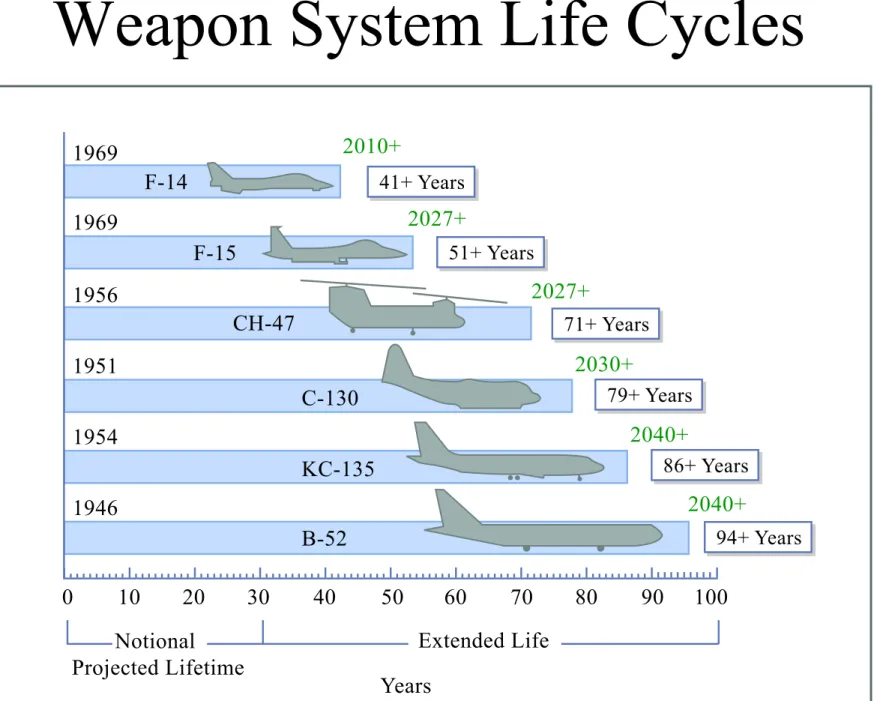
Weapon System Life Cycles
j 0
Notional
Pro ected Lifetime Extended Life Years 1946 B-52 KC-135 C-130 CH-47 F-15 F-14 1954 1951 1956 1969 1969 50 60 70 80 90 10 20 30 40 100 2040+ 2040+ 2030+ 2027+ 2027+ 2010+ 94+ Years 86+ Years 79+ Years 71+ Years 51+ Years 41+ Years
Figure by MIT OCW.
Boeing 707 / KC-135 and
Douglas DC-8
• Aircraft designed and produced in the late
1950’s / 1960’s still productive:
.KC-135 Tankers refueling fighter aircraft in Afghanistan
. DC-8 Freighters are still flying for UPS, Emory Airfreight and others
Aircraft Service Life Longer than
Ships?
Rugged Structure:
Comprehensive fatigue analysis and testing ( 2 to 3 lifetimes)
• Conservative design philosophy for safety
• Progressive depot maintenance rigidly enforced
( A-checks, B-checks, C-checks, D-checks)
• Designed for ease of inspection
EXPENSIVE ASSET NEEDS LONG • ECONOMIC LIFE !
ENGINES
• Designed for high reliability and low in-flight
shut-down rate (e.g. 2 engine ETOPS 777)
• PDM- significant overhaul schedule, but at extended on-wing operational periods
( TBO-16,000 to 20,000 hrs.)
• Extensive bench, ground and flight testing in
development to weed-out premature failures and assure component / sub-system reliability
QUESTIONS ????
• How many of you have driven in a car that has been repainted?
• How many of you have driven in a car that had an overhauled engine?
• FACT: Engines of large 40’-50’ Trailer Trucks are completely overhauled every 250,000-300,000
miles
IF THE DESIGN PHILOSOPHY IS RIGHT, WE CAN EXTEND THE ECONOMIC LIFE OF COMPLEX SYSTEMS
AVIONICS
• AIRFRAME LIFE can last through several generations of avionics / software:
C-130A (1954) Analog “boiler gauges”for cockpit displays
C-130 (late 1980’s) Evolution to digital avionics
C-130 J (1999) Digital flat panel color displays, GPS, GPWS, Terrain Following radar, etc.
UPGRADES & DERIVATIVES
• The lifecycle of an aircraft is typically
extended by upgrading or conversion:
Commercial Military
727 to Combi AH-64 to D
DC-10 to MD-10 CH-47A,B,C to D
DC-8 PAX to Freighter B-52 to H model
DERIVATIVES
Planning for “growth” in the original design:
Normally, the design staff lays-out a “family” of
aircraft that permits downstream /future models in the product family.
Examples:
.Wingspan increase /Fuselage stretch .Increased thrust engines/ better SFC . Latest Avionics
. Alternate model types envisioned at the start: Freighter/Combi/ER/Convertible Freighter
F/A-18E/F to C/D to E/F to Electronic Warfare EF-18F
With an Extended Useful Life,
What does this Infer Regarding
Lifecycle Cost of an Aircraft?
• ACQUISITION COST= 1/3 Total LCC
• OPERATIONS / SUPPORT COST=2/3 LCC
• An aircraft from inception, must be designed to : . Have the performance to achieve spec mission
. Be reliable and easy to maintain
. Be cost-effective ( achieve “design closure and
HOW DO WE ACHIEVE ALL
THESE CHARACTERISTICS?
• THE CURRENT ORGANIZATIONAL
PHILOSOPHY IS CALLED:
“ INTEGRATED PRODUCT
AND
IPPD-Integrated Product and
Process Development
• Evolution from the WW2 / Korean War
“Chief Project Engineer” organization Engineering provided Manufacturing with
“the design”
Manufacturing had to interpret the drawings, develop a Manufacturing/Tooling Plan,
design/fab tools, fab parts, assemble the aircraft
ENGINEERING “Throwing the
design over the wall” to
MANUFACTURING
• RESULTS:
. Parts didn’t fit; dimensional errors; omissions; .Significant Rework and “Re-do’s”
. Designs often were not producible with accept-able “yields”
. Behind-schedule conditions
The Hunters and the Bear
• The Engineer
• Three Manufacturing personnel:
1 Tool designer
1 Industrial Engineer
Integrated Product Team ( IPT)
• Over the last 10 years or so, the IPT has evolved into the “preferred” organizational approach for developing, fielding and operating complex
systems. Example:
F/A-18E/F Engineering Development Contract:
Ahead of schedule completion
$5 billion Budget Under-run
The Integrated
Product Development
Story
The Fundamental Cost/Profit
Relationship
Has changed in the last 15 years in
Has changed in the last 15 years in
the defense industry:
the defense industry:
Price Price Cost Cost Profit 15% Profit 15% Price
Price ProfitProfit
Customer
Customer
Willing to
Willing to
Pay
Pay CostCost
“
“Cost PlusCost Plus”” ProfitProfit CustomerCustomer--Determined Determined Equals Price
Equals Price PricePrice
(Industry Must Lower
(Industry Must Lower
Costs To Achieve Profit!)
$50,000 Ford
Taurus?
Lean Enterprise Value Stream
To Achieve a Lean Enterprise
Program, We Need to Understand a New Product’s Value Stream:
1.
1. The Customer Specifies ValueThe Customer Specifies Value
2.
2. Product Development/Engineering Product Development/Engineering
Create a Design Concept that Attempts
Create a Design Concept that Attempts
to Meet Our Customer
to Meet Our Customer’’s Requirementss Requirements
3.
3. Suppliers Create 60 Suppliers Create 60 –– 70% of Our 70% of Our
Product
The Value Stream
The Value Stream
Customer Customer Manufacturing Manufacturing Systems Systems Supplier Supplier Networks Networks Product Product Development Development Value is Specified Value is Specified Value is Created Value is Created
1 2 3 5 6 8 9 10 11 12
Overarching Practices
4 7
Design for Manufacturing
Has Reduced F/A-18E/F Parts Count
Design for Manufacturing
Has Reduced F/A-18E/F Parts Count
E/F 25% Larger and 42% Fewer Parts Than C/D
E/F 25% Larger and 42% Fewer Parts Than C/D
1
CC84740117.ppt
Forward Fuselage and Equipment
Center/Aft Fuselage, Vertical Tails and Systems
C/D Parts 5,500 E/F Parts 3,494 Wings and Horizontal Tails C/D Parts 5,907 E/F Parts 4,046 C/D Parts 1,774 E/F Parts 1,268
C/D Parts E/F Parts
14,104 8,099
C/D Parts
C/D Parts E/F PartsE/F Parts 14,104
14,104 8,0998,099
Total
DESIGN
FOR
DESIGN FOR
SUPPORTABILITY
OR
How can we design to achieve:
Airline Dispatch Reliability
Or
Military Squadron Availability
Or
SUPPORTABILITY
• Deals with the Operation and Maintenance
of the aircraft: . Reliability
. Maintainability
. Human Factors Engineering
RELIABILITY
• SYSTEM RELIABILITY-
Airline Dispatch Reliability- the ability of an aircraft to depart the gate within 15 mins. of scheduled departure time
unrestrained by mechanical, electrical or software issues.
RELIABILITY(cont’d.)
• COMPONENT RELIABILITY-Typically measured as :
MEAN TIME BETWEEN FAILURE (MTBF):
Helicopter transmission 3000 hours Rotor Blade 4000 hours Flight Control Computer 2500 hours
HUMAN FACTORS
ENGINEERING
• Design of the aircraft to ensure that it can be operated and maintained efficiently and safely.
Examples:
.Ability of a mechanic to lift a 40lb.battery .”Fool-proofing” a design to eliminate the
possibility of inadvertently crossing electrical wires
MAINTENANCE
ENGINEERING
• (ALSO KNOWN AS MAINTAINABILITY ENGINEERING)
• EXAMPLES:
.Accessability of key components for ease of removal
.Ilustrated Maintenance Manuals using photos, 3D drawings, for disassembly/ assembly
. Required maintenance /lubrication schedules, TBOs,
. Indentured Parts Lists
.Designing for Autonomic Maintenance down-
Managing the Design Process
(Lots of Issues to Keep Track of !!!!)
• Requires an extensive /Iterative Tracking System with monthly specialist estimates:
Performance- weight, range, payload, time-to-climb, etc.
Design to Unit Production Cost Reliabilty
Maintainability
Schedule
The SUPPLY CHAIN
60-70% OF A TOTAL AIRCRAFT IS TYPICALLY PROVIDED BY KEY SUPPLIERS: Fuselage Sections Wing / Empennage Avionics/ FCC/ Com-Nav Flight Control Surfaces Actuators, Hydraulic valvesEngines, APU
The Value Stream
The Value Stream
Customer Customer Manufacturing Manufacturing Systems Systems Supplier Supplier Networks Networks Product Product Development Development Value is Specified Value is Specified Value is Created Value is Created
TO ACHIEVE THE MISSION
SPECIFICATION
• OVERALL TECHNICAL PARAMETERS
ARE APPORTIONED TO EACH SUBCONTRACTOR, e.g.:
Parker Aerospace ( Hydraulic Flap Actuator Supplier) would receive a “Procurement
Specification” stating the requirements for: .Allowable space envelope, weight,
reliability, MM/FH, Qual requirements, , unit cost, delivery date, etc.
FLOWDOWN
• THE PROCESS OF DRIVING ALL
ELEMENTS OF THE TECHNICAL SPECIFICATION AND BUSINESS
AGREEMENT TO ALL SUPPLIERS IS KNOWN AS:
SUPPLY CHAIN
• WITHIN THE IPT, THE MATERIAL
DEPT./ SUPPLIER MANAGEMENT
ORG./ SUPPLY CHAIN MGT. ORG’N. WILL:
.Identify Capable Suppliers
.Conduct a Competitive Procurement .Negotiate Technical Spec, Price,
On-Dock date
.Negotiate Technical Changes
LIFECYCLE MANAGEMENT
SUMMARY
• INTRICATE PROCESS!
• MILLIONS OF DATA BITS TO
MANAGE OVER 40+ YRS.
• HUGE AMOUNT OF DETAIL
DECISIONS TO TRACK / MONITOR COMPLIANCE
• INTEGRATED PRODUCT TEAM HAS
THE RIGHT INGREDIENTS TO MAKE IT HAPPEN!
LESSONS LEARNED
• Early and constant attention to tracking
schedule, cost, technical performance and configuration are key to achieving program objectives.
• “Earned Value” method of schedule / cost
tracking is superior (BCWS, BCWP, ACWP)
• Close coordination with Customers,
Suppliers in an atmosphere of “open and honest” communication is key
LESSONS LEARNED (Cont’d.)
• IPT TEAM FOCUS ON THE PRODUCT
THROUGHOUT THE LIFECYCLE IS CRITICAL:
. Team decisions should be based on
“WHAT’S BEST FOR THE PRODUCT!”
HOMEWORK ASSIGNMENT
• 1.For your respective aircraft, go into
“Jane’s All The World’s Aircraft” or other sources and enter into your spreadsheet:
a.All the derivative / upgrade models and their distinguishing characteristics( more thrust, payload, range, new avionics, new weapons, etc.)
b. List the first flight date and calculate the number of years the basic aircraft has been in operation
Reference
• 2002 Minta Martin Lecture, April 19, 2002
“Lean Engineering ( or Why we no longer can ignore 80% of a Product’s Cost!)”
Prof. Allen Haggerty, Hunsaker Visiting
Professor, Dept. of Aeronautics &