XA0302214
EVALUATION OF TRAINING EFFECTIVENESS- OVERVIEW OF PRINCIPLES, PROBLEMS AND PRACTICES IN SWEDEN
Hakan Andersson
Kamkraftsakerhet och utbildning AB Sweden
Abstract
Evaluation of training is a complex concept that involves many interrelated activities. Successful evaluation studies require a basic understanding of this complexity. Evaluation of training and training effects is therefore a part of the basic instructor-training program at KSU, The Swedish nuclear training and safety centre. Complex evaluation studies require, however, preconditions that far from always can be met. It is therefore also important to learn from successful evaluation studies and try to extrapolate the conclusions to other similar situations. A short overview of one such study at a Swedish nuclear power plant is presented.
1. WHAT IS EVALUATION?
Evaluating of training is a broad concept that carries several meanings.
The most common meaning refers to the practice of giving tests and questionnaires to the participants at the end of a course. The tests are then used to see if individuals meet the course objectives and the results of the questionnaires are used to improve the way the course is being conducted.
A second meaning refers to the practice of evaluating the efficiency of the training itself. The purpose is then to see if the training is done in the best and most economic way. Could the same result be obtained at a lower cost or could a better result be obtained at the same cost? These are typical questions in such studies.
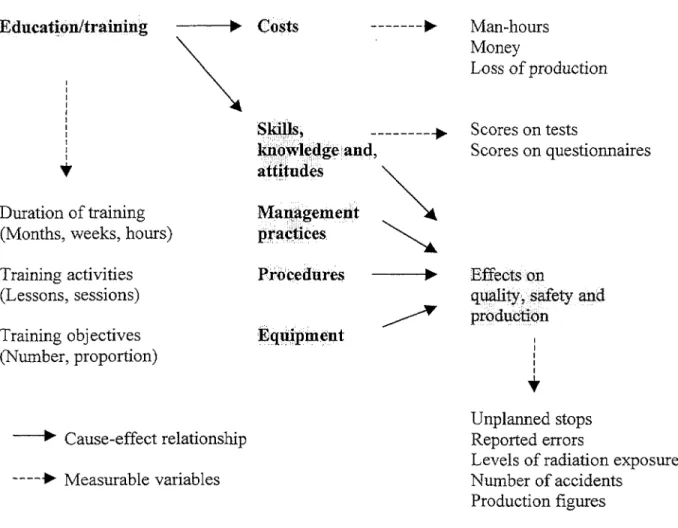
A third meaning would be to evaluate if the training has positive effects on quality, safety and production and if the resources spent on training is justified as compared to the savings that can be made.
These types of evaluations are all interrelated. The second type of evaluation cannot be made without data from the first type and the third cannot be made without data from the first and second type of evaluation. Unless a good practice has been establish in the first types of evaluations it is difficult to make well-controlled evaluation studies of the last and perhaps most interesting kind. Even then, assessing and evaluating the effects of training on quality, safety and production is a complicated task.
The effect of training may also interact with the other factors. Good procedures would for instance require a certain amount of training to work properly. The way the training activities are organised and integrated into the everyday operation may have strong effects on how much impact the training will have. It is therefore difficult to measure the effects of training alone.
2. PROBLEMS
Because of the complexity well-controlled and well-documented studies are rare. Optimistic attempts to "prove" the positive effects of training have too often failed to provide the clear-cut evidence of the training effects that the evaluators had hoped for. There are many problems along the road. For evaluations to be successful it is necessary to define all relevant variables, define the measurements, design an evaluation plan, collect all needed data, analyse those data and draw valid conclusions. The problems of doing all this are easy to underestimate. They can be found in the following categories:
Defining training. Defining tests.
Defining questionnaires.
Defining how costs should be calculated. Defining how efficiency should be calculated.
Defining valid measurements of quality, safety and production.
Implementing evaluation plans that isolates the effects of training from other factors.
Ill-defined variables and inadequate planning almost certainly lead to either wrong conclusions or to no valid conclusions at all. Studies that fail to handle these problems are at best a waste of time and money for the evaluation efforts. In the worst case the result will be erroneous conclusions regarding to effects of the training. Useless training practices may in such cases survive for years without responsible managers becoming aware of this fact.
Although trivial as they may seem at a first glance the problems mentioned above are not so trivial at a closer look. Just one example. It is quite common that training only is defined as the number of hours the participants spend in training. However, training defined this way may in some cases be extremely effective and in other have effectiveness close to zero. Unless the training objectives and the training activities are part of the definition of training the evaluation efforts are likely to fail from the very beginning. Even if the training objectives are well defined and also achieved during the training the effectiveness could be close to zero if the needs analysis has not been properly done. You might train the wrong stuff.
3. TRAINING THE EVALUATORS
Because of the complexity of the evaluation task it is not reasonable to expect that everyone can do this without adequate preparation and training. Learning what the proper preparations are, is an important part of that training. For this reason KSU is giving two courses with the focus on different phases of the evaluation process. The first course is a three-day course where instructors are taught the basic skills of how to make tests and questionnaires and how to score and evaluate the results.
The course content is:
Writing training objectives for skills, knowledge and attitudes Writing test items
Formulating statements in questionnaires. Scoring tests and questionnaires
Estimating the reliability of tests and questionnaires.
The second course is a three-day course focused on the evaluation of training effects on quality, safety and production.
The course content is: Planning evaluations.
Defining variables and measurements Collecting data and making interviews. Statistical concepts and methods.
Analysing quantitative and qualitative data
4. THE EVALUATION PRACTICE AT THE NUCLEAR POWER PLANTS
Written tests, performance tests and questionnaires at the end of a course are the most common evaluation activities in Swedish nuclear power plants. For all safety related training like operation, radiation protection, electrical safety these types of evaluations are the common practice. This means that the situation is acceptable from a safety point of view.
Evaluations focusing on the efficiency and the effectiveness of the training itself are rare, however. In many situations it is not possible to make proper assessments and evaluations because the needed data is simple not available. In other situations there has been no economic incentive in spending the extra resources on such evaluations.
In a few cases it has been perceived to be worth the efforts, however. Unfourtunatly these cases are not well documented. One good example is however sufficiently well documented and the lessons learned from that one will therefore be shortly described here.
4.1 Valve operation training for auxiliary operators
In 1992 a member of the central training staff at a Swedish nuclear power plant started to investigate the reasons for reported valve problems at the plant. In the database the valve errors were described as leakage and/or corrosions problems. Such problems were generally not considered to be problems that could be attributed to a lack of training. When the data were studied in more detail, however, it turned out that a large proportion of the problems could be found in certain types and dimensions of valves and that those were manually operated by the auxiliary operators. An even closer look revealed that the valves were operated incorrectly.
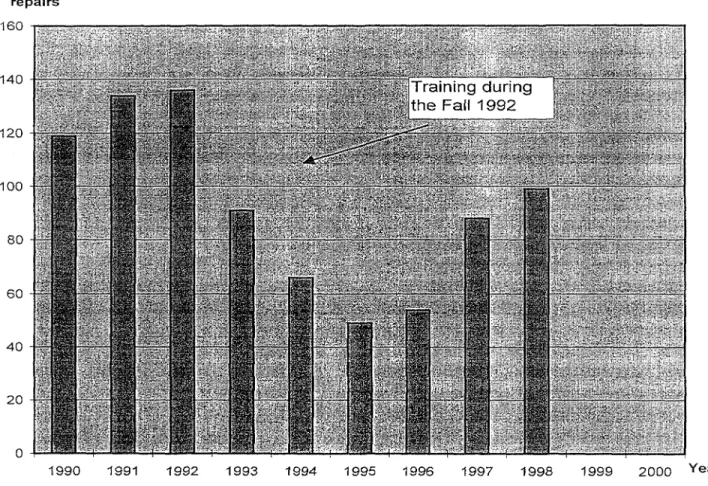
When the problem was identified a training course with the focus on the specific problems was designed and given to all 37 auxiliary operators at the power plant. Since the cost for the specially designed course was considerable higher than for a general "off the shelf' valve course it was decided that an attempt to evaluate the effectiveness of this course should be made. The results are shown in Table 1 which shows short-term and long-term effects of a problem oriented training course on the annual repair of valves.
When the data was analysed it turned out that the dramatic reduction in numbers of repairs could be attributed to a changed behaviour as a result of the training. The training was the only plausible cause that was present at the critical time.
The cost for developing and runnirig the training was also monitored. When it was compared to the reduced costs of repairing valves it turned out that the cost for developing and conducting the problem oriented training was covered in one year.
4.2 Lessons learned
The staff that received the training was well trained from the beginning. They had all received basic training on valves and how they should be operated. The problems with the valves were therefore not originally perceived as a training problem. A careful analysis by a
skilled trainer was required to detect this.
When the problem oriented training was preceded by a careful needs analysis and this analysis also was reflected in the content of the training considerable economic gain was made through the effects of the training.
The cost for developing the specific problem oriented course was considerable higher then it would have been to run a standard course about valves with a more general content.
Without the evaluation of the training effects it would not be possible to know, if the specifically designed problem oriented training would be worth the additional efforts. Without this knowledge the low cost standard course would look a lot more attractive. The chances are that the company in that case would be tempted to go for the low cost alternative and thereby be losing money without being aware it. A practice that also could go on for years.
The long term data shows an increasing trend in the number of repairs. This makes perfectly sense since the problems oriented training haven't been given since 1992, and there has been some turnover among the auxiliary operators since then. It is thus possible to use the data to see when a retraining need to be scheduled.
hi a few words:
Low cost solutions are not always the most economical solutions.
A qualified evaluation is often needed to uncover the true value of training. Resources spent on effectiveness evaluations can pay off more than expected.
Education/training > Costs
Duration of training (Months, weeks, hours) Training activities (Lessons, sessions) Training objectives (Number, proportion) Skills, knowledge and, attitudes Management practices Procedures Equipment Man-hours Money Loss of production Scores on tests Scores on questionnaires Effects on
quality, safety and production
Cause-effect relationship Measurable variables
Unplanned stops Reported errors
Levels of radiation exposure Number of accidents
Production figures
Annual
number of Effects of valve maintenance training for auxiliary operators
repairs 160 140 120 100 * •* ^ "^«3!l»x *•£"» *««. r ^F^^ . v lW*i* •^•4"' 4 ".^ ?5^^ -Training during the Fail 1992 iS^- ' t ^£' fl, v r*¥T^ * t-v* zff-^'^*-^ ^c>V * J"^"^ ^
fc^hs^mH*:
1990 1991 1992 1993 1994 1995 1996 1997 1998 1999 2000 YearTable 1. Short-term and long-terra effects of a problem oriented training course on the annual repair of valves.