FEDERAL MINISTRY OF POWER AND STEEL
FEDERAL REPUBLIC OF NIGERIA
Renewable Electricity Policy Guidelines
December 2006
Chatti Plaza, 6 Sapele Street, Garki II – Abuja
Tel/Fax: +234 9 234 8525
Email: [email protected]
www.iceednigeria.org
TABLE OF CONTENTS
Abbreviations and Acronyms ...2
1.0. Background ...3
1.1 Vision...4
1.2 Electricity situation in Nigeria ...4
1.3 The role of renewable electricity ...5
1.4 Barriers to the renewable electricity industry ...6
2.0 Definition of renewable electricity ...8
3.0 Review of existing policies...9
3.1 1999 Constitution of the Federal Republic of Nigeria...9
3.2 National Economic Empowerment and Development Strategy ...9
3.3 National Electric Power Policy and Electric Power Sector Reform Act ...9
3.4 National Energy Policy ...10
4.0 Objectives of policy guidelines...13
5.0 Renewable electricity promotion and regulatory policies ...14
5.1 Market expansion...14
5.2 Grid-connected operations ...14
5.3 Off-grid Operations...15
5.4 Rural electrification ...16
6.0 Financing renewable electricity ...17
6.1 Renewable Electricity Trust Fund ...17
6.2 Other sources of financing ...18
7.0 Policy and regulatory institutions ...20
7.1 The Federal Executive Council...20
7.2 Federal Ministry of Power and Steel ...20
7.3 Nigerian Electricity Regulatory Commission ...20
7.4 Rural Electrification Agency ...21
7.5 Energy Commission of Nigeria ...22
7.6 Other Agencies...22
8.0 International cooperation ...23
8.1 Deepening domestic economic reforms...23
8.2 Clean Development Mechanism ...23
8.3 International institutions ...23
8.4 Knowledge-based networks ...23
Appendices...24
References...24
The consultation process...25
Glossary ...26
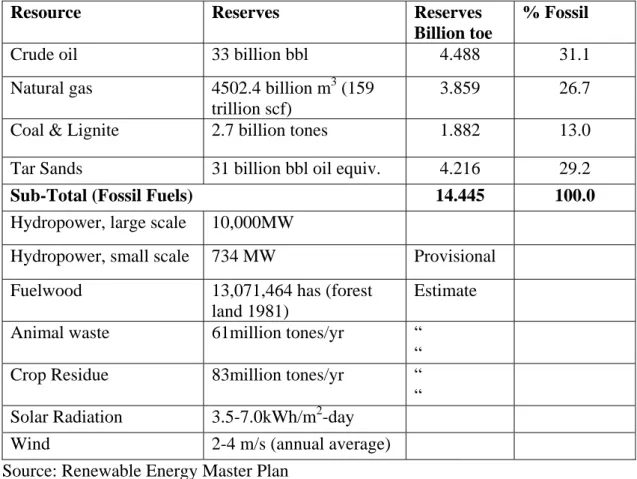
Table 1: Nigeria’s energy reserves/potentials...30
Table 2: Electricity tariffs in Nigeria ...30
Table 3: Global renewable energy indicators ...31
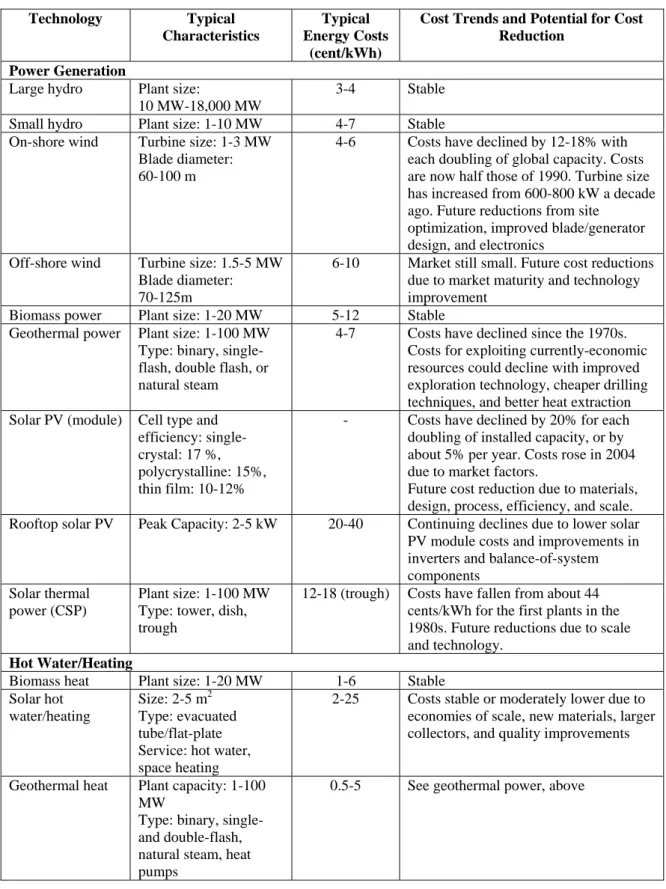
Table 4: Status of renewable technologies-- characteristics and cost...32
Table 5: Non- EU countries with renewable energy targets ...34
A
Ab
b
br
b
re
ev
vi
ia
at
ti
io
on
ns
s
a
an
n
d
d
A
Ac
cr
ro
on
ny
ym
ms
s
BPE Bureau of Public Enterprises
CDM Clean Development Mechanism
CET Central External Tariff
CHP Combined Heat and Power
CIDA Canadian International Development Agency
ECN Energy Commission of Nigeria
EPSR Electric Power Sector Reform Act 2005
ETF Education Trust Fund
FMPS Federal Ministry of Power and Steel
FMW Federal Ministry of Works
FMWR Federal Ministry of Water Resources
GEF Global Environmental Facility
GW Gigawatt
GWh Gigawatt hour
KW Kilowatt
KWh Kilowatt hour
MDGs Millennium Development Goals
MW Megawatt
MWh Megawatt hour
NEEDS National Empowerment and Economic Development
Strategy
NEP National Energy Policy
NEPA National Electric Power Authority
NEPP National Electric Power Policy
NERC Nigerian Electricity Regulatory Commission
NPIRD National Policy on Integrated Rural Development
PBF Public Benefit Fund
PHCN Power Holding Company of Nigeria
PV Photovoltaic
RE Renewable Electricity
REA Rural Electrification Agency
REAP Renewable Electricity Action Program
REF Rural Electrification Fund
RETF Renewable Electricity Trust Fund
REMP Renewable Energy Master Plan
REP Rural Electrification Policy
1
1.
.0
0.
.
B
Ba
ac
ck
kg
gr
ro
ou
un
nd
d
The Policy Guidelines on Renewable Electricity (herein referred to as the Policy
Guidelines) is the Federal Government of Nigeria’s overarching policy on all electricity derived from renewable energy sources. The Policy Guidelines sets out the Federal Government’s vision, policies and objectives for promoting renewable energy in the power sector.
The Policy Guidelines is drawn primarily from the Constitution of the Federal Republic of Nigeria (1999), the National Energy Policy (2003), the National Electric Power Policy (2001), Electric Power Sector Reform Act (2005), the Renewable Energy Master Plan (2005), the draft Rural Electrification Policy and the National Economic Empowerment and Development Strategy (NEEDS).
Access to electricity services is critical to achieving economic and social development targets outlined in the NEEDS and the Millennium Development Goals (MDGs). The Federal Government of Nigeria is therefore committed to reaching these sustainable development targets through the full mobilization of the electricity sector. Renewable energy presents unique opportunities to scale up access to electricity services nationwide. In the pursuit of these objectives, the Federal Government seeks the implementation of the policy on renewable electricity in collaboration with other levels of government, communities and the private sector for the following specific reasons:
First and foremost, renewable energy represents an important tool in the Government’s overall effort to expand access to electricity services nationwide. Improving access to electricity is consistent with NEEDS and MDG targets in stimulating economic growth, employment creation and poverty reduction. The policy enables the government to align and mainstream renewable energy development in the country with these broader national development aspirations.
Second, rural electricity access in Nigeria is less than 20%. By their nature, renewable electricity technologies are generally modular and are ideal candidates for improving rural electricity access situations in the country. Grid power extensions over long distance to serve low load densities are usually technical and financial a poorer option than
decentralized renewable electricity.
Third, until now, renewable electricity has never really been part of the national power planning process.The policy guideline provides a common framework to integrate renewables into the energy technology mix in meeting national electricity supply. Fourth, renewable electricity provides more diversity and improves the reliability of electricity supply through the grid. This could potentially be important in ensuring the stability of grid electricity supply, especially in times of localized disruption of sources of power supply.
Fifth, renewable energy is environmentally friendly being mostly carbon neutral. This reduces indoor and urban pollution as well as emission of greenhouse gases that cause global warming.
1.1 Vision
The Federal Government of Nigeria’s vision of renewable energy in the power sector is the achievement of accelerated sustainable development through increased share of renewable electric power to the national electricity supply.
1.2 Electricity situation in Nigeria
Nigeria is endowed with sufficient energy resources to meet its present and future development requirements. The country possesses the world’s sixth largest reserve of crude oil. It is increasingly an important gas province with proven reserves of nearly 5000 billion cubic meters. Coal and lignite reserves are estimated to be 2.7billion tons, while tar sand reserves represent 31 billion barrels of oil equivalent. Identified hydroelectricity sites have an estimated capacity of about 14,250MW. Nigeria has significant biomass resources to meet both traditional and modern energy uses, including electricity
generation. The country is exposed to a high solar radiation level with an annual average of 3.5 – 7.0kWh/m2/day. Wind resources in Nigeria are however poor - moderate, and efforts are yet to be made to test their commercial competitiveness.
The current installed capacity of grid electricity is about 6000MW, of which about 67 percent is thermal and the balance is hydro-based. Between 1990 and 1999, there was no new power plant built and the same period witnessed substantial government under-funding of the utility for both capital projects and routine maintenance operations. Generating plant availability is low and the demand – supply gap is crippling. Poor services have forced most industrial customers to install their own power generators, at high costs to themselves and the Nigerian economy.
By 2005, the transmission network consisted of 5000km of 330 kV lines, and 6000km of 132 kV lines. The 330 kV lines fed 23 substations of 330/132 kV rating with a combined capacity of 6,000 MVA or 4,600 MVA at a utilization factor of 80%. In turn, the 132 kV lines fed 91 substations of 132/33 kV rating with a combined capacity of 7,800 MVA or 5,800 MVA at a utilization factor of 75%.
The distribution grid consisted of 23,753 km of 33 kV lines and 19,226 Km of 11 kV lines. In turn, these fed 679 substations of 33/11kV rating and 20,543 substations of 33/0.415 and 11/0.415 kV ratings. In addition, there were 1,790 distribution transformers and 680 injection transformers.
The transmission network is overloaded with a wheeling capacity less than 4,000 MW. It has a poor voltage profile in most parts of the network, especially in the North, inadequate dispatch and control infrastructure, radial and fragile grid network, frequent system collapse, exceedingly high transmission losses.
PHCN’s business operations are inefficient. The system suffers from chronic under-investment, poor maintenance, un-recorded connections and under- billing arising from a
preponderance of un-metered connections. The utility’s financial performance, as well as its ability to serve customers satisfactorily has been consistently poor.
Access to electricity services is low. About 60 percent of the population – Over 80 million people are not served with electricity. Per capita consumption of electricity is approximately 100kWh against 4500kWh, 1934 kWh and 1379kWh in South Africa, Brazil and China, respectively. Under a business-as-usual scenario, the proportion of Nigerians without access to electricity services will continue to increase over time. The Rural Electrification Program began in 1981 focuses exclusively on grid extension; costs per connection remain high and annual rate of connection is low. With the chronic shortage of available generating capacity and low tariffs for rural areas, there is little incentive for PHCN to champion an expansion program. In all, rural electricity capital assets continue to deteriorate through neglect, vandalism and theft.
The chronic shortage of available generating capacity has negatively affected the industrial and manufacturing sectors. With self-generation prevalent in the industrial, commercial and domestic sub-sectors, the electrical energy demand in Nigeria currently estimated at 10,000 MW is actually not known.
The Federal Government is undertaking comprehensive reforms to address the electricity situation in the country. The enactment of the Electricity Power Sector Reform Act (2005), establishment of the Nigerian Electricity Regulatory Commission and the
unbundling of PHCN are concrete legal, regulatory and institutional steps that will begin to address the challenges of the sector. Presently, a new wave of investments in the power generation championed both by the government and the private sector has commenced. The government has invested in generation expansion targeting a cumulative capacity of over 10,000 MW by the end of 2007. Expansion of transmission lines within the target period will increase to over 15,000 km from about 11,000km. The capacity of available transformers will double (10,444MVA – 22,414MVA).
1.3 The role of renewable electricity
Increased power generation from conventional sources and grid extensions alone will not achieve electricity access expansion targets rapidly and cost-effectively. Accelerating rural electrification coverage will require an aggressive deployment of multiple supply options and business delivery systems. Consistent with the provisions of the EPSR Act, the Federal Government will seek to meet national electricity access targets through the following strategies:
Grid-based extension for proximate areas;
Independent mini-grids for remote areas with concentrated loads where grid service is not economic or will take many years to come; and
Standalone renewable electricity systems for remote areas with scattered small loads.
Non-conventional or renewable energy is a key element in the overall strategy of the Federal Government in rapidly expanding access to electricity services in the country. Beyond large hydropower, the current total contribution of renewable energy in Nigeria’s electricity industry is about 35MW composed of 30MW small hydropower and 5MW
solar PV. This represents about 0.6% of total nominal electricity generating capacity in the country.
1.4 Barriers to the renewable electricity industry
Specific policy, regulatory, financing and investment, technological, public awareness, quality and standards, poor resource database and intermittency of resource availability confront the development of the market for renewable electricity.
a) Policy and regulatory barriers
The focus of national policy has consistently been on centralized conventional sources of electric power. Several incentives were established to promote investments in conventional power generation. Subsidizing grid power has so far penalized investments in alternative energy solutions. This lack of a level playing field for all energy sources and technologies has constituted a formidable barrier to the growth of alternative electricity services.
Until lately, the Power Holding Company of Nigeria (PHCN) was the only entity legally permitted to produce and distribute electricity. Under the 2005 Act, independent power producers are permitted to operate, however, the legal framework for successfully implementing PPA is still evolving. The perception of significant regulatory risks by potential investors and financial institutions compound the challenges faced by potential renewable electricity investors. Moreover, guaranteed access to the grid is an important element of an investment decision to embark on grid-connected power projects. At present, a non-discriminatory open access to the national electricity grid, for renewable power, is not assured.
b) Financing and Investment barriers
Renewable energy projects have high initial costs. This affects the overall cost of energy produced per kWh. Investors will not be favorably disposed to wind, small hydro or power from cogeneration plants if they will not make profit by selling the electricity. Average electricity tariff in Nigeria is put at about N6:75 per KW-h (approximately 5 cents per kWh). Average cost of typical sources of renewable power for mini hydro is 5-10 cents; solar PV: 20-40 cents; biomass power: 5-12cents; wind power: 6-5-10 cents. Without adequate financial incentives market entry will be difficult.
Renewable electricity projects are not common practice, therefore bankers perceive a higher degree of risk and are reluctant to lend – instead they give preference to large-scale conventional electricity investments. Interest rates are generally high and the appetite for long term credits are low among financial institutions, especially for non-business-as-usual projects as small scale renewable power projects.
Nigeria has no significant manufacturing capacity for components of renewable energy technologies. The existing capacity in solar PV and small hydro plants is limited. Significant supply chain constraints include long project implementation periods, high import tariffs, bottle-necks in the customs clearing of goods and the issue of corruption.
c) Technological Barrier
As noted in the 2005 National Renewable Energy Master Plan1 supplies and servicing for renewable electricity projects are not readily available in Nigeria. Therefore, potential IPPs may face significant logistical challenges in procuring equipment and maintenance support for renewable electricity projects.
Beyond the local availability of supplies, there are significant gaps in the capacity for manufacture and maintenance of system components such as small hydro and wind turbines. In most cases, the choice and design of turbines are site-specific. With no local turbine manufacturers available in Nigeria, this adds to project complexity and costs. The simple fact that the project will be dependent on manufactures of the turbines for spares and major maintenance presents a major technical challenge. To compound these barriers, these projects are often located in remote areas and therefore face significant challenges in attracting competent and qualified manpower for operations.
d) Public awareness
There is limited public awareness of the potentials of renewable electricity in meeting some of the energy and development challenges facing the country. The inadequacy of awareness creates a market distortion which results in higher risk perception for potential renewable electricity projects. The general perception is that these forms of energy technologies are not mature and only suited for niche markets.
e) Standards and quality control
A major constraint to the development of the renewable energy market in Nigeria is the poorly established standard and quality control of locally manufactured and imported technologies. Creating quality assurance is a precondition for building consumer
confidence and in growing the market for renewable energy. Two important dimensions to issues of quality include the perception of potential users, poorly developed regime for standards setting, testing and certification as well as professionalism among operators. f) Inadequate resource assessment
The growth of the renewable power industry will depend to a large extent on the availability of a solid resource database. Reliable and up-to-date sources of data will assist investors in making decisions on renewable electricity.
g) Intermittency of resource availability
An underlying barrier affecting all renewable electricity resources is the intermittency of their availability. The challenge of energy storage and system management presents a major challenge and adds to the complexity and costs of renewable electricity.
The Policy Guideline establishes a framework to addresses the above barriers. It creates measures that enable market expansion and private sector participation in renewable electricity business. It further facilitates grid-connected and off-grid operations as well as increased role for renewable electricity in rural electrification.
1
2
2.
.0
0
D
De
ef
fi
in
ni
it
ti
io
on
n
o
of
f
r
re
en
ne
ew
wa
ab
b
le
l
e
e
el
le
ec
ct
tr
ri
ic
ci
it
ty
y
“Renewable electricity” refers to electric power obtained from energy sources whose utilization does not result in the depletion of the earth’s resources. Renewable electricity also includes energy sources and technologies that have minimal environmental impacts, such as less intrusive hydro and certain biomass combustion. These sources of electricity normally will include solar energy, wind, biomass co-generation and gasification, hydro, geothermal, tide, wave and hydrogen energy. Based on the resource situation and the technological base of the country, the Policy Guideline focuses on hydropower, biomass co-generation, solar PV and wind energy for electricity production.
Small, Mini and Micro Hydropower – Small hydropower is defined by the Renewable Energy Master Plan as all hydroelectricity schemes below 30 MW, mini below 1MW, micro below 100kW and pico below 1kW.
Biomass electricity – Green plants converting sunlight into plant material through photosynthesis produce biomass energy. Biomass cogeneration is the predominant process of producing both thermal energy and electrical energy from biomass-fuelled boilers, with excess steam above that required for electricity being used for other
purposes such as process heat, district heating and cooling plants, or even sold off to third parties requiring such services.
Solar energy – Electricity is generated from solar energy predominantly through photovoltaic materials (cells or modules) that converts sunlight directly into electricity. Solar thermal electricity technologies are also available whereby solar energy are concentrated unto boilers to produce vapor which could then be used in a conventional steam power plant. In Nigeria, solar photovoltaic technologies are used for small-scale power supply in some rural electrification programs of some States of the federation. Wind energy – The energy contained in the movement of air in form of wind is used to turn the blades of windmills or wind turbines which in turn could be used to drive electrical generators to produce electricity. Large modern wind turbines operate together in “wind farms” to produce electricity for utilities, while small turbines are used to meet localized and small energy needs.
3
3.
.0
0
R
Re
ev
vi
ie
ew
w
o
of
f
e
ex
xi
is
st
ti
in
ng
g
p
p
ol
o
li
ic
ci
ie
es
s
Several policy documents have provisions that are relevant to the development of the Policy Guideline. These include the 1999 Constitution of the Federal Republic, the National Economic Empowerment and Development Strategy (2004), the National Electric Power Policy (2001), Electric Power Sector Reform Act 2005 and the National Energy Policy (2003).
3.1 1999 Constitution of the Federal Republic of Nigeria
The 1999 Constitution of the Federal Republic of Nigeria places electricity generation, transmission and distribution on the Concurrent Legislative List. This allows all tiers of government to be involved in most aspects of the electricity supply industry.
3.2 National Economic Empowerment and Development Strategy
The National Economic Empowerment and Development Strategy (NEEDS), Chapter 5, proposes a set of targets to be met by the power sector before 2007, among which are:
Increase generation capacity from 4,200 MW to 10,000 MW (138% increase)
Increase transmission capacity from 5,838 MVA to 9,340 MVA (60% increase)
Increase distribution capacity from 8,425 MVA to 15, 165 MVA (80% increase)
Reduce transmission and distribution losses from 45% to 15%
The NEEDS document also highlights the Federal Government’s mandate to the former public utility NEPA, some of which are:
Expeditiously implement the electric power sector reform program
Generate 10,000 MW by 2007, from existing plants, new host generation, and reasonably priced independent power plants.
Develop the capacity to transmit and distribute the higher level of generation.
Explore alternative energy sources, such as coal, solar power, wind power, and hydropower.
Deregulate the power sector to allow increased private sector participation.
3.3 National Electric Power Policy and Electric Power Sector Reform Act
The National Electric Power Policy (NEPP) of 2001 was the precursor to the Electric Power Sector Reform (EPSR) Act of 2005. Indeed most of the significant provisions of NEPP are included in the EPSR.
The Electric Power Sector Reform (EPSR) Act, 2005, emphasizes the role of renewable electricity in the overall energy mix, especially for expanding access to rural and remote areas. In Part IX under Rural Electrification, Section 88 (9) stipulates that information shall be presented to the President by the Minister of Power and Steel on, among others: (a) expansion of the main grid
(b) development of isolated and mini-grid systems, and (c) renewable energy power generation
The REA is mandated to provide a strategy and plan for expanding access to electricity, including the use of renewable energy.
3.4 National Energy Policy
In the Policy Overview of the National Energy Policy, NEP, of August 2003, the overall thrust of the energy policy is stated as “optimal utilization of the nation’s energy
resources for sustainable development”. The following are the relevant provisions of the NEP for the development of the Policy Guideline:
3.4.1 Hydropower Policies
(i) The nation shall fully harness the hydropower potential available in the country for electricity generation
(ii) The nation shall pay particular attention to the development of the mini and micro hydropower schemes
(iii) The exploitation of the hydro power resources shall be done in an environmentally friendly manner
(iv) Private sector and indigenous participation in hydropower development shall be actively promoted
Objectives
(i) To increase the percentage contribution of hydro electricity to the total energy mix
(ii) To extend electricity to rural and remote areas, through the use of mini and micro hydro power schemes
(iii) To conserve non-renewable resources used in the generation of electricity (iv) To diversify the energy resource base
(v) To ensure minimum damage to the ecosystem arising from hydropower development
(vi) To attract private investments into the hydropower sub-sector Strategies
(i) Establishing and maintaining multilateral agreements to monitor and regulate the use of water in international rivers flowing through the country
(ii) Ensuring increased indigenous participation in the planning, design and construction of hydropower stations
(iii) Providing basic engineering infrastructure for the production of hydropower plants, equipment and accessories
(iv) Encouraging private sector, both indigenous and foreign, in the establishment and operation of hydropower plants
(v) Encouraging private sector, both indigenous and foreign, for the local production of hydropower plants and accessories
(vi) Ensuring that rural electricity boards incorporate small-scale hydropower plants in their development plans
(vii) Promoting and supporting R&D activities for the local adaptation of hydropower plant technologies
(viii) Initiating and updating data on the development of the hydro potential of our rivers and identifying all possible locations for dams
3.4.2 Solar Policies
(i) The nation shall aggressively pursue the integration of solar energy into the energy mix
(ii) The nation shall keep abreast with worldwide developments in solar energy technology
Objectives
(i) To develop the nation’s capability in the utilization of solar energy
(ii) To use solar energy as a complimentary energy resource in the rural and urban areas
(iii) To develop the market for solar energy technologies (iv) To develop solar energy conversion technologies locally Strategies
(i) Intensifying R&D in solar energy technology (ii) Promoting training and manpower development
(iii) Providing adequate incentives to local manufacturers for the production of solar energy systems
(iv) Providing adequate incentives to suppliers of solar energy products and services
(v) Introducing measures to support the local solar energy industry
(vi) Setting up extension programs to introduce solar technology into the energy mix
(vii) Providing fiscal incentives for the installation of solar energy systems
(viii) Setting up and maintaining a comprehensive information system on available solar energy resources and technologies
3.4.3 Biomass Policies
(i) The nation shall effectively harness non-fuelwood biomass energy resources and integrate them with other energy resources
(ii) The nation shall promote the use of efficient biomass conversion technologies Objectives
(i) To promote biomass as an alternative energy resource especially in the rural areas
(ii) To promote efficient use of agricultural residues, animal and human wastes as energy sources
(iii) To reduce health hazards arising from combustion of biomass fuel
Strategies
(i) Developing extension programs to facilitate the general use of new biomass energy technologies
(iii) Establishing pilot projects for the production of biomass energy conversion devices and systems
(iv) Providing adequate incentives to local entrepreneurs for the production of biomass energy conversion systems
(v) Training of skilled manpower for the maintenance of biomass energy conversion systems
(vi) Developing skilled manpower and providing basic engineering infrastructure for the local production of components and spare parts for biomass systems 3.4.4 Wind
Policies
(i) The nation shall commercially develop its wind energy resources and integrate this with other energy resources into a balanced energy mix
(ii) The nation shall take necessary measures to ensure that this form of energy is harnessed at sustainable costs to both suppliers and consumers in the rural areas
Objectives
(i) To develop wind energy as an alternative energy resource (ii) To develop local capability in wind energy technology
(iii) To use wind energy for provision of power in rural areas and remote communities far removed from the national grid
(iv) To apply wind energy technology in areas where it is technically and economically feasible
Strategies
(i) Encouraging R&D in wind energy utilization
(ii) Developing skilled manpower for provision of basic engineering infrastructure for local production of components and spare parts of wind power systems (iii) Intensifying work in wind data acquisition and development of wind maps (iv) Training of skilled craftsmen to ensure the operation and maintenance of wind
energy systems
(v) Providing appropriate incentives to producers, developers and consumers of wind energy systems
(vi) Developing extension programs to facilitate the general use of wind energy technology
These enabling policy provisions provided the impetus for the Federal Ministry of Power and Steel to embark on the development of National Policy Guideline for Renewable Electricity and Renewable Electricity Action Program. This document pertains to the National Policy Guidelines on Renewable Electricity.
4
4.
.0
0
O
Ob
bj
je
ec
ct
ti
iv
ve
es
s
o
of
f
p
po
ol
li
ic
cy
y
g
gu
u
id
i
d
el
e
li
in
ne
es
s
The overall objective of this Policy Guideline is to expand the role of renewable electricity in sustainable development through effective promotional and regulatory instruments. The policy guideline seeks to achieve the following specific objectives:
Expand electricity generating capacity to meet national economic and social development goals;
Encourage the diversification of sources of electricity supply through renewable energy, and as such improve the energy security of the country;
Increase access to electricity services nationwide, especially in rural areas;
Stimulate growth in employment generation through an expanded renewable electricity industry;
Enhance technological development through increased domestic manufacturing of renewable electricity components;
Stimulate competition in the delivery of renewable electricity;
Promote rapid expansion of renewable-based electricity market through cost-reducing supply side and demand side incentives.
Develop regulatory procedures that are sensitive to the peculiarities of renewable energy based power supply;
Create stable and predictable investment climate in renewable electricity market;
Provide effective protection of electricity consumers through effective regulation; and
Reduce household and outdoor air pollution as well as contribute to the abatement of greenhouse gas emissions, and thus contribute to improved health and overall social development.
5
5.
.0
0
R
Re
en
ne
ew
wa
ab
b
le
l
e
e
el
le
ec
ct
tr
ri
ic
ci
it
ty
y
p
p
ro
r
om
mo
ot
ti
io
on
n
a
an
n
d
d
r
re
eg
gu
u
la
l
at
to
or
ry
y
p
po
ol
li
ic
ci
ie
es
s
In growing the market for renewable electricity in Nigeria, the Federal Government sets the following policies and regulatory measures:
5.1 Market expansion
Policy 1: The Federal Government of Nigeria shall expand the market for renewable electricity to at least five percent of total electricity generating capacity and a minimum of 5TWh of electric power production, excluding large hydropower by 2016.
These policy targets shall be achieved through the following strategies:
5.1.1: Licensing and fees schedule: Applicable licensing and fees schedule shall be revised and where necessary, simplified to provide additional incentives for eligible renewable electricity investments.
5.1.2: Local manufacture and assembly. Tax exemptions for a period not less than five years shall apply to new investments in the manufacture and assembly of renewable electricity components. Eligible investments include the manufacture and assembly of solar cells and modules, manufacture of electrical turbines of less than 30MW capacity and other components that may be approved by the Federal Government.
5.1.3: Subsidies. The Federal Government seeks to reduce the upfront costs for consumers of renewable energy technologies through subsidies for the following
technologies: solar PV component, including deep cycle batteries, all electro-mechanical components of SHP technology, wind power, boilers and turbines for cogeneration of less than 30MW. Subsidies shall meet incremental costs of producing agreed quantity of renewable electricity through approved sources. To ensure an efficient allocation of resources, subsidies shall be allocated through competitive bidding.
5.1.4: Technical standards and certification of personnel. NERC shall ensure the development of technical standards and certification procedures for technical personnel participating in renewable electricity projects. Categories of certification procedures may be delegated to other agencies, including the REA.
5.1.5: Public awareness. The Federal Government shall raise public awareness of the benefits and opportunities of renewable electricity. Annual budgets shall be available for public awareness purposes. Government agencies or other stakeholders may carry out these public awareness activities.
5.2 Grid-connected operations
Grid-based renewable electricity is crucial in promoting the development and utilization of electricity, diversifying the sources of electricity supplies, strengthening energy security, expanding electricity access and improving the environment.
Policy 2: The Federal Government shall establish stable and long-term favorable pricing mechanisms and ensure unhindered access to the grid. Grid operators must guarantee the purchase and transmission of all available electricity from renewable electricity
producers. While renewable electricity plant owners bear the cost of connection, grid operators must ensure the necessary system upgrade. All upgrade costs must be declared to ensure the necessary transparency.
The following strategies will support grid-connected operations:
5.2.1: Feed-in tariffs. To ensure a stable pricing policy, the Federal Government introduces feed-in tariffs for small hydro schemes not exceeding 30MW, all biomass cogeneration power plants, solar and wind-based power plants, irrespective of their sizes. Specific tariff regimes formulated by NERC shall be long term, guarantee buyers under standard contract and provide reasonable rate of return.
5.2.2: Access to the grid. NERC shall promote the generation of electricity through renewable sources by providing suitable commercial and technical measures for connectivity to the grid and sale of electricity to any persons. Commercial regulations encompass permitted renewable energy fuels, application and connection procedures, costs incurred by each party, tariffs, and billing arrangements. The technical regulations shall specify the requirements for a renewable energy generator to connect to the grid. These include responsibilities of each party; criteria for synchronization (acceptable voltage levels, frequency, power factor, etc.) required protection relays, and provisions for emergency disconnect.
5.2.3: Development of a Standard for Power Purchase Agreements. NERC shall develop an appropriate standard or model for PPAs. The PPA sets the terms by which power is marketed and/or exchanged. It shall determine the delivery location, power characteristics, price, quality, schedule, and terms of agreement and penalties for breach of contract. It shall among other things, ensure that prices provide an adequate return on investments in renewable electricity; standardizes and simplifies contractual relationships; and protects investors, utilities and consumers.
5.2.4: Tariff regulation. Subject to the provisions of this Policy Guideline, NERC shall specify the terms and conditions for the determination of tariff, and in so doing shall be guided by the promotion of renewable sources in electricity production.
5.3 Off-grid Operations
Off-grid renewable electricity operations are vital to meeting the Federal Government’s policy on the electric power sector and expanding access to rural areas, in particular.
Policy 3: The Federal Government supports the construction of independent renewable electricity systems in areas not covered by the electricity grid to provide power service for local economic activities and sustainable living.
Off-grid renewable electricity operations shall be expanded through the following strategies:
5.3.1: Mini-grid concessions. In developing mini-grid concessions, NERC shall select a company to exclusively serve a specific geographical location with obligation to serve all customers that request service. The agency shall provide subsidies and shall regulate the fees and operations of the concession. Electricity service concessions may employ a mixture of energy sources to serve customers.
NERC shall develop light-handed measures for awarding renewable electricity
concessions for the production and distribution of electricity within mini-grids generating electricity exceeding 1 MW and distributing electricity above 100 KW in aggregate at a site.
5.3.2: Stand-alone systems standards: Technical specifications and codes for stand-alone solar PV, micro hydro and wind power will be developed as well as a process of certification for technical personnel.
5.4 Rural electrification
Renewable electricity offers cost effective, modular and decentralized options for extending electricity and stimulating sustainable development in rural areas. Consistent with the EPSR Act, off-grid renewable electrification is a key component of the Federal Government’s policy on expanding access to energy services to rural areas.
Policy 4: The Federal Government will develop innovative, cost-effective and practical measures to accelerate access to electricity services in rural areas through renewable sources.
5.4.1: Rural business development. The Federal Government shall promote the role of the private sector in the delivery of rural electrification through renewable sources. This will be achieved through the support of entrepreneurship, training, marketing, feasibility studies, business planning, management, financing, and connection to banks and relevant institutions. This approach includes integrating renewable electricity provision with other services, including water, telecommunication, fertilizers, pumps, generators, batteries, kerosene, LPG, electronics.
5.4.2: Comparative line extension analysis. All new grid extension proposals must include information about on-site renewable energy technology options and a cost/benefit analysis comparing proposed grid extension and decentralized renewable electricity.
6
6.
.0
0
F
Fi
in
n
an
a
nc
ci
in
n
g
g
r
re
en
ne
ew
wa
a
bl
b
le
e
e
el
le
ec
ct
tr
ri
ic
ci
it
ty
y
Financing is crucial to realizing the Federal Government’s policy thrust on renewable electricity. The Government’s primary instrument for funding renewable electricity is through the establishment of a fund to stimulate the expansion of the renewable electricity market.
Policy 5: There shall be a Renewable Electricity Trust Fund which shall be set up under the Rural Electrification Fund.
6.1 Renewable Electricity Trust Fund
The purpose of the Renewable Electricity Fund (RETF) shall be to promote, support and provide renewable electricity through private and public sector participation. The RETF seeks to provide support to the following:
Construction of independent renewable electricity projects, especially in rural and remote areas;
Establishment of domestic production of technologies for the development and utilization of renewable electricity;
Provision of resources for micro financing to stand-alone systems under 20kW capacity
Support to research and development and construction of pilot projects;
Promote training and capacity building in renewable electricity technology and business development;
Encourage public awareness initiatives; and
Provision of surveys and assessments of renewable electricity resources and other relevant information.
Support from the RETF shall be guided by the following principles:
Support shall be temporary and targeted – They must have a clear phase-out scheme or timetable and should have an attainable target within that time frame.
Support shall be spread out over time – Facilitating producers and investors to plan. This will create dependability of support and enable short processing procedures.
There shall be competition in the financial support system – This assists in preparing the producers of plants for the market and increases efficiency of the allocation of resources from the fund.
Support to projects shall be subject to continuous reviews and evaluations – Reviews and evaluations of support should be an on-going process to determine their impact and eliminate waste.
6.1.1 Source of funds – The Renewable Electricity Trust Fund is a proportion of the Rural Electrification Fund which consists of the following capital and assets:
Monies appropriated by the National Assembly
Revenue from surcharge on eligible consumer of electric power as may be determined by the NERC
Donations, gifts and loans from all eligible local and international sources 6.1.2 The Rural Electrification Trust Fund and the Renewable Electricity Fund The sources of funds for the Renewable Electricity Trust Fund is a proportion of the Rural Electrification Fund as may be determined by the Honorable Minister of Power and Steel in addition to other donations, gifts and loans dedicated to renewable electricity from local and international sources.
6.1.3 Management of the Renewable Electricity Trust Fund
The Renewable Electricity Trust Fund shall be managed under the Rural Electrification Fund.
6.1.4 Funding guidelines – Priorities shall be given to the following projects:
“Low hanging fruits” projects requiring minimal subsidies to accomplish;
Economic and financial viability of projects beyond the initial support;
The demonstration effect of projects, especially in terms of rapid scale up;
Investor commitment in terms of equity and independent loan financing.
Consistent with the EPSR Act and the Draft Rural Electrification Policy, eligible projects must be demand-driven with proven investor or community support.
6.2 Other sources of financing
The Federal Government shall continuously improve the climate for enhanced funding of renewable electricity through equity, debt financing, grants and micro finance.
6.2.1 Equity Investments – The Federal Government shall continuously review the conditions for effective private sector participation in renewable electricity investments with a view to improving the attractiveness of the sub-sector.
6.2.2 Debt Financing – A key component of the Federal Government’s policy is the improvement of the overall macro-economic and financial framework that ensures the availability and affordability of long-term funding for investors in renewable electricity. The Renewable Electricity Trust Fund and other measures shall assist in lowering the cost and improving access to funding for these projects.
6.2.3 Grants – The Federal Government is committed to mobilizing resources through international cooperation towards the development of renewable electricity for
sustainable development in Nigeria. Grant financing from agencies of government and independent foundations shall also be promoted.
6.2.4: Micro credit for Renewable Electricity Systems – As a result of the high upfront cost of renewable electricity systems, the Federal Government shall provide resources through the Renewable Electricity Trust Fund for micro credit to buyers of standalone systems, especially in rural areas.
7
7.
.0
0
P
Po
ol
li
ic
cy
y
a
an
nd
d
r
re
eg
gu
ul
la
at
to
or
ry
y
i
in
ns
s
ti
t
it
tu
u
ti
t
io
on
n
s
s
The Federal Government seeks to implement the Policy in close partnership with other stakeholders, particularly state agencies and the private sector. The following institutions will be responsible for the implementation of the Policy and Regulatory Guideline:
Policy 6: The Federal Government is committed to a multi-stakeholder partnership in the delivery of renewable electricity to meet national development goals.
7.1 The Federal Executive Council The Federal Executive Council will:
Provide the overall direction for the development of the electricity industry in Nigeria
Ensure the general consistency of electric power policy with all other national policies and, specifically, with other aspects of energy policy;
Facilitate the alignment of the policy and regulatory guideline on renewable electricity with Nigeria’s international obligations, especially on climate change; and
Enact promptly the necessary laws, regulations and other measures required to support the policy guideline.
7.2 Federal Ministry of Power and Steel
The Federal Ministry of Power and Steel will have the overall responsibility for formulating electric power policy, including the policy on renewable electricity. The specific functions of the Ministry will include:
Proposing policy options and recommendations to the Federal Government concerning legislation, policy and investment on renewable electricity;
Monitoring and evaluation of implementation and performance of the policy within governmental agencies and in the electricity market;
Establishing, monitoring and evaluating the performance of renewable electricity policy on increasing the access to electricity in rural areas;
Facilitating the close coordination of renewable electricity activities among agencies of the Federal Government;
Ensuring that Nigeria’s renewable electricity policy is consistent with national obligations in regional and international organizations; and liaising with the National Assembly on matters relating to renewable electricity production and use.
7.3 Nigerian Electricity Regulatory Commission
The promotion of a growing market for renewable electricity requires an effective and independent regulatory agency. The Nigerian Electricity Regulatory Commission (NERC) is established by the EPSR Act 2005 to carry out the following functions:
To create, promote, and preserve efficient industry and market structures, and to ensure the optimal utilization of resource for the provision of electricity services;
To maximize access to electricity services, by promoting and facilitating consumer connections to distribution systems in both rural and urban areas;
To ensure that an adequate supply of electricity is available to consumers;
To ensure that the prices charged by licensees are fair to consumers and are sufficient to allow the licensees to finance their activities and to allow for reasonable earnings for efficient operation;
To ensure the safety, security, reliability, and quality of service in the production and delivery of electricity to consumers;
To ensure that regulation is fair and balanced for licensees, consumers, investors, and other stakeholders; and
To present quarterly report to the President and National Assembly on its activities.
In discharging its regulatory functions, NERC shall in respect of renewable electricity seek to perform the following functions:
Develop simplified licensing procedures for renewable energy investments;
Develop a framework for power purchase agreement that ensures access to grid-based renewable electricity;
Ensure preferential prices for renewable electricity to cover additional costs due to size, technology, location and the intermittent nature of the particular renewable electricity resource base;
Lower licensing charges for renewable electricity licensees
Develop and maintain quality standards for renewable electricity equipments and installations;
Lessen the regulatory compliance and reporting burden;
Ensure that appropriate Environmental Impact Assessments are conducted prior to award of licenses; and
Report specifically on the status of the renewable electricity industry in its quarterly report to the President and the National Assembly.
7.4 Rural Electrification Agency
The Rural Electrification Agency was established by the EPSR Act 2005. The primary function of the REA includes the following:
Extension of the main grid
Development of isolated and mini-grid systems; and
Renewable energy power generation.
In promoting renewable electric power supply, the REA shall carry out the following functions:
Serve as an implementation agency for the Policy Guideline;
Provide a coordinating point for renewable electricity activities among state and federal agencies; and
7.5 Energy Commission of Nigeria
Energy Commission of Nigeria was established by Act 62 of 1979 as amended by Acts 32 of 1988 and 19 of 1989 and is charged with the responsibility of conducting strategic planning and coordination of national policies in the field of energy in all its
ramifications. The major objectives of the Commission are to:
Guarantee increased contribution of the energy sector to national income and the economy;
Guarantee adequate, sustainable and optimal supply of energy at appropriate cost and in an environmentally responsible manner to the various sector of the
economy by utilizing all viable energy resources in a optimal mix;
Promote an efficient consumption pattern of energy resources;
Promote indigenous acquisition of energy technology and managerial expertise as well as indigenous participation in the energy sector industries; and
Promote increased investment and the development of energy sector industries with private sector participation.
In promoting renewable electricity, the Commission will among other things:
Ensure that evolving policies conform and are harmonized with the overall thrust of the National Energy Policy;
Ensure broad-based participation by key stakeholders in the energy sector; and
Provide overall coordination of renewable electricity within the broader energy sector.
7.6 Other Agencies
The following agencies and organizations shall be consulted in the implementation of the policy:
Other relevant Federal Government agencies;
State Rural Electrification Boards and relevant State ministries;
Organized private sector; and
8
8.
.0
0
I
In
n
te
t
er
rn
na
at
ti
io
on
na
al
l
c
co
oo
op
pe
er
ra
at
ti
io
on
n
International cooperation is crucial for the development of renewable electricity in Nigeria for several reasons: First, the country requires significant foreign direct investment to enable the emergence and growth of the renewable electricity industry. Second, international cooperation will trigger sources of concessionary funding through multilateral and bilateral development cooperation. Third, the concern over global warming resulting from increasing emissions of greenhouse gases creates a renewed interest in the potential of renewable energy in addressing these concerns. Fourth,
international cooperation will enhance technological development and market deployment of renewable electricity technologies; and Fifth, international cooperation is essential for reforms and implementation activities through the adaptation of best practices.
Policy 7: Nigeria is committed to broadening international cooperation in expanding the role of renewable electricity in meeting national development goals as well as
contributing to global efforts in addressing climate change.
This policy will be met through the following instruments: 8.1 Deepening domestic economic reforms
The Federal Government is committed to far reaching reforms of the domestic economy to among other things, encourage international investment in electricity services. These reforms include continuous improvements in legal, regulatory and financial frameworks to ensure high returns for local and international investors.
8.2 Clean Development Mechanism
Nigeria is a signatory to the Kyoto Protocol and eligible to participate in the Clean Development Mechanism (CDM). The CDM provides opportunities for increased international investment in renewable energy and energy efficiency while it allows Nigeria contribute to reducing greenhouse gas emissions. The Federal Government will continuously develop national capacity to participate in the CDM.
8.3 International institutions
Nigeria supports the strengthening of renewable energy portfolios within existing international institutions such as the World Bank and UNDP. In partnership with other countries, the Nigeria will work towards the establishment of an International Renewable Energy Agency.
8.4 Knowledge-based networks
Nigeria seeks to expand the scope of national participation in collaborative R&D renewable electricity activities, including NGO movements and international organizations.
A
Ap
p
pe
p
en
nd
di
ic
ce
es
s
References
Bureau of Public Enterprises (2005) Electric Power Sector Reform Act 2005.
ECOWAS (2006) White Paper for Regional Policy Geared Towards Increasing Access to Energy Services for Rural and Peri-urban Populations in order to Achieve the Millennium Development Goals.
Energy Commission of Nigeria (2003) National Energy Policy.
Energy Commission of Nigeria (2006) Renewable Energy Master Plan (Draft) Federal Republic of Germany (2004) The Renewable Energy Sources Act of 21 July 2004.
Federal Government of Nigeria (1999) 1999 Constitution of the Federal Republic of Nigeria
National Planning Commission (2004) National Economic Empowerment and Development Strategy (NEEDS).
Nigerian Electricity Regulatory Commission (2006) Licence and Operating Fees Regulation, 2006. NERC: Abuja.
REN21 (2006) Renewables 2005 – Global Status Report. Paper Prepared for the REN21 by the Worldwatch Institute.
Republic of South Africa (2003) White Paper on Renewable Energy. Johannesburg: Department of Minerals and Energy.
The consultation process
In the process leading to the development of this draft policy guidelines, the following stakeholders were consulted:
Federal Ministry of Power & Steel
Federal Ministry of Water Resources
UNIDO Regional Centre on Small Hydro
Energy Commission of Nigeria
Federal Ministry of Agriculture and Rural Development
Federal Ministry of Environment
Power Holding Company of Nigeria (Abeokuta, Calabar & Enugu)
First Bank Plc
Bank of Industry
Energy Commission of Nigeria
Nigerian Electricity Supply Company Limited, Jos
Canadian International Development Agency
World Bank
United States Agency for International Development
Glossary
Average Electricity tariff: The average price paid by consumers over the course of one year. It is significant in that it will often be the base for the setting of tariffs paid under Tariff Mechanisms.
Capital subsidies or consumer grants: One-time payments by the government or utility to cover a percentage of the capital cost of an investment, such as a solar hot water system or a rooftop solar PV system.
Co- generation: A method of using the heat that is produced as a by- product of electrical generation and that would otherwise be wasted be wasted. The heat can be used for space heating of buildings (usually in district or community heating schemes) or for industrial purposes. Utilizing the heat in this way means that 70-85% of the energy converted from fuel stuffs can be use, rather than the 30-50 % that is typical for electrical generation alone. Co-generation schemes can be relatively small scale, for use at the level of a factory or hospital, or can be major power stations. The term CHP is employed at the level of a factory or hospital, or can be major power stations. The term CHP is employed in the UK and some other parts of Europe, while the term co-generation is employed elsewhere in Europe, the US and other countries.
Contestable Markets: A contestable market is one where the barriers to entry are low. Thus a perfectly contestable market would have no barriers. Barriers can include anything which acts to protect the industry incumbent from new entrants and can stem from institutional or regulatory arrangement relating to pricing, licensing, marketing or a number of other sources.
Demand Side Management: The planning, implementation, and monitoring of utility activities designed to encourage consumers to modify patterns of electricity usage, including the time and level of electricity demand. It refers only to energy and load- shape modifying activities that are undertaken in response to utility-administered programs. It does not refer to energy and load –shape changes arising from the normal operation of the market place or from government – mandated energy efficiency standards. Demand-side Management (DSM) covers the complete range of load –shape objectives, including strategic conservation and load management, as well as strategic load growth.
Distribution Network Operator: The owner of the physical network providing electricity at low voltages. Generally connects the transmission grid to the majority of consumers, though some lager consumers may connect directly to the transmission grid. The DNO may have some involvement in balancing the supply of electricity.
Energy Conservation: Using less energy (kWh) irrespective of whether the benefit increase, decrease or stay the same. Energy Conservation is thus the goal if environmental targets are to be met.
Energy Efficiency: This can be defined in slightly different ways, and includes using less energy (kWh) to achieve the same benefits (e.g. internal temperature, industrial output etc), or using the same or a lesser amount of energy (kWh) but achieving more benefits
(e.g. a warmer home, higher output). The focus tends to be on improving the welfare of the end-user.
Feed-in tariff: A policy that set a fixed price at which power producers can sell renewable power can sell renewable power into the electric power network. Some policies provide a fixed tariff while others provide a fixed tariff while others provide fixed premiums added to market –or cost- related tariffs. Some provide both.
Gigawatt (GW)/Gigawatt-hour (GWh)/Gig watt-thermal (GWth): See megawatt,kilowatt-hour, megawatt-thermal.
Investment tax credit: Allows investments in renewable energy to be fully or partially deducted from tax obligations or income.
Kilowatt-hour (kWh): A unit of produced or consumed electricity. Also the most common unit for the retail price of electricity as in cents/kWh.
Large hydropower: Electricity from water flowing downhill, typically from behind a dam. No international consensus exists on the threshold that separates large from small hydropower, but the upper limit varies from 2.5 - 50 MW with 10MW becoming more standard.
Megawatt (MW): A unit of power-generating capacity. Represents an instantaneous power flow and should not be confused with units of produced energy (i.e., MWh, or megawatt-hours).
Megawatt-thermal (MWth): A unit of heat-supply capacity used to measure the potential output from a heating plant, such as might supply a building or a neighbourhood. More recently used to measure the capacity of solar hot water/heating installations. Represents an instantaneous heat flow and should not be confused with units of produced heat (i.e..MWh(th), or megawatt-hours-thermal).
Micro-generation: Micro-generation systems typically range in size from a few kilowatts (kW) to 500kW. They are small generators installed close to the point of use, either in smaller businesses or for household use.
Modern biomass: Biomass- utilization technologies other than those defined for traditional biomass, such as biomass co-generation for power and heat, biomass gasification, biogas anaerobic digesters, and production of liquid bio-fuels for use in vehicles.
Net metering: Allows a two-way flow of electricity between the electricity distribution grid and customers with their own generation. When instantaneous consumption exceeds self –generation, the meter runs forward. When instantaneous self generation exceeds consumption, the meter runs backward and power flows to the grid. The customer pays for the net electricity used in each billing period and may be allowed to carry over net generation from month to month.
Performance Based Regulation (PBR): Regulatory approaches rely on the application of financial incentives and disincentives related to specific outputs to induce desired behaviours on the part of regulated companies. PBR links company outputs to revenue and can be applied to achieve benefits such as increased innovation, increased standards for quality of supply, reduced losses and a range of other things which are perhaps otherwise not addressed by regularly approaches by regulatory approaches such as rate of return.
Production Tax Credit: Generally provides a per kilowatt- hour tax credit for electricity generated by qualifying energy resources. The mechanism tends to be used exclusively in the US to stimulate renewable energy exploitation. Usually available for a fixed period, tax credits provide a fixed credit per kWh adjusted annually for inflation. The use of credits can penalize smaller generators if they do not pay sufficient tax to use the credits against other investments.
Regulatory Risk: A risk to businesses that changes in regulation will have a negative impact on their operation. Where government and regulatory risk, they are likely to come under pressure to allot some form of compensation to companies who suffer as a result of regulation in order to ensure that future investment is not discouraged.
Renewable Energy: The use of energy from asourcethat does not result in the depletion of the earth’s resources whether this is from a central or local source.
Renewable Energy Certificates (RECs): A certificate that represents a unit of renewable electricity generated that can be used to verify the fulfillment of an obligation to source a certain percentage of renewable generation as required in Renewable Portfolio standard schemes. Trading may be allowed so that companies that under-achieve their obligation can buy certificates from those who have over-achieved.
Renewable energy target: A commitment, plan or goal by a country to achieve a certain level of renewable energy by a future date. Some targets are legislated while others are set by regulatory agencies or ministries. Can take many forms with varying degrees of enforcement leverage. Also called “planning targets”, “development plans,” and “obligations.”
Renewable portfolio standard (RPS): A standard requiring that a minimum percentage of generation sold or capacity installed is provided by renewable energy. Obligated utilities are required to ensure that the target is met, either through their generation, power purchase from other producers or direct sales from third parties to the utility’s customers. Small/mini/micro/pico hydropower: Small hydropower is commonly is commonly defined as below 10 MW, mini below 1MW, micro below 100kW and pico below 1kW. Pico hydro will typically not involve a dam but just captures the power of flowing water. Soft loans: A loan made available (usually by a government) at a preferred rate of interest, or with interest deferred for some time (or both). Such a loan can be made available to encourage investment in particular technologies or industrial sectors.
Solar home system: A rooftop solar panel, battery and charge controller that can provide modest amounts of power to rural homes not connected to the electric grid. Typically
provides an evening’s lighting (using efficient lights) and TV viewing from one day’s battery charging.
Solar photovoltaic (PV) panel/module/cell: Converts sunlight into electricity. Cells are basic building block, which is then manufactured into modules and panels.
Sustainable Development:” That which meets all the needs of the present generation without compromising the ability of future generations to meet their own needs.”(U.N. Brundtland Commission).
Tradable renewable energy certificates: Each certificate represents the certified generation of one unit of renewable energy (typically one MWh). These certificates allow trading of renewable energy obligations among consumers and /or producers, and in some markets like the United States allow anyone to purchase separately the green attributes of renewable energy.
Tariff mechanism: A mechanism to encourage the growth of renewable energy generating capacity. Notable examples are Denmark and Germany. A tariff mechanism generally provides a particular rate per kWh of electricity generated and guarantees that payments will continue for a fixed or minimum period. The tariff can be fixed beforehand, can be fixed to reduce in specific gradations over time or can be linked to the Average Electricity Tariff.
Transmission System Operator (TSO) (also Transmission Network Operator-TNO): The Company which owns and maintains the transmission (high voltage) network, and which is responsible for balancing supply and demand in the electricity system.
Utility green pricing: A utility offers its customers a choice of power products, usually at differing prices, offering varying degrees of renewable energy content. The utility guarantees to generate or purchase enough renewable energy to meet the needs of all green power customers.
Table 1: Nigeria’s energy reserves/potentials
Resource Reserves Reserves Billion toe
% Fossil
Crude oil 33 billion bbl 4.488 31.1
Natural gas 4502.4 billion m3 (159 trillion scf)
3.859 26.7
Coal & Lignite 2.7 billion tones 1.882 13.0
Tar Sands 31 billion bbl oil equiv. 4.216 29.2
Sub-Total (Fossil Fuels) 14.445 100.0 Hydropower, large scale 10,000MW
Hydropower, small scale 734 MW Provisional
Fuelwood 13,071,464 has (forest
land 1981)
Estimate Animal waste 61million tones/yr “
“
Crop Residue 83million tones/yr “ “
Solar Radiation 3.5-7.0kWh/m2-day
Wind 2-4 m/s (annual average)
Source: Renewable Energy Master Plan
Table 2: Electricity tariffs in Nigeria
Category Amount (N/kW-hr)
Residential with single phase meter 4.00
Residential with 3-phase meter 6.50
Commercial houses with single-phase meter 8.00
Commercial with 3-phase meter 8.50
Average 6.75 Exchange rate used: $1 = N135:00. Source: NEPA
Table 3: Global renewable energy indicators
Existing
Capacity
Indicator End of 2004 Comparison Indicators
Power generation (GW)
Large hydropower 720 World electric power
Small hydropower 61 capacity = 3,800
Wind turbines 48
Biomass power 39
Geothermal power 8.9
Solar PV, off- grid 2.2
Solar PV, grid-connected 1.8
Solar thermal power 0.4
Ocean (tidal) power 0.3
Total renewable power capacity
(excluding large hydropower) 160
Rural (off-grid) energy
Household-scale biogas digesters 16 million Total households off - grid = Small-scale biomass gasifiers n/a 360 million
Household-scale solar PV systems 2 million
Solar cookers 1million
Table 4: Status of renewable technologies-- characteristics and cost Technology Typical Characteristics Typical Energy Costs (cent/kWh)
Cost Trends and Potential for Cost Reduction
Power Generation
Large hydro Plant size:
10 MW-18,000 MW
3-4 Stable
Small hydro Plant size: 1-10 MW 4-7 Stable
On-shore wind Turbine size: 1-3 MW Blade diameter: 60-100 m
4-6 Costs have declined by 12-18% with each doubling of global capacity. Costs are now half those of 1990. Turbine size has increased from 600-800 kW a decade ago. Future reductions from site
optimization, improved blade/generator design, and electronics
Off-shore wind Turbine size: 1.5-5 MW Blade diameter: 70-125m
6-10 Market still small. Future cost reductions due to market maturity and technology improvement
Biomass power Plant size: 1-20 MW 5-12 Stable
Geothermal power Plant size: 1-100 MW Type: binary, single-flash, double single-flash, or natural steam
4-7 Costs have declined since the 1970s. Costs for exploiting currently-economic resources could decline with improved exploration technology, cheaper drilling