Finding the circle that best fits a set of points
L. MAISONOBE∗October 25th 2007
Contents
1 Introduction 2
2 Solving the problem 2
2.1 Principles . . . 2 2.2 Initialization . . . 3 2.3 Issues . . . 4 2.4 Iterative improvement . . . 4 2.4.1 Problem statement . . . 4 2.4.2 Direct solving . . . 5 2.4.3 Levenberg-Marquardt . . . 5 2.4.4 Conjugate gradient . . . 5 3 Numerical example 7 A Algorithms 10 ∗[email protected]
1
Introduction
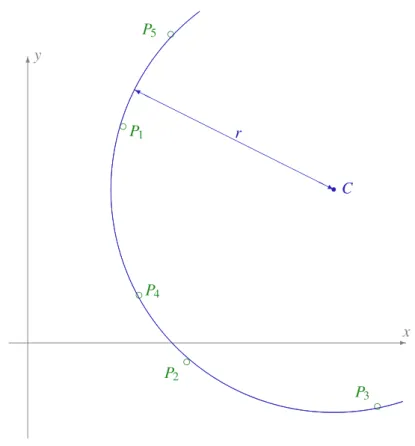
We consider the following 2D problem: given a set ofnpointsPi(xi,yi)(i=1. . .n) find the centerC(xc,yc) and the radiusr of the circle that pass closest to all the
points.
Figure 1: closest circle problem
-x 6 y c P1 c P2 c P3 cP4 c P5 rC H H H H H H H Y H H H H H H H j r
For the latest version of this document, please check the downloads page of the spaceroots site athttp://www.spaceroots.org/downloads.html. The paper can be browsed on-line or retrieved as a PDF, compressed PostScript or LaTeX source file. An implementation in the Java language of the algorithms presented here is also available in source form as a stand-alone file athttp:// www.spaceroots.org/documents/circle/CircleFitter.java.
2
Solving the problem
2.1 Principles
The underlying principles of the proposed fitting method are to first compute an initial guess by averaging all the circles that can be built using all triplets of
non-aligned points, and then to iteratively reduce the distance between the circle and the complete set of points using a minimization method.
2.2 Initialization
For any given triplet of non-aligned points, there is a single circle passing through all three points: the triangle circumcircle. We will use this property to build an initial circle.
LetPi(xi,yi),Pj(xj,yj)andPk(xk,yk)be three points. The triangle circumcenter
is at the intersection of the perpendicular bisectors of the triangle sides. Equation (1) holds as the circumcenter belongs to the perpendicular bisector of side(Pi,Pj)
and equation (2) holds it also belongs to the perpendicular bisector of side(Pj,Pk):
xCi,j,k =(xi+xj) +αi,j(yj−yi)
2 yCi,j,k =(yi+yj)−αi,j(xj−xi) 2 (1) xCi,j,k= (xj+xk) +αj,k(yk−yj) 2 yCi,j,k= (yj+yk)−αj,k(xk−xj) 2 (2)
Solving this set of linear equations is straightforward:
αi,j= (xk−xi)(xk−xj) + (yk−yi)(yk−yj) ∆ αj,k= (xk−xi)(xj−xi) + (yk−yi)(yj−yi) ∆
where ∆= (xk−xj)(yj−yi)−(xj−xi)(yk−yj)
(3)
Hence the circumcenter coordinates are:
(4) xCi,j,k= (yk−yj)(x 2
i +y2i) + (yi−yk)(x2j+y2j) + (yj−yi)(x2k+y2k)
2∆ yCi,j,k=−
(xk−xj)(x2i +y2i) + (xi−xk)(x2j+y2j) + (xj−xi)(x2k+y2k)
2∆
These coordinates can be computed as long as the determinant∆is non-null,
which means the three points are not aligned.
Since the method is intended to be general, we do not make any assumptions on the points. Some of them may have small (or even large) errors, some may be aligned with other ones, some may appear several times in the set. We cannot reliably select one triplet among the other ones. We build the initial guess of the fitting circle by averaging the coordinates of the circumcenters of all triplets of non aligned points.
2.3 Issues
The initialization process described above may be inadequate in some cases. If the number of points is very large, the number of triplets will be overwhelm-ingly large as it grows inn3. In this case, only a subset of the complete triplets set must be used. Selecting the subset implies knowing the distribution of the points, in order to avoid using only points in the same area for initialization.
If the points sample contains really far outliers in addition to regular points, the initial center may be offset by a large amount. This is due to the fact the mean is not a robust statistic. This can be circumvented by either using a median rather than a mean or by dropping outliers (either before or after circumcenter determination).
If the points distribution is known to cover exactly one circle with a consistent step between the points and no outliers, a much simpler initialization process is simply to use the mean of the x and y coordinates for all points.
2.4 Iterative improvement
2.4.1 Problem statement
Once we have an initial guess for the circle center, we want to improve it for some definition ofbest fitagainst the points set. Using a least squares estimator based on the euclidean distance between the points and the circle is a common choice.
We try to minimize the cost functionJ:
J= n
∑
i=1 (di−r)2 where di= q (xi−x)2+ (yi−y)2diis the euclidean distance between the pointPi(xi,yi)and the circle centerC(x,y)
andris the circle radius.
For a given circle center, we compute the optimum circle radius ˆrby solving:
(5) ∂J ∂r r=rˆ =0⇒rˆ=∑ n i=1di n
This means that bothdiand ˆrcan be considered as functions of the circle center coordinatesxandywhich from now on will be the free parameters of our model.
Using the choicer=rˆ, the cost function can be rewritten:
(6) J= n
∑
i=1 (di−r)ˆ 2= n∑
i=1 di2−(∑ n i=1di) 2 nfrom this expression we can compute the gradient of the cost function with respect to the free parameters:
(7) ∇J ∂J ∂x =2 n
∑
i=0 (x−xi)(di−r)ˆ di ∂J ∂y =2 n∑
i=0 (y−yi)(di−r)ˆ di2.4.2 Direct solving
Equation (7) can easily be solved analytically. However experience shows that even for small errors with the initial guess, this leads to a solutionC(x,y)that is very far from the validity domain of the partial derivatives values.
This sensitivity to the initial guess is a common issue with GAUSS-NEWTON
based least squares solvers. Iterating as in a fixed point method does not help either, iterations diverge once we are too far. So we have to refrain from using this easy but wrong solution and use a more robust approach.
2.4.3 Levenberg-Marquardt
The LEVENBERG-MARQUARDTmethod is a combination of the GAUSS-NEWTON
and steepest descent methods. It benefits from the strength of both methods and is both robust even for starting points far from the solution and efficient near the solution. It is a sure bet and is highly recommended.
This method is however quite complex to implement, so it should be used only if a validated implementation of the method is easily available. The MINPACK implementation1 in fortran is widely used. Our own Mantissa2 Java library also provides a Java implementation based on the MINPACK one as of version 6.0. Many other implementations are available in various languages.
For cost functionJ =∑ni=1(di−r)ˆ 2, the LEVENBERG-MARQUARDT method
needs the jacobian matrix of the deviationsdi−rˆ. The two elements of rowiof this matrix is given by equation (8):
∇(di−r) =ˆ ∂ di−1n∑nk=0dk ∂x ∂ di−1n∑nk=0dk ∂y = x−xi di −1 n n
∑
k=0 x−xk dk y−yi di − 1 n n∑
k=0 y−yk dk (8)This solver is far more efficient than the simple one we will present in the following section (by several orders of magnitude). The drawbacks are the imple-mentation complexity.
2.4.4 Conjugate gradient
If no LEVENBERG-MARQUARDTbased solver are available, we can still find the
values of the free parameters that minimize the cost functionJ using the simpler
1http://www.netlib.org/minpack/lmder.f
conjugate gradient method with POLAK and RIBIERE` factor. This will be less efficient than using LEVENBERG-MARQUARDTespecially when the points are far from a real circle, but is very simple to do.
The conjugate gradient method is also an iterative one, using two embedded loops. The outer loop computes a new search direction by combining the cost function gradient at the current step and the previous search direction. The inner loop roughly minimizes the cost function in the search direction. This method is very easy to implement and allows to have a self-contained algorithm.
The rough minimization of the cost function along the search direction can be done by performing a few steps of a NEWTONsolver on the derivative of the cost
functionJ(x+λu,y+λv)with respect to the stepλ.
The following equations are the exact derivatives used for this rough inner minimization (we useJu,v(λ) =J(x+λu,y+λv),diu,v(λ) =di(x+λu,y+λv)and
ˆ
ru,v(λ) =r(xˆ +λu,y+λv)as a way to simplify the equation):
Ju,v(λ) = n
∑
i=0 di2u,v(λ)− 1 n n∑
i=0 diu,v(λ) !2 dJu,v(λ) dλ =2 n∑
i=0(x+λu−xi)u+ (y+λv−yi)v
diu,v(λ)−ru,v(λ)ˆ diu,v(λ) d2Ju,v(λ) dλ2 =2(u 2+v2) n
∑
i=0 diu,v(λ)−rˆu,v(λ) diu,v(λ) −2 n n∑
i=0(x+λu−xi)u+ (y+λv−yi)v diu,v(λ) !2 +2ˆru,v(λ) n
∑
i=0(x+λu−xi)u+ (y+λv−yi)v2 di3u,v(λ) hence (9) dJu,v(λ) dλ λ=0 =2 n
∑
i=0 (x−xi)u+ (y−yi)vdi−rˆ di and d2Ju,v(λ) dλ2 λ=0 = 2(u2+v2) n∑
i=0 di−rˆ di −2 n n∑
i=0 (x−xi)u+ (y−yi)v di !2 +2 ˆr n∑
i=0 (x−xi)u+ (y−yi)v2 di3 (10)The preceding equations are used in a traditional conjugate gradient method, assumingxandyhave been initialized, as shown in algorithm 2 (page 11).
The parameters of the algorithms are the maximal number of iterations imax, and the two convergence thresholdsεinner andεouter. Their values depend on the problem at hand (number of points, expected error at each points, required accu-racy). Finding the values for a given problem is a matter of trial and errors. As always with the conjugate gradient method, there is no real need to have an accu-rate minimum along the search direction, henceεinner may be quite large (I used
values between 0.02 and 0.1). It is even possible to remove completely the conver-gence check and replace it with an arbitrary small number of NEWTONsteps.
3
Numerical example
This section shows an example application of the algorithms described in this note. It is based on a simple case with only five points and an order of magnitude of about 1% of the circle radius for the errors in the points locations.
We start with the following set of five points:
point x y P1 30 68 P2 50 -6 P3 110 -20 P4 35 15 P5 45 97
Since there are five points in the set, there are ten different triplets, none of them have aligned points:
circumcenter x y circumcenter x y C1,2,3 93.650 45.500 C1,4,5 103.768 48.223 C1,2,4 103.704 48.217 C2,3,4 92.400 40.142 C1,2,5 103.753 48.230 C2,3,5 94.178 47.765 C1,3,4 95.821 47.473 C2,4,5 103.720 48.229 C1,3,5 99.228 50.571 C3,4,5 96.580 49.100
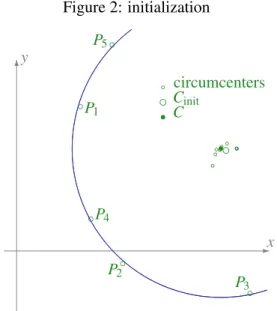
we observe that with this data set, four circumcenters (C1,2,4,C1,2,5,C1,4,5and C2,4,5) are very close to each other. This is only a coincidence. This explains why
few points show up in figure 2: the four rightmost points are almost superimposed. Averaging these circumcenters gives the initial value for the circle center:
Cinit(98.680,47.345)
The initial value of the cost function is 13.407.
Using the LEVENBERG-MARQUARDTmethod with very stringent convergence thresholds (10−10 for all tolerance settings: relative cost, relative parameters and
Figure 2: initialization -x 6 y bP 1 b P2 b P3 bP4 b P5 a aaa a a aa aacr a circumcenters cCinit r C
orthogonality), convergence is reached after only 4 cost function evaluations and 4 jacobians evaluations. Using the conjugate gradient method with a loose conver-gence setting for the inner loop and a tight one for the outer loop (εinner=0.1 and εouter=10−12), convergence is reached after 7 iterations.
Both methods give the same results3. The minimal value found for the cost function is 3.127. The parameters for the best fitting circle and the corresponding residuals are: ( C(96.076,48.135) r=69.960 ⇒ d1−r=−0.963 d2−r=1.129 d3−r=−0.417 d4−r=−0.475 d5−r=0.725
This example is only one example, no conclusions should be drawn from the similar results and iteration numbers. Some key features that depend on the prob-lems and are not addressed in this paper are the following ones:
number of points: this example uses 5 points, other may have hundreds of points,
error level: errors range to about 1% of the circle radius, I have encountered real life applications were errors were around 0.001%, other were errors were about 30%,
3a previous version of this paper found slight differences between the results and a large difference in the number of iterations, this was due to an implementation bug in the conjugate gradient method
error distribution is homogeneous: but in some application errors may be highly correlated (dented or squizzed circles),
circle coverage: the example points all belong to the same left half of the circle, in some cases points will be regularly distributed over the circle, and in some cases there will be some strange distribution like 3.5 turns.
A
Algorithms
σx←0 σy←0 q←0 loop fori=1toi=n−2 loop for j=i+1to j=n−1 loop fork= j+1tok=ncompute∆using equation (3) if|∆|>εthen
// we know the points are not aligned computeCi,j,kusing equation (4) σx←σx+xCi,j,k σy←σy+yCi,j,k q←q+1 end if end loop end loop end loop ifq=0then
errorall points are aligned
end if
returncircle centerC(σx/q,σy/q)
compute ˆrusing equation (5) computeJusing equation (6) compute∇Jusing equation (7)
if|J|<ε1or|∇J|<ε2then
return// we consider we already have the minimum
end if Jprev←J ∇Jprev←∇J
~uprev←~0
loop fromi=1toi=imax
// search direction
~u← −∇J ifi>1then
β←∇JT(∇J−∇Jprev)/∇Jprev2 // Polak-Ribiere coefficient
~u←~u+β~uprev end if
∇Jprev←∇J
~uprev←~u
// rough minimization along the search direction (a few Newton steps)
loop Jinner←J
computedJ/dλusing equation (9) computed2J/dλ2using equation (10)
λ← −(dJ/dλ)/(d2J/dλ2) C←C+λ~u
compute ˆrusing equation (5) computeJusing equation (6) compute∇J using equation (7)
whilei≤imaxand|J−Jinner|/J≥εinner if|J−Jprev|/J<εouter
return// convergence reached
end if end loop
errorunable to converge inimaxiterations