IRL @ UMSL
Dissertations UMSL Graduate Works
11-2-2018
The Dreaded Performance Appraisal: Can the
Process Ever be Comfortable?
Lauren LaBat [email protected]
Follow this and additional works at:https://irl.umsl.edu/dissertation
Part of theIndustrial and Organizational Psychology Commons
This Dissertation is brought to you for free and open access by the UMSL Graduate Works at IRL @ UMSL. It has been accepted for inclusion in Dissertations by an authorized administrator of IRL @ UMSL. For more information, please [email protected].
Recommended Citation
LaBat, Lauren, "The Dreaded Performance Appraisal: Can the Process Ever be Comfortable?" (2018).Dissertations. 794.
The Dreaded Performance Appraisal: Can the Process Ever be Comfortable?
Lauren R. LaBat
M.A., Psychology, University of Missouri – St. Louis, 2015 B.A., Psychology, Rhodes College, 2013
A Dissertation Submitted to The Graduate School at the University of Missouri – St. Louis in partial fulfillment of the requirements for the degree
Doctor of Philosophy in Psychology
with an emphasis in Industrial and Organizational Psychology
December 2018 Advisory Committee John Meriac, Ph.D. Chairperson Stephanie Merritt, Ph.D. Jim Breaugh, Ph.D. Nancy Singer, Ph.D.
Table of Contents
Abstract ... 5
The Dreaded Performance Appraisal: Can the Process Ever be Comfortable? ... 6
The Performance Appraisal Process ... 9
Performance Appraisals and Rating Distortion ... 10
Additional Performance Appraisal Factors ... 13
Performance Appraisal Discomfort ... 15
Rater Training ... 17
Frame-of-Reference Training ... 18
Performance Appraisal Discomfort and Rater Training ... 19
Antecedents and Outcomes of Performance Appraisal Discomfort ... 21
Personality as an Antecedent ... 21
Self-Efficacy as an Outcome ... 24
The Current Study and Hypotheses ... 25
Study 1: Effect of Training and Individual Differences on Rater Discomfort ... 27
Hypothesis 1... 29 Hypothesis 2: ... 29 Hypothesis 3... 30 Hypothesis 4... 30 Hypothesis 5... 30 Hypothesis 6... 31 Hypothesis 7... 31 Hypothesis 8... 32 Method ... 32 Participants ... 32 Procedure ... 32 Measured Variables ... 32
Rater Training Experience ... 32
Perceived Quality of Training ... 33
Agreeableness and Conscientiousness ... 33
Rater Self-Efficacy ... 33
Rater Discomfort ... 34
Demographics ... 34
Exploratory Variables ... 34
Performance Appraisal Beliefs ... 35
Performance Appraisal Views ... 35
Exploratory Analyses ... 40
Study 1 Discussion ... 42
Study 2: The Effects of Training and Individual Difference Factors on Rater Behaviors ... 45
Hypothesis 9... 47 Hypothesis 10... 47 Hypothesis 11... 48 Hypothesis 12... 49 Hypothesis 13... 50 Hypothesis 14... 50 Hypothesis 15... 51 Hypothesis 16... 51 Hypothesis 17... 51 Hypothesis 18... 51 Hypothesis 19... 52 Hypothesis 20... 52 Method ... 53 Participants ... 53 Design ... 54 Procedure ... 54 Materials ... 55 Stimulus Materials ... 55 Frame-of-Reference Training ... 56 Control Training... 56 Measured Variables ... 57
Agreeableness and Conscientiousness ... 57
Rater Self-Efficacy ... 57
Rater Discomfort ... 58
Measured Dimensions ... 58
Rating Scale and Comparison Scores ... 59
Overall Performance ... 59 Rater Leniency ... 59 Rater Accuracy... 59 Training Reactions ... 61 Demographics ... 61 Results ... 62 Study 2 Discussion ... 67
General Discussion ... 70
Limitations and Future Research ... 71
Practical Implications and Conclusions ... 73
References ... 77
Appendix A: Hypothesized Model and Final Model ... 89
Appendix B: Study 1 Results Tables ... 91
Appendix C: Study 2 Results Tables ... 93
Appendix D: Measures ... 99
Study 1 Measures ... 99
Big Five Inventory (BFI) ... 99
Performance Appraisal Self-Efficacy Scale for Raters (PASES) ... 100
Perceived Quality of Training ... 101
Study 1 Demographics ... 102
Study 1 Exploratory Variables ... 103
Performance Appraisal Beliefs ... 103
Performance Appraisal Views ... 103
Additional Exploratory Items ... 106
Performance Appraisal Discomfort Scale ... 106
Study 2 Additional Scales ... 108
Training Reactions ... 108
Overall Performance ... 108
Study 2 Demographics ... 108
Appendix E: Study 2 Materials ... 109
Sample Rating Form ... 109
Sample Frame-of-Reference Training Handout ... 110
Sample Job Description ... 112
Abstract
Previous research has indicated that individuals dislike and resist the performance appraisal process. Fewer studies have examined reasoning for unintentional rating distortion that may result from a lack of training and clear understanding of how to effectively evaluate behaviors. Researchers have shown that the appraisal process is uncomfortable for raters, but empirical studies have yet to explore how to reduce this discomfort. Rater training research has revealed that trained raters have improved observational skills, a more precise vocabulary to describe behaviors, and improved rating accuracy. This research explored the relationship between performance appraisal discomfort and trait motivational factors (i.e., personality and self-efficacy) and rater behavior (i.e., leniency and accuracy), along with the impact of the experience of training. Additionally, these studies investigated whether performance appraisal discomfort could be reduced after experiencing rater training (specifically, Frame-of-Reference training). Results revealed that individual difference variables (personality and self-efficacy) were not consistently related to ratings of discomfort; however, rater training was found to be an effective mechanism for reducing discomfort with making performance ratings. Future research ideas and practical implications are discussed.
The Dreaded Performance Appraisal: Can the Process Ever be Comfortable? A seemingly constant source of dissatisfaction, performance appraisal systems are often met with resistance from employees and employers. The process has been said to leave employees dejected and unfit for “productive” work for several weeks after making ratings (Deming, 1986), with research demonstrating that the system is unpleasant for both employees and supervisors (Longenecker, Sims, & Gioia, 1987). Why then, do organizations spend considerable time and money investing in a process that their employees despise? Several researchers have indicated that motivation and political factors contribute to lenient, biased, or inaccurate ratings (Cleveland & Murphy, 1992; Longenecker et al., 1987; Murphy, Cleveland, & Hanscom, 2018). Another explanation for inaccurate ratings that has received less attention could be that raters are not well-trained, leading to discomfort with the appraisal process. Researchers have called for the use of actual supervisor data to better understand performance appraisal discomfort (Bernardin & Villanova, 2005).
Using both field and lab investigations, these studies examined the impact of training on discomfort with performance ratings and explored the contributions of other performance appraisal factors and antecedents and outcomes of discomfort (i.e.,
individual difference characteristics). The objectives of this study included investigating the relationship between performance appraisal discomfort and motivational factors (i.e., personality and self-efficacy) and between performance appraisal discomfort and rating factors (i.e., leniency and accuracy). Additional objectives included determining whether performance appraisal discomfort could be reduced after training and delving deeper into
how training influences the relationships between discomfort with appraisals and motivational factors.
Performance management processes include appraisals or reviews that are often linked to compensation decisions, making them an important component of
organizations. Bretz, Milkovich, and Read (1989) reported that over 90% of Fortune 100 firms use performance appraisals for administrative purposes; however, even if
compensation was not a factor, performance ratings still have a place in businesses. For example, the use of 360-degree performance evaluations has gained increasing popularity (Nowack & Mashihi, 2012), even when used only for developmental purposes. Thus, performance ratings continue to persist in organizations. In fact, not only are managers making ratings of performance, but peers and subordinates are also being asked to weigh in with their perspectives. Consequently, it is crucial that raters learn to view the
performance appraisal process as an opportunity to provide important and useful behavioral feedback as opposed to a laborious chore they must endure. Rather than exploring alternative reasons to overcome resistance to performance appraisals, previous research has focused more on improving rating accuracy through changing rating formats (Landy & Farr, 1980) or utilizing rater training (Roch, Woehr, Mishra, & Kieszczynska, 2012; Woehr & Huffcutt, 1994).
Earlier studies suggest that the main reason raters distort their ratings is because they lack motivation (Fisher, 1989) or are influenced by social factors (i.e., trying to please other employees, Bernardin & Villanova, 1986; Levy & Williams, 2004; Tziner, Murphy, Cleveland, & Roberts-Thompson, 2001), when a more important issue may be that raters are simply not confident in their performance appraisal abilities.
Saffie-Robertson and Brutus (2014) noted that the underlying cause of resistance to performance appraisals may be due to the unease evaluators feel when faced with assessing others’ work performance. If performance appraisal research is to apply to practices in
organizations, it is important not only to improve rating accuracy, but also to help raters feel confident in their ratings.
In order to accomplish this, an important motivational factor that warrants more investigation is performance appraisal discomfort, which concerns employees’ feelings towards different components of the performance appraisal process (e.g., providing ratings, monitoring performance, justifying rating). Villanova, Bernardin, Dahmus, and Sims (1993) found that raters who reported higher levels of performance appraisal discomfort gave more lenient ratings than raters reporting lower levels of discomfort. Workers who experience discomfort with the appraisal process are expected to engage in more withdrawal and avoidance behaviors, such as turnover intentions or actual turnover (Villanova et al., 1993), which could be detrimental to performance rating and feedback processes.
Previous research has also indicated that all performance appraisal discussions are likely to produce some level of discomfort to the extent that appraisal is believed to be associated with important outcomes, such as compensation decisions (Smith, Harrington, & Houghton, 2000). While these and other studies have investigated predictors and outcomes of performance appraisal discomfort (Fried, Tiegs, & Bellamy, 1992; Smith et al., 2000; Villanova et al., 1993), fewer researchers have explored how to reduce rater discomfort. Rater training may be one way to address this important organizational issue, with an approach towards using it to reduce discomfort rather than increase accuracy.
The Performance Appraisal Process
Before proposing how rater training may help to reduce rater discomfort, it is important to understand more about the performance appraisal process, and what about it leads to discomfort with ratings. Performance appraisals have been defined as a “variety of activities through which many organizations seek to assess employees and develop their competence, enhance performance and distribute rewards” (Fletcher, 2001, p.473). Murphy and Cleveland (1995) maintain that the term “performance evaluation” has become synonymous with performance ratings, explaining that ratings are often the main format used for evaluations. The performance appraisal process has also been referred to as “one of the most emotionally charged activities in business life” (Pearce & Porter, 1986, p. 212). This perspective has largely been attributed to the relationship between performance evaluations and personnel decisions.
According to Bol (2011), rating inaccuracy is a common issue plaguing performance evaluations due to the subjective nature of the task and its use for
administrative purposes as opposed to developmental. However, though employees are frustrated by performance appraisals, research indicates that managers are resistant to discarding performance appraisals completely, as they often believe them to be an essential component to human resource process (Meyer, 1991). As a result, in some organizational contexts, an inaccurate appraisal may be tolerated over no appraisal at all. Therefore, it is important to understand first why raters distort their ratings, and second, to consider novel methods for combatting this issue.
Performance Appraisals and Rating Distortion
Cleveland and Murphy (1992) indicated that it is often the motivation of a rater that determines the accuracy of an appraisal, and the distortion of ratings has been attributed to several different motives. Fisher (1989), for example, noted that even if raters are capable of rating accurately, there is no guarantee that they will choose to do so. This suggests that while raters may have the ability to make accurate ratings, they frequently lack the necessary motivation or drive to be accurate. Longenecker et al. (1987) noted that employees appear to dislike giving and receiving performance
appraisals because though the process typically takes up a small piece of the year, it has a significant impact on individual career development and organizational performance.
Several researchers have shown that supervisors inflate ratings in order to avoid the aversive nature of appraisals (Latham, 1986; Longenecker et al., 1987), especially if they have to provide feedback face-to-face (Villanova et al., 1993). The prospect of future collaboration was found to predict higher performance appraisal ratings (Randall & Sharples, 2012). Moreover, supervisors may distort ratings for political reasons, such that though they may want to provide accurate appraisals, it may not be in their best interests to do so (Fisher, 1989; Poon, 2004). For example, Bernardin and Villanova (1986) found that superiors, administrators, and subordinates believed ratings were inflated to avoid confrontations with subordinates or to please employers. In another example, supervisors may inflate ratings in order to preserve their relationship with their subordinates. When the relationship between a manager and their employees was
In support of these political explanations for rating inaccuracy, there are also other motivational justifications. Expectancy theory of motivation (Mitchell, 1982) proposed that the ability to generate accurate ratings could depend on whether those ratings would result in desirable or undesirable outcomes. Similarly, there is evidence that attitudes (i.e., affective commitment, and use of appraisal), perceptions of fairness (Jawahar, 2007), and orientations toward performance appraisal (i.e., confidence in performance appraisal system) influence rating distortion, and as a result may influence comfort with performance appraisals (Tziner & Murphy, 1999; Tziner et al., 2001; Tziner, Murphy, & Cleveland, 2002).
The performance appraisal purpose also plays an important role (Jawahar & Williams, 1997). Individuals were found to be motivated to rate more leniently and less accurately when the appraisal was used for administrative purposes as opposed to for research, feedback, or employee development (Cleveland & Murphy, 1992; Jawahar & Williams, 1997). Jawahar and Williams (1997) referred to this as the performance appraisal purpose effect. In their study investigating the multiple uses of performance appraisal, Cleveland, Murphy, and Williams (1989) reported that the information
collected during performance appraisals had the greatest impact on salary administration and performance feedback, lending support to the hypothesis that individuals rate more leniently when ratings are a factor in salary decisions. Raters may have different motivations depending on who they are rating. For example, making ratings for a supervisor or direct report that may influence a promotion or salary increase could hold more weight or make a larger impact than making ratings for a peer, as those are typically
used only for developmental purposes. It is clear having the power to influence another employee’s income may lead to discomfort, and subsequently lenient ratings.
Jawahar and Williams (1997) observed evidence of the performance appraisal purpose effect in several scenarios. More lenient ratings were reported in field settings with organizational raters as opposed to research settings with student raters when the purpose was administrative. Furthermore, ratings were more lenient when appraisals were made of a direct report or subordinate (downward appraisal) than of a manager or
supervisor (upward appraisal). Though ratings do not appear to be as lenient when a performance appraisal is used for development, the process of making ratings can still be difficult for raters who lack proper training. Considering these varied reasons for rating leniently, Cleveland et al. (1989) explained how appraisals are often conflicting for raters who must compare between-employee when making decisions about promotions or salary, but then also compare within-employee to make decisions about development. Jawahar and Williams (1997) proposed addressing the performance appraisal discomfort effect by finding ways to decrease the discomfort raters and ratees experience with the appraisal process. This research explored this recommendation and suggested that
training could be an effective means of reducing discomfort with performance appraisals. Typically, inaccurate or distorted ratings result in elevated ratings that are skewed in a positive direction, meaning employees receive higher ratings than they deserve (Murphy & Cleveland, 1991). Specifically, rater leniency (also known as rating elevation or inflation) is described as the tendency of raters to assign higher ratings than those that would be justified or substantiated by actual performance (Bernardin, Cooke, &
the most prevalent and problematic issues related to performance appraisals (Pulakos & O’Leary, 2011).
Lenient ratings can lead to dissatisfaction with performance appraisals among managers, as it can be difficult to determine termination decisions, recognize and reward top performers, and portray the performance appraisal system as equitable (Bernardin et al., 2000). Unfortunately, research has shown rating elevation to be a relatively stable characteristic (Kane, Bernardin, Villanova, & Peyrefitte, 1995; Villanova et al., 1993), with Guilford (1954) suggesting that one underlying cause of this is a rater’s personality. However, if rater leniency results from raters being uncomfortable with performance appraisals and therefore less confident in their ratings, it may be advantageous to explore ways to reduce discomfort rather than methods to increase rating accuracy.
Additional Performance Appraisal Factors
There are several factors that may influence the effectiveness of a performance appraisal system that would conceivably also impact comfort with appraisals. Smither (1998) indicated that effective performance appraisals focus on performance variables as opposed to personal traits. Gilliland and Langdon (1998) emphasized that employees must believe they can give meaningful input into the appraisal process in order for it to be considered effective. Fried et al. (1992) added that having time to observe an employee also strengthens the effectiveness of a performance appraisal. Time pressures can be burdensome for raters, impacting their ability to provide strong, or well-documented, evaluations (Bernardin & Villanova, 1986). Villanova et al. (1993) maintained the importance of considering how the nature of and frequency of supervisor feedback contribute to performance appraisal effectiveness. Moreover, appraisals should be
task-relevant, with managers being trained to observe pertinent skills (Coutts & Schneider, 2004). Appraisal systems bereft of these components may lead raters to feel
uncomfortable with the evaluation system.
It is also worthwhile to consider the different components of a performance appraisal. The process includes several steps, such as observing behavior, evaluating behavior, and providing feedback. Although the Performance Appraisal Discomfort scale (PADS) developed by Villanova et al. (1993) proposes a factor structure that examines different components of performance appraisals (i.e., provision of negative feedback, solicitation of feedback, justifying/defending ratings, and encouraging performance monitoring), other studies have focused specifically on the feedback piece (Cox, Marler, Simmering, & Totten, 2011; Ilgen & Moore, 1987; Tumlin, 2004). Technological advances such as electronic rating forms and performance management software have facilitated ease of documenting qualitative and quantitative information (Brutus, 2010) from performance appraisals, making it easier to conduct evaluations; however, raters are often still uncomfortable with performance appraisals due to the psychological costs of having to share negative feedback (Cox et al., 2011; Rosen & Tesser, 1970).
With so many elements contributing to the performance appraisal process, more research should investigate ways to reduce performance appraisal discomfort.
Furthermore, research is needed to examine the impact these elements have on employees with actual supervisory experience to get to the root cause of why managers and
supervisors dislike performance appraisals, soliciting their feedback in order to improve their confidence and reliance on the process. Though performance appraisals are disliked, they continue to persist in organizations. Theoretically, reduced discomfort may improve
attitudes and beliefs about the performance appraisal system, which should influence rating behavior and potentially rating accuracy. Furthermore, rating leniency should be reduced if raters are trained to understand the impact of their ratings and to be confident in their observations. To further explore and probe into performance appraisal discomfort and how it may relate to rating accuracy, Villanova et al. (1993) developed a scale to measure the construct.
Performance Appraisal Discomfort
Performance appraisal discomfort is an application of the theory of job
compatibility, which refers to the extent to which workers maintain preferences for job characteristics that are consistent with the actual demands of the job (Villanova et al., 1993). The Performance Appraisal Discomfort Scale (PADS) was developed by Villanova et al. (1993) to capture and measure this construct. The job compatibility framework suggests that workers whose preferences do not align with actual job
characteristics should report greater discomfort in performing job activities (Villanova et al., 1993). Additionally, workers who report greater discomfort may engage in more voluntary turnover behaviors at work (Villanova et al. 1993).
In their development of the PADS, Villanova et al. (1993) delineated four factors: provision of negative feedback, solicitation of feedback, justifying/defending ratings, and encouraging performance monitoring. Villanova et al. (1993) suggested that the factor structure can be interpreted in light of demands placed on raters in appraisal situations. Smith et al. (2000) investigated factors of the performance appraisal process that may contribute as antecedents of performance appraisal discomfort. Their study results revealed that the beliefs held by the rater significantly affected the extent to which raters
reported performance appraisal discomfort and suggested that discussions of performance problems would evoke greater discomfort than discussing acceptable performance if the rater believed appraisals influenced important work outcomes (Smith et al., 2000).
Since it is clear from previous research that there are factors (i.e., the belief that appraisals are important, Smith et al., 2000) that influence the level of performance appraisal discomfort, and that discomfort often leads to negative outcomes (i.e., rating distortion and withdrawal behaviors, Villanova et al. 1993), a question emerges as to which factors might contribute to reducing the level of discomfort supervisors feel when approaching performance ratings. Arguably, an important component that may play a role would be managerial experience.
In their study investigating leniency effects and performance appraisal discomfort, Villanova et al. (1993) found rater discomfort to be a relatively stable rater characteristic that was not subject to significant change as a result of moderate experience in appraisal situations, suggesting that limited experience in performance appraisal would not
significantly influence responses on the PADS. Similar to the findings of Villanova et al. (1993), Smith et al. (2000) found that rater’s age and managerial experience had no significant impact on performance appraisal discomfort. More experienced supervisors reported lower levels of performance appraisal discomfort than raters with less
experience, but this finding was only marginally significant (Smith et al., 2000). Rather than the amount of time a rater has accrued in age or years of work experience, the type of experiences or skills acquired may be more important determinants of discomfort.
These findings contributed to the idea that performance appraisal discomfort does not change as a result of having more experience with conducting a performance
appraisal. If this is the case, and more experience does not significantly reduce discomfort with performance appraisals, what other factors may be able to increase comfort with appraising performance? Surprisingly, research had not investigated whether supervisors were uncomfortable making performance appraisals simply because they did not feel they had the skills or resources to provide accurate ratings supported by strong feedback. This research sought to demonstrate that rater discomfort is not stable, and could potentially be significantly reduced with appropriate rater training.
Rater Training
New managers are faced with the challenge of evaluating behavior without the experience more seasoned managers may have; however, even tenured or experienced managers, as indicated by previous research, may not have received the tools they needed to be successful at making effective and accurate ratings, resulting in rating distortion (Smith et al., 2000; Villanova et al., 1993). New managers move from focusing on their own tasks to coordinating the efforts of one or more individuals whose behavior they must evaluate (Hill, 2004). Being a manager not only includes stepping into a role of authority, but also requires developing interpersonal judgment in order to navigate and negotiate through politics and managing multiple relationships (Hill, 2004).
In an investigation into the performance appraisal process for police officers, Coutts and Schneider (2004) found that only 11.1% of participants who made ratings indicated substantial training for performance appraisals was provided while 67.3% indicated that very little training was provided. The vast majority of those sampled were receiving performance appraisals under the assumption that their supervisors were not provided with enough training to effectively evaluate their performance (Coutts &
Schneider, 2004). Previous research does not provide much insight into whether new manager training incorporates how to observe and evaluate others. While managers and supervisors may learn to manage, do they ever learn to effectively assess another person’s performance?
Rater training research has mainly focused on the benefits of training for rating accuracy; however, rater training may have the potential to increase rater motivation to provide accurate ratings by helping raters to feel more confident in their appraisal abilities (Roch et al., 2012). There are several advantages of rater training, including improved observational skills, gaining new insights about behaviors, and having a more precise vocabulary with which to describe behaviors (Byham, 1971; Thornton & Rupp, 2005). One of the most widely used types of rater training, Frame-of-Reference Training (FORT), has been shown to most effectively improve rating accuracy compared to other types of rater training, namely Behavioral Observation Training (BOT) and Rater Error Training (RET) (Noonan & Sulsky, 2001; Stamoulis & Hauenstein, 1993; Woehr & Huffcutt, 1994).
Frame-of-Reference Training. FORT has received the most attention in empirical research and was first introduced by Bernardin and Buckley (1981) who suggested that establishing a common frame of reference would increase observational skills. FORT is designed to influence how a rater encodes, represents, organizes, and recalls information, and often incorporates other approaches of rater training, such as emphasizing performance dimensionality which is characteristic of Performance Dimension Training (Roch et al., 2012). This type of training improves rating accuracy by helping raters understand what behaviors are indicative of specific levels of
performance on specific dimensions and by establishing performance prototypes that allow raters to categorize ratee performance based on these prototypes presented during training (Roch et al., 2012; Sulsky & Day, 1992; Woehr & Huffcutt, 1994).
The focus of FORT is on the scaling of behaviors (i.e., determining effective or ineffective levels of performance), with the goal being that raters will learn to use common conceptualizations when providing ratings (Athey & McIntyre, 1987). The attention FORT places on the evaluation of behavior has been found to be more effective than the concern of BOT on the observation of behavior (Noonan & Sulsky, 2001; Woehr & Huffcutt, 1994). The emphasis placed on understanding rating scales and aligning observations with other raters should be beneficial for reducing performance appraisal discomfort.
Performance Appraisal Discomfort and Rater Training
If raters did not have to worry that their thoughts about behavior deviated too much from others in their organization and if they could be confident in their ability to observe and notice relevant behaviors, they would likely be more comfortable with the appraisal process and make less lenient, more accurate ratings. Typically, FORT involves providing the opportunity for practice and feedback, and feedback has been used to increase rater motivation to transfer skills learned in training to their job (Baldwin & Ford, 1988). If supervisors are taught which behaviors are indicative of certain levels of performance and are better able to discriminate between dimensions and levels of performance, it is hypothesized that as a result of FORT, they may experience less performance appraisal discomfort. Brutus and Donia (2010) examined the usefulness of a peer evaluation system and found that standardizing the experience of the peer evaluation
led to better performance and better observed performance the second time peer behavior was evaluated.
This finding suggested that uniting under a common guideline for evaluating behavior should allow individuals to learn to better observe performance, and
theoretically, be more comfortable with evaluating behavior and make more accurate ratings. To further test this idea using FORT, which seeks to help raters align on how they view and observe behaviors, the opportunity to practice and receive feedback on practice ratings may help raters feel more comfortable with the appraisal process in addition to increasing their rating accuracy. Furthermore, training should help raters understand how to more effectively describe and notice behaviors, reducing discomfort and improving attitudes and beliefs about the performance appraisal system.
Additionally, research has indicated that evaluators often inflate subordinate ratings either to accomplish their own goals (Longenecker et al., 1987), because of organizational politics (Poon, 2004), or because of discomfort with the rating process (Villanova et al., 1993). Previous research has consistently found a positive relationship between discomfort and leniency (Bernardin & Villanova, 2005; Saffie-Robertson & Brutus 2014; Tziner & Murphy, 1999; Villanova et al., 1993). As a result, generating from previous research, it is expected that there will be a positive relationship between performance appraisal discomfort and leniency of ratings, such that those who report less performance appraisal discomfort after training should have less lenient ratings.
Furthermore, because FORT and BOT have been found to improve rating accuracy (Woehr & Huffcutt, 1994) and because performance appraisal discomfort is associated
with more lenient ratings, it was expected that reduced discomfort would be related to greater rating accuracy.
If rater training was found to aid in reducing discomfort managers feel with conducting performance appraisals by clarifying what different levels of performance refer to for a given dimension, there could be strong implications for management
training contents. Findings may lend support for the idea that all managers in supervisory roles should go through training to obtain the resources they need to feel more
comfortable with conducting performance appraisals. If results indicate that more accurate scores are related to less performance appraisal discomfort, this study would indicate that not only does rater training assist in helping raters be more accurate, but it also helps them to become more confident in their rating abilities, reinforcing the importance of investing in training for employees. In addition to examining the impact training may have on performance appraisal discomfort, this study investigated how training might influence an expected existing relationship between individual difference characteristics and discomfort with performance appraisals.
Antecedents and Outcomes of Performance Appraisal Discomfort
Personality as an Antecedent. Saffie-Robertson and Brutus (2014) called for additional research on discomfort with performance appraisals by suggesting a more comprehensive model be tested that is inclusive of other variables that may influence discomfort. The proposed study examined how these variables might contribute when rater training was also introduced. One such variable is personality. According to Tziner et al. (2002), raters high in conscientiousness tended to better discriminate among ratees,
as they were more likely to make a good-faith effort to provide accurate evaluations than less conscientious individuals.
Relatedly, Bernardin, et al. (2000) found that ratings made by individuals who were low in conscientiousness or high in agreeableness made more elevated or lenient ratings. Randall and Sharples (2012) argued that conflict avoidance was a factor of motivation in ratings, reporting that high agreeableness predicted higher performance ratings. In another example, Bernardin et al. (2009) established that those low in conscientiousness or high in agreeableness made less accurate ratings and rated lower performers more leniently than other raters. Bernardin, Thomason, Buckley, and Kane (2015) concluded that there is a U-shaped relationship between personality and ratings, such that high and low levels of agreeableness were both related to less accurate ratings.
A meta-analysis conducted by Harari, Rudolph, and Laginess (2015) supported similar ideas regarding the influence of personality on performance ratings.
Agreeableness, extraversion, conscientiousness, and emotional stability were all shown to have a positive relationship with performance ratings, while openness did not influence ratings (Harari et al., 2015). These effects were stronger in a field compared to a lab setting, and the effect of personality was stronger on ratings when they were collected for research purposes rather than administrative purposes and when accountability was low (Harari et al., 2015). Given these research findings, rater personality undoubtedly matters for performance ratings, but how might training and discomfort fit in? If personality factors influence the types of ratings made, would training reduce ratings of discomfort, regardless of a rater’s personality? This study examined the relationship between
personality and discomfort to determine if there are differences if a participant has experienced training.
In their investigation of the relationships between academic motivation and personality among college students, Clark and Schroth (2010) found that those who were extrinsically motivated (i.e., those who engaged in behaviors to obtain an external reward or to avoid a punishment compared to those who were intrinsically motivated and
engaged in behaviors for the enjoyment felt from learning or trying something new) tended to be more extroverted and conscientious, while those who lacked motivation tended to be disagreeable, suggesting that personality may influence motivation.
Translated to the context of this study, because performance appraisal discomfort could be viewed as a motivational variable, it may be influenced by personality characteristics. Perhaps someone who is disagreeable and dislikes the performance appraisal process is less likely than agreeable individuals to become comfortable with ratings as a result of rater training simply because they are disagreeable.
In addition to research examining the relationship between personality
characteristics and performance ratings, scholars have explored the association between personality dimensions and rating discomfort. Scholars have presented evidence that neuroticism and agreeableness are associated with conflict avoidance, contributing to discomfort with ratings (Sawyer, Hollis-Sawyer, & Pokryfke, 2002; Suls, Martin, & David, 1998). Specifically, positive relationships were identified between agreeableness, neuroticism, and rating discomfort (Sawyer et al., 2002).
Taken together, these findings indicated that those who tended to be less detail-oriented and aimed to please others tended to make ratings that were skewed in a positive
direction (Bernardin et al., 2000; Bernardin et al., 2009). Agreeable workers were often found to be more empathetic towards others, as they were focused on social approval (Costa & McCrae, 1992), suggesting that agreeable individuals could make more positive ratings. It seems plausible that those who are more conscientious may focus more on the individual components of performance evaluations, striving to do their best work at each step. This level of focus may decrease their feelings of discomfort with the appraisal process, while those who are more agreeable may experience more anxiousness
throughout the appraisal as they seek social approval, resulting in more discomfort with performance appraisals. Earlier studies have yet to further explore these relationships in an organizational setting along with additional individual difference measures, such as performance appraisal discomfort. Additionally, scholars have not considered the effect of training. The current study contributes to literature on individual differences and performance appraisals by filling this void in research.
Self-Efficacy as an Outcome. In addition to personality, self-efficacy has been explored as a potential contributing factor of performance appraisal discomfort
(Bernardin & Villanova, 2005; Tziner & Murphy, 1999), but could also be examined as an outcome variable. Originating from social learning theory, self-efficacy is related to outcome expectancies, and is the extent to which an individual is confident in their ability to complete a task (Bandura, 1982). When considering self-efficacy towards the
performance appraisal process, specifically, scholars have investigated the confidence raters feel in the ratings they make (Bernardin & Villanova, 2005). Raters may be more likely to distort ratings if they are not confident in their ability to evaluate behavior (Napier & Latham, 1986). Theoretically, raters who are high in self-efficacy should
collect better information about a ratee before making an evaluation and provide more compelling justifications for their ratings (Bernardin & Villanova, 2005). Additionally, raters may be more careful when observing performance and taking notes.
In one earlier study, the researchers examined self-efficacy training and rater discomfort (Bernardin & Villanova, 2005). Self-efficacy training was directed at
increasing raters’ confidence and ability to identify particular performance levels, as well as to provide negative feedback to ratees (Bernardin & Villanova, 2005). This type of training was found to significantly reduce rating elevation and performance appraisal discomfort, providing support for the idea that training may help alleviate stresses associated with conducting performance appraisals (Bernardin & Villanova, 2005). Related to personality, positive relationships were identified between self-efficacy and conscientiousness, suggesting that more conscientious raters are also more confident raters (Tziner et al., 2002).
Given these findings, it is conceivable that self-efficacy would be influenced by training. If training were found to reduce performance appraisal discomfort, raters should theoretically report more confidence in their ratings compared to individuals who do not experience training. Rater training may act as a moderator, impacting the strength of the relationship between self-efficacy and performance appraisal discomfort. A few
hypotheses are offered regarding the influence of rater training and performance appraisal discomfort.
The Current Study and Hypotheses
Overall, this research investigated whether rater discomfort could be reduced with appropriate rater training. It is possible that performance appraisal discomfort stems from
a lack of confidence in appraisal skills, or results from the fact that appraisal skills were never learned. Surprisingly, few research studies have investigated whether supervisors are uncomfortable making ratings simply because they feel they lack the skills or
necessary resources to provide accurate ratings. These studies explored how rater training could impact expected existing relationships between trait characteristics and
performance appraisal discomfort.
The objectives of this research were to a) examine the relationship between performance appraisal discomfort and other trait motivational factors (i.e., personality and self-efficacy) and state motivational factors (i.e., reason for performance appraisal and type of performance appraisal), b) investigate the relationship between performance appraisal discomfort and rating factors (i.e., leniency and accuracy) and test whether there are differences between participants who experience training compared to those who do not, and c) explore whether performance appraisal discomfort is reduced after experiencing rater training. Two separate research studies addressed these research objectives. Study 1 was a field investigation of these variables relating to performance appraisal discomfort, and Study 2 was a lab investigation that sought to replicate findings of Study 1 with more control over the specific type of rater training and individual
experiences. Both Study 1 and Study 2 were conducted concurrently.
Saffie-Robertson and Brutus (2014) indicated that due to the sensitive nature of the performance appraisal process, a limitation of performance appraisal research is that experimental studies are often conducted with university student samples. To address this limitation and examine the relationship between performance appraisal discomfort and personality and between performance appraisal discomfort and self-efficacy in the field,
Study 1 used a nonexperimental design to examine relationships between individual difference variables (i.e., personality and self-efficacy) and performance appraisal discomfort among individuals with management experience (i.e., a field study with managers who regularly rate performance). Study 2 explored similar relationships using a training manipulation and investigated how a specific type of training may influence rating behaviors (i.e., leniency and accuracy). Several hypotheses were offered with respect to personality, training, and performance appraisal discomfort.
Study 1: Effect of Training and Individual Differences on Rater Discomfort
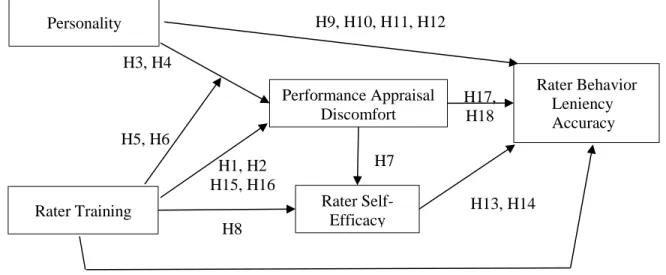
Study 1 explored relationships between individual difference variables and performance appraisal discomfort using a nonexperimental design (see Appendix A for visual model). Participants with management or supervisory experience were recruited and asked to indicate whether they have experienced any type of rater training, which type (if identifiable, i.e., new manager training or performance evaluation training) they experienced, and how extensive the training was. Participants were also asked to respond to a questionnaire with personality, self-efficacy, and performance appraisal discomfort items, as well as other exploratory variables that may be related to discomfort (see Exploratory Variables). These variables included factors related to participants’ attitudes and reactions towards the performance appraisal system. Results of Study 1 were
expected to demonstrate how performance appraisal discomfort operates among individuals with management experience and to bolster external validity.
Study 1 investigated the impact of other types of interventions, such as leadership development training or new manager training courses on performance appraisal
manipulated. Common types of rater training have been found to improve rater accuracy (Noonan & Sulsky, 2001; Woehr & Huffcutt, 1994), suggesting that individuals who have experienced rater training or performance evaluation training should be more comfortable making evaluations of behavior. Therefore, a negative relationship was expected between rater training and performance appraisal discomfort. Because rater training improves observational skills and gives raters a more precise vocabulary for describing and understanding behaviors (Byham, 1971; Thornton & Rupp, 2005), it was predicted that those who reported having gone through a type of performance
management or evaluation training would show lower performance appraisal discomfort than those who reported having not experienced performance management or evaluation training.
In an academic scenario, Young (2004) found that classrooms are often updated with useful technology, but teachers are not provided with training to learn how to effectively utilize the updated systems. When students complain about this, professors feel pressured to try using the tools even when they are uncomfortable with them (Young, 2004). If this is true in an organizational context, supervisors may be trying to conduct effective performance appraisals when they are uncomfortable with the resources
available to them due to a lack of training. This study examined whether supervisors who felt their organization provided them with the tools and resources needed be successful managers were more likely to have experienced training or mentorship in conducting performance appraisals. It was expected that those who began conducting appraisals with little or no assistance from their organization may feel that they were not afforded the
proper resources to learn what behaviors they should be looking for in their direct reports, and as a result, these individuals could be more uncomfortable with the appraisal process.
Hypothesis 1: There will be a negative relationship between the presence or absence of training and performance appraisal discomfort, such that participants who have experienced training will have lower ratings of performance appraisal discomfort compared to those who have not experienced training.
Hypothesis 2: There will be a negative relationship between the perceived quality of training and performance appraisal discomfort, such that participants who perceive a higher quality of the training they received will have lower ratings of performance appraisal discomfort compared to those who thought the training they experienced was of lower quality.
As discussed previously, research findings suggested that personality
characteristics may contribute to rating behavior. Individuals who are agreeable tend to focus on social approval and conflict avoidance, and are therefore expected to experience more discomfort (Bernardin et al., 2009; Costa & McCrae, 1992). Based on this research, agreeableness was predicted to be positively related to discomfort due to the fact that these individuals may be motivated by or make their ratings based on potentially distressing and uncomfortable social or political factors within an organization (Bernardin et al., 2009). Conscientious raters should focus on avoiding mistakes, following instructions, and doing their best work (Costa & McCrae, 1992), suggesting that conscientious participants might experience less discomfort with evaluating behavior. Even if clear guidelines are not available, conscientious raters could be more
likely to explore and research on their own to ensure they complete their ratings correctly.
Hypothesis 3: There will be a positive relationship between agreeableness and performance appraisal discomfort, such that individuals with higher levels of agreeableness will indicate higher ratings of performance appraisal discomfort.
Hypothesis 4: There will be a negative relationship between conscientiousness and performance appraisal discomfort, such that those with higher levels of conscientious will report lower ratings of performance appraisal discomfort. Moreover, it was hypothesized that training would play a role in the relationship between personality and performance appraisal discomfort. Study 1 sampled current business professionals with managerial experience. Participants were asked if they have ever attended a training specific to their company’s performance appraisal rating process and to provide details around this training (i.e., length of training, content, frequency). Knowing that agreeable individuals may distort ratings for social approval while
conscientious individuals seek to avoid errors (Bernardin et al., 2009; Costa & McCrae, 1992; Sawyer et al., 2002), and because training should enable new raters to learn how to navigate political relationships (Hill, 2004) as well as how to evaluate performance accurately (Roch et al., 2012), it was expected that training experience would attenuate the relationship between agreeableness and performance appraisal discomfort while strengthening the relationship between conscientiousness and performance appraisal discomfort.
Hypothesis 5: Training experience will moderate the relationship between agreeableness and performance appraisal discomfort, such that the positive
relationship will be weaker if an individual has experienced training and stronger if an individual has not experienced training.
Hypothesis 6: Training experience will moderate the relationship between conscientiousness and performance appraisal discomfort, such that the negative relationship will be stronger if an individual has experienced training and weaker if an individual has not experienced training.
Self-efficacy was identified as a potential outcome of performance appraisal discomfort. As stated earlier, raters with higher levels of self-efficacy were expected to provide stronger justifications for their ratings as a result of making sure they can be confident and secure in their ratings (Bernardin & Villanova, 2005). Bernardin and Villanova (2005) created a scale to measure self-efficacy specifically in the performance appraisal context. In support of earlier work conducted by Bernardin and Villanova (2005), participants who experience lower levels of discomfort with evaluations and ratings were expected to feel more confident in their ratings. Previous research has not explored generally how performance management or evaluation training may impact rater self-efficacy or appraisal discomfort. As training should increase one’s confidence in their ability to make accurate ratings by increasing the carefulness with which they approach performance ratings and observations (Roch et al., 2012) to reduce errors made (Woehr & Huffcutt, 1994), experiencing training should strengthen the negative
relationship between rater self-efficacy and performance appraisal discomfort.
Hypothesis 7: There will be a negative relationship between rater self-efficacy and performance appraisal discomfort such that individuals with higher levels of rater self-efficacy will report lower ratings of performance appraisal discomfort.
Hypothesis 8: There will be a positive relationship between training experience and rater self-efficacy, such that individuals who have experienced rater training will report higher levels of self-efficacy.
Method
Participants. Participants were recruited using Qualtrics Panels. Participants were required to have at least one year of managerial or supervisory experience (i.e., a role in which the individual has/had direct reports and is/was responsible for evaluating employee performance) to take part in this study. All 250 participants passed the attention check items and no outliers were identified during data cleaning. The final sample was 64% female and 36% male, with the majority of the participants identifying as Caucasian (83%). Almost all of the participants reported that they were currently employed (90%) and the majority indicated that they worked 30 or more hours per week and were currently employed in a management or supervisory role (87%).
Procedure. Instructions and requirements for participation in this study were posted during recruitment for this study. Those who were eligible to participate could click on a survey link taking them to the informed consent form and questionnaire. The survey was expected to take no longer than one hour to complete. Once participants completed the online survey, they received credit/compensation for their participation per their agreement with Qualtrics Panels.
Measured Variables. The following variables were measured in Study 1. See
Appendix D for a list of the items for each of these measures.
Rater Training Experience. Participants were asked whether they had
number of exploratory questions were asked to further investigate the type of training experienced.
Perceived Quality of Training.Participants responded to one global measure of perceived quality and a scale of items that were developed for this study to measure the perceived quality of rater training. Generated items were evaluated by subject matter experts (SMEs) who rated the items based on relevance to the experience of rater training. Results were examined by looking at both the global measure of perceived quality and the composite of the items developed to measure this construct (α = .94). As differences in findings between the two were negligible, the global measure was used for reporting purposes.
Agreeableness and Conscientiousness. Personality subscales were measured using Bent-Martinez and John’s (1998) English Big Five Inventory (BFI). Respondents indicated their agreement to items on a five-point Likert scale (1 = “strongly disagree”, 5 = “strongly agree”). The BFI (α = .76) consists of five subscales, with Agreeableness (α = .79) and Conscientiousness (α = .83) being used for this study.
Rater Self-Efficacy. Rater Self-Efficacy was measured using the Performance Appraisal Self-Efficacy Scale (PASES) developed by Bernardin and Villanova (2005). Participants were asked to indicate the level of confidence they would have in being able to successfully perform the behaviors described in 12 statements on a five-point Likert scale (1 = with no confidence, 5 = with great confidence). Since its development, the PASES has been used by Brutus, Fletcher, and Baldry (2009), who found that the four subscales composed of three items each yielded acceptable reliability (α = .93): process features of the appraisal (α = .86), rater subjectivity (α = .79), appraisal discussion (α =
.83), and suggesting performance improvement (α = .75). Higher scores relate to higher levels of self-efficacy.
Rater Discomfort. Participants completed the Discomfort with Peer Evaluation Scale (Saffie-Robertson & Brutus, 2014). Items were amended for use with employees as opposed to students. Responses are meant to reflect the degree of discomfort felt by raters in performance appraisal situations. Participants rated their perceived discomfort level on a five-point Likert scale (1 = no discomfort, 5 = high discomfort). The discomfort scale (α = .92) includes three subscales (collecting information, two items, α = 0.82; rating, four items, α = 0.88; and post-rating, four items, α = 0.78), each reflecting different steps in a performance evaluation process (i.e., discomfort felt when collecting information used for evaluation purpose, discomfort felt when filling out rating form, and discomfort felt after the rating process is over).
Demographics. Participants were asked to respond to several demographic items asking them to report information about themselves (i.e., age, sex, race, and employment status, job title, tenure/years at organization, tenure/years in supervisory role, and number of hours worked).
Exploratory Variables. Participants were also asked to provide details around their supervisory role and organization. These items were used to learn additional information regarding the type of training experienced as well as context about their organization’s performance appraisal process. Items included: opportunity to observe subordinate behavior, whether feedback is given face-to-face or electronically, whether the appraisal is used for development or administrative purposes, the frequency with which appraisals are conducted each year, the amount of time devoted to conducting an
individual appraisal, and how many people the participant conducts appraisals for each year. Participants were also asked to provide information about any training they have experienced related to management or learning to make evaluations. In addition, the following measures will be included for exploratory purposes.
Performance Appraisal Beliefs. Information on performance appraisal beliefs were collected in order to understand the impact of performance appraisals for each participant, as they are likely to work in different industries and organizations.
Performance appraisal beliefs were measured with items used by Smith et al. (2000), who averaged five items from the Federal Employee Attitude Survey (DiMarco & Nigro, 1983). Responses were provided on a five-point scale with anchors of “strongly disagree” to “strongly agree”, and a mid-point of “undecided”. A high score on this scale would indicate strong beliefs that the organization’s performance appraisal system affected organizational decisions. The coefficient alpha for this scale was .69 when used by Smith et al. (2000).
Performance Appraisal Views. In order to gain additional insight into participants’ specific thoughts about individual performance appraisal systems,
participants were asked to respond to relevant items from Coutts and Schneider’s (2004) 18-item questionnaire measuring views about different aspects of the performance appraisal system. This measure was originally administered to employees rather than individuals who were supervisors or managers. Items were amended for use with this sample of employees with management or supervisory experience. This questionnaire covers the basis of appraisal systems, opportunity for input on an appraisal, the frequency and nature of performance feedback, perceptions of role in the performance appraisal
process to help clarify performance expectations and set goals, perceptions of accuracy of the appraisal, and extent of training received.
Results
The first few hypotheses examined the relationships between training, personality characteristics, and performance appraisal discomfort. Prior to examining these
correlations, a preliminary analysis was conducted to examine whether there were mean differences on any of the key variables of interest between individuals who reported experiencing management or performance appraisal training (n = 104, 42%) and those who reported that they did not experience training (n = 146, 58%). No significant differences in reports of agreeableness, conscientiousness, self-efficacy, or discomfort with evaluation were found (See Appendix B for details; i.e., means, standard deviations, and correlations, etc.). Interestingly, regardless of training experience, the majority of the participants reported experiencing little or no discomfort with making performance evaluations (85%).
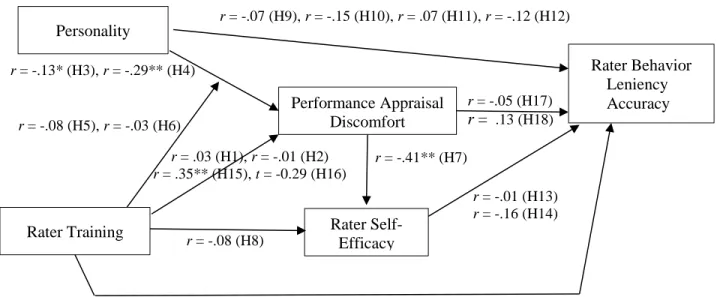
The first hypothesis examined the relationship between rater training and rater discomfort. Hypothesis 1 predicted that there would be a significant negative relationship between the presence or absence of training and rater discomfort, such that participants who experienced training would have significantly lower ratings of rater discomfort compared to those who had not experienced training. A bivariate correlation between training and rater discomfort revealed a nonsignificant positive relationship, r(250) = 0.03, p = 0.697. This finding aligned with the result that there were no significant differences found among ratings of rater discomfort between those who reported experiencing training (M = 1.82, SD = 0.85) and those who reported they had not
experienced training (M = 1.87, SD = 0.89), t(248) = -0.39, p = 0.697. Because no relationship was found between rater discomfort and the experience of management or performance appraisal training, this hypothesis was not supported.
The second hypothesis stated that there would be a negative relationship between the perceived quality of training and rater discomfort, such that participants who perceive a higher quality of training will have lower ratings of rater discomfort. Of the participants who reported experiencing rater training, 60% reported that the training was “very” or “extremely” useful. A bivariate correlation between training quality and rater discomfort resulted in a nonsignificant negative relationship, r(146) = -0.01, p = 0.953.
Consequently, this hypothesis was not supported.
The third and fourth hypotheses investigated the relationships between personality variables and rater discomfort. Hypothesis 3 stated that there would be a significant positive relationship between agreeableness and rater discomfort, with more agreeable individuals being expected to report higher ratings of discomfort. Hypothesis 4 postulated that there would be a significant negative relationship between conscientiousness and rater discomfort, such that individuals who were conscientious would report lower ratings of discomfort. Bivariate correlations revealed significant negative correlations, both between agreeableness and rater discomfort, r(250) = -0.13, p = 0.044, and between conscientiousness and rater discomfort, r(250) = -0.29, p < 0.001. Interestingly, participants who indicated higher agreeableness and conscientiousness also reported lower feelings of discomfort with rating and evaluating performance, providing support Hypothesis 4, but not for Hypothesis 3.
The fifth and sixth hypotheses explored the influence of training experience on the relationships between personality variables and rater discomfort. Hypotheses 5 and 6 suggested that training would moderate the relationship between personality
characteristics and rater discomfort. Specifically, the presence of training was expected to attenuate the relationship between agreeableness and discomfort while strengthening the relationship between conscientiousness and discomfort. In order to examine these hypotheses, a multiple regression analysis was conducted. The relationship between personality and discomfort was expected to depend on whether a participant experienced training or not. A multiple regression analysis revealed a statistically significant
relationship between agreeableness and rater discomfort (r(250) = -0.13, p = .022), but not between rater discomfort and training experience (r(250) = 0.03, p = .349), nor
between agreeableness and training experience (r(250) = -0.08, p = .096). The interaction term between agreeableness and training experience was not significant, ∆R2 = 0.013,
∆F(1, 246) = 3.29, B = 0.11, p = 0.071, suggesting that training experience did not influence the relationship between agreeableness and rater discomfort.
Similarly, a statistically significant relationship was found between
conscientiousness and rater discomfort (r(250) = -0.29, p < .001), but not between rater discomfort and training experience (r(250) = 0.03, p = .349), nor between
conscientiousness and training experience (r(250) = -0.03, p = .051). In the first step of the multiple regression, conscientiousness and training experience were included, and these two together did account for a significant amount of variance in rater discomfort, R2 = 0.089, F(2, 247) = 12.12, p < 0.001). In testing for moderation, the interaction term between conscientiousness and training experience was added to the regression model.
The result was not significant, ∆R2 = 0.00, ∆F(1, 246) = 0.11, B = 0.02, p = 0.742.
Examination of both interactions suggest that training experience does not influence the relationship between personality characteristics (agreeableness and conscientiousness) and rater discomfort, as neither hypothesis was supported.
The seventh and eighth hypotheses examined the relationships between rater self-efficacy and discomfort as well as between rater self-self-efficacy and training. Hypothesis 7 proposed that there would be a significant negative relationship between self-efficacy and rater discomfort. A bivariate correlation resulted in a significant negative correlation, r(250) = -0.41, p < 0.001, providing support for this hypothesis. Individuals who reported feeling increased confidence in their ability to make ratings during performance
appraisals also indicated less discomfort with making ratings. This finding also suggests that those who may lack confidence in their ability to make ratings experience increased feelings of discomfort.
Hypothesis 8 stated that there would be a positive relationship between training experience and rater self-efficacy, such that those who have experienced rater training will indicate higher levels of rater self-efficacy. A bivariate correlation revealed a nonsignificant negative correlation between training experience and rater self-efficacy, r(250) = -0.08, p = 0.220. This finding aligns with the results that there were no
significant differences found among ratings of rater self-efficacy between those who reported experiencing training (M = 4.23, SD = 0.69) and those who reported they had not experienced training (M = 4.12, SD = 0.71), t(248) = 1.23, p = 0.220. This hypothesis was not supported and could indicated that among those who participated in this study, training experience did not influence feelings of confidence with making ratings.
Exploratory Analyses
Exploratory analyses were conducted to gain additional insights into performance appraisals and rater training. Curvilinear relationships between personality variables and rater discomfort were explored, given that previous research has established that
curvilinear relationships exist between certain personality traits and managerial
performance (Bernardin et al., 2015). No specific hypotheses were proposed, but these non-linear relationships were tested using regression as supplemental analyses.
Regression analyses revealed that there was not a significant curvilinear relationship between rater discomfort and agreeableness (ß = -0.187, F (2,247) = 2.04, p = .132), but there was a significant curvilinear relationship between conscientiousness and rater discomfort (ß = -1.28, F (2,247) = 12.66, p < .001).
Looking at other personality variables, Neuroticism was significantly correlated with rater discomfort (r(250) = 0.15, p = 0.018), while Extraversion was not significantly correlated with discomfort (r(250) = -0.11, p = 0.088). These findings suggest that individuals who reported increased neuroticism also reported higher rater discomfort. Based on the definitions of Extraversion and Neuroticism (Costa & McCrae, 1992), these findings are not surprising and are likely to have been the hypothesized direction. These results suggest further analysis into the relationship between personality and rater discomfort and could be especially interesting for selection or development assessments in organizations. It stands to reason that a combination of personality types could compile a “profile” that contributes to rater behavior rather than one personality factor alone.
Descriptive statistics were conducted to examine context behind participants’ views and beliefs about performance appraisals, and also to better understand the
background and experiences of the sample. Of the participants who participated in Study 1, 90% indicated that performance appraisals could increase productivity when conducted correctly, and 80% reported that their organization considered performance appraisals to be an important part of a supervisor’s duties. Interestingly, 69% of respondents agreed that the performance appraisal system in their organization helped to improve the performance of employees. When responding to questions about the purpose of the performance appraisal, 70% of participants reported that performance appraisals
influence personnel actions while 60% reported the performance appraisal determine pay in their organization.
Respondents also reported other goals of their performance appraisal systems. A little over half (58%) of the sample reported that their performance appraisals are “always” or “frequently” based on personal traits (i.e., dependability, imitative, agreeableness) while 82% of the sample reported their performance appraisals are “always” or “frequently” based on work-related factors (i.e., quality of work outputs). About 70% of the sample indicated that they are regularly evaluated by a supervisor and 90% of the sample reported receiving face-to-face feedback after the performance appraisal “always” or “sometimes.” Over half of the sample (80%) have a meeting to discuss their performance appraisal with their supervisor, and most (90%) respondents indicated that the performance appraisal helps them clarify performance expectations to a “moderate” or “large” extent. Regarding training, 53% of respondents reported that very little training is provided concerning the effective use of the performance appraisal system, while 27% reported that substantial training is provided and 20% reported that no training is provided.