Kent Academic Repository
Full text document (pdf)
Copyright & reuse
Content in the Kent Academic Repository is made available for research purposes. Unless otherwise stated all content is protected by copyright and in the absence of an open licence (eg Creative Commons), permissions for further reuse of content should be sought from the publisher, author or other copyright holder.
Versions of research
The version in the Kent Academic Repository may differ from the final published version.
Users are advised to check http://kar.kent.ac.uk for the status of the paper. Users should always cite the published version of record.
Enquiries
For any further enquiries regarding the licence status of this document, please contact: [email protected]
If you believe this document infringes copyright then please contact the KAR admin team with the take-down information provided at http://kar.kent.ac.uk/contact.html
Citation for published version
Donnelly, C. and Wardle, J. and Quaife, S. and Forbes, Lindsay J.L. and Boylan, J. and Tishelman,
C. and Gavin, A. (2017) Do perceived barriers to clinical presentation affect anticipated time
to presenting with cancer symptoms: An ICBP Study. European Journal of Public Health, 27
(5). pp. 1-25. ISSN 1101-1262.
DOI
https://doi.org/10.1093/eurpub/ckx064
Link to record in KAR
http://kar.kent.ac.uk/64488/
Document Version
Author's Accepted Manuscript
1
Authors: Conan Donnelly
1*, Samantha Quaife
2,
Lindsay Forbes
3Jackie Boylan
4,
Carol Tishelman
5,
Anna Gavin
11 Northern Ireland Cancer Registry, Queen’s University Belfast, Centre for Public Health, Mulhouse Building, Grosvenor Road, Belfast BT12 6BJ, UK 2 Health Behaviour Research Centre, Department of Epidemiology and Public Health, University College London, Gower Street, London WC1E 6BT, UK; 3Centre for Health Services Studies, University of Kent, Canterbury, Kent, CT2 7NF, UK. 4 School of Nursing, Queen’s University Belfast, Institute of Clinical Science – University Road, Belfast, BT12 6BA 5 Department of Learning, Informatics, Management and Ethics, Karolinska Institutet, Berzelius va¨g 3, Stockholm 171 77, Sweden
*Corresponding author: Conan Donnelly, email: [email protected], tel: 02890971623
Do perceived barriers to clinical presentation affect anticipated time to
presenting with cancer symptoms: An ICBP Study
2
Abstract
Background: Cancer survival in the UK and Denmark are lower when compared to similar countries with late diagnosis a possible cause. We aimed to study the relationship between barriers to attending a primary care physician (GP) and anticipated time to help seeking (ATHS) with four cancer symptoms in six countries. Method: A population-based survey measuring cancer awareness and beliefs conducted within the International Cancer Benchmarking Partnership in Australia, Canada, Denmark, Norway, Sweden and UK. Data were collected on perceived barriers to GP consultation (including embarrassment, worry about wasting the doctors time, fear about what the doctor might find and being too busy) and ATHS for persistent cough, abdominal swelling, rectal bleeding and breast changes. Relationships between
perceived barriers and ATHS were investigated using multivariable analysis. Results: Among 19,079 respondents, higher perceived barrier scores were associated with longer ATHS intervals for all symptoms studied (p<0.01) responders with the highest barrier scores (>10.84) had between two and three times the odds of longer ATHS. ATHS was low in Australia for all symptoms and highest in Denmark for abdominal bloating. Conclusion: Perceived barriers to help-seeking have a role in delaying GP presentation. Early diagnosis campaigns should address emotional and practical barriers that reduce early presentation with potential cancer symptoms.
3
Introduction
The International Cancer Benchmarking Partnership (ICBP)1 was established to investigate and explain international variation in cancer survival. Survival rates for patients diagnosed between 1995 and 2007 with lung, breast, bowel or ovarian cancer were persistently higher in Australia, Canada, and Sweden, intermediate in Norway, and lower in Denmark and the UK (England, Northern Ireland, and Wales)2. Survival deficits were most marked shortly after diagnosis. Comparisons of lung3, colorectal4 and breast5 cancer survival rates between the UK, Sweden and Norway have reported similar findings, which may partly be explained by later diagnosis in the UK.
Patient delay in presenting to their primary care physician (GP) has been highlighted as an important component of the diagnostic interval for a number of cancers6. A systematic review of risk factors for delayed presentation with cancer symptoms identified a number of psychosocial factors associated with patient-mediated delay. These include perceived symptom seriousness, fear of cancer and embarrassment7. Similarly a UK study reported that emotional and practical barriers to GP presentation were associated with lower use of health services for symptoms patients worried might be cancer8. Factors for delayed presentation most commonly observed in Britain were difficulty making an appointment, worry about wasting the doctor’s time and worry about the diagnosis9. Other studies reported delay to be associated with access to services10, lifestyle complexity, time, logistical considerations11, 12. In lung cancer, stigma of the disease related to internal self-blame has been highlighted as common13-14 and acts as an additional barrier to presentation15, 16, 17, 18.
The ICBP collaboration has shown that while the UK has similar levels of cancer symptom awareness, the public perceived more barriers to help-seeking in the UK than in other countries studied19. The researchers suggest that interventions which address barriers and prompt earlier presentation in primary care should be developed and evaluated. The next step is to quantify
4 the role of barriers to help-seeking along the patient pathway to diagnosis in relation to different cancer symptoms and across different jurisdictions. This study used the international Awareness and Beliefs about Cancer (ABC) survey20 to compare the anticipated time to help seeking (ATHS) between countries and investigate how potential barriers to symptomatic presentation relate to anticipated help-seeking intervals.
Method
In 2011, the population-based ABC survey using computer-assisted telephone interviews with adults aged ≥50 years in six countries (Australia, Canada, Denmark, Norway, Sweden and the UK) was undertaken as part of the ICBP, to assess barriers to symptomatic presentation and ATHS. Details of the instrument and the survey methodology have been outlined previously20. Briefly the survey incorporated instruments to measure cancer awareness, cancer beliefs, barriers to help seeking and ATHS. Backward-forward translation was carried out in non-English speaking jurisdictions and equivalency of meaning testing was carried out with focus groups. Reliability and validity testing were also undertaken.
Anticipated time to help-seeking
The primary dependent variables studied were ATHS which was collected for four potential cancer symptoms: i) persistent cough, ii) breast changes, iii) rectal bleeding, and iv) abdominal bloating. The interview instructions were: ‘I’m going to read you out a list of signs and symptoms; for each one can you tell me how long it would take you to go to the doctor from the time you first noticed the symptom.’ The responses were grouped into six time intervals (as soon as I noticed, up to 1 week, over 1 up to 2 weeks, over 2 up to 3 weeks, over 3 up to 4 weeks, more than a month, would not contact a doctor). Respondents who said they would seek help from health professionals other than a GP (<1.3%), or answered ‘don’t know’ or ‘refused to respond’ (<3.5%), were removed from the analysis as the ATHS interval for these responses
5 was unclear. Age-sex adjusted comparisons of ATHS between countries were carried out using direct age standardisation.
Barriers to symptomatic presentation
The independent variable of interest in this study was an aggregate score of perceived barriers to symptomatic presentation to the GP. The score consisted of four items: i) ‘I would be too embarrassed’, ii) ‘I would be worried about what the doctor might find’, iii) ‘I would be worried about wasting the doctor's time’, and iv) ‘I am too busy to make time to go to the doctor’. Respondents were asked, ‘could you say if any of these might put you off going to the doctor’ to which they could respond: ‘no’, ‘yes, sometimes’ or ‘yes, often’. The responses were scored as ‘no’=0, ‘sometimes’=1 and ‘often’=2. An aggregate barriers score was calculated using results of the factor analysis outlined previously20
and presented on a scale with a minimum of 0 and maximum of 50. Respondents with incomplete data for the barrier items, or who answered ‘don’t know’ were excluded from the analysis (see Table 1). Almost half of the respondents reported no barriers, but those that did were categorised into tertiles (low: <3.75, medium: 3.75-10.84, high: >10.84).
Other covariates
Other covariates included sex, age, marital status (categorised as married/cohabiting vs single/divorced/separated/widowed), level of education mapped to UNESCO international standards for education (tertiary level qualification vs other)21, current smoking status (smoker or non-smoker) and country of residence. Participants were also asked to report their perceived difficulty in arranging an appointment with a doctor, as ‘very difficult’, ‘somewhat difficult’, ‘somewhat easy’ or ‘very easy’. For analysis, this was dichotomised into ‘difficult’ or ‘easy’. In addition, the cancer beliefs measure comprising three items: ‘cancer can often be cured’, ‘a diagnosis of cancer is a death sentence’ and ‘people can expect to continue with normal activities and responsibilities’ was included in the analysis.
6 Analysis
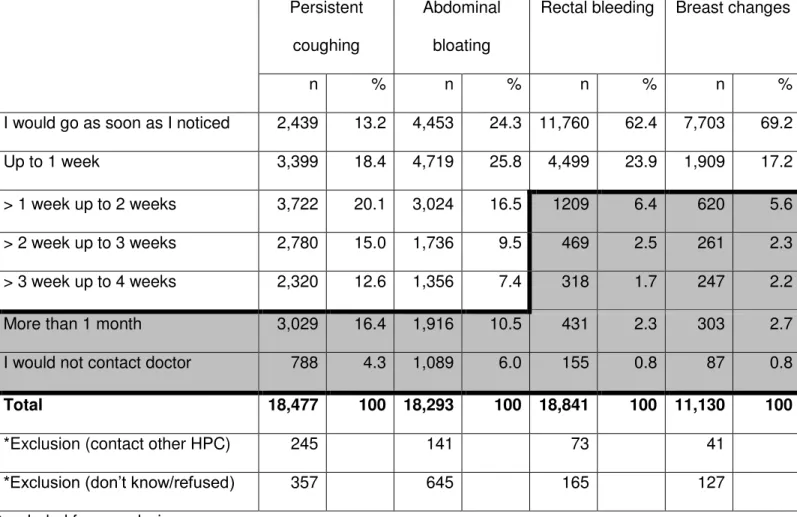
The dependent variable, ATHS, was dichotomised so the cut-point for late presentation was set at the response category nearest the 80th percentile for the anticipated delay for each symptom to investigate the characteristics of those with the longest ATHS. The distribution of anticipated time from symptom onset to presentation to a GP varied by symptom type and is presented in Table 1. Cut-points for late presentation were set at: 4 weeks for both persistent cough (20.7% of respondents had ATHS of > 4 weeks) and abdominal bloating (16.5% of respondents), and 1 week for both rectal bleeding (13.7% of respondents) and breast changes (13.6% of respondents). To determine the sensitivity of varying cut-points for ATHS on the relationship between barriers and anticipated time to help-seeking, cut-points were adjusted and the analysis was repeated. For persistent coughing and abdominal bloating the cut-point was adjusted from 4 weeks to 1 week while the cut-point for breast changes and rectal bleeding was adjusted from 1 week to 4 weeks.
Univariate analysis with 2 tests was undertaken to investigate factors associated with ATHS. Multivariable logistic regression modeling was used to test independence of associations between the aggregate barrier scores and ATHS for each cancer symptom, after adjusting for age, sex, having a tertiary qualification, smoking status, marital status, perceived ease of seeing a doctor, cancer beliefs and symptom recognition. Only variables that had a moderate association (p<0.25) with time to help seeking were retained in models. Models were also produced to determine sensitivity of associations to varying cut points for ATHS.
Results
The sample size was 19,079 (6,965 in the UK, 4,002 in Australia, 2,064 in Canada, 2,000 in Denmark, 2,009 in Norway and 2,039 in Sweden). The estimated response rate (after adjusting for the likely proportion of households that were eligible) varied between countries, ranging from 16% in Canada to 38% in Denmark. Australia had a response rate of almost 36%, Norway,
7 23%, Sweden, 28% and the UK response rate was approximately 19%a. Like most population-based surveys, men, people with lower educational attainment, and those from ethnic minority groups were under-represented22, 23. Missing data ATHS and barrier responses were minimal (<2.5%). Over 50% of the participants in the study reported no perceived barriers.
Significant variation between countries in age-sex adjusted ATHS was observed. No distinct patterns emerged for any of the four symptoms, although in Australia lower proportions of respondents reported long ATHS (defined as exceeded the specified cut points for each symptom) to help seeking for all four symptoms (Figure 1). The proportion of patients anticipating >4 weeks’ time to help seeking for a persistent cough was significantly lower in Sweden (17%) and Australia (16%). Fewer respondents (8%) in Sweden reported an ATHS interval >4 weeks before attending with abdominal bloating compared to 23% in Denmark and 15% in all other countries. However, a larger proportion of respondents in Sweden reported an interval >1 week before attending with rectal bleeding (17%) compared to Australia (8%). Also, a larger proportion of respondents from Canada reported an ATHS interval >1 week for breast changes (21%), compared with all other countries (Figure 1).
Univariate analyses (Table S1) showed significant associations between younger age, perceived difficulty in seeing the doctor, having a tertiary qualification, reporting ‘often’ or ‘sometimes’ for each of four barriers to symptomatic presentation and higher likelihood of longer ATHS for all four symptoms. Holding more negative beliefs about cancer was also associated with a higher likelihood of longer ATHS, as assessed by the three item cancer belief measure (Table S1).
a
8 In multivariable analysis a higher barrier score was associated with longer ATHS, after adjusting for age, sex, having a tertiary qualification, smoking status, marital status, perceived ease of seeing a doctor, cancer beliefs and symptom recognition. Respondents with the highest barrier scores (>10.84) had between two and three times the odds of longer ATHS compared to those with no barriers for all symptoms. The relationship between country and ATHS varied by symptom. For persistent cough, compared to Australia, all other countries had increased odds of an ATHS interval >4 weeks with the odds highest for respondents from Norway. For abdominal bloating, respondents from Denmark had higher odds of an ATHS interval >4 weeks while the odds were lowest for respondents from Sweden (Table 2). Compared to Australia, all other countries had increased odds of an ATHS interval >1 week with rectal bleeding, with Norway and Sweden highest. Respondents in Canada had the highest odds of an ATHS interval >1 week with breast changes after accounting for other factors (Table 3).
A strong positive association between barrier score and ATHS was observed across all countries for all four symptoms (Table S2 & S3) with the exception of breast changes in Canada. However, the effect size varied between countries with a statistically significant interaction between barrier and country for ATHS with breast changes, and an interaction approaching significance for abdominal bloating. For breast changes and abdominal bloating there was a particularly strong positive association between barrier score and time to help seeking in Sweden, with a more modest effect size in Canada and Norway.
With regard to the individual barrier items, each barrier was associated with a longer ATHS interval for all four potential cancer symptoms. The association was graded such that the odds of anticipating a longer time to help-seeking increased across the three response options (from ‘no’, to ‘sometimes’, to ‘often‘), with the greatest likelihood of late presentation in those responding ‘often'. In adjusted analyses, the individual barrier associated with the highest odds
9 of a longer interval before help-seeking was responding ‘often’ to ‘being worried about wasting the doctor’s time’ for persistent cough and abdominal bloating and responding ‘often’ to being embarrassed’ for rectal bleeding and breast changes (Table S4).
ATHS varied by symptom type, with a trend towards a longer interval for vague symptoms such as persistent coughing and abdominal bloating, and a shorter interval for breast changes and rectal bleeding. Sensitivity analysis was performed to determine the effect of varying the cut-point for ATHS with an interval of >1 week for a persistent cough or abdominal bloating, and an interval of >4 weeks for rectal bleeding or breast changes. For all symptoms, barrier scores remained significantly associated with a longer ATHS interval in the model (Table S5). Similarly, patterns in the proportion of respondents reporting longer ATHS was similar in sensitivity analysis as when the original cut points were applied (Table S6).
Discussion
This large population-based international study allowed, for the first time, an investigation into variation in ATHS between countries and any association between perceived barriers to symptomatic presentation and ATHS for specific cancer symptoms.
Significant variation in ATHS between countries and symptoms was found, which persisted after accounting for other factors. ATHS was shorter for alarm symptoms (rectal bleeding and breast changes) and longer for vague symptoms (coughing and abdominal pain). There was no consistent pattern in variation across all symptoms and patterns did not consistently correlate with cancer survival variation. The lack of association may be due to the influence of other factors such as delay later in the diagnostic pathway, co-morbid disease or variation in treatment.
10 The lower proportions of respondents anticipating longer intervals with a persistent cough and rectal bleeding in Australia and abdominal bloating or breast changes in Sweden was not explained by barriers, symptom awareness or other factors in the study. These may be explained by other healthcare, cultural or social factors or differences in cancer awareness raising activities between countries and is worthy of further investigation. In addition, understanding the extent to which this variation in ATHS intervals to help seeking reflects actual patient behaviour would be of value. It is unlikely that that the indicator of ATHS reflects true behaviour around help seeking with cancer symptoms.
As in previous UK-based studies8, 9 there was an association between the level of endorsement of perceived barriers and the ATHS interval before help-seeking that remained after adjusting for other factors. However, the relationship varied by country. Barriers consistently had strong odds in explaining longer ATHS for all symptoms investigated. These findings further reinforce the importance of tailoring cancer awareness campaigns so that messages specifically address these barriers to presentation as well as deficits in symptom awareness. However, there was some heterogeneity between countries in the relationship between barriers and ATHS with breast changes with relatively modest effect size in Canada compared to Sweden. ATHS >1 week with breast changes was particularly high in Canada; it appears that other factors such as symptom recognition and ease of visiting a doctor played a more prominent role in explaining variation in ATHS in Canada while these relationships were less marked in Sweden (data not presented). These population differences in barriers to help seeking highlight the importance of targeted country and perhaps region specific campaigns, tailored to the unique characteristics of each population.
The study findings suggest that each of the four quite distinct barriers are important in their own right in explaining ATHS in help-seeking, though their relative importance varies by symptom
11 type. Embarrassment was more strongly associated with longer time to help-seeking for intimate symptoms such as breast changes and rectal bleeding, while worry about wasting the doctor’s time was a more important determinant of help-seeking for the more vague symptoms (persistent cough and abdominal bloating). These findings highlight the importance of ensuring that public campaigns aimed at reducing inappropriate help-seeking do not encourage unwarranted concern over wasting the doctor’s time, consequently contributing to barriers to presentation, which ultimately have the potential to lead to a diagnostic delay in cancer.
It is also important to recognise that after accounting for barriers and beliefs, symptom recognition remained an important factor in each of the models in which it was included. This is consistent with several other studies which have highlighted the importance of symptom knowledge for early help-seeking for the cancers of interest in this study 24, 25, 26, 27, 28. These findings further support the suggestion that early diagnosis campaigns should address both awareness of cancer symptoms and barriers to presentation in the population.
Barriers to presentation, symptom awareness and cancer beliefs cannot fully explain variation in ATHS intervals within different age groups and those with different educational attainment. Further work is needed to understand causes for variation in different population sub-groups with a view to developing more targeted interventions for at risk groups.
Strengths & Weaknesses
The survey used standard administration across 12 different jurisdictions providing a large international population-based sample. While response rates were low they were typical of those recent studies with similar methods. Although weighting addressed biases toward older people, women and those from higher socio-economic groups, other differences in non-response characteristics may have influenced the study findings.
12 Although the ABC tool used in this study was not based on a specific theoretical model, it encompasses domains used in most of the help-seeking models and has performed well in reliability and validity testing20. While cultural differences may exist in interpretation and response to questions between countries, steps were taking to ensure equivalency of meaning of the items across different languages. The analysis has been able to account for variations in a range of demographic characteristics and cancer beliefs. The study was also sensitive to frequency with which each barrier was reported (‘sometimes’ or ‘often’), and unlike previous studies, the analyses were symptom-specific. The extent to which reported ATHS predicts patterns in actual delay is not unclear with some quite distinct differences between actual delay and educational attainment25, 27 or age27-33 to the associations reported here for ATHS. However, associations between smoking status and ATHS for persistent coughing reflected previous studies of actual delay. It is also reassuring that a previous study investigating actual help-seeking with possible cancer symptoms observed a similar relationship for similar barriers8. Rather than providing a prediction of delay among cancer patients, ATHS provides an indicator of those who are most likely to delay. By focusing on the 20% of respondents who anticipate the longest delays, this study focuses on those expected to delay longest before a diagnosis of cancer. Further work is required to determine the validity of ATHS as an indicator of actual help seeking behaviour.
By varying cut points to dichotomise the time to help-seeking, the method accounted for variation in time to help seeking for different symptoms, with a trend towards a longer interval for vague symptoms such as persistent coughing and abdominal bloating, and a shorter interval for breast changes and rectal bleeding. Sensitivity analysis confirmed the relationships between time to help seeking and barriers persisted when alternative cut points were applied and confirmed the relationship with cancer survival patterns regardless of cut point.
13
Conclusion
Perceived barriers to presentation with symptoms contribute strongly to explaining variation in ATHS for cancer symptoms though the relationship varies by country, symptom time and socio-demographic circumstance. This paper highlights the importance of addressing emotional and practical barriers that patients perceive to stand in the way of GP consultations, with a view to expediting diagnosis and improving cancer survival.
Acknowledgements
We thank the ICBP Module 2 Academic Team especially the late Jane Wardle who was instrumental in the original work, Amanda Ramirez, Peter Vedsted and Alice Simon, Brad Groves, Samantha Harrison, Donia Sadik and Martine Bomb of Cancer Research UK for managing the programme and the Module 2 Working Group for managing the project in each country. ICBP Programme Board: Ole Andersen, Søren Brostrøm, Heather Bryant, David Currow, Anna Gavin, Gunilla Gunnarsson, Jane Hanson, Todd Harper, Stein Kaasa, Nicola Quin, Linda Rabeneck, Michael A Richards, Michael Sherar, Bob Thomas. Academic Reference Group: Neil Aaronson, David Cella, Henrik Møller, Keith Petrie, Liesbeth Van Osch. Funding for the completion of survey work and primary analysis: Australia: Cancer Council Victoria, Department of Health Victoria, Cancer Institute New South Wales; Canada: Canadian Partnership against Cancer; Denmark: Danish Cancer Society and Novo Nordic Foundation; Norway: Norwegian Directorate for Health and Social Affairs; Sweden: Swedish Social Ministry and the Association of Local Authorities and Regions; United Kingdom: Department of Health/ National Cancer Action Team, Northern Ireland Public Health Agency, Tenovus and Welsh Government. These analyses were carried out with funding from the Department of Health Policy Research Unit in Cancer Awareness, Screening and Early Diagnosis. The Policy Research Unit in Cancer Awareness, Screening, and Early Diagnosis receives funding for a research programme from the Department of Health Policy Research Programme. It is a
14 collaboration between researchers from seven institutions (Queen Mary University of London, University College London, King’s College London, London School of Hygiene and Tropical Medicine, Hull York Medical School, Durham University and Peninsula Medical School). The views expressed are those of the authors and not necessarily those of the NHS, or the Department of Health.
Conflict of interest statement
The funders were not involved in study design, collection, analysis and interpretation of the data, writing of the article or the decision to submit it for publication. Where the author was employed by the funding organisation, the governing body of the organisation had no influence on any of these. The authors have no conflicts of interest to report.
Key points
This study reports international variation in anticipated time to help seeking
Patterns are not consistent with international variation in cancer survival
Perceived barriers to clinical presentation with possible cancer symptoms are strongly associated with anticipated time to help seeking
Cancer awareness campaigns should be locally tailored and should target barriers to help seeking to promote earlier presentation with cancer symptoms
15
16
References
1. Butler J, Foot C, Bomb M, Hiom S, Coleman M, Bryant H, Vedsted P, Hanson J, Richards M; The ICBP Working Group. The International Cancer Benchmarking Partnership: An international collaboration to inform cancer policy in Australia, Canada, Denmark, Norway, Sweden and the United Kingdom. Health Policy. 2013 May 18. doi:pii:
S0168-8510(13)00097-3. 10.1016/j.healthpol.2013.03.021. [Epub ahead of print]
2. Coleman M, Forman D, Bryant H, Butler J, Rachet B, Maringe C, Nur U, Tracey E, Coory M, Hatcher J, McGahan C, Turner D, Marrett L, Gjerstorff M, Johannesen T, Adolfsson J, Lambe M, Lawrence G, Meechan, D, Morris E, Middleton R, Steward J, Richards M. The IMWG (2011) Cancer survival in Australia, Canada, Denmark, Norway, Sweden, and the UK, 1995–2007 (the International Cancer Benchmarking Partnership): an analysis of population-based cancer registry data. Lancet 377: 127–138.
3. Holmberg L, Sandin F, Bray F, Richards M, Spicer J, Lambe M, Klint A, Peake M, Strand TE, Linklater K, Robinson D, Møller H. National comparisons of lung cancer survival in England, Norway and Sweden 2001-2004: differences occur early in follow-up. Thorax. 2010 May;65(5):436-41.
4. Morris EJ, Sandin F, Lambert PC, Bray F, Klint A, Linklater K, Robinson D, Påhlman L, Holmberg L, Møller H. A population-based comparison of the survival of patients with colorectal cancer in England, Norway and Sweden between 1996 and 2004. Gut. 2011 Feb 8.
17 5. Møller H, Sandin F, Bray F, Klint A, Linklater KM, Purushotham A, Robinson D, Holmberg L.
Breast cancer survival in England, Norway and Sweden: a population-based comparison. Int J Cancer. 2010 Dec 1;127(11):2630-8. doi: 10.1002/ijc.25264.
6. P Baughan, B O'Neill and E Fletcher. Auditing the diagnosis of cancer in primary care: the experience in Scotland Open. Br J Cancer 101: S87-S91
7. Macleod U1, Mitchell ED, Burgess C, Macdonald S, Ramirez AJ.
Risk factors for delayed presentation and referral of symptomatic cancer: evidence for common cancers. Br J Cancer. 2009 Dec 3;101 Suppl 2:S92-S101.
8. Simon AE, Waller J, Robb K, Wardle J. Patient delay in presentation of
possible cancer symptoms: the contribution of knowledge and attitudes in a population sample from the United Kingdom. Cancer Epidemiol Biomarkers Prev. 2010
Sep;19(9):2272-7.
9. Robb K, Stubbings S, Ramirez A, Macleod U, Austoker J, Waller J, Hiom S, Wardle J. Public awareness of cancer in Britain: a population-based survey of adults. Br J Cancer. 2009 Dec 3;101 Suppl 2:S18-23.
10. Facione NC, Dodd MJ, Holzemer W, Meleis AI. Helpseeking for self-discovered breast symptoms. Implications for early detection. Cancer Pract. 1997 Jul-Aug;5(4):220-7.
11. O'Mahony M, McCarthy G, Corcoran P, Hegarty J. Shedding light on women's help seeking behaviour for self discovered breast symptoms. Eur J Oncol Nurs. 2013 Oct;17(5):632-9.
18 12. Lauver D, Coyle M, Panchmatia B. Women's reasons for and barriers to seeking care for
breast cancer symptoms. Womens Health Issues. 1995 Spring;5(1):27-35.
13. Cataldo JK, Slaughter R, Jahan TM, Pongquan VL, Hwang WJ. Measuring stigma in people with lung cancer: psychometric testing of the cataldo lung cancer stigma scale. Oncol Nurs Forum. 2011 Jan;38(1):E46-54.
14. Else-Quest NM, LoConte NK, Schiller JH, Hyde JS. Perceived stigma, self-blame, and adjustment among lung, breast and prostate cancer patients. Psychol Health. 2009 Oct;24(8):949-64.
15. Weiss MG, Ramakrishna J, Somma D. Health-related stigma: rethinking concepts and interventions. Psychol Health Med. 2006 Aug;11(3):277-87.
16. Bell K, Salmon A, Bowers M, Bell J, McCullough L.Smoking, stigma and tobacco 'denormalization': Further reflections on the use of stigma as a public health tool. A
commentary on Social Science & Medicine's Stigma, Prejudice, Discrimination and Health Special Issue (67: 3). Soc Sci Med. 2010 Mar;70(6):795-9; discussion 800-1.
17. Carter-Harris L, Hermann CP, Schreiber J, Weaver MT, Rawl SM. Lung cancer stigma predicts timing of medical help-seeking behavior. Oncol Nurs Forum. 2014 May;41(3):E203-10.
19 18. Ironmonger, L., Ohuma, E., Ormiston-Smith, N., Gildea, C., Thomson, C.S. and Peake,
M.D., 2015. An evaluation of the impact of large-scale interventions to raise public awareness of a lung cancer symptom. British journal of cancer, 112(1), pp.207-216.
19. Forbes LJ, Simon AE, Warburton F, Boniface D, Brain KE, Dessaix A, Donnelly C, Haynes K, Hvidberg L, Lagerlund M, Lockwood G, Tishelman C, Vedsted P, Vigmostad MN, Ramirez AJ, Wardle J; International Cancer Benchmarking Partnership Module 2 Working Group. Differences in cancer awareness and beliefs between Australia, Canada, Denmark, Norway, Sweden and the UK (the International Cancer Benchmarking Partnership): do they contribute to differences in cancer survival? Br J Cancer. 2013 Feb 5;108(2):292-300
20. Simon AE, Forbes LJ, Boniface D, Warburton F, Brain KE, Dessaix A, Donnelly M, Haynes K, Hvidberg L, Lagerlund M, Petermann L, Tishelman C, Vedsted P, Vigmostad MN, Wardle J, Ramirez AJ; ICBP Module 2 Working Group, ICBP Programme Board and Academic Reference Group. An international measure of awareness and beliefs about cancer: development and testing of the ABC. BMJ Open. 2012 Dec 18;2(6).
21. UNESCO (2006) International Standard Classification of Education. UNESCO Institute for Statistics: Geneva.
22. Frida Carlsson, Representatively of a postal public health questionnaire survey in Sweden, with special reference to ethnic differences in participation Public, Environmental &
Occupational Health (SSCI) | 63/158
23. DA Dillman, G Phelps, R Tortora, K Swift, J Kohrell, Jodi Berck, Benjamin L. Messer
20 interactive voice response (IVR) and the Internet. Social Science Research. Mar 2009. 38(1):1-18
24. Quaife SL, Forbes LJ, Ramirez AJ, Brain KE, Donnelly C, Simon AE, Wardle J. Recognition of cancer warning signs and anticipated delay in help-seeking in a population sample of adults in the UK. Br J Cancer. 2013 Oct 31.
25. Mitchell E, Macdonald S, Campbell NC, Weller D, Macleod U (2008) Influences on pre-hospital delay in the diagnosis of colorectal cancer: a systematic review. Br J Cancer 98: 60 – 70
26. Coates RJ, Click LA, Harlan LC, Robboy S, Barrett RJ, Eley JW, Reynolds P, Chen VW, Darity WA, Blacklow RS, Edwards BK. Differences between Black and White patients with cancer of the uterine corpus in interval from symptom recognition to initial medical
consultation (United States) Cancer Causes Control. 1996;7:328–336.
27. Ramirez AJ, Westcombe AM, Burgess CC, Sutton S, Littlejohns P, Richards MA. Factors predicting delayed presentation of symptomatic breast cancer: a systematic
review. Lancet. 1999;353:1127–1131.
28. Bowen EF, Rayner CFJ. Patient and GP led delays in the recognition of symptoms suggestive of lung cancer. Lung Cancer.2002;37:227–228.
29. Curtin R, Presser S, Singer E. Changes in Telephone Survey Nonresponse over the Past Quarter Century. Public Opinion Quarterly. 2005;69(1):87–98.
21 30. Ramirez AJ, Westcombe AM, Burgess CC, Sutton S, Littlejohns P, Richards MA (1999)
Factors predicting delayed presentation of symptomatic breast cancer: a systematic review. Lancet 353: 1127–1131
31. Worden JW, Weisman AD (1975) Psychosocial components of lagtime in cancer diagnosis. J Psychosom Res 19: 69–79
32. Risberg T, Sorbye SW, Norum J, Wist EA (1996) Diagnostic delay causes more
psychological distress in female than in male cancer patients. Anticancer Res 16(2): 995– 999
33. Mor V, Masterson-Allen S, Goldberg R, Guadagnoli E, Wool MS (1990) Pre-diagnostic symptom recognition and help seeking among cancer patients. J Community Health 15(4): 253–266
22
Table 1: Anticipated time to help-seeking for potential cancer symptoms (shaded areas highlight cut-points applied to create dichotomised outcome measures for analysis).
*excluded from analysis
Persistent coughing
Abdominal bloating
Rectal bleeding Breast changes
n % n % n % n %
I would go as soon as I noticed 2,439 13.2 4,453 24.3 11,760 62.4 7,703 69.2 Up to 1 week 3,399 18.4 4,719 25.8 4,499 23.9 1,909 17.2 > 1 week up to 2 weeks 3,722 20.1 3,024 16.5 1209 6.4 620 5.6 > 2 week up to 3 weeks 2,780 15.0 1,736 9.5 469 2.5 261 2.3 > 3 week up to 4 weeks 2,320 12.6 1,356 7.4 318 1.7 247 2.2 More than 1 month 3,029 16.4 1,916 10.5 431 2.3 303 2.7 I would not contact doctor 788 4.3 1,089 6.0 155 0.8 87 0.8
Total 18,477 100 18,293 100 18,841 100 11,130 100
*Exclusion (contact other HPC) 245 141 73 41
23 Table 2: Multivariable analysis presenting relationship between barrier score, country and anticipated time to help seeking (odds of an interval of ≥ 1 weeks before presenting to the doctor with (a) persistent cough or (b) abdominal bloating, adjusting for age, smoking status, sex, education status, marital status and recognition of symptom as a cancer warning sign
Characteristic
Persistent cough - anticipated interval of ≥ 4 weeks
Abdominal bloating - anticipated interval of ≥4 weeks Unadjusted Adjusted Unadjusted Adjusted
OR* CI OR* CI OR* CI OR* CI
Barrier score No Barrier 1 1 1 1 Low 1.52 1.37-1.69 1.50 1.36-1.67 1.52 1.36-1.71 1.47 1.30-1.65 Medium 2.01 1.82-2.22 1.95 1.77-2.16 2.10 1.88-2.34 2.04 1.82-2.29 High 2.50 2.27-2.75 2.36 2.14-2.61 2.88 2.60-3.19 2.82 2.53-3.14 Country Australia 1 1 1 1 Canada 1.19 1.04-1.37 1.14 0.99-1.31 1.03 0.89-1.19 0.95 0.81-1.10 Denmark 1.33 1.16-1.52 1.37 1.19-1.58 1.52 1.33-1.75 1.80 1.56-2.08 UK 1.42 1.29-1.57 1.23 1.11-1.37 1.10 0.98-1.22 0.96 0.86-1.07 Norway 1.63 1.42-1.86 1.59 1.38-1.82 1.03 0.88-1.19 1.14 0.97-1.33 Sweden 1.09 0.95-1.26 1.05 0.90-1.21 0.41 0.35-0.50 0.43 0.35-0.52 *OR is the odds ratio for anticipated help-seeking > 4 weeks
24 Table 3: Multivariable analysis presenting relationship between barrier score, country and anticipated time to help seeking (odds of an interval of ≥ 1 weeks before presenting to the doctor with (a) rectal bleeding or (b) breast changes, adjusting for age, smoking status, sex, education status, marital status and recognition of symptom as a cancer warning sign
Characteristic
Rectal bleeding - anticipated interval of ≥1 week
Breast changes - anticipated interval of ≥ 1 week
Unadjusted Adjusted Unadjusted Adjusted
OR* CI OR* CI OR* CI OR* CI
Barrier score No Barrier 1 1 1 1 Low 1.50 1.32-1.69 1.47 1.30-1.67 1.64 1.40-1.93 1.59 1.35-1.87 Medium 1.75 1.55-1.96 1.80 1.60-2.04 1.84 1.58-2.15 1.80 1.54-2.11 High 2.79 2.51-3.10 2.92 2.60-3.26 2.71 2.36-3.12 2.75 2.38-3.19 Country Australia 1.00 1.00 1.00 1.00 Canada 1.77 1.50-2.10 1.71 1.44-2.02 1.90 1.58-2.27 1.88 1.56-2.26 Denmark 1.83 1.55-2.16 1.96 1.65-2.33 1.04 0.84-1.29 1.15 0.91-1.44 UK 1.68 1.48-1.93 1.50 1.31-1.72 1.12 0.96-1.29 1.02 0.88-1.20 Norway 2.58 2.20-3.17 2.67 2.27-3.15 1.27 1.02-1.58 1.29 1.03-1.62 Sweden 2.21 1.88-2.60 2.27 1.92-2.68 0.87 0.69-1.09 0.86 0.68-1.09 *OR is the odds ratio for anticipated help-seeking > 1 weeks
25 Figure 1: Age-sex adjusted proportions of respondents reported anticipated time to help seeking by country 0 5 10 15 20 25 30 35 Persistent cough (>4wks) Abdominal bloating (>4wks)
Rectal bleeding (>1wk) Breast changes (>1wk)
%