Rapid Development of Extensible Profilers for the
Java Virtual Machine with Aspect-Oriented Programming
Danilo Ansaloni
Faculty of Informatics University of Lugano Switzerland[email protected]
Walter Binder
Faculty of Informatics University of Lugano Switzerland[email protected]
Alex Villazón
Faculty of Informatics University of Lugano Switzerland[email protected]
Philippe Moret
Faculty of Informatics University of Lugano Switzerland[email protected]
ABSTRACT
Many profilers for Java applications are implemented with low-level bytecode instrumentation techniques, which is te-dious, error-prone, and complicates maintenance and ex-tension of the tools. In order to reduce development time and cost, we promote building Java profilers using high-level aspect-oriented programming (AOP). We show that the use of aspects yields concise profilers that are easy to develop, extend, and maintain, because low-level instrumentation de-tails are hidden from the tool developer. Our profiler re-lies on inter-advice communication, an extension to common AOP languages that enables efficient data passing between advice woven into the same method. We illustrate our ap-proach with two case studies. First, we show that an exist-ing, instrumentation-based tool for listener latency profiling can be easily recast as an aspect. Second, we present an as-pect for comprehensive calling context profiling. In order to reduce profiling overhead, our aspect parallelizes application execution and profile creation.
Categories and Subject Descriptors
D.1.2 [Programming Techniques]: Automatic Program-ming; D.2.8 [Software Engineering]: Metrics— Perfor-mance measures
General Terms
Algorithms, Languages, Measurement, Performance
Keywords
Profiling, aspect-oriented programming, bytecode instru-mentation, Calling Context Tree, concurrency, Java
Permission to make digital or hard copies of all or part of this work for personal or classroom use is granted without fee provided that copies are not made or distributed for profit or commercial advantage and that copies bear this notice and the full citation on the first page. To copy otherwise, to republish, to post on servers or to redistribute to lists, requires prior specific permission and/or a fee.
WOSP/SIPEW’10,January 28–30, 2010, San Jose, California, USA. Copyright 2010 ACM 978-1-60558-563-5/10/01 ...$10.00.
1.
INTRODUCTION
Bytecode instrumentation techniques are widely used for profiling [9, 8, 11, 6, 14, 7]. Java supports byte-code instrumentation using native byte-code agents through the Java Virtual Machine Tool Interface (JVMTI) [18], as well as portable bytecode instrumentation through the
java.lang.instrument API. Several bytecode engineering libraries have been developed, such as BCEL [19] and ASM [15]. However, because of the low-level nature of byte-code and of bytebyte-code engineering libraries, it is difficult and error-prone to implement new profilers, which often requires high effort for development and testing. Moreover, profilers based on low-level instrumentation techniques are difficult to maintain and extend.
In order to ease, speed up, and reduce the cost of pro-filer development, maintenance, and extension, we resort to aspect-oriented programming (AOP) [13]. AOP allows concisely specifying instrumentations in a high-level man-ner. For example, an aspect can be used to specify profiling code to be executed before or after the invocation of some methods of interest, hiding the low-level details of bytecode instrumentation from the tool developer [16].
Profiling usually requires instrumentation with full method coverage, that is, comprehensive instrumentation reaching all methods executed in the Java Virtual Machine (JVM); otherwise, part of the program execution may be missing in the generated profiles. Prevailing aspect weavers, such as AspectJ [12] orabc[2], do not support comprehen-sive aspect weaving, notably because they prevent aspect weaving in the Java class library. Even though weaving of the Java class library can be forced in AspectJ, weaving core Java classes usually results in JVM crashes upon bootstrap-ping [5, 21].
Our approach to aspect-based profiler development relies on MAJOR [21, 22], an aspect weaver that complements AspectJ with support for comprehensive weaving. To this end, MAJOR leverages FERRARI1 [5], a bytecode instru-mentation framework that ensures full method coverage of any user-defined instrumentation.
We present an inter-advice communication model [20] for AOP, which has been integrated into MAJOR. Inter-1 http://www.inf.usi.ch/projects/ferrari/
advice communication allows for efficiently passing data be-tween advice that are woven into the same method. With the aid of annotations, the aspect programmer can declare invocation-local variables, which correspond to local vari-ables with the scope of a woven method. The inter-advice communication model is complementary to AspectJ con-structs and enables important optimizations in our aspect-based profilers.
We demonstrate our approach with two case studies. First, we illustrate how the listener latency profiler LiLa [11], which is based on bytecode instrumentation using ASM [15], can be recast as an aspect using MAJOR and inter-advice communication.
Second, we present an aspect for calling context profiling. Calling context profiling helps analyse the dynamic inter-procedural control flow of applications. It is particularly important for understanding and optimizing object-oriented software, where polymorphism and dynamic binding hinder static analyses. The Calling Context Tree (CCT) [1] is a prevailing data structure for calling context profiling. It provides dynamic metrics, such as the number of method invocations, for each calling context. There is a large body of related work dealing with different techniques to generate CCTs [1, 17, 23], highlighting the importance of the CCT for calling context profiling. Our aspect yields complete CCTs representing overall program execution. In order to speed up CCT construction on multicores, we refine the aspect so as to parallelize CCT construction and program execution.
2.
BACKGROUND
In this section we give a brief overview of AOP and sum-marize our prior work on which this paper builds.
2.1
Aspect-Oriented Programming
AOP [13] enables a clean modularization of crosscutting concerns in applications, such as error checking and han-dling, synchronization, monitoring, or logging. AOP helps avoid related code that is scattered throughout methods, classes, or components.
AspectJ [12] is a popular AOP language for Java, allow-ing new functionality to be systematically added to existallow-ing programs. In AspectJ, anaspectis an extended class with additional constructs. Ajoin point is any identifiable exe-cution point in a system (e.g., method call, method execu-tion, object creaexecu-tion, or field assignment). Join points are the places where a crosscutting action can be inserted. The user can specify weaving rules to be applied to join points through so-calledpointcutsandadvice. A pointcut identifies or captures join points in the program flow, and the action to be applied is called advice.
AspectJ supports three kinds of advice: before(),
after(), andaround(), which are executed prior, following, or surrounding a join point’s execution. Aspects are com-piled into standard Java classes. In the aspect class, advice are compiled into methods. During the weaving process, the weaver inserts code in the woven class to invoke these advice methods. Advice can receive some context information, e.g., to identify which join point has been captured.
During the execution of a woven class, by default, a sin-gleton instance of the aspect is instantiated. Several aspects can be woven simultaneously and can therefore coexist dur-ing the execution.
2.2
Prior Work
Our approach to profiler development relies on
MAJOR [21, 22], an aspect weaver that enhances AspectJ with support for comprehensive weaving. That is, MAJOR is able to weave aspects into all classes loaded in the JVM, including dynamically loaded or generated classes, as well as the standard Java class library. MAJOR can weave aspects into all classes in the Java class library in a portable way, compatible with any standard, state-of-the-art JVM.
MAJOR deals with issues such as bootstrapping the JVM with a woven Java class library and preventing infinite re-cursions when an advice invokes methods in the woven Java class library [21]. To this end, MAJOR leverages FERRARI [5], a generic bytecode instrumentation frame-work that guarantees complete method coverage of user-defined instrumentations (after an initial JVM bootstrap-ping phase, which is completed before the application’s
main(...) method is invoked).
BMW [4] is a profiler generator based on bytecode instru-mentation techniques. In contrast to MAJOR, the program-ming model of BMW is very much restricted. It provides only a small set of low-level pointcuts, which severely limits the kind of profilers that can be specified. Hence, BMW can-not be considered an AOP framework. In addition, BMW does not support instrumentation of the Java class library.
In [6, 14], we addressed platform-independent calling con-text profiling using a hard-coded, low-level instrumentation that was difficult to extend. Thanks to AOP and to our new inter-advice communication model, we can now con-cisely express profilers as aspects in just a few lines of code. The high-level specification of aspect-based profilers eases the implementation of optimizations, such as the parallelized CCT construction presented in this paper.
2.3
Inter-Advice Communication
In AspectJ, the around() advice, in conjunction with a
proceed() statement, allows storing data in local variables before a join point, and accessing that data after the join point. The invocation ofproceed()within an advice causes the execution of the captured join point. Hence, one com-mon use of thearound()advice can be regarded as commu-nicating data produced in abefore()advice to anafter()
advice, within the scope of a woven method.
However, there are two severe limitations when using the
around()advice for communicating data across a join point: 1. The AspectJ weaver implements the around()advice by inserting wrapper methods in woven classes [10]. However, wrapping certain methods in the Java class library breaks stack introspection in many recent JVMs, including Sun’s HotSpot JVMs and IBM’s J9 JVM [14, 22].
2. The around() advice does not constitute a gen-eral mechanism for efficiently passing data in lo-cal variables between arbitrary advice that are wo-ven into the same method body. For instance, it is not possible to pass data in local vari-ables from one “before() execution()” advice to an “after() call()” advice.
Inter-advice communication[20] allows efficient data pass-ing in local variables between advice bodies. This solves the two aforementioned problems, since it does not require the
insertion of any wrapper methods and it enables data pass-ing between arbitrary advice woven into the same method body. To make use of inter-advice communication, we mark public static fields in an aspect with the Java annotation
@InvocationLocal. Within advice bodies woven on the same method, invocation-local variables are mapped to local variables.
3.
CASE STUDY 1: LISTENER LATENCY
PROFILING
In this section we show how an existing profiler that uses low-level bytecode instrumentation can be recast as a com-pact aspect. With this case study, we also illustrate how a common use of thearound()advice can be replaced by a combination ofbefore()andafter()advice in conjunction with inter-advice communication.
Listener latency profiling (LLP) [11] helps developers lo-cate slow operations in interactive applications, where the perceived performance is directly related to the response time of event listeners. LiLa2 is an implementation of LLP based on ASM [15], a low-level bytecode engineering library. TheLiLaAspectin Figure 1 is an implementation of LLP providing the functionality of LiLa. In contrast to LiLa, the aspect is concisely implemented in a few lines of code. Figure 1 shows two versions of theLiLaAspect; one version relying on thearound()advice, and a second version lever-aging inter-advice communication.
To calculate the response time of events, the aspect in Figure 1(a) uses thearound() advice to surround the ex-ecution of methods on instances (target objects) of any subtype of theEventListener interface, which is specified by the “execution(* EventListener+.*(..))” expression of theallEvents() pointcut. The start time is computed before the execution of the intercepted method, which is triggered by the call to proceed(...). After (normal or abnormal) method completion, the actual execution time is computed. Whenever the execution time exceeds a given threshold (indicating high latency), the event is profiled. The methodprofileEvent(...), which is not shown in the figure, logs an identifier of the intercepted method (conveyed by the static join point, which is accessed through AspectJ’s pseudo-variable thisJoinPointStaticPart), the execution time, and the target object. This information helps devel-opers locate the causes of potential performance problems due to slow event handling.
Unfortunately, as described in Section 2.3, the use of the
around() advice compromises comprehensive aspect weav-ing. Therefore, in general, the aspect in Figure 1(a) cannot be used to capture events in classes of the Java class library. However, it is of paramount importance that LLP covers the Java class library, because it includes many implementations of theEventListenerinterface. Our inter-advice communi-cation mechanism solves this problem.
Figure 1(b) shows theLiLaAspectusing inter-advice com-munication to emulate the functionality of thearound() ad-vice with before() and after() advice. The invocation-local variable start is used to pass the time information from the before() advice to the after() advice. The
before()advice is simpler because it does not need to access the target object. Thanks to inter-advice communication, 2 http://www.inf.usi.ch/phd/jovic/MilanJovic/
Lila/Welcome.html
(a) LiLaAspect with around() advice: public aspect LiLaAspect {
// only calls lasting at least 100ms are profiled
public static final long THRESHOLD_NS = 100L * 1000L * 1000L; pointcut allEvents() : execution(* EventListener+.*(..)); Object around(EventListener l) : target(l) && allEvents() {
long start = System.nanoTime(); try {
return proceed(l); // proceed with the execution } finally {
long exectime = System.nanoTime() - start; if (exectime >= THRESHOLD_NS) profileEvent(thisJoinPointStaticPart, exectime, l); } } ... }
(b) Equivalent aspect using inter-advice communication: public aspect LiLaAspect {
public static final long THRESHOLD_NS = 100L * 1000L * 1000L; pointcut allEvents() : execution(* EventListener+.*(..)); @InvocationLocal
public static long start; before() : allEvents() {
start = System.nanoTime(); }
after(EventListener l) : target(l) && allEvents() { long exectime = System.nanoTime() - start; if (exectime >= THRESHOLD_NS)
profileEvent(thisJoinPointStaticPart, exectime, l); }
... }
Figure 1: Simplified LiLaAspect implementing LLP
the aspect can be comprehensively woven, thus providing the basic functionality of the original LiLa tool in a com-pact and extendible way.
4.
CASE STUDY 2: CALLING CONTEXT
PROFILING
In this section we illustrate our approach to profiler devel-opment with aspects that generate complete CCTs covering all method execution in an application, including methods in the Java class library. We leverage MAJOR’s ability of weaving with full method coverage and inter-advice commu-nication for efficiently passing state between advice.
First, we discuss our data structure representing a CCT. Second, we present a simple aspect for CCT creation. Third, we show that the aspect can be easily extended to collect additional dynamic metrics. Fourth, we optimize CCT con-struction by parallelizing it with program execution.
4.1
CCT Representation
Before presenting an aspect that creates CCTs, we briefly discuss our data structure representing CCTs at runtime. In a multithreaded environment, there are two options: Each thread may create a separate, thread-confined CCT, and the per-thread CCTs may be integrated after termination of the corresponding threads. Alternatively, the CCT under con-struction may be shared between all threads, and access to
public aspect CCTProf {
public static final CCTNode root = new CCTNode(); public static final ThreadLocal<CCTNode> currentNode =
new ThreadLocal<CCTNode>() {
protected CCTNode initialValue() { return root; } };
@InvocationLocal
public static CCTNode caller, callee;
pointcut execs() : execution(* *.*(..)) && !within(CCTProf); before() : execs() {
caller = currentNode.get();
callee = caller.profileCall(thisJoinPointStaticPart); currentNode.set(callee);
}
after() : execs() { currentNode.set(caller); } ...
}
Figure 2: Simplified profiling aspect that generates a CCT using inter-advice communication
the CCT has to be thread-safe. While the first approach en-ables efficient access to the thread-local CCTs, it can result in high memory consumption if several concurrent threads execute the same code. Therefore, we chose the second op-tion, a single, shared, thread-safe CCT.
Thread-safety of a shared CCT can be achieved in dif-ferent ways. Synchronizing every access to the CCT is too expensive. Hence, we rely on a non-blocking data structure using atomic Compare-And-Swap (CAS) instructions [3]. Each CCT node has a reference to a method identifier, a reference to callee nodes, as well as counters to store the dynamic metrics collected within the corresponding calling context, such as the number of method invocations.
Each node in the CCT is represented by an in-stance of type CCTNode, which stores the dynamic met-rics collected for the corresponding calling context and offers a simple interface to update the profiling data in the form of methods profileM(...), where M corre-sponds to a dynamic metric (profileTime(long time),
profileAllocation(Object o), etc.). The method
profileCall(JoinPoint.StaticPart mid) plays a special role; it returns the child CCT node representing a callee re-spectively creates such a node if it does not already exist. The argumentmid(method identifier) is the static join point identifying the callee method.
4.2
Simple Profiling Aspect for CCT Creation
Figure 2 illustrates a simple aspect for generating a CCT (for simplicity, we do not consider constructors in this example). The aspect keeps the root of the shared CCT in a static field and defines the thread-local vari-ablecurrentNode representing the current position in the CCT for each thread. The two advice in Figure 2 build the CCT. The before() advice is woven in method en-tries. It loads the caller’sCCTNodeinstance from the thread-local variable currentNode, looks up the callee’s CCTNode(profileCall(...)), and stores it into the thread-local vari-able. The static join point representing the woven method (i.e., the method identifier of the callee) is accessed through AspectJ’sthisJoinPointStaticPartpseudo-variable.
The fields caller and callee are declared as
@InvocationLocal. That is, thanks to our inter-advice
public aspect AllocCCTProf {
... // same code as in CCTProf (see Figure 2)
pointcut allocs() : call(*.new(..)) && !within(AllocCCTProf); after() returning(Object o) : allocs() {
callee.profileAllocation(o); }
}
Figure 3: Extended aspect to collect also object al-location metrics
communication mechanism, both the caller node and the callee node can be efficiently accessed from local variables in other advice that are woven into the same method body. Theafter()advice, woven before (normal and abnormal) method completion, restores the caller’s CCTNode, which is referenced by the invocation-local variablecaller, into the thread-local variablecurrentNode.
Note that without inter-advice communication, direct ac-cess to the caller’s CCTNode instance would be impossible in the after() advice. However, the aspect programmer has two other options: (1) In the after() advice, the callee’s CCTNode is loaded from the thread-local variable in order to to access the parent node (assuming that each
CCTNodeinstance keeps a reference to the parent node in the tree). (2) Instead of the before()andafter() advice, an
around()advice is used. Both options have drawbacks. The first option causes higher overhead because of extra memory read accesses. The second option results in code transfor-mations that introduce wrapper methods, which can cause problems when weaving the aspect in the Java class library (see Section 2.3).
In order to highlight the flexibility of our AOP-based ap-proach to profiler development, Figure 3 illustrates an exten-sion of theCCTProfaspect, calledAllocCCTProf, in order to collect also object allocation metrics for each calling context. The additional after() advice is woven after construc-tor invocations, and the newly created object is passed to the advice as argument. We assume that the method
profileAllocation(...)updates object allocation metrics, such as the number of allocated instances and an estimate of the total allocated bytes in a calling context.
In Figure 3 the invocation-local variable callee is read in order to directly access the CCTNode instance corresponding to the current calling context. Hence, thanks to inter-advice communication, the thread-local variable currentNode need not be accessed in the given advice. Note that in the AllocCCTProf aspect, the invocation-local variable callee is used to efficiently pass data from a “before(): execution()” advice to an “after(): call()” advice. Prevailing AOP languages, such as AspectJ, do not offer any mechanism to this end.
4.3
Parallelizing CCT Creation
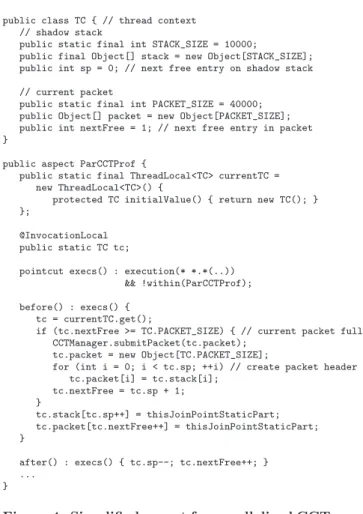
In order to reduce the overhead of calling context profil-ing on multicores, we parallelize application code and CCT construction [3]. Each thread maintains a calling context representation that does not require access to the shared CCT upon update, but preserves enough information that allows another thread to asynchronously perform the corre-sponding CCT updates. To this end, each thread produces “packets” of method calls and returns. When a packet is full, it is passed to the “CCT manager” through a queue. The
public class TC { // thread context // shadow stack
public static final int STACK_SIZE = 10000;
public final Object[] stack = new Object[STACK_SIZE]; public int sp = 0; // next free entry on shadow stack // current packet
public static final int PACKET_SIZE = 40000; public Object[] packet = new Object[PACKET_SIZE]; public int nextFree = 1; // next free entry in packet }
public aspect ParCCTProf {
public static final ThreadLocal<TC> currentTC = new ThreadLocal<TC>() {
protected TC initialValue() { return new TC(); } };
@InvocationLocal public static TC tc;
pointcut execs() : execution(* *.*(..)) && !within(ParCCTProf); before() : execs() {
tc = currentTC.get();
if (tc.nextFree >= TC.PACKET_SIZE) { // current packet full CCTManager.submitPacket(tc.packet);
tc.packet = new Object[TC.PACKET_SIZE];
for (int i = 0; i < tc.sp; ++i) // create packet header tc.packet[i] = tc.stack[i]; tc.nextFree = tc.sp + 1; } tc.stack[tc.sp++] = thisJoinPointStaticPart; tc.packet[tc.nextFree++] = thisJoinPointStaticPart; }
after() : execs() { tc.sp--; tc.nextFree++; } ...
}
Figure 4: Simplified aspect for parallelized CCT cre-ation
CCT manager has a thread pool to process incoming pack-ets and to update the CCT. In order to enable parallel and possibly out-of-order processing of packets, the packets must be independent of each other. Each packet corresponds to a partial CCT, and the integration of these partial CCTs must be a commutative and associative operation.
Figure 4 shows the aspectParCCTProf, implementing par-allelized CCT creation. The thread-local variablecurrentTC
of typeTC (thread context) keeps calling context informa-tion for each thread. The state of aTC instance includes a shadow stack (stack), a “stack pointer” (sp), which indi-cates the next free element on the shadow stack, a packet of method calls and returns (packet), and the index of the next free entry in the packet (nextFree). The invocation-local variabletc helps reduce (relatively expensive) access to the thread-local variable currentTC, which is read only once in each woven method.
Each packet consists of a header and a sequence of method calls and returns. The header corresponds to the calling context of the first method call in the packet. It can be regarded as routing information that describes a path in the shared CCT, starting from the root. The header ends with anullvalue. In the following sequence, method calls are represented by the corresponding method identifiers (i.e.,
JoinPoint.StaticPartinstances), whereas returns are sim-ply indicated bynullvalues. Since returns at the end of a packet have no effect on the partial CCT corresponding to the packet, we allownextFreeto exceed the packet size.
Figure 4 specifies how the packet is updated upon method entry and completion. On method entry, the method identi-fier of the callee method has to be appended to the packet. Hence, if the current packet is full, it is submitted to the CCT manager (CCTManager.submitPacket(...)). After-wards, a new packet is created, where the header is a copy of the current shadow stack. On method completion,nextFree
is simply incremented, creatingnullentries in the packet. When a thread terminates, its last packet is usually incom-plete and has not been submitted to the CCT manager. We address this issue by registering each thread upon creation in the CCT manager. The CCT manager is responsible for de-tecting thread termination (e.g., by periodically polling the thread state), to collect the last packet from theTCinstance of a terminated thread, and to put it into the queue.
Each thread in the CCT manager’s thread pool repeatedly takes a packet from the queue and integrates the correspond-ing partial CCT into the shared CCT. The thread first cre-ates a thread-local, partial CCT representing the method calls in the packet. Afterwards, the partial CCT is inte-grated into the shared CCT using a recursive method. This approach helps reduce the number of accesses to nodes in the shared CCT, because packets frequently include repetitive call patterns (e.g., methods invoked in a loop). Instead of accessing the shared CCT upon each method call, we need to access it only once for a series of accumulated method calls. Note that the packet format can be extended to support also other events than method call and return. For example, in order to profile object allocation, the packet could store a class reference for each allocated object (in addition to the method identifiers upon method invocation).
5.
CONCLUSION
Bytecode instrumentation techniques are very useful in the development of profilers, but mastering them requires deep knowledge of the virtual machine and of low-level byte-code engineering libraries. The resulting profilers are often complex, require considerable development effort, and are hard to extend. As an alternative to bytecode instrumenta-tion, we promote AOP for the rapid development of extensi-ble profilers. With the aid of AOP, many important profilers can be concisely specified in a few lines of code.
However, current AOP frameworks, such as AspectJ, lack some features that are essential for building useful and effi-cient aspect-based profilers. For instance, aspect-weaving in the standard Java class library is seriously restricted or even impossible. Furthermore, it is not possible to efficiently pass data in local variables from one join point to another within the same woven method. To overcome these limitations, we leverage MAJOR, an aspect weaver that ensures comprehen-sive weaving in all classes loaded in a JVM. Furthermore, we use inter-advice communication, a novel mechanism for passing data in local variables between woven advice bod-ies. Inter-advice communication is complementary to the features offered by current AOP languages, and we have in-tegrated it into MAJOR.
To illustrate our approach to profiler development, we pre-sented two case studies, an aspect for listener latency profil-ing, as well as an extensible and efficient aspect for calling context profiling.
Acknowledgements: The work presented in this paper has been supported by the Swiss National Science Foundation.
6.
REFERENCES
[1] G. Ammons, T. Ball, and J. R. Larus. Exploiting hardware performance counters with flow and context sensitive profiling. InPLDI ’97: Proceedings of the ACM SIGPLAN 1997 conference on Programming language design and implementation, pages 85–96. ACM Press, 1997.
[2] P. Avgustinov, A. S. Christensen, L. J. Hendren, S. Kuzins, J. Lhot´ak, O. Lhot´ak, O. de Moor, D. Sereni, G. Sittampalam, and J. Tibble. abc: An extensible AspectJ compiler. InAOSD ’05: Proceedings of the 4th International Conference on Aspect-Oriented Software Development, pages 87–98, New York, NY, USA, 2005. ACM Press.
[3] W. Binder, D. Ansaloni, A. Villaz´on, and P. Moret. Parallelizing Calling Context Profiling in Virtual Machines on Multicores. InPPPJ ’09: Proceedings of the 7th International Conference on Principles and Practice of Programming in Java, pages 111–120, New York, NY, USA, 2009. ACM.
[4] W. Binder and J. Hulaas. Flexible and efficient measurement of dynamic bytecode metrics. InFifth International Conference on Generative Programming and Component Engineering (GPCE-2006), pages 171–180, Portland, Oregon, USA, Oct. 2006. ACM. [5] W. Binder, J. Hulaas, and P. Moret. Advanced Java
Bytecode Instrumentation. InPPPJ’07: Proceedings of the 5th International Symposium on Principles and Practice of Programming in Java, pages 135–144, New York, NY, USA, 2007. ACM Press.
[6] W. Binder, J. Hulaas, P. Moret, and A. Villaz´on. Platform-independent profiling in a virtual execution environment.Software: Practice and Experience, 39(1):47–79, 2009.
http://dx.doi.org/10.1002/spe.890.
[7] W. Binder, M. Schoeberl, P. Moret, and A. Villaz´on. Cross-profiling for embedded Java processors. InFifth International Conference on the Quantitative
Evaluation of SysTems (QEST-2008), pages 287–296, Saint-Malo, France, Sept. 2008. IEEE Computer Society.
[8] M. Dmitriev. Profiling Java applications using code hotswapping and dynamic call graph revelation. In WOSP ’04: Proceedings of the Fourth International Workshop on Software and Performance, pages 139–150. ACM Press, 2004.
[9] B. Dufour, L. Hendren, and C. Verbrugge. *J: A tool for dynamic analysis of Java programs. In
OOPSLA ’03: Companion of the 18th Annual ACM SIGPLAN Conference on Object-Oriented
Programming, Systems, Languages, and Applications, pages 306–307, New York, NY, USA, 2003. ACM Press.
[10] E. Hilsdale and J. Hugunin. Advice weaving in AspectJ. InAOSD ’04: Proceedings of the 3rd International Conference on Aspect-Oriented Software Development, pages 26–35, New York, NY, USA, 2004. ACM.
[11] M. Jovic and M. Hauswirth. Measuring the
performance of interactive applications with listener latency profiling. InPPPJ ’08: Proceedings of the 6th international symposium on Principles and practice of
programming in Java, pages 137–146, New York, NY, USA, 2008. ACM.
[12] G. Kiczales, E. Hilsdale, J. Hugunin, M. Kersten, J. Palm, and W. G. Griswold. An overview of AspectJ. In J. L. Knudsen, editor,Proceedings of the 15th European Conference on Object-Oriented Programming (ECOOP-2001), volume 2072 ofLecture Notes in Computer Science, pages 327–353, 2001. [13] G. Kiczales, J. Lamping, A. Menhdhekar, C. Maeda,
C. Lopes, J.-M. Loingtier, and J. Irwin.
Aspect-Oriented Programming. In M. Ak¸sit and S. Matsuoka, editors, Proceedings of European Conference on Object-Oriented Programming, volume 1241, pages 220–242. Springer-Verlag, Berlin, Heidelberg, and New York, 1997.
[14] P. Moret, W. Binder, and A. Villaz´on. CCCP: Complete calling context profiling in virtual execution environments. InPEPM ’09: Proceedings of the 2009 ACM SIGPLAN Workshop on Partial Evaluation and Program Manipulation, pages 151–160, Savannah, GA, USA, 2009. ACM.
[15] ObjectWeb. ASM. Web pages at
http://asm.objectweb.org/.
[16] D. J. Pearce, M. Webster, R. Berry, and P. H. J. Kelly. Profiling with AspectJ.Software: Practice and Experience, 37(7):747–777, June 2007.
[17] J. M. Spivey. Fast, accurate call graph profiling.Softw. Pract. Exper., 34(3):249–264, 2004.
[18] Sun Microsystems, Inc. JVM Tool Interface (JVMTI) version 1.1. Web pages athttp://java.sun.com/ javase/6/docs/platform/jvmti/jvmti.html, 2006. [19] The Apache Jakarta Project. The Byte Code
Engineering Library (BCEL). Web pages at
http://jakarta.apache.org/bcel/.
[20] A. Villaz´on, W. Binder, D. Ansaloni, and P. Moret. Advanced Runtime Adaptation for Java. InGPCE ’09: Proceedings of the Eighth International Conference on Generative Programming and Component Engineering, pages 85–94. ACM, Oct. 2009.
[21] A. Villaz´on, W. Binder, and P. Moret. Aspect Weaving in Standard Java Class Libraries. InPPPJ ’08: Proceedings of the 6th International Symposium on Principles and Practice of Programming in Java, pages 159–167, New York, NY, USA, Sept. 2008. ACM.
[22] A. Villaz´on, W. Binder, and P. Moret. Flexible Calling Context Reification for Aspect-Oriented
Programming. InAOSD ’09: Proceedings of the 8th International Conference on Aspect-oriented Software Development, pages 63–74, Charlottesville, Virginia, USA, Mar. 2009. ACM.
[23] X. Zhuang, M. J. Serrano, H. W. Cain, and J.-D. Choi. Accurate, efficient, and adaptive calling context profiling. InPLDI ’06: Proceedings of the 2006 ACM SIGPLAN conference on Programming language design and implementation, pages 263–271, New York, NY, USA, 2006. ACM.