İSTANBUL TECHNICAL UNIVERSITY GRADUATE SCHOOL OF SCIENCE ENGINEERING AND TECHNOLOGY
Ph.D. THESIS
JULY 2016
USING MACHINE LEARNING TECHNIQUES TO ENHANCE TEACHING AND PERFORMANCE PREDICTION OF STUDENTS WITH
AUTISM SPECTRUM DISORDERS
Akram RADWAN
Department of Computer Engineering Computer Engineering Program
Computer Engineering Department Computer Engineering Program
JULY 2016
İSTANBUL TECHNICAL UNIVERSITY GRADUATE SCHOOL OF SCIENCE ENGINEERING AND TECHNOLOGY
USING MACHINE LEARNING TECHNIQUES TO ENHANCE TEACHING AND PERFORMANCE PREDICTION OF STUDENTS WITH
AUTISM SPECTRUM DISORDERS
Ph.D. THESIS Akram RADWAN
(504112514)
Bilgisayar Mühendisliği Anabilim Dalı Bilgisayar Mühendisliği Programı
TEMMUZ 2016
İSTANBUL TEKNİK ÜNİVERSİTESİ FEN BİLİMLERİ ENSTİTÜSÜ
YAPAY ÖĞRENME YÖNTEMLERİ İLE OTİZM SPEKTRUM BOZUKLUĞU OLAN ÖĞRENCİLERİN ÖĞRETİMİNİN VE ÖĞRETİM PERFORMANSI
TAHMİNİNİN İYİLEŞTİRİLMESİ
DOKTORA TEZİ Akram RADWAN
(504112514)
Thesis Advisor : Prof. Dr. Zehra ÇATALTEPE ... Istanbul Technical University
Jury Members : Assoc. Prof. Dr. Hatice KÖSE ... Istanbul Technical University
Prof. Dr. Barış KORKMAZ ... Istanbul University
Asst. Prof. Dr. Yusuf YASLAN ... Istanbul Technical University
Asst. Prof. Dr. Albert Ali SALAH ... Boğaziçi University
Akram RADWAN, a Ph.D. student of ITU Graduate School of Science Engineering and Technology, student ID 504112514, successfully defended the thesis/dissertation entitled “Using Machine Learning Techniques to Enhance Teaching and Performance Prediction of Students with Autism Spectrum Disorders”, which he prepared after fulfilling the requirements specified in the associated legislations, before the jury whose signatures are below.
Date of Submission : 20 June 2016 Date of Defense : 19 July 2016
FOREWORD
Fırst and Foremost, I would like to express my deepest gratitude to my advisor, Professor Zehra ÇATALTEPE. I benefit so much from her deep insight into machine learning, his professionalism, and her constant encouragement. Her willingness to adapt to and encourage my ever-evolving interests enabled the body of this thesis to come to fruition. Thanks Zehra Hoca for contributing your time and for everything. I am also very grateful to my committee members, Professor Barış KORKMAZ and Professor Hatice KÖSE for providing many suggestions and valuable discussions that improved this thesis. My sincere thanks also go to Professor Binyamin BİRKAN, who guided us in selection of experimental design. I appreciate his willingness to share his expertise knowledge in the area of autism. I am also thankful to my friend Mr. Fadi HANIA for his help on the programming of the web application.
We would like to thank the educators at the Right to Live Society (RTL) and Palestinian Society for Autism & Rehabilitation (PSAR) for their help conducting the experiments. This study would not have happened without children who participated in this study. I respect their efforts and thank their family for their cooperation. Finally, a very special thanks to my wife Azhar and my five children. Without their love and support, this work would not have been completed. I would like to dedicate this thesis to my parents for their boundless love.
TABLE OF CONTENTS Page FOREWORD ... ix TABLE OF CONTENTS ... xi ABBREVIATIONS ... xiii SYMBOLS ... xv
LIST OF TABLES ... xvii
LIST OF FIGURES ... xix
SUMMARY ... xxi
ÖZET ... xxiii
INTRODUCTION ... 1
Autism and Learning Disability ... 1
Machine Learning for Autism ... 2
Purpose of Thesis ... 4
Thesis Research Questions ... 4
Thesis Contributions ... 5
Publications and Derived Work ... 6
Thesis Organization ... 6
ACTIVE MACHINE LEARNING FRAMEWORK FOR TEACHING ... 9
Active Machine Learning ... 9
Proposed AML Framework ... 11
2.2.1 Formulation ... 11 Method ... 14 2.3.1 Participants ... 14 2.3.2 Ethical approval ... 16 2.3.3 Setting ... 16 2.3.4 Target objects ... 17
2.3.5 The web application ... 18
2.3.6 System architecture ... 19
2.3.7 Experimental design ... 20
2.3.8 Dependent measures ... 21
2.3.9 Procedures ... 21
2.3.10 Inter-observer agreement and procedural ntegrity ... 25
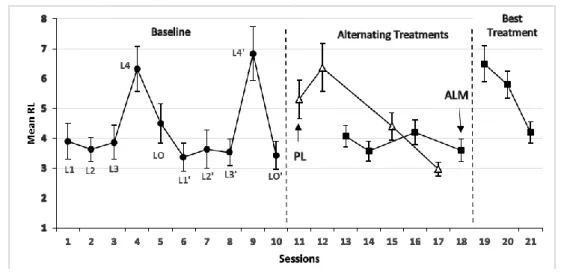
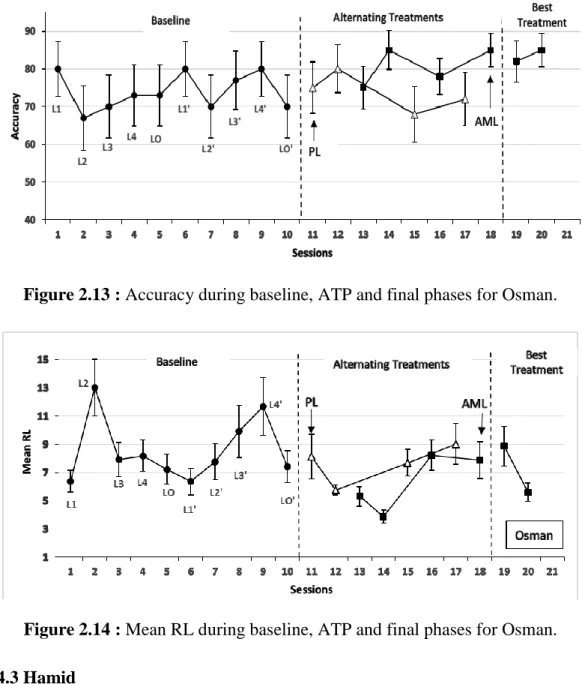
Results ... 26 2.4.1 Ali ... 27 2.4.2 Osman ... 29 2.4.3 Hamid ... 30 2.4.4 Layla ... 31 2.4.5 Khalil ... 33
2.4.6 Reduction in required teaching trials ... 33
Discussion ... 34
2.5.1 The suitability of AML framework for students with ASD ... 35
2.5.2 Efficiency of the teaching condition ... 35
OBJECT CATEGORIZATION TASK FOR STUDENTS WITH ASD ... 39
Using Assistive Technology to Enhance Teaching ... 39
Results and Discussion ... 40
3.2.1 General performance of students... 40
3.2.2 Relationships between variables ... 40
3.2.3 The effectiveness of difficulty levels ... 41
3.2.4 The effect of the negative responses ... 42
3.2.5 The effect of the location of object's image ... 43
3.2.6 The familiarity of categories ... 44
3.2.7 Difficulty of recognizing the objects ... 45
3.2.8 Guidance for developing tablet applications ... 47
CLASS IMBALANCE AND CLASS NOISE ... 49
Background... 49
Class Imbalance Approaches ... 51
4.2.1 Data re-sampling methods ... 51
4.2.1.1 Random over-sampling ... 51
4.2.1.2 Random under-sampling ... 52
4.2.1.3 SMOTE ... 52
4.2.2 Cost-sensitive learning ... 52
4.2.3 Thresholding (cut-off adjustment) ... 53
Evaluation Metrics in Imbalanced Domains ... 53
Noise Detection Approaches ... 55
Machine Learning for predicting student performance ... 55
Literature Review ... 56
LEARNING PERFORMANCE PREDICTION ON EDUCATION DATA .. 59
Proposed Methods ... 60
Dataset ... 62
Experiments and Results ... 64
5.3.1 Experiment 1 ... 64
5.3.2 Experiment 2 ... 65
5.3.3 Experiment 3 ... 72
Important Features on Predicting Student’s Performance ... 74
CONCLUSIONS AND FUTURE WORK ... 77
REFERENCES ... 81 APPENDICES ... 89 APPENDIX A ... 90 APPENDIX B ... 91 APPENDIX C ... 95 CURRICULUM VITAE ... 97
ABBREVIATIONS
ABA : Applied Behavior Analysis AI : Artificial intelligence AML : Active Machine Learning ASD : Autism Spectrum Disorders ATP : Alternating Treatments Phase AUC : Area Under the ROC Curve
BST-CF : class-Balanced by SMOTE & Thresholding combined with CF BST-EF : class-Balanced by SMOTE & Thresholding combined with EF CARS : Childhood Autism Rating Scale
CF : Classification Filter
DS : Dataset
DTT : Discrete Trial Teaching EDM : Educational Data Mining EF : Ensemble Filter
IES : Inverse Efficiency Score IPF : Iterative-Partitioning Filter ITS : Intelligent Tutoring Systems LR : Logistic Regrssion
ML : Machine Learning
PIQ : Performance Intelligent Quotes PL : Passive Learning
PSAR : Palestinian Society for Autism & Rehabilitation RF : Random Forest
RN : Random Classifier
ROC : Receiver Operating Characteristics ROS : Random over-sampling
RTL : Right to Live Society
SMOTE : Synthetic Minority Oversampling Technique SMOTE-ENN: SMOTE with Edited Nearest Neighbor SMOTE-TL : SMOTE with Tomek links
SSL : Semi-Supervised Learning SVM : Support Vector Machine
WISC : Wechsler Intelligence Scale for Children WRAML : Weighted Response Active Machine Learning
SYMBOLS
: Significance level 𝑬𝒘 : Weighted error 𝑺𝒋(𝒕) : Teaching set
𝑼𝒋 : Uncertainty measurement 𝒎𝒋(𝒕) : Number of mistake at level 𝐿𝑗 𝜽∗ : Threshold value AR : Auditory repeats 𝑯 : Entropy 𝑳 : Labeled set 𝑳𝒋 : Difficulty level j RC : Response correct RL : Response latency RT : Response time 𝒘𝒋 : Weight for level 𝐿𝑗
𝑰𝒎(𝒇) : Importance of feature
𝜼 : Learning rate
LIST OF TABLES
Page
Table 2.1 : The performance of participants.. ... 9
Table 2.2 : The overall performance of categories... 15
Mean performance for all levels across baseline and ATP phases ... 28
Average accuracy, mean of correct response latency and the IES for treatments PL and AML during ATP phase ... 29
Table 3.1 : The performance of participants.. ... 40
Table 3.2 : The overall performance of categories... 46
Table 4.1 : Confusion matrix for two-class problem .. ... 53
Table 5.1 : Description of the dataset used .. ... 63
Table 5.2 : The results of classification algorithms using baseline feature set.. ... 65
Table 5.3 : Comparison of AUC results for different classifiers using baseline feature set.. ... 67
Table 5.4 : Comparison of AUC results for different classifiers using baseline with RT features... 67
Table 5.5 : Results for BST-CF with different borderline’s width on dataset DS.. .. 68
Table 5.6 : Results for BST-EF with different borderline’s width on dataset DS.. .. 68
Table 5.7 : Results for BST-CF with different borderline’s width on dataset DS-2..68
Table 5.8 : Results for BST-FF with different borderline’s width on dataset DS-2.. 69
Table 5.9 : The Friedman test .. ... 72
Table 5.10 : The AUC results based on SMOTE-ENN and weighting... 73
Table 5.11 : The AUC results for sequential prediction based on SMOTE-ENN & using proposed methods.. ... 73
Table 5.12 : The AUC results for sequential prediction based on Weighting and using proposed methods.. ... 73
Table 5.13 : Importance of attributes using RF model.. ... 74
LIST OF FIGURES
Page
Participant’s activities during the conduction of the experiments. ... 17
A sample of images from the dataset used for teaching and assessment. Columns L1-L4 show different difficulty levels. ... 18
(a) Screen display of baseline, teaching and assessment trial (b) The reward screen for the correct answer in a teaching trial. (c) Screen display of an initial assessment trial. ... 19
... 20
... 22
Flowchart of the assessment session in baseline phase. ... 23
... 24
... 25
... 25
... 26
... 27
Mean RL during baseline, ATP and final phases for Ali ... 29
... 30
Mean RL during baseline, ATP and final phases for Osman ... 30
Hamid ... 31
Mean RL during baseline, ATP and final phases for Hamid ... 31
Layla ... 32
Mean RL during baseline, ATP and final phases for Layla ... 32
Khalil ... 33
Mean RL during baseline, ATP and final phases for Khalil ... 34
Mean accuracy at only included levels in all phases ... 36
Figure 3.1 : The performance of the participants in terms of accuracy and RT ... 41
Figure 3.2 : Residuals plots against the model fit the data. ... 41
Figure 3.3 : The performance of the difficulty levels in terms of accuracy and RT. 42 Figure 3.4 : The mean RT for correct and incorrect response trials. ... 43
Figure 3.5 : (Left) Chosen location vs. number of errors (Right) Chosen location vs. percentage of auditory repeats. ... 44
Figure 3.6 : Confusion matrix for each category ... 45
Figure 3.7 : Objects vs. inverse efficiency score (IES) ... 46
Figure 4.1 : The three types of instances: safe, borderline and noisy instances. ... 50
Figure 5.1 : The overall design of BST-CF and BST-EF.. ... 62
Figure 5.2 : Average AUC obtained by different classifiers using only class-imbalance approaches and with BST-CF on dataset DS. ... 70
Figure 5.3 : Average AUC obtained by different classifiers using only class-imbalance approaches and with BST-CF on dataset DS-2 .. ... 70
Figure 5.4 : Average AUC obtained by different classifiers using only class-imbalance approaches and with BST-EF on dataset DS. ... 71
Figure 5.5 : Average AUC obtained by different classifiers using only class-imbalance approaches and with BST-EF on dataset DS-2 ... 71
Figure 5.6 : Important of all features based on RF model ... 75 Figure B.1 : Ethical committee approval ... 91 Figure B.2: Consent form for parents ... 92 Figure B.3: Permission from RTL School ... 93 Figure B.4:. Permission of PSAR School ... 94 Figure C.1:. The initial probability list for participant 1 ... 95
USING MACHINE LEARNING TECHNIQUES TO ENHANCE TEACHING AND PERFORMANCE PREDICTION OF STUDENTS WITH AUTISM
SPECTRUM DISORDERS SUMMARY
The number of children diagnosed with autism spectrum disorders (ASD) is on the rise. Thanks to the advances in IT technology the use of computerized teaching systems and hence the variety, quality and quantity of data collected with them has increased. This thesis introduces a web- based teaching tool tailored for ASD students. Then, machine learning techniques, such as active machine learning (AML), noise elimination and class balancing, are applied on the collected student learning data. Using a new AML method, a method of planning what will be taught at the next session based on previous session performance is introduced. Using a new noise elimination and class balancing method to predict student performance during teaching is also devised.
The thesis represents the first attempt to use machine learning techniques for teaching students with ASD. AML technique enables a machine learning model to perform better with less labeled training data by allowing it to choose the training instances. Although AML has been studied in different domains, such as video annotation and web page classification, its applications to human learning have been studied very little. To the best of our knowledge, there is no research on using AML for teaching children with ASD.
In the first part of this thesis, we propose an AML approach for teaching students with ASD, and compare the effectiveness of passive learning (PL) and AML on teaching object recognition for those students. AML approach presents to the child the most informative teaching set of objects. For this purpose, a web and touch-based application was developed and presented on a tablet PC. Objects from everyday lives of children were grouped based on their categories and difficulty levels. The teaching procedure was based on applied behavioral analysis (ABA) principles. The study was approved by the Ethics Board of Istanbul Technical University (ITU). Five children with mild to moderate levels of ASD participated in the experiment. An alternating treatments design of single subject research methods was used to compare the effects of AML and PL. The results indicate that AML was more effective than PL for four out of the five students. Consequently, children can learn faster and are able to reach a learning criterion with fewer teaching trials.
The second part of the thesis presents an analysis and visualization of the data collected using the web application during the learning sessions. The results of the analysis were interpreted and they provided us a better understanding about object categorization for students with ASD. A number of factors influence a student's response including familiarity of categories, difficulty levels, the location of object's image and similarities with the other objects. The findings help us enhance the teaching
process and monitor student’s learning progress and then personalize learning for each student. Due to several features for tablet PC, we suggest that the tablet is an effective educational tool to enhance teaching for the students. Finally, we offer suggestions that may help in future applications that can be developed for students with ASD. In the third part of this thesis, we propose to apply machine learning techniques to predict the performance of students with ASD while they learn tasks described above. The real dataset, gathered from the web application for the students, suffers from two major problems that can negatively impact the ability of classification models to predict the correct label: class imbalance and class noise.
A series of experiments have been carried out to improve prediction results through reducing the effect of both class noise and class imbalance on the induced classifiers. In the first experiment different approaches have been applied in order to resolve the problem of imbalanced classification by data re-sampling methods and cost-sensitive learning. In the second experiment, two methods were proposed to eliminate the noisy instances, located inside the borderline area, from the majority class. Our methods combine over-sampling SMOTE technique with thresholding technique to balance the training data and choose the best boundary between classes. Then we apply a noise detection approach to identify noisy instances. The best results from the two experiments were used in the third experiment to predict the response correct of the students’ future trial using only the preceding session’s trials. Results for different classification algorithms showed that the two proposed methods achieve significant improvements in terms of the AUC (Area Under the ROC Curve) metric with respect to the existing techniques used for class-imbalance problem. Moreover, our prediction methods performed better when data of a student, who has a lot of noise, were excluded from the dataset. The most robust classifier over our methods was random forest. It performed better on average than logistic regression (RL), Support vector machine (SVM) and Adaboost with LR.
The contributions of this thesis are as follows:
1- At the time of writing, this is the first study of using AML to teach students with ASD.
2- The research results enhanced education outcomes and student’s recognition abilities, and thus can improve the learning process of a student with ASD to reach better results.
3- The thesis provides a dataset of a real-world images for the most common categories of concrete objects in daily life of a child.
4- We develop and implement a user-friendly web-based application, which presents a customizable and efficient tool enabling the child, parents and caregivers to work together through the computerized learning methods. 5- We propose to use machine learning filtering techniques on students’ learning
data to improve the quality of the data.
6- The prediction results have significantly improved when our proposed methods are combined with class-imbalance approaches.
YAPAY ÖĞRENME YÖNTEMLERİ İLE OTİZM SPEKTRUM BOZUKLUĞU OLAN ÖĞRENCİLERİN ÖĞRETİMİNİN VE ÖĞRETİM
PERFORMANSI TAHMİNİNİN İYİLEŞTİRİLMESİ ÖZET
Otizm Spektrum Bozukluğu (ASD – Autism Spectrum Disorder) teşhisi alan çocuk sayısı son zamanlarda büyük artış göstermiştir. Internet Teknolojileri’ndeki ilerlemeler sayesinde ise bilgisayarla öğretim sistemlerinin kullanımı ve dolayısı ile bu yolla toplanan verilerin çeşitliliği, miktarı ve kalitesi artmıştır. Bu tez kapsamında, öncelikle ASD’li çocukların öğretiminde kullanılabilecek web tabanlı bir yazılım üretilmiştir. Daha sonra öğrencilerle yapılan öğrenim uygulamalarından elde edilen veriler üzerinde aktif yapay öğrenme, gürültülü verileri giderme, sınıfları dengeleme yapay öğrenme teknikleri kullanılmıştır. Tez kapsamında geliştirilen yeni bir aktif yapay öğrenme tekniği ile önceki öğrenme oturumlarının verileri kullanılarak bir sonraki oturumda ne öğretilebileceği belirlenmiştir. Yine tez kapsamında geliştirilen ve gürültü temizleme ve sınıf dengelemeyi aynı zamanda yapan bir yöntemle, öğretim sırasında öğrenci başarım ve süre performansını tahmin eden bir yöntem geliştirilmiştir.
Bu tez otizm spektrum bozuklukları (ASD – autism spectrum disorders) olan çocukların eğitiminde yapay öğrenme (ML – machine learning) teknikleri kullanılarak çocuklara bir nesne tanıma görevi öğretilirken performanslarının öngörülmesine yönelik ilk girişimi yansıtmaktadır. Otizm genelde öğrenme bozukluğuyla ilişkilendirilir. ASD'li insanların yaklaşık %70'inde belli bir dereceye kadar öğrenme bozukluğu mevcuttur. Dolayısıyla bu kişiler çoğu insanla aynı şekilde öğrenemez ve bir kavramı öğrenmeleri için eğitimlerinde özel yöntemlerin izlenmesine ihtiyaç vardır.
Bu tezde davranış modelleri ile ML modelleri birlikte kullanılarak bu çocukların daha iyi öğrenmeleri için ML tekniklerinden faydalanmalarının mümkün olup olmadığı araştırılmıştır. Aktif makine öğrenimi (AML – Active Machine Learning) teknikleri, ML modelinin öğrenme sırasında kullanılacak örnekleri seçmesine olanak tanıyarak modelin daha az sayıda etiketli eğitim verisi ile daha iyi işlev görmesini sağlamaktadır. AML, video etiketleme ve internet sayfası sınıflandırması gibi farklı alanlarda kullanılmış olsa da, insan öğrenmesi üzerindeki uygulamalarına yönelik araştırmalar kısıtlıdır. Bildiğimiz kadarı ile ASD'li çocuklara eğitim vermek için AML tekniklerinin kullanılması üzerine bir araştırma mevcut değildir.
Bu tezin ilk kısmında ASD'li çocuklara eğitim verilmesi konusunda bir AML yaklaşımı benimsenmesi önerilmiş ve bu çocuklar için nesne tanınmasının öğretilmesinde pasif öğrenme (PL - Passive Learning) ve AML tekniklerinin etkililikleri karşılaştırılmıştır. AML yaklaşımı çocuklara bir dizi nesnenin öğretilmesi için, çocuğun daha önceki eğitim seanslarında aynı kategoride ya da zorluk seviyesinde olan nesneler tanıma sırasında gösterdiği performansı hesaba katan bir
yöntem sunmaktadır. Önceki eğitimler sırasındaki performans, çocuğun bilip bilmediği, ne kadar sürede cevap verdiği ve kaç defa yönergenin sesli olarak tekrar edilmesini istediği bilgilerinin hepsini içerecek şekilde değerlendirilmiştir. Bu doğrultuda internet ve dokunma tabanlı bir uygulama geliştirilmiş ve bir tablet bilgisayar üzerinde sunulmuştur. Çocukların günlük hayatlarından nesneler kategorilerine ve dört zorluk derecesine göre gruplara ayrılmıştır. Öğretme prosedürü için ASD'li her yaştan insan için etkili olduğu bulunan uygulamalı davranış analizi (ABA – Applied Behavioral Analysis) prensipleri temel alınmıştır. Uygulama çocuğun hata yapmasına izin vermemektedir. Eğer çocuk doğru seçeneği bulamamış ise, sunulan resimler üzerinde çeşitli etkiler ile (yanlış resmin küçültülmesi, doğru resmin sallanması gibi) çocuk doğru seçeneğe yönlendirilmektedir. Çocuğa bulması gereken nesne sesli olarak bildirilmektedir. Doğru ya da yanlış cevap vermesi durumunda, doğru cevabı pekiştirecek ve doğruyu ödüllendirecek sesli uyarılar içermektedir. Araştırmaya hafif ve orta derecede ASD'si olan beş çocuk (1 kız, 4 erkek) katılmıştır. Katılımcıların yaşları 5 ile 9 arasındadır (ortalama: 7,16; standart sapma: 1,1). Katılımcılar Filistin'de ASD'li öğrencilere eğitim veren iki okuldan seçilmiştir. AML ve PL'nin etkilerinin karşılaştırılması için tek denekli araştırma yöntemleri şeklinde tasarlanan eğitimler değişmeli olarak uygulanmıştır. Çalışma İstanbul Teknik Üniversitesi (İTÜ) Etik Kurulu tarafından onaylanmıştır.
Sonuçlar AML'nin araştırmamızdaki beş öğrencinden dördü için pasif öğrenmeden daha etkili olduğunu göstermiştir. Sonuç olarak bu öğrenciler bir öğrenme kriterine ulaşmak için gerekli öğrenme denemelerine daha az ihtiyaç duyarak daha hızlı öğrenebilmiştir. Bu tezde tanımlandığı şekliyle önerilen AML sadece ASD’li bireylerin eğitiminde kullanılmakla sınırlı değildir, başka eğitim alanlarına da uygulanabilir.
Tablet bilgisayarlar, özellikle anında geri bildirim sağlamaları ve öğrenme sürecindeki ara adımlar hakkında geniş bilgi tutma imkanları sayesinde öğretimin geliştirilmesi açısından etkili eğitim araçları olabilmektedir. Tezin ikinci kısmında öğrenme seansları esnasında, tez kapsamında geliştirilmiş olan bir web tabanlı internet uygulaması tablet bilgisayarlar üzerinde kullanılarak, toplanan veriler analiz edilmiş ve görselleştirilmiştir. Analiz sonuçları sayesinde deney yapılan ASD'li öğrencilerin nesne sınıflandırmasına ilişkin açıklamalar sunulmuştur. Kategorilerin aşinalığı, zorluk seviyeleri, nesnenin görüntüsünün konumu ve diğer nesnelerle olan benzerliği gibi birçok faktör öğrencinin tepkisini etkileyebilir. Çalışmamızda tepki süresi ile öğrencilerin performansları arasında güçlü bir negatif korelasyon olduğu saptanmıştır. Aynı zamanda pozitif tepkilerin negatif tepkilerden daha hızlı verildiği gözlemlenmiştir. Bu bulgular ile öğrencilerin öğrenme süreçleri izlenerek öğrenmenin her bir öğrenci için kişiselleştirilmesi sağlanabilecektir. Son olarak da ASD'li öğrenciler için ileride geliştirilebilecek uygulamalara yardımcı olabilecek önerilerde bulunulmaktadır.
Tezin üçüncü kısmında ASD'li öğrenciler yukarıdaki nesne tanıma görevini öğrenirken performanslarının öngörülmesi için makine öğrenimi tekniklerinin uygulanması tavsiye edilmektedir. Öğrenciler için geliştirilmiş olan internet uygulamasından elde edilen gerçek veri kümesinde doğru etiketi (öğrencinin bir sonraki soruyu bilip bilmeyeceği ve ne kadar sürede bileceği) tahmin etmek için sınıflandırma modellerinin yeterliliğini olumsuz bir şekilde etkileyebilecek iki büyük problemin olduğu
Hem sınıf gürültüsünün hem de sınıf dengesizliğinin uyarılan sınıflandırıcılar üzerindeki etkisinin azaltılması ile öngörü sonuçlarının iyileştirilmesi için yapılan farklı araştırmalar vardır. Dengesiz sınıflandırma problemini çözmek amacıyla verilerin tekrar örneklenmesi ve maliyete duyarlı öğrenme yaklaşımları uygulanmıştır. Sınıfın çoğunluğuna göre sınır bölgesi içerisinde bulunan gürültülü durumların ortadan kaldırılması için iki yöntem tavsiye edilmiştir. Tez kapsamında geliştirilen yöntemlerde, verilerde sentetik azınlık aşırı örneklendirme tekniği olan SMOTE (synthetic minority over-sampling technique) ile eşik tekniği kullanılarak eğitim verilerinin dengelenmesi ve sınıflar arasındaki en iyi sınırın seçilmesi sağlanmaktadır. Daha sonra gürültülü durumların belirlenmesi için bir gürültü tespit yaklaşımı uygulanmıştır. İlk yöntemde gürültülü durumların belirlenmesi için sınıflandırma filtresi (classification filter - CF) kullanılırken, ikinci yöntemde toplu filtre (ensemble filter - EF) kullanılmıştır. İki deneydeki en iyi sonuçlar üçüncü deneyde yalnızca önceki seanstaki deneyler ile öğrencilerin ilerideki deneydeki doğru yanıtlarının öngörülmesi için kullanılmıştır.
Farklı sınıflandırma algoritmalarının sonuçları önerilen CF ve EF bazlı iki yöntemin daha önceki çalışmalarda kullanılan sınıf dengesizliği tekniklerine göre başarım açısından önemli ilerlemeler sağladığını göstermektedir. Ayrıca verisinde çok sayıda gürültülü örnek olan bir öğrencinin verileri veri kümesinden tamamen çıkarıldığında, sınıflandırma yöntemleri daha da etkili olmuştur. Farklı sınıflandırıcılar kullanılan deneylerde, en iyi sınıflandırıcı rastgele orman sınıflandırıcısı olmuştur. Rastgele orman sınıflandırıcısı ortalama olarak lojistik regresyon (LR), destek vektör makineleri (DVM) ve LR sınıflandırıcısı kullanan Adaboost yönteminden daha etkili sonuçlar vermiştir. Özelliklerin önemi üzerine yapılan bir analiz, tepki süresi ve nesnenin seviyesinin bir öğrencinin performans tahmininin doğru olmasında en etkili olduğunu göstermiştir.
Bu tezin katkıları şu şekilde özetlenebilir:
1- Bu yazımın yapıldığı sırada, ASD’de olan öğrencilerin eğitiminde aktif yapay öğrenme (AML) tekniklerinin kullanıldığı ilk çalışmadır.
2- Yapılan tez çalışması sonucunda oluşturulan yöntemlerle öğrencilerin bilgi öğrenme performanslarının diğer yöntemlere göre daha iyi arttığı gösterilmiştir. Bu yöntemler ASD’li öğrencilerin öğrenme süreçlerini iyileştirme amacı ile kullanılabilir.
3- Tez çalışması sırasında bir çocuğun günlük hayatında gördüğü nesnelerin değişik zorluk seviyelerine göre sınıflandırıldığı bir görüntü veri kümesi oluşturulmuştur.
4- Kullanımı kolay web tabanlı bir uygulama tasarlanmış ve üretilmiştir. Bu uygulama öğrenci, ebeveyn ve öğretmenin beraber çalışarak bilgisayarla öğretim yöntemlerini kullanabileceği bir ortam oluşturmuştur.
5- Geliştirilen verideki gürültülü örnekleri bulup eleyen filtreleme yöntemlerinin veri kalitesini ve başarım performansını arttırdığı gösterilmiştir.
6- Gürültü giderme yöntemleri sınıf dengesizliğini giderme yöntemleri ile bir arada kullanılarak başarım performansı daha da arttırılmıştır.
INTRODUCTION
This chapter first introduces the area of autism and some difficulties of learning disability associated with autism. Second, it places our research presented in this thesis into a broader machine learning context. Next, it presents the purpose of the thesis and identifies the research problems, states the research questions, and lists the thesis contributions. Finally, the structure of the rest of this thesis is outlined.
Autism and Learning Disability
Autism spectrum disorder (ASD) refers to a group of complex neurodevelopment disorders. ASD is characterized by significant impairment in some areas of functioning, including social interaction, verbal and nonverbal communication, social imagination and repetitive behaviors (American Psychiatric Association, 2013). An estimated over 3 million individuals in the U.S. and tens of millions worldwide are affected by ASD (Autism Speaks, 2015). There is no single medical test for diagnosis of autism and no known cure so far.
Autism is often associated with learning disability. Nearly 70% of people with ASD have some degree of learning disability (Corbett, 2006) based on the individual's IQ score and the level of cognitive functioning (Jordan, 2013). Hence, students with ASD cannot learn in the same way as most people, and they need special treatment to learn a concept or an object. For every concept, there is a need to repetitively teach it using different instances and after a carefully chosen regime. In the human learning scenario, both obtaining training instances and predictions produced by the child for instances may be difficult. During the last decades, there have been efforts to understand the nature of the learning difficulties in ASD and to find effective treatments. One of the difficulties faced by people with ASD is the recognition of categories.
Categorization of objects poses challenges to children with ASD, especially when it is based on complex and less apparent features such as material or contextual features (Tager-Flusberg, 1985; Klinger and Dawson, 1995; Galleguillos and Belongie, 2010).
People with ASD also have deficiencies in prototype and category formation (Gastgeb et al, 2012). Plaisted et al. (1998) concluded that individuals with ASD were more accurate in processing unique features of objects than other commonly shared features between objects. Gastgeb et al. (2006) examined whether individuals with ASD have difficulty categorizing common objects, and whether their categorization abilities are affected by the typicality of objects. The authors found that "Individuals with ASD can readily categorize when the task involves simple and typical basic objects or faces but have difficulty when categorization is more complex or involves less typical objects or faces" (Gastgeb et al, 2012). .
There is no single teaching strategy that will be successful with all children with ASD. One of the methods that has shown effectiveness in teaching skills to children with ASD is Discrete Trial Teaching (DTT) (Artoni et al, 2012; Eldevik et al, 2013). DTT is an instructional approach which divides teaching skill or concept into parts/elementary steps with increasing levels of difficulty and teach repetitively to accomplish the task successfully. DTT is a specific method of teaching based on the principles of Applied Behavior Analysis or ABA (Alberto and Troutman, 2012). The procedures based on ABA have been shown to be efficient for people of any age with ASD in a number of research studies (Artoni et al, 2012; NAC, 2015). ABA aims to help individuals to give correct answers. Prompting the individual to perform the desired skill is an important part of this method (Alberto and Troutman, 2012). These prompts can be provided as visual cues, such as pointing out the correct answer or fading out the wrong options. Prompts need to be repeated until the desired behavior or skill is performed. Reinforcement lets the child be rewarded for the correct behavior, and it should immediately follow the correct response to make the student understand the connection between the correct answer and the reward (Doenyas et al, 2014). Educational therapy techniques, such as ABA, Treatment and Education of Autistic and related Communication handicapped CHildren (TEACCH) (Mesibov and Shea, 2010) and Assistive Technology (Lang et al, 2014) without the use of any machine learning algorithms have been used in order to teach children with ASD.
Machine Learning for Autism
science that evolved from the study of pattern recognition and computational learning theory in artificial intelligence (AI). ML focus on analyzing data to identify patterns and make accurate predictions. Over the past decade, learning algorithms have found widespread applications in numerous areas such as computer vision, object recognition, web search, natural language processing, emotion recognition etc.
Supervised learning (also called inductive learning) learns from the available data (experience), which is given in the form of training data (instances). The knowledge induced from the data can then be used for descriptive or predictive purposes. Supervised ML methods have been employed in ASD studies in order to enhance autism diagnosis (Wall et al, 2012; Bone et al, 2015) and to discriminate children with ASD from typically developing children (Crippa et al, 2015). Lastly, several ML classifiers have been applied to test whether a subset of behaviors was sufficient to detect individuals with and without ASD with high accuracy (Kosmicki et al, 2015). There are a few studies based on reinforcement learning (RL) (Sarma and Ravindran, 2007; Solomon et al, 2011; Wang, 2014). RL (Sutton and Barto, 1998) is an area of ML inspired by behaviorist psychology. It allows machines and software agents to automatically determine the ideal behavior or action within a specific context, in order to maximize its performance. Sarma and Ravindran (2007) proposed to use RL for building intelligent tutoring systems (ITS) to teach students with ASD, who cannot communicate well with others. ITS used neural networks to customize instructions according to the student’s needs. The study by Solomon et al. (2011) investigated the probabilistic reinforcement learning with Bayesian state–space model in adults with ASD. They showed that individuals with ASD have further deficits in using positive feedback to exploit rewarded choices in a task requiring learning relationships between stimulus pairs.
Semi-supervised learning (or SSL) has attracted a highly considerable amount of interest in ML. SSL techniques allow classifiers or learners to learn from labeled and unlabeled data at the same time (Davy, 2005; Zhu and Goldberg, 2009). Typically, they are used when we have a small size labeled dataset with a large size unlabeled dataset. During the last decade, SSL methods such as active learning, co-training, and co-testing have significantly improved learning performance in various applications. Actually human learns concepts in similar way of SSL; from a limited number of labeled data (e.g. parental labeling of objects) and a large amount of unlabeled data
(e.g. observation of objects without naming in real-life) (Zhu and Goldberg, 2009). In the ML scenario, it is easy to obtain the predictions of the classifier and it is usually expensive to obtain the actual labels for instances.
Our research is motivated by the fact "As the psychological and machine learning models are formally identical, the lifted variants of the machine learning models provide candidate hypotheses about human SSL" (Gibson et al, 2013, p. 135). Because humans use both labeled and unlabeled data when learning a categorization task (Zhu et al, 2007), SSL techniques can be useful for explaining human behavior.
Purpose of Thesis
In this thesis, we aim to incorporate ML models with behavioral models to teach students with ASD and to investigate whether they can benefit from ML techniques to learn better. The first goal is to examine the useo of the active machine learning (AML) technique for teaching students with ASD to recognize object categories, and evaluate its effectiveness compared with passive learning (PL). Secondly, we aim to use ML filtering techniques, on imbalanced data gathered from the web application during learning sessions, to improve the quality of the data. Then we can get more accurate prediction results of the student’s performance through reducing the impact of both class noise and class imbalance on the induced classifiers. For this purpose, two empirical methods are proposed to address noise filtering and class imbalance problems simultaneously.
Thesis Research Questions
To handle the research problems, we address the following research questions: Q1: Which technique PL or AML is more effective on teaching object recognition
for students with ASD?
Q2: Can AML reduce the number of teaching trials required to reach a learning criterion?
Q3: Do the object difficulty levels have an effect on object categorization? Q4: Which categories of objects are the most familiar to children with ASD? Q5: Which factors have more influence on a student's response?
Q6: How we can reduce the impact of both class noise and class imbalance problems on the students’ learning data?
Q7: Are the AUC scores obtained by the combinations of proposed methods in Chapter 5 and a classifier significantly better than the AUC scores obtained from only a classifier with class-imbalance approach?
Q8: Which attributes and features are the most significant predictors of the correctness of a student?
The thesis aims to answer these research questions by applying our investigation on a group of students with ASD. Answers to questions Q1 and Q2 given in Chapter 2, where question Q3-Q5 are examined in quantitative analyses of gathered data in Chapter 3. Answers to questions Q6-Q8 are found by results of a series of experiments in Chapter 5.
Thesis Contributions
The contributions of this thesis are as follows:
1- At the time of writing, this is the first study of using AML to teach students with ASD.
2- The research results enhanced education outcomes and student’s recognition abilities, and thus can improve the learning process of a student with ASD to reach better results.
3- The thesis provides a dataset of a real-world images for the most common categories of concrete objects in daily life of a child.
4- We develop and implement a user-friendly web-based application, which presents a customizable and efficient tool enabling the child, parents and caregivers to work together through the computerized learning methods. 5- We propose to use machine learning filtering techniques on students’ learning
data to improve the quality of the data.
6- The prediction results have significantly improved when our proposed methods are combined with class-imbalance approaches.
Publications and Derived Work
The scientific contributions of the thesis are listed in the following articles:
Radwan, A., and Cataltepe, Z., (2016). The Use of Tablet PCs in Teaching Object Recognition to Students with ASD, Proceedings of 3rd International Conference on Education and Social Sciences INTCESS, February 8-10, 2016, Istanbul, Turkey, pp. 399-408.
Radwan, A., and Cataltepe, Z., (2016). Using assistive technology to enhance teaching for students with autism spectrum disorders. International E-Journal of Advances in Education, 2(4), 112–121. DOI: http://dx.doi.org/10.18768/ijaedu.15760 Radwan, A. M., Birkan, B., Hania, F., and Cataltepe, Z., (2016). Active machine learning framework for teaching object recognition skills to children with autism. International Journal of Developmental Disabilities. Published online 17 Jun 2016. DOI:10.1080/20473869.2016.1190543
Radwan, A., and Cataltepe Z., Improving Performance Prediction on Education Data with Noise and Class Imbalance. Intelligent automation and Soft Computing. Submitted, July 2016.
Thesis Organization
The remainder of the thesis is organized as follows. Chapter 2 presents the proposed active machine learning framework, which teaches object recognition to the student with ASD by presenting to him the most informative teaching set of objects. The effectiveness of framework is compared to the traditional passive learning. Additionally, the design of web application and the procedure of assessment and teaching trials are described.
Chapter 3 presents an analysis and visualization of the data collected using our web application during the learning sessions and concludes some useful decisions about teaching process and student’s response.
Chapter 4 describes several approaches that have been used to handle the class imbalance and noise detection. Furthermore, we review some previous works related to predicting student’s performance using ML methods.
Chapter 5 proposes two empirical methods that address noise filtering and class imbalance problems simultaneously. It also describes three series of experiments and the important of features used in the prediction.
Chapter 6 summarizes the results presented in this thesis, offers conclusions of the work performed, and presents directions for further work. Finally, Appendices provide additional materials that required to our work in Chapter 2.
ACTIVE MACHINE LEARNING FRAMEWORK FOR TEACHING Active Machine Learning
When a ML model is trained, learning is performed on a random subset of all the available set of labeled training data. We will refer to this mode of learning as passive learning (PL). In PL mode of learning, the classifier (learner) does not participate interactively with the teacher (Davy, 2005). A passive learner receives a random dataset from the world and then produces a classifier or model. Thus, PL is more straightforward and easier to implement.
Active machine learning (AML) is a popular research area in ML (Davy, 2005; Settles, 2010). It allows selection of the most informative instances in training dataset of the domain for manual labeling. AML aims to produce a highly accurate classifier using as few labeled instances as possible, thereby required labeled data at minimal cost (Settles, 2010). In AML, the classifier is initially trained on a small set of instances, and it chooses informative instances from an unlabeled pool of data to request labels from the expert or oracle that can upon request provide a label for any instance in this pool (Tong and Koller, 2001). We provide a comparison of AML and TPL in Table 2.1 (Davy 2005; Settles 2010).
Table 2.1 : Comparison of active machine learning and passive learning.
PL AML
No control over training instances select training instances from a pool of unlabeled data (queries)
Large number of required training instances
Relatively small Examine the entire training data before
inducing a classifier (batch process)
Learner sees one or a subset instances at a time (iterative process)
One classifier induced Many
Multiple studies proposed several AML algorithms and applied them to different computer recognition applications. They have shown that when AML is used, ML models require significantly less training data and can still perform well without loss of accuracy (Settles, 2010; Yang et al, 2014). Unlike machines, a human learner gets tired as s/he answers questions, so finding out whether s/he knows a concept or not (i.e. getting the labels) is usually an expensive task. Therefore, using AML for human learning may help human learning become more efficient and effective and hence reduce the cost of teaching. There are a few studies on the applications of AML to the human learning domain. The first such study was by (Zhu et al, 2007) which tried to answer the question "Do humans use unlabeled data in addition to labeled data to learn categories?". It also aimed to evaluate whether a human learner is sensitive to the distributions of unlabeled instances in classification. Results showed that human behavior fitted well to the predictions of a Gaussian mixture model for semi-supervised learning. Castro et al. (2009) investigated what they refer to as human active learning. They showed that humans learn faster with greater performance when they can actively select the informative instances from a pool of unlabeled data instead of random sampling. However, human AML is sensitive to noise, and humans were not as good as machines in selecting queries from an unlabeled dataset of artificial 3D visual stimuli. There are other empirical studies which addressed human AML with a focus on learning two-class problems on a one-dimensional input space (Zhu et al, 2007; Castro et al, 2009), but there were obstacles to generalize the model to multi-dimensional classification problems (Gibson et al, 2013).
Typically, AML approaches select a single unlabeled instance, which is the most informative at that iteration and then re-train the classifier. Even for the simplest models, the re-training process is time consuming. Thus, in this study, we selected a batch mode active learning strategy (Hoi et al, 2006; Guo and Schuurmans, 2008) that selects multiple instances each time.
There are a number of AML query selection strategies which have been presented by Settles (2010): 1) Uncertainty Sampling which is the simplest and the most commonly used strategy. Uncertainty sampling focuses on selecting the instance that the classifier is most uncertain about to label, 2) Expected Error Reduction which aims to query instance that minimizes the expected error of the classifier; and 3)
Query-by-of classifiers find most disagreement. Bagging and boosting are used to generate committees of classifiers from the same dataset. They aim to combine a set of weak classifiers to create a single strong classifier. While bagging creates each base classifier independently, boosting allows these classifiers to influence each other during training process (Olsson, 2009). Boosting is an iterative process that initially assigns equal weight to each of the training samples, then the weights are modified based on the error rate of individual classifier.
Proposed AML Framework
We present a novel batch-mode pool-based AML framework (Guo and Schuurmans, 2008; Settles, 2010) on a domain containing instances with various difficulty levels to a child. The purpose of our framework is to determine how uncertain or informative an unlabeled instance is to a particular child at a certain iteration. Then we can select instances to be learned from the unlabeled pool U at the next iteration. Our approach chooses informative instances based on the commonly used uncertainty sampling strategy. This strategy selects the unlabeled instances (objects) that the child has the least confidence.
The uncertainty sampling approach is usually associated with a classifier, which is used to compute the uncertainty of each instance in an unlabeled pool U (Yang et al, 2014). AML algorithm often starts with a small size of labeled training data. After the classifier is trained, we can provide the posterior probability 𝑃𝜃(𝑦|𝑥) under model with parameters 𝜃. The uncertainty function can be calculated using the label probability 𝑃𝜃(𝑦|𝑥).
In our AML framework, a child plays the role of the classifier and we do not have a probabilistic model. So, we computed the uncertainty in the context of the child’s responses to measure of informativeness for all objects. If an object’s uncertainty is high, it implies that the child does not have sufficient knowledge to classify the object, and then adding this object into the training set can improve the child's recognition ability.
2.2.1 Formulation
Let 𝑂𝑖, 𝑖 = 1, 2, . . , 𝑁 be the objects of the dataset to be learned, and 𝐿𝑗, 𝑗 =
in this study, but the analysis below can be easily extended to a different number of difficulty levels. Let 𝐿 = {(𝑂1, 𝑦1), … , (𝑂𝑚, 𝑦𝑚)} denote the set of labeled instances where 𝑦𝑖 is the label for object 𝑂𝑖. Let U denote the set of unlabeled instances. In order to measure uncertainty for each object and level, the following three factors were considered:
1. Response correct 𝑅𝐶(𝑖, 𝑗) which is defined as follows: 𝑅𝐶(𝑖, 𝑗) = 1 means that the object 𝑂𝑖 is classified correctly by the child in the assessment session at level 𝐿𝑗
and 𝑅𝐶(𝑖, 𝑗) = 0 otherwise.
2. Response latency 𝑅𝐿(𝑖, 𝑗) which is measured as the time the participant has taken to label an object 𝑂𝑖 in the assessment session at level 𝐿𝑗.
3. The number of auditory stimulus repeats 𝐴𝑅(𝑖, 𝑗) which is required to classify the object 𝑂𝑖 at level 𝐿𝑗.
In previous works that used uncertainty for AML, classifiers’ label probability was used to measure uncertainty. In this study, in addition to 𝑅𝐶, which corresponds to label probability, we also have the other factors, which are 𝑅𝐿 and 𝐴𝑅. Below we describe a method to combine all of these factors in uncertainty measurement. First of all, we introduce the uncertainty component that corresponds to label probability using the 𝑅𝐶 values. Since objects in our study have different difficulty levels, we weigh informativeness of an object according to its level. Thus, the weighted error of participant's response for object 𝑂𝑖 can be defined as follows:
𝐸𝑤(𝑂𝑖) = ∑4 𝑤𝑗(1 − 𝑅𝐶(𝑖, 𝑗))
𝑗=1 , 𝑖 = 1,2, … , 𝑁 (2.1)
where 𝑤𝑗 is the weight for level 𝐿𝑗. The weights 𝑤𝑗 sum up to 1 and they determine how much importance should be given to each level. Especially at the beginning, the participants are more likely to make mistakes at higher levels. In order to emphasize errors at lower levels at the beginning of learning the weights should be initialized such that lower levels’ weights are larger. In this study, the weights are initialized as follows:
𝑤1 = 0.4, 𝑤2 = 0.3, 𝑤3 = 0.2 and 𝑤4 = 0.1 where ∑4𝑖=1𝑤𝑖 = 1 .
The weights are updated after each iteration, which consists of assessment sessions at included levels in the current phase, according to the following rule:
𝑤(𝑡+1) = 𝑤(𝑡)[1 − (5 − 𝑗)𝜂]𝑚𝑗 (𝑡)
where 𝑤𝑗(𝑡) is weight 𝑗 at iteration 𝑡 and 𝜂 is the learning rate such that 0 < 𝜂 < 1 4⁄ . In our implementation, a small learning rate was used (𝜂 = 0.05) for all iterations.
𝑚𝑗(𝑡) = ∑𝑁 1 − 𝑅𝐶(𝑖, 𝑗)
𝑖=1 is the number of mistakes for a participant at level 𝐿𝑗 where 0 ≤ 𝑚𝑗(𝑡) ≤ N. After weights are updated, they are always renormalized so that their sum is 1. From equation (2.2), the weights for high levels are more sensitive to the number of mistakes than weights for lower levels. Thus, the increase in the value of a weight implies that the participant has improved at the corresponding level.
Entropy in information theory is associated with the orderly or disorderly configuration of data. Disorderly configuration can be interpreted as that most of the data points are scattered randomly (Li et al, 2004). We used entropy to measure the similarity (or dispersion) among the weight vector 𝑊(𝑡) = (𝑤1(𝑡), 𝑤2(𝑡), 𝑤3(𝑡), 𝑤4(𝑡)) at iteration 𝑡. Maximum entropy (𝐻𝑚𝑎𝑥 = 2) occurs when all weights are uniformly distributed across levels and 𝑤𝑗(𝑡) = 0.25 for all 𝐿𝑗. The decrease in entropy indicates existence of weight(s) dissimilar to other levels’ weights, and this fact could be used to detect outlier weight(s) different than other weights. The above formulation of weights would enable us to determine the mastery criterion level that the participant needed for mastering or passing some levels. In current study, after performing a phase, the entropy 𝐻 of weight vector is compared with the previous phase. If 𝐻(𝑊(𝑡)) decreases, then the level corresponding to a larger weight in previous iteration is assigned to be passed. This means that the participant has mastered the level, and there is no need to assess this level at the following phases.
In addition to the weighted error 𝐸𝑤(𝑂𝑖), we incorporate 𝑅𝐿 and 𝐴𝑅 into uncertainty measurement of an object 𝑂𝑖 at level 𝐿j as follows:
𝑈𝑗(𝑂𝑖) = 𝐸𝑤(𝑂𝑖) ×∑𝑁𝑅𝐿(𝑖,𝑗)𝑅𝐿(𝑖,𝑗) 𝑖=1 × exp ( 𝐴𝑅(𝑖,𝑗) ∑𝑁𝑖=1𝐴𝑅(𝑖,𝑗)) 𝛽 (2.3) 𝑖 = 1,2, … , 𝑁 𝑎𝑛𝑑 𝑗 = 1, . . ,4
In this equation, the effect of 𝑅𝐿 and 𝐴𝑅 has been normalized. Here 𝛽 controls the importance of 𝐴𝑅. The effect of 𝐴𝑅 has been reduced using the square (𝛽 = 2). After each iteration, for each level 𝐿𝑗 and based on the performance of the participant, we computed the uncertainty 𝑈𝑗(𝑂𝑖) for each object 𝑂𝑖 at level 𝐿j according to equation (2.3). Based on the uncertainty values, we selected a batch of 𝑛 queries, which we call the teaching set 𝑆𝑗(𝑡) at iteration 𝑡. This set contains 𝑛 objects with the highest 𝑈𝑗(𝑂𝑖)
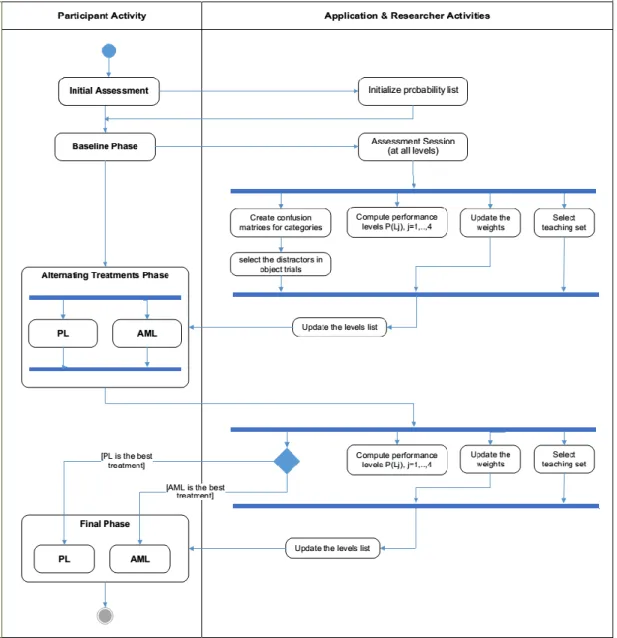
values and it will be used in next phase. We summarize our framework, called the weighted response AML framework (WRAML), in Algorithm 1.
Algorithm 1 : One phase of the WRAML framework. Given: Labeled set 𝑳, unlabeled set 𝑼, query batch size n,
initial values for weights 𝒘𝒋(𝟎), current iteration number 𝒕 and weights 𝒘𝒋(𝒕)
1. 𝑚 ≔ 1
2. while (𝑚 < 3) do
3. // In the procedure of the investigation, a phase consists of only two iterations
4. 𝑚 = 𝑚 + 1
5. 𝑡 = 𝑡 + 1
6. Do assessment sessions at included levels
7. // compute the uncertainty for each object at each level 8. for level 𝑗 = 1 to 4 do 9. for object 𝑖 = 1 to 𝑁 do 10. Retrieve 𝑅𝐶(𝑖, 𝑗), 𝑅𝐿(𝑖, 𝑗) and 𝐴𝑅(𝑖, 𝑗) 11. Compute 𝑈𝑗(𝑂𝑖) in equation (2.3) 12. end for 13. end for
14. // compute the teaching set 𝑆 𝑗
(𝑡)
for each level. 15. for level 𝑗 = 1 to 4 do
16. for query 𝑘 = 1 to n do
17. // query the most informative instances
18. Select object 𝑂𝑘∗ in 𝑆
𝑗 (𝑡)
with the maximum 𝑈𝑗(𝑂𝑖) 19. Query the true label 𝑦𝑘 for 𝑂𝑘∗
20. end for
21. end for
22. Update the weights 𝑤
𝑗(𝑡+1) according to equation (2.2) 23. end while
24. // Decide on which levels are passed after the phase is performed
25. if 𝐻(𝑊(𝑡)) < 𝐻(𝑊(𝑡−2)) then //t-2 because a phase consists of two iterations 26. for level j = 1 to 4 do 27. if 𝑤 𝑗(𝑡)> 𝑤𝑗(0) & 𝑤𝑗(𝑡) ≥ 𝑤𝑗(𝑡−1) then 28. Assign 𝐿𝑗 passed 29. end for 30. end if Method 2.3.1 Participants
Five children (1 female and 4 males) with mild to moderate levels of ASD participated in this study. Participants’ ages ranged from 5 to 9 years (mean= 7.16, SD= 1.1) (see
a diagnosis of ASD by an independent psychiatrist based on DSM-5 criteria (American Psychiatric Association, 2013); (b) having no other disabilities; (c) at least one year of full-time school enrollment; (d) attending school regularly (five days a week); and (e) being able to remain seated for 15-20 minutes while engaged in an activity. Participants were recruited from two schools in Gaza-Palestine that provide education for students with ASD; Right to Live Society (RTL) and Palestinian Society for Autism & Rehabilitation (PSAR). The Arabic version of Wechsler Intelligence Scale for Children (WISC-III) (Khaleefa, 2006) was used to assess children’s IQ for determining the general level of intelligence. Moreover, the Childhood Autism Rating Scale (CARS) was used for assessing the presence and severity of ASD (Vaughan, 2011). CARS scores, which ranged from 32 to 36, indicated a moderate to mild degree of severity of autism.
Table 2.2 : Description of participants1.
Name Gender Age
(year) WISC PIQ Score CARS Score School Tablet Skills
Ali M 7.3 90 34 PSAR good
Osman M 5.4 76 36 PSAR poor
Hamid M 8.8 80 33 RTL good
Layla F 7.5 72 36 RTL poor
Khalil M 6.8 70 35 RTL average
Ali was 7 years and 4 months old boy at the beginning of the study. His performance IQ (PIQ) score on WISC-III was 90 and his score on CARS indicated a mild degree of ASD. Ali had no difficulty with receptive and expressive language. He responded quickly to the educator's instructions. He joined the PSAR School two years ago and his reading skills are good compared to his peers. His tablet usage skills were very good and also he had a high level of engagement. Therefore, he enjoyed the experiment.
Osman was 5 years and 5 months old boy, with a diagnosis of a moderate degree of autism and his PIQ was 76.. He was enrolled PSAR School 1.5 year ago. Osman presented very limited verbal skills, particularly verbal comprehension. His assessment profile indicated for self-harm and aggressive behaviors, which included kicking, hitting, and crying. These behaviors were observed both at home and at
school. So we faced some problems while conducting the experiment sessions and his educator needed to be next to him through the sessions.
Hamid was a male student who was 8 years and 10 months old. He was diagnosed with mild autism and his PIQ was 80. Hamid was enrolled RLT School when he was 4 years of age. His stereotypic responses included hand flapping and head movement. Hamid has reading and writing skills, and his skill of understanding what he reads is improving. In terms of his expressive language, he is able to hold short conversations and usually used four-word sentences. His tablet skill was fine.
Layla, the only girl in the study, was 7 years and 5 months old at the start of the study. Her PIQ score was 72 with a moderate severe ASD. She was enrolled RLT School 4 years ago with a minimal language and a history of tantrums. Layla had stubborn behavior and sometimes exhibited crying and noncompliance. She also appeared to communicate with people she knew before.
Khalil was 6 years and 9 months old boy diagnosed with moderate autism. His PIQ score was 76. He has been a student in RLT for 2 years and so far he has difficulty with receptive and expressive language. He responded to familiar instructions and primarily used three-word sentences to communicate his needs. Khalil was good with tablets, but he presented poor fine motor skills while touching the screen.
2.3.2 Ethical approval
The study was approved by The Ethics board of Istanbul Technical University (Ref no. BM-28, dated May 12, 2015) (see Figure B.1). Written informed consent was signed for each child by their parents after they received a complete explanation on the purpose of the study and assurance about the confidentiality of the information (see Figure B.2). The form was also signed by the child's educator as a witness. Written permission was also obtained from the two schools where the experiments were conducted (Figure B.3 and Figure B.4).
2.3.3 Setting
The sessions in the experiments were conducted in the participants’ respective school. The room was furnished with suitable chairs and tables. It was quiet and free from distractions to keep the participant's attention only on the application. As teaching
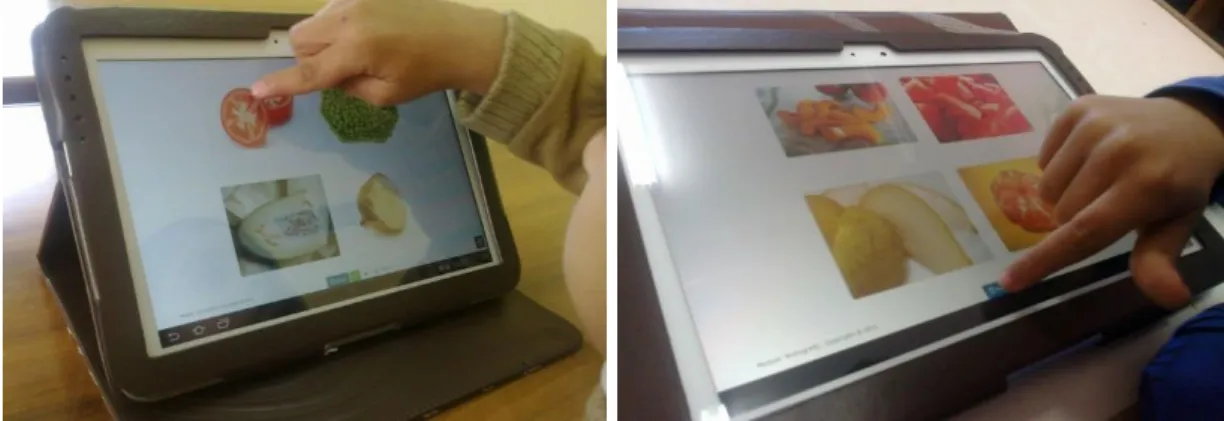
using software presented on computers or tablets were shown to increase children's attention and desire to learn in comparison to traditional programs (Lorah et al, 2013; McNaughton and Light, 2013), our application was presented on a tablet PC “Samsung Galaxy Note 10.1”. A digital camera was used to record some sessions for each participant and also some pictures were taken as in Figure. 2.1. Later, videotaped files were used to keep track of the child's behavior.
Figure 2.1 : Participant’s activities during the conduction of the experiments. 2.3.4 Target objects
We chose five common categories for a real-world dataset: fruits, vegetables, animals, tools for eating & cleaning and furniture. For each category, we picked six objects (see Table A.1). These objects were chosen according to two principles: 1) they represented the most common categories of concrete objects in the daily life of a child. 2) they were commonly used or were familiar to children with ASD. Children’s own teaching staff were consulted when the decision for objects and categories was made.
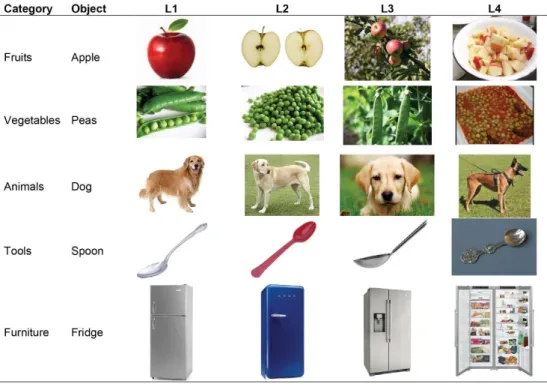
Picture stimuli of target objects were colored images, and they were collected using image search engines, in particular Google and Bing. Every object class contained about 31 different images and dataset has a total of 930 images. Some preprocessing was performed on the images to bring them to uniform resolution and size. We used an attribute-based approach (Farhadi et al, 2009) to select levels of difficulty: color, shape, size, plurality, cross-section, pattern, material (made of) and function (see Figure 2.2). Indeed, levels of difficulty did not have strict definitions and they depend on the nature of a category. In order to measure the ability of children to generalize (i.e. they do not memorize a particular picture, but learn the concept), different images were used for each phase. So we divided the dataset of images into seven groups to ensure that the images used in the assessment sessions of one phase will not be used
in the following assessment sessions for other phases. Moreover, the images used for teaching and assessment sessions of the same phase should be different, otherwise over-fitting could occur (Alpaydin, 2014). Some preprocessing were performed on the objects’ images. We performed the following tasks: 1) Uniform the resolution of images and they scaled to be 300x360 pixels. 2) Minimize the size of the image files to be less than 50KB. 3) Crop unused and irrelevant parts of images or focus on the targeted objects.
Auditory stimuli consisted of recorded voice saying the name of the object such as ‘apple’, ‘cat’, ‘table’ or asking about the function of the object in the three categories (animals, tools and furniture) whose functions could not be expressed visually, using questions such as ‘‘What do you sit on?’’ or ‘‘What do you use to eat soup?’’ All auditory stimuli were of the same volume and intensity. The audio recordings were recorded by a native Arabic speaker female university student in a sound-proofed room and they were provided in mp3 format.
Figure 2.2 : A sample of images from the dataset used for teaching and assessment. Columns L1-L4 show different difficulty levels.
2.3.5 The web application
The method of identifying an object from an array after hearing its name is referred to as receptive labeling (Grow et al, 2014) or object label trial (Volkert et al, 2008). The
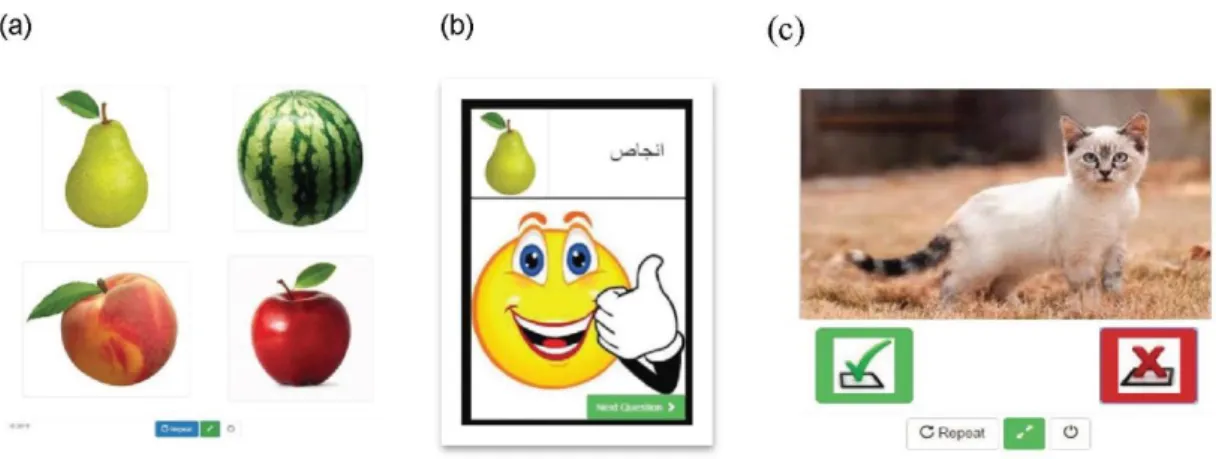
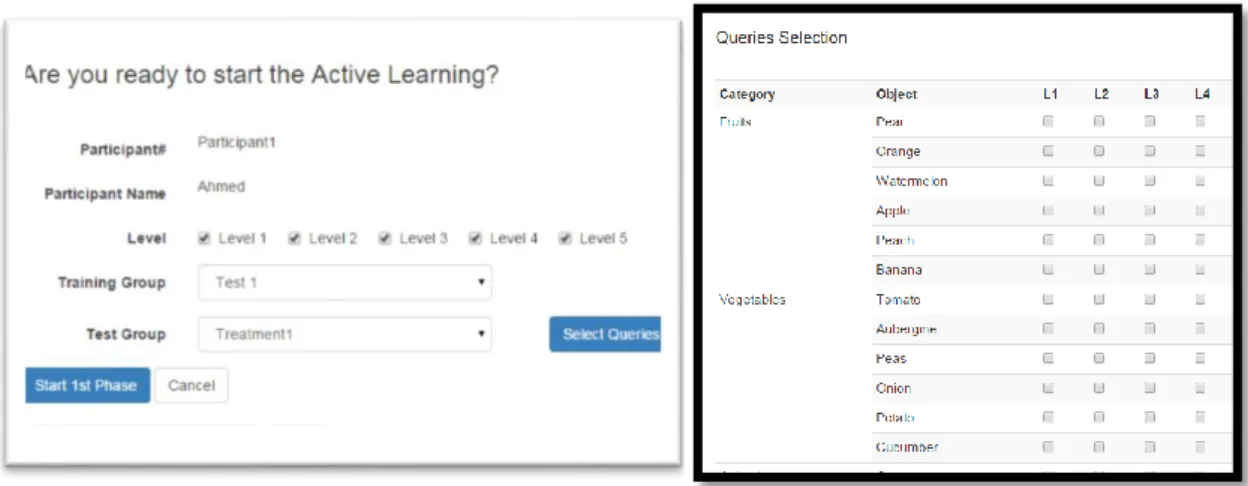
The procedure of an assessment trial was as follows: the application firstly presented an array of four objects (e.g., images of an apple, banana, pear and orange) on the tablet’s screen as shown in Figure 2.3(a). Second, the participant immediately heard an auditory stimulus through the tablet. Third, the child engaged in a response (e.g., pointing to or touching the picture on the screen of the tablet). A child was encouraged to respond as quickly as possible and did not receive any feedback on the accuracy of his response.
In a teaching label trial, the application started in a way, which is similar to that in the assessment trial. If the child chose a correct answer, the application gave visual (smileys) and acoustical reinforcement (applause) to reward learning as shown in Figure 2.3(b). The application also provided the written name, picture and auditory stimulus for the correct answer. If the given answer was incorrect (i.e. one of the distractors is chosen), the application gave a certain acoustical sound to indicate the wrong answer and the child was asked to try again. An incremental cue was presented by shaking the correct answer horizontally two times in order to help the child. If the child's response was again incorrect, he was then given another opportunity to answer by shrinking three distractors in order to emphasize the correct answer. Finally, if the child could not answer correctly, the correct answer was given and shown on the tablet’s screen.
Figure 2.3 : (a) Screen display of baseline, teaching and assessment trial. (b) The reward screen for the correct answer in a teaching trial. (c) Screen display of an
initial assessment trial. 2.3.6 System architecture
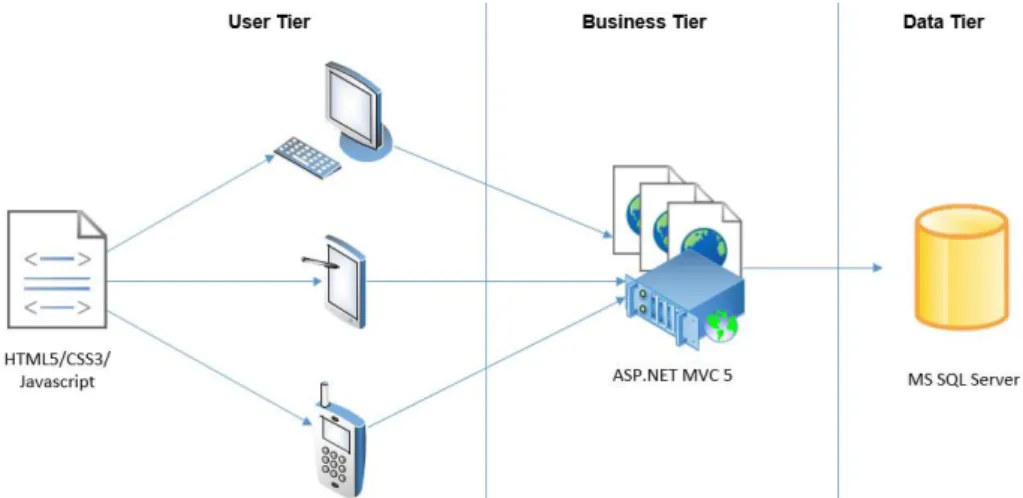
The system was designed and built as a web-based application. That design decision allowed for more flexibility to access the application from anywhere and using any