Chem 360 Jasperse Ch. 19 Notes + Answers. Amines 1
Reactions of Amines
1. Reaction as a proton base (Section 19-5 and 19-6)
R NH H N H H R H X H-X (proton acid) NaOH amine
base ammonium salt(acidic)
• Mechanism: Required (protonation)
• Reverse Mechanism: Required (deprotonation)
• Amines are completely converted to ammonium salts by acids • Ammonium salts are completely neutralized back to amines by bases
• Patterns in base strength: Reflect stabilization/destabilization factors on both the amine and the ammonium
o N lone pair: sp3 > sp2 > p
o For sp3 nitrogens, 3º > 2º > 1º
2. Reaction with Ketones or Aldehydes (Section 18-16,17 and 19-10)
R' R O aldehyde or ketone ZNH2, H+ R' NHZ OH R tetrahedral "aminol" H+, -H2O H2O, H+, -ZNH2 H2O, H+ imine R' R NZ Notes:
• “Z” can be a carbon, nitrogen, oxygen, or hydrogen atom/group. • The “aminol” can’t be isolated, it’s only present at equilibrium.
• Equilibrium factors apply. Water drives to the carbonyl side; removal of water drives to the imine side.
• Mechanism: Learned for last test (not tested this time)
Chem 360 Jasperse Ch. 19 Notes + Answers. Amines 2 3. Alkylation of 1º Alkyl Halides (Section 19-12, 19-21A)
R Br R N H H N H R H X ammonium salt R
3a. Polyalkylation is routine.
o With excess alkyl halide and base, keep on alkylating until it becomes the quaternary ammonium salt (no surviving H’s on nitrogen, examples below) .
Mechanism required for polylalkylations. The mechanism involves repetitive sequential SN2 alkylation-deprotonations. Ph NH2 3 CH3-Br NaHCO3 Ph N CH3 CH3 H3C Br NH 2 CH3CH2-Br NaHCO3 N Br Et3N Et3N CH2Ph Br PhCH2-Br
3b. Monosubstitution is possible when excess ammonia (or other cheap amines) is used.
• Mechanism for monosubstitution required. This involves simple SN2, followed by deprotonation by the excess amine.
Br excess NH3 NH2
4. Acylation with Acid Chlorides to From Amides: (Section 19-13, 20-15)
R N R1 O R2 H N R1 R2 R Cl O base required
(either excess amine, or NaOH or NaHCO3, or NEt3 or pyridine...)
• Mechanism: Required (addition-elimination-deprotonation)
• Amine must have at least one hydrogen to begin. But 1º, 2º, or NH3 all react well. • But 3º amines can’t work.
• Some base is required for the deprotonation step and to absorb the HCl. For cheap amines, excess amine can simply be used. Alternatively, amines with no H’s (triethylamine, pyridine) can be used. Or else NaOH or NaHCO3 can be used.
Chem 360 Jasperse Ch. 19 Notes + Answers. Amines 3
4b. Acylation with Carboxylic Acids to From Amides: (Section 20-12)
R N R1 O R2 H N R1 R2 R HO O heat
• Mechanism: Not Required
• Fairly high temperatures often required, and yields aren’t as good as with acid chlorides
• Biologically amine + acid → amide is routine, and is facilitated by complex enzyme mechanisms
5. Substitution for Aromatic Amines via the Diazonium Salts (“The Sandmeyer Reaction”) (Section 19-17, 18) ArNH2 NaNO2, HCl ArN2 Cl diazonium salt CuCN H3PO2 H2O, H+, heat ArCl CuCl ArBr CuBr ArCN ArOH ArH
• Mechanism: Not Required
• Qualitatively, can think of this as a nucleophilic substitution: a nucleophile replaces N2, a premier leaving group. The actual mechanism is probably radical, however. • Application in synthesis: The amine (an o/p director) is often derived from a nitro (a
meta director). Using the nitro group to direct meta, then reducing and converting the nitrogen into CN, Br, Cl, OH, or H, provides products we haven’t been able to make before.
Chem 360 Jasperse Ch. 19 Synthesis of Amines 4
Synthesis of Amines
6. From Aldehydes or Ketones: Reductive Amination (Section 19-19)
R R1 O Ketone or aldehyde + H N R3 R2 NaBH3CN cat. H+ R R 1 H N R3 R2 via R R1 N R3 R2 • Access: 1º, 2º, or 3º Amines
• Mechanism: Not required. (Basic workup)
• The carbonyl reactant can be an aldehyde or a ketone
• The amine reactant must have at least one hydrogen, as shown above; but R2 and/or R3 can be either a carbon or a hydrogen. Thus:
o NH3 → 1º RNH2 o 1º RNH2 → 2º R2NH o 2º R2NH→ 3º R3N o 3º R3N don’t react R R1 O Ketone or aldehyde + H N H R2 NaBH3CN cat. H+ R R 1 H N H R2 via R R1 N H R2 R R1 O Ketone or aldehyde + H N H H NaBH3CN cat. H+ R R 1 H N H H via R R1 N H H ammonia 1º amine 1º amine 2º amine R R1 O Ketone or aldehyde + H N R3 R2 NaBH3CN cat. H+ R R 1 H N R3 R2 via R R1 N R3 R2 2º amine 3º amine
7. Via Amides: (Section 19-20)
R N R1 O R2 LiAlH4 R N R1 R2
• No mechanism required for the reduction • Access: 1º, 2º, or 3º Amines.
• R1 and R2 can be either H or C. Thus, you can produce either 1º, 2º, or 3º amines in this way:
o RCONH2 → 1º RCH2NH2 o RCONHR→ 2º RCH2NHR o RCONR2 → 3º RCH2NR2
Chem 360 Jasperse Ch. 19 Synthesis of Amines 5 8. From Amines via Amides: (Section 19-20)
R N R1 O R2 LiAlH4 R N R1 R2 H N R1 R2 R Cl O + acylation R N R1 O R2 LiAlH4 R N R1 R2 H N R1 R2 R OH O + acylation heat • Access: 1º, 2º, or 3º Amines
• Acylation mechanism required (see reaction 4) but reduction mechanism not required.
9. Reduction of nitro compounds: (section 19-21C)
NO2
Fe, HCl NH2
• Access: 1º Amines only (especially aromatic amines) • No mechanism required.
• There are many other recipes for reduction of nitro compounds:
o Pd/H2, Ni/H2, Pt/H2,
o Fe/HCl, Zn/HCl, Sn/HCl
10. From 1º Alkyl Halides: Alkylation of Ammonia (Section 19-12, 19-21A) (See reaction 3).
R Br
excess NH3
R NH2
• Access: 1º Amines only
• Mechanism required. (see reaction 3b) • No change in number of carbons. • Excess NH3 prevents polysubstitution. 11. From Nitriles: Reduction of Nitriles (Section 19-21B)
R NH2 C N
R LiAlH4
• Access: 1º amines • Mechanism not required.
12. From Alkyl Halides: Via the Nitrile (Section 19-21B)
NH2 R
R CN R Br 1. KCN
2. LiAlH4
• Access: 1º Amines only • Mechanism not required. • One-Carbon chain extension!
Chem 360 Jasperse Ch. 19 Synthesis of Amines 6
Summary of Amine Syntheses
Route Reaction
Number
Source/
Precursor
Reagent
Available
Amines
Comments
1
#6
Aldehydes
or Ketones
R2NH, H+
NaBH3CN,
1º, 2º, or 3º
Amines
2
#7, #8
Amides
LiAlH4
1º, 2º, or 3º
Amines
3
#7, #8
Amines
(via Amide)
1.
RCOCl
(or RCO2H, heat)
2.
LiAlH4
1º ArNH2
4
#7, #8
Acid Chlorides
or Acids
(via Amide)
1.
RNH2
2.
LiAlH4
5
#9
ArNO2
Fe/HCl
1º ArNH2
6
#10
1º RCH2Br
NH3 (excess)
1º only,
with CH2
next to
nitrogen
Original
carbon
chain is
not
extended
1.
7
#12
1º RCH2Br
(via nitrile)
2.
KCN
3.
LiAlH4
1º only,
with CH2
next to
nitrogen
Original
carbon
chain is
extended
by one
carbon
8
#11
RCH2CN
LiAlH4
1º only,
with CH2
next to
nitrogen
Chem 360 Jasperse Ch. 19 Mechanisms 7 Mechanisms 1. Protonation NH2 H Cl NH3 Cl 1.-Reverse. Deprotonation N H H H OH NH2 3. Polyalkylation Ex: Ph NH2 3 Br NaOH Ph N Et Et Et Br Mech: Ph NH2 Br Ph N H Et H OH Ph NHEt Ph N H Et Et Ph NEt2 OH Ph N Et Et Et Br Br SN2 SN2 SN2 Deprotonate Deprotonate 3b. Monoalkylation OH Deprotonate Br NH3 SN2 NH3 NH2
Chem 360 Jasperse Ch. 19 Mechanisms 8 4. Acylation Ex: NH2 Cl O NaOH NH O
Mech: 3 steps: Addition-Elimination-Deprotonation
OH NH2 Cl O N H O N H H O Cl N H H O Add Elim Deprotonate
Chem 360 Jasperse Ch. 19 Notes + Answers. Amines 9 Formal Amine Nomenclature: X-alkanamine, N-alkyl-X-alkanamine, etc.
• Choose longest C-chain to which nitrogen is attached, and number from end nearer Nitrogen • The nitrogen does **not** count as a number itself. An alkyl substituent is “N-alkyl”… • Be sure to specify with a number to indicate which carbon has the nitrogen
• NH2 as a Substituent: “Amino”
Common Naming (for simple amines): Alkylamine, dialkylamine, trialkylamine….(ex Three Common Amine Names to Memorize
Name Structure N Atom Hybrid Lone-Pair Hybrid Aniline NH2 sp 2 p Pyridine N sp 2 sp2 Pyrrole NH sp 2 p
Some Other Famous Common Amine Names (No memory requirement) Name Structure Pyrrolidine NH Pyridine N H Purine N N N N H Pyrimidine N N RNA, DNA, ATP, and ADP are made from derivatives of Purine and Pyrimidine “Amino Acids” etc N N N N H H H H etc O O O R1 H R3 H R2 H H N OH H O R1H N OH H O H R2 H H N OH H O R3H Loss of Water Makes Amide Bonds, Polymers amide polymer "protein" "polypeptide" -The major natural amino acids all have "S" configuration
-20 major natural amino acids
-Under neutral conditions, the amine actually deprotonates the acid to give not an "amino acid" but actually an "ammonium carboxylate"
-The side groups "R" can be acid, basic, hydrophilic, or hydrophobic.
-The sequence or R groups on thepolymer
essentially spells out the biological activity of the protein.
H N O H O R1H H neutral pH H N OH H O R1H H acidic pH H N O H O R1H basic pH
Chem 360 Jasperse Ch. 19 Notes + Answers. Amines 10 Nomenclature. Draw the structure or provide the name for the following.
1. N-methyl-3-phenyl-2-octanamine HN CH3 2. Z-3-penten-1-amine NH2 3. 3-hexanamine NH2 4. pyridine N 5. NH2 CH3 H 2-methyl-1-butanamine 6. NH2 O
4-amino-2-pentanone (here, amino is substituent, ketone priority) 7. Structure and Hybridization. For each of the Nitrogens in structures below:
• circle the Nitrogen atom if the atom is sp3 hybridized; but a box around the Nitrogen
atom if it is sp2 hybridized.
• Then beside each Nitrogen atom write in the hybridization of the Nitrogen lone pair, • and the approximate bond angles (180, 120, 109, or 90) about the nitrogen atom.
N NH NH2 NH N N N N H N N CH3 sp3 sp3 sp3 sp2 sp2 sp2 sp2 p p p
8. Boiling Points. Rank the following in terms of boiling point, 1 being highest, 4 being lowest. OH OH NH2 N 1 H-bonding + molecular weight 4 no H-bonding 2 3
Alcohols H-bond themselves better than amines (because amine H is less positive
9. Water Solubility. Rank the following in terms of water solubility, 1 being most water soluble, 5 being least water soluble.
OH
OH NH2 O CH3
5 1
2 3 4
Chem 360 Jasperse Ch. 19 Notes + Answers. Amines 11
Acidity/Basicity Table 19.1: Neutral Acids and Anionic Bases
Class Neutral Acid Structure Ka Acid Strength Anion Base Base Strength Strong Acids H-Cl, HsSO4 102Cl O S O O HO , Carboxylic Acid R OH O 10-5 R O O Phenol OH 10-10 O 1,3-Dicarbonyl O OMe O 10-12 O OMe O ! Water HOH 10-16 HO Alcohol ROH 10-17 RO Ketones and Aldehydes O ! H 10-20 O ! Amine (N-H) (iPr)2N-H 10-33
(iPr)
2N Li
Alkane (C-H) RCH3 10-50 RCH2Quick Checklist of Acid/Base Factors
1. Charge
2. Electronegativity
3. Resonance/Conjugation 4. Hybridization
5. Impact of Electron Donors/Withdrawers 6. Amines/Ammoniums
When comparing/ranking any two acids or bases, go through the above checklist to see which factors apply and might differentiate the two.
When a neutral acids are involved, it’s often best to draw the conjugate anionic bases, and to think from the anion stability side.
Chem 360 Jasperse Ch. 19 Notes + Answers. Amines 12
Acidity/Basicity Table 19.2: With both Neutral and Cationic Acids and both
Neutral and Anionic Bases
Class Structure Ka Acid Strength Base Base Strength Strong Acids H-Cl, H2SO4 10 2 Cl O S O O HO , Smell Awful! Hydronium H3O+ , ROH+ cationic 100 H2O, HOR neutral Humans Carboxylic Acid R OH O 10-5 R O O Cuz Phenol OH 10-10 O People Ammonium Ion (Charged) R N R H R
Charged, but only weakly acidic!
10-12
R N R R
Neutral, but basic!
Against Water HOH 10-16 HO Working Alcohol ROH 10-17 RO Are Ketones and Aldehydes O ! H 10-20 O ! Kingdoms Amine (N-H) (iPr)2N-H 10-33
(iPr)
2N Li
Animal Alkane (C-H) RCH3 10-50 RCH2 All Notes to remember1. Average neutral amine a thousand billion times more basic than a neutral oxygen
(electronegativity factor)
2. An average neutral amine is thousands of times less basicthan non-resonance stabilized
hydroxide or alkoxide anions (charge factor)
3. But average neutral amine millions of times more basic than highly resonance-stabilized
carboxylate anion (resonance factor trumps charge factor in this case)
4. Ammonium cations are million of times less acidic than neutral carboxylic acids, but are more acidic than neutral water/alcohol!
5. Neutral amine can completely deprotonate carboxylic acids, but not water or alcohols. 6. Therefore hydroxide can deprotonate ammoniums, but carboxylates cannot.
Chem 360 Jasperse Ch. 19 Notes + Answers. Amines 13
More Detailed Discussion of Acid/Base Patterns/Factors to remember
1. Charge
• Nonfactor on Table 19.1, since all of the “acids” have the same charge (neutral) • In Table 19.1, all of the “bases” have the same charge (anion, single negative charge) • Normally, all else equal, cations are more acidic than neutrals, and anions more
basic than neutrals. (See Table 19.2)
2. Electronegativity:
• Acidity: H-X (halogen) > H-O > H-N > H-C • Basicity: X < O < N < C
• Anion Stability: X > O > N > C 3. Resonance/Conjugation:
• Oxygen Series:
Acidity: sulfurice acid > carboxylic acid > phenol > alcohol
O S O O HO Anion Basicity: O O O O < < < O S O O HO O O O O > > > Anion Stability: • Carbon Series:
o Acidity: 1,3-dicarbonyl > ketone (monocarbonyl) > alkane
o Anion Basicity: O OMe O O < < o Anion Stability: O OMe O O > > • Nitrogen Series:
o Acidity: amide > amine
o Anion Basicity: NH O NH < o Anion Stability: NH O NH >
• Note: Resonance is often useful as a tiebreaker (for example, molecules in which both have O-H bonds and both have equal charge, so that neither the charge factor nor the electronegativity factor could predict acidity/basicity)
• NOTE: Resonance can sometimes (not always) trump electronegativity or even charge.
o Example of resonance versus electronegativity: a C-H with carbonyl
resonance (ketone/enolate case) is more acidic than an N-H with no resonance help but less acidic than an O-H with no resonance help. A C-H with two
Chem 360 Jasperse Ch. 19 Notes + Answers. Amines 14 carbonyl resonances (a 1,3-dicarbonyl case) is more acidic than even an O-H that has no resonance help.
o Example of resonance versus charge: A carboxylate anion, with serious resonance stabilization, ends up being so stabilized that it is even less basic than a neutral, uncharged amine! A hydrogen sulfate anion from sulfuric acid is less basic than not only neutral amines but also neutral oxygen (water, etc.) 4. Hybridization:
For lone-pair basicity, (all else being equal), sp3 > sp2 > sp > p
NH2 O NH2 N H3C C N sp3 sp2 sp p > > > Neutral Nitrogen Series CH2 O CH2 H3C C C sp3 sp2 sp p > C > > Carbanion Series O O O > sp3 p Oxygen Anion Series
This means that for acidity, alkynes > alkenes > alkanes 5. Electron donating/electron withdrawing substituents:
Electron withdrawing substituents will stabilize negatively charged anions, but will destabilize positively charged cations.
o This means a withdrawer will increase the acidity of a neutral acid because it will stabilize the resulting anion.
o This means a withdrawer will decrease the basicity of a neutral base because it will destabilize the resulting cation
Electron donating substituents will stabilize positively charged cations, but will destabilize negatively charged anions.
o This means a donor will increase the basicity of a neutral base because it will stabilize the resulting cation. The resulting cation will be less acidic.
Cation Acidity: Basicity: Cation Stability: H NH3> R NH3 H NH3 R NH3 < H NH2< R NH2
ammonia alkyl amine
o This means a donor will decrease the acidity of a neutral acid because it will destabilize the resulting anion, and will increase the basicity of the anion
Anion Basicity:
Acidity: H O H > R O H H O > R O Stability:Anion H O > R O water alcohol
6. Ammonium Cations as Acids and Neutral Amines as Bases
Neutral amines are more basic than any neutral oxygen (electronegativity factor)
Neutral amines are less basic than most anionic oxygens, including alkoxides, hydroxides (charge factor)
However, neutral amines are more basic than highly resonance-stabilized carboxylate anions (in this case, resonance factor trumps the charge factor).
Chem 360 Jasperse Ch. 19 Notes + Answers. Amines 15
Table 9.3 Relative Basicity of Different Classes of Neutral Nitrogen Compounds.
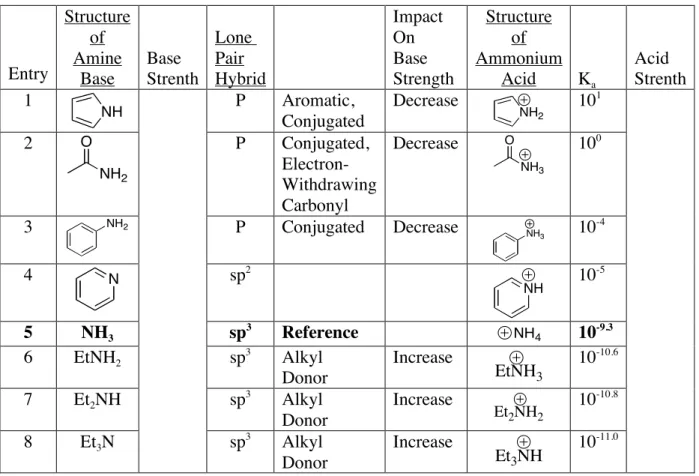
Entry Structure of Amine Base Base Strenth Lone Pair Hybrid Impact On Base Strength Structure of Ammonium Acid Ka Acid Strenth 1 NH P Aromatic, Conjugated Decrease NH2 10 1 2 NH2 O P Conjugated, Electron- Withdrawing Carbonyl Decrease NH3 O 100 3 NH2 P Conjugated Decrease NH3 10 -4 4 N sp2 NH 10 -5 5 NH3 sp 3 Reference NH4 10-9.3 6 EtNH2 sp3 Alkyl Donor Increase EtNH3 10 -10.6 7 Et2NH sp 3 Alkyl Donor Increase Et2NH2 10 -10.8 8 Et3N sp3 Alkyl Donor Increase Et3NH 10 -11.0
General Amine Basicity Patterns.
a. Relative basicity correlates Lone pair hybridization: sp3
(entries 5-8) > sp2
(entry 4) > p (entries 1-3) (hybridization factor)
b. Within the sp3
amines, increasing alkyl substitution increases basicity (entries 5-8): 3º > 2º > 1º > NH3 (electron donating group factor)
Note: patterns (a) and (b) essentially cover everything.
c. Amides are much less basic than amines, or even other nitrogens with p-lone pairs (less than amines reflects hybridization and conjugation; amides are less basic than other p-hybrid conjugated lone pairs because or the electron-withdrawing group factor).
d. Conjugated nitrogens are in general less basic than isolated nitrogens (both hybridization and conjugation factors)
• Note: The acidity of conjugate ammonium cations (conjugate acids relative to the amines) is directly and inversely related to the basicity of the neutral amines. • Key: remember patterns (a) and (b) above. That should help you solve relative basicity
problems. If given ammoniums, draw the related conjugate neutral amines, rank them as bases, and realize that the strongest amine base relates to the weakest ammonium acid. • You should be able to handle any ranking problems involving either amines as bases or their
Chem 360 Jasperse Ch. 19 Notes + Answers. Amines 16
Explanation for Basicity Pattern: Acidity/Basicity is an equilibrium measurement, and thus reflects both product stability and starting material stability.
H N H H N H H H H B N C B N C H A A
• Anything that stabilizes the cation increases the basicity of the nitrogen • Anything that destabilizes the cationdecreases the basicity of the nitrogen
• Anything that stabilizes the aminedecreases the basicity of the nitrogen (especially if that stabilizing factor is sacrificed upon protonation)
• Anything that destabilizes the amine increases it’s basicity
• When lone pair is p, that always reflects stabilizing conjugation and reduced basicity. This is the origin of both the p-hybridization factor and the resonance/conjugation factor.
Entry Base Conjugate Cation Substituent And it’s Impact
Why: Which Side
Is Stabilizied or Destabilized? 5 NH3 NH4 + Reference 6-8 Et3N Et3NH+ Alkyl Groups Increase Basicity
Cation side stabilized by alkyl groups (electron donors, cation stabilizers) 1
NH NH2 Being part of
Aromatic ring Reduces Basicity
Neutral side is stabilized
by aromaticity. (Aromaticity is lost following protonation.) 2 NH2 O NH3 O Acyl/Amide Conjugated To Carbonyl Neutral side is
stabilized by conjugation to the carbonyl. That conjugation is lost following protonation. Second, the
cation side is destabilized by the strongly electron withdrawing carbonyl group. 3 NH2 NH3 Conjugated To Aromatic
Neutral side is stabilized
by conjugation. (That conjugation is lost following protonation.)
5 N N H Aromatic. Part of Aromatic Ring
Amine side is stabilized by the sp2 hybridization of the lone pair. An sp2
lone pair is shorter than an sp3 orbital. The shorter sp2
orbital means the electrons are nearer and held more tightly by the nitrogen nucleus, and are thus more stable.
Chem 360 Jasperse Ch. 19 Notes + Answers. Amines 17 Choose the More Acidic for Each of the Following Pairs: Single Variable Problems
10. NH3 NH4
The ammonium. Charge factor.
11. OH2 OH The cation. Charge factor.
12. OH NH2 CH3
1 2 3
Electronegativity factor.
13. OH OH
O
The acid. Resonance factor.
14. NH2 NH
2 O
The amide. Resonance factor.
15. Ph NO2 Ph O Ph O OMe O
1-2-3. Electron donor/withdrawer factor. Nitro withdrawer stabilizes anion; methoxy donor destabilizes anion.
1-2-4.
Choose the More Basic for Each of the Following Pairs (Single Variable)
16. NH3 NaNH2 Charge factor, second structure
17. NaOH H2O NaOH, charge factor.
18. NH3 H2O Ammonia. Electronegativity factor.
19. Ph O Ph O
O
Alkoxide. Resonance factor.
20. Ph NO2 Ph O Ph O OMe O
3-2-1. Donor/withdrawer factor. Nitro withdrawer stabilizes, methoxy donor destabilizes.
21. NH2 NH3 O2N NH2
1 - 2 - 3 Donor/withdrawer. Alkyl is donor, nitro is withdrawer.
Choose the More Basic for Each of the Following (Multiple Variables, apples and oranges…)
22. NH3 O Alkoxide. Charge trumps electronegativity.
23. O Ph
O
Enolate. Resonance isn’t enough to outweight electronegativity.
24. O Ph
O O
Alkoxide. Resonance is so good that even a C anion beats the O anion.
Chem 360 Jasperse Ch. 19 Notes + Answers. Amines 18 Choose the More Basic for Each of the Following Pairs
25. NH3 NaNH2
Charge factor. NaNH2.
26. NH3 NaOH
NaOH. Charge factor outweighs electroneg.
27. NH3 H2O
NH3. Electroneg factor.
28. NH3 CH3OH
NH3. Electroneg factor.
29. NH3 O
Alkoxide. Charge factor.
30. NH3 O
O
Ammonia. The anion is so stabilized by resonance that the neutral amine is more basic.
31. NH3 Cl O S O O HO or
Ammonia. Both of these “strong acid” anions are so stable that they don’t function as bases.
32. NH3 CH3MgBr
Grignard. C anion. Charge factor.
33. NH3 CH3NH2
CH3NH2. Donor effect.
34. For the following sets of bases, rank them, 1 being the most basic.
a. CH3MgBr CH3NHNa CH3NH2 CH3OH
1 2 3 4
Carbanion N anion N neutral O neutral
So we see both the charge factor and the electronegativity factors at play.
b. O O
O
CH3NH2 OH
1 3 2 4
Anion, no res Anion, with res Neutral, Nit Neutral, Ox Alkoxide with charge is stronger than neutral nitrogen. But carboxylate with resonance is weaker than neutral nitrogen. Neutral oxygen is weakest (loses all charge and electroneg wars)
Chem 360 Jasperse Ch. 19 Notes + Answers. Amines 19
35. Amine Basicity. For the following pairs or sets of bases, rank them, 1 being the most basic.
a. NH NH
Second thing is stronger. Hybridization factor. Sp3 nitrogen versus p nitrogen.
b. NH2 NH2
O
First thing is stronger. Hybridization factor. Sp3 nitrogen versus p nitrogen.
c. benzamide [PhC(O)NH2] aniline (PhNH2) pyridine triethylamine 4 3 2 1 sequence. The first two are p hybrids, pyridine is sp2, triethylamine is sp3
(hybridization factor). The tie-break between the first two is that amides are weaker, the result of the electron-withdrawing carbonyl.
d. triethylamine ethylamine ammonia
1 2 3. All three are sp3, so 3º > 1º > ammonia, as a result of the electron donor substituents.
e. dimethylamine methylamine aniline (PhNH2) 1 2 3. First two are both sp3, latter p. So hybridization factor sets aniline apart. Dimethylamine is 2º, so donor factor makes it more basic.
f. MeO NH2 H NH2 O2N NH2 1 2 3. Donor/withdrawer factor. g. NH2 NH2 NH2 F F F 1 2 3 Donor/withdrawer factor. h. triethylamine NaOH 2 1. Charge factor.
i. methanol methylamine methane
2 1 3. Electroneg factor. Methane has no lone pair, so is totally non-basic.
j. CH3MgBr CH3NHNa CH3ONa CH3NH2 CH3CO2Na CH3OH
1 2 3 4 5 6
Chem 360 Jasperse Ch. 19 Notes + Answers. Amines 20
36. Rank the acidity of the following compounds, 1 being most acidic. a. H3O+ NH4+Cl- water acetic acid (CH
3CO2H) NH3
1 3 4 2 5
Charge factor, electronegativity factor, and resonance factor all impact.
Of the three neutrals, acetic acid is most due to resonance, ammonia least due to electroneg. Of the two cations, hydronium is stronger than ammonium (electronegativity).
Ammonium ion is weaker than carboxylic acid (due to carboxylate resonance trumping charge factor)
b. H3O+ acetic acid (CH
3CO2H) Me3NH+Cl- ethanol
1 2 3 4
Charge, electroneg, and resonance.
Acetic acid is stronger than ammonium due to resonance on resulting carboxylate. c. NH4+Cl- Me3NH+Cl- PhNH3+Cl
-2 3 1
Hybridization and donor effect. #1 wins because it produces aniline, which has p hybridization and is stabilized by conjugation. #2 and #3 both produce sp3 lone pairs. #3 is least acidic because of the alkyl donors, which stabilize the cation.
37. Suppose all of the molecules A-D are dissolved in diethyl ether.
OH OH O OH NHMe D C B A a. Which one or ones will extract (dissolve) into aqueous sodium hydroxide? (And why?) Answer: B and C.
Key: An organic will move into the organic phase if it is ionized.
Why: B and C give resonance stabilized anions that are more stable than hydroxide. Hydroxide is unable to deprotonate A and D, since that would result in anions less stable than hydroxide. Since they stay neutral, they stay in the organic layer.
b. Which, if any, will extract into aqueous hydrochloric acid? (And why?) Answer: D.
Key: An organic will move into the organic phase if it is ionized.
Why: Amine D is protonated in acid to give a water soluble ammonium ion. The oxygen compounds are not protonated and ionized by acidic water; since they stay neutral, they stay in the ether layer.
c. Which, if any, will extract into neutral water? (Why or why not?) Answer: None.
Key: an organic will move into the organic phase if it is ionized.
Why: Neutral water neither protonates nor deprotonates the compounds. They all stay neutral, so they all stay in the organic layer.
d. Explain how you could use an extraction scheme to separate D from A.
• Dissolve in ether.
• Treat with aqueous acid, which protonates/ionizes D but not A. • Separate layers.
• Concentrate the organic phase; get pure A. • Add base to the aqueous layer, to convert DH+
back to neutral D. In it’s neutral form, amine D will no longer be soluble in water, and will either crystallize out or can be extracted out with an organic solvent.
Chem 360 Jasperse Ch. 19 Notes + Answers. Amines 21
Draw the Products of the following Amine reactions.
38. 4-phenyl-2-hexanone, H+ PhNH2 NPh Ph 39. Cyclohexanone + H2NNH2 NNH2 40. Me3N + PhCH2I N CH3 CH2Ph CH3 H3C I 41. Ph NH2 excess Bromoethane NaOH N CH2CH3 CH2CH3 CH2CH3 Ph Br 42. PhCH2Br Excess NH3 Ph NH2 43. NaOH H2N Br HN IntramolecularSN2 44. Cl O PhNH2 PhHN O 45. Ph Cl O + N-methylbutanamine Ph N O 46. Ph OH NH2 O + heat Ph N H O
Chem 360 Jasperse Ch. 19 Notes + Answers. Amines 22 47. 1. HNO3, H2SO4 2. Br2, Fe 3. Fe, HCl 4. NaNO2, HCl 5. CuCl Br Cl 48. 1. HNO3, H2SO4 2. Fe, HCl 3. NaNO2, HCl 4. CuCN 5. KMnO4 CO2H CN 49. NH2 Br Br 1. NaNO2, HCl 2. H3PO2 H Br Br 50. NH2 H3C 1. NaNO2, HCl 2. H2O, H2SO4, heat OH H3C Design Synthesis 51. CN Br 1. HNO3, H2SO4 (installs nitro group, meta director)
2. Br2, FeBr3 (installs bromine in the meta position) 3. Fe, HCl (reduces nitro to amine)
4. NaNO2, HCl (converts amine to diazo)
5. CuCN (replaces N2 group with CN)
52.
1. Cl2, FeCl3 (installs chlorine in the meta position) 2. Fe, HCl (reduces nitro to amine)
3. NaNO2, HCl (converts amine to diazo) 4. H2O, H2SO4, heat (converts diazo to OH)
Cl
OH Nitrobenzene
Chem 360 Jasperse Ch. 19 Notes + Answers. Amines 23
19.14 Reaction with Sulfonyl Chlorides: and the Hinsberg Test
N H + Cl S R O O S R O O N -HCl Sulfonamide
• Exactly as for amide formation
• Many antibiotic drugs: sulfonamides are so similar to amides that they occupy enzyme active sites prevent bacterial growth
Sulfonamides and the Hinsberg Test for 1º/2º/3º Amines Keys:
• Sulfonamides are Nonbasic
• Sulfonamides in which the nitrogen has a hydrogen are acidic
N H + Cl S R O O excess NaOH Basic Conditions: Soluble or Insoluble? excess HCl Acidic Conditions: Soluble or Insoluble? Starting Amine Derived
Sulfonamide Basic Conditions Acidic Conditions
1º Amine S R O O N R H S R O O N R Soluble S R O O N R H Insoluble 2º Amine S R O O N R R S R O O N R R Insoluble S R O O N R R Insoluble
3º Amine None Can Form R N
R R Insoluble N R R R H Soluble
Chem 360 Jasperse Ch. 19 Notes + Answers. Amines 24
Synthesis of Amines: Draw the products for the following reactions.
53. O NaBH3CN, H + + MeNH2 NHMe 54. NaBH3CN, H+ O + NH3 NH2 55. NaBH3CN, H+ + MeNH2 Ph O Ph NHMe 56. OH 1. PCC 2. PhMgBr; H3O+ 3. H2CrO4 4. PhNH2, NaBH3CN, H+ Ph NHPh 57. NH O LiAlH4 NH 58. NH2 Cl O 1. 2. LiAlH4 H N 59. Ph Cl O 1. MeNH 2 2. LiAlH4 Ph NHMe 60. Ph Br 1. NaCN 2. LiAlH4 Ph NH2
Chem 360 Jasperse Ch. 19 Notes + Answers. Amines 25
61. Come up with various pathways (4 good ones) to the following 1º amine:
NH2 1º amine Br excess NH3 O NH3 NaBH3CN, H+ Br 1. NaCN 2. LiAlH4 LiAlH4 NH 2 O Cl O NH3
62. Come up with pathways (4 good ones) to the following 2º amine:
H N 2º amine or or H N H N O O LiAlH4 LiAlH4 H2N O O NH2 + + NaBH3CN, H+ NaBH3CN, H+ Cl O H2N Cl O NH2
Chem 360 Jasperse Ch. 19 Notes + Answers. Amines 26
Provide Reagents for the following Transformations.
63. N H O NH2 NaBH3CN, H+ 64. OH NMe 2 1. PCC 2. Me2NH, NaBH3CN, H+ 65. Ph Cl O Ph NH2 1. NH3 2. LiAlH4 66. O NH2 Cl O AlCl3 1. HNO3, H2SO4 2. Zn(Hg), HCl 3. Fe, HCl
(either order, steps 2 and 3)
67. Ph Br Ph NH2 excess NH3 68. Ph Br Ph NH2 NaCN Ph CN LiAlH4