Cosigned Or Group Loans June 2004
Philip Bond, University of Pennsylvania Ashok S. Rai, Williams College Abstract
We analyze lending contracts when social sanctions are used to enforce repayments and borrowers di¤er in their unobserved sanctioning abilities. Symmetric group loans are preferred to cosigned loans when borrowers are relatively equal, and cosigned loans are preferred when borrowers are unequal. This explains why microlenders that target the poor (e.g., the Grameen Bank) use symmetric group loans while other untargeted lenders use cosigned loans. Complicated menus of loan contracts that induce borrowers to self select can do no better than these simple loan contracts unless borrowers are very productive. In particular, we explain why group lending arrangements o¤ering di¤erent loan terms to members of the same group are seldom observed.
JEL Codes: O16, D82
Keywords: Microcredit, Social Sanctions, Grameen Bank.
1
Introduction
The Grameen Bank and its group lending contract has received substantial academic attention in recent years. Grameen makes symmetric group loans: identical loans are made to a group of borrowers and all are punished if one does not repay. It is now well established that symmetric group loans can do better than individual loans
0Corresponding author. Department of Economics, Fernald House, Williams College, Williamstown, MA 01267. Fax: (413) 597-4045. Email: [email protected]
(Ghatak and Guinnane (6)). But symmetric group loans are just one way of lending to individuals who have insu¢ cient collateral of their own. Asymmetric group loans, in which group members are given di¤erent loan terms, are also a possibility — but these are seldom observed except in their most extreme form: cosigned loans. In a cosigned loan, a borrower provides a cosigner who does not receive a loan but is punished if the borrower does not repay. Such arrangements are ubiquitous.1
In other words, symmetric group loans and cosigned loans are extremes on the continuum of joint liability lending. In this paper we …rst compare these two com-monly observed loan contracts. Under what circumstances will we observe symmetric group loans? And conversely, when will we observe cosigned loans? Then we ask why only the extremes are observed, i.e., why group lending schemes seldom o¤er di¤erent loan terms to members of the same group.2
Our paper builds on Besley and Coate (4)’s in‡uential model of how socially sanctioned punishments can be used to enforce repayment. These sanctions include social ostracism, shame, and exclusion from informal insurance networks, and are widespread in villages and other close-knit communities.3 Borrowers potentially 1Co-signed loans have been around at least since 19th century Germany (Banerjee et al (3)). The distinction between cosigned loans and group loans is made in the literature but not theorized (Ghatak and Guinnane (6)).
2Leading microlenders such as the Grameen Bank, BancoSol in Bolivia, the Bank for Agriculture and Agricultural Co-operatives in Thailand and the Kenya Rural Enterprise Program all make group loans that are symmetric.
3Social sanctions form the basis of informal contract enforcement (see Greif (7) for a review). Recent evidence suggests social sanctions can help explain the high repayment rates of microlenders. Karlan (8) …nds that Peruvian groups with social ties are more likely to repay than groups without social ties. He also …nds that groups with social ties are more likely to ostracize defaulters. Ahlin and Townsend (1) …nd that Thai villages where borrowers report that they will be excluded from informal village credit markets if they do not repay the microlender have higher repayment rates than villages where borrowers do not report these socially sanctioned punishments.
di¤er both in their sanctioning abilities and in their susceptibility to social sanctions. We refer to borrowers as strong and weak, where strong borrowers have higher sanc-tioning ability/lower susceptibility to sanctions than weak borrowers. Consequently weak borrowers have a higher willingness to repay, since they are threatened with tougher sanctions ex post. In practice, however, sanctioning abilities and suscepti-bilities are di¢ cult for an outside lender to observe. It is in such a private information environment that we analyze cosigned and group loans.
When would we expect cosigned loans to be used instead of group loans? If one of the borrowers does not have an investment opportunity, then there is no point in lending to both, and so cosigned loans are trivially the best option. But we show that even when both borrowers have investment opportunities, cosigned loans are preferred to group loans when borrowers are su¢ ciently unequal in sanctioning ability. Conversely, if borrowers are relatively equal, then symmetric group loans are preferred. Since microlenders target the poor, their borrowing pool is relatively equal in its sanctioning ability compared with an untargeted lender’s. Just as the theory predicts therefore, we see microlenders make symmetric group loans. We therefore address a puzzle posed by Ray (13): microcredit schemes build on horizontal links between villagers (group loans) instead of vertical links (cosigned loans).
Why are only the extremes of symmetric group loans and cosigned loans observed in practice? After all, in making a symmetric group loan, a bank is forced to “level down”the loan size to a point at which even the member who faces the least signi…cant social sanction still repays. In contrast, with an asymmetric group loan the bank could provide more funds to borrowers who face larger sanctions in the event of default. Ideally the bank would like to design a lending scheme that induces borrowers to (at least partially) reveal their sanctioning abilities and susceptibilities, and so lend more than in a symmetric group loan. We show, however, that unless borrowers are very productive no group lending scheme will achieve this. So conditional on making
a group loan, the bank will make a symmetric group loan.
In contrast to the di¢ culties of trying to treat borrowers di¤erently under private information while giving both a loan, if the bank instead only makes a single cosigned loan then private information ceases to have any bite at all. Private information is so much less of an impediment in cosigned lending than in group lending for the following reason. With cosigned loans, an individual will clearly never cosign a loan that he anticipates being defaulted on. But all cosigners are themselves loan recipients in an asymmetric group loan. So they may all may end up with positive utility even if default ensues.
In contrast to the adverse selection or moral hazard problems that have been the focus of the microcredit literature, our paper deals with limited enforcement.4 Even
though many believe that enforcement di¢ culties are a crucial reason for …nancial constraints in developing countries, there have only been a few papers on this topic.5
As mentioned, Besley and Coate (4) is the closest study to ours. They study lend-ing contracts with symmetric borrowers, and so neither asymmetric group loans nor cosigned loans arise in their model. In contrast, the potential borrowers in our model have unequal and unobserved sanctioning abilities. This allows us to study a richer
4This literature on adverse selection and moral hazard includes Armendariz and Gollier (2), Banerjee et al (3), Ghatak (5), La¤ont (11), Rai and Sjöström (12), and Stiglitz (14), among others. In all of these papers, borrower returns are contractible, i.e., borrowers will repay as long as they have enough funds to do so. In our paper, by contrast, borrowers must beinduced to repay by threatening punishment, e.g., the seizure of collateral by the bank or social sanctions imposed by other villagers. (Note also that the private information in these papers is on the riskiness of borrower projects, e¤ort levels, or ability to repay; while the private information in our paper is on the borrower’s willingness to repay).
5Besley and Coate (4) and La¤ont and N’Guessan (10) study limited enforcement in microcredit contracts. Ligon et al (9) provide evidence for how limited enforcement constrains insurance in South Indian villages.
set of contracts for which symmetric group loans and cosigned loans are special cases. We proceed as follows. In section 2 we describe the basic model and show that either cosigned loans or asymmetric group loans are e¢ cient when the bank has full information on borrower types. In sections 3 and 4, we assume that the bank cannot observe borrower types. In section 3, we compare the simple loan contracts we observe (cosigned loans and symmetric group loans) and establish that cosigned loans are preferred whenever borrowers are su¢ ciently heterogeneous. In section 4
we establish circumstances under which more general loan contracts are ine¤ective in preventing strong borrowers from pretending to be weak and defaulting on the bank. In section5 we illustrate our results with a simple numerical example. We conclude in section 6.
2
The economy
There are two agents, i 2 f1;2g; and a bank. As in much of the literature, we will assume a non-convex production possibility set to motivate credit constraints. Let be the unequal investment level. Each agent can invest xi in a project with certain rate of return > 1: If an agent has xi < he must use a costless storage technology. Letf(xi)denote output from input xi:
f(xi) = 8 < : xi if xi xi if xi < :
Aside from their unequal abilities to impose social sanctions on each other, which we discuss in detail below, agents areex ante identical. They have no funds of their own to invest. Each agent has collateralc. The bank can threaten to seize this collateral if the borrower does not repay; in such cases, the bank can sell the collateral for an amount c.
To make the problem of interest, we assume throughout that
c < : (1)
That is, borrowers do not possess enough collateral to raise directly.
Agents can also impose sanctions on each other. We model these sanctions in the same fashion as Besley and Coate (4) as an exogenous social norm. Speci…cally, it is socially acceptable for one agent to sanction another if the other agent’s action causes harm, and not otherwise. In the context of credit, this means that agent 1
can sanction agent2 if agent2’s action causes the bank to seize collateral from agent
1; and vice versa.
We denote the combined social sanctioning ability of the two agents by s. By analogy with physical collateral, and in line with common usage, we often refer tosas social collateral. In this paper our main focus is on the consequences of di¤erences in sanctioning ability across the two agents: one agent can impose sanctions of s, while the other can impose sanctions of (1 )s s, where 2 [0;1=2] is a measure of how similar the two agents are in terms of sanctioning abilities. Throughout, we refer to the agent with sanctioning ability s as the weak agent, and to the agent with sanctioning ability(1 )s as the strong agent.6
It is natural to assume that the sanction imposed on an agent is no more than the harm he has caused:
s cand (1 )s cfor all : (2)
Throughout the paper we assume s c, which guarantees that (2) holds.
One interpretation of is as a measure of sanctioning ability. For example, a villager may have a plot of land that is upstream from another, and so can sanction
6Notice that the strong and weak agents have the same endowment of collateral c. Provided collateral endowments are observable by the bank, this assumption could be straightforwardly relaxed without qualitatively changing our results.
the downstream villager by restricting irrigation water. In such a situation, we would refer to the upstream villager as strong and the downstream villager as weak. Two alternative interpretations of (that are equally valid for the results that follow) are: 1. Agents di¤er in their susceptibility to sanctions. For example, agent 1may be more susceptible to social ostracism than agent2: In other words, even though their sanctioning abilities are exactly the same, agent 1 is e¤ectively punished more than agent 2 by the same sanction. For example, agent 1 may have a shop at the village center, and so may indeed be more prone to social ostracism (loss of sales in his shop) than another villager.
2. Agents have the same sanctioning ability (s) but di¤erent skills in renegotiating the imposition of social sanctions. Suppose agent2fails to repay and the bank seizes cfrom agent1as a consequence. Agent1is now in a position to impose a sanction s on agent 2. Then the agents have the incentive to renegotiate: they would be collectively better of if no sanction were imposed. This is a standard split-the-surplus game. If denotes agent1’s bargaining power, then the outcome is for agent2to pay (“bribe”) agent 1an amount sin return for not imposing the sanction. Conversely, if agent 1’s bargaining power is 1
then agent 2 pays a bribe of (1 )s. The net e¤ect is that a weak (strong) agent faces a welfare loss of (1 )s ( s) if he causes harm to the other agent.
The bank o¤ers loan contracts (xi; Ri; i( )) for each i 2 f1;2g, where xi is the loan size, Ri is the repayment amount, and i(t1; t2) indicates if collateralc is seized
from agent i when borrowers transfer t1 and t2 to the bank: if i(t1; t2) = 1 then
collateral is seized, while if i(t1; t2) = 0no collateral is seized.7 In other words, the 7More generally we could allow the bank to seize a fraction of collateral c but that would not change our results.
-Investment Production Repayment Punishment
iinvestsxi Outputf(xi) irepaysti2[0; f(xi)] Bank seizes collateral
Agents imposes sanctions
Figure 1: Basic Timeline
bank can impose a punishment of c directly on borrowers. The timing is as shown in …gure 1.
First consider individual loans. The seizure rule for agent 1 is independent of whether agent 2repays, and vice versa:
i(t1; t2) = 8 < : 1 if ti < Ri 0 otherwise :
Consequently the maximum that can be recovered from each agent isRi c: A loan of at least to either agent is infeasible by assumption (1). So lending is impossible with individual loans.
Next we distinguish between two types of joint liability lending: cosigned loans, where only one agent receives a loan and the other is a cosigner, and group loans where both agents receive a cosigned loan (and consequently both are cosigners). In both these loan contracts, the bank can seize collateral worth c but agents can also impose punishments on each other worth s and (1 )s:
A cosigned loan to agent 1with agent2 as cosigner has the following seizure rule, where collateral is seized from both if the loan is not repaid:
1(t1; t2) = 2(t1; t2) = 8 < : 1 if t1 < R1 0 otherwise :
The seizure rule for a group loan to agents1and2stipulates that ifeither agent does not repay, then collateral is seized from both:
1(t1; t2) = 2(t1; t2) = 8 < : 1 if t1 < R1 or t2 < R2 0 otherwise :
Without loss, for the remainder of this section we assume that agent 1 is the weaker agent, and agent 2 is the stronger agent. So if the bank o¤ers a group loan with R1; R2 >0, then the repayment game is given below:
Borrower 2’s repayment
R2 0
R1 R1; R2 R1 c; c s
Borrower1’s
repayment 0 c (1 )s; R2 c c; c
If the required repayments R1 and R2 satisfy
R1 c+ (1 )s and R2 c+ s (3)
then it is an equilibrium for both borrowers to repay. (In this case there is also an equilibrium in which both borrowers default. We shall restrict attention to a weak repayment constraint: whenever there are multiple equilibria, we focus on the repayment equilibrium.)8
Any loan (xi; Ri) the bank makes to agent i 2 f1;2g must give non-negative utility,
f(xi) Ri 0 (4)
and repayments must be feasible
Ri f(xi) (5)
8Multiple equilibria arise in the same way in Besley and Coate (4), who also focus on the equi-librium in which both repay. Alternatively, if borrowers were to impose social sanctions on each other when both default, then the repayment game would have a unique equilbrium.
We now turn to the bank’s contract design problem. We take the bank’s objective to be the maximization of aggregate borrower welfare, subject to the constraint that is makes non-negative pro…ts. Both altruistic lenders subject to a tight funding constraint (such as development banks), and competitive pro…t-maximizing banks can be expected to behave broadly in this manner.
Formally, the bank chooses (xi; Ri) for eachi to maximize aggregate welfare X
i=1;2
(f(xi) Ri)
subject to a break even constraint X i=1;2
(xi Ri) 0 (6)
and subject to the repayment constraints (3), the individual rationality constraints (4), and the limited liability constraints (5).9
The solution to this problem is given by the proposition below. Even though individual lending is impossible, lending is feasible with group loans or cosigned loans. Given full observability of social sanctions, the e¢ cient group loan will generally be asymmetric.
Proposition 1 (Benchmark: bank observes borrower types)
(i) The bank lends to both agents (asymmetric group loans) if
min c+ s 2; 2
1
c+ 1 1 s (7)
(ii) The bank lends only to the weak agent (cosigned loan) if
min c+ s 2; 2
1
c+ 1 1 s < c+ (1 )s (8)
9Notice that co-signed loans are just an especially asymmetric group loan where R
1 = 0 or
(iii) No lending is possible if
c+ (1 )s < (9)
All formal proofs are relegated to the appendix. Proposition 1 establishes that the form of lending depends on relationship between the minimum investment and the collateral endowmentsc, s and (1 )s. When the minimum investment is small enough, < c+ s, then it is feasible to recover from both agents and so group loans are e¢ cient. The strong agent is asked for a smaller repayment than the weaker agent: R1 =c+ s and R2 = c+ (1 )s. There is some freedom in how
to set the loan sizes: depending on the project return , it may be possible to give equal loans and still satisfy the individual rationality constraint of both borrowers. In general, however, the loan granted to the weaker borrower will be larger, to re‡ect his larger repayment.
The more interesting case is when c+ s < < c+ (1 )s: Now the bank can recover from the weak agent but not from the strong agent. The bank would like to lend to both using group loans. But that would mean losing money on the strong agent. Therefore group loans are feasible only if the bank can make enough money on the larger loan to the weak agent without violating the weak agent’s individual rationality constraint. Note that the smaller is, the greater the discrepancy in the repayment sizes. Consequently when is su¢ ciently small, the weak agent is no longer willing to cross-subsidize the strong agent, and so it becomes impossible to lend at least to each. In such a situation (condition (8)), the bank will only lend to the weak agent using the strong agent as cosigner.
Finally, if it is impossible to recover from even the weak agent, i.e., if > c+ (1 )s; then lending is clearly infeasible.
Group loans generate a higher surplus than cosigned loans: the total surplus using group loans is( 1)(2c+s)while the total surplus with a cosigned loan is only
( 1)(c+(1 )s). But group loans are only feasible if the minimum investment size is su¢ ciently low relative to the collateral the agents possess. With group loans the total lending exceeds 2c (the total collateral in the village), while with cosigned loans the total lending is less than 2c:
So far we have established that asymmetric group loans with the weak borrower receiving a larger loan than the strong borrower are e¢ cient if feasible. But in practice we observe microlenders make symmetric group loans. Even though villagers surely di¤er in their sanctioning abilities, lenders do not appear to take these di¤erences into account. We shall discuss their reasons for doing so in section 4.
3
Symmetric group loans vs. cosigned loans
In practice banks are outsiders with limited information on the social standing of speci…c villagers and their sanctioning abilities/susceptibilities. In this section (and the next) we assume that the bank is uninformed in this regard. We do assume, however, that the bank knows the basic social structure of the community from which the borrowers are drawn. More formally, the bank knows the parameter , but does not know whether the sanctioning ability of borrower 1 is or 1 .10;11 In other 10Or equivalently as we discussed in the previous section, (a) whether agent 1 is more or less susceptible than agent2 to sanctions, or (b) whether agent1has higher or lower bargaining power in the renegotiation of sanctions than agent2:
11What contract will the bank use if it does not even know ? The only contract that is immune to default is to o¤er a cosigned loan of size c+s=2: the bank can be sure that at least one of the two borrowers faces a social sanction of s=2, no matter what the true value of is. In contrast, no group loan is default free for all possible values of . If the bank has some idea of ’s value, it may be prepared to make a loan which is defaulted on sometimes. When the bank’s prior on is su¢ ciently concentrated around the true value, our results will be qualitatively una¤ected. A full consideration of this case is beyond the scope of the paper.
words, the bank knows if the community is relatively equal, or relatively unequal, in terms of sanctioning ability — but does not know whether a particular agent is relatively strong or weak.
In general, the bank’s contract design problem is to o¤er a menu of loan contracts that induces agents to reveal their types (and hence reveal how much they are willing to repay).12 Let W S (respectively, SW) denote the state where borrower 1 is weak (strong) and borrower 2 is strong (weak). Since there are two possible states, W S
and SW, the menu will include two possible contracts:
xW S1 ; xW S2 ; RW S1 ; RW S2 ; xSW1 ; xSW2 ; R1SW; RSW2 (10)
Note that since individual lending is impossible under assumption (1), without lossall loan contracts are assumed to entail seizure of both agents’collateral if either agenti= 1;2fails to make the paymentRi. (This is clearly the case for group loans. For cosigned loans, it is true since there is only one required repayment — which if not made, triggers seizure of both agents’collateral.)
We will restrict attention to anonymous menus — that is, those in which if the names of the two borrowers were interchanged, the menu of possible contracts would be unchanged. Formally, an anonymous menu is one that satis…es xW S1 = xSW2 ,
xSW
1 =xW S2 , R1W S =R2SW, andRSW1 =RW S2 .
When the menu of contracts o¤ered is non-degenerate — that is, the contracts are not identical — how do the two borrowers decide which contract to accept? It is natural to suppose that the strong agent will have more of a say in selecting a menu option than the weak agent. We model this by assuming that with probability 1
12When the riskiness of borrower investments is unobserved, Ghatak (5) has shown that group lending induces borrowers to match assortatively. But in our model, it is the willingness to repay that is unobserved. If there are many strong and weak borrowers, then strong will match with weak in an attempt to default on group loans. So assortative matching does not help overcome this asymmetric information problem.
it is the strong agent who chooses which contract to accept, while with probability it is the weak agent who makes the decision. (Our results would be qualitatively unchanged if instead the strong agent chose the contract with a probability given by any non-linear but increasing function of1 .) However, once the contract has been selected, the non-selecting agent has veto power and can decline the selected contract. When this happens, no loan is made at all. Consequently the selecting agent will only choose a contract that satis…es the other agent’s individual rationality constraint.
In practice, the most common loan contracts are the symmetric group loan, and a cosigned loan. In this section, we analyze the performance of these two contracts. In section 4, we then consider whether the bank could o¤er an alternate loan contract that outperforms symmetric group loans and cosigned loans. As we will see, under a wide range of parameter values symmetric group loans and cosigned loans are in fact the most e¢ cient lending contracts available to the bank.
3.1
The self-selection property of cosigned loans
Formally, a cosigned lending policy under asymmetric information is a particularly simple menu in which there are two menu items: one in which agent 1 takes a loan cosigned by agent 2, and the other in which agent 2 takes a loan cosigned by agent
1. In terms of the notation de…ned in (10), and under our anonymity assumption,
xW S1 =xSW2
and
RW S1 =RSW2
with
That is, xW S
1 =xSW2 is the loan size o¤ered,RW S1 =RSW2 is the required repayment,
and the cosigning agent neither receives a loan nor is required to make a repayment. As we saw in the section 2, when the bank’s objective is to maximize aggregate borrower welfare, then conditional on making a cosigned loan he prefers to lend to the weaker borrower. The reason is simple — the weaker borrower can be called upon to repayc+ (1 )s, while the stronger borrower can only be induced to repay
c+ s. Consequently a larger loan can be made to the weak borrower.
A striking property of cosigned loans is that the bank’s ignorance of the relative sanctioning abilities of the two borrowers does not impede this targeting of the weak borrower. This can be seen as follows. The bank would ideally like to make a cosigned loan of x=c+ (1 )s to the weak borrower, with a repayment of R =x. Consider what happens if it o¤ers the cosigned loan menu de…ned above, with the loan sizes xW S
1 = xSW2 and repayments RW S1 = RSW2 both set to the preferred level
c+ (1 )s.
Without loss, suppose that agent 1 is the weak agent — i.e., the state is W S. Under this menu, if agent 2, the strong agent, is the one who selects the contract, he is happy to select the W S contract: agent 1 gets the loan of c+ (1 )s, while agent 2 is the cosigner. The reason is that under this selection, agent 1 will indeed repay, and so agent 2 does not lose his collateral. In contrast, if agent 2 selects the contract SW, then agent 1 foresees that agent 2 will default on the repayment
c+ (1 )s — and so agent 1vetoes the selection, since it leaves him with negative welfare. Finally, if agent 1 is the contract-selecting agent, then the same arguments imply that he prefers to choose the W S contract in which he receives the loan, and agent2 will not veto this choice since his expected payo¤ is 0.
To summarize, the bank is able to make a cosigned loan of c+ (1 )s to any agent who can …nd a cosigner, and be sure that only a weak agent will take such a loan — and the weak agent will not default. Recall, moreover, that from Proposition
1 cosigned loans achieve the constrained …rst best when the minimum loan size is relatively large compared to the collateral endowmentsc ands. Consequently, under these same conditions the bank’s ignorance of agents’sanctioning abilities does not reduce social welfare:
Lemma 1 (Self selection of cosigned loans)
If (8) holds, then self selection using cosigned loans allows an uninformed bank to lend as much as if it were fully informed.
As we will see in section 4, when the solution to the full information problem is for the bank to employ an asymmetric group loan (i.e., when (8) does not hold), the situation is very di¤erent: the bank’s lack of knowledge of sanctioning abilities constrains its ability to lend e¢ ciently. Speci…cally, unless the agents’project return is very high, the bank is unable to e¤ectively separate the two agents. Instead, the bank is forced to use either a cosigned loan or a symmetric group loan, even though neither is e¢ cient under full information.
3.2
The choice between group loans and cosigned loans
So far we have discussed one commonly observed contract, namely cosigned loans. We now turn to the other commonly observed contract, group loans in which loans and repayments are identical across members. We have termed such contracts symmetric group loans. Formally, symmetric group loans are a degenerate menu of loan contracts in which both borrowers are o¤ered identical loans,
xW S1 = xSW2 =xSW1 =xW S2 RW S1 = RSW2 =RSW1 =RW S2 :
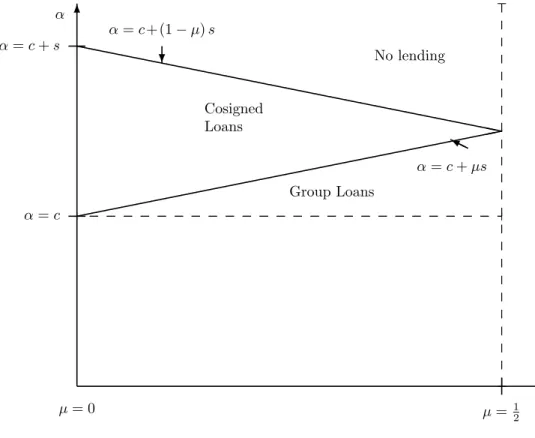
-6 =12 = 0 =c =c+s HYH =c+ s Group Loans `````` `````` `````` ``````````` ? =c+ (1 )s Cosigned Loans No lending
A comparison between the two types of loans as the minimum project size and the inequality parameter varies is depicted in Figure 2.
The comparison is summarized as:
Proposition 2 (Symmetric group loans vs. cosigned loans)
(i) The bank lends to both agents (symmetric group loans) if
c+ s (11)
(ii) The bank lends only to the weak agent (cosigned loan) if
c+ s < c+ (1 )s (12)
(iii) No lending is possible if
c+ (1 )s < (13)
As in the full-information problem (see Proposition 1), the bank’s choice of con-tract depends on the relative size of the minimum investment and the collateral endowmentscands. The bank can recoverc+ sfrom each borrower with symmet-ric group loans. Whenever symmetsymmet-ric group loans are feasible, they will be preferred to cosigned loans because2c+ 2 s, the total lending using symmetric group loans is higher thanc+ (1 )s, the total lending with cosigned loans. When group loans are infeasible, i.e., when agents are su¢ ciently heterogeneous or the minimum investment size is su¢ ciently large, then the bank will just give a cosigned loan to the weak agent. Even though the bank cannot tell the agents apart, by o¤ering a cosigned loan that the strong agent is unwilling to repay (and consequently the weak agent is unwilling to cosign), the bank e¤ectively selects the weak agent.
Corollary 1 (Inequality)
For all su¢ ciently unequal agents the bank will use cosigned loans in preference to symmetric group loans. Conversely, if c+s=2then for all su¢ ciently equal agents the bank will use symmetric group loans in preference to cosigned loans.13
Notice that the bank always prefers to give cosigned loans for su¢ ciently small. This is unlike the full information case: from Proposition 1, absent private information when the minimum project is small14 the bank prefers asymmetric group loans to cosigned loanseven when the borrowers are very unequal.
So far we have compared two simple loan contracts, cosigned loans and symmetric group loans. This comparison is suggestive, but leaves open the question of whether the bank could o¤er an even better loan contract. We take up this question in detail in the next section. Note, however, that there are a couple of circumstances where we can immediately conclude that the bank’s choice does indeed boil down to one between a symmetric group loan and a cosigned loan. First, when potential borrowers are exactly equal ( = 1=2) then we are back to the full-information problem. >From Proposition 1, the bank will either make a group loan or a cosigned loan; and since borrowers have the same exposure to social sanctions, the optimal group loan is symmetric. Second, from Lemma 1 we know that under some circumstances the bank can do no better than cosigned loans even if it had full information. In particular, if the weak borrower’s repayment capability exceeds , and is su¢ ciently small ( su¢ ciently large) for asymmetric group loans to be impossible, cosigned loans achieve the …rst best.
13If > c+s=2then symmetric group loans are never feasible. 14Speci…cally, below
min c+s 2; 2
1
4
Why asymmetric group loans are never observed
Above we provided a justi…cation for why we should observe cosigned loans (Lemma 1 shows that sometimes the bank can do no better). But we have not justi…ed why only symmetric group loans are observed. Recall that Proposition 1 clearly shows that in general asymmetric group loans are preferred to symmetric ones when the bank is informed. In this section, we demonstrate the di¢ culties of implementing asymmetric group loans when the bank is uninformed.
We consider two ways in which the bank may be able to improve upon the perfor-mance of the symmetric group loan and cosigned loan contracts discussed in section 3. First, a bank may be able to induce borrowers to reveal their types truthfully by o¤ering a suitably designed menu of loan contracts. The menu of cosigned loans described in section 3.1 is one example of a menu that induces truthful self selection. There, however, information revelation is obtained at the cost of giving only one of the borrowers a loan. This encourages truthful selection because the payo¤ to a weak agent to cosigning a loan for the strong agent is very low — he both loses his collateral when the strong agent defaults, and does not receive any loan. As such, he will always veto a strong agent who attempts to take a cosigned loan for himself. Below, we examine whether the bank can induce truthful information revelation using alternate menus, i.e., those which involve making asymmetric group loans.
Second, the bank may simply o¤er asymmetric group loans where borrowers do not repay all of the time. Thus far we have restricted attention to loan contracts that are default-free. But by o¤ering an asymmetric group loan with one of required payments above c+ s, the bank faces default whenever the borrower it asks for this high repayment turns out to be strong. This occurs with probability 1=2. More
generally, by randomizing the requested repayments after the initial loan is made, the bank could e¤ectively choose to face any default rate.
The results of this section are easily summarized: there are only limited circum-stances in which the bank can o¤er loan contract that dominates the simple and commonly observed alternatives of cosigned loans and symmetric group loans. In particular, unless the project return is high, symmetric group loans and cosigned loans are the best contracts at the bank’s disposal.
4.1
Alternate menus
Let us start with the question of whether we can do better by o¤ering non-degenerate menus of loan contracts (other than cosigned loans). We show that such menus can be useful, but only in very limited circumstances. In particular, unless projects are very productive then restricting attention to simple contracts, i.e., symmetric group loans or cosigned loans, is without any loss of surplus.
To understand why menus are of limited use in making group loans, it is useful to start by constructing an example in which a menu does in fact play a useful role. The example will make clear what conditions must be satis…ed for a menu to be welfare improving. As we will argue, these conditions are unlikely to be met. Loosely speaking, in order to prevent strong agents from pretending to be weak and defaulting, the menu options must provide the strong agent with favorable terms. Consequently the weak agent must be o¤ered unfavorable terms in order for the bank to break even. The weak agent will refuse to participate unless he is very productive. Suppose the bank is operating in a somewhat unequal community, with = 1=4, and that the project size lies somewhere between c+s=4 and c+ 3s=8. From Proposition 2 we know that cosigned loans are preferred to a symmetric group loan.
The bank o¤ers a menu xW S
1 ; xW S2 ; RW S1 ; RW S2 ; xSW1 ; xSW2 ; RSW1 ; RSW2 , where
the loan contract xW S1 ; xW S2 ; RW S1 ; RW S2 is characterized by
xW S1 = and R1W S =c+ 3s=4
xW S2 = 2c+ 3s=4 and RW S2 =c+s=4
while the loan contract xSW1 ; xSW2 ; RSW1 ; R2SW is just the opposite, i.e.,xSW1 =xW S2
etc. Notice that xW S
2 > since < c+ 3s=8.
To see how this menu works, suppose for now that the strong borrower selects theW S contract in state W S and the SW contract in state SW. Under the terms of these contracts, the strong borrower is required to make a smaller repayment to the bank than the weak borrower is. As a result, the borrowers will repay their loans. Since the strong borrower chooses the contract with probability3=4, the bank is repaid at least 34 (2c+s) + 41(2c) = 2c+ 3s=4 in expectation, and breaks even. Moreover, the bank lends a total amount of 2c+ 3s=4which is higher than the total lending of c+ 3s=4 under the cosigned loan contract, which in turn dominates the symmetric group loan contract.
A key feature of the loan menu is that despite repaying less, the strong borrower receives a large loan. It is this feature of the contract that gives the strong borrower the incentive to choose the intended loan contracts, i.e., contract SW in state SW
and contract W S in stateW S. Under this choice, the strong borrower’s utility is
US = (2c+ 3s=4 ) c+ s 4 :
If instead the strong borrower deviates, and instead chooses the contractSW in state
W S, then he is asked to make a repayment that exceeds the punishment he faces for non-repayment. Consequently both borrowers default, and the strong borrower’s utility is
~
That is, the strong borrower ends up “repaying” less, which is attractive, but at the cost of receiving a smaller loan, which is unattractive. His utility level under the intended contractW S is higher (i.e.,US U~S) whenever
s
8
c+ 38s ;
a condition which is satis…ed whenever the project return is large enough.
In this menu it is the strong borrower who is given the incentives to choose the intended contract. These incentives are provided at the expense of the weak borrower, who receives a smaller loan and must make a larger repayment. His utility is
(c+ 3s=4), which is positive whenever the project return is large enough. In this case he will not veto the strong borrower’s choice of the intended loan contract.15
This example shows that when the project return is high enough, it may be pos-sible for the bank to design a menu of contracts that allows it to lend a greater amount than is possible using either cosigned loans, or symmetric group loans. However, it also makes clear the main limitation on the use of such menus: Unless the project return is high enough, it is impossible to simultaneously induce one borrower to select the “right”loan, while still meeting the individual rationality constraint of the other. Since a strong villager has less of an incentive to repay, he can only be asked for a small repayment. But the strong borrower must also receive a large loan — for otherwise, he can pretend to be the weak borrower, and simply default on the bank. This leaves the weak borrower with a large repayment and a small loan — an unattractive proposition unless his project return is in fact very high.
This feature of the example generalizes to:
Lemma 2 (A condition that rules out menus)
15It is easily shown, however, that when the weak borrower chooses the contract he will select the unintended contract. The borrowers default. By construction, the bank still breaks even, in spite of a1=4 probability of default.
Fix 2 [0;1=2]. Then there exists a such that if , there exists no menu in which the bank is able to lend more than is possible using cosigned loans or a symmetric group loan, while itself breaking even.
Speci…cally, if is low enough such that for both = ;1 ,
2 1 + 1 1 + > c+ 1 1 + 1 (1 + ) s (14) and one of < c+ (1 )s (15) c+ (1 ) s 2 (16)
hold, then no menu with the above properties exists.
Lemma 2 gives conditions under which no menu of contracts is useful. The combination of conditions is relatively hard to interpret. Fortunately, if we accept a weaker set of conditions we have:
Proposition 3 (No menu can do better if small)
If <2 c= , then there exists no menu in which the bank is able to lend more than is possible using cosigned loans or a symmetric group loan.
Observe that the bound on in Proposition 3 is tighter the further is from c. That is, the larger the funding shortfall that must be met by the use of social sanc-tions, the less scope there is to make use of more complicated lending arrangements. Instead, the lending bank’s choice reduces to one between making a cosigned loan to one borrower, or a symmetric loan to both.
This negative result contrasts starkly with Lemma 1. Unlike menus of asymmetric group loans, cosigned loans are a useful selection device because they are so extreme. The cosigner receives nothing, and so if a weak agent anticipates default, then he has
no incentive to cosign a loan for a strong agent since he will certainly lose c. If the bank o¤ers a menu of asymmetric group loans, however, the cosigner is given a loan of . Even if a weak agent anticipates that both will default, he will now make a potentially positive surplus of c: So a weak agent may willingly go along with an asymmetric group loan if his output exceeds the loss of collateral. For this reason, separating borrower types is so much more di¢ cult if the bank is trying to lend to both borrowers than if the bank is only trying to lend to one borrower.
4.2
Loans with default
We now to a consideration of loan contracts with a positive probability of default. The leading example is an asymmetric group loan, with one of the requested repayments above c+ s, the strong borrower’s willingness to repay. A second possibility is to explicitly randomize the requested repayments.
The main rationale for why asymmetric group loans would never be o¤ered is straightforward, and easy to see. Suppose a loan contract calls for repayments
R1 >0andR2 >0. As we have seen, the borrowers will only make these repayments
in both states SW and W S if
R1; R2 c+ minf s;(1 )sg:
So if the bank wants to avoid the possibility of default, then to maximize the original loan size it can restrict its attention to contracts in which both borrowers repay the same amount.
Although default is costly for the bank — and thus ultimately for the borrowers — there remains the possibility that the constrained optimal loan contract is one in which default occurs. For example, the bank might o¤er a contract in which
R1 = c+ s and R2 = c+ (1 )s. Under this contract, the bank will be repaid
strong (state W S). Consequently the bank’s total expected repayment is 2c+s=2. Whenever the borrowers are even remotely close to having equal sanctioning ability, i.e., >1=4, then this is a lower repayment than is obtainable under the symmetric group loan contract in which each is asked to repay c+ s. In general, if > 1=4
then a symmetric group loan is preferred to any other single loan contract (i.e. to anydegenerate menu of loan contracts).
Moreover, even when borrowers are very unequal (i.e., < 1=4), there is little scope for the bank to o¤er a single loan contract other than the symmetric group loan. The reason is that clearly the only way such a contract can succeed in generating a higher expected repayment is if one of the borrowers is sometimes asked to make a large repayment. Moreover, if the bank asks a strong borrower for the larger repayment, both borrowers default. So an asymmetric loan contract must end up sometimes taking large repayments from the weak borrower. The weak borrower will only agree to such a contract when the original loan is correspondingly large. But the circumstances in which the bank can a¤ord to make two loans of more than the minimum size , with at least one of them large, and cover these costs even in the face of default, are extremely limited.
To summarize:
Proposition 4 (No Single Loan Contracts Can Do Better)
If >1=4, then o¤ering any single loan contract other than a symmetric group loan is suboptimal. If <1=4, then there exists a ^such that for all rates of return <^
5
An example
In this section, we provide a simple numerical example to illustrate our results. Sup-pose that both agents have collateralc= 75: They have projects with minimum scale
= 100; and rate of return = 6=5: The total social sanctions available are s= 75:
As before we shall use (x; R) to denote a loan contract where x is loan size and R
is repayment, and the seizure rule speci…es that collateral will be seized from both if one does not repay.
Consider two economies, one which is more equal than the other. In the equal economy, = 1=3: So the weak agent can sanction the strong agent in an amount of 1375 = 25; and the strong can sanction the weak agent in the amount 2375 = 50:
So the strong agent’s willingness to repay is 100 and the weak agent’s willingness to repay is 125: With full information, the bank can make an asymmetric group loan: a loan of (100;100) to the strong agent and a loan of(125;125) to the weak agent.
In the unequal economy, = 1=5: So the weak agent can sanction the strong agent in an amount of 1575 = 15; and the strong can sanction the weak agent in the amount 4575 = 60: So the strong agent is willing to repay up to 90 and the weak agent is willing to repay up to 135: With full information, the bank can again make an asymmetric group loan: a loan of (100;90) to the strong agent and a loan of
(125;135) to the weak agent. Since the weak agent is su¢ ciently productive, he will cross-subsidize the strong, and the bank succeeds in lending at least = 100to both. For both economies, condition (7) in Proposition 1 holds, i.e. these asymmetric group loans are e¢ cient.
Now suppose that the bank cannot distinguish between the states W S and SW, i.e., cannot tell weak from strong, but can observe whether the economy is equal or unequal. Let us …rst restrict the bank to o¤ering either symmetric group loans or cosigned loans, just as in section 3. In the equal economy, the bank can recover at
least 100 from each agent. So the bank will make a symmetric group loan, i.e. loans of (100;100) to each agent. In the unequal economy, by contrast, the bank cannot make the same symmetric group loan because the strong agent will default. Instead, the bank o¤ers a cosigned loan of (135;135): The weak agent is unwilling to cosign such a loan for the strong agent (because the strong agent will certainly default, and the weak agent will lose collateral). But the strong borrower is willing to cosign such a loan for the weak agent. Consequently, only the weak agent can invest. This illustrates Proposition 2. Symmetric group loans are preferred in relatively equal economies. In particular, condition (11) holds for the equal economy, and condition (12) holds for the unequal economy.
The question remains: can we do better than symmetric group or cosigned loans using menus of loan contracts. To illustrate the argument in section 4.1 consider the unequal economy. There the ine¢ ciency is that only one of the two villagers is able to invest. Suppose the bank o¤ers the full information contracts as a menu, i.e., o¤ers the contracts (100;90) and (125;135), where (100;90) is intended for the strong agent and(125;135) is intended for the weak agent. The strong agent has an incentive to take the (125;135) loan meant for the weak agent and default; the weak agent will default as well. The bank will not break even with such a menu. So the bank must design a menu to reward the strong borrower in order to convince him to take a loan (and repay). But the bank is constrained: the contract intended for the weak agent must satisfy the weak agent’s individual rationality constraint by asking for a repayment no higher than 120. This candidate menu is: a contract (110;90)
intended for the strong agent and (100;120) intended for the weak agent. Does the strong borrower now have enough incentive to choose the larger loan? The answer is no. If the strong borrower chooses the (100;120) loan and defaults, her pro…ts are 65(100) 75 = 45: If the strong borrower takes the (110;90) loan, her pro…ts are
6
default. And clearly when the weak borrower chooses, he will take the larger loan too and both will default. So this candidate menu fails to separate the agents. More generally, since < 2 c= for this example, Proposition 3 implies no other menu of loan contracts is of help. The bank can do no better than cosigned loans in the unequal economy.
6
Conclusion
We have analyzed lending contracts in a model where borrowers have unobserved social sanctioning capabilities (and consequently, unobserved willingness to repay). We have shown that simple and commonly observed loan contracts are constrained e¢ cient unless projects are very productive. Symmetric group loans are constrained e¢ cient when borrowers are relatively equal. Symmetry stems from the unobserv-ability of the borrower’s unobserv-ability to sanction each other. When borrowers are relatively unequal, cosigned loans are e¢ cient.
We have argued that group loans make most sense for targeted anti-poverty lenders. In that sense, we provide an explanation for why the commercial banking sector has not adopted group loans even though they have been used in microcredit for several decades. A testable implication of this paper is that mistargeting of mi-crocredit to the rich will raise default rates. If microlenders allow rich borrowers to enter groups, the poor may very well continue to repay their loans but the rich who are stronger will default.
7
Appendix: Proofs
Proof of Proposition 1: First notice that
c+ s minfc+s 2;(2
1
)c+ (1 1 )sg
since c+ s < c+s=2 and 1<(2 1= ). Also, <(1 1 ). Thus
minfc+ s 2;(2
1
)c+ (1 1 )sg c+ (1 )s
because c+ s2 c+ (1 )s
(i) There are two cases:
1. Case c+ s. The following group loan satis…es all the constraints,
x1 = R1 =c+ (1 )s
x2 = R2 =c+ s
and it is impossible to o¤er a larger loan to either agent without violating the breakeven constraint (6) or the repayment constraints (3).
2. Case c+ s < minfc+ s2;(2 1)c+ (1 1 )sg. It is clearly e¢ cient to set repayments as high as possible. SoR1 =c+ (1 )sandR2 =c+ s: The
individual rationality constraints (4) make it e¢ cient to give the stronger agent a smaller loan, so x2 = and x1 = 2c+s : Agent 2’s individual rationality
constraint is satis…ed
> c+ s > c+ s
And agent 1’s individual rationality constraint is satis…ed if
(2c+s ) c+ (1 )s
or equivalently
(ii)If condition (7) does not hold, it is impossible to lend to both agents. Why? If > c+s=2 then the breakeven constraint (6) and the repayment constraints (3) cannot all be satis…ed ifx1+x2 = 2 : If c+s=2 but
(2 1)c+ (1 1 )s <
then the breakeven constraint (6) and the repayment constraints (3) can all be satis-…ed ifx1+x2 = 2 , but it is impossible to satisfy the individual rationality constraints.
So the only option is to lend at least to one agent. Since the bank can recover more from the weak agent, the most it can lend is
x1 =R1 =c+ (1 )s
where agent 2 is the cosigner.QED
Proof of Proposition 2: (a) Group loans. Need R c+ s for weak agent to accept liability on any loan (x; R) o¤ered to the strong agent. So the most the bank can lend using symmetric group loans is
x=R =c+ s
Such loans are feasible if (11) and the surplus is ( 1)(2c+ 2 s):
(b) Cosigned loan. NeedR c+ (1 )s for strong agent to accept liability on any loan(x; R) o¤ered to the weak agent. So the most the bank can lend is
x=R =c+ (1 )s
This loan is accepted by both agents only if o¤ered to the weak agent. Such a loan is feasible if (11) or (12) and the surplus is ( 1)(c+ (1 )s):
(c) If group loans are feasible, they are always preferred to the cosigned loan. To see this, note that the surplus is higher with a cosigned loan if
or equivalently if
< s c
3s
But assumption (2) makes this impossible. QED.
Proof of Lemma 2: Suppose the menu induces borrowers to always default. Then the bank can lend at most 2c in total. Since2c < 2 , the bank can only lend to one of the agents, and we have established that using cosigned loans to lend to the weak agent is e¢ cient in such a case. So this menu can do no better cosigned lending. For a menu to do better than cosigned loans, at least one of the borrower’s must select a contract in which repayment actually occurs. Let1 be the sanctioning ability of this borrower: note that 2 f ;1 g. Throughout the proof, we will refer to this borrower as the strong borrower, and to the other borrower as the weak borrower; this is solely for expositional convenience, and in fact the in question may be greater than 1=2. Without loss, write the menu as xS; xW; RS; RW ; xS; xW; RS; RW , and assume that the menu is designed so that the strong borrower selects the contract which gives him a loan of xS and repayment RS. We refer to this contract as the intended contract.
We claim …rst that when the unintended contract is selected, the borrowers default; and that moreover, when it is the weak borrower’s turn to choose the contract, he chooses the unintended contract. To establish this claim, note …rst that the menu can only dominate a symmetric group loan if one of the repayments RS and RW exceeds
c+ minf ;1 gs. For repayment to occur when the strong borrower selects the intended contract, RS c+ s and RW c+ (1 )s. Given these observations, either RW > c+ s or RS > c+ (1 )s — and so if the intended contract is not selected, the borrowers default.
Observe that the strong borrower chooses the intended contract if and only if
What happens when the weak borrower makes the contract selection? He will choose the intended contract if
xW RW xS c:
Together, these two inequalities imply c RW RS c. But this in turn implies the bank can lend no more than 2c in total, which again contradicts the assumption that the menu dominates cosigned lending. Thus the weak borrower will pick the unintended contract, completing the proof of the claim.
Given this preliminary observation, in order for the menu to deliver at least to each borrower, and for the bank to break-even, the loan parameters xS; xW; RS; RW
must satisfy — in addition to constraint (17) — the following set of inequalities:
xS and xW (both borrowers receive at least )
RS c+ s (the strong borrower repays)
RW c+ (1 )s (the weak borrower repays)
xS RS 0 (the strong borrower has positive utility)
xW RW 0 (the weak borrower has positive utility)
(1 ) RS+RW + 2 c xS+xW (the bank breaks even)
These inequalities de…ne a constraint set, X say. We will show that X must be empty.
Suppose to the contrary that X is non-empty. So it contains some element
xS; xW; RS; RW . It is easily seen that it must then contain an element in which either (a) the weak borrower’s IR constraint binds, xW = RW, or (b) the weak agent receives the minimum feasible loan, xW = . (If a contract satis…es neither condition, we can always reduce xW and increase xS while preserving the strong borrower’s incentive to choose the right contract.)
First, suppose a menu exists that satis…es the stated constraints and in which the weak borrower receives zero utility, i.e., xW =RW. For the bank to break even,
(1 )RS+ ( (1 ) 1)xW + 2 c xS;
and so the strong borrower’s utility xS RS from choosing the intended contract is certainly less than
( (1 ) 1)RS+ ( (1 ) 1)xW + 2 c:
A necessary condition for the strong borrower to choose the intended contract is thus
( (1 ) 1)RS+ ( (1 ) 1)xW + 2 c > xW c
The repayment RS must be less than c+ s, otherwise the borrower will not repay. So our contract must satisfy
( (1 ) 1) (c+ s) + ( (1 ) 1)xW + 2 c > xW c i.e. c+ 1 1 + 1 (1 + ) s > 2 1 + 1 1 + x W
But since xW , this contradicts assumption (14).
Second, suppose a menu exists that satis…es the stated constraints and in which the weak borrower receives the lowest feasible loan, xW = . By assumption the weak borrower’s IR constraint is satis…ed, RW 0. So if the repayment that can be extracted from the weak borrower is high enough, i.e., c+ (1 )s > , then we can always raise the repayment owed by the weak borrower so that his IR constraint binds, =RW — but we have just ruled out this case. So if inequality (15) holds, the proof is complete.
The remainder of the proof deals with the case in which the weak borrower’s maximum repayment is lower, i.e., c+ (1 )s . Note that we can assume without loss that the weak borrower is being asked to repay the maximum amount,
RW = c+ (1 )s, since this leaves him with positive utility. So for the bank to break even, the loan to the strong borrower must satisfy
xS (1 ) RS +c+ (1 )s + 2 c :
The strong borrower’s utility is thus less than
( (1 ) 1)RS + (1 ) (c+ (1 )s) + 2 c
A necessary condition for the strong borrower to choose the intended contract is thus
( (1 ) 1)RS+ (1 ) (c+ (1 )s) + 2 c c
As before, the strong borrower’s repayment RS must be less than c+ s. So our contract must satisfy
( (1 ) 1) (c+ s) + (1 ) (c+ (1 )s) + 2 c c
i.e. c+ (1 ) s
2
which contradicts assumption (16). QED
Proof of Proposition 3: We will show that when < 2 c= , then for all
2[0;1]inequality (14) must hold, along with either inequality (15) or (16). For inequality (14), we must show that
f( ) (2 (1 )) c(1 + ) (1 ) s+ s >0
Observe that
f0( ) = c+ s (1 )s+s
f00( ) = 2 s
Thusf is convex quadratic function. Its minimum lies at
= c s ( s) 2 s
Since >1 and s > c s, <1. It follows thatf( ) is an increasing function over the the domain of interest, 2 [0;1]. Finally, f(0) = (2 ) c, which is positive by assumption. So inequality (14) holds, as claimed.
Since <2 c= , inequality (15) holds whenever
< c+ (1 )s
2 c=
i.e. < c+ (1 )s 2
Since trivially c+ (1 )s2 exceeds c+ (1 ) s2, it follows that at least one (and possibly both) of inequalities (15) and (16) must hold. This completes the proof.
QED
Proof of Proposition 4: We have given the main intuition for this result in the text. The details are tedious but not fundamentally hard, and are omitted. The proof is available from the authors upon request.
References
[1] Ahlin, C. and R. Townsend (2003). Using Repayment Data to Test Across Models of Joint Liability Lending. (Manuscript)
[2] Armendariz de Aghion, B. and C. Gollier. (2000). “Peer Group Formation in an Adverse Selection Model,”Economic Journal, 110:1-12.
[3] Banerjee, A., T. Besley, and T. Guinnane (1994). Thy Neighbor’s Keeper: The Design of a Credit Cooperative with Theory and a Test. Quarterly Journal of Economics 109, 491-515.
[4] Besley, T. and S. Coate (1995). Group Lending, Repayment Incentives and Social Collateral. Journal of Development Economics, 46, 1-18.
[5] Ghatak, M. 2000. “Screening by the company you keep: Joint Liability Credit and the Peer Selection e¤ect,”Economic Journal, 110.
[6] Ghatak, M. and T. Guinnane (1999). The Economics of Lending with Joint Li-ability: A Review of Theory and Practice,”Journal of Development Economics, 60, 195-228.
[7] Greif, A. (1996). Contracting, Enforcement and E¢ ciency: Economics Beyond the Law, Annual Bank Conference on Development Economics, Bruno, M and Pleskovic, B (eds.) 239 265:
[8] Karlan, D. (2004). Social Capital and Group Banking. (Manuscript).
[9] Ligon, Ethan; Thomas, Jonathan P; Worrall, Tim (2002). Informal Insurance Arrangements with Limited Commitment: Theory and Evidence from Village Economies Review of Economic Studies, vol. 69, no. 1, 209-44
[10] La¤ont J.J. and T.T. N’Guessan (2001), Group contracting and enforcement. Journal of Institutional and Theoretical Economics 157, 487–498.
[11] La¤ont, J.J. (2003). Collusion and Group Lending with Adverse Selection Jour-nal of Development Economics, vol. 70, no. 2, 329-48
[12] Rai, A. and T. Sjöström. (2004). Is Grameen Lending E¢ cient? Repayment Incentives and Insurance in Village Economies. Review of Economic Studies 71 (1), 217-234, January.
[13] Ray, D. (1998).Development Economics, Princeton University Press.
[14] Stiglitz, J., (1990). Peer monitoring and credit markets. World Bank Economic Review 4