Knowledge Management
powered by Open Source
Implement Knowledge
Management Using Open
Source “Platforming”
Abstract
Managing enterprise knowledge drives innovation and productivity within an enterprise. Today Knowledge Management is considered as one of the most important initiatives that an enterprise needs to embark upon.
The confusion however remains on how to start and leverage the different products and technologies available such as CMS, Document Management System, Enterprise Content Management products, Social Networks etc in a fashion where it is possible to implement Knowledge Management effectively.
Open Source provides now an alternative approach to implement Knowledge Management in ways that suit your business. However, this requires a “Platforming” approach where the best of available open source technologies and frameworks come together to deliver the best that the open source model has to offer.
This Platforming approach using open source allows organizations to look at open source differently and understand better the flexibility and choice available in this approach. Knowledge Management initiatives face an uphill task while defining the ROI for stakeholders. The Platforming approach allows a open source led long term path that surely delivers results and helps pace the KM implementation as per the speed of organizational learning around such initiatives.
Understanding KM – Its Evolution from discipline to practices with
Web 2.0
Knowledge Management is the name given today to a range of practices and strategies deployed in an organization to identify, create, represent, distribute and enable adoption of insights and experiences.
Knowledge Management programs are typically tied to organizational objectives and are intended to lead to the achievement of specific outcomes such as shared intelligence, improved performance, competitive advantage, or higher levels of innovation.
During 1990’s Knowledge Management (KM) became an established discipline and organizations started adopting focused policies and actions such as Communities of Practices, knowledge bases, and expert systems to further their KM agenda. The technologies at the time were driven by large databases, intranet tools, and decision support systems. This approach was a top to bottom driven via a KM strategy and often driven by the management stakeholders.
In early 2000 the focus on a bottom top approach to knowledge management began. The stress was more on the management of knowledge at the individual level. This also led to personal knowledge management practices with focus on information
categorization, collaboration, taxonomies, terms classifications, and most importantly people to people networking.
Thus began the most exciting evolution phase of Knowledge Management with focus on the individual and creating an environment with the right technology, practices, and strategies. This phase was more aimed at an individual level and lead to a highly
participatory approach from individuals and organizations alike to deliver knowledge insights.
Explicit & Implicit Knowledge
Knowledge Management today is understood as Explicit and Implicit knowledge.
Explicit knowledge is knowledge that has been or can be articulated,
codified, and stored in certain media. The most common forms of explicit knowledge are manuals, documents, procedures, and stories. Thus any externalized knowledge can now be stored in databases, content management systems, document management systems, Intranets and knowledge
repositories.
Implicit Knowledge is knowledge that people carry in their heads.
Compared with explicit knowledge, implicit knowledge is more difficult to articulate or write down and so it tends to be shared between people through discussion, stories and personal interactions. It includes skills, experiences,
“All knowledge is connected to all other knowledge. The real knowledge management is in making the
connections.”
More recently with the advent of
the Web 2.0, the concept of
Knowledge Management has
evolved towards a vision more
based on people participation and
emergence. It is becoming clear
now that whatever the future of
Knowledge Management tomorrow
Web 2.0 technologies and practices
will have a central role to play.
Web 2.0 and Social Web Accelerate Implicit & Explicit Knowledge
Management
In the last few years Enterprise social network with Web 2.0 tools have greatly accelerated Knowledge Management for both the categories (explicit or implicit). Moreover, trends such as open source have resulted in a significant increase in the number of open source tools and technologies available today to assist in management of both explicit and implicit knowledge management.
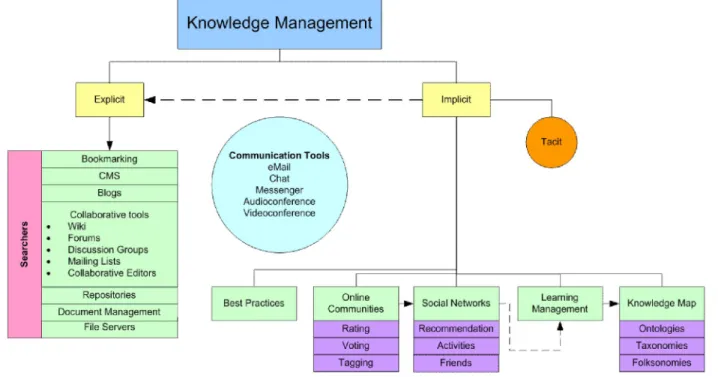
Figure 1 Understanding Knowledge Management Map with Web 2.0 Technologies
Reference from : http://scientometrics.wordpress.com/2008/10/13/open-source-knowledge-management-tools/(TEN Competence- European Network Study extract)
As shown in the diagram above explicit knowledge management tools already exist in the form of several Web 2.0 technologies such as Wikis, Blogs, Forums, Discussion Groups, Mailing Lists, Document Management and File Servers. Most of this content is searchable to quickly dig into the knowledge. Insights are possible through Semantic search into the content.
Implicit information can now be managed through setup of Best practices implemented by creation of virtual online communities providing community collaboration applications. On top of the communities the Social Networks capture implicit knowledge directly from individuals participating within the social network.E-Learning management systems can also be integrated into the social network with information flow providing allows access to learning resources.
Use of Knowledge Maps
Knowledge Maps are visual representation of knowledge. It is similar to a virtual directory that points people participating within the community towards people, documents and repositories Knowledge maps are then super imposed on the implicit knowledge captured by the Social Network and Virtual Communities created. Using a combination of Taxonomies, Ontology’s and tagging schemes a knowledge map for the community is created.
Ontology’s are formal representation of knowledge as a set of concepts within a domain, and the
relationships between those concepts. It is used to describe the different entities within that domain,
and may be used to describe the domain.
Taxonomy is a practice and science of
classification of terms related to a particular community
The Business Need
“Every organization generates vast amounts of information while conducting business; yet few organizations are
able to leverage it all to generate new opportunities or capitalize on collective knowledge assets.”
Millions of documents, emails, memos, charts, and Web pages, not to mention the tacit information that employees possess, remain undiscovered and their potential untapped. Organizations that let such valuable information languish are in danger of missing competitive opportunities or even losing the information forever.
Employees duplicate existing work because they are not aware of prior efforts by others or concurrent projects with overlapping goals. New employees often don’t know where to look for information or who to turn to for answers. Customers make decisions to buy elsewhere. Partners miss strategic opportunities.
In spite of this, all organizations evolve a way of managing knowledge. It is
happening around us in a crude ad hoc manner. During day-to-day life activities,
employees interact with each other in any or some form of networking and
produce knowledge. This interaction generates knowledge in several structure
and format.
Good Knowledge management practices, tools and technologies help to link people looking for knowledge with those who have it. It focuses on capturing this information, whether it is explicitly held in a document or database or exists tacitly in the forms of knowledge and experience in the minds of employees. This tacit information is exceedingly hard to preserve. Industry analysts estimate that without knowledge management practices in place more than 80 percent of the information that employees, customers and partners have is lost to the organization.
Document Management, Collaboration, Social Networking and other disciplines all come together to form a
comprehensive enterprise knowledge management strategy. The base of such a knowledge management strategy is built on search and tagging technology which offers employees the ability to quickly and easily find existing useful content in context and be notified of any new
content as it is generated. In addition, search for the knowledge assets
scattered over the internet.
Challenges in responding to Business Need
Information Technology has responded to this business challenge by providing point products that solve a few needs around document management, content management and search.
Some of these products attempt to merge with collaborative and social technologies to create a new way of Knowledge Management that is based on bottom to top approach and highly granualar in nature. The trends also show that
Knowledge Management technologies and Collaboration Technologies need to come together since there is a significant increase in both these areas.
The technology landscape in use to aid knowledge management within organizations to create a knowledge sharing environment includes use of a whole gamut of technologies supported by proprietary and open source products.
However there have been numerous challenges in deployment or use of these technologies. Implementing Knowledge Management or sharing does not convince a budget holder clearly of Return on Investment(ROI). This is primarly also because knowledge management is:
A long term investment where benefits are very real and important to business but very hard to quantify.
Is not available today fully in any proprietary or open source product and requires a new way of thinking that is evolutionary but in the right direction
Vendor lock in of any solution adopted makes it difficult to manage the technology adoption at a pace that the organization can handle.
The use of these technologies above show that while collaboration technologies have started penetrating the entperise in a big way there are several other knowledge management applications such as document management, digital asset management, records management, knowledge repositories that are only slowly taking ground.
Most requirements for a knowledge management environment within a business is entwined with workflow, business process context and require greater degree of integration with communication technologies.
Open Source, Open Data, Open Interfaces – The way to go
Open source provides a wide variety of options with different enabling technologies and systems required for knowledge management. Some of these technologies are mature while others are evolving within the open source communities. The list below provides an overview of how far open source has penetrated with a volley of options available (Note: Only the most viable of the open source options are mentioned here, however the total list of open source options runs into several scores in each
category):
Flexibility (and Pitfalls) of Choice
Taking an open source route is also a double edged sword. We have the benefit of tremendous flexibility of choice and yet at the same time there are too many choices and one can easily get lost.
Open source technologies with open standards and open interfaces provide an excellent set of tools in several collaboration and knowledge management categories shown in the diagram above. Ultimately these tools represent flexibility of choice.
However adoption of these tools is confusing for most users because of the specific need that these tools address at any one time. This leads to key questions in the mind of anyone interested in adoption of Open Source as a strategy for knowledge management.
•Wordpress,
Drupal,
OpenCMS,
Liferay
Web Based Content Management•Alfresco,
Knowledge
Tree
Document Management & ECM•Elgg, Social
Engine,
Liferay
Social NetworkReality is that putting knowledge management in place is a combination of multiple technologies such as ECM, Document Management, Web Based Content Management, Search and now Social Networks.
Most of the open source options today have evolved around a set of use cases of Knowledge management such as Search, Web content publishing, Ability to search and manage documents. Most organizations do not have resources to implement a
comprehensive Knowledge Management initiatives using just one of the open source software.
Feasibility
• What tools to pick? Which open source tool for which KM
requirement?
• What can and can not be achieved through the commonly available
open source tools?
Technology
• Is the open source technology really open and robust? How do we
ensure this and go with a
• Does it support open data and open interfaces?
Legal
• Are there legal implications of using too much of open source?
• How will the licensing impact our business if we make modification to
Open Source “Platforming”
Open Source Platforming is an innovative business approach to implementing open source and can be applied effectively to Knowledge Management.
Using best of breed open source options that solve one problem well, multiple challenges around Knowledge Management can be solved. Organizations such as InfoAxon use this approach to develop integrated platforms that bring together a potent mix of Dynamic Knowledge Repositories, Enterprise Search, Web Content Management and Enterprise Portals laced with Social Network Contexts.
Platform not a Product
It is important to note that the focus of Open Source Platforming approach is to have a White Label business integration ready solution that can take upon several forms as required by the particular flavor of knowledge management required. The platform therefore helps organizations interested in adopting open source in the right manner.
Knowledge
Management
Environment
Social Network Contexts Enteprise Content Management Dynamic Knowledge Repositories Federated SearchOpen Source Platforming approach focuses on creating white label well architected Open source technology platforms. Using the best that open source has to offer these platforms bring together different knowledge sharing disciplines delivered with a social networking context that is business friendly.
The Platforming Roadmap
Most organizations today have either gone or will go through the above stages of knowledge management roadmap or more likely moving through the following stages:
Setting up of Dynamic
Knowledge Repositories
Collaborative Knowledge
Sharing Environment
Knowledge Management
around Business Processes
Knowledge Management with
deep meaningful insights
Dynamic Knowledge
Repositories store content agnostic to the content type and are breathing, evolving changing repository of content. At the time of setup the content models for the business are created. Knowledge is created through social and collaborative spaces entwined with business process workflows Deeper insights into knowledge are delivered through semantic search and context based tagging with an ever evolving set of semantic
Put Knowledge Management at Your own pace through “Platforming”
Level 1 – Implement Dynamic Knowledge Repositories, Expose Content
as a Service
Dynamic knowledge repositories help set up an open standard content repository within an organization.
Using open source technologies such as Alfresco and Apache Jackrabbit it is possible to create interoperable and platform independent knowledge repositories that expose content to any external application. Using this approach it is possible to expose content as a service.
Build Insights
Get Social around Business Processes
Usher Collaboration
Activate Content Repositories
Level 2 – Collaborative Enterprise Social Network backed by
Knowledge Repositories
At this stage, social networking experience is implemented on top of an existing or newly established dynamic knowledge repository. This approach helps developed Project and Service “Knowledge Spaces” and weave these spaces within the social network experience. The result is a well connected collaborative social environment within the enterprise.
The dynamic knowledge repository is tuned at the stage further to integrate with the overall social network experience of the users. This leads to instant connections that are identified by the individuals and employees automatically thus creating an enterprise social network backed by knowledge repositories.
Level 3 – Process based Knowledge Sharing
Process based Knowledge Management and sharing combines contents with automatic business contexts using the tasks performed by the Users.
Open source technologies such as jBPM, JBOSS and Alfresco provide a configurable workflow engine well integrated and used within the platform approach. User works in a normal project process within the knowledge spaces and creates content during various tasks.
Information is automatically associated with several contextual information to whatever contents produced by the user, and presents these perspective information along with the content as required.
Level 4 – Enhancing Knowledge Management using Semantic Web
Semantic Web (also called Web 3.0) helps us understand the “meaning” behind the information stored in knowledge repositories. Semantic Web uses open data integration formats such as RDF (Resource Description Framework), XML, and Web Ontology todescribe the concepts, terms and definitions of a particular business domain.
Content stored in knowledge repositories is published along with Semantic HTML data as it is extracted from the knowledge repository.
Semantic Web technologies provide several tools for knowledge capture, processing and sharing of content related to a domain. Fine Grained Intelligent Semantic Search
The content can be searching using Semantic technologies and reduce the ambiguity against full text based searches commonly provided by the search engines. The search results can also be contextualized to a higher degree using the semantic metadata and provide content much more sharply and based on interests of the user.
Visualization of Social Network and Knowledge Repository
Open source Semantic technologies also help provide a better visualization of the knowledge repository and also of the underlying relationships behind the search results. For e.g. if a Knowledge worker searches through a listing then using cross references and annotations it should be possible to provide representative views of the search results.
Open Source Platform for Knowledge
Management
fusionKM
is a Knowledge Management platform – using the platform organizations can quickly establish internal KM solution and develop their internal business process and taxonomy. It allows organizations to create departments, networks, projects, groups and enables users to work in a collaborative environment.The platform is offered as an in-premise SaaS model. The whole stack is maintained and managed by InfoAxon.
Social Network Solutions in today’s days create Networks, enables users to collaborate in a highly interactive fashion; but rarely they are useful in terms of Knowledge Management aspects. In other words, today’s social network platforms do not cater to a major business problem – Knowledge Management. fusionKM enables organizations to establish a number of networks and groups within and thus enabling all the knowledge sharing and management aspects.
fusionKM allows users to conduct single point and comprehensive search not only from the in-premise knowledge bank but also from the wide spread internet sources. Automatic and intelligent search engine enables users to find the desired information quickly and efficiently. The rich knowledge repository of fusionKM constitutes of Wikis, Blogs, Documents, Discussion Forums, EMails, Media files etc.
The Knowledge Network
Like a social networking platform, in fusionKM, people can make friends, join any groups or communities – thus creating their individual network. fusionKM introduces Knowledge Network which is, for a person, the whole knowledge base of his/her social network. Now a person’s knowledge is not limited to him profile only; but his whole social networks constitute his knowledge base. fusionKM enables organizations to create groups, departments, locations, projects – and users contribute in these thus creating knowledge contents. Users can be friends to each other thus expanding their knowledge network.
Organization’s knowledge thus keeps on building in a single repository on a highly collaborative and web 2.0 enterprise portal framework.
Solution Highlights
Service Oriented Architecture (SOA)The solution is designed and architected in Service Oriented Architecture (SOA), making it fully extensible and integrated with organizations internal and legacy systems.
Repository as Service
The full knowledge repository can be exposed as REST based HTTP services, making the solution ready to serve as knowledge provider to other systems.
Business Process
The integrated business process engine can be configured to implement any workflow
processes of any industry or organization. It has integrated modules for Reporting, Timesheet, Project Management, Task Management, Escalation etc.
Portal
Full featured JSR complaint portal framework with lots of built in applications such as Wiki, Blog, Discussion Forum, Calendar, Theme, Web CMS, Document Management, Private Messaging etc.
CMIS
CMIS complaint platform enabling interoperability between other Enterprise Content Management Systems.
Protocols
A number of industry standard protocols such as WebDAV, IMAP, CIFS, FTP etc are supported in fusionKM making the platform pluggable to other complaint systems.
Intranet ready
fusionKM is a fitting solution for organization wide Intranet setups with multiple branches, departments and geographically distributed.
Mesh Ups
fusionKM has built in applications to integrate with several other popular information and knowledge sources; such as Bing, Youtube, Flickr, Delicious, Wikipedia etc.
Open Platform
No limit in number of users and knowledge content size and space.
ffff
The Technology 1. Liferay® Portal 2. Alfresco® ECMS 3. Open Office 4. JBPM 5. JQuery, YUI 6. Lucene 7. MySQL 8. Apache Tomcat Features 1. Friends 2. Communities/Groups 3. Sub-Organizations/Locatio ns 4. Integrated Search engine 5. Graphical Representation of Knowledge/Network 6. Contextualized Search 7. Tagging/Tag Cloud 8. Public, Private contents 9. Portal Framework 10. Wikis, Blogs 11. Discussion Threads 12. Dynamic Document Metadata 13. Document Check-In/Check-Out, versioning 14. Document Transformation, PDF generation 15. Image Processing, Transformation 16. Automatic/Custom Workflows 17. Private MessagingBenefits
For Users
Reduces time required to complete knowledge intensive work
Increases “trust level” in information accuracy and timeliness
Eases burden on subject “experts” since users can get answers and guidance to their questions on a self-serve basis
For Administrators
Minimal resources required for ongoing maintenance as many tasks can be scheduled for automatic rule based execution
Security inherited from content source, so administrators do not have to worry about unauthorized users gaining access to sensitive information
Comprehensive toolkit for building, supervising and managing the Enterprise Portal For Organizations
Improves ROI of knowledge asset management by reusing information instead of reinventing and searching for it
Reduces cost of retaining intellectual capital and transmitting it to new employees or successors
Quick and Easy installation and use across the enterprise
All resources and knowledge under a single umbrella
Flexible licensing and pricing model
Based on full Open Source – Full ownership, no vendor lock-in
Full featured Corporate Intranet platform
19. Image Gallery 20. Related Documents 21. Tree-style Folder structure for documents 22. Granular and Customizable Permissioning model 23. Notifications 24. Calendars, Events 25. Search by Synonyms 26. Dynamic Portal Themes
27. Separate Themes and Navigations for groups, locations, communities 28. Powerful Web CMS
for Portal pages 29. Public, Private, Restricted groups 30. Saved Searches 31. Custom Taxonomies 32. User Folksonomy 33. JSR Portal framework, Portlets 34. Full Text Search 35. CIFS document
access for Intranet setups
36. Templates
37. Dedicated, private space for users
INDIA OFFICE: InfoAxon Technologies Ltd. H-189, Sector-63, Electronic City, NODIA-201307, U.P India UK OFFICE: InfoAxon Technologies UK Ltd. Building A, Trinity Court, Wokingham Road,
Bracknell, Berkshire RG42 1PL, United Kingdom
complete “Enterprise Solution Platforms” using Open Standards, Web 2.0 next generation technologies and Open Source Frameworks providing end-to-end solutions to business problems.
India’s First Global Open Source Integration Company
We are India's First Global Open Source Integration Company providing business solutions in areas of