MCWP 3-40.2
Information Management
U.S. Marine Corps
PCN 143 000094 00
To Our Readers
Changes: Readers of this publication are encouraged to submit suggestions and changes that will improve it. Recommendations may be sent directly to Commanding General, Marine Corps Combat Development Command, Doctrine Division (C 42), 3300 Russell Road, Suite 318A, Quantico, VA 22134-5021 or by fax to 703-784-2917 (DSN 278-2917) or by E-mail to [email protected]. Recommendations should include the following information:
l Location of change
Publication number and title Current page number
Paragraph number (if applicable) Line number
Figure or table number (if applicable)
l Nature of change
Add, delete
Proposed new text, preferably double-spaced and typewritten
l Justification and/or source of change
Additional copies: A printed copy of this publication may be obtained from Marine Corps Logistics Base, Albany, GA 31704-5001, by following the instructions in MCBul 5600, Ma-rine Corps Doctrinal Publications Status. An electronic copy may be obtained from the Doc-trine Division, MCCDC, world wide web home page which is found at the following universal reference locator: http://www.doctrine.usmc.mil.
Unless otherwise stated, whenever the masculine gender is used, both men and women are included.
DEPARTMENT OF THE NAVY Headquarters United States Marine Corps
Washington, D.C. 20308-1775
24 January 2002 FOREWORD
Marine Corps Warfighting Publication (MCWP) 3-40.2, Information Management, builds on the doctrinal foundation established by Marine Corps Doctrinal Publication 6, Command and Control. As set forth in MCDP 6, information management is one of the three basic el-ements of command and control (C2), the other two elel-ements are people and C2 support. MCWP 3-40.2 explains how information supports the C2 process and how it assists those who plan, decide, execute, and assess. It presents all users and handlers of information with a variety of techniques and guidelines to manage information effectively in order to support the assessment and decisionmaking processes. Specifically, MCWP 3-40.2 discusses the fundamentals of information, personnel responsibilities, C2 support structure development, and security of information.
Reviewed and approved this date.
BY DIRECTION OF THE COMMANDANT OF THE MARINE CORPS
EDWARD HANLON, JR. Lieutenant General, U.S. Marine Corps
Commanding General
Marine Corps Combat Development Command
Information Management_________________________________________________________________________________________ iii
I
NFORMATION
M
ANAGEMENT
T
ABLE
OF
C
ONTENTS
Chapter 1. Fundamentals of Information
Information and the Commander . . . 1-1 Principles . . . 1-2 Use Requirements to Define the Information Flow . . . 1-2 Tailor Information for the Commander . . . 1-3 Use Multiple Sources of Information . . . 1-3 Deliver Information on Time . . . 1-3 Dissemination Accurate and Relevant Information . . . 1-3 Create Flexible and Redundant Procedures and Plans . . . 1-3 Protect Information Through a Vigorous Security Program . . . 1-3 Classes of Information Within an Information Hierarchy . . . 1-3 Raw Data . . . 1-4 Processed Data . . . 1-4 Knowledge . . . 1-4 Understanding . . . 1-5 Characteristics of Quality Information . . . 1-5 Information Format. . . 1-5 Focusing Information Management . . . 1-5 Commander’s Intent . . . 1-5 Commander’s Guidance . . . 1-6 Commander’s Critical Information Requirements . . . 1-6 Decisionmaking . . . 1-6 Assessment . . . 1-6 Understanding Information . . . 1-7 Planned Decisions. . . 1-8 Spontaneous or Unplanned Decisions . . . 1-9 Information Management During Joint, Combined, and
Multinational Operations . . . 1-10
Chapter 2. Personnel and Duties
Key Information Management Personnel . . . 2-1 Commander . . . 2-1 Chief of Staff/Executive Officer. . . 2-1 Primary Staff. . . 2-1 Information Management Officer. . . 2-2 Staff Section Information Managers. . . 2-2 Request for Information Manager . . . 2-3 Common Tactical Picture/Common Operational
Picture Manager . . . 2-3 Webmaster . . . 2-3
iv______________________________________________________________________________________________________ MCWP 3-40.2
Subordinate Unit and Higher Headquarters
Information Management Officers . . . 2-4 Organizations That Influence Information Management . . . 2-4
Combat Operations Center, Tactical Air Operations Center,
and Combat Service Support Operations Center . . . 2-4 Combat Intelligence Center . . . 2-4 Future Operations Section. . . 2-4 Future Plans Section . . . 2-5 Security Personnel . . . 2-5 Information Security Manager . . . 2-5 Special Security Officer . . . 2-5 Information Systems Security Officer . . . 2-5 Operations Security Officer . . . 2-5 User Responsibilities. . . 2-6
Chapter 3 Command and Control Support Structure Development
Information Flow . . . 3-1 Location of Information . . . 3-1 Mobility. . . 3-1 Accessibility . . . 3-1 Filter/Fusion . . . 3-1 Push Versus Pull . . . 3-2 Information Management C2 Support Structure. . . 3-2 Process Flow . . . 3-2 Configuration Flow . . . 3-2 Personnel Requirements . . . 3-3 Documentation . . . 3-3 Information Management Matrix . . . 3-3 Daily Battle Rhythm Matrix . . . 3-3 Decision Support Matrix . . . 3-3 Request for Information Management . . . 3-4 Information Manager . . . 3-4 Submission Guidelines . . . 3-4 Validation . . . 3-5 Submission to Higher Headquarters . . . 3-5 Responses . . . 3-6 Major Subordinate Command Procedures . . . 3-6 Information Management Plan . . . 3-6 Networks . . . 3-6
Information Management__________________________________________________________________________________________ v Chapter 4 Security Information Assurance . . . 4-1 Information Protection . . . 4-1 Threats . . . 4-2 Accidental Threats . . . 4-2 Attacks . . . 4-2 Protection . . . 4-3 Information Security . . . 4-3 Access to Classified Information . . . 4-3 Security Marking of Documents. . . 4-4 Computer Disk Classification. . . 4-4 Classified Destruction. . . 4-4 Future, Multi-Level Security Requirements . . . 4-4
Appendices
A Information Management’s Support of Planning . . . A-1 B Information Management Tools and References . . . B-1
Notes Glossary
C
HAPTER
1
F
UNDAMENTALS
OF
I
NFORMATION
The term information generically refers to all facts, data, or instructions in any medium or form. The commander requires quality information to under-stand situations and events and to quickly control the challenges that confront him. Marine Corps Doctrinal Publication (MCDP) 6, Command and Control, states that information serves two pur-poses: to help create situational awareness as the basis for decisions and to direct and coordinate ac-tions in the execution of a decision. Quality infor-mation adds value to the decisionmaking process and is critical to the success or failure of an opera-tion. Therefore, the commander must determine his information requirements and ensure that infor-mation is managed effectively.
The Marine Corps operating environment of today and the emerging threats of tomorrow require force mobility, unit dispersion, and command agility. As we move into the 21st century, the abil-ity to simultaneously share qualabil-ity information from various locations will be necessary if the commander is to make effective command and control (C2) decisions. Information management addresses information as a commodity instead of a technology and is performed at all levels, regard-less of the extent of automation. Effective infor-mation management delivers critically important information in a timely manner to those who need it in a form that they can quickly understand. Information management includes all activities involved in the identification, collection, filtering, fusing, processing, focusing, dissemination, and usage of information. It assembles information that promotes understanding of the battlespace and enables the commander to better formulate and analyze courses of action, make decisions, execute those decisions, and understand results from previous decisions. Information manage-ment provides the quality information a com-mander needs to support the decisionmaking
process. The role of information management is to provide a timely flow of relevant information that enables the commander to anticipate chang-ing conditions and understand its impact on cur-rent and future operations.
Information and the Commander
The commander makes decisions based on his understanding of the location, disposition, and status of friendly and enemy forces. Historically, a commander achieved situational awareness by personally viewing the battle. As the size and scope of competing forces and the battlespace in-creased, the commander’s ability to fully under-stand the battle became limited. To achieve understanding, a commander began to use situa-tion maps, textual material (e.g., messages, re-ports, status boards), and voice reports in conjunction with his experience (i.e., intuitive reasoning and judgment) and personal contact with frontline units to make decisions. However, information that provided enhanced understand-ing of the situation or event was often available, but it was not provided to the commander in a timely manner or in a form that they could quickly understand.
Today, the commander’s and the staff’s informa-tion requirements remain relatively the same— they still rely on quality information to attain an understanding of the battlespace. What has changed is the technological capability to pro-duce and disseminate enormous amounts of data. The role of information management is to pro-vide a timely flow of relevant information that supports all aspects of the planning, decision, ex-ecution, and assessment (PDE&A) cycles of nu-merous, and potentially widely dispersed, units. Automated capabilities and commonly under-stood procedures are used to display battlespace
1-2 ____________________________________________________________________________________________________ MCWP 3-40.2
information in a dynamic environment and to rapidly gain understanding in order to make ef-fective decisions.
The philosophy contained in MCDP 6 emphasizes that Marines must learn to operate in an environ-ment of uncertainty, and that combat is by its very nature chaotic, disruptive, and unpredictable. In-formation collected in such an environment can of-ten be inaccurate or misleading, and it may be not be important, relevant, or available within the time constraints of the commander’s decisionmaking process. Technological advances have further placed enormous amounts of information at a com-mander’s fingertips: more information is available than one Marine can possibly collate, assimilate, and evaluate.
Simply collecting and disseminating volumes of information does not reduce information over-load. Information management offers a solution to the information requirements of decisionmaking. Effective information management procedures enable users to reap the benefits of technology while providing quality information to command-ers thereby facilitating decisionmaking, strength-ening command and control, and avoiding information overload.
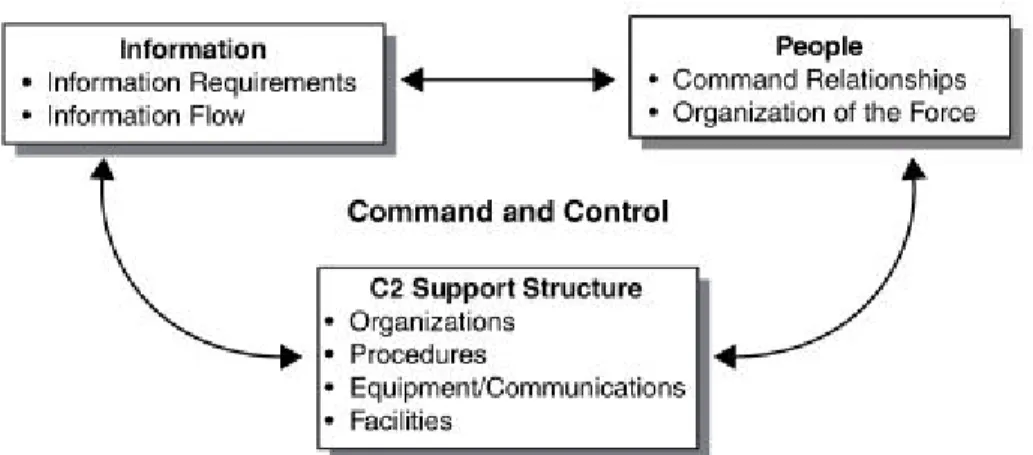
MCDP 6 states that the three elements of com-mand and control are information, people, and C2 support structure (see fig. 1-1), and that they must interact seamlessly to produce effective and har-monious actions. These three elements provide the commander with the tools needed to develop and execute effective information management proce-dures that support all aspects of decisionmaking.
Principles
The following principles are required to effi-ciently and effectively manage information and should guide the information management pro-gram at every level of command in order to facil-itate decisionmaking. These principles apply to every situation that requires a decision.
Use Requirements to Define the Information Flow
Command relationships, organization of the force, and information needs influence the flow of infor-mation. Recognition of user requirements and the resulting information flow allows commands to ap-ply the proper mix of personnel, equipment, train-ing, procedures, and network infrastructure to produce the information needed to make decisions.
Information Management _______________________________________________________________________________________ 1-3
Tailor Information for the Commander
Filter out unnecessary, redundant, or irrelevant information according to the defined information requirements in order to prevent information overload. Provide information in the format spec-ified by the commander.
Use Multiple Sources of Information
Knowledge is normally gained from information derived from numerous products that have been fused together. The use of multiple sources nor-mally improves information accuracy and re-duces error. But it can also increases network traffic and add to the delay between gathering in-formation and gaining knowledge. Therefore, there needs to be a balance between collecting, processing, and dissemination.
Deliver Information on Time
The delivery of information in a timely manner is critical. When requesting information, the requestor should clearly state when the information is re-quired. The information should then be delivered to the requestor in a timely manner. Information that is late does not support the decisionmaking process.
Disseminate Accurate and Relevant Information
Inaccurate or irrelevant information is worse than no information at all. However, even fragmen-tary information that supports critical informa-tion requirements may be of some value if it is validated and provided in a timely manner in a form that is clearly understood.
Create Flexible and
Redundant Procedures and Plans
The information management plan must be able to overcome changes generated by battle dam-age, sudden increases in the volume of informa-tion, and the needs of different commanders at all
echelons of command. The information manage-ment plan should have redundant capabilities and incorporate back up procedures, alternate paths, and primary and alternate personnel/organiza-tions. It should avoid having any “single point of failure” anywhere in the network, security, infor-mation, or information assurance architectures.
Protect Information Through a Vigorous Security Program
Information management must assure the integ-rity of the information and the sources/databases from which that information was derived. Cor-rupted or degraded information is of little value and adversely affects the quality of the decision-making process.
Classes of Information Within an
Information Hierarchy
There are four classes of information within the information hierarchy: raw data, processed data (information), knowledge, and understanding. Each class of information has its own distinct role in the decisionmaking process. The graduations between the different classes may not always be clear, but as information moves through the infor-mation hierarchy (see fig. 1-2 on page 1-4), it be-comes more valuable to the decisionmaker. Information management’s goal is to facilitate the development of quality information throughout the information hierarchy, thus increasing its value and relevance and ensuring the develop-ment of understanding by the commander.
Some level of situational awareness can be achieved with raw data, but situational aware-ness tends to strengthen as information moves through the information hierarchy. Enhanced sit-uational awareness enables the commander to be better prepared to anticipate future conditions, vi-sualize operations, provide guidance, and accu-rately assess situations. Developing accurate situational awareness with limited and uncertain
1-4 ____________________________________________________________________________________________________ MCWP 3-40.2
information under severe time constraints is the fundamental challenge of information manage-ment. There are two elements of situational awareness: information and skill. Information is provided by the staff and major subordinate com-mands in the form of feedback to help build the commander’s understanding of the situation. Skill is the personal understanding of the situation that is based on the commander’s experience, judg-ment, and intuition. The combination of informa-tion and skill provides the commander with an image of the situation from which he can base fu-ture decisions.
Raw Data
Raw data are the facts and individual pieces of in-formation (data) that are the building blocks of pro-cessed information. This initial class of information
is rarely of much use until transformed and pro-cessed in some way to give it meaning.
Processed Data
Processed data comes from organizing, correlat-ing, comparcorrelat-ing, processcorrelat-ing, and filtering raw data and making it readily understandable to the potential user. The act of processing gives the in-formation a limited amount of value. Processed data may have some immediate, obvious, and significant tactical value but it has not been eval-uated or analyzed.
Knowledge
Knowledge is the result of analyzing, integrating, and interpreting processed data; it brings meaning
Information Management _______________________________________________________________________________________ 1-5
and value to a situation or event. Simply put, knowl-edge is a representation of what is happening.
Understanding
Understanding means we have gained situational awareness and it allows the commander to be bet-ter prepared to anticipate future events and to make sound decisions, even in the face of uncer-tainty. It is the highest level of information and the most valuable. It is an appreciation for why things are happening. Understanding occurs when per-sonnel synthesize bodies of knowledge and then apply experience, judgment, and intuition to re-duce gaps generated by uncertainty in order to ar-rive at a complete mental image of the situation.
Characteristics of Quality Information
Quality information adds value to the decision-making process. Information is susceptible to dis-tortion, both by the enemy (intended) and by friendly sources (unintended). The characteris-tics of quality information are as follows:
l Accuracy—Information that conveys the true
situation.
l Relevance—Information that applies to the
mission, task, or situation at hand.
l Timeliness—Information that is available in
time to make decisions.
l Usability—Information that is in common,
eas-ily understood formats and displays.
l Completeness—Information that contains all the
necessary information for the decisionmaker.
l Brevity—Information that has only the level of
detail required.
l Security—Information that has been afforded
adequate protection where required.
Information Format
Sight is the most used human sense and 75 per-cent of all environmental stimuli are received
through visual reception. The retention rate of graphic presentations is greater than that of bal presentations. Whether visual, textual, or ver-bal, the presentation format should be commonly understood and used consistently to minimize confusion and facilitate understanding. The staff produces information in a format that is tailored to the commander’s needs; for example, some commanders prefer visual products, yet other commanders prefer textual information, while still others may prefer a combination of several products. It is important for the staff to clearly learn which form of information is most useable to the commander. It is equally as important for the commander to identify to the staff the format he finds most useful.
Focusing Information Management
Information management focuses the flow of in-formation shown in figure 1-2. The staff and ma-jor subordinate command process, commander’s critical information requirements (CCIRs), and commander’s judgment are tools that can be used to focus large volumes of available data to per-mit the efficient flow of quality information through the information hierarchy. Commanders and their staffs use these tools to focus and sort information in order to identify information that satisfies critical information requirements linked to key decisions. The commander’s intent, com-mander’s guidance, and CCIR are used to mea-sure the effectiveness of information that is used to support decisionmaking.
Commander’s Intent
MCWP 5-1, Marine Corps Planning Process, states, “Commander’s intent is the commander’s personal expression of the purpose of the opera-tion. It must be clear, concise, and easily under-stood. It may also include how the commander envisions achieving a decision as well as the end-state or conditions, that when satisfied, accom-plish the purpose.”1 The commander’s intent
1-6 ____________________________________________________________________________________________________ MCWP 3-40.2
establishes the standards by which success is judged. Through commander’s intent the aims of the commander are articulated, his information re-quirements can be discerned, and the framework for effective information management is formed.
Commander’s Guidance
The commander’s guidance forms the basis for planning, execution, and direction; therefore, it must be clear and concise. Although not prescrip-tive in nature, the planning guidance assists the staff in making initial judgments on the ways and means to achieve a decision. Based on his per-sonal experience and judgment, the commander articulates clear and concise guidance that helps to focus the information management efforts of the staff and subordinate commanders.
Commander’s Critical Information Requirements
CCIR are tools for the commander to reduce in-formation gaps generated by uncertainties that he may have concerning his own force, the threat, and/or the environment. They define the informa-tion required by the commander to better under-stand the battlespace, identify risks, and to make sound, timely decisions in order to retain the ini-tiative. CCIR focus the staff on the type and form of quality information required by the com-mander, thereby reducing information needs to manageable amounts. Instead of reacting to the threat, commanders are able to maintain tempo by controlling the flow of information they re-quire to attain the level of understanding they need within the battlespace. As events unfold, in-formation requirements may change as new deci-sions are required and CCIR are continuously assessed for relevance to support current and fu-ture decisions/situations. The commander ap-proves CCIR, but the staff recommends and manages CCIR to assist the commander.
The commander categorizes CCIR as either friendly activities, threat activities, or the envi-ronment. Friendly activities CCIR include the
in-formation the commander needs to make timely and appropriate decisions relevant to his force. This includes such information as force closure, critical supply levels, and levels of combat effec-tiveness. Threat activities CCIR include the infor-mation the commander needs at a particular time that relates with other available information and intelligence to assist in assessing and understand-ing the situation. This includes indications and warnings of threat intent and/or actions by the threat (e.g., troop movements, changes in oppos-ing force intents or policies). Environment CCIR include the information the commander needs re-garding the physical battlespace environment. This includes all types of information not covered in the friendly or threat categories (e.g., meteoro-logical conditions, supporting infrastructure, geo-political considerations, relevant activities of nongovernmental and private organizations).
Decisionmaking
Assessment
MCDP 6 establishes the doctrinal foundation and the conceptual framework for assessment:
The commander commands by deciding what needs to be done and by directing or influ-encing the conduct of others. Control takes the form of feedback—the continuous flow of in-formation about the unfolding situation return-ing to the commander—which allows the commander to adjust and modify command action as needed. Feedback indicates the dif-ference between the goals and the situation as it exists. . . . Feedback is the mechanism that allows commanders to adapt to changing cir-cumstances—to exploit fleeting opportunities, respond to developing problems, modify [plans], or redirect efforts.2
Assessment is the final step in the PDE&A cycle. The PDE&A cycle is the process the commander and staff use to plan operations, make accurate and timely decisions, direct effective execution
Information Management _______________________________________________________________________________________ 1-7
of operations, and assess the results of those op-erations. It is a framework that supports the com-mander’s efforts to assimilate information in the chaotic environment of war in order to increase tempo through timely and decisive actions. Assessment answers the commander’s question, “How are we doing?” It should help the com-mander identify success or failure, determine the extent to which required conditions have been met for follow-on action, and recognize when a partic-ular endstate has been reached. More specifically, assessment (the evaluation of effects) should en-able the commander to measure the overall progress of an operation as it unfolds on the battle-field. By accurately measuring this progress, the commander can make informed decisions for fu-ture actions.
The assessment process is continuous throughout planning and execution. Planning is where the commander establishes his intent (purpose) for the mission as well as his envisioned endstate. It is also where the staff identifies the essential tasks and associated conditions that must be ac-complished in order to achieve mission success. These are amplified and supported by measures of effectiveness (MOEs), indicators, and perti-nent information in the commander’s order that are expressed in clear, precise, and accurate lan-guage. They may be used as “gauges” to mea-sure performance in execution and become information requirements for evaluating the ef-fectiveness of previously made decisions.
Understanding Information
The commander must frequently make decisions with incomplete information—less than perfect un-derstanding. He may make decisions based on par-tial understanding or at a limited level of situational awareness. Understanding is used to support deci-sions and is a basis for future planning and execu-tion. Understanding can affect decisions already made and allow the commander to better visualize success or failure. Experience, personality, and intu-itive reasoning by personnel making the decisions
often influence the type and form of information used to achieve understanding. The development of tasks, conditions, MOEs, indicators, and pertinent information can be useful tools to recognize quality information used to achieve understanding.
Tasks
There are two parts to any mission: the task to be accomplished and the reason or intent behind it. The task describes the action to be taken. If tasks are to be assessed, planners must develop proper task statements. Tasks that are developed must have a corresponding purpose that describes ef-fects in tangible and measurable terms. Gener-ally, these effects can be described in terms of time, sizes of units, observable capabilities, or terrain. Once a purpose is identified and some tangible qualifiers in terms of time and terrain are identified during planning, assessing the degree to which the task has been accomplished during execution is easier.
Conditions
A condition describes the status of battlespace elements that the commander would like to have in place before executing a decision. It can also be used to determine when a task, stage, or phase of an operation is complete. Conditions must be tied to tasks. Conditions are expressed in enough detail to allow personnel to realistically assess progress, yet broad enough to provide commanders the flexibility to adjust actions to meet unexpected changes. Conditions must be understandable, relevant, and measurable in order to be effective assessment tools. Conditions are expressed as a positive statement rather than a negative statement to enable personnel to realistically assess the status of associated battlespace characteristics.
Measures of Effectiveness
MOEs are those characteristics of the battlespace that comprise specific components of a condi-tion. MOEs support highly specific information needs. Often MOEs identify desired results to
1-8 ____________________________________________________________________________________________________ MCWP 3-40.2
support a key decision that satisfies the compo-nents of a condition. MOEs are defined in terms of indicators and pertinent information. The es-tablishment of MOEs enable the commander to assess whether or not conditions have been satis-fied, which allows the commander to evaluate whether or not decisions have achieved the de-sired results.
Indicators
Indicators are measurable observations that show that the MOEs are, or are about to be, satisfied. Indicators are supported by one or more perti-nent information criteria used to evaluate the sup-ported MOE. Traditionally, each staff section identifies and monitors specific indicators. This procedure can result in the same indicator being managed by multiple staff sections. A better ap-proach is to ensure all staff sections are aware of all indicators associated with each MOE. Sharing this information can prevent staff sections from duplicating efforts to satisfy the same indicator. More than one indicator can support MOEs, a condition, and/or a CCIR.
Pertinent Information
Information needed to satisfy indicators is identi-fied as pertinent information. Pertinent informa-tion satisfies indicators that are established relative to each MOE used to support a desired condition or CCIR. Staff sections identify infor-mation they need to satisfy each indicator for which they are responsible. Timely identification of pertinent information enables the staff to effi-ciently allocate resources in order to routinely pro-duce quality information. Even more importantly, it is the tool that enables the information manage-ment officer (IMO) to work with each staff sec-tion to create an informasec-tion management plan (IMP) that identifies procedures used to facilitate the delivery of quality information to those who need it in a format they can quickly understand.
Planned Decisions
Planned decisions are developed during the plan-ning phase and implemented during execution. De-cision points are generated/created as a result of the planned decision process. Decision points iden-tify points in time or space where the commander expects to make key decisions. Friendly and en-emy forces and environmental factors influence those key decisions. Understanding the type of in-formation necessary to support planned decisions enables the unit to implement effective and effi-cient information management procedures. These procedures enable the commander and staff to clearly identify what type of information is re-quired, who needs it, when it needs to be shared, and the required format. To support planned deci-sions, the commander and the staff will—
l Develop decision points during planning that
will influence actions and events during execu-tion. The decision support matrix (DSM) and decision support template (DST) list these deci-sion points and any associated named areas of interest.
l Establish CCIR that identify friendly, threat,
and environmental information the commander requires to gain the knowledge needed to make key decisions listed in the DSM and DST.
l Establish indicators to help determine whether
the MOE has been met.
l Develop named areas of interest, based on
geo-graphic locations, that intelligence collection assets monitor to confirm or deny enemy activ-ity/indicators for the appropriate threat CCIR. Report requirements are determined for subor-dinate commands that support friendly, threat, and environmental CCIR.
l Ensure that information that satisfies an
indica-tor is immediately sent to the combat opera-tions center, flagged as input to a CCIR, and immediately shared with all other staff sec-tions. If the indicator provides knowledge the commander needs to satisfy the CCIR, the staff
Information Management _______________________________________________________________________________________ 1-9
is notified and the commander decides whether or not he has adequate understanding of the sit-uation to make a decision.
Figure 1-3 demonstrates how personnel can iden-tify and manage quality information to support planned decisions based on warfighting func-tions. As indicators occur and understanding de-velops, the senior watch officer consults the DSM/DST to determine what preplanned solu-tions are still valid. These facts are then placed before the commander, who applies his experi-ence, judgment, and intuition to the information to make a decision.
Spontaneous or Unplanned Decisions
Information management must be flexible enough to provide information that supports both planned and spontaneous decisions for which no prior planning was conducted. Spontaneous or unplanned decisions are those decisions gener-ated by unexpected or unplanned actions or activ-ities. Since combat is inherently uncertain, the commander and the staff use course of action (COA) wargaming to identify environmental fac-tors and threat activities that could affect the friendly COA, and to develop branch plans to ad-dress these possibilities. Potentially, planners
1-10 ___________________________________________________________________________________________________ MCWP 3-40.2
could develop multiple branch plans; they could be intimately aware of friendly, threat, and envi-ronmental actions, reactions, and counteractions; and they could still be surprised. When the plan is executed, the threat could perform an unexpected action or activity that would require a completely new branch plan to be developed and executed. However, armed with the knowledge and under-standing gained by developing numerous branch plans, the commander and staff planners are now better prepared to observe, orient, and react with “unplanned” decisions. Knowledge and under-standing of current and anticipated actions by the threat, friendly forces, and the environment en-ables the commander to make sound, timely deci-sions that control tempo even in the face of uncertainty. The following actions may occur in support of unplanned decisions:
l Indicators are generated as an event develops.
Some of these indicators are collected and re-ported in accordance with commander’s guid-ance and intent as articulated during planning.
l As this information is reported, the combat
operations center will at some point in time recognize that an event is occurring that is not on the DSM/DST and for which no planning has been done.
l Recognition of an unplanned event requires
new plans and decisions to be made. This ac-tion generates new informaac-tion requirements from the commander and staff. These informa-tion requirements focus on the impending event indicators to determine timing, location, disposition, and/or status of the event and its probable outcome.
l An understanding of the event is developed once
sufficient information is collected on the indica-tors. This understanding enables the commander
to make an informed decision and control tempo despite unexpected events.
Information Management During Joint,
Combined, and Multinational Operations
Information management procedures must be capa-ble of providing a framework for rapid and effec-tive exchange of information that enables the Marine Corps component to share critical and rele-vant information in support of joint, combined, and multinational operations. Although each Service possesses Service-unique capabilities, joint opera-tions require information management procedures that are commonly understood by all components/ Services. Effective information management proce-dures ensure all essential information requirements and the processes necessary to support those infor-mation requirements are understood by each com-ponent supporting the joint force.
Joint force commanders and component com-manders maintain their situational awareness through the use of a common operational picture (COP). The Marine Corps component and sub-ordinate echelons of command maintain a com-mon tactical picture (CTP). The COP and CTP help commanders execute the single battle by maintaining situational awareness. The CTP dis-plays friendly and threat forces in a graphic for-mat with amplifying text as required. It also displays relevant tactical control and fire sup-port coordination measures. The CTP and COP are derived using a common tactical dataset and other sources of information. The common tacti-cal dataset consists of shared information de-rived from numerous sources that support the COP and CTP.
C
HAPTER
2
P
ERSONNEL
AND
D
UTIES
Personnel are the second element of command and control. This chapter identifies the principal managers of quality information within each command and outlines their information manage-ment responsibilities. Although these individuals are key personnel with specific information man-agement duties, every user of information has an inherent responsibility to help manage, filter, and fuse information. In a personnel-constrained en-vironment, information management personnel may serve multiple roles and provide expertise to numerous functional areas (i.e., staffs, boards, and cells). In every command, all personnel, as information users, should support information management procedures that enhance decisions made throughout the decision cycle.
Key Information Management Personnel
Commander
The commander does not merely participate in planning: he drives the process. His intent and guidance are key to planning. The commander uses planning to gain knowledge and situational awareness to support his decisionmaking pro-cess. Subordinate commanders use the com-mander’s guidance and concept of operations to accomplish the mission. The commander estab-lishes priorities for gathering and reporting qual-ity information needed to maintain situational awareness and achieve a level of understanding. Clear guidance, commander’s intent, and CCIR provide a focus for the staff to identify quality in-formation used to support key decisions.
Additionally, the commander performs the fol-lowing information management functions:
l Approves the command information
manage-ment plan used to share quality information.
l Approves the command communications plan
that complements and supports the information management plan.
Chief of Staff/Executive Officer
The chief of staff/executive officer is responsible for coordinating the actions of the staff and ensur-ing that the commander receives the information he needs to make decisions. The chief of staff/ex-ecutive officer directs the development of the oper-ation order and performs the following additional information management functions:
l Directs the development of and approves the
daily battle rhythm.
l Implements the IMP. l Appoints the IMO.
l Ensures that information management
proce-dures are adequately shared with the staff and subordinate commands.
Primary Staff
The staff functions as the commander’s eyes and ears. They take the commander’s guidance, in-tent, and CCIR and use them to collect, filter, and analyze data. The staff then provide the resulting information to the commander. The principal staff members perform the following information management functions:
l Identify pertinent information used to support
2-2 ____________________________________________________________________________________________________ MCWP 3-40.2
l Establish internal staff section procedures to
share quality information through the use of newsgroups, e-mail, message handling, home-pages, requests for information (RFI), and sus-pense control measures.
l Appoint a staff section information manager as
a point of contact for information management matters.
l Appoint personnel responsible for maintaining
information technology and network infrastruc-ture used to share quality information.
l Ensure training is completed for basic
informa-tion management and security procedures for appropriate personnel in each staff section.
l Evaluate information management procedures
to assure efficient flow of quality information.
l Establish benchmarks and conduct subjective
analysis to evaluate efficiency and effective-ness of information management procedures.
l Work closely with the IMO to develop network
diagrams that identify the functional applica-tions and network infrastructure required to share quality information with those that need it in a format that is clearly understood.
Information Management Officer
The IMO must be capable of working closely with personnel of all ranks to coordinate proce-dures necessary to share quality information gen-erated by the staff. These procedures should promote development and exchange of knowl-edge required by the commander to make deci-sions. At a minimum, the IMO must be aware of the following functional needs:
l Key decisions the commander must make to
successfully achieve desired results. These de-cisions are normally reflected in a DSM.
l Knowledge required by the commander to
achieve the level of understanding he needs be-fore making key decisions.
l Information the commander needs to reduce his
uncertainty about his force, the threat, and the environment. Normally this information satis-fies the CCIR.
l Information required to satisfy established
con-ditions for tactical operations.
l Information the commander needs on a daily
basis to maintain situational awareness.
To perform these functional needs, the IMO must be capable of working closely with the staff to accomplish the following tasks:
l Develop and publish the command IMP. l Determine processes and procedures to satisfy
CCIR.
l Publish and update the information management
matrix.
l Develop daily battle rhythm matrix (DBRM)
(see the Daily Battle Rhythm Matrix paragraph on page 3-3).
l Coordinate additional training required by staff
and component elements to support production of quality information through effective infor-mation management procedures.
l Work closely with the command CTP manager
(as described in the paragraph entitled Com-mon Tactical Picture/ComCom-mon Operational Picture Manager on page 2-3) and with staff, subordinate, and higher headquarters IMOs to develop effective, efficient track management procedures.
l Work closely with information exchange
tech-nology personnel to facilitate efficient dissemi-nation of quality information throughout the MAGTF.
Staff Section Information Managers
Each staff section information manager should be aware of information required by the commander, when it is required, and the desired format. Staff section information managers are expected to perform the following tasks:
l Monitor internal and external flow of
informa-tion by their staff secinforma-tion.
l Ensure the command IMO is aware of routine
daily updates and information produced by each staff section to satisfy CCIR.
Information Management _______________________________________________________________________________________ 2-3
l Provide the G-6/S-6 a daily update of
command-level information requirements that may need network infrastructure support, sharing of infor-mation, and equipment to support functional needs (i.e., the number and type of equipment, internet protocol [IP] accounts, e-mail and com-puter naming conventions, radio net and tele-phone requirements, and user lists for inclusion in e-mail and telephone directories).
l Ensure compliance with information management
procedures used to share quality information through the use of Intranet/Internet capabilities.
l Coordinate and conduct information
manage-ment training for internal staff section members.
Request for Information Manager
RFIs are used to reduce uncertainty within the command. Questions that cannot be satisfied by organic assets are forwarded to higher headquar-ters in the form of a formal RFI. Answers to questions that allow the staff to promote knowl-edge they require to support the commander are shared through RFI responses. RFI managers are assigned by the G-2 for intelligence-related ques-tions and the G-3 for all nonintelligence-related questions. RFI managers are expected to perform the following tasks:
l Receive, validate, prioritize, and submit RFIs
to the appropriate authority for resolution.
l Develop/manage a tracking system that ensures
that RFIs are processed in a timely manner and that responses are expeditiously disseminated to the requester and accessible to all personnel. See the Networks paragraph on page 3-9 for more discussion of RFI procedures.
Common Tactical Picture/
Common Operational Picture Manager
The CTP/COP manager is responsible for the re-porting and display of friendly, threat, and other appropriate tracks. He is also the unit track man-ager. The CTP/COP manager for blue force tracks
is normally assigned by the G-3. The CTP/COP manager for enemy force tracks is normally as-signed by the G-2. The overall unit CTP/COP manager normally is the G-3 CTP/COP manager. The CTP/COP manager is expected to perform the following tasks:
l Coordinate and deconflict all ground unit
tracks with all major subordinate commands and higher headquarters. Air tracks are the re-sponsibility of the aviation combat element, which provides air tracks to the command ele-ment as required.
l Work closely with the senior watch officer to
ensure that the location and disposition of friendly and enemy ground units are visually updated as required.
Webmaster
Internets and Intranets are valuable resources used to share quality information both internal and external to the staff. The webmaster, who is assigned by the G-6, creates a unit’s web site. Specifically, the webmaster is responsible for the following tasks:
l Create the command web site to support
shar-ing of quality information. At a minimum, the web site supports internal and external report-ing requirements, CCIR, RFIs, commander’s daily brief, and daily battle rhythm.
l Maintain the web site to ensure that changes to
information requirements are posted in a timely manner.
l Maintain security over the web site and ensure
that information contained therein is available to the appropriate personnel.
l Ensure procedures are developed,
disseminat-ed, and understood on how to access the site, upload information, and change the site.
l Maintain links to external sites of interest to the
staff.
l Develop formatting standards.
l Create initial pages for each staff section and
2-4 ____________________________________________________________________________________________________ MCWP 3-40.2
to maintain their page in order to ensure unifor-mity of design among sections.
l Develop custom web-based applications. l Advise/assist staff section web representatives.
Subordinate Unit and Higher Headquarters Information Management Officers
Each major subordinate command and higher headquarters appoints an IMO as a primary point of contact for information management matters. Subordinate and higher headquarters IMOs can be expected to perform the following tasks:
l Review/update information reflected by the
re-ports matrix and daily battle rhythm.
l Conduct liaison with the higher headquarters
and adjacent IMOs.
l Coordinate and assist the training required to
produce quality information throughout the Marine air-ground task force (MAGTF).
l Ensure appropriate management personnel are
designated within the command to address technical support if the MAGTF chooses to use automated or electronic means to share and manage command information (i.e., web site, newsgroup, public folders, shared directories).
Organizations That
Influence Information Management
Combat Operations Center, Tactical Air Operations Center, and Combat Service Support Operations Center
The combat operations center, tactical air opera-tions center, and combat service support operaopera-tions center support current operations. Personnel oper-ating in these centers conduct the following infor-mation management related activities:
l Assess information flow to support operations. l Review and record incoming message traffic to
filter and fuse information in accordance with the commander’s guidance and intent. Provide
the commander with information that relates to the CCIR and decision points.
l Manage the CTP through commonly
under-stood track management procedures.
l Monitor the CTP’s efficiency, effectiveness,
and accuracy to provide enhanced situational awareness of friendly and enemy forces.
l Maintain a master suspense action log/journal. l Maintain a chronological record of significant
events.
l Direct production of the commander’s daily
briefings and fragmentary order production.
l Assess, update, and integrate priority
intelli-gence requirements.
Combat Intelligence Center
The combat intelligence center is the overarch-ing intelligence operations center established within the main command post. It performs the following functions:
l Reviews, assesses, and disseminates
threat-related information in a format that is quickly understood by those needing the information. This provides a common understanding of the threat within the designated battlespace.
l Monitors the efficiency, effectiveness, and
ac-curacy of the threat assessment determined by the common tactical picture parameters.
l Works closely with the combat intelligence
center, future operations section, and future plans section to ensure threat assessments satis-fy designated planning horizons and are updat-ed accordingly.
l Develops, monitors, and updates priority
infor-mation requirements and RFIs. Responds to priority information requirements and RFIs of the commander, staff, and subordinate com-mands.
Future Operations Section
The future operations section develops courses of action that support the next stage or phase of the
Information Management _______________________________________________________________________________________ 2-5
operation, and information management supports the following activities:
l Collaborative planning, which requires the
sharing of quality information through the use of collaborative capabilities and commonly un-derstood procedures as outlined in appendix A.
l Visually displaying information, which includes
tools and overlays that describe fire support co-ordinating measures, boundaries, maneuver, lo-gistics/sustainment, decisions, and intelligence.
l Planning tools that are capable of supporting
COA development.
l Filtering tools and procedures to assess measures
of effectiveness for conditions tethered to key de-cisions required to support execution and transi-tion to the next stage or phase of the operatransi-tion.
Future Plans Section
The future plans section develops the next phase of the operation. Information management supports the following future plans activities and tools:
l Collaborative planning, which requires the
sharing of critical and relevant information through the use of collaborative capabilities and commonly understood procedures.
l Visually displaying information, which includes
tools and overlays that describe fire support co-ordination measures, boundaries, maneuver, lo-gistics/sustainment, decisions, and intelligence.
l Planning tools that are capable of supporting the
development of the next phase of the operation.
Security Personnel
Information Security Manager
The information security manager is responsible for the proper accountability, control, personnel access, and physical security/storage of noncom-partmented classified data (hard and soft copy forms). This includes the TOP SECRET control
officer’s responsibility for the JTF TOP SECRET registry’s accountability, control, and access.
Special Security Officer
The special security officer is responsible for sen-sitive compartmented information (SCI) manage-ment, control, and access and is normally a G-2/ S-2 function.
Information Systems Security Officer
The information systems security officer is re-sponsible for safeguarding the command’s infor-mation systems. The inforinfor-mation systems security officer enhances the command’s information se-curity knowledge, skills, and abilities through command-wide education and training programs. The information systems security officer performs the following information management functions:
l Maintains a plan for site security.
l Ensures the information system is operated,
used, maintained, and disposed of in accor-dance with security policies and practices.
l Conducts site survey and vulnerability
assess-ments of systems in order for them to process classificed and sensitive information.
l Ensures the information system is accredited and
certified if it processes sensitive information.
l Ensures users and system support personnel
have the required security clearances and au-thorization, and are familiar with internal secu-rity practices before access to the information system is granted.
l Ensures the information system has intrusion
detection devices.
l Enforces information system security policies
and safeguards.
Operations Security Officer
The operations security officer provides oversight and implementation of the command operations se-curity program, ensuring protection against compro-mise of friendly force information. This position is
2-6 ____________________________________________________________________________________________________ MCWP 3-40.2
normally a G-3/S-3 function, and it receives sup-port from the G-2/S-2 (counterintelligence officer).
User Responsibilities
The following duties and responsibilities are in-cumbent upon all users of information to ensure proper information flow:
l Report information as required by the
com-mand CCIR.
l Ensure accuracy and relevance of information
be-fore further dissemination. Clearly differentiate
between original information and previously re-ported information to avoid duplicate reporting.
l Properly control, classify, protect, and archive
all information and information systems for which they are responsible. This requires a clear understanding of approved control measures for various classifications of information.
l Read and comply with the information
require-ments published by the IMP.
l Retain any irrelevant or conflicting information
discarded during analysis and correlation of data—do not destroy it prematurely. This infor-mation may become useful when combined with additional facts.
C
HAPTER
3
C
OMMAND
AND
C
ONTROL
S
UPPORT
S
TRUCTURE
D
EVELOPMENT
C2 support structure is the third element of com-mand and control. C2 support structure is more than advanced technology and equipment—it is the inte-grated use of organizations, people, capabilities, training, procedures, doctrine, and network infra-structure to support C2 and decisionmaking pro-cesses. An effective C2 support structure produces information that promotes understanding of the situ-ation or event and allows the commander to be bet-ter prepared to direct and coordinate actions in the execution of a decision.
Information Flow
An effective C2 support structure improves infor-mation flow by—
l Reducing labor and saving time by automating
repetitive procedures and performing intensive calculations.
l Disseminating information to many users in
different geographic locations.
l Transforming tabular data into graphic or other
visual products that allow personnel to quickly understand the situation or event. Appendix A contains examples of visual mapping products that support each step of the Marine Corps Planning Process.
When developing a C2 support structure that en-hances the flow of information across warfighting functions (command and control, maneuver, fires, intelligence, logistics, force protection) and across traditional staff section boundaries, numerous fac-tors should be considered. These facfac-tors include location of information, mobility, accessibility, fil-ter/fusion, and push versus pull.
Location of Information
The repositioning of the required information at anticipated point(s) of need speeds up the flow of information, reduces demands on communica-tions networks, and provides required information to those that need it in a timely manner. Knowing that information is prepositioned at a specific point is critical when units are highly dispersed.
Mobility
A reliable and secure flow of information must be commensurate with the commander’s mobility and tempo of operations requirements. The capa-bilities and procedures necessary to support ef-fective information flow must be flexible enough to adjust immediately to support low footprint and highly mobile command posts, as well as the mobility requirements of subordinate units.
Accessibility
All levels of command must have access to the information they require to support concurrent and/or parallel planning, mission execution, and assessment. An effective C2 support system uses automation to provide the user with quality infor-mation quickly; for example, automated, dynamic visual display of forces in a CTP environment.
Filter/Fusion
Information is received from many sources, in many mediums, and in different formats. Filtering occurs when information is evaluated/assessed and deemed to be of value and irrelevant data is dis-carded. Fusion is the logical blending of informa-tion from multiple sources into an accurate, concise, and complete summary. The C2 support
3-2 ____________________________________________________________________________________________________ MCWP 3-40.2
structure must give analysts and decisionmakers the ability to quickly filter and fuse information.
Push Versus Pull
Information management uses two basic ap-proaches to share information: supply-push and demand-pull. The C2 support structure incorpo-rates the most appropriate approach based on the commander’s information requirements.
A supply-push methodology relies heavily on in-formation being pushed from the source to the user, either as the information becomes available or according to a schedule. The advantage of sup-ply-push is that the commander normally does not need to request quality information. Quality infor-mation is delivered (or pushed) to the user in a timely manner. This type of information manage-ment can result in information overload because producers of information may not completely un-derstand user information requirements.
In a pure demand-pull system the user initiates the flow of information and seeks out information required. If the information is readily available— pre-existing in a database—the requirement is quickly satisfied. If the information is not avail-able, the requirement must move through the chain of command until it reaches the appropri-ate level. Information can be tailored specifically to support the identified requirement, thereby avoiding overload. The disadvantage to the de-mand-pull system is the cost in time, since the search for information may not begin until the commander or user has identified a need.
Information Management
C2 Support Structure
The development of an information management C2 support structure consists of the following three steps: process flow, configuration flow, and personnel requirements.
Process Flow
MCDP 1-2, Campaigning, identifies six basic warfighting functions: command and control, ma-neuver, fires, intelligence, logistics, and force protection, and an information process supports each warfighting function. Each process captures the step-by-step tasks necessary to collect, ana-lyze, and disseminate the information. Under-standing the process flow (how information is physically transmitted and processed) that sup-ports each warfighting function enables the IMO to work closely with the staff and commander to develop effective information management pro-cedures. An effective C2 support structure ac-counts for the different warfighting processes unique to each level of command.
The first step in the development of an information management C2 support structure is to identify the process flow that supports each warfighting func-tion. A process flow diagram identifies the series of tasks necessary to support each warfighting function. Information management is central to the process and is focused on supporting the pro-cesses that satisfy information requirements essen-tial to the warfighting functions.
Configuration Flow
Once the process flow diagrams have been cre-ated, the next step in the development of an infor-mation management C2 support structure is the development of the configuration flow diagrams. A configuration flow diagram describes the con-figuration of systems necessary to support the tasks in the process flow diagram.
A configuration flow diagram is established by performing the following actions—
l Determining the system required to perform
each task identified by the process flow diagram.
l Identifying the network infrastructure
neces-sary to disseminate information produced by personnel performing each task identified by the process flow diagram.
Information Management _______________________________________________________________________________________ 3-3
Each system is placed in the appropriate com-mand element organization linked by the proper network infrastructure. Current command rela-tionships and task organization of forces are taken into consideration to develop the configura-tion flow diagram. This methodology permits a command to identify system and network short-falls or potential vulnerabilities.
Personnel Requirements
In the final step of developing a C2 support struc-ture, the command identifies personnel require-ments from the configuration flow diagram and determines the number of personnel, skill sets (training), and procedures necessary to support each warfighting function. The identified person-nel requirements are then measured against what is currently being used by the command. This comparison allows the command to identify any deficiencies and to implement corrective action if necessary. Both of these actions result in an effi-cient flow of information within the command C2 support structure and effective decisionmaking.
Documentation
Capturing information management decisions and plans in documentation that is easily distributed facil-itates a common understanding of information management throughout the command.
Information Management Matrix
The information management matrix records all information requirements, user(s), recipients, ca-pabilities used to process the information, and pathways necessary to pass information. It is a powerful planning tool used to support execution, to determine the source of information flow lem(s), and to correct any information flow prob-lems through appropriate action/coordination. A carefully designed information management ma-trix significantly enhances the efficiency and ef-fectiveness of staffs and decisionmakers. The staff
determines the content of the information manage-ment matrix.
Daily Battle Rhythm Matrix
The DBRM is a schedule of key daily events that involve the commander and the staff. These events can include staff briefings, updates, visits, reports, and products (e.g., air tasking order, intelligence summary). These events are extracted from the information management matrix and placed on the DBRM. The purpose of the DBRM is to dissemi-nate the schedule and facilitate the integration of various events. The commander and the staff are responsible for identifying which event needs to be placed on the DBRM. The chief of staff/executive officer manages the DBRM.
Decision Support Matrix
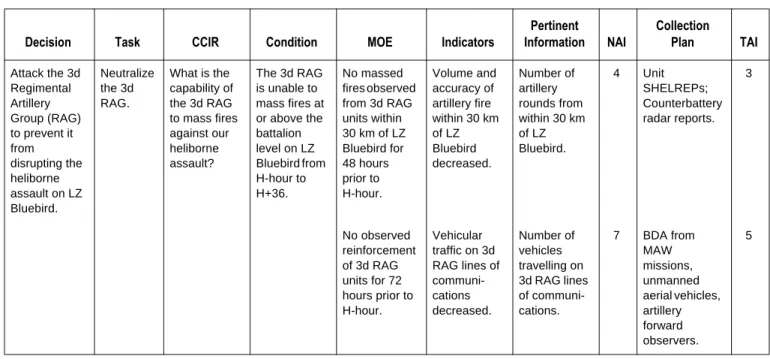
The DSM links information to key decisions and helps the commander coordinate activities and main-tain situational awareness. The commander and staff develop a DSM during the planning process. The DSM identifies key decisions that the commander expects to make during the next stage or phase of the operation. Table 3-1, on page 3-4, illustrates how a DSM can be used to assist with the identification of quality information used to support assessment. Once the DSM is written, a DST can be created. The DST is a mapping product that graphically displays the text information contained in the DSM.
The DSM identifies the CCIR needed by the commander in order to gain knowledge and to achieve the understanding he needs before mak-ing key decisions to achieve the desired results. The DSM identifies conditions and MOEs to as-sist in recognizing when desired results for each decision are achieved. For certain decisions, MOEs and approved conditions may be the same, but that determination depends upon the type of decision being made by the commander. The DSM identifies indicators that support each MOE. Indicators may be developed to support the designated condition directly. Each staff section identifies pertinent information used to support
3-4 ____________________________________________________________________________________________________ MCWP 3-40.2
each indicator. Indicators are managed using tools that enable all personnel to share pertinent infor-mation that satisfy indicators. Staff sections en-sure the IMO is aware of pertinent information used to satisfy indicators.
Request for Information Management
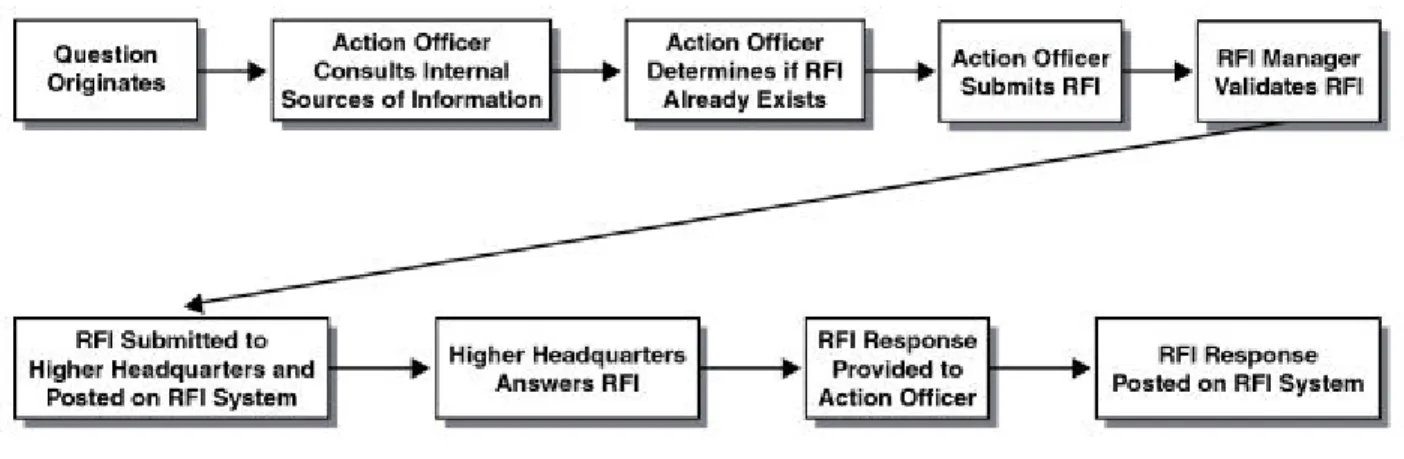
RFIs are specific, time-sensitive ad hoc require-ments for information or products submitted to higher headquarters to support an ongoing crisis or operation not necessarily related to standing require-ments or scheduled intelligence production. RFIs are generated to answer questions that cannot be re-solved with organic assets, when the information does not exist within internal databases, and when the information cannot be satisfied by resident sub-ject matter experts. Figure 3-1 depicts a typical pro-cess flow used to support RFI management.
Information Manager
An RFI manager (G-2 or G-3) serves as the cen-tral point of contact for multiple sources: the op-erational planning team, primary staff sections, and major subordinate commands. All RFIs are submitted to the appropriate RFI manager who
validates the RFI, assigns priorities, and submits the RFI for resolution. Each RFI manager ap-plies the commander’s guidance and intent, CCIR, and good judgement to guide validation and prioritization of each RFI. RFIs directly tied to the CCIR are assigned a higher priority than other RFIs.
Submission Guidelines
Before the requestor submits an RFI, local infor-mation and the RFI database is searched to ensure that the information is not available or that a sim-ilar request has not already been submitted. If the information cannot be found, an RFI is submit-ted to the appropriate RFI manager. All intelli-gence-related requests for information are processed through a G-2 RFI manager. All nonin-telligence-related requests for information are processed by the G-3 RFI manager. The follow-ing guidelines apply to the draftfollow-ing and submis-sion of RFIs:
l Limit the RFI to one question per request.
Mul-tiple questions can increase response time and add confusion as multiple agencies answer the questions from one RFI.
Table 3-1. Example of a Decision Support Matrix.
Decision Task CCIR Condition MOE Indicators
Pertinent Information NAI Collection Plan TAI Attack the 3d Regimental Artillery Group (RAG) to prevent it from disrupting the heliborne assault on LZ Bluebird. Neutralize the 3d RAG. What is the capability of the 3d RAG to mass fires against our heliborne assault? The 3d RAG is unable to mass fires at or above the battalion level on LZ Bluebird from H-hour to H+36. No massed fires observed from 3d RAG units within 30 km of LZ Bluebird for 48 hours prior to H-hour. Volume and accuracy of artillery fire within 30 km of LZ Bluebird decreased. Number of artillery rounds from within 30 km of LZ Bluebird. 4 Unit SHELREPs; Counterbattery radar reports. 3 No observed reinforcement of 3d RAG units for 72 hours prior to H-hour. Vehicular traffic on 3d RAG lines of communi-cations decreased. Number of vehicles travelling on 3d RAG lines of communi-cations. 7 BDA from MAW missions, unmanned aerial vehicles, artillery forward observers. 5