Memory-Based Store Price Judgments: The Role of Knowledge
and Shopping Experience
Chezy Ofir
a,∗, Priya Raghubir
b, Gili Brosh
a, Kent B. Monroe
c,d, Amir Heiman
e aSchool of Business Administration, Hebrew University, Mount Scopus, Jerusalem, IsraelbHaas School of Business, University of California Berkeley, United States
cDepartment of Business Administration, University of Illinois, Urbana-Champaign, United States dDepartment of Marketing, University of Richmond, Richmond, VA, United States eDepartment of Agricultural Economics, Faculty of Agriculture, Hebrew University, Israel Received 3 December 2007; received in revised form 20 August 2008; accepted 28 August 2008
Abstract
This paper investigates the processes underlying consumers’ memory-based store price judgments. The numerosity heuristic implies that the greater the number of relatively lower priced products at a store that consumers can recall, the lower will be their overall price image of the store. That is, people use the number of recalled low-price products to judge the overall store price image. We show that this expectation holds only for knowledgeable consumers. Instead, less knowledgeable consumers use the ease with which low-price products are recalled (i.e., the availability heuristic) as a cue to make store price judgments. Therefore, the fewer low-price products they recall, the easier their recall task, and the lower their price perceptions of the store.
Field studies using different manipulations tested and confirmed these predictions. Managerial implications for retailers are offered. Theoretical implications for behavioral price perceptions, memory-based judgments, and the use of heuristic cues are also discussed.
© 2008 Published by Elsevier Inc on behalf of New York University.
Keywords:Store price judgments; Consumer knowledge; Memory; Ease of recall; Numerosity
Price positioning is a basic element in marketing and retail strategy. Consumers’ perceptions of a retailer’s prices are of strategic importance because they influence store preferences (Arnold, Oum, and Tigert 1983). Indeed, buyers may focus on the general pricing strategy and positioning of different retailers (Monroe 2003). Retail pricing and positioning are among the most challenging decisions facing retailers (Binkley and Bejnarowicz 2003; Grewal and Levy 2007; Levy et al. 2004; Schindler 2006). Basic strategies such as everyday low prices or high–low pricing affect consumers’ perceptions of a retailer’s prices. Retailers may also signal their relative price levels via their store names (e.g., “Best Buy”), advertising messages and claims (e.g., “Low Price Guaranteed!”) (Dutta and Biswas 2005; Kukar-Kinney and Walters 2003; Kukar-Kinney, Walters, and MacKenzie 2007; Kukar-Kukar-Kinney, Xia, and Monroe 2007), slogans (e.g., “Always low prices”),
pres-∗Corresponding author at: School of Business Administration, Hebrew
Uni-versity, Mount Scopus, Jerusalem, Israel.
E-mail address:[email protected](C. Ofir).
ence/absence of reference prices (Burman and Biswas 2007; Chandrashekaran 2004; Chandrashekaran and Grewal 2003; Darke and Chung 2005; Kopalle and Lindsey-Mullikin 2003; Ofir 2004), semantic price cues and various forms of promo-tions (Folkes and Wheat 1995; Hardesty and Bearden 2003; Kim 2006;Krishnan, Biswas, and Netemeyer 2006) and price matching guarantees (Dutta and Biswas 2005; Kukar-Kinney and Walters 2003;Kukar-Kinney et al. 2007a,b) that are offered. All these various pricing strategies and tactics help estab-lish consumer judgments of prices in a store or a store price image.
Consumers often judge a store’s prices in the absence of price lists and other pricing signals or when not actually inside the store. In such cases, they rely on their memory of product prices to make an overall judgment of store prices. These memory-based judgments influence their store-price perceptions and the degree the store is attractive to them (Binkley and Bejnarowicz 2003). Despite their prevalence in everyday consumer activity, relatively little research has been devoted to memory-based judg-ments of store prices. The present investigation attempts to help fill this gap.
0022-4359/$ – see front matter © 2008 Published by Elsevier Inc on behalf of New York University. doi:10.1016/j.jretai.2008.08.001
When consumers rely on their memory to judge a store’s prices, they may conjure up some examples of products and prices in that store. Depending on their orientation and experi-ences with the store they may recall a sample of products and prices that are relatively low in price or relatively high in price. Also, they may recall a few products and prices (e.g., two or three) or a larger set of products in the store (e.g., five). There are two rival hypotheses about the judgments that they may make depending on the number of exemplar products they recall and the relative ease of recalling these exemplars.
If the consumer recalls relatively low-priced products, then the numerosity heuristic (Pelham, Sumarta, and Myaskovsky 1994) implies that the greater the number of low-priced products they recall, the lower will be their price perceptions of the store. Recalling a large number of low-priced products signals to the
consumer that store prices are relatively low. But, theavailability
heuristicsuggests that people would judge the store’s prices as a function of the ease that the prices of a sample of the products come to mind (Tversky and Kahneman 1973). If it is easy to recall such products and their prices, people may infer there are a large number of such items. Consequently, if people find
it easy to recall low-price products, the availability heuristic
argues that they may infer the store has many low-price items. Therefore, if they easily recall a small number of low-price items, they are more likely to believe that overall the store has lower priced products. On the other hand, if they attempt to recall a relatively larger number of low-price items, the task becomes more difficult. As the task of recalling a given set of product exemplars becomes more difficult, they may infer that the overall number of low-price products in the store is small and conclude that the store does not have many low-priced products.
This paper examines how consumers may use these two alter-native heuristics to make store price judgments: the number of recalled low-priced products in a store (the numerosity heuris-tic) versus the ease that low-priced products of a store come to mind (the availability heuristic). The idea that people use ease of recall as a cue to make judgments about the content of information retrieved from memory has been shown in a
range of tasks (seeSchwarz and Vaughn 2002for a review). We
propose and show that the relative use of “numerosity” versus “ease-of-recall” cues depends on the individual’s prior level of knowledge. More knowledgeable consumers are more likely to use the numerosity heuristic: the greater the number of low-price products in a store that they recall, the lower they believe the store’s price level is. However, less knowledgeable consumers are more likely to use the availability heuristic: the greater the number of low-price products that they try to recall, the more difficult it is to recall these products, and therefore they infer the store has relatively high prices.
Using field and laboratory experiments, studies 1A, 1B, and 2 show that consumers who recall few low-price products (e.g., two) in a store rate it as lower priced than do consumers who recall relatively more low-price products (e.g., five) from the store. Analogously, consumers who recall a few high-price prod-ucts at a store judge it to be higher priced than do consumers who recall relatively more expensive products from the store. Study 3 shows that this effect is moderated by consumer knowledge.
The primary substantive contributions of this paper are to the field of behavioral price research with managerial implications for retailers. We (1) demonstrate that store-price perceptions are tensile, memory-based, and contingent on contextual cues; (2) extend the literature on the numerosity heuristic and the avail-ability heuristic into price perception research; and (3) show that consumer knowledge helps explain which of these heuris-tics will be used and consequently consumers’ beliefs about a store’s relative price levels.
The effect of availability and numerosity on memory-based judgments of store prices
The availability heuristic
The availability heuristic proposes that people find it is eas-ier to recall fewer pieces of information than many pieces of information (Tversky and Kahneman 1973). This effect sug-gests that it is the ease of retrieval rather than the retrieved evidence itself that would influence consumers’ store price judgments. Therefore, if people experience difficulty in recall-ing examples of low-price products in a store, they may infer that there are few low-price products available and conclude that the store is expensive. There is evidence supporting the availability heuristic. For example, recalling a few positive attributes of a product compared to recalling a larger num-ber of positive attributes led to more favorable evaluations of cars (Wänke, Bohner, and Jurkowitsch 1997), computers (Menon and Raghubir 2003), and perceptions of health risk
(Menon, Block, and Ramanathan 2002; Raghubir and Menon
1998).
The numerosity heuristic
The “numerosity heuristic” refers to when people judge amount (e.g., area) or likelihood of occurrence based on the pre-sented number of units composing the stimulus (Pelham et al. 1994). A related finding in pricing, in an on-line stimulus-based
paradigm,Alba et al. (1994)found that consumers perceive a
store to have lower prices when they are presented with a larger number of lower priced products than a store with a fewer num-ber of such products. In our context of memory-based store price judgments, the numerosity heuristic could be conceptu-ally translated into the prediction that the more instances of a particular event come to mind, the more such events will be believed to exist; that is, if one recalls many instances of low-price products in a store, one will perceive the store to be low-priced.
The moderating effect of memory- versus stimulus-based judgments on use of ease-of-recall
Some studies have directly or indirectly contrasted these two
heuristics. For example,Menon et al. (2002)showed that there
is an ease of recall effect when judgments are memory-based but not when they are stimulus-based. In a stimulus-based situation, consumers believed that their risk for Hepatitis-B was greater
when provided many (vs. few) symptoms of the disease. How-ever, in a memory-based situation, when consumers had to recall these symptoms, then the more symptoms they had to recall, the lower were their perceptions of risk. This result suggests that the presented information is more diagnostic than feeling of ease of recall.
The fact that memory-based vs. stimulus-based judgments favor the use of one heuristic over another is particularly relevant, as prior research has studied how consumers make store price judgments given a sample of prices of products in the store—a
stimulus-based task.Alba et al. (1994) presented participants
with a list of 60 prices from two stores. The frequency store offered relatively more comparatively lower priced products than did the competitor (but only by a small amount per compar-ison). The depth store offered a few products that comparatively were substantially lower in price than the competitor’s. The actual market-basket price for the items was equal for each store. After reviewing each store’s price lists, respondents estimated the market basket price of the frequency store to be significantly less than the depth store. One possible conclusion from this result is that when a task is stimulus-based, it is more likely that the numerosity heuristic would influence judgments of the relative price level of a store.
These findings may suggest that if consumers retrieve from memory relatively more low-priced products from a specific store relative to a competitive store, they integrate product prices into a store-price evaluation when the judgments follow a stimulus-based and comparative task. However, when con-sumers are asked about their perceptions of store prices in the absence of price lists, or when not actually inside the store, they have to rely on their memory from previous experiences. In such a situation they would likely retrieve exemplars of rel-atively low-priced (or high-priced) products at a specific store.
Thus, givenMenon et al.’s (2002)results, we would expect that
when a price judgment task is memory-based, people would use the availability heuristic (ease of recall) to make store price judgments.
Specifically, we argue that if ease of recall is informa-tive, then consumers who retrieve few (e.g., two – an easy recall task) low-priced products will judge store prices as less expensive than those who retrieve many (e.g., five – a rela-tively more difficult recall task) low-priced products, due to the greater ease of recalling a few low-priced products. More specifically:
H1. Consumers’ judgments of a store’s price level will be lower
(higher) after recalling two rather than five low-priced (higher priced) products.
Studies 1A and 1B examine memory based store price judgments (H1). Study 2 investigates whether Hypothesis 1 holds when consumers are asked to recall expensive prod-ucts. These studies are followed by a theoretical discussion regarding the role of knowledge in these processes. Addi-tional analyses of the data from studies 1A and 1B along with Study 3 investigate the moderating role of consumer knowledge (H2).
Study 1A
The objective of study 1A was to examine Hypothesis 1, based on memory research that suggests that the ease of recall-ing low-priced products, rather than the number of such products recalled, will affect store price perceptions. This research was performed in a field experiment focusing on a specific food store.
Method
Design and participants. Ninety-nine consumers approach-ing a supermarket were assigned at random to two experimental cells. All consumers were requested to recall examples of low-priced products sold in the store: Half of the people were requested to indicate two products and the other half were asked to indicate five products. A pretest with 20 and 25 consumers respectively, indicated that recalling 2 (5) low-priced products in the store were perceived as an easy (difficult) task. The objective of this pretest was to ensure that the levels of recall were suffi-cient to elicit adequate levels of ease for this experiment. There is no intention and it is beyond the scope of this paper to assess the relation between amount of recall and the metacognitive feelings of ease.
Dependent measure. The consumers were then asked to rate the store using two 7-point scales anchored by “expensive-cheap” and “very high-very low” prices. Higher numbers suggest that prices are lower. As the responses to these two items were highly correlated, they were averaged into a single price-perception index (r= .87,p< .001).
Manipulation check. After the dependent measure, partici-pants rated the ease of recalling products using two semantic differential scales anchored by “easy-difficult,” and [took] “little-much thought”. Higher numbers indicate that the task was perceived to be more difficult. The responses to these two items were highly correlated and were averaged into a single ease-of-recall index (r= .83,p< .001).
Controls and covariates. As explained below, given a poten-tial influence of shopping experience on the relevant recall processes respondents were asked what percentage of grocery shopping they did for their household at the specific store: up to 10%, 11–40%, 41–60%, 61–80%, and 81–100%. Using this measure enables examining Hypothesis 1 while controlling for shopping experience.
Results
A t-test applied to the two conditions varying in amount of recalled products revealed a significant difference where recalling two products was perceived easier than recalling
five products (M2= 4.01 vs. M5= 5.29; t(97) = 4.17, p< .001,
r= .39). The store was perceived to be less expensive after
recalling two (vs. five) products (M2= 4.43 vs. M5= 3.15,
t(97) = 6.37, p< .001), r= .54. The effect remained signifi-cant when controlling for shopping experience using analysis
of covariance (F(1,96) = 38.3, p< .001; r= .53), supporting
Study 1B
The objective of study 1B was to further test Hypothesis 1 regarding recall of lower priced products in the store.
Method
The procedure was similar to that used in study 1A. One hundred and one consumers approaching a supermarket were asked to recall either two or five low-priced products in the store. They then completed the two measures used to compute the store-price index, as in the previous study (r= .84,p< .001). Subsequently, their store evaluations were elicited using two 7-point scale items anchored by “negative-positive” and “bad-good.” Higher numbers indicate a more favorable evaluation. These two scale items were averaged to form the overall store evaluation index (r= .92,p< .001).
As in study 1A, respondents were asked about the percentage of food shopping they did for their household at the specific store, their frequency of shopping at that specific store (less than once a month, 1–3 times a month, once a week, twice a week, more than twice a week), and the two scales measuring the ease-of-recall index (r= .83,p< .001).
Results and discussion
As intended the manipulation of amount of recall resulted
in easier retrieval for two (vs. five) products (M2= 3.0 vs.
M5= 5.62,t(99) = 10.4,p< .001,r= .72). Also, consistent with Hypothesis 1 consumers perceived the store to be less
expen-sive in the easier recall condition (M2= 3.29, vs. M5= 2.21,
t(98) = 5.38), p< .001, r= .48).1 This effect remained signifi-cant when controlling for shopping experience using analysis of covariance (F(1,97) = 26.92,p< .001,r= .47). The results are consistent with those presented in study 1A using a different sample of consumers shopping in a different store. Both studies support Hypothesis 1.
Both studies found support for the availability heuristic in the domain of recalling inexpensive products purchased from a store. It is an open question as to whether the effect would also occur if consumers were asked to recall
expen-sive products. Specifically, Krishna and Johar (1996)suggest
that consumers are motivated to notice and recall low price rather than more expensive products in a store. Therefore, it is possible that the task of recalling low price or expensive products may lead to asymmetric effects. Study 2 examined
whetherH1holds when consumers are asked to recall expensive
products. Study 2
The objective of this study was to testH1in the context of
memory for high-priced products. The availability heuristic (i.e., ease of recall) is expected to predict high price image as well as low price image.
1The effect was also significant for overall store evaluation (t(99) = 3.30,
p< .001,r= .31).
Method
Seventy-eight responding consumers were assigned at ran-dom to one of four conditions in a 2 (type of products: low price or high price) by 2 (number of recalled products: two or five) between-subjects design. A pretest with 26 shoppers at the store suggested that recalling two products would be easier than recalling five products for low-priced as well as high-priced products. Consumers were approached before entering a super-market (located in a different geographical area from the stores used in Studies 1A and 1B) and asked to recall two (or five) low-price (or high price) products at the store. They then com-pleted dependent measures and manipulation checks which were elicited as in the previous studies to form the price perception
index (r= .97, p< .001) and the ease-of-recall index (r= .94,
p< .001). As in previous studies higher numbers on the price
perception measure indicate that prices are lower. Results and discussion
Manipulation check. A 2 (type of products recalled: low
price vs. high price)×2 (number of products recalled: two vs.
five) ANOVA on the ease-of-recall index showed a significant main effect for number of items recalled. Recalling two
prod-ucts was perceived to be easier (M= 3.46) than recalling five
products (M= 5.44, F(1,74) = 23.9, p< .001, r= .49). Neither
the main effect for type of product recalled nor the interaction
between the two factors was significant (p> .05). Respondents
rated recalling two products as significantly easier than
recall-ing five products for both low-priced products (M2= 3.65 vs.
M5= 6.0, respectively,t(38) = 3.89,p< .001,r= .53), as well as
for high-priced products (M2= 3.26 vs.M5= 4.84, respectively,
t(36) = 3.01, p< .005, r= .45). Therefore, the manipulation of ease of recall worked as intended and was not influenced by whether the products recalled were low priced or high priced.
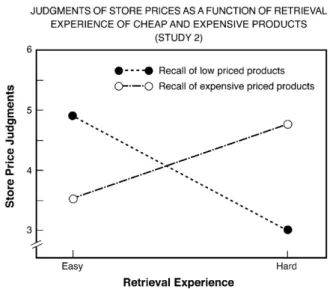
Hypothesis 1. A 2 (type of product)×2 (number of products recalled) ANOVA revealed a significant interaction
(F(1,74) = 18.63, p< .001; see Fig. 1). No other effects were
significant (Fs < 1). The pattern of means suggests that con-sumers recalling low-priced products judge the store as less expensive when two (as opposed to five) such products are
recalled (M= 4.88 vs. M= 3.00, respectively, F(1,74) = 13.65,
p< .01,r= .39). This result replicates the findings of studies 1A and 1B, providing further evidence for Hypothesis 1.
When consumers recalled high-priced products, the reverse pattern was obtained: Consumers judged the store to be more expensive when they recalled two versus five expensive products
(M= 3.50 vs. M= 4.76 for two and five high-priced
prod-ucts, respectively (F(1,74) = 5.95, p< .01, r= .27), supporting Hypothesis 1. It was easier for consumers to recall two (vs. five) high-priced products; consequently, they perceived the store to be more expensive.
Discussion. The results support Hypothesis 1: the ease of recalling two (vs. five) low-priced products
in a store leads to perceptions that the store was less
expensive; however, the ease of recalling two (vs. five)
Fig. 1. Judgments of store prices as a function of retrieval experience of cheap and expensive products (study 2).
expensive. Study 2 builds on studies 1A and 1B results showing that store price judgments are malleable, being contingent on the ease with which the prices of individual products in the store come to mind. These results add to research that has found that store price judgments are affected by stimulus-based price information (Alba et al. 1994; Cox and Cox 1990). These results also add to the literature on the use of ease of retrieval as information by showing that when store judgments are memory based, consumers are influenced more by the ease that information comes to mind than by the number of low (high) priced products recalled.
Knowledge versus experience in memory based store price judgments
Although the ease of retrieval effect is quite robust, never-theless it is attenuated under certain conditions, such as when an alternative cause for the feeling of ease is provided, e.g., background music or contextual features (Schwarz and Vaughn 2002). It has also been suggested that the effect is automatic; so that once the feeling of ease or difficulty has been experienced it influences the judgment even if it is subsequently discredited (Menon and Raghubir 2003). Previous consumer research has indicated that consumers’ product knowledge and experiences moderate their use of heuristics when making judgments (Rao and Monroe 1988). In general, consumers are heterogeneous in terms of how frequently they shop and how knowledgeable they are about store prices (Estelami and De Maeyer 2004; Magi and Julander 2005). We now conceptualize how consumers’ store knowledge and experience may influence their use of the ease-of-recall heuristic.
The moderating role of knowledge
Studies in consumer research that incorporate consumer knowledge have focused on knowledge about brands or
spe-cific products rather than knowledge about stores (e.g.,Monroe
1976, 2003; Park, Mothersbaugh and Feick 1994). Neverthe-less, the findings obtained from these studies have implications for the role of consumer knowledge in forming memory-based store price judgments. We now propose that consumers’ knowl-edge will moderate the use of the feeling of ease (the availability heuristic) associated with recall. We argue that people use the relative ease of recall as a cue to judge the frequency of an event in their memory because they are uncertain about such an event. Using the ease-of-recall cue can diminish the uncertainty associated with these judgments. Examining the moderating role of knowledge can also help us understand why con-sumers use ease of retrieval as a cue for making memory-based judgments.
There are three reasons for the moderating role of knowledge on using cues to make judgments. One is that knowledgeable people possess a more developed and more complete cognitive representation of the task allowing them to efficiently encode and interpret new information. Such a suggestion was first made for experts’ chess-playing strategies (Chase and Simon 1973), and has since been found to be robust in a range of other domains
(Chi, Feltovich, and Glaser 1981, 1982; Chiesi, Spillich, and
Voss 1979;Choo and Trotman 1991; Sundali and Atkins 1994). Ofir (2000)demonstrated that experts use recalled information without the need to rely on process-related cues such as ease of recall. In the marketing literature it has been demonstrated and concluded that knowledge increases people’s ability to inter-pret and use intrinsic product cues (Monroe 2003). Indeed, more knowledgeable consumers are less likely to use price or other extrinsic cues to make quality-related judgments (Rao and Monroe 1988). These results suggest that domain knowl-edge reduces the need to use feelings of ease associated with retrieval and instead use the recalled evidence to make a judg-ment.
The second reason is that knowledge reduces the uncertainty associated with a judgment and therefore the need to make
infer-ences to identify missing information.Rao and Sieben (1992)
suggest that less knowledgeable consumers, being more uncer-tain, provide lower quality and overall evaluations than more knowledgeable consumers, because knowledgeable consumers have more information on product quality and prices and have a lesser need to make inferences.
Thirdly, Unkebach (2006) used a color contrast task to
demonstrate that the effects of cognitive fluency can be reversed. That is, the interpretation and therefore the impact of fluency depend on what people have learned about the cue’s valid-ity. Conceptually, it could be argued that consumers with high domain knowledge discovered the lack of consistent validity of the ease of retrieval cue and therefore use recalled evidence. For example, they recall a few high-priced products easily but know that the store is not expensive. That is, their knowledge regard-ing store prices reveals that feelregard-ings associated with recall may not be consistently valid.
These results imply that knowledgeable consumers may be more certain about low-priced products in a store. They possess higher abilities to use information and are likely to have learned the potential low validity of experiences associ-ated with recall. Knowledgeable consumers are therefore less
likely to use subjective ease of recall when making store price judgments. Specifically, we hypothesize that consumers with a lower level of knowledge will use ease of recall as a cue when making store price judgments. Consequently, they will judge a store to be less expensive when they are asked to recall fewer (i.e., two vs. five) low-priced products in the store. Conversely, more knowledgeable consumers will use the content (i.e., numerosity of instances) of the information recalled rather than the ease of retrieval to make a judg-ment. They will judge the store to be less expensive after recalling five (as opposed to two) low-priced products. More for-mally, knowledge will moderate the ease-of-retrieval effect such that:
H2. Less (more) knowledgeable consumers’ judgments of a
store’s price level will be lower after recalling two (five) rather than five (two) low-priced products.
The role of shopping experience
Early findings in behavioral pricing research have demon-strated that given different price levels, experience with a product significantly influences consumers’ preferences (Monroe 1976;
see alsoBiswas 1992).Park, Iyer, and Smith (1989)have
pro-vided evidence regarding the role of shopping experience in shopping behavior. Indeed, based on a review of the cumulative research it was suggested that consumer experience may enhance some cognitive tasks associated with shopping and consumer behavior (Alba and Hutchinson 1987).
Moreover, previous research has demonstrated that actual experience may have a different effect on consumers’ judg-ments than objective knowledge (Mitchell and Dacin 1996). In the context of this research, it can be argued that consumers’ store knowledge is influenced by two types of information in memory (Park et al. 1994). One type of information is memory about the store’s attributes such as features, layout, frequency of deals, and prices, which may or may not be accurate. The second type of information is store-related expe-riences that comprise the memory for relationships between the consumer and the store in terms of information search, frequency of visits, and shopping/purchase experiences. Over-all, experience cues are more accessible in memory than information cues. Consequently, contrary to prior beliefs, shop-ping experience may not lead to judgment processes similar to the ones hypothesized for objective knowledge. Thus, we do not expect that there will be a significant relationship between store shopping experience and use of the availability heuristic.
H3. For less and more experienced consumers, the store will
be judged as less expensive when they recall two rather than five low-priced products.
In studies 1A and 1B shopping experience was measured as a control variable. These data can also be used to test the poten-tial moderating role of shopping experience on memory-based
judgments of a store’s price level. As shown in Appendix A,
a reanalysis of the results of studies 1A and 1B along with a
meta-analysis suggest that shopping experience does not mod-erate the processes associated with memory-based store price
judgments.2Thus,H3could not be rejected.
Study 3
Method. The procedure was similar to that used in the previ-ous studies. One hundred consumers approaching a store were assigned at random to two experimental cells: recall either two or five low-priced products. They then completed the two items
composing the store price perception index (r= .97, p< .001)
and the two items composing the ease-of-recall index (r= .88,
p< .001).
Objective knowledge was assessed by a set of ten true/false questions about prices at the store. Items for assessing objective knowledge were selected based on a pretest. The following are the objective knowledge items used in this study: “The price
of package [size. . .] [brand] is about $0.9,” “If you buy 3 juice
packages [brand] size [. . .] it would cost about $2.20,” “The
price of a bottle of [brand x] shampoo is more expensive than [brand y], both in the same bottle [size of package],” “A
six-pack of [brand x] six-package [. . .] is now on special,” “The price
of[fruit] [weight] is about $1.50,” “The price of cold cuts [brand] [package] is about $4.40,” “The price of a ready to eat food [brand] [package] is about $1.20”,“The price of cereals [brand x] compared to [brand y] both in identical [package] is more expensive,” “Jam [brand x] is more expensive than [brand y] both in identical [package]”, and “Corn oil is more expensive than Soya oil both in identical [package].”
All questions specified the size of the package of each brand or indicated equal package size for the brands being compared. Because prices and specials are likely to change over time, questions were specific to the store and within a short inter-val of time. The consumer interviews therefore took place over a short period of time to avoid problems of outdated questions. A weighted objective knowledge measure was used. Based on a pretest in which the questions were assessed, weights (between 1 and 4) were assigned to the various questions, according to their difficulty. Thus, the weighted score reflected a rele-vant objective knowledge measure. The median of this measure (Median = 12) was used to split the sample and form the high-and low-knowledge consumer groups. Means for the
knowl-edge scale for the high and low conditions areMlow= 8.17 versus
Mhigh= 15.84 (t(98) = 14.7,p< .001). An ANOVA applied to this measure produced only a significant main effect for the knowl-2 An additional study to test the robustness of these findings was conducted using a third recall task (recalling items purchased), a different method (labo-ratory experiment), a different sample (undergraduate students), and a modified task (recalling two or eight products). Participants for this laboratory experi-ment were 138 undergraduate students who participated for partial course credit. They responded to several questions regarding a popular supermarket store. As in previous studies, it was significantly easier to recall two (M= 3.77) than eight products (M= 4.80,F(1,132) = 14.42,p< .001). The main finding of this study is that the store was perceived as significantly less expensive when two rather than eight items were recalled (M= 5.13 vs. 4.82,F(1, 132) = 4.84,p< .05). Neither the main effect for task nor the interaction was significant. Finally, three mea-sures of shopping experience (i.e., number of visits, amount of money spent, and percentage of grocery bought at the store) did not affect the basic finding.
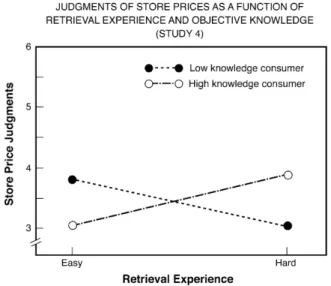
Fig. 2. Judgments of store prices as a function of retrieval experience and objective knowledge (study 4).
edge factor. Neither the recall condition nor the interaction was significant.
Results and discussion
Manipulation check. Recalling two (vs. five) low-priced products was perceived as easier for both consumer groups (low
knowledge: M= 2.97 vs.M= 5.87, respectively,t(49) = 10.56,
p< .001,r= .86; high knowledge:M= 2.68 vs.M= 5.79,
respec-tively,t(47) = 8.58,p< .001,r= .61). A 2 (knowledge level)×2 (number of recalled products) ANOVA showed a significant main effect for the number of items recalled (F(1,95) = 176.4,
p< .001), while neither the main effect for knowledge nor the
interaction reached significance.
Hypothesis 2. A 2 (knowledge level)×2 (number of recalled products) ANOVA on the store price perception index revealed a significant interaction between the number of items recalled and the level of consumer knowledge (F(1,96) = 20.19,p< .001)3; no other effect was significant. The interaction is depicted
graphi-cally inFig. 2. The moderating effects of knowledge were also
tested using it as a continuous variable in a regression analy-sis with similar results (F(1,96) = 19.04,p< .001). The results show that the less knowledgeable consumers rated the store as less expensive after recalling two (vs. five) low-priced products
(M2= 3.98 vs. M5= 3.00, with higher numbers indicating the
store is perceived to be less expensive;t(49) = 3.29, p< .005,
r= .33). This result replicates the availability heuristic (ease of recall effect) found in the previous studies. In contrast, more knowledgeable consumers use the number of low-priced items they recall to make price judgments. They rate the store as less expensive when they recall five (vs. two) low-priced products 3 The same analyses were conducted using a less refined measure of consumer knowledge, namely, number of correct responses for each consumer. An iden-tical pattern of results was obtained: a significant interaction (F(1,96) = 22.42,
p< .001) with no other significant effects. The results replicate using knowledge as a continuous variable in a regression analysis.
(M2= 2.85 vs.M5= 3.84, with higher numbers indicating that
the store is perceived to be less expensive;t(47) = 3.07,p< .005,
r= .33). Overall, the results support Hypothesis 2, that less
knowledgeable consumers use the ease of recall of low-priced products (the availability heuristic), whereas more knowledge-able consumers use the number of recalled products (numerosity heuristic) to judge store prices.
General discussion
Store-price positioning is a critical and basic element in retail strategy (Ofir and Winer 2002). It is considered an important fac-tor in sfac-tore attraction. Companies invest substantial resources to develop and maintain a desired price positioning. Previous research on consumer perceptions of store prices has focused mainly on stimulus-based store price perceptions. The present investigation, however, draws attention to an everyday consumer activity that has not been investigated in this domain, namely memory-based store price judgments. The present research suggests that the process of recalling low-price or expensive products affects price perceptions of a specific store.
Review of findings and theoretical implications
The results of the four studies support Hypothesis 1, which posits that ease of retrieval of low price or expensive products in a particular store significantly affects consumers’ store price judg-ments. In other words, a store was perceived to be less expensive overall when consumers recalled only two low-priced products in the store, as compared to when they recalled five low-priced
products. The results supportingH1are replicated for the recall
of high price products (study 2). The level of objective store knowledge was found to moderate this process (study 3). This result is of importance given the heterogeneity of consumers and the use of memory-based information in everyday consumer decisions. Knowledgeable consumers’ store-price perceptions were not influenced by ease of recall, but by the number of items recalled, while those of less knowledgeable consumers were influenced by the ease of recall of the products.
Ease of recall as information. This research has
implica-tions for the research on ease of recall as information.Menon
et al. (2002)showed that the ease-of-retrieval effect could be modified when the information was contextually available. At a conceptual level, knowledgeable consumers may have access to information in a manner akin to stimulus-based information for novices. In such instances, the feeling of ease associated with recall is dominated by the number of recalled products.
Price perception research. This research also shows that the subjective experiences associated with remembering can impact price perceptions and that objective knowledge moderates the
process.Alba et al. (1994)examined store-price perception as a
function of strategies used in presenting comparative price lists. The research presented here shows that price judgments based on a variety of specific instances (i.e., seeing different prices over time), as opposed to data-driven comparative price lists, may be prone to biases in recall which can affect the way they are integrated into store-price judgments.
Effects of experience and knowledge. The paper also con-tributes to the literature on the moderating effects of individual differences in information processing strategies. While shopping experience did not moderate the effect, objective knowledge did. This result adds to the evidence that the two are separate constructs.
Findings in behavioral pricing research have demonstrated that experience with a product significantly influences consumer preferences and demonstrated the role of shopping experience in shopping behavior (Monroe 1976, 2003). However, we argue that objective knowledge is a key to using one’s own subjective experience of recall as an information cue. The argument does not necessarily hold for shopping experience. Both more and less experienced consumers use ease of recall as a cue for judging store prices. It is only when the actual experience translates into a relatively high level of knowledge of a domain that consumers
have less need to use the ease of recall cue.Mitchell and Dacin
(1996)obtained conceptually similar results for experience with a product. In their study, product experience did not affect the number of correct choices or the number of correct attributes. It seems that shopping experience, like experience with a prod-uct, needs to be actively interpreted for it to become relevant knowledge. Shopping experience may serve as an indication of familiarity, which is viewed as a dimension of consumer
knowledge (e.g.,Alba and Hutchinson 1987; Mitchell and Dacin
1996; Monroe 1976). However, it was not discriminative in the judgment processes examined in their research.
Somewhat related, in line withTybout et al. (2005), it could
be argued that consumers with very high levels of knowledge have information easily accessible to them in memory, and so, ease of retrieval is less diagnostic for them than the number of the recalled low-price products. In contrast, for consumers with relatively low objective knowledge, the subjective feeling of ease is diagnostic. Therefore, while knowledge should moderate the use of ease of recall as a cue, experience may not.
Furthermore,Unkelbach’s (2006)findings regarding learned
cue validity could suggest that being at the store many times makes consumers more familiar with the store but not neces-sarily more knowledgeable about store prices. A consumer may be familiar with a store but has neither experienced nor learned the lack of consistent validity of the ease of recall cue. Finally, given the limited research in the pricing domain in particular and the focal biases in general with regard to the moderating effects of experience and knowledge further research with dif-ferent measures and tasks is needed. An example is the price
tactic persuasion knowledge measure (e.g.,Hardesty, Bearden,
and Carlson 2007).
Managerial implications and areas for future research
Pricing research has focused on on-line stimulus-based judgments (e.g., comparative price lists, advertised deals), over-looking memory-based store-price judgments to some extent. The present research demonstrates that recalling products labeled in memory as “inexpensive” or “expensive” have a significant and practically meaningful effect on such price judg-ments. An important implication of the findings is it may not be
necessary for consumers to recall exact product prices when judging store prices. This conclusion is reinforced by previ-ous research suggesting that recall for exact product prices is quite low (Vanhuele, Laurent, and Dreze 2006) and is quite consistent with suggestions that consumers store in memory evaluations of whether specific products are inexpensive or expensive and not exact prices (Monroe and Lee 1999; Monroe 2003).
A related research question is the effect of consumers’ prior beliefs about the store on memory based store price judgments. This question is of significant practical importance given the quest for marketing strategies either to maintain or to reposition
retail chains. Alba et al. (1994)have demonstrated that prior
beliefs have only a minor effect and the frequency cue is stronger. Prior beliefs may, however, influence encoding and recall of product prices at the store.
Recalling few low-price products could lead to a judg-ment of a low store price image. A practical and theoretical research question, therefore, is what type of cues, deals or pre-sentation methods determines whether products are evaluated and encoded as low-priced at a specific store. For example, some previous research suggests that depth (magnitude) of deals over time may have more impact than frequent shallow
deals (e.g., Lalwani and Monroe 2005). Alba et al. (1994),
however, in the context of comparative store-price lists, pro-vide support for the frequency cue. This issue deserves further research in the context of memory-based store price judgments. Similarly, these effects should be researched in various
seg-ments such as price sensitive shoppers (e.g.,Kim, Srinivasan,
and Wilcox 1999; Wakefield and Inman 1993) (See Grewal and Levy 2007 for an excellent review of needed research in retailing.).
Acknowledgements
The authors acknowledge the support of the Davidson and Kmart Research Centers and the Julian Simon Foundation at the Hebrew University, the Haas School of Business, as well as the assistance of students at various stages of this research.
Appendix A. Shopping experience and ease of recall Study 1A. Consumers who bought either more than 60% or less than 60% of their food purchases at the store were classified as high or low experience consumers, respectively for additional analyses. Thus, 60.6% of the consumers were categorized as having low shopping experience (buying less than 60% of their food at the store). A 2 (number of
prod-ucts recalled)×2 (shopping experience) ANOVA on the ease
of recall measure resulted in a main effect for the recall factor
(F(1,95) = 12.98,p< .001). Shopping experience did not have
either a main or an interaction effect. Experienced as well as less experienced shoppers found it easier to recall two (as opposed
to five) low-price products (experienced shoppers: M2= 3.90
vs. M5= 4.93, respectively, t(37) = 1.78, p< .08, r= .28; less
experienced shoppers: M2= 4.12 vs. M5= 5.43, respectively,
A 2 (number of products recalled)×2 (shopping experience) ANOVA on the store price index revealed a main effect for
the recall factor (F(1,95) = 33.65, p< .001). Shopping
experi-ence did not have either a main or an interaction effect (F’s < 1). Less experienced and more experienced shoppers both judged store prices to be lower after recalling two (as opposed to
five) low-price products (experienced shoppers: M= 4.50 vs.
3.29, respectively, t(37) = 3.75, p< .001, r= .52; less
experi-enced shoppers:M= 4.36 vs.M= 3.10, respectively,t(58) = 4.69,
p< .001,r= .52). Therefore,H1was supported when consumers
were asked to recall low-price products in the store regardless of their level of shopping experience at the store.
Study 1B.In this study, 49% of shoppers purchased less than 60% of the food for their families in the store, while the rest purchased more than 60% and were classified as low and high experience, respectively for further analyses. An ANOVA on the ease-of-recall index revealed a main effect for number of product prices recalled (F(1,79) = 93.1,p< .001), while no other effect reached significance (F’s < 1). Experienced as well as less experienced shoppers found it significantly easier to recall two (as opposed to five) low-price products (experienced shoppers:
M2= 2.93 vs. M5= 5.82, respectively, t(50) = 7.22, p< .001,
r= .71; less experienced shoppers: M2= 3.17 vs. M5= 5.51,
respectively,t(47) = 6.49,p< .001,r= .69).
A 2 (shopping experience)×2 (number of recalled products)
ANOVA on the store-price index showed a main effect for the recall factor (F(1,96) = 20.97,p< .001), while no other effects were significant (F’s < 1). Both groups judged store prices to be less expensive after recalling two (as opposed to five) low-price
products (experienced shoppers:M= 3.37 vs. 2.31, respectively,
t(49) = 3.25,p< .01,r= .42; less experienced shoppers:M= 3.10 vs.M= 2.16, respectively, t(47) = 3.26,p< .01, r= .43). These results replicate those of study 1A, ease-of-recall effects are robust to differences in store shopping experience, supporting H3.
The results were replicated using an alternate measure of shopping experience: shopping frequency. A 2 (shopping
frequency)×2 (recall number) ANOVA also showed only a
sig-nificant main effect for recall (F(1,97) = 27.21,p< .001) with no other effect reaching significance (F’s < 1). They were also repli-cated when only consumers who purchased over 80% of their food in that store were included in the sample.
Summary. This re-analysis of results of studies 1A and
1B support H3 and suggest that different levels of
shop-ping experience are not associated with the use of different judgment heuristics. A meta-analytic technique was used to
combine the results of studies 1A and 1B.Rosenthal’s (1991)
method of addingtvalues was used. Pooling both studies
sug-gested that experienced as well as less experienced shoppers found retrieving two low-priced products significantly easier than retrieving five low-priced products (experienced shoppers Z= 6.21,p< .001; less experienced shoppersZ= 7.01,p< .001). Moreover, as hypothesized, combining the results of studies 1A and 1B suggest that both groups differing in shopping experi-ences judge the store’s prices to be lower after recalling two (as opposed to five) low-priced products (experienced shoppers: Z= 4.71,p< .001, less experienced shoppers:Z= 5.51,p< .001).
References
Alba, Joseph W. and J. Wesley Hutchinson (1987), “Dimensions of Consumer Expertise,”Journal of Consumer Research,13 (March), 411–54. Alba, Joseph W., Susan M. Broniarczyk, Terrence A. Shimp and Joel E. Urbany
(1994), “The Influence of Prior Beliefs, Frequency Cues, and Magnitude Cues on Consumers’ Perceptions of Comparative Price Data,”Journal of Consumer Research,21 (September), 219–35.
Arnold, Stephen J., Tae H. Oum and Douglas J. Tigert (1983), “Determinant Attributes in Retail Patronage: Seasonal, Temporal, Regional and Interna-tional Comparisons,”Journal of Marketing Research,20 (May), 149–57. Binkley, James K. and John Bejnarowicz (2003), “Consumer Price Awareness
in Food Shopping: The Case of Quantity Surcharges,”Journal of Retailing,
79 (1), 27–36.
Biswas, Abijhit (1992), “The Moderating Role of Brand Familiarity in Reference Price Perceptions,”Journal of Business Research,25 (November), 251–62. Burman, Bisisha and Abijhit Biswas (2007), “Partitioned Pricing: Can We
Always Divide and Prosper?,”Journal of Retailing,83 (4).
Chandrashekaran, Rajesh (2004), “The Influence of Redundant Comparison Prices and Other Price Presentation Formats on Consumers’ Evaluations and Purchase Intentions,”Journal of Retailing,80 (1), 53–66.
Chandrashekaran, Rajesh and Dhruv Grewal (2003), “Assimilation of Adver-tised Reference Prices: The Moderating Role of Involvement,”Journal of Retailing,79 (1), 53–62.
Chase, W.G. and Herbert A. Simon (1973), “Perceptions in Chess,”Cognitive Psychology,4 (January), 55–81.
Chi, Michelene T.H., P.J. Feltovich and R. Glaser (1981), “Categorization and Representation of Physics Problems by Experts and Novices,”Cognitive Science,5 (2), 121–52.
, P.J. Feltovich and R. Glaser (1982), “Categorization in Experts and Novices,” inThe Handbook of Intelligence, Sternberg R. ed. Hillsdale, NJ: Erlbaum, 66–84.
Chiesi, H.L., G.J. Spilich and J.F. Voss (1979), “Acquisition of Domain-Related Information in Relation to High and Low Domain Knowledge,”Journal of Verbal Learning and Verbal Behavior,18 (January), 257–73.
Choo, F. and K.T. Trotman (1991), “The Relationship between Knowledge Structure and Judgment of Experienced and Inexperienced Auditors,”The Accounting Review,66 (November), 464–85.
Cox, Anthony D. and Deana Cox (1990), “Competing on Price: The Role of Retail Price Advertisements in Shopping Store-Price Image,”Journal of Retailing,66 (4), 428–45.
Darke, Peter R. and Cindy M.Y. Chung (2005), “Effects of Pricing and Promotion on Consumer Perceptions: It Depends on How You Frame It,”Journal of Retailing,81 (1), 35–47.
Dutta, Sujay and Biswas Abhijit (2005), “Effects of Low Price Guarantees on Consumer Post-purchase Search Intentions: The Moderating Roles of Value Consciousness and Penalty Level,”Journal of Retailing,81 (4), 283–91. Estelami, Hooman and Peter De Maeyer (2004), “Product Category
Deter-minants of Price Knowledge for Durable Consumer Goods,” Journal of Retailing,80 (2), 129–38.
Folkes, Valerie and Rita Wheat (1995), “Consumers’ Price Perception of Pro-moted Products,”Journal of Retailing,71 (3), 317–28.
Grewal, Dhruv and Michael Levy (2007), “Retailing Research: Past, Present and Future,”Journal of Retailing,83 (4), 447–64.
Hardesty, David M. and William O. Bearden (2003), “Consumer Evaluations of Different Promotion Types and Price Presentations: The Moderating Role of Promotional Benefit Level,”Journal of Retailing,79 (1), 17–26. Hardesty, David M., William O. Bearden and Jay P. Carlson (2007),
“Persua-sion Knowledge and Consumer Reactions to Pricing Tactics,”Journal of Retailing,83 (2), 199–210.
Kim, Hyeong Min (2006), “Consumers’ Responses to Price Presentation For-mats in Rebate Advertisements,”Journal of Retailing,82 (4), 309–17. Kim, Byung-Do, Kannan Srinivasan and Ronald T. Cox (1999), “Identifying
Price Sensitive Consumers: The Relative Merits of Demographic vs. Pur-chase Pattern Information,”Journal of Retailing,75 (2), 177–93. Kopalle, Praveen K. and Joan Lindsey-Mullikin (2003), “The Impact of External
Reference Price on Consumer Price Expectations,”Journal of Retailing,79 (4), 225–36.
Krishna, Aradhna and Gita V. Johar (1996), “Consumer Perceptions of Deals: The Biasing Effects of Varying Deal Prices,”Journal of Experimental Psy-chology: Applied,2 (3), 187–206.
Krishnan, Balaji C., Abhijit Biswas and Richard G. Netemeyer (2006), “Seman-tic Cues in Reference Price Advertisements: The Moderating Role of Cue Concreteness,”Journal of Retailing,82 (2), 95–104.
Kukar-Kinney, Monika and Rockney G. Walters (2003), “Consumer Perceptions of Refund Depth and Competitive Scope in Price-Matching Guarantees: Effects on Store Patronage,”Journal of Retailing,79 (3), 153–60. Kukar-Kinney S Monika, Rockney G. Walters and Scott B. MacKenzie (2007a),
“Consumer Responses to Characteristics of Price-matching Guarantees: The Moderating Role of Price Consciousness,” Journal of Retailing,83 (2), 211–2.
Kukar-Kinney, Monika, Lan Xia and Kent B. Monroe (2007b), “Consumers’ Perceptions of the Fairness of Price-matching Refund Policies,”Journal of Retailing,83 (3), 325–37.
Lalwani, Ashok K. and Kent B. Monroe (2005), “A Reexamination of Frequency-Depth Effects in Consumer Price Judgments,”Journal of Con-sumer Research,32 (December), 480–5.
Levy, Michael, Dhruv Grewal, Praveen K. Kopalle and James D. Hess (2004), “Emerging Trends in Retail Pricing Practice: Implications for Research,”
Journal of Retailing,80 (3), xiii–xxi.
Magi, Anne W. and Claes-Robert Julander (2005), “Consumers’ Store-Level Price Knowledge: Why Are Some Consumers More Knowledgeable Than Others?,”Journal of Retailing,81 (4), 319–2.
Menon, Geeta, Lauren G. Block and Suresh Ramanathan (2002), “We’re at as Much Risk as We are Led to Believe: Effects of Message Cues on Judgments of Health Risk,”Journal of Consumer Research,28 (March), 533–49. Menon, Geeta and Priya S. Raghubir (2003), “Ease-of-Retrieval as an
Auto-matic Input in Judgments: A Mere Accessibility Framework?,”Journal of Consumer Research,30 (September), 230–43.
Mitchell, Andrew A. and Peter A. Dacin (1996), “The Assessment of Alterna-tive Measures of Consumer Expertise,”Journal of Consumer Research,23 (December), 219–3.
Monroe, Kent B. (1976), “The Influence of Price Differences and Brand Famil-iarity on Brand Preferences,”Journal of Consumer Research,3 (June), 42–9. (2003), “Pricing: Making Profitable Decisions,” 3rd ed. New York: McGraw-Hill/Irwin.
Monroe, Kent B. and Angela Y. Lee (1999), “Remembering vs. Knowing: Issues in Buyers’ Processing of Price Information,”Journal of the Academy of Marketing Science,27 (Spring), 207–25.
Ofir, Chezy (2000), “Ease of Recall vs. Recalled Evidence in Judgment: Experts vs. Laymen,”Organizational Behavior and Human Decision Processes,81 (January), 28–4.
(2004), “Reexamining Latitude of Price Acceptability and Price Thresholds: Predicting Basic Reaction to Price,”Journal of Con-sumer Research,30 (March), 612–21.
Ofir, Chezy and Russell S. Winer (2002), “Pricing: Economic and Behavioral Models,” inHandbook of Marketing, Barton Weitz and Robin Wensley , eds. London: Sage Publications, 267–81.
Park, C. Whan, Easwar S. Iyer and Daniel C. Smith (1989), “The Effects of Situational Factors on In-Store Grocery Shopping Behavior: The Role of Store Environment and Time Available for Shopping,”Journal of Consumer Research,15 (March), 422–33.
Park, C. Whan, David L. Mothersbaugh and Lawrence Feick (1994), “Consumer Knowledge Assessment,”Journal of Consumer Research,21 (June), 71–82. Pelham, Brett W., T.T. Sumarta and L. Myaskovsky (1994), “The Easy Path from Many to Much: The Numerosity Heuristic,”Cognitive Psychology,26 (April), 103–3.
Raghubir, Priya and Geeta Menon (1998), “AIDS and Me, Never the Twain Shall Meet: The Effects of Information Accessibility on Judgments of Risk and Advertising Effectiveness,”Journal of Consumer Research.,25 (June), 52–63.
Rao, Akshay R. and Kent B. Monroe (1988), “The Moderating Effect of Prior Knowledge on Cue Utilization in Product Evaluations,”Journal of Consumer Research,15 (September), 253–64.
Rao, Akshay R. and Wanda A. Sieben (1992), “The Effect of Prior Knowledge on Price Acceptability and the Type of Information Examined,”Journal of Consumer Research,19 (September), 256–70.
Rosenthal, Robert (1991), “Meta-Analytic Procedures for Social Research,” Newbury Park, CA: Sage Publications.
Schindler, Robert M. (2006), “The 99 Price Ending as a Signal of a Low-Price Appeal,”Journal of Retailing,82 (1), 71–7.
Schwarz, Norbert and L.A. Vaughn (2002), “The Availability Heuristic Revis-ited: Ease of Recall and the Content of Recall as Distinct Sources of Information,” inHeuristics and Biases: The Psychology of Intuitive Judg-ment, Gilovich T., Griffin D. and Kahneman D., eds. Cambridge, UK: Cambridge University Press, 103–19.
Sundali, J.A. and A.B. Atkins (1994), “Expertise in Investment Analysis: Fact or Fiction,”Organizational Behavior and Human Decision Processes,59 (August), 223–41.
Tversky, Amos and Daniel Kahneman (1973), “Availability: A Heuristic for Judging Frequency and Probability,”Cognitive Psychology,5 (September), 207–32.
Tybout, Alice M., Brian Sternthal, Prashant Malaviya, Georgios A. Bakamit-sos and Se-Bum Park (2005), “Information Accessibility as a Moderator of Judgments,”Journal of Consumer Research,32 (June), 76–85.
Unkebach, Christian (2006), “The Learned Interpretation of Cognitive Fluency,”
Psychological Science,17 (4), 339–45.
Vanhuele, Marc, Gilles Laurent and Xavier Dreze (2006), “Consumers’ Imme-diate Memory for Prices,”Journal of Consumer Research,33 (September), 163–72.
Wakefield, Kirk and Jeffrey J. Inman (1993), “Who are the Price Vig-iliantes? An Investigation of Differentiating Characteristics Influencing Price Information Processing,” Journal of Retailing, 69 (2), 216– 34.
Wänke, Michaela, Gerd Bohner and Andreas Jurkowitsch (1997), “There are Many Reasons to Drive a BMW: Does Imagined Ease of Argument Genera-tion Influence Attitudes?,”Journal of Consumer Research,24 (September), 170–7.