Tracker-Independent Drift Detection and Correction
Using Segmented Objects and Features
Tarek Ghoniemy
A Thesis in the Department
of
Electrical and Computer Engineering
Presented in Partial Fulfillment of the Requirements For the Degree of
Doctor of Philosophy (Electrical and Computer Engineering) at Concordia University
Montr´eal, Qu´ebec, Canada
August 2017
c
Concordia University
School of Graduate Studies
This is to certify that the thesis prepared By: Tarek Ghoniemy
Entitled: Tracker-Independent Drift Detection and Correction Us-ing Segmented Objects and Features
and submitted in partial fulfillment of the requirements for the degree of
Doctor of Philosophy (Electrical and Computer Engineering)
complies with the regulations of this University and meets the accepted standards with respect to originality and quality.
Signed by the final examining committee:
Chair Dr. Subhash Rakheja
External Examiner Dr. Stephane Coulombe
Concordia External Examiner Dr. Thomas G. Fevens Examiner Dr. Wei-Ping Zhu Examiner Dr. Hassan Rivaz Supervisor Dr. Maria A. Amer Approved by:
Dr. Wei-Ping Zhu, Graduate Program Director
29 Sept. 2017
Abstract
Tracker-Independent Drift Detection and Correction
Using Segmented Objects and Features
Tarek Ghoniemy, Ph.D. Concordia University, 2017
Object tracking has been an active research topic in the field of video processing. However, automated object tracking, under uncontrolled environments, is still difficult to achieve and encounters various challenges that cause the tracker to drift away from the target object. To effectively handle object or environment tracking challenges, recent powerful tracking approaches are learning-based, meaning they learn object appearance changes while tracking online. The output of such trackers is, however, limited to a bounding box representation, the center of which is considered as the estimated object location. Such bounding box may not provide accurate foreground/background discrimination and may not handle highly non-rigid objects. Moreover, the bounding box may not surround the object completely, or it may not be centered around it, which affects the accuracy of the overall tracking process. Our main objective in this work is to reduce drifts of state-of-the-art tracking algorithms (trackers) using object segmentation so to produce more accurate bounding box.
To enhance the quality of state-of-the-art trackers, this work investigates two main venues: first tracker-independent drift detection and correction using object features and second, selection of best performing parameters of Graph Cut object segmentation and of support vector machines using artificial immune system. In addition, this work proposes a framework for the evaluation and ranking of different trackers using easily interpretable performance measures, in a way to account for the presence of outliers.
For tracker-independent drift detection, we use saliency features or objectness using saliency, the ratio of the salient region corresponding to the target object with respect to the estimated bounding box is used to indicate the occurrence of tracking drift with no prior information about the target model. With objectness measures, we use both
relative area and score of the detected candidate boxes according to the objectness measure to indicate the occurrenece of the tracking drift. For drift correction, we investigate the application of object segmentation on the estimated bounding box to re-locate it around the target object. Due to its ability to lead to a global near optimal solution, we use the Graph Cut object segmentation method. We modify the Graph Cut model to incorporate an automatic seed selection module based on interest points, in addition to a template mask, to automatically initialize the segmentation across frames. However, the integration of segmentation in the tracking loop has its computational burden. In addition, the segmentation quality might be affected by tracking challenges, such as motion blur and occlusion. Accordingly, object segmentation is applied only when a drift is detected. Simulation results show that the proposed approach improves the tracking quality of five recent trackers.
Researchers often use long and tedious trial and error approaches for determining the best performing parameter configuration of a video-processing algorithm, particularly with the diverse nature of video sequences. However, such configuration does not guarantee the best performance. A little research attention has been given to study the algorithm’s sensitivity to its parameters. Artificial immune system is an emergent biologically motivated computing paradigm that has the ability to reach optimal or near-optimal solutions through mutation and cloning. This work proposes the use of artificial immune system for the selection of best performing parameters of two video processing algorithms: support vector machines for object tracking and Graph Cut based object segmentation.
An increasing number of trackers are being developed and when introducing a new tracker, it is important to facilitate its evaluation and ranking in relation to others, using easy to interpret performance measures. Recent studies have shown that some measures are correlated and cannot reflect the different aspects of tracking performance when used individually. In addition, they do not incorporate robust statistics to account for the presence of outliers that might lead to insignificant results. This work proposes a framework for effective scoring and ranking of different trackers by using less correlated quality metrics, coupled with a robust estimator against dispersion. In addition, a unified performance index is proposed to facilitate the evaluation process.
ACKNOWLEDGMENTS
I wish to express my sincere gratitude and indebtedness to Dr. Maria A. Amer for her supervision, guidance, and encouragement throughout this study. Her invaluable suggestions and constructive criticism during the preparation of this thesis enabled me to present the thesis in this form.
I would like also to thank my Vidpro group members and dear friends including but not limited to, Julien Valognes, Prabhakaran Ravindran, and Saeid Vosoughi for their support and encouragement during the course of this study.
This thesis is dedicated to my parents and my brothers who have supported me all the way since the beginning of my studies.
Also, this thesis is dedicated to my outstanding wife and my children, who have been a great source of motivation and inspiration.
Contents
List of Figures xi
List of Tables xiv
Nomenclature xv 1 Introduction 1 1.1 Motivation . . . 1 1.2 Problem Statement . . . 2 1.3 Research Objectives . . . 3 1.4 Summary of Contributions . . . 3 1.5 Thesis Outlines . . . 4 2 Background 6 2.1 Overview . . . 6 2.2 Object Tracking . . . 6 2.2.1 Introduction . . . 6
2.2.2 Classification of Object Tracking Approaches . . . 7
2.2.2.1 Fixed Appearance Modeling Based Tracking . . . 8
2.2.2.2 Adaptive Appearance Modeling (Learning) Based Tracking 9 2.2.3 Object Tracking System Components . . . 11
2.2.3.1 Target Modeling (Prediction) Module . . . 12
2.2.3.2 Target Tracking Module . . . 12
2.2.3.3 Detection Module . . . 12
2.2.3.4 Feature Extraction Module . . . 14
2.3 Common Tracking Performance Evaluation Measures . . . 15
2.4 Artificial Immune System . . . 16
2.5 Summary . . . 20
3 Tracker-independent Drift Detection and Correction 21 3.1 Abstract . . . 21
3.2 List of Symbols . . . 22
3.3 Introduction . . . 22
3.4 Prior Work . . . 24
3.4.1 Segmentation-based Trackers . . . 24
3.4.2 Learning-based Trackers . . . 25
3.4.3 Trackers with Drift Detection and Correction . . . 27
3.4.4 Differences to Our Approach . . . 28
3.5 Proposed Method . . . 28
3.5.1 Saliency-based Drift Detection . . . 28
3.5.2 Drift Correction Using Seeded Segmentation . . . 31
3.6 Results and Analysis . . . 34
3.6.1 Experimental Setup . . . 34
3.6.2 Objective Results . . . 35
3.6.3 Subjective Results . . . 53
3.6.4 Proposed vs. Segmentation-based Tracking Methods . . . 57
3.6.5 Computational Costs . . . 58
3.6.6 Advantages and Limitations . . . 59
3.7 Conclusion . . . 60
4 Artificial Immune System Based Parameter Optimization of SVM in Object Tracking 62 4.1 Abstract . . . 62
4.2 List of Symbols . . . 63
4.3 Introduction . . . 63
4.4 Prior Work . . . 64
4.5 Proposed AIS Approach for SVM Optimization . . . 66
4.5.1 Background . . . 66
4.5.2 Our Approach . . . 68
4.6 Results . . . 72
4.6.1 AIS Model Simulation . . . 72
4.6.2 Experimental Setup . . . 75
4.6.3 Objective and Subjective Tracking Improvement . . . 76
4.7 Conclusion . . . 80
5 Artificial Immune System Based Parameter Optimization of Graph Cut Segmentation 82 5.1 Abstract . . . 82
5.2 List of Symbols . . . 82
5.4 Prior Work . . . 84
5.5 Proposed AIS-based G-Cut Optimization . . . 85
5.5.1 Background . . . 85
5.5.2 Our Approach . . . 86
5.6 Results . . . 88
5.6.1 Experimental Setup . . . 88
5.6.2 Objective and Subjective Results . . . 89
5.7 Conclusion . . . 93
6 Robust Scoring and Ranking of Object Tracking Techniques 94 6.1 Abstract . . . 94
6.2 List of Symbols . . . 95
6.3 Introduction . . . 95
6.4 Prior Work . . . 97
6.4.1 Ranking Methods . . . 97
6.4.2 Related Performance Measures . . . 98
6.5 Proposed Performance Measures . . . 99
6.5.1 Proposed Unified Performance Index . . . 99
6.5.2 Proposed Recovery and Drift Measures . . . 100
6.6 Proposed Evaluation Framework . . . 101
6.6.1 Overview . . . 101
6.6.2 Scoring Mechanism . . . 102
6.6.3 Sequence-pooled Ranking Mechanism . . . 103
6.7 Results and Analysis . . . 104
6.7.1 Experimental Setup . . . 104
6.7.2 Scoring and Ranking usingAOR and F R . . . 105
6.7.3 IOF Ranking Results . . . 106
6.7.4 Recovery and Drift Results . . . 109
6.7.5 Stability of the Proposed Framework . . . 111
6.7.6 Speed Ranking . . . 111
6.8 Conclusion . . . 112
7 Conclusion and Future Work 113 7.1 Conclusion . . . 113
7.2 Future Work . . . 115
Appendix A Objectness-based Tracker Drift Detection 131
A.1 Introduction and Related Work . . . 131
A.2 Proposed Method . . . 132
A.3 Objective Results . . . 135
A.4 Conclusion . . . 138
A.5 Ground-Truth based Reference to Drift Detection . . . 139
Appendix B Framework for Parameter Weighting and Selection for Ob-ject Tracking Algorithms 143 B.1 Abstract . . . 143 B.2 List of Symbols . . . 144 B.3 Introduction . . . 144 B.4 Prior Work . . . 145 B.5 Proposed Framework . . . 146 B.5.1 Parameter Weighting . . . 147
B.5.2 Configuration Selection and Scoring . . . 148
B.6 Results and Analysis . . . 150
B.6.1 Experimental Setup . . . 150
B.6.2 Parameter Weighting . . . 151
B.6.3 Configuration Scoring . . . 152
List of Figures
2.1 Learning-based object tracking system. . . 10
2.2 Object tracking system components. . . 11
2.3 Clonal selection algorithm. . . 19
2.4 Non-Uniform mutation process of antibodies [1]. . . 20
3.1 Block diagram of the proposed drift detection and correction method. . . 29
3.2 Scale-variant versus scale-invariant example frames. . . 31
3.3 Automatic seed masks for segmentation. . . 32
3.4 Distance d versus the average intensity µo of AF region. . . 33
3.5 Interest points filtering process and segmentation output. . . 34
3.6 Average precision plot using automatic drift detection and correction. . . 46
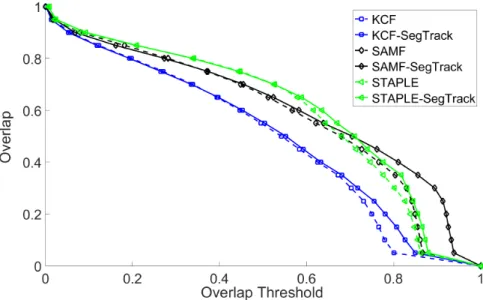
3.7 Average success plot using automatic drift detection and correction. . . . 46
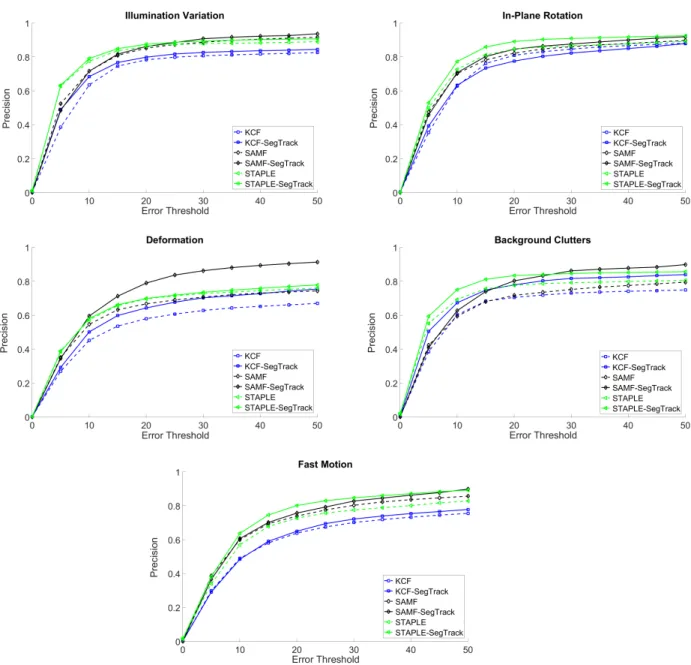
3.8 Precision plot of all trackers over all test videos per challenge. . . 48
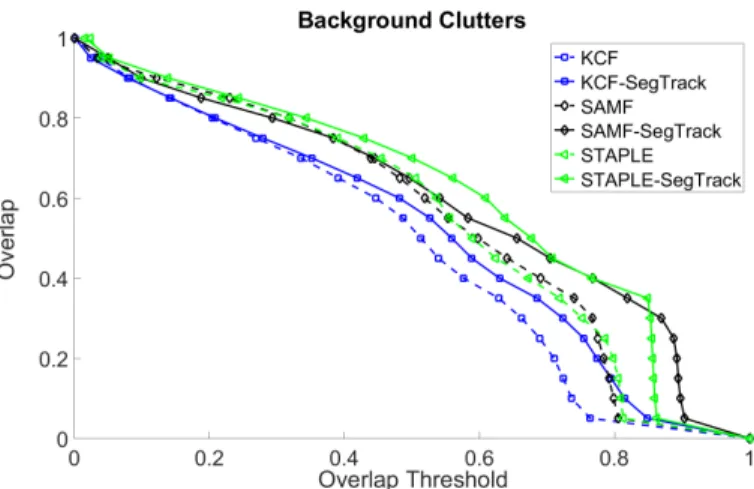
3.9 Success plot of all trackers over all test videos per challenge. . . 50
3.10 AOR of base and modified trackers over all sequences. . . 50
3.11 CLE of base and modified trackers over all sequences. . . 51
3.12 FR of base and modified trackers over all sequences. . . 51
3.13 Recovery-failure (drift) plot of base and modified trackers. . . 52
3.14 Subjective results using the proposed drift detection and correction. . . . 55
3.15 Base tracker related limitations. . . 60
4.1 Block diagram of the proposed AIS method for SVM optimization. . . 69
4.2 Functions for the evaluation of the AIS model. . . 74
4.3 Convergence rate of Test function with different AIS parameters. . . 74
4.4 Search range of the CLONALG-based AIS model usingTest function. . . 75
4.5 AOR plot of base and modified STRUCK trackers over all test videos. . . 76
4.7 F R plot of base and modified STRUCK trackers over all test videos. . . 77
4.8 Precision plot of base and modified STRUCK trackers over all test sequences. . . 78
4.9 Success plot of base and modified STRUCK trackers over all test sequences. 78 4.10 Subjective results of the proposed AIS method applied to STRUCK. . . . 79
5.1 Block diagram of the proposed AIS-based G-Cut optimization. . . 88
5.2 AIS selection of the best performing segmentation parameters. . . 90
5.3 Example of G-Cut-AIS-based segmentation parameters: input image and seeds (left); segmentation using AIS selected parameters (middle); ground truth (right). . . 90
5.4 Precision plot of the default and AIS-based parameters of G-Cut segmentation. . . 91
5.5 Accuracy plot of the default and AIS-based parameters of G-Cut segmentation. . . 91
5.6 G-Cut segmentation samples using default vs. AIS parameters. . . 92
5.7 Tracking improvement (in %) of AIS-based vs. manual segmentation parameters when using STRUCK [2] . . . 92
5.8 Tracking improvement (in %) of AIS-based vs. manual segmentation parameters when using STAPLE [3] . . . 93
6.1 The behavior of the proposedIOF performance index (left) versus CoTPS measure (right). . . 100
6.2 Block diagram of proposed scoring and ranking framework. . . 102
6.3 AOR vs F R as a reference measure to evaluate the proposed measures. . 105
6.4 IOF Rank-score plot. . . 107
6.5 Ranking using IOF index. . . 107
6.6 Recovery (R) vs. drift (D) plot. . . 111
A.1 Block diagram of the proposed edge-based objectness for drift detection. 133 A.2 Candidate box of maximum area and maximum score using edge-based objectness. . . 134
A.3 AOR of base and modified KCF tracker using objectness. . . 136
A.4 CLE of base and modified KCF tracker using objectness. . . 136
A.5 FR of base and modified KCF tracker using objectness. . . 137
A.7 CLE of base and modified STAPLE tracker using objectness. . . 138 A.8 FR of base and modified STAPLE tracker using objectness. . . 138 A.9 Ground truth based drift detection. . . 139 A.10AOR plot of ground-truth based drift detection (KCF-GDD) versus drift
correction at each frame (KCF-N1) for KCF. . . 141 A.11CLE plot of ground-truth based drift detection (KCF-GDD) versus drift
correction at each frame (KCF-N1) for KCF. . . 141 A.12F R plot of ground-truth based drift detection (KCF-GDD) versus drift
correction at each frame (KCF-N1) for KCF. . . 142
B.1 Block diagram of the proposed parameter selection and weighting framework. . . 147 B.2 Precision and Success plots of default and proposed selected configuration
of STAPLE tracker. . . 155 B.3 AOR of default and best performing configuration of STAPLE tracker. . 156 B.4 F R of default and best performing configuration of STAPLE tracker. . . 156
List of Tables
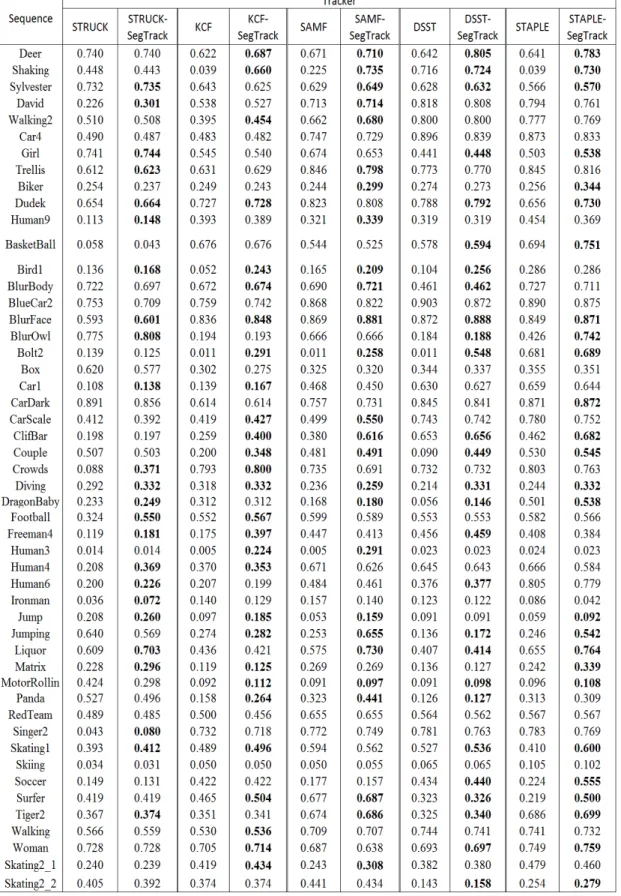
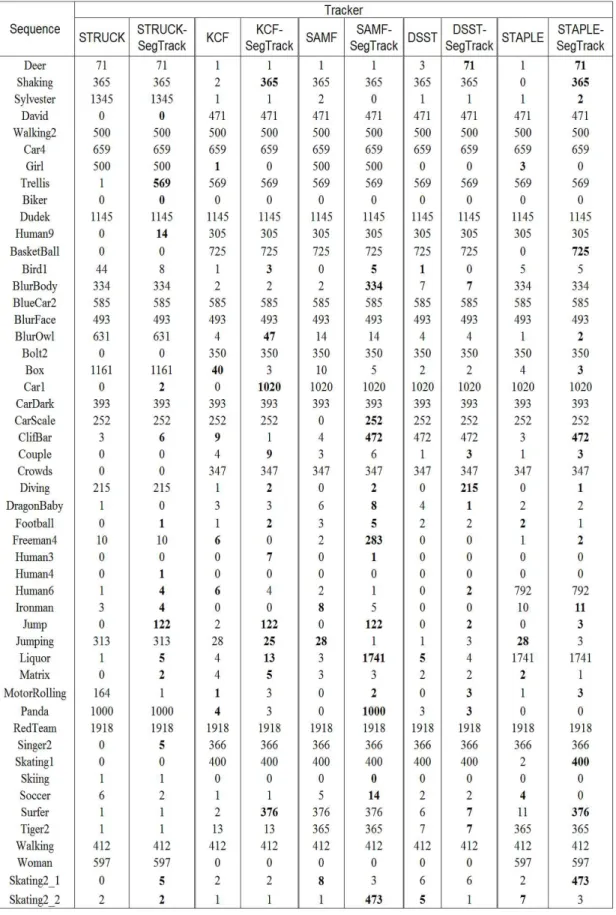
3.1 The overlap ratio of base and modified trackers per sequence. . . 36
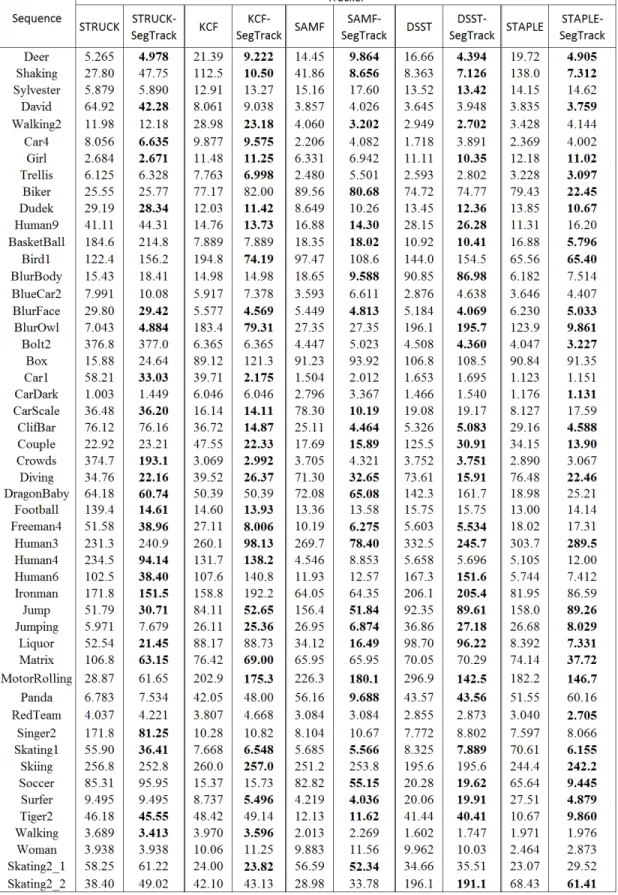
3.2 The center location error of base and modified trackers per sequence. . . 38
3.3 The failure rate of base and modified trackers per sequence. . . 40
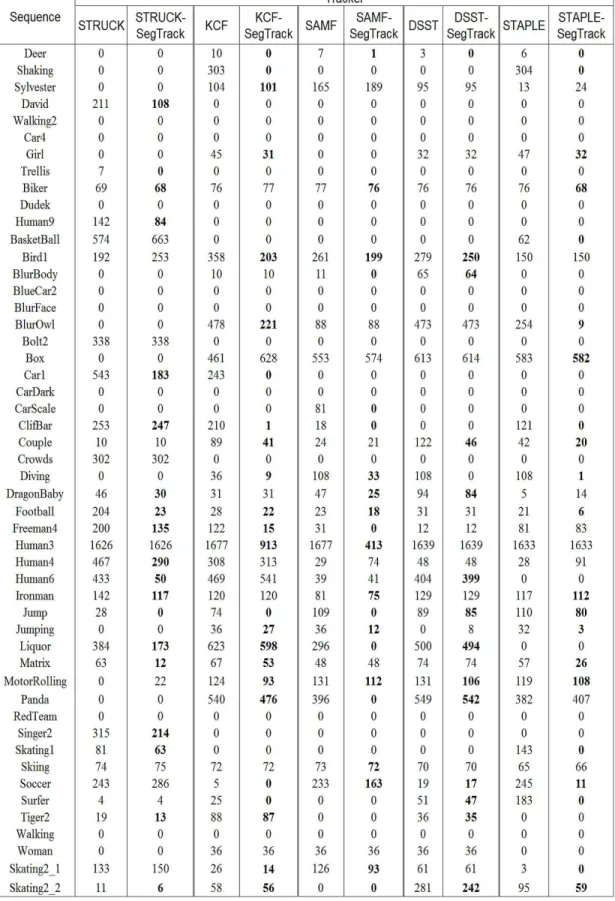
3.4 The number of drifts of base and modified trackers per sequence. . . 42
3.5 The number of recovery of base and modified trackers per sequence. . . . 44
3.6 Average improvement of the proposed drift detection and correction method. 53 3.7 Comparison of proposed method vs. JOTS. . . 58
3.8 Frame rate of the proposed drift detection and correction method. . . 59
4.1 Tracking quality of base and modified (AIS) STRUCK. . . 80
6.1 Scoring and ranking of the tested trackers based on AOR and F R individually. . . 106
6.2 IOF Scoring and ranking based on IOF index according to MAD measure.106 6.3 IOF Scoring and ranking of the tested trackers for individual test sequences.108 6.4 Average recovery-based ranking over all 100 videos. . . 110
6.5 Average drift-based ranking over all 100 videos. . . 110
6.6 pRD-based ranking over all 100 videos. . . 110
A.1 Average improvement of the proposed objectness-based drift detection and correction method. . . 135
B.1 Ranges and increments of the parameters of STRUCK, KCF, and STAPLE trackers. . . 151
B.2 Generated parameters’ weightswk. . . 152
B.3 Scoring of parameter sets of STRUCK. . . 153
B.4 Scoring of parameter sets of STAPLE. . . 154
Nomenclature
Acronyms
AIS Artificial Immune System
AOR Average Overlap Ratio
BB Bounding Box
CLE Center Location Error
CLONALG Clonal Selection Algorithm
CoTPS Combined Tracking Performance Score
FPS Frame Per Seconds
FR Failure Rate
G-Cut Graph Cut
MAD Median Absolute Deviation
MRF Markov Random Field
NCLE Normalized Center Location Error
1
Chapter 1
Introduction
1.1
Motivation
In general, given the initialized location of an object in the first frame of a video sequence, object tracking is meant to estimate the state of the target object in subsequent frames. Interests in object tracking continue to increase widely with the availability of high speed computing machines, high quality video cameras, and the need for automated video analysis in many applications such as robotics, video surveillance, and traffic management. Despite the fact that much progress has been made in recent years, developing a robust tracking algorithm is still a challenging problem due to numerous uncontrolled factors that can be object-related (appearance and scale change, deformation, fast motion, and motion blur), tracking environment-related (non-stationary scenes, cluttered scenes, and illumination change), or even tracking-system-related (real-time, automation, and low resolution constraints). These challenges can negatively affect the tracking accuracy, and a drifting problem may occur in which the tracker drifts away from the target object, or false detection may be encountered [4–7].
To handle object appearance variations effectively, adaptive methods have been proposed to update the representation of a target incrementally over time. Recent powerful tracking algorithms [2, 8–13], are learning-based methods that can deal with such appearance variations. However, the output of such tracking algorithms is limited
to a bounding box (BB) representation. This BB may not handle highly non-rigid objects, or may not be centered correctly around the target object, leading to a tracking drift. The investigation of suitable approaches of drift detection and correction is thus necessary for enhanced object tracking.
A common problem in video processing algorithms, such as Graph Cut (G-Cut) object segmentation or support vector machines (SVM) in object tracking, is the parameter selection that significantly affects the algorithm accuracy. Adopting optimization techniques, such as using artificial immune system (AIS), for parameter selection reduces the experimental work to spend for selecting the best parameters, reduces the bias of human intervention, and leads to optimal or near-optimal parameters that achieve better segmentation quality [14, 15].
1.2
Problem Statement
In spite of exhaustive research work, developing a robust object tracking algorithm is still a challenging task for complex and dynamic scenes, due to the drastic appearance changes caused by illumination changes, pose changes, and shape deformation. Two main problems can be highlighted; the limitation of the tracking output of learning-based object trackers to a BB, the center of which is considered as the estimated object location, and the different environmental challenges that result in tracking drift or failure. The integration of recent powerful object segmentation into object tracking to relocate the estimated output BB around the target object, when a drift is detected, may lead to better tracking.
As tracking and segmentation algorithms incorporate numerous parameters, it is important to study the influence of each parameter on the quality. Using AIS optimization techniques for the adaptive parameter selection can be a solution.
Recent benchmarks for tracking evaluation and ranking do not include robust statistical measures to account for the presence of outliers that might lead to insignificant results. It is useful to present a framework for scoring and ranking of trackers using effective quality metrics, coupled with a robust estimator against outliers. A single
(unified) performance index, in addition to new performance metrics can facilitate the ranking process.
1.3
Research Objectives
The first objective of this work is to investigate the effect of integrating tracker-independent drift detection and object segmentation for drift correction, on the overall accuracy of learning-based tracking algorithms.
The second objective is to investigate the use of AIS optimization for adaptive parameter selection in the domains of object tracking and segmentation.
The third objective is to propose a framework for scoring and ranking of trackers, using known quality metrics, coupled with a robust estimator against dispersion. The investigation of new performance metrics that facilitate trackers’ evaluation is to be investigated.
1.4
Summary of Contributions
The contributions of this thesis are:
1. A method for tracker-independent saliency-based drift detection where we use the saliency features of the target object inside the estimated BB to indicate the occurrence of tracking drift without prior information about the target model (Chapter 3).
2. A method for tracker-independent drift detection using edge-based objectness measure (Appendix A).
3. A method for segmentation-based drift correction where we use an automatic seeded G-Cut segmentation and propose a two-layer seed selection method based on SIFT points and foreground/background intensity relation (Chapter 3).
4. A method for adaptive selection of parameters of SVM using the AIS clonal selection-based optimization for enhanced object tracking (Chapter 4).
5. A method for optimal selection of parameters of G-Cut segmentation using the AIS clonal selection-based optimization (Chapter 5).
6. A framework for scoring and ranking of different trackers using known quality metrics, coupled with a robust estimator to account for the presence of outliers (Chapter 6).
7. New tracking evaluation measures where we propose a unified overlap-failure performance index, recovery, drift, and pure recovery-to-drift measures to facilitate trackers’ evaluation and ranking (Chapter 6).
8. A framework for the selection of the best performing configuration (parameter set), and weighting all parameters according to their influence on the tracking quality. (Appendix B).
1.5
Thesis Outlines
Chapter 2 presents object tracking approaches. The principal components of an object tracking system are briefly described. Common tracking performance measures are presented. Finally, artificial immune systems are presented.
Chapter 3 introduces the proposed tracker-independent drift detection method using saliency features prior work. Automatic seed selection and segmentation for on demand drift correction is then discussed. Objective and subjective experimental results of the proposed method, applied to five state-of-the-art trackers on a publicly available data set classified into different challenging attributes, are analyzed 1.
Chapter 4 introduces the use of artificial immune system optimization for object tracking. A method for adaptive parameter selection of SVM for enhanced object tracking is proposed. The objective and subjective experimental results of the proposed approaches, applied to STRUCK tracker, are presented.
Chapter 5 introduces a method for the selection of near-optimal Graph Cut segmentation parameters using artificial immune system, and the obtained results are summarized.
1The author wishes to thank Prabhakaran Ravindran for his help in running simulations of JOTS
Chapter 6 presents the proposed object tracking scoring and ranking framework, and the corresponding ranking measures. The objective and subjective experimental results, applied to ten state-of-the-art different performing trackers on a publicly available data set, are presented.
Chapter 7 concludes the thesis and poses possible avenues for future research work. Appendix A presents a proposed tracker-independent drift detection method using edge-based objectness. The objective experimental results of the proposed method applied to different trackers on a data set of various challenges show promising results.
AppendixB 2presents a proposed framework for the selection, scoring, and weighting of the parameters of the tracking algorithms. The objective experimental results of the proposed framework applied to three different performing tracking algorithms are discussed.
Due to different contributions in the thesis, the symbols of each contribution are proprietary to each contributing chapter and we give a list of symbols at the start of each chapter.
2The author wishes to acknowledge the partial contribution of Julien Valognes to Appendix B and
Chapter 6, as part of his ”Concordia Undergraduate Student Research Award”. Julien helped with developing the methods in sections B.5.1, B.5.2, 6.6.2, and 6.6.3 as well as in running related simulations.
Chapter 2
Background
2.1
Overview
In this chapter, object tracking approaches are introduced and categorized from appearance modeling and segmentation points of view as discussed in section 2.2.2. Components of a generic object tracking system are briefly described in section 2.2.3. Common tracking performance measures are introduced in section 2.3. Artificial immune system (AIS) algorithm, as a powerful and adaptive machine learning tool that can be investigated to enhance the accuracy of visual object tracking, is introduced in section 2.4.
2.2
Object Tracking
2.2.1
Introduction
Visual object tracking, concerned with the problem of estimating the trajectory of an object in the image plane, has many important applications. Such applications include, but not limited to automated surveillance, traffic analysis, video indexing, human computer interaction, as well as autonomous navigation. Interests in object tracking increased widely with the availability of ultra-high speed computing machines, super-high quality video cameras, and the need for automated video analysis. Automated analysis of videos is a sophisticated operation that starts by detection
of object(s) of interest, then tracking the trajectory of such object(s) across frames, and ending by trajectory analysis to understand the behavior of objects and their corresponding interactions. Even though tracking is considered an important part of the above process, it is the most error prone component.
Difficulties in object tracking arise from a variety of uncontrolled factors in the tracking environment that probably appear in the form of information loss. Loss of information may be due to scene projection, noise effect, complex object motion, camera motion, deformable object shapes, mutable object appearance, illumination changes, occlusions, and real-time constraints which impose extra level of difficulty on the tracking systems. While recent researches have introduced a significant progress in the domain-specific visual tracking, developing tracking systems that can benefit the cognitive abilities of human beings is still a challenging research problem. Typically, most existing tracking systems impose various constraints in order to simplify the tracking problem and hence, such tracking systems cannot adaptively fit in various environments. Accurate tracking requires effective modeling and representation of the tracking environment.
Numerous approaches for object tracking have been proposed. They primarily differ from each other based on the way they approach the following questions: Which object representation is suitable for tracking?, Which image features should be used?, and How should the motion, appearance, and shape of the object be modeled? Answers to these questions depend on the context/environment in which the tracking is performed and the end use for which the tracking information is being sought. Several tracking methods, that attempt to answer these questions for a variety of scenarios, have been published [4, 5, 16].
2.2.2
Classification of Object Tracking Approaches
Visual object tracking algorithms can be categorized according to different points of view. Recent studies adopt the classification of object tracking approaches into fixed and adaptive appearance modeling based methods [6]. Fixed appearance modeling based tracking methods can be sub-categorized into non-segmentation-based and
segmentation-based methods. Learning-based tracking methods [6, 8–11, 13, 17, 18] do not incorporate segmentation in their tracking framework and hence, can be categorized as non-segmentation-based methods.
2.2.2.1 Fixed Appearance Modeling Based Tracking
Tracking methods with fixed models of a target prior to the start of tracking task use different methods to represent the appearance of objects such as templates and density-based approaches [4]. Template matching is the most commonly used approach in the case of single object tracking due to its simplicity. Templates, however, only encode the object appearance generated from a single view. Parametric density has been used for object representation in many tracking algorithms. Using probability density, object appearance can be estimated either parametrically, such as mixture of Gaussian (MoG), or non-parametrically, such as histograms. Mean-shift tracking approach uses a mixture of both spatial information and color histogram for object representation [19]. An obvious advantage of the Mean-shift tracker over the template matching is the elimination of an exhaustive search and accordingly, it has a good contribution for real-time applications. However, such tracking methods may fail as a result of the inevitable appearance variations that can be from the object itself such as non-rigid structure, shape deformation, posture changes and abrupt motion, or from the surrounding environment such as illumination variation, camera motion, camera scale and occlusion [6].
In general, object tracking algorithms start by detection of object of interest and then, finding the object correspondence across frames. In [4], point tracking algorithms that use probabilistic approach [20,21] to solve the correspondence problem, represent objects as points, and the association of such points is based on the previous object state which can include object position and motion. These approaches do not include a segmentation step in the tracking algorithm itself and can be categorized as segmentation-free methods. In this work, we will categorize tracking algorithms that do not incorporate a segmentation step in the tracking loop as non-segmentation-based tracking [22]. The accuracy of such approaches is coupled with the assumptions and constraints followed
by the tracking algorithm.
While object segmentation is meant to partition image pixels into meaningful regions based on certain characteristics such as color or texture in a spatial domain, object tracking aims to partition such pixels based on consistence properties in a temporal domain and hence, the two tasks facilitate each other and are found to be closely related and both can be greatly improved if they are solved jointly. Accordingly, a new class of object tracking approaches, that combines tracking and segmentation in an integrated framework, is found to improve the performance of tracking systems. While solving the segmentation problem helps precluding the tracking failures, tracking at the same time provides an important input that can guide segmentation and enhance its performance. Integration of segmentation and tracking approaches is found to enhance the target localization performance, leading to a reduced tracking drift [23–27]. Such approaches are also found to use probabilistic methods or kernel based tracking methods integrated with a proper segmentation technique. However, many of such approaches impose few assumptions about object contours that must be given in the first frame. Such methods focus on explicitly integrating segmentation methods, such as graph-cuts and active contours, into object tracking in each frame to enhance the tracking accuracy [28–30]. In such approaches, segmentation algorithms are used to support the tracking rather than separating the object accurately from its surrounding. These approaches will be referred to as segmentation-based tracking approaches. These object tracking approaches apply fixed object models, and are more likely to fail as a result of inevitable appearance changes.
2.2.2.2 Adaptive Appearance Modeling (Learning) Based Tracking
To handle the appearance variations effectively, adaptive methods have been proposed to update (learn) the representation of a target incrementally over time. Recent tracking algorithms [6, 8–11, 13, 17, 18], are learning-based methods that can deal with such appearance variations, thus achieving more accurate tracking compared with fixed model-based ones. An appearance model is used to represent the object of interest (target) while the motion model predicts the likely states of target over
time. In general, a learning-based object tracking system interconnects four main modules: object initialization, appearance modeling, motion estimation, and object localization as illustrated in Figure 2.1, where F1 represents the first frame in a given video sequence and N represents the number of frames. The tracking process starts by object initialization that can be manual (user annotates object location using BB) or automatic through detection mechanism. Once the object is initialized, several factors need to be considered for a robust appearance modeling. First, the object of interest has to be efficiently represented, which concentrates on how to robustly describe the spatio-temporal characteristics of object appearance. Visual object representation can be either local (encodes local statistical information such as interest points) or global (reflects the global statistical characteristics such as color histogram). For robust tracking, adaptive methods have been proposed to update the representation of a target using statistical learning techniques.
Figure 2.1: Learning-based object tracking system.
From point of view of statistical appearance modeling, recent tracking algorithms use an updating scheme to update the target model and hence, referred to as learning-based tracking algorithms. Such schemes can be generative, discriminative, or hybrid methods. For generative methods [8], tracking is formulated as searching for the region of the highest similarity with the object in neighborhood. For discriminative methods [17, 31], tracking is formulated as a classification problem that aims to discriminate the object of interest from its background. Discriminative classifiers often outperform generative models given enough training data, while generative methods often have better generalization for small size of training data. Discriminative learning is also refereed
to as Tracking-By-Detection. Recently, hybrid discriminative generative methods have opened a promising direction to benefit from both types of methods [9].
After appearance modeling, motion estimation is formulated as a dynamic state estimation problem. The task of motion estimation is usually completed by utilizing a prediction module using Kalman or particle filtering [4, 32]. Kalman filter simply finds the exact solution, given a simple model under assumption that the state space model is linear and the noise follows the statistical Gaussian distribution. Such limitations can be overcome by using Particle filters. Finally, a greedy search based on motion estimation can be used for object localization and the target model is then updated.
2.2.3
Object Tracking System Components
Object tracking is a sophisticated process concerned with the estimation of target(s) trajectory. An object tracking system comprises several complementary interconnected modules as illustrated in Figure 2.2. It starts by initializing the object(s) in the first frame F1 in the form of a bounding box B1. Target modeling is then adopted for object state estimation through prediction. The target tracking-by-learning (learning module) is then employed to update the adaptive model over time in order to discriminate the object of interest at each frame Ft in the form of Bt. During tracking, the object
detection and feature extraction modules provide the required information to improve the tracking process.
2.2.3.1 Target Modeling (Prediction) Module
In addition to observed measurements, other information can contribute to the target state estimation. Some information may result from motion constraints of the moving object and its interaction with the environment [13]. Motion estimation is formulated as a dynamic state estimation problem and is usually adopted by utilizing a prediction module using Kalman or particle filtering [33, 34]. Kalman filter simply finds an exact solution, under assumption that the state space model is linear and the noise is statistically Gaussian. On the contrary, particle filtering can deal with nonlinear models and different forms of noise. Particle filtering simulates the state space of the system using certain number of random particles, each of which is weighted through approximation of the probability density function (PDF).
2.2.3.2 Target Tracking Module
Given the object regions in the image, it is then the trackers task to perform object correspondence across frames to generate the corresponding trajectories. Recently, object tracking is posed as a learning-based problem, where adaptive appearance models are adopted for target modeling. Such learning-based tracking can handle drastic appearance changes caused by illumination change, camera motion, pose change, and object shape deformation. In learning-based approaches, the tracking is posed as a classification problem to discriminate between the object and its surrounding. The learning strategy is embedded in the tracking framework to update the target appearance model adaptively in response to appearance variations. The essential phase of the learning module is the update phase, in which the close neighborhood of the current estimated object location is used to sample positive training examples, distant surrounding of such location is used to sample negative examples, and both are used to update the classifier over time during tracking.
2.2.3.3 Detection Module
The object detection mechanism, needed by any tracking system, is of utmost importance and can affect the performance of tracking results, especially for objects that employ a
small motion across frames. A common approach for object detection is to make use of the temporal information computed across frames to detect the change in object location relative to its surroundings. Such temporal information is usually in the form of frame differencing, which highlights changing regions in consecutive frames. Object detection can be performed in a variety of ways. The most commonly known approaches for object detection are Interest points, Background modeling, and object segmentation [4].
Common detectors follow the sliding window paradigm [35, 36]. A classifier is first trained to distinguish windows containing instances of a given class from all other windows. The classifier is then used to score every window in a test image. Local maxima of the score localize instances of the class. However, this approach is class specific, and is not appropriate for automated applications such as object tracking that track different types of objects. In addition, it is computationally intensive. Objectness measures attempt to generate a small set (few hundreds or thousands) of object regions that cover every object in the input image, regardless of the specific categories of those objects (generic over classes). Compared with traditional sliding window approach, estimating object proposals in a pre-processing stage has the following advantages: 1) better accords with our human visual system behavior which perceives objects before identifying them; 2) speeds up the computation by reducing the search locations, especially when the number of object classes that need to be detected is high [37].
Recently, objectness measures [38] and saliency models [39] have occupied major research areas in object detection. Objectness approaches are related to several research strands such as interest point detectors (IPS) and saliency models (class-specific and class-generic). IPS respond to local textured image neighborhoods, and focus on individual points instead of the entire object(s) in the image scene [40]. Class-specific saliency models define, as a salient region, the visual characteristics that best distinguish a specific object class, such as vehicle or human, from others [41]. Class-generic saliency models [42–45] measure the saliency of pixels as the degree of uniqueness of their neighborhood relative to the surrounding region.
2.2.3.4 Feature Extraction Module
Feature extraction and description is an essential step in the tracking pipeline and allows us to highlight information of interest to represent a target. Extracted features can be grouped into three main classes that are low-level (color and motion), mid-level (edges, interest points, and regions), and high-level (object models) [4]. The most widely used features for object description include color, edge, optical flow, and texture. Color is one of the most widely used features for tracking, however, color spaces are sensitive to noise and illumination changes [46]. Edges are commonly used as a representative feature for applications of boundary tracking [47]. An important property of edges is that they are less sensitive to illumination changes compared to color features. Corner is closely related to algorithms that use edge analysis to find rapid changes in direction [48].
The terms corners and interest points are used interchangeably and refer to point-like features in an image, which have a local two dimensional structure. Blob provides a complementary description of image structures in terms of silhouettes [49]. Blob may sometimes also be regarded as interest point descriptors as they often contain point structures. However, Blob detectors can detect too smoothed image areas that cannot be detected by a corner detector. Optical flow is commonly used as a feature in motion-based segmentation and tracking applications [50]. Optical flow is a dense field of displacement vectors that defines the translation of each pixel in a region under constant intensity assumption constraint. Texture is a measure of the intensity variation of a surface which quantifies properties such as smoothness and regularity. Compared to color and edges, texture requires a processing step to generate the descriptors [49]. Interest-point detectors such as Scale-invariant Feature Transform (SIFT) [51], speeded up robust features (SURF) [52], oriented FAST and rotated BRIEF (ORB) [53] aim at selecting highly distinctive local image features that can be accurately localized across multiple image frames under pose and illumination variation.
2.3
Common
Tracking
Performance
Evaluation
Measures
Several performance metrics of the tracking algorithms use empirical discrepancy methods [54] that compare off-line ground-truth data with the estimated trajectories. Among such metrics, the average overlap ratio (accuracy), center location error, normalized center location error, failure rate (robustness), or derivatives thereof, such as success and precision plots are commonly used [55].
• The average overlap ratio (AOR) measures the overlap ratio between the estimated BB predicted from the tracker (Bt) and the annotated BB (Btg) according to
AOR= Bt∩B
g t
Bt∪Btg
.
• The center location error (CLE) is a widely used metric that computes the average Euclidean distance between the centers ˆce and ˆcg of the estimated Bt and the
annotated Btg. However, when the tracker loses the target, the output location might be random and thus the measure does not reflect the actual tracking quality.
The normalized center location error (N CLE) computes the normalized Euclidean distance between the centers ˆce and ˆcg of the estimated Bt and the annotated Btg
with respect to the ground truth BB dimensions.
• The failure rate (F R) is the percentage of the number of failures per sequence based on the overlap between the Bt and Btg according toF R=
NZ
NF
where NZ is
the number of frames where AOR = 0 and NF is the total number of frames per
sequence.
• The success plot is a widely used metric for the evaluation of different tracking algorithms [56, 57]. It represents the percentage of frames for which the overlap measure exceeds a certain threshold, with respect to different thresholds.
• The precision plot is commonly used to measure the percentage of frames in which the estimated locations are within a certain threshold distance of the ground-truth
positions. Such plot is measured with respect to different thresholds in a specific range.
2.4
Artificial Immune System
Artificial Immune System (AIS) is an emergent biologically motivated computing paradigm. Its main concept is the extraction of principles from the natural immune system (NIS) in order to design alternative computational tools for complex problem solving. The main role of the immune system is to recognize and discriminate an organism from foreign elements. The capability to recognize and eliminate specific (non-self) patterns serves as a good source of inspiration to develop novel computational mechanisms for machine learning and pattern recognition [58, 59]. AIS algorithms are considered highly robust, adaptive, self-organized, and inherently parallel structured [60]. They have the ability to escape the local optimum region through mutation, and strong local search capability through cloning. They also add diversification by replacing the worst performing individuals in the population. Several AIS techniques have been developed for optimization and machine learning problems, each of which mimics a certain principal in the NIS. Among such techniques, the clonal selection algorithm (CLONALG) [59] is a widely employed AIS approach. In optimization problems, CLONALG learns to recognize patterns through an evolutionary-like procedure and is capable of solving complex engineering tasks, such as multi-modal and combinatorial optimization [59]. CLONALG algorithm is used in diverse applications including image classification [15, 61] and segmentation [62, 63]. Affinity proportional reproduction and mutation are two important features of the CLONALG algorithm.
In AIS terminology, the optimization problem to be solved is the antigene, generated solutions are the antibodies, fitness value (objective function evaluation) is the affinity, cloning is the reproduction of solutions, mutation is the random modification of solutions, and receptor editing is the diversification of solutions. For CLONALG-based AIS [1], a population of antibodies (solutions) ab is randomly generated of certain size PS as
PS =n·Nd =PM +PR, (2.1)
where PS is the size of the population, n is a small number, Nd is the total number
of design variables, PM is the number of best candidate solutions, and PR is the
number of candidate solutions to be replaced by randomly created solutions. Each antibody represents a combination of alternatives of all design variables in the form of chromosomal representation. The antibodies are sorted according to their affinity into either non-dominated (superior among all antibodies) or dominated. The dominance is checked and the best PM antibodies are selected which go through a cloning process
that forms the local search tool of the algorithm. The number of clones Ncln to all the
antibodies is selected as
Ncln=nc·PS, (2.2)
where nc is a small number. The antibodies with the highest affinity are subjected
to higher clones, so they are more likely to be selected as the best solutions in the next generations. Then a subset of the cloned antibodies undergoes hyper-mutation and diversification operations that form the basis of the global search mechanism of the algorithm. To perform the mutation process, the antibodies are encoded into binary strings and the mutation rate is kept inversely proportional to antigene affinity. A percentage of the worst members of the previous population of antibodies is replaced with some randomly generated new solutions which will add diversity to the population. The cloning and mutation processes increase the tendency to achieve the optimal solution. The memory (archive) of sizeAS is utilized to store the best candidate antibodies among
generations and is defined as
AS > divk−(div−1)k+ 2k, (2.3)
solutions andk is the number of objectives in the optimizatiion problem. When copying the best antibodies to the archive, if the archive is not full, all the non-dominated antibodies are allowed to enter the archive. If the archive is full, the best antibodies which belong to the lowest crowded region are allowed to enter the archive, and spontaneously make random elimination of the antibodies which belong to the most crowded regions with the same rate of the newly introduced antibodies. The length le of the encoded
binary string for each antibody is calculated as in
2le > U
b, (2.4)
where Ub is the upper boundary of the corresponding design variable.
Figure 2.3 illustrates the detailed flowchart of the clonal selection algorithm, which randomly generates PS solutions of the optimization problem. The best antibodies
according to a pre-defined size go through cloning and mutation process to construct new candidate solutions. These solutions are evaluated and a percentage of the best solutions PM is added to the population. Further, a percentage of worst PR antibodies
are discarded and replaced with new randomly created solutions. Note that symbols in Figure 2.3 represent the number of solutions. We aim to show that the number of solutions is the same and the candidate solutions may be changed to find the near optimal ones. In the flowchart, we add the non-best solutions, fraction of the best solutions (where we applied clonning and hyper-mutations), and fraction of the rest of the best solutions to form the solutions in the current iteration.
The CLONALG undergoes four steps to reach the final near optimal solution [64]:
• generation of random population which is a pool of antibodies or immune cells, • proliferation of best antibodies which is simply performed through cloning process, • hyper-mutation of clones (blind variation) to maintain diversity by applying
random genetic changes, and
• affinity of antigene antibody interaction through the evaluation of the objective function and elimination of low affinity antibodies.
Figure 2.3: Clonal selection algorithm.
Consequently, the best antibody or group of design variables which achieve the best objective function value will continue for more processes in the algorithm and the rest with low affinity will be removed. The CLONALG possesses the following three techniques to maintain diversity that improves the ability to find a solution closer or at the global optimal, preventing from stuck into local minima [1, 65]:
• hyper-mutation,
• receptor editing, which is called non-uniform mutation, and • a fraction of new antibodies are added to the generated solutions.
The diversity maintained by the non-uniform mutation helps the antibody-antigene affinity to escape from local minima in the affinity landscape as shown in Figure 2.4. As illustrated, the uniform mutation allows an antibody A to search small local searches of antibodies with higher affinities (A1), because low affinities are eliminated, while non-uniform mutation allows large search area steps, where the affinity might be lower (an antibody A to an antibody B) or higher (A to C), in which mutation will lead to reach a solution near to the global optimum.
Figure 2.4: Non-Uniform mutation process of antibodies [1].
2.5
Summary
In this chapter, object tracking approaches are presented, with a focus on the adaptive appearance modeling-based approaches. The principal components of object tracking systems are introduced. Common performance measures are then introduced. The CLONALG artificial immune system algorithm is then presented.
21
Chapter 3
Tracker-independent Drift Detection
and Correction
3.1
Abstract
Accurate object tracking is still a challenging problem due to numerous factors, that may cause the tracker to drift away from the target object. Some trackers use segmentation to enhance the tracking quality. Recent learning-based trackers perform much better than segmentation-based ones. However, their output is a bounding box that may not well discriminate foreground and background and may not be centered correctly around the target object. This chapter proposes a method that detects drift of a tracker, using saliency features of the target objects. If the tracker tends to drift or shows inaccuracies, we propose a method that applies automatic seeded object segmentation on the estimated tracking output to correct the drift. Such segmentation is meant to re-locate the bounding box around the target object. As seeds for segmentation, we propose to use SIFT interest points conditioned they are non-background pixels. Results on a publicly available benchmark of 100 sequences that cover various tracking challenges show the ability of the proposed method to improve the tracking quality of five recent, and different performing, trackers. Simulation also show that the proposed method outperforms segmentation-based trackers.
3.2
List of Symbols
3.3
Introduction
Object tracking is a demanding application. Given the initial location of a target in the first frame, it estimates the states of the target in subsequent frames. Despite the fact that much progress has been made in recent years, developing a robust (no-drift) tracking algorithm is still a challenging problem due to numerous uncontrolled factors. Such factors can be object-related (appearance and scale change, deformation, fast motion, motion blur, or occlusion), environment-related (non-stationary scenes, cluttered background, or illumination changes), system-related (real-time and automation constraints), or combinations thereof [4]. The above-mentioned factors may cause the tracker to drift away from the target object [4]. Drift detection is crucial, as it allows the tracking algorithm to start a recovery (drift correction) process in order to maximize the tracking accuracy. Drift detection can be based either on prior information about
the target object and tracking environment [66, 67], or on features of the target object such as visual saliency.
This chapter first proposes a method for drift detection using saliency features. Visual saliency is the perceptual quality that makes an object stands out relative to its surrounding and thus captures attention. Detection of salient regions of an image has diverse applications, including object detection and segmentation [68–70], recognition [71], and image retrieval [72]. Saliency is also used as cue to measure how likely an image window contains an object [38]. Using saliency features for drift detection has several advantages. First, no prior information is needed. Second, the saliency detection process is not computationally expensive. Finally, one can still get the saliency information even under challenging conditions such as occlusion and illumination variations [73].
Object segmentation can be used to improve the accuracy of object tracking [74]. Segmentation-based tracking approaches provide segmentation input to the tracking algorithm in a closed loop form, for successful tracking [23–27]. However, such approaches are not competitive in accuracy with learning-based tracking approaches such as [2, 10–13]. On the other side, the output of learning-based trackers is, limited to a bounding box (BB). Such BB may not accurately discriminate foreground and background, handle non-rigid objects, or be centered accurately around the target object, which affects the accuracy of the overall tracking process. This chapter thus proposes drift correction by applying automatic seeded object segmentation on the tracker’s output BB for enhanced tracking quality through drift reduction. Applying object segmentation on each output BB of the tracker is assumed to provide more accurate BB location with respect to the target object. However, running the segmentation each frame has two main drawbacks: first, it is computationally intensive; second, segmentation result may become inaccurate under video challenges such as motion blur or occlusion. Accordingly, we propose to apply object segmentation only when a tracking drift is detected.
In the rest of the chapter, section 3.4 presents prior work, and its relation to the proposed approach, which is introduced in section 3.5; section 3.6 presents the analysis
and discussion of the obtained results; and section 3.7 concludes the work and proposes future work.
3.4
Prior Work
Various approaches have been used for enhancing object tracking quality such as integrating segmentation and tracking in a closed loop as well as template matching. Object tracking approaches can be divided into those explicitly using object segmentation [23–27], and those not making explicit use of it, such as learning-based tracking methods [2,10–13]. In the following, we review both categories and also methods that explicitly handle drift detection and correction.
3.4.1
Segmentation-based Trackers
Segmentation-based tracking approaches use segmentation to initialize the tracking per frame in a closed loop form. In [23], a fine Random-Walker (R-Walk) segmentation of an object at any frame is used to initialize the tracking for the next frame. In [24], a closed loop interaction between EM-like color-histogram tracking and R-Walk segmentation has enhanced the accuracy of object localization. The spatial properties and appearance of segmented objects are exploited to initialize the tracking algorithm in the next step. In [25], G-Cut segmentation is applied to mean-shift tracking in a closed loop. Integrating G-Cut within the optical flow tracker in [26] showed the ability to track articulated objects under challenging conditions. These methods require user input at the first frame.
In [74], Wen et al. presented a joint tracking and segmentation (JOTS) algorithm which integrates multi-part tracking and segmentation into a unified energy optimization framework. The multi-part tracking and segmentation are carried out iteratively to minimize an objective function using a RANSAC-style approach. JOTS uses the SLIC super pixel for multi-part segmentation and the segmentation is used to initialize the tracking at next incoming frame. In such approaches, the segmentation is crucial to initialize the tracking algorithm at each frame for successful tracking. However,
running segmentation at each frame has two main drawbacks: first, it is computationally intensive; second, segmentation may become inaccurate under video challenges such as motion blur which may mislead the tracking process.
In the above methods, seeds through interactive user input are required. Interactive seeded segmentation has appealing results [75–78] which require input seeds to represent both object and background through user interaction. However, it is impractical for automated tracking applications. [79] presented a method of object recognition and segmentation using Scale-Invariant Feature Transform (SIFT) and G-Cut. However, this method assumes that the object models, used for filtering of the interest points, are pre-selected, which is not always available. In [80], J. Shan et al., presented a new automatic seed point selecting method for region growing algorithm for breast lesion’s images. One of the limitations of this method is that results are affected by shadow with similar intensity of the lesion region, which is a case that can commonly occur in tracking environment. [81] used the initial contour (not seed points) close to the object boundary to initialize the active contour segmentation. The initial contour of the level set segmentation is a closed curve. Therefore, the convex-hull polygon is chosen to embody the salient object points. However, the active contour segmentation is computationally intensive. In [82], Yang et al. presented an automatic color image segmentation using G-Cut and color SIFT (CSIFT) features. They assume that pre-captured models of the colored target object are available.
3.4.2
Learning-based Trackers
The last few years have witnessed the emergence of several learning-based high performing trackers [2, 3, 8–11, 13, 18, 83–85]. STRUCK tracker [2] is an adaptive tracker based on kernelized structured output prediction using support vector machine, which is learned incrementally over time. Sequential minimal optimization (SMO) is adopted to find the optimal support vectors from samples around estimated object location to update the classifier for target prediction. ASLA tracker [8] uses a structural local sparse appearance model that exploits both partial and spatial information from sampled candidate patches around estimated object location. A dictionary learning based on a
structured sparse representation is combined with robust sparse coding in which the learned classifier is employed to separate the object from background. SCM tracker [9] uses a collaborative model with an updating scheme that considers both the latest observations and the original template, thereby handles appearance changes effectively. KCF tracker [10] is a Kernelized Correlation Filter operating on simple HOG features that performs training and detection to discriminate an object appearance from its surrounding. SAMF tracker [11] is a correlation filter (CF) based tracker that uses a scale adaptive scheme to tackle the problem of the fixed template size in the CF. LOT tracker [12] automatically estimates and adapts, on-line, to the rigidity of the tracked object through a probabilistic model to handle appearance variations over time. DSST tracker [13] extends the Minimum Output Sum of Squared Errors tracker [86] with robust scale estimation. In addition, DSST learns a one-dimensional discriminative scale filter to estimate target size. STAPLE tracker [3] combines two image patch representations to learn a model that is inherently robust to both color changes and deformations. Two independent ridge regression problems are solved, exploiting the inherent structure of each representation to maintain real-time performance. STAPLE combines the scores of template and histogram models in a dense translation search, that are learned independently, enabling greater accuracy. CCOT [84] introduced a formulation for training continuous convolution filters. It employs an implicit interpolation model to pose the learning problem in the continuous spatial domain which enables the efficient integration of multi-resolution deep feature maps. T-CNN [83] presented an online visual tracking algorithm by managing multiple appearance models in a tree structure. Such algorithm employs Convolutional Neural Networks (CNNs) to represent target appearances. It is convenient to handle multi-modality in appearances and preserve model reliability through smooth updates along tree paths.
Deep learning is one of the most successful research directions in machine learning and computer vision. In object tracking, it detects candidate targets in consecutive frames in which deep learning is used to recognize the object of interest among such candidates. The power of deep learning appears in its ability for automatic feature expression. Through a multi-layered learning architecture, the deep networks can achieve
both high dimensional and abstraction level with obvious distinction. One of the most popular deep-learning architectures is the convolution neural network (CNN) [87]. Due to its superiority among other architectures, CNN becomes the mainstream model in visual tracking. Generally, an off-line trained large-scale CNN is adopted for both classification and tracking. The common approaches of CNN-based tracking are both fully CNN (FCNT) [85] and multi-domain CNN (MD-Net) [18]. FCNT constructs a feature selection network in addition to prediction networks. In addition, such networks are found to use irreverent image data to reduce the training demand, which causes deviation from tracking to some extent [87]. In the pre-training phase, the object of certain class in one video can be a background in another video. As a result MD-Net defines a domain to be a set of videos that contain same kind of objects and proposes to use a multi-domain structure to distinguish between the object and background in each domain independently. Deep learning approaches have some limitations. First, the pre-training is inefficient for on-line training that affects the tracking performance. Second, it incorporates a large number of parameters that are not shared among different layers. Third, MD-Net does not fully utilize video information in temporal domain. Recent network models, such as recurrent neural networks, are being discovered and showed to outperform the FCNT and MD-Net.
Learning-based trackers output a BB that is not adaptive to object boundaries and shape, specially when the target object undergoes drastic appearance changes. Also once the tracker starts drifting, the location and overlap error accumulate quickly, distorting object model recursively and eventually leading up to a total failure.
3.4.3
Trackers with Drift Detection and Correction
Drift detection allows the tracking algorithm to start a drift correction (recovery) process. To detect drift from the target object, object detection methods can be used. State-of-the-art object detectors follow the sliding window paradigm [35,36]; they classify first windows containing instances of a given class. The classifier is then used to score every window in a test image in which a local maximum of the score localizes instances of such class. After drift detection, a recovery process is important to correct the
drift. In [67], Schreiber proposed a modified Lucas-Kanade template matching with drift correction, in which an object is tracked by extracting a template in the first frame and then finding the region which matches the template as closely as possible in the remaining frames. The underlying assumption is that the object appearance remains the same. In [66] the current estimated template is updated using naive algorithm and then, aligned with the retained first frame template to give the final update. Such drift correcting algorithm is still sensitive to variations in the object appearance relative to the first template.
3.4.4
Differences to Our Approach
Our proposed method 1) is tracker independent, and can be applied to any tracking algorithm; 2) requires no prior information about the target object for automatic drift detection; 3) uses automatic segmentation with robust seed selection through both SIFT and intensity features to filter out seeds related to the background regions; and 4) outputs a BB more adaptive to object boundaries and shape. Our method differs from segmentation-based tracking, as it applies segmentation only when a drift is detected and hence, it can achieve both better quality as well as higher frame rate.
3.5
Proposed Method
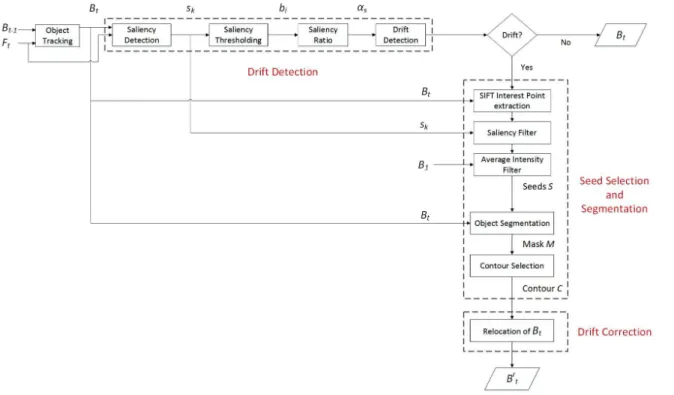
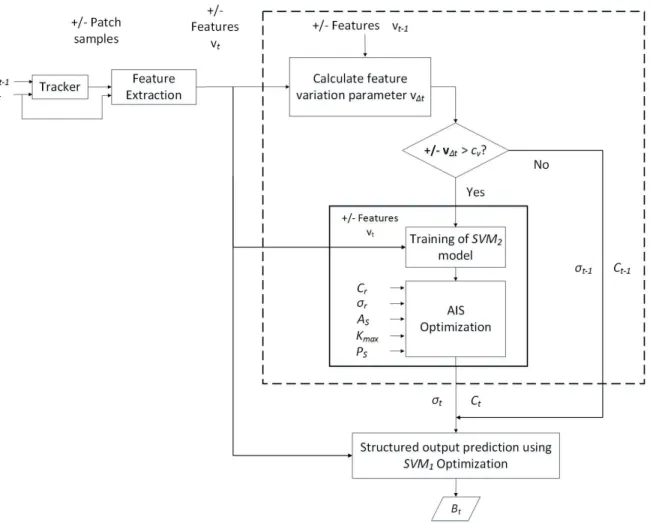
The proposed method comprises two main components as shown in Figure 3.1: drift detection using saliency features and drift correction using seeded segmentation. At current frame Ft, given the estimated tracking output BB from previous frameFt−1, an
object tracker estimates the BB (Bt) around the target. If a drift is detected, the drift
correction relocates the BB around the target through automatic seeded segmentation.
3.5.1
Saliency-based Drift Detection
Saliency object detection, sometimes called salient segmentation, is interpreted in computer vision as the process that incorporates detection of the most salient region(s)
Figure 3.1: Block diagram of the proposed drift detection and correction method.
in an image and then segmenting the boundary of such region(s). For saliency of a region, a high contrast to its surrounding regions is usually stronger evidence than that of far-away regions. Generally, an object is more likely to be salient than a region on the background, as image background is usually more structured and homogeneous (thus less salient) than objects [88].
While most of saliency models [42, 43, 45] employ local contrast, we calculate the saliency map more robustly [44] using global contrast differences and spatial coherence. However, directly introducing the spatial relation among individual pixels is computationally expensive and thus, we partition the BB Bt into K regions (e.g.,
using [89]) and calculate the saliency sk of each region rk as a weighted sum of
corresponding regions’ contrast according to the spatial distance among them. For this, we first find the histogram of each region rk and then calculate the saliency sk of rk as
sk= X (i6=k) ni·Dlab(rk, ri)·e−E(rk,ri)/σ 2 s, (3.1)
where ni is the number of pixels inside region ri and Dlab(rk, ri) is the color distance
between regionsrk andri inLAB color space, E(rk, ri) is the Euclidean spatial distance
between centers of rk and ri, and σs controls the strength of spatial weighting. σs =
PN j=1dpj
N is the average of differences between pixels pairs of the frame Ft, where dpj
is the average of absolute intensity differences between pixel pj and its four neighbors
and N is the number of pixels in Ft. We calculate the number of regions K using the
super-pixel segmentation, which groups pixels of Bt into regions with similar values.
With {sk}, each pixel pl of Bt has a saliency value. To reduce complexity, we apply a
saliency thresholding of sk to get the binary maskbl
bl = 1 :sk(pl)> ts, 0 :otherwise (3.2)
with ts global to Bt defined as
ts = P k (nk·sk) P knk , (3.3)
where nk is the number of pixels in rk. Finally, our drift detector determines whether
the target object inside Bt has drifted from its expected position depending on αs, the
ratio of the binary salient pixels inside {bl}, as follows
T Drif t= 1 : (αs < cs1)∨((αs> cs2)∧(αs < cs3)) 0 :otherwise. (3.4)
Meaning if αs the ratio of binary pixels in Bt is within the range (cs2, cs3), such as 0.6
and 0.9, or smaller than cs1, such as 0.2, then drift is detected with
αs=
Nb
P
k nk
, (3.5)
where Nb is the number of binary pixels (i.e., pixels pl with bl = 1) of Bt, Pknk is
the total number of pixels in all K regions (or the number of pixels in Bt). cs1, cs2, and cs3 are experimentally selected constants that decide whether the target saliency is low and hence a drift starts to occur. As shown in Figure 3.2, such constants are