A robust way of steganography by using
blocks of an image in spatial domain
Author:
Ladeh S.Abdulraman1 Sheerko R. Hma Salah2 Halgurd S. Maghdid3 Azhin T. Sabir4
SCIENTIFIC RESEARCH How to cite this paper:
Abdulraman. L.S., Hma-Salah. S.R., Maghidid. H. S., Sabir. A. T. A robust way of steganography by using blocks of an image in spatial domain. Innovaciencia. 2019; 7 (1): 1-7.
http://dx.doi.org/10.15649/2346075X.690 Reception date: Received: 03 May 2019 Accepted: 8 September 2019 Published: 25 October 2019 Keywords:
Steganography; Information hiding; Spatial domain; LSB Matching.
ABSTRACT
Steganography is a way to convey secret communication, with rapid elec-tronic communication and high demand of using the internet, steganog-raphy has become a wide field of research and discussion. In this paper a new approach for hiding information in cover image proposed in spatial domain, the proposed approach divides the host image into blocks of size (8x8) pixels and message bits are embeds into the pixels of a cover image. The 64-pixel values of each block converted to be represented in binary system and compared with corresponding secret data bits for finding the matching and hold 6-pixels. The search process performed by comparing each secret data bit (8-bits) with created binary plane at the cover image, if matching is found the last row of the created binary plane which is (LSB) is modified to indicate the location of the matched bits sequence “which is the secret data” and number of the row, if matching is not found in all 7th rows the secret sequence is copied in to the corresponding 8th row location.
The payload of this technique is 6 pixels’ message (48-bits) in each block. In the experiments secret messages are randomly embedded into differ-ent images. The quality of the stego-image from which the original text message is extracted is not affected at all. For validation of the presented mechanism, the capacity, the circuit complexity, and the measurement of distortion against steganalysis is evaluated using the peak-signal-to-noise ratio (PSNR) are analyzed.
El uso de bloques de imagen en el dominio espacial como una vía robusta de estenografía
1 Ladeh S. Abdulraman is with the Software Engineering Department, Koya University, Koya, [email protected]. 2 Sheerko R. Hma Salah is with the Software Engineering Department, Koya University,Koya, [email protected]. 3 Halgurd S. Maghdid is with the Software Engineering Department , Koya University, Koya, halgurd.sarhang @koyauniversity.org. 4 Sabir A is with the Software Engineering Department , Koya University, Koya, Azhin.tahir @koyauniversity.org.
Check for updates
INTRODUCCTION
The rapid growth of the internet and exponentially using of it as a communication media increasing day
by day. Requirements for a higher secure commu
-nication has become more important and resistant.
Steganography is the techniques and science to cre
-ate and establish safe channel between the sender and the receiver, and keeping information secure, integrity, and protecting its accessibility (1).
Steganography in the past several years considered as a guaranteeing way of e-communication and niche in security deals with hiding of an information in a various medium used as a cover such as text, audio, video, image, protocol (2).
Image considered as a suitable format for stegan-ography, because it contains a high amount of re-dundancies in their canonical representation, redun-dancy mean the unnecessary bits that can be altered without the alteration being detected easily, so image formats comply with this demand (3). The word steg-anography is of ancient Greek words which
com-bination of two words Steganos means “protected or covered” and Graphie means “writing”. The first
recorded use of steganography was in 1499 by Jo-hannes Trithemius (2)(4). As it’s obvious the objective of steganography is to promise a safe way of e-com-munication by concealing the secret message in to
cover source. The opposite of “protected message”
on the other side is trying to detect the payload, steganalysis which is the opposite of steganography on the other side working to detect the existence of the hidden message. Steganalysis is the art and sci-ence of detecting and identifying suspected hidden message and recover it if possible.
The good and the effective techniques in stegan
-ography must hold two important major challenges
which are security of the carrier and the payload size, the two metrics must be balanced and considered well (5).
a- Perceptual transparency: The secret message
avoid raising the suspicions of
eavesdrop-pers, because the technique fails when the
stego-cover is precepted and finally the pay
-load may be removed or replaced.
b- Payload size: Is the amount of the embedded data plays an important role in
steganogra-phy “A larger hiding capacity allows the use of smaller cover for a message of fixed size and thus decreases the bandwidth required
to transmit the stego-image”.
The two popular methods used in steganography can be broadly divided into two main groups which are
based on the hiding domain, spatial and frequency
domain methods. In spatial domain, the information is inserted directly and embedded in the values of
the cover image pixel. Frequency domain methods transform the cover image to frequency domain and
information is hidden in this domain (2) (6). Spatial domain methods are relatively simple compared to
methods of frequency domain, and in general they
are more sensitive to small changes on the cover me-dia. The transform domain methods on the other hand are more robust to changes but the capacity of hiding information is lower compared to spatial domain methods (2).
In this study a new approach for hiding information in cover image presented in spatial domain, which hides covert message in digital image.
The rest of this paper is organized as the
follow-ing sections. The first section is an overview of re
-lated work, in the next section the proposed hiding
technique is described in detail with an example to
explain the technique, section IV emphasizing on ex
-perimental results and comparing it with other
relat-ed studies, finally section V concludes the proposrelat-ed
method and outlines future studies directions. BACKGROUND AND RELATED WORKS A survey on steganographic approaches for Least
Significant Bit (LSB) substitution in spatial domain
introduced. Generally, schemes in a spatial domain often lead to fast processing and higher capacity in
experiments of this approach give a good and ac-ceptable result compared with presented approaches in the literature.
In (7), the typical and standard spatial domain algo-rithm using LSB replacement overviewed, each pixel in fact can be represented in 1-Byte, starting at the left hand from MSB to LSB the LSB contains no
visual sense and Human Vision Sense HVS never re
-alize any change in this bit. In this technique the only altered bit plane is the first right side bit of each pixel which is LSB. The main constraint in this technique
is robustness against steganalysis because most st-ganalysis attacks are able to detect and retrieve the existence of the secret message.
As explained in reference (8). A new steganography method using image layers proposed in this method
the host image divided into blocks of (8-by-8) fixed
size of pixels and converted to binary representation (bit-plane), the corresponding secret bits embeds into each block using the layers (plane) generated by
the binary representation. The algorithm tries to find
the similarity between the secret data bits and the
rows and columns of the layers. The sequence of
the layer and the location of the row and column marked by modifying minimum number of bits in
the Least Significant Bits of the block, which pro
-vides minimum amount of degradation in the cover
image, this method tries to find match in the higher
layers of host image, which is the key strozng of this method that increase the robustness, but the main constraint in this study is to hide only one secret pix-el in each block (64-pixpix-els).
The proposed scheme in (9). It hides a secret message
in a cover image by finding identical bits between se
-cret message and cover image. After the comparison done and the similarity found, the location of hid-den data bits marked at the cover image and can be retrieved beyond the legal receiver. By this scheme minimum bits in stego-image will be changed so the
quality will never degrade. The used cover image in
this technique is color image with 4-bit binary inten
-sity values. The probability of finding exact matching
between the secret message and pixels of an image is restricted which affect the payload size.
The author in paper (10). In this study a new
steg-anographic technique improved and discussed, by
embedding secret characters into cover image (RGB image). The algorithm performs the search and tries
to find matches between secret character and the
cover image. Each secret character after represented in a binary is divided in to 3 segments of (3-bits,
3-bits, and 2-bits), the first 3bits stored in 8-bits of
Red palette after matching is found, and the same
for second 3-bits into Green palette, finally the re
-maining 2-bits in blue palette in RGB pixel of cover
image. In the case if searching done without finding
exact similarity, all non-identical bits will be stored in
LSB of the corresponding pixel. This technique is efficient because secret message cannot be spotted
by steganalysis easily.
A new method proposed in (11). In this method Plan Bit Substitution Method (PBSM) were used in which secret bits are embedded into the pixel values of a cover image. The whole process is divided into two
parts, first solving binary operation for manipula
-tion of cover image with help to least significant bit
(LSB) operator-based matching. Second the secret message encrypted before embedding and decrypted after extraction process. This method considered as
an adaptive technique, because it tries to store more
than one bit in each pixel rather than storing the data
in every least significant bit of the pixels, which in
-crease the robustness. To estimate the number of bits which can be embedded in the pixels of the host image, it uses the side information of neighboring pixels to hide the secret data called (PBSM).
The proposed approach in our study performs other related works in which embed 6-pixels in each block rather than 1-pixel as (8)(9)(10), and outperforms (7), in which secret message randomly emended in side the
cover image rather than sequentially embedding it, therefore it’s more secure as it can not be extracted
THE PROPOSED APPROACH
This section describes the proposed method which embeds the message bits into the pixel values of
an image; That’s the cover image is divided into a number of fixed size of (8x8) pixels of blocks. From
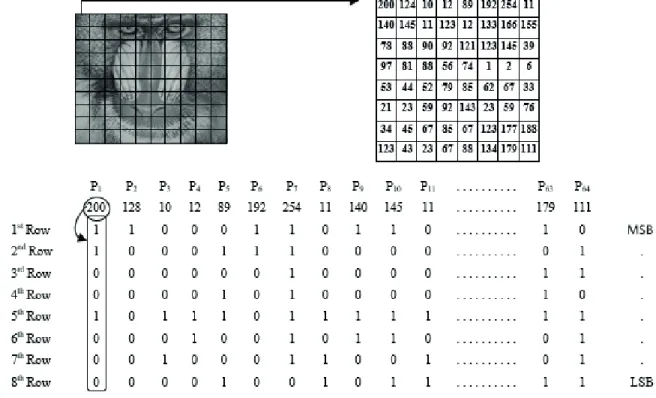
each block a palette of 8x64 bits is constructed as
shown in figures 1 and 2. The palette consists of
8 row which represents digits in the corresponding block starts from the MSB to the LSB of the pixels
i.e. the first row of the palette represents the MSB of
each pixel in the block, the followed row consists of the second MSB of each pixel and so on.
Figure 1. Representing one image block and its palette
Figure 2. Search space generation for the 1st row The process of embedding secrete message is per-formed by searching the palette from the 1st to the 7th rows, the last row is used as an indicator to mark
the location of the secrete sequence bits. The search
-ing process is started by compar-ing the 1st eight bits
(b1-b8) of the first row with the eight bits of the
secrete message, if there is an exact matching be-tween them, then the last row is updated to indicate
the location. In the last row the first tenbits are
re-served for indication, the 1st bit represents whether
matching, it’s assigned to 1, from the 2nd to the 4th
bits are assigned to indicate the row number, because
there are 7 rows, hence three bits are required for
representation. The remained 6 bits are used to in-dicate the column number that the secret message starts from, because there are 64 columns therefore
the minimum number of the bits are required is 6
bits. In the case if the exact matching did not exist in
the first search at the first row, the process of search
b2-b9. In the shifting step one byte is generated for comparison, as a result 57 bytes are produced in a single row, that means there are 57 probabilities for
finding the exact matching. So in total 399 probabili
-ties are generated from the whole rows. The 2nd eight bits are embedded by using the second ten bits of the last row as indicator with the same searching pro-cess, the last ten bits of the last row which is b51-b60 indicates the location of the 6th bits sequence of the
secrete message, this process results in hiding 6 let-ters in a block.
Given the secret bit sequence, the technique applies
a search process over all rows except last row at the
palette, attempting to find matching by performing
a XOR between them, if the result between the
(1-Byte) of the secret sequence bits and (1-(1-Byte) of the cover-image is equal to 0 it means the exact matching
is found, otherwise mismatching will occur. Proba-bly mismatching is the second case which may occur, in this case the 1st two bits from the corresponded ten bits are assigned to 0 and the rest bits holds the
mismatched message as its. The technique finds an
exact match in the experiments is %56 in the worst
case if embedding rate is %100, that’s considered
as a great number of matching because the search
space of finding an exact matching is 399 probabili
-ties as discussed before in this section EXPERMENTAL RESULTS
In the experiments the performance of the proposed method is evaluated and measured by the degree of robustness against steganalysis, Peak Signal to Noise
Ratio PSNR that measured in (dB) and Mean Square
Error (MSE) are used. PSNR is a good measure for comparing resolution results between the original (cover-image) and embedded (stego-image), where
defined as:
PSNR=10*log10 MSE=
Where is the cover-image, is the stego-image, and are the size of the images. The comparison of
aver-age PSNR and averaver-age modification rate MSE are
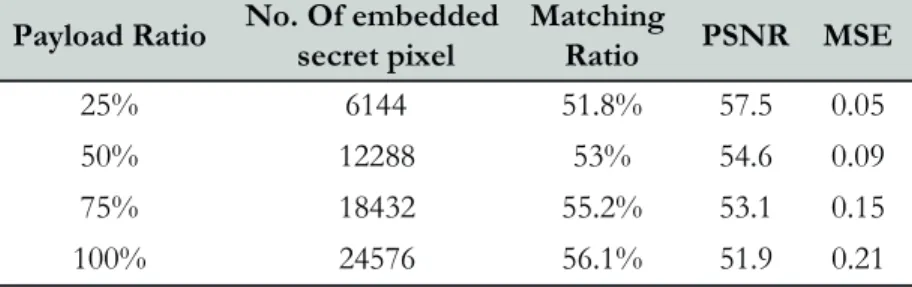
viewed in table (1), with number of matched and mismatched pixels. This table is a result of embed-ding randomly selected secret messages into 8 stan-dard images.
Tabla 1. Results of proposed Steganographic Algorithms using average PSNR
Payload Ratio No. Of embedded secret pixel Matching Ratio PSNR MSE
25% 6144 51.8% 57.5 0.05
50% 12288 53% 54.6 0.09
75% 18432 55.2% 53.1 0.15
100% 24576 56.1% 51.9 0.21
The results in the above table shows that the PSNR still above (50 dB) in the worst case when full
em-bedding rate is given, and the quality of the image is preserved because distortion can’t be spotted in
naked eyes. If we look at the trends towards increas-ing embeddincreas-ing rate, the capacity of the payload is
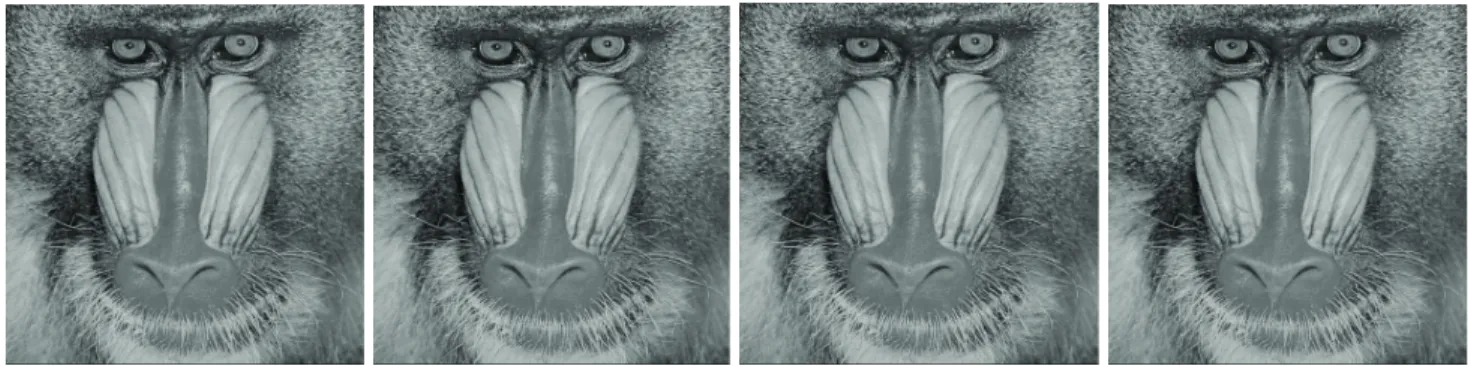
high because this method embeds 6-pixels in each block. Figure3 shows the orignal image of size
(512*512) pixels, while figure 3-a through 3-d display
the stego-images after adding the payload ratio of 25%,50% ,75%, and 100% respectively.
Figure 3. Original Image
Figure 3-a. Payload of 25% Figure 3-b. Payload of 50% Figure 3-c. Payload of 75% Figure 3-d. Payload of 100%
CONCLUSIONS
This paper introduced a new data hiding method in spatial domain. The main reason of steganography is to establosh secure link between sender and
re-ceiver, to Exchange confidential information by em
-bedding it in to a cover image, secure and roubest steganographic mechanism implemented in this
study, almost most of the techniques in spatial do
-main focus on only Least Significant Bits to embed
the secret message as explained before for the reason
of preserving the quality of the stego-image. But the
proposed technique uses different way in embed
-ding secret data by attempting to find matching at
the higher order digits of the pixel values which is
the most significant bits, that is considered as a spe
-cial characteristic to increase and improve security of the stego-image. Security in steganography refers to the ability of embedded data to remain intact if the stego-image undergoes extraction by the illegal receiver. Also hiding capacity play an important role in steganography, the high performance and strong points in this method is the payload size, that is capable to embed 6-pixels into each block. And
also randomly embedding secret sequence bits for
the purpose of increasing level of security while
maintaining and preserving the visual quality and
REFERENCES
1. Borse, Dipalee and Patil, Shobhana. Review and Analysis of Multifarious Spatial Domain
Stegan-ography Techniques. 2015; 4(1-Jan-2015).
2. Akhter F. A novel approach for image steganog-raphy in spatial domain. 2013; 13(7).
3. Neeta DaSKaJD. Implementation of LSB stegan-ography and its evaluation for various bits. 2006.
4. Samaratunge S. New steganography technique
for palette based images. 2007;(IEEE).
https://doi.org/10.1109/ICIINFS.2007.4579198 5. Cheddad AaCJaCKaMKP. Digital image stegan-ography: Survey and analysis of current methods. 2010; 90.
https://doi.org/10.1016/j.sigpro.2009.08.010 6. Liu, Qingzhong and Sung, Andrew H and
Ri-beiro, Bernardete and Wei, Mingzhen and Chen, Zhongxue and Xu, Jianyun. Image complexity
and feature mining for steganalysis of least signif-icant bit matching steganography. 2008; 178. https://doi.org/10.1016/j.ins.2007.08.007
7. Chan, Chi-Kwong and Cheng, Lee-Ming. Hiding data in images by simple LSB substitution. 2004; 37.
https://doi.org/10.1016/j.patcog.2003.08.007
8. Kurtuldu, Omer and Arica, Nafiz. A new stegan
-ography method using image layers. 2008. https://doi.org/10.1109/ISCIS.2008.4717893 9. Al-Shatnawi AM. A new method in image
stegan-ography with improved image quality. 2012; 6.
10. Prasad, Koyi Lakshmi and Rao, T Ch Malleswara. A Novel Secured RGB LSB Steganography with Enhanced Stego-Image Quality. 2013; 3.
11. Sravanthi, GS and Devi, B Sunitha and Riyazod-din, SM and Reddy, M Janga. A spatial domain
image steganography technique based on plane