Assessing the Effectiveness of Internal Control Systems in the
Public Sector of Ghana on Selected District Assemblies in
Northern Region, Ghana
BY YAKUBU ABDULAI,C/O GAMBAGA COLLEGE OF EDUCATION P. O. BOX 33, GAMBAGA
ABSTRACT
An internal control system is necessary for the efficient and effective operations of an entity. It is fundamental for the attainment of goals and objectives in an organization. The main objective of the study was assessing the effectiveness of internal control system in the public sector of Ghana in selected Assemblies in the Northern Region of Ghana using a mixed research design approach. 57 core staff from one District Assembly, one Municipal Assembly and one Metropolitan Assembly were purposely sampled and participated in the study. The study revealed internal control systems existed within the public sector in Ghana. Also, the effectiveness level of internal control systems within the three assemblies were described as averagely effective. Lack of financial resources to enforce and implement internal control rules and regulations, too much politics in the enforcement of internal control rules, unconcern of bosses to enforce internal control rules at their respective departments/units, employees lacking understanding of the essence of internal controls were some of the challenges facing internal controls implementation within the Assemblies. The study recommended the provision of the necessary financial resources for the implementation of internal controls within the public sector, the development of a comprehensive internal control policy framework and guidelines for the implementation and enforcement of internal controls within the public sector, organization regular capacity building programmes for junior, senior and management and ensuring an all-inclusive internal control implementation strategies at the Assemblies as measures for enhancing the effectiveness of internal control within the public sector.
1.1 INTRODUCTION
The role of an internal control system in the efficient and effective functioning of organization cannot be overemphasized. An internal control system is considered fundamental for the success and existence of any organization relative to efficiency and effectiveness (COSO, 2013). Metropolitans, Municipals and District Assemblies administration are not based on the board of directors’ tradition, their operations and functions are guided and directed by public laws and regulations. As portrayed by the district league table results, some MMDAs are well-controlled and performing whiles others are not depending on the commitment of management in implementing and enforcing internal control systems that ensure efficiency and effectiveness.
As captured by Aduam (2015), the significance of internal control system in an organization cannot be underrated. The effectiveness of an internal control system in an organization is a pre-requisite for achieving the goals and objectives of an organization that is used to measure its performance (Ama, 2012). The opinion of Ayagre & Osei (2015) on the role of an internal control system in an organization is that, the breakdown of an internal control system has a high probability of causing its failure. Hence, Ofori (2011) opined that the existence and effectiveness of internal control is a pre-requisite and fundamental for efficient and effective administration of an organization. These emphases on the importance of an internal control system justified its significance in the operation and function of public sector organizations whose main source of funding is the public purse.
In recent times, the issues of efficiency and effectiveness in the operations of public sector organizations has taken a center-stage in the public discourse. Public sector managers and employees are expected to be accountable for the public resources entrusted unto their care. Conversely, the circumstances under which public institutions are currently managed in Ghana are quite discouraging. The image of the public sector in Ghana has been soiled with negative accusations and perceptions based on lack of efficiency and effectiveness within the
will surely increase the likelihood of reliable and efficient management of the organization. Thus it provides some assurance of the organization performing creditable well than a similar organization without an effective and efficient internal control system.
Lakis and Giriunas (2012) alluded to this fact when they indicated in their work that, effective internal control systems are pre-requisite for comparative advantage. This reiterates the role internal control systems play in the efficient and effective management and administration of an organization. Therefore, internal control system has become a mechanism which supports organizations to achieving their objectives and to accomplish its core responsibilities effectively relative the effectiveness and efficiency of the system.
It is therefore imperative that, effective and efficient internal control system has become one of the major internal instruments or mechanisms for strengthening and checking the gaps or leakages in the management and operation of an organization or entity especially institutions that control and manage the public purse to ensure efficiency and effectiveness in their operations.
It is therefore right and appropriate that, this study will evaluate the effectiveness of the internal control system within the public sector using the Committee of Sponsoring Organization (COSO’s) of the Treadway Commission’s five components framework which has been approved as a standard framework for measuring the effectiveness of an internal control system in organizations. The study will therefore examine the availability of these components of an effective internal control system in an organization and test their effectiveness using the set of basic principles under each component.
1.2. Age Composition of Respondents
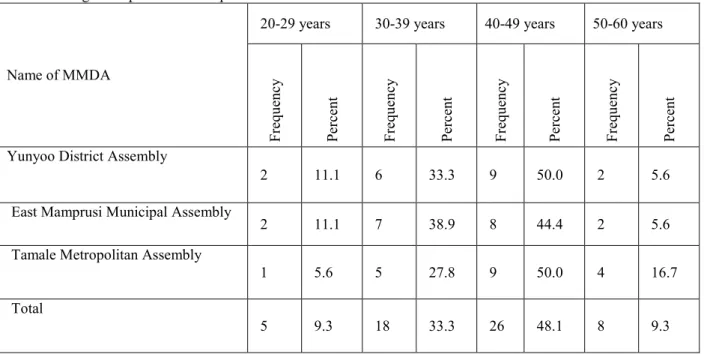
The age of the 57 staff were grouped under four cohorts which included 20-29 years, 30-39 years, 40-49 years and 50-60 years cohorts as presented in table 1.1.
Table 1.1: Age Composition of Respondents
Name of MMDA
20-29 years 30-39 years 40-49 years 50-60 years
Fr eq ue nc y Pe rc en t Fr eq ue nc y Pe rc en t Fr eq ue nc y Pe rc en t Fr eq ue nc y Pe rc en t
Yunyoo District Assembly
2 11.1 6 33.3 9 50.0 2 5.6
East Mamprusi Municipal Assembly
2 11.1 7 38.9 8 44.4 2 5.6
Tamale Metropolitan Assembly
1 5.6 5 27.8 9 50.0 4 16.7
Total
5 9.3 18 33.3 26 48.1 8 9.3
Source: Field Survey, 2018
The results presented in table 1.1 shows majority of the respondents from the three Assemblies fell within 40-49 years age cohort. This was followed by the 30-39 years age cohort. In total, 48.1 % of the 54 staff from the three Assemblies were within the 40-49 years cohort, 33.3 % fell within the 30-39 years age cohort, whilst 9.3 % respectively were within the 20-29 years and 50-60 years age cohorts.
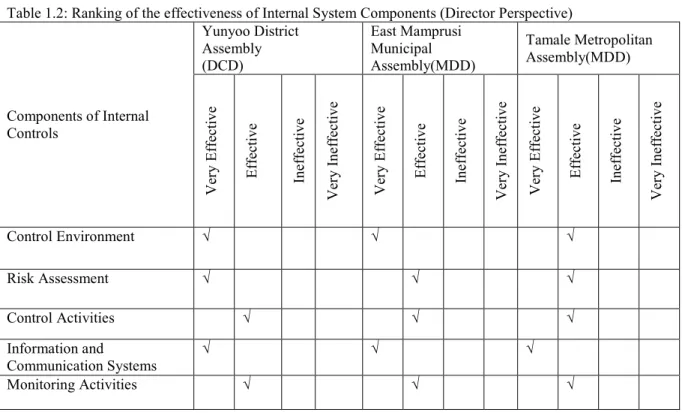
Table 1.2: Ranking of the effectiveness of Internal System Components (Director Perspective) Components of Internal Controls Yunyoo District Assembly (DCD) East Mamprusi Municipal Assembly(MDD) Tamale Metropolitan Assembly(MDD) V er y E ff ec tiv e E ff ec tiv e In ef fe ct iv e V er y In ef fe ct iv e V er y E ff ec tiv e E ff ec tiv e In ef fe ct iv e V er y In ef fe ct iv e V er y E ff ec tiv e E ff ec tiv e In ef fe ct iv e V er y In ef fe ct iv e Control Environment √ √ √ Risk Assessment √ √ √ Control Activities √ √ √ Information and Communication Systems √ √ √ Monitoring Activities √ √ √
Source: Field Survey, 2018
Control environment component of internal control using the COSO framework was considered very effective by the Directors of Yunyoo District Assembly and East Mamprusi Municipal Assembly whilst the Metropolitan Director of Tamale considered it effective. In addition, risk assessment component was considered very effective by the Yunyoo District Assembly Coordinating Director whilst the East Mamprusi Municipal Assembly Director and the Metropolitan Director of Tamale considered the same component as effective. Information and communication systems was rated very effective by all the Directors whilst control activity and monitoring activity were considered effective by all the Directors. These ratings were based on the grounds that, there are structures such as participatory decision making process, ethical values, high knowledge of staff on internal controls, existence of Audit unit and committee, laid down channels for communication are available and working at the Assembly. However, the ratings were not same as the challenges in the implementation of these structures vary.
They however, identified too much politics in the enforcement of internal controls rules and lack of financial resources to enforce and implement internal control rules and regulation as the very high challenges facing internal controls functioning at the Assemblies. In addition, they identified unconcern of bosses to enforce internal control rules at their respective departments/units, employees lacking understanding of the essence of internal controls as a result of poor sensitization by management and lack of prosecution of offenders as high challenges facing internal control effectiveness at the Assemblies levels. They indicated, some staff at the various Assemblies can breach internal control procedures and go unpunished due to their political affiliation though acts and regulations governing the public forbid politics. This is seriously affecting the effective implementation of internal control mechanisms at the Assembly level. The Director of Yunyoo District Assembly indicated as a manager, you sometimes become helpless and for your job security, you just have to keep mute, the Director concluded.
as part of their management system. This presupposes that, the information and communication component of the internal control framework at the Assemblies are functioning, hence the staff awareness. This provides a fertile grounds for the study to measure the effectiveness level of the internal control system at each Assembly. The mode of awareness of the internal control system at the Assembly from the staff perspective were from three major sources; staff meeting, job description and colleague staff. 55.5% the staff from Yunyoo District, 50% of the East Mamprusi Municipal Assembly and 44.4% of the Tamale Metropolitan indicated that, they were aware of the existence of internal controls at their respective Assemblies through their job description. According to them, in their appointment letters, they are mandated to abide by all the conditions of the public service which invariable are the external and internal controls within the service. This explicitly indicates the existence of some controls within the service. Also, 27.8 % of staff from Yunyoo District Assembly, 22.2 % of the East Mamprusi Municipal Assembly staff and 38.9 % of the Tamale Metropolitan Assembly staff became aware of the existence of internal controls at their various Assemblies through staff meeting whilst 16.7 %, 27.9 % and 16.7 % of the Yunyoo District Assembly staff, East Mamprusi Municipal Assembly staff and Tamale Metropolitan Assemblies respectively became aware through colleague staff. These sources of awareness of the existence of the existence of internal controls at the various Assemblies affirms the universality of internal controls within the public sector as indicated by the Metropolitan/Municipal/District Coordinating Directors.
Regarding enforcement, Inusah & Abdualai (2015) asserts that, the mere existence of internal controls in an organization does not guarantee the achievement of its purpose of achieving the objective of an organization in the area of operations, reporting and compliance. Interestedly, all the staff (54) affirms the Director’s opinion that, management enforced internal controls at the Assemblies.
1.3.3. Existence of the Five (5) Components of Internal Controls System
To conclude on the existence and effectiveness of internal controls at the Assemblies, the study measured the existence of the individual components of the COSO framework as measured under the Administrative heads section.
1.3.3.1. Existence of Control Environment
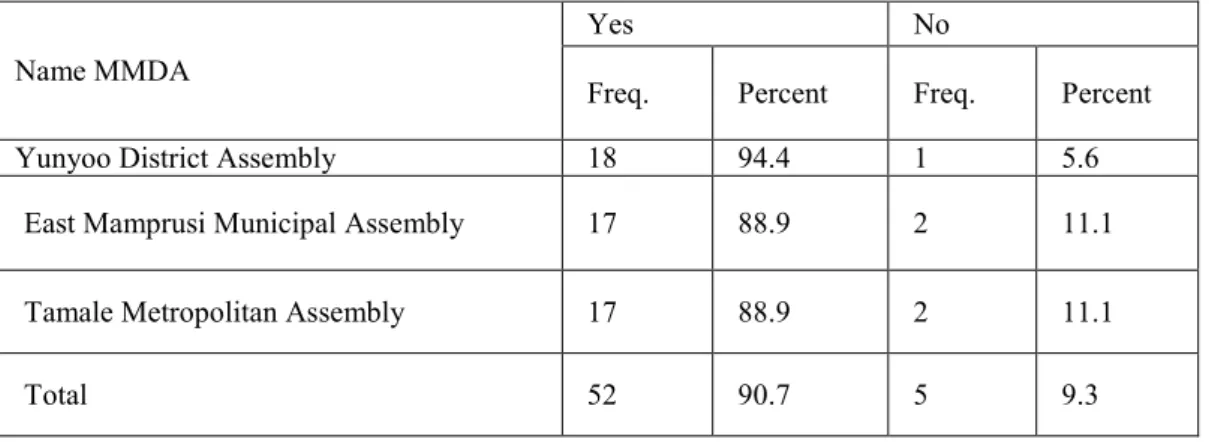
The first component of internal control under the COSO framework is the control environment. It basically create the environment for the other components to strive. This section measured the existence of this component at Metropolitan, Municipal and District Assemblies levels from the perspective of the 54 staff as presented in table 1.3.
Table 1.3: Existence of Control Environment at the Assemblies
Name MMDA
Yes No
Freq. Percent Freq. Percent
Yunyoo District Assembly 18 94.4 1 5.6
East Mamprusi Municipal Assembly 17 88.9 2 11.1
Tamale Metropolitan Assembly 17 88.9 2 11.1
Total 52 90.7 5 9.3
Source: Field Survey, 2018
From table 1.3, out of the 54 staff from the three Assemblies, 90.7 % of them indicated that, there existed the control environment component at their Assemblies. Thus, there exist standards, processes and structures that forms the basis for carrying out internal control mechanisms across their respective Assemblies. A minority of 9.3 % said no standards, processes and structures that forms the basis for carrying out internal control mechanisms across their Assemblies. Hence, majority of the staff affirms the opinions by the three Directors that control environment exist at their Assemblies.
1.3.3.2. Existence of Control Activity
The implementation of internal control at MMDAs will be challenge if management directives are not adhered to. Control activities measures the plans and processes that ensures that management orders are carried out. The COSO framework is explicit on the control activity. Control activity in an internal control system include staff rotation, independent verification of transactions and security of assets among other.
Table 1.4: Existence of Control Activity at the Assemblies
Name MMDA Yes Freq. Percent No Freq. Percent
Yunyoo District Assembly 18 94.4 1 5.6
East Mamprusi Municipal Assembly 19 100.0 0 0
Tamale Metropolitan Assembly 17 88.9 2 11.1
Total 54 94.4 3 5.6
Source: Field Survey, 2018
Similar to control environment, majority of the staff affirms the three Director’s opinion that, there exist control activity at the Assembly. 94.4 % of the 54 respondents indicated that, there are actions established by policies and procedures to achieve the objectives of the Assemblies are implemented. However, 5.6 % disagreed. The large majority of the staff affirming the existence of control activity reflects the directive by the COSO (2014) that policies governing derivative use should be clearly defined and communicated throughout an implementing organization.
1.3.3.3. Risk Assessment
There is no activities without risk factors. The identification and analysis of risk are very relevant in achieving the objectives of any entity. COSO (2013) indicated risk assessment is expected to deal with fraud in an organization. This section measured the existence of dynamic and iterative process for identifying and analyzing risks towards the achievement of the objective of the Assemblies forming basis for determining how assessed risk will be managed.
Table 1.5: Risk Assessment Activity at the Assemblies
Name MMDA Yes Freq. Percent No Freq. Percent
Yunyoo District Assembly 16 83.3 3 16.7
East Mamprusi Municipal Assembly 14 72.2 5 27.8
Tamale Metropolitan Assembly 16 83.3 3 16.7
Total 46 79.6 11 20.4
Source: Field Survey, 2018
From table 1.5, though a sizable percent of the staff agreed to the existence of risk assessment structures within the Assembly, a significant percent disagreed. A total of 79.6 % of the 54 staff who participated in the study agreed that there exist dynamic and iterative process for identifying and analyzing risks towards the achievement of the objectives of the Assemblies forming basis for determining how assessed risk will be managed whilst 20.4 % disagreed. Though the 20.4 % is considered significant but it would be understood in the context that risk assessment is a sensitive area and not all departments/units will be involved.
1.3.3.4. Information and Communication System
Information and communication system is one of the necessary requirement for an effective internal control system in an organization. According to the COSO (2013), information and communication systems are key for a successful implementation of an entity internal control system towards the achievement of the objectives of the entity. This component of internal control creates the commitment and willingness to support management directives to a successful internal control implementation.
Table 1.6: Information and Communication System
Name MMDA Yes No
Freq. Percent Freq. Percent
Yunyoo District Assembly 19 100.0 0 0
East Mamprusi Municipal Assembly 18 94.4 1 5.6
Tamale Metropolitan Assembly 19 100.0 0 0
Total 56 98.1 1 1.9
Table 1.7: Existence of Monitoring Activity at the Assembly
Name MMDA Yes No
Freq. Percent Freq. Percent
Yunyoo District Assembly 18 94.4 1 5.6
East Mamprusi Municipal Assembly 17 88.9 2 11.1
Tamale Metropolitan Assembly 18 94.4 1 5.6
Total 53 92.6 4 7.4
Source: Field Survey, 2018
The results presented in table 1.7 reflects a vibrant monitoring activity at the various Assemblies levels. A total of 92.6 % of the 54 staff who participated in the study indicated that there exist monitoring activity at the Assemblies. Thus, there are on-going evaluation, separate evaluation or a combination of the two at the Assemblies. This affirms the three Directors’ verdict that, monitoring and evaluation is considered a serious business at the Assembly level where a monitoring team is established to take charge of monitoring aspect of the Assembly’s operations. This finding is contrary to Ama (2012) finding that, there exist uncertainty in the monitoring mechanism of most public sector organization in Ghana including Metropolitan, Municipal and District Assemblies.
Overall, the opinions expressed by the 54 departmental/units staff who participated in the study validates most of the opinions expressed by the Coordination Directors. This affirms the existence of all the five components of an internal control system as contained in the COSO framework.
1.4. Existence of internal control system among MMDAs
The study results revealed that there existed internal control system at the Metropolitan, Municipal and District Assembly level in Ghana. Both the Coordinating Directors and the other staffs who participated in the study unanimously indicated that they were aware of internal controls and that, the Assemblies had active internal control system as well as the public sector as a whole. In addition, the Directors had indicated that the Assemblies had all the five components of the COSO framework at the Assemblies namely control environment, risk assessment, control activity, information and communication as well as monitoring activity. Regarding the staff who participated in the study, majority of them indicated the five components of the COSO framework existed at their respectively Assemblies.
This outcome of the study confirms the findings of Effah (2011) who concluded that internal controls actual exist in public sector organization and compliance were very high especial financial internal controls.
1.5 Conclusion
Based on the outcomes of the study presented above relative to central place of internal controls in the implementation of the necessary activities of the Assemblies towards the goals and objectives of the Assemblies. The study offered the recommendations as measures for ensuring and enhancing the effectiveness of internal controls at the Assemblies and the public sector at large. Providing the necessary financial resources for the implementation of internal controls within the public sector. Lack of financial resources to enforce and implement internal controls rules and regulations is a challenge facing the effective implementation of internal controls mechanisms at the Assemblies and the public sector at large. Also, development of a comprehensive internal control policy framework and guidelines for the implementation and enforcement of internal controls within the public sector. In addition, organizing regular capacity building programmes for junior, senior and management staff of public sector institutions on internal controls. One surer way of ensuring the effective implementation of internal control activities within an organization is by ensuring all stakeholders within the implementation and enforcement ladder are well equipped and ready for its implementation
1.6 References
Aduam, J., (2015). Assessing the Effectiveness of Internal Controls Mechanism of the Techiman Municipal Assembly, Kumasi: Nkrumah University of Science and Technology.
Ayagre, P. & Osei, V., (2015). An Evaluation of Internal Control Systems: Evidence from Ghana’s Cocoa Industry. MERC Global’s International Journal of Management, 3(1), p. 1.
Ama, A. J. N., (2012). An Assessment of Internal Control System on the Image of the Hospitality Industries in Royal Mac-Dic Hotel and Capital the Hospitality Industries in Royal Mac-Dic Hotel and Capital, Kumasi: Kwame Nkrumah University of Science and Technology.
Committee of Sponsoring Organisations of the Treadway Commission (COSO, 2014); Internal Control Issues in Derivatives Usage [online] available at http:// www.aicpa.org/ IC-Issues-Derivatives Usage_Summary.htm {accessed 15th April 2017}.
Committee of Sponsoring Organisations of the Treadway Commission (COSO, 2013); Internal Control Issues in Derivatives Usage [online] available at http:// www.aicpa.org/ IC-Issues-Derivatives Usage_Summary.htm
{accessed 15th April 2017}.
Effah, A., (2011). An evaluation of internal financial controls in public hospitals : A case study of regional and municipal hospitals , Kumasi: Kwame Nkrumah University of Science and Technology.
Ghana News Agency., (2015). Ghana Revenue Authority ready for single window operation. Accra: Ghana News Agency.
Inusah, A. M. & Abdulai, S. (2015). Assessing Internal Financial Controls of the Lands Commission of Ghana. European Journal of Business, Economics and Accountancy, 3(3), pp. 1-2.
Lakis, V. and Giriūnas, L. (2012). The Concept of Internal Control System: Theoretical Aspect. Ekonomika, [online] 91(2), pp.142-149. Available at: http://www.zur-nalai.vu.lt/ekonomika/article/viewFile/890/412 [Accessed 6 Apr. 2017].
Ofori, W., (2011). Effectiveness Of Internal Controls: A Perception Or Reality? The Evidence Of Ghana Post Company Limited In Ashanti Region, Kumasi: Kwame Nkrumah University of Science and Technology.
Office.
Noorvee, L. (2006). Evaluation of the effectiveness of internal control over financial reporting, Being in MSc. Thesis, university of Tart