King’s Research Portal
DOI:https://doi.org/10.1080/13563467.2019.1664446
Document Version
Peer reviewed version
Link to publication record in King's Research Portal
Citation for published version (APA):
Karwowski, E., Shabani, M., & Stockhammer, E. R. (Accepted/In press). Dimensions and Determinants of Financialisation: Comparing OECD Countries since 1997. NEW POLITICAL ECONOMY.
https://doi.org/10.1080/13563467.2019.1664446
Citing this paper
Please note that where the full-text provided on King's Research Portal is the Author Accepted Manuscript or Post-Print version this may differ from the final Published version. If citing, it is advised that you check and use the publisher's definitive version for pagination, volume/issue, and date of publication details. And where the final published version is provided on the Research Portal, if citing you are again advised to check the publisher's website for any subsequent corrections.
General rights
Copyright and moral rights for the publications made accessible in the Research Portal are retained by the authors and/or other copyright owners and it is a condition of accessing publications that users recognize and abide by the legal requirements associated with these rights. •Users may download and print one copy of any publication from the Research Portal for the purpose of private study or research.
•You may not further distribute the material or use it for any profit-making activity or commercial gain •You may freely distribute the URL identifying the publication in the Research Portal
Take down policy
If you believe that this document breaches copyright please contact [email protected] providing details, and we will remove access to the work immediately and investigate your claim.
Dimensions and determinants of financialisation: Comparing
OECD countries since 1997
Ewa Karwowski (University of Hertfordshire, University of Johannesburg,
Mimoza Shabani (University of East London) Engelbert Stockhammer (King’s College London)
Abstract
The financialisation literature has grown over the past decades. Despite a generally accepted definition, financialisation has been used to describe different phenomena. We distinguish between financialisation of non-financial companies, households and the financial sector and use activity and vulnerability measures. We identify seven financialisation hypotheses in the literature and empirically investigate them in a cross-country analysis for 17 OECD countries and two time periods, 1997-2007 as well as 2008-2017. We find different financialisation measures are only weakly correlated, suggesting the existence of distinct financialisation processes. There is strong evidence that financialisation is linked to asset price inflation and correlated with a debt-driven demand regime. Financial deregulation encourages financialisation. There is limited evidence that market-based financial systems are more financialised. Foreign financial inflows do not seem a main driver. We do not find indication that an investment slowdown precedes financialisation. Our findings suggest financialisation should be understood as variegated process, playing out differently across economic sectors and countries.
Keywords: financialisation, cross country analysis, financial deregulation, property prices
1. Introduction
Since the term was coined in the early 1990s financialisation has become a popular topic in academic research, expanding its reach even into the financial press, with Forbes magazine warning that financialisation is “running amok” (Denning, 2014). The established working definition sees financialisation as “the increasing role of financial motives, financial markets, financial actors and financial institutions in the operations of the domestic and international economies” (Epstein, 2005, p. 3). Because this definition is so broad, the term has been used to describe a range of different phenomena. Bridging social sciences, financialisation research can be broadly classified into the following three streams. Economists, especially those writing in the post-Keynesian or Marxist tradition, tend to either address the systemic (macroeconomic) level or adopt a firm-focused approach at the mesoeconomic level. Political scientists, in particular those close to the Varieties of Capitalism (VoC) approach, have also adopted the macroeconomic view, identifying financialisation as part of the market-based financial system. In both, the macro- and mesoeconomic analysis, the changing interaction between financial sector and non-financial companies (NFC) is the analytical focus. Cultural Political Economy (CPE) research, in contrast, stresses the (microeconomic) impact of financialisation on the everyday life of the individual. Here the research purpose is to assess the changing position of households vis-à-vis the financial sector. While this diversity has enriched the financialisation debate, it has adversely affected the clarity and coherence of the research agenda. This paper aims at identifying the different interpretations of financialisation, clarifying the arguments and their explanatory power.
Empirically, financialisation research has focused either on changes within individual countries over time, with strong emphasis on the US as the archetypal financialised economy (Lazonick and O’Sullivan, 2000; Krippner, 2005), or on specific sectors across a small number of countries. This has created an analytical gap in the area of cross-country comparison over time for larger samples of countries. A notably exception is the study by Maxfield, Winecoff and Young (2017) across 14 OECD economies. However, their
investigation focuses only on the financial sector and specifically leverage among financial firms, assessing whether there is a convergence towards financialised practices among these companies. They find convergence among large, transnationally operating financial firms but significant variation otherwise. The need for more cross-country and sectoral analysis has been acknowledged with more comparative studies across countries published recently (see Gospel, Pendelton and Vitols (2014) for an approach based on the VoC literature; Becker et al. (2010) for a comparison of financialisation experiences across four emerging economies and Lapavitsas and Powell (2013) for a sectoral study comparing the US, UK, France, Germany and Japan). However, while there are cross-country comparisons across a small handful of economies, there is little systematic cross-country analysis especially for large samples.
The dominant focus on the US has introduced two biases in the literature. First, it has encouraged an understanding of financialisation that uses the US experience as the key reference point. Other countries are then evaluated against this experience (e.g. Maxfield et al., 2017; Robinson, 2017). Second, financialisation has been regarded as driven by a central logic, implying different parts of the economy are experiencing financialisation in parallel. This view emerges from the idea that financialisation is a symptom of mature capitalism, which has at its core a ‘stagist’ understanding of capitalist development based on convergence. Engelen and Konings (2010) call this the modernist thesis of institutional convergence which states that with the increasing dominance of financial markets in capitalism economies’ institutional differences decline. We will refer to this as the strong financialisation view.
The first contribution of the paper is to identify testable hypotheses about financialisation and test them econometrically. We distil seven causal hypotheses about financialisation from the literature: First, the strong financialisation view argues that there is a single financialisation process and different sectoral financialisation measures will thus be correlated (H1). Second, some Marxists have argued that financialisation is the results of a (prior) secular slowdown in profitability and investment rates (H2). Third, financialisation is driven by financial deregulation (H3). Forth, financialisation is essentially a shift towards market-based financial systems (H4). Fifth, some post-Keynesian authors have argued that financialisation should be understood as part of a debt-driven demand regime (in contrast to export-driven or wage-led demand regimes) (H5). Sixth, development economists have argued that financialisation is
driven by foreign financial inflows (H6). Seventh, Minskyans interpret financialisation as driven by asset price inflation (H7).
Secondly, we offer a cross-country analysis of financialisation across three sectors, i.e. households, NFCs and the financial sector, for 17 OECD countries spanning the decade before the global financial crisis (1997-2007) as well as the decade after the crisis (2008-2017). Since we are interested in institutional change, which is slow in nature, we use decade averages in our analysis. Treating the two time periods separately acknowledges the institutional rupture brought about by the global financial crisis. We use activity as well as vulnerability measures of financialisation. Activity measures capture the financial flows such as the share of gross financial income in total income of NFCs and are habitually used in the literature (see Krippner, 2005). Vulnerability measures, inspired by Minskyan analysis, account for stocks of debt relative to income, exemplified in the ratio of household debt to disposable GDP.
While this paper fills an analytical gap by providing the first systematic analysis of the three private-sector aggregates across a large number of economies, there are limitations to the cross-country approach. Such a perspective runs the danger of downplaying sub-national and super-national factors (although international finance and implicitly financial centres play a role in H3 and H6). However, our analysis does not regard nation states as homogenous spaces as we emphasize the different sectoral dynamics of financialisation. Our cross-country analysis is part of the division of labour with other financialisation approaches. It is complementary to studies that go beyond the nation state and that investigate changes over time particularly in the public sector.
Our findings can be summarised as follows. Financialisation takes multiple forms across countries with little support for the strong view of financialisation. We do not find evidence that the secular slowdown in investment is linked to financialisation. The claim that the market-based/bank-based distinction can help identify financialisation or that financial capital inflows drive financialisation can only be substantiated to a limited extent. We do find a general effect, i.e. evidence across different sectors, that financial deregulation contributes towards financialisation and that a debt-driven demand regime is linked to financialisation. Most notably, asset price bubbles (in housing markets) are associated with financialisation, proving to be linked to the financialisation of households, non-financial firms and the finance sector.
Our evidence suggests that financialisation is multifaceted in the sense that it plays out in distinct and potentially conflicting processes across macroeconomic sectors. For instance, household financialisation linked to higher consumer debt is likely to spur economic activity while the financialisation of NFCs tends to dampen investment and therefore growth. Consequently, global forces – such as international financial flow or financial liberalisation – will affect countries differently depending on domestic institutions and sectoral make-ups. Therefore, we argue that financialisation is a variegated phenomenon, creating different concrete economic outcomes across countries in the presence of global forces. The rest of the paper is organised in the following way. The next section reviews the financialisation debate, tracing the emergence of the seven research hypotheses formulated by us. Section 3 states the research hypotheses in formal terms. Section 4 then discusses the data gathered and methodology used. Subsequently, our test results are put forward and discussed in detail in section 5. Finally, section 6 concludes summarising the implications of our findings for financialisation theory and future research.
2. Financialisation debates: An overview
As the phenomenon of financialisation has slowly moved into the focus of the academic mainstream (especially in sociology, see Tomaskovic-Devey and Lin, 2011), the concept has been refined and research foci have shifted over the past two decades. Tracing the origins of financialisation the research agenda can be broadly classified into three categories. Economists tend to address the concept systemically, stressing changing macroeconomic structures and their impact on financial stability (see Becker et al., 2010). Alternatively, they address the mesoeconomic level, focusing on the firm (see van Treeck, 2009, who makes a similar distinction between the two levels of analysis). As far as its foundation in economic theory is concerned the financialisation debate is firmly rooted in non-mainstream approaches, with strong influences of post-Keynesian theory, especially Kaleckian theory of demand regimes and Minsky’s analysis of financial instability, and Marxist theory. The systemic perspective is also shared by political scientists particularly proponents of the VoC approach (Hall and Soskice, 2001). Macro- and mesoeconomic analyses centre on the changing interaction between non-financial corporations and the financial sector. In contrast, research in the area of CPE has emphasised the increasing impact of financial institutions on everyday life (Montgomerie, 2009; van der Zwan, 2014). Here the individual (and by
extension the household) is in the microeconomic analytical focus.1 Since the coining of the term ‘financialisation’ in the early 1990s, the three research agendas have widened, resulting in increasing overlap. The financial crisis has sparked increased interested in the question of household financialisation among economists (Barba and Pivetti, 2008; Stockhammer, 2013; Stockhammer and Wildauer, 2016), while sociologists reacted by integrating the non-financial corporate sector more into their analysis (Tomaskovic-Devey and Lin, 2011). Initial impulses for the financialisation debate came from the notable economic changes underway in OECD countries since the 1970s. These include the deregulation of financial markets, a wave of financial innovation, changes in corporate governance, and increases in household debt. Macroeconomically, over the same period investment rates declined, income inequality grew, and financial instability increased.
An early predecessor of the financialisation debate can be found in historical analyses of institutional differences across financial systems. Inspired by Gerschenkron’s work (1962) on economic development in Europe, a typology of countries emerged in the course of the 1980s (Carrington and Edwards, 1979; Zysman, 1983; Rybczynski, 1984; Berglöf, 1991), distinguishing between bank-based and market-based economies. Bank-based financial systems were characterised by tight rapports between big banks and large corporations, exemplified in the economies of Germany and Japan. By contrast, Anglo-Saxon economies with their more dispersed ownership structures and active capital markets were classified as market-based. Initially, the market-based financial system was blamed for slowing investment rates, for instance in the UK (Carrington and Edwards, 1979) vis-à-vis Germany and Japan. The slowdown in investment rates in Anglo-Saxon economies has also been in the centre of the Marxist debate on financialisation. Within the Marxist literature the idea emerged that dampened profitability of real production induced non-financial firms to concentrate on financial activity instead (Brenner, 2002; Krippner, 2005; Vidal, 2012), explaining the observed investment slowdown. This provides us with H2, namely that financialisation is the result of a secular slowdown in investment rates.
In the 1990s, corporate finance researchers (Mayer, 1987, 1990; Corbett and Jenkinson, 1996, 1997) observed that these fundamental distinctions among countries’ financial systems were increasingly blurred. Schaberg (1999) put forward the hypothesis that a shift from bank-based economies towards a more market-based set-up was under way, which dampened investment activity by non-financial corporations. This argument has left a lasting impression on the
financialisation debate, in which the process of financialisation is often still understood as a shift from bank-based to market-based financial institutions (see Aglietta and Breton, 2001; Lapavitsas, 2009, 2013).
This line of research has been further pursued by the VoC literature. Hall and Soskice (2001) classify countries into liberal market economies (LMEs), where competitive markets direct economic activity, and coordinated market economies (CMEs), where non-market relations are more important for such coordination. The categorisation is closely linked to the bank-based/market-based dichotomy. LMEs are characterised by strong market activity, including active and deep financial markets, whereas in CMEs relationship banking is dominant. Here financial institutions are understood as functional with respect to productive structures. Because of the inherent complementarities LMEs should be more prone to financialisation, making the dichotomy a potential tool to identify financialised economies. However, the understanding of financialisation as shift from bank-based to market-based financial structures is controversial.2 The dichotomous categorisation of countries’ financial systems into ideal types has been challenged on conceptual as well as empirical grounds (Corbett, 19873; Lazonick, 2010; Bruff, 2011; Dixon, 2012). We will investigate whether the process of financialisation is related to a shift from bank-based to market-based financial systems as H4.
In parallel to the research on systemic macroeconomic changes in financial institutions, a literature focusing on the interaction between non-financial corporations and the financial sector at the mesoeconomic level emerged. This strand of the financialisation debate stresses the modifications that the relationship between shareholders and other stakeholders in large corporations were undergoing since the 1980s, which saw a wave of mergers and acquisitions activity among listed non-financial firms, especially in the US. In mainstream economics, this increase in stock market activity was hailed as a mechanism to increase market discipline among corporate managers (Jensen, 1986; seeShleifer and Vishny, 1997 for a survey). Thus, the changes in financial markets were interpreted as improvements to corporate governance, resulting in higher pressure on managing directors to act efficiently, maximising profits and reducing wastage. In contrast, critical voices among the management and organisations researchers (Froud et al., 2000) pointed towards the adverse impact of rising shareholder value orientation among listed non-financial firms. The new focus on financial pay-outs, necessitating short-term profits, was identified as a reason for the slowing investment and employment activity of listed companies (Lazonick and O’Sullivan, 2000).
The critical view on shareholder value orientation was backed by post-Keynesian and Regulationist macroeconomic research, exploring the adverse impact of financialisation on macroeconomic stability and aggregate demand. Based on a post-Keynesian theory of the firm, Stockhammer (2004) showed that increased power of shareholders over listed companies has reduced capital accumulation among NFCs in major OECD countries in aggregate. In a Regulationist framework, Boyer (2000) put forward a theoretical model, analysing the conditions for financialised growth (or, to use Boyer’s terminology, a finance-led growth regime) to occur and its impact on macroeconomic stability.
While much of the early debate within heterodox economics centred on non-financial firms, the change in their investment behaviour was clearly linked to a changing financial sector, set off by financial deregulation. Here, the rise of institutional investors (Clark, 2000; Toporowski, 2000; Langley, 2004) and more recently the growth of the shadow banking industry (Pozsar, 2008; Adrian and Shin, 2009; Pozsar et al., 2010; Kessler and Wilhelm, 2013; Nesvetailova, 2014) have been central themes. Since the 1980s the assets of institutional investors such as pension funds, commercial insurers and investment companies have increased dramatically, especially in the UK and US. In both countries, institutional investors held assets twice the size of GDP by 2000, while this figure was a mere 50 per cent of GDP in 1980 (Evans, 2009). Toporowski (2000) argued that these companies’ financial investments contributed to share price inflation since their increasing demand for financial paper greatly outstripped listed firms’ equity issuance. Similarly, the shadow banking industry, which broadly defined contains all non-traditional banking institutions, contributed towards the inflation of housing prices in the run-up to the global financial crisis. Traditional banking institutions, which were exposed to closer regulatory scrutiny, could move loans and more innovative financial instruments such as collateralised debt obligations off balance sheet, using financial companies that were part of shadow banking (Pozsar et al., 2010). The hypothesis emerges that financialisation is fostered by financial deregulation (see H3).
At least since the 1980s both advanced and developing countries have been advised by international organisations such as the IMF and the World Bank to pursue international financial deregulation and integration4, based on the promise of greater financial sector efficiency and economic productivity (Levine and King, 1993). Increasingly frequent financial crises in emerging economies during the 1990s were taken as warning by some (Hellman, Murdock and Stiglitz, 1997; Wade and Veneroso, 1998) but conveniently overlooked by others (Levine, 2005; IMF, 2006). Financial liberalisation thus shaped
financial institutions, especially in emerging economies. This point was convincingly made in the aftermath of the 1997-8 Asian Financial Crisis. Dymski (1999) and Arestis and Glickman (2002) showed that capital inflows into the economies of Southeast Asia set off a Minskyan process, inflating prices of equity and residential property. The process increased financial fragility and brought about financial and currency crises. This literature was the predecessor of a new research agenda, focusing on the distinctiveness of financialisation in developing countries. In this context, the destabilising impact of financial liberalisation has been critically explored in much detail by authors discussing financialisation in specific emerging markets (see Akkemik and Özen (2014) for Turkey, Babb (2005) and Levy (2013) for Mexico, Barbosa-Filho (2005) for Brazil, and Demir (2007) for Argentina, Mexico and Turkey). This research strand, much like the early contributions of heterodox economists, focuses on non-financial corporations and the macroeconomic consequences of their increased orientation towards financial profit. This literature stresses that the financialisation experiences of developing and emerging economies are heterogeneous, both vis-à-vis the US experience (Zhang, 2009), for example because poor countries have by definition a weaker domestic currency than the US (see Kaltenbrunner and Painceira, 2018 for a case study of Brazil and Viktorov and Abramov, 2019 for one of Russia), but also within this country group. For instance, Becker et al. (2010) show that the crisis induced by foreign capital flows triggered a series of de-financialisation measures in Chile, while a similar crisis led to reforms favouring financialisation in Serbia. An important implication across this strand of literature is that financialisation is externally driven by foreign financial inflows (see H6). The question arises whether that is generally the case or specific to emerging markets.
Since the financial crisis heterodox economists have turned their attention to households and the macroeconomic impact of the growth in debt-financed consumption (Cynamon and Fazzari, 2008). This strand of research emerged among applied mainstream economists, mainly those working for economic policy institutions such as the OECD and the US Federal Reserve, who highlighted increasing household consumption levels since the 1990s. The falling saving rates (especially among US households) that worried these institutions were explained through wealth effects generated by rising equity prices in the 1990s (Ludvigson and Steindel, 1999) and by soaring residential property prices in the 2000s (Case and Quigley, 2006; Girouard et al., 2006). Since households were regarded as rational and financial markets as efficient, rising household debt was not perceived as a threat to economic stability. In fact, the wealth effects literature developed independently of the
mainstream research on credit cycles that stressed the interplay between credit markets and economic instability (Bernanke, Gertler and Gilchrist, 1999; Matsuyama, 2007). In the heterodox tradition, however, the role of credit was elaborated in Minskyan models of the business cycle where financial deregulation exacerbates instability and creates credit cycles (Charles, 2008; Fazzari, Ferri and Greenberg, 2008; Zhang and Bezemer, 2014). Credit bubbles have also been described as central characteristic of financialised economies such as the US and the UK, where capital gains on real estate and financial instruments become more lucrative than productive investment (Hudson, 2010) while transforming households into asset holders but also major debtors (Montgomerie and Büdenbender, 2015). In short, this literature is, explicitly or implicitly, arguing that credit and asset price inflation, i.e. bubbles in equity and particularly real estate prices, have been an important driver of financialisation (see H7).
Within financialisation research CPE has pioneered the analysis of financialisation and the household. CPE deals with the impact of finance on social and cultural norms.5 Financialisation of everyday life in this view is a cultural process constructing new subjectivities (de Goede, 2004; Langley, 2007; Happer, 2017). Due to its methodological approach CPE has not given rise to an analysis of the economic mechanisms associated with the financialisation of households, but rather focused on its impact on the construction of identities. Only of late, has heterodox economics explicitly analysed the links between wage stagnation and household debt (Barba and Pivetti, 2008), between financialisation and inequality (ILO, 2008; Alvarez, 2015; Bengtsson and Ryner, 2015; Stockhammer, 2017; Santos, Rodrigues and Teles, 2017) and, most recently, between austerity, financialisation and household debt (Dowling, 2017; Oren and Blyth, 2018; Dagdeviren, Balasuriya, Luz, Malik and Shah, 2019). These are important research areas, closely linked to the question whether financialisation is inherently connected to specific demand regimes. Thus, from this research strand the hypothesis emerges that a debt-driven demand regime (as opposed to an export-driven or wage-led demand regime) is closely intertwined with financialisation (see H5).
The empirical literature on financialisation is heavily skewed: first, most of the existing research has either investigated changes within a single country over time (Krippner, 2005; Davies, 2016; Röper, 2018) or focused on specific sectors across a small number of countries (Stockhammer, 2000; Demir, 2007; Lapavitsas and Powell, 2011). Second, most of the literature is on the US experience. Krippner’s (2005) influential study of the financialisation
of the US economy is a prime example (see also Lazonick and O’Sullivan, 2000; Orhangazi, 2008). The skewed focus of empirical analysis is in part due to the fact that the US is the archetypical case of a financialised economy; better data availability also invites this focus. The overemphasis of the US case encouraged an interpretation of financialisation as a uniform process, implying the correlation of financialisation across economic sectors. Lapavitsas and Powell (2013) for instance refer to financialisation as characteristic for mature capitalism. This implies a ‘stagist’ understanding of financialisation based on an underlying central logic that drives the process. Engelen and Konings (2010) call this the modernist thesis of institutional convergence. The claim is that the increasing dominance of financial markets in capitalism leads to convergence of economic institutions across countries. In stark contrast, the literature on emerging markets financialisation discussed in relation to H6 stresses the varying and country-specific incarnations of financialisation (see Becker et al., 2010). Thus, the question arises whether there is one type of financialisation, i.e. the strong financialisation view, or whether the phenomenon varies across countries and sectors, i.e. variegated financialisation (see H1).
Overall, financialisation research provides a diverse picture in that there is general agreement on the definition of financialisation, while actual research analyses quite distinct phenomena and posits different causal mechanisms. This diversity is amplified by the fact that different streams within financialisation build on different theories and have different disciplinary backgrounds. This is, to some extent what makes financialisation so rich and interesting, but it begs the question of coherence. Do these authors really talk about the same phenomenon? Are the different theories applied complementary or contradictory? At present the field lacks a systematic integration that identifies different analytical claims and it lacks an empirical evaluation of the explanatory power of the different arguments. The contribution of this paper is that it distils specific hypotheses from this literature that can be tested empirically.
3. Formalising the research hypotheses
The review of the literature on financialisation illustrates that while there is basic agreement on the phenomenon, different streams of the discussion use the term to describe varying aspects of it. We distinguish on the one hand between financialisation in different economic sectors and on the other hand between flow and stock measures. The sector, i.e. households, firms or the financial sector, matters because financialisation can proceed at different speeds
and the economic and social effects of say, financialisation of households and the financialisation of firms differ. We also distinguish between activity (flow) indicators to assess the relative importance of financial vis-à-vis real activity, and vulnerability (stock) measures. The activity or flow measure refers to the financial incomes or payments relative to total income. Several studies have used such measures (e.g. Krippner, 2005; Stockhammer, 2004). Vulnerability is debt relative to income, which is used by post-Keynesian economists, pioneered by Hyman Minsky (1975), as a measure of financial fragility. Debt has to be serviced out of current income. An increase in interest rates or a fall in asset prices can easily push units with high debt to income ratios into or towards insolvency.
Sectoral financialisation is examined in the light of the seven financialisation hypotheses, which we have identified from the literature. Since the purpose of the analysis is to establish whether the growing financialisation of a specific sector is associated with increased financialisation of other sectors and dimensions, we employ one-tailed correlation tests. Thus, we test whether positive correlations among the identified financialisation measures exist, which would imply positive associations across different dimensions of financialisation. First, given that the concept of financialisation has been used to refer to different phenomena, the question arises whether financialisation is best perceived as one process or whether financialisation in the different sectors proceeds relatively independently. In other words: Is there one financialisation process or are there several distinct and independent sectoral financialisation processes? This hypothesis (H1) will be operationalised by testing the correlation of all sectoral dimensions of financialisation across countries. Thus, if H1 is correct, country should experience financialisation across the three sectors with similar relative intensity:
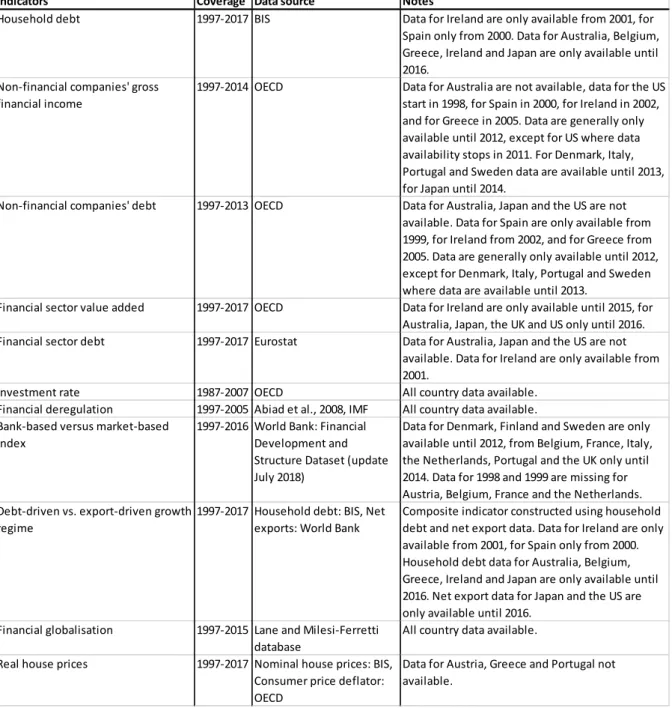
H1: , where is the ranking of a financialisation indicator for sector in country . Sectors are households (HH), non-financial companies (NFC) and the financial sector (FIN). We will accept H1 if statistically significant correlations can be found for at least one financialisation measure across HH, NFC and FIN with each of the two remaining, private-sector aggregates. Due to data availability we only test this hypothesis for the decade before the crisis (1997-2007). Data measuring NFC financialisation is generally only available until 2012 (see table A1 in the appendix), providing us with only half of the necessary observations for most countries for the later time period (2008-2017).
The second hypothesis assesses the link between the investment slowdown observed in many OECD countries since the 1980s and financialisation. Some Marxist authors argue that a slowdown of investment precedes financialisation (Brenner, 2003). Thus, if there is an association between the two, countries with lower growth in investment rates in the decade prior to each of our periods of analysis (i.e. 1987-1997 or 1998-2007) should be the same ones that have high (stock and flow) measures of financialisation for the three sectors in the years running up to the financial crisis (1997-2007) or the decade since (2008-2017).
H2: , where is the inverse ranking of countries based on their average growth rate for capital formation in the preceding decade (1987-1997 or 1998-2007). This means countries with lower growth rates are ranked higher.
In the financialisation debate, an important role in bringing about the phenomenon is assigned to financial deregulation (Copley, 2017). Thus, H3 states that financialisation results from financial deregulation. If the hypothesis is correct the rankings of sectoral financialisation measures should correlate positively with our measure of financial deregulation. The financial reform index is only available until 2005. Hence, we only test this hypothesis for the decade before the crisis (1997-2007). H3 can be formalised as follows:
H3: , where is the ranking of countries based on the financial reform index.
A substantial part of the literature, in particular within the VoC approach, uses financialisation in the sense of a shift to more market-based forms of financial intermediation (Dore, 2008; see also the New Political Economy, 2002 debate). If the distinction between market-based and bank-based financial systems is useful to identify financialised countries, sectoral financialisation should be associated with our market-based/bank-based indicator. This leads to our fourth hypothesis:
H4: , where is the ranking of countries based on the market based/bank based measure.
The recent post-Keynesian literature distinguishes between debt-driven and export-driven demand regimes (Lavoie and Stockhammer 2013; Hein and Mundt 2013). Regulationists have proposed a similar, if analytically less rigorous, distinction (Becker and Jäger, 2012). We investigate whether this distinction is associated with financialisation, testing the
association between a debt-driven demand regime and financialisation measures across economic sectors.
H5: , where is the ranking of countries based on the indicator for debt-driven/export-driven demand regimes that we have constructed.
As discussed in section 2, research on emerging economies, in part based on Minskyan analyses, has argued that financialisation is often caused by the liberalisation of capital accounts allowing for unhindered inflows of financial capital, especially portfolio investment, from abroad (e.g. Arestis and Glickman, 2002; Kaltenbrunner and Painceira, 2018). Thus, we investigate to what extent financialisation positively correlates with financial inflows.
H6: , where is the ranking of countries based on the foreign financial inflow measure.
Finally, we want to explore the Minsky-inspired hypothesis that financialisation is associated with bubbles in asset prices, testing the association between real property prices and sectoral financialisation.
H7: , where is the ranking of countries based on real house price inflation.
To test these hypotheses, we have calculated the correlation among average values for 1997-2007 and 2008-2017, for the five sectoral financialisation indicators and the seven explanatory measures that account for H2-H7. Focusing on the averages for the two periods allows us to study structural changes across these 17 countries, largely abstracting from cyclical movements brought about by business cycles. Distinguishing the two decades before and after the crisis we can pick up on any fundamental changes that might have been brought about by the global financial crisis. The next section discusses our data and methodology.
4. Data and methodology
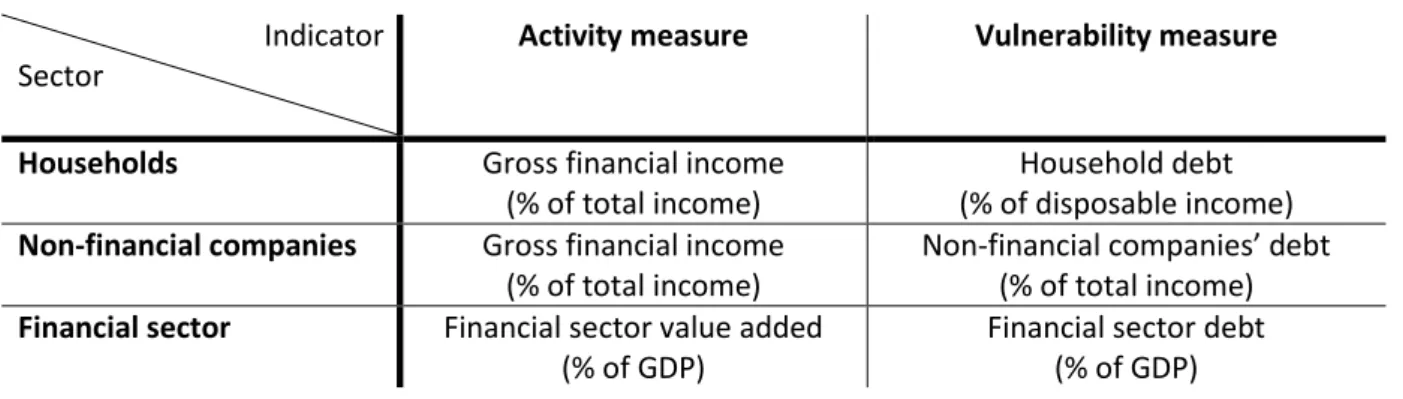
Table 1 below summarises the activity and vulnerability measures of financialisation by economic sector. We distinguish between households, NFCs and financial companies, represented in the rows of Table 1. The second and third columns of the table provide the distinction between activity (flow) measures and financial vulnerability (stock) measures.
Table 1. here
The activity measures suggested are gross financial income of households (as per cent of total income), gross financial income (as share of total income) by NFCs and value added6 as share of GDP for the financial sector. These measures capture the importance of financial activity vis-à-vis real activity. The indicators of financial vulnerability adopted are households’ and NFCs’ debt as share of their income and financial sector debt as share of GDP. The financialisation indicators for the finance sector are expressed as share of GDP (rather than sectoral income) since they capture the financial activity and vulnerability of the entire economy relative to its productive capacity. Data availability constrains the variables that can be compiled. Specifically, data on households’ income stream from their financial operations, which could serve as activity measure for households’ financialisation, is not available for a sufficient number of countries.7 Thus, we are limited to five sectoral financialisation measures, namely household debt, gross financial income of NFCs, NFCs’ debt, financial sector value added as well as financial sector debt.
In order to test the seven hypotheses identified in the literature we use a cross-correlation analysis. The Spearman rank-order correlation has been employed to test the relationship between the different financialisation measures and the explanatory variables across our dataset, which consists of 17 OECD countries (Australia, Austria, Belgium, Denmark, Finland, France, Germany, Greece, Ireland, Italy, Japan, Netherlands, Portugal, Spain, Sweden, the UK and the US).8
The Spearman rank-order correlation test allows us to assess the degree to which a country and its individual economic sectors are financialised relative to other economies in the sample without defining rigid financialisation thresholds. Looking at the relative positions of economies vis-a-vis each other makes sense for the group of OECD countries chosen because as advanced economies they share similar institutions. Since the Spearman test enables us to focus on cross-country comparisons it is a preferred method to, for instance, a panel regression with fixed effects which could assess within-country changes. The Spearman test is a non-parametric test and can, therefore, be used in our small sample of 17 countries. It is a more general test of correlation than alternatives such as Pearson’s correlation index, since normality and linearity are not required (Corder and Foreman, 2014).
The Spearman rank-order correlation analysis requires that the data are in ordinal scale. That is, for each indicator ranks are assigned to the countries in the order from high to low.9 Table
2 exemplifies this ordering for the five financialisation measures. The ranks shown refer to the average level of each measure for the period 1997-2007. Average values are provided in brackets for each country.
Table 2. here
In our sample household debt (displayed in column 2 of Table 2) has been highest in Denmark where it amounted to 253 per cent of households’ disposable income on average for the years 1997-2007. The Scandinavian country is followed by the Netherlands (213 per cent of disposable income) and then three Anglo-Saxon economies: Ireland (173 per cent), Australia (149 per cent) and the UK (127 per cent). Belgium (75 per cent), Italy (59 per cent) and Greece (46 per cent) have the lowest levels of household debt in this group. Similarly, countries have been ranked with respect to the financial income and the debt that their non-financial corporations hold (columns 3 and 4 in Table 2) as well as value added and debt within the financial sector (columns 5 and 6). Data on household debt, NFCs and the financial sector value added are from the OECD. Financial sector debt is from Eurostat. A detailed overview of data sources and coverage is provided in table A.1 in the appendix. If the strong financialisation view (H1) is correct, the different financialisation measures will be highly correlated across all sectors.
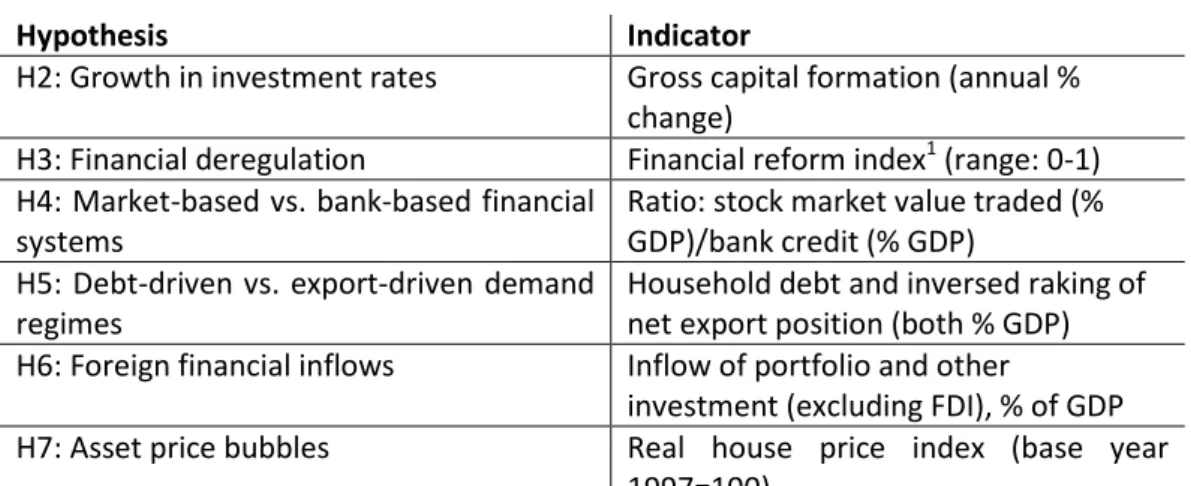
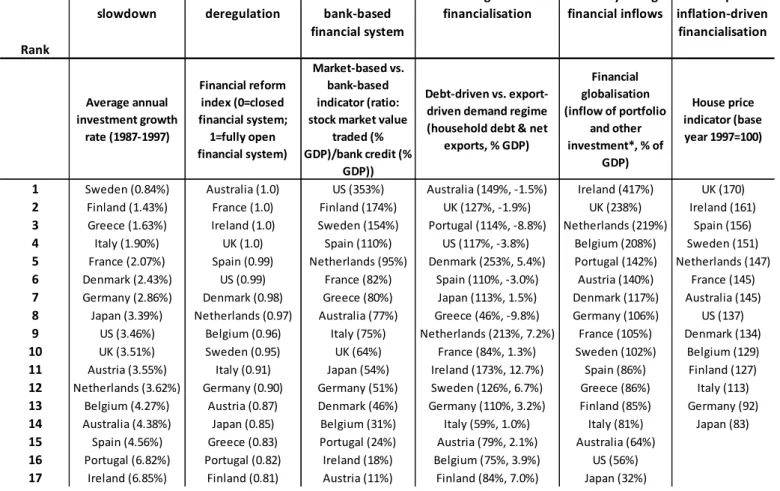
The explanatory factors representing H2-H7 are summarised in Table 3. H2 is captured by the OECD’s measure of annual change in gross capital formation. For H3, a normalised financial reform index obtained from the IMF has been utilised to capture financial deregulation (Abiad, Detragiache, and Tressel, 2008). The higher the index, the more financially deregulated a country with the value 1 assigned to economies that are perceived to be perfectly ‘reformed’ (or completely deregulated). To assess H4, the indicator for market-based/bank-based financial systems has been obtained from the World Bank’s Financial Development and Structure Database. We employ the activity measure, also used by Beck, Demirgüç-Kunt, and Levine (2009), which is the ratio of stock market value traded relative to bank credit as percent of GDP.
Table 3. here
For H5, we have constructed a demand-regime indicator, which is the arithmetic mean of the rank in terms of household debt and its inverse ranking with respect to net exports. Thus, the indicator is an ordinal measure, indicating whether a country possesses a more debt-driven or
a more export-driven demand regime (Hein, 2013). The higher a country is ranked with respect to the indicator, the more debt-driven its demand regime in relation to the other 17 economies in our sample. Foreign financial inflows (for H6) are accounted for in terms of financial capital inflows, namely portfolio and other financial inflows, which have been identified as potentially fragility-inducing in the literature around financial liberalisation of emerging economies. Since foreign direct investment (FDI) tends to be long-term investment and less volatile, it has not been included in this measure. The individual components of the measure have been obtained from the Lane and Ferretti dataset (Lane and Milesi-Ferretti, 2011). Finally, for H7 we utilise real house price indices sourced from the BIS to capture bubbles in residential property.
5. Hypotheses testing and results
Hypothesis 1 posits that financialisation occurs across all three economic sectors concurrently. To test this hypothesis, the Spearman correlation coefficients are calculated for our financialisation measures. If H1 holds, we should see strong positive correlations in financialisation measures across all sectors. Table 4 shows ten correlation coefficients between five sectoral financialisation dimensions. Household debt, our measure for household financialisation, correlates strongly with financialisation indicators for NFCs (with a correlation coefficient of 0.552), and the financial sector, that is the financial sector value added and financial sector debt (with correlation coefficients of 0.549 and 0.657, respectively). Only the activity measure for NFC financialisation is not correlated with household financialisation (0.232) which is in line with criticisms voiced against the limitations of NFCs’ financial income as financialisation measure (see, for instance, Christophers, 2012). However, we cannot detect any correlation between NFC and financial sector financialisation measures. Overall, five out of ten correlations are statistically significant. Given that one would expect some explanatory variables (as tested in H2 to H7) to drive these variables and that we cannot find correlation among financialisation measures for all three sectors, we regard this as low and conclude that the evidence is not supportive of the strong financialisation view.10
The lack of significant association between financialisation measures for the financial sector and NFCs is surprising given the origins of the financialisation research agenda. The early financialisation studies focused on the interaction between financial and corporate sector, be it from the perspective of falling corporate investment rates or rising shareholder value orientation (as reviewed in section 2). Similarly, the VoC literature and its idea of complementarity between financial and productive structures in different types of market economies would suggest a close link between financialisation of NFCs and financial sector financialisation. In contrast, our results suggest that the impact of the financial sector on households’ financialisation seems to be more important since household financialisation is associated with financial sector value added. Overall, the three economic sectors are not moving in lockstep in terms of financialisation, providing evidence for a variegated financialisation view.
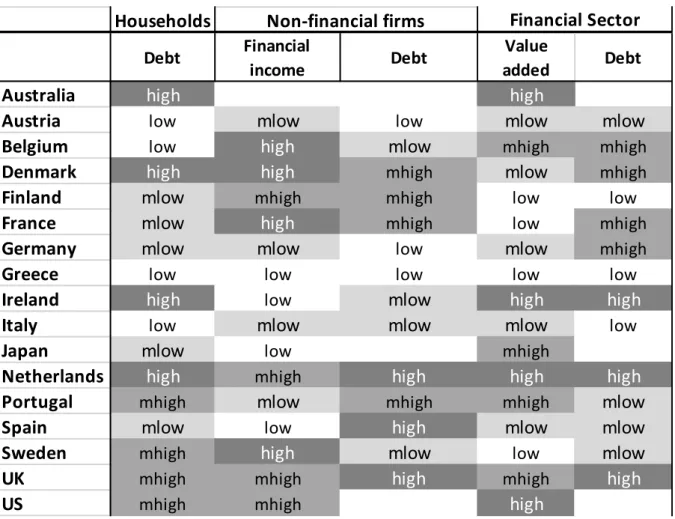
To illustrate this point further Table 5 visualises the rankings of our five sectoral financialisation measures through colour coding. The 17 sample countries are arranged in quartiles with respect to their relative position in the country ranking for each financialisation indicator. We will refer to these as ‘high’ (top quartile), ‘medium high’ (second quartile), ‘medium low’ (third quartile) and ‘low’ (bottom quartile), respectively.11
The quartile labels in the table have been colour-coded, with darker shadings indicating higher levels of financialisation. Strikingly the three Anglo-Saxon countries UK, US, and (where data is available) Australia show signs of financialisation across all three sectors, figuring either high or medium high on all sectoral measures. In contrast, Austria, Greece, and Italy rank low or medium low on our five financialisation measures. However, most countries simultaneously figure high/medium high and low/medium low on at least one of the sectoral financialisation indicators. This means generally we do not find supporting evidence that financialisation has happened simultaneously across all economic sectors. Thus, we reject H1, concluding that financialisation is not a uniform process, but diverges across sectors in different countries. Table 5. here
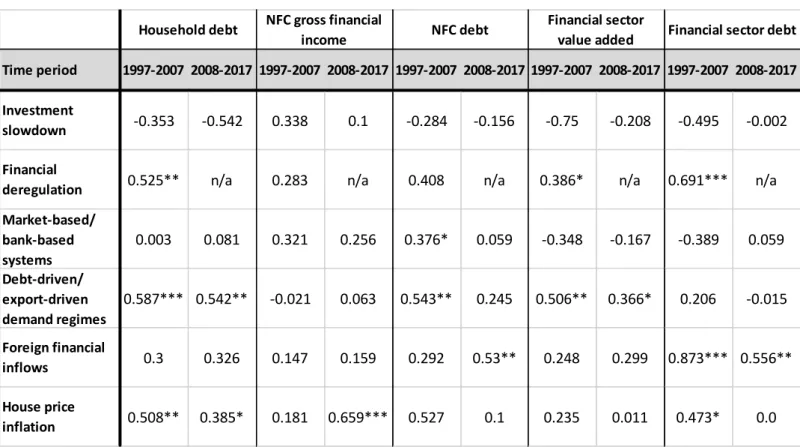
Table 6 reports the correlation between the measures for financialisation hypotheses H2 to H7 and the financialisation by sector for the periods 1997-2007 and 2008-2017. We will refer to the evidence for a hypothesis as supportive if we find two or more statistically significant correlations and as of limited support if we find one statistically significant correlation. For H2, the Marxist investment slowdown hypothesis, we find no statistically significant
correlation. In other words, we cannot detect any effect of a secular investment slowdown onto financialisation. This result holds also for both periods. In contrast, we find that financial deregulation, H3, is positively and statistically significantly correlated with household debt (with a correlation coefficient of 0.525) and both measures of financial sector financialisation (with coefficients of 0.386 for financial sector value added and 0.691 for financial sector debt) for the years 1997-2007. The financialisation measures for NFC do not show significant correlations with the financial deregulation measures (with correlation coefficients of 0.283 for NFC gross financial income and 0.408 for NFC debt). Thus, we find support for H3. Since the financial reform index is only available until 2005, we cannot test H3 for the decade after the global financial crisis.
Table 6. here
We find limited support that the market-based/bank-based indicator captures financialisation trends in the three sectors (H4). Only the correlation with NFC debt (0.386) is statistically significant for the decade before the crisis. In the later period (2008-2017) even this limited evidence supporting H4 disappears. In other words, the shift from bank-based to market-based financial systems at most might affect NFCs, but not other sectors of the economy. If in fact there is an impact at all since the Spearman rank-correlation test for 2008-2017 does not show any statistical significance between H4 and the sectoral financialisation measures. In contrast, the debt-driven/export-driven demand regime measure is positively correlated with financialisation measures across all economic sectors in the run-up to the financial crisis. For instance, household debt associates positively with this explanatory indicator (0.587). This is not surprising since the indicator is constructed using countries’ relative levels of household indebtedness. More importantly, the measure also correlates with NFC debt (0.543), capturing the financialisation of the non-financial corporate sector, and financial sector value added (0.506), our measure of financial activity for financial corporations.12 In the later decade, the growth regime remains significantly correlated with households debt (0.542) and financial sector value added (0.366). But the link between debt-driven growth and NFC financialisation disappears. Overall, we find support for H5 that demand regimes and the degree of financialisation are correlated. This means the demand regime exercises a general effect on the economy where countries characterised by debt-driven demand are likely to be financialised. This result is consistent with our findings under H1. While we could not confirm a uniform financialisation process that converges across sector, we found
that especially household and financial sector financialisation are closely interlinked. This interaction is likely to be produced in a debt-driven demand regime where the growth of the financial sector goes hand in hand with rising household debt, in turn financing consumption. There is evidence that the debt-driven demand regime is interlinked with financialisation across all three private-sector aggregates since H5 is significantly correlated with financialisation measures for households, NFCs and the financial sector for the period before the crisis.
In the run-up to the global financial crisis, measures of foreign financial inflows were not correlated with increasing levels of financial activity or financial vulnerability across the three economic aggregates with the sole exception of financial sector debt. Most of the correlation coefficients are very small (around 0.1-0.2). However, the link between financial inflows and the vulnerability measure for the financial sector (i.e. financial sector debt) is strong, with a correlation of 0.873 (which is statistically significant at the 1 per cent level). Since the crisis a significant link between financial inflows and NFC debt can be detected (0.53). Overall, there is limited support for H6.13 This may be due to our focus on OECD economies whereas H6 has been formulated in the context of emerging and developing economies.
Finally, concerning H7, house price inflation is positively associated with vulnerability measures across all three sectors. This means house price inflation is correlated with household debt (yielding a correlation coefficient of 0.508), NFC debt (0.527) and financial sector debt (0.473) between 1997-2007. Thus, there is strong empirical support for H7. However, when considering the period 2008-2017 the link between house price inflation and financial sector debt disappears, suggesting a decline in financial companies’ enthusiasm to support mortgage extension, fuelling surges in real estate prices after the crisis. Nevertheless, the evidence suggests a strong link between house price inflation and financialisation across the three private-sectors economic aggregates.
6. Summary and conclusion
Financialisation is an empirical phenomenon that has given rise to different theoretical explanations. The paper set out to investigate seven financialisation hypotheses and assesses their explanatory power. We have undertaken a cross-country analysis for 17 OECD
economies for the two time periods 1997-2007 and 2008-2017. To summarise our findings, there is only weak support for the strong financialisation view, i.e. the idea that financialisation converges across the three economic sectors, households, businesses and the financial sector. In particular, surprisingly, the financialisation of businesses and the financial sector do not seem to be correlated. We find no evidence for the Marxist hypothesis that financialisation is preceded by a secular slowdown in investment. This means the prominent Marxist argument that financialisation can be understood as the result of NFCs abandoning productive investment in favour of financial activities because of low profitability (and thus low growth) is not supported in our sample (Brenner, 2003). There is very limited evidence that financialisation can be understood as a shift from a bank-based to a more market-based financial structure as suggested by some financialisation proponents (Lapavitsas, 2009, 2012; Aglietta and Breton, 2010) and the VoC literature (Hall and Soskice, 2001). Hence, the distinction between bank-based and market-based economies (or CMEs and LMEs) as propagated by the VoC literature might be useful when discussing the financialisation of NFC, but not financialisation across the economy more broadly. Equally, there is limited evidence that financial globalisation in the form of foreign financial inflows drives financialisation but it appears to induce financial sector debt and has spread to NFC debt since the crisis.
In contrast, we find that financial deregulation has contributed to financialisation of households and the financial sector and that demand regimes are correlated with financialisation. Hence, debt-driven economies have higher household debt levels and, crucially, also increased NFC indebtedness combined with heightened financial activity (measured in value added) of the financial sector. On the one hand, our results confirm the view that the changes in financial markets that have been under way since the 1980s, particularly deregulation, have importantly contributed to financialisation as argued by Clark (2000) and Toporowski (2000) for pension funds. This also means that the phenomenon of shadow banking, most recently identified as an essential aspect of financial market deregulation, deserves more attention in financialisation research going forward. A debt-driven demand regime also favours financialisation across all three economic sectors. These findings give renewed importance to research efforts that identify varying demand regimes across countries (such as Hein, 2013 and Stockhammer, 2013).
We find correlations between asset price inflation and the financialisation of households, NFC and the financial sector. OECD countries whose housing markets were characterised by
high prices in the run-up to the financial crisis also experienced high household indebtedness as well as high debt among non-financial corporations and financial companies. Thus, there is some evidence that Minsky-type processes are at work when households, NFC and the financial sector get caught up in the financialisation process. But we only find an effect across all three private-sector aggregates, households, NFCs and financial firms, for the first period (1997-2007) while the link between house price inflation and financial sector financialisation severs subsequently (2008-2017). Nevertheless, our findings point towards the crucial relevance of models of financial instability and post-Keynesian models of credit cycles for financialisation research. Hence, our findings suggest that shadow banking, demand regimes and asset price inflation are important aspects to consider in future financialisation research.
Our analysis is a cross-country study of advanced economies for the pre- and post-crisis decade. Its findings may be specific to this sample. This points to three further directions for future research. First, our analysis has focused on differences across countries and should be complemented by an analysis of changes within countries over time. Second, we have focused on two particular time periods, the years before (1997-2007) and after the global financial crisis (2008-2017). This was in part motivated by data availability. Where possible the analysis should be extended to cover earlier decades. We should note that real estate booms in many countries were a specificity of this period and it is fully consistent with our approach if earlier experiences of financialisation differ. Third, the country sample is constrained by data availability. It would be interesting to extend the analysis to include emerging economies and to financial centre city states. For example, we would expect a stronger role of capital inflows in emerging economies.
Our findings suggest that, at least for our sample, some theories of financialisation are more useful than others. Thus, the established working definition of financialisation (Epstein, 2005) appears to have shortcomings. The hypotheses based on post-Keynesian theory (H5 and H7) have received more support than the ones underpinned by Marxist theory (H2) and by VoC theory (H3). We fail to find full support for what we have called the strong financialisation view. In contrast, we propose a variegated financialisation approach: financialisation is not a single process that occurs across all economic sectors simultaneously. Rather sectoral financialisation processes are distinct and relatively independent. They proceed for different reasons and, potentially, with different effects. The financialisation of households, businesses and the financial sector has distinct causes. Moreover, these sectoral
financialisation processes can have effects on the economy as a whole that work in opposite directions. The financialisation of non-financial firms has been found to dampen investment expenditure (Stockhammer, 2004; Orhangazi, 2008; Tori and Onaran 2016), whereas households’ financialisation is likely to increase consumption financed by credit. While the former phenomenon has a negative effect on aggregate demand, the latter has a positive one. The overall macroeconomic result depends therefore on sectoral interactions. For instance, Stockhammer, Durand and List (2016) point out that real estate bubble-driven financialisation in the Anglo-Saxon countries differed from financialisation in southern Europe. Only in the former countries did it come with sharply rising inequality and strong welfare state retrenchment. Our approach suggests that we need theories that allow for variation in financialisation experiences and effects. Nevertheless, there seem to be structural commonalities in rich countries concerning the process of financialisation. Our evidence suggests that financalisation is best understood as a process mainly driven by financial deregulation, debt accumulation and asset price inflation. If our sample is any guide, theories that explain asset price dynamics, the interaction of financialisation and demand regimes, and theories that help to understand the complex impact of financial deregulation on the working of the financial sector are key in furthering the research agenda on financialisation.
References
Abiad, A., Detragiache, E., and Tressel, T. 2008. A new database of financial reforms. International Monetary Fund.
Adrian, T., and Shin, H. S. 2009. The shadow banking system: Implications for financial regulation (Staff Report No. 382). New York, N.Y.: Federal Reserve Bank of New York.
Aglietta, M., and Breton, R. 2001. Financial systems, corporate control and capital accumulation. Economy and Society, 30(4), 433–466.
Akkemik, K.A. and Özen, Ş. 2014. Macroeconomic and institutional determinants of financialisation of non-financial firms: Case study of Turkey. Socio-Economic Review, 12(1), 71-98.
Alvarez, I. 2015. Financialization, non-financial corporations and income inequality: the case of France, Socio-Economic Review, 13(3), 449-75.
Arestis, P., and Glickman, M. 2002. Financial crisis in Southeast Asia: Dispelling illusion the Minskyan way. Cambridge Journal of Economics, 26(2).
Babb, S. 2005. The rise of the new money doctors in Mexico. In G. A. Epstein (Ed.), Financialization and the world economy. Cheltenham, UK ; Northampton, MA: Edward Elgar.
Barba, A., and Pivetti, M. 2008. Rising household debt: Its causes and macroeconomic implications--a long-period analysis. Cambridge Journal of Economics, 33(1), 113– 137.
Barbosa-Filho, N. H. 2005. International liquidity amd growth fluctuations in Brazil. In G. A. Epstein (Ed.), Financialization and the world economy. Cheltenham, UK; Northampton, MA: Edward Elgar.
Beck, T., Demirgüç-Kunt, A., and Levine, R. 2009. Financial institutions and markets across countries and over time data and analysis (Policy Research Working Paper No. 4943). Washington, D. C.: The World Bank.
Becker, J. and Jäger, J. 2012. Integration in Crisis: A regulationist perspective on the interaction of European varieties of capitalist. Competition and Change, 16(3), pp. 169-87.
Becker, J., Jäger, J., Leubolt, B. and Weissenbacher, R. 2010. Peripheral financialization and vulnerability to crisis: A Regulationist perspective. Competition and Change, 14(3-4), 225-47.
Bengtsson, E. and M. Ryner. 2015. The (International) Political Economy of Falling Wage Shares: Situating Working-Class Agency, New Political Economy, 20:3, 406-430. Berglöf, E. 1988. Capital structure as a mechanism of control: A comparison of financial
systems (Discussion Paper No. 48). Cambridge, Massachusetts: Harvard Law School. Bernanke, B. S., Gertler, M., and Gilchrist, S. 1999. The financial accelerator in a quantitative business cycle framework. In J. B. Taylor and Woodford, M. (Eds.), Handbook of macroeconomics, volume 1. Elsevier.
Besedovsky, N. 2017. Financialization as calculative practice: the rise of structured finance and the cultural and calculative transformation of credit rating agencies, Socio-Economic Review, https://doi.org/10.1093/ser/mwx043.
Boyer, R. 2000. Is a finance-led growth regime a viable alternative to Fordism? A preliminary analysis. Economy and Society, 29(1), 111–145.
Brenner, R. 2003. The boom and the bubble: The US in the world economy. London: Verso. Bruff, I. 2011. What about the Elephant in the Room? Varieties of Capitalism, Varieties in
Capitalism, New Political Economy, 16:4, 481-500,
Carrington, J. C., and Edwards, G. T. 1979. Financing industrial investment. London: Macmillan.
Case, K., Shiller, R., and Quigley, J. 2001. Comparing wealth effects: The stock market versus the housing market (No. w8606). Cambridge, MA: National Bureau of Economic Research.
Charles, S. 2008. Teaching Minsky’s financial instability hypothesis: a manageable suggestion. Journal of Post Keynesian Economics 31, 1: 125-38.
Christophers, B. 2012. Anaemic Geographies of Financialisation, New Political Economy, 17:3, 271-291.
Clark, G. L. 2000. Pension fund capitalism. Oxford [England] New York: Oxford University Press.
Clark, G. L., and Wójcik, D. 2007. The geography of finance. Oxford University Press. Copley, J. 2017. Financial Deregulation and the Role of Statecraft: Lessons from Britain’s
1971 Competition and Credit Control Measures, New Political Economy, 22:6, 692-708.
Corbett, J. 1987. International perspectives on finance: evidence from Japan. Oxford Review of Economic Policy, 3(4), 30–55.
Corbett, J., and Jenkinson, T. 1996. The financing of industry, 1970–1989: an international comparison. Journal of the Japanese and International Economies, 10(1), 71–96. Corbett, J., and Jenkinson, T. 1997. How is Investment Financed? A Study of Germany,
Japan, the United Kingdom and the United States. The Manchester School, 65(S), 69– 93.
Corder, G. W. and Foreman, D. I. 2014. Nonparametric statistics: a step-by-step approach (Second edition). Hoboken, New Jersey: Wiley.
Cynamon, B. Z., and Fazzari, S. M. 2008. Household debt in the consumer age: Source of growth--Risk of collapse. Capitalism and Society, 3(2).
Dagdeviren, H., Balasuriya, J., Luz, S., Malik, A. and Haider Shah. 2019. Financialisation, Welfare Retrenchment and Subsistence Debt in Britain, New Political Economy, DOI: 10.1080/13563467.2019.1570102
Davies, L. E. 2016. Identifying the “financialization” of the nonfinancial corporation in the U.S. economy: A decomposition of firm-level balance sheets, Journal of Post Keyensian Economics, 39(1), 115-41.
de Goede, M. 2004. Repoliticising financial risk, Economy and Society, 32(2): 197– 217. Demir, F. 2007. The rise of rentier capitalism and the financialization of real sectors in
developing countries. Review of Radical Political Economics, 39(3), 351–359. Denning, S. 2014, June 3. Why financialization has run amok. Forbes.
Dixon, A, 2012. Function before form: macro-institutional comparison and the geography of finance. Journal of Economic Geography 12 (3): 579-600.
Dore, R. 2008. Financialization of the global economy. Industrial and Corporate Change, 17(6), 1097–112.
Dowling, E. 2017. In the wake of austerity: social impact bonds and the financialisation of the welfare state in Britain, New Political Economy, 22(3), 294-310.
Dymski, G. A. 1999. Asset bubbles and Minsky crises in East Asia: A spatialized Minsky approach (Research Paper Series). Department of Economics, University of California-Riverside.
Engelen, E. and Konings, M. 2010. Financial capitalism resurgent: Comparative institutionalism and the challenges of financialization. In Morgan, G., Campbell, J., Crouch, C., Pedersen, O. K. and R. Whitley (Eds.), The Oxford handbook of comparative institutional analysis, 601–624. Oxford: Oxford University Press.
Epstein, G. A. (Ed.). 2005. Financialization and the world economy. Cheltenham, UK ; Northampton, MA: Edward Elgar.
Evans, T. 2009. Money and finance today. In J. Grahl (Ed.), Global finance and social Europe. Cheltenham, UK : Northampton, MA: Edward Elgar.
Fazzari, S., Ferri, P. and Greenberg, E. 2008. Cash flow, investment, and Keynes–Minsky cycles. Journal of Economic Behavior and Organization 65, 555–572.
Froud, J., Haslam, C., Johal, S., and Williams, K. 2000. Shareholder value and Financialization: consultancy promises, management moves. Economy and Society, 29(1), 80–110.
Gerschenkron, A. 1962. Economic backwardness in historical perspective: a book of essays. Cambridge, Mass.: Belknap Pr.
Girouard, N., Kennedy, M., André, C., and van den Noord, P. 2006. Recent house price developments (OECD Economics Department Working Papers No. 475). Hall, P. A., and Soskice, D. W. (Eds.). 2001. Varieties of capitalism: the institutional foundations of comparative advantage. Oxford [England] ; New York: Oxford University Press. Happer, C. 2017 Financialisation, media and social change, New Political Economy, 22(4),
437-49.
Hein, E. 2011. ’Financialisation, distribution, and growth'. In E. Hein and E. Stockhammer (Eds.), A New Guide to Keynesian Economics and Economic Policies. Edward Elgar. Hellman, T., Murdock, K., and Stiglitz, J. E. 1997. Financial restraint: Toward a new
paradigm. In M. Aoki, H.-K. Kim, and M. Okuno-Fujiwara (Eds.), The role of government in East Asian economic development: Comparative institutional analysis (pp. 163–207). New York, N.Y.: Oxford University Press.
Hudson, M. 2010. The Transition from Industrial Capitalism to a Financialized Bubble Economy. SSRN Electronic Journal.
IMF. 2006. Global financial stability report (No. April). Washington, D. C.: International Monetary Fund.
Jensen, M. C. 1986. Agency costs of free cash flow, corporate finance, and takeovers. The American Economic Review, 76(2), 323–9.
Kaltenbrunner, A. and J. P. Painceira 2018 Subordinated Financial Integration and Financialisation in Emerging Capitalist Economies: The Brazilian Experience, New Political Economy, 23(3), 290-313.Kessler, O., and Wilhelm, B. 2013. Financialization and the three utopias of shadow banking. Competition and Change, 17(3), 248–264.