Construction Traffic Management Plan
PROJECT: FOXGROUND AND BERRY BYPASS CONTRACT No.: 12.2574.3019
CONTROLLED COPY NO: e-copy
DISTRIBUTION LIST OF CONTROLLED COPIES Copy No. Issued to
1 Fulton Hogan Construction Project Director
2 Client – Roads and Maritime Services of NSW Project Authorised Delegate 3 Project Verifier – Hyder/APP Project Verifier’s Director Revised by:
Salar Aga – Quality Manager (Eastern Construction) ___________________________
(Signature/Date)
Reviewed and authorised by: Andrew McRae – Project Director ___________________________ (Signature/Date)
Content ID: 7ZD-CTMP Revision: 3
This is an uncontrolled copy if photocopied or unsigned. Copyright © 2014, Fulton Hogan Ltd. All rights reserved.
Revised: 03-09-14 Page 2 of 100
Document Control
This Plan interfaces with the other associated plans, which together describe the proposed overall project management system for the Project.
The latest revision of this plan is available on the Fulton Hogan server. If any unsigned hard copies of this document are printed, they are valid only on the day of printing.
The revision number is included at the bottom of each page. When revisions occur, the entire document will be issued with the revision number updated accordingly for each owner of a controlled copy.
Attachments/Appendices to this plan are revised independently of this plan.
Revision History
Rev Revised By Reviewed &
Approved By Date Description/Summary of Changes 0 A. Loader A. McRae 02-06-14 Initial issue for approval.
1 S. Aga A. McRae 25-06-14 Revised to adjust minor formatting and to
incorporate the comments received from RMS, PV and the ER. Refer to the comments sheet for details.
2 S. Aga A. McRae 21-07-14 Revised to incorporate further comments received from RMS, Shoalhaven City Council and Kiama Municipal Council. Refer to the comments within the transmittal for details.
3 S. Aga A. Mcrae 03-09-14 Revised to incorporate the comments received from DP&E. Refer to the comments within the transmittal for details.
Content ID: 7ZD-CTMP Revision: 3
This is an uncontrolled copy if photocopied or unsigned. Copyright © 2014, Fulton Hogan Ltd. All rights reserved.
Revised: 03-09-14 Page 3 of 100
Table of Contents
1. Introduction ... 6 Purpose ... 6 1.1. Scope ... 6 1.2. Project Description ... 7 1.3. Background ... 7 1.4. Requirement Matrix ... 7 1.5. Environmental Management Document System ... 71.6. 2. Key Issues ... 8
3. Strategy for the Project ... 11
4. Objectives and Targets ... 12
5. Traffic Management Responsibilities ... 13
6. Time Management ... 17
7. Traffic Staging ... 17
8. Construction Staging for Intersections... 20
9. Traffic Control Plans ... 22
For Works which are Accommodated by Standard TCPs ... 23
9.1. For Works requiring a Non-Standard TCP ... 23
9.2. For Works requiring a VMP ... 24
9.3. Modifications to TCPs and VMPs ... 26
9.4. 10. Key Traffic Management and Safety Issues ... 26
Safety and Amenity of Road Users and the Public ... 26
10.1. 10.1.1. General Road Users and the Public ... 26
10.1.2. Pedestrians ... 27
10.1.3. Cyclists ... 29
10.1.4. Public Transport ... 32
10.1.5. Road and Property Access ... 33
Road Construction Work Adjacent to Traffic ... 34
10.2. Site Security and Site Access ... 34
10.3. Lighting ... 37
10.4. 11. Managing Construction Vehicular Movements ... 37
12. Traffic and Road User Delay Management ... 43
General Protocols ... 43
12.1. For Works requiring a Road Occupancy Licence ... 45
12.2. Periods for Implementation of Road Occupancies ... 46
12.3. Closure of Shoulders or Auxiliary Lances... 47
12.4. Forecast of Proposed Road Occupancies ... 47
12.5. Temporary Speed Zones ... 47
12.6. Speed Limit ... 48
12.7. 12.7.1. Determining the Need for a Roadwork Speed Zone ... 48
12.7.2. Submission of SZA Procedure ... 49
12.7.3. Extensions to SZA Period of Operation ... 49
Traffic Switching Arrangements and Procedure ... 49 12.8.
Content ID: 7ZD-CTMP Revision: 3
This is an uncontrolled copy if photocopied or unsigned. Copyright © 2014, Fulton Hogan Ltd. All rights reserved.
Revised: 03-09-14 Page 4 of 100
12.8.1. General ... 49
12.8.2. Temporary Roadways and Detours ... 51
12.8.3. Opening to Traffic upon Completion... 53
13. Proposed Changes to Traffic Flow Arrangements ... 53
Traffic Flow Arrangements ... 53
13.1. Temporary Works ... 53
13.2. Capacities ... 54
13.3. Facilities on Existing, Local and Regional Roads ... 55
13.4. 13.4.1. Overtaking Lanes ... 55 13.4.2. Rest Areas ... 55 13.4.3. Shoulders ... 55 13.4.4. Parking Areas ... 55 13.4.5. Breakdown Bays ... 55 13.4.6. Other Facilities ... 56 14. Traffic Controllers... 56
15. Plant and Equipment ... 57
16. Traffic Control Devices ... 58
Safety Barriers ... 58
16.1. Temporary Traffic Signals ... 58
16.2. Pavement Marking and Signage ... 58
16.3. 16.3.1. Project Identification, including Signage to Acknowledge Government Funding and Management ... 59
16.3.2. Information, Distance Information and Advance Warning Signage ... 60
16.3.3. Regulatory Signage ... 61
16.3.4. Directional Signage ... 61
16.3.5. Advanced Warning and Notification Signage ... 61
16.3.6. Advertising ... 63
17. Communication and Consultation ... 63
18. Community Involvement... 63
19. Provisions for Special Events ... 65
20. Emergency and Response to Incidents ... 66
21. Notification Requirements to Authorities ... 68
21.1.1. Information to be Reported ... 68
21.1.2. Frequency ... 69
21.1.3. Methods of Reporting... 69
21.1.4. Presentations ... 69
22. Monitoring and Inspections ... 70
23. Maintenance of Roadways ... 71
24. Audits... 72
General Audits ... 72
24.1. Road Safety Audits ... 72
24.2. Audit Frequency and Responsibility ... 72
24.3. Reporting ... 73
24.4. 25. Review and Improvement ... 73
Content ID: 7ZD-CTMP Revision: 3
This is an uncontrolled copy if photocopied or unsigned. Copyright © 2014, Fulton Hogan Ltd. All rights reserved.
Revised: 03-09-14 Page 5 of 100
26. Training and Awareness ... 74
27. Related Standards/Legislations/Regulations/Guidelines/Codes ... 75
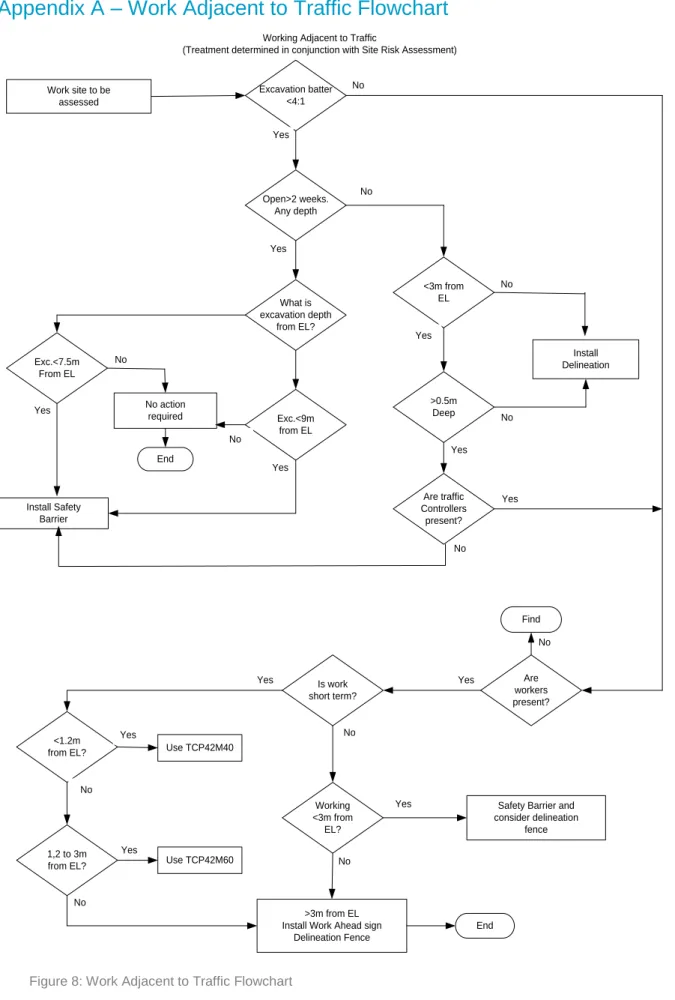
Appendix A – Work Adjacent to Traffic Flowchart... 76
Appendix B – Construction Staging ... 77
Appendix C - Traffic Staging Schedule ... 85
Appendix D – Existing Environment ... 89
Appendix E – Construction Traffic Impacts... 94
Acronyms
CEMP Construction Environmental Management Plan CTMP Construction Traffic Management Plan
DP&E Department of Planning and Environment EWMS Environmental Work Method Statement FBB Foxground to Berry Bypass Project MCoA Minister’s Conditions of Approval RASS Radar Activated Speed Signs RMS Roads and Maritime Services ROL Road Occupancy Licence SoC Statement of Commitments
SWTC Scope of Works and Technical Criteria TCP Traffic Control Plan
TCaWS Traffic Control at Works Sites Manual TMC Transport Management Centre for NSW
TMC-SR RMS’s Southern Region Traffic Operations Unit located in Wollongong TMP Traffic Management Plan
VMP Vehicle Management Plan VMS Variable Message Signs
Content ID: 7ZD-CTMP Revision: 3
This is an uncontrolled copy if photocopied or unsigned. Copyright © 2014, Fulton Hogan Ltd. All rights reserved.
Revised: 03-09-14 Page 6 of 100
1.
Introduction
This Construction Traffic Management Plan (CTMP) describes how Fulton Hogan proposes to safely manage vehicular, cyclists and pedestrian traffic during the design and construction phase of the Foxground and Berry Bypass (FBB) Project, so that project objectives are fully realised.
Fulton Hogan acknowledges the safety of road users and the effective management of traffic is paramount to the successful day-to-day activities during the construction phase of this Project. This CTMP seeks to ensure the certainty of the delivery of the prescribed road user requirements including: provision of a safe environment for workers and the travelling public, and minimising impacts on the road network.
This CTMP covers the RMS’s requirements depicted under Appendixes 21 and 43 of SWTC (Traffic Management and Safety Plan) and is also part of the Construction Environmental Management Plan (CEMP) to address the requirements of the Minister’s Conditions of Approval (MCoA), Roads and Maritime Services of NSW (RMS)’ Statement of Commitments (SoC), the safeguards listed in the FBB Environmental Assessment (EA) and all applicable legislation.
This Plan operates as the master document to a set of site or zone specific Traffic Management Plans (TMP) and their associated Traffic Control Plans (TCP) and Temporary Works Drawings. Together they deal with the safe and effective management of traffic during the design and construction phase of the Project.
This CTMP is applicable to all staff, employees, subcontractors, and any statutory Service Authorities undertaking service relocations throughout the duration of the contract until project completion and its implementation and on-going development will be managed by the senior project team.
Purpose
1.1.
The intended purpose of the CTMP is to describe how Fulton Hogan will implement the work in accordance with the requirements of the Project Deed as well as the requirements of MCoA.
Scope
1.2.
This Plan applies to all parts of the construction of the Works. It does not apply to the maintenance of the road after opening to traffic.
The scope includes:
The provision for the safe movement of vehicular and pedestrian traffic
The protection of workers from passing traffic
The provision for access to properties located within the limits of the works
The design, construction, maintenance and removal of any necessary temporary roadways and detours
The provision of traffic controllers
Content ID: 7ZD-CTMP Revision: 3
This is an uncontrolled copy if photocopied or unsigned. Copyright © 2014, Fulton Hogan Ltd. All rights reserved.
Revised: 03-09-14 Page 7 of 100 It also covers maintenance of the existing road corridor, including the existing road and road shoulder that may be used for the temporary diversion of traffic, over the duration of the works.
Project Description
1.3.
The FBB Project is a Design and Construct (D&C) Project, which involves upgrading the Princes Highway (HW1) from Toolijooa Road to Schofields Lane, 50.66 to 63.72km south of Wollongong, NSW. The aims of the Project are to improve the standard of the highway, eliminate “black spots” and reduce overall travel time in the south coast region. This Project is the second stage of three in the Gerringong to Bomaderry Upgrade Project and the Principal is RMS.
Background
1.4.
The FBB EA (AECOM, 2012) considered the potential traffic impacts during the construction of the Project.
As part of the EA development, a detailed traffic and transport assessment was prepared to address the Secretary requirements issued by the then Department of Planning and Environment (DP&E). The traffic and transport assessment was included in the EA as Volume 2 Appendix D Technical paper: traffic and transport.
Requirement Matrix
1.5.
The requirement matrix that is appended to this plan is developed to assist users and reviewers to identify where various elements of RMS requirements are addressed in this plan in particular to Appendix 21 of SWTC as well as the requirements of MCoA.
Environmental Management Document System
1.6.
The Project Environmental Management document system is described in the CEMP. This plan is part of Fulton Hogan’s environmental management framework for the Project, as described in Section 4.1 of the CEMP. In accordance with the requirements of MCoA B36(a), this Plan has been developed in consultation with Shoalhaven City Council and Kiama Municipal Council (for details refer Section 4).
Management measures identified in this CTMP will be incorporated into the Contractor’s site or activity specific Environmental Work Method Statements (EWMS).
EWMSs will be developed and signed off by environment and management representatives prior to associated works and construction personnel will be required to undertake works in accordance with the identified safeguards.
Used together, the CEMP, sub-plans, strategies, procedures and EWMS form management guides that clearly identify required environmental management actions for reference by Fulton Hogan’s personnel and contractors.
The review and document control processes for this plan are described in Section 10 of the CEMP.
Content ID: 7ZD-CTMP Revision: 3
This is an uncontrolled copy if photocopied or unsigned. Copyright © 2014, Fulton Hogan Ltd. All rights reserved.
Revised: 03-09-14 Page 8 of 100
2.
Key Issues
This CTMP addresses the following Key Issues and Processes identified within the RFT document:
Safety and amenity of road users and the public;
Site security, site access and signage;
Project identification, including advertising and site signage;
Traffic and road user delay and inconvenience management;
Speed limit signage;
Traffic transfer (switch) arrangements and procedures;
Maintenance during Construction;
Traffic and Safety Management Responsibilities;
construction staging including detailing the intersection layout and capacities for each and every construction stage;
Impact of construction traffic on local roads in particular to Sandtrack; and
Emergency and Incident Response Plans.
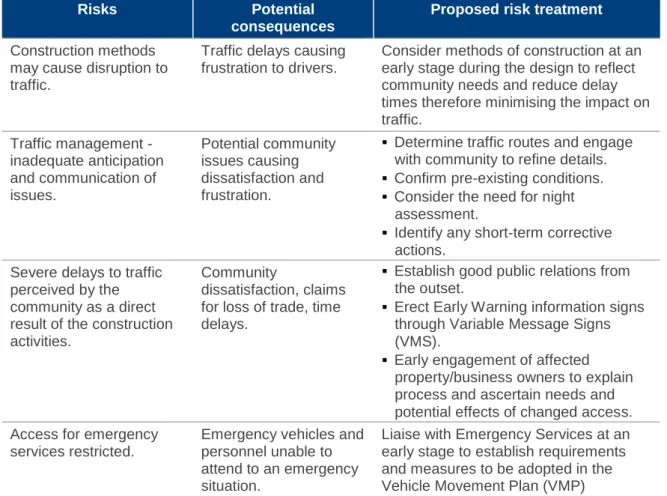
The Table below shows the risks to be dealt with during the design and construction stage of the Project that may affect safety:
Table 1: Key Issues
Risks Potential
consequences
Proposed risk treatment Construction methods
may cause disruption to traffic.
Traffic delays causing frustration to drivers.
Consider methods of construction at an early stage during the design to reflect community needs and reduce delay times therefore minimising the impact on traffic. Traffic management - inadequate anticipation and communication of issues. Potential community issues causing dissatisfaction and frustration.
Determine traffic routes and engage with community to refine details. Confirm pre-existing conditions. Consider the need for night
assessment.
Identify any short-term corrective actions.
Severe delays to traffic perceived by the community as a direct result of the construction activities.
Community
dissatisfaction, claims for loss of trade, time delays.
Establish good public relations from the outset.
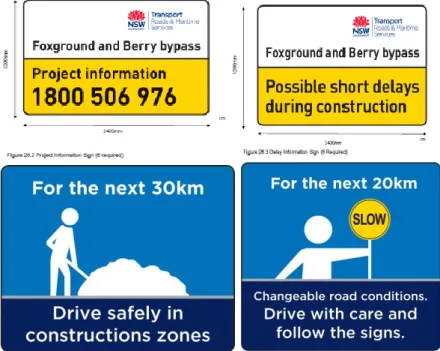
Erect Early Warning information signs through Variable Message Signs (VMS).
Early engagement of affected property/business owners to explain process and ascertain needs and potential effects of changed access. Access for emergency
services restricted.
Emergency vehicles and personnel unable to attend to an emergency situation.
Liaise with Emergency Services at an early stage to establish requirements and measures to be adopted in the Vehicle Movement Plan (VMP)
Content ID: 7ZD-CTMP Revision: 3
This is an uncontrolled copy if photocopied or unsigned. Copyright © 2014, Fulton Hogan Ltd. All rights reserved.
Revised: 03-09-14 Page 9 of 100
Risks Potential
consequences
Proposed risk treatment Local Bus and other
commercial operators.
Impact bus routes, commercial operations, disruption to business causing frustration.
CTMP to be developed with consultation with CCS.
Bus routes to remain unchanged where possible to avoid “changes” due to construction activities.
Changes to be managed by Fulton Hogan Community Manager to ensure co-ordinated approach.
Major Traffic Incident. Local traffic disrupted upsetting locals.
Regular checking of Traffic
Management Plan implementation. Have procedures in place for rapid
recovery, Keep locals informed. Access to site for
deliveries.
Traffic disruption or interference.
Development of this Plan in conjunction with Community Communication Strategy - access points will be high risk locations and will need detailed consideration. Simplification of traffic staging will
simplify access arrangements or minimise impacts.
Signage and pre-delivery notifications for delivery routes to be clear and simple as per the VMP.
Traffic Speed. Works in multiple areas across the Project may result in intermittent speed changes that may frustrate road users.
Traffic to generally be reduced to 80kph speeds within construction zone.
Construction zone to be full length of the Project. CTMP to consider simplifying traffic staging to avoid construction zone impacting on traffic.
Pedestrian access. Potential disruption to progress causing pedestrians to not comply with pedestrian provisions.
Liaise closely with the relevant bodies from an early stage to ensure pedestrian access provisions are adequately addressed, well established and maintained.
Lowering speeds, when it is perceived unnecessary.
Poor public opinion and safety for workers if motorists start ignoring limits.
Appropriate design of traffic protection measures, intersections, alignments etc. to allow consistent speed limits, i.e., 80km/h where-ever possible. Too many changed
configurations.
Unfamiliarity causing potential confusion of road users that may cause traffic incidents.
Keep motorists on existing alignment for as long as possible. Effective use of VMSs for advanced notification and clear direction during any traffic flow adjustments.
Inadequate provisions for break-downs during construction.
Traffic delay. Design temporary break down bays. Consider temporary verges where possible during design of traffic staging.
Content ID: 7ZD-CTMP Revision: 3
This is an uncontrolled copy if photocopied or unsigned. Copyright © 2014, Fulton Hogan Ltd. All rights reserved.
Revised: 03-09-14 Page 10 of 100
Risks Potential
consequences
Proposed risk treatment Public or livestock
entering work-site or Princes Highway. Unauthorised access to site.
Traffic Incident. Provide clear delineation and fencing. Educate community
(farmers/neighbours, of WorkCover requirements etc.). "Neighbours induction". Channel interests through formally organised tours.
Dangerous entry and exits to sites and properties.
Traffic Incident. Ensure that entries and exits are designed to cater for expected traffic volumes and with respect to sight distances, acceleration and deceleration provision and clear advanced warning signage.
Seasonal traffic variations not allowed for
High volumes during holidays and weekends.
Consider seasonal volumes in programming works. Keep RMS informed and up to date. Be aware of reporting and notification requirements. Reduced allowable
movements
Traffic delay, confusion to commuters that may lead to an incident.
Implement effective community
engagement strategies that will consider businesses, property owner’s
requirements. Paddle Power - complying
with cyclists demand for better access and routes during construction including safety measures
Confusion to
Pedestrians and Cyclists that may result in dangerous movements. Community
dissatisfaction.
Engagement of Traffic Steering Groups to liaise with local and regional cycle groups and commuters to ensure provision for cyclists is well addressed and notified to the community.
Damage to local roads due to heavy vehicle movements.
Vehicle damage and potential incidents. Poor community and council relationship.
Allow for heavy vehicle movements in traffic staging and planning to ensure existing, temporary alignment and pavements are suitable during the construction period.
Carry out Road Dilapidation Surveys Impact of construction
traffic on Sandtrack
Increased traffic on the Sandtrack and
excessive damages to the local road
Monitor the road safety on ‘the Sandtrack’ during construction. Implement measures where
reasonable and feasible, in consultation with Kiama Municipal Council and Shoalhaven City Council, should additional road safety issues be identified appropriate road safety Traffic Management Risk Assessment Workshop
Further to the above mentioned key issues, a Traffic Management Risk Assessment Workshop will be conducted prior to the commencement of any traffic management works in accordance with Clause 2.9 of Specification RMS D&C G10. This will identify and address the risks associated with the road safety, traffic management and local network issues specific to the site.
All workshops will be organised and championed by the Traffic Management Steering Group to incorporate all relevant parties to determine best for project outcomes.
Content ID: 7ZD-CTMP Revision: 3
This is an uncontrolled copy if photocopied or unsigned. Copyright © 2014, Fulton Hogan Ltd. All rights reserved.
Revised: 03-09-14 Page 11 of 100 Additional workshops and trainings will be undertaken to train the Project team regarding the implementation of this plan, TCPs and when traffic arrangement issues need to be reinforced or reviewed.
The outcomes of the workshop will be documented in the Project Risk Register that is appended to the Risk Management Plan.
Traffic Management and Mitigation Measures
A range of environmental requirements and control measures are also identified in the EA, Statement of Commitments, Conditions of Approval and other RMS documents. Mitigation and management measures will be implemented to avoid, minimise or manage impacts to traffic. Specific measures and requirements to address impacts on traffic are outlined in the requirements matrix accompanied with this Plan. Further details on the key issues relating to traffic management are provided in this Plan.
The measures have been prepared in accordance with RMS QA Specification G10 - Control of Traffic and Traffic Control at Work Sites Manual (2010).
Impact of Construction’s Heavy Construction Vehicles on Local Roads
The local roads likely to be used by the Project's heavy construction vehicles are identified in the appendixes of this Plan. Road dilapidation reports are required to be prepared for these local roads, and a copy of the report(s) are to be provided to the relevant council (Kiama Municipal Council and Shoalhaven City Council), prior to use by the Project's heavy construction vehicles. Any damage resulting from the use of the identified local roads by the Project's heavy construction vehicles, aside from that resulting from normal wear and tear, will be required to be repaired, unless otherwise agreed by the relevant council.
A road dilapidation report is also required to be prepared for the 'Sandtrack' and a copy of the report is required to be provided to the relevant council (Kiama Municipal Council and Shoalhaven City Council), prior to commencement of construction. Should monitoring in accordance with MCoA B36(a) reveal higher than anticipated volumes of traffic (as defined in the document referred to in Condition A1(b)) resulting in a higher rate of deterioration in the condition of local road infrastructure, consultation with the relevant Council shall be undertaken to determine mitigation measures in accordance with Condition B36(a). A report will be required to be prepared and submitted to the DP&E’s Secretary at 12 months and 24 months after commencement of construction, and prior to operation, unless otherwise agreed by the DP&E’s Secretary.
3.
Strategy for the Project
The roads affected by the construction of the Project vary greatly from the heavily trafficked Princes Highway to infrequently used local roads. However, the requirement remains the same as impacts in both cases must be kept to a minimum
Therefore Fulton Hogan will:
Design the works to ensure the current number of lanes exist at all times and minimise lane closures in both number and duration;
Schedule the works to exclude lane closures during Public Holiday Weekends and School Holidays and minimise closures during daylight hours;
Content ID: 7ZD-CTMP Revision: 3
This is an uncontrolled copy if photocopied or unsigned. Copyright © 2014, Fulton Hogan Ltd. All rights reserved.
Revised: 03-09-14 Page 12 of 100
Schedule the work to minimise the Lane, road occupancy and shoulder closures for tie-ins to existing pavements
Ensure appropriate controls and procedures are implemented during construction activities to address potential traffic impacts along the Project corridor;
Ensure appropriate measures are implemented to address the relevant MCoA and SoC outlined in in the appended requirements matrix, and the safeguards detailed in the EA;
Incorporate traffic control measures for construction vehicle movements and works programs in order to minimise traffic and transport impacts on local roads and the existing highway; and
Ensure appropriate measures are implemented to comply with all relevant legislation and other requirements as described in this Plan.
4.
Objectives and Targets
The project objectives have been developed to align with those of the RMS as documented, including but not limited to, the Project Deed and associated SWTC.
In summary, the key objectives to be adopted by the project team with respect to the CTMP are to:
Keep traffic delays to a minimum;
Minimise disruption to businesses;
Comply with MCoA and RMS’s SoC;
Maintain satisfactory property access;
Minimise disturbance to the environment;
Traffic impacts are within the scope permitted by the Planning Approval;
Ensure the safety of employees, contractors, the general public, Project Verifier (PV) and RMS personnel, pedestrians, cyclists and traffic;
When required, obtain approvals and licenses such as Speed Zoning Authorisations (SZA);
Design temporary roadways and detours in accordance with RMS Road Design Guide, Traffic Control at Worksites Manual and RMS specification D&C G10; and
Meet the requirements of SWTC, project specific Specification RMS D&C G10 Traffic Management, and the RMS Traffic Control at Works Sites Manual (TCaWS).
Progress against the nominated objectives will be continually assessed during the course of the project.
The delivery of the objectives for this project is the responsibility of the Project Director or nominee, as detailed in the Duties and Responsibilities section of this Plan.
The Key Review Areas (KRA) associated with the traffic management is summarised in the following table:
Content ID: 7ZD-CTMP Revision: 3
This is an uncontrolled copy if photocopied or unsigned. Copyright © 2014, Fulton Hogan Ltd. All rights reserved.
Revised: 03-09-14 Page 13 of 100 Table 2: Key Performance Areas
KRA Target KPI
Traffic
Operations No unplanned impact on traffic flow due to works
Average travel times are maintained during peak periods
Provide a safe environment for road users and workers
Ensure impacts on road users are kept to a minimum
Ensure road users and the community are regularly informed about traffic changes
Number of Community complaints
Record of internal and external traffic incidents
Travel time as nominated in schedule 31 of Project Deed
Traffic Scores as nominated in schedule 31 of Project Deed
5.
Traffic Management Responsibilities
The project team is responsible for all construction activities, including the implementation and maintenance of the various temporary traffic management arrangements and have the qualifications depicted under ‘Traffic Controllers’ of this Plan. Fulton Hogan’s initial Project Team organisational structure is appended to the Project Management Plan (PMP) and overall roles and responsibilities are outlined in both PMP and the CEMP. Specific responsibilities for the implementation of construction traffic management are detailed below. In addition, at least one of the site personnel is required to carry an Orange (Design and Inspect) licence for TCP.
Project Director
Ensures the Project’s road safety and traffic management objectives are achieved;
Ensures that all the incidents caused by site activity, and incidents on public roadway that are unrelated to the construction activity are reported to RMS; and
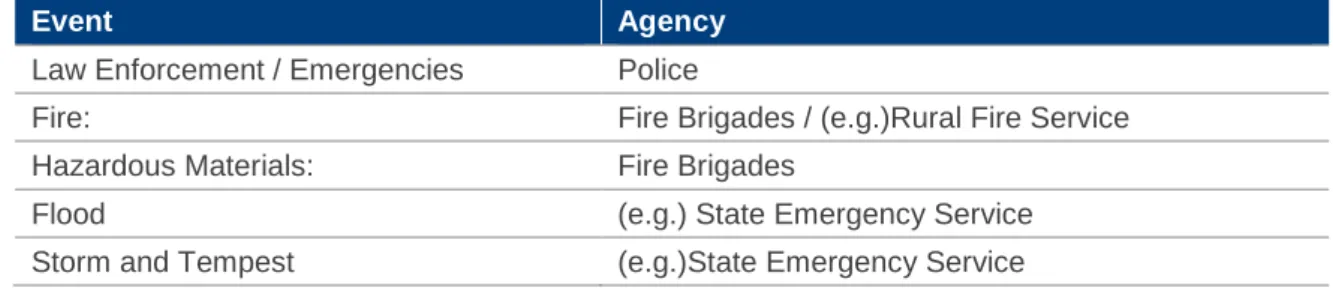
Co-ordinating incidents to RMS Incident Manager for Southern Region and Police.
Project/Construction/Engineering Managers
The Project Managers are responsible for ensuring traffic management:
Is properly planned, organised, directed and controlled;
Is properly resourced with people, equipment, facilities and systems;
Meets the requirements of the contract including the Project Deed, SWTC and RMS Specifications D&C G10;
Complies with all other legislation; and
Content ID: 7ZD-CTMP Revision: 3
This is an uncontrolled copy if photocopied or unsigned. Copyright © 2014, Fulton Hogan Ltd. All rights reserved.
Revised: 03-09-14 Page 14 of 100 Project Superintendents
Co-ordinates the field resources;
Supports the delivery of the road safety and traffic management objectives;
Assists with the implementation of the CTMP
Provides direction and support to enable effective planning of temporary traffic management arrangements;
Ensures all field team members receive the appropriate training; and
Managing all Emergency Controls as depicted in Incidents and Emergency Response Plan.
Traffic Manager
The nominated Traffic Manager will be required to have, as a minimum, RMS’ Select/Modify Traffic Control Plan (Red Card) qualifications and will be required to have the delegated authority from, and responsibility to, the Project Managers for continuously monitoring the implementation and operation of all road occupancies to ensure that they are compliant with the ROLs, TCPs, VMPs, etc., including, but not limited to:
Monitoring and quantifying the durations of delays to the free flow of traffic;
Monitoring, measuring and recording traffic queue lengths, including the maximum traffic queue lengths in each direction and the total occupancy or stoppage time;
Maintaining and adjusting traffic control measures and devices to assist prevailing traffic flows, minimise lane and shoulder occupancies and any lost traffic flow capacity and minimise traffic flow delay durations and queuing;
Monitoring of over-dimension heavy vehicle movements;
Prepare and keep records of all road occupancies and records of all traffic flow delays and durations, traffic queue lengths and other ROL related matters and submit a report including copies of those records to RMS by 9.00am on the Thursday following the week being recorded;
The selection of any Traffic Control subcontractors;
Ensuring that processes and control systems needed are established, implemented and maintained;
Approving TCPs (where required) for individual tasks including those of subcontractors;
Arranging and approving training;
Ensuring that the requirements of all the plans are properly implemented;
Regularly reviewing the continuing suitability, adequacy, and effectiveness, of all the plans;
Preparing and submitting Hold Point Forms, SZAs, applications and Directions to Restrict applications 10 working days before the works are scheduled to begin;
Allocation of all resources required for the implementation of all the plans;
Ensuring that control measures are maintained and that work-in-progress is inspected
Content ID: 7ZD-CTMP Revision: 3
This is an uncontrolled copy if photocopied or unsigned. Copyright © 2014, Fulton Hogan Ltd. All rights reserved.
Revised: 03-09-14 Page 15 of 100
Identifying training needs and arranging for employees and subcontractors to attend the training;
Ensuring subcontractors/suppliers have suitable qualifications and experience;
Carrying out and recording weekly inspections and verifications to demonstrate compliance;
Facilitating traffic awareness and giving toolbox talks to the site; and
Reporting traffic incidents to the Project Director.
The Traffic Manager (or the delegates in his absence) will be contactable at all times (7 days per week and 24 hrs. per day) during the construction phase of the works to receive and answer traffic/incident related inquiries from RMS and the Police. Site Emergency contact list shall be located in the Fulton Hogan Incident and Emergency Response Plan that will be displayed in the site office and the crib room. Refer to the Incident and Emergency Response Plan for details concerning the managing of incidents and emergencies on the project.
The Traffic manager will have the authority to stop work on any activity if it is considered to be necessary to prevent traffic incidents, or to comply with the directions of RMS or Police.
Traffic Coordinator
The Traffic Engineer will be required to be qualified to the “Traffic Control Worksite Manual” course (i.e. holds a current Select /Modify Traffic Control Plans) and will have delegated authority from, and responsibility to, the Traffic Manager for:
Implementing the Traffic Management Plan and the TCPs on site
Maintaining the TCPs
Assessing and monitoring subcontractor’s capabilities and performance in respect of site activities
Ensuring the safe passage of traffic at all times
Ensuring everyone on site is inducted and wears the appropriate approved clothing
Driving through the site to inspect the traffic control layout, recording any deficiencies and the action taken to rectify them
Report incident including public roadway that are unrelated to the construction activity, near misses to Traffic Manager/ WHS Manager.
Engineers Responsible for the Work Activity
Assist in the delivery of the road safety and traffic management objectives outlined in the Plan;
Plan all work activities and identify the required traffic management arrangements to facilitate the works;
Liaise with the Traffic Crews in the planning and implementation of the required traffic management arrangements;
Content ID: 7ZD-CTMP Revision: 3
This is an uncontrolled copy if photocopied or unsigned. Copyright © 2014, Fulton Hogan Ltd. All rights reserved.
Revised: 03-09-14 Page 16 of 100
Conduct regular inspections (including pre-starts) of traffic controls and VMPs and, where necessary, instruct the rectification of deficiencies;
Allocate plant, equipment and human resources for the works including the provision of the temporary traffic control arrangements; and
Conduct and keep records of daily and weekly (day and night) inspections of the traffic control arrangements, assist audits and, where necessary, rectify deficiencies.
Foreman
Ensure compliance to the approved TCPs;
Issues the required TCPs and, where relevant, road occupancy approvals and speed zone authorisations to the traffic control crew / or subcontractor;
Ensures adequate plant, equipment and human resources are made available for the installation and maintenance of temporary control devices;
Conducts pre-start inspections and regular night / weekly inspections of traffic control arrangements, and ensure all deficiencies are rectified;
Assist with the implementation of mitigation measures to address unsafe road conditions, and unusual traffic congestion;
Assist with the management of unplanned incidents, providing initial response to make the site safe; and
Records unplanned incident details, and when traffic controls are in operation, including the installation and removal of regulatory signage.
Functional Personnel
Functional personnel provide support for all construction activities and their traffic management related responsibilities are described above; and
WHS team is responsible for managing haulage routes in compliance with WHS Management Plan.
Community Relations Manager
Liaises with the community for all aspects of community and stakeholder issues;
Represents the Project for all community and stakeholders issues;
Conducts consultation with stakeholders for traffic planning, and provides an on-going liaison role;
Prepares and distributes changed traffic condition information to the community; and
Content ID: 7ZD-CTMP Revision: 3
This is an uncontrolled copy if photocopied or unsigned. Copyright © 2014, Fulton Hogan Ltd. All rights reserved.
Revised: 03-09-14 Page 17 of 100
6.
Time Management
Fulton Hogan aims to meet its time related obligations. Among them are:
Submitting CTMP 60 days from date of the Project Deed or 4 weeks prior to the proposed commencement date for construction which affects traffic conditions;
Submitting TCPs and VMPs at least 10 business days prior to its proposed use;
Submitting ROLs at least 10 business days prior to its proposed use;
Notifying a day prior to opening temporary roadways and detours to traffic;
Allowing 2 days after opening a temporary roadways or detour to traffic prior to disturbing sections of the existing roadway being placed to provide for the event where failure of the temporary roadway or detour occurs and there is a need to direct traffic back onto the existing roadway;
Conduct a Road Safety Audit within 24 hours of or opening temporary roadways or detours.
Submitting Road Safety Audit Reports within 7 days of implementation of the TCPs;
Notifying emergency services and relevant sections of the community and transport industry of work which results in significant traffic disruption. Provide to the RMS a draft of an appropriate advertisement 3 weeks before the proposed placement of the advertisement;
Notifying residents and businesses affected by disruption to property access or by night works in built-up areas. A letter will:
o be “letter-box-dropped” at least three Business Days before the proposed date
o detail the dates and times of the proposed access restrictions and contact details
Performing work and Services only in the times permitted; and
Lodging early as possible (at worst no less than 10 Business Days before the work) a road occupancy application. Noting, however, the exemptions for emergencies and hazards;
The above mentioned community notification is required to be done in accordance to the Community Communications Strategy (CCS).
7.
Traffic Staging
Traffic Management and Safety issues on FBB are diverse as the area incorporates varied traffic flow arrangements and capacities through rural and urban environments in particular to construction heavy vehicle traffic impacts depicted under appendix E of this Plan.
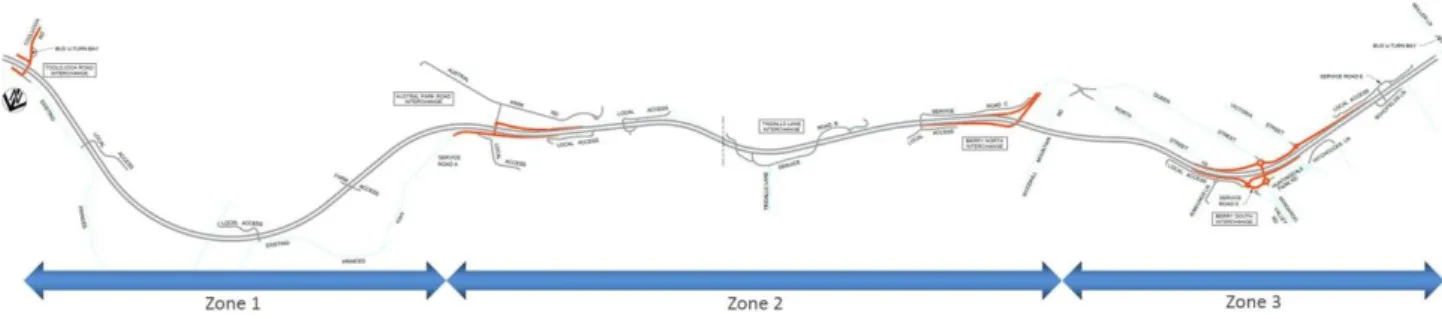
The Project has been divided into three zones, each of which has typical and also specific issues due to:
The type of works required in relation to the proximity of the existing highway;
The vicinity of local residents / business;
Content ID: 7ZD-CTMP Revision: 3
This is an uncontrolled copy if photocopied or unsigned. Copyright © 2014, Fulton Hogan Ltd. All rights reserved.
Revised: 03-09-14 Page 18 of 100
Flows in and around each area.
Figure 1: Construction zones – for Illustration purposes only, refer to construction staging design package for details
The details of each zone are summarised in Appendixes B and C of this Plan. Staging Strategy
Initial traffic staging plans (series TS-01) submitted during the tender stage of FBB project will be further developed and issued as part of the design packages. These indicate the general staging methodology across the Project, detailing the location and timing of construction works in any given stage. These plans also show traffic flow locations and any temporary pavement works required to ensure sufficient separation is achieved between construction areas and live traffic.
These Traffic Staging Plans will be revised/prepared in accordance with clause 2.6 of Specification RMS D&C G10 and there will be a series of TCP to be implemented that are associated with each Traffic Staging Plan in order to safely progress each stage of the works as outlined in this Plan.
For each zone of the FBB Project, safety will be considered based on the specific nature of the works in particular to the risks associated to existing environment under appendix D of this Plan, the impacts of construction vehicular traffic depicted under appendix E of this plan and the general vehicle movements for construction sites and site compounds as depicted under section 9.3 of this Plan. Fulton Hogan will provide the skills and resources required to minimise the overall effect of the works on road users and the public to keep safety at front of mind. This will be done through strategic planning and implementation of sound construction and staging techniques that will always consider the impact and safety of road users and the public.
Measures that Fulton Hogan will use to deliver public safety include:
Providing separation between the public and the works. This is a key element to providing safety to road users and the construction team. This will be done through the use of barriers, haul roads, side tracks, staging works and roadside furniture such as approved safety barriers to provide sufficient separation and safety measures to minimise the impact of the works. Predominant methods in each specific zone include:
o Zone 1 - Separation will be achieved through implementing an effective internal haul road system, including temporary creek crossings, in the Broughton Creek flood plain, south of Toolijooa Ridge. This will facilitate earthworks operations and construction of the underpasses in this zone. The
Content ID: 7ZD-CTMP Revision: 3
This is an uncontrolled copy if photocopied or unsigned. Copyright © 2014, Fulton Hogan Ltd. All rights reserved.
Revised: 03-09-14 Page 19 of 100 on-site haul road will largely eliminate earthworks construction vehicles from the existing road network;
o Zone 2 - Separation will be achieved through a number off side tracks and temporary widening of the existing highway to allow construction of the northbound carriageway to minimise disruption to traffic. Once this is completed, traffic will be switched onto the new northbound carriageway, in contraflow, and the southbound portion of the works will be completed; and
o Zone 3 - The critical areas are around the Kangaroo Valley Interchange where a temporary pavement will be constructed around the works catering for vehicular, cyclist and pedestrian access. Temporary pavement widening around the Schofields Lane Interchange will be constructed in order to shift traffic and construct the main alignment through contraflow.
Implementing specific traffic management measures only where absolutely necessary to reduce traffic speed, volumes and alignment to provide safety to both construction crews and the public;
Limiting the working hours of works that could pose substantial impact on road users and the public;
Minimising disruption during peak traffic periods, public holiday weekends and school holidays by limiting the extent of traffic management undertaken during these times;
Providing and maintaining public access to affected properties, farms and agricultural crossings/tracks, and recreational areas such as Broughton Creek. VMPs will be developed for specific areas that require work access restrictions to maintain public access. Fulton Hogan’s community team will be overall responsible for discussions with these affected parties to determine what measures will be put in place;
Design the works to minimise the number of construction site entry and exit points and provide traffic control to avoid traffic conflicts and minimise delays;
Implementation of visual barriers to reduce potential distraction of road users;
Community consultation and notification to keep road users and the public up to date regarding traffic management measures or restrictions; and
Avoid the hazardous movements as depicted under Managing Construction Vehicular Movements of this Plan.
Construction Traffic Routes
Proposed traffic routes for construction vehicles during construction taking into account the the impacts of construction traffic depicted under appendix E of this plan will vary during the life of the Project. As haul roads become established, usage of the existing highway by heavy vehicles will be reduced across the alignment pending the position of site access locations across each stage of the Project.
Delivery of materials and plant are expected to come from both north and south of the project extents. These heavy vehicle movements will make their way to the safest access gate location depending on their direction of travel and the respective delivery location. Access gate locations will be provided in locations that will provide the least disruption to road users and safe entry/exit movements.
Content ID: 7ZD-CTMP Revision: 3
This is an uncontrolled copy if photocopied or unsigned. Copyright © 2014, Fulton Hogan Ltd. All rights reserved.
Revised: 03-09-14 Page 20 of 100 Haul of material generated by earthworks during construction, including movements to and from processing areas, will be predominantly internal haul movements which will not disrupt the Princes Highway.
Where feasible, plan for using the cleared footprint adjacent to the Princes Highway along the section to be duplicated for construction traffic to minimise use of the existing road network by construction traffic.
Expected traffic volumes are addressed in the tables of Appendix-D of this Plan.
8.
Construction Staging for Intersections
The Construction Staging for Intersections summarised in the appendix B and C of this Plan has been developed primarily based on the limitations inherent in the alignment design. Where potential options existed for staging of traffic, the following was considered in determining the preferred staging arrangements:
Alignment, i.e. the relationship of in plan location of both the northbound and southbound carriageways to plan location of the existing pavement.
Alignment i.e. the relationship in elevation at locations where traffic was planned to deviate from an existing pavement to a newly constructed pavement or vice versa.
Location of services and potential relocation requirements
Construction program
Requirements for temporary works
This staging design will be further developed to ensure that it provides a safe environment for our workforce, the travelling public including cyclists and pedestrians during all stages of construction. This development will take into account the existence of established community provisions, such as public transport arrangements and any other requirements that are identified during the design and community consultation processes.
Fulton Hogan fully appreciates the complexity and sensitivity of any traffic management provision to the local residents and businesses, particularly at Croziers Rd and Jaspers Brush. The strategy and subsequent refinement of the traffic management plan will consider and address all matters concerning safety, risk, time delay and conversely the opportunity of early delivery of parts of the works to the benefit of road users.
Fulton Hogan have adopted the less disruptive construction staging and methodology at intersections by utilising temporary pavement extensively in order to minimise the number of traffic switches and ultimately providing the most cost effective and simple staging solution.
Intersection Layouts and Capacities
The intersection layouts and capacities at intersections will be derived by the requirements of each construction stage of the Project. Staging at intersections incorporates temporary and permanent traffic switches to provide access for works required during each respective stage. These traffic switches will be at existing and new intersections at various times during the Project.
Content ID: 7ZD-CTMP Revision: 3
This is an uncontrolled copy if photocopied or unsigned. Copyright © 2014, Fulton Hogan Ltd. All rights reserved.
Revised: 03-09-14 Page 21 of 100 A summary of each intersection and its respective staging elements is Appendix-B of this Plan.
Intersections, in both temporary and permanent states, will be designed to ensure that capacities at each respective intersection will maintained as a minimum at the levels that existed at the original intersection prior to the commencement of construction, in accordance with the SWTC.
Preliminary traffic capacity analysis indicates the 100th highest hourly traffic volume (100HHV) for the opening year, 2017, on this section of the Princes Highway would be approximately 1091 vehicles/hour in each travel direction.
This is based on Table 9.10 of SWTC, Appendix 9, which indicates the future main carriageways would carry approximatly16, 789 vehicles per day south of Berry in the opening year. Assuming a 50/50 directional split. There would be 8395 vehicles/day on each carriageway. Under the 100HHV conditions (i.e. 13% of the daily traffic volume), there would be approximately 1091 vehicles/hour in each direction.
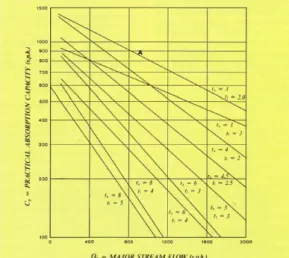
The Figure below indicates that for a minimum gap (ta) requirement of 3 seconds, and a major stream flow of 1091 vehicle/hour/direction, the travel lanes would have capacity to absorb an additional 800 vehicles/hour. This is shown by point A in the following Figure. These results indicate there will be ample spare capacity at temporary gates and intersections to absorb local traffic and construction vehicles. If for any reason this is not practical, then the a minimum gap (ta) requirement of 5 seconds will be considered.
Figure 2: Practical Absorption Capacity for Major Streams at Un-signalised Intersections
The worst case movement at the temporary at-grade intersections is likely to be the right turn movement from side roads onto the Princes Highway. During detailed design, right and left turning traffic may be separated to maximise the intersection performance.
Minimum Design Standards
Fulton Hogan will design both temporary and permanent intersections in accordance with the following as a minimum:
Content ID: 7ZD-CTMP Revision: 3
This is an uncontrolled copy if photocopied or unsigned. Copyright © 2014, Fulton Hogan Ltd. All rights reserved.
Revised: 03-09-14 Page 22 of 100
RMS Road Design Guide in accordance with RMS Specification G10.
Lighting Requirements at Intersections
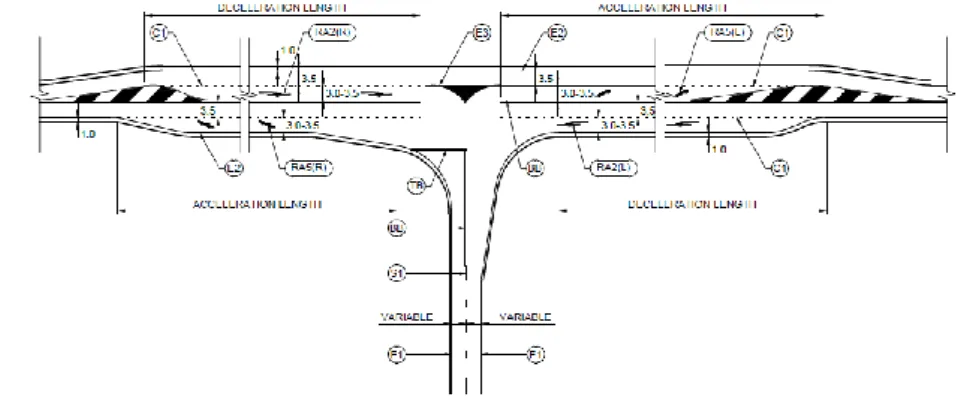
Permanent lighting at intersections has been assessed in accordance with Clause 5.19 of the SWTC. Based on this, intersections that will incorporate permanent design lighting are as follows:
Berry South Interchange
Roundabout at Kangaroo Valley Road / Queen Street; and
Roundabout at Kangaroo Valley Road / Hitchcock’s Lane;
Roundabout at Rawlings Lane / Northbound Entry and Exit Ramps;
Roundabout at Queen Street / Victoria Street / Southbound Entry Ramp;
Roundabout at Woodhill Mountain Road / North Street / Princes Highway;
Intersection of Toolijooa Road and the Northbound Entry Ramp;
Intersection of Toolijooa Road and the Southbound Exit Ramp; and
Intersection of Austral Park Road and the Northbound Entry Ramp / Service Road.
Generally existing lighting will be maintained until new lighting is installed and commissioned at each respective intersection; however where this is not possible or appropriate temporary lighting will be provided. During further development of traffic staging during Detailed Design, specific staging arrangements for each intersection will be developed which will provide substantial detail regarding lighting staging and will include:
Sequencing of construction activities at the intersection;
Details of traffic management requirements and techniques;
Timing of new lighting installation during staging;
Timing of commissioning new lighting;
Any temporary lighting that may be required during staging; and
Any potential impacts on traffic and the community.
9.
Traffic Control Plans
Fulton Hogan will implement approved Traffic Control measures for any works which disrupt free traffic movement in road related areas such as highway, local roads, car parks, driveways, pedestrian accesses/ facilities etc.
These measures will include Traffic Control Plans (TCP) and Vehicle Movement Plans (VMP) as required and will encompass vehicle movement and pedestrian movement for both construction resources and the general public. Any property accesses affected by the construction activities will also be identified on the TCPs.
Content ID: 7ZD-CTMP Revision: 3
This is an uncontrolled copy if photocopied or unsigned. Copyright © 2014, Fulton Hogan Ltd. All rights reserved.
Revised: 03-09-14 Page 23 of 100 TCPs for any activity associated with the Works, including the use of temporary warning signs, will be required to be developed on the basis of the following documents and in the order of hierarchy listed below:
1. RMS D&C G10
2. RMS Traffic Control at Worksites Manual
3. AS 1742.3 - 2002 "Traffic Control Devices for Works on Roads" 4. Construction Traffic Management Plan
TCPs must not be hand drawn and all text, dimensions and symbols must be clear and legible to the naked eye.
Property accesses, side roads and any special features affecting position of signs and devices must be shown on TCPs, as required.
TCPs must be designed and implemented to allow for and accommodate the passage of over-dimension heavy vehicles through all the road occupancies. The project team is required to liaise with the RMS to establish communication protocols for the passage of over-dimension heavy vehicles through all road occupancies.
For all planned and scheduled maintenance and other works under the contract; Fulton Hogan will prepare Traffic Control Plans as follows:
For Works which are Accommodated by Standard TCPs
9.1.
Fulton Hogan will use the standard TCPs that have been extracted from TCaWS. The standard TCPs will be examined for suitability; approved and signed by Traffic Manager or delegate, who holds the “Traffic Control Worksite Planning” qualification (i.e. holds a current RMS’s Select/Modify Traffic Control Plans, the Red Card).
Fulton Hogan will not begin any works which will involve any obstruction to traffic until these TCP’s have been approved by the RMS.
A Hold Point release will be submitted by Fulton Hogan in accordance with Clause 2.8.3 of Specification D&C G10 as follows:
Table 3: Hold Points – Standard TCP Hold Point
Process Held: Works which would involve any obstruction to traffic Submission Details TCP as described above.
Release of Hold Point: The RMS’s approval of standard TCPs.
For Works requiring a Non-Standard TCP
9.2.
Non-Standard TCPs will be drawn and signed off by the Traffic Manager or a person employed by Fulton Hogan or engaged as a subcontractor. The person designing/drawing the TCPs must be qualified in the RMS “Design and Audit Traffic Control Plans” course (i.e. holds a current RMS’s Design & Inspect Traffic Control Plans,
Content ID: 7ZD-CTMP Revision: 3
This is an uncontrolled copy if photocopied or unsigned. Copyright © 2014, Fulton Hogan Ltd. All rights reserved.
Revised: 03-09-14 Page 24 of 100 the Orange Card) and is experienced in the design and implementation of traffic management plans.
Work will not begin until the RMS has approved the non-standard TCP.
A hold point release form will be submitted by Fulton Hogan in accordance with Clause 2.8.3 of Specification D&C G10.
Table 4: Hold Points – Non-Standard TCP Hold Point
Process Held: Works requiring a non-standard TCP. Submission Details Non-standard TCP as described above
Release of Hold Point: The RMS’s approval of Fulton Hogan’s non-standard TCP
For Works requiring a VMP
9.3.
Vehicle Movement Plans (VMPs) will be developed to provide for traffic associated with the Works such as trucks delivering materials and equipment and work supervisors’ vehicles, to safely manoeuvre into and out of traffic streams, and turn at work areas, stockpile sites, local roads and turn around. VMP/s will also reflect the parking, turning areas and vehicle entry and exit points to the worksite and indicate clearly that these are the only points where interface with the road traffic is permitted.
VMPs may be prepared integrating into Traffic Staging Plans and Construction Staging Plans reflecting the work activity so that the intended purpose and objectives in the plan are met.
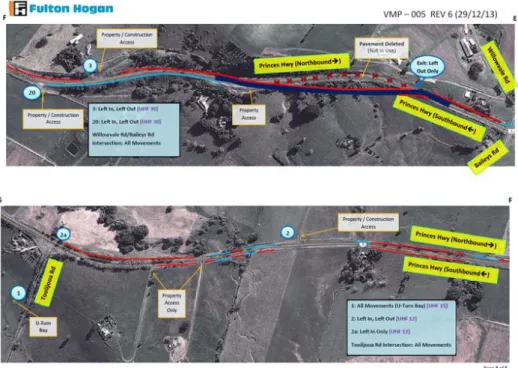
The VMPs will be updated throughout the Project. An example of the VMP from another project is provided below. The format of the VMP allows it to be easily understood for all that require information regarding site access. For example, if one were to require access into gate 19, a quick reference notes that this is a southbound, left in, left out access and to utilise UHF30 for entry contact. This VMP will be issued to the project team and as an instruction to all suppliers to ensure compliance by delivery drivers. Included in the VMP is a list of delivery protocols and contact details to ensure that all vehicle movements in and out of site are managed consistently and do not compromise the safety of the road user.
Content ID: 7ZD-CTMP Revision: 3
This is an uncontrolled copy if photocopied or unsigned. Copyright © 2014, Fulton Hogan Ltd. All rights reserved.
Revised: 03-09-14 Page 25 of 100 Figure 3: Sample VMP
VMPs will be prepared by a person who has qualified in the RMS “Design and Audit Traffic Control Plans” course (i.e. holds a current RMS’s Design & Inspect Traffic Control Plans) and is experienced in the design and implementation of traffic management plans.
Another Person with similar qualification should review and sign off the final VMP (i.e. VMPs should not be prepared and signed off by the same person).
VMPs are to allow for safe management of pedestrians, including the workforce via means of separation and segregation in particular in the areas where heavy vehicles operate as depicted under Key Traffic Management and Safety Issues section below. This will be a risk based approach and an example of the risk treatments options could be installing water filled barriers, safety barriers, witch’s hats, flagging or other treatments identified in the risk assessment to delineate the workers from plant giving the workers a reminder that heavy plant are nearby, or the treatments depicted under relevant Fulton Hogan procedures and site rules where workers are not allowed to approach the plant within (15/30 meters no-go zone) prior to making an eye contact with the relevant operator.
Considerations will also be given for displaying VMP information at access gates and site display boards and at appropriate heights for the drivers to view.
Work will not begin until the RMS has approved the VMP.
A Hold Point release form will be submitted by Fulton Hogan in accordance with Clause 2.8.3 of Specification D&C G10.
Content ID: 7ZD-CTMP Revision: 3
This is an uncontrolled copy if photocopied or unsigned. Copyright © 2014, Fulton Hogan Ltd. All rights reserved.
Revised: 03-09-14 Page 26 of 100 Hold Point
Process Held: Works requiring a VMP. Submission Details VMP as described above.
Release of Hold Point: The RMS’s approval of Fulton Hogan’s VMP.
Modifications to TCPs and VMPs
9.4.
Traffic control plans shall be regularly reviewed for their effectiveness, and shall be amended and recorded in traffic control register with revision and approval date:
As and when deemed necessary to maintain or improve safety of the public and construction activities; including both vehicular and pedestrian movements;
When there are programmed changes to the construction activities that will affect traffic movements on public roads; and
When existing traffic control measures are required to be amended to improve traffic flow or to minimise the impact of construction traffic on road users.
Any modifications to approved TCPs and VMPs will require RMS approval through Hold Point approval process.
10.
Key Traffic Management and Safety Issues
Safety and Amenity of Road Users and the Public
10.1.
10.1.1. General Road Users and the Public
For each zone of the Project, safety will be considered based on the specific nature of the works. Fulton Hogan will provide the skills and resources required to minimise the overall effect of the works on road users and the public to keep safety at front of mind. This will be done through strategic planning and implementation of sound construction techniques that will always consider the impact and safety of road users and the public. Measures that Fulton Hogan will use to deliver public safety include:
Providing separation between the public and the works. This is a key element to providing safety to road users and the construction team. This will be done through the use of barriers, haul roads, side tracks, staging works and roadside furniture such as approved safety barriers to provide sufficient separation and safety measures to minimise the impact of the works. Predominant methods in each specific zone include:
Zone 1 - Separation will be achieved through implementing an effective internal haul road system, including temporary creek crossings, in the Broughton Creek flood plain, south of Toolijooa Ridge. This will facilitate earthworks operations and construction of the underpasses in this zone. The on-site haul road will largely eliminate earthworks construction vehicles from the existing road network;
Content ID: 7ZD-CTMP Revision: 3
This is an uncontrolled copy if photocopied or unsigned. Copyright © 2014, Fulton Hogan Ltd. All rights reserved.
Revised: 03-09-14 Page 27 of 100
Zone 2 - Separation will be achieved through a number off side tracks and temporary widening of the existing highway to allow construction of the northbound carriageway to minimise disruption to traffic. Once this is completed, traffic will be switched onto the new northbound carriageway, in contraflow, and the southbound portion of the works will be completed; and
Zone 3 - The critical areas are around the Kangaroo Valley Interchange where a temporary pavement will be constructed around the works catering for vehicular, cyclist and pedestrian access. Temporary pavement widening around the Schofields Lane Interchange will be constructed in order to shift traffic and construct the main alignment through contraflow.
Implementing specific traffic management measures only where absolutely necessary to reduce traffic speed, volumes and alignment to provide safety to both construction crews and the public;
Limiting the working hours of works that could pose substantial impact on road users and the public;
Minimising disruption during peak traffic periods, public holiday weekends and school holidays by limiting the extent of traffic management undertaken during these times;
Providing and maintaining public access to affected properties, farms and agricultural crossings/tracks, and recreational areas such as Broughton Creek. Construction Method Statements (CMS) and the VMP will be developed for specific areas that require work access restrictions to maintain public access. Fulton Hogan’s community team will be overall responsible for discussions with these affected parties to determine what measures will be put in place;
Implementation of visual barriers to reduce potential distraction of road users; and
Community consultation and notification to keep road users and the public up to date regarding traffic management measures or restrictions.
The strategy and subsequent refinement of the Traffic Management Plan will consider and address the potential safety impact of construction works on the public. Fulton Hogan will manage these issues through planning, implementation and inspection of the works.
RMS’s Representative may order removal, or cessation of any activity, which causes delay to traffic or threatens or threatens the safety of the public, notwithstanding that approval has been given to the traffic change.
A Traffic Steering Group will be established for the Project. It will consist of a spectrum of the Project management, engineering and workforce personnel. It will also incorporate representatives from RMS and the Project Verifier. This group will meet monthly to ensure all aspects of traffic management and safety are being addressed.
The Table under Key Issues of this Plan shows the risks to be dealt with during the design and construction stage of the Project that may affect safety:
10.1.2. Pedestrians
Identifying Pedestrian Needs
Content ID: 7ZD-CTMP Revision: 3
This is an uncontrolled copy if photocopied or unsigned. Copyright © 2014, Fulton Hogan Ltd. All rights reserved.
Revised: 03-09-14 Page 28 of 100
Number of pedestrians;
Type of pedestrian activity: whether office, retail, residential or recreational;
Origin and destination points of the pedestrians, and their desired travel path;
Needs of vulnerable pedestrians, such as young children, the elderly, vision impaired, disabled people, people with prams and trolleys; and
Proximity of pedestrian generation developments, such as schools, shopping centres, railway stations, bus terminals.
Particular attention will be given to pedestrian movements in and around Kangaroo Valley Road and North Street in Zone 3 as these roads provide key residential links for pedestrians to and from local business and schools in Berry.
The AUSTROADS Guide to Road Design – Part 6A Pedestrian and cyclist paths provides guidance on the needs of pedestrians and the Project team will be required to adhere to these guidelines.
Defining Work Area
To provide a safe environment for pedestrians, the Traffic Manager will clearly define the boundaries of all work areas, and provide defined walking paths, where required.
Fencing will be installed to restrict physical access to hazardous areas and for site security, which will be appropriately sign posted. Various types of temporary and semi-permanent fencing may be installed including plastic mesh; water filled plastic delineators, weldmesh pool fencing, chain wire mesh, and the like. All physical barriers must be maintained during the Project and appropriately secured to prevent injury to the public.
Providing Temporary Footpaths
Where the work areas restrict access to existing footpaths, the Traffic Manager will be required to develop and implement alternative routes and facilities.
This will be initiated through community engagement to confirm any specific requirements or suggestions that they may have regarding any changes required.
Alternatives routes may include using the opposite footpath or detours via other streets. Alternative facilities may include footpath protections such as barriers or a speed reduction to ensure adherence to minimum lateral clearances to traffic or provision of temporary footpaths through the work area.
All temporary footpaths will be required to be:
Clearly defined;
Signposted appropriately to indicate the direction of the footpath;
Constructed of an all-weather surface, free of trip hazards;
Designed to accommodate the type of pedestrians to be encountered within the area;