discussed in the Construction Plan Report. A concrete spill containment system will be installed to capture any leaks from the transformer(s) as previously described in Section 5.5.
The increase in runoff coefficient over the project location (+120 metres) is estimated at 5.5%, therefore quantity control is not proposed. Minor flow attenuation may be provided via swales. The extensive use of surface drainage allows for removal of suspended solids during flow over grassed areas. Although the majority of the site poses no increased loading of Total Suspended Solids (TSS) or other pollutants (concrete pads and rooftops are not considered to increase TSS loading), spill containment design features for the substation have been considered as described in Section 5.5.
5.9.4 Waste Management
Project operations will result in the generation of solid waste (i.e., office waste, materials packaging, used mechanical parts, etc.) and used turbine lubricant and oils. Waste will be temporarily stored in a secured area of the O&M building. Refer to Section 6.6.4 for a description of waste management during project operations.
5.9.5 Contaminants to Air
Emissions from motorized vehicles are discussed in Section 7.6.5 of the Facility Operations Plan.
6. FACILITY OPERATIONS PLAN
6.1 Turbine Operation and Monitoring
The wind turbines will be operated in a manner consistent with nationally recognized standards for operation of wind turbine facilities in Canada.
6.2 Site Supervision and Training
will:be:a:continuous:and:ongoing:process:throughout:the:wind:farm’s:construction,:operations,: and decommissioning. During the operations phase of the project, there is expected to be limited traffic coming to and from the project site and traveling within the Project area. These trips will primarily consist of maintenance staff traveling to and from the O&M building to visit/inspect the turbines, as required..
Radio and land communication systems will be installed to provide on-site notification and also allow remote monitoring of the status of the turbines. Components defined as critical, such as the rotor, generator, gearbox and cooling system, will be monitored using a supplier designed system to ensure safe shutdown. Controls will be implemented for fail safe action in the event of electrical or instrument losses. The wind turbine system will be integrated with a Supervisory Control and Data Acquisition (SCADA) system to ensure that the project’s critical controls, alarms and functions are properly coordinated and monitored for safe, secure and reliable operation.
6.3 Meteorological Data and Wind Turbine Operations
The project’s:two:existing meteorological monitoring towers will be removed once construction is started and two new, permanent meteorological towers will be installed at Lot 26, Concession 2 and Lot 28, Concession 8, Township of Melancthon for long term data acquisition, reporting and wind farm operations. Meteorological data from the towers will be used to asses wind turbine performance and environmental conditions on a real-time basis. This information will be used to make operational decisions related to individual wind turbines and the wind farm system. . Onboard wind turbine sensors will also provide measurements of wind speed, wind: direction,: and: temperature: which: will: be: used: to: augment: and: validate: the: site’s: meteorological tower data and to support wind farm operations.
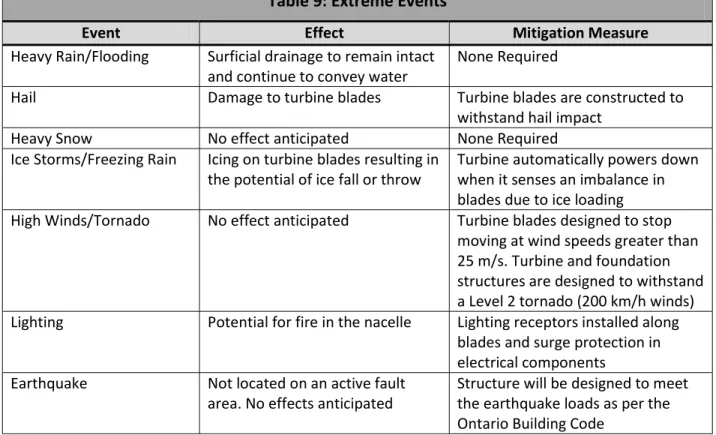
During extreme or unexpected conditions the wind farm operations staff may be required to initiate emergency shutdown of one or more wind turbines or mitigation measures to protect personnel and wind farm assets. This includes wind conditions that exceed the wind turbiens rated speeds, extreme cold and icing, and/or other weather events. Table 9 describes extreme events and mitigation measures that the wind farm operations staff would use to deal with them.
Table 9: Extreme Events
Event Effect Mitigation Measure
Heavy Rain/Flooding Surficial drainage to remain intact and continue to convey water
None Required
Hail Damage to turbine blades Turbine blades are constructed to
withstand hail impact
Heavy Snow No effect anticipated None Required
Ice Storms/Freezing Rain Icing on turbine blades resulting in the potential of ice fall or throw
Turbine automatically powers down when it senses an imbalance in blades due to ice loading
High Winds/Tornado No effect anticipated Turbine blades designed to stop moving at wind speeds greater than 25 m/s. Turbine and foundation structures are designed to withstand a Level 2 tornado (200 km/h winds) Lighting Potential for fire in the nacelle Lighting receptors installed along
blades and surge protection in electrical components
Earthquake Not located on an active fault
area. No effects anticipated
Structure will be designed to meet the earthquake loads as per the Ontario Building Code
6.4 Maintenance
There will be eight to ten maintenance personnel on-site to monitor and co-ordinate routine maintenance activities of the wind farm, including general maintenance and cleaning, road maintenance and snow removal.
6.4.1 Structural/Mechanical Maintenance and Cleaning
Normal maintenance on the individual wind turbines will occur approximately twice per year. This scheduled maintenance involves complete checks of structural soundness, electronics systems, changing of hydraulic and lubricating fluids, and an overall inspection of the wind turbines and project’s: Balance: of: Plant:Please refer to the Wind Turbine Manufacturer Maintenance Checklist (Appendix F), for additional information on routine maintenance required for the turbines. For safety reasons, two person teams will conduct maintenance at all times. The expected maintenance time involved is two days per turbine, per year. Used fluids will be temporarily stored in a designated area of the O&M building prior to disposal offsite at a
Cleaning is undertaken to prevent the accumulation of dirt and debris which may restrict normal movement on the structure and/or retain moisture or chemicals, leading to structural component deterioration. Potential maintenance activities could include cleaning, lubrication and painting. The primary concern with this activity is the release of materials and siltation into the aquatic environment such as abrasives and protective coatings. Lubrication materials may contain petroleum compounds, which are potentially toxic to aquatic species.
Unexpected maintenance occurs infrequently and typically involves the replacement of a major component, such as a gearbox, transformer or blade. In the event of a major malfunction, a crane may be required to lift the affected component. Crane pads will be located in the same place as during the construction and installation phase and where possible, mitigation measures described in the Construction Plan Report will be followed.
Environmental effects mitigation measures in respect to structural maintenance and cleaning will include:
All waste generated in the removal of damaged and deteriorated components will be collected for proper disposal
All materials, where possible, will be reused. Non-salvageable materials will be disposed of at a provincially approved location
All necessary precautions will be taken to prevent discharge or loss of any harmful material or substance into a watercourse
All empty containers of paint, solvents, and cleaners will be disposed of in an appropriate manner at a provincially approved location
If sandblasting is required, it will be done in an off-site maintenance shop
If on-site sandblasting is necessary, screens or traps will enclose the area to be sandblasted
Sandblasting will be performed over a surface which allows the sand or residue to be collected upon completion of sandblasting (i.e., plastic or plywood)
Sandblasting will not be performed in high wind conditions
Sensitive features (i.e., rare plants, watercourses, environmentally sensitive habitats) identified during construction will be protected during maintenance activities.
6.4.2 Road Maintenance and Snow Removal
and monitoring measures related to these maintenance activities. Snow removal and application of sand and/or de-icing agents (i.e., salt) may be required during the winter months to maintain safe conditions for maintenance activities.
Environmental effects mitigation measures in respect to snow removal will include:
A service provider will be used for snow and ice removal on roads
The use of sand, salt and combinations thereof, will be minimized to that which is necessary to ensure the safety of the maintenance staff. Sand application will be the primary means of maintaining safe driving conditions. Salt will only be used as necessary
Prior to salt application, as much snow as possible will be removed from the road through plowing
Salt application will be targeted to areas requiring treatment in order to minimize the volume of salt used and the amount of salt lost to adjacent areas
Snow removed from access roads and site surfaces will not be dumped near a watercourse or wetland or other environmentally sensitive area.
6.4.3 Maintenance of Power Line and Substation/Switching Station
The 69 kV power line will be maintained by Hydro One under a Joint Use Agreement with the project. This maintenance will include route inspection of the material condition of the power line, insulators, pole structures, and tree trimming requirements. DWP will be responsible for the maintenance of the power in the section that does not currently contain Hydro One poles however it is expected that DWP will contract with Hydro One to maintain its portion of the 69 kV line to ensure maintenance continuity and adherence to Hydro One maintenance standards for the entire line. Standard utility bucket/boom truck would be used to access the power line and for tree trimming when required. DWP does not anticipate having to perform any snow removal or the use of salt/deicing agents along the 230 kV power line.
Maintenance activities for the 230 kV power line are expected to include monthly and semi-annual inspections. The line will be inspected using licensed and trail-authorized ATVs and snowmobiles depending upon the season and trail conditions. Approximately every five years, and: as: part: of: the: line’s: planned: maintenance: program, the line will be physically inspected using a standard, long reach, bucket truck that would remain on the rail bed and extend its
6.5 Interference to Telecommunication Systems
Wind turbines can cause interference to telecommunications systems. The interference can be caused as a result of the turbine being in the line-of-sight between a receiver and the signal source as indicated by the Radio Advisory Board of Canada Technical Information and Coordination Process Between Wind Turbines and Radio Communications and Radar System
(2007). Frequency modulated (FM) signals are much more immune to this phenomena and only become impaired in very close proximity to wind turbines. Amplitude modulated (AM) signals are more susceptible to interference in the following three ways:
1. Signal Blockage – the radio signal can be blocked as a result of the turbine being directly between the signal source and the receiver
2. Static Ghosting – the broadcast signal is reflected off the tower of the wind turbine and results in the signal being delayed to the receiver
3. Pulsing – the receiver picks up an interference signal, in addition to the direct signal, as a result of the signal reflecting off of the turbine blades. This results in periodic variations in the television picture quality.
As per the RABC, 2007 guidelines, DWP consulted with the following communications agencies:
Radio Advisory Board of Canada (RABC)
Canadian Wind Energy Association (CanWEA)
Transport Canada- Aerodromes and Air Navigation Unit
Royal Canadian Mounted Police – RCMP Communication Towers
Department of National Defense – National Defense Communication Towers
Environment Canada – Weather Radars
NAV Canada – Civilian ATC Radars
Department of National Defense – Military Air Defense and ATC Radars
Canadian Coast Guard – Vessel Traffic System Radars
Natural Resources Canada – Seismological Monitoring Arrays.
While not all agencies have responded to the request for comments, agencies that have responded did not indicate any concerns with the project layout. DWP will continue to consult with these agencies to confirm that no concerns exist and or to propose mitigation as is appropriate. See Appendix H for the NavCanada response letter.
be within the consultation zone of five microwave paths that could potentially be obstructed by two turbines (T37 and T38). After more detailed investigation, it was determined that neither turbines pose an obstruction of the Fresnel zones. It was also concluded that both turbines are beyond the reactive near-field region of the microwave antennas.
The Comserach report concludes that the Project’s: site: plan:will not adversely affect the microwave point to point links under study. Please See Appendix G for the Comsearch Microwave Analysis Report.
6.6 Process Features
6.6.1 Water Taking
Water will be drawn from a small water well to provide non-potable water for the O&M building. It is estimated that by using a low-flow toilet and faucet for the restroom facilities, approximately 400 litres of water would be required per day. No residual environmental effects are anticipated from this water taking. There is no history of water shortages within the project location.
6.6.2 Sewage
It will be the:project:owner’s:responsibility:to:ensure:proper:maintenance:of:the:septic:system:: The septic tank, with a minimum capacity of 3,000 litres will be pumped regularly (every four to five years). Environmental mitigation measures include prevention of release into the septic system of chemicals or other hazardous materials that could cause environmental harm or destroy bacteria required for sewage breakdown. Facilities will be developed in compliance with: Ontario’s:Environmental Protection Act to ensure that sewage effluent is not released untreated to the environment.
6.6.3 Stormwater Management
Storm water captured in the transformer containment system will be managed as previously described in Section 5.6.
6.6.4 Waste Management
The major concern regarding waste substances is their uncontrolled release to the environment through accidental spillage and subsequent adverse effects on terrestrial, aquatic and marine habitat and species, soil, groundwater quality and human health and safety. Please refer to the Emergency Response Plan in Section 9 for further details about handling of potentially hazardous substances and procedures for reporting spills under the Environmental Protection Act.
Project operations will generate less than 5 kilograms of office waste per day. Waste will also be generated from wind turbine maintenance. Approximately six oil or air filters will have to be replaced annually per turbine. The amount of spent oil is about 1 litre of oil per turbine per year. The turbines may also need new brake pads, pitch batteries and pre-contacts for proper functioning. Every three years, the turbines will need a complete set of oil changes for the yaw drive, gearbox and pitch drives, which will accumulate about 900 litres to 1,000 litres of waste oil. Every five years, the converter coolant will need to be changed. The waste coolant, about 60 litres per turbine, will require disposal according to Ontario Regulation 347.
Waste will be stored in a secured area of the O&M building. Solid waste will be collected and transported off-site for disposal at the Township of Melancthon and the Township of Amaranth Landfills or in cases where either landfill cannot accept the waste (i.e., hazardous waste) it will be disposed of by a private hauler. Liquid and hazardous industrial waste (oils etc.) will be disposed in accordance with Ontario Regulation 347.
The following protection measures will minimize the potential environmental effects of solid waste disposal:
Food waste will be stored in a manner that ensures wildlife will not be attracted and will be removed from the site on a daily basis
On-site temporary disposal areas for surplus material will be designated and will be located a minimum of 30 metres from a wetland or watercourse. In circumstances where landowners will not permit the use of alternate locations the buffer zone will be reduced to a minimum of 10 metres
The Contractor will, with the prior approval of the Site Supervisor, designate and use areas for the transfer and limited temporary storage of hazardous materials and special wastes. These sites will be properly labeled and appropriately controlled, and will be
All surplus materials, rubbish, waste materials, and construction debris will be removed from the site upon completion of construction of the project
All waste will be handled in accordance with relevant provincial and federal requirements
Waste material will not be dumped on-site. In the event that waste materials are inadvertently dumped, the Construction Manager (or designate) will immediately act to have the dumped material cleaned up and removed
No waste or debris will be permitted to enter any watercourse
Only material approved by the Independent Construction Compliance Monitor and the Site Supervisor will be disposed of or reused onsite (e.g., clean fill materials)
Run-off from a disposal/storage area will not be allowed to enter a watercourse. 6.6.5 Contaminants to Air
There will be infrequent, short-duration emissions of greenhouse gases from motorized vehicles during the operations phase. This will result from accessing the O&M building or from transporting maintenance personnel to the turbine sites. Compared to background conditions, these emissions are negligible. No other significant discharges of contaminants to air are expected during the operation phase of the project.
7. DESCRIPTION OF NEGATIVE ENVIRONMENTAL EFFECTS AND MITIGATION
The following sections provide a summary of potential environmental effects and mitigation measures associated with the project operations period.
7.1 Archaeological Resources
Section 5.8 of the Construction Report provides a summary of potential project effects on archaeological resources. The operations phase of the project will not result in additional effects on archaeological resources. All Archaeological Assessment Reports can be found in Appendix A of the Construction Plan Report. Please note all Archaeological Assessments were undertaken prior to a change in the turbine numbering system. The turbines referenced below are based on the revised turbine numbering system.