
Liquidity forecasting
36
0
0
Full text
(2)
(3) CCBS Handbook No. 27 – June 2008. Liquidity forecasting Simon T Gray. When central banks enter into transactions to implement their monetary policy, they necessarily make use of their own balance sheets. Whether they are undertaking open market operations (OMO) to inject or drain funds from the banking system, or allowing the banks to use standing facilities to borrow or deposit funds, the central bank’s balance sheet will be impacted: the funds in question are commercial bank balances held at the central bank. Ideally, operations undertaken to implement policy should have a predictable impact on the economy, via the banking system. This means that the central bank needs to know the context in which it is operating: what is the current availability of commercial bank balances compared with the level of demand, and how is this expected to change in the near term? An accurate current picture and good forecast of the central bank’s likely future balance sheet is required. The same information on the central bank’s balance sheet is also needed if the central bank wishes to manage liquidity pro-actively. Most central banks do, whether it is to avoid a shortage of liquidity impacting on the payment system, or an excess impacting short-term yields and/or the exchange rate. This Handbook examines the issues involved in forecasting the central bank’s balance sheet. This is normally referred to as ‘liquidity forecasting’ since the item on the balance sheet which central banks typically try to manage is commercial banks balances, a subset of high-powered liquidity.. [email protected] Centre for Central Banking Studies, Bank of England, Threadneedle Street, London, EC2R 8AH The views expressed in this Handbook are those of the authors, and are not necessarily those of the Bank of England. Series editors: Gill Hammond, email [email protected] and Francesco Zanetti, email [email protected] This copy is also available via the internet site at http://www.bankofengland.co.uk/education/ccbs/handbooks_lectures.htm © Bank of England 2008.
(4)
(5) Contents What is liquidity and why do central banks care?. 5. Definitions of liquidity. 6. What are free and excess reserves? Can there be excess cash? Should account be taken of non-domestic currencies?. 7 8 8. Autonomous factors: levels and changes. 9. What period should be forecast?. 9. The short-term forecast Timeframe for long-term forecast. 9 10. Forecasting the autonomous factors. 11. Cash Government transactions Government guarantees Net foreign assets Float Taking account of known transactions. 11 13 16 16 18 18. Forecasting demand for liquidity. 18. Improving the quality of forecasts. 20. Good data The forecast team Where in the central bank should the forecast team be located?. 20 21 22. Publication of the forecast. 22. Using the forecast. 23. Reserve averaging and the frequency of operations. 24. Summary. 25. Annex 1: Example of government expenditure pattern. 26. Annex 2: Examples of published liquidity forecasts. 27. Bank of England ECB. 27 27. Annex 3: Government cash flows in the euro area. 28. Annex 4: UK Treasury cash-flow management. 29. The departmental cash-flow management scheme. 30. Handbooks in Central Banking. 31. Handbooks: Lecture Series Handbooks: Research Series CCBS publications. 32 32 32.
(6)
(7) Handbook No. 27 Liquidity forecasting. 5. Liquidity forecasting What is liquidity and why do central banks care? Liquidity — in terms of a monetary aggregate rather than ease of trading an asset — can be defined as narrow (or high-powered or central bank) money at one extreme; or the widest definition of broad money aggregates at the other. Both are of interest to central banks, as they have implications for both monetary and financial stability.(1) Increasingly, cross-border linkages mean that liquidity imbalances in one country can lead to spillovers into another economy. This is most obviously the case with the broader definition of liquidity: investors facing a shortage of domestic assets (excess liquidity can also be viewed as a shortage of assets)(2) may try to access foreign assets; this will normally involve foreign exchange markets and cross-border transactions. To the extent central bank and commercial bank balances are interchangeable in the wholesale money markets, disequilibria in high-powered money may also spillover cross-border — evidenced by market behaviour in the United States, the United Kingdom and the euro area in August–September 2007. When this Handbook talks about ‘liquidity’, what is meant is the narrow definition — a subset of central bank liabilities — rather than a broader monetary aggregate. In particular, it is the domestic-currency denominated, non-interest-bearing liabilities of the central bank held by the non-state sector. Central banks typically manage monetary policy by controlling the cost of this liquidity (whether indirectly, via the cost of commercial bank borrowing from the central bank to fund the liabilities, or directly via the cost at which its liabilities are remunerated) and thus, through arbitrage, the cost of interbank funds. But if there is either too much or too little of this liquidity in the market, the central bank will find it harder to manage monetary policy; and most central banks therefore try to manage market liquidity in a manner which will facilitate the implementation of monetary policy. Central banks tend to forecast banks’ free reserves, and estimate excess reserves (see definitions, below), because they believe: (i) that a disequilibrium — whether too much or too little liquidity — tends to promote behaviour by banks which the central bank does not want; and therefore. (ii) that the central bank may need to react in order to continue implementing an appropriate monetary policy stance. If there is a shortage of liquidity, then the central bank will (almost) always supply the need. There have been a few occasions where a central bank has not been able to supply sufficient cash to meet the economy’s needs — notably when there is hyperinflation or civil unrest (or in one Latin American country, when the central bank printers went on strike) — and people may then resort to barter or increased dollarisation. But this is very unusual. As regards a shortage of commercial bank reserves held at the central bank, the risk is that a shortage would mean payments could not be cleared at the end of the day. It is to avoid this risk that central banks have in place credit standing facilities (SFs) — though they will normally aim to supply liquidity via open market operations (OMO) — to avoid spikes in market interest rates. Commercial banks might have sufficient balances for payments purposes, but be short of reserves balances in terms of meeting reserve requirements (RRs) or liquid asset ratios (LARs). Since the interest rate penalty of a shortfall is typically the same as for accessing the credit SF or higher, the impact on banks’ behaviour will be similar, so that central banks will where possible supply the necessary liquidity via OMO. In any case, liquidity will nearly always be supplied, albeit possibly at a high price, so that ex-post liquidity shortages are unusual. The consequences of a liquidity surplus are not the mirror-image of a shortage, and central bank structures are not therefore always symmetrical. There is no risk of payment system failure because of a surplus of liquidity, nor of a failure to meet reserve requirements. Arguably, there is therefore less need for a deposit SF. But there will be consequences of a surplus on the behaviour of commercial banks, which typically run counter to the policy goals of the central bank. The immediate consequence of excess liquidity is that short-term interest rates will fall, potentially close to zero. This is evident in a number of countries. Banks could try to offset this loss of income by making riskier loans in search of yield (with consequences for financial stability and possibly inflation, if there is excessive lending); or they might refuse to take customer deposits, especially interest-bearing deposits (with consequences for the development of financial intermediation, and possibly inflation if this encourages consumption rather (1) See for instance ‘What is global excess liquidity, and does it matter?’, Ruffer, R and Stracca, L (2006), ECB Working Paper no. 696. (2) See for instance, taking the broad definition, ‘On the macroeconomics of asset shortages’, Caballero, R (2006), NBER Working Paper no. 12753..
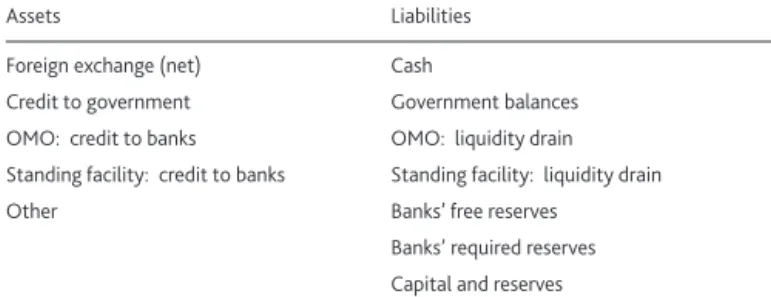
(8) 6. Handbook No. 27 Liquidity forecasting. than saving); or they might try to move into foreign exchange where some return on balances is available (with consequences for either the exchange rate or the central bank’s foreign exchange reserves, or both; and possibly for inflation if the exchange rate depreciates).. so that short-term market rates are very low, the opportunity cost of holding excess balances at the central bank may be seen as small. Banks might then exhibit only a sluggish response to excess holdings of liquidity, and it can be harder to determine, behaviourally, where the boundary lies between desired and excess reserves.. Some central banks eg in the Far East have observed that when the market has a large structural surplus of liquidity, the interest-rate transmission mechanism of monetary policy weakens. This again points to an impact on monetary policy implementation. If the market swings from a surplus to a shortage from day to day — so that even the direction of the disequilibrium is unpredictable — short-term interest rates will be more volatile that would otherwise be the case (this will tend to impede development of the longer-term end of the market) and banks will be more reluctant to take positions because of the risks involved. In other words, liquidity forecasting and management is part of the central bank’s goal of stabilising the value of money — whether this means, in a given context, stabilising the domestic value by keeping inflation low, or stabilising the external value by keeping the exchange rate(1) at a particular level. And it supports the broader goal of financial market stability, by reducing the risks which can arise from short-term price volatility. The ECB Monthly Bulletin (May 2002) noted, in the context of liquidity management: ‘Central bank liquidity management comprises assessing the liquidity needs of the banking system and supplying or absorbing the appropriate amount of liquidity through open market operations.’ This implies that liquidity management, at least for the ECB, is essentially accommodative. With such an approach, the central bank does not pre-determine a path for liquidity (reserve money) growth, it simply aims to supply the net requirements of the market, whatever the requirement is. This approach may be easier when the market is characterised by a structural deficit of liquidity (eg the United Kingdom, the United States, the euro area and Japan), since there is a marginal cost to banks in obtaining liquidity — they need to borrow from the central bank — and excess reserves are typically not remunerated. Banks have an incentive to hold the right amount — enough for payments purposes but minimal costly excess. Where there is a structural surplus of liquidity, however, the incentive structure may be less obvious. In principle, there may be no difference: banks will still want enough for payments purposes and minimal costly excess. But if the central bank leaves some excess liquidity in the market,. It follows from the purpose of the liquidity forecast, that the forecast should be seen in the context of the central bank’s liquidity management policy and operations. If liquidity is to be managed using OMO — ie transactions where the central bank takes the initiative — the central bank must have a good forecast.. Definitions of liquidity The task of forecasting liquidity involves a forecast of the balance sheet of the central bank, so that, by residual, the central bank can judge the scope of its market interventions in order to maintain the appropriate level of liquidity in the economy. It is important to differentiate between the various liabilities on the central bank’s balance sheet (Table A). Table A The central bank’s balance sheet Assets. Liabilities. Foreign exchange (net). Cash. Credit to government. Government balances. OMO: credit to banks. OMO: liquidity drain. Standing facility: credit to banks. Standing facility: liquidity drain. Other. Banks’ free reserves Banks’ required reserves Capital and reserves. Not all central bank liabilities are fully liquid, and not all are held by the non-state sector. For instance: • government deposits with the central bank are liquid, but the government will not necessarily respond to ‘excess’ deposits in the same way as a private sector bank;(2) • term deposits or central bank bills, normally a form of OMO used to drain excess liquidity, are interest-bearing and are a response to excess liquidity; • required or contractual reserves may represent free liquidity from day to day if there is a system of reserve averaging, but cannot be freely used over the maintenance period as a whole; (1) Nominal, real or trade weighted. (2) Some central and regional government treasuries do hold surplus funds with commercial banks (whether private or state sector) if balances at the central bank are not remunerated..
(9) Handbook No. 27 Liquidity forecasting. • foreign debt is interest-bearing and is not in domestic currency; and • capital and reserves of the central bank are not held by the non-state sector.(1) Cash is clearly non-interest bearing, held by the non-state sector, and liquid; there could be an excess or a deficit of it in the economy. Commercial bank current account balances constitute ‘free’ reserves which may or may not be ‘excess’. As a final point here, it is often far from clear just how to move from a published central bank balance sheet to the pro-forma structure used above. Central bank staff may need to do some work with their accounts department in order to be able to produce a balance sheet — at least broken down into the major items — that is operationally useful for liquidity management.. What are free and excess reserves? All funds in banks’ current accounts could be defined as free reserves, to the extent that banks are free to use the funds on any given day. Where there is (i) an required reserves (RR) regime and reserve averaging is practiced, or (ii) a voluntary contractual reserves (VCR) regime, these reserves are likely to be maintained in the commercial banks’ current accounts at the central bank. This means that balance sheet data are not sufficient to indicate whether a bank has free or excess reserves: the liquidity forecaster needs to know in addition what the RR/VCR target levels are. It is important in this case to distinguish between what might be ‘free’ balances — ie can be used freely — on a given day, and what are free for the reserve maintenance period as a whole. On any given day, a bank can run its balance at the central bank down to zero (or whatever lower bound is set), even if at that point it holds less than the reserve target, whether for that day or for the maintenance period up to that point. But over the reserve maintenance period as a whole, it is not free to do so. A bank may of course end a period with reserves lower than its target; but this is not a ‘free’ option — there will be an interest rate penalty — and central banks will normally work on the assumption that each bank aims at least to meet its reserves target, and manages liquidity accordingly. The central bank could, in general terms, define ‘excess’ reserves as anything above the level desired by commercial banks. This begs the question: what level do commercial banks want to hold? Some banks will always want to hold a certain amount of reserves voluntarily, for payments system liquidity and perhaps for precautionary motives. Where there is a regime of RR with no averaging,(2) banks hold voluntary (or ‘demanded’) reserves on top of the required level for transactions purposes. Where. 7. averaging is allowed, banks typically have to hold higher balances — on average — than they would voluntarily chose. Since the averaging mechanism provides them with scope for liquidity management, one might expect a priori that any balances held above the reserve requirement level would be excess to demand. Indeed, some commentators define any reserves held on top of required reserves as ‘excess’. But this may not be correct, for various reasons, either on any given day, or for the maintenance period as a whole. In some countries, liquidity forecasters can assume that the banking system as a whole will target reserves of marginally more than the RR target — perhaps between 0.25%–0.5% above the RR level in the euro area, for instance. If the combination of the central bank’s OMO and reserve averaging provides ample scope for liquidity management, then banks will tend to target marginally above the RR target. As there is some stigma associated with a shortfall (the interest rate cost of a shortfall or an excess is normally symmetrical), banks have a small incentive to err on the side of a surplus. But in some countries, where the use of OMO is less predictable and access to the credit SF is seen as very expensive, some banks will hold a larger, but less predictable, buffer above the RR target. The size of the targeted buffer will be a function of the uncertainty of the central bank’s operations; the operational structure and its relationship to the setting of monetary policy; possibly of exchange rate speculation; and of the reliability of the payment system and commercial banks’ internal treasury systems. Changes in any of these will affect the size of the targeted buffer, making it harder to estimate the level of desired reserves, and thus by residual of excess reserves. Similar forecasting problems can arise if the level of RR is not high enough to provide all banks with enough scope for liquidity management — as in the United States at present — or if reserves are held on a purely voluntary basis — as in Australia. In both cases, the central bank has to estimate the desired level of voluntarily-held reserves before it can decide whether the forecast actual level of reserves is on target or not. To some extent, the central bank may have to be guided by the behaviour of the market. It may observe that if the level of free reserves is within a certain band (this may be thought of as a ‘comfort zone’), short-term market rates will reflect the policy rate; whereas if reserves are above or below that band, market behaviour responds by moving interest rates or changing demand for foreign exchange. This handbook takes the view that it is important to distinguish between free reserves — whether or not they are on top of required reserves — and reserves which exceed the commercial banks’ demand for them. Thus excess reserves are a subset of (1) There are rare exceptions, where the central bank’s capital is held by the private sector; but this is normally for historical reasons, and this capital could not behave in the same way as excess liquidity. (2) Reserve requirement averaging is discussed in detail in Handbook No. 24..
(10) 8. Handbook No. 27 Liquidity forecasting. free reserves: it is not an alternative term for the same thing. Commercial banks’ behaviour will be different, depending on whether balances held at the central bank are (i) held voluntarily (desired, or demanded, reserves), in which case the banks will want to keep them; or (ii) in excess of the desired level, in which case the banks will seek to convert them into an asset which carries some form of return. What matters to the central bank is the behaviour of commercial banks seeking to get rid of excess reserves,(1) or avoiding the risk of a shortfall.. is no such record of foreign currency in circulation, and no prospect of obtaining accurate reporting of such holdings.. Can there be excess cash? In most countries, cash is supplied on demand; and because there is a cost to holding cash, the economy as a whole does not make excessive demands. Central banks will therefore tend to assume that supply of cash equals demand, and that — by contrast with commercial banks balances at the central bank — there is never an ‘excess’ of cash which might affect behaviour. This should be true as long as commercial banks are free to return excess cash holdings to the central bank; and that there are efficient and cost-effective means for any (temporarily) surplus cash to flow from the economy via the commercial banks back to the central bank. But there are exceptions to this. In a few countries with less developed financial systems — ‘cash economies’ — there can be excess cash in circulation. This normally arises when a government pays salaries (and perhaps pensions) in cash; and is often associated with monetary financing (the central bank’s balance sheet expands as the government borrows from it to withdraw cash). The cash may find its way back to the central bank via the banking system, or could be left in the economy with potentially inflationary consequences. The latter scenario is more likely to happen where a large part of the economy is unbanked (one reason for salaries being paid in cash in the first place), and the mechanisms for returning surplus cash to the central bank are inadequate or non-existant.(2) The task of forecasting this form of excess liquidity — excess cash in circulation — may be harder than simply forecasting demand for cash when it is only supplied on demand, as there may be no normal, base level to compare with; but in such a case it may be more important.. Should account be taken of non-domestic currencies? Having defined the task of liquidity forecasting as estimating (i) the future level of domestic-currency, non-interest-bearing central bank liabilities held by the non-state sector and (ii) the demand for such liabilities, it is worth considering the impact of non-domestic currencies in a (semi) dollarised economy. It is impossible for a central bank to know how much foreign currency cash is circulating in its economy. Data for domestic currency in issue can be taken from the central bank’s own balance sheet, and data for domestic currency in circulation by adjusting this for reported vault cash held by banks. But there. It can nevertheless be useful for a central bank to know whether the level of dollarisation is changing. This will help it to understand what is driving the growth in domestic currency in circulation and whether it might be excessive, inflationary etc. For instance, if there is substantial de-dollarisation, then as the population switches from foreign to domestic currency, the volume of domestic currency will increase faster than the growth rate of/demand for total transactional cash in the economy. Rapid growth in domestic currency in circulation may not be a problem. It might be possible periodically to undertake surveys(3) to get an idea of the level, and more importantly changes in the level, of dollarisation in order to be able to form a judgement on this. A few central banks do so. If a central bank finds that substantial use is made of its currency in other countries — notably the US dollar and the euro — it may be useful to estimate such holding for the purposes of analysing currency demand; and to forecast it separately, as it may behave differently to cash demanded domestically. It is reasonable to assume in most cases that there is unlikely to be an excess of foreign exchange in circulation, except perhaps for short transitional periods, since it can normally be invested abroad for a return. An excess or shortage may result in banks selling/buying foreign exchange from the central bank, which will in turn affect domestic currency liquidity, and possibly also the exchange rate. However, to the extent the financial sector is inefficient, the transactional costs of investing foreign exchange abroad may be excessive, encouraging — at the margin — any excess holdings to be spent domestically. They would then have much the same impact as excess holdings of domestic currency. Some countries have found that, if the exchange rate appreciates and is expected to continue appreciating, then demand for domestic currency, non-interest-bearing liabilities of the central bank will increase temporarily, as people expect to benefit the exchange rate gain; but once the exchange rate is perceived to have stabilised, this will unwind. In an under-banked economy, the easiest (or only) way of (1) If banks judge that it will be impossible to get rid of the excess, their behaviour will be affected in a different way — this will be explored later. (2) It will also impact the transmission mechanism. Changes in interest rates may affect the balance between consumption (transactions money) and saving (bank deposits) if enough people hold bank deposits; but cannot influence directly those who use only cash. The level of savings held in the form of cash under the mattress (as opposed to bank deposit) should be influenced by the level of inflation or strength of the exchange rate (high inflation encourages more hording of physical goods); but this is less under the central bank’s direct control. (3) It is unlikely to be worthwhile asking individuals how much foreign currency cash they hold, as they would be suspicious and have incentives to lie. But shopkeepers might be prepared to say what percentage of their purchases (from suppliers) and sales are denominated and/or paid for in foreign currency. Changes over time in the responses would give an indication of changing levels of dollarisation..
(11) Handbook No. 27 Liquidity forecasting. taking a speculative position on the domestic currency may be via holdings of physical cash.. Autonomous factors: levels and changes The factors which the central bank needs to forecast — those which are not under its direct control — are often referred to as ‘autonomous factors’. For most central banks, the main items are: • cash in circulation; • net government balances; and • net foreign assets (for some this will mean simply foreign exchange reserves). There may be others, such as the ‘float’ in the payment system, which are important for some countries but not for others. Some items may be irregular. For instance, profit remittance to the government may happen twice a year; or foreign exchange inflows relating to a privatisation may affect a few days around the time of the privatisation only; but their size means that account needs to be taken of them when they happen; and the forecast model should allow for their inclusion as necessary. As indicated earlier, excess reserves are a subset of free reserves (and cash). These are normally the residual in the forecast; it is necessary to forecast the other items of the balance sheet, both assets and liabilities, in order to generate a forecast for free reserves. On the assumption that the central bank has a reasonably accurate picture of its balance sheet for a recent date (ideally close of business the previous day), it will know the balances in commercial banks’ current accounts for a date in the past. This being the case, the central bank can in practice forecast the changes to the main items, rather than the levels themselves, since that will produce a forecast for changes to free reserves. The central bank can therefore concentrate on forecasting the items which show the largest fluctuations in value. Clearly, if the central bank forecasts the levels, then changes for the given period are a residual; and if changes to the latest balance sheet are forecast, the forecast future balance sheet is a residual. One implies the other. Both approaches have merit, and at different times, both may need to be used. Assume that cash in circulation today is 100, and is forecast to increase by 0.5% tomorrow, to 100.5. If the figure for today is revised to 100.3, does this mean that some of the increase in demand for tomorrow has happened early, in which case the forecast level is not altered but the change is? Or should the forecast level be increased on the basis of a higher base number and unchanged forecast increase? Depending on the circumstances, either could be right. Similarly, assume that the level of government balances is revised up for today. That might increase the level forecast for tomorrow, for a given. 9. income and expenditure forecast; or it might imply a different change, if the government targets a particular balance held at the central bank. These factors may be stated in terms of levels (eg the level of foreign exchange reserves) or in terms of flows (changes to the level of net foreign exchange reserves). In practice, the latter may be more useful, since the central bank normally wants to forecast changes in the residual item, commercial banks’ free reserves. It is important to remember that the forecast needs to cover items which affect commercial bank liquidity. A change in the exchange rate will lead to a revaluation of foreign exchange reserves, with a counterpart in a ‘revaluation reserve’; but these offset each other, and do not impact on commercial bank liquidity.. What period should be forecast? For the purposes of liquidity management, the central bank ideally needs to undertake a daily forecast for coming few weeks — certainly until the end of the current reserve maintenance period. If daily data is not available — as is the case in a number of central banks — a weekly forecast might need to be used instead, until data availability can be improved. But if the central bank’s monetary instruments include longer-term operations — with a maturity of several months, perhaps — then there is a good case for producing a rough forecast of the central bank’s balance sheet for the next few months, in order to provide a context for those longer-term operations. And for some central banks, there is merit in occasionally projecting the balance sheet out for several years, for instance to help answer the question: if the current structure of operations continues for the next five years, what will the balance sheet look like based on assumptions for the yield curve and the exchange rate? Is the current stance sustainable?(1) A central bank must undertake a short-term forecast, if its monetary operations are to be undertaken in a pro-active way: otherwise, it would simply be guessing what to do in volume terms. But it should also make a longer-term forecast. This is in part as a check (if the long-term forecast and the short-term forecast appear regularly and substantially out of line with each other, is one wrong? Are the same assumptions being used?); and for different aspects of operational planning.. The short-term forecast There may be some interaction between the length of the maintenance period, and the central bank’s ability to produce an accurate forecast. Some central banks find that they can produce a reasonably accurate forecast for the two weeks or (1) One Eastern European central bank defined these as: for liquidity purposes, daily and monthly; for financial planning purposes, quarterly and annual; and long term, occasional eg looking forward seven years to estimate possible impact on the balance sheet if/when it joins the euro..
(12) 10. Handbook No. 27 Liquidity forecasting. month ahead, but cannot accurately split the forecast by each day, or even week. If this is the case, the maintenance period could be set to match the period which the central bank can best forecast. A longer period than five weeks would be very unusual, and might give the market too much freedom; but if extending from one or two weeks to four-five weeks would allow for a significant improvement in liquidity management, it should be considered. That said, the central bank should still aim to improve data and forecast quality to provide a more accurate short-term picture of financial market developments.. expected volume of OMO to be undertaken during the remainder of the maintenance period.. The short-term forecast needs to take account of the commercial banks’ time horizon. If there is a daily liquidity constraint — as was the case in the United Kingdom prior to May 2006, for instance — then an accurate forecast is needed for the current day. Most central banks will want to have some idea of the forecast for the current day, if only to be reasonably sure that reserve balances held by the commercial banks are sufficient to be able to cope with expected cash movements in the economy. The next time horizon would normally be the period until the next planned OMO. For some central banks, this will be the next day, and therefore a one-day forecast is sufficient (this is also the period used by the Reserve Bank of Australia, where there is no reserve maintenance period, though operations are not necessarily undertaken every day). For others, it may be a one-week period — eg the Bank of England since May 2006,(1) and the euro system. The central bank might assume that the commercial banks as a whole would like to end the system with average reserves for the maintenance period roughly at the target level, and to stay at that level for the remainder of the maintenance period. If this can be achieved, so that at the start of a seven-day period the system has roughly the right level of reserves, the question is: what volume of liquidity adjustment is needed to keep the banks on track for the coming seven days? Although in theory banks could move substantially away from the target level for a few days, in practice it is unlikely that they would want to do so. If there are one-off events, such as a securitisation or large payment due to or from the government, which might lead the banks to want to vary from the target average level, the central bank will need to be aware of this and take it into account. The third time horizon to consider is the period between today and the end of the current maintenance period, which might be one day, or could be up to one month. The Bank of England and the ECB publish daily information which shows the average level of reserves held in the maintenance period to date, and the average level required for the remainder of the period if the banks are to hit the target (or mid-point of the target, in the case of the United Kingdom) exactly. This is factual information rather than a forecast; but taken together with the forecast changes in autonomous factors indicates the. Most central banks find it useful to end a reserves maintenance period in the middle of the working week (typically Wednesday or Thursday). Certain of the autonomous items — notably cash in circulation, and the float (where relevant) are more volatile at the start and the end of the working week, and therefore harder to forecast. Ending the maintenance period on a day which is easier to forecast makes it more likely that the right amount of liquidity will be provided. If this is done, it also implies that maintenance periods should be a whole number of weeks, rather than eg a calendar month long. For policy consistency purposes, it may also make sense to align the start and end of maintenance periods with the day on which the central bank reviews monetary policy (provided this is on a regular schedule). In the United Kingdom, the maintenance period starts on the day the Monetary Policy Committee announces its decision, and ends the day before the next MPC meeting. In the euro area, a similar alignment is made between those Governing Council meetings which review monetary policy, and the end of the maintenance period.. Timeframe for long-term forecast Beyond the current maintenance period, which constitutes a constraint for banks’ liquidity management, a liquidity forecast is used more for planning purposes than for specific operations. The longer-term forecasts may be useful in planning the maturity structure of longer-term, price-taking OMOs. Many central banks, whether injecting or draining liquidity from the economy, opt to place some of the transactions/part of their balance sheet on a — maturity (up to fourteen days to maturity), where they operate as price maker; and other transactions/part of their balance sheet at a much longer-term maturity (possibly several years, but perhaps just several months), where they operate as price taker. When deciding how much of the balance sheet should be placed at longer-term maturities, and how long those maturities should be, it will help to have some idea of how the balance sheet is expected to develop in the future. A longer-term forecast may also be useful if the central bank is uncertain whether its current policy stance is sustainable. This is notably in the case with an exchange-rate target. But this form of forecast will be different to the short-term balance sheet forecasting. The central bank may want to estimate: (1) The Bank of England’s Red Book, which describes the framework for monetary operations, can be found at: www.bankofengland.co.uk/markets/money/publications/redbookjan08.pdf..
(13) Handbook No. 27 Liquidity forecasting. • Likely growth in demand for domestic currency in coming years: this will be a function of GDP growth (including the grey/black economy which may be a major user of cash rather than formal banking channels), expected inflation, any expected (de-)dollarisation, payment system developments etc. • Likely pressures on its foreign exchange reserves and the exchange rate: this will be a function of GDP growth, world demand for the country’s exports, changes in competitiveness, future repayments of foreign currency borrowings etc. • Possible changes in government behaviour eg if the government has committed to ending monetary financing, or is moving to a budget surplus, or moving cash balances from commercial banks to the central bank as part of an enhanced treasury-management function, or a change from foreign currency to domestic borrowing.. 11. For most central banks, the main three autonomous items which need to be forecast are cash (= currency in issue); net government transactions; and net foreign exchange transactions. These are explored in more detail below.. Cash There is normally a strong seasonal component to cash in circulation, even in countries with a developed financial system, where most savings and most transactions — by value, and in some cases by number — do not use cash (Chart 1 illustrates strong seasonal pattern for the United Kingdom). In most countries, supply always equals demand, as cash is issued on demand, and central banks take back cash, via the banking system, if there ever is a surplus due to seasonal factors.(1) Chart 1 Daily data for notes in circulation in the United Kingdom, showing seasonal patterns Public holidays Working days. £ billions. This sort of forecast will use quarterly or even annual data, and will not be concerned by within month, or maybe even within year seasonality; and it may benefit from a level of economic analysis that cannot be used with some elements of the very short-term forecast. If the forecast is being used for monetary policy, rather than liquidity management purposes — for instance, if the central bank is using a monetary aggregate as its intermediate monetary policy target — it will probably need to extend to at least twelve months. The central bank will normally only take ‘corrective’ action if the growth path of the targeted aggregate is off-track over several months and this is expected to cause problems for the final target of monetary policy.. Forecasting the autonomous factors The items on the central bank balance sheet which need to be forecast are often referred to as the ‘autonomous factors’. These are the items normally understood to be beyond the central bank’s direct control. OMO clearly are within the central bank’s control; and use of SFs is normally forecast as zero — though see discussion below. Commercial banks’ current account balances is the residual item; the forecast needs to encompass everything else, though in practice it could ignore items that lead to offsetting changes and which do not impact banking sector liquidity (eg property revaluation might change an asset item and ‘capital and reserves’ on the liability side, but would make no difference to liquidity). More emphasis should, of course, be placed on forecasting items which are likely to show large changes. A large balance sheet item which never changes will not impact liquidity; and a very small item which changes by small amounts will not have much impact (though if there are a lot of such items, the cumulative effect could be significant).. 45. 42. 40. 37. Jan.. Mar.. May. July 2005. Sep.. Nov. Jan.. Mar.. May 06. July. 35 0. Source: Bank of England.. In a country with a developed financial system, the government will make little direct use of cash. Salaries for civil servants, pensions etc are paid by direct credit to a banking account. Any subsequent demand for cash — as people withdraw part of their salary (in some countries predominantly via ATMs if in cash, though most expenditure may be in a non-cash form) — will be subsumed into the cash demand management of the commercial banks. There is therefore no direct link in the forecast between government salary disbursements and cash in circulation; there will instead be a net government expenditure with a counterpart in commercial bank accounts at the central bank (covered in a later section here). If a significant part of the population is finance-constrained, then a peak in cash withdrawals may coincide with the payment of government salaries and pensions. The central bank would then need to monitor whether this happened; and if such a link changed over time eg with a move to non-cash means of payment, or with a reduction (or growth) in the finance-constrained proportion of the population. (1) By contrast, coins are not normally taken back even if there is a seasonal surplus..
(14) 12. Handbook No. 27 Liquidity forecasting. In countries with a less developed financial system, the government may pay salaries, pensions etc predominantly in cash. The exact route may vary for the cash flows: does the government collect cash from the central bank and deliver it to ministries etc? Or is cash sent to commercial banks around the country for disbursal? In general, there will be a close relationship between net government expenditure and cash in circulation; and no direct impact on commercial bank balances at the central bank, to the extent the government uses cash from the central bank, rather than bank accounts, to make payments. If the government starts to make use of direct credits to bank accounts, the relationship will change; but it may happen in stages over several months or even years (the banking system needs to be given time to gear up to a large increase in customers). And there may be changes in individuals’ behaviour. In some countries, the first time a salary is paid into an account rather than in cash, all of the cash is withdrawn on day one. The next month, the beneficiary may only withdraw enough for a week or two. Over time, the individual may start to make use of non-cash payment services, or savings accounts at the bank. The transitional phase, which may last for quite a long period, will make forecasting harder.. harder to forecast demand for domestic currency. The relationship may change if there is de-dollarisation, for instance if there is a growing level of confidence in the domestic currency, or if it is expected to appreciate against the dollar (or whatever the alternative currency is) in the near future; or it may change if there is an increase in the level of dollarisation, for instance if there is a perception that central bank behaviour may lead to an increase in inflation and consequently a weakening of the exchange rate. A process which accurately forecasts the total demand for transactional cash would not then give the right result for the domestic currency component. There is no simple answer to this problem. But it may make sense for the central bank to run periodical surveys to try to estimate how much domestic and foreign currency is being used — for instance, asking a sample group of shop-keepers every month or quarter roughly what percentage of transactions are denominated in which currency. Multiple seasonalities may also be a major issue in forecasting a daily path for currency demand. The four main factors which need to be considered are:. Trend and cyclical growth In some countries, the government (and other groups) make payment by cheque; but the recipient encashes the cheque immediately — in some cases at central bank counters. Cash flow management might be easier if the central bank did not encash such cheques, but instead they had to be paid into accounts at a commercial bank. This might also encourage the beneficiary to leave some of the cash in the bank (where they can hold an account), whereas encashment at the central bank requires the full amount to be taken in cash. However, quick results should not be expected. For example, Ghana’s Cocoa board has for some time made payments by cheque, but finds that these are encashed very quickly. In some countries, forecasting cash demand will be affected by the level of dollarisation. ‘Dollarisation’ does not mean exclusively the use of US dollars outside the United States; it encompasses use of any non-domestic currency for transactional purposes. In some countries, there may be more than one such currency. The deutschemark, and subsequently the euro, have been widely used at times in central European countries which are not part of the euro area; the South African rand may be used in neighbouring countries. Afghanistan currently sees use of the US dollar as well as the Pakistani rupee and other currencies.(1) Where a non-domestic currency is used as a substitute for the domestic one, the demand for transactional cash will clearly not be the same as the demand for domestic currency transactional cash. As long as the relationship between use of domestic and foreign currency is stable, this may not be a major problem. But if the relationship changes, then it will be. This may be in line with nominal GDP growth: a neutral assumption, in the absence of any other information, might be that demand for cash would be a stable ratio of nominal GDP. Or there might be a trend movement in the relationship observable over time. Increasing use of non-cash alternatives for payments will affect the relationship. Similarly, more widespread availability of ATMs may reduce cash holdings, by making it easier for users to replenish cash when needed.. Annual seasonality eg key festivals Many countries find that there is increased demand for currency around key festivals, as people typically spend more money then. Some may be picked up quite easily: Christmas always falls on 25 December (except in some Orthodox countries), although it may be classed as a moving holiday because it falls on a different day of the week each year. Easter may be in March or April; and Ramadan is always earlier than in the previous year because of the use of a lunar calendar for its calculation. Moveable feasts will require some manipulation, as standard statistical programmes may not cope well with them. In other countries, there will be a strong seasonality related to holiday periods: tourists, or spending related to seasonal remittances from abroad, may substantially increase the demand for cash at peak times. (1) Use of non-domestic currencies also adds a layer of complexity to the forecast for note demand for those central banks who issue the notes used abroad, though not normally on a very short-term basis. The US Federal Reserve Bank has to take account of demand for US banknotes (including by denomination) in many countries around the world..
(15) Handbook No. 27 Liquidity forecasting. Monthly seasonality If government salaries, pensions etc are paid in cash, this may lead to a monthly pattern for cash demand. In some countries, for instance, cash in circulation rises towards the end of each month when salaries and/or pensions are paid, and then falls gradually until the same point in the following month.. Weekly seasonality Many countries find a clear weekly seasonality. More cash is withdrawn ahead of weekends, and returned to the central bank — via shop tills and commercial banks — on the first working day of the following week. This is sometimes known as the trading-day effect. In some countries the pattern is very strong; and it will be influenced by public holidays. Where wages are paid weekly — typically on a Thursday or Friday — this will also cause a weekly pattern in cash holding. Again, standard statistical analysis tools may not be able to cope well with weekly patterns, which run across month and year ends. But the central bank needs to forecast them.. Forecast judgement and adjustment As well as this analytical approach to cash demand, the central bank can also liaise with the major cash demanders (normally commercial banks, or maybe cash-handling security firm intermediaries) on their expected demand for cash over the next few days. The analytical forecast may indicate that there will be no net demand for cash over the next two-three days, but if all the major banks say they are sending lorries to collect more, the forecast team needs to be aware of this. A pooled forecast — combining the statistical forecast with information from note sorting and distribution centres — should be expected on average to generate a more accurate forecast than either of the individual inputs.. Denomination forecasting The demand for cash forecast will clearly be of use not only to the liquidity forecasting team, but to those responsible within the central bank for the printing of currency in circulation. They will need to ensure that sufficient notes of the correct denomination are printed and available to meet demand. The forecast for total demand, and the aggregation of the forecasts for individual denominations, are likely to differ to some extent. Since this involves an industrial process, and for perhaps the majority of central banks worldwide involves shipping in notes from producers in other countries, some advance notice is required. But there is a cost to holding excess notes — storage costs, security, the risk that a particular series may be withdrawn from circulation before all stocks have been used — so central banks cannot simply over-order massively in order to avoid the risk of running short of notes.. Government transactions Most central banks say that ‘net government transactions’ is the hardest part of the forecast. One central bank noted that. 13. its Ministry of Finance published forecast income and expenditure data on its website; but the numbers were simply unreliable. Others say that their Ministry of Finance is reluctant to release some data, claiming it to be confidential (though in some cases at least this appears to be code for ‘We don’t know either!’). In some cases, what the central bank needs to know, and the way in which the Ministry of Finance views data, may be rather different. The Ministry cares most about the budget balance, while the central bank cares about its liquidity impact (and of course any impact on demand and thus inflation). The Ministry of Finance may make use of commercial banks — whether state-owned or private sector — for substantial parts of its net transactions. This mixes transactions across the books of the central bank, which do impact liquidity, with other transactions which do not. If this is the case, then the central bank will need to persuade the Ministry of Finance that it is worth making some effort to obtain data in the form useful to the central bank. It might argue, for instance, that improvements in cash management by the Ministry of Finance will not only help to stabilise short-term interest rates and support financial market development (with spin-off benefits for the government if it borrows in domestic markets), but that it should also allow direct savings to the Ministry of Finance as it can then manage its funds more effectively. Economic models may be useful in helping to forecast the government’s budget flows on an annual basis, but cannot provide the short-term cash-flow forecasts needed for liquidity management.(1) However, the short-term projections of cash flow should be compared against the annual profile: they should give broadly the same picture over time.(2) In general, expenditure is often easier to forecast than income, as it relies more on official decisions. A government department may decide on a particular expenditure and negotiate prices and payment dates — for instance, for a fleet of new ambulances, or for upgraded IT equipment, or additional teachers — and should have a good idea about how much will be spent, and when. But receipts against corporate income tax or duties on tobacco will reflect the aggregate total of company profits in the relevant period, or of the spending (or smoking) decisions of large numbers of people. It may also be the case that the path for expenditure is smoother (less volatile) than that for income, and so easier to forecast.. (1) Even on an annual basis, some elements may prove hard to model. For instance, companies paying corporation tax may be able to offset past profits and interest payments against their taxable profits, reducing the aggregate tax yield; and the impact of these factors will vary through the economic cycle. (2) These issues are covered in an article by Mike Williams which can be found at www.mj-w.net/pdfs/ForecastingUKCashFlows.pdf. His site also contains a useful note on government cash management, www.mj-w.net/pdfs/williams_technote.pdf..
(16) 14. Handbook No. 27 Liquidity forecasting. Chart 2 tracks, on a monthly basis, UK government income and expenditure over a 4.5 year period. It is clear that the expenditure path is much smoother than that for income; though the seasonality of income items is probably easier to spot, with regular troughs and peaks. A central bank will want data with a higher frequency than monthly; but monthly is much better than nothing, and it may be possible to estimate a reasonable monthly pattern based on published data alone, or using data of transactions across accounts at the central bank.. Chart 3 Spain — seasonal patterns in government flows 2000. 2002. 2004. 2001. 2003. 2005. 2006 € billions. 20. 15. 10. 5. Chart 2 UK government flows, 2002–06 £ billions. 60 Jan. Feb. Mar. Apr. May June July Aug. Sep. Oct. Nov. Dec.. Receipts. 50. 40. 30. Source: Thomson Datastream.. Chart 4 Spain — seasonal patterns in government revenue 2000. 2002. 2004. 2001. 2003. 2005. 2006 € billions. Expenditure 20. 10. Jan. May Sep. Jan. May Sep. Jan. May Sep. Jan. May Sep. Jan. May 2003 05 07 04 06. 0. 25. 20. 0. 15. Source: ONS.. 10. The pattern of a smoother expenditure path than that for income holds is probably fairly general, though not universal. Charts 3 and 4 show much more volatile income patterns, but also a strong — and so reasonably predictable — seasonality. In some cases, the pattern of expenditure and income appears less stable, but the net figure may nevertheless be relatively stable and predictable (see for example Chart 5). If it is the net figure that impacts the central bank’s balance sheet — this will depend on whether all flows go through the central bank’s books, and how the government manages the cash flow differences — then the central bank may be able to obtain useful information to support its liquidity forecast even in the absence of a precise forecast for the components of government transactions.. 5. Jan. Feb. Mar. Apr. May June July Aug. Sep. Oct. Nov. Dec.. 0. Source: Thomson Datastream.. Chart 5 Italy — seasonal patterns in net government income 2000. 2002. 2004. 2001. 2003. 2005. 2006 € billions. 50 40 30 20 10. +. On the expenditure side, some items should be quite easy for the government to forecast. This is notably the case with staffing and pensions, since each department ought to have good records of how many staff it employs and at what salary levels; and the day of the month of salary payments are normally pre-determined.(1) Information on normal salary payment dates will allow a within month pattern to be imposed on monthly payment flows.. 0. – 10. Jan. Feb. Mar. Apr. May June July Aug. Sep. Oct. Nov. Dec.. 20. Source: Thomson Datastream.. (1) Though one West African central bank suggested that many staff would be happy to be paid in the right month, let alone on the correct date..
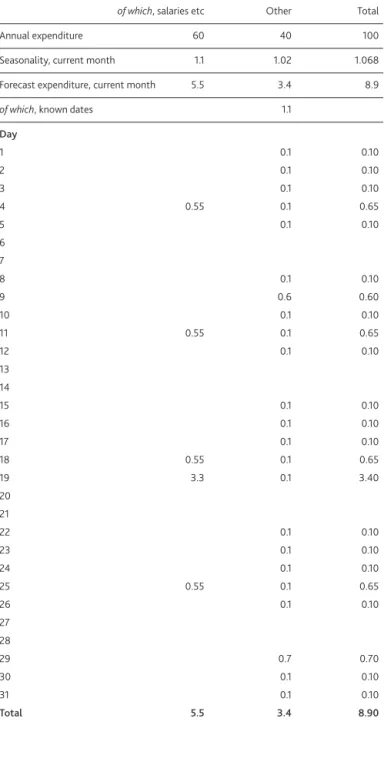
(17) Handbook No. 27 Liquidity forecasting. Expenditure on major one-off items should also be known reasonably accurately some weeks in advance, and accurately at least a few days in advance. It should be possible to instruct ministers and senior civil servants that authorisation of any payment above a certain level (X million currency units, or Y% of the budget) must be pre-notified to the Ministry of Finance treasury management unit. It may even be that such pre-notification is already required for budget management purposes, and what is needed is simply to copy the information to the Ministry of Finance treasury/cash management unit. If, for example, wages and salaries (including civil servants, hospital staff, military, pensioners and teachers) account for 60% of expected payments; and large one-off payments on known dates are expected to account for another 10%, then the forecast could start with the total monthly expenditure (using a known seasonal pattern(1) and budget data); input estimates for salaries and one-off payments on the known dates; and spread the remaining payments evenly — eg around 1.5% of total monthly expenditure on each working day of the month. For a given two or four week reserves maintenance period, this may be reasonably accurate. On the income side, accurate forecasts may be harder. But as indicated above, there may be some key dates and/or strong seasonality that can be used to help. For instance, corporate tax in many countries is due on a certain date each quarter. Income tax due from individuals may be received (or at least due) on a particular day of the month. The central bank might observe from examination of the relevant government accounts held at the central bank that X% of the expected income is usually paid on those dates, and that Y% is normally spread over the following few days. Economic development since the last budget might lead the central bank to adjust the total expected tax payments for the relevant period. This will assist it in converting a budget forecast for quarterly corporate tax income into a cash flow forecast for specific days in the future.. 15. does give rise to potentially tricky issues for the government, but can make the liquidity forecast easier. Issues include: • Should the government use all commercial banks, or just a few? How does it choose? If it stopped using a particular bank because of concerns about creditworthiness, could this cause the bank to collapse? • If there are state-owned banks, or dominant banks in general, should the government use the state-owned and/or large banks, which are possibly the strongest and have the largest branch network; or would this preserve their dominance and so prevent a growth in competition? • Should the government ask for collateral if it is keeping large balances with commercial banks; and if it does so, how might this impact secondary market liquidity for eligible assets? Some central banks set a limit either on the government’s balance with the central bank, or on short-term fluctuations in the balance eg France and Poland (Chart 6). Chart 6 Poland — government deposits at the central bank Polish Zloty, billions. 25. 20. 15. 10. 5. 0 Jan. Apr. July Oct. Jan. Apr. July Oct. Jan. Apr. July Oct. 2004 06 05 Source: National Bank of Poland.. As with expenditure items, large income flows expected on particular dates can be entered into the forecast, and other flows spread evenly through the forecast period. The ECB publishes on its website some institutional arrangements by country — see Annex 3 for an example of this. This indicates that in some countries government net flows across the books of the central bank do not cause any forecast problems,(2) while in others they can be both large and hard to forecast. To a large extent this will depend on institutional arrangements. For instance, if the government uses commercial banks for the majority of its banking transactions, both for holding cash balances and for making payments, these flows will not impact market liquidity and so do not need to be captured by the forecast. Such a practice. The UK government tasked its Debt Management Office with cash management as well, from 2000 (see Annex 4). Cash management is distinct from (longer-term) debt management, in that the former is necessary even if the government has a balanced budget and no debt (since income and expenditure will not be matched on a daily basis); while the latter need not be affected by short-term uncertainties in cash flow, but instead is driven by longer-term budget planning. Cash management is a treasury function, and still requires an accurate and timely forecast of government flows to be (1) The seasonality for salaries and pensions may be different to that for other items. If the two can be split out, this should allow for a more accurate forecast. (2) In some cases this is because the flows are small, with most government transactions going through commercial banks rather than the central bank..
(18) 16. Handbook No. 27 Liquidity forecasting. produced, as well as some form of dealing-room transactions to manage cash on both a very short-term and on a medium-term basis. But when conducted effectively, it means that the government net transactions across the books of the central bank are very small on a day-by-day basis. This substantially facilitates the central bank’s task of liquidity management.. Net foreign assets If the central bank’s exchange rate policy is genuinely for a free floating rate, the forecast for net foreign exchange transactions may be close to zero. The central bank will make occasional foreign exchange transactions on behalf of the government and other customers, but otherwise may not need to buy or sell foreign exchange. However, this situation is relatively unusual in practice.. Government guarantees Some governments find it hard to forecast cash flows relating to guarantees given to local government, state-owned enterprises or other state-supported bodies. This raises three issues: • If the government is fully guaranteeing a loan by another state body, it may make more sense for the government to borrow from the markets, and on-lend as necessary to that state body. By reducing the number of issuers, and bringing the borrowing into the ambit of the government’s overall debt management strategy, total borrowing costs should be reduced and market liquidity improved. • If central government, or government departments, do give guarantees, it is essential that proper procedures are followed. This would include: guarantees only to be given by duly authorised bodies, and following agreed procedures; and information on such guarantees to be reported to the Ministry of Finance so that central government has unified and complete data on the amounts and timing of any payments guaranteed. • On an ongoing basis, regular (eg quarterly) reporting should be provided on financial developments by any body which has received a guarantee, so that central government is not caught by surprise if a guarantee is called; and ad hoc reporting by any body in receipt of a guarantee if there is a deterioration in its financial position which might lead to the guarantee being called. In some countries where government guarantees are given, none of the above holds true. The Ministry of Finance may need to be pro-active in seeking out information, in establishing proper procedures, and possibly in refusing to cover any ‘guarantee’ which has not been properly authorised (this would give an incentive to lenders to be more cautious, and to ensure that central government was kept informed). Guarantees may be given for foreign exchange loans rather than domestic currency. This could lead to unexpected changes in net foreign exchange assets as well as government balances; but may mean there is no impact on domestic currency liquidity held by commercial banks (the fall in net foreign exchange assets could be offset by a reduction in the government’s deposit at the central bank).. If the central bank operates a T + 2 settlement for foreign exchange transactions, at least the very short-term forecast should be easy, since it will have two days’ notice of a transaction before it impacts on domestic currency liquidity. Some differentiation may be possible: the central bank could adopt a policy of T + 2 settlement as a rule; but allow or insist on T + 0 (if settlement issues do not prevent) for SFs using foreign exchange, or fine-tuning OMO (where the central bank particularly wants to impact liquidity conditions today). If the central bank has an exchange rate target, it may have little control over foreign exchange transactions, at least in the short term, although it may be able to forecast a trend. This relates to an important difference, from the point of view of liquidity management, between using an interest rate and an exchange rate tactical target. In the former case, the central bank can change the price/interest rate without needing to vary the volume of injection/withdrawal of domestic liquidity; but in the latter case it may need to vary the volume bought/sold in order to achieve the price target. This point is illustrated in Chart 7, showing the volume of US dollars sold by the Central Bank of Iraq in its daily foreign exchange auction.(1) There is clearly some seasonality in demand eg ahead of Ramadan. Increased consumption during Ramadan has an impact on net imports (to the extent consumption goods are imported) and thus on demand for foreign exchange. (There will also be an associated seasonality in cash demand.) More strikingly, in the last two months of 2006, when the central bank tightened monetary policy by appreciating the dinar by around 10% against the US dollars, the volume of sales reacted very strongly. The broad direction of the reaction was predictable: while the currency was appreciating, banks and their customers would want to hold on to dinar balances for as long as possible, in the expectation of buying US dollars more cheaply later on; and once the expected appreciation was largely complete, they would unwind their positions — so the volume of net sales fell sharply until the appreciation was largely complete, and then rose above longer-term trend levels for a period. But it seems unlikely that the central bank could have maintained the exchange rate ahead of Ramadan without varying the volume of its sales in line with market (1) The origins of the CBI’s foreign exchange auction are described in ‘A new currency for Iraq’, published by Central Banking Publications in 2005..
(19) Handbook No. 27 Liquidity forecasting. demand, or that it could have engineered an appreciation of the exchange rate without prompting a change in the volume of market demand. Chart 7 Iraq — FX auction volumes Auction volume US$. 17. sales.(1) If the central bank can detect seasonal patterns, and impose these on underlying trends in demand, it may obtain a reasonably accurate monthly forecast for net foreign exchange demand. In some cases, liaison with commodity exporting bodies (in many countries, commodity exports are handled by a centralised institution) may provide the central bank with useful information on the likely timing of future flows.. 14 day moving average 28 day moving average 91 per cent moving average, auction volume US$. US$ thousands. 140,000. Dinar appreciation 120,000 Ramadan 100,000 80,000 60,000 40,000 20,000. Apr.. May June July Aug. Sep. Oct. 2006. Nov. Dec. Jan.. Feb. 07. 0. Source: Central Bank of Iraq website.. From the point of view of liquidity management, this meant that the policy of currency appreciation resulted in large changes in domestic currency liquidity; whereas a parallel policy of increasing official interest rates would not necessarily have any impact on liquidity. In the short term, this need not be a problem. While domestic currency liquidity may increase in a way that is not fully predictable, if it is increasing because of a change in demand, it may be reasonable to assume that the two offset each other. The change in domestic currency balances does not necessarily imply a change in the volume of excess liquidity. Even if in general the central bank’s balance sheet is asset driven, the particular case described above reflects a liability-driven change. In the short term at least, this may not require a central bank response. If there is strong exchange rate pressure, it will be impossible for the central bank to forecast future purchases or sales accurately: the market is too unpredictable in times of stress. But under normal conditions — for instance, the first four months transactions in Chart 7 — the central bank may be able to forecast reasonably accurately the market’s net demand for foreign exchange. It will not be able to do so on a daily basis, since there are too many factors that affect very short-term demand. But it may observe trends in market demand. For instance, it may find that there are regular seasonal patterns. In some countries, imports rise ahead of key festivals, and this will impact the timing of demand. In others, export receipts for major items may be remitted on certain known days; or there may be a seasonal pattern to. It will also be useful for the central bank to understand what drives imports. To the extent that marginal imports are a response to changes in export earnings, then whether exports increase or decrease, the net demand for foreign exchange may be stable over time. The central bank will need to understand the lags involved — for instance, 75% of an increase in export revenues may feed though to import demand from one to three months later. Timely information on exports will help to forecast changes in net foreign exchange assets in coming months. But it is also possible that imports may be funded by bank borrowing. In this case, changes in bank lending may be a lead indicator of changes in imports, and thus in the market’s demand for foreign exchange. One might conclude that if foreign exchange operations are intended to influence the exchange rate, the price is (more or less) under the control of the central bank, but the volume will be determined by the market. They should therefore be treated as an autonomous item in the liquidity forecast. But if the transaction is not expected to influence the exchange rate, the volume is more likely to be controllable by the central bank, and should therefore be grouped with monetary operations — whether OMO or SF — in the liquidity forecast. Examples of this type of operation would include: • The Bank of Mexico regularly sells foreign exchange, in order to reduce the rate of growth of its foreign exchange reserves and the counterpart increase in domestic liquidity. The volume of sales is determined by net purchases of foreign exchange in preceding quarters, and the daily volume to be sold over the coming month is pre-announced. As the policy is clear and the volumes pre-announced, and because the market is deep, the actual sales do not impact the market exchange rate; and the volume is fully controlled by the central bank. • Foreign exchange swaps are used by a number of central banks. Their usefulness will vary depending on whether there is a surplus or a deficit of liquidity in the market, and on the level (if any) of dollarisation in the economy. But since they do not affect the underlying exposure of the market to foreign exchange, they should not affect the market exchange rate. (1) Weather will affect seasonal demand for oil and gas, and thus revenue for export/expenditure on import. Some crops have a clear season eg coffee beans; while others do not eg bananas..
Figure
Outline
Related documents
The strategy adopted in this paper for the automated detection of pulmonary nodules is based on the selection of nodule candidates by means of a stable 3D Mass–Spring Model
Brazil was divided into five different sub-regions according to area, population and national grid connections: South, São Paulo, Southeast, North, and Northeast. The regional
American Economic Review, American Political Science Review, Eastern Economic Journal, Economic Inquiry, Economic Journal, European Economic Review, European Journal of
u Auto-optimization of mailings according to opening rate, clicks and turnover (for ex- ample different variants are sent to a dif- ferent 10% of the mailing list respectively,
Office of the University Librarian Office of the University Librarian Collections & Access Services Research & Outreach Research & Outreach Special Collections
This significant reduction in size made it possible for HermiT to verify answer tuples in reasonable time; indeed, query answering for LUBM(40) is far beyond the capabilities of
The potential of our approach is illustrated below with animations of: (1) the position of the journal Social Networks among other journals in its citation impact environment
Darussalam Gontor dalam Tiga Bahasa,.... 34 جمنارب في ةيسينودنلإا ةلداعلما دهعم داتحا سيئرك يشكرز الله حتف لمأ ذاتسلأل ءاقللإا دادعإ داتحلا عامتجلاا
