Cleopatra Veloutsou, University of Glasgow George Christodoulides, Birkbeck, University of London
Submission: November 2015 Resubmission: February 2016
Resubmission: March 2016
The authors thank Spyros Gounaris, University of Strathclyde, and Nina Michaelidou,
Loughborough University, for their careful reading and suggestions. This work was supported by the Economic and Social Research Council [RES-000-22-3431]. Send correspondence to Kalliopi Chatzipanagiotou, University of Glasgow, Adam Smith Business School, The Gilbert Scott Building, Glasgow, G12 8QQ, Scotland, UK
([email protected]); Cleopatra Veloutsou, University of Glasgow, Adam Smith Business School, The Gilbert Scott Building, Glasgow, G12 8QQ, Scotland, UK (email: [email protected]); George Christodoulides, Department of
Management, Birkbeck, University of London, Malet Street, Bloomsbury, London WC1E 7HX, UK ([email protected]).
Abstract
Brand equity is a valuable (intangible) asset for firms. Research examines brand equity from the side of consumers, firms, or other stakeholders. Consumer-based brand equity focuses on consumers and represents positive business outcomes. Despite its importance, most extant literature focuses on brand equity as a construct, thus failing to recognize the complexity of the phenomenon. This study uses complexity theory and fuzzy set qualitative comparative analysis to put forth an empirically validated framework that shows consumer-based brand equity as a dynamic and sequential process consisting of three blocks: Brand building, brand understanding, and brand relationships. This study provides insights into the creation process of brand equity, and helps progress the discussion from a focus on brand equity as a construct to a focus on brand equity as a process.
Keywords: Brand equity; consumers; fuzzy set qualitative comparative analysis; brand management
1. Introduction
Researchers widely acknowledge brand equity as a key marketing performance indicator, a source of competitive advantage, and a vital component of business success (Christodoulides et al., 2015). Although brand equity may derive from various stakeholders, consumer-based brand equity (CBBE) dominates marketing research. Despite the merits of existing research, failure to simultaneously capture the complex, dynamic, and idiosyncratic nature of CBBE highlights the need for more holistic, advanced, and actionable CBBE models that yield additional insights into the creation of brand equity (Davcik et al., 2015).
The literature on CBBE almost exclusively focuses on brand equity as a construct. Several studies (see Buil et al., 2013) suggest CBBE is an outcome of its dimensions and linearly associate numerous dimensions with overall CBBE. However, treating this undoubtedly complex phenomenon as linear might lead to simplistic or distorted interpretations. Building on previous research (e.g. Woodside, 2014), this study adopts complexity and configural theory to examine CBBE as a dynamic and evolving processthat moves away from the logic that CBBE is a static and monolithic construct by shedding more light on the brand equity creation process. Academics rarely, and usually without empirical support, indicate that the development of CBBE is neither linear nor single pathway (Keller, 1993). However, the nature of the CBBE phenomenon suggests that many closely related brand concepts co-exist at different stages in the process (e.g., consumers’ perceptions, feelings, relationships, and dynamic interactions) and that interrelationships among these concepts may occur (Henderson et al., 1998; Krishnan, 1996). Thus, the present study
identifies CBBE as a complex system that includes separate development stages under which a sub-system of closely interrelated concepts lies, and empirically demonstrates the building blocks and various combinations that result in high CBBE.
The contribution of this study to the literature is threefold. First, the study captures the multi-dimensionality and dynamic nature of CBBE and introduces a new approach (i.e., fs/QCA) to examine brand equity. Second, by accounting for the complexity of relationships among CBBE components, the study empirically explains how these components contribute to the development of CBBE, offering a list of managerially actionable steps for the formation and management of CBBE. Third, the study considers the co-creation of brand value between consumers and the brand and incorporates consumers’ relationship with the brand as a
separate CBBE building block (Christodoulides & de Chernatony, 2010; Ding & Tseng, 2015).
2. Conceptual development
CBBE is “a set of perceptions, attitudes, knowledge, and behaviors on the part of consumers that results in increased utility and allows a brand to earn greater volume or greater margins than it could without the brand name” (Christodoulides & de Chernatony, 2010, p. 48). The majority of researchers examine CBBE as a memory-associative network, including brand information as “nodes.” Consumers’ brand nodes may reflect various consumer benefits or attributes, and relationships with the brand. The links between the nodes tend to be heavily idiosyncratic because of the plethora of brand sources over time and brand episodes and multiple pathways explaining how consumers link a specific node to another may occur (Krishnan, 1996). Thus, a CBBE conceptualization as a memory-associative network reveals causal complexity, asymmetry, and equifinality (more than one pathway to explain the subject under study) as major characteristics of CBBE. CBBE is a process with discrete evolutionary stages that include closely interrelated brand concepts and contribute through a “branding ladder” to creating a strong brand (Keller, 1993; Lehmann et al., 2008).
This research builds on the above to provide a more holistic, advanced, and
parsimonious model of CBBE by using complexity and configural theory, both suitable to uncover and decode the complexity, asymmetry, and equifinality that characterize CBBE (e.g., Ragin, 2008; Woodside, 2013, 2014). Specifically, this study identifies CBBE as an overall system with three major blocks or sub-systems: Brand building, brand understanding,
and brand relationship. Explaining the relationships among these blocks can help elucidate
the CBBE creation process. The CBBE process starts with brand building (input) activities to position the brand in the mind of the consumers. Consumers then respond in a cognitive-affective-conative sequence (Lavidge & Steiner, 1961) as brand understanding exemplifies, brand relationships and ultimately overall brand equity. Each sub-system includes closely interrelated brand concepts as shortcuts of information or nodes about consumers’ brand perceptions, evaluations, and feelings (Henderson et al., 1998; Keller, 1993). The model recognizes 15 nodes in the CBBE process that consumers should attain in each of the different development stages of CBBE. What follows is an explanation of each block.
2.1. The brand building block (BBB)
Brand equity describes the intangible asset that derives from a company’s brand-building efforts (Ambler et al., 2002). Brands contribute to product differentiation (Davcik & Sharma, 2015) by being unique and distinctive (Netemeyer et al., 2004). Companies want consumers to be able to think and describe the brand in real, material, and abstract terms; thus, they usually invest in brand positioning and create functional and non-functional attributes (Chen, 2001) or brand symbolic and functional utility (Koçak et al., 2007) to differentiate their offer. This brand-building approach is consistent with the two aspects of CBBE: The experiential (the brand’s imagery) and functional (perceptions of brand
the company’s brand-positioning efforts, which BBB encapsulates. A heritage brand, a nostalgic brand, and brand personality capture the experiential aspects of the BBB. Prior research identifies brand history (heritage and nostalgia) as one of the dimensions of brand value (Lehmann et al., 2008). A heritage brand contains “a dimension of … identity found in its track record, longevity, core values, use of symbols and particularly in an organizational belief that its history is important” (Urde et al., 2007, p. 4). Nostalgic brands are “part of the consumer’s history and related to particular memories” (Smit et al., 2007, p. 628), reminding consumers of parts of their lives. A strong brand personality is a dimension of brand equity (Veloutsou et al., 2013), whereas dimensions of brand personality can predict brand equity and make up brand associations (Buil et al, 2008). Rather than focusing on specific brand personality traits, this study assesses the brand personality appeal (Freling et al., 2011), which this study conceptualizes as the extent to which a brand has a strong, favorable, and distinct personality.
Perceived quality, brand leadership, and the brand’s competitive advantage capture the functional aspect of the BBB. Perceived quality is “the consumer’s judgment about a
product’s overall excellence or superiority” (Zeithaml, 1988, p. 3). As one of Aaker’s (1991) brand equity dimensions, perceived quality appears as a dimension of CBBE in scale
development studies for a long time (e.g., Yoo & Donthu, 2001), is a key component of CBBE (Veloutsou et al., 2013), and is arguably one of the functional aspects of BBB. Brand leadership, which the literature rarely acknowledges (e.g., Veloutsou et al, 2013), is the extent to which a brand dominates a respective category. Brand competitive advantage is consumers’ perceptions of a brand’s advantage over other brands in its category and results in higher financial performance (Hunt & Morgan, 1995).
Brand knowledge is a core component of brand equity not only because of the specific characteristics of the brand but also because of the uniqueness, strength, and favorability of associations (Keller, 1993). Consumers know, understand, and appreciate the features of strong brands (Lehmann et al., 2008).
BUB consists of awareness, associations, reputation, and self-connection. Brand awareness and brand associations are key features of Aaker’s (1991) model and widely appear in scale development research (e.g. Christodoulides et al, 2015; Yoo & Donthu, 2001). Brand awareness is “the ability of a potential buyer to recognize or recall that a brand is a member of a certain product category” (Aaker, 1991, p. 61). Brand associations refer to “anything linked in memory to a brand” (Aaker, 1991, p. 109). This study examines the strength and clarity of brand associations. Self-connection “reflects the extent to which the brand is part of the self, part of the self-image, and refers to the question whether the consumer and his or her brand have lots in common” (Smit et al., 2007, p. 628). Self-connection here is the consumers’ understanding and internalization of the brand positioning and characteristics, subsequently leading to the formation of consumer–brand relationships. Reputation is “the overall value, esteem and character of a brand as seen or judged by people in general” (Chaudhuri, 2002, p. 34), involves consumers’ assessment of the components of the brand and is a key part of brand understanding.
2.3. The brand relationship block (BRB)
Consumers and the brand co-create brand value (Christodoulides & de Chernatony, 2010; Ding & Tseng, 2015), and therefore the relationship between consumers and the brand is a key asset to strong brands (Strandvik & Heinonen, 2013). Despite relevant literature stressing the role of consumer–brand relationships in strengthening a brand, little empirical research incorporates relationships as such as a dimension of brand equity (Christodoulides et
al., 2006; Lehmann et al., 2008). All previous attempts include only one brand relationship dimension (e.g. Lehmann et al., 2008) and do not capture consumers’ emotional reactions to and personal feelings about the brand.
Partner quality, intimacy, trust, and relevance are the components of BRB. Partner quality refers to “the qualities of the partner in the relationship, and whether the brand takes good care of the consumer, shows interest and is reliable” (Smit et al., 2007, p. 628). Intimacy is the “psychological closeness between the relationship partners and the knowledge about the brand” (Smit et al., 2007, p. 628) and captures the emotional connection with the brand (Christodoulides et al., 2006) and the depth of the psychological consumer–brand bond (e.g., brand resonance; Broyles et al., 2010). Previous research treats both partner quality and intimacy as part of the consumer–brand relationship quality (Aaker et al., 2004; Smit et al., 2007). Trust is the “confident expectations of the brand's reliability and intentions” (Delgado-Ballester & Munuera-Alemán, 2005, p. 188) and some scale development attempts report trust, trustworthiness, or reliability of the brand as part of CBBE (e.g., Lassar et al., 1995). Relevance is the degree to which a brand is personally relevant to a consumer, at both a personal and a social level (Veloutsou et al., 2013).
2.4. Overall brand equity (OBE)
OBE is the strength of the brand, which overall preference and purchase intention primarily indicates (Buil et al., 2013; Yoo & Donthu, 2001). This construct captures brand preference, attachment, and loyalty, all concepts that research highlights as indicators of CBBE (e.g. Christodoulides et al., 2015; Yoo & Donthu, 2001).
The Venn diagrams in Figure 1 show the configural nature of the antecedent conditions within the different blocks, and the arrows indicate the major flows of configural relationships among them. Thus:
RP1. Sufficient configurations of the elements constituting BBB lead to high scores in the individual components of BUB.
RP2. Sufficient configurations of the elements constituting BUB lead to high scores in the individual components of BRB.
RP3. Sufficient configurations of the elements constituting BRB lead to high scores in CBBE. Because of the dynamic nature of CBBE and because major components of the brand building and understanding blocks relate to consumers’ relationship with the brand and, thus, CBBE, this study proposes:
RP4. Sufficient configurations of the elements constituting BBB directly contribute to produce high scores in BRB.
RP5. Sufficient configurations of the elements constituting BBB directly contribute to produce high scores in CBBE.
RP6. Sufficient configurations of the elements constituting BUB directly contribute to produce high scores in CBBE.
Figure 1 here.
3. Method
3.1. Data collection
To better understand the dimensionality of CBBE and to make measurement choices, the study carried out an extensive analysis of the literature and 15 semi-structured interviews with senior brand managers and consultants. Potential items that could capture the dimensions under investigation came from multiple studies. Additional items came from the interviews. These items were part of a pilot questionnaire that a panel of experts received (Hardesty & Bearden, 2004). Eight experts (senior academics with significant knowledge in the area of brand equity) rated the items on clarity and representativeness of the content domain. Of the
69 items in the initial item pool, 41 items survived, and formed the survey questionnaire. Four items come from Yoo and Donthu (2001) and measured OBE. The study measured all items on 7-point scales. The reliability analysis scores for each of the study’s scales (available on request) ranged from 0.74 to 0.99, well above the acceptable value of 0.70.
The data for the main study came from face-to-face interviews primarily in urban centers in the United Kingdom. The study set quotas for age and gender to ensure the sample was representative of UK residents. To increase the response rate, respondents could enter a drawing for one of two gift cards worth £100. This procedure produced 304 full
questionnaires. All respondents selected a category from a list of categories spanning goods (e.g., shampoo), services (e.g., coffee shop, bank), and the Internet (e.g., retailer) and identified their favorite brand from that category. They then responded to subsequent questions about that brand.
3.2. Data analysis
Preliminary symmetrical statistical tests identified the correlations among the study’s major concepts and the potential for contrarian cases to occur. Although positive and high, inter-correlations are below 0.80, suggesting that symmetrical relationships do not occur and the variables are apt for subsequent analysis (Woodside, 2013).
Quintile analysis then obtained a fine-grained examination of the relationships among the different pairs of constructs. The results indicate that negative and positive contrarian cases do occur. Thus, any attempt to focus only on the main effect between these variables would lead to a distorted picture of their relationship. In contrast, fs/QCA allows the inclusion of contrarian cases, with the goal of identifying the configurations of the antecedent
The first step in fs/QCA is data calibration, where the transformation of the variable raw scores into set measures occurs (Woodside & Zhang, 2013). Following the direct method of calibration (Ragin, 2008), the study used three qualitative anchors (1.0 = full membership, 0 = full non-membership, and 0.5 = the crossover point of maximum ambiguity regarding membership). For instance, for CBBE, the study set cases in the highest quintile equal to .95 membership (197 = 0.95), cases in the middle quintile at 0.50 (148 = 0.50), and calibrated cases in the lowest quintile at 0.05 (74 = 0.05). In a similar fashion, the study calibrated all the conditions of the conceptual framework. The study employs 0.80 as the minimum consistency threshold for consideration and only the configurations with a minimum of two cases in a “truth table” for further analysis.
To identify the elements of each block that are more relevant to the outcomes of interest, this study adopts Ragin and Fiss’s (2008) and Fiss’s (2011) rationale and notation of core and peripheral causal conditions. Core causal conditions are the conditions with strong evidence of a causal relationship to the outcome of interest, whereas peripheral conditions are those that contribute to the outcome but their role is weaker.
4. Results
4.1. Models of BBB predicting high scores in BUB outcomes (RP1)
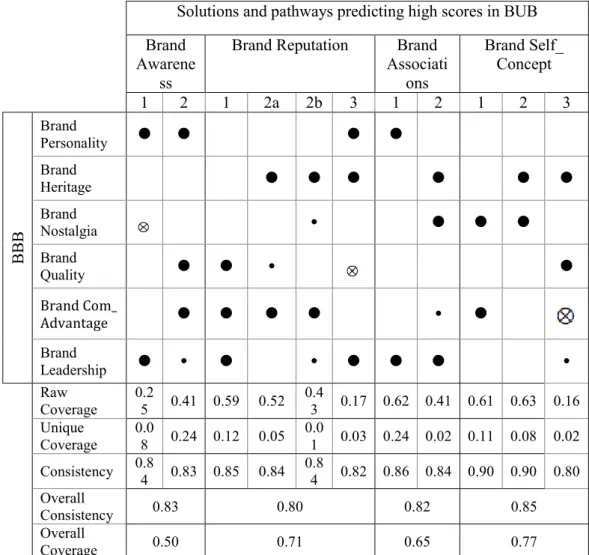
The results of intermediate solutions demonstrate that sufficient configurations of antecedent conditions from BBB lead to high scores in each of the components of BUB. Table 1 summarizes the derived core-periphery models, which indicate that both experiential and functional conditions contribute to the prediction of high scores in BUB outputs providing support to RP1.
Two solutions predict high scores in brand awareness, although solution 2 is the most empirically relevant, with raw coverage = 0.41 and unique coverage = 0.24. The results suggest that what makes consumers build brand awareness is a combination of a favorable brand personality, excellent brand quality, and strong brand advantage.
Although three solutions sufficiently produce brand reputation, the first two solutions are the most empirically relevant. Thus, for consumers to perceive a brand as highly
reputable, they must either tap into its strong functional characteristics (competitive
advantage, quality, and leadership) or focus on the brand’s heritage and strong competitive advantage (solutions 2a &b).
Two solutions generate strong brand associations, but the combination of a distinct, strong brand personality and the leading role of the brand in its category explain the majority of cases. The extent to which a brand dominates a respective category constitutes a core causal condition for both solutions leading to high scores in brand associations.
From the three solutions that lead to strong brand self-connection, the most empirically relevant suggests that brands should remind consumers aspects of their lives (nostalgic elements of the brand) in combination with either the brand’s strong competitive advantage or heritage (solutions 1 & 2).
4.2. Models of BUB and BBB predicting high scores in BRB outcomes (RP2 & RP4)
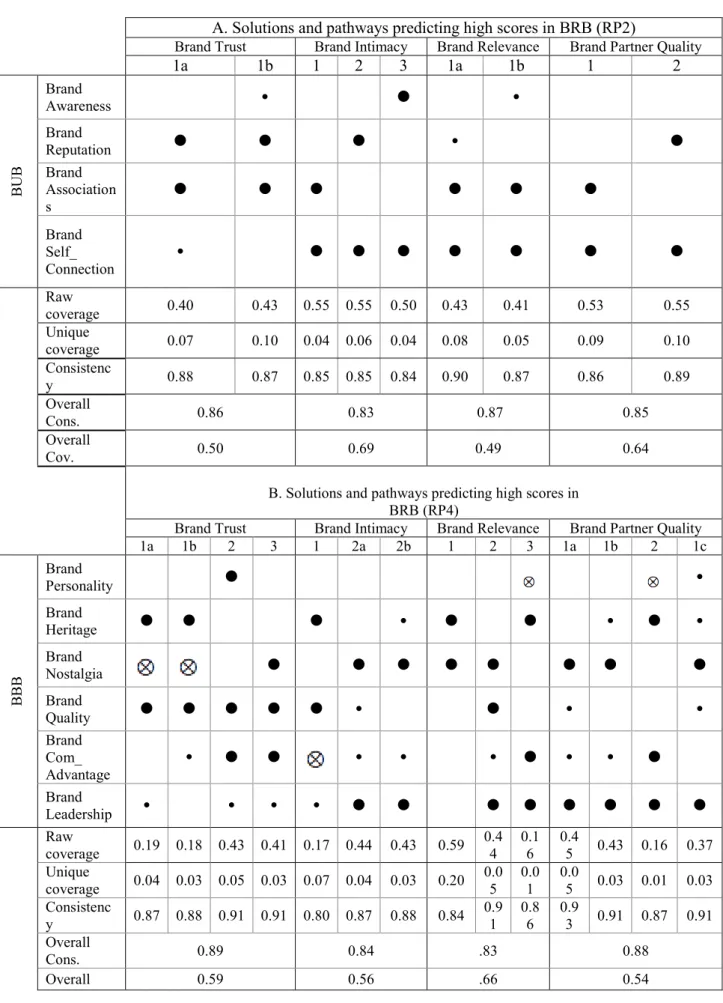
Table 2 summarizes the results for RP2 and RP4. Specifically, Table 2 (Panel A) includes the configurations of BUB antecedent conditions leading to high scores in each of the outcomes in BRB (RP2). Panel B (Table 2) demonstrates the configurations of BBB antecedent conditions generating high scores in each of the outcomes of BRB (RP4). All BUB and BBB conditions contribute to predicting high scores in BRB outputs, confirming RP2 and RP4, respectively.
Table 2 here.
To generate consumers’ relational components with the brand, such as intimacy, relevance, and partner quality, personal connection is a core causal condition. Conversely, for consumers to build trust in the brand, they largely depend on brand reputation and
associations. Specifically, consumers sense a brand’s trustworthiness only for brands with which they have previously developed strong and favorable associations. Consumers’
awareness of and self-connection with the brand contribute peripherally to facilitate this trust-building process.
All BUB conditions play a core role through three causal pathways for intimacy building. Consumers begin with their self-connection with the brand, which is a necessary condition, combining alternatively: Brand association (solution 1), or brand reputation (solution 2), or awareness (solution 3) to produce high scores in brand intimacy.
The results highlight brand associations and brand self-connection as core conditions generate high scores in consumers’ brand relevance when combined peripherally with either brand reputation (solution 1a) or brand awareness (solution 1b). For brand partnership, the results show the core combinatorial role of brand reputation, associations, and consumers’ brand connection. Awareness does not lead to high scores in consumers’ brand partnership.
The solutions for RP4 highlight brand quality as a necessary condition for high scores in brand trust. The results also indicate the different pathways of BBB components in
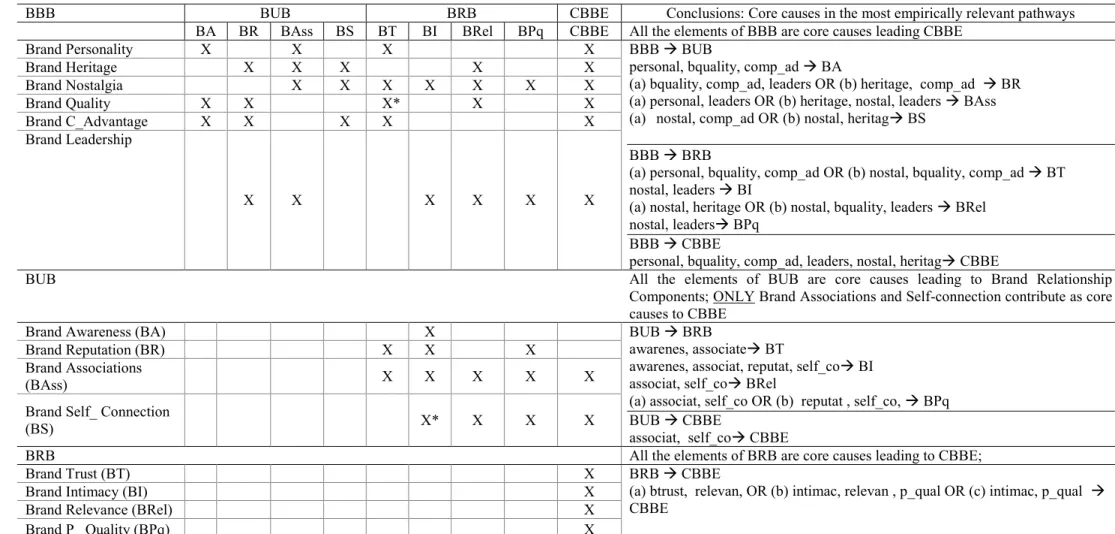
predicting each of the brand relationship outcomes. The study does not discuss all possible combinations because of space limitations; however, Table 4 presents the most empirically relevant combinations and synthesizes the study’s main results.
Table 3 summarizes the results of the models predicting high scores in CBBE.
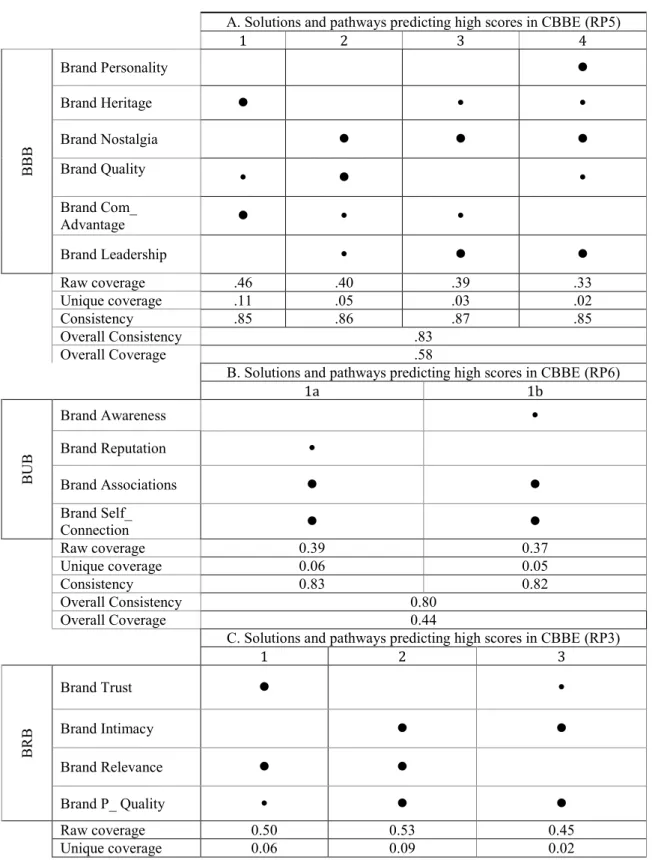
Consumers clearly take different paths to high CBBE. Table 3 (Panel A) presents four models of BBB conditions that lead to high CBBE. The results show that all causal conditions of BBB contribute in separate configurations to high scores in CBBE, providing support for RP5.
Table 3 here.
Consumers follow four alternative pathways in which the brand building components play a core causal role, albeit in different combinations. Both experiential- and performance-related characteristics contribute to the creation of CBBE. Consumers’ perceptions of brand heritage and competitive advantage (solution 1) or consumers’ focus on their personal history with the brand (brand nostalgia) and brand quality (solution 2), or brand nostalgia, in
combination with the core role of brand leadership (solution 3) constitute core pathways for CBBE. Brand nostalgia, clear perceptions of the brand personality, and consideration of the brand as leading in its category is another combination likely to result in high CBBE (solution 4).
The results highlight one solution of BUB conditions sufficiently predicts high scores in CBBE (Table 3, Panel B), providing support for RP6. Consumers’ favorable brand
associations and strong self-connection with the brand are core causal conditions for
predicting high CBBE when combined peripherally with either brand reputation (1a) or brand awareness (1b).
Three models support the core role of BRB conditions, which sufficiently predict high scores in CBBE (Table 3, Panel C) and provide support for RP3. All brand relationship components constitute core causes in predicting high CBBE, albeit in different combinations.
Additional tests further confirm complexity theory’s major tenets including the recipe
principle,equifinality principle and asymmetryprinciple (Woodside, 2014). To ensure the
solidarity of solutions, the study employs two alternative checks (Fiss, 2011): (1) The different frequencies of cases (one, three, and four cases) and (2) the different levels of consistency in solutions (0.81 to 0.90) and a series of robustness tests. The number of solutions is slightly different, but the overall interpretation of results remains substantively similar to the original solutions.
5. Discussion
The study contributes to branding theory and practice by proposing and empirically examining an advanced, holistic, and actionable CBBE model that moves away from the logic that CBBE is a static and monolithic construct. The study leverages the advantages of
complexity theory and fs/QCA to capture and synthesize the major tangible and intangible aspects of CBBE and decode the CBBE building process to provide directions and
implications for both academics and brand managers.
The proposed conceptual framework includes three “constellations” of conceptually close and interrelated concepts, which form three recognizable and concise blocks or sub-systems: BBB, BUB, and BRB. The results confirm the study’s research propositions, indicating that CBBE is the final outcome in a sequential, evolutionary causal chain that includes the above blocks and further suggests that each of them directly influences CBBE. The results show that with complex and dynamic phenomena such as CBBE, one solution does not fit all. The conceptual framework that this study proposes not only adds to the branding literature by shifting the discussion from brand equity as a construct to brand equity
as a dynamic and complex process but also provides unique advantages for brand managers
manager’s effort or strategy. Table 4 summarizes the study’s results providing a managerial roadmap for brand managers.
Specifically, BBB concepts pervade, through separate pathways, consumers’
understanding of and relationship with the brand, and also constitute core causes capable of predicting high levels of CBBE. Regarding BUB, all the constructs contribute to enhancing consumers’ relationship with the brand, though consumers’ self-connection and brand association constitute core for achieving high scores in CBBE. Brand awareness and reputation, even when buttressing consumers’ trust in the brand, contribute not directly but rather peripherally to the creation of strong CBBE. Finally, enhancing consumers’
relationship with the brand seems to be a great challenge (and opportunity) for brand managers because of the connection of BRB components as core causes to sustainable and strong CBBE.
In addition, managers can use the conceptual framework in multiple ways. For example, they could focus on the major blocks of this conceptualization to nourish the brand experiential and performance-related characteristics and enhance consumers’ relationship with the brand or they could focus on specific outputs such as brand reputation. To enhance brand reputation, the results highlight the importance of investing in a brand’s performance-related characteristics (brand quality, competitive advantage, and leadership). However, focusing on the combination of brand competitive advantage and brand heritage could be an alternative pathway to the creation of a highly reputable brand. Thus, the study sets the foundation for a more advanced and complex examination and perspective of CBBE, highlighting the usefulness of complexity theory and fs/QCA in data analysis and branding theory development and practice.
The replication of this study in different contexts (e.g., country, industry, period) would be particularly helpful for the conceptual framework's further testing and
establishment. Additionally, the detection of potential differences in the study’s CBBE configural model among groups of consumers with different demographic/psychographic characteristics would significantly extend knowledge of the brand equity process. Research that extends the findings by examining consumers’ unfavorable brands, rather than favorable brands that this study focuses on, would prove fruitful. Because CBBE is a dynamic and evolving process, future work examining the initial building stage of CBBE for new brands in the market and the longitudinal assessment of their CBBE development would shed new light on the whole process and its outcomes.
References
Aaker, D. A. (1991). Managing brand equity. Capitalizing on the value of brand name. New York, NY: Free Press.
Aaker, J., Fournier, S., & Brasel, A. (2004). When good brands do bad. Journal of Consumer
Research,31(1), 1–16.
Ambler, T., Bhattacharya, C.B., Edell, J., Keller, K., Lemon, K., & Mittal, V. (2002). Relating brand and customer perspectives on marketing management. Journal of Service Research, 5(1), 13–25.
Broyles, A., Leingpibul, T., Ross R., & Foster, B. (2010). Brand equity’s
antecedent/consequence relationships in cross-cultural settings. Journal of Product &
Brand Management, 19(3), 159–169.
Buil, I., de Chernatony, L., & Martinez E. (2008). A cross-national validation of the consumer-based brand equity scale. Journal of Product and Brand Management,
17(6), 384–392.
Buil, I., Martinez E., & de Chernatony, L. (2013). The influence of brand equity on consumer responses. Journal of Consumer Marketing, 30(1), 62–74.
Chaudhuri, A. (2002). How brand reputation affects the advertising-brand equity link. Journal
of Advertising Research, 42(2), 33–43.
Chen, A. C.-H. (2001). Using free association to examine the relationship between
characteristics of brand associations and brand equity. Journal of Product and Brand
Management,10(7), 439–451.
Christodoulides, G., Cadogan, J., & Veloutsou, V. (2015). Consumer-based brand equity measurement: lessons learned from an international study. International Marketing
Christodoulides, G., & de Chernatony, L., (2010). Consumer-based brand equity
conceptualisation and measurement. International Journal of Market Research, 52(1), 43–66.
Christodoulides, G., de Chernatony, L., Furrer, O., & Abimbola, T. (2006). Conceptualising and measuring the equity of online brands. Journal of Marketing Management,
22(7/8), 799–825.
Davcik, N., & Sharma, P., (2015). Impact of product differentiation, marketing investments and brand equity on pricing strategies. European Journal of Marketing, 49(5/6), 760– 781.
Davcik, N., Vinhas da Silva, R., & Hair, J. (2015). Towards a unified theory of brand equity: conceptualizations, taxonomy and avenues for future research. Journal of Product & Brand Management, 24(1), 3–17.
Delgado-Ballester, E., & Munuera-Alemán, J. L. (2005). Does brand trust matter to brand equity? Journal of Product & Brand Management, 14(3), 187–196.
Ding, C., & Tseng, T. (2015). On the relationships among brand experience, hedonic emotions, and brand equity. European Journal of Marketing, 49(7/8), 994–1015. Fiss, P. C. (2011). Building better casual theories: A fuzzy set approach to typologies in
organizational research. Academy of Management Journal, 54(2), 393–420.
Freling, T., Crosno, J., & Henard, D. (2011). Brand personality appeal: conceptualization and empirical validation. Journal of the Academy Marketing Science,39(3), 392–406. Hardesty, D. M., & Bearden, W. O. (2004). The use of expert judges in scale development:
Implications for improving face validity of measures of unobservable constructs.
Henderson, G. R., Iacobucci, D., & Calder, B. J. (1998). Brand diagnostics: Mapping branding effect using consumer associative networks. European Journal of
Operational Research, 111(2), 306–327.
Hunt, S. D., & Morgan, R. M. (1995). The comparative advantage theory of competition.
Journal of Marketing, 59(2), 1–15.
Keller, K.L. (1993). Conceptualizing, measuring, and managing customer-based brand equity.
Journal of Marketing, 57(1), 1–22.
Koçak, A., Abimbola, T., & Özer, A. (2007). Consumer brand equity in a cross-cultural replication: An evaluation of a scale. Journal of Marketing Management, 23(1/2), 157–173.
Krishnan, H. S. (1996). Characteristics of memory associations: A consumer-based brand equity perspective. International Journal of Research in Marketing, 13(4), 389–405 Lassar, W., Mittal, B., & Sharma A. (1995). Measuring customer-based brand equity. Journal
of Consumer Marketing, 12(4), 11–19.
Lavidge, R.J. & Steiner, G.A. (1961). A model for predictive measurements of advertising effectiveness. Journal of Marketing, 25(October), 59–62.
Lehmann, D. R., Keller, K. L., & Farley, J. U. (2008). The structure of survey-based brand metrics. Journal of International Marketing,16(4), 29–56.
Netemeyer, R.G., Krishnan, B., Pullig, C., Wang, G., Yagci, M., Dean, D., Ricks, J. & Wirth, F. (2004). Developing and validating measures of facets of customer-based brand equity. Journal of Business Research, 57(2), 209–224.
Ragin, C. C. (2008). Redesigning social inquiry: Fuzzy sets and beyond. Chicago, IL: Chicago University Press.
Ragin, C. C., & Fiss, P. C. (2008). Net effects analysis versus configurational analysis: An empirical demonstration. In C. C. Ragin (Ed.), Redesigning social inquiry: Fuzzy sets
and beyond (pp. 190–212). Chicago, IL: University of Chicago Press.
Smit, E., Bronner, F., & Tolboom, M. 2007. Brand relationship quality and its value for personal contact. Journal of Business Research, 60(6), 627–633.
Strandvik, T. M., & Heinonen, K. (2013). Diagnosing service brand strength: Customer-dominant brand relationship mapping. Journal of Service Management, 24(5), 502– 519.
Urde, M., Greyser, S., & Balmer, J. (2007). Corporate brands with a heritage. Journal of
Brand Management, 15(1), 4–19.
Veloutsou, C., Christodoulides, G., & de Chernatony, L. (2013). A taxonomy of measures for consumer-based brand equity: Drawing on the views of managers in Europe. Journal
of Product and Brand Management, 22(13), 238–248.
Wagemann, C., & Schneider, C. Q. (2010). Qualitative comparative analysis (QCA) and fuzzy-sets: agenda for a research approach and a data analysis technique. Comparative
Sociology, 9(3), 376–396.
Woodside, A. G. (2013). Moving beyond multiple regression analysis to algorithms: Calling for a paradigm shift from symmetric to asymmetric thinking in data analysis, and crafting theory. Journal of Business Research, 66(4), 463–472.
Woodside, A. G., & Zhang, M. (2013). Cultural diversity and marketing transactions: Are market integration, large community size, and world religions necessary for fairness in ephemeral exchanges. Psychology & Marketing, 30(3), 263–276.
Woodside, A. G. (2014). Embrace perform model: Complexity theory, contrarian case analysis, and multiple realities. Journal of Business Research, 67(12), 2495–2503.
Yoo, B., & Donthu, N. (2001). Developing and validating a multidimensional consumer-based brand equity scale. Journal of Business Research,52(1), 1–14.
Zeithaml, V.A. (1988). Consumer perceptions of price, quality, and value: A means-end model and synthesis of evidence. Journal of Marketing, 52(July), 2–22
Table 1. Core–periphery models of BBB predicting high scores in BUB (RP1)
Solutions and pathways predicting high scores in BUB Brand
Awarene ss
Brand Reputation Brand Associati ons Brand Self_ Concept 1 2 1 2a 2b 3 1 2 1 2 3 BBB Brand Personality
Brand Heritage
Brand Nostalgia
Brand Quality
Brand Com_ Advantage
Brand Leadership
Raw Coverage 0.2 5 0.410.590.52 0.43 0.170.620.410.61 0.63 0.16 Unique Coverage 0.08 0.24 0.12 0.05 0.01 0.03 0.24 0.02 0.11 0.08 0.02 Consistency 0.84 0.83 0.85 0.84 0.84 0.82 0.86 0.84 0.90 0.90 0.80 Overall Consistency 0.83 0.80 0.82 0.85 Overall Coverage 0.50 0.71 0.65 0.77Note: The black circles indicate the presence of a condition, and circles with “x” indicate its absence. The large circles indicate core conditions; the small circles indicate peripheral conditions. Blank spaces in a pathway indicate “don't care.”
Table 2. Core–periphery models of BBB and BUB predicting high scores in BRB
A. Solutions and pathways predicting high scores in BRB (RP2)
Brand Trust Brand Intimacy Brand Relevance Brand Partner Quality
1a 1b 1 2 3 1a 1b 1 2 B UB Brand Awareness
Brand Reputation
Brand Association s
Brand Self_ Connection
Raw coverage 0.40 0.43 0.550.550.50 0.43 0.41 0.53 0.55 Unique coverage 0.07 0.10 0.04 0.06 0.04 0.08 0.05 0.09 0.10 Consistenc y 0.88 0.87 0.85 0.85 0.84 0.90 0.87 0.86 0.89 Overall Cons. 0.86 0.83 0.87 0.85 Overall Cov. 0.50 0.69 0.49 0.64B. Solutions and pathways predicting high scores in BRB (RP4)
Brand Trust Brand Intimacy Brand Relevance Brand Partner Quality
1a 1b 2 3 1 2a 2b 1 2 3 1a 1b 2 1c B B B Brand Personality
Brand Heritage
Brand Nostalgia
Brand Quality
Brand Com_ Advantage
Brand Leadership
Raw coverage 0.19 0.18 0.430.410.170.440.43 0.59 0.4 4 0.1 6 0.4 5 0.430.160.37 Unique coverage 0.04 0.03 0.050.030.070.04
0.03
0.20 0.05
0.01
0.05
0.03
0.01
0.03
Consistenc y 0.87 0.88 0.91 0.91 0.80 0.87 0.88 0.84 0.91 0.86 0.93 0.91 0.87 0.91 Overall Cons. 0.89 0.84 .83 0.88 Overall 0.59 0.56 .66 0.54Cov.
Note: The black circles indicate the presence of a condition, and circles with “x” indicate its absence. The large circles indicate core conditions; the small circles indicate peripheral conditions. Blank spaces in a pathway indicate “don't care.”
Table 3. High scores in BBB, BUB and BRB predicting high scores in CBBE
A. Solutions and pathways predicting high scores in CBBE (RP5)
1 2 3 4 B B B Brand Personality
Brand Heritage
Brand Nostalgia
Brand Quality
Brand Com_ Advantage
Brand Leadership
Raw coverage .46 .40 .39 .33 Unique coverage .11 .05 .03 .02 Consistency .85 .86 .87 .85 Overall Consistency .83 Overall Coverage .58B. Solutions and pathways predicting high scores in CBBE (RP6)
1a 1b B UB Brand Awareness Brand Reputation Brand Associations
Brand Self_ Connection
Raw coverage 0.39 0.37 Unique coverage 0.06 0.05 Consistency 0.83 0.82 Overall Consistency 0.80 Overall Coverage 0.44C. Solutions and pathways predicting high scores in CBBE (RP3)
1 2 3 B R B Brand Trust
Brand Intimacy
Brand Relevance
Brand P_ Quality
Raw coverage 0.50 0.53 0.45 Unique coverage 0.06 0.09 0.02Consistency 0.83 0.82 0.82
Overall Consistency 0.80
Overall Coverage 0.62
Note: The black circles indicate the presence of a condition, and circles with “x” indicate its absence. The large circles indicate core conditions; the small circles indicate peripheral conditions. Blank spaces in a pathway indicate “don't care.”
Table 4. Synthesizing the results: Identifying the core causes in the CBBE development process
BBB BUB BRB CBBE Conclusions: Core causes in the most empirically relevant pathways
BA BR BAss BS BT BI BRel BPq CBBE All the elements of BBB are core causes leading CBBE
Brand Personality X X X X BBB BUB
personal, bquality, comp_ad BA
(a) bquality, comp_ad, leaders OR (b) heritage, comp_ad BR (a) personal, leaders OR (b) heritage, nostal, leaders BAss (a) nostal, comp_ad OR (b) nostal, heritag BS
BBB BRB
(a) personal, bquality, comp_ad OR (b) nostal, bquality, comp_ad BT nostal, leaders BI
(a) nostal, heritage OR (b) nostal, bquality, leaders BRel nostal, leaders BPq
BBB CBBE
personal, bquality, comp_ad, leaders, nostal, heritag CBBE
Brand Heritage X X X X X Brand Nostalgia X X X X X X X Brand Quality X X X* X X Brand C_Advantage X X X X X Brand Leadership X X X X X X
BUB All the elements of BUB are core causes leading to Brand Relationship
Components; ONLY Brand Associations and Self-connection contribute as core causes to CBBE
Brand Awareness (BA) X BUB BRB
awarenes, associate BT
awarenes, associat, reputat, self_co BI associat, self_co BRel
(a) associat, self_co OR (b) reputat , self_co, BPq BUB CBBE
associat, self_co CBBE
Brand Reputation (BR) X X X
Brand Associations
(BAss) X X X X X
Brand Self_ Connection
(BS) X* X X X
BRB All the elements of BRB are core causes leading to CBBE;
Brand Trust (BT) X BRB CBBE
(a) btrust, relevan, OR (b) intimac, relevan , p_qual OR (c) intimac, p_qual CBBE
Brand Intimacy (BI) X
Brand Relevance (BRel) X
Brand P_ Quality (BPq) X
X indicates the contribution of the condition as a core cause in the most empirically relevant models predicting the outcome of interest. * indicates the role of a cause as a N.C