On the Scalability of Real-Time Scheduling Algorithms on
Multicore Platforms: A Case Study
∗
Bj¨orn B. Brandenburg, John M. Calandrino, and James H. Anderson
Department of Computer Science, University of North Carolina at Chapel Hill
Abstract
Multicore platforms are predicted to become significantly larger in the coming years. Given that real-time workloads will inevitably be deployed on such platforms, the scalabil-ityof the scheduling algorithms used to support such work-loads warrants investigation. In this paper, this issue is con-sidered and an empirical evaluation of several global and partitioned scheduling algorithms is presented. This evalua-tion was conducted using a Sun Niagara multicore platform with 32 logical CPUs(eight cores, four hardware threads per core). In this study, each tested algorithm proved to be a viable choice for some subset of the workload categories considered.
1
Introduction
Most major chip manufacturers have embraced multicore technologies as a way to continue performance improve-ments in their product lines, given the heat and thermal problems that plague single-core chip designs. To date, sev-eral manufacturers have released dual-core chips, Intel and AMD each have quad-core chips on the market, and Sun’s Niagara and more recent Niagara 2 systems have eight-core chips with multiple hardware threads per core. In the future, per-chip core counts are expected to increase significantly. Indeed, Intel has announced plans to release chips with as many as 80 cores by 2011 [20].
With the arrival of multicore chips such as those just mentioned, multiprocessors are becoming commonplace in both servers and personal machines. This has led to renewed interest in multiprocessor real-time scheduling. In work on this topic, the greatest focus (by far) has been on algorith-mic issues. While clearly important, such research must be augmented by experimental efforts that address implementa-tion concerns. To facilitate this, our research group recently developed a Linux extension called LITMUSRT (LInux
Testbed forMUltiprocessorScheduling inReal-Time sys-tems), which allows different (multiprocessor) scheduling algorithms to be linked as plugin components [13, 16, 28]. LITMUSRThas been used by our research group to conduct
empirical evaluations of a variety of different scheduling policies [10, 11, 13] and synchronization protocols [12, 14].
∗Work supported by IBM, Intel, and Sun Corps., NSF grants CCF 0541056, and CNS 0615197, and ARO grant W911NF-06-1-0425.
Focus of this paper. All of the studies just cited were con-ducted using a conventional (not multicore) four-processor1
Intel SMP. While such a platform is probably sufficient for drawing valid conclusions about current multicore de-signs (as most have modest per-chip core counts), it is not large enough to expose scalability weaknesses that may arise as larger platforms become more common. It is also not sufficient for drawing conclusions about platforms that are architecturally very different from current Intel designs. Additionally, many multicore architectures have hardware features that make them quite different from conventional SMPs. Perhaps the most important such difference is the presence of on-chip shared caches, which can lessen task migration overheads.
Motivated by these observations, we present in this paper a case-study comparison of several multiprocessor schedul-ing algorithms that was conducted usschedul-ing a Sun UltraSPARC T1 “ Niagara” multicore platform. The Niagara is an inter-esting test platform for several reasons. First, it has 32 log-ical CPUs (eight cores and four hardware threads per core) and thus would certainly qualify as a “large” platform to-day. Second, it has features that are likely to be common in future multicore designs, such as hardware multi-threading and on-chip shared-cache support—in the case of the Ni-agara, a 3 MB L2 cache that is shared by all eight cores. Finally, each core on the Niagara is based on a RISC-like design that is quite different from current Intel designs.
In the study described herein, scheduling algorithms are compared on the basis of real-timeschedulability, assuming runtime overheads as measured under LITMUSRT on our Niagara test platform. Our usage of this particular test plat-form has enabled several commonly-raised questions to be addressed for the first time. For example: It is often claimed that global algorithms (see below) will not scale well with increasing processor counts due to run-queue length and contention—if the focus isschedulability, is this true? It is likewise often claimed that Pfair algorithms (again, see be-low) are not practical because they potentially migrate tasks frequently—on a multicore platform with shared caches, is this true? In addition to addressing these and other ques-tions, we also report on changes made to LITMUSRTto
re-base it to the Linux 2.6.24 kernel (from 2.6.20) and to port it
1We use the terms “core” and “processor” somewhat interchangeably. We often use “core” to emphasize that we are referring to a processor that is one of several on a single chip.
to the Niagara machine. Given the nature of the case study presented here, it is important to acknowledge that the scope of this paper isspecificallylimited to LITMUSRTas imple-mented on the Niagara. While we do comment on larger multicore chips that we expect other manufacturers such as Intel to release in the future, such comments must naturally be regarded as somewhat speculative at this point.
Scheduling algorithms considered. In this paper, we consider the schedulability of sporadic task systems. A spo-radic taskrepeatedly generates work to schedule in the form of sequentialjobs. A sporadic task system can be scheduled via apartitioned,global, orclusteredapproach. Under par-titioning, tasks are statically assigned to processors and each processor is scheduled separately. Under global scheduling, all jobs are scheduled using a single run queue, and inter-processor migration is allowed. In a clustered approach, tasks are partitioned onto clusters of processors, and within each cluster, assigned tasks are globally scheduled [3, 15].
In our study, we considered the global PD2 Pfair
al-gorithm [27] and partitioned, global (preemptive and non-preemptive), and clustered variants of the earliest-deadline-first(EDF) algorithm. Regarding schedulability, we consid-ered bothhardreal-time systems wherein deadlines should not be missed, andsoftreal-time systems wherein bounded deadline tardiness is permissible. As explained later, the al-gorithms considered in our study were selected for both the-oretical and pragmatic reasons.
Our methodology. The focus of this study is to compare the aforementioned algorithms in terms of schedulability considering real-world overheads. This was done via a four-phase approach: (i)we ported LITMUSRT to our Niagara
platform and implemented the algorithms under investiga-tion;(ii)once the system was stable, we ran several hundred (synthetic) task sets with randomly generated parameters on the test machine and recorded over 70 GB of raw system overhead samples;(iii)we analyzed the recorded overhead samples and distilled expressions for average and worst-case overheads; and(iv)we conducted simulations in which the schedulability of randomly-generated task sets was checked, with the overheads determined in Step (iii) taken into ac-count, using the best schedulability tests currently known for each tested algorithm.
Summary of results. In the first part of the paper, we de-scribe our efforts to port LITMUSRT to the Linux 2.6.24 kernel and our Niagara platform, and comment on a few newly-added extensions. In the second part of the paper we present our experimental results. As in the prior SMP-based study [16], we found that for each tested algorithm, sce-narios exist in which it is a viable choice. PartitionedEDF
usually performed best for hard real-time systems; clustered
EDFusually performed best for soft real-time systems. Per-haps most surprisingly, a “staggered” variant ofPD2 (see
Sec. 2) was among the best performing algorithms overall. Its good performance is due to the theoretical optimality of
PD2, which counterbalances the higher runtime overheads
of Pfair algorithms. This result calls into question the com-mon belief that global algorithms are not viable on platforms with more than just a few processors.
We present these findings later in Sec. 4 after first provid-ing needed background in Sec. 2 and describprovid-ing our modifi-cations to LITMUSRTin Sec. 3.
2
Background
We consider the scheduling of a system ofsporadic tasks,
T1, . . . , TN, onmprocessors. Thejthjob (or invocation) of
taskTiis denotedT j
i. Such a jobT j
i becomes available for
execution at itsrelease time,r(Tij). Each taskTiis specified by aworst-case(per-job)execution cost,e(Ti), andperiod,
p(Ti). JobTij should complete execution by itsabsolute deadline,r(Tij) +p(Ti); otherwise, it istardy. The spacing between job releases must satisfyr(Tij+1)≥r(Tij) +p(Ti);
if it further satisfiesr(Tij+1) = r(Tij) +p(Ti), thenTi is
calledperiodic. Task Ti’sutilizationorweightreflects the
processor share it requires and is given bye(Ti)/p(Ti). In this paper, we assume that tasks are independent and do not self-suspend.
Scheduling. Ahardreal-time (HRT) system is considered to beschedulable iff it can be shown that no job deadline is ever missed. Asoftreal-time (SRT) system is considered (in this paper) to be schedulable iff it can be shown that deadline tardiness is bounded. Any algorithm for checking schedulability necessarily depends on the scheduling algo-rithm being used and must be designed to account for over-heads that arise in practice, such as context-switching times, cache-related overheads,etc. Such overheads are typically accounted for by inflating per-job execution costs.
As noted earlier, multiprocessor retime scheduling al-gorithms can follow a partitioned, global, or clustered ap-proach. Below, we describe the representative algorithms from each category considered in our study. Note that we do not consider static-priority algorithms in this paper. This is intentional: such algorithms are inferior to those described below from the standpoint of schedulability generally [17], and cannot guarantee bounded tardiness without severely re-stricting overall utilization in the SRT case [19].
EDFscheduling. InEDFscheduling algorithms, jobs are scheduled in order of increasing deadlines, with ties broken arbitrarily. In this paper, we consider aclusteredpreemptive
EDF algorithm, denoted C-EDF, in which tasks are par-titioned onto clusters of processors and those within each cluster are scheduled globally within it. We also consider two special cases ofC-EDF:partitionedEDF, denoted P-EDF, where each cluster consists of only one processor, and
!"#$%"&&'!()*+,-(".$(/ 0123)(2$")4,+*"+&%.* 0123)(2$")4,#*&*")* 5#167,8 5#167,9 : : : ; 8 9 < = > ? (c) ; 8 9 < = > ? @ : : : (a) ; 8 9 (b)< = > ? @ : : : 8 9 < < 9 8 8 9 <
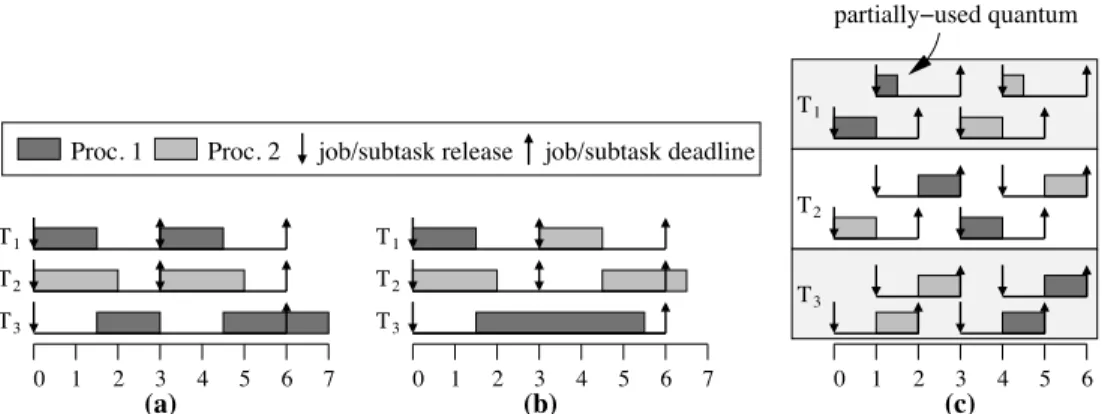
Figure 1: (a)G-EDF,(b)G-NP-EDF, and(c)PD2
schedules of a two-processor system with three tasks:T1, with an execution cost
of1.5and period of3.0,T2with an execution cost of2.0and a period of3.0, andT3with an execution cost of4.0and a period of6.0.
one cluster. In addition to these preemptive algorithms, we consider non-preemptiveG-EDF, denotedG-NP-EDF. Non-preemptive algorithms allow task migrations, but once a job commences execution on a processor, it runs to com-pletion on that processor without preemption. Thus, jobs
may not migrate.
Partitioning algorithms require that a bin-packing prob-lem be solved to assign tasks to processors. As a result, there exist task systems with total utilization slightly higher than
m/2 that no such algorithm can schedule,even if bounded deadline tardiness is allowed[19]. Thus, underP-EDF, re-strictive caps on total utilization are required to ensure tim-ing constraints, for both HRT and SRT systems. Similar caps are required forG-EDFin the HRT case. However, in the SRT case,G-EDFensures bounded deadline tardiness, as long as total utilization is at mostm[19]. The same is true
ofG-NP-EDF, which is significant, because under it,
over-heads are lower (since jobs do not migrate). C-EDFwas proposed as a compromise betweenP-EDFandG-EDFfor large multicore platforms in which some cores share a high-level cache, while others share only a low-high-level cache (or no cache) [15]. In such a platform, it is best to consider each set of cores that share a high-level cache to be a “cluster.” In this way, lower migration costs can be ensured than forG-EDF
and the bin-packing limitations ofP-EDFare ameliorated. Regarding the latter, note that each cluster is viewed as a bin; thus, clustering increases bin sizes and decreases the number of bins, which makes bin-packing easier.
Pfair scheduling. Pfair scheduling algorithms [6, 26] can be used to optimally schedule HRT (and thus SRT) systems, provided all timing parameters are multiples of the system’s quantum size. The term “optimal” means that no deadline is missed when scheduling any feasible system (i.e., any sys-tem with total utilization at mostm). In a Pfair algorithm, a jobTijof a taskTiof weightwt(Ti)is scheduled one quan-tum at a time in a way that approximates anidealallocation in which it receivesL·wt(Ti)time over any interval of length
Lwithin[r(Tij),r(Tij) +p(Ti)). This is accomplished by
sub-dividing each task into a sequence of quantum-length
subtasks, each of which must execute within a certain time
window, the end of which is its deadline. Subtasks are scheduled on anEDFbasis, and tie-breaking rules are used in case of a deadline tie. A task’s subtasks may execute on any processor, but not at the same time (tasks are sequen-tial). In this paper, we consider thePD2[1, 26] algorithm,
which is the most efficient known optimal Pfair algorithm, and a variant of it calledstaggeredPD2(S-PD2) [23].
Un-derPD2 (and most other Pfair algorithms), quanta are
as-sumed to align across processors, i.e., all processors cross the same quantum boundary at the same time. With S-PD2, quanta are staggered across processors,i.e., quantum
boundaries are spread out evenly across a full quantum. Un-der bothPD2 andS-PD2, if a task is allocated a quantum
when it requires less execution time, the unused part of the quantum is “wasted.” In contrast, under theEDFschemes considered above, such a task would relinquish its assigned quantum “early,” allowing another task to be scheduled.
Example. To see some of the differences in the algo-rithms described above, consider Fig. 1, which depicts two-processor G-EDF, G-NP-EDF, and PD2 schedules for a
system of three tasks,T1,T2, andT3, as defined in the
fig-ure’s caption. There are several things worth noting here. First, these three tasks cannot be partitioned onto two pro-cessors, so this system is not schedulable underP-EDF(so we do not depict a schedule for this case). (Recall that C-EDFgeneralizes bothG-EDFandP-EDF.) Second, under each ofG-EDFandG-NP-EDFa deadline is missed. Third, in theG-NP-EDFschedule in inset (b), taskT2’s second job
cannot execute at time 3 sinceT3’s job must execute
non-preemptively (there is actually a deadline tie here). Fourth, each task has the same window structure in inset (c). For tasksT2 andT3, this is easily explained: a task’s window
structure is determined by its weight and both of these tasks have a weight of 2/3. As for taskT1, under Pfair scheduling,
windows are defined by assuming that each task’s execution cost is an integral number of quanta. Thus, we must round
upT1’s cost to 2.0, giving it a weight of 2/3. Because of this,
some quanta allocated to taskT1are only half-used. Earlier experimental study. In the earlier SMP-based study [16], all of the algorithms described above were con-sidered, exceptC-EDF. In this prior study,P-EDFandPD2
tended to be the best choices for HRT workloads. This is due to the lower runtime overheads ofP-EDF(because tasks do not migrate and processors are scheduled using uniprocessor algorithms) and the optimality ofPD2. For SRT workloads,
G-EDFandG-NP-EDFwere usually preferable. This is
be-cause these algorithms do not require restrictive utilization caps in this case, and on the platform considered in [16], were found to have lower runtime overheads than Pfair al-gorithms. In this paper, we seek to re-examine these algo-rithms on a “large” multicore platform with shared caches and also determine the viability of clustered approaches.
3
Implementation
Before presenting our experimental results, we briefly dis-cuss our efforts in re-basing LITMUSRT to Linux 2.6.24,
porting it to the Niagara, and adding clustered-scheduling support.
LITMUSRT design. The pre-existing LITMUSRT code base that was modified is based on Linux 2.6.20. A detailed description of that LITMUSRTversion can be found in [13]. Here, we provide a brief description. LITMUSRThas been implemented via changes to the Linux kernel and the cre-ation of user-space libraries. Since LITMUSRTis concerned with real-time scheduling, most kernel changes affect the scheduler and timer-interrupt code. The kernel modifica-tions can be split into roughly three components. Thecore infrastructureconsists of modifications to the Linux sched-uler, as well as support structures and services such as trac-ing and priority queues. The schedultrac-ing policies are imple-mented asscheduler pluginsthat provide functions that im-plement needed scheduling-related methods. Finally, a col-lection ofsystem callsprovides an API for real-time tasks to interact with the kernel. This basic structure has been re-tained in the new version of LITMUSRT. Some of the more notable changes are discussed next.
Integrating with the new Linux scheduler. The new Linux scheduler, introduced in version 2.6.23, selects a task to schedule by traversing a list ofscheduling classes
and selecting the highest-priority task from the first non-idle class. In stock Linux, there are three classes: POSIX RT, CFS, and IDLE (listed in order of decreasing priority). We integrated LITMUSRTwithin Linux by inserting a new
LITMUSRT scheduling class as the top scheduling class.
Thus, jobs scheduled by LITMUSRT always have higher
priority than other (background) jobs.
While scheduling classes provide a basic extension mechanism, implementing global schedulers is still diffi-cult because Linux fundamentally assumes partitioning— all changes to a task’s state are serialized through the lock that protects the run queue where the task resides (there is one run queue per processor). Thus, in order for a task to migrate, two run queue locks (source and target run queue) must be held. The LITMUSRT core needs to
mi-grate a task when a global scheduler plugin selects a real-time task that has executed previously on a different proces-sor. However, the Linux scheduler acquires the local (tar-get) run queue lockbeforeinvoking the scheduling classes. If the LITMUSRT migration code were to simply acquire the source’s run queue lock, then deadlock could quickly ensue. Instead, the local run queue’s lock must be released before both locks can be acquired together (in a specific or-der). This creates a race window, between the invocation of the active plugin and the actual context switch, in which the state of both local tasks and the migrating task can change. For example, if the previously-scheduled task blocked (pos-sibly due to loading shared libraries, etc.) and resumes in the short time while its run queue lock is available, then it may not be noticed by the scheduler and be “forgotten” (i.e., it may never be scheduled again) since the stock Linux scheduler does not expect tasks to resume while scheduling is in progress (the run queue lock normally protects against this scenario). Such untimely task state changes and similar races can be detected (and properly handled) by examining the state of the involved tasks prior to releasing and after reacquiring the local run queue lock.
Job releases. Sporadic job releases are now controlled through the use of the high-resolution timers that were intro-duced in version 2.6.16 of Linux. Such timers allow events to occur at an exact time as the result of a timer interrupt. The times at which events can be specified to occur is limited only by the precision and accuracy of the underlying timer hardware. As a result, job releases can now occur within a few hundred nanoseconds of any specified release time, and periods do not have to be a multiple of the quantum size.
Quantum alignment. In Linux, a quantumis defined to be the interval between twoticks, which are periodic timer interrupts. In LITMUSRT, the quantum length is set at1ms. Some scheduling policies implemented in LITMUSRT(e.g.,
PD2) require that quanta are aligned across CPUs. This
pro-vides a unified and consistent notion of time across the sys-tem. The Linux kernel uses high-resolution timers (when such hardware is available) to set up a periodic tick on each CPU in such a way that interrupts are uniformly distributed over the first half of the tick length—the result is a form of staggered quanta. We modified the tick initialization code to optionally have ticks occur at the same time on each CPU, resulting in aligned quanta, or to stagger them evenly
across entire quanta. The choice between aligned or stag-gered quanta is made at boot time.
Clustered scheduling. Clustered scheduling was imple-mented as a hybrid of the existingG-EDFandP-EDF plug-ins. Individual ready queues are used as inP-EDF, but with one ready queue per cluster. Within each scheduling do-main, theG-EDFimplementation is used to make schedul-ing decisions. In the current implementation, a cluster con-sists of the four hardware threads of one core (since they share an L1 cache). In the rest of the paper, references to
“C-EDF” are assumed to refer to this variant. In a future
version, we plan to support runtime changes to the cluster size (when there is no real-time workload present).
Other LITMUSRT updates. Various other updates have
taken place since the last revision of LITMUSRT. These up-dates include the following. First, we now allow scheduling policies to be changed without rebooting whenever there is no real-time workload present. Second, task execution costs and periods are now specified in nanoseconds, so that more accurate methods of handling job releases and task overruns can be employed (such as the use of high-resolution timers for job releases, discussed earlier). Third, for increased timing accuracy, the notion of time used in LITMUSRT is
now that provided by the high-resolution timers. Fourth, we now allow both processes and threads to be used to de-fine LITMUSRTtasks—processes have independent address
spaces, while threads share the same address space. Fifth, we rewrote thePD2plugin to enable sporadic job releases
(previously, only periodic tasks were supported). Sixth, we implemented FIFO ticket locks for thesparc64 architec-ture (stock Linux provides ticket locks only on Intel’sx86
architecture). Seventh, we introduced proper support for synchronous and asynchronous task-system initialization. The new API allows real-time tasks to finish their initializa-tion and then wait for the task-system release (phases can be specified for tasks to support asynchronous releases). In pre-vious versions of LITMUSRT, a more ad hoc approach was used that involved transitioning the system between non-real-time and non-real-time mode.
Niagara-related challenges. In performing the above changes, several Niagara-related challenges arose. First, several Linux tools that are typically used for debugging were either not available or broken on the Niagara. (These problems will hopefully be fixed in mainline Linux soon.) Most notable waslockdep, a debugging facility that de-tects potential causes of kernel deadlock at runtime. An alternative is to use netconsole, which allows debug-ging messages to be sent to another machine before the local console freezes (bugs in scheduling code often bring down the system before any debug output can be written locally). However,netconsolecould not be reliably used due to memory management bugs in the underlying network driver.
Second, the Niagara uses a weak memory consistency model. To deal with this, memory barrier instructions had to be added to the existing LITMUSRTcode. Finally, the dif-ferent architecture, higher degree of parallelism, and slower core speeds of the Niagara (as compared to our prior SMP testbed) caused several race conditions to be exposed that were actually present in the pre-existing LITMUSRT code
base (but never triggered in testing). Dealing with all of these various issues was made more challenging by the lack of good debugging support.
4
Experiments
In this section, we report on the results of experiments con-ducted using LITMUSRT to compare the scheduling
algo-rithms introduced previously. We compared these algo-rithms on the basis of both schedulability and tardiness, un-der consiun-deration of various overheads determined empiri-cally on our test platform.
4.1
Overheads
In real systems, task execution times are affected by the fol-lowing sources of overhead. At the beginning of each quan-tum,tick scheduling overheadis incurred, which is the time needed to service a timer interrupt. When a job is released,
release overhead is incurred, which is the time needed to service the interrupt routine that is responsible for releasing jobs at the correct times. Whenever a scheduling decision is made, ascheduling overheadis incurred, which is the time taken to select the next job to schedule. Whenever a job is preempted,context-switching overheadis incurred, as is ei-therpreemptionormigration overhead; the former term in-cludes any non-cache-related costs associated with the pre-emption, while the latter two terms account for any costs due to a loss of cache affinity. Preemption (resp., migration) overhead is incurred if the preempted job later resumes exe-cution on the same (resp., a different) processor.
Limitations of real-time Linux. To satisfy the strict def-inition of HRT, all worst-case overheads must be known in advance and accounted for. Unfortunately, this is currently not possible in Linux, and it is highly unlikely that it ever will be.2This is due to the many sources of unpredictability within Linux (such as interrupt handlers and priority inver-sions within the kernel), as well as the lack of determinism on the hardware platforms on which Linux typically runs. The latter is especially a concern, regardless of the OS, on multiprocessor platforms. Indeed, research on timing anal-ysis has not matured to the point of being able to analyze
2By “Linux,” we mean modified versions of the stock Linux kernel with improved real-time capability, not paravirtualized variants such as RTLinux [29] or L4Linux [22], where real-time tasks are not actually Linux tasks. Stronger notions of HRT can be provided in such systems, at the ex-pense of a more restricted and less familiar development environment.
Plugin Tick AVG Schedule AVG Context Switch AVG Release AVG PD2 4.336 + 0.026N 4.667 2.597 + 0.001N — S-PD2 2.169 + 0.016N 4.247 2.539 + 0.001N — G-EDF 2.080 + 0.002N 11.836 + 0.056N 7.550 5.840 + 0.127N C-EDF 2.863 6.080 + 0.010N 3.174 16.533 P-EDF 2.059 + 0.002N 2.678 + 0.008N 4.728 + 0.005N 3.952 + 0.005N
Plugin Tick WC Schedule WC Context Switch WC Release WC
PD2 11.271 + 0.301N 31.720 3.107 + 0.010N — S-PD2 4.838 + 0.321N 43.182 3.219 + 0.003N — G-EDF 3.043 + 0.003N 55.284 + 0.263N 29.233 45.025 + 0.314N
C-EDF 3.230 14.758 + 0.011N 6.077 30.347 P-EDF 2.727 + 0.002N 8.565 + 0.014N 14.917 + 0.036N 4.727 + 0.009N
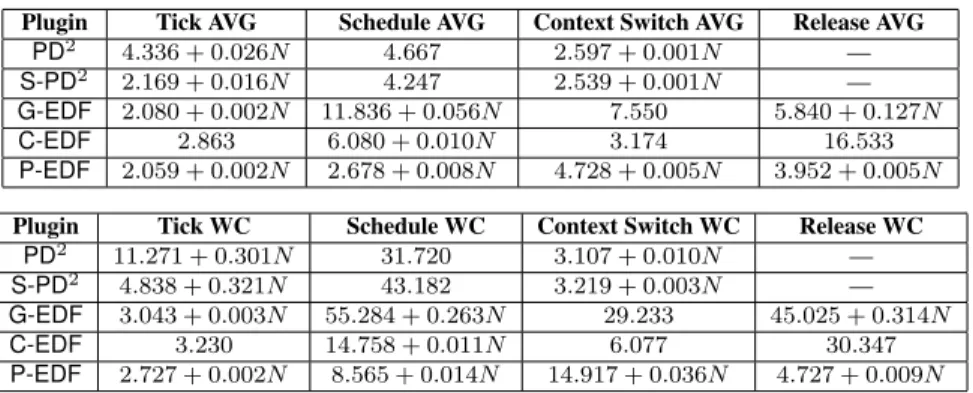
Table 1: Measured average (SRT) and worst-case (HRT) kernel overheads, inµs. Nis the number of tasks. In ourPD2andS-PD2
implementation, periodic tasks do not incur release overheads (see Sec. 4.4).
complex interactions between tasks due to atomic opera-tions, bus locking, and bus and cache contention. Despite these observations, there are now many advocates of using Linux to support applications that require some notion of real-time execution. As noted by McKenney [25],
I believe that Linux is ready to handle applications requiring sub-millisecond process-scheduling and interrupt latencies with 99.99+ percent proba-bilities of success. No, that does not cover ev-ery imaginable real-time application, but it does cover a very large and important subset.
Our objectives in designing LITMUSRT are in agreement with McKenney’s viewpoint.
Measuring overheads. Given the comments above about timing analysis, overheads must be determined experimen-tally. Doing so is not as easy as it may seem. In particular, in repeated measurements of some overhead, a small number of samples may be “outliers.” This may be due to a variety of factors, such as warm-up effects in the instrumentation code and the various non-deterministic aspects of Linux it-self noted above. In light of this, we determined each over-head term by discarding the top 1% of measured values, and then taking the maximum (for HRT) or average (for SRT) of the remaining values. This same approach was used previ-ously in [14]. We believe that this is approach is reasonable, given the way in which Linux-based systems are likely to be used in supporting real-time workloads. Moreover, the ob-tained overheads should be more than sufficient for obtain-ing a valid comparison of different schedulobtain-ing approaches, which is our main focus.
All overheads were measured on the Sun Niagara (Ul-traSPARC T1) system mentioned earlier. The Niagara is a 64-bit machine containing eight cores on one chip running at 1.2 GHz. Each core supports four hardware threads. On-chip caches include a 16K (resp., 8K) four-way set associa-tive L1 instruction (resp., data) cache per core, and a shared, unified 3 MB 12-way set associative L2 cache. Our test sys-tem is configured with 16 GB of off-chip main memory. In
contrast to Sun’s upcoming Niagara-successor “Rock,” our first-generation Niagara does not employ advanced cache-prefetching technology.
Below, we discuss the overheads that were measured. In this discussion, G-NP-EDF is not considered because it shares a common implementation with G-EDF (non-preemptivity is enabled by simply setting a flag [13]) and thus they have the same overheads.
Kernel overheads. We obtained kernel overheads by en-abling aligned quanta and measuring the system’s behavior for periodic task sets consisting of between 50 and 450 tasks in steps of 50. For each scheduling algorithm and task-set size, we measured ten task sets generated randomly (as de-scribed in Sec. 4.2), for a total of 90 task sets per scheduling algorithm. Each task set was traced for 30 seconds. We repeated the same experiments with staggered quanta. In total, more than 45 GB of trace data and 600 million indi-vidual overhead measurements were obtained during more than seven hours of tracing.
For each overhead term, we plotted all measured values for both aligned and staggered quanta as a function of task-set size (discarding outliers, as discussed above). We noted that average overheads were substantially less for staggered quanta. This is due to reduced bus/lock contention in this case (since kernel invocations become more spread out). Given that we assume average overheads for SRT systems, we opted to use average overheads obtained with staggered quanta for SRT systems (except forPD2). Staggering causes
an additional quantum of potential tardiness, which we re-garded to be of negligible impact. As tardiness should be zero in HRT systems, worst-case overheads were defined assuming aligned quanta (except for S-PD2). When
plot-ted, most overheads showed a clear linear trend. To cap-ture these trends, we computed expressions for maximum and average values using linear regression analysis. For the few overheads where measurements did not reveal a conclu-sive trend, we assumed a constant value equal to the max-imum observed value. All kernel overhead expression so computed are shown in Table 1.
Overall Preemption Intra-Cluster Migr. Inter-Cluster Migr.
Algorithm AVG WC AVG WC AVG WC AVG WC
PD2 172.05 681.11 131.46 649.43 141.82 654.22 187.62 681.11
S-PD2 89.396 104.13 86.214 103.37 87.844 103.44 90.233 104.13
G-EDF 73.047 375.44 95.196 375.44 73.454 326.82 72.592 321.14
C-EDF 67.047 171.62 78.507 171.62 64.772 167.34 — —
P-EDF 72.362 139.12 72.362 139.12 — — — —
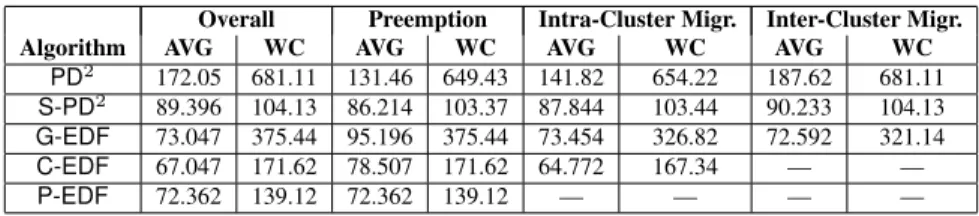
Table 2:Measured average (SRT) and worst-case (HRT) preemption and migration costs, inµs. Note that, whilePD2,S-PD2, and G-EDFare not clustered algorithms, we still distinguish between migrations within a cluster (staying on the same core) and across clusters (moving to a different core). In our schedulability experiments, the “overall” figures were used since in global algorithms it is generally not possible to predict if a preempted task will migrate.
Preemption and migration overheads. To measure the impact of losing cache affinity, we ran a number of task sets under LITMUSRT in which each job repeatedly accesses a 64K working set (WS) while maintaining a 75/25 read/write ratio. We found that 64K WS sizes produced significant differences in the overheads measured for each algorithm. We considered larger WS sizes to be unreasonable given the memory access times and shared cache size of our platform. Smaller WS sizes would likely result in smaller overheads and better overall performance for global policies, but are not considered here—thus, our experiments could be seen as being biased towards partitioning.
After the first access by a job of its entire WS, subsequent references are cache-warm, until a preemption or migration occurs. Tasks were instrumented to detect and record these situations and the corresponding access times for the entire WS. The time to reference the WS immediately after resum-ing execution, minus the time to reference the WS when it is cache-warm, gives the cost of the preemption or migra-tion (depending on whether the corresponding job resumed on a different CPU) that occurred. In total, over 105 mil-lion preemption and migration overheads were recorded for task sets consisting of between 50 and 450 tasks run for 60 seconds each. Again, we measured a total of 90 task sets per scheduling algorithm. (Aligned quanta were used for all algorithms exceptS-PD2. Quantum placement does not
affect preemption behavior inEDFschemes.) As noted ear-lier, we determined overheads for HRT (resp., SRT) systems by taking the maximum (resp., average) of the recorded val-ues after discarding the top 1% of measured valval-ues. In the case of preemption/migration overheads, we also discarded any value that clearly was not correctly measured (e.g., due to a preemptionwhilemeasuring an overhead).
Table 2 indicates that the preemption and migration over-heads are considerably higher than in the Intel platform con-sidered in the earlier SMP study [16]. The Niagara does not perform any branch prediction or attempt to hide costs due to memory latency or pipeline stalls by allowing out-of-order instruction execution. Hardware multi-threading is intended as the main mechanism for alleviating these costs. How-ever, while hardware multi-threading may increase overall throughput, it does not improve the performance of a single
sequential task. These costs, combined with the low
per-core clock frequencies relative to most Intel platforms, cause the Niagara to execute tasks much slower than any current Intel platform even in the absence of preemptions and mi-grations.
Note that, while the Niagara contains a shared on-chip lower-level cache, the size of this cache (3 MB) is quite small relative to those in the latest Intel multicore chips, where shared caches are often 2-3 MBper-core(e.g., four cores might share a 12 MB cache). Thus, the impact of a shared cache on migration costs is relatively small, even with 64K per-job WS sizes, since cache affinity can be lost after relatively short preemptions. Additionally,contention
for the bus and memory subsystem appears to be a major source of overhead—this is especially apparent when com-paring the worst-case overheads of PD2 and S-PD2. In
PD2, all preempted jobs access their WS at the same time
upon resuming (or beginning) execution, since all proces-sors make scheduling decisions at the same time, and this results in significant worst-case contention on such a large platform.
In the average case, the overheads under eachEDF algo-rithm are similar. We believe that the fluctuations in this case are due to the variation in the task sets that are run under each algorithm, and the non-determinism associated with attempting to measure these overheads within user-space tasks (these were the only overheads that could not be measured entirely within the kernel). In the case ofPD2,
contention appears to have an impact even on average-case results—since scheduling decisions are only made at quan-tum boundaries, the chance that multiple tasks resume exe-cution at the same time increases significantly, resulting in a corresponding increase in contention and overheads. In
S-PD2, scheduling decisions are evenly distributed across
each quantum, which reduces contention both in the worst and average cases, resulting in lower overheads as compared toPD2. It also results in the lowest worst-case overhead
overall, as it is the only approach thatforcesscheduling de-cisions, and thus the times that jobs resume after being pre-empted, to be evenly distributed over time—this keeps con-tention low in all cases.
Interestingly, forG-EDFandC-EDF, the cost of a pre-emption is slightlymorethan the cost of a migration. We believe that this is due to the length of time that a job is
preempted. Preemption lengths were longer when a task resumed on the same CPU (instead of a different CPU), and longer preemption lengths cause a greater loss of cache affinity and hence higher overheads. This makes sense
un-derG-EDFandC-EDF: a job that is preempted will only
migrate to another CPU if one becomes available before its current CPU is again available. Thus, when a job mi-grates, the total length of its preemption is reduced. In G-EDFin particular, an inability to migrate to another CPU to resume execution upon being preempted is rare on such a large platform, so such scenarios had a small impact on overall average-case costs. Interestingly, these trends were not observed forPD2orS-PD2—since preemption lengths
did not vary much for these algorithms, the bus and mem-ory subsystem contention costs associated with migrations remain the dominant factor. Preemption lengths tend to be more uniform in these algorithms, due to the way in which jobs are scheduled as subtasks that only become eligible a fixed amount of time after a job release. As a final obser-vation, note that costs are larger overall for algorithms that
allowmigrations, due to an increase in contention that im-pacts the preemption and migration overheads of all jobs, even those that do not migrate.
4.2
Experimental Set-Up
We determined the schedulability of randomly-generated task sets under each tested algorithm, for both HRT and SRT systems, using the overheads listed in Sec. 4.1. We used dis-tributions proposed by Baker [2] to generate task sets. Task periods were uniformly distributed over [10ms,100ms]. Task utilizations were distributed differently for each ex-periment using three uniform and three bimodal distribu-tions. The ranges for the uniform distributions were [0.001, 0.1] (light), [0.1, 0.4] (medium), and [0.5, 0.9] (heavy). In the three bimodal distributions, utilizations were distributed uniformly over either [0.001, 0.5) or [0.5, 0.9] with re-spective probabilities of 8/9 and 1/9 (light), 6/9 and 3/9 (medium), and 4/9 and 5/9 (heavy). Task execution costs ex-cluding overheads were calculated from periods and utiliza-tions (and may be non-integral). Each task set was created by generating tasks until a specified cap on total utilization (that varied between1and32) was reached and by then dis-carding the last-added task, thereby allowing some slack to account for overheads. Sampling points (on average spaced 0.13 apart) were chosen such that sampling density is high in areas where curves change rapidly. For each distribution and each sampling point, we generated 2000 task sets, for a total of over 8.5 million task sets.
Schedulability tests. Schedulability was checked using schedulability tests that were augmented to account for the overheads listed in Sec. 4.1. Overheads were accounted for using standard techniques for inflating task execution costs (see [18] for an in-depth discussion). With the exception of
C-EDFandG-EDF, the schedulability tests used in our
ex-periments (which we briefly summarize below) are the same as those used in the earlier SMP-based study [16].
ForPD2andS-PD2, we simply checked if total
utiliza-tion, including overheads, is at mostm. Note that, under both Pfair schemes, execution costs must be rounded up to integral values after overheads are included. Additionally, for HRT correctness, periods must be reduced by one since sporadic releases only take effect at quantum boundaries. To compensate for the worst-case delay due to staggering underS-PD2, task periods must be further reduced bym−1
m
(in HRT systems). Period reduction is not required for SRT correctness since it introduces only constant tardiness.
For P-EDF andC-EDF, we determined whether each
task set could be partitioned using the first-fit decreasing heuristic. UnderP-EDF, HRT and SRT schedulability dif-fer only in the use of maximum or average overheads: un-der partitioning, if tardiness is bounded, then it is zero, so the only way to schedule a SRT task set is to view it as hard. UnderC-EDF, schedulability within each cluster was checked by applying the appropriateG-EDF test(s) (HRT or SRT) within the cluster (see below). There exists a cyclic dependency between partitioning a task set and accounting for overheads. In our experiments, we first tried to partition and then inflate for overheads. If the inflation caused a pro-cessor (or cluster) to become over-utilized, we then tried to first inflate and then partition. Not that testing HRT schedu-lability by partitioning givesP-EDFa significant advantage since this method is considerably less pessimistic than ap-plying closed-form tests.
New HRT schedulability tests forG-EDFhave been pub-lished since the prior SMP-based study [16]. There now are five major sufficient (but not necessary) HRT schedulability tests forG-EDF[4, 5, 7, 8, 21]. Interestingly, for each of these tests, there exist task sets that are deemed schedulable by it but not the others [5, 8]. Thus, HRT schedulability
un-derG-EDFandC-EDFwas determined by testing whether
a given task set passes at least one of these five tests. We
omit G-NP-EDFfrom our HRT schedulability results
be-cause there currently exists no good HRT schedulability test for it. For SRT schedulability, since G-EDF and G-NP-EDFcan guarantee bounded deadline tardiness if the system is not overloaded [18], only a check that total utilization is at mostmis required.
4.3
Schedulability Results
HRT schedulability results are shown in Fig. 2. The first col-umn of the figure (insets (a)–(c)) gives results for the three uniform distributions (light, medium, heavy) and the second column (insets (d)–(f)) gives results for the three bimodal distributions. The plots indicate the fraction of the generated task sets each algorithm successfully scheduled, as a func-tion of total utilizafunc-tion. In the HRT case, aligned quanta are
0 0.2 0.4 0.6 0.8 1 2 4 6 8 10 12 14 16 18 20 22 24 26 28 30 32 schedulability utilization cap uniformly distributed in [0.001, 0.1]
P-EDF [1] C-EDF [2] G-EDF [3] PFAIR [4] S-PFAIR [5]
[1] [2] [3] [4] [5] 0 0.2 0.4 0.6 0.8 1 2 4 6 8 10 12 14 16 18 20 22 24 26 28 30 32 schedulability utilization cap
bimodally distributed in [0.001, 0.5] (8/9) and [0.5, 0.9] (1/9)
P-EDF [1] C-EDF [2] G-EDF [3] PFAIR [4] S-PFAIR [5]
[1] [2] [3] [4] [5] (a) (d) 0 0.2 0.4 0.6 0.8 1 2 4 6 8 10 12 14 16 18 20 22 24 26 28 30 32 schedulability utilization cap uniformly distributed in [0.1, 0.4]
P-EDF [1] C-EDF [2] G-EDF [3] PFAIR [4] S-PFAIR [5]
[1] [2] [3] [4] [5] 0 0.2 0.4 0.6 0.8 1 2 4 6 8 10 12 14 16 18 20 22 24 26 28 30 32 schedulability utilization cap
bimodally distributed in [0.001, 0.5] (6/9) and [0.5, 0.9] (3/9)
P-EDF [1] C-EDF [2] G-EDF [3] PFAIR [4] S-PFAIR [5]
[1] [2] [3] [4] [5] (b) (e) 0 0.2 0.4 0.6 0.8 1 2 4 6 8 10 12 14 16 18 20 22 24 26 28 30 32 schedulability utilization cap uniformly distributed in [0.5, 0.9]
P-EDF [1] C-EDF [2] G-EDF [3] PFAIR [4] S-PFAIR [5] [1,2] [3] [4] [5] 0 0.2 0.4 0.6 0.8 1 2 4 6 8 10 12 14 16 18 20 22 24 26 28 30 32 schedulability utilization cap
bimodally distributed in [0.001, 0.5] (4/9) and [0.5, 0.9] (5/9)
P-EDF [1] C-EDF [2] G-EDF [3] PFAIR [4] S-PFAIR [5]
[1] [2]
[3]
[4] [5]
(c) (f)
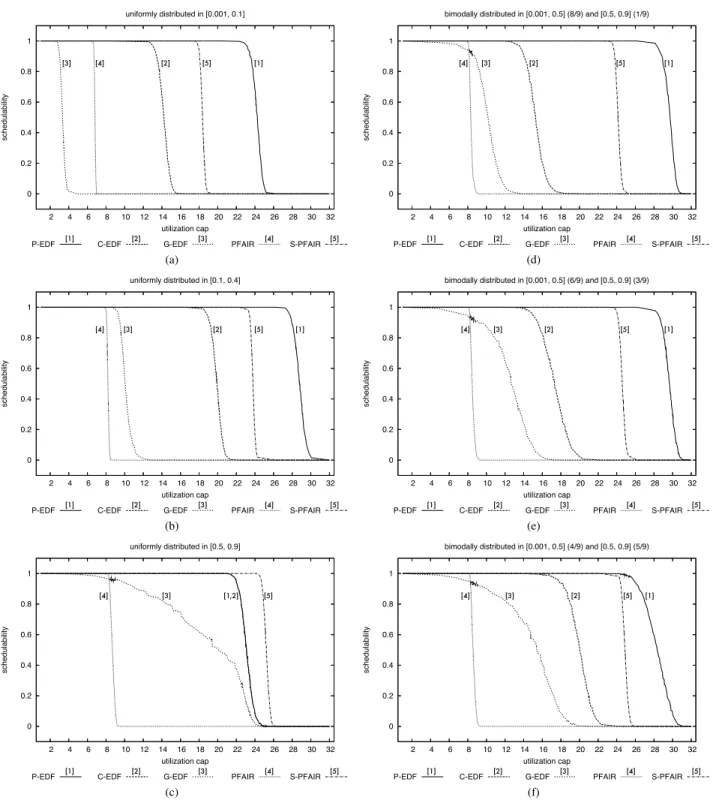
Figure 2: Hard real-time schedulability under various per-task weight distributions. (a)Uniform light. (b)Uniform medium. (c) Uniform heavy.(d)Bimodal light.(e)Bimodal medium.(f)Bimodal heavy.
assumed for all algorithms except forS-PD2.
There are several things to notice here. First,PD2
ex-hibits untenable performance due to its high preemption and migration costs. By preempting and scheduling subtasks at the same instant on all processors,PD2exposes the off-chip
memory bandwidth to be a critical bottleneck. In contrast,
S-PD2—specifically designed to avoid bus contention—
exhibits consistently good performance, suggesting that its slight tradeoff in optimality for reduced runtime overheads yields a viable alternative to partitioning. Second,G-EDF
is consistent as well, but consistently poor. In the HRT case, the schedulability tests used forG-EDFare inferior to those used for the other schemes. Moreover, it suffers from high worst-case scheduling and migration costs. The former is especially significant when many light tasks are present (in-sets (a) and (d)) because in such cases there are compara-tively more tasks overall. Third,P-EDFperforms best, ex-cept when many heavy tasks are present (inset (c)).P-EDF
benefits from low run-time overheads but suffers from bin-packing issues, which are somewhat ameliorated by using a bin-packing heuristic, instead of a closed-form test. Note that it outperformsS-PD2 except for when most tasks are
very heavy (inset (c)). Finally, notice thatC-EDFexhibits performance that is intermediate between G-EDF and P-EDF, as might be expected.
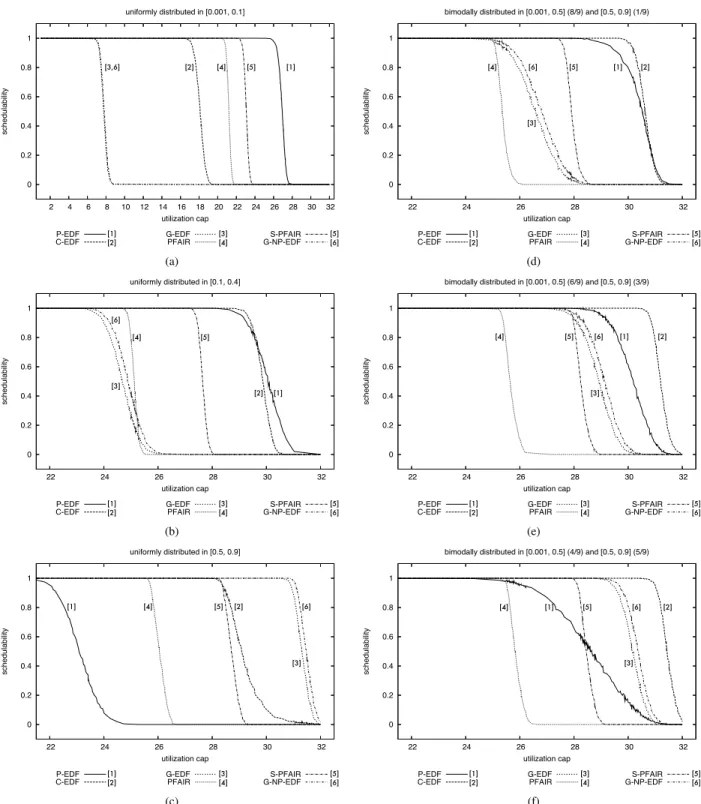
Schedulability results for the SRT case are shown in Fig. 3, which is organized similarly to Fig. 2. In the SRT case, staggered quanta are assumed for all algorithms except
PD2, which we have included for the sake of completeness.
Again, there are several interesting things to notice. First,
G-EDFis very negatively impacted by its higher
schedul-ing overheads. This can be seen clearly in insets (a), (b), and (d). In these cases, most tasks are light, which means that the overall number of tasks is high. Note that, in contrast to the HRT case,G-EDFis not negatively impacted here by the schedulability test used for it. Second,G-NP-EDFdoes not exhibit significantly better performance thanG-EDF(in fact, the graphs almost coincide in inset (a)). This strongly suggests that preemption and migration costs are not the lim-iting factor for theG-EDFfamily of scheduling algorithms (as implemented in LITMUSRT). Rather, they are limited by scheduling overheads. Third,P-EDFperforms correspond-ingly poorly when task utilizations are high (inset (c)), due to bin-packing problems. Note that, forP-EDF, the only difference between Figs. 2 and 3 is that worst-case over-heads are assumed in the former, and average-case in the latter. Fourth,C-EDFperforms best in most cases (insets (b) and (d)-(f)), since it has lower runtime overheads than
G-EDFand does not suffer from bin-packing limitations as
severe asP-EDF. Consequently, its performance degrades when there are either very many light tasks (inset (a)) or mostly heavy tasks (inset (c)), but not as much as the perfor-mance ofG-EDF andP-EDF, respectively. Fifth,S-PD2
is usually among the better performing algorithms and the only algorithm that does not exhibit pathological scenarios. While PD2 performs significantly better than in the HRT
case, it is usually among the worst algorithms. This is due toPD2using aligned quanta and hence having higher
over-heads.
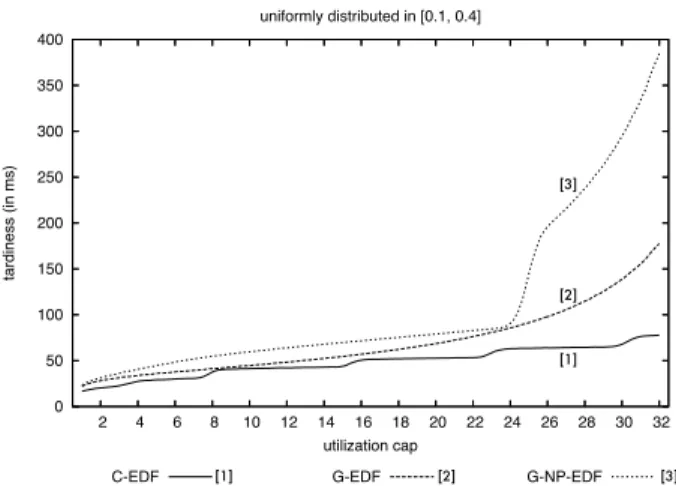
In the SRT case, tardiness is also of interest. Fig. 4 shows the average of the per-task worst-case tardiness bounds (computed using formulas in [19]) for the scenario in Fig. 3(b). (PD2,S-PD2, andP-EDFare not shown,
be-cause assuming staggered quanta, tardiness under each is at most one or two quanta.) As seen, tardiness is highest under
G-NP-EDFand lowest underC-EDF. The “stair-step”
pat-tern forC-EDFis due to a ceiling operator in the tardiness-bound expression.
4.4
Discussion
WhilePD2andG-EDF(and correspondinglyG-NP-EDF)
are both global algorithms, they are implemented quite dif-ferently in LITMUSRT. Our G-EDF implementation is
mostly event-based. Job releases are implemented by us-ing one-shot Linux high-resolution timers. Moreover, the scheduler may be invoked from different processors in re-acting to these and other events. This design enables arbi-trary task periods to be supported and job releases to be very accurately timed. One timer is used for each release time; if multiple releases coincide (e.g., at a hyperperiod boundary) one timer is shared and only one release event is handled by the scheduler, which enables merging the released jobs into the ready queue in O(logN)time. In contrast, a simpler implementation that does not share timers has to perform
O(N)individual merges. We found that sharing timers re-duces measured worst-case release overheads significantly (in some cases by up to 50 percent). However, our experi-ments revealed thatG-EDFstill suffers from high overheads due to long queue lengths and lock-contention. We are cur-rently investigating approaches to mitigate these sources of overhead.
In contrast, the PD2 plugin is very much time-driven. The scheduling logic is contained mostly in the tick han-dler, which is invoked at every quantum boundary. Since
PD2scheduling decisions are made at well-known times, a
master-slave approach is used where only one processor (the master) schedules the next quantum; this eliminates any po-tential run-queue contention. Moreover, queue-merge op-erations can be performed to add newly-released work to the run queue in O(logN)time. Such a design also has the advantage that strictly-periodic execution does not re-quire per-release timers. However, one downside of thePD2
implementation is that a sporadic job can experience up to one quantum of delay (the time to the next quantum bound-ary) before it becomes eligible for scheduling. (SincePD2
0 0.2 0.4 0.6 0.8 1 2 4 6 8 10 12 14 16 18 20 22 24 26 28 30 32 schedulability utilization cap uniformly distributed in [0.001, 0.1] P-EDF
C-EDF [1][2] G-EDFPFAIR [3][4] G-NP-EDFS-PFAIR [5][6]
[1] [2] [4] [5] [3,6] 0 0.2 0.4 0.6 0.8 1 22 24 26 28 30 32 schedulability utilization cap
bimodally distributed in [0.001, 0.5] (8/9) and [0.5, 0.9] (1/9)
P-EDF
C-EDF [1][2] G-EDFPFAIR [3][4] G-NP-EDFS-PFAIR [5][6]
[1] [2] [3] [4] [6] [5] (a) (d) 0 0.2 0.4 0.6 0.8 1 22 24 26 28 30 32 schedulability utilization cap uniformly distributed in [0.1, 0.4] P-EDF
C-EDF [1][2] G-EDFPFAIR [3][4] G-NP-EDFS-PFAIR [5][6]
[1] [2] [3] [4] [5] [6] 0 0.2 0.4 0.6 0.8 1 22 24 26 28 30 32 schedulability utilization cap
bimodally distributed in [0.001, 0.5] (6/9) and [0.5, 0.9] (3/9)
P-EDF
C-EDF [1][2] G-EDFPFAIR [3][4] G-NP-EDFS-PFAIR [5][6]
[1] [2] [3] [4] [5] [6] (b) (e) 0 0.2 0.4 0.6 0.8 1 22 24 26 28 30 32 schedulability utilization cap uniformly distributed in [0.5, 0.9] P-EDF
C-EDF [1][2] G-EDFPFAIR [3][4] G-NP-EDFS-PFAIR [5][6]
[1] [2] [3] [4] [5] [6] 0 0.2 0.4 0.6 0.8 1 22 24 26 28 30 32 schedulability utilization cap
bimodally distributed in [0.001, 0.5] (4/9) and [0.5, 0.9] (5/9)
P-EDF
C-EDF [1][2] G-EDFPFAIR [3][4] G-NP-EDFS-PFAIR [5][6]
[1] [2]
[3]
[4] [5] [6]
(c) (f)
Figure 3: Soft real-time schedulability under various per-task weight distributions. (a)Uniform light. (b)Uniform medium. (c) Uniform heavy. (d)Bimodal light. (e)Bimodal medium.(f)Bimodal heavy. (Please note the different scale of (a). Also, note that the
comments apply toS-PD2.)
Given thatS-PD2has much higher tick overheads than
G-EDF, and since ticks occur frequently, one might expect
G-EDFto outperformS-PD2for SRT systems. However,
our experiments show that this is not the case. In fact, G-EDFis only competitive in scenarios with low task counts (e.g., insets (c), (e), and (f) of Fig. 3). This is due to the manner in which release overheads are accounted for in schedulability analysis. Linux’s high-resolution timers are interrupt-based, and since interrupts always preempt a real-time task, a job can—in the worst case—be delayed by job releases from allother tasks. Since the standard analysis for interrupts [24] inflates execution costs on a per-task ba-sis, this amounts to an overhead penalty ofO(N2). This is
less of an issue forP-EDFandC-EDFsince their analysis only needs to account for interrupts from (fewer) local tasks. Also, due to reduced lock contention, release overheads are significantly lower with partitioned algorithms. SincePD2
does not use high-resolution timers (apart from the periodic tick), it avoids these interrupt overheads altogether.
In our initial attempt at porting LITMUSRT to the
Ni-agara, all run queues were implemented using linked lists. However, such an implementation quickly proved to be un-tenable for several of the global algorithms. Experiments showed that a simple traversal of a 500-element list can take up to 50µson the Niagara—clearly too much considering that thePD2plugin may have to perform 32 traversals
ev-ery 1000µs. Such problems necessitated a switch to bino-mial heaps. This reduced scheduling costs significantly (in benchmarks, most heap operations required at most 0.5µs) and illustrates how sensitive global algorithms are to the manner in which run queues are supported.
We speculate that the results of this paper may extend to other multicore platforms where rather simple cores are used (as is the case in some embedded platforms). However, performance trends may be very different on platforms with cores of the complexity of x86-like architectures, which have features designed to hide memory latencies. On such a platform, preemption and migration costs may be very dif-ferent from that seen on our test platform. However, if com-panies like Intel really do intend to produce chips with 80 cores as noted earlier, it remains to be seen if this can be done without resorting to simpler core designs. Note that the use of simpler core designs will likely result in higher execution costs and hence task utilizations. This does not bode well forP-EDF. On the other hand, we are doubtful that global algorithms can scale to such high core counts. Thus, we expect clustered algorithms to offer the best per-formance.
5
Conclusion
This paper has presented a case-study comparison of sev-eral multiprocessor real-time scheduling algorithms on a
0 50 100 150 200 250 300 350 400 2 4 6 8 10 12 14 16 18 20 22 24 26 28 30 32 tardiness (in ms) utilization cap uniformly distributed in [0.1, 0.4]
C-EDF [1] G-EDF [2] G-NP-EDF [3] [1]
[2] [3]
Figure 4: Tardiness as a function of the total utilization cap. This graph corresponds to inset (b) of Fig. 3 and is representative for other results obtained but not shown here due to space constraints.
agara platform. To the best of our knowledge, this study is the first attempt by anyone to assess thescalabilityof such algorithms based upon empirically-derived overheads. The major conclusions of our study are as follows: (i)for HRT workloads on the Niagara,S-PD2andP-EDFare generally
the most effective approaches;(ii)for SRT workloads on the Niagara, there is no single best overall algorithm, although
S-PD2 and C-EDFseem to be less susceptible to
patho-logical scenarios than the other tested algorithms; (iii) for multicore platforms with on-chip shared caches, preemption and migration costs can still be considerably more costly in algorithms that allow migrations if caches are small or memory bandwidth is limited;(iv)quantum-staggering can be very effective in reducing such costs;(v) for global ap-proaches, scheduling overheads are greatly impacted by the manner in which run queues are implemented. Although P-EDFfared relatively well in our study, we note that, in other work, we have found that partitioning approaches are more negatively impacted (in terms of schedulability) by task-synchronization requirements [12, 14] and runtime work-load changes [9]. Such concerns have not been considered in this paper.
There are numerous directions for future work. First, we would like to re-consider how run-queue support for global algorithms is provided in LITMUSRT. In particular, we would like to determine whether run-queue overheads can be lessened through the use of more clever data structures or more efficient synchronization techniques. Second, in re-lated work, we have investigated the impact synchroniza-tion has on schedulability in work involving a convensynchroniza-tional SMP [12, 14]; we would like to repeat that study on the Ni-agara. Third, we would like to repeat any Niagara-based studies we conduct on an Intel platform of comparable size, when one is available. In all of these studies, we would also like to consider the impact of dynamic workload changes.
Acknowledgement. We thank Sanjoy Baruah for helpful discussions regardingG-EDFHRT schedulability tests.
References
[1] J. Anderson and A. Srinivasan. Mixed Pfair/ERfair schedul-ing of asynchronous periodic tasks.Journal of Computer and System Sciences, 68(1):157–204, February 2004.
[2] T. Baker. A comparison of global and partitioned EDF schedulability tests for multiprocessors. Technical Report TR-051101, Department of Computer Science, Florida State University, 2005.
[3] T. Baker and S. Baruah. Schedulability analysis of multipro-cessor sporadic task systems. In Sang H. Son, Insup Lee, and Joseph Y. Leung, editors,Handbook of Real-Time and Em-bedded Systems. Chapman Hall/CRC, Boca Raton, Florida, 2007.
[4] T. P. Baker. Multiprocessor EDF and deadline monotonic schedulability analysis. In Proceedings of the 24th IEEE Real-Time Systems Symposium, pages 120–129, Dec. 2003. [5] S. Baruah. Techniques for multiprocessor global
schedula-bility analysis. InProceedings of the 28th IEEE Real-Time Systems Symposium, pages 119–128, 2007.
[6] S. Baruah, N. Cohen, C.G. Plaxton, and D. Varvel. Propor-tionate progress: A notion of fairness in resource allocation.
Algorithmica, 15:600–625, 1996.
[7] M. Bertogna, M. Cirinei, and G. Lipari. Improved schedu-lability analysis of EDF on multiprocessor platforms. In
Proceedings of the 17th Euromicro Conference on Real-Time Systems, pages 209–218, 2005.
[8] M. Bertogna, M. Cirinei, and G. Lipari. Schedulability anal-ysis of global scheduling algorithms on multiprocessor plat-forms. IEEE Transactions on Parallel and Distributed Sys-tems, 2008. To appear.
[9] A. Block and J. Anderson. Accuracy versus migration over-head in multiprocessor reweighting algorithms. In Proceed-ings of the 12th International Conference on Parallel and Distributed Systems, pages 355–364, July 2006.
[10] A. Block, B. Brandenburg, J. Anderson, and S. Quint. An adaptive framework for multiprocessor real-time systems. In
Proceedings of the 20th Euromicro Conference on Real-Time Systems, pages 23–33, July 2008.
[11] B. Brandenburg and J. Anderson. Integrating hard/soft real-time tasks and best-effort jobs on multiprocessors. In Pro-ceedings of the 19th Euromicro Conference on Real-Time Systems, pages 61–70, July 2007.
[12] B. Brandenburg and J. Anderson. An implementation of the PCP, SRP, M-PCP, D-PCP, and FMLP real-time synchro-nization protocols in LITMUSRT. InProceedings of the 14th IEEE International Conference on Embedded and Real-Time Computing Systems and Applications, pages 185–194, Au-gust 2008.
[13] B. Brandenburg, A. Block, J. Calandrino, U. Devi, H. Leon-tyev, and J. Anderson. LITMUSRT: A status report. In
Proceedings of the 9th Real-Time Workshop, pages 107–123. Real-Time Linux Foundation, November 2007.
[14] B. Brandenburg, J. Calandrino, A. Block, H. Leontyev, and J. Anderson. Synchronization on real-time multiprocessors: To block or not to block, to suspend or spin? InProceedings of the 14th IEEE Real-Time and Embedded Technology and Applications Symposium, pages 342–353, April 2008. [15] J. Calandrino, J. Anderson, and D. Baumberger. A hybrid
real-time scheduling approach for large-scale multicore plat-forms. InProceedings of the 19th Euromicro Conference on Real-Time Systems, pages 247–256, July 2007.
[16] J. Calandrino, H. Leontyev, A. Block, U. Devi, and J. An-derson. LITMUSRT: A testbed for empirically comparing real-time multiprocessor schedulers. InProceedings of the 27th IEEE Real-Time Systems Symposium, pages 111–123, December 2006.
[17] J. Carpenter, S. Funk, P. Holman, A. Srinivasan, J. Anderson, and S. Baruah. A categorization of real-time multiprocessor scheduling problems and algorithms. In Joseph Y. Leung, editor, Handbook on Scheduling Algorithms, Methods, and Models, pages 30.1–30.19. Chapman Hall/CRC, Boca Raton, Florida, 2004.
[18] U. Devi.Soft Real-Time Scheduling on Multiprocessors. PhD thesis, University of North Carolina, Chapel Hill, NC, 2006. [19] U. Devi and J. Anderson. Tardiness bounds for global
EDF scheduling on a multiprocessor. Real-Time Systems, 38(2):133–189, February 2008.
[20] C. Farivar. Intel Developers Forum Roundup: Four cores now, 80 cores later. http://www.engadget.com /2006/09/26/intel-developers-forum-roundup-four-cores-now-80-cores-later/, 2006.
[21] J. Goossens, S. Funk, and S. Baruah. Priority-driven schedul-ing of periodic task systems on multiprocessors. Real-Time Systems, 25(2-3):187–205, 2003.
[22] H. H¨artig, M. Hohmuth, and J. Wolter. Taming Linux. In
Proceedings of the 5th Annual Australasian Conference on Parallel And Real-Time Systems, September 1998.
[23] P. Holman and J. Anderson. Adapting Pfair scheduling for symmetric multiprocessors. Journal of Embedded Comput-ing, 1(4):543–564, 2005.
[24] J. Liu.Real-Time Systems. Prentice Hall, 2000.
[25] P. McKenney. Shrinking slices: Looking at real time for Linux, PowerPC, and Cell. http://www-128.ibm.com/ developerworks/power/library/pa-nl14-directions.html, 2005.
[26] A. Srinivasan and J. Anderson. Optimal rate-based schedul-ing on multiprocessors. InProceedings of the 34th ACM Sym-posium on Theory of Computing, pages 189–198, May 2002. [27] A. Srinivasan and J. Anderson. Optimal rate-based schedul-ing on multiprocessors.Journal of Computer and System Sci-ences, 72(6):1094–1117, September 2006.
[28] UNC Real-Time Group. LITMUSRTproject.
http://www.cs.unc.edu/˜anderson/litmus-rt/.
[29] V. Yodaiken and M. Barabanov. A real-time Linux. In Pro-ceedings of the Linux Applications Development and Deploy-ment Conference (USELINUX), January 1997.