MATH 527A
1. Introduction
Our geometric intuition is derived from three-dimensional space. Three coordinates suffice. Many objects of interest in analysis, however, require far more coordinates for a complete description. For example, a functionf with domain [−1,1] is defined by infinitely many “coordi-nates” f(t), one for eacht ∈[−1,1]. Or, we could consider f as being determined by its Taylor series P∞
n=0ant
n (when such a representation
exists). In that case, the numbers a0, a1, a2, . . . could be thought of as
coordinates. Perhaps the association of Fourier coefficients (there are countably many of them) to a periodic function is familiar; those are again coordinates of a sort.
Strange Things can happen in infinite dimensions. One usually meets these, gradually (reluctantly?), in a course on Real Analysis or Func-tional Analysis. But infinite dimensional spaces need not always be completely mysterious; sometimes one lucks out and can watch a “coun-terintuitive” phenomenon developing in Rn for large n. This might be
of use in one of several ways: perhaps the behavior for large but finite n is already useful, or one can deduce an interesting statement about limn→∞ of something, or a peculiarity of infinite-dimensional spaces is
illuminated.
I will describe some curious features of cubes and balls inRn, as n→
∞. These illustrate a phenomenon called concentration of measure. It will turn out that the important law of large numbers from probability theory is just one manifestation of high-dimensional geometry.
Along the way, we will meet some standard analysis techniques. These may be familiar to varying degrees. I think it could be useful for you to see how multidimensional integrals, linear algebra, estimates, and asymptotics appear in the analysis of a concrete problem. A num-ber of these matters are relegated to appendices. In the main part of the exposition, I try to focus (as much as possible) on geometric phenomena; it would be reasonable to read about those first, and only
c
2010 by Hermann Flaschka.
refer to an appendix for quick clarification as needed. Ultimately, you should also understand the appendices.
2. The Cube
2.1. Volume of the cube. Cn(s) is the cube centered at the origin
inRn with sidelength 2s. I.e.,
Cn(s) ={(x1, . . . , xn)| −s≤xj ≤s for all j}.
Its n-dimensional volume is (by definition)
Vol(Cn(s)) = (2s)×(2s)× · · · ×(2s)
| {z }
ntimes
= (2s)n.
We have an obvious consequence:
Proposition 2.1. As n → ∞, the volume of Cn(s) tends to zero if
s < 12, to ∞ if s > 21, and it is always = 1 for s = 12.
From now on, Cn(1
2) will be my reference cube, and I will simply
write Cn. So Vol(Cn) = 1 for all n. Notice, however, that the point
(12, . . . ,12) is a vertex of the cube, and it has distance √n/2 from the origin. So
Proposition 2.2. The cube Cn has diameter √n, but volume 1.
The mathematics is completely elementary, but I hope you agree that visualizing such behavior is rather more tricky. It gets worse. 2.2. Concentration of volume. I want to compare the volume ofCn
to the volume of a subcube, Cn(1 2 −
2), where ∈ (0,1) is given. We
already know from Proposition 2.1 that the latter volume tends to zero as n→ ∞. Hence the “shell” between the two cubes contains most of the volume:
Proposition 2.3. For every ∈(0,1),
Volume of shell= Vol(Cn−Cn(1 2 −
2))
tends to 1 as n→ ∞.
In other words, asn → ∞, there is no such thing as “a thin shell of small volume”. All the volume of Cn escapes towards its surface, out of any prescribed subcube.
In order to understand, in some measure, how the volume concen-trates at the surface of Cn, look again at
(2.1) Vol(Cn−Cn(1
2−
2)) = 1−(1−)
Of course, (1−)n→0 because 0<1− <1. Now invoke Lemma A.1: lim n→∞(1 + a n) n =ea.
This suggests that we should let the in (2.1) vary with n. Instead of taking a subcube Cn(1
2 −
2) whose sides are in fixed ratio to the side
(length = 1) of Cn, we expand the subcube, and shrink the shell, as n increases. In this way, the volume “trapped” in the shrinking shell does have a nonzero limit:
Proposition 2.4. For every t >0,
lim n→∞Vol(C n− Cn(1 2− t 2n)) = limn→∞1−(1− t n) n = 1−e−t
. [It is understood that n must be large enough to ensure 2nt < 12].
How to think about this? Say you want to know what shell contains half the volume of Cn (for large n, of course). Since 1−e−t = .5 for
t=.69315. . ., you know that the cube of sidelength 1−.69...
2n has volume
about 12, with the remaining volume 12 contained in the very thin shell (of width .69...2n ) between the subcube and our reference cube,Cn.
Later on, we will look at the cube a bit differently, and see that its volumealso concentrates along the diagonal plane
x1 +· · ·+xn= 0.
This will be related to probability theory. First, however, we will study the ball; it is more symmetrical than the cube, and easier to deal with.
2.3. Surface area of the cube. In dimensions 1 and 2, “cubes” are not cubes in the everyday sense of the word. The “cube” C1(s) is a
line segment of length 2s. The “cube”C2(s) is a square, sidelength 2s.
It has four 1-dimensional sides, each of which is a copy of C1(s). The
surface area of C2(s) is the total 1-dimensional “volume”, in this case
just ordinary length, of the four sides, to wit 4×(2s).
C3(s) is the usual cube. Its six 2-dimensional sides are copies of
C2(s), and the surface area of C3(s) is the sum of the 2-dimensional
volumes, or the usual areas, of its sides: 6×(2s)2.
The cube C4(s) in four dimensions has a number of 3-dimensional sides. Let’s call them 3-faces. The “surface area” ofC4(s) is really the sum of the 3-dimensional volumes of the 3-faces: 8×(2s)3.
To see why this formula is correct, we need to describe the 3-faces. A 3-face is determined by setting one of the coordinates equal to its extreme value,±s, and allowing the other coordinates to vary in [−s, s].
For example,
{(s, x2, x3, x4)| |xj| ≤s for j = 2,3,4}
is a 3-face. It is a copy of the cube
C3(s) ={(x1, x2, x3)| |xj| ≤s for j = 1,2,3};
except the indices have changed (which is irrelevant). This object has the 3-dimensional volume (2s)3. There are eight 3-faces, since any one of the four coordinates could be fixed at +sor−s, with the other three coordinates allowed to vary in [−s, s].
The “surface area” of Cn(s) is the sum of the (n−1)-dimensional
volumes of its (n−1)-faces. “Area” is not really a good term 1, but we will use it to distinguish between the n-dimensional volume of the solid n-dimensional object, and the (n−1)-dimensional volume of the boundary of the object. Later on, the same convention will apply to the ball.
Exercise 2.1. How many (n −1)-faces does Cn(s) have? How many
(n−k)-dimensional faces, for 0 ≤ k ≤ n? (A 0-face is a vertex, and the n-face, by convention, is the whole solid cube).
Exercise 2.2. For eachs∈(0,∞), compare the behavior of the volume ofCn(s) to the behavior of its surface area, asn → ∞. The cases= 12
should strike you as being counterintuitive.
Exercise 2.3. Fix ∈(0, s). Let S be the slice
S =Cn(s)∩ {(x1, . . . , xn−1, z)| |z|< },
i.e. a sort of “equatorial slice” of the cube. How does the ratio Vol(S)
Vol(Cn(s))
behave as n → ∞?
3. Volume of the Ball
The material about concentration of volume comes (at times verba-tim) from P. L´evy,Probl`emes concrets d’analyse fonctionelle, Gauthier-Villars (1951), p.209 ff. See also pp. 261-262 of the Math 527 notes for the computation of the volume of a ball in Rn.
1something like “(n−1)-dimensional Lebesgue measure” might be preferred by
n−1 x n IR 1 sin cos d(sin )
Figure 1. Volume of ball by slices
3.1. Volume of the ball, part 1. We writeBn(R) for the solid ball, radiusR, centered at the origin inRn. The term “ball” means “surface plus interior”. The surface itself is called the “sphere”, denoted by Sn−1(R). The superscript (n−1) signifies that the sphere in
Rn has dimension (n−1). Thus Bn(R) = {(x1, . . . , xn)∈Rn|x21+· · ·x 2 n≤R}, Sn−1(R) = {(x1, . . . , xn)∈Rn|x21+· · ·x 2 n=R}. Example 3.1. To be clear about dimensions, consider
B4(1) ={(x1, x2, x3, x4)|x21+x22+x23+x24 ≤1} ⊂R4.
This is 4-dimensional, in the sense that as long asx2
1+x22+x23+x24 <1,
all four coordinates can be varied independently. However, S3(1) ={(x1, x2, x3, x4)|x21+x 2 2+x 2 3+x 2 4 = 1} ⊂R 4.
This is 3-dimensional, in the sense that once three of the xj are fixed,
the remaining one is largely determined (up to±sign, in this example). There are better definitions, but this should convey the idea. It is rather tricky to picture S3, since we can’t go into four dimensions, but there
Now let Kn be the volume of the unit ball Bn(1) in Rn. Then the
volume ofBn(R) is K
nRn. Let us calculate Kn (refer to Figure 1).
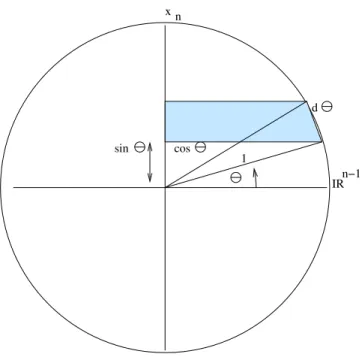
The circle represents the ball of radius 1. The horizontal axis is
Rn−1, the set of (n−1)-tuples (x1, . . . , xn−1). The vertical axis is the
last direction, xn. If we were computing the volume of the ball in R3
(i.e., n = 3), we would add up the volumes of circular slices of radius cosθ and thicknessd(sinθ):
K3 = Z π2
−π
2
πcos2θ d(sinθ).
Now this integrand πcos2θ is the two-dimensional volume of the two
-dimensional ball (=disk) of radius cosθ. Note that it has the form volume of two-dimensional unit ball×radius2 =π×cos2θ.
Using symmetry in θ, we may thus write
K3 = 2 Z π2
0
K2cos3θ dθ.
The pattern continues forn >3. I claim thatxn = sinθ, represented
by a horizontal line segment in the figure, intersectsBn(1) in an (n− 1)-dimensional ball of radius cosθ. Indeed, the intersection is defined by
x21+· · ·+x2n−1 + sin2θ≤1
=⇒ x21+· · ·+x2n−1 ≤1−sin2θ= (cosθ)2, (3.1)
and this is Bn−1(cosθ). So, instead of a very thin slice with a
two-dimensional disk as cross-section, we now have a very thin (d(sinθ)) slice whose cross-section is the ball of radius cosθ in dimension (n−1). Its volume is Kn−1cosn−1θ×d(sinθ). Thus,
(3.2) Kn = 2 Z π2 0 Kn−1cosnθ dθ= 2InKn−1, where (3.3) In def = Z π2 0 cosnθ dθ.
To make further progress towards a useful formula for Kn, we need
3.2. The integral In. Here we collect information about In. We
re-turn to the volume Kn in the next subsection.
Integration by parts in (3.3) gives (for n >1) In= [sinθcosn−1θ] π 2 0 + (n−1) Z π2 0 cosn−2θsin2θ dθ = (n−1) Z π2 0 (cosn−2θ−cosnθ)dθ = (n−1)(In−2−In). Hence (3.4) In= n−1 n In−2.
Since I0 = π2 and I1 = 1, we can solve (3.4) recursively. Starting with
I0, we find I2, I4, . . ., and fromI1 we get I3, I5, . . .. The pattern is easy
to ascertain: I2p = π 2 1·3·5· · ·(2p−1) 2·4·6· · ·(2p) , (3.5) I2p+1 = 2·4·6· · ·(2p) 3·5· · ·(2p+ 1). (3.6)
Remark 3.1. Standard notation: 1·3·5·7· · ·(2p+ 1) = (2p+ 1)!!. We will need to know howInbehaves asn → ∞. Since the integrand
cosnθ decreases with n for every θ 6= 0, one expects thatI
n→0. This
is true, but we want to know how fast the decrease is. The next lemma provides the answer. We use the notation an ∼ bn to signify that
limn→∞ abn
n = 1; this would be a good time to glance at Appendix B. Lemma 3.1. In ∼
pπ 2n.
Proof. From (3.5) and (3.6), one sees thatfor all positive n,
(3.7) InIn−1 =
π 2n. (Another proof: nIn= (n−1)In−2 implies
(3.8) nInIn−1 = (n−1)In−2In−1;
then writing (3.8) for with n replaced by n−1, n−2, . . ., we get the string of equalities
nInIn−1 = (n−1)In−1In−2 = (n−2)In−2In−3 =· · ·=I1I0 =
π 2.) Here is the idea of the rest of the proof. First we note that by (3.4), In ∼ In−2. Next we show that In−1 is trapped between In and In−2.
It will follow that In−1 ∼ In, so that (3.7) gives In2 ∼ 2nπ. Taking the
square root will establish the Lemma. Let’s do it more carefully. Because 0≤cosθ ≤1, we have
cosnθ <cosn−1θ <cosn−2θ for θ∈(0,π2), and thus
In < In−1 < In−2.
Divide by In and use (3.7):
1< In−1 In
< n n−1. Since the right side has limit 1, it follows that
lim n→∞ In−1 In = 1. Now multiply (3.7) by In In−1 and rearrange: In p π/(2n) 2 = In In−1 .
The right side has limit = 1, hence so does the left side. Now take the
square root.
Remark 3.2. Lemma 3.1 has a remarkable consequence. Applied to n= 2p+ 1, it says that lim p→∞(2p+ 1)·I 2 2p+1 = π 2, or in longhand, (3.9) lim p→∞ 2242· · ·(2p)2 3252· · ·(2p−1)2 1 2p+ 1 = π 2.
There is a “dot-dot-dot” notation that is used for infinite products, analogous to the usual notation for infinite series (here . . . stands for a certain limit ofpartial products, analogous to the familiar partial sums); one would write
π 2 =
2·2·4·4·6·6· · ·
3·3·5·5·7·7· · ·.
This is called Wallis’ product2.
2J. Wallis,Arithmetica infinitorum, Oxford 1656 (!). The product can be recast
as Π∞
1 (4n2/(4n2−1)). By the way, Wallis was a codebreaker for Oliver Cromwell,
Let us now look at R π2
0 cos
nθ dθ more closely. The integrand is
de-creasing in θ, and for each θ 6= 0 (where its value is = 1), it decreases to zero with n. So the main contribution to the integral should come from a neighborhood of θ = 0. Indeed, if α > 0 and θ ∈ (α,π2], then cosθ <cosα and so
Z π2 α cosnθ dθ < Z π2 α cosnα dθ= (π 2 −α) cos nα.
Now cosnα approaches zero geometrically, but we saw in Lemma 3.1 that In approaches zero only like n−
1
2. We are in the situation of the
example in Appendix B (“geometric decrease beats power growth”), which gives n12(cosα)n→0:
1 In Z π2 α cosnθ dθ →0. We obtain:
Proposition 3.1. For every α∈(0,π2],
In ∼ Z α
0
cosnθ dθ.
If, however, the limit of integration α is allowed to decrease as n increases, one can trap a proper fraction of the the total value of In in
the shrinking interval of integration. Consider Z √β n 0 cosnθ dθ= √1 n Z β 0 cosn(√t n)dt. From (A-6) in Appendix A,
Z β 0 cosn(√t n)dt→ Z β 0 e−t 2 2 dt,
and we just saw that
In∼ r π 2n. Thus (3.10) lim n→∞ 1 In Z √βn 0 cosnθ dθ= r 2 π Z β 0 e−t 2 2 dt.
Remark 3.3. By the time we get to (3.10), we no longer need β ∈
(0, π/2). That restriction was used in the earlier observation that the integral over any finite subinterval [0, α]⊂[0, π/2] was asymptotically
equivalent to In. Once we go to the shrinking upper limit α =β/
√ n, then this upper limit will fall into (0, π/2] when n is large enough, no
matter the choice of β.
3.3. Volume of the ball, part 2. We had obtained the relation (3.2), Kn = 2
Z π2
0
Kn−1cosnθ dθ= 2InKn−1.
Replace n by (n−1) to get Kn−1 = 2In−1Kn−2, and thus
Kn = 4InIn−1Kn−2.
Now recalling (3.7) from the preceding subsection, we obtain a recur-sion relation from which Kn can be determined:
(3.11) Kn=
2π n Kn−2.
Knowing thatK2 =πandK3 = 43π, we findK4, K6, . . .andK5, K7, . . .,
and recognize the pattern: K2p = πp p! (3.12) K2p+1 = 2·(2π)p 1·3·5· · ·(2p+ 1). (3.13)
This formula has an amazing consequence:
Proposition 3.2. For every R >0, the volume of the ball of radius R
in Rn tends to zero as n→ ∞.
Proof. Ifn = 2p is even, for example, the volume will be K2pR2p = (πR2)p p! . Thus K2p+2R2p+2 = (πR2)2 (p+ 2)(p+ 1)K2pR 2p,
showing that the volume decreases rapidly, oncep becomes sufficiently large. (If you notice that the K2pR2p happen to be the coefficients in
the Taylor series representation of ex when x = πR2, this argument should ring a bell). The proof for odd dimensions is similar. As was seen in Proposition 2.1, the dependence of the volume of the cubeCn(s) on s and n is quite different.
There is another curious relation between cubes and balls that should be noticed. The distance between the origin and the vertex (s, . . . , s) of Cn(s) is s√n. Therefore, the radius (=s√n) of the smallest ball
containing Cn(s) tends to ∞ with n. Furthermore, if s > 12, then Vol(Bn(s√n)) → ∞ (since the volume of the inscribed cube tends to infinity). On the other hand, the largest ball contained in Cn(s) will have radius s, which is independent of n. Even if Vol(Cn(s)) → ∞,
the volume of this inscribed ball Bn(s) tends to zero.
It is tempting to extrapolate to infinite dimensions. InR∞(whatever that might mean), a cube is not contained in any ball of finite radius. The cube with sides of length = 1 and volume = 1 contains the unit ball, which has volume = 0. Well, this last statement is mostly nonsense, but somewhere in it there is a little truth.
3.4. Asymptotic behavior of the volume. The formula for Kn
in-volves factorials, which are approximated by Stirling’s formula (C-2), k!∼√2πk kke−k. Proposition 3.3. Vol(Bn(R√n))∼ (2πe) n 2 √ nπ R n .
Proof. Apply Stirling’s formula, first in even dimensions. From (3.12),
K2p ∼
πp
√
2πp ppe−p;
if we setp=n/2 and do some rearranging (exercise), we get
(3.14) Kn ∼
(2πe)n2
√
nπ(√n)n.
Multiplying this by (radius)n= (√nR)n, we get the desired formula.
The case of odd dimensions is something of a mess, and there is a subtle point. Begin by multiplying top and bottom of the expression (3.13) for K2p+1 by
2·4·6· · ·(2p) = 2pp!,
and also multiply from the beginning by the factor (√n)n that will come from (√nR)n, to get (recall that n= 2p+ 1)
2(2π)p2pp!
(2p+ 1)! (2p+ 1)
2p+1 2 .
Next, substitute for the two factorials from Stirling’s formula. The terms are ordered so that certain combinations are easier to see.
2(2π)p2p √ 2πp p 2π(2p+ 1) e−p e−2p−1 pp (2p+ 1)2p+1(2p+ 1) 2p+1 2 .
First some obvious algebraic simplifications in the last expression: 2(2π)p2pep+1 √ p √ 2p+ 1 pp (2p+ 1)p(2p+ 1) −1 2. Moreover, pp (2p+ 1)p = 1 2p p p+ 12 p = 1 2p 1 (1 + 2p1)p,
and inserting this leads to
(3.15) K2p+1 ∼2(2π)pep+1 √ p √ 2p+ 1 1 (1 + 2p1)p(2p+ 1) −1 2.
Now we do asymptotic simplifications as p→ ∞. The subtle point arises here. Let RHS stand for the right side of (3.15).
So far we know that
(3.16) lim
p→∞ K2p+1
RHS = 1.
If we replace any part of RHS by an asymptotically equivalent expres-sion, obtaining a modified expression RHS’, say, we will still have
lim p→∞ K2p+1 RHS’ = 1. For example, lim p→∞ √ p √ 2p+1 1 √ 2 = 1. We can then modify (3.16):
lim p→∞ K2p+1 RHS √ p √ 2p+1 1 √ 2 = 1. This gives a new denominator, and we get
lim p→∞ K2p+1 2(2π)pep+1 1√ 2 1 (1+21p)p(2p+ 1) −1 2 = 1,
which we would write more briefly as (3.17) K2p+1 ∼2(2π)pep+1 1 √ 2 1 (1 + 2p1)p(2p+ 1) −12 .
A comparison of (3.15) and (3.17) suggests that we have allowedpto tend to ∞ in some places, but not in others. Isn’t this unethical? No it is not, as long as we are replacing one expression whose ratio with K2p+1 tends to 1 by another expression with the same property.
This same reasoning further allows us to substitute 1
e12
for 1
(1 + 2p1)p.
By now, (3.15) has been simplified to
(3.18)
√
2(2π)pep+12
(2p+ 1)12
.
and it is an easy manipulation to turn this into the desired formula in
terms of n= 2p+ 1. Corollary 3.1. lim n→∞Vol(B n (R√n)) = ( 0, if R ≤ √1 2πe ∞, if R > √1 2πe. Proof. Write the asymptotic expression for the volume as
(√2πeR2)n
√
nπ ,
and recall that when 2πeR2 >1, the numerator grows much faster than
the denominator. The case ≤1 is trivial.
This is a little more like the behavior of the volume of the cube, especially if you think not about the side length 2s of Cn(s), which
remains fixed, but about the length 2s√n of its diagonal: Cube: diameter = constant ×√n,
Ball: radius = constant ×√n.
The behavior of the volume is determined by the value of the propor-tionality constant. Still, there is no way to get a nonzero, non-infinite limiting volume for the ball.
3.5. Volume concentration near the surface. Consider the two concentric ballsBn(1) and Bn(1−). The ratio of volumes is
Vol(Bn(1−))
Vol(Bn(1)) =
Kn(1−)n
Kn
= (1−)n.
For every , this ratio tends to zero as n → ∞, which means that ev-ery spherical shell, no matter how thin, will contain essentially the whole volume of Bn(1). Of course, it should be remembered that lim Vol(Bn(1)) = 0, so the shell also has a small volume, it is just
To see how the volume accumulates at the surface, we again let depend on n, as we did for the cube. Choosing= t
n, we find that Vol(Bn(1− t n)) Vol(Bn(1)) = Kn(1− nt)n Kn = (1− t n) n→ e−t. The interpretation is exactly as for the cube (subsection 2.1).
3.6. Volume concentration near the equator for Bn(R). Recall
that
Vol(Bn(R))→0
for every R. We ask: what fraction of this vanishing (as n → ∞) volume accumulates near the equator of the ball? Letθ1 <0< θ2, and
consider (3.19) R n Rθ2 θ1 cos nθ dθ Rn R π2 −π2 = 1 2In Z 0 θ1 cosnθ dθ+ Z θ2 0 cosnθ dθ .
The numerator is the volume of the slice bounded by the hyperplanes3 xn = Rsinθ1, xn = Rsinθ2 (see Figure 1). Since the factor Rn has
cancelled, we will temporarily set R = 1 and work with the unit ball; later, R will be re-inserted by hand.
According to Proposition 3.1, the two integrals on the right side of (3.19) are each asymptotically equivalent to In. Hence:
Proposition 3.4. For every θ1 ∈ [−π2,0) and θ2 ∈(0,π2], the fraction of the volume of Bn(R) contained in the equatorial slice between the hyperplanes xn = sinθ1 and xn = sinθ2 tends to 1 as n → ∞. If, however, θ1 > 0 (θ1 < θ2), then the fraction of volume in the slice tends to zero.
As before, to trap a proper fraction of the volume, we must allow the limits of integration to approach 0 as n → ∞. The results of Subsection 3.2 suggest that we take θ1 = √β1n and θ2 = √β2n, β1 < β2.
The signs of the β’s will not matter now, only the fact that √βj
n → 0
at a cleverly chosen rate. Incidentally, since sinu ∼ u for u → 0, the bounding hyperplanes xn = sin(√βjn) are essentially xn = √βjn as n gets
large.
From equation (3.10), we now obtain
3ahyperplanein
Rnis ann−1-dimensional set defined by a single linear equation inx1, . . . , xn. If this set does not contain the origin, it is sometimes called anaffine
hyperplane, but I won’t make that distinction. “Hyper” means “one dimension down”, in this context. The set defined by a single, generally nonlinear, equation f(x1, . . . , xn) = 0 is ahypersurface. The sphereSn−1(R) is a hypersurface inRn.
Proposition 3.5. Let β1 < β2. The fraction of the volume of Bn(1) contained in the slice bounded by the hyperplanesxn= sin(
βj √ n), j = 1,2, tends to (3.20) √1 2π Z β2 β1 e−t 2 2 dt.
Remark 3.4. Proposition 3.5 remains true if one asks about the volume between the hyperplanes xn = √βjn, j = 1,2. That volume differs from
the volume in the proposition by Z sin−1(√β1 n) β1 √ n cosnθ dθ
and another similar integral, but the limits of integration approach each other as n → ∞ and the integral tends to zero. The details are
omitted.
Remark 3.5. If you know some probability theory, you will have noticed that (3.20) represents an area under the standard normal curve. It is an often used fact that the value of (3.20) for β1 =−1.96, β2 = +1.96
is approximately .95. In other words, for large n all but about 5% of the volume of Bn(R) will be found in the very thin slice between
xn=±1.96R√n .
Remark 3.6. By rotational symmetry, Proposition 3.5 will hold for ev-ery equator, not just the one perpendicular to the xn-direction.
Think about that for a minute. Next, incorporate this in your
thoughts: the volume also concentrates near the surface
of the ball.
3.7. Volume concentration near the equator for Bn(R√n). The
results of the last subsection can be viewed from a slightly different angle, which is important enough to be emphasized in its own little subsection.
Instead of fixing R, and looking at the fraction of volume contained in the slice between4 xn = √β1n and xn = √β2n, one can let the radius of
the ball become infinite at the rate R√n and look at the slice between x=β1andxn =β2. Keep in mind that Vol(B(R
√
n))→0 or∞, so we may be talking about a fraction of a tiny volume or of a huge volume.
4it is simpler to use β/√n instead of sin(β/√n); the two are asymptotically
Proposition 3.6. Letβ1 < β2. The fraction of the volume ofBn(R
√ n)
contained in the slice bounded by the hyperplanes xn = βj, j = 1,2, tends to (3.21) √1 2π Z β2 β1 e−t 2 2 dt.
Exercise 3.1. Prove this proposition.
4. Surface area of the ball
4.1. A formula for surface area. Recall that the surface of a “ball” is a “sphere”. We speak of the “area” of a sphere simply to distinguish that quantity from the “volume” of the whole ball. But keep in mind (Example 3.1) that the sphere S3(R) is itself 3-dimensional (sitting
in the 4-dimensional R4). What we refer to as its “area” is actually
its 3-dimensional volume. Likewise, the “area” of Sn−1(R) ⊂
Rn is
understood to mean its (n−1)-dimensional volume.
The surface area ofBn(R) is easily expressed in terms of Vol(Bn(R)).
Consider the n-dimensional volume of the spherical shell between the balls of radii R+δR and R:
Vol(Bn(R+δR))−Vol(Bn(R)) =Kn[(R+δR)n−Rn]
=Kn[nRn−1δR+· · ·],
with · · · denoting terms in (δR)2 and higher. Think of this volume as being approximately
(4.1) volume of shell = area of Sn−1(R) × thickness δR of shell, i.e.
volume of shell =nKnRn−1×δR+· · · .
(4.1) becomes more accurate asδR→0. Hence the area of Sn−1 is
(4.2) d
dR Vol(B
n
(R)) =nKnRn−1.
This type of argument would indeed recover a formula which you know from calculus, for the area of a region D on a surface (in R3)
given by z =f(x, y): Z Z D q 1 +f2 x +fy2dx dy.
But we will need to get at the area of the sphere by a different, seem-ingly more rigorous approach anyway.
n−1 x n IR sin d 1 cos
Figure 2. Surface area by slices
Let Ln−1 denote the surface area of the unit ball Bn(1) in Rn. We
know from general principles that the ballBn(R) will have surface area
Ln−1×Rn−1; this will be used shortly. Now refer to Figure 2, which
again represents the unit ballBn(1) in
Rn. (If you are at all uneasy with
the use of “n” in what follows, work through the steps using n= 3). Recall from (3.1) that the line segmentxn= sinθrepresents the ball
Bn−1(cosθ); as just remarked, it will have surface areaL
n−2×(cosθ)n−2.
This is (n −2)-dimensional volume. The outside arc of the shaded area is the surface of a cylinder put together as follows: the base is Bn−1(cosθ) and the edge (surface) of the base isSn−2(cosθ); the height is dθ. For small dθ, the side of the cylinder is nearly perpendicular to the base, and then the outside arc of the shaded region represents a contribution
circumference × height =Ln−2(cosθ)n−2×dθ
to the total surface area. Therefore
(4.3) Ln−1 =
Z π2
−π
2
Ln−2cosn−2θ dθ= 2In−2Ln−2.
To obtain a formula for Ln−1, we can proceed in three ways. First,
in the formula Ln−1 = nKn, which is (4.2) at R = 1, use the known
Figure 3. Volume vs. surface area
2π, and use the known expressions for In−2. Third, in (4.3), replace
Ln−2 by 2In−3Ln−3 (which is (4.3) after the replacement (n −1) →
(n−2)), to get
Ln−1 = 4In−2In−3Ln−3 =
2π
n−2Ln−3 (last step by (3.7)). Then use L1 = 2π and L2 = 4π to get started on a recursive
deter-mination of Ln−1. Presumably, all these methods lead to the same
answer: Proposition 4.1. L2p = 4π (2π)p−1 (2p−1)!! L2p−1 = 2π πp p!.
Remark. It is worth understanding exactly why cosnθbecomescosn−2θ, and not cosn−1θ, which would be analogous to the change in the
expo-nent of R.
For the volume, we had
volume of base of slice ∝ (radius)n−1 which was then multiplied by
thickness of slice =d(sinθ) = cosθ dθ. For the surface area, it was
surface area of base of slice ∝ (radius)n−2
(here the power does just drop by 1), but this was only multiplied by the “arclength” dθ. So the difference is the bit of rectangle that sticks
out beyond the circular arc in Figure 3.
Exercise 4.1. Compare then → ∞behavior of the volume and surface area of Bn(R√n), for allR >0. One value of R should be peculiar.
4.2. Surface area concentration near the equator. The surface area ofBn(R) concentrates near the (or any) equator. The calculation
has already been done. Look at (3.19). If Rn is replaced by Rn−1, and
cosnθ is replaced by cosn−2θ, (3.19) represents the fraction of surface
area ofBn(R) contained between the hyperplanesx
n = sinθj,j = 1,2.
Everything we know about the n → ∞ limits remains true, word for word. I will not restate the results, you do it:
Exercise 4.2. State precisely the proposition about surface area
con-centration near the equator.
5. The weak law of large numbers
In this section, concentration of volume for the cube about its “equa-tor” is shown to be an expression of one of the basic theorems of prob-ability theory. I will use several technical probprob-ability definitions in an intuitive way; otherwise, there would be too many digressions.
5.1. The probability setting. Let C1 = C1 again be the interval (12) = [−1
2, 1
2], and consider the experiment of “choosing a number at
random from this interval”. All results are to be considered equally likely. More precisely, the probability that a randomly chosen number x1 falls into a subinterval [a, b] j [−12,12] is defined to be its length,
b −a. We write P(x1 ∈ [a, b]) = b −a. (So P(x1 ∈ [−12,12]) = 1).
In a setup like this, where the possible choices form a continuum, the probability that a random x1 will be exactly equal to a given number
iszero. For example,P(x1 = 0) = 0. A justification might be that you
would never know x1 to all its decimal places. More mathematically,
this is the only possible logical consequence of our starting definition of the probability: P(x1 ∈[0,0]) = 0−0 = 0.
Now we go to Cn (unit side length, remember), and define the
prob-ability that a randomly chosen point lies in a regionDjCn to be the
volume, Vol(D). Again, the whole cube has probability 1. One can imagine pickingx= (x1, . . . , xn) “as a whole”, e. g. by throwing a dart
into the n-dimensional cube.
Or—and this is what I will do—one can build up the randomx one coordinate at a time. First choose x1 ∈ C1 at random. Then,
inde-pendently of this first choice, pick x2 ∈C1. Continue. The probability
that an x built in such a way lies in D is again Vol(D). This is not easy to prove with full mathematical rigor, one essentially needs the theory of Lebesgue measure. I will illustrate for the case n = 2 and D = a rectangle. The key technical notion, which cannot be avoided, is independence.
Summary. An “experiment” with a number (maybe infinite) of possible outcomes is performed. An event A is a subset of the set of possible out-comes. A probability measure assigns numbers between 0 and 1 to events. The interpretation of “P(A) = p” is that if the “experiment” is repeated a large number N times, then about pN of the results will fit the criteria defining A. (Every single statement I just made requires clarification and much more mathematical precision.)
Example 5.1. Suppose a 6-sided die is tossed 60,000 times. Let A= “2, 4, or 6 shows”, andB = “1, 3, 4, or 6 shows”.
Assuming that each of the six outcomes 1,2,3,4,5,6 is equally likely, we have P(A) = 12 and P(B) = 23. This means, intuitively, that A should happen on about half, or 30,000 of the tosses. Of these 30,000, about one third each will result in in 2,4,6, so B happens on 2/3 or 20,000 tosses. Tosses resulting in 1 or 3 are no longer possible, since we are restricting attention to outcomes where Ahas occurred.
In other words, the probability of B was 23 at the outset, and it was still 2
3 after the results were restricted to the outcomes 2,4,6 in A. One says: (5.1) the probability ofB given A = the probability ofB.
We cannot make a better prediction about the occurrence ofB amongst the outcomes satisfyingAthan we could about the occurrence ofB amongst all
possible outcomes.
Example 5.2. Suppose nowB is “1,3, or 5 shows”. Then none of the 30,000 tosses fitting the description ofA will fit the description ofB. Thus:
the probability ofB given A= 0.
If we know that A has occurred, we know with certainty that B has not
occurred.
We consider the A and B in Example 5.1 to be independent. Exam-ple 5.2 illustrates an extreme case of non-independence. Another extreme case would be B = “1, 2, 4, or 6 shows”. If we know thatA has happened, it is certain that B has also happened, or
the probability ofB given A= 1.
The technical meaning ofindependence is a rephrasing of (5.1): (5.2) P(Aand B both happen ) =P(A)P(B).
To understand this, rewrite it as (if P(A)6= 0) (5.3) P(Aand B both happen )
The left side is the fraction of the outcomes satisfying A for which B also happens. In the setting of Example 5.1, it would be
20,000 30,000 = 1 3 ×60,000 1 2 ×60,000 = 2 3 =P(B).
Example 5.3. We will pick a point x∈C2 at random, by choosing its two coordinates independently. Let A1 be the event “x1 ∈ [a1, b1]”,
and let A2 be the event “x2 ∈ [a2, b2]”. We have P(A1) = b1 −a1,
P(A2) =b2−a2. The choices ofx1andx2are to be made independently.
This means that we require that
P(x1 ∈[a1, b1] and x2 ∈[a2, b2]) = (b2−a2)(b1−a1).
But this is the same as saying that
P(x= (x1, x2)∈ rectangle with base [a1, b1] and height [a2, b2])
= Vol(rectangle).
The general statement “P(x ∈ D) = Vol(D)” is deduced by approxi-mating the region D by a union of small rectangles (compare the defi-nition of a multiple integral as limit of Riemann sums).
Laws of large numbers give precise meaning to statements that “some-thing should happen on average”. For example, if we choose, randomly and independently, a large number N of points in C1 = [−1
2, 1 2], say
a1, a2, . . . , aN, any positiveaj should sooner or later be nearly balanced
by a negative one, and the average
(5.4) a1+a2+· · ·+aN
N
should be close to zero. The largerN is, the better the “law of averages” should apply, and this ratio should be closer to zero.
Now, as just explained, these independently chosenajcan be thought
of as the coordinates of a randomly picked pointa= (a1, . . . , aN) in the
high-dimensional cube CN. One version of the “law of averages” says that the volume of the region in CN where (5.4) is not close to zero becomes negligible as N → ∞. In other words, we have concentration of volume again: Vol {a= (a1, . . . , aN)∈CN | | a1+a2+· · ·+aN N | is small} →1. I now turn to the geometric problem, and revert to my usual notation (x1, . . . , xn) ∈ Cn. The interest is in concentration of volume about
the plane Π0 : x1 +· · ·+xn = 0. Notice that this plane has normal
diagonal of the cube, passing through the corner (12,12, . . . ,12). The distance to the corner is 12√n. We want to look at slices bounded by planes Π±η :x1+. . .=±η; possibly η will depend on n—we shall see.
The honest approach would be to find a nice, more or less explicit, formula for the volume of such an “equatorial” slice, as there was for a ball, and then to apply the geometric fact of concentration of volume to obtain a probabilistic application. However, I confused myself trying to find a volume formula; there are too many corners when you slice the cube by a plane Πη, and I gave up. The less satisfying approach
is to prove the probabilistic result as it is done in probability texts (using a simple inequality, see 527 Notes, p. 386), and to reinterpret it in geometric language. This is what I have to do.
5.2. The weak law of large numbers. For x = (x1, . . . , xn) ∈ Cn,
set
Sn(x) =x1+· · ·+xn;
this is a function whose domain is the cube. I will sometimes omit the argument x. Further, given >0, define the “equatorial slice”
(5.5) S ={x∈Cn | |
Sn(x)
n |< }.
Theorem 5.1 (Weak law of large numers). For every >0,
lim n→∞Vol(S) = 1. Equivalently, (5.6) lim n→∞Vol {x∈Cn| |Sn(x) n |> } = 0.
Remark 5.1. The “weak law” is really a much more general theorem. I have stated it in the context of our cube example. But thexj might also
be chosen at random from the two-element set {−1,1}, withP(−1) = P(1) = 12. These two numbers could signify “tails” and “heads” in a toss of a fair coin. We would then be working with a discrete cube,
{−1,1}n. Theorem 5.1 gives one precise meaning to the law of averages
for coin tosses: there are, on average, about as many heads as there
are tails.
Remark 5.2. If there is a weak law, there should be a strong law, and there is. It is set in the limiting cube, C∞, where now x= (x1, x2, . . .)
is an ∞-tuple. It says that those xfor which
(5.7) lim
N→∞
x1+· · ·+xN
occupy total volume 1 in C∞. Evidently, some more theory is needed here, to give meaning to the notion of volume in C∞, and to clarify the nature of possible sets of zero volume (where the limit (5.7) fails
to hold).
The proof of Theorem 5.1 is based on a useful inequality, which is stated here for the cube Cn, although any region of integration could be used. For typing convenience, I use a single integral sign to stand for an n-fold multiple integral, and I abbreviatedx1· · ·dxn=dnx:
Z · · · Z | {z } Cn · · ·dx1· · ·dxn≡ Z Cn · · · dnx.
Lemma 5.1 (Chebyshev’s inequality). Let F :Cn →
R be a function
for which σ2 def= R
F(x)2dnx is finite. For δ >0, let
Aδ ={x∈Cn| |F(x)|> δ}. Then
(5.8) Vol(Aδ)<
σ2
δ2. Proof. (of lemma) Since Aδ jCn,
Z Aδ F(x)2dnx≤ Z Cn F(x)2dnx=σ2. Forx∈Aδ we have (δ)2 <(F(x))2, so Z Aδ δ2dnx< Z Aδ F(x)2dnx. The left side is just
δ2
Z
Aδ
dnx=δ2Vol(Aδ).
Combine this string of inequalities to get δ2 Vol(Aδ)< σ2,
as desired.
Proof. (of Theorem) We apply Chebyshev’s inequality to F = Sn.
First, we note that
(Sn)2 = n X j=1 x2j + n X i=1 n X j=1 j6=i 2xixj.
The integral over Cn of the double sum vanishes, since in the iterated multiple integral, Z 12 −1 2 xidxi = 0.
A typical contribution from the simple sum is Z Cn x21 = Z 12 −1 2 · · · Z 12 −1 2 Z 12 −1 2 x21dx1 dx2. . . dxn = 1 12. Thus, σ2 = n 12. Chebyshev’s inequality now gives
Vol {x| |Sn(x)|> δ} < n 12δ2.
Set δ =n in this relation, and you get
(5.9) Vol {x| |Sn(x)| n > } < 1 12n2.
This tends to zero as n → ∞, and the theorem is proved. 5.3. Connection with concentration of volume. We have seen that the volume of the region j Cn where |Sn|
n < tends to 1 as
n → ∞. The geometric meaning of this fact still needs a little more clarification.
To this end, we switch to a coordinate system in which one direction is perpendicular to the planes Πη :x1+· · ·+xn=η. This new direction
is analogous to thexn-direction in our discussion of the ball.
Lete1, . . . ,en be the standard basis,
ej = (0, . . . ,0, 1 |{z} jthplace ,0, . . . ,0). Thus, x=x1e1+· · ·+xnen.
Now let fn be the unit vector
1 √ n(1, . . . ,1) = 1 √ n(e1+· · ·+en)
in the direction normal to Π0. The orthogonal complement to fn is of
course the (n−1)-dimensional vector subspace Π0 ={x∈Rn|x1+· · ·+xn = 0}.
The process of Gram-Schmidt orthogonaliztion in linear algebra guar-antees that we can start with the unit vector fn, and construct
or-thonormal vectors f1, . . . ,fn−1 which, together with fn, provide a new
orthonormal basis of Rn. (These f
j are far from unique; certainly one
possible set can be written down, but that would be more confusing than helpful).
The point is that a given x in the cube now has two coordinate expressions:
x1e1+· · ·+xnen=y1f1+· · ·+yn−1fn−1+ynfn.
Take inner products of both sides with fn, and remember that the fj
are orthonormal. You find
(5.10) yn= 1 √ n(x1+· · ·+xn) = 1 √ nSn.
Now go back to (5.9). Inserting (5.10), we convert it into
Vol {y| |yn|> √ n} < 1 12n2.
Finally, notice that the corner of the cube, where all xj = 12,
corre-sponds to yn =
√
n
2 . We may therefore phrase the weak law of large
numbers in more geometric language, as follows.
Proposition 5.1. The diagonal of Cn has length √n. The fraction of the (unit) volume of Cn contained in the slice S√n (see (5.5))
ap-proaches 1 as n→ ∞.
In other words, a slice S√
n whose width is an arbitrarily small
frac-tion of the length of the diagonal of Cn will eventually enclose almost
all the volume of Cn.
Remark 5.3. Recall that the volume of Cn also concentrates near the
surface!
Exercise 5.1. Verify that one possible choice for the new basis vectors
fj is, forj = 1, . . . , n−1 fj = ( 1 p j(j + 1), . . . , 1 p j(j+ 1) | {z } jterms ,−p j j(j+ 1),0, . . . ,0).
A. appendix: compound interest
In the main part of these notes, we need two facts. First, equation (A-2) below, which often arises in a discussion of compound interest in beginning calculus. It is fairly easy to prove. Second, the rather more subtle formula (A-1) lim n→∞ Z β 0 cosn(√t n)dt= Z β 0 lim n→∞cos n(√t n)dt = Z β 0 e−t 2 2 dt,
which is a consequence of (A-2) and some other stuff. The first subsec-tion explains the ideas, and everything afterwards fills in the technical mathematical details. There are lots of them, because they will reap-pear during the Math 527 year, and you might as well get a brief introduction. The details could well detract from the important issues on first reading. Study the earlier material, and then go through the details in the appendices later (but do go through them).
A.1. The ideas. The first result should be familiar.
Lemma A.1. For every a∈R,
(A-2) lim n→∞(1 + a n) n =ea.
I will actually require a consequence of a refinement of Lemma A.1. This generalization of Lemma A.1 says, in a mathematically precise way, that if bn→0, then we still have
(A-3) lim n→∞(1 + a+bn n ) n =ea,
and that the approach to the limit is equally fast for all a in any fixed finite interval [−A, A]. (Technical term: the convergence is uniform). The relevant application is this unexpected corollary:
Corollary A.1. (A-4) lim n→∞cos n(√t n) =e −t2 2.
Convergence is uniform on finite intervals, in this sense: given β >0
and >0, there is an integer N >0 depending on β and but not on t, such that n > N implies
(A-5) |cosn(√t n)−e
−t2
Figure 4. Illustration of (A-4)
Shelve that definition for the moment, and let me reveal why (A-4) should be true and why I want this “uniform” convergence. From the Taylor series for cosu we have
cosu= 1− 1
2u
2+· · · .
Suppose all the “· · ·” terms are just not there. Then by (A-2),
(cos(√t n))
n= (1− t2
2n)
n
which has limit e−t2/2! But the “· · ·” are there, in the guise of the correction term in Taylor’s formula. So one encounters the more com-plicated limit (A-3).
I will then want to conclude that
(A-6) lim n→∞ Z β 0 cosn(√t n)dt ↓ = Z β 0 lim n→∞cos n(√t n)dt = Z β 0 e−t 2 2 dt.
This seems plausible, given (A-4), but it is not always true that the limit of the integrals of a sequence of functions is equal to the integral of the limit function. In other words, equality = may fail for some↓ sequences of functions.
0 2 4 6 8 10 12 14 16 18 20 0.75 0.8 0.85 0.9 0.95 1 y=n^2*x^n*(1-x), n=10,20,30,40,50 Figure 5. fn →0, but R fn90
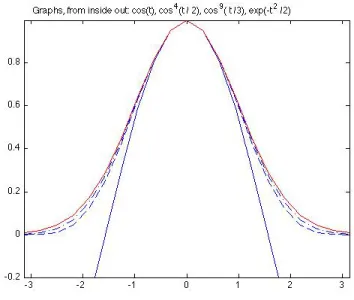
Figure 4 shows the graphs of cosn(t/√n) for n = 1,4,9, and the
graph of exp(−t2/2) (it is the outermost curve). The cosine powers get
very close to each other, and to the exponential, over the whole interval [−π, π]. Take an arbitrarily narrow strip along the curve exp(−t2/2).
All the cosn(t/√n), from some n on, will fit into that strip5.
This is the meaning of “fn → f uniformly”. Pick any narrow strip
about the graph of the limit function f. Then the graphs of fn fit into
that strip, from someN onwards.
Clearly, the areas under the cosine curves approach the area under the exponential curve. This is an obvious, and important, consequence of “uniform convergence”.
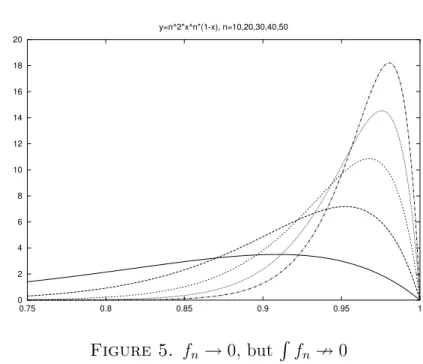
Figure 5 shows the graphs of the functions fn(x) = n2xn(1−x),
defined for 0 ≤ x ≤ 1. Clearly, fn(0) = fn(1) = 0 for all n, and for
each individual x ∈ (0,1), the “geometric decay beats power growth” principle implies that fn(x)→ 0 (see the beginning of Appendix B, if
you are not sure what I mean). Sofn(x)→0 for everyx∈[0,1]. If the
convergence fn →0 were uniform on the closed interval [0,1], then–by
definition of uniform convergence–you could pick an arbitrarily narrow strip about y = 0, say |y| < , and all fn, from some n on, would fit
into that strip. This does not happen here. fn(x) → 0 at different
rates for different x.
5 the convenient strip has the form {(t, y)| |y−exp(−t2/2)| < }. Compare
This affects the behavior of the integrals R fn. We have Z 1 0 n2(xn−xn+1)dx=n2( 1 n+ 1 − 1 n+ 2) = n2 (n+ 1)(n+ 2) →1. Again: even though fn(x)→ 0 for every individual x, the integrals of
the fndo not approach zero. An area of size close to 1 migrates to the
right. The graph becomes very high over a very narrow interval, and the integrals remain finite even thoughfn becomes very small over the
rest of [0,1].
We express this by saying that the identity
(A-7) lim n→∞ Z 1 0 fn(x)dx= Z 1 0 lim n→∞fn(x)dx
does not hold. But if you look back at (A-4) and (A-1), you see that the property (A-7) is the key to the example.
Just to confuse matters: interchange of limit and integral may be valid even for sequences{fn}that donot converge uniformly. Take
fn(x) =nxn(1−x), 0≤x≤1.
As forn2xn(1−x), one hasf
n(x)→0 for eachx, i.e.
lim n→∞fn(x) = 0. Because Z 1 0 fn(x)dx= n (n+ 1)(n+ 2), it is true that lim n→∞ Z fn(x)dx= 0 = Z 1 0 lim n→∞fn(x)dx.
However, convergence is not uniform. You should check this by drawing graphs of fn for a few values ofn. A more mathematical way to see it is to find the maximum
value offn. It is (n/(n+ 1))n+1, assumed atx=n/(n+ 1). Curiously enough, the
maximum value approaches exp(−1). No matter how large you take n, there will always be a bump in the graph that sticks up to about.36, preventing the graph from fitting into a narrow strip about the limit function,f(x)≡0. Check this.
A.2. Sequences of numbers. First, a review of some simple, and likely familiar, definitions and facts about limits of sequences of num-bers.
Definition A.1. A sequence {cn}∞n=1 converges to c as n → ∞ if for
every > 0 there is an integer N()>0 (i.e., depending in general on ) such that
n > N() implies |cn−c|< .
We will want to plug sequences into continuous functions, and use the following property (sometimes taken as definition of continuity, because it is easy to picture).
(A-8) If F is continuous, then cn →c=⇒F(cn)→F(c).
We will prove later that
(A-9) nln(1 + a
n)→a.
Taking F to be the exponential function exp, cn = nln(1 + an), and
c=a, we then obtain from (A-8) and (A-9) that
(A-10) (1 + a
n)
n = exp[nln(1 + a
n)]→e
a,
which is one of our goals.
While (A-8) is a very practical definition of continuity, the “official” one can be adapted to more general settings; we will do later in the course.
Definition A.2. A function F :R →R is continuous atc∈ R, if for every >0 there is a δ() (i.e., depending in general on ), such that
|x−c|< δ() implies |F(x)−F(c)|< .
If f satisfies this condition, one can deduce the property (A-8). If you are not familiar with this style of proof, read it.
Claim:
Suppose thatF is continuous atc, in the sense of Definition A.2. Ifcn→c, then
F(cn)→F(c).
We need to show that given > 0, there is an N() >0, such that n > N() implies|F(cn)−F(c)|< . So let >0 be given. According to Definition A.2, we
are guaranteed aδ() so that
|x−c|< δ() implies |F(x)−F(c)|< .
Now use Definition A.1 of convergence, but substitute ourδfor the in the defini-tion: There is anN(δ)>0 such that
n > N(δ) implies |cn−c|< δ;
thisN depends onδ, and throughδalso on. The implications n > N(δ()) =⇒ |cn−c|< δ=⇒ |F(cn)−F(c)|<
A.3. Sequences of functions. So much for sequences of numbers, and how they behave when plugged into a continuous function; how-ever, we will need to work with sequences of functions.
Let us return to uniform convergence. The picture one should have in mind is, as explained above:
“the graphs of fn are close to the graph of limfn
(A-11)
over the whole interval”
Definition A.3. A sequence of functions{fn}∞n=1 converges uniformly
to the function f on the interval [−A, A], if for each >0 there is an N such that
n > N implies |fn(a)−f(a)|< , for all a∈[−A, A].
(A = ∞ could occur, or the interval might be replaced by one of the
more general form [α, β]).
Example A.1. Remember that the functions fn(x) = n2xn(1−x) do
not approach the identically zero function uniformly on [0,1]. It was easy to see that the verbal description (A-11) is violated, but perhaps it is less clear how to deal with the ’s and N’s. If we want to show that the criterion of the definition is not satisfied, we must show that its negation holds:
“there exists >0, such that for every N >0, there exist n > N and a∈[0,1] for which|fn(a)−0|> ”.
aside: Since negating more involved statements could, later in the course, be more tricky, a brief elaboration might be warranted.
The definition is built from “for all” and “there exists” statements, nested in a Russian-doll sort of way.
1) for all >0, the following is true:
2) there exists anN for which the following is true: 3) for alln > N the following is true:
4) for alla∈[0,1], the following is true: 5)|fn(a)−f(a)|< .
The negation of “X is true for all” is “X is false for at least one”, and the negation of “there exists one for which X is true” is “X is false for all”.
Now let us negate the sequence of statements 1)-5). There is an >0 for which 2) is false.
Thus, for thatand every choice ofN >0, 3) is false. Choose anN arbitrarily and continue.
For thatand the chosenN, there is ann > N such that 4) is false. For that, the chosenN, and thatn, there is ana∈[0,1]
Thus, for thatand every choice ofN, and that nand thata, we have|fn(a)−f(a)| ≥.
Let us show that our sequencefn does not converge uniformly. Take
= 1. (The argument can be adapted to your favorite .)
The maximum value offn is attained at a=n/(n+ 1), and equals
max(fn) =n n n+ 1 n+1 =n n+ 1 n (n+1)!−1 ,
which tends to ∞ with n, because the factor next to the n tends to exp(−1), by (A-10). From some n on, say starting with M, this max-imum value is > 2. Then, given an arbitrary N, pick n > N so large (larger thanM) that max(fn)>2. Now recall that 2 is bigger than 1.
Ergo, max(fn)> and convergence is not uniform.
Note that this argument simply says, in a roundabout way, that for every largen, the graph offn goes up higher than 1, somewhere. So it
will never fit into a width 1 strip6.
This next proposition is one of our goals7.
Proposition A.1. Suppose fn → f uniformly on the finite interval
[α, β]. Then Z β α fn(a)da→ Z β α f(a)da.
Proof. Let >0 be given. We have Z β α fn(a)da− Z β α f(a)da = Z β α (fn(a)−f(a))da ≤ Z β α |fn(a)−f(a)|da.
By uniform convergence, there is an N >0 such that
|fn(a)−f(a)|< β−α, a∈[α, β]. So Z β α |fn(a)−f(a)|da < Z β α β−αda=, as desired.
Exercise A.1. The proof used the inequality |R
g| ≤R
|g|. Why is this true?
6For every really really largen, the graph goes up higher than 1023, and will not
fit into an= 1023-strip. That is another possible
7If you know that the integral may not be defined for some wild functions—I am
Remark A.1. The integration interval has to be finite for this particular proof to make sense, since you need (β−α) to be a finite number. In fact, the proposition is no longer true on an infinite integration interval. Let fn(a) = ( 1 n, for n≤a≤2n, 0, otherwise. Then fn→0 uniformly on all ofR, while
Z ∞
−∞
fn(a)da= 1 for all n = 1,2,3, . . . .
There is one final uniform convergence issue. Earlier, we had cn →c
and concluded that (F continuous) F(cn) → F(c). Now, if fn → f
uniformly, does F ◦fn → F ◦f uniformly (F ◦f is the composition,
F(f(a)))?
It is really tedious to write down the full statement, so let me just indicate the idea. Suppose the Mean Value Theorem applies to F, and that |F0(c)|< some K on a big interval. Thus,
F(y)−F(x) = F0(c)(y−x), or |F(y)−F(x)| ≤K|y−x|
for some c∈[x, y]. It follows that
|F(fn(a))−F(f(a))| ≤K|fn(a)−f(a)|,
and if n is large enough, the right side will be as small as you please. Of course, one should worry about ranges and domains; the argument that goes intoF is the value that comes out offnorf. The details are
left as exercise.
Proposition A.2. Suppose the functions fn are continuous on[−A, A] (or[α, β], more generally) and that they converge uniformly to the con-tinuous function f on that interval8. Suppose the range of the fn and
f lies in some open subinterval of [−C, C]. Let F : [−C, C] → R be continuously differentiable, and suppose there is a number K such that
|F0(c)| < K for c ∈ [−C, C]. Then F ◦ fn → F ◦f uniformly on
[−A, A].
A.4. Compound interest proofs.
Lemma A.2. Fix A >0. Let {bk} be a sequence of functions converg-ing uniformly to zero on [−A, A]. Then for every > 0, there is an integer N >0 (depending on A,{bk}, ) such that n > N implies
|ea−(1 + a+bn(a)
n )
n|< , for all a∈[−A, A].
Instead of proving this Lemma all at once, I will start with the simplest case, and repeat the argument with small modifications. This is a bit tedious, but conceivably the strategy can be helpful to you if you haven’t spent a lot of time with proofs.
Proof. Let us first prove Lemma A.1. Assertion (A-2) will follow from the relation obtained by taking logarithms,
(A-12) lim
n→∞nln(1 + a n) = a.
Recall the Taylor series for ln(1 +x), valid for |x|<1: ln(1 +x) =x+ x
2
2 + x3
3 +· · · . We use this in the left side of (A-3).
nln(1 + a n) = n( a n + a2 2n2 + a3 3n3 +· · ·) =a+ ρn z }| { a2 n ( 1 2 + a 3n + a2 4n2 +· · ·). (A-13)
We need to show that the error termρncan be made arbitrarily small
by taking n large enough. (Caution: the “n” is not the summation index! You have a different series for each n). Estimate:
1 2 + a 3n + a2 4n2 +· · · ≤1 2 + |a| 3n + |a|2 4n2 +· · · (triangle inequality) ≤1 + |a| n + ( |a| n ) 2+ (|a| n ) 3+· · · (decrease denominator). (A-14)
This last series is the familiar geometric series, P
rk, with r = |an| in our case. It converges when 0< r <1, and this will happen as soon as
|a|
Now let > 0 be given. Choose N0 (it will depend on a and ) so
that n > N0 implies
|a|
n < 1
2. Then the geometric series converges, and
moreover
1
1− |an| <2.
The error term is then estimated by
|ρn|< |a|2 n 1 1−|na| <2 |a|2 n . Next, choose N ≥N0 so that n > N implies
2|a| 2 n < . Forn > N, therefore, |ρn|< , or |ln(ea)−ln(1 + a n) n|< .
This is the translation of
(A-15) lim
n→∞ln(1 + a n)
n = ln(ea)
into official mathematics. The desired (A-2) now follows by taking exponentials.
Next case. If you can follow the rest of the proof, you win a prize. I have likely made it uglier than necessary.
So far,ahas been a single fixed number. If, however, it is allowed to range over an interval [−A, A], we are asking about the convergence of fn(a) = nln(1 + an) to f(a) = a. The convergence is uniform. To see
this, we replace the upper bounds in the proof just concluded by their largest possible value. Take N0 (it will depend on and now on A) so
large that for n > N0,
1 1−A
n
<2 (the same as An < 12). Then
1 1− |an| ≤ 1 1−A n <2, for|a| ≤A. Finally, given >0, choose N ≥N0 so that forn > N
2A
2
Then the error term from (A-13), which is now written ρn(a) since a
is no longer fixed, satisfies
|ρn(a)|< |a|2 n 1 1− |an| ≤ A2 n 1 1−A n <2A 2 n < . Thus we have for all a ∈[−A, A],|a−nln(1 + a n)|< when n > N,
which is uniform convergence. Applying Proposition A.2, we conclude that
(1 + a n)
n→ea, uniformly on [−A, A].
Last case: the general statement. Instead of (A-13), we have
(A-16) nln(1 +a+bn(a) n ) =a+bn(a) + ρn(a) z }| { a2 n n ( 1 2 + an 3n + a2 n 4n2 +· · ·),
where an is used as abbreviation for a+bn(a) in the sum.
Choose 0< < 1. (If we can make something less than any such , we can obviously make it less than big ’s). Because bn→0 uniformly,
there is an N0 such that n > N0 implies |bn(a)| < 2 < 1 for all a ∈
[−A, A] (the reason for taking 1/2 ofbecomes clear shortly). For such n, we have
|an|=|a+bn(a)| ≤ |a|+|bn(a)|<|a|+ 1 ≤A+ 1.
Next, take N ≥N0 so that simultaneously
1 1−A+1 n <2 and 2(A+ 1) 2 n < 2 when n > N. Just as before,
|ρn(a)|< 2. One arrives at nln(1 +a+bn(a) n ) =a+bn(a) +ρn(a), where |ρn(a)|<
Therefore |a−nln(1 + a+bn(a) n )|<|ρn(a)|+|bn(a)|< 2 + 2 =.
Another application of Proposition A.2 proves Lemma A.2 in full
glory.
A.5. The corollary. It is now time to prove Corollary A.1. Recall, from Calculus, Taylor’s formula with remainder (also called Lagrange’s formula, or Lagrange’s remainder form):
(A-17) f(u) =f(0) +f0(0)u+ 1 2!f 00 (0)u2+ 1 3!f 000 (0)u3 + 1 4!f (iv)(c)u4;
c is some number known to lie between 0 and u. Applied to cos, this gives cosu= 1− 1 2u 2+ 1 24(cosc)u 4. Set u= √t n: (A-18) cos(√t n) = 1− t2 2n + 1 24(cosc) t4 n2.
Here, cwill lie between 0 and √t
n, and will depend ont and n. Writing
the right side of (A-18) in the form
1 + −t
2/2 + (1/24)(cosc)(t4/n)
n ,
we see that we can identify −t2/2 with a and (1/24)(cosc)(t4/n) with bn(a) in Lemma A.2. Since |t| ≤β and |cosc| ≤1, it is also true that
|(1/24)(cosc)(t4/n)| ≤ 1 n
β4
24,
from which it is clear thatbn→0 uniformly on [−β, β]. Thus, Lemma A.2
applies, and we have proved the corollary.
Primarily, we wanted the limiting relation (A-6) for the integrals. This immediately follows from Proposition A.1.
B. appendix: asymptotic equivalence
Here is an example. Letr∈(0,1) andp >0 be fixed. We know that as n → ∞, both rn and n−p tend to zero. Do they approach zero at the same rate? One way to see that the answer is “no” is to look at the ratio
rn
n−p =n prn.
This has limit zero9. On the other hand,
n−p and (√n2+n+ 5)−p
tend to zero at the same rate, since n−p (√n2+n+ 5)−p = √ n2+n+ 5 n p = ( r 1 + 1 n + 5 n2) p,
which has limit 1.
This leads to a definition.
Definition B.1. If {an},{bn} are two sequences for which
(B-1) lim
n→∞ an
bn
= 1,
we say that the sequences areasymptotically equivalent, and write (B-2) an∼bn (asn → ∞, usually left unsaid).
In the examples above, the two sequences both had limit zero. They might just as well both tend to infinity, in which case the statement (B-2) would mean that they grow at the same rate. The same notation is applied to functions: if f(x), g(x)→0 or f(x), g(x)→ ∞ as x→A (A could be finite or ±∞) and
(B-3) lim x→A f(x) g(x) = 1, we write f ∼g as x→A.
Here, we usually insert “as x → A”, since x might be asked to ap-proach any one of many possible values A. In the case of sequences, the subscript n has to go to ∞ (unless n → −∞), so it is hardly ever necessary to mention the fate of n.
Remark B.1. If an and bn both have the same finite, nonzero limit L
as n → ∞, relation (B-1) is automatic and contains no information. What might be useful is a comparison of the rate of approach to the limit, i.e. consideration of the ratio
an−L
bn−L
.
9The logarithm of the right side is plnn+nlnr. Recall thatnincreases much
faster than lnn, so thenlnrdominates and it tends to−∞. So the log of the right side tends to −∞, and the right side tends to zero. Calculus students learn that “geometric decay beats power growth”.
Remark B.2. The concept of asymptotic equivalence, as defined above, is only the most restrictive of a number of related (and important) notions. One might wonder when the ratios in (B-2) or (B-3) remain bounded–in that case, the sequences or functions are comparable in a weaker sense. This is written: f = O(g) (read: “f is big Oh of g”). Or one might want the ratio to approach zero, signifying that the numerator decays more rapidly than the denominator. Written: f =o(g) (“f is little oh of g”). For example, the assertion
ex = 1 +x+o(x) as x→0
means that the error term in the approximation of ex by 1 +x tends to zero faster than x, for smallx. We will not need these variants, but
they are constantly used in applied analysis.
C. appendix: Stirling’s formula
C.1. The formula. It is difficult to get a handle on the growth of n! as n increases. For example, 90! ∼ 1.48×10138, 100! ∼ 9.32×10157
(my computer calculatedP90
1 lnk, and then exponentiated). Is there a
pattern? In probability theory one asks about the binomial coefficient (C-1) 2n n = (2n)! (n!)2,
which counts the number of outcomes of the experiment of tossing a coin 2n times in which exactly n heads (and, of course, also exactly n tails) occur10. How big is (C-1)? One must replace the factorials by something manageable, and Stirling’s formula provides the tool (proof below).
Proposition C.1.
(C-2) n!∼√2πn nne−n.
It is important to understand what (C-2) does claim, and what it does not claim. According to our definition of “∼”,
lim
n→∞
n!
√
2πn nne−n = 1.
It is not true that the difference
|n!−√2πn nne−n|
is at all small. What is small is the relative error, since
lim n→∞ |n!−√2πn nne−n| n! = limn→∞|1− √ 2πn nne−n n! |=|1−1|= 0. 102−2n 2n n
A table will illustrate this. n 5 10 25 n! 120 3,628,800 1.551×1025 Stirling 118.02 3,598,695 1.546×1025 Ratio 1.0168 1.0084 1.0033 Rel. Error .0168 .0084 .0033 Difference 1.98 30,104 5.162×10²²
Remark C.1. Stirling’s formula (C-2) can be improved. It is possible to show that n!∼√2πn nne−n[1 + 1 12n + 1 288n2 +O(n −3)]
using the “big Oh” notation from Remark B.2. Thus O(n−3) stands
for numbers Tn satisfying
|Tn/n−3|=|n3Tn|< C, n→ ∞,
for some fixed (but perhaps unknown) numberC. The Tn’s are
there-fore smallish, but notice that they are multiplied by the huge prefactor outside the [. . . ]. Big Oh can be further replaced by 51840n−1393 +O(n
−4),
etc. ad nauseum. Math 583 deals with techniques for obtaining
“as-ymptotic expansions” like this.
Example C.1. To illustrate Stirling’s formula, let us find the asymptotic form of the binomial coefficient (C-1).
(C-3) (2n)! (n!)2 ∼ p 2π(2n) (2n)2ne−2n (√2πn nne−n)2 = 22n √ πn.