QUANTILE REGRESSION WITH CENSORING AND ENDOGENEITY
Victor Chernozhukov
Iván Fernández-Val
Amanda E. Kowalski
Working Paper 16997
http://www.nber.org/papers/w16997
NATIONAL BUREAU OF ECONOMIC RESEARCH
1050 Massachusetts Avenue
Cambridge, MA 02138
April 2011
We thank Denis Chetverikov and Sukjin Han for excellent comments and capable research assistance.
We are grateful to Richard Blundell for providing us the data for the empirical application. Stata
software
to implement the methods developed in the paper is available in Amanda Kowalski's web
site at http://www.econ.yale.edu/ak669/research.html. We gratefully acknowledge research
support from
the NSF. The views expressed herein are those of the authors and do not necessarily reflect the views
of the National Bureau of Economic Research.
© 2011 by Victor Chernozhukov, Iván Fernández-Val, and Amanda E. Kowalski. All rights reserved.
Short sections of text, not to exceed two paragraphs, may be quoted without explicit permission provided
that full credit, including © notice, is given to the source.
Victor Chernozhukov, Iván Fernández-Val, and Amanda E. Kowalski
NBER Working Paper No. 16997
April 2011
JEL No. C14
ABSTRACT
In this paper, we develop a new censored quantile instrumental variable (CQIV) estimator and describe
its properties and computation. The CQIV estimator combines Powell (1986) censored quantile regression
(CQR) to deal semiparametrically with censoring, with a control variable approach to incorporate
endogenous regressors. The CQIV estimator is obtained in two stages that are nonadditive in the unobservables.
The first stage estimates a nonadditive model with infinite dimensional parameters for the control
variable, such as a quantile or distribution regression model. The second stage estimates a nonadditive
censored quantile regression model for the response variable of interest, including the estimated control
variable to deal with endogeneity. For computation, we extend the algorithm for CQR developed by
Chernozhukov and Hong (2002) to incorporate the estimation of the control variable. We give generic
regularity conditions for asymptotic normality of the CQIV estimator and for the validity of resampling
methods to approximate its asymptotic distribution. We verify these conditions for quantile and distribution
regression estimation of the control variable. We illustrate the computation and applicability of the
CQIV estimator with numerical examples and an empirical application on estimation of Engel curves
for alcohol.
Victor Chernozhukov
Department of Economics
Massachusetts Institute of Technology
Cambridge, MA 02142
Iván Fernández-Val
Department of Economics
Boston University
270 Bay State Rd
Boston, MA 02215
Amanda E. Kowalski
Department of Economics
Yale University
37 Hillhouse Avenue
Room 32, Box 208264
New Haven, CT 06520
and NBER
1.
Introduction
Censoring and endogeneity are common problems in data analysis. For example, income
survey data are often top-coded and many economic variables such as hours worked, wages
and expenditure shares are naturally bounded from below by zero. Endogeneity is also an
ubiquitous phenomenon both in experimental studies due to partial noncompliance (Angrist,
Imbens, and Rubin, 1996), and in observational studies due to simultaneity (Koopmans
and Hood, 1953), measurement error (Frish, 1934), sample selection (Heckman, 1979) or
more generally to the presence of relevant omitted variables. Censoring and endogeneity
often come together. Thus, for example, we motivate our analysis with the estimation of
Engel curves for alcohol – the relationship between the share of expenditure on alcohol
and the household’s budget. For this commodity, more than 15% of the households in our
sample report zero expenditure, and economic theory suggests that total expenditure and
its composition are jointly determined in the consumption decision of the household. Either
censoring or endogeneity lead to inconsistency of traditional mean and quantile regression
estimators by inducing correlation between regressors and error terms. We introduce a
quantile regression estimator that deals with both problems and name this estimator the
censored quantile instrumental variable (CQIV) estimator.
Our procedure deals with censoring semiparametrically through the conditional quantile
function following Powell (1986). This approach avoids the strong parametric assumptions
of traditional Tobit estimators.
The key ingredient here is the equivariance property of
quantile functions to monotone transformations such as censoring. Powell’s censored
quan-tile regression estimator, however, has proven to be difficult to compute. We address this
problem using the computationally attractive algorithm of Chernozhukov and Hong (2002).
An additional advantage of focusing on the conditional quantile function is that we can
cap-ture nonadditive heterogeneity in the effects of the regressors across the distribution of the
response variable by computing CQIV at different quantiles (Koenker, 2005). The traditional
Tobit framework rules out this heterogeneity by imposing a location shift model.
We deal with endogeneity using a control variable approach. The basic idea is to add a
variable to the regression such that, once we condition on this variable, regressors and error
terms become independent. This so-called control variable is usually unobservable and need
to be estimated in a first stage. Our main contribution here is to allow for semiparametric
models with infinite dimensional parameters and nonadditive error terms, such as quantile
regression and distribution regression, to model and estimate the first stage and back out the
control variable. This part of the analysis constitutes the main theoretical difficulty because
the first stage estimators do not live in spaces with nice entropic properties, unlike, for
example, in Andrews (1994) or Newey (1994). To overcome this problem, we develop a new
technique to derive asymptotic theory for two-stage procedures with plugged-in first stage
estimators that, while not living in Donsker spaces themselves, can be suitably approximated
by random functions that live in Donsker spaces. The CQIV estimator is therefore obtained
in two stages that are nonadditive in the unobservables. The first stage estimates the control
variable, whereas the second stage estimates a nonadditive censored quantile regression model
for the response variable of interest, including the estimated control variable to deal with
endogeneity.
We analyze the theoretical properties of the CQIV estimator in large samples. Under
suit-able regularity conditions, CQIV is
√
n
-consistent and has a normal limiting distribution.
We characterize the expression of the asymptotic variance. Although this expression can be
estimated using standard methods, we find it more convenient to use resampling methods
for inference. We focus on weighted bootstrap because it has practical advantages over
non-parametric bootstrap to deal with discrete regressors with small cell sizes (Ma and Kosorok,
2005, and Chen and Pouzo, 2009).
We give regularity conditions for the consistency of
weighted bootstrap to approximate the distribution of the CQIV estimator. For our leading
cases of quantile and distribution regression estimation of the control variable, we provide
more primitive assumptions that verify the regularity conditions for asymptotic normality
and weighted bootstrap consistency. The verification of these conditions for quantile and
distribution regression estimators of the first stage is new to the best of our knowledge.
The CQIV estimator is simple to compute using standard statistical software. We
demon-strate its implementation through Monte-Carlo simulations and an empirical application to
the estimation of Engel curves for alcohol. The results of the Monte-Carlo exercise
demon-strate that the performance of CQIV is comparable to that of Tobit IV in data generated
to satisfy the Tobit IV assumptions, and it outperforms Tobit IV under heteroskedasticity.
The results of the application to Engel curves demonstrate the importance of accounting for
endogeneity and censoring in real data. Another application of our CQIV estimator to the
estimation of the price elasticity of expenditure on medical care appears in Kowalski (2009).
1.1.
Literature review.
There is an extensive previous literature on the control variable
approach to deal with endogeneity in models without censoring. Hausman (1978) and
Wooldridge (2010) discussed parametric triangular linear and nonlinear models.
Newey,
Powell, and Vella (1999) described the use of this approach in nonparametric triangular
sys-tems of equations for the conditional mean, but limited the analysis to models with additive
errors both in the first and the second stage. Lee (2007) set forth an estimation strategy
using a control variable approach for a triangular system of equations for conditional
quan-tiles with an additive nonparametric first stage. Imbens and Newey (2002, 2009) extended
the analysis to triangular nonseparable models with nonadditive error terms in both the
first and second stage. They focused on identification and nonparametric estimation rates
for average, quantile and policy effects. Our paper complements Imbens and Newey (2002,
2009) by providing inference methods and allowing for censoring. Chesher (2003) and Jun
(2009) considered local identification and semiparametric estimation of uncensored
trian-gular quantile regression models with a nonseparable control variable. Relative to CQIV,
these local methods impose less structure in the model at the cost of slower rates of
con-vergence in estimation. While the previous papers focused on triangular models, Blundell
and Matzkin (2010) have recently derived conditions for the existence of control variables
in nonseparable simultaneous equations models.
We refer also to Matzkin (2007) for an
excellent comprehensive review of results on nonparametric identification of triangular and
simultaneous equations models.
Our work is also closely related to Ma and Koenker (2006). They considered
identifica-tion and estimaidentifica-tion of quantile effects without censoring using a parametric control variable.
Their parametric assumptions rule out the use of nonadditive models with infinite
dimen-sional parameters in the first stage, such as quantile and distribution regression models in
the first stage. In contrast, our approach is specifically designed to handle the latter, and
in doing so, it puts the first stage and second stage models on the equally flexible
foot-ing. Allowing for a nonadditive infinite dimensional control variable makes the analysis of
the asymptotic properties of our estimator very delicate and requires developing new proof
techniques. In particular, we need to deal with control variable estimators depending on
random functions that do not live in Donsker classes. We address this difficulty
approx-imating these functions with sufficient degree of accuracy by smoother functions that live
in Donsker classes. In the case of quantile and distribution regression, we carry out this
approximation by smoothing the empirical quantile regression and distribution regression
processes using third order kernels.
For models with censoring, the literature is more sparse. Smith and Blundell (1986)
pio-neered the use of the control variable approach to estimate a triangular parametric additive
model for the conditional mean.
More recently, Blundell and Powell (2007) proposed an
alternative censored quantile instrumental variable estimator that assumes additive errors in
the first stage. Our estimator allows for a more flexible nonadditive first stage specification.
1.2.
Plan of the paper.
The rest of the paper is organized as follows. In Section 2, we
present the CQIV model, and develop estimation and inference methods for the parameters of
interest of this model. In Section 3, we describe the associated computational algorithms and
present results from a Monte-Carlo simulation exercise. In Section 4, we present an empirical
application of CQIV to Engel curves. In Section 5, we provide conclusions and discuss
potential empirical applications of CQIV. The proofs of the main results, and additional
details on the computational algorithms and numerical examples are given in the Appendix.
2.
Censored Quantile Instrumental Variable Regression
2.1.
The Model.
We consider the following triangular system of quantile equations:
Y
= max(
Y
∗, C
)
,
(2.1)
Y
∗=
Q
Y∗
(
U
|
D, W, V
)
,
(2.2)
D
=
Q
D(
V
|
W, Z
)
.
(2.3)
In this system,
Y
∗is a continuous latent response variable, the observed variable
Y
is
ob-tained by censoring
Y
∗from below at the level determined by the variable
C
,
D
is the
continuous regressor of interest,
W
is a vector of covariates, possibly containing
C
,
V
is a
latent unobserved regressor that accounts for the possible endogeneity of
D
, and
Z
is a
vec-tor of “instrumental variables” excluded from (2.2).
1Further,
u
7→
Q
Y∗
(
u
|
D, W, V
) is the
conditional quantile function of
Y
∗given (
D, W, V
); and
v
7→
Q
D
(
v
|
W, Z
) is the conditional
quantile function of the regressor
D
given (
W, Z
). Here,
U
is a Skorohod disturbance for
Y
that satisfies the independence assumption
U
∼
U
(0
,
1)
|
D, W, Z, V, C,
and
V
is a Skorohod disturbance for
D
that satisfies
V
∼
U
(0
,
1)
|
W, Z, C.
In the last two equations, we make the assumption that the censoring variable
C
is
inde-pendent of the disturbances
U
and
V
. This variable can, in principle, be included in
W
. To
recover the conditional quantile function of the latent response variable in equation (2.2),
it is important to condition on an unobserved regressor
V
which plays the role of a
“con-trol variable.” Equation (2.3) allows us to recover this unobserved regressor as a residual
that explains movements in the variable
D
, conditional on the set of instruments and other
covariates.
In the Engel curve application,
Y
is the expenditure share in alcohol, bounded from below
at
C
= 0,
D
is total expenditure on nondurables and services,
W
are household demographic
characteristics, and
Z
is labor income measured by the earnings of the head of the household.
Total expenditure is likely to be jointly determined with the budget composition in the
household’s allocation of income across consumption goods and leisure. Thus, households
1We focus on left censored response variables without loss of generality. If Y is right censored at C, Y =
min(Y∗, C), the analysis of the paper applies without change to Ye = −Y, Ye∗ = −Y∗, Ce = −C, and
with a high preference to consume “non-essential” goods such as alcohol tend to expend a
higher proportion of their incomes and therefore to have a higher expenditure. The control
variable
V
in this case is the marginal propensity to consume, measured by the household
ranking in the conditional distribution of expenditure given labor income and household
characteristics. This propensity captures unobserved preference variables that affect both the
level and composition of the budget. Under the conditions for a two stage budgeting decision
process (Gorman, 1959), where the household first divides income between consumption
and leisure/labor and then decide the consumption allocation, some sources of income can
provide plausible exogenous variation with respect to the budget shares. For example, if
preferences are weakly separable in consumption and leisure/labor, the consumption budget
shares do not depend on labor income given the consumption expenditure (see, e.g., Deaton
and Muellbauer, 1980). This justifies the use of labor income as an exclusion restriction.
An example of a structural model that has the triangular representation (2.2)-(2.3) is the
following system of equations:
Y
∗=
g
Y
(
D, W, ²
)
,
(2.4)
D
=
g
D(
W, Z, V
)
,
(2.5)
where
g
Yand
g
Dare increasing in their third arguments, and
²
∼
U
(0
,
1) and
V
∼
U
(0
,
1)
independent of (
W, Z, C
). By the Skorohod representation for
²
,
²
=
Q
²(
U
|
V
) =
g
²(
V, U
),
where
U
∼
U
(0
,
1) independent of (
D, W, Z, V, C
). The corresponding conditional quantile
functions have the form of (2.2) and (2.3) with
Q
Y∗(
u
|
D, W, V
) =
g
Y(
D, W, g
²(
V, u
))
,
Q
D(
v
|
W, Z
) =
g
D(
W, Z, v
)
.
In the Engel curve application, we can interpret
V
as the marginal propensity to consume out
of labor income and
U
as the unobserved household preference to spend on alcohol relative
to households with the same characteristics
W
and marginal propensity to consume
V
.
In the system of equations (2.1)–(2.3), the observed response variable has the quantile
representation
Y
=
Q
Y(
U
|
D, W, V, C
) = max(
Q
Y∗(
U
|
D, W, V
)
, C
)
,
(2.6)
by the equivariance property of the quantiles to monotone transformations. For example,
the quantile function for the observed response in the system of equations (2.4)–(2.5) has
the form:
Whether the response of interest is the latent or observed variable depends on the source of
censoring (e.g., Wooldridge, 2010). When censoring is due to data limitations such as
top-coding, we are often interested in the conditional quantile function of the latent response
variable
Q
Y∗and marginal effects derived from this function. For example, in the system
(2.4)–(2.5) the marginal effect of the endogenous regressor
D
evaluated at (
D, W, V, U
) =
(
d, w, v, u
) is
∂
dQ
Y∗(
u
|
d, w, v
) =
∂
dg
Y(
d, w, g
²(
v, u
))
,
which corresponds to the ceteris paribus effect of a marginal change of
D
on the latent
response
Y
∗for individuals with (
D, W, ²
) = (
d, w, g
²
(
v, u
)). When the censoring is due
to economic or behavioral reasons such are corner solutions, we are often interested in the
conditional quantile function of the observed response variable
Q
Yand marginal effects
derived from this function. For example, in the system (2.4)–(2.5) the marginal effect of the
endogenous regressor
D
evaluated at (
D, W, V, U, C
) = (
d, w, v, u, c
) is
∂
dQ
Y(
u
|
d, w, v, c
) = 1
{
g
Y(
d, w, g
²(
v, u
))
> c
}
∂
dg
Y(
d, w, g
²(
v, u
))
,
which corresponds to the ceteris paribus effect of a marginal change of
D
on the observed
response
Y
for individuals with (
D, W, ², C
) = (
d, w, g
²(
v, u
)
, c
). Since either of the marginal
effects might depend on individual characteristics, average marginal effects or marginal effects
evaluated at interesting values are often reported.
2.2.
Generic Estimation.
To make estimation both practical and realistic, we impose a
flexible semiparametric restriction on the functional form of the conditional quantile function
in (2.2). In particular, we assume that
Q
Y∗(
u
|
D, W, V
) =
X
0β
0(
u
)
, X
=
x
(
D, W, V
)
,
(2.7)
where
x
(
D, W, V
) is a vector of transformations of the initial regressors (
D, W, V
).
The
transformations could be, for example, polynomial, trigonometric, B-spline or other basis
functions that have good approximating properties for economic problems. An important
property of this functional form is linearity in parameters, which is very convenient for
computation. The resulting conditional quantile function of the censored random variable
Y
= max(
Y
∗, C
)
,
is given by
Q
Y(
u
|
D, W, V, C
) = max(
X
0β
0(
u
)
, C
)
.
(2.8)
This is the standard functional form for the censored quantile regression (CQR) first derived
by Powell (1984) in the exogenous case.
Given a random sample
{
Y
i, D
i, W
i, Z
i, C
i}
ni=1, we form the estimator for the parameter
β
0(
u
) as
b
β
(
u
) = arg
min
β∈Rdim(X)1
n
nX
i=11(
S
b
0 ib
γ > ς
)
ρ
u(
Y
i−
X
b
i0β
)
,
(2.9)
where
ρ
u(
z
) = (
u
−
1(
z <
0))
z
is the asymmetric absolute loss function of Koenker and
Bassett (1978),
X
b
i=
x
(
D
i, W
i,
V
b
i),
S
b
i=
s
(
X
b
i, C
i)
, s
(
X, C
) is a vector of transformations
of (
X, C
), and
V
b
iis an estimator of
V
i. This estimator adapts the algorithm for the CQR
estimator developed in Chernozhukov and Hong (2002) to deal with endogeneity. We call
the multiplier 1(
S
b
0i
b
γ > ς
) the selector, as its purpose is to predict the subset of individuals
for which the probability of censoring is sufficiently low to permit using a linear – in place
of a censored linear – functional form for the conditional quantile. We formally state the
conditions on the selector in the next subsection. The estimator in (2
.
9) may be seen as a
computationally attractive approximation to Powell estimator applied to our case:
b
β
p(
u
) = arg
min
β∈Rdim(X)1
n
nX
i=1ρ
u[
Y
i−
max(
X
b
i0β, C
i)]
.
The CQIV estimator will be computed using an iterative procedure where each step will
take the form specified in equation (2.9). We start selecting the set of “quantile-uncensored”
observations for which the conditional quantile function is above the censoring point. We
implement this step by estimating the conditional probabilities of censoring using a flexible
binary choice model. Quantile-uncensored observations have probability of censoring lower
than the quantile index
u
. We estimate the linear part of the conditional quantile function,
X
0i
β0
(
u
), on the sample of quantile-uncensored observations by standard quantile regression.
Then, we update the set of quantile-uncensored observations by selecting those observations
with conditional quantile estimates that are above their censoring points and iterate. We
provide more practical implementation details in the next section.
The control variable
V
can be estimated in several ways. Note that if
Q
D(
v
|
W, Z
) is
invertible in
v
, the control variable has several equivalent representations:
V
=
ϑ0
(
D, W, Z
)
≡
F
D(
D
|
W, Z
)
≡
Q
−D1(
D
|
W, Z
)
≡
Z
10
1
{
Q
D(
v
|
W, Z
)
≤
D
}
dv.
(2.10)
For any estimator of
F
D(
D
|
W, Z
) or
Q
D(
V
|
W, Z
), denoted by
F
b
D(
D
|
W, Z
) or
Q
b
D(
V
|
W, Z
), based on any parametric or semi-parametric functional form, the resulting estimator
for the control variable is
b
V
=
ϑ
b
(
D, W, Z
)
≡
F
b
D(
D
|
W, Z
) or
V
b
=
ϑ
b
(
D, W, Z
)
≡
Z
10
1
{
Q
b
D(
v
|
W, Z
)
≤
D
}
dv.
Here we consider several examples: in the classical additive location model, we have that
collecting transformations of
W
and
Z
. The control variable is
V
=
Q
−1V
(
D
−
R
0π
0)
,
which can be estimated by the empirical CDF of the least squares residuals. Chernozhukov,
Fernandez-Val and Melly (2009) developed asymptotic theory for this estimator. If
D
|
W, Z
∼
N
(
R
0π
0
, σ
2), the control variable has the common parametric form
V
= Φ
−1([
D
−
R
0π
0
]
/σ
), where Φ
−1denotes the quantile function of the standard normal distribution. This
control variable can be estimated by plugging in estimates of the regression coefficients and
residual variance.
In a non-additive quantile regression model, we have that
Q
D(
v
|
W, Z
) =
R
0π0
(
v
)
,
and
V
=
Q
−1 D(
D
|
W, Z
) =
Z
1 01
{
R
0π
0(
v
)
≤
D
}
dv.
The estimator takes the form
b
V
=
Z
10
1
{
R
0π
b
(
v
)
≤
D
}
dv,
(2.11)
where
π
b
(
v
) is the Koenker and Bassett (1978) quantile regression estimator and the integral
can be approximated numerically using a finite grid of quantiles. The use of the integral to
obtain a generalized inverse is convenient to avoid monotonicity problems in
v
7→
R
0π
b
(
v
) due
to misspecification or sampling error. Chernozhukov, Fernandez-Val, and Galichon (2010)
developed asymptotic theory for this estimator.
We can also estimate
ϑ
0using distribution regression. In this case we consider a
semi-parametric model for the conditional distribution of
D
to construct a control variable
V
=
F
D(
D
|
W, Z
) = Λ(
R
0π0
(
D
))
,
where Λ is a probit or logit link function. The estimator takes the form
b
V
= Λ(
R
0b
π
(
D
))
,
where
b
π
(
d
) is the maximum likelihood estimator of
π
0(
d
) at each
d
(see, e.g., Foresi and
Per-acchi, 1995, and Chernozhukov, Val and Melly, 2009). Chernozhukov,
Fernandez-Val and Melly (2009) developed asymptotic theory for this estimator.
2.3.
Regularity Conditions for Estimation.
In what follows, we shall use the following
notation. We let the random vector
A
= (
Y, D, W, Z, C, X, V
) live on some probability
space (Ω
0,
F
0, P
). Thus, the probability measure
P
determines the law of
A
or any of its
elements. We also let
A
1, ..., A
n, i.i.d. copies of
A
, live on the complete probability space
(Ω
,
F
,
P
), which contains the infinite product of (Ω
0,
F
0, P
). Moreover, this probability space
bootstrap. The distinction between the two laws
P
and
P
is helpful to simplify the notation
in the proofs and in the analysis. Calligraphic letter such as
Y
and
X
denote the support
of
Y
and
X
; and
YX
denotes the joint support of (
Y, X
). Unless explicitly mentioned, all
functions appearing in the statements are assumed to be measurable.
We now state formally the assumptions. The first assumption is our model.
Assumption 1
(Model)
.
We have
{
Y
i, D
i, W
i, Z
i, C
i}
ni=1, a sample of size
n
of independent
and identically distributed observations from the random vector
(
Y, D, W, Z, C
)
which obeys
the model assumptions stated in equations (2.7) - (2.10), i.e.
Q
Y(
u
|
D, W, Z, V, C
) =
Q
Y(
u
|
X, C
) = max(
X
0β
0(
u
)
, C
)
, X
=
x
(
D, W, V
)
,
V
=
ϑ
0(
D, W, Z
)
≡
F
D(
D
|
W, Z
)
∼
U
(0
,
1)
|
W, Z.
The second assumption imposes compactness and smoothness conditions. Compactness
can be relaxed at the cost of more complicated and cumbersome proofs, while the smoothness
conditions are fairly tight.
Assumption 2
(Compactness and smoothness)
.
(a) The set
YDWZCX
is compact. (b)
The endogenous regressor
D
has a continuous conditional density
f
D(
· |
w, z
)
that is bounded
above by a constant uniformly in
(
w, z
)
∈ WZ
. (c) The random variable
Y
has a conditional
density
f
Y(
y
|
x, c
)
on
(
c,
∞
)
that is uniformly continuous in
y
∈
(
c,
∞
)
uniformly in
(
x, c
)
∈
X C
, and bounded above by a constant uniformly in
(
x, c
)
∈ X C
. (d) The derivative vector
∂
vx
(
d, w, v
)
exists and its components are uniformly continuous in
v
∈
[0
,
1]
uniformly in
(
d, w
)
∈ DW
, and are bounded in absolute value by a constant, uniformly in
(
d, w, v
)
∈
DWV
.
The following assumption is a high-level condition on the function-valued estimator of
the control variable. We assume that it has an asymptotic functional linear representation.
Moreover, this functional estimator, while not necessarily living in a Donsker class, can be
approximated by a random function that does live in a Donsker class. We will fully verify this
condition for the case of quantile regression and distribution regression under more primitive
conditions.
Assumption 3
(Estimator of the control variable)
.
We have an estimator of the control
variable of the form
V
b
=
ϑ
b
(
D, W, Z
)
,
such that uniformly over
(
d, w, z
)
∈ DWZ
, (a)
√
n
(
ϑ
b
(
d, w, z
)
−
ϑ
0(
d, w, z
)) =
1
√
n
nX
i=1`
(
A
i, d, w, z
) +
o
P(1)
,
E
P[
`
(
A, d, w, z
)] = 0
,
where
E
P[
`
(
A, D, W, Z
)
2]
<
∞
and
k
√1nP
n i=1`
(
A
i,
·
)
k
∞=
O
P(1)
, and (b)
k
ϑ
b
−
ϑ
e
k
∞=
o
P(1
/
√
n
)
,
for
ϑ
e
∈
Υ
,
where the entropy of the function class
Υ
is not too high, namely
log
N
(
²,
Υ
,
k · k
∞)
.
1
/
(
²
log
2(1
/²
))
,
for all
0
< ² <
1
.
The following assumptions are on the selector. The first part is a high-level condition on
the estimator of the selector. The second part is a smoothness condition on the index that
defines the selector. We shall verify that the CQIV estimator can act as a legitimate selector
itself. Although the statement is involved, this condition can be easily satisfied as explained
below.
Assumption 4
(Selector)
.
(a) The selection rule has the form
1[
s
(
x
(
D, W,
V
b
)
, C
)
0γ > ς
b
]
,
for some
ς >
0
, where
b
γ
→
Pγ
0and, for some
²
0>
0
,
1[
S
0γ
0
> ς/
2]
≤
1[
X
0β
0(
u
)
> C
+
²
0]
≤
1[
X
0β
0(
u
)
> C
]
P
-a.e.,
where
S
=
s
(
X, V
)
and
1[
X
0β
0
(
u
)
> C
]
≡
1[
P
(
Y
=
C
|
Z, W, V
)
< u
]
. (b) The set
S
is compact. (c) The density of the random variable
s
(
x
(
D, W, ϑ
(
D, W, Z
))
, C
)
0γ
exists and
is bounded above by a constant, uniformly in
γ
∈
Γ
and in
ϑ
∈
Υ
, where
Γ
is an open
neighborhood of
γ
0and
Υ
is defined in Assumption 3. (d) The components of the derivative
vector
∂
vs
(
x
(
d, w, v
)
, c
)
are uniformly continuous at each
v
∈
[0
,
1]
, uniformly in
(
d, w, c
)
∈
DWC
, and are bounded in absolute value by a constant, uniformly in
(
d, w, v, c
)
∈ DWVC
.
The next assumption is a sufficient condition to guarantee local identification of the
pa-rameter of interest as well as
√
n
-consistency and asymptotic normality of the estimator.
Assumption 5
(Identification and non-degeneracy)
.
(a) The matrix
J
(
u
) := E
P[
f
Y(
X
0β
0(
u
)
|
X, C
)
XX
01(
S
0γ
0> ς
)]
is of full rank. (b) The matrix
Λ(
u
) := Var
P[
f
(
A
) +
g
(
A
) ]
,
is finite and is of full rank, where
f
(
A
) :=
{
1(
Y < X
0β
0(
u
))
−
u
}
X
1(
S
0γ
0> ς
)
,
and, for
X
˙
=
∂
vx
(
D, W, v
)
|
v=V,
g
(
A
) := E
P[
f
Y(
X
0β
0(
u
)
|
X, C
)
X
X
˙
0β
0(
u
)1(
S
0γ
0> ς
)
`
(
a, D, W, Z
)]
¯
¯
a=A.
Assumption 4(a) requires the selector to find a subset of the quantile-censored observations,
whereas Assumption 5 requires the selector to find a nonempty subset. Given
β
b
0(
u
), an initial
s
(
x
(
D, W,
V
b
)
, C
) = [
x
(
D, W,
V
b
)
0, C
]
0,
b
γ
= [
β
b
0(
u
)
0,
−
1]
0, and
ς
is a small fixed cut-off that
ensures that the selector is asymptotically conservative but nontrivial. To find
β
b
0(
u
), we use
a selector based on a flexible model for the probability of censoring. This model does not
need to be correctly specified under a mild separating hyperplane condition for the
quantile-uncensored observations (Chernozhukov and Hong, 2002). Alternatively, we can estimate a
fully nonparametric model for the censoring probabilities. We do not pursue this approach
to preserve the computational appeal of the CQIV estimator.
2.4.
Main Estimation Results.
The following result states that the CQIV estimator is
consistent, converges to the true parameter at a
√
n
rate, and is normally distributed in large
samples.
Theorem 1
(Asymptotic distribution of CQIV)
.
Under the stated assumptions
√
n
(
β
b
(
u
)
−
β
0(
u
))
→
dN
(0
, J
−1(
u
)Λ(
u
)
J
−1(
u
))
.
We can estimate the variance-covariance matrix using standard methods and carry out
analytical inference based on the normal distribution. Estimators for the components of the
variance can be formed, e.g., following Powell (1991) and Koenker (2005). However, this
is not very convenient for practice due to the complicated form of these components and
the need to estimate conditional densities. Instead, we suggest using weighted bootstrap
(Chamberlain and Imbens, 2003, Ma and Kosorok, 2005, Chen and Pouzo, 2009) and prove
its validity in what follows.
We focus on weighted bootstrap because it has practical advantages over nonparametric
bootstrap to deal with discrete regressors with small cell sizes and the proof of its consistency
is not overly complex, following the strategy set forth by Ma and Kosorok (2005). Moreover,
a particular version of the weighted bootstrap, with exponentials acting as weights, has a
nice Bayesian interpretation (Chamberlain and Imbens, 2003).
To describe the weighted bootstrap procedure in our setting, we first introduce the “weights”.
Assumption 6
(Bootstrap weights)
.
The weights
(
e
1, ..., e
n)
are i.i.d. draws from a random
variable
e
≥
0
, with
E
P[
e
] = 1
and
Var
P[
e
] = 1
, living on the probability space
(Ω
,
F
,
P
)
and
are independent of the data
{
Y
i, D
i, W
i, Z
i, C
i}
ni=1for all
n
.
Remark 1
(Bootstrap weights). The chief and recommended example of bootstrap weights
is given by
e
set to be the standard exponential random variable. Note that for other
positive random variables with E
P[
e
] = 1 but Var
P[
e
]
>
1, we can take the transformation
˜
e
= 1 + (
e
−
1)
/
Var
P[
e
]
1/2, which satisfies ˜
e
≥
0, E
P[˜
e
] = 1, and Var
P[˜
e
] = 1.
The weights act as sampling weights in the bootstrap procedure. In each repetition, we
draw a new set of weights (
e
1, . . . , e
n) and recompute the CQIV estimator in the weighted
sample. We refer to the next section for practical details, and here we define the quantities
needed to verify the validity of this bootstrap scheme. Specifically, let
V
b
ei
denote the
esti-mator of the control variable for observation
i
in the weighted sample, such as the quantile
regression or distribution regression based estimators described in the next section. The
CQIV estimator in the weighted sample solves
b
β
e(
u
) = arg
min
β∈Rdim(X)1
n
nX
i=1e
i1(
b
γ
0S
b
ie> ς
)
ρ
u(
Y
i−
β
0X
b
ie)
,
(2.12)
where
X
b
ei
=
x
(
D
i, W
i,
V
b
ie),
S
b
ie=
s
(
X
b
ie, C
i), and
γ
b
is a consistent estimator of the selector.
Note that we do not need to recompute
b
γ
in the weighted samples, which is convenient for
computation.
We make the following assumptions about the estimator of the control variable in the
weighted sample.
Assumption 7
(Weighted estimator of control variable)
.
Let
(
e
1, . . . , e
n)
be a sequence of
weights that satisfies Assumption 6. We have an estimator of the control variable of the form
b
V
e=
ϑ
b
e(
D, W, Z
)
,
such that uniformly over
DWZ
,
√
n
(
ϑ
b
e(
d, w, z
)
−
ϑ0
(
d, w, z
)) =
√
1
n
nX
i=1e
i`
(
A
i, d, w, z
) +
o
P(1)
,
E
P[
`
(
A, d, w, z
)] = 0
,
where
E
P[
`
(
A, D, W, Z
)
2]
<
∞
and
k
√1nP
n i=1e
i`
(
A
i,
·
)
k
∞=
O
P(1)
, and
k
ϑ
b
e−
ϑ
e
ek
∞=
o
P(1
/
√
n
)
,
for
ϑ
e
e∈
Υ
,
where the entropy of the function class
Υ
is not too high, namely
log
N
(
²,
Υ
,
k · k
∞)
.
1
/
(
²
log
2(1
/²
))
,
for all
0
< ² <
1
.
Basically this is the same condition as Assumption 3 in the unweighted sample, and
therefore both can be verified using analogous arguments. Note also that the condition is
stated under the probability measure
P
, i.e. unconditionally on the data, which actually
simplifies verification. We give primitive conditions that verify this assumption for quantile
and distribution regression estimation of the control variable in the next section.
The following result shows the consistency of weighted bootstrap to approximate the
asymptotic distribution of the CQIV estimator.
Theorem 2
(Weighted-bootstrap validity for CQIV)
.
Under the stated assumptions,
condi-tionally on the data
√
n
(
β
b
e(
u
)
−
β
b
(
u
))
→
dN
(0
, J
−1(
u
)Λ(
u
)
J
−1(
u
))
,
Note that the statement above formally means that the distance between the law of
√
n
(
β
b
e(
u
)
−
β
b
(
u
)) conditional on the data and the law of the normal vector
N
(0
, J
−1(
u
)Λ(
u
)
J
−1(
u
)),
as measured by any metric that metrizes weak convergence, conveges in probability to zero.
More specifically,
d
BL{L
[
√
n
(
β
b
e(
u
)
−
β
b
(
u
))
|
data]
,
L
[
N
(0
, J
−1(
u
)Λ(
u
)
J
−1(
u
))]
} →
P0
,
where
d
BLdenotes the bounded Lipshitz metric.
In practice, we approximate numerically the distribution of
√
n
(
β
b
e(
u
)
−
β
b
(
u
)) conditional
on the data by simulation. For
b
= 1
, . . . , B,
we compute
β
b
eb
(
u
) solving the problem (2.12)
with the data fixed and a set of weights (
e1
b, ..., e
nb) randomly drawn for a distribution that
satisfies Assumption 6. By Theorem 2, we can use the empirical distribution of
√
n
(
β
b
e b(
u
)
−
b
β
(
u
)) to make asymptotically valid inference on
β0
(
u
) for large
B
.
2.5.
Quantile and distribution regression estimation of the control variable.
One
of the main contributions of this paper is to allow for quantile and distribution regression
estimation of the control variable. The difficulties here are multifold, since the control
vari-able depends on the infinite dimensional function
π
0(
·
), and more importantly the estimated
version of this function,
b
π
(
·
), does not seem to lie in any class with good entropic properties.
We overcome these difficulties by demonstrating that the estimated function can be
approx-imated with sufficient degree of accuracy by a random function that lies in a class with good
entropic properties. To carry out this approximation, we smooth the empirical quantile
re-gression and distribution rere-gression processes by third order kernels, after suitably extending
the processes to deal with boundary issues. Such kernels can be obtained by reproducing
ker-nel Hilbert space methods or via twicing kerker-nel methods (Berlinet, 1993, and Newey, Hsieh,
and Robins, 2004). In the case of quantile regression, we also use results of the asymptotic
theory for rearrangement-related operators developed by Chernozhukov, Fern´andez-Val and
Galichon (2010). Moreover, all the previous arguments carry over weighted samples, which
is relevant for the bootstrap.
2.5.1.
Quantile regression.
We impose the following condition:
Assumption 8
(QR control variable)
.
(a) The conditional quantile function of
D
given
(
W, Z
)
follows the quantile regression model, i.e.,
Q
D(
· |
W, Z
) =
Q
D(
· |
R
) =
R
0π
0(
·
)
, R
=
r
(
W, Z
)
,
where the coefficients
v
7→
π
0(
v
)
are three times continuously differentiable with uniformly
bounded derivatives, and
R
is compact; (b) The conditional density
f
D(
· |
R
)
is uniformly
bounded by a constant
P
-a.e., and is continuous at
R
0π
0
(
v
)
uniformly in
v
∈
(0
,
1)
P
-a.e.
For
ρ
v(
z
) := (
v
−
1(
z <
0))
z
, let
b
π
e(
v
)
∈
arg
min
π∈Rdim(R)1
n
nX
i=1e
iρ
v(
D
i−
R
0iπ
)
,
where either
e
i= 1 for the unweighted sample, to obtain the estimates; or
e
iis drawn from
a positive random variable with unit mean and variance for the weighted sample, to obtain
bootstrap estimates. Then set
ϑ
0(
d, r
) =
Z
(0,1)1
{
r
0π
0(
v
)
≤
d
}
dv
;
ϑ
b
e(
d, r
) =
Z
(0,1)1
{
r
0π
b
e(
v
)
≤
d
}
dv.
The following result verifies that our main high-level conditions for the control variable
estimator in Assumptions 3 and 7 hold under Assumption 8. The verification is done
simul-taneously for weighted and unweighted samples by including weights that can be equal to
the trivial unit weights, as mentioned above.
Theorem 3
(Validity of Assumptions 3 & 7 for QR)
.
Suppose that Assumption 8 holds. (1)
We have that
√
n
(
ϑ
b
e(
d, r
)
−
ϑ
0(
d, r
)) =
1
√
n
nX
i=1e
i`
(
A
i, d, r
) +
o
P(1)
Ã
∆
e(
d, r
)
in
`
∞(
DR
)
,
`
(
A, d, r
) :=
f
D(
d
|
r
)
r
0E
P[
f
D(
R
0π
0(
ϑ
0(
d, r
))
|
R
)
RR
0]
−1×
×
[1
{
D
≤
R
0π
0(
ϑ
0(
d, r
))
} −
ϑ
0(
d, r
)]
R,
E
P[
`
(
A, d, r
)] = 0
,
E
P[
`
(
A, D, R
)
2]
<
∞
,
where
∆
e(
d, r
)
is a Gaussian process with continuous paths and covariance function given
by
E
P[
`
(
A, d, r
)
`
(
A,
d,
˜
r
˜
)
0]
. (2) Moreover, there exists
ϑ
e
e:
DR 7→
[0
,
1]
that obeys the same
first order representation, is close to
ϑ
b
ein the sense that
k
ϑ
e
e−
ϑ
b
ek
∞
=
o
P(1
/
√
n
)
, and, with
probability approaching one, belongs to a bounded function class
Υ
such that
log
N
(
²,
Υ
,
k · k
∞)
.
²
−1/2,
0
< ² <
1
.
Thus, Assumption 3 holds for the case
e
i= 1
, and Assumption 7 holds for the case of
e
ibeing drawn from a positive random variable with unit mean and variance as in Assumption
6. Thus, the results of Theorem 1 and 2 apply for the QR estimator of the control variable.
2.5.2.
Distribution regression.
We impose the following condition:
Assumption 9
(DR control variable)
.
(a) The conditional distribution function of
D
given
(
W, Z
)
follows the distribution regression model, i.e.,
where
Λ
is either the probit or logit link function, the coefficients
d
7→
π
0(
d
)
are three times
continuously differentiable with uniformly bounded derivatives; (b)
D
and
R
are compact;
(c) The Gram matrix
ERR
0has full rank.
Let
b
π
e(
d
)
∈
arg
min
π∈Rdim(R)1
n
nX
i=1e
i{
1(
D
i≤
d
) log Λ(
R
0iπ
) + 1(
D
i> d
) log[1
−
Λ(
R
i0π
)]
}
,
where either
e
i= 1 for the unweighted sample, to obtain the estimates; or
e
iis drawn from
a positive random variable with unit mean and variance for the weighted sample, to obtain
bootstrap estimates. Then set
ϑ
0(
d, r
) = Λ(
r
0π
0(
d
));
ϑ
b
e(
d, r
) = Λ(
r
0b
π
e(
d
))
.
The following result verifies that our main high-level conditions for the control variable
estimator in Assumptions 3 and 7 hold under Assumption 9. The verification is done
simul-taneously for weighted and unweighted samples by including weights that can be equal to
the trivial unit weights.
Theorem 4
(Validity of Assumptions 3 & 7 for DR)
.
Suppose that Assumption 9 holds. (1)
We have that
√
n
(
ϑ
b
e(
d, r
)
−
ϑ0
(
d, r
)) =
√
1
n
nX
i=1e
i`
(
A
i, d, r
) +
o
P(1)
Ã
∆
e(
d, r
)
in
`
∞(
DR
)
,
`
(
A, d, r
) :=
∂
Λ(
r
0π
0(
d
))
r
0E
P·
∂
Λ(
R
0π
0(
d
))
2Λ(
R
0π
0(
d
))[1
−
Λ(
R
0π
0(
d
))]
RR
0¸
−1×
×
1
{
D
≤
d
} −
Λ(
R
0π
0(
d
))
Λ(
R
0π
0(
d
))[1
−
Λ(
R
0π
0(
d
))]
∂
Λ(
R
0π
0(
d
))
R,
E
P[
`
(
A, d, r
)] = 0
,
E
P[
`
(
A, D, R
)
2]
<
∞
,
where
∆
e(
d, r
)
is a Gaussian process with continuous paths and covariance function given
by
E
P[
`
(
A, d, r
)
`
(
A,
d,
˜
r
˜
)
0]
, and
∂
Λ
is the derivative of
Λ
. (2) Moreover, there exists
ϑ
e
e:
DR 7→
[0
,
1]
that obeys the same first order representation, is close to
ϑ
b
ein the sense that
k
ϑ
e
e−
ϑ
b
ek
∞
=
o
P(1
/
√
n
)
and, with probability approaching one, belongs to a bounded function
class
Υ
such that
log
N
(
²,
Υ
,
k · k
∞)
.
²
−1/2,
0
< ² <
1
.
Thus, Assumption 3 holds for the case
e
i= 1
, and Assumption 7 holds for the case of
e
ibeing drawn from a positive random variable with unit mean and variance as in Assumption
6. Thus, the results of Theorem 1 and 2 apply for the DR estimator of the control variable.
3.
Computation and Numerical Examples
This section describes the numerical algorithms to compute the CQIV estimator and
weighted bootstrap confidence intervals, and shows the results of a Monte Carlo numerical
example.
3.1.
CQIV Algorithm.
The algorithm to obtain CQIV estimates is similar to Chernozhukov
and Hong (2002). We add an initial step to estimate the control variable
V
. We name this
step as Step 0 to facilitate comparison with the Chernozhukov and Hong (2002) 3-Step CQR
algorithm.
Algorithm 1
(CQIV)
.
For each desired quantile
u
, perform the following steps:
0.
Obtain an estimate of the control variable for each individual,
V
b
i, and construct
X
b
i=
x
(
D
i, W
i,
V
b
i)
.
1.
Select a subset of quantile-uncensored observations,
J
0, whose conditional quantile
function is likely to be above the censoring point, namely select a subset of
{
i
:
X
0i
β
0(
u
)
> C
}
. To find these observations, we note that
X
0β
0(
u
)
> C
is equivalent
to
P
(
Y > C
|
X, C
)
>
1
−
u.
Hence we predict the quantile-uncensored observations
using a flexible binary choice model:
P
(
Y > C
|
X, C
) = Λ(
S
i0δ0
)
, S
i=
s
(
X
i, C
i)
,
where
Λ
is a known link function, typically a probit or a logit. In estimation, we
replace
S
iby
S
b
i=
s
(
X
b
i, C
i)
. Then, we select the sample
J
0according to the following
criterion:
J0
=
{
i
: Λ(
S
b
i0δ
b
)
>
1
−
u
+
k0
}
.
2.
Estimate a standard quantile regression on the subsample defined by
J
0:
b
β
0(
u
) = arg
min
β∈Rdim(X)X
i∈J0ρ
u(
Y
i−
X
b
i0β
)
.
(3.1)
Next, using the predicted values, select another subset of quantile-uncensored
obser-vations,
J
1, from the full sample according to the following criterion:
J
1=
{
i
:
X
b
i0β
b
0(
u
)
> C
i+
ς
1}
.
(3.2)
3.
Estimate a standard quantile regression on the subsample defined by
J1
. Formally,
replace
J0
by
J1
in (3.1). The new estimates,
β
b
1(
u
)
, are the 3-Step CQIV coefficient
estimates.
4.
(Optional) With the results from the previous step, select a new sample
J2
replacing
b
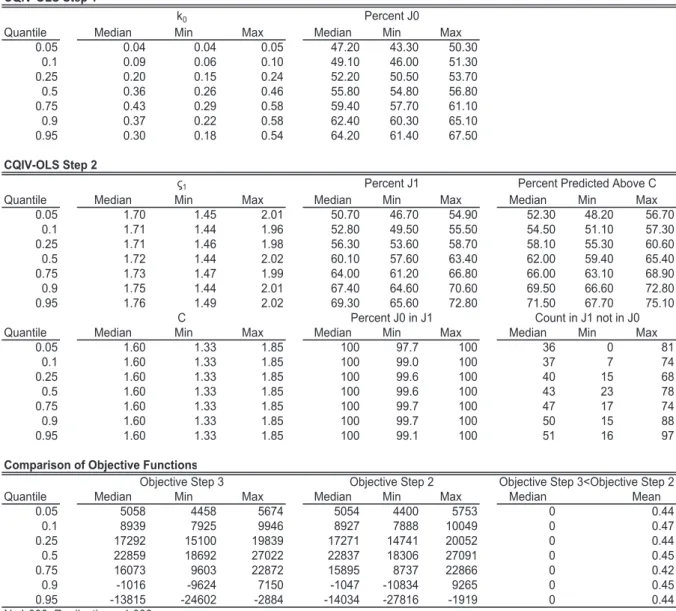
Remark 2
(Step 0). A simple additive strategy is to estimate the control variable using
the empirical CDF of the residuals from the first stage OLS regression of
D
on
W
and
Z
.
More flexible non-additive strategies based on quantile regression or distribution regression
are described in the previous section.
Remark 3
(Step 1). To predict the quantile-uncensored observations, a probit, logit, or any
other model that fits the data well can be used. Note that the model does not need to be
correctly specified; it suffices that it selects a nontrivial subset of observations with
X
0i
β
0(
u
)
>
C
i. To choose the value of
k
0, it is advisable that a constant fraction of observations satisfying
Λ(
S
b
0i
b
δ
)
>
1
−
u
are excluded from
J
0for each quantile. To do so, set
k
0as the
q
0th quantile
of Λ(
S
b
0i
δ
b
) conditional on Λ(
S
b
i0δ
b
)
>
1
−
u
, where
q
0is a percentage (10% worked well in our
simulation). The empirical value of
k
0and the percentage of observations retained in
J
0can
be computed as simple robustness diagnostic tests at each quantile.
Remark 4
(Step 2). To choose the cut-off
ς
1, it is advisable that a constant fraction of
observations satisfying
X
b
0i
β
b
0(
u
)
> C
iare excluded from
J
1for each quantile.
To do so,
set
ς
1to be the
q
1th quantile of
X
b
i0β
b
0(
u
)
−
C
iconditional on
X
b
i0β
b
0(
u
)
> C
i, where
q
1is a
percentage less than
q
0(3% worked well in our simulation). In practice, it is desirable that
J
0⊂
J
1. If this is not the case, we recommend altering
q
0,
q
1, or the specification of the
regression models. At each quantile, the empirical value of
ς
1, the percentage of observations
from the full sample retained in
J
1, the percentage of observations from
J
0retained in
J
1,
and the number of observations in
J
1but not in
J
0can be computed as simple robustness
diagnostic tests. The estimator
β
b
0(
u
) is consistent but will be inefficient relative to the
estimator obtained in the subsequent step.
Remark 5
(Steps 1 and 2). In the notation of Assumption 4, the selector of Step 1 can be
expressed as 1(
S
b
0i
b
γ > ς
0), where
S
b
i0b
γ
=
S
b
i0b
δ
−
Λ
−1(1
−
u
) and
ς
0= Λ
−1(1
−
u
+
k
0)
−
Λ
−1(1
−
u
).
The selector of Step 2 can also be expressed as 1(
S
b
0i
b
γ > ς
1)
,
where
S
b
i= (
X
b
i0, C
i)
0and
b
γ
= (
β
b
0(
u
)
0,
−
1)
0.
Remark 6
(Steps 2, 3 and 4). Beginning with Step 2, each successive iteration of the
algorithm should yield estimates that come closer to minimizing the Powell objective
func-tion. As a simple robustness diagnostic test, we recommend computing the Powell objective
function using the full sample and the estimated coefficients after each iteration, starting
with Step 2. This diagnostic test is computationally straightforward because computing the
objective function for a given set of values is much simpler than maximizing it. In practice,
this test can be used to determine when to stop the CQIV algorithm for each quantile. If
the Powell objective function increases from Step
s
to Step
s
+ 1 for
s
≥
2, estimates from
Step
s
can be retained as the coefficient estimates.
3.2.
Weighted Bootstrap Algorithm.
We recommend obtaining confidence intervals through
a weighted bootstrap procedure, though analytical formulas can also be used. If the
esti-mation runs quickly on the desired sample, it is straightforward to rerun the entire CQIV
algorithm
B
times weighting all the steps by the bootstrap weights. To speed up the
com-putation, we propose a procedure that uses a one-step CQIV estimator in each bootstrap
repetition.
Algorithm 2
(Weighted bootstrap CQIV)
.
For
b
= 1
, . . . , B
, repeat the following steps:
1.
Draw a set of weights
(
e
1b, . . . , e
nb)
i.i.d from a random variable
e
that satisfies
As-sumption 6. For example, we can draw the weights from a standard exponential
distribution.
2.
Reestimate the control variable in the weighted sample,
V
b
eib
=
ϑ
b
eb(
D
i, W
i, Z
i)
, and
construct
X
b
eib
=
x
(
D
i, W
i,
V
b
ibe)
.
3.
Estimate the weighted quantile regression:
b
β
be(
u
) = arg
min
β∈Rdim(X)X
i∈J1be
ibρ
u(
Y
i−
β
0X
b
ibe)
,
where
J
1b=
{
i
:
β
b
(
u
)
0X
b
ibe> C
i+
ς
1}
,
and
β
b
(
u
)
is a consistent estimator of
β
0(
u
)
,
e.g., the 3-stage CQIV estimator
β
b
1(
u
)
.
Remark 7
(Step 2). The estimate of the control function
ϑ
b
eb
can be obtained by weighted
least squares, weighted quantile regression, or weighted distribution regression.
Remark 8
(Step 3). A computationally less expensive alternative is to set
J
1b=
J
1in all the
repetitions, where
J
1is the subset of selected observations in Step 2 of the CQIV algorithm.
We can construct an asymptotic (1
−
α
)-confidence interval for a function of the parameter
vector
g
(
β
0(
u
)) as [
b
g
α/2,
b
g
1−α/2], where
b
g
αis the sample
α
-quantile of [
g
(
β
b
1e(
u
))
, . . . , g
(
β
b
Be(
u
))].
For example, the 0.025 and 0.975 quantiles of (
β
b
e1,k
(
u
)
, . . . ,
β
b
B,ke(
u
)) form a 95% asymptotic
confidence interval for the
k
th coefficient
β
0,k(
u
).
3.3.
Monte-Carlo illustration.
The goal of the following numerical example is to
com-pare the performance of CQIV relative to tobit IV and other quantile regression estimators
in finite samples. We generate data according to a normal design that satisfies the tobit
parametric assumptions and a design with heteroskedasticity in the first stage equation for
the endogenous regressor
D
that does not satisfy the tobit parametric assumptions. To
facilitate the comparison, in both designs we consider a location model for the response
vari-able
Y
∗, where the coefficients