A Large Scale Six Sigma Program
at the Hospital Group of Skaraborg
by
Svante Lifvergren Alexander Chakhunashvili Bo Bergman Hospital Group of Skaraborg
541 85 Skövde Sweden
Hospital Group of Skaraborg 541 85 Skövde Sweden Chalmers University of Technology 412 96 Göteborg Sweden
[email protected] [email protected] [email protected]
KEYWORDS: Six Sigma, Healthcare, Black Belt project, variation, change, learning
1.
B
ACKGROUNDThe challenges of healthcare today are astronomical –from a patient safety, accessibility and medical quality points of view. More (and more expensive) treatment possibilities are
available, the proportion of elderly people in the population is growing, people’s awareness of the curing possibilities is increasing and, as a consequence, the cost of healthcare is also increasing. Not until recently the potential of utilising concepts from the quality movement has been recognised in healthcare. Although some early insights have been voiced, see e.g. [Curing healthcare] it is not until the nineties an awareness of the possibilities offered by the industrial quality movement has been realised.
In Sweden, a wave of new quality improvement initiatives has started to come into sight during the last years. A typical case is the Skaraborg Hospital Group, where since 2003 systematic quality initiatives have been taken.
The Skaraborg Hospital Group, (SkaS), is situated in the Western Region of Sweden and serves a population of 260 000. The group consists of four hospitals – the hospitals of
Lidköping, Skövde, Mariestad and Falköping. The services offered by SkaS include acute and planned care in a large number of specialities. In total there are more than 700 beds and around 4700 employees at SkaS. SkaS shares a responsibility together with the local authorities and the primary care units for the entire healthcare chain of integrated care.
In the mid nineties, the concept of process improvement found its way into Swedish healthcare. However, a more profound knowledge of process orientation from a system’s point of view was not attained. Instead, the concept was more often used as a tool to map processes and it seldom led to sustainable improvements (Eriksson, 2005). At the same time,
the leading institute for advocating system changes in healthcare processes internationally - the Institute for Healthcare Improvement (IHI), US - started a lot of initiatives to improve the American Healthcare system. Some of these initiatives, e.g. The Collaborative Breakthrough series, have heavily influenced Swedish improvement efforts in healthcare since then. Still, according to Olsson et al (Olsson, 2005), most improvement projects in Swedish healthcare start from a co-worker’s and not a patient’s perspective. Also, the results of the efforts are not known or even measured. Even more, experiences from e.g. SkaS show that there is poor knowledge about how variation affects quality and how to reduce unwanted variation in healthcare processes. From a SkaS point of view, it was felt that stronger improvement initiatives were needed.
In 2004 the first author, a physician - eventually also Development Director and member of the top management team of SkaS with a responsibility for the hospital-wide Quality Improvement efforts - followed a course on Quality-driven Organisation Development
provided by Chalmers University of Technology for health care professionals with leadership, organisation development or quality management roles in their organizations. Applying some tools from the Six Sigma toolbox created a taste for more and an insight in the power of variation reduction for quality and productivity improvement. Together with two more persons in the health care system of SkaS, one quality physician and one economist – both of them on the executive staff for SkaS, the first author of this paper was given the opportunity to attend a regular Black Belt course at the Chalmers University of Technology. They were all eager to get the chance to investigate the variation reduction ideas further in order to learn in what sense and to what extent the ideas were applicable to Swedish healthcare.
2.
T
HE FIRST ENCOUNTERThe Black Belt course at Chalmers is a traditional Six Sigma course that recurs every year in the curriculum of the International Master’s Program in Quality Management. The course lasts for six months, corresponds to 10 Credits when successfully completed and is designed to promote students from Chalmers to work in teams together with black belt candidates from industrial companies. Thus, each team consists of several students working with a
representative from a participating company. Each company has to bring a ‘real life problem’ in to the course. The team then together tries to solve the problem using the Six Sigma’s DMAIC roadmap (Define, Measure, Analyze, Improve, Control).
In September of 2005, the three co workers from SkaS had the opportunity to attend the course, which was the first time that personnel from a healthcare organization were represented at a Chalmers Six Sigma education.
In this particular case, the participants from SkaS looked at a problem well recognized in Swedish healthcare systems – the variation in INR when treating patients with warfarin.
projects became obvious. Also, the toolbox associated with Six Sigma seemed to be a powerful instrument in trying to solve crucial problems in core healthcare processes. The projects attracted a lot of curiosity and interest among nurses and physicians but also among managers. As a result of this, four more improvement facilitators from SkaS were sent to a privately held black belt course in 2005. All in all, five black belt projects were completed in this first wave.
3.
T
HES
ECONDW
AVE OFB
LACKB
ELTP
ROJECTSBased on these experiences, the top management team of SkaS decided to widen the Six Sigma endeavour and launch a strategic initiative. Another 14 black belt candidates were recruited from different parts of the organization in early 2006. The majority of the candidates were nurses who had been working for some years at SkaS, most of them with some
experience from earlier improvement projects. One engineer, an economist, a systems programmer and a physiotherapist also participated in the course. An external
consultant/Master Black Belt from QRAFT was hired to manage and supervise the education and the improvement projects. The initiative was co managed by the first author and the collaborators who had participated in the Chalmers course. Every black belt candidate was able to devote 50% of his/her working time to the project. In industrial settings, black belts usually work full time with their projects. To compensate for this, each project was led by two black belt candidates – a solution that eventually proved to be very successful.
In order to ensure participation on a broad scale, every clinic was supposed to collect its own improvement ideas leading to Black Belt projects. However, primarily due to the overall absence of goals and results in the targeted care processes, many clinics had serious problems in defining tangible projects. A lot of effort had to be put in to the Define phase leading to a redefinition of some of the projects. Some line managers in the concerned processes thought that this approach conveyed a non favourable top-down flavour to the initiative. Eventually, seven projects were carried out as originally planned:
• Reducing haemolysis in blood tests at the emergency ward • Reducing waiting times at the emergency ward
• Lowering HbA1C in patients with diabetes
• Reducing unnecessary cancellations of orthopaedic operations
• Reducing unwanted variation in hours used for supervising suicidal patients at different psychiatric wards
• Lowering the rate of Caesarean sections
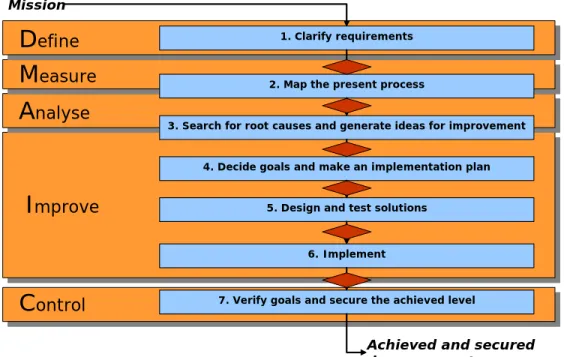
The black belt course started in February of 2006 and lasted for ten months. It consisted of five three-day seminars and one concluding examination day in December when the results from the projects were presented. To a large extent, the course followed the layout of a traditional black belt education. However, less emphasis was put on variation reduction and more on project management. The content of the seminars followed a slightly redefined DMAIC problem solving process:
Figure 1: S lightly redefined DMAIC solving process used during the second black belt wave at SkaS (© QRAFT)
Besides the project leaders (two black belts per project), there was also a cross-functional project team as well as a steering committee consisting of managers responsible for the process to be improved in every project. The role of the committee was to continuously monitor and give approval after each step in the DMAIC problem solving process. Every co-worker and manager with a role in the project received a 3-day education in Six Sigma concepts and methods. All in all, almost a hundred co-workers were thus actively involved in the projects.
Identified solutions to the quality problems in the projects were implemented using a method of iterating PDSA-cycles inspired by the “Breakthrough Method” developed by Institute of Healthcare Improvement (IHI) (ref).
1. Clarify requirements
Mission
Achieved and secured improvement
2. Map the present process
3. Search for root causes and generate ideas for improvement
4. Decide goals and make an implementation plan
5. Design and test solutions
6. Implement
7. Verify goals and secure the achieved level
D
efineM
easureA
nalyseI
mproveIn order to refine but also to adapt the problem solving approach to better suit healthcare processes, the course was evaluated using a survey answered by the black belts. A learning seminar was also conducted with the course participants after completion of the projects. To summarize the experiences, the black belts were very content with the course. The methodology and the tools were found to be suitable for solving the problems encountered in the projects. In many cases, the systematic use of 7 QC was sufficient and the more advanced tools at hand were not needed. Involving steering committees and project groups in every project was considered to be critical for the successful improvements that were achieved. The continuous dialogue taking place in these groups broadened the ownership of the projects. It would nevertheless be a mistake to say that the black belts could work without obstacles or elements of resistance. As put by one of the black belts:
‘The difficulties that I encountered at the beginning of the project were primarily due to the problem of getting the doctors involved. Some of the doctors were very much against the whole project. They know best themselves! And why should they put effort into an improvement project when their hands are needed in the daily care of the patient?’
But still, the Six Sigma methodology with its scientific approach seemed to reduce some of the resistance. The same black belt reflects:
‘A great deal of the resistance could be eliminated by showing significant results. The DMAIC problem solving process is excellent in this respect. A doctor rarely contradicts a significant p-value! There aren’t that many arguments against that.’
Put together, the experiences from the second wave of black belt projects were overwhelmingly positive. All the black belts were given the opportunity to continue as improvement leaders at SkaS for three more years with 50% working time allocated for supporting improvement efforts and conducting new black belt projects.
4.
T
HE THIRD WAVE OFB
LACKB
ELTP
ROJECTSBased on the so far positive experiences, the top management of SkaS decided to permanent the Six Sigma initiative in early 2007. This meant that the improvement leader role was incorporated into the organizational structure of SkaS. All improvement leaders had to have black belt competence. In order to establish a sustainable network for improvement, it was estimated that fifteen more improvement leaders had to be recruited with the goal of constantly having 25-30 active black belts at SkaS.
Since the sole strategy of SkaS is to excel at quality development, the top management considered it necessary that SkaS itself was able to manage its education initiatives regarding improvement knowledge.
Therefore, based on a collaboration between SkaS, the University of Skövde and the Chalmers University of Technology, a black belt course (20 CREDITS) hosted by the University of Skövde was initiated. The third author, Prof Bo Bergman at Chalmers, is the examinator of the course.
The second author, a master black belt from Chalmers with a doctor’s degree in quality engineering, has been hired at SkaS to be in charge of the Six Sigma program and also to function as head teacher at the course. The three first black belts from SkaS educated at Chalmers also function as teachers and mentors in the course and work as Champions in the program.
In this third black belt wave, fifteen improvement leaders from SkaS together with five participants from the University of Skövde are attending the course, which started in March of 2007. With the exception of one economist, one physiotherapist and an assistant nurse, all the other black belt candidates participating in the course are nurses. This time, a database for collecting improvement ideas from the clinics has been implemented, which has made it easier to identify and define projects. Seven healthcare projects are represented in the course, for instance:
• Improve cooperation between institutional and non-institutional care in the Psychiatric Division of SkaS
• Minimize the number of patients that select other hospitals than SkaS for elective care • Reduce the number of orthopaedic patients at the emergency ward
• Reduce medication costs at the Gynaecological Division
• Reduce the proportion of institutional care at the Children’s Clinic • Reduce variation in waiting time to the Elderly Care homes in Lidköping
The original DMAIC model has been refined after the second round of Six Sigma education by adding a session on learning and reflection. Figure 2 summarizes the SkaS’s DMAICL approach
Figure 2: The refined Six Sigma roadmap now used at SkaS - DMAICL
Based on experiences from the two first black belt waves, more emphasis is put on variation knowledge and on methods to enhance creativity and the ability to select among possible solutions. A session on Lean Production has been incorporated, since a lot of the projects deal with process flows. The Learning phase has been added to secure achieved improvements but also to consolidate the learning process.
D
M
A
I
C
L
Measure
Define Analyze Improve Control
Learn
Formulate the problem Identify improvemen t areas Define project goals Measure the process, determine current state and quantify the problem Analyze the data and determine root causes of the problem Improve the process by designing alternative solutions and by selecting the one you want to go on with Control and monitor the new peocess as well as standardize and integrate it into daily work Summarize the project and reflect on your own learning process. Continue to integrate solutions into the daily work
Common to other Swedish applications of Six Sigma, a lot of emphasis is put on teamwork. In every project, a project group consisting of frontline personnel is engaged in the
improvement work. The project is always owned by a steering committee consisting of line managers from the concerned processes. This approach has minimized resistance to change and created a lot of enthusiasm for the projects.
In the Improve phase, iterative PDSA-cycles inspired from the Collaborative Breakthrough series from IHI has been used when testing possible solutions. This procedure has also been successful and fosters broad participation among co-workers.
6.
C
ONCLUSIONVariation is an important concept that is not currently fully understood and managed in healthcare. The refined Six Sigma concept described in this article seems to be a successful way to reduce unwanted variation and thus improve healthcare processes. Eleven out of twelve projects have so far been successful in this initiative and reached significant results. To achieve action and learning a combination with “Breakthrough Methods” seems favourable when implementing solutions. By continuously educating co-workers and managers in the different projects, the resistance to change has been practically non-existent. Furthermore, SkaS is planning to start a research project together with Chalmers University of Technology on the use of Design for Six Sigma in an effort to minimize the effects of medication errors.
R
EFERENCESBergman, B. and Klefsjö, B. (2003). Quality from Customer Need to Customer Satisfaction, Studentlitteratur, Lund.
Berwick D., Blanton Godfrey A. and Roessner J. (1990). Curing Healthcare, John Wiley & Sons, San Fransisco
Eriksson, Nomie (2005). Friska vindar i sjukvården - stöd och hinder vid förändringar i professionella organisationer,
PhD dissertation, Förvaltningshögskolan, Göteborgs Universitet. (A PhD dissertation on process oriented work at SkaS and at Ryhov Hospital in Jönköping)
Magnusson, K., Kroslid, D. and Bergman, B. (2003). Six Sigma, the Pragmatic Approach, Studentlitteratur, Lund.
Olsson J, Kammerlind P, Thor J, Elgh M: Surveying Improvement Activities in Health Care on a National Level – The Swedish Internal Collaborative Strategy and Its Challenges,
Quality Management in Healthcare; Vol 12, 2005 No 4, pp 202-216
The Breakthrough Series (2003):
IHI’s Collaborative Model for Achieving Breakthrough Improvement, IHI Boston