
energies
ReviewState of the Art of Machine Learning Models in
Energy Systems, a Systematic Review
Amir Mosavi1,2,3 , Mohsen Salimi4 , Sina Faizollahzadeh Ardabili5, Timon Rabczuk6, Shahaboddin Shamshirband7,8,* and Annamaria R. Varkonyi-Koczy9
1 School of the Built Environment, Oxford Brookes University, Oxford OX3 0BP, UK; [email protected]
2 Centre for Accident Research Road Safety-Queensland, Queensland University of Technology, Brisbane QLD 4059, Australia
3 Institute of Automation, Kando Kalman Faculty of Electrical Engineering, Obuda University, Budapest, Hungary
4 Department of Renewable Energies, Niroo Research Institute, Tehran, Iran; [email protected] 5 Biosystem Engineering Department, University of Mohaghegh Ardabili, Ardabil 5619911367, Iran;
6 Department of Computer Engineering, College of Computer and Information Sciences, King Saud University, Riyadh, Saudi Arabia; [email protected]
7 Department for Management of Science and Technology Development, Ton Duc Thang University, Ho Chi Minh City, Vietnam
8 Faculty of Information Technology, Ton Duc Thang University, Ho Chi Minh City, Vietnam 9 Department of Mathematics and Informatics, J. Selye University, Komarno 94501, Slovakia;
* Correspondence: [email protected]
Received: 12 February 2019; Accepted: 28 March 2019; Published: 4 April 2019 Abstract: Machine learning (ML) models have been widely used in the modeling, design and prediction in energy systems. During the past two decades, there has been a dramatic increase in the advancement and application of various types of ML models for energy systems. This paper presents the state of the art of ML models used in energy systems along with a novel taxonomy of models and applications. Through a novel methodology, ML models are identified and further classified according to the ML modeling technique, energy type, and application area. Furthermore, a comprehensive review of the literature leads to an assessment and performance evaluation of the ML models and their applications, and a discussion of the major challenges and opportunities for prospective research. This paper further concludes that there is an outstanding rise in the accuracy, robustness, precision and generalization ability of the ML models in energy systems using hybrid ML models. Hybridization is reported to be effective in the advancement of prediction models, particularly for renewable energy systems, e.g., solar energy, wind energy, and biofuels. Moreover, the energy demand prediction using hybrid models of ML have highly contributed to the energy efficiency and therefore energy governance and sustainability.
Keywords: energy systems; machine learning; artificial neural networks (ANN); support vector machines (SVM); neuro-fuzzy; ANFIS; wavelet neural network (WNN); big data; decision tree (DT); ensemble; hybrid models; deep learning; blockchain; renewable energy systems; energy informatics; internet of things (IoT); smart sensors; remote sensing; prediction; forecasting; energy demand
Energies2019,12, 1301 2 of 42
1. Introduction
An energy system is a group of organized elements designed for the purpose of generation, control and/or transformation of energy [1,2]. Energy systems may incorporate combinations of mechanical, chemical, thermal, and electromagnetical components, covering a wide range of energy categories including renewables and alternatives [3–5]. The advancement of energy systems is facing critical decision-making tasks to satisfy numerous demanding and contradictory objectives considering functional performance, efficiency, financial burden, environmental impact, etc. [6].
The growing utilization of data collectors in energy systems has resulted in a massive amount of data accumulated. Smart sensors are now extensively used in energy production and energy consumption [7–9]. Such big data has created a vast number of opportunities and challenges for informed decision-making [10,11]. ML models have contributed to the implementation of big data technologies in various applications [12–16]. Since prediction methods based on ML models simplify the extraction of functional dependencies from observations, such data-driven models have gained popularity in the energy realm [17–19]. Today, ML models in energy systems are essential for predictive modeling of production, consumption, and demand analysis due to their accuracy, efficacy and speed [20,21]. ML models also provide an understanding on energy system functionality in the context of complex human interactions [22,23]. The use of ML models for conventional energy systems, along with alternative and renewable energy systems, has been promising [24,25]. Due to the popularity of the field, many review papers have emerged that present insight into present applications and future challenges and opportunities [26]. However, the existing review papers either survey the applications of a single ML model, e.g., ANNs [17], or cover only one energy domain, e.g., solar radiation forecasting [24]. Consequently, the advancements of ML models and their progress in various energy systems have not yet been addressed in the literature. Therefore, a comprehensive review of essential ML models is the main objective of this paper. Consequently, the contribution of this paper is to present the state of the art of ML models in energy systems and discuss their likely future trends.
The rest of this paper is organized as follows. In Section2the methodology of the research is presented. In the section three state of the art of ML models in energy systems is presented with an initial analysis of the database search. The ML models are categorized and the original papers with high relevance have been reviewed. Each subsection contains a brief discussions and outlook on the results related to each subject. Section3also includes an overview of recently emerged hybrid ML models. Section4focuses on the latest advancement of hybrid ML models in the highly demanding application areas e.g., solar, wind, and demand energy systems. Finally, in Section4, an overall discussion and conclusions are presented.
2. Methodology of Survey
The purpose of the research methodology is to identify, classify and review the notable ML and DL models used in energy systems. In our comprehensive review, using the Thomson Reuters Web-of-Science and Elsevier Scopus for implementation of the search queries would ensure that any paper in the database would meet the essential quality measures, originality, high impact, and high h-index. Furthermore, to present an in-depth review and understanding of each modeling technique and its progress, we aimed at having four different categories for the models used in energy systems, i.e., single ML models, hybrid models, ensemble models, and DL.
Figure1demonstrates the methodology of this review. In step 1 of the methodology the initial database of the relevant articles is identified based on the search queries of: “energy system” and “machine learning” or “neural network” or “support vector” or “ANFIS” or “WNN” or “DT” or “MLP”
or “ELM” or “ensemble” or “deep learning.” However, for every ML method, we applied a new search query to suit that search well. These queries will identify the relevant articles, yet the queries are uncertain whether the ML model belongs to either ensemble or hybrids. Also, some articles in the initial database might not be relevant at all. For instance, a hybrid or ensemble model of ML may
Energies2019,12, 1301 3 of 42
include single model(s). For that reason, steps 2 and 3 of the methodology are designed in such a way to classify the ML models into the right categories for the review. In step 4 the models are classified into the four categories and arranged in separate tables to be reviewed individually.
Energies 2019, 12, x FOR PEER REVIEW 3 of 43
in such a way to classify the ML models into the right categories for the review. In step 4 the models are classified into the four categories and arranged in separate tables to be reviewed individually.
Figure 1. Methodology of research.
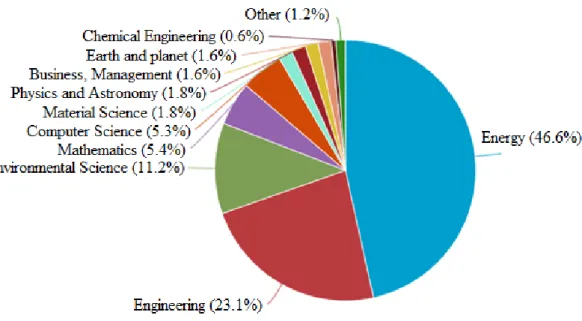
The database includes 2601 relevant documents. During step two of the methodology the number of relevant documents drops to 240. In step three the documents are reduced to 70 original papers to be reviewed in this paper. Analyzing the initial database shows a great increase in the number of articles using ML models. Figures 2 and 3 demonstrate the growth in the number of papers during the past two decades on energy systems that utilized ML and different subject areas using ML in energy systems, respectively. The increase in the number of documents in energy systems has also been due to the implementation of smart grid systems and the IoT. During the past decade, novel ML models including deep learning, ensembles, and hybrids have emerged in energy systems. Through introducing novel ML models to energy systems, the increasing number of papers represents a huge experimental effort to explore new opportunities.
Figure 1.Methodology of research.
The database includes 2601 relevant documents. During step two of the methodology the number of relevant documents drops to 240. In step three the documents are reduced to 70 original papers to be reviewed in this paper. Analyzing the initial database shows a great increase in the number of articles using ML models. Figures2and3demonstrate the growth in the number of papers during the past two decades on energy systems that utilized ML and different subject areas using ML in energy systems, respectively. The increase in the number of documents in energy systems has also been due to the implementation of smart grid systems and the IoT. During the past decade, novel ML models including deep learning, ensembles, and hybrids have emerged in energy systems. Through introducing novel ML models to energy systems, the increasing number of papers represents a huge experimental effort to explore new opportunities.
Energies 2019, 12, x FOR PEER REVIEW 3 of 43
in such a way to classify the ML models into the right categories for the review. In step 4 the models are classified into the four categories and arranged in separate tables to be reviewed individually.
Figure 1. Methodology of research.
The database includes 2601 relevant documents. During step two of the methodology the number of relevant documents drops to 240. In step three the documents are reduced to 70 original papers to be reviewed in this paper. Analyzing the initial database shows a great increase in the number of articles using ML models. Figures 2 and 3 demonstrate the growth in the number of papers during the past two decades on energy systems that utilized ML and different subject areas using ML in energy systems, respectively. The increase in the number of documents in energy systems has also been due to the implementation of smart grid systems and the IoT. During the past decade, novel ML models including deep learning, ensembles, and hybrids have emerged in energy systems. Through introducing novel ML models to energy systems, the increasing number of papers represents a huge experimental effort to explore new opportunities.
Energies2019,12, 1301 4 of 42
Energies 2019, 12, x FOR PEER REVIEW 4 of 43
Figure 2. The growth in the number of articles during the past two decades.
The initial consideration of the database of identified articles shows an exponential increase in the quantity of the literature on the use of ML in various energy systems (see Figure 2). Considering the application areas of the database, ML models have been extensively used in diverse applications of energy systems, especially for predicting electrical energy and renewable energies demand and consumption. The continued growth of literature can also confirm the great potential of ML models in energy systems.
Figure 3. Subject areas of ML in energy systems. 3. State of the Art of ML Models in Energy Systems
The methodology identifies 10 major ML models frequently used in energy systems, i.e., ANN, MLP, ELM, SVM, WNN, ANFIS, decision trees, deep learning, ensembles, and advanced hybrid ML models. The notable manuscripts are accordingly categorized into the relevant groups and further reviewed in this section. Note that, in the presented taxonomy, deep learning as an emerging modeling technique has been categorized under the ML models. Furthermore, it is worth mentioning that WNN and ANFIS are of a hybrid nature. However, the category of “advanced hybrid ML models” includes only recently developed algorithms.
In this section the accuracy of the ML model is further evaluated. Since different ML models are available, choosing and demonstrating the superiority of the models requires comparing their performance. Hence, some comparative performance parameters are required. The most popular comparative performance parameters are the root mean square error (RMSE) and correlation coefficient (r), which are used to indicate the error and precision of the models [27,28]; Equations (1) and (2) represent these parameters.
(
)
2 11
N ti pi iRMSE
x
x
n
==
∑
−
(1)(
)
( )
1/2 2 1 2 1 1 n ti pi i n ti i x x r x = = − = − ∑
∑
, (2)where xti represents the target value, xpi represents the predicted value, and n is the number of data points. Figure 3.Subject areas of ML in energy systems.
The initial consideration of the database of identified articles shows an exponential increase in the quantity of the literature on the use of ML in various energy systems (see Figure2). Considering the application areas of the database, ML models have been extensively used in diverse applications of energy systems, especially for predicting electrical energy and renewable energies demand and consumption. The continued growth of literature can also confirm the great potential of ML models in energy systems.
3. State of the Art of ML Models in Energy Systems
The methodology identifies 10 major ML models frequently used in energy systems, i.e., ANN, MLP, ELM, SVM, WNN, ANFIS, decision trees, deep learning, ensembles, and advanced hybrid ML models. The notable manuscripts are accordingly categorized into the relevant groups and further reviewed in this section. Note that, in the presented taxonomy, deep learning as an emerging modeling technique has been categorized under the ML models. Furthermore, it is worth mentioning that WNN and ANFIS are of a hybrid nature. However, the category of “advanced hybrid ML models” includes only recently developed algorithms.
In this section the accuracy of the ML model is further evaluated. Since different ML models are available, choosing and demonstrating the superiority of the models requires comparing their performance. Hence, some comparative performance parameters are required. The most popular comparative performance parameters are the root mean square error (RMSE) and correlation coefficient (r), which are used to indicate the error and precision of the models [27,28]; Equations (1) and (2) represent these parameters.
RMSE= v u u t1 n N
∑
i=1 xti−xpi2 (1) r= 1− n ∑ i=1 xti−xpi2 n ∑ i=1 (xti)2 1/2 , (2)where xti represents the target value, xpi represents the predicted value, and n is the number of data points.
Energies2019,12, 1301 5 of 42
3.1. ANN
Artificial neural networks are frameworks for different machine learning algorithms to process complex data inputs. ANNs can be utilized for several purposes such as forecasting, regression and curve fitting. An artificial neural network fundamental unit is a neuron that utilizes a transfer function for the output formulation. The main advantage of ANN models is their lower complexity for multiple-variable problems. Table1demonstrates some critical papers in this field. Instead of complicated rules, ANN can learn patterns of crucial information within an intricate information domain [4]. Also, due to the noise-immune and fault-tolerant characteristics of ANNs, they can be successfully used for inherently noisy data from energy systems.
Table 1.Notable ANN models used in energy systems.
Year Reference Journal Application
2018 Abbas et al. [29] Electronics(Switzerland) Optimization of renewable energy generation capacities 2017 Anwar et al. [30] IEEE Transactions on
Power Systems
Mitigation of wind power fluctuation and scheduling strategies for power generation 2017 Boukelia et al. [31] Renewable Energy Prediction of levelized cost of electricity 2016 Chatziagorakis et al. [32] Neural Computing and
Applications
A forecasting model for wind speed and hourly and daily solar radiation 2018 Gallagher et al. [33] Energy and Buildings Measurement and verification of energy
savings in industrial buildings
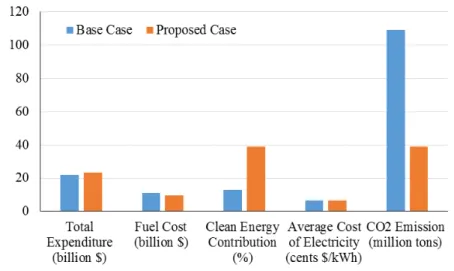
Abbas et al. (2018) [29] used genetic algorithms to optimize the generation capacities of renewable energy systems integrated with storage systems. This study evaluated the economic feasibility of the introduction of energy storage systems to the electric grid. The artificial neural network was used to validate the predicted load model. The uncertainties related to the renewable energy systems were dealt with using a chance-constrained model. Then, the problem was solved by genetic algorithms. The robustness of the proposed model was verified by its application to a case in western China. Figure4reports the results of the proposed method in comparison with the base case in terms of total expenditure (billion $), fuel cost (billion $), clean energy contribution (%), the average cost of electricity (cents $/kWh), and CO2emissions (million Tons). Based on Figure4, the use of clean energy nearly doubled, which led to a reduction in CO2emissions from about 109 million tons to 38 million tons. Therefore the proposed case has an effective role compared with the base case.
Energies 2019, 12, x FOR PEER REVIEW 5 of 43
3.1. ANN
Artificial neural networks are frameworks for different machine learning algorithms to process complex data inputs. ANNs can be utilized for several purposes such as forecasting, regression and curve fitting. An artificial neural network fundamental unit is a neuron that utilizes a transfer function for the output formulation. The main advantage of ANN models is their lower complexity for multiple-variable problems. Table 1 demonstrates some critical papers in this field. Instead of complicated rules, ANN can learn patterns of crucial information within an intricate information domain [4]. Also, due to the noise-immune and fault-tolerant characteristics of ANNs, they can be successfully used for inherently noisy data from energy systems.
Table 1. Notable ANN models used in energy systems.
Year Reference Journal Application
2018 Abbas et al. [29] Electronics (Switzerland) Optimization of renewable energy generation capacities 2017 Anwar et al. [30] IEEE Transactions on Power Systems scheduling strategies for power generation Mitigation of wind power fluctuation and 2017 Boukelia et al.
[31] Renewable Energy Prediction of levelized cost of electricity 2016 Chatziagorakis et al. [32] Neural Computing and Applications A forecasting model for wind speed and hourly and daily solar radiation 2018 Gallagher et al. [33] Energy and Buildings Measurement and verification of energy savings in industrial buildings
Abbas et al. (2018) [29] used genetic algorithms to optimize the generation capacities of renewable energy systems integrated with storage systems. This study evaluated the economic feasibility of the introduction of energy storage systems to the electric grid. The artificial neural network was used to validate the predicted load model. The uncertainties related to the renewable energy systems were dealt with using a chance-constrained model. Then, the problem was solved by genetic algorithms. The robustness of the proposed model was verified by its application to a case in western China. Figure 4 reports the results of the proposed method in comparison with the base case in terms of total expenditure (billion $), fuel cost (billion $), clean energy contribution (%), the average cost of electricity (cents $/kWh), and CO2 emissions (million Tons). Based on Figure 4, the use of clean energy nearly doubled, which led to a reduction in CO2 emissions from about 109 million tons to 38 million tons. Therefore the proposed case has an effective role compared with the base case.
Figure 4. Results for study by Abbas et al. (2018). Reproduced from [29], Elsevier: 2018.
Anwar et al. (2017) [30] presented a novel strategy for generation scheduling and power smoothing for a hybrid system of marine current and wind turbines. In this study, innovative
Energies2019,12, 1301 6 of 42
Anwar et al. (2017) [30] presented a novel strategy for generation scheduling and power smoothing for a hybrid system of marine current and wind turbines. In this study, innovative strategies were proposed to mitigate wind intermittency effects. Contrary to the randomness of wind, marine currents are highly predictable. The presented methodologies incorporate an optimal strategy for sizing for this hybrid system. Bootstrapped artificial neural networks were developed to predict intervals for wind speed—speeds of marine currents modeled utilizing the Harmonic Analysis Method. The results of the model show the robustness of the presented methodology, which can be used to successfully decrease power fluctuations, make considerable cost savings, and ensure reliable dispatch scheduling for power generation. Boukelia et al. (2017) [31] used an ANN-based approach to assess a parabolic trough solar power plant. In this study, an ANN model was developed to predict the levelized electricity cost of two parabolic trough solar thermal power plants coupled with a fuel backup system and thermal energy storage. The techno-economic study was performed comparing molten salt and thermic oil usage to optimize thermal plants’ hourly and annual performance.
Chatziagorakis et al. (2016) [32] studied the control of hybrid renewable energy systems, using recurrent neural networks to forecast weather conditions. A forecasting model using a recurrent neural network for prediction of hourly and daily solar radiation and wind speed was presented. The results of the simulation indicated that a recurrent neural network was capable of delivering acceptable future estimation to evaluate the available renewable energy safely.
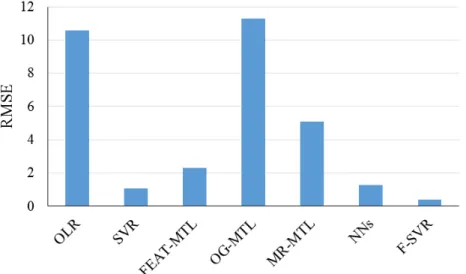
Gallagher et al. (2018) [33] studied the suitability of machine learning for the optimization of uncertainty in energy savings measurement and verification. In this paper, the new use of machine learning algorithms for energy savings in industrial buildings was studied. The applied machine learning techniques consisted of k-nearest neighbors, support vector machines, artificial neural networks, decision trees, and bi-variable and multi-variable ordinary least squares regression. The model’s prediction performances were validated to optimize model parameters. The results demonstrated that models based on ML algorithms were more precise than conventional methods. Results ofRMSEhave been presented in Figure5.
Energies 2019, 12, x FOR PEER REVIEW 6 of 43
strategies were proposed to mitigate wind intermittency effects. Contrary to the randomness of wind, marine currents are highly predictable. The presented methodologies incorporate an optimal strategy for sizing for this hybrid system. Bootstrapped artificial neural networks were developed to predict intervals for wind speed—speeds of marine currents modeled utilizing the Harmonic Analysis Method. The results of the model show the robustness of the presented methodology, which can be used to successfully decrease power fluctuations, make considerable cost savings, and ensure reliable dispatch scheduling for power generation. Boukelia et al. (2017) [31] used an ANN-based approach to assess a parabolic trough solar power plant. In this study, an ANN model was developed to predict the levelized electricity cost of two parabolic trough solar thermal power plants coupled with a fuel backup system and thermal energy storage. The techno-economic study was performed comparing molten salt and thermic oil usage to optimize thermal plants’ hourly and annual performance.
Chatziagorakis et al. (2016) [32] studied the control of hybrid renewable energy systems, using recurrent neural networks to forecast weather conditions. A forecasting model using a recurrent neural network for prediction of hourly and daily solar radiation and wind speed was presented. The results of the simulation indicated that a recurrent neural network was capable of delivering acceptable future estimation to evaluate the available renewable energy safely.
Gallagher et al. (2018) [33] studied the suitability of machine learning for the optimization of uncertainty in energy savings measurement and verification. In this paper, the new use of machine learning algorithms for energy savings in industrial buildings was studied. The applied machine learning techniques consisted of k-nearest neighbors, support vector machines, artificial neural networks, decision trees, and bi-variable and multi-variable ordinary least squares regression. The model’s prediction performances were validated to optimize model parameters. The results demonstrated that models based on ML algorithms were more precise than conventional methods. Results of RMSE have been presented in Figure 5.
Figure 5. RMSE values for study by Gallagher et al. (2018). Reproduced from [33], Elsevier: 2018. 3.2. MLP
MLP is an advanced version of ANN for engineering applications and energy systems; it is considered a feed-forward neural network and uses a supervised and back-propagation learning method for training purposes [34–36]. This is a simple and popular method for the modeling and prediction of a process, and, in many cases, it is considered as the control model. Table 2 demonstrates some important papers in this field.
Table 2. Notable MLP models used in energy systems.
Year Reference Journal Application
Figure 5.RMSEvalues for study by Gallagher et al. (2018). Reproduced from [33], Elsevier: 2018. 3.2. MLP
MLP is an advanced version of ANN for engineering applications and energy systems; it is considered a feed-forward neural network and uses a supervised and back-propagation learning method for training purposes [34–36]. This is a simple and popular method for the modeling and prediction of a process, and, in many cases, it is considered as the control model. Table2demonstrates some important papers in this field.
Energies2019,12, 1301 7 of 42
Table 2.Notable MLP models used in energy systems.
Year Reference Journal Application
2015 Ahmad et al. [37] Solar Energy A day ahead prediction of hourly global solar irradiation 2017 Chahkoutahi et al. [38] Energy Electricity load forecasting 2017 Kazem et al. [39] Energy Conversion and
Management
Prediction of solar system power output 2017 Loutfi et al. [40] International Journal of
Renewable Energy Research
Hourly global solar radiation prediction
2017 Shimray et al. [41] Computational Intelligence and Neuroscience
Ranking of different potential power plant projects
Ahmed et al. (2015) [37] performed a study on forecasting hourly solar irradiation for New Zealand. In this paper, the ability to provide 24-h-ahead hourly global solar irradiation forecasts was assessed utilizing several methods, especially incorporating autoregressive recurrent neural networks. Hourly time series were used for training and testing the forecasting methods. MLP, NARX, ARMA, and persistence methods were compared usingRMSE. Figure6presents the related results. Based on the results, the NARX method with the lowest value ofRMSEpresented a precision about 49%, 22%, and 52% higher than that of the MLP, ARMA, and Persistence methods, respectively.
Energies 2019, 12, x FOR PEER REVIEW 7 of 43
2015 Ahmad et al. [37] Solar Energy A day ahead prediction of hourly global solar irradiation 2017 Chahkoutahi et al. [38] Energy Electricity load forecasting 2017 Kazem et al. [39] Energy Conversion and Management Prediction of solar system power output 2017 Loutfi et al. [40] Renewable Energy Research International Journal of Hourly global solar radiation prediction 2017 Shimray et al. [41] Computational Intelligence and Neuroscience Ranking of different potential power plant projects
Ahmed et al. (2015) [37] performed a study on forecasting hourly solar irradiation for New Zealand. In this paper, the ability to provide 24-h-ahead hourly global solar irradiation forecasts was assessed utilizing several methods, especially incorporating autoregressive recurrent neural networks. Hourly time series were used for training and testing the forecasting methods. MLP, NARX, ARMA, and persistence methods were compared using RMSE. Figure 6 presents the related results. Based on the results, the NARX method with the lowest value of RMSE presented a precision about 49%, 22%, and 52% higher than that of the MLP, ARMA, and Persistence methods, respectively.
Figure 6. RMSE values for study by Ahmed et al. (2015). Reproduced from [37], Elsevier: 2015.
Chahkoutahi et al. (2017) [38] introduced a seasonal optimal hybrid model to forecast the electricity load. In this study, a direct optimum parallel hybrid model was presented using multi-layer perceptron neural network, Seasonal Autoregressive Integrated Moving Average, and Adaptive Network-based Fuzzy Inference System to forecast the electricity load. The main reason for using this model was to utilize these models’ advantages for modeling complex systems. The validation of the presented model implies that it was more accurate than its components. Figure 7 presents the results of the proposed DOPH method against SARIMA, MLP, ANFIS, DE-based, and GA-based models. The output of each method was compared with target values using RMSE. Based on the results, the proposed method could improve the prediction capability by 51.4%, 33.18%, 31.10%, 16.44%, and 12.8%, compared with the SARIMA, MLP, ANFIS, DE-based, and GA-based models, respectively, in the test stage.
Figure 6.RMSEvalues for study by Ahmed et al. (2015). Reproduced from [37], Elsevier: 2015.
Chahkoutahi et al. (2017) [38] introduced a seasonal optimal hybrid model to forecast the electricity load. In this study, a direct optimum parallel hybrid model was presented using multi-layer perceptron neural network, Seasonal Autoregressive Integrated Moving Average, and Adaptive Network-based Fuzzy Inference System to forecast the electricity load. The main reason for using this model was to utilize these models’ advantages for modeling complex systems. The validation of the presented model implies that it was more accurate than its components. Figure7presents the results of the proposed DOPH method against SARIMA, MLP, ANFIS, DE-based, and GA-based models. The output of each method was compared with target values usingRMSE. Based on the results, the proposed method could improve the prediction capability by 51.4%, 33.18%, 31.10%, 16.44%, and 12.8%, compared with the SARIMA, MLP, ANFIS, DE-based, and GA-based models, respectively, in the test stage.
Kazem et al. (2013) [39] designed and installed a photovoltaic system for electricity production. The output of the system was measured for one year. The photovoltaic system output was simulated and predicted by self-organizing feature maps, feed-forward networks, support vector machines, and multi-layer perceptron. Ambient temperature and solar radiation data were these model’s inputs,
Energies2019,12, 1301 8 of 42
and the PV array current and current were the outputs. The outputs of each model were compared with the target values usingRMSEfactor. The results have been presented in Figure8. Based on the results, the SOFM generates the lowestRMSEvalue compared to the MLP model, GFF model, and SVM model. Therefore the SOFM model is suitable for this purpose.
Energies 2019, 12, x FOR PEER REVIEW 8 of 43
Figure 7. RMSE values for study by Chahkoutahi and Khashei (2017). Reproduced from [38], Elsevier 2017.
Kazem et al. (2013) [39] designed and installed a photovoltaic system for electricity production. The output of the system was measured for one year. The photovoltaic system output was simulated and predicted by self-organizing feature maps, feed-forward networks, support vector machines, and multi-layer perceptron. Ambient temperature and solar radiation data were these model’s inputs, and the PV array current and current were the outputs. The outputs of each model were compared with the target values using RMSE factor. The results have been presented in Figure 8. Based on the results, the SOFM generates the lowest RMSE value compared to the MLP model, GFF model, and SVM model. Therefore the SOFM model is suitable for this purpose.
Figure 8. RMSE values for study by Kazem and Yousif (2013). Reproduced from [39], Elsevier: 2013. Loutfi et al. (2017) [40] presented an analysis of the design of solar energy systems. In this study, a comparison between multilayer perceptron and neural autoregressive with exogenous inputs was presented. The proposed model has excellent ability to produce hourly solar radiation forecasts for cheaper data such as relative humidity and temperature. The results of the best model are presented in Table 3 for the developed model. The study proposes the NARX method in conjunction with the MLP method. As is clear from Table 3, the proposed method has the best prediction capability with reference to nRMSE and correlation coefficient values.
Table 3. Results of evaluations of models by Loutfi et al. (2017). Reproduced from [40], Elsevier: 2017. Figure 7. RMSE values for study by Chahkoutahi and Khashei (2017). Reproduced from [38], Elsevier 2017.
Energies 2019, 12, x FOR PEER REVIEW 8 of 43
Figure 7. RMSE values for study by Chahkoutahi and Khashei (2017). Reproduced from [38], Elsevier 2017.
Kazem et al. (2013) [39] designed and installed a photovoltaic system for electricity production. The output of the system was measured for one year. The photovoltaic system output was simulated and predicted by self-organizing feature maps, feed-forward networks, support vector machines, and multi-layer perceptron. Ambient temperature and solar radiation data were these model’s inputs, and the PV array current and current were the outputs. The outputs of each model were compared with the target values using RMSE factor. The results have been presented in Figure 8. Based on the results, the SOFM generates the lowest RMSE value compared to the MLP model, GFF model, and SVM model. Therefore the SOFM model is suitable for this purpose.
Figure 8. RMSE values for study by Kazem and Yousif (2013). Reproduced from [39], Elsevier: 2013. Loutfi et al. (2017) [40] presented an analysis of the design of solar energy systems. In this study, a comparison between multilayer perceptron and neural autoregressive with exogenous inputs was presented. The proposed model has excellent ability to produce hourly solar radiation forecasts for cheaper data such as relative humidity and temperature. The results of the best model are presented in Table 3 for the developed model. The study proposes the NARX method in conjunction with the MLP method. As is clear from Table 3, the proposed method has the best prediction capability with reference to nRMSE and correlation coefficient values.
Table 3. Results of evaluations of models by Loutfi et al. (2017). Reproduced from [40], Elsevier: 2017. Figure 8.RMSEvalues for study by Kazem and Yousif (2013). Reproduced from [39], Elsevier: 2013. Loutfi et al. (2017) [40] presented an analysis of the design of solar energy systems. In this study, a comparison between multilayer perceptron and neural autoregressive with exogenous inputs was presented. The proposed model has excellent ability to produce hourly solar radiation forecasts for cheaper data such as relative humidity and temperature. The results of the best model are presented in Table3for the developed model. The study proposes the NARX method in conjunction with the MLP method. As is clear from Table3, the proposed method has the best prediction capability with reference to nRMSEand correlation coefficient values.
Shimray et al. (2017) [41] performed a study on the installation of hydropower plant sites ranking using a Multi-layer Perceptron Neural Network. In this paper, a model was developed for decision makers to rank potential power plant sites based on water quality, air quality, energy delivery cost, natural hazard, ecological impact, and project duration. The case in this paper was ranking several potential plant sites in India.
Energies2019,12, 1301 9 of 42
Table 3.Results of evaluations of models by Loutfi et al. (2017). Reproduced from [40], Elsevier: 2017. ML Model The Best Structure r f
MLP 5-30-1 0.938 23.31
NARX 1 5-10-1 0.974 15.1
3.3. ELM and Other Advanced ANNs
In order to find an advanced version of ANNs, the keywords of the search here were extreme learning machine, Feed-forward neural networks, Back-propagation neural networks, functional neural network, Feedforward, and back propagation. The ELM has a high speed of learning and the proper ability of generalization. Table4lists some important papers in this field.
Table 4.Notable ELM models used in energy systems.
Year Reference Journal Application
2017 Arat and Arslan [42] Applied Thermal Engineering
Optimization of the district heating system aided with geothermal heat pump 2015 Bagnasco et al. [43] Energy and Buildings Electrical consumption forecasting model
of a building
2018 Li, Q et al. [44] Applied Energy Forecasting of PV power generation 2016 Premalatha and Valan
Arasu [45]
Journal of Applied Research and Technology
Monthly average global radiation prediction
2014 Yaïci and Entchev [46] Applied Thermal Engineering
Performance forecasting of a solar thermal energy system
Arat and Arslan (2017) [42] presented an optimum design for a geothermal heat pump for a district heating system. Three different back propagation learning algorithms was used. These algorithms were Pola–Ribiere Conjugate Gradient, Levenberg-Marquardt, and Scaled Conjugate Gradient. The presented ELM model was composed of two stages. The second stage of the ELM structure was composed of three levels of ANN models in this proposed model. The results of this study showed that the values obtained from ANN were very close to the analytical data. Figure9demonstrates the correlation coefficient values, and Table5presents theRMSEvalues for each parameter separately.
Energies 2019, 12, x FOR PEER REVIEW 9 of 43
ML Model The Best Structure r f
MLP 5-30-1 0.938 23.31
NARX 1 5-10-1 0.974 15.1
Shimray et al. (2017) [41] performed a study on the installation of hydropower plant sites ranking using a Multi-layer Perceptron Neural Network. In this paper, a model was developed for decision makers to rank potential power plant sites based on water quality, air quality, energy delivery cost, natural hazard, ecological impact, and project duration. The case in this paper was ranking several potential plant sites in India.
3.3. ELM and Other Advanced ANNs
In order to find an advanced version of ANNs, the keywords of the search here were extreme learning machine, Feed-forward neural networks, Back-propagation neural networks, functional neural network, Feedforward, and back propagation. The ELM has a high speed of learning and the proper ability of generalization. Table 4 lists some important papers in this field.
Table 4. Notable ELM models used in energy systems.
Year Reference Journal Application
2017 Arat and Arslan [42] Applied Thermal Engineering system aided with geothermal heat pump Optimization of the district heating 2015 Bagnasco et al. [43] Energy and Buildings Electrical consumption forecasting model of a building 2018 Li, Q et al. [44] Applied Energy Forecasting of PV power generation 2016 Premalatha and Valan Arasu [45] Research and Technology Journal of Applied Monthly average global radiation prediction 2014 Yaïci and Entchev [46] Applied Thermal Engineering Performance forecasting of a solar thermal energy system
Arat and Arslan (2017) [42] presented an optimum design for a geothermal heat pump for a district heating system. Three different back propagation learning algorithms was used. These algorithms were Pola–Ribiere Conjugate Gradient, Levenberg‒Marquardt, and Scaled Conjugate Gradient. The presented ELM model was composed of two stages. The second stage of the ELM structure was composed of three levels of ANN models in this proposed model. The results of this study showed that the values obtained from ANN were very close to the analytical data. Figure 9 demonstrates the correlation coefficient values, and Table 5 presents the RMSE values for each parameter separately.
Figure 9. r values of study of Arat and Arslan (2017). Reproduced from [42], Elsevier: 2017. Table 5. RMSE values of the study of Arat and Arslan (2017). Reproduced from [42], Elsevier: 2017.
Energies2019,12, 1301 10 of 42
Table 5.RMSEvalues of the study of Arat and Arslan (2017). Reproduced from [42], Elsevier: 2017. Parameter Model RMSE Parameter Model RMSE Parameter Model RMSE
COP LM-28 0.07506 Cinst LM-28 229,835 WP2 LM-50 58.3957 SCG-28 0.79114 SCG-28 335,283 SCG-50 606.962 CGP-28 0.77328 CGP-28 345,108.6 CGP-50 862.943 εsys LM-28 0.00335 Cop LM-28 32,357.74 WP3 LM-50 1.14269 SCG-28 0.01616 SCG-28 183,385.5 SCG-50 13.3365 CGP-28 0.01963 CGP-28 384,134.8 CGP-50 22.8781 Wc LM-50 98.07454 NPV LM-20 45,456.24 Hr LM-50 25.2462 SCG-50 1044.513 SCG-20 3,104,498 SCG-50 294.616 CGP-50 1939.327 CGP-20 20,565,006 CGP-50 498.103 Qcon LM-50 87.0961 COPsys LM-28 0.03824 Qevp LM-50 2.208349 SCG-50 1027.196 SCG-28 0.31434 SCG-50 465.1691 CGP-50 1754.37 CGP-28 0.29927 CGP-50 575.9355
Bagnasco et al. (2015) presented a study of power consumption forecasting (load forecasting model) in hospitals. The presented artificial neural network utilizing a backpropagation training algorithm can take loads, time of the day, data concerning the type of day (e.g., weekday/holiday) and weather data. The proposed forecast algorithm can be easily integrated into the Building Management Systems real-time monitoring system. Case A includes no weather data, and Case B includes day-ahead temperature data.RMSEvalues have been presented in Figure10.
Energies 2019, 12, x FOR PEER REVIEW 10 of 43
Parameter Model RMSE Parameter Model RMSE Parameter Model RMSE COP SCG-28 0.79114 LM-28 0.07506 Cinst SCG-28 LM-28 229,835 335,283 WP2 SCG-50 606.962 LM-50 58.3957 CGP-28 0.77328 CGP-28 345,108.6 CGP-50 862.943 εsys SCG-28 0.01616 LM-28 0.00335 Cop SCG-28 183,385.5 LM-28 32,357.74 WP3 SCG-50 13.3365 LM-50 1.14269 CGP-28 0.01963 CGP-28 384,134.8 CGP-50 22.8781 Wc SCG-50 1044.513 LM-50 98.07454 NPV SCG-20 3,104,498 LM-20 45,456.24 Ηr SCG-50 294.616 LM-50 25.2462 CGP-50 1939.327 CGP-20 20,565,006 CGP-50 498.103 Qcon LM-50 87.0961 COPsys LM-28 0.03824 Qevp LM-50 2.208349 SCG-50 1027.196 SCG-28 0.31434 SCG-50 465.1691 CGP-50 1754.37 CGP-28 0.29927 CGP-50 575.9355
Bagnasco et al. (2015) presented a study of power consumption forecasting (load forecasting model) in hospitals. The presented artificial neural network utilizing a backpropagation training algorithm can take loads, time of the day, data concerning the type of day (e.g., weekday/holiday) and weather data. The proposed forecast algorithm can be easily integrated into the Building Management Systems real-time monitoring system. Case A includes no weather data, and Case B includes day-ahead temperature data. RMSE values have been presented in Figure 10.
Figure 10. RMSE values for study by Bagnasco et al. (2015). Reproduced from [43], Elsevier: 2015. Li et al. (2018) [44] presented a multi-clustered echo state network model to directly forecast PV electricity generation. Measured and estimated PV electricity generation data characteristic such as stationarity (or non-stationarity), seasonality and complexity analysis were investigated through data mining approaches. The simulation results showed that the presented multi-clustered echo state network model can accurately forecast photovoltaic power output one hour ahead. The one-day forecast has 91–98% correlation coefficient for cloudy days and 99% for sunny days. Figure 11 presents the correlation coefficient values for the study based on day and method.
Figure 10.RMSEvalues for study by Bagnasco et al. (2015). Reproduced from [43], Elsevier: 2015. Li et al. (2018) [44] presented a multi-clustered echo state network model to directly forecast PV electricity generation. Measured and estimated PV electricity generation data characteristic such as stationarity (or non-stationarity), seasonality and complexity analysis were investigated through data mining approaches. The simulation results showed that the presented multi-clustered echo state network model can accurately forecast photovoltaic power output one hour ahead. The one-day forecast has 91–98% correlation coefficient for cloudy days and 99% for sunny days. Figure11presents the correlation coefficient values for the study based on day and method.
Energies2019,12, 1301 11 of 42
Energies 2019, 12, x FOR PEER REVIEW 11 of 43
Figure 11. Correlation coefficient values for the study by Li et al. (2018). Reproduced from [44], Elsevier: 2018.
Premalatha and Valan Arasu (2016) [45] utilized ANN models to predict global solar radiation. The main purpose of this study was to develop an ANN model for accurate prediction of solar radiation. Two different ANN models based on four algorithms were considered in this paper. The last 10 years of meteorological data were collected from five different sites in India to train the models. The criteria for determining best ANN algorithm were a minimum mean absolute error, root mean square error, and maximum linear correlation coefficient of 3.028, 3.646, and 0.927, respectively.
Yaïci and Entchev (2014) [46] utilized artificial neural networks to predict the performance of a solar thermal energy system. This system was used for space heating and domestic hot water—two different variants of the back-propagation learning algorithm (scaled conjugate gradient algorithms and the Levenberg‒Marquardt). The presented model was applied for predicting several performance parameters of the system such as the temperature stratification of the preheat tank, the derived solar fractions, the solar collectors’ heat input to the heat exchanger, and auxiliary propane-fired tank heat input. This methodology can be used for condition monitoring and fault detection of a solar thermal energy system.
3.4. SVM
SVMs are machine learning algorithms built on statistical learning theory for structural risk minimization. In pattern recognition, classification, and analysis of regression, SVMs outperform other methodologies. The significant range of SVM applications in the field of load forecasting is due to its ability to make generalizations. Also, local minima lead to no problems in SVM. Table 6 presents some important papers in this field.
Table 6. Notable SVM models used in energy systems.
Year Authors Journal Application
2015 Arabloo et al. [47] Fuel Estimation of optimum oxygen-steam ratios 2013 Arikan et al. [48] International Review of Electrical
Engineering
Classification of power quality disturbances
2017 Ma et al. [49] IEEE Transactions on Circuits and Systems I: Regular Papers Estimation of irradiance levels from photovoltaic electrical characteristics
2016 Özdemir et al. [50] Neural Network World quality in electrical energy systems Harmonic estimation of power 2016 Pinto et al. [51] Neurocomputing prediction in a fast execution time An electricity market price
Figure 11. Correlation coefficient values for the study by Li et al. (2018). Reproduced from [44], Elsevier: 2018.
Premalatha and Valan Arasu (2016) [45] utilized ANN models to predict global solar radiation. The main purpose of this study was to develop an ANN model for accurate prediction of solar radiation. Two different ANN models based on four algorithms were considered in this paper. The last 10 years of meteorological data were collected from five different sites in India to train the models. The criteria for determining best ANN algorithm were a minimum mean absolute error, root mean square error, and maximum linear correlation coefficient of 3.028, 3.646, and 0.927, respectively.
Yaïci and Entchev (2014) [46] utilized artificial neural networks to predict the performance of a solar thermal energy system. This system was used for space heating and domestic hot water—two different variants of the back-propagation learning algorithm (scaled conjugate gradient algorithms and the Levenberg-Marquardt). The presented model was applied for predicting several performance parameters of the system such as the temperature stratification of the preheat tank, the derived solar fractions, the solar collectors’ heat input to the heat exchanger, and auxiliary propane-fired tank heat input. This methodology can be used for condition monitoring and fault detection of a solar thermal energy system.
3.4. SVM
SVMs are machine learning algorithms built on statistical learning theory for structural risk minimization. In pattern recognition, classification, and analysis of regression, SVMs outperform other methodologies. The significant range of SVM applications in the field of load forecasting is due to its ability to make generalizations. Also, local minima lead to no problems in SVM. Table6presents some important papers in this field.
Arabloo et al. (2015) [47] introduced a novel methodology for the optimization of the oxygen-steam ratio in the gasification process of coal. A methodology utilizing support vector machine algorithm was presented for estimation of proper steam-oxygen ratio to balance the heat requirement and released heat in the coal gasification process. A comparison of experimental data and predicted values showed the precision of the predictive model that can be used for commercial implications in the coal gasification process. Arikan et al. (2013) [48] performed a study to classify power quality disturbances utilizing support vector machines. In this paper, five kinds of power quality disturbances and pure sine was utilizing support vector machines that were based on wavelets. The proposed method performance was validated utilizing synthetic data derived from the mathematical model and real-time measurements. Support vector machines, artificial neural network, and the same future vector and data Bayes classifier were compared. It was observed that support vector machines gave the best results both for synthetic data and in real time.
Energies2019,12, 1301 12 of 42
Table 6.Notable SVM models used in energy systems.
Year Authors Journal Application
2015 Arabloo et al. [47] Fuel Estimation of optimum oxygen-steam ratios
2013 Arikan et al. [48] International Review of Electrical Engineering
Classification of power quality disturbances
2017 Ma et al. [49] IEEE Transactions on Circuits and Systems I: Regular Papers
Estimation of irradiance levels from photovoltaic electrical characteristics 2016 Özdemir et al. [50] Neural Network World Harmonic estimation of power quality
in electrical energy systems 2016 Pinto et al. [51] Neurocomputing An electricity market price prediction in
a fast execution time
Ma et al. (2017) [49] developed a soft sensor (a field-support vector regression) to upgrade the estimation accuracy of solar irradiance levels from photovoltaic electrical parameters. The soft sensor collected its input data into several groups based on ambient temperature. The introduced soft sensor can be implanted in a photovoltaic module, a current sensor, or a thermometer. It was validated by experimental prototype and simulations utilizing measured outdoor conditions. Figure12presents the RMSEvalues for the study.
Energies 2019, 12, x FOR PEER REVIEW 12 of 43
Arabloo et al. (2015) [47] introduced a novel methodology for the optimization of the oxygen‒ steam ratio in the gasification process of coal. A methodology utilizing support vector machine algorithm was presented for estimation of proper steam‒oxygen ratio to balance the heat requirement and released heat in the coal gasification process. A comparison of experimental data and predicted values showed the precision of the predictive model that can be used for commercial implications in the coal gasification process. Arikan et al. (2013) [48] performed a study to classify power quality disturbances utilizing support vector machines. In this paper, five kinds of power quality disturbances and pure sine was utilizing support vector machines that were based on wavelets. The proposed method performance was validated utilizing synthetic data derived from the mathematical model and real-time measurements. Support vector machines, artificial neural network, and the same future vector and data Bayes classifier were compared. It was observed that support vector machines gave the best results both for synthetic data and in real time.
Ma et al. (2017) [49] developed a soft sensor (a field-support vector regression) to upgrade the estimation accuracy of solar irradiance levels from photovoltaic electrical parameters. The soft sensor collected its input data into several groups based on ambient temperature. The introduced soft sensor can be implanted in a photovoltaic module, a current sensor, or a thermometer. It was validated by experimental prototype and simulations utilizing measured outdoor conditions. Figure 12 presents the RMSE values for the study.
Figure 12. RMSE values of the study of Ma et al. (2018). Reproduced from [49], Elsevier: 2018.
Özdemir et al. (2016) [50] used Support Vector Machine for harmonic distortion estimation. The power distribution network was studied, and the predicted results were compared with the quantified real data. The presented approach was compared with the artificial neural network and linear regression methods. The validation of the predicted results demonstrated that Support Vector Machine is robust for total harmonic distortion in the power network. Pinto et al. (2016) [51] developed a multi-agent system for modeling competitive electricity markets. This study proposed applying support vector machines to lay out decision support for electricity market players. The presented model was coupled with an Adaptive Learning Strategic Bidding System to be used as a decision support system. This methodology was validated and then compared with the artificial neural network. The results were encouraging: a robust price forecast for electricity market was obtained quickly.
3.5. WNN
WNN takes the benefits of both the theory of wavelets and neural networks and combines them. This method contains an FFNN with one hidden layer. One of the missions of WNNs is to estimate the function of a process or a trend or computing. A WNN can train the structure of a function using a series of data and generate or compute an expected output value for a given input value [52]. WNN
Figure 12.RMSEvalues of the study of Ma et al. (2018). Reproduced from [49], Elsevier: 2018.
Özdemir et al. (2016) [50] used Support Vector Machine for harmonic distortion estimation. The power distribution network was studied, and the predicted results were compared with the quantified real data. The presented approach was compared with the artificial neural network and linear regression methods. The validation of the predicted results demonstrated that Support Vector Machine is robust for total harmonic distortion in the power network. Pinto et al. (2016) [51] developed a multi-agent system for modeling competitive electricity markets. This study proposed applying support vector machines to lay out decision support for electricity market players. The presented model was coupled with an Adaptive Learning Strategic Bidding System to be used as a decision support system. This methodology was validated and then compared with the artificial neural network. The results were encouraging: a robust price forecast for electricity market was obtained quickly. 3.5. WNN
WNN takes the benefits of both the theory of wavelets and neural networks and combines them. This method contains an FFNN with one hidden layer. One of the missions of WNNs is to estimate the
Energies2019,12, 1301 13 of 42
function of a process or a trend or computing. A WNN can train the structure of a function using a series of data and generate or compute an expected output value for a given input value [52]. WNN has several advantages over other neural networks. WNN needs a smaller training amount than the MLP method, and has fast convergence. Table7presents some important papers in this field.
Table 7.Notable WNN models used in energy systems.
Year Authors Journal Application
2016 Doucoure et al. [53] Renewable Energy Prediction of time series for renewable energy sources
2018 Gu et al. [54] Energy Heat load perdition in district heating systems 2018 He et al. [55] Applied Energy Wind speed forecasting (reduction of the influence
of noise in the raw data series)
2018 Qin et al. [56] Algorithms Simultaneous optimization of fuel economy and battery state of charge
2017 Sarshar et al. [57] Energy Uncertainty reduction in wind power prediction
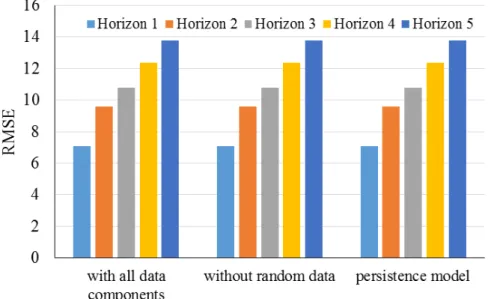
Doucoure et al. (2016) [53] developed a prediction methodology for renewable energy sources to promote the use of renewable energy isolated and grid-connected power systems. The presented method was based on artificial neural networks and wavelet decomposition. The predictability of every component of the input data utilizing the Hurst coefficient was analyzed in this study. To ensure the predictability of the information, some components with low predictability potential were eliminated to reduce the computational algorithm complexity. Figure13presents theRMSEvalues for the study in three terms, with all data components, without random data and persistence data related to the proposed method.
Energies 2019, 12, x FOR PEER REVIEW 13 of 43
has several advantages over other neural networks. WNN needs a smaller training amount than the MLP method, and has fast convergence. Table 7 presents some important papers in this field.
Table 7. Notable WNN models used in energy systems.
Year Authors Journal Application
2016 Doucoure et al. [53] Renewable Energy Prediction of time series for renewable energy sources 2018 Gu et al. [54] Energy Heat load perdition in district heating systems 2018 He et al. [55] Applied Energy Wind speed forecasting (reduction of the influence of noise in the raw data series) 2018 Qin et al. [56] Algorithms Simultaneous optimization of fuel economy and battery state of charge 2017 Sarshar et al. [57] Energy Uncertainty reduction in wind power prediction
Doucoure et al. (2016) [53] developed a prediction methodology for renewable energy sources to promote the use of renewable energy isolated and grid-connected power systems. The presented method was based on artificial neural networks and wavelet decomposition. The predictability of every component of the input data utilizing the Hurst coefficient was analyzed in this study. To ensure the predictability of the information, some components with low predictability potential were eliminated to reduce the computational algorithm complexity. Figure 13 presents the RMSE values for the study in three terms, with all data components, without random data and persistence data related to the proposed method.
Figure 13. RMSE values for study by Doucoure et al. (2016). Reproduced from [53], Elsevier: 2016. Gu et al. (2018) [54] studied heat load prediction utilizing different prediction models such as extreme learning machine, wavelet neural network, support vector machine, back propagation neural network optimized using a genetic algorithm, and wavelet neural network. Historical loads and indoor temperature were assumed to be influential. The support vector machine demonstrated smaller errors compared to the three other neural network algorithms. Figure 14 presents the values of RMSE and correlation coefficient for the study.
Figure 13.RMSEvalues for study by Doucoure et al. (2016). Reproduced from [53], Elsevier: 2016. Gu et al. (2018) [54] studied heat load prediction utilizing different prediction models such as extreme learning machine, wavelet neural network, support vector machine, back propagation neural network optimized using a genetic algorithm, and wavelet neural network. Historical loads and indoor temperature were assumed to be influential. The support vector machine demonstrated smaller errors compared to the three other neural network algorithms. Figure14presents the values ofRMSEand correlation coefficient for the study.
EnergiesEnergies 2019, 12, x FOR PEER REVIEW 2019,12, 1301 14 of 43 14 of 42
(a)
(b)
Figure 14. RMSE and r values for study by Gu et al. (2018). Reproduced from [54], Elsevier: 2018. He et al. (2018) [55] proposed a hybrid forecasting model which was composed of three modules: data clustering, data preprocessing and forecasting modules. The decomposing technique was used to decrease the noise influence within the raw data series to achieve a more stable sequence to extract traits from the original data. A similar fluctuation pattern was selected for the training database in the forecasting module to improve the forecasting accuracy. The experimental data demonstrate that the presented model outperforms other discussed forecasting models in the paper. Figure 15 presents the RMSE values in cases of non-season and season datasets.
Figure 14.RMSEandrvalues for study by Gu et al. (2018). Reproduced from [54], Elsevier: 2018. He et al. (2018) [55] proposed a hybrid forecasting model which was composed of three modules: data clustering, data preprocessing and forecasting modules. The decomposing technique was used to decrease the noise influence within the raw data series to achieve a more stable sequence to extract traits from the original data. A similar fluctuation pattern was selected for the training database in the forecasting module to improve the forecasting accuracy. The experimental data demonstrate that the presented model outperforms other discussed forecasting models in the paper. Figure15presents the RMSEvalues in cases of non-season and season datasets.
Qin et al. (2018) [56] introduced online energy management control of hybrid electric vehicles based on NDP to optimize battery state of charge and fuel economy at the same time. In the proposed NDP method, the action network was a conventional wavelet neural network, and the critic network was a multi-resolution wavelet neural network. The action network was constructed on the Morlet function, and the critic network was stem from the Meyer wavelet function. Based on results, the NDP EMS have a high capability the same as the NDP in online applications. Based on comparisons, the RBFNN-based NDP EMS supports the efficiency of the CWNN and MRWNN.
Energies2019,12, 1301 15 of 42
Energies 2019, 12, x FOR PEER REVIEW 15 of 43
Figure 15. RMSE values for study by He et al. (2018). Reproduced from [55], Elsevier: 2018.
Qin et al. (2018) [56] introduced online energy management control of hybrid electric vehicles based on NDP to optimize battery state of charge and fuel economy at the same time. In the proposed NDP method, the action network was a conventional wavelet neural network, and the critic network was a multi-resolution wavelet neural network. The action network was constructed on the Morlet function, and the critic network was stem from the Meyer wavelet function. Based on results, the NDP EMS have a high capability the same as the NDP in online applications. Based on comparisons, the RBFNN-based NDP EMS supports the efficiency of the CWNN and MRWNN.
Sarshar et al. (2017) [57] presented an adaptive probabilistic concept of the confidence interval for addressing randomness of wind speed. To increase forecasting accuracy, wavelet decomposition was utilized for time series of wind power, and the results were used in the artificial neural network. Then predicted wind power dependable levels adaptive probabilistic concept of confidence interval were calculated. An energy storage system was used to decrease the impact of forecasting errors on the micro-grid and to increase planning flexibility. Finally, the presented algorithm was validated with a typical micro-grid case study. The results indicated that the presented adaptive probabilistic concept of confidence interval worked well and demonstrated the superiority of WNN to ANN. 3.6. ANFIS
ANFIS is a modeling method that employs an artificial neural network based on the Takagi– Sugeno fuzzy inference system. This technique benefits from the capabilities of both fuzzy logic and neural network. ANFIS is a method with five main layers. This method is considered as an early form of the hybrid ML method [28]. Table 8 presents some important papers in this field.
Figure 15.RMSEvalues for study by He et al. (2018). Reproduced from [55], Elsevier: 2018.
Sarshar et al. (2017) [57] presented an adaptive probabilistic concept of the confidence interval for addressing randomness of wind speed. To increase forecasting accuracy, wavelet decomposition was utilized for time series of wind power, and the results were used in the artificial neural network. Then predicted wind power dependable levels adaptive probabilistic concept of confidence interval were calculated. An energy storage system was used to decrease the impact of forecasting errors on the micro-grid and to increase planning flexibility. Finally, the presented algorithm was validated with a typical micro-grid case study. The results indicated that the presented adaptive probabilistic concept of confidence interval worked well and demonstrated the superiority of WNN to ANN.
3.6. ANFIS
ANFIS is a modeling method that employs an artificial neural network based on the Takagi–Sugeno fuzzy inference system. This technique benefits from the capabilities of both fuzzy logic and neural network. ANFIS is a method with five main layers. This method is considered as an early form of the hybrid ML method [28]. Table8presents some important papers in this field.
Table 8.Notable ANFIS models used in energy systems.
Year Reference Journal Application
2018 Abdulwahid et al. [58] Sustainability (Switzerland) A protection device for a reverse power protection system 2017 Bassam et al. [59] Sustainability (Switzerland) Module temperature estimation of
PV systems 2018 Kampouropoulos et al. [60] IEEE Transactions on
Smart Grid
Prediction of the power demand of a plant and optimization of energy flow 2016 Mohammadi et al. [61] Renewable and Sustainable
Energy Reviews
Identification of the most relevant parameters for forecasting of daily
global solar radiation 2016 Sajjadi et al. [62]
Journal of the Taiwan Institute of Chemical
Engineers
Transesterification yield estimation and prediction of biodiesel synthesis
Abdulwahid and Wang (2018) [58] introduced a novel protection method for preventing reverse power flow developed on neuro-fuzzy networks for utilization in the smart grid. This study presented an upgraded protection device using a newly developed intelligent decision support system (IDSS). The presented IDSS was a decision system support system that coupled the robust specification for fuzzy inference systems and neural networks. The proposed methodology can monitor extreme environmental conditions.
![Figure 5. RMSE values for study by Gallagher et al. (2018). Reproduced from [33], Elsevier: 2018](https://thumb-us.123doks.com/thumbv2/123dok_us/340308.2537345/6.892.155.740.677.963/figure-rmse-values-study-gallagher-reproduced-from-elsevier.webp)
![Figure 6. RMSE values for study by Ahmed et al. (2015). Reproduced from [37], Elsevier: 2015](https://thumb-us.123doks.com/thumbv2/123dok_us/340308.2537345/7.892.224.673.554.825/figure-rmse-values-study-ahmed-reproduced-from-elsevier.webp)
![Table 3. Results of evaluations of models by Loutfi et al. (2017). Reproduced from [40], Elsevier: 2017.](https://thumb-us.123doks.com/thumbv2/123dok_us/340308.2537345/9.892.115.779.403.611/table-results-evaluations-models-loutfi-et-reproduced-elsevier.webp)
![Figure 10. RMSE values for study by Bagnasco et al. (2015). Reproduced from [43], Elsevier: 2015](https://thumb-us.123doks.com/thumbv2/123dok_us/340308.2537345/10.892.208.684.574.839/figure-rmse-values-study-bagnasco-reproduced-from-elsevier.webp)
![Figure 11. Correlation coefficient values for the study by Li et al. (2018). Reproduced from [44], Elsevier: 2018](https://thumb-us.123doks.com/thumbv2/123dok_us/340308.2537345/11.892.196.704.133.394/figure-correlation-coefficient-values-study-li-reproduced-elsevier.webp)
![Figure 14. RMSE and r values for study by Gu et al. (2018). Reproduced from [54], Elsevier: 2018](https://thumb-us.123doks.com/thumbv2/123dok_us/340308.2537345/14.892.180.702.125.690/figure-rmse-and-values-study-reproduced-from-elsevier.webp)