version when available.
Downloaded 2020-10-17T01:02:15Z
Some rights reserved. For more information, please see the item record link above.
Title
Knowledge graph mining with latent shape graphs
Author(s)
Muñoz, Emir
Publication
Date
2020-07-21
Publisher
NUI Galway
Doctoral Thesis
Knowledge Graph Mining with
Latent Shape Graphs
Emir Muñoz
JULY21, 2020
External Examiner Prof. Dr Fabian Suchanek
Supervisor Dr Matthias Nickles
Internal Examiner Prof. Dr Mathieu d’Aquin Co-supervisor
Dr Vít Nováˇcek
DISSERTATION SUBMITTED IN PURSUANCE OF THE DEGREE OFDOCTOR OFPHILOSOPHY
Data Science Institute
The research presented in this dissertation has been supported by Fujitsu Laboratories Ltd., Japan and the Data Science Institute at National University of Ireland Galway, Ireland through the projects KI2NA (2014–2016) and TOMOE (2016–2018).
Abstract
Knowledge Graph Mining with Latent Shape Graphs
Knowledge graphs are graph-structured knowledge bases that have shown to be of great value in many Artificial Intelligence applications in academia and industry alike. They are typically generated automatically from un-/semi- structured data sources. The increasing popularity of knowledge graphs has been limited by multiple challenges given the size and quality of the information they contain. This thesis explores the relationship between the quality of knowledge graphs and machine learning technologies used to discover and ex-tract knowledge from them. We focus on quality in terms of completeness and consistency. Knowledge graphs provide the flexibility required for representing knowledge at differ-ent scales in open environmdiffer-ents such as the Web. However, their versatility makes them have an ever-changing schema, which also makes them hard to summarize and under-stand their content. Moreover, they are typically never complete—even in very specific domains—and their consistency with respect to a given schema or ontology cannot be guar-anteed without the corresponding validation. That lack of an accurate schema has shown to be problematic in use cases where applications might need to rely on the fact that data satisfy a set of constraints.
The contribution of this thesis is twofold. Firstly, we propose a scalable data-driven method to exhibit the actual (latent) shape of graph data. We introduce an algorithm for mining relation cardinality bounds and building so-called shapes that exhibit important as-pects of the structure (or topological information) of entities and relations in a knowledge graph. Latent shapes also allow us to formalise an approximate algorithm for validating the structure of knowledge graphs. Secondly, we exploit the latent shapes of entities and relations to enhance the performance of machine learning models aimed to predict missing links and complete knowledge graphs. We use local patterns information and graph-based feature models in the Bioinformatics domain for improving the prediction of adverse drug reactions achieving new state-of-the-art results. Finally, we extend latent feature models by encoding the cardinality of relations as a regularisation term used to learn semantic embed-dings that improve the precision of downstream prediction tasks in benchmark datasets.
Acknowledgements
A self that goes on changing is a self that goes on living — Virginia WoolfThis journey started a while back with me leaving home to a short adventure in Ire-land for three months. That time recently became eight years! I would like to thank my mother Rosa, sisters (Daniela, Yessenia), nieces (Thaira, Brenda, Sophia), and nephews (Diego, Axel) for all their support and love in the distance.
From early in my career as a researcher, I have been privileged to work and collaborate with many people who taught me in their way what is to be a good researcher. First, I would like to thank Dr Flavio Ferrarotti and Dr Aidan Hogan from who I truly learnt a lot about Databases and the Semantic Web. Without knowing it, you really made me see research from different angles and guided me to follow the topic of this PhD thesis. Special thanks to my supervisor Dr Matthias Nickles and co-supervisor Dr Vít Nováˇcek for all the guidance and support during the process of this thesis. The process was not always smooth but Matthias and Vít helped me to stay focused and advised me in the difficult times. I would also like to thank the members of my committee: Prof. Dr Fabian Suchanek and Prof. Dr Mathieu d’Aquin for their valuable feedback and guidance. Their valuable questions, comments and suggestions have helped to improve this document.
A lot of thanks go to the Data Science Institute (previously DERI, INSIGHT, and DSI) and the Fujitsu team (Luca, Pierre-Yves, Piero, Sameh, Pasquale, Anthony, and many others). Too many people to mention, but all of you made this journey very satisfactory. Thank you for the opportunities and for believing in me.
On a personal note, I would like to thank my friends in Chile: Davinia, Eduardo, Joaquin, and Rodrigo for keeping me updated with their lives and adventures. Many thanks to my friends I met in Ireland: Hugo, Daniela, Gabi, Erik, and many others. Last but most importantly, a special thank you goes to my wife Bianca who lifted me all these years and decided to join me in this madness. I love you very much.
Published Work
Parts of this thesis also appear in the following peer-reviewed publications:
International Journals.
• Emir Muñoz, Vít Nováˇcek, and Pierre-Yves Vandenbussche (2019). ‘Facilitating pre-diction of adverse drug reactions by using knowledge graphs and multi-label learning models’. In:Briefings in Bioinformatics20.1, pp. 190–202
• Emir Muñoz and Matthias Nickles (2018). ‘Statistical Relation Cardinality Bounds in Knowledge Bases’. In:T. Large-Scale Data- and Knowledge-Centered Systems39, pp. 67– 97
PhD Symposium Papers.
• Emir Muñoz (2016). ‘On Learnability of Constraints from RDF Data’. In:The Seman-tic Web. Latest Advances and New Domains - 13th International Conference, ESWC 2016, Heraklion, Crete, Greece, May 29 - June 2, 2016, Proceedings. Ed. by Harald Sack, Eva Blomqvist, Mathieu d’Aquin, Chiara Ghidini, Simone Paolo Ponzetto, and Christoph Lange. Vol. 9678. Lecture Notes in Computer Science. Springer, pp. 834–844
International Conferences.
• Emir Muñoz, Pasquale Minervini, and Matthias Nickles (2019). ‘Embedding cardi-nality constraints in neural link predictors’. In: Proceedings of the 34th ACM/SIGAPP Symposium on Applied Computing, SAC 2019, Limassol, Cyprus, April 8-12, 2019. Ed. by Chih-Cheng Hung and George A. Papadopoulos. ACM, pp. 2243–2250
• Emir Muñoz and Matthias Nickles (2017). ‘Mining Cardinalities from Knowledge Bases’. In: Database and Expert Systems Applications - 28th International Conference, DEXA 2017, Lyon, France, August 28-31, 2017, Proceedings, Part I. ed. by Djamal Bensli-mane, Ernesto Damiani, William I. Grosky, Abdelkader Hameurlain, Amit P. Sheth, and Roland R. Wagner. Vol. 10438. Lecture Notes in Computer Science. Springer, pp. 447–462
• Sameh K. Mohamed, Emir Muñoz, Vít Nováˇcek, and Pierre-Yves Vandenbussche (2017). ‘Identifying Equivalent Relation Paths in Knowledge Graphs’. In: Language, Data, and Knowledge - First International Conference, LDK 2017, Galway, Ireland, June 19-20, 2017, Proceedings. Ed. by Jorge Gracia, Francis Bond, John P. McCrae, Paul Buite-laar, Christian Chiarcos, and Sebastian Hellmann. Vol. 10318. Lecture Notes in Com-puter Science. Springer, pp. 299–314
Medical Informatics Association Annual Symposium, Chicago, IL, USA, November 12-16, 2016. 2500122[PII]. AMIA, pp. 924–933
International Workshops.
• Sameh K. Mohamed, Vít Nováˇcek, Pierre-Yves Vandenbussche, and Emir Muñoz (2019). ‘Loss Functions in Knowledge Graph Embedding Models’. In: Proceedings of the Workshop on Deep Learning for Knowledge Graphs (DL4KG2019) Co-located with the 16th Extended Semantic Web Conference 2019 (ESWC 2019), Portoroz, Slovenia, June 2, 2019. Ed. by Mehwish Alam, Davide Buscaldi, Michael Cochez, Francesco Osborne, Diego Reforgiato Recupero, and Harald Sack. Vol. 2377. CEUR Workshop Proceed-ings. CEUR-WS.org, pp. 1–10
• Emir Muñoz (2014). ‘Learning Content Patterns from Linked Data’. In: Proceedings of the Second International Workshop on Linked Data for Information Extraction (LD4IE 2014) co-located with the 13th International Semantic Web Conference (ISWC 2014), Riva del Garda, Italy, October 20, 2014.Ed. by Anna Lisa Gentile, Ziqi Zhang, Claudia d’Amato, and Heiko Paulheim. Vol. 1267. CEUR Workshop Proceedings. CEUR-WS.org, pp. 21– 32
Other papers published during the course of the PhD but that are not included in this thesis.
• Pasquale Minervini, Luca Costabello, Emir Muñoz, Vít Nováˇcek, and Pierre-Yves Vandenbussche (2017). ‘Regularizing Knowledge Graph Embeddings via Equivalence and Inversion Axioms’. In: Machine Learning and Knowledge Discovery in Databases -European Conference, ECML PKDD 2017, Skopje, Macedonia, September 18-22, 2017, Pro-ceedings, Part I. ed. by Michelangelo Ceci, Jaakko Hollmén, Ljupco Todorovski, Celine Vens, and Saso Dzeroski. Vol. 10534. Lecture Notes in Computer Science. Springer, pp. 668–683
• Semih Yumusak, Emir Muñoz, Pasquale Minervini, Erdogan Dogdu, and Halife Kodaz (2016). ‘A Hybrid Method for Rating Prediction Using Linked Data Features and Text Reviews’. In:Joint Proceedings of the 5th Workshop on Data Mining and Knowl-edge Discovery meets Linked Open Data and the 1st International Workshop on Completing and Debugging the Semantic Web (Know@LOD-2016, CoDeS-2016) co-located with 13th ESWC 2016, Heraklion, Greece, May 30th, 2016. Ed. by Heiko Paulheim, Jens Lehmann, Vojtech Svátek, Craig A. Knoblock, Matthew Horridge, Patrick Lambrix, and Bijan Parsia. Vol. 1586. CEUR Workshop Proceedings. CEUR-WS.org
• Suad Aldarra and Emir Muñoz (2015). ‘A Linked Data-Based Decision Tree Classifier to Review Movies’. In:Proceedings of the 4th Workshop on Knowledge Discovery and Data Mining Meets Linked Open Data co-located with 12th Extended Semantic Web Conference (ESWC 2015), Portoroz, Slovenia, May 31, 2015.Ed. by Johanna Völker, Heiko Paulheim, Jens Lehmann, and Vojtech Svátek. Vol. 1365. CEUR Workshop Proceedings. CEUR-WS.org
• Bo Liu, Sebastian Link, and Emir Muñoz (2015). ‘Validation of Expressive XML Keys with XML Schema and XQuery’. In: 11th Asia-Pacific Conference on Conceptual Modelling, APCCM 2015, Sydney, Australia, January 2015. Ed. by Motoshi Saeki and Henning Köhler. Vol. 165. CRPIT. Australian Computer Society, pp. 81–90
• Suad Aldarra, Emir Muñoz, Pierre-Yves Vandenbussche, and Vít Nováˇcek (2014). ‘SemanTex: Semantic Text Exploration Using Document Links Implied by Concep-tual Networks Extracted from the Texts’. In: Proceedings of the ISWC 2014 Posters & Demonstrations Track a track within the 13th International Semantic Web Conference, ISWC 2014, Riva del Garda, Italy, October 21, 2014. Ed. by Matthew Horridge, Marco Rospocher, and Jacco van Ossenbruggen. Vol. 1272. CEUR Workshop Proceedings. CEUR-WS.org, pp. 345–348
• Emir Muñoz, Luca Costabello, and Pierre-Yves Vandenbussche (2014). ‘µRaptor: A DOM-based System with Appetite for hCard Elements’. In: Proceedings of the Second International Workshop on Linked Data for Information Extraction (LD4IE 2014) co-located with the 13th International Semantic Web Conference (ISWC 2014), Riva del Garda, Italy, October 20, 2014. Ed. by Anna Lisa Gentile, Ziqi Zhang, Claudia d’Amato, and Heiko Paulheim. Vol. 1267. CEUR Workshop Proceedings. CEUR-WS.org, pp. 67–71
• Emir Muñoz, Aidan Hogan, and Alessandra Mileo (2014). ‘Using linked data to mine RDF from wikipedia’s tables’. In: Seventh ACM International Conference on Web Search and Data Mining, WSDM 2014, New York, NY, USA, February 24-28, 2014. Ed. by Ben Carterette, Fernando Diaz, Carlos Castillo, and Donald Metzler. ACM, pp. 533– 542
Patent applications submitted over the course of the PhD (not necessarily related).
• Pasquale Minervini, Luca Costabello, Emir Muñoz, Vít Nováˇcek, and Pierre-Yves Vandenbussche (May 2018).Method and apparatus for completing a knowledge graph. US Patent App. 15/821,088
• Emir Muñoz, Suad Aldarra, and Luca Costabello (Jan. 2017). A method, computer program and filter for protecting a computer device against malicious RDF content in Linked Data. EPO Patent App. EP20170153795
• Emir Muñoz, Ahmed Abdelrahman, Vít Nováˇcek, and Pierre-Yves Vandenbussche (Nov. 2016).Apparatus and a system for calculating similarities between drugs and using the similarities to extrapolate side effects. US Patent App. 15/087,902
• Roger Menday, Luca Costabello, Jürgen Umbrich, Pierre-Yves Vandenbussche, Emir Muñoz, and Vít Nováˇcek (Oct. 2016). Query mediator, a method of querying a polyglot data tier and a computer program executable to carry out a method of querying a polyglot data tier. US Patent App. 15/084,293
Contents
1 Introduction . . . . 1 1.1 Motivation . . . 1 1.2 Research questions . . . 4 1.3 Contributions . . . 7 1.4 Thesis structure . . . 8 I Background 11 2 Fundamentals . . . . 13 2.1 Knowledge bases . . . 142.1.1 Semantic Web knowledge bases . . . 15
2.1.2 Unique name assumption . . . 16
2.1.3 Interpretation of knowledge bases . . . 18
2.2 Knowledge graphs . . . 20
2.2.1 Definitions . . . 22
2.3 Completeness and consistency in knowledge graphs . . . 23
2.3.1 Consistency . . . 24
2.3.2 Completeness . . . 25
2.4 Machine learning: A brief overview . . . 27
2.4.1 Regularisation . . . 30
2.5 Deep learning: A brief overview . . . 31
2.6 Learning problems . . . 33 2.6.1 Learning to rank . . . 34 2.6.2 Multi-label learning . . . 35 2.6.3 Evaluation metrics . . . 35 2.6.3.1 Learning to rank . . . 35 2.6.3.2 Multi-label learning . . . 36 2.7 Summary . . . 38
3 Knowledge Graph Mining . . . . 40
3.1 Schema in knowledge graphs . . . 41
3.1.1 Dynamic schema problem . . . 43
3.1.2 Validation approaches for knowledge graph . . . 45
3.1.2.3 Query-based approaches . . . 48
3.1.2.4 High-level languages . . . 49
3.2 Schema inference approaches . . . 54
3.2.1 Statistical metadata extraction . . . 55
3.2.2 Rule mining . . . 56
3.2.3 Complex structural inferences . . . 57
3.2.4 Elements of structure: cardinality constraints . . . 60
3.3 Completion of knowledge graph . . . 62
3.3.1 What is knowledge graph completion? . . . 62
3.3.2 Completion tasks . . . 63
3.3.3 Statistical properties for completion . . . 65
3.4 Statistical relational learning . . . 66
3.4.1 Graph-based feature approaches . . . 67
3.4.2 Latent feature approaches . . . 69
3.4.3 Model training and negatives generation . . . 72
3.5 Summary . . . 74
II Latent Shapes in Knowledge Graph 77 4 Approaches for Mining Cardinality . . . . 79
4.1 Problem statement . . . 80
4.2 Notion of cardinality bounds . . . 81
4.3 Cardinality mining algorithm . . . 84
4.3.1 Algorithm . . . 84
4.3.2 Knowledge graph normalisation: rewriting approaches . . . 86
4.3.2.1 SPARQL rewriting . . . 87
4.3.2.2 Programmatic rewriting . . . 87
4.3.3 Detection of cardinality patterns . . . 88
4.3.4 Outlier detection and filtering . . . 89
4.4 Experimental settings . . . 90
4.4.1 Datasets . . . 91
4.4.2 Test settings . . . 92
4.5 Results and discussion . . . 92
4.5.1 Quantitative evaluation . . . 92
4.5.2 Qualitative evaluation . . . 93
4.6 Summary . . . 98
5 Approximate Validation of Knowledge Graphs . . . . 100
5.1 Problem statement . . . 101
5.2 Related work . . . 103
5.3 An algorithm for approximate structure validation . . . 105
5.3.1 Approximate validation . . . 105
5.3.2 Machine learning framework . . . 109
5.3.3 Feature vectors extraction . . . 111
5.4 Experimental settings . . . 113
5.4.1 Datasets . . . 113
5.4.2 Test Settings . . . 114
5.5 Results and discussion . . . 116
5.6 Summary . . . 122
III Knowledge Graph Mining Applications 123 6 Knowledge Graphs to Improve Adverse Drug Reactions Prediction . . . . 125
6.1 Problem statement . . . 126
6.2 Related work . . . 127
6.3 ADRs prediction using knowledge graphs . . . 127
6.4 Biomedical knowledge graphs . . . 130
6.5 Experimental settings . . . 131
6.6 Results and discussion . . . 133
6.6.1 Comparison on Liu’s dataset . . . 133
6.6.2 Comparison on Bio2RDF dataset . . . 135
6.6.3 Comparison on SIDER 4 dataset . . . 136
6.6.4 Comparison on Aeolus dataset . . . 137
6.7 Summary . . . 139
7 Cardinality Regularisation of Neural Link Predictors . . . . 140
7.1 Problem statement . . . 141
7.2 Related work . . . 143
7.3 Regularisation based on cardinality . . . 143
7.3.1 Lower bound estimation . . . 146
7.3.2 Sum estimation . . . 146
7.4 Experimental settings . . . 147
7.4.1 Evaluation protocol . . . 147
7.4.2 Datasets . . . 148
7.5 Results and discussion . . . 148
7.5.1 Link prediction evaluation . . . 149
7.5.2 Sampling techniques evaluation . . . 151
7.5.3 Cardinality violations evaluation . . . 151
7.6 Summary . . . 154
8 Summary and Outlook . . . . 157
8.1 Summary of contributions . . . 157
8.1.1 Part I: Background . . . 158
8.1.2 Part II: Latent shapes in knowledge graph . . . 160
8.1.3 Part III: Knowledge graph mining applications . . . 162
8.2 Limitations . . . 163
8.3 Future directions . . . 165
8.3.1 Dynamic knowledge graphs and definition of completeness . . . 165
8.3.2 Veracity of statements . . . 166
8.3.3 Embeddings, logics, and scalability . . . 166
8.3.4 Automatic benchmark generation . . . 167
Bibliography . . . . 168
Declaration
I declare that this thesis, titled “Knowledge Graph Mining with Latent Shape Graphs”, is com-posed by myself, that the work contained herein is my own except where explicitly stated otherwise in the text, and that this work has not been submitted for any other degree or professional qualification except as specified.
July 21, 2020 Galway, Ireland
EMIRMUÑOZ
List of Figures
1.1 Overview of the proposed research and contributions of this thesis. . . 7
1.2 Thesis structure by parts and chapters. . . 9
2.1 Example Semantic Web knowledge base with basic information about people. 17 2.2 Example of UNA 2.0 as defined in SHACL. . . 18
2.3 Venn diagram explaining the completeness of a knowledge base. . . 27
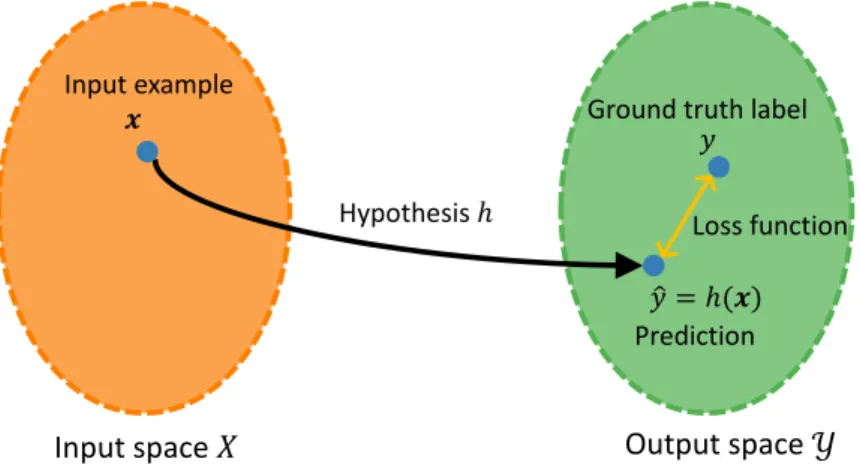
2.4 Machine learning general framework (adapted from T. Liu (2011)). . . 29
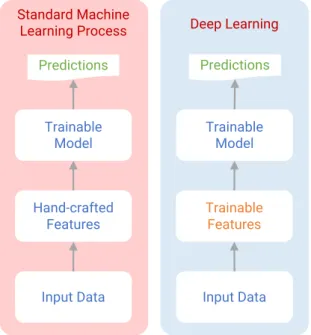
2.5 Deep learning general framework versus traditional machine learning. . . 31
2.6 Neural network architecture with one hidden layer. . . 33
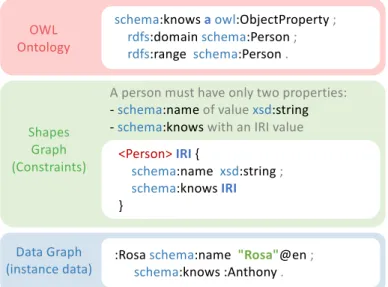
3.1 Comparison between ontology and shapes graph definition (adapted from Labra Gayo, E. Prud’hommeaux, Boneva, et al. (2018)). . . 43
3.2 Classification of RDF knowledge graph approaches (Meester, Heyvaert, Dörthe Arndt, et al.,2019). . . 46
3.3 SPARQL query to check whether a person has one name of type literal. . . 48
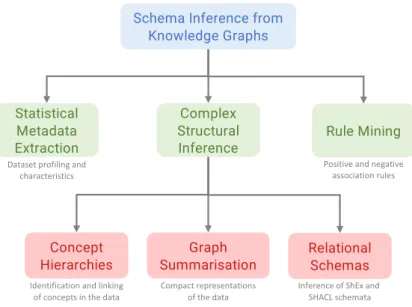
3.4 Classification of schema inference approaches from knowledge graphs. . . 55
3.5 Example graph summary from the knowledge graph in Figure2.1. . . 59
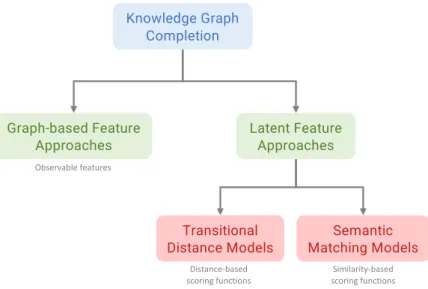
3.6 Classification of knowledge graph completion approaches. . . 67
3.7 Illustration of a fact according to the interpretation of TransE. . . 70
4.1 SPARQL 1.1 definition of a minimum cardinality constraint. . . 83
4.2 Query the cardinality of a relation ($relationvariable) for every entity of a given type ($typevariable). . . 88
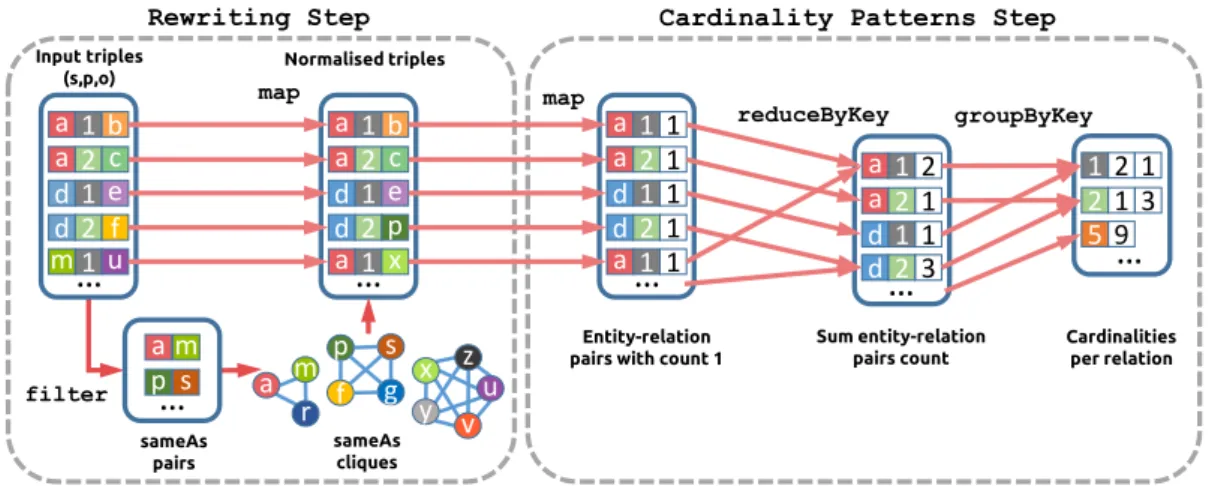
4.3 Cardinality patterns extraction using MapReduce approach. . . 89
4.4 Box plot figures for each relation in the entity typefoaf:Personof the SWDF KG. . . 95
4.5 Box plot figures for each relation in the entity typec4dm:Eventof the SWDF KG. 96 4.6 Box plot figures for each relation in the entity typeswrc:InProceedingsof the SWDF KG. . . 97
4.7 Subset of relation cardinality bounds for typemondial:Volcano. . . 98
5.1 Approximate structure validation model with machine learning. . . 109
5.2 Plotting the 2D embeddings generated by t-SNE and UMAP for the River-BodyOfWaterclass. . . 118
5.4 Confusion matrix with the results of paths of length 3, no inverse edges, and cardinality features overLibrarydataset. . . 120 5.5 Confusion matrices given by the decision tree over the RiverBodyOfWater
dataset with paths of length 1 and different settings of inverse and cardinality features. . . 121
5.6 Macro-F1 measured over different percentages of unlabelled data for the RiverBodyOfWaterdataset. . . 122 6.1 Example knowledge graph and neighbourhood mixture with drug-related
entities and their relations. . . 129
6.2 A Bio2RDF fragment around the cyclophosphamide drug, showing the con-nections between three main (colour-coded) databases: DrugBank, SIDER and KEGG. . . 132
6.3 Machine learning flow chart for training and testing of a model. . . 133
7.1 Value of the regularisation termGhrbased on the lower and upper bounds of
a cardinality constraintϕr = (ϕ↓r, ϕ↑r). . . 145
7.2 Changes in the distribution ofXhr[E]without (left, in blue) and with (right, in orange) regularisation using ER-MLP in YAGO3-10. Horizontal lines cor-respond to quartiles. . . 152
7.3 Influence of the regularisation weight over the average mean ofXhr[E](solid
lines) and Hits@10 (dashed lines) in WN18 with ComplEx. . . 153
List of Tables
3.1 Summary of latent feature models with their scoring functions and constraints. 75
4.1 An axiomatisation for reduction on equality . . . 85
4.2 Datasets characteristics. . . 91
4.3 Evaluation of completeness and consistency per dataset: one type and five random properties per type. . . 93
5.1 Coverage of validation approaches w.r.t. constraint types (T. Hartmann,2016). 104 5.2 Schema.org Microdata datasets used for approximate validation experi-ments. We omit the http://schema.org/ prefix from the class names. In parentheses, the values after filtering classes with more than 10 entities. . . . 114
5.3 Feature extraction for the different datasets. We use Xand Xfor “no” and “yes” answers. . . 115
6.1 Multi-source feature sets used by state-of-the-art methods. . . 128
6.2 Characteristics of datasets used in the ADR prediction task. . . 131
6.3 Number of triples in the Bio2RDF datasets used in our experiment. . . 131
6.4 Comparison of the models’ performance on the Liu’s dataset. (?) is our model proposed in Muñoz, Nováˇcek, and Vandenbussche (2016) and (†) are tradi-tional models with default parameters. . . 134
6.5 Ranking performance of the proposed models on the Liu’s dataset. . . 135
6.6 Predictive power of the proposed models using drugs in the Liu’s dataset and features from the Bio2RDF v1 dataset (DrugBank + SIDER). . . 136
6.7 Predictive power of the proposed models using drugs in the Liu’s dataset and features from the Bio2RDF v2 dataset (DrugBank + SIDER + KEGG). . . 136
6.8 Predictive power of the proposed models using a combination of features from both the Liu’s dataset and the Bio2RDF v2 dataset. . . 136
6.9 Comparison of the predictive power of the models on the SIDER 4 dataset. . . 137
6.10 Predictive power of the proposed models on drugs in the SIDER 4 dataset using Bio2RDF v2 dataset features. . . 137
6.11 Predictive power of the proposed models on the SIDER 4 dataset with up-dated ADRs from the Aeolus dataset. . . 139
7.1 Top-5 predictions for parents of parent of edgar_allan_poe given by Dist-Mult (B. Yang, Yih, X. He, et al.,2015). . . 142
10. We also show the updated bounds after manual revision. . . 149
7.4 Link prediction results (Hits@nand Mean Reciprocal Rank, filtered setting) on WN18 and WN18RR. . . 150
7.5 Link prediction results (Hits@nand Mean Reciprocal Rank, filtered setting) on FB13 and YAGO3-10. . . 150
7.6 Link prediction results (Hits@nand Mean Reciprocal Rank, filtered setting) for the best ComplEx model using different sampling techniques. . . 151
7.7 Predictions with probability> 0.8for (edgar_allan_poe,hasParent,?) by Dist-Mult when imposing the cardinality regulariser. . . 153
C
HAPTER1
Introduction
Contents 1.1 Motivation . . . 1 1.2 Research questions . . . 4 1.3 Contributions . . . 7 1.4 Thesis structure . . . 81.1
Motivation
T
HEfunctioning of the human brain is still largely mysterious for scientists. Our brain allows us to store (an enormous amount of) data and perform fast reasoning on top of it in almost no time. Thanks to our brain we are able to recognise entities (e.g., people, locations, objects) in images and text, and identify the relationships that can exist between entities according to our domains of knowledge. Although our knowledge about how the brain works is highly incomplete, we have developed several technologies that try, to some extent, to emulate its operation.Artificial intelligence (AI) is a cross-disciplinary approach to understanding, modelling, and creating intelligent machines (systems). The aim of AI research and applications is, e.g., to understand speech or images, automate routine tasks (reducing chances of human error), speed up medicine and basic scientific research. These problems may be easy for (expert) people but hard for computers. First approaches in AI projects tried to hard-code the informal knowledge that a person has on any topic. However, such knowledge must be painstakingly handcrafted from scratch and it is mostly subjective and intuitive, which makes it difficult to formalise. These approaches are known asknowledge baseapproaches to artificial intelligence (Firebaugh,1988).
Decades after with the added factor of massification of the Internet and the Web, we have an increasing number of knowledge bases created in academia and industry alike, generated automatically or manually, and comprising general or domain-specific knowl-edge. The availability of such a large amount of knowledge has attracted the attention of
AI researchers towards training machines to acquire their own knowledge, by generalising from experience, what is known asmachine learning. Machine learning became an answer to the problem of requiring people to manually encode rules to make decisions. With machine learning those rules can be extracted automatically from a pile of data. In machine learning algorithms, objects are represented by features and mapped to an output, e.g., mapping the well-known Iris flowers to their specie (setosa, versicolor, virginica) using their representa-tion in terms of sepal and petal length, and width (Fisher,1936).
While the popularity and use cases in which knowledge bases can be used are increasing in both academic and industrial environments, creating or maintaining complete knowl-edge bases is still one of the main challenges for users and the community. Knowlknowl-edge bases are never complete for large and open domains—and rarely complete even for very specific domains—making them error-prone and hard to exploit, let alone to reason with them (Motro,1989; Drumond, Rendle, and Schmidt-Thieme, 2012; Razniewski, Suchanek, and Nutt, 2016). Since knowledge bases find wide applications in areas of life sciences, natural language processing, and financial sector, among others, the task of completion of knowledge bases has attracted much attention recently in the literature (Socher, D. Chen, Manning, et al., 2013; Gardner and Mitchell, 2015; Q. Wang, B. Wang, and L. Guo, 2015; Q. Wang, J. Liu, Y. Luo, et al., 2016). In this thesis, we focus on designing and applying machine learning techniques to deal with certain knowledge bases completion tasks.
Methods to help the exploitation of knowledge bases usually represent them as graphs, where entities are nodes connected by edges that represent relationships between entities, resulting in a so-calledknowledge graph (Nickel, K. Murphy, Tresp, et al., 2016; Paulheim, 2017; Q. Wang, Mao, B. Wang, et al.,2017). While it is easy in some cases to identify relevant features in relational data and use them to apply machine learning algorithms, in knowl-edge graphs it becomes difficult to do the same due to the graph topology. Say you have a knowledge graph that contains information about articles and authors, you can easily think of relations such as title, authors, publisher and year of publication to be used as features. However, if a knowledge graph contains information about more abstract or complex do-mains such as life sciences, e.g., describing drugs and adverse drug reactions, it is harder to think in relevant features if one is not a domain expert. Nevertheless, even if one does not have an explicit schema at hand, there is always a latent schema inherently satisfied by the data (Hogan,2018). An example is the cardinality information, which has shown to be a powerful tool to understand the data and its structure (Liddle, Embley, and Woodfield, 1993) even by non-expert users, but this information is almost never explicit in knowledge graphs (Mirza, Razniewski, Darari, et al.,2017; Muñoz and Nickles,2017).
Approaches applying machine learning over knowledge graphs roughly fall into two categories: (a) observed feature models, and (b) latent feature models. Observed fea-ture models generate graph-based feafea-tures from a knowledge graph, such as subgraphs, connecting paths and neighbourhood information, which can be easily interpretable (Lao, Mitchell, and Cohen,2011; Gardner and Mitchell,2015; Ristoski and Paulheim,2016b). On the other hand, latent feature models embed entities and relations into a latent vector space
1.1 Motivation | 3 learnt by minimising a loss function, and perform inference in that space (Bordes, Weston, Collobert, et al., 2011; Nickel, Tresp, and Kriegel, 2011). The former category of models is more suited for use cases that require interpretability of the predictions (e.g., in life sci-ences), while the latter models are seen as black boxes usually harder to interpret (Ribeiro, S. Singh, and Guestrin,2016; Zilke, Loza Mencía, and Janssen,2016). Yet latent feature mod-els for knowledge graphs have shown to be more effective than observed feature modmod-els in several tasks (Nickel, K. Murphy, Tresp, et al.,2016; Q. Wang, Mao, B. Wang, et al., 2017), despite the fact that their assumption of a “complete” knowledge graph is never met.
Recent works in knowledge representation using symbolic logic and automated reason-ing in knowledge graphs (Bordes, Usunier, García-Durán, et al.,2013; B. Yang, Yih, X. He, et al.,2015; Nickel, K. Murphy, Tresp, et al.,2016; Trouillon, Welbl, Riedel, et al.,2016) have proposed approaches where deep learning (Goodfellow, Bengio, and Courville, 2016), a subset of machine learning, is used to discover the mapping from representation to output along with the representation itself. In other words, the representation of the entities and re-lations in a knowledge graph is learnt during the training process. This approach is known asrepresentation learning(Goodfellow, Bengio, and Courville,2016). Thus, AI systems using knowledge graphs require little intervention and easily adapt to new tasks. Representation learning methods achieve remarkable better performance results than handcrafted features, but they usually require much larger amount of annotated data for training. They learn low-dimensional representations—so-calledvector representationsorembeddings—of entities and relations from the relational information contained in the knowledge graph.
Although the representation learning methods are trained to preserve as much informa-tion as possible compared with the input knowledge graph, the resulting embeddings are known to break some expected properties (Rocktäschel, S. Singh, and Riedel,2015; Min-ervini, Costabello, Muñoz, et al.,2017). Latent feature approaches require of large datasets to learn good representations about entities and relations in a knowledge graph, and they tend to be inaccurate for relations with sparse data. Rocktäschel, S. Singh, and Riedel (2015) introduce a novel training paradigm for learning embeddings that combine matrix factori-sation with first-order logic formulæ, thus, learning embeddings that satisfy logical back-ground knowledge. Likewise, other works have proposed approaches to enhance embed-dings learning by introducing logical rules (S. Guo, Q. Wang, L. Wang, et al., 2016), con-straints (Minervini, Costabello, Muñoz, et al.,2017; Ding, Q. Wang, B. Wang, et al., 2018), and neighbourhoods information (D. Q. Nguyen, Sirts, L. Qu, et al.,2016), among others. (We refer the reader to Q. Wang, Mao, B. Wang, et al. (2017) for a survey of approaches learning knowledge graph embeddings with background knowledge.) However, there are still missing approaches that consider structural elements of knowledge graphs like the car-dinality of relations.
To summarise, knowledge graphs are graph-structured knowledge bases, rich in infor-mation, where relationships or connections between entities are first-class citizens. The structure of knowledge graphs is not always explicitly stated and, thus, most machine learning algorithms ignore and do not considered the topology of data. Therefore, there
is a primary need for methods that expose the structure or shape that knowledge graphs data naturally exhibit in order to inform and bootstrap learning methods in novel areas such as Bioinformatics. If available such kind of information could be incorporated during the learning of distributed representations and used to improve the quality of downstream tasks over knowledge graphs (e.g., the completion task). Consequently, one would like to develop methods that incorporate the structure factors found in knowledge graphs to im-proving their completeness and representation of knowledge in real-world scenarios.
In the following, we formulate the research questions that we find are key to address current gaps in the state-of-the-art of knowledge graphs mining, namely, how to expose their schema structure and how to use such information in machine learning.
1.2
Research questions
The research carried out in this thesis is guided by four research questions defined around the study of consistency and completeness quality dimensions in knowledge graphs. The problem that we seek to address in this thesis is how to automatically extract structural information (shapes) from knowledge graphs, which can then be used to improve the per-formance of machine learning algorithms trying to complete the knowledge graph itself. More specifically, in this thesis we investigate the following research questions:
Research Question 1 What type of patterns are able to expose the inherent shape information (topology) of a given knowledge graph, and how these patterns can be extracted efficiently when no schema or ontology is available?
One of the oldest knowledge graphs is Cyc (Lenat, 1995) (started in 1984), attempting to assemble a comprehensive ontology for common sense knowledge describing how the world works, and thus enabling AI applications with human-like common sense reason-ing. The level of description and curation required to build Cyc is enormous and hard to mimic—the initial estimated build time of Cyc was 5 years (350 person-years), but the effort has been prolonged and estimated already to be over 900 person-years back in 2009 (Sar-jant, Legg, Robinson, et al.,2009). As this example shows, knowledge graphs are naturally schema-less giving them huge flexibility, but creating them requires a huge effort for defin-ing their structure and constraints. To assess consistency, data generators only state basic and simple constraints that roughly cover entity types, possible relationships between enti-ties, and their data types. Other type of constraints are rarely stated and left to be defined by the end-users (data consumers) depending on their specific use cases. Thus, it is hard for data consumers to know what is the shape of the information contained in a knowledge graph beforehand.
The most simple and effective way to understand the structure of a knowledge graph is analysing the relationships between entities, that is, edges or links in the graph (Hayes and Gutiérrez, 2004; Lao and Cohen, 2010; Gutiérrez, Hurtado, Mendelzon, et al., 2011;
1.2 Research questions | 5 Fernández, Martínez-Prieto, Fuente Redondo, et al., 2018). Although understanding the constraints at a relationship level is a critical aspect of data and knowledge modelling, the extraction of such constraints has not received much attention in knowledge graphs, mainly due to the complex structure and the semantics used to interpret the data (as we will se in Section2.1.3). Therefore, there is a clear need for methods that unveil the structural pat-terns that entities and relationships naturally follow in a knowledge graph. We hypothesise that a notion of relation cardinality could help unveiling the structure of entities in the data. Such patterns could then be easily encoded using popular constraint languages and used by data consumers to determine the suitability of a knowledge graph for a given use case. This question focuses on finding scalable approaches for extracting cardinality constraint patterns in different sized datasets.
Research Question 2 How to validate large-scale and noisy knowledge graphs using an ap-proximate and more granular approach?
RQ(1)assumes that no schema is provided for a knowledge graph, and thus its quality is most likely unknown. However, once a schema is defined, data consumers may require to know whetherallthe input data in a knowledge graph satisfies the given schema. This becomes challenging for large-scale knowledge graphs considering that, in practice, most of the validations are done using inference engines and ontology languages (such as the Web Ontology Language, OWL (Motik, Peter F. Patel-Schneider, and Parsia,2012)), which have scalability issues. Traditionally, validation requires to take the closed-world and unique name assumptions; however, OWL is arguably not meant for that. The W3C community has been working on a few option to tackle this gap, and in 2017 released two popular alter-natives: Shapes Constraint Language (SHACL) and Shape Expressions (ShEx). Even after data users define schemas using a constraint language, the consistency of knowledge graphs it is not static (i.e., cannot be ensured all the time), considering that knowledge graphs are dynamic and constantly enriched with new information. The only route to ensure that the data actually satisfy the restrictions is validating the data against a schema.
Strict and full validation of a knowledge graph is expensive and approximate solutions could help users to save a considerable amount of resources, i.e., computing time and mem-ory. Assuming that knowledge graphs contain several link patterns, it may be argued that by knowing the validity of a small set of entities, the in-/ validity value can be passed to other entities with similar local patterns—directly related to the constraints in a schema. For instance, if one knows that entitye1 is valid against a schemaS, then we may assume
that a very similar entitye2 should also be valid w.r.t. S. As the structure of knowledge
graphs may be quite complex, it has to be ensured that whatever are the patterns used for validation, they have to be (a) easy to extract in large graphs, and (b) dynamic to adapt to new triples that may be added in the future.
Research Question 3 How to influence the performance of machine learning algorithms try-ing to complete a knowledge graph ustry-ing cardinality and subgraph patterns present in the same
knowledge graph?
Knowledge graphs are largely sparse and contain only positive information. The knowl-edge graph completion task deals with the automatic understanding of the structure of knowledge graphs to predict missing relationships or links. Due to the many applications of this task it has quickly become one of the main research areas in statistical relational learn-ing (Getoor and Taskar,2007). As we have mentioned previously, several large-scale open domain knowledge graphs are available on the Web such as Wikidata, DBpedia, NELL, among others (Vrandecic and Krötzsch, 2014; Mitchell, Cohen, Jr., et al., 2018). Among them, there is a good number of domain-specific knowledge graphs that aim to achieve a better completeness in a more bounded domain of knowledge like Bioinformatics (Dumon-tier, Callahan, Cruz-Toledo, et al.,2014; Law, Knox, Djoumbou, et al.,2014; Kim, Thiessen, Bolton, et al.,2015; Banda, Evans, Vanguri, et al.,2016). Knowledge graphs have different characteristics (e.g., size, license, etc.) and complex structure. Because of the previous and knowledge graphs’ schema-less nature it is not trivial for machine learning models to ex-ploit their content. Here we expect to build upon RQs(1) and(2) and naturally think of using the latent shapes in a knowledge graph to improve the performance of data mining and knowledge discovery algorithms, which are usually fed with relational data.
The challenge is then how to encode heterogeneous and complex graph data into fea-tures for machine learning. A few approaches have been proposed for combining semantic data and machine learning (Ristoski and Paulheim, 2016b). Features generated from the structure of knowledge graphs are easy to interpret by humans and help to validate predic-tion results. In particular, we would like to explore the Bioinformatics domain and discover missing links between drugs and side effects.
Research Question 4 How to incorporate cardinality constraints as additional structural in-formation into the process of learning latent representations from knowledge graphs?
Link patterns studied in the above research questions can be categorised as observable
patterns in the graph data, e.g., a path connecting two entities (Lao and Cohen,2010). Re-cent works have shown, however, thatlatentfeature models have the ability to learn better representations for entities and relations in a knowledge graph yielding better prediction results, but at the cost of interpretability (Nickel, Tresp, and Kriegel,2012). The derived la-tent representations (a.k.a. vectors or embeddings) cannot be directly mapped to observable patterns in the data, thus, may not have a direct meaning for end users.
Knowledge graphs express data as a directed graph with labelled edges (relations) be-tween nodes (entities). However, since entities and relations do not have their own embed-dings, the core potential of reasoning and inference in knowledge graphs cannot be fully exploited (Socher, D. Chen, Manning, et al., 2013; S. Guo, Q. Wang, L. Wang, et al.,2016; Minervini, Costabello, Muñoz, et al.,2017; W. Chen, Xiong, Yan, et al.,2018). In addition to our contributions to traditional machine learning, we also aim to identify the benefits of us-ing structural information in the learnus-ing of latent representations for a knowledge graph.
1.3 Contributions | 7
KNOWLEDGE GRAPH SHAPES GRAPH & VALIDATION KNOWLEDGE GRAPH MINING
üKGs are schema-lessand do not possess the ability to perform logic reasoning
üKGs have a complex structure
üCompletenessis a problem in KGs
üConsistencyis not ensured in KGs
üSHACLis the W3C recommendation for specifying constraints for KGs
üWe learn cardinality constraints from instance data and expose shapes
üSince strict validation is expensive, we propose an approximateapproach
✓Link Predictiontask: given (h, r) predict t, or given (r, t) predict h
✓We predict adverse drug reactions
✓Embeddingsdo not follow the schema of the KG
✓We encode cardinality constraints as a regularisationterm over embeddings
? ?
We build an algorithm for automatic discovery of latent
structures in KGs
We use the cardinality constraints to regularise the
embeddings in a KG Link Prediction Consistency Completeness Validation KG Completion
⇪
RQ (1) RQ (2) RQ (3) RQ (4) Shapes GraphFigure 1.1: Overview of the proposed research and contributions of this thesis.
More specifically, we will attempt to enforce constraints satisfied by the knowledge graphs over the learnt embeddings. For example, if in the knowledge graph an entity has a relation of cardinalityn, we expect this constraint to be satisfied by the embeddings.
Given the applicability of representation learning in knowledge graphs, contributions towards the improvement of latent representations become very relevant and applicable to different downstream tasks. This raises a sub-question, that aims to measure the effects of constraining the embeddings in the link prediction task over benchmark datasets.
4.1 What are the effects in the performance of the link prediction task when using cardinality constraints as regularisation in knowledge graph embedding models?
1.3
Contributions
Through this thesis, we combine several concepts from Graph Theory (e.g., paths, sub-graphs), Databases (e.g., constraints, validation), and Machine Learning (e.g., classification, link prediction). We combine these concepts and define important aspects of the structure of knowledge graphs that can then be used in data mining and knowledge discovery. Fig-ure1.1provides an overview of the concepts, research questions, and contributions made. From our study of the four research questions stated above, we do a set of technical contributions. In particular, this thesis makes the following technical contributions:
• We provide an up-to-date overview of languages to define schemas for knowledge graphs (Section3.1).
• We review approaches to inferring schema information from knowledge graphs (Sec-tion3.2).
• We present an extensive review of the knowledge graph completion problem (Sec-tion 3.3) and the statistical relational learning models applied to the completion problem: graph-based feature approaches (Section 3.4.1) and latent feature ap-proaches (Section3.4.2).
• We introduce a principled approach using SPARQL query language for mining cardi-nality bounds from knowledge graphs, where cardinalities unveil the inherent struc-ture of data, and show how to boost its performance by up to 40x using Apache Spark (Section4.3).
• We show that local patterns for entities in the form of subgraphs or neighbourhoods can be efficient to extract and used to propose a novel approximate validation for large knowledge graphs using machine learning (Section5.3).
• We present a novel approach to discovering adverse drug reactions using knowledge graphs and machine learning (Section6.3).
• We empirically show the benefits of considering knowledge graphs for knowledge discovery in Bioinformatics obtaining new state-of-the-art results (Section6.6). • We present a novel regularisation term to encode cardinality information of relations
into loss functions used to train knowledge graph embedding models (Section7.3). • We empirically analyse the benefits of our novel cardinality regulariser on
state-of-the-art knowledge graph embedding models and benchmark datasets (Section7.4).
1.4
Thesis structure
The content of this thesis is organised in four sequential parts that we illustrate in Figure1.2
and summarise as follows.
Part I: Background.We dedicate the first part to present all fundamentals required to un-derstand the content of this thesis. First, due to the different fields where knowledge bases, and most recently knowledge graphs, have been used we differentiate between semantic and non-semantic knowledge graphs from a data modelling perspective.
Following the scope defined in this introduction, in Chapter2we will review the fun-damentals of machine learning and problems related to the quality analysis of knowledge graphs. We discuss the related work on two important quality dimensions for knowledge graphs, namely, consistency and completeness. Both of these dimensions have huge impli-cations in tasks related to data mining and knowledge discovery in knowledge graphs.
Both consistency and completeness have their own challenges, but they are intertwined with one another in knowledge graphs. In Chapter 3, we explore the aspects related to
knowledge graph miningand its connections with these quality dimensions. We review the main problems and approaches studied in literature around the topics of schema languages
1.4 Thesis structure | 9
Part III: Knowledge Graphs Mining Applications
Part IV: Conclusions
Part II: Latent Shapes in Knowledge Graphs
Part I: Background Chapter 1. Introduction Chapter 2. Fundamentals Chapter 3. Knowledge Graph Mining
Chapter 4. Approaches for Mining
Cardinality
Chapter 5. Approximate Validation of
Knowledge Graphs
Chapter 8. Summary and Outlook
Chapter 7.
Cardinality Regularisation of Neural Link Predictors
Chapter 6.
Knowledge Graphs to Improve Adverse Drug Reactions Predictions
RQ (1) RQ (2)
RQ (3) RQ (4)
Introduces the concepts of consistency and completeness in KGs
Related work on schema languages and knowledge graph completion
From KGs using a scalable and sound data-driven approach
Against structural constraints
Using observable features from KGs
in the life sciences domain Encodes cardinality constraints in latent representations of KGs
and schema inference in knowledge graphs. We then review existing approaches for com-pletion of knowledge graphs using statistical relational learning models.
Part II: Latent Shapes in Knowledge Graph.In this part, we address RQ(1)and the prob-lem of missing schema for knowledge graphs, and propose data-driven approaches to mine patterns that could be used to build a schema for a given knowledge graph. To this end, in Chapter4we push forward the use of cardinality constraints to exhibit the natural struc-ture of knowledge graphs, and propose a mining algorithm using the SPARQL query lan-guage. However, our SPARQL approach has some limitations that we overcome by propos-ing an efficient minpropos-ing algorithm based on the well-known divide-and-conquer method, which delivers equivalent results in a more efficient way—using less time and memory. Once the important parts of the structure of a knowledge graph are made explicit, they can be used to define latent shapes (shapes graphs), and to check consistency of new content.
In Chapter 5, we address our RQ (2) and propose a novel approximate solution for validating the content of a knowledge graph using machine learning algorithms, when accuracy-efficiency trade-offs are allowed—errors are accepted in order to speed up vali-dation. We follow the assumption that entities following similar structural patterns should share the validity state w.r.t. a given shapes graph. We test our assumption and approach using knowledge graphs from the Web Data Commons project, which contain noisy triples.
Part III: Knowledge Graph Mining Applications.This part is dedicated to the applications of structural patterns learnt from knowledge graphs in two areas. First, in Chapter6 we address RQ (3)and present an application in the Bioinformatics domain, encoding entity patterns as observable features used to boost the performance of classical machine learn-ing algorithms. More specifically, we validate a cardinality based propositionalisation for entities that can be used to feed information from knowledge graphs to different learning algorithms. The specific problem we target is the prediction of adverse drug reactions using a knowledge graph that we build by merging information about drugs, proteins, and side effects from different sources. We evaluate our approach using existing benchmarks and compare against several machine learning models obtaining new state-of-the-art results.
Second, in Chapter7, we study the use of cardinality information in recently introduced neural representation learning models for knowledge graphs. Neural link prediction mod-els aim to jointly learn a scoring function to score facts and the distributional representa-tion (a.k.a. embeddings) of entities and relarepresenta-tions in the knowledge graph by minimising a loss function. Since the learnt embeddings do not respect schema information—cardinality more specifically—we propose a regularisation term to enforce these patterns during train-ing; hence, addressing RQ(4). For the evaluation of RQ(4.1), we use standard benchmark datasets derived from Freebase, YAGO, and WordNet databases to predict missing link.
Part IV: Conclusion. We dedicate the last part, consisting of Chapter 8, to conclude this thesis by summarising our findings from the previous three parts. We then list the limita-tions of the proposed approaches and discuss possible research avenues for the future of knowledge graph mining.
Part I
C
HAPTER2
Fundamentals
Contents
2.1 Knowledge bases . . . 14
2.1.1 Semantic Web knowledge bases . . . 15
2.1.2 Unique name assumption . . . 16
2.1.3 Interpretation of knowledge bases . . . 18
2.2 Knowledge graphs . . . 20
2.2.1 Definitions . . . 22
2.3 Completeness and consistency in knowledge graphs . . . 23
2.3.1 Consistency . . . 24
2.3.2 Completeness . . . 25
2.4 Machine learning: A brief overview . . . 27
2.4.1 Regularisation . . . 30
2.5 Deep learning: A brief overview . . . 31
2.6 Learning problems . . . 33
2.6.1 Learning to rank . . . 34
2.6.2 Multi-label learning . . . 35
2.6.3 Evaluation metrics . . . 35
2.7 Summary . . . 38
In this chapter, we will lay out the main concepts used throughout this thesis, namely, knowledge bases and knowledge graphs. We pay special attention to the quality dimen-sions of completeness and consistency that have attracted considerable attention given the applicability of knowledge graphs in artificial intelligence problems. We review the defini-tion of Semantic Web knowledge bases and how they have been interpreted by practidefini-tioners and researchers. We then review the recent concept of relational knowledge graphs, which correspond to a recently popular view over knowledge bases under the lenses of graph the-ory. The graph view is maybe the most important characteristic of knowledge graphs that provides great flexibility and has been welcomed by different communities that found hard to adopt the previous Semantic Web solutions. Despite the fact that knowledge graphs are
interpreted as graphs, they have certain particularities that make their interpretation even more complex than simple graphs. We identify some of these particularities and discuss their relation with the completeness and consistency dimensions of data quality. These two dimensions of quality have been tackled using machine learning techniques that provide high-performance solutions and opportunities for dealing with the uncertainty found in most knowledge graphs. Finally, we present a brief overview of machine learning and deep learning frameworks relevant in the context of this thesis.
2.1
Knowledge bases
Aknowledge base(KB) is a set of statements that describe the knowledge about the truths of the actual world plus a set of constraints that describe statements that must be true in all possible worlds and statements that ought to be true (in all possible worlds) (Reiter,1986; Dignum and Riet,1991). This definition assumes that the knowledge of the world may be incomplete and that knowledge bases may contain temporal information. A knowledge base differentiates between facts and constraints. Sometimes facts are also seen as con-straints, e.g., the following statement “all Irish citizens live in Ireland” may seem to be a general fact, but that does not make it a constraint. Some day an Irish citizen might decide to move outside of Ireland, which would make the statement false. On the other hand, there are constraints that are always true and constraints that ought to be true (Dignum and Riet, 1991). Dignum and van de Riet provide a clear example for this:
(a) All people have an age which is non-negative, and
(b) All people that borrow a book must return it (within 3 weeks).
The first constraint is clearly always true, whilst the second may be violated.
Together knowledge bases andinference engineswere originally considered as the build-ing blocks of expert systems, which are known as the first knowledge-based systems in Artificial Intelligence. A knowledge base stores structured and unstructured data using a flexible schema—and thus differs from the more common term database—to represent facts about the world. The facts in a knowledge base are fed to an inference engine that can reason about those facts applying logical rules for deducing new facts (information) or identifying inconsistencies (Hayes-Roth,1983). Unlike databases, the structure of a knowl-edge base is richer and equivalent to a theory in First-Order logic or anontology, and de-fines the concepts and relationships used to describe and represent a domain. A Descrip-tion Logics knowledge base is a pair (T,A), where T (or T-Box) is the set alignments of classes and properties (i.e., schema), similar to object-oriented classes, and A (or A-Box) is the set of instances (materialised types) of those classes (i.e., data). Knowledge bases focus mainly on the A-Box than on the T-Box, henceforth, we regard them as A-Box and ontologies as T-Box. Knowledge bases are one of the most (if not the most) important component of theSemantic Web (Berners-Lee, J. Hendler, and Lassila, 2001) providing the
2.1 Knowledge bases | 15 knowledge exchange part.1 “The Semantic Web provides a common framework that allows data to be shared and reused across application, enterprise, and community boundaries”
(https://www.w3.org/2001/sw/). The vision of the Semantic Web is to convert the
tradi-tional Web from a Web of Document into a Web of Data, where we do not only have docu-ments and links between them, but typed entities (e.g.,Alan_Turingof typePerson,Galway of typeLocation) and relations between entities (e.g.,bornIn,studiedAt) available on the Web. One of the main ideas behind the Semantic Web was to bring the structure and provide a well-defined meaning to Web pages. Such “meaning” could then be used by software appli-cations to enable computers and people to cooperate and unleash endless possibilities—the data in Web pages would not only be visible but could also be understood.
This framework builds upon several technologies interconnected in what is called the
Semantic Web Stack. At the bottom of this stack we find one of the fundamental standards for data modelling in the Semantic Web, theResource Description Framework(RDF) (Cyganiak, Wood, and Lanthaler,2014) used for describing Web resources and their relationships. RDF allows to make statements about resources using expressions of the formsubject–predicate– object, known as triples. The subject denotes the resource, and the predicate expresses the relationship between thesubjectand theobject. Objects can be resources or string literals.
An ontology defines the vocabulary of concepts and relations in a knowledge base. On-tologies consist of: (i) a set ofproperties, which are binary relations between subject resources and object resources; (ii) a set ofclasses, where elements of a class are known as instances
of that class; and (iii) the possible constraints on the properties and classes. For instance,
rdfs:subClassOf, rdfs:domain, rdfs:range, and rdf:type are properties in Itemi; while
schema:Country, foaf:Person, and dbo:SportsClub are classes in Itemiithat can be used to state the class of an instance using the rdf:typeproperty, e.g., (Chile, rdf:type, schema
:Country) (Arenas, Gutiérrez, and Pérez, 2009).2 Additionally, one could state constraints
like “an instance of the classParentis who has at least one relationhasChildwith an instance of classPerson.”
Next, we present a more formal definition of Semantic Web knowledge bases, and the common assumptions adopted for their interpretation either locally (e.g., by agents) or glob-ally (e.g., in the World Wide Web). For a thorough description of the Semantic Web Stack, we refer the readers to the W3C standards documentation (https://www.w3.org/2001/sw/).
2.1.1 Semantic Web knowledge bases
Knowledge bases in the Semantic Web are represented using the Resource Description Framework (RDF) data model, therefore they are also calledRDF graphs. We define a Se-mantic Web Knowledge Basefollowing Arenas, Gutiérrez, and Pérez (2009).
1http://bit.ly/TheSemWebArchived version of the Scientific American article, May 2001 by Tim
Berners-Lee, James Hendler and Ora Lassila.
2Henceforth, we will use abbreviations such as rdfs, rdf, schema, foaf, or dboto refer to vocabulary
Definition 2.1
LetRbe the set ofentities(resources), Bthe set of blank nodes,P the set of predicates, andLthe set ofliterals. A finiteknowledge baseKis a set oftriples, sayK={(s,r,o)i}mi=1,
where each(s,r,o)∈(R ∪ B)× P ×(R ∪ B ∪ L). In each (s,r,o),sdenotes thesubject,r
denotes the relationpredicate, andodenotes theobject. The setsR,B, andLare infinite and pair-wise disjoint.
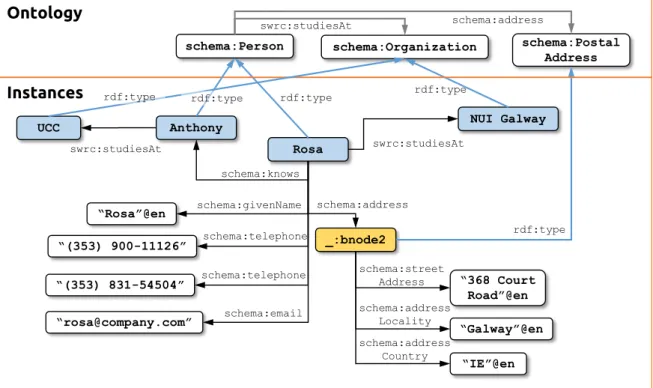
Figure2.1presents an small example of a Semantic Web knowledge base with the separation between ontology and instance data. Graphically, each triple (s, r, o) is represented by a labelled edge s−−→r o. In the definition of RDF, the set of edge labels can be a non-empty intersection with the set of node labels. This differentiates a Semantic Web knowledge base from a graph in the classical sense (Arenas, Gutiérrez, and Pérez,2009).
We also define some auxiliary functions as follows:
• pred(K, τ) ={r | ∃s, o(s,r,o) ∈ K ∧(s,rdf:type, τ)∈ K}returns the set of predicates
appearing with instances of entity typeτ;
• proj(K, s, r) = {(s,r,o) | ∃o (s,r,o) ∈ K} returns the triples in K whose projected subject issand predicate isr; and
• sameAsPairs(K) = {(s, o) | ∃s, o(s,owl:sameAs,o) ∈ K}as the function that returns
all pairs of equivalent entities but defined using a different naming, e.g., U.S. and
United_States_of_America.
Note that the predicate owl:sameAsis used in most cases to represent equality, but other predicates could also be used for the same purpose.
Among the most popular Semantic Web knowledge bases are: DBpedia (Auer, Bizer, Kobilarov, et al., 2007) project that extracts structured content from articles in Wikipedia; Freebase (Bollacker, R. P. Cook, and Tufts,2007) a collaborative and community generated knowledge base comprising structured data from different sources; Wikidata (Vrandecic, 2012) a collaborative knowledge base supporting Wikipedia with factual information; and YAGO (Suchanek, Kasneci, and Weikum,2007), an open source knowledge base automati-cally generated from Wikipedia and other sources.
Semantic Web knowledge bases require of certain characteristics that make them suit-able for open environments such the Web. They inherit two main characteristics from on-tology languages and description logics, namely, the non-unique name assumption and the open-world assumption, which influence how we can interpret and imply knowledge.
2.1.2 Unique name assumption
The unique name assumption (UNA) is a simplifying assumption made in some ontology languages and description logics. It entails that two different names always refer to differ-ent differ-entities in the world (Russell and Norvig, 2010). On the one hand, theWeb Ontology
2.1 Knowledge bases | 17 schema:Person Anthony Rosa “Rosa”@en _:bnode2 “368 Court Road”@en “IE”@en “Galway”@en “(353) 900-11126” “(353) 831-54504” schema:Postal Address rdf:type rdf:type schema:telephone schema:givenName schema:telephone schema:address schema:street Address schema:address Locality schema:address Country schema:knows “[email protected]” schema:email NUI Galway swrc:studiesAt schema:Organization rdf:type Ontology Instances swrc:studiesAt UCC rdf:type rdf:type swrc:studiesAt schema:address
Figure 2.1: Example Semantic Web knowledge base with basic information about people.
Language(OWL) (Motik, Peter F. Patel-Schneider, and Parsia,2012) default semantics does not adopt the UNA, thus two different constants can refer to the same individual (entity resource). This is a desirable behaviour in an environment such as the Web, where reach-ing an agreement for labellreach-ing entities is infeasible (Horrocks and Tessaris,2002). On the other hand, validation checking approaches in RDF usually adopt aclosed-world assumption
(CWA) with UNA, i.e., inferring a statement to be false on the basis of failure to prove it, and if two entities are named differently they are assumed to be different entities (Bosch, Acar, Nolle, et al.,2015).
To deal with this, theShape Constraint Language(SHACL) defines the so-calledUNA 2.0, which is a simple workaround where all entities are treated as different, unless explicitly stated otherwise byowl:sameAs(or equivalent) property. From a practical point of view, the CWA is also a desirable feature for data mining algorithms when considering the semantics of Semantic Web knowledge bases, avoiding misinterpretations of the data.
Some properties and patterns in knowledge graphs are highly sensible to the adoption of UNA, e.g., cardinality. Figure2.2(left) shows an example where the adoption of classical UNA will lead to a count of five different entities (i.e., ex:A, ex:B, ex:C, ex:D, ex:E), and
ex:A would have cardinality one for the property ex:p1. While when adopting UNA 2.0 (Figure2.2, right) these counts change: now we have four different entities (i.e.,ex:A,ex:B,
ex:C, ex:E), and the cardinality of ex:p1in ex:Aincreases to 2. Here, we call rewritingthe process of applying UNA 2.0 to a previouslyunnormalisedknowledge base.
owl:sameAs
ex:p1 ex:p2 ex:p1 ex:p1 ex:p2 ex:p1
rdf:type ex:A ex:C1 ex:D ex:E ex:C ex:B rdf:type ex:C1 ex:E ex:C ex:B ex:A rdf:type
Rewriting
Figure 2.2: Example of UNA 2.0 as defined in SHACL.
2.1.3 Interpretation of knowledge bases
In knowledge representation, there are a few ways to interpret what it is known to be true or what not. In general, no single person or agent can have complete knowledge about the world. Only in cases where the person or agent has complete control over the infor-mation (e.g., the domain is very constrained) we may say that everything can be known. This shows a direct relationship between the interpretation of a knowledge base and its completeness. A knowledge base can be interpreted in different ways according to their completeness (Reiter, 1977; Minker, 1982; Levy, 1996; L. A. Galárraga, Teflioudi, Hose, et al.,2013; X. Dong, Gabrilovich, Heitz, et al.,2014; Razniewski and Nutt,2014; Razniewski, Suchanek, and Nutt,2016). In the following, we describe the most common assumptions to interpret a knowledge base.
Open-World Assumption (OWA).This assumption says that the truth value of a statement may be true irrespective of whether or not it is in the knowledge base. Commonly, knowl-edge bases are interpreted under the OWA because they miss facts that hold in the real world, thus are incomplete (Reiter, 1977). It is also a desirable behaviour for collabora-tive environments to support the creation and addition of new knowledge as statements, e.g., when adding a new entity or integrating two or more knowledge bases. Because of OWA, we cannot tell whether a knowledge base is complete or not given a query. For in-stance, if we only know the facts (Aidan, bornIn, Ireland) and (Aidan, fatherOf, Aoife), it is unknown whetherAoifewas also born in Ireland even though her father was. A complete-ness statement for knowledge bases under OWA could only be possible if we have access to a hypothetical-ideal knowledge base which allows to inferall true statements.
Closed-World Assumption (CWA).This assumption is the opposite of the OWA and says that statements that are true are also known to be true, and statements not present in the knowledge base (and that cannot be inferred from it) are false (Reiter, 1977). Under this assumption, a knowledge base is complete and contains all the facts that it attempts to model, usually within a fixed world such a specific topic or domain. By interpreting a knowledge base under CWA we can ensure that the knowledge base is always complete for all queries. For instance, if we only know the facts (Aidan, bornIn,Ireland) and (Aidan,
2.1 Knowledge bases | 19
fatherOf,Aoife), we also know thatAoifewas not born in Ireland because that fact is not in the knowledge base. Compared with OWA, CWA is too restrictive and used only when the knowledge base is known to be complete (e.g., small domain), or when the knowledge base is known to be incomplete but that is enough to answer queries. Some authors have proposed extending the framework of the Semantic Web to get the benefits of Semantic Web but still allow forms of CWA and negation as failure (NAF) (see Grimm and Motik (2005), Horrocks, Parsia, Patel-Schneider, et al. (2005), Sengupta, Krisnadhi, and Hitzler (2011), and Patel-Schneider (2015), among others). However, adding CWA and NFA poses new issues and requirements, such as more powerful query languages and modifications to the original framework, that do not nicely fit the goal of the Semantic Web. Yet the CWA assumption is partially favourable and desirable for use cases such as data validation and knowledge discovery. Since in such cases, approaches require to have access to all the knowledge available.
However, in practice, a knowledge base can be complete for some entities/relations, while it is known to be incomplete for others.
Partial Closed-World Assumption (PCWA).This is an intermediate ground between OWA and CWA. PCWA was first introduced in Motro (1989), where queries were used to de-scribe the complete parts of a database introducing what is known as partially complete databases.3 This assumption says that if a knowledge base contains one value for a subject– relation pair, then we fall into CWA and the knowledge base contains all values for that given subject and relation (Motro,1989; Levy,1996; L. A. Galárraga, Teflioudi, Hose, et al., 2013; Razniewski and Nutt, 2014; Razniewski, Savkovic, and Nutt, 2016). However, if it is not known any value for the subject–relation pair, we cannot say anything—we fall into OWA. Clearly, CWA and PCWA look similar; however, PCWA is more cautious making judgements only if an entity has a value for a given relation. Intuitively, PCWA is espe-cially well suited forfunctional relations, where an entity can have at most one object (e.g., identifiers).
In L. A. Galárraga, Teflioudi, Hose, et al. (2013), PCWA is used to generate negative examples for a rule mining system, but they refer to it asPartial Completeness Assumption
(PCA). Likewise, in X. Dong, Gabrilovich, Heitz, et al. (2014), PCWA is used to generate neg-ative examples during the development of Google’s Knowledge Vault project—a Web-scale system for probabilistic knowledge fusion, but still the authors refer to it asLocal Closed-World Assumption(LCWA).
Example2.1 shows examples of interpreting a knowledge base using the different as-sumptions just introduced.
3Motro (1989) also introduced the notion of incorrect databases which contain facts that do not hold in the
Example 2.1
Clearly, each one of the assumptions have direct implications on the interpretation of a knowledge base. Considering the knowledge base in Figure 2.1and the statement (Anthony,swrc:studiesAt,NUI Galway), we have:
• OWA: the fact is unknown, and it may or may not be true. • CWA: the fact is unknown, and false because it is not in the KB.
• PCWA: the fact is unknown, and false because we know at least one swrc: studiesAtproperty forAnthony, then we know all of them.
A