Software Assurance:
Enabling Security and Resilience
throughout the Software Lifecycle
Joe Jarzombek,
PMP, CSSLP
Director for Software Assurance
Cyber Security & Communications
US Department of Homeland Security
National
Defense
Commerce
Next SwA Working Groups sessions: 27-29 Nov 2012 at MITRE, McLean, VA
Public/Private Collaboration Efforts for
Security Automation and Software
Supply Chain Risk Management
Defects
Intentional
Vulnerabilities
Unintentional
Vulnerabilities
Software Assurance Addresses Exploitable Software:
Outcomes of non-secure practices and/or malicious intent
EXPLOITABLE SOFTWARE
Exploitation potential of vulnerability is independent of ―intent‖
*
Intentional
vulnerabilities:
spyware & malicious
logic deliberately
imbedded (might not
be considered
defects)
Malware
‗High quality‘ can
reduce security
flaws attributable to
defects; yet
traditional S/W
quality assurance
does not address
intentional
malicious behavior
in software
Software Assurance (SwA) is the level of confidence that software functions as
intended and is free of vulnerabilities, either intentionally or unintentionally designed
or inserted as part of the software throughout the life cycle.*
Challenges in Mitigating Risks Attributable to Exploitable
Software and Supply Chains
•
Complexity hampers ability to determine and predict code behavior;
so any ―assurance‖ claims for security/safety-critical applications are
limited.
•
Without adequate diagnostic capabilities and commonly recognized
standards from which to:
–
discern product assurance;
–
benchmark process capabilities, and
–
assert claims about the assurance of products, systems and services,
•
―provenance and pedigree of supply chain actors‖ become a more
dominant consideration for security/safety-critical applications:
–
Enterprises and Users lack requisite transparency for more informed
decision-making for mitigating risks;
–
Favoring domestic suppliers does not necessarily address ‗assurance‘ in
terms of capabilities to deliver secure/safe components, systems or
Challenges in Mitigating Risks Attributable to Exploitable
Software and Supply Chains
•
Several needs arise:
–
Need internationally recognized standards to support security
automation and processes to provide transparency for more
informed decision-making for mitigating enterprise risks.
–
Need ‗Assurance‘ to be explicitly addressed in standards &
capability benchmarking models for organizations involved with
security/safety-critical applications.
–
Need more comprehensive diagnostic capabilities to provide
sufficient evidence that ―code behavior‖ can be well understood
to not possess exploitable or malicious constructs.
–
Need rating schemes for software products and supplier
Challenges in Mitigating Risks Attributable to Exploitable
Software and Supply Chains (cont.)
Enterprises seek comprehensive capabilities to:
•
Avoid installing software with
MALWARE
pre-installed.
•
Determine that no publicly reported
VULNERABILITIES
remain in code prior to operational acceptance, and that
future discoveries of common vulnerabilities and
exposures can be quickly patched.
•
Determine that exploitable software
WEAKNESSES
that
put the users most at risk are mitigated prior to
operational acceptance.
CVE
CWE
MAEC
Challenges in Preventing and Responding to
Cyber Incidents
•
―Silos‖ of operation
•
Proprietary reporting formats
•
Needs arise:
–
Need standards to support security automation and processes to
support exchange of information and cyber indicators relative to
incident management and response.
Cross-site Scripting (XSS)
Attack (CAPEC-86)
Improper Neutralization of
Input During Web Page
Generation
(CWE-79)
Security Feature
SQL Injection Attack
(CAPEC-66)
Improper Neutralization of Special
Elements used in
an SQL Command
(CWE-89)
8
Exploitable Software Weaknesses (CWEs) are sources for future
Zero-Day Attacks
Software Security Assurance: Not just a good idea
•
Many people responsible for protecting
most critical infrastructure facilities have
felt comfortable about security of their
systems.
– Facilities rely on industrial control
systems (ICS) -- custom-built suites
of systems that control essential
mechanical functions of power grids,
processing plants, etc -- usually not
connected to the Internet, also
known as "air-gapped."
– Many industry owners, operators
and regulators believed that this
security model provided an infallible,
invulnerable barrier to malicious
cyber attacks from criminals and
advanced persistent threat (APT)
adversaries.
• National Defense Authorization
Act (NDAA) -- which included a
focus on software security (in
Section 932, Strategy on
Computer Software Assurance)
-- serves as first cybersecurity
law of 2011 and requires the
U.S. Dept of Defense to
develop a strategy for ensuring
the security of software
applications.
• Software Security Assurance, a
set of practices for ensuring
proactive application security,
is key to making applications
compliant with this new law.
―How Stuxnet Demonstrates That Software Assurance Equals Mission Assurance:
Software Security Assurance: Not just a good idea
Steps organizations can take now to support software security assurance.
Tips from white paper on “7 Practical Steps to Delivering More Secure Software”:
1.
Quickly evaluate current state of software security and create a plan for dealing with it throughout the life cycle.
2.
Specify the risks and threats to the software so they can be eliminated before they are deployed.
3.
Review the code for security vulnerabilities introduced during development.
4.
Test and verify the code for vulnerabilities.
5.
Build a gate to prevent applications with vulnerabilities from going into production.
6.
Measure the success of the security plan so that the process can be continually improved.
7.
Educate stakeholders about security so they can implement the security plan.
Any development organization can implement this security plan immediately and begin to receive a
return on their efforts within a minimal period of time. The key is to start now.
To complement the software strategy, there are several other areas of good security practices to
observe and implement if they are not already part of the organizational security approach:
1.
Implement software configurations such as the U.S. Government Configuration Baseline (formerly the Federal
Desktop Core Configuration), strong authentication, and strict, documented internal policies and procedures.
2.
Ask vendors to provide guarantees of software security as required by HR 6523.
3.
Insert and enforce software assurance requirements in contracts.
4.
Review IT security policies to ensure that all users of organizational networks and data comply with the strictest
security policies possible with respect to the mission.
5.
Determine how much risk the organization can afford and who is accountable for that risk. Constructing a new
building in parts of California without accounting for earthquakes is unacceptable.
―How Stuxnet Demonstrates That Software Assurance Equals Mission Assurance:
The rules of the game have changed,‖ by Rob Roy, Federal CTO of Fortify, an HP Company
Building software
without accounting for
security is no longer an
acceptable risk.
Comprehensive Program Protection
5/1/2012 | Page 11 Distribution Statement A – Cleared for public release by OSR on 4/25/2012, SR Case # 12-S-1841 applies.
Program Protection Plan Outline and
Guidance as ―Expected Business
Practice‖
http://www.acq.osd.mil/se/pg/index.html#PPP
Signed by Principal Deputy, USD(AT&L) on
July 18, 2011
What‘s in the DoD Policy Memo?
–
“Every acquisition program shall submit a PPP
for Milestone Decision Authority review and
approval at Milestone A and shall update the
PPP at each subsequent milestone and the
Full-Rate Production decision.”
– Expected business practice, effective
immediately, and reflected in upcoming DoDI
5000.02 and DAG updates
The PPP is the Single Focal Point for All
Security Activities on the Program
Program Protection Process
5/1/12 Page 12 Distribution Statement A – Cleared for public release by OSR on 4/25/2012, SR Case # 12-S-1842 applies.
Software Assurance Methods
Additional Guidance in PPP Outline and Guidance
Development Process
Apply assurance activities to the procedures and structure imposed on software development
Operational System
Implement countermeasures to the design and acquisition of end-item software products and their interfaces
Development Environment
Apply assurance activities to the environment and tools for developing, testing, and integrating software code and interfaces
Counter-measure Selection
Homeland
Security
Cybersecurity and Communications
DHS CS&C Software Assurance (SwA) Program
Advances security and resilience of software throughout the lifecycle; focuses
on reducing exploitable software weaknesses and addresses means to improve
capabilities that routinely develop, acquire, and deploy resilient software.
•
Serves as a focal point for interagency public-private collaboration to
enhance development and acquisition processes, capability benchmarking
and rating schemes to address software security needs.
– Hosts interagency Software Assurance Forums, working groups and training to provide public-private
collaboration in advancing software security and providing publicly available resources.
– Provides collaboratively developed, peer-reviewed information resources on Software Assurance, via
journals, guides & on-line resources suitable for use in education, training, and process improvement.
– Provides input and criteria for leveraging international standards and maturity models used for process
improvement and capability benchmarking of software suppliers and acquisition organizations.
•
Enables software security automation and measurement capabilities through
use of common indexing and reporting capabilities for malware, exploitable
software weaknesses, cyber indicators and attacks which target software.
– Collaborates with national & international standards organizations and industry to create standards,
metrics and certification mechanisms from which products and tools could be qualified for software
security verification.
– Manages programs for Malware Attribute Enumeration Classification (MAEC), Common Weakness
Enumeration (CWE), Common Attack Pattern (CAPEC) & Cyber Observable eXpression (CybOX).
– Manages programs for Common Vulnerabilities & Exposures (CVE) and Open Vulnerability &
Assessment Language (OVAL) that provide information feeds for continuous monitoring, security
content automation, vulnerability databases, and security/threat alerts from many organizations
19
DHS Software Assurance (SwA) Outreach & Awareness
Co-sponsor SwA working group sessions, semi-annual SwA Forum,
for government, academia, and industry to facilitate ongoing
public-private collaboration.
Provide SwA presentations, workshops, and tracks at conferences
Co-sponsor SwA issues of CROSSTALK to ―spread the word‖
Sep 2008 issue on ―Application Security‖
Mar/Apr 2009 issue on ―Reinforcing Good Practices‖
Sep/Oct 2009 issue on ―Resilient Software‖
Mar/Apr 2010 issue on ―System Assurance‖
Sep/Oct 2010 issue on ―Game Changing Tools & Practices‖
Mar/Apr 2011 issue on ―Rugged Software‖
Sep/Oct 2011 issue on ―Protecting against Predatory Practices‖
Mar/Apr 2012 issue on ―Securing a Mobile World‖
Sep/Oct 2012 issue on ―Resilient Cyber Ecosystem‖
Mar/Apr 2013 issue on ―Supply Chain Risk Management‖
Collaborate with standards organizations, consortiums, professional
societies, education/training initiatives in promoting SwA
Provide free SwA resources via ―BuildSecurityIn‖ website to
promote secure development methodologies
(since Oct 05)
Host SwA Community Resources & Information Clearinghouse
via
https://buildsecurityin.us-cert.gov/SwA
(since Dec 07)
21
Sw Documentation Management Sw Configuration Management Sw Quality Assurance Sw Verification & Sw Validation Sw Review Sw Audit Sw Problem Resolution Domain EngineeringReuse Asset Management
Reuse Program Management
Implementation
•Secure coding and Sw construction •Security code review and static analysis •Formal methods
Integration
•Sw component integration
•Risk analysis of Sw reuse components Verification & Validation
•Risk-based test planning
•Security-enhanced test and evaluation
• Dynamic and static code analysis
• Penetration testing
•Independent test and certification
Transition
•Secure distribution and delivery
•Secure software environment (secure configuration, application monitoring, code signing, etc)
Operation
• Incident handling and response
Maintenance
• Defect tracking and remediation
• Vulnerability and patch management
• Version control and management
Disposal
Stakeholder Requirements Definition Requirements Analysis
•Attack modeling (misuse and abuse cases) •Data and information classification •Risk-based derived requirements •Sw security requirements
Architectural Design
•Secure Sw architectural design •Risk-based architectural analysis •Secure Sw detailed design and analysis
Decision Management Risk Management • Threat Assessment Configuration Management Information Management Measurement Project Planning
Project Assessment and Control
• Assurance case management
Life Cycle Model Management
Infrastructure Management
• SwA ecosystem
• Enumerations, languages, and repositories
Project Portfolio Management
Human Resource Management
• SwA education
• SwA certification and training
• Recruitment
Quality Management
Acquisition
• Outsourcing
• Agreements
• Risk-based due diligence
• Supplier assessment
Supply
Governance Processes
Project-Enabling Processes
Enterprise risk management
• Compliance
• Business case
Strategy and policy
Agreement Processes
Supply Chain Management
Operations and Sustainment
Project Support Processes
Project Management Processes
Technical Processes Software Reuse Processes Software Support Processes Engineering Project Organization
Many SwA Resources Focus On Development
SwA in Acquisition & Outsourcing
• Software Assurance in Acquisition and Contract Language
• Software Supply Chain Risk Management and Due-Diligence
SwA in Development
• Integrating Security into the Software Development Life Cycle
• Key Practices for Mitigating the Most Egregious Exploitable Software Weaknesses
• Risk-based Software Security Testing
• Requirements and Analysis for Secure Software
• Architecture and Design Considerations for Secure Software
• Secure Coding and Software Construction
• Security Considerations for Technologies, Methodologies & Languages
SwA Life Cycle Support
• SwA in Education, Training and Certification
• Secure Software Distribution, Deployment, and Operations
• Code Transparency & Software Labels
• Assurance Case Management
• Secure Software Environment and Assurance EcoSystem
SwA Measurement and Information Needs
• Making Software Security Measurable
• Practical Measurement Framework for SwA and InfoSec
• SwA Business Case and Return on Investment
SwA Pocket Guides and SwA-related documents are collaboratively developed with peer review; they are
subject to update and are freely available for download via the DHS Software Assurance Community
Resources and Information Clearinghouse at
https://buildsecurityin.us-cert.gov/swa
(see SwA Resources)
Architecture and Design Considerations for
Secure Software – SwA Pocket Guide*
The IEEE Guide to the Software Engineering Body of Knowledge (SWEBOK) defines the design phase
as both ―the process of defining the architecture, components, interfaces, and other characteristics of
a system or component‖ and ―the result of [that] process.‖ The software design phase:
is the software engineering life cycle activity where software requirements are analyzed in order
to produce a description of the software‘s internal structure that will serve as the basis for its
implementation.
consists of the
architectural design and detailed design activities that follow the software
requirements analysis phase and precedes software implementation in the SDLC
.
This pocket guide includes the following topics:
Basic Concepts
Design Principles for Secure Software
Architecture and Threat Modeling
Secure Design Patterns
–
Architectural-level Patterns
–
Design-level Patterns
Secure Session Management
Design and Architectural Considerations for Mobile Applications
Formal Methods and Architectural Design
Design Review and Verification
Key Architecture and Design Practices for Mitigating Exploitable Software Weaknesses
Questions to Ask Developers
Software Security Testing –vs–
Security Requirements Testing
Software security testing is not the same
as testing the correctness and adequacy
of security functions implemented by
software, which are most often verified
through requirements-based testing that:
cannot fully demonstrate that software is
free from exploitable weaknesses /
vulnerabilities.
is not the best approach to determining
how software will behave under
anomalous and hostile conditions.
Download FREE SwA Pocket Guide on
Software Security Testing at
Software Security
Test Techniques
throughout SDLC
See details in FREE SwA Pocket
Guide on Software Security Testing at
https://buildsecurityin.us-cert.gov/swa
Penetration Testing can
enhance pre-deployment
test outcomes and identify
post-release exploit points
Secure Coding
Preparing to Write Secure Code
Secure Coding Principles
Secure Coding Practices
Secure Memory and Cache Management
Secure Error and Exception Handling
What to Avoid
Questions to Ask Developers
Key Practices for Mitigating the Most Egregious
Exploitable Software Weaknesses
•
Identifies mission/business risks attributable to
the respective weaknesses; identifies common
attacks that exploit those weaknesses, and
provides recommended practices for preventing
the weaknesses.
•
CWE focuses on stopping vulnerabilities at the
source by educating designers, programmers, and
QA/testers on how to eliminate all too-common
mistakes before software is even shipped.
•
CWE Top-N lists serve as tools for education, training
and awareness to help programmers prevent the
kinds of vulnerabilities that plague the software
industry.
•
Software consumers could use the same list to help
them to ask for more secure software.
•
Software managers and CIOs can use the CWE list as
a measuring stick of progress in their efforts to
secure their software.
Understand Assurance-Related
Process Capability Expectations
Look to Standards for
Assurance Process Detail
Understand Your Business
Requirements for Assurance
Build or Refine and Execute
Your Assurance Processes
Measure Your Results
Process Improvement Lifecycle - A Process for
Achieving Assurance
Adapted from: Paul Croll, Computer Sciences Corporation, August 2007
Mission/Business Process
Organization Support
Assurance Process Reference Model
Enterprise Assurance
Support
ES 1 Establish and maintain organizational culture where assurance is an integral part of achieving the mission
ES 2 Establish and maintain the ability to support
continued delivery of assurance capabilities ES 3 Monitor and improve
enterprise support to IT assets
Development Engineering
DE 1 Establish assurance requirements
DE 2 Create IT solutions with integrated business
objectives and assurance DE 3 Verify and Validate an
implementation for assurance
Development Organization
DO 1 Establish the assurance resources to achieve key business objectives
DO 2 Establish the environment to sustain the assurance program within the organization
Development Project
DP 1 Identify and manage risks due to vulnerabilities
throughout the product and system lifecycle
DP 2 Establish and maintain assurance support from the project
DP 3 Protect project and organizational assets
Acquisition and Supplier
Management
AM 1 Select, manage, and use effective suppliers and third party applications based upon their assurance capabilities.
Created to facilitate Communication Across An Organization’s Multi-Disciplinary Stakeholders
Enable
Resilient
Technology
Define Business Goals
Sustained
environment to
achieve
business goals
through
technology
Prioritize
funds and
manage risks
https://buildsecurityin.us-cert.gov/swa/proself_assm.htmlBusiness Case for Software Assurance
April 2009 SwA Report provides
background, context and examples:
• Motivators
• Cost/Benefit Models Overview
• Measurement
• Risk
• Prioritization
• Process Improvement & Secure Software
• Globalization
• Organizational Development
• Case Studies and Examples
Security Measurement Resources
Practical Measurement
Framework for
Software Assurance
and
Information Security
Oct 2008
Software Assurance Curriculum Project
•
Vol I: Master of Software Assurance Reference Curriculum
•
Vol II: SwA Undergraduate Course Outlines
see
www.sei.cmu.edu/library/abstracts/reports/10tr019.cfm
to
download the PDF version of the report CMU/SEI-2010-TR-019
•
Vol III: Master of SwA Course Syllabi
•
Vol IV: Community College Education
In Dec 2010 the IEEE Computer Society and the ACM recognized the
Master of Software Assurance (MSwA) Reference Curriculum as a certified
master‘s degree program in SwA —the first curriculum to focus on assuring
the functionality, dependability, and security of software and systems.
• Report on ―Integrating the MSwA Reference Curriculum into Model Curriculum and
Guidelines for Graduate Degree Programs in Information Systems‖ provides reference
and guidance material.
•To facilitate implementation, the MSwA project team is offering assistance, free of
charge, to educational institutions looking to launch an MSwA degree program.
• For more information,go to
https://buildsecurityin.us-cert.gov/bsi/1165-BSI.html
.
Software Assurance Professional Competency Model
Specialty Areas*
•
Software Assurance & Security Engineering
•
Information Assurance Compliance
•
Vulnerability Assessment & Management
•
Cyber Threat Analysis
•
Systems Requirements Planning
•
Systems Security Architecture
•
Strategic Planning & Policy Development
•
Technology Research and Development
•
Education and Training
•
Knowledge Management
―In the digital age, sovereignty is
demarcated not by territorial frontiers
but by supply chains.‖
– Dan Geer, CISO In-Q-Tel
Enterprise Risk Management
and Governance are security
motivators
Acquisition could be considered
the beginning of the lifecycle;
more than development
Software Assurance provides a focus for:
-- Secure Software Components,
-- Security in the Software Life Cycle,
-- Software Security in Services, and
-- Software Supply Chain Risk Management
IT/software security risk landscape is a convergence
between ―defense in depth‖ and ―defense in breadth‖
Acquisition Program
Supplier
―Supply chain introduces risks to American society
that relies on Federal Government for essential
information and services.‖
30 Sep 2005 changes to Federal Acquisition
Regulation (FAR) focus on IT Security
Focuses on the role of contractors in security as
Federal agencies outsource various IT functions.
―Scope of Supplier Expansion and Foreign Involvement‖ graphic in DACS www.softwaretechnews.com Secure Software Engineering, July 2005 article ―Software Development Security: A Risk Management Perspective‖ synopsis of May 2004 GAO-04-678 report ―Defense Acquisition: Knowledge of Software Suppliers Needed to Manage Risks‖
Risk Management (Enterprise <=> Project):
Shared Processes & Practices Different Focuses
Enterprise-Level:
Regulatory compliance
Changing threat environment
Business Case
Program/Project-Level:
Cost
Schedule
Performance
Software Supply Chain Risk Management
traverses enterprise and program/project interests
1. Insert and enforce software assurance requirements in contracts.
2. Review IT security policies to ensure that all users of organizational networks and data comply with the strictest security policies possible with respect to the mission.
Who makes risk
decisions?
Who inherits the
residual risk?
Who ‗owns‘ the
residual risk
attributable to
exploitable software?
Source: Maximizing Benefits and Mitigating Risks of Open
Source Components in Application Development, by Sonatype
Even after vulnerabilities
are discovered and
patches made available,
many developers use the
flawed, non-patched
version of reused
components
4
Abuse Cases Security Requirements Risk Analysis Risk-based Test Plans Static/Dynamic AnalysisSecurity Ops & Vulnerability Mgt Risk Analysis Design Review Requirements and Use Cases
Plan
Risk AssessmentDesign
Security Design Reviews Application Security Testing S/W Support Scanning & RemediationBuild
Deploy
Architecture andDetailed Design Code and Testing
Field Deployment and Feedback
Organizations that provide security engineering & risk-based analysis
throughout the lifecycle will have more resilient software products / systems.
Leverage Software Assurance resources (freely available) to incorporate in training & awareness Modify SDLC to incorporate security processes and tools (should be done in phases by practitioners to determine best integration points)
Avoid drastic changes to existing development environment and allow for time to change culture and processes
Make the business case and balance the benefits
Retain upper management sponsorship and commitment to producing secure software.
Penetration Testing
* Adopted in part from ―Software Assurance: Mitigating Supply Chain Risks‖ (DHS NCSD SwA); ―What to Test from a Security Perspective for the QA Professional‖ (Cigital) and ―Neutralizing the Threat: A Case Study in Enterprise-wide Application Security Deployments‖ (HP Fortify Software & Accenture Security Technology Consulting)
Code Review
―Build Security In‖ throughout the lifecycle
Security-Enhanced Process Improvements
Secure Programming Practices Test / Validation of Security & Resilience Secure Distribution/ Deployment Documentation for Secure Use & Configuration
Organizational Process Assets cover: governance, policies, standards, training, tailoring guidelines
Secure S/W Requirements Engineering Secure Design Principles & Practices Attack Modeling Library Updates with Patches
NIST SP
800-53
NIST SP
800-64
Objectives for SCRM & SwA in Acquisition
■
we need ―systems-of-systems‖ or ―enterprise systems‖ thinking
for risk management (building on 800-39 and 800-64)
■
IT Baselines for SCRM are different, but should build on 800-53
45
4. Integrated Activities, 5. Measurement & Monitoring
2. Preconditions
3. Distributed Enhancements
NIST SP
800-39
1. Framing
SCRM
& SwA
SwA Acquisition & Outsourcing Handbook
―Software Assurance in Acquisition:
Mitigating Risks to the Enterprise―
Version 1.0, Oct 2008, available for
community use;
published by National Defense
University Press, Feb 2009
Executive Summary 1. Introduction
1.1 Background
1.2 Purpose and Scope
1.3 Audience—Acquisition Official Defined 1.4 Document Structure
1.5 Risk-Managed Software Acquisition Process
2. Planning Phase
2.1 Needs Determination, Risk Categorization, & Solution Alternatives
2.2 SwA Requirements
2.3 Acquisition Plan and/or Acquisition Strategy 2.4 Evaluation Plan and Criteria
2.5 SwA Due Diligence Questionnaires
3. Contracting Phase
3.1 Request for Proposals
3.1.1 Work Statement 3.1.2 Terms and Conditions 3.1.3 Instructions to Suppliers 3.1.4 Certifications 3.1.5 Prequalification 3.2 Proposal Evaluation 3.3 Contract Negotiation 3.4 Contract Award
4. Implementation and Acceptance Phase
4.1 Contract Work Schedule 4.2 Change Control
4.3 Risk Management Plan
4.4 Assurance Case Management 4.5 Independent Software Testing 4.6 Software Acceptance
5. Follow-on Phase
5.1 Support and Maintenance
5.1.1 Risk Management
5.1.2 Assurance Case Management— Transition to Ops
5.1.3 Other Change Management Considerations
5.2 Disposal or Decomissioning
Appendix A/B— Acronyms/Glossary
Appendix C— An Imperative for SwA in Acquisition Appendix D— Software Due Diligence Questionnaires
Table D-1. COTS Proprietary Software Questionnaire Table D-2. COTS Open-Source Software Questionnaire Table D-3. Custom Software Questionnaire
Table D-4. GOTS Software Questionnaire Table D-5. Software Services
Appendix E— Other Examples of Due Diligence Questionnaires Appendix F— Sample Language for the RFP and/or Contract
F.1 Security Controls and Standards
F.2 Securely Configuring Commercial Software F.3 Acceptance Criteria
F.4 Certifications
F.5 Sample Instructions to Offerors Sections F.6 Sample Work Statement Sections F.7 Open Web Application Security Project F.8 Certification of Originality
Appendix H— References
SwA Acquisition &
48
Software Supply Chain Risk Management and Due-Diligence
--
Table 1 –
SwA Concern Categories
SwA Concern Categories
Risks
Purpose for Questions
Software History and Licensing
Development Process Management
Software Security Training and Awareness
Planning and Requirements
Architecture and Design
Software Development
Built-in Software Defenses
Component Assembly
Testing
Software Manufacture and Packaging
Installation
Assurance Claims and Evidence
Support
Software Change Management
Timeliness of Vulnerability Mitigation
Individual Malicious Behavior
Security ―Track Record‖
Financial History and Status
Organizational History
Foreign Interests and Influences
Service Confidentiality Policies
Operating Environment for Services
Security Services and Monitoring
Software Supply Chain Risk Management and Due-Diligence --
Table 1 –
SwA Concern Categories
SwA Concern Categories
Risks
Purpose for Questions
Software History and Licensing
The software supplier‘s development practice in using code of unknown origin may be unable to produce trustworthy software.
To address supply chain concerns and identify risks pertaining to history/pedigree of software during any and all phases of its life cycle that should have been considered by the supplier.
Development Process Management
If supplier project management does not perceive the value of SwA and enforce best practices, they will not be consistently implemented.
To determine whether project management enforces software assurance–related best practices.
Software Security Training and Awareness
Developers unaware of software assurance best practices are likely to implement software with
security flaws (making it more susceptible to attack).
To determine whether training of developers in SwA best practices is a supplier policy and practice.
Planning and Requirements
If nonfunctional requirements (security, quality, safety) are not specified, developers will not implement them.
To determine whether the supplier‘s requirements analysis process explicitly addresses SwA requirements.
Architecture and Design
The software may be designed without considering security or minimization of exploitable defects.
To determine how security is considered during the design phase.
Software Development
If developers lack qualified tools or if personnel are allowed to inappropriately access or change
configuration items in the development environment, then delivered software might have unspecified features. The supplier might lack sufficient process capability to deliver secure products, systems or services.
To ascertain that the supplier has and enforces policies and SwA practices in the development of software that use secure software
development environments to minimize risk exposures.
Built-in Software Defenses
The software may lack preventive measures to help it resist attack effectively and proactively.
To ensure that capabilities are designed to minimize the exposure of the software‘s vulnerabilities to external threats and to keep the software in a secure state regardless of the input and parameters it receives from its users or environment.
Testing Software released with insufficient testing may contain an unacceptable number of exploitable defects.
To determine whether the appropriate set of analyses, reviews, and tests are performed on the software throughout the life cycle which evaluate security criteria.
Software Manufacture and Packaging
Vulnerabilities or malicious code could be introduced in the manufacturing or packaging process.
To determine how the software goes through the manufacturing process, how it is
packaged, and how it remains secure.
Installation The software may not install as advertised and the acquirer may not get the software to function as expected.
To ensure the supplier provides an acceptable level of support during the installation process.
Assurance Claims and Evidence
Supplier assurance claims (with supporting evidence) may be non-existent or
insufficiently verified.
To determine how suppliers communicate their claims of assurance; ascertain what the claims have been measured against, and identify at what levels they will be verified.
Support Supplier ceases to supply patches and new releases prior to the acquirer ending use of software. Vulnerabilities may go unmitigated.
To ensure understanding of supplier policy for security fixes and when products are no longer supported.
Software Change Management
Weak change control procedures can corrupt software and introduce new security
vulnerabilities.
To determine whether software changes are adequately assessed and verified by supplier management.
Timeliness of
Vulnerability Mitigation
Sometimes it can be extremely difficult to make a software supplier take notice and repair software to mitigate reported vulnerabilities.
To ensure security defects and configuration errors are fixed properly and in a timely fashion.
Software Supply Chain Risk Management and Due-Diligence
--
Table 1 –
SwA Concern Categories
SwA Concern Categories Risks Purpose for Questions
Component Assembly Insufficient analysis of software components used to assemble larger software packages may introduce vulnerabilities to the overall package.
To ensure that the software components are thoroughly vetted for their security properties, secure behaviors, and known types of
weaknesses that can lead to exploitable vulnerabilities.
Individual Malicious Behavior
A developer purposely inserts malicious code, and supplier lacks procedures to mitigate risks from insider threats within the supply chain.
To determine whether the supplier has and enforces policies to minimize individual malicious behavior.
Security ―Track Record‖ A software supplier that is unresponsive to known software vulnerabilities may not mitigate/patch vulnerabilities in a timely manner.
To establish insight into whether the supplier places a high priority on security issues and will be responsive to vulnerabilities they will need to mitigate.
Financial History and Status
A software supplier that goes out of business will be unable to provide support or mitigate product defects and vulnerabilities.
To identify documented financial conditions or actions of the supplier that may impact its viability and stability, such as mergers, sell-offs, lawsuits, and financial losses.
Organizational History There may be conflicting circumstances or competing interests within the organization that may lead to increased risk in the software development.
To understand the supplier‘s organizational background, roles, and relationships that might have an impact on supporting the software.
Foreign Interests and Influences
There may be controlling foreign interests (among organization officers or from countries) with malicious intent to the users‘ country or organization planning to use the software.
To help identify supplier companies that may have individuals with competing interests or malicious intent to a domestic buyer/user.
Service Confidentiality Policies
Without policies to enforce client data
confidentiality/ privacy, acquirer‘s data could be at risk without service supplier liability.
To determine the service provider‘s
confidentiality and privacy policies and ensure their enforcement.
Operating Environment for Services
Operating environment for the services may not be hardened or otherwise secure.
To understand the controls the supplier has established to operate the software securely.
Security Services and Monitoring
Insufficient security monitoring may allow attacks to impact services.
To ensure software and its operating environment are regularly reviewed for adherence to SwA requirements through periodic testing and evaluation.
Software Supply Chain Risk Management and Due-Diligence
--
Table 1 –
SwA Concern Categories
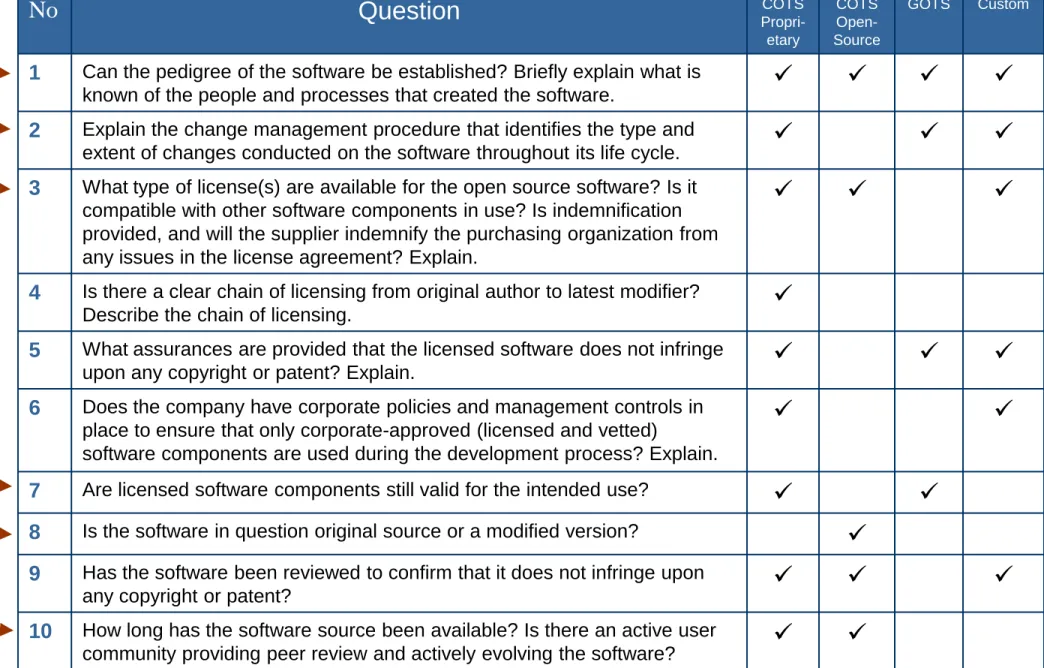
Table 2- Questions for COTS (Proprietary & Open Source), GOTS, & Custom Software
No
Question
COTS Propri-etary COTS Open-Source GOTS Custom1
Can the pedigree of the software be established? Briefly explain what isknown of the people and processes that created the software.
2
Explain the change management procedure that identifies the type andextent of changes conducted on the software throughout its life cycle.
3
What type of license(s) are available for the open source software? Is itcompatible with other software components in use? Is indemnification provided, and will the supplier indemnify the purchasing organization from any issues in the license agreement? Explain.
4
Is there a clear chain of licensing from original author to latest modifier?Describe the chain of licensing.
5
What assurances are provided that the licensed software does not infringeupon any copyright or patent? Explain.
6
Does the company have corporate policies and management controls inplace to ensure that only corporate-approved (licensed and vetted)
software components are used during the development process? Explain.
7
Are licensed software components still valid for the intended use?
8
Is the software in question original source or a modified version?
9
Has the software been reviewed to confirm that it does not infringe uponany copyright or patent?
10
How long has the software source been available? Is there an active user11
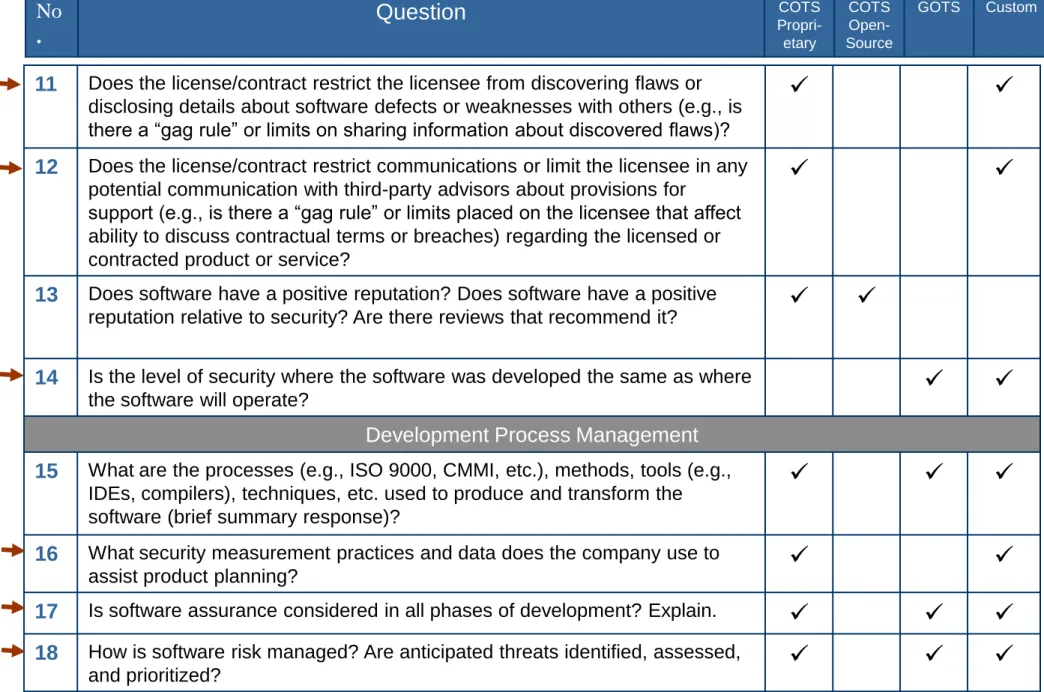
Does the license/contract restrict the licensee from discovering flaws or disclosing details about software defects or weaknesses with others (e.g., is there a ―gag rule‖ or limits on sharing information about discovered flaws)?
12
Does the license/contract restrict communications or limit the licensee in anypotential communication with third-party advisors about provisions for
support (e.g., is there a ―gag rule‖ or limits placed on the licensee that affect ability to discuss contractual terms or breaches) regarding the licensed or contracted product or service?
13
Does software have a positive reputation? Does software have a positivereputation relative to security? Are there reviews that recommend it?
14
Is the level of security where the software was developed the same as wherethe software will operate?
Development Process Management
15
What are the processes (e.g., ISO 9000, CMMI, etc.), methods, tools (e.g.,IDEs, compilers), techniques, etc. used to produce and transform the software (brief summary response)?
16
What security measurement practices and data does the company use toassist product planning?
17
Is software assurance considered in all phases of development? Explain.
18
How is software risk managed? Are anticipated threats identified, assessed,and prioritized?
Table 2- Questions for COTS (Proprietary & Open Source), GOTS, and Custom Software
No
.
Question
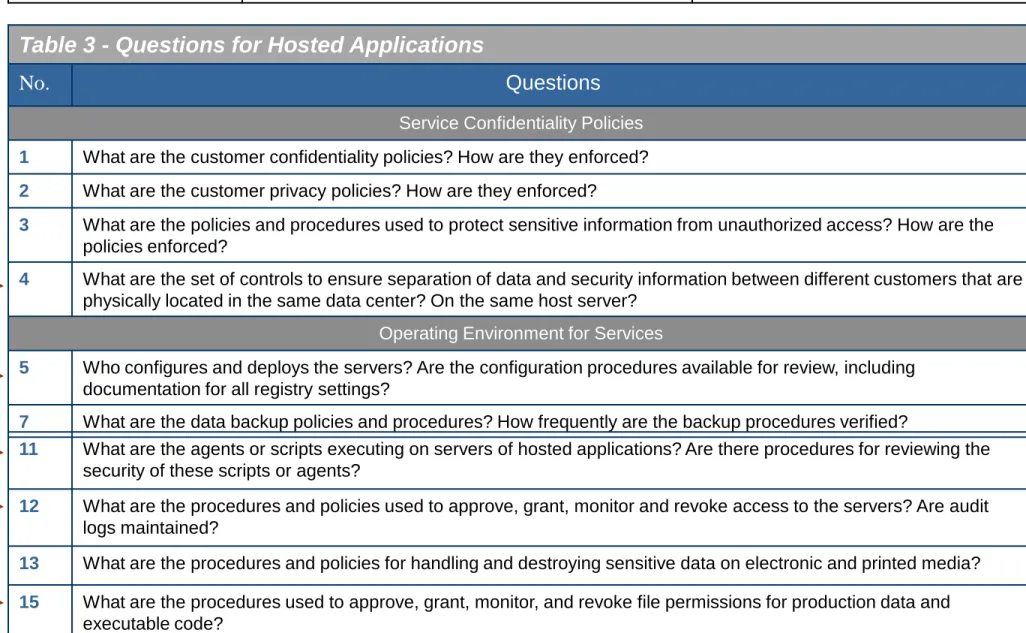
COTS Propri-etary COTS Open-Source GOTS Custom15 What are the procedures used to approve, grant, monitor, and revoke file permissions for production data and executable code?
11 What are the agents or scripts executing on servers of hosted applications? Are there procedures for reviewing the security of these scripts or agents?
12 What are the procedures and policies used to approve, grant, monitor and revoke access to the servers? Are audit logs maintained?
13 What are the procedures and policies for handling and destroying sensitive data on electronic and printed media?
7 What are the data backup policies and procedures? How frequently are the backup procedures verified?
Table 3 - Questions for Hosted Applications
No.
Questions
Service Confidentiality Policies 1 What are the customer confidentiality policies? How are they enforced?
2 What are the customer privacy policies? How are they enforced?
3 What are the policies and procedures used to protect sensitive information from unauthorized access? How are the policies enforced?
4 What are the set of controls to ensure separation of data and security information between different customers that are physically located in the same data center? On the same host server?
Operating Environment for Services
5 Who configures and deploys the servers? Are the configuration procedures available for review, including documentation for all registry settings?
Table 1 –
SwA Concern Categories
--
(with interests relevant to security and privacy)
SwA Concern Categories Risks Purpose for Questions
Service Confidentiality Policies
Without policies to enforce client data confidentiality/ privacy, acquirer‘s data could be at risk without service supplier liability.
To determine the service provider‘s confidentiality and privacy policies and ensure their enforcement.
Software Assurance
Automation
throughout
the Lifecycle
the level of
confidence
that
software functions as intended and is free from vulnerabilities
Languages, enumerations,
registries, tools, and repositories
Including design, coding, testing,
deployment, configuration and
operation
Software Assurance (SwA) is the level of confidence that
software functions as intended and is free of vulnerabilities,
either intentionally or unintentionally designed or inserted as
part of the software throughout the life cycle.*
Automation is
one piece
CAG
ITU-T
CCv4
CIEL
ARF
OCIL
CCI
Many DHS, DoD, and NIST
sponsored efforts are key to
changing how software-based
systems are developed,
deployed & operated securely.
These are (or are becoming
used in) international
© 2012 MITRE
Making Security Measurable (MSM):
You Are Here
Deploy
Design
Build
Test
Design
Test
Deploy
Assess
Vulnerabilities
Exploits
Attacks
Malware
Software Assurance
Enterprise Security Management
Threat Management
CWE, CAPEC, CWSS, CWRAF
CPE, CCE, OVAL, OCIL,
XCCDF, AssetId, ARF
CVE, CWE, CAPEC, MAEC,
CybOX, IODEF
1980‘s
1990‘s
2000‘s
automated probes/scans disabling audits exploiting known vulnerabilities password guessing back doors sniffers network mgmt. diagnostics www attacks binary encryptiontechniques to analyze code for vulnerabilities without source code
executable code attacks (against browsers)
automated widespread attacks
GUI intruder tools
hijacking sessions
Internet social engineering attacks
burglaries
packet spoofing automated probes/scans
widespread attacks on DNS infrastructure
widespread attacks using NNTP to distribute attack ―stealth‖/advanced scanning techniques
email propagation of malicious code DDoS attacks
increase in tailored worms sophisticated
command & control
anti-forensic techniques home users targeted distributed attack
tools
increase in wide-scale Trojan horse distribution Windows-based remote controllable Trojans (Back Orifice)
widespread denial-of-service attacks password cracking
2010‘s
Attack
Sophistication
diffuse spywareCyber Threats Emerged Over Time
1980‘s
1990‘s
2000‘s
automated probes/scans disabling audits exploiting known vulnerabilities password guessing back doors sniffers network mgmt. diagnostics www attacks binary encryptiontechniques to analyze code for vulnerabilities without source code
executable code attacks (against browsers)
automated widespread attacks
GUI intruder tools
hijacking sessions
Internet social engineering attacks
burglaries
packet spoofing automated probes/scans
widespread attacks on DNS infrastructure
widespread attacks using NNTP to distribute attack ―stealth‖/advanced scanning techniques
email propagation of malicious code DDoS attacks
increase in tailored worms sophisticated
command & control
anti-forensic techniques home users targeted distributed attack
tools
increase in wide-scale Trojan horse distribution Windows-based remote controllable Trojans (Back Orifice)
widespread denial-of-service attacks password cracking
2010‘s
Attack
Sophistication
diffuse spywareSolutions Also Emerged Over Time
© 2012 MITRE
Architecting Security with Information
Standards for COIs
Asset
Management
System
Development
Vulnerability
Management
Configuration
Management
Management
Threat
System
Certification
Detection
Intrusion
Management
Incident
Change
Management
Management
Identity
Trust
Asset
Management
System
Development
Vulnerability
Management
Configuration
Management
Management
Threat
System
Certification
Detection
Intrusion
Management
Incident
Change
Management
Management
Identity
Trust
Operational Enterprise Networks Development & Sustainment Security Management Processes
Enterprise IT Asset Management Operations Security Management Processes
Centralized Reporting Enterprise IT Change Management Assessment of System Development, Integration, & Sustainment Activities and Certification & Accreditation Asset Inventory Configuration Guidance Analysis Vulnerability Analysis Threat
Analysis Detection Intrusion Management Incident
Identity Management Trust
Enterprise IT Asset Management Asset Inventory Configuration Guidance Analysis Vulnerability Analysis Threat
Analysis Detection Intrusion Management Incident
Operational Enterprise Networks
Centralized Reporting Development & Sustainment Security Management Processes Assessment of System Development, Integration, & Sustainment Activities and Certification & Accreditation
Operations Security Management Processes
CVE/CWE/ CVSS/CCE/ CCSS/OVAL/XCCDF /OCIL/ CPE/CAPEC/ MAEC/CWSS/ CEE/ARF/ SWID/CybOX CVE/CWE/CVSS/CCE/CCSS/OVAL/OCIL/XC CDF/CPE/CAPEC/MAEC/CWSS/CEE/ARF/S WID/CybOX CCE/ OVAL/OCIL/ XCCDF/CPE /SWID/CCS S/ARF CVE/CWE/ CVSS/CCE/ OVAL/OCIL/ XCCDF/CPE/ CWSS/SWID CVE/CWE/ CVSS/CCE/ OVAL/OCIL/XC CDF/CPE/CAPE C/MAEC/CybO X/SWID CVE/CWE/ CVSS/CCE/ OVAL/OCIL/ARF/X CCDF/CPE/CAPEC /MAEC/CEE/CybO X/SWID CPE/ SWID/ OVAL/ ARF CWE/CAPEC/ CWSS/MAEC/ OVAL/OCIL/X CCDF/CCE/CP E/ARF/SWID/S AFES/SACM Centralized Reporting Enterprise IT Change Management Identity Management Trust Management
© 2011 MITRE
•
C
P
E (Platforms)
What IT systems do I have in my enterprise?
•
C
V
E (Vulnerabilities)
What known vulnerabilities do I need to worry about?
•
CV
SS
(Scoring System)
What vulnerabilities do I need to worry about right now?
•
C
C
E (Configurations)
How can I configure my systems more securely?
•
X
CC
DF (Configuration Checklists)
How do I define a policy of secure configurations?
•
OV
AL
(Assessment Language)
How can I be sure my systems conform to policy?
•
OC
IL
(Interactive Language)
How can I be sure the operation of my systems conforms to policy?
•
C
W
E (Weaknesses)
What weaknesses in my software could be exploited?
•
C
AP
EC (Attack Patterns)
What attacks can exploit which weaknesses?
•
C
E
E (Events)
What events should be logged, and how?
•
AR
F (Assessment Results)
How can I aggregate assessment results?
•
MA
EC (Malware Attributes)
How can we recognize malware & share that info?
•
C
yb
OX
(Cyber Observables)
What observable behavior might put my enterprise at risk?
© 2011 MITRE
•
C
P
E (Platforms)
What IT systems do I have in my enterprise?
•
C
V
E (Vulnerabilities)
What known vulnerabilities do I need to worry about?
•
CV
SS
(Scoring System)
What vulnerabilities do I need to worry about right now?
•
C
C
E (Configurations)
How can I configure my systems more securely?
•
X
CC
DF (Configuration Checklists)
How do I define a policy of secure configurations?
•
OV
AL
(Assessment Language)
How can I be sure my systems conform to policy?
•
OC
IL
(Interactive Language)
How can I be sure the operation of my systems conforms to policy?
•
C
W
E (Weaknesses)
What weaknesses in my software could be exploited?
•
C
AP
EC (Attack Patterns)
What attacks can exploit which weaknesses?
•
C
E
E (Events)
What events should be logged, and how?
•
AR
F (Assessment Results)
How can I aggregate assessment results?
•
MA
EC (Malware Attributes)
How can we recognize malware & share that info?
•
C
yb
OX
(Cyber Observables)
What observable behavior might put my enterprise at risk?
Standardization Efforts leveraged by the
© 2011 MITRE