Ding, Yaqi (2018) The role of institutional shareholder activism in
corporate governance: a comparative study of the UK and US and China.
PhD thesis.
http://theses.gla.ac.uk/9002/
Copyright and moral rights for this work are retained by the author
A copy can be downloaded for personal non-commercial research or study, without prior permission or charge
This work cannot be reproduced or quoted extensively from without first obtaining permission in writing from the author
The content must not be changed in any way or sold commercially in any format or medium without the formal permission of the author
When referring to this work, full bibliographic details including the author, title, awarding institution and date of the thesis must be given
Enlighten:Theses
http://theses.gla.ac.uk/
The Role of Institutional Shareholder Activism in Corporate Governance: A
Comparative Study of the UK, US and China
Yaqi Ding
Submitted in fulfilment of the requirement for the Degree of Doctor of Philosophy in Law (PhD in Law)
School of Law College of Social Sciences
University of Glasgow November 2017
Abstract
Although institutional shareholders are still in their infancy in China, Chinese institutional shareholder activism in corporate governance is drawing public attention in state-owned enterprise (SOE) reform. Since the United Kingdom (UK) and United States (US) are at the forefront in this regard, a comparative study was conducted to explore whether Chinese institutional investors activism could influence corporate governance as their UK and US counterparts and whether the possibility of more institutional shareholder activism in China exists as the country rides on the current wave of economic reform.
A contractual perspective of the firm and principal–agent relationship between members provide a useful tool to get a better understanding of the internal structure of organizations. Therefore, the thesis begins with the agency theory and the analysis of agency problems existed in each jurisdiction serve as a foundation for further research. Apart from the legal research, historical and political perspective of research were adopted. On the one hand, the factors that promote the development of institutional shareholders are analysed with the evolution of the ownership structure. This retrospective assists with an understanding of the wider context in which institutional shareholder activism emerged. On the other hand, the socialist ideology and political legitimacy management by the Chinese Communist Party deeply influence every aspect of Chinese economy. The political influence is discussed and Chinese institutional shareholder activism analysed under the influence of political factors.
Given the fact that institutional shareholder activism operates within a complex framework, a breakdown of shareholder activism by typologies of institutional investors and forms of activism is presented. The extent of institutional shareholder activism in the UK, US and China was explored from an empirical perspective. Academic research, reports from institutional investors and industry associations, related news, and cases were collected to assist with the study. Although it appears that there is institutional shareholder activism with similar features in the UK, US and China, the role that institutional shareholder activism plays in corporate governance is different. Nine factors that contribute to the difference in institutional shareholder activism are presented. Based on these findings, the research suggests that although institutional
shareholder activism is rational and beneficial to corporate performance under certain circumstances, and more institutional shareholder activism can be expected as it fits within a broad tapestry of economic reform, it is not easy for Chinese institutional shareholders to overcome their passivity and engage in corporate governance actively. The possible way forward was analysed at the end of the thesis.
Key words: agency theory, corporate governance, institutional shareholder activism, State Owned Enterprise reform
i
Contents
List of Figures ... v
List of Legislations ... vii
List of Cases ... x
Acknowledgement ... xi
Author’s Declaration ... xiii
Abbreviations ... xiv
Introduction ... 1
Chapter 1: Agency Problems and Corporate Governance Mechanism ... 1
1.1 Contractual perspective of the firm and principal–agent relationship ... 1
1.2 The United Kingdom and the United States ... 6
1.2.1 Evolution of ownership structure and vertical agency problems ... 6
1.2.2 Internal corporate governance mechanism ... 11
1.2.2.1 Division of power ... 12
1.2.2.2 Directors and managers ... 15
1.2.2.3 Shareholders ... 17
1.2.3 External mechanism ... 18
1.2.3.1 External legal mechanism ... 19
1.2.3.2 External market mechanism ... 22
1.3 China ... 23
1.3.1 The background ... 23
1.3.1.1 Political legitimacy management ... 23
1.3.1.2 SOE reform and the evolution of its ownership structure ... 26
1.3.1.3 Vertical and horizontal agency problems ... 30
1.3.2 Dual corporate governance mechanisms ... 32
1.3.2.1 Internal corporate governance mechanism ... 35
ii
1.3.2.3 Political governance ... 44
1.4 Conclusion ... 50
Chapter 2: The Development and Typologies of Institutional Shareholders ... 54
2.1 The development of institutional investors in the United Kingdom and United States 54 2.1.1 Development of institutional investors in the United Kingdom ... 55
2.1.2 Development of institutional investors in the US ... 61
2.2 The landscape of institutional investors ... 66
2.2.1 Mutual funds ... 66
2.2.2 Insurance companies ... 69
2.2.3 Pension funds... 71
2.2.4 Hedge funds ... 72
2.2.5 Others ... 74
2.3 The development of institutional investors in China ... 76
2.4 The landscape of institutional investors ... 82
2.4.1 Securities Investment Funds ... 82
2.4.2 Insurance companies ... 84
2.4.3 Pension funds... 86
2.4.4 Qualified foreign institutional investors ... 90
2.5 Conclusion ... 90
Chapter 3: Institutional Shareholder Activism: Theoretical Perspective ... 93
3.1 Overview of shareholder activism ... 93
3.2 Theoretical foundation of shareholder activism ... 96
3.3 Institutional shareholder passivity ... 108
3.3.1 Internal factors ... 108
3.3.2 Legal and political environment ... 111
3.3.2.1 United Kingdom ... 111
iii
3.3.2.3 China ... 116
3.4 Reasons behind the growth of institutional shareholder activism ... 118
3.4.1 Reasons from the perspective of institutional shareholders ... 118
3.4.2 Reasons from a wider context ... 120
3.4.2.1 Agency problems and corporate governance deficiencies call for institutional shareholder activism ... 120
3.4.2.2 Deregulation and policy support... 123
3.5 Conclusion ... 138
Chapter 4: Institutional Shareholder Activism in the United Kingdom and United States ... 141
4.1 Factors that influence institutional shareholder activism ... 141
4.2 Unveiling institutional shareholder activism in the United Kingdom and United States 143 4.2.1 Typology of institutional shareholder activism ... 144
4.2.1.1 Private meetings ... 144
4.2.1.2 Voting ... 149
4.2.1.3 Submitting proposals ... 156
4.2.1.4 Legal actions ... 158
4.2.2 Activism by different institutional shareholders ... 161
4.2.2.1 Mutual fund ... 162
4.2.2.2 Pension funds... 164
4.2.2.3 Insurance companies ... 170
4.2.2.4 Hedge funds ... 173
4.2.2.5 Industry trade associations ... 176
4.3 Conclusion ... 181
Chapter 5: Institutional Shareholder Activism in China ... 186
5.1 Factors that influence institutional shareholder activism ... 186
iv
5.2.1 Typology of institutional shareholder activism ... 191
5.2.1.1 Private meeting ... 196
5.2.1.2 Voting ... 199
5.2.1.3 Submitting a shareholder proposal ... 201
5.2.1.4 Legal actions ... 203
5.2.2 Activism by different institutional shareholders ... 204
5.2.2.1 Securities investment funds ... 205
5.2.2.2 Insurance companies ... 211
5.2.2.3 Pension funds ... 212
5.2.2.4 Qualified foreign institutional investors ... 213
5.3 Conclusion ... 214
Chapter 6: Conclusion ... 218
6.1 Summary of the effects of institutional shareholder activism ... 218
6.2 Reasons for the differences in institutional shareholder activism ... 220
6.3 Possibility for more institutional shareholder activism ... 224
6.4 The way forward... 226
v
List of Figures
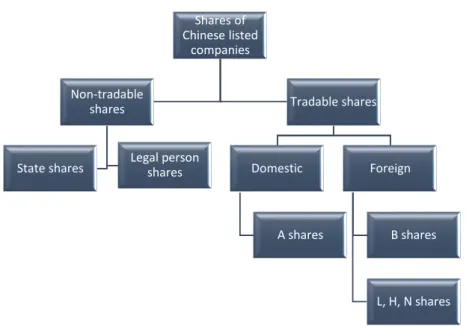
Figure 1.1: Main classes of shares in China Figure 1.2: Composition of corporate financing Figure 1.3: The governance of SOEs
Figure 1.4: Anglo-American model of corporate governance Figure 1.5: Chinese model of corporate governance
Figure 2.1: Beneficial ownership of UK shares by value from 1998 to 2014 Figure 2.2: Percentage of UK stock market owned by value in 2014
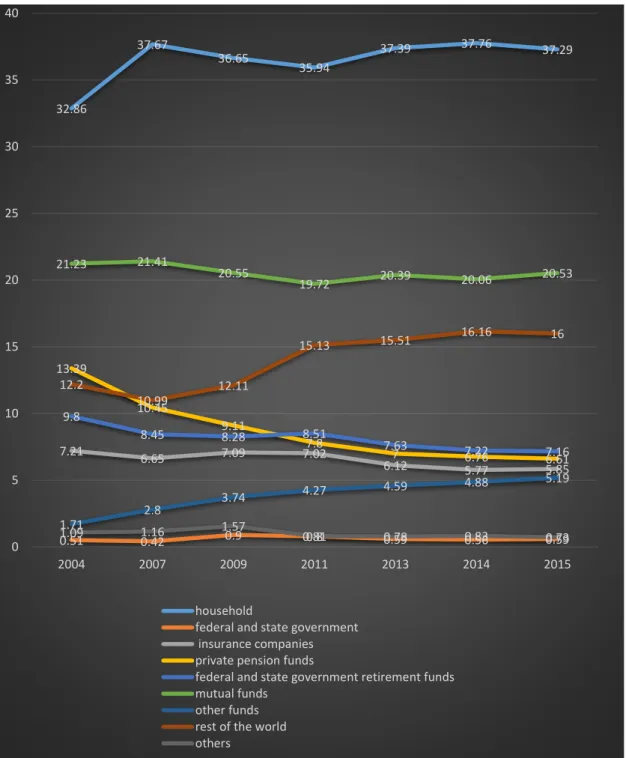
Figure 2.3: Ownership of corporate equities from 2004 to 2015 Figure 2.4: Percentage of US stock market owned by value in 2015
Figure 2.5: Funds managed by insurance and long-term savings providers, by asset class in the UK
Figure 2.6: Sovereign Wealth Fund rankings
Figure 2.7: The number of newly opened institutional account and the related policies, laws and regulations
Figure 2.8: Percentage of tradable A shares owned by value from 2004 to 2014 Figure 2.9: Percentage of tradable A shares owned by value in 2014
Figure 3.1: Empirical research of shareholder activism, 1993–2016 Figure 3.2: Percentage of different results in empirical research Figure 3.3: United Kingdom regulatory structure
Figure 3.4: Regulatory framework in China
Figure 4.1: Internal factors that influence institutional shareholder activism Figure 4.2: Factors that influence institutional shareholder activism
Figure 4.3: Relationship between factors in Figure 4.1 and activism level and different routines taken by institutional shareholders at different activism levels
Figure 5.1: Internal factors that influence institutional shareholder activism Figure 5.2: Cases of institutional shareholder activism, 1994-2014
Figure 5.3: Types of institutional shareholders engaged in activism in Figure 5.2 Figure 5.4: Results of institutional shareholder activism in Figure 5.2 cases Figure 5.5: Types of activism by institutional shareholders in Figure 5.2 cases
Figure 5.6: Number of institutional shareholder activism cases each year, 1994–2014 Figure 5.7 State-owned shares in Gree Electrical Appliance Inc. of Zhuhai, 2012
vi
Figure 5.8: Main shareholders and their portion of shares on the day of the shareholder meeting
Figure 5.9: Votes gained by each director candidate
Figure 5.10: Internal factors that influence institutional shareholder activism Figure 5.11: Relationship between factors in Figure 5.1 and activism level and
different routines taken by institutional shareholders on different activism levels
vii
List of Legislations
United Kingdom and United States
Status
Companies Act 1948 Pension Act 1995
Delaware General Corporations Law The Securities Act of 1933
Glass–Steagall Act in 1933
The Securities and Exchange Act 1934 Securities and Exchange Act 1934 Investment Company Act 1940
Employee Retirement Income Security Act 1974 Financial Service and Markets Act 2000
Companies Act 2006
Self-Regulatory Rules
The UK Corporate Governance Code (2010) The Stewardship Code (2010)
The UK Corporate Governance Code (2012) The UK Corporate Governance Code (2014) The UK Corporate Governance Code (2016)
China
Constitution of the Chinese Communist Party (1969)
Decision of the Central Committee of the CPC on Reform of the Economic Structure (1978)
Decision of the Central Committee of the Communist Party of China on Reform of the Economic Structure (1984)
viii
The Company Law of the People's Republic of China (1993)
Decision on Issues Concerning the Establishment of a Socialist Market Economic Structure (1993)
Notice of the Central Committee of the CPC on further Strengthening and Improving the Party Building Work in SOEs (1997)
Joint Opinions on Strengthening and Improving Party Building Work in Central SOEs (2004)
Interim Measures for the Administration of Stock Investments of Insurance Institutional Investors (2004)
Measures on the Administration of Split Share Structure Reform of Listed Companies (2005)
Guidance Notes on the Split Share Structure Reform of Listed Companies (2005)
Notice of the China Securities Regulatory Commission1 on Piloting the Share-trading Reform of Listed Companies (2005)
Law on State-owned Assets in Enterprises (2008)
Measures for the Administration of Securities Investment within the Borders of China by Qualified Foreign Institutional Investors (2012)
The Securities Investment Fund Law of People's Republic of China (2012 Revision)
Decision on Major Issues Concerning Comprehensively Deepening Reforms (2013) Notice of the People’s Bank of China on Relevant Matters Concerning Investment in the Interbank Bond Market by Qualified Foreign Institutional Investors (2013)
The Securities Law of the People's Republic of China (2013 Revision)
The Company Law of the People's Republic of China (2013 Revision)
Notice of the Central Committee of the CPC on Further Strengthening and Improving the Party Building Work in SOEs (2013)
Regulation on the National Social Security Fund (2014)
Interim Measures for the Administration of Utilization of Insurance Funds (2014)
1 Hereinafter ‘CSRC’.
ix
Notice of the Shanghai Stock Exchange on Matters Concerning Strengthening the Management of the Securities Trading Activities of Qualified Foreign Institutional Investors and RMB Qualified Foreign Institutional Investors (2014)
Notice of the Shenzhen Stock Exchange on Issuing the Detailed Implementation Rules of the Shenzhen Stock Exchange for the Securities Trading of Qualified Foreign Institutional Investors and RMB Qualified Foreign Institutional Investors (2014)
The Law on Legislation of the People's Republic of China (2015 Revision)
Measures for the Administration of Investment in Basic Pension Insurance Funds (2015)
Guidance Opinions on the Deepening of Reform of State-owned Enterprise (2015)
Interim Measures on the Administration of the Investment of National Social Security Fund (2016)
x
List of Cases
UK and US
Bligh v Brent (1837) 2 Y & C Ex 268
Cook v Deeks [1916] UKPC 10
Foss v Harbottle (1843) 67 ER 189
Hutton v West Cork Railway Co (1883) 23 Ch D 654
In re Walt Disney Derivative Legislation (Chancery Court) (2003) 825 A 2d 275
Kidsco Inc v Dinsmore 674 A.2D 483 (Del. Ch. 1995)
O’Neil v Phillips [1999] 1 WLR 1092
Ooregum Gold Mining Co of India v Roper [1892] AC 125
Sinclair Oil Corp. v. Levien 280 A.2d 717
Salomon v A Salomon & Co Ltd [1896] UKHL 1
Zahn v. Transamerica Corp. 162 F.2d 36 (3d Cir. 1947)
China
Li Xiaozhong and 28 other shareholders v Xiao Wuyong & Zhang Dingzhong re: Nanchuan Municipal Hardware Infrastructure Electric Chemical Industry Company Limited, Chongqing Nanchuan City Basic-Level People’s Court (2006)
Dong Fengchang v Fang Yishu re: Shanghai Zhongjian Enterprise Company Limited, Shanghai Hongkou District Basic-level People’s Court, no. 2 Civil Division (2008)
Zhu Yongjun and 20 other shareholder plaintiffs v Liu Huanren, Zhu Yongjun and Ma Zhonghua re: Shizuishan Municipal HengJ!Uan Metals Collection Company Limited, Shizuishan Municipal Wukou District Basic-level People’s Court (2008),
xi
Acknowledgement
12 February 2014, the telephone rang at 11:21. I had been waiting for this call anxiously for a few days. This phone interview was from Professor Iain G. MacNeil, who has been my supervisor for the past three years. I could say ‘thank you’ to you a million times over and it still would not be enough to show how appreciative I am of you. First, I should like to express my profound gratitude to you for your continual support for, and patient guidance through my PhD studies. You never gave up on me even when I was in the deepest darkness. Words can neither qualify nor quantify how much your support meant to me. Second, thank you for also being a role model and an inspiration. You not only offered professional guidance along the way, but also nurtured my soul by influencing me imperceptibly with your personality traits. You are the best supervisor I could ever have wished for.
I should also like to express my deepest appreciation to Dr Lilian Moncrieff. As my second supervisor, your valuable suggestions and comments contributed a great deal to the completion of this thesis. In addition, thank you so much for your kindness and encouragement. You shared your wisdom with me when I was confused; you comforted me and cheered me up when I was experiencing bad times. I am so lucky to have had you as my supervisor.
My sincere appreciation is extended to Professor Hse-Yu (Iris) Chiu from University College London (UCL), without whom I would never have had the chance to conduct this PhD research. The interesting and high-quality company law course offered by you established a foundation for my further study. Thank you for being so kind as to write the recommendation letter for me and for supervising my LLM dissertation. You were a blessing to me.
Any academic creation should not be isolated from other scholars’ intellectual and critical discussions. I am thankful for all the insightful, comments and advice on my research. I would like to show my special gratitude to Dr David Cabrelli, Dr Konstantinos Sergakis and Professor Beate Sjåfjell for sharing their pearls of wisdom with me.
xii
Special thanks go to the China Scholarship Council for its financial support throughout my doctorate studies in Glasgow. I am grateful to the staff of the Law School, especially Susan, who are always kind and helpful. The friendly environment and efficient work they provide are conducive to successful research.
I am using this opportunity to express my gratitude to my friends who supported me throughout this course. Dr Chi Zhang, thank you for being such a fantastic friend and mentor. You inspired me in all possible aspects and always stood by me through the good and bad times. I honestly cannot thank you enough for your kindness, generosity, and support. The days we spent in office 515 were definitely my most enjoyable memories of Glasgow. I would also like to thank Dr Chong Yun from Tsinghua University, Mrs Yaping Dou from North China Electric Power University, and all my dear friends in China and UK. I am truly blessed to have all of you in my life.
Finally, this work is dedicated to my parents as a token of my deepest gratitude for your continuous love, support and understanding.
The storm of the last night has crowned this morning with golden peace. Thanks for all the pains and darkness. ‘Let this be my last word, that I trust thy love.’
xiii
Author’s Declaration
I declare that, except where explicit reference is made to the contribution of others, this dissertation is the result of my own work and has not been submitted for any other degree at the University of Glasgow or any other institution.
Signature:
Printed name: Yaqi Ding
xiv
Abbreviations
ABI Association of British Insurers
AFL-CIO The American Federation of Labor and Congress of Industrial Organization
ALI American Law Institute
AITC Association of Investment Trust Companies CA 2006 Companies Act 2006 (UK)
CalPERS California Public Employees’ Retirement System CBRC China Banking Regulatory Commission
CCGINK China Corporate Governance Index
CEO Chief Executive Officer
CII Council of Institutional Investors CIS Collective investment scheme
CIRC China Insurance Regulatory Commission
CL 2005 The Company Law of the People's Republic of China
CPC Communist Party of China
CPF Corporate pension funds
CREF College Retirement Equities Fund
CSDC China Securities Depository and Clearing Corporation Limited
CSRC Chinese Securities Regulatory Commission
DB Defined benefits
DC Defined contributions
DTR Disclosure Rules and Transparency Rules
ERISA Employee Retirement Income Security Act of 1974 FCA Financial Conduct Authority
FPC Financial Policy Committee
FSMA 2000 Financial Services and Markets Act 2000
GDP Gross domestic product
ICVCs Investment companies with variable capital IMA Investment Management Association
IMMEA Interim Measure for the Management of Enterprise Annuities Fund
ISC Institutional Shareholders’ Committee ISS Institutional Shareholder Services IVIS Institutional Voting Information Service
JSC Joint stock companies
LLC limited liability company
LLSV Rafael La Porta, Florencio López-de-Silanes, Andrei Shleifer and Robert Vishny
LSE London Stock Exchange
MoLSS Ministry of Labour and Social Security
MOF Ministry of Finance
NACD National Association of Corporate Directors NAPF National Association of Pension Funds
xv
NASDAQ National Association of Securities Dealers Automated Quotations
NPC National People’s Congress
NSSF National Social Security Fund
NYSE New York Stock Exchange
NYSTRS New York State Teachers’ Retirement System
OECD Organization for Economic Co-operation and Development OEICs open-ended investment companies
OUP Oxford University Press
PBOC People‘s Bank of China
PIRC Pensions and Investment Research Consultants Ltd PLSA Pensions and Lifetime Saving Association
PRC The People‘s Republic of China
QFII Qualified Foreign Institutional Investor
RMB Renminbi
SASAC State-owned Assets Supervision and Administration Commission
SIF Securities Investment Funds
SL 2005 Securities Law of the People's Republic of China
SOE State Owned Enterprises
SSE Shanghai Stock Exchange
SWF Sovereign Wealth Funds
SZSE Shenzhen Stock Exchange
TIAA Teachers Insurance and Annuity Association
TUC The Trade Union Congress
UITs Unit investment trusts
UK United Kingdom
US United States of America
1
Introduction
With the development of modern enterprises, and the separation between ownership and control, founders who provide ‘start-up’ capital for companies no longer completely control these companies. The result is that professionally trained managers are hired with the expectation that their specialised human capital could maximise profits. Given the fact that contracts between shareholders and managers cannot specify every possible aspect, some degree of control rights needs to be allocated to managers to allow them to make decisions when contingencies that were not foreseen in contracts occur at some point in the future. According to Jensen and Meckling, when one or more persons (the principal(s)) entrust other persons (the agent(s)) to act on their behalf with certain decision-making power passed on to the agent, an agency relationship is generated.1 Therefore, a principal–agent relationship is formed between shareholders and managers. However, it has to be acknowledged that everyone has a self-interested utility-maximising motivation and managers are no exception in this regard. With considerable control rights and the advantage of information at their disposal, managers are likely to benefit themselves at the expense of shareholders’ profits. Therefore, agency problems are generated in this process.
Apart from the agency problems between shareholders and managers, the agency relationship between majority shareholders and minority shareholders could generate problems as well. To alleviate the agency problems, on the one hand, the distribution of powers among different participants in the business entities is sophisticatedly designed; on the other hand, those who are outsiders of the business entities, such as regulators, governments, trade unions, financial institutions and the market itself, exercise an external monitoring function. This system of checks and balances is corporate governance.2 Although an attempt has been made to build a sophisticated mechanism to ensure that corporates operate efficiently with minimum agency costs, growing corporate scandals, the collapse of world-renowned companies and the recent worldwide financial crisis serve as evidence of some kind of failure in corporate governance mechanisms.
1 Michael C Jensen and William H Meckling, ‘Theory of the Firm: Managerial Behaviour, Agency Costs and Ownership Structure’ (1976) 3 Journal of Financial Economics 305.
2
‘Like poets and revolutionaries, corporate law scholars and policymakers dream. If only we could find the silver bullet, the wonder drug, we could solve the manager– shareholder agency cost problem that is the focus of much of corporate law.’3
Institutional shareholders, with their large portion of equity holdings and ability to influence their investee companies, are regarded as the ‘wonder drug’ of corporate governance problems or, at least, a drug worth trying. However, the question of the role that institutional shareholders should play in corporate governance is a complex one and the call for increased institutional shareholder activism is not the subject of consensus.4 The excessive risk taking and short-term actions bolstered the criticism against institutional shareholder activism. While there is no consistent consensus in the scholarly literature on the extent to which institutional shareholders should engage with their investee companies, most scholars agree that a certain degree of institutional shareholder activism is needed to improve corporate governance. During the past decades institutional investors have increasingly engaged in corporate governance activities in the United Kingdom5 and United States of America6. In China, although institutional shareholders are still in their infancy, news about Chinese institutional shareholder activism is drawing public attention. Institutional shareholder activism appears to have come of age.
China is standing at the crossroads of state-owned enterprise7 reform. In August 2015, Guidance Opinions on the Deepening of Reform of State-owned Enterprises8 were issued by the Central Committee and the State Council. The Guidance Opinions provide 30 specific guidelines for mixed ownership reform of China’s SOEs. In the period 2015–2017, various guidelines and opinions were issued to map out SOE mixed ownership reform. The mixed ownership reform is aimed at diversifying the ownership structure of SOEs in order to boost the efficiency in SOEs.9 Given the fact that SOEs
3 Edward B Rock, ‘Institutional Investors in Corporate Governance’ in Oxford Handbook on Corporate Law and Governance (2015) University of Pennsylvania, Institute for Law & Economics Research Paper No. 14–37.
4 See Chapter 3. 5 Hereinafter ‘UK’. 6 Hereinafter ‘US’. 7 Hereinafter ‘SOE’.
8 Hereinafter ‘the Guidance Opinion’. ‘Guidance Opinions on the Deepening of Reform of State-owned Enterprises’ [ 中 共 中 央 、 国 务 院 关 于 深 化 国 有 企 业 改 革 的 指 导 意 见 ] 2015 <http://www.gov.cn/zhengce/2015-09/13/content_2930440.htm> accessed 8 November 2016.
3
are large in size, small companies and individuals are too weak to participate in this reform process. Hence, institutional shareholders and some powerful companies are expected to play a major role in the reform. A senior officer responsible for SOE reform remarked that institutional investors – like national social security funds and insurance funds – are top priorities when looking for private investors in the mixed ownership reform.10 Institutional shareholders are given the expectation that they could engage in corporate governance actively as their UK and US counterparts so as to alleviate severe agency problems within SOEs. This boils down to a foundational question: do Chinese institutional investors have the capacity to perform the role now expected of them?
In order to answer this core question, this thesis adopts a comparative scholarship between the UK, US and China. Given the fact that institutional shareholder activism operates within a complex framework, the comparative study focuses on (1) the different agency problems that institutional shareholders encounter; (2) reasons for the development of institutional investors; (3) the influence from the wider context, such as political, ideological and legal factors; (4) typologies of institutional investors and different forms of activism; (5) and the differences in the effects of institutional shareholder activism and reasons behind such differences. There are two reasons for choosing the UK and US as objectives when doing the comparison. First, the UK and US enjoy the reputation of being leaders in corporate governance,11 and they keep their advantages in the area of research on institutional shareholder activism. An in-depth comparison is beneficial in that it provides either experiences or lessons to inspire their Chinese counterparts. Second, although there are huge differences between the UK, US and China in terms of ideology, state power, economic structure and share ownership structure, the development of company law and corporate governance in China is itself a continual borrowing process from the UK and US, and there are many resemblances between these three countries. There is, therefore, comparability between these countries and legal transplantation is possible.
10 Yitian Zhu, ‘Pension funds and Chinese investors are top priorities in SOE reform’ [国企混改优先考
虑 社 保 和 中 国 投 资 者 ] (Wall Street News, 29 December 2014)
<https://wallstreetcn.com/articles/212537> accessed 8 November 2016.
11 The UK and US scored the top among 49 countries in a survey conducted by the World Bank. World Economic Forum 2003, cited in Qiao Liu, ‘Corporate Governance in China: Current Practices, Economic Effects and Institutional Determinants’ (2006) 52 CESifo Economic Studies 432.
4
Considering that the contractual perspective of the firm and principal-agent relationship between members not only provide a useful tool to get a better understanding of the internal structure of organizations, but also permeate and drive the whole corporate governance discourse, the thesis begins with the contractual theory of the firm and uses agency theory as the analytical basis for this research. This is followed by corporate governance mechanisms that are aimed at relieving agency problems. Chapter 2 probes the reasons for the development and growth of institutional investors, and data are presented to characterize the size of the different institutional investors in the UK, US and China. The third chapter provides a detailed theoretical analysis of institutional shareholder activism. In essence, three question are answered in this chapter: (1) is shareholder activism rational? (2) what are the reasons for institutional shareholder passivity? and (3) why is there currently a growth in institutional shareholder activism. Chapter 4 deals with institutional shareholder activism in the UK and US in an empirical way. It first reviews the factors that influence institutional shareholder activism, then the typologies of activism, followed by how different institutional shareholders deploy these types of activism. This chapter ends with an analysis of how the factors mentioned at the beginning influence the engagement activities of UK and US institutional shareholders. Chapter 5 looks at institutional shareholder activism in China in an empirical way. The research was conducted under a similar structure to that used in Chapter 4. Chapter 6 concludes the thesis. It contains a summary of the findings in Chapters 4 and 5 on the different influences of institutional shareholder activism in corporate governance in these three countries, and then cites the reasons that led to these differences. Finally, the chapter explores the possibility of developing Chinese institutional shareholder activism and the possible way forward.
This thesis offers three original approaches: first, it adopts a historical perspective in the first two chapters, and takes stock of the evolution of share ownership structure and the development of institutional shareholders. This retrospective assists with an understanding of the wider context in which, and push factors that resulted in, the emergence and development of institutional shareholder activism. Second, the political control of SOEs by the State is a force that cannot be ignored and this thesis brings this political influence into discussion. The theme of political legitimacy management by
5
the Chinese Communist Party12 runs throughout the thesis and this is the first time that institutional shareholder activism under the influence of the statehas been analysed. In Chinese context, the political reform and governmental influence play an vital role in influencing every aspects of corporate governance. Only by embedding institutional shareholders into this broader political territory, can we get a clear picture about its nature and function. Third, this thesis situates institutional shareholder activism within a more complete framework and treats this form of activism as a kind of behaviour adopted by various types of subjects that are different in aims, objectives, motives and preferences. The contribution of this thesis lies in exploring that whether Chinese institutional investor activism could influence corporate governance as in the same way its UK and US counterparts and whether the possibility of more institutional shareholder activism in China exists as the country rides on the current wave of economic reform by taking both legal and political elements into account.
12 Hereinafter ‘CPC’.
1
Chapter 1: Agency Problems and Corporate Governance Mechanism
The purpose of this chapter is to provide an overview of the background information that is necessary for the later discussion on institutional shareholder activism in this research. Corporate law and governance can only fulfil their role appropriately if the problems that need to be addressed are known. A contractual perspective of the firm and principal–agent relationship between members provide a useful tool to get a better understanding of the internal structure of organizations. Therefore, this chapter starts with an examination of the contractual theory and agency problems. Sections 1.2 and 1.3 deal with the UK, US and China respectively. Each section begins with a description of the evolution of share ownership structure, followed by the kind of agency problems that are generated in certain share ownership structures. These sections then examine the corporate governance frameworks that have been designed to relieve agency problems. Section 1.4 concludes with a brief summary.
1.1 Contractual perspective of the firm and principal–agent relationship
Before Coase published The Nature of the Firm in 1937,1 the conventional theory of the firm, which is often referred to as the ‘neoclassical theory of the firm’, was the dominant theory in economics.2 Put briefly, the reasons for the existence of the firm, in the eyes of economists, were that the firm ‘was a means of realizing economies of scale in the production of goods and services’.3 Firms could collect different inputs, combine
their effectively by means of their specialization and output it as final products.4 As a response to the radical change in the economic and political landscapes5 in the late 1970s, neoliberalism came onto the stage and Coase’s theory became part of the standard microeconomic literature as it focused on the perspective that was ignored by
1 Ronald H Coase, ‘The Nature of the Firm’ (1937) 4 Economica 386.
2 Thomas S Ulen, ‘The Coasean Firm in Law and Economics’ (1992) 18 Journal of Corporate Law 301. 3 Ibid.
4 Brian R Cheffins, Company Law: Theory, Structure, and Operation (Clarendon Press 1997) 4. 5 Such as the stagflation in this period and competition with new-born economies such as Japan and West Germany. See details in David Harvey, A Brief History of Neoliberalism (2005 Oxford University Press).
2
neoclassical theory, that is, what precisely it is that went on in this ‘black box’.6 Coase’s central thesis is that the emergence of a firm to supersede a market is because the difference in costs, that is, the costs of operating institutions are lower than the operation of a market.7 Transactions will be undertaken within the firm when the cost of an internal transaction is lower than the external market as firms and markets are alternative forms of contracting, with the minimization of transaction costs determining the choice of the two. However, the utilization of ‘some authority to direct the resource’8 is not free of charge.9 The boundaries of the firm would be settled when the
costs of using the organizational structure are equal to the expenses of organizing such a deal in the market.10
Coase’s work paved the way for the further development of contractual theory, including transaction cost economics and principal–agent theory, which are two main strands of scholarship, with the former focusing on the relationship between the firm and the market and the latter focusing on the internal organizational structure of the firm.11 Alchian and Demsetz developed the theory that the emergence of the firm was a response to the benefits of team production.12 Williamson made a deep and far-reaching analysis of transaction cost economics by pointing out that post-contractual opportunism could result in the problem of shirking and that bringing a transaction from the market into the firm could mitigate this opportunistic behaviour.13 Principal–agency theory recognizes conflicts of interest between different economic actors. As a result, careful monitoring within a production team is necessary.14 Jensen and Meckling first formulated the conception that the corporation was ‘a nexus of contracts’ and further
6 Ronald H Coase, ‘The Institutional Structure of Production’ (1992) 82 The American Economic Review 713.
7 Steven NS Cheung, ‘The Contractual Nature of the Firm’ (1983) 26 The Journal of Law and Economics 12.
8 Coase (n 1) 391.
9 The information asymmetry and administration of employees in the hierarchical structure in the firm would also be costly.
10 Coase (n 1) 395.
11 Oliver Hart, ‘An Economist’s Perspective on the Theory of the Firm.’ (1989) 89 Columbia Law Review 1762.
12 Armen A Alchian and Harold Demsetz. ‘Production, Information Costs, and Economic Organization’ (1972) 62 The American Economic Review 777.
13 Oliver E Williamson, ‘Transaction Cost Economics: The Comparative Contracting Perspective’ (1987) 8 Journal of Economic Behaviour & Organization 627. See also Henry N Butler, ‘The Contractual Theory of the Corporation’ (1989) 11 George Mason University Law Review 99, 100.
3
investigated the agency relationship by giving it an exact definition15 and demonstrated other related issues.16 As mentioned above, the agency theory focuses on the internal organizational structure of the firm. It is therefore a great lens with which to look inside the firm to see how the corporate governance mechanisms work. Before discussing agency problems and corporate governance frameworks, it is necessary to clarify this theoretical foundation:
Agency theory is a useful tool for looking at corporations in the free market economy, such as the UK and US, as contractual theory requires a free and competitive market to survive. It is therefore not surprising that the rationality behind using agency theory in the Chinese context might be challenged as the extent of market orientation of the Chinese economy is still debatable. There are two reasons for explaining its appropriateness. First, almost all the theories are imperfect and the contractual theory is, to some extent, unsatisfactory. Although the contractual theory is meant to point out the voluntary, market-orientated nature of the firm, it has gone too far to neglect that there is no distinct line between the public and private elements in the lives of most persons and institutions, which means that the world is neither a complex of contracts, nor is it a delegated sovereign authority.17 As Bratton pointed out: ‘freedom of contract is freedom to ask the sovereign to confer power constraining your freedom on another party. At the same time, contract cannot exist where sovereign control is complete, it requires some minimum of individual autonomy.’18 Therefore, it is hard to make a
thorough distinction between the market and the political environment, since they are intermixed to some extent. Eisenberg also stated that the contractual theory only caught half of the truth and the firm was not only a hierarchical organization, but also a ‘bureaucratic hierarchical organization’.19 Therefore, Bratton claimed that the complex
coexistence (i.e., contracts, hierarchies and the state) should be accepted as a starting
15 In Jensen and Meckling’s opinion, an agency relationship is ‘a contract under which one or more persons (the principal(s)) engage another person (the agent) to perform some service on their behalf which involves delegating some decision making authority to the agent’. See Michael C Jensen and William H Meckling. ‘Theory of the Firm: Managerial Behaviour, Agency Costs and Ownership Structure.’ (1976) 3 Journal of Financial Economics 305.
16 Ibid 306.
17 William W Bratton, ‘Nexus of Contracts Corporation: A Critical Appraisal’ (1988) 74 Cornell Law Review 407.
18 Ibid.
19 Melvin A Eisenberg, ‘The Conception that the Corporation is a Nexus of Contracts, and the Dual Nature of the Firm.’ (1998) 24 The Journal of Corporate Law 819.
4
point of the theory. Secondly, as will be discussed later in this chapter,20 since the first company law promulgated in 1993, liberalistic and market-oriented reform has never stopped in China, and the reform of SOEs and the promulgation of 2006 companies law was under the direction of ‘free-market and contractual theory’.21 Therefore, a market
with state intervention should not be viewed as a market that rejects free contracting to prevent the application of contractual theory. The theory serves as a useful tool to examine the elements of corporate relationship closer. Therefore, it may seem inappropriate at first glance to apply contractual theory to the Chinese context. However, this theory was widely applied and works well when considering the internal relationship within companies in China.
Having clarified this theoretical foundation, this chapter moves on to the principal– agent relationship. When one or more persons (the principal(s)) entrust other persons (the agent(s) to act on their behalf with certain decision-making power passed on to the agent, an agency relationship is generated.22 There are three kinds of agency relationships that could exist in business firms: (1) a vertical agency relationship between shareholders and managers; (2) a horizontal agency relationship between majority shareholders and minority shareholders; and an (3) agency relationship between a firm itself and other contractual parties.23 As the third kind of agency relationship could be regulated by other laws, such as contract law and tort law, it is, therefore, beyond the present discussion in the area of company law. However, the interest may not always be aligned between principals and agents, therefore, agency cost arises between the shareholders (principals) and the managers (agents) in three aspects: ‘the monitoring expenditures by the principal, the bonding expenditures by the agent and the residual loss.’24 To lessen the agency costs, controlling and monitoring
mechanisms are put in place within the organization to align the interests of various parties. This checks-and-balances system is corporate governance.25 The corporate
20 See section 1.3.1.2.
21 Weiying Zhang, Corporate Theory and the Reform of Chinese Companies[企业理论与中国企业改 革] (Peking University Press 1999) 25.
22 Jensen and Meckling (n 15) 309.
23 Reinier Kraakman, The Anatomy of Corporate Law: A Comparative and Functional Approach (3rd edn Oxford University Press 2017) 36.
24 Jensen and Meckling (n 15) 312.
25 David Larcker and Brian Tayan, Corporate Governance Matters: A Closer Look at Organizational Choices and their Consequences (Pearson Education 2015). However, there is no accepted definition of corporate governance and it has been said to be an ambiguous concept. One of the classic and often cited
5
world today can be divided into the rival system of concentrated and dispersed ownership, under which the balance of power may differ: shareholders may be more powerful in one jurisdiction, whereas shareholders are in an inferior position in other jurisdictions. Therefore, the agency problems may vary in jurisdictions with different ownership structures and the corporate governance mechanisms aimed at alleviating agency costs may be different. According to Cheffin’s classification, corporate governance systems in particular countries divide into two categories: ‘outsider/arm’s-length’ and ‘insider/control-oriented’.26 The ‘outsider’ typology is a kind of share
ownership where the shares are not concentrated in one or more blockholders who enjoy decisive influence, it is the individual investors and the institutional investors that own the majority of the shares.27 The term ‘arm’s length’ represents the situation where investors are less likely to intervene in the operation of a business and keep a rational distance from the management team.28 The ‘insider’ typology is the kind of situation where share ownership is concentrated in the hands of a few people. The term ‘control-oriented’ signifies that ‘core’ shareholders are capable of excising considerable influence and they hold the control rights tightly in their hands. Although this dichotomy could mislead to some extent,29 it is basically accurate when only
definitions of corporate governance is taken from the Cadbury Report where it is said that ‘corporate governance is the system by which companies are directed and controlled with boards of directors responsible for the governance of the company while the role of the shareholders in governance is to appoint the directors and the auditors and to satisfy themselves that an appropriate structure is in place.’ The Organisation for Economic Co-operation and Development (OECD) provided a narrower explanation saying that corporate governance is ‘a system by which business corporations are directed and controlled. The corporate governance structure specifies the distribution of rights and responsibilities among different participants in the corporation … By doing this, it also provides the structure through which company objectives are set, and the means of attaining those objectives and monitoring performance … it also provides the structure through which the objectives are set, and the means of attaining objectives, and monitoring performance, are determined.’
26 Brian R Cheffins, Corporate Ownership and Control: British Business Transformed (Oxford Scholarship Online 2010) 5 <http://ukcatalogue.oup.com/product/9780199236978.do>, accessed 25 January 2017.
27 John Armour, Brian R Cheffins and David A Skeel Jr, ‘Corporate Ownership Structure and the Evolution of Bankruptcy Law: Lessons from the United Kingdom’ (2002) 1 Faculty Scholarship <http://scholarship.law.upenn.edu/faculty_scholarship/712\nThis> accessed 3 September 2017. 28 Ibid.
29 According to Coffee, first, the assumption that something about the common heritage of the ‘Anglo-Saxon’ countries – their common law, politics, cultural heritage, or whatever – explains their unique convergence on a ‘dispersed ownership’ system of corporate governance simply does not hold up under closer analysis. Australia and Canada have origins at least as ‘Anglo-Saxon’ as the United States, but in these countries concentrated ownership is more common than dispersed ownership. Second, an even more fundamental problem with attempts to attribute dispersed ownership to a particular set of legal or political circumstances is that companies with dispersed ownership are present in virtually all developed economies. See details in John C Coffee, ‘Dispersed Ownership: The Theories, the Evidence, and the Enduring Tension Between 'Lumpers' and 'Splitters'’ (2010) Columbia Law and Economics Working
6
considering the UK, US and China. The UK and US belong to the former camp which is characterised by an outsider/arm’s-length system of corporate governance, while insider/control-oriented corporate governance predominates in China. In the following section the different agency problems and corporate governance mechanisms in these two camps respectively are analysed.
1.2 The United Kingdom and the United States
1.2.1 Evolution of ownership structure and vertical agency problems
Since Berle and Means published The Modern Corporation and Private Property, it has been widely accepted that modern large corporations, wherever located, will follow American norms under which share ownership would be widely dispersed.30 However, the empirical work carried out during the 1990s changed the perceptions markedly and revealed that a separation of ownership and control was the exception worldwide rather than the rule.31 Although dispersed ownership is not the norm, it is received wisdom that the UK and US are the spokespersons of dispersed ownership. However, most business enterprises start their life with high insider ownership.32 The control power of the firm is in the hand of the owners – one or more founders who provide the ‘start-up’ capital that is needed to form an enterprise. The divorce of corporate ownership and control can only occur when the blockholders are prepared to unwind or dilute their stakes and there are sizeable amounts of capital available for the purchase of shares. What follows is a brief historical description of the trajectory of the evolution of UK and US ownership structures.
Paper No. 363 < https://papers.ssrn.com/sol3/papers.cfm?abstract_id=1532922>, accessed 4 September 2017.
30 Adolf A Berle and Gardiner C Means. The Modern Corporation and Private Property (Macmillan 1932).
31 See, for example, Marco Becht and Colin Mayer, ‘Introduction’ in Fabrizio Barca and Marco Becht (eds), The Control of Corporate Europe (Oxford University Press 2001) 1–2, 20; Stijin Claessens, Simon Djankov and Larry HP Lang, ‘The Separation of Ownership and Control in East Asian Corporations’ (2000) Journal of Financial Economics 58, 81.
32 Jean Helwege, Christo Pirinsky and René Stulz, ‘Why Do Firms Become Widely Held? An Analysis of the Dynamics of Corporate Ownership’ (2007) 62 Journal of Finance 995.
7
In UK, the word ‘company’ was first used when merchant adventurers were granted a Royal Charter for the purposes of trading overseas33 and business corporations emerged as a production of the Royal Charter in the seventeenth century. At the end of the seventeenth century, companies could be established without reference to any form of explicit state endorsement or involvement.34 Hence, ‘The Bubble Act’ came into force
in 1720 to underscore the problematic legal status of such enterprises, followed by the bursting of the South Sea Bubble. The Industrial Revolution between 1760 and 1830 provided conditions that were propitious for the widely held company to emerge.35 By
the end of the eighteenth century, professional brokers and dealers were well developed and this led to the formation of an effective market for the trading of securities, the London Stock Exchange. By the mid-nineteenth century, a sizeable number of enterprises, operating in fields such as utilities, transport, banking, insurance and mining, had publicly traded shares and the largest railways were seen to be pioneers of the modern-style divorce of ownership and control36 as they had a sizeable shareholder base and lacked powerful blockholders. However, at this stage, while a certain amount of separation between ownership and control had emerged, control was still in the hands of blockholders.37 The latenineteenth and early twentieth centuries witnessed a rapid growth in the number of companies that had made the move to the stock market, not only on the London Stock Exchange, but also on provincial stock exchanges.38 Besides, tax law provided a fresh incentive to the diffusion of share ownership. Considerations of the next generation, the irresistible generous exit offers and the capital-raising for mergers were constant incentives to unwind the controlling status.39 The transformation
33 Paul L Davies, Gower & Davies: The Principles of Modern Company Law (Sweet & Maxwell, 9th edn, 2012).
34 Cheffins (n 26) 134.
35 On the period covered, see Joel Mokyr, ‘Editor’s Introduction: The New Economic History and the Industrial Revolution’ in Joel Mokyr (ed), The British Industrial Revolution: An Economic Perspective, (2nd edn Westview press 1999) 1, 3.
36 François Crouzet, The Victorian Economy (Routledge1982) 293; Geoffrey Channon, ‘A Nineteenth Century Investment Decision: The Midland Railway’s London Extension’, (1972) 3 Economic History Review 449; Terry Gourvish, Railways 1830–70: A Business History (Cambridge University Press 2011) 83.
37 According to Cheffins in Corporate Ownership and Control, market forces may be blamed for the deterrence in the growth of modern corporate enterprises. Factories usually operated on a small scale with no requirements for large capital and a sense of individualism prevailed at that time, and blockholders had no incentives. Therefore, they declined to exit.
38 Edward Victor Morgan, The Stock Exchange: Its History and Functions (Elek Books1969) 133. There are several reasons behind such growth. First is the decline of the factors that hampered diversified ownership structure; second is the rise of institutional shareholders. This point will be analysed in more detail at Chapter 2.
8
to diffused ownership structure still continued. From the late nineteenth and early twentieth century, the pace was accelerated to a fully-fledged outsider/arm‘s-length system of ownership and control. Even though Britain’s economy experienced a decline in the middle of the twentieth century, competitive pressure, tax rules, company law reform and revisions of stock exchange listing rules paved the way for UK companies to become dispersed ownership structures. First, profits declined in the middle of the twentieth century and legal reforms deterred firms from creating anti-competitive alliances to seek refuge, which tempted blockholders to exit. Besides, merger activity and public offerings of shares were associated with rising stock prices, making the offer to blockholders to exit too good to refuse. Second, company law made its contribution to the separation of ownership and control at this stage.40 Third, even though company law is a crucial determinant of ownership structure, it arrived too late to act as a catalyst for the divorce of ownership and control. Instead, Stock Exchange listing rules filled the gap. The London Stock Exchange and provincial stock exchanges each imposed requirements on companies seeking to list shares for trading, with the relevant regulations being unified after the exchanges federated in 1965.41 Fourth, tax played an important role in forcing individual investors to quit. Given the fact that high rates of tax were imposed on dividends, those private investors with large incomes therefore turned to forms of savings that received more favourable tax treatment.42 Besides, the development of institutional shareholders and the establishment of some institutional investment organisations during this stage, such as the Institutional Shareholders Committee43 in 1973 and the Association of British Insurers44 in 1985, also contributed to the diversification of shareholder ownership in the UK. By 1990, the separation of ownership and control had become the norm in large business enterprises in the UK.45
40 The Companies Act 1967 further deepened the regulation on disclosure by imposing additional requirements to disclose financial data and compelled blockholders to disclose more confidential information. The Companies Act 1980 bumped the score from ‘3’ to ‘5’ on La Porta et al’s anti-director index and this was attributed to the requirement that companies issuing new shares make the equity available on a pro rata basis to existing shareholders in accordance with the percentage of shares already owned unless shareholders waived this protection. The Companies Act 1980 also criminalized insider dealing for the first time. See details in Rafal La Porta, Florencio Lopez-de-Silanes, Andrei Shleifer and Robert W Vishny ‘Law and Finance’ (1998) 106 Journal of Political Economy <http://faculty.som.yale.edu/zhiwuchen/EmergingMarkets/LawAndFinance.pdf> accessed 27 September 2017.
41 Davies (n 34) 135.
42Marshall E Blume, ‘The Financial Markets’ in Tony Buxton, Paul Chapman, Paul Temple (eds), Britain’s Economic Performance (2nd edn Routledge 1997) 317.
43 Hereinafter ‘ISC’. 44 Hereinafter ‘ABI”. 45 Cheffins (n 26) 19.
9
Although it is in the UK rather than in the US that the corporate form of business was originated and developed, the suitable soil and climate in the US made it a satisfactory place for the growth of corporations.46 Until the nineteenth century, corporations established in the US were limited to public interest enterprises47 and they were mainly in the form of individual proprietorship and partnership. During the nineteenth century, there were isolated examples of companies with widely held shares and well-developed managerial hierarchies.48 Throughout the nineteenth century business enterprises were
mainly held privately and in industrial enterprises, family control was very much the norm.49 The ‘corporate revolution’ occurred between 1880 and 1930.50 During this era, ownership evolved from private to public and the contour of the dispersed ownership structure took shape. By World War I, Chandler claimed that the crucial transformation, with more extensive managerial hierarchies and clear-cut separation of management and ownership, was developed. 51 Stock market capitalism thrived in the US during this stage. The number of companies traded on the stock exchanges increased rapidly, from 682 in 1900 to 2,659 in 1930.52 Some factors could account for this ‘corporate revolution‘. First, the growth of the public securities markets in the nineteenth century was driven by a lack of capital. Owing to the greater geographic distances to be connected in the US, the capital demands on the infrastructure industries, such as railroads, steel, auto and telephone, were exceptionally large. Therefore, these large-scale enterprises needed to draw capital from widely dispersed shareholders and the infusion of foreign capital. However, the administrative tasks were too numerous and complex in these giants, specially trained full-time managers were needed to deal with the day-to-day businesses. The combination of a huge enterprise, special management team, and diversified shareholders shifted the control power from the hand of shareholders to that of managers. This became the quintessential characteristics of
46 Lori Verstegen Ryan and Marguerite Schneider. ‘The Antecedents of Institutional Investor Activism.’ (2002) 27 Academy of Management Review 568.
47 Berle and Means (n 30).
48 Naomi R Lamoreaux, ‘Entrepreneurship, Business Organization, and Economic Concentration’ (2000) 2 The Cambridge Economic History of the United States, 418.
49 Ibid 412–13; Thomas R Navin and Marian V Sears. ‘The Rise of a Market for Industrial Securities, 1887–1902’ (1955) 29 Business History Review 112.
50 Walter Werner, ‘Corporation Law in Search of Its Future’ (1981) 81 Columbia Law Review 1636. 51 Alfred D Chandler Jr, ‘The United States: Seedbed of Managerial Capitalism’ in Alfred D Chandler and Herman Daems (eds) Managerial Hierarchies: Comparative Perspectives on the Rise of the Modern Industrial Enterprise (Harvard University Press 1980) 9; Alfred D Chandler Jr, Scale and Scope: The Dynamics of Industrial Capitalism (Harvard University Press 1990) 52, 84–85.
52 Mary O’Sullivan, ‘The Expansion of the US Stock Market, 1885–1930: Historical Facts and Theoretical Fashions’ (2007) 8 Enterprise & Society 498.
10
constructing enterprises in the twentieth century.53 Second, tax rates exerted great influence on stock ownership. A sharp wartime increase in taxation of the income of the wealthy drove those with high income to switch to tax-favoured investments and equities.54 Although this fever halted abruptly in 1921 due to the fall of the high marginal tax rates, new economic optimism developed by revelations of new products and technologies, speculative excess and promising stock market fortified the demand for shares.55 Third, the special legislative system under federalism paved the way for
this significant change. Corporate law was left to the states, and the states developed very liberal laws regarding corporations in efforts to attract capital to them. The Constitution of the US contained no provisions that dealt with incorporation. 56 In addition, the economic panic of 1907 resulted from massively over-leveraged stock-market trading schemes on the largely unregulated New York Stock Exchange, which promoted the promulgation of the Securities Act of 1933 and 1934, which is the first sweeping legislative attempts with the aim of regulating the securities market and reforming business entities. From then on, a constant stream of legislation instilled the concept of corporate governance into US businesses. The good legal environment promoted the dispersion of shares. By 1930, the separation between ownership and control had been established in the US. The years after that saw the consolidation of the dispersed ownership structure. The pace of separating ownership from control had accelerated markedly in the following 30 years. The shares held by individual shareholders were only 6.5 million in 1952 and the number increased to 15 million in 1961.57 A number of the studies conducted in the 1960s and 1970s indicated that there was a surging demand for shares by institutional investors and dispersed ownership was the norm.58
53 Alfred D Chandler, Jr, The Visible Hand: The Managerial Revolution in American Business (Harvard University Press 1993) 87.
54 Mark Smith, Toward Rational Exuberance: The Evolution of the Modern Stock Market (Farrar Straus Giroux 2001) 64–70; Steven A Bank and Brian R Cheffins, ‘Tax and the Separation of Ownership and Control,’ in Wolfgang Schön (ed), Tax and Corporate Governance (Springer 2008) 111, 136–37. 55 Steve Fraser, Wall Street: A Cultural History (Faber & Faber 2005) 340–50.
56 Roberta Romano, The Genius of American Corporate Law (AEI Press 1993). Not everyone is happy with this decentralization, with many analysts thinking it leads to rules that overly favour managers. For more see William L Cary, ‘Federalism and Corporate Law: Reflections upon Delaware’ (1974) 83 Yale Law Journal 663, 705; Lucian Arye Bebchuk, ‘Federalism and the Corporation: The Desirable Limits on State Competition in Corporate Law’ (1992) Harvard Law Review 1437.
57 Smith (n 52) 179. Berle (n 30) 62.
58 Brian Cheffins and Steven Bank, ‘Is Berle and Means Really a Myth?' (2009) 83 Business History Review 454.
11
Under the dispersed ownership structure in the UK and US, founders who provide ‘start-up’ capital no longer fully control the company and professionally trained managers are hired with the expectation that their specialised human capital could maximise profits. An effective contract between shareholders and managers to specify what managers should do with the capital and how the returns will be allocated is possible.59 However, complete contracts are impossible as future contingencies cannot be anticipated.60 Therefore, some degree of control rights needs to be allocated to
managers to allow them to make decisions when contingencies that were not foreseen in the contract arise. According to Jensen and Meckling, ‘the relationship between the stockholders and the managers of a corporation fits the definition of a pure agency relationship’.61 One has to admit that everyone has a self-interested utility-maximising
motivation and managers are no exception to this. With the considerable control rights and advantage of information in hand, managers are likely to act opportunistically to benefit themselves. In contrast, the principal has to ensure that the agent is performing as promised, and exercises some kind of monitoring and controlling behaviour to ensure the quality of the agent’s performance. Therefore, costs are inevitable in this process and corporate governance was developed to respond to this problem. What corporate governance concerned with is how to deal with the relationship between principals and agents; how to assign the power and responsibilities between them, and how to cut agency costs. The corporate governance structure was built with the aim of controlling conflict between them and to reduce these agency costs.
1.2.2 Internal corporate governance mechanism
The starting point to building a corporate governance framework may be from the internal structure, given the fact that the balance of power between different actors within the company may be affected by how the company is operated. Under traditional corporate structures, shareholders elect the board of directors who control the operation of the company and choose the managers to run the day-to-day business on their behalf. Internal corporate governance encompasses the mechanisms that are designed to
59 Oliver D Hart, ‘Incomplete Contracts and the Theory of the Firm’ (1988) 4(1) Journal of Law, Economics, & Organization 121.
60 Eugene F Fama and Michael C Jensen, ‘Separation of Ownership and Control’ (1983) 26 The Journal of Law and Economics 304.