ETSI TS 102 223
V13.0.0
(2015-03)
Smart Cards;
Card Application Toolkit (CAT)
(Release 13)
Reference
RTS/SCP-T003r08avd00
Keywords
smart card
ETSI
650 Route des Lucioles
F-06921 Sophia Antipolis Cedex - FRANCE Tel.: +33 4 92 94 42 00 Fax: +33 4 93 65 47 16
Siret N° 348 623 562 00017 - NAF 742 C Association à but non lucratif enregistrée à la
Sous-Préfecture de Grasse (06) N° 7803/88
Important notice
The present document can be downloaded from:
http://www.etsi.org/standards-search
The present document may be made available in electronic versions and/or in print. The content of any electronic and/or print versions of the present document shall not be modified without the prior written authorization of ETSI. In case of any
existing or perceived difference in contents between such versions and/or in print, the only prevailing document is the print of the Portable Document Format (PDF) version kept on a specific network drive within ETSI Secretariat. Users of the present document should be aware that the document may be subject to revision or change of status.
Information on the current status of this and other ETSI documents is available at
http://portal.etsi.org/tb/status/status.asp
If you find errors in the present document, please send your comment to one of the following services:
https://portal.etsi.org/People/CommiteeSupportStaff.aspx Copyright Notification
No part may be reproduced or utilized in any form or by any means, electronic or mechanical, including photocopying and microfilm except as authorized by written permission of ETSI.
The content of the PDF version shall not be modified without the written authorization of ETSI. The copyright and the foregoing restriction extend to reproduction in all media.
© European Telecommunications Standards Institute 2015. All rights reserved.
DECTTM, PLUGTESTSTM, UMTSTM and the ETSI logo are Trade Marks of ETSI registered for the benefit of its Members.
3GPPTM and LTE™ are Trade Marks of ETSI registered for the benefit of its Members and
of the 3GPP Organizational Partners.
Contents
Intellectual Property Rights ... 11
Foreword ... 11
Modal verbs terminology ... 11
1 Scope
... 12
2 References
... 13
2.1 Normative references ... 13
2.2 Informative references ... 15
3 Definitions,
symbols and abbreviations ... 16
3.1 Definitions ... 16 3.2 Symbols ... 17 3.3 Abbreviations ... 17
4
Overview of CAT ... 19
4.1 Profile download ... 19 4.2 Proactive UICC ... 194.3 Data download to UICC ... 20
4.4 Menu selection ... 20
4.5 Call control by network access application ... 20
4.6 Void ... 20
4.7 Event download ... 20
4.8 Security ... 21
4.9 Multiple card ... 21
4.10 Timer expiration ... 21
4.11 Bearer Independent Protocol ... 21
4.12 Description of the access technology indicator mechanism ... 21
4.13 Tag allocation guidelines ... 22
4.14 Description of the network search mode mechanism ... 22
4.15 CAT operation in reduced capability terminals ... 22
4.16 CAT over the modem interface ... 22
4.17 CAT facilities provided by eCAT clients ... 23
4.18 Negotiation of Poll Interval ... 24
5 Profile
download
... 24
5.1 Procedure ... 24
5.2 Structure and coding of TERMINAL PROFILE ... 24
5.3 Definition of display parameters in profile download ... 31
5.3.1 Number of characters supported down the terminal display ... 31
5.3.2 Number of characters supported across the terminal display ... 32
5.3.3 Display can be resized ... 32
5.3.4 Text wrapping ... 32
5.3.5 Text scrolling ... 32
5.3.6 Width reduction when in a menu ... 32
5.3.7 Text attributes ... 32
6 Proactive
UICC
... 33
6.1 Introduction ... 33
6.2 Identification of terminal support ... 35
6.3 General procedure ... 36
6.4 Proactive UICC commands and procedures ... 36
6.4.1 DISPLAY TEXT ... 36 6.4.2 GET INKEY ... 38 6.4.3 GET INPUT ... 39 6.4.4 MORE TIME ... 40 6.4.5 PLAY TONE ... 40 6.4.6 POLL INTERVAL ... 41
6.4.7 REFRESH ... 42
6.4.8 SET UP MENU ... 44
6.4.9 SELECT ITEM ... 44
6.4.10 SEND SHORT MESSAGE ... 45
6.4.11 Void ... 46
6.4.12 Void ... 46
6.4.13 SET UP CALL ... 46
6.4.14 POLLING OFF ... 48
6.4.15 PROVIDE LOCAL INFORMATION ... 48
6.4.16 SET UP EVENT LIST ... 48
6.4.17 PERFORM CARD APDU ... 49
6.4.18 POWER OFF CARD ... 49
6.4.19 POWER ON CARD... 50
6.4.20 GET READER STATUS ... 50
6.4.21 TIMER MANAGEMENT ... 50
6.4.22 SET UP IDLE MODE TEXT ... 51
6.4.23 RUN AT COMMAND ... 52
6.4.24 SEND DTMF ... 52
6.4.25 LANGUAGE NOTIFICATION ... 53
6.4.26 LAUNCH BROWSER ... 53
6.4.27 OPEN CHANNEL ... 54
6.4.27.1 OPEN CHANNEL related to CS bearer... 54
6.4.27.2 OPEN CHANNEL related to packet data service bearer ... 56
6.4.27.3 OPEN CHANNEL related to local bearer ... 58
6.4.27.4 OPEN CHANNEL related to Default (network) Bearer ... 59
6.4.27.5 OPEN CHANNEL related to UICC Server Mode ... 60
6.4.27.6 OPEN CHANNEL related to Terminal Server Mode ... 61
6.4.28 CLOSE CHANNEL ... 62
6.4.29 RECEIVE DATA ... 63
6.4.30 SEND DATA ... 64
6.4.31 GET CHANNEL STATUS ... 65
6.4.32 SERVICE SEARCH ... 66
6.4.33 GET SERVICE INFORMATION ... 66
6.4.34 DECLARE SERVICE ... 67
6.4.35 SET FRAMES ... 67
6.4.36 GET FRAME STATUS ... 68
6.4.37 RETRIEVE MULTIMEDIA MESSAGE ... 68
6.4.38 SUBMIT MULTIMEDIA MESSAGE ... 69
6.4.39 DISPLAY MULTIMEDIA MESSAGE ... 70
6.4.40 ACTIVATE ... 71
6.4.41 CONTACTLESS STATE CHANGED ... 71
6.4.42 COMMAND CONTAINER ... 71
6.4.43 ENCAPSULATED SESSION CONTROL ... 71
6.5 Common elements in proactive UICC commands ... 72
6.5.1 Command number ... 72 6.5.2 Device identities ... 72 6.5.3 Alpha identifier ... 72 6.5.4 Icon identifiers ... 72 6.5.5 Text Attribute ... 73 6.5.6 Frame identifier ... 73
6.6 Structure of proactive UICC commands ... 73
6.6.1 DISPLAY TEXT ... 73 6.6.2 GET INKEY ... 73 6.6.3 GET INPUT ... 74 6.6.4 MORE TIME ... 74 6.6.5 PLAY TONE ... 75 6.6.6 POLL INTERVAL ... 75 6.6.7 SET-UP MENU ... 76 6.6.8 SELECT ITEM ... 76
6.6.9 SEND SHORT MESSAGE ... 77
6.6.10 Void ... 77
6.6.12 SET UP CALL ... 77
6.6.13 REFRESH ... 78
6.6.14 POLLING OFF ... 78
6.6.15 PROVIDE LOCAL INFORMATION ... 78
6.6.16 SET UP EVENT LIST ... 78
6.6.17 PERFORM CARD APDU ... 79
6.6.18 POWER OFF CARD ... 79
6.6.19 POWER ON CARD... 79
6.6.20 GET READER STATUS ... 79
6.6.21 TIMER MANAGEMENT ... 79
6.6.22 SET UP IDLE MODE TEXT ... 80
6.6.23 RUN AT COMMAND ... 80
6.6.24 SEND DTMF COMMAND ... 80
6.6.25 LANGUAGE NOTIFICATION ... 81
6.6.26 LAUNCH BROWSER ... 81
6.6.27 OPEN CHANNEL ... 82
6.6.27.1 OPEN CHANNEL related to CS bearer... 82
6.6.27.2 OPEN CHANNEL related to packet data service bearer ... 83
6.6.27.3 OPEN CHANNEL related to local bearer ... 84
6.6.27.4 OPEN CHANNEL related to Default (network) Bearer ... 85
6.6.27.5 OPEN CHANNEL related to UICC Server Mode ... 85
6.6.27.6 OPEN CHANNEL related to Terminal Server Mode ... 86
6.6.28 CLOSE CHANNEL ... 86
6.6.29 RECEIVE DATA ... 86
6.6.30 SEND DATA ... 87
6.6.31 GET CHANNEL STATUS ... 87
6.6.32 SERVICE SEARCH ... 87
6.6.33 GET SERVICE INFORMATION ... 87
6.6.34 DECLARE SERVICE ... 88
6.6.35 SET FRAMES ... 88
6.6.36 GET FRAMES STATUS ... 89
6.6.37 RETRIEVE MULTIMEDIA MESSAGE ... 89
6.6.38 SUBMIT MULTIMEDIA MESSAGE ... 89
6.6.39 DISPLAY MULTIMEDIA MESSAGE ... 90
6.6.40 ACTIVATE ... 90
6.6.41 CONTACTLESS STATE CHANGED ... 90
6.6.42 COMMAND CONTAINER ... 90
6.6.43 ENCAPSULATED SESSION CONTROL ... 91
6.7 Command results ... 91
6.8 Structure of TERMINAL RESPONSE... 93
6.8.1 Command details ... 95 6.8.2 Device identities ... 95 6.8.3 Result ... 95 6.8.4 Duration ... 95 6.8.5 Text string ... 95 6.8.6 Item identifier ... 96 6.8.7 Local information ... 96
6.8.8 Call control requested action ... 97
6.8.9 Result data object 2 ... 97
6.8.10 Card reader status ... 97
6.8.11 Card ATR ... 97 6.8.12 R-APDU ... 97 6.8.13 Timer identifier ... 97 6.8.14 Timer value ... 97 6.8.15 AT Response ... 97 6.8.16 Text string 2 ... 97 6.8.17 Channel data ... 98 6.8.18 Channel status ... 98
6.8.19 Channel data length ... 98
6.8.20 Bearer description ... 98
6.8.21 Buffer size ... 98
6.8.23 Service Availability ... 98
6.8.24 Service Record ... 98
6.8.25 Other address (local address) ... 99
6.8.26 Frames Information... 99
6.8.27 SA template ... 99
6.8.28 eCAT sequence number ... 99
6.8.29 Encrypted TLV list ... 99
6.8.30 MAC ... 99
6.8.31 DNS server address ... 99
6.9 Proactive UICC session and terminal display interaction ... 99
6.10 Handling of unknown, unforeseen and erroneous messages ... 100
6.10.1 General ... 100
6.10.2 Message too short ... 100
6.10.3 Missing minimum information ... 100
6.10.4 Unknown Tag value ... 100
6.10.5 Unexpected Tag value ... 101
6.10.6 Length errors ... 101
6.10.7 Contents not understood ... 101
6.10.8 Extended length data objects ... 101
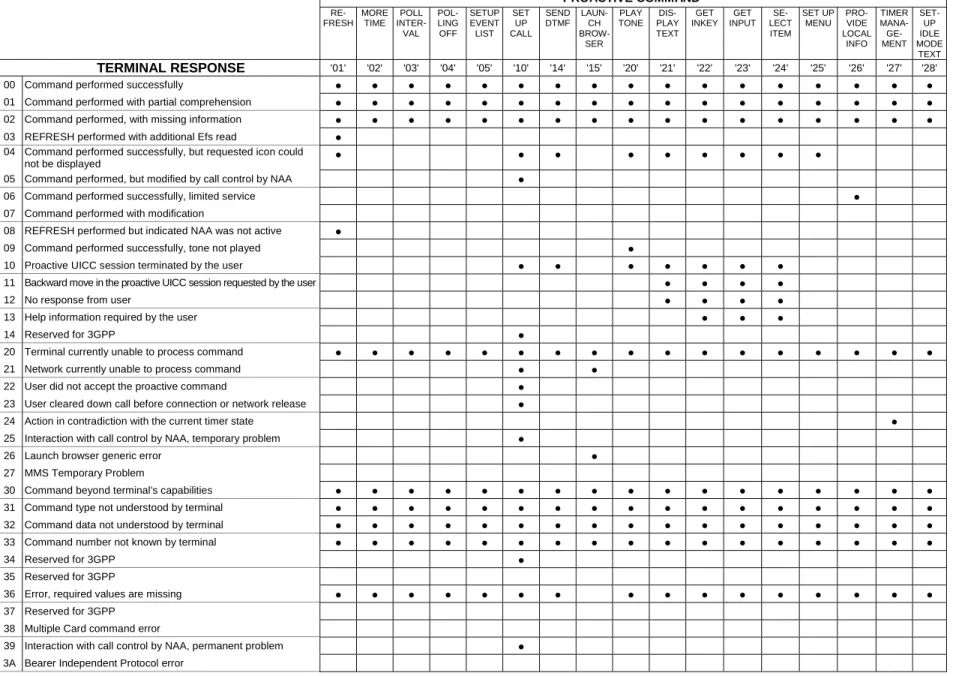
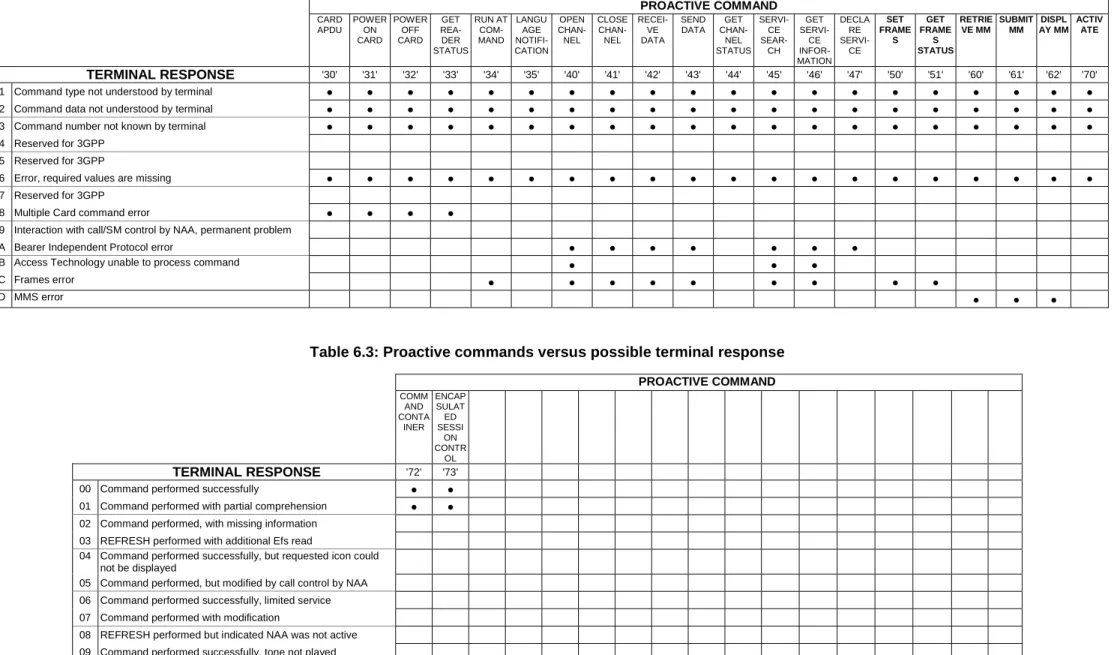
6.11 Proactive commands versus possible terminal response ... 101
7 ENVELOPE
commands
... 106
7.1 Void ... 106
7.2 Menu selection ... 106
7.2.1 Procedure ... 106
7.2.2 Structure of ENVELOPE (MENU SELECTION) ... 106
7.3 Call Control by NAA ... 107
7.3.1 Call Control by NAA ... 107
7.3.1.1 Procedure for mobile originated calls ... 107
7.3.1.2 Void... 107
7.3.1.3 Indication to be given to the user ... 107
7.3.1.4 Interaction with Fixed Dialling Number (FDN) ... 108
7.3.1.5 Support of Barred Dialling Number (BDN) service ... 109
7.3.1.6 Structure of ENVELOPE (CALL CONTROL) ... 109
7.4 Timer expiration ... 111
7.4.1 Description ... 111
7.4.2 Structure of ENVELOPE (TIMER EXPIRATION) ... 111
7.5 Event download ... 112
7.5.1 MT call event ... 112
7.5.1.1 Procedure ... 112
7.5.1.2 Structure of ENVELOPE (EVENT DOWNLOAD - MT call) ... 112
7.5.2 Call connected event ... 113
7.5.2.1 Procedure ... 113
7.5.2.2 Structure of ENVELOPE (EVENT DOWNLOAD - call connected) ... 113
7.5.3 Call disconnected event ... 114
7.5.3.1 Procedure ... 114
7.5.3.2 Structure of ENVELOPE (EVENT DOWNLOAD - call disconnected) ... 114
7.5.4 Location status event ... 115
7.5.4.1 Procedure ... 115
7.5.4.2 Structure of ENVELOPE (EVENT DOWNLOAD - Location status) ... 115
7.5.5 User activity event ... 115
7.5.5.1 Procedure ... 115
7.5.5.2 Structure of ENVELOPE (EVENT DOWNLOAD - User activity) ... 116
7.5.6 Idle screen available event ... 116
7.5.6.1 Procedure ... 116
7.5.6.2 Structure of ENVELOPE (EVENT DOWNLOAD - Idle screen available) ... 116
7.5.7 Card reader status event ... 117
7.5.7.1 Procedure ... 117
7.5.7.2 Structure of ENVELOPE (EVENT DOWNLOAD - Card reader status) ... 117
7.5.8 Language selection event ... 118
7.5.8.1 Procedure ... 118
7.5.9 Browser termination event ... 118
7.5.9.1 Procedure ... 118
7.5.9.2 Structure of ENVELOPE (EVENT DOWNLOAD - Browser termination) ... 119
7.5.10 Data available event ... 119
7.5.10.1 Procedure ... 119
7.5.10.2 Structure of ENVELOPE (EVENT DOWNLOAD - Data available) ... 119
7.5.11 Channel status event ... 120
7.5.11.1 Procedure ... 120
7.5.11.2 Structure of ENVELOPE (EVENT DOWNLOAD - Channel status) ... 120
7.5.12 Access Technology Change Event ... 121
7.5.12.1 Procedure ... 121
7.5.12.2 Structure of ENVELOPE (EVENT DOWNLOAD - Access Technology Change)... 121
7.5.13 Display parameters changed event ... 122
7.5.13.1 Procedure ... 122
7.5.13.2 Structure of ENVELOPE (EVENT DOWNLOAD - Display parameters changed) ... 122
7.5.14 Local Connection event ... 122
7.5.14.1 Procedure ... 122
7.5.14.2 Structure of ENVELOPE (EVENT DOWNLOAD - Local Connection)... 123
7.5.15 Network Search Mode Change Event ... 123
7.5.15.1 Procedure ... 123
7.5.15.2 Structure of ENVELOPE (EVENT DOWNLOAD - Network Search Mode Change) ... 124
7.5.16 Browsing status event ... 124
7.5.16.1 Procedure ... 124
7.5.16.2 Structure of ENVELOPE (EVENT DOWNLOAD - Browsing status) ... 124
7.5.17 Frames Information changed event ... 125
7.5.17.1 Procedure ... 125
7.5.17.2 Structure of ENVELOPE (EVENT DOWNLOAD - Frames Information changed) ... 125
7.5.18 HCI connectivity event ... 125
7.5.18.1 Procedure ... 125
7.5.18.2 Structure of ENVELOPE (EVENT DOWNLOAD - HCI connectivity event) ... 126
7.5.19 Contactless state request ... 126
7.5.19.1 Procedure ... 126
7.5.19.2 Structure of ENVELOPE(EVENT DOWNLOAD - Contactless state request) ... 126
7.5.20 Profile Container ... 127
7.5.20.1 Procedure ... 127
7.5.20.2 Structure of ENVELOPE (EVENT DOWNLOAD - Profile Container) ... 127
7.5.21 Void ... 129
7.5.22 Poll Interval Negotiation ... 129
7.5.22.1 Procedure ... 129
7.5.22.2 Structure of ENVELOPE (EVENT DOWNLOAD – Poll Interval Negotiation) ... 129
7.6 MMS Transfer Status ... 130
7.6.1 Procedure ... 130
7.6.2 Structure of ENVELOPE (MMS Transfer Status) ... 130
7.7 MMS notification download... 131
7.7.1 Procedure ... 131
7.7.2 Structure of ENVELOPE (MMS notification download) ... 132
7.8 Terminal Applications ... 132
7.8.1 Description ... 132
7.8.2 Structure of ENVELOPE (TERMINAL APPLICATIONS) ... 133
7.9 Envelope Container ... 133
7.9.1 Description ... 133
7.9.2 Structure of ENVELOPE (ENVELOPE CONTAINER) ... 134
7.10 Service List Retrieval ... 135
7.10.1 Description ... 135
7.10.2 Structure of ENVELOPE (SERVICE LIST) ... 135
8 COMPREHENSION-TLV
data
objects
... 135
8.1 Address ... 136
8.2 Alpha identifier ... 137
8.3 Subaddress ... 137
8.4 Capability configuration parameters ... 137
8.6 Command details ... 137 8.7 Device identities ... 143 8.8 Duration ... 144 8.9 Item ... 145 8.10 Item identifier ... 145 8.11 Response length ... 145 8.12 Result ... 145 8.12.1 Void ... 147
8.12.2 Additional information for terminal problem ... 147
8.12.3 Additional information for network problem ... 148
8.12.4 Void ... 148
8.12.5 Void ... 148
8.12.6 Void ... 148
8.12.7 Void ... 148
8.12.8 Additional information for interaction with call control ... 148
8.12.9 Additional information for MultipleCard commands ... 148
8.12.10 Additional information for launch browser problem ... 149
8.12.11 Additional information for Bearer Independent Protocol ... 149
8.12.12 Additional information for Frames commands ... 150
8.12.13 Additional information for SUBMIT and RETRIEVE MULTIMEDIA MESSAGE ... 150
8.13 3GPP- SMS TPDU ... 150
8.14 Void ... 150
8.15 Text string ... 150
8.15.1 Coding of text in unpacked format ... 151
8.15.2 Coding of text in packed format ... 151
8.15.3 Coding of text in 16 bits UCS2 alphabet format ... 151
8.16 Tone ... 151 8.17 Void ... 153 8.18 File list ... 153 8.19 Location information ... 153 8.20 IMEI ... 153 8.21 Help request ... 153
8.22 Network measurement results ... 154
8.23 Default text ... 154
8.24 Items next action indicator ... 154
8.25 Event list ... 155
8.26 Cause ... 156
8.27 Location status ... 156
8.28 Transaction identifier ... 156
8.29 Void ... 156
8.30 Call control requested action ... 157
8.31 Icon identifier ... 157
8.32 Item icon identifier list ... 157
8.33 Card reader status ... 158
8.34 Card ATR ... 159
8.35 C-APDU ... 159
8.36 R-APDU ... 160
8.37 Timer identifier ... 160
8.38 Timer value ... 160
8.39 Date-time and time zone ... 161
8.40 AT command ... 161 8.41 AT response... 162 8.42 BC repeat indicator ... 162 8.43 Immediate response ... 162 8.44 DTMF string ... 162 8.45 Language ... 162 8.46 Void ... 163 8.47 Browser identity ... 163 8.48 URL ... 163 8.49 Bearer ... 163
8.50 Provisioning file reference ... 164
8.52 Bearer description... 164
8.53 Channel data ... 165
8.54 Channel data length ... 165
8.55 Buffer size ... 165
8.56 Channel status ... 166
8.57 Card reader identifier ... 167
8.58 Other Address ... 167
8.59 UICC/terminal interface transport level ... 167
8.60 AID ... 168 8.61 Access technology ... 168 8.62 Display parameters ... 169 8.63 Service record ... 169 8.64 Device filter ... 171 8.65 Service search ... 172 8.66 Attribute information ... 173 8.67 Service availability ... 173
8.68 Remote entity address ... 174
8.69 ESN ... 175
8.70 Network access name ... 175
8.71 CDMA-SMS TPDU ... 175
8.72 Text attribute ... 175
8.73 Item text attribute list ... 175
8.74 IMEISV ... 176
8.75 Network search mode ... 176
8.76 Battery State ... 177 8.77 Browsing status ... 177 8.78 Frame Layout ... 177 8.79 Frames Information ... 178 8.80 Frame identifier ... 179 8.81 MEID ... 179
8.82 Multimedia Message Reference ... 179
8.83 Multimedia Message Identifier ... 179
8.84 Multimedia Message Transfer status ... 180
8.85 MM Content Identifier ... 180
8.86 Multimedia Message Notification ... 180
8.87 Last Envelope ... 180
8.88 Registry application data ... 181
8.89 Activate descriptor ... 182
8.90 Broadcast Network information ... 182
8.91 Contactless state request ... 184
8.92 Contactless functionality state ... 184
8.93 Extended registry application data ... 184
8.94 eCAT client profile ... 185
8.95 eCAT client identity ... 185
8.96 Encapsulated envelope type ... 185
8.97 Call control / Poll Interval Negotiation result... 186
8.98 eCAT sequence number ... 186
8.99 Encrypted TLV list ... 187
8.100 MAC ... 187
8.101 SA template ... 188
8.102 CAT service list ... 189
8.103 Refresh enforcement policy ... 190
8.104 DNS Server Address ... 191
9 Tag
values
... 191
9.1 BER-TLV tags in terminal to UICC direction ... 191
9.2 BER-TLV tags in UICC to terminal direction ... 191
9.3 COMPREHENSION-TLV tags in both directions ... 191
9.4 Type of command and next action indicator ... 192
10
Allowed type of command and device identity combinations ... 193
Annex A (normative):
Support of CAT by terminal equipment ... 195
Annex B (informative):
Example of DISPLAY TEXT proactive UICC command ... 197
Annex C (normative):
Structure of CAT communications ... 198
Annex D (informative):
Terminal display in proactive UICC session ... 199
Annex E (informative):
Help information feature processing ... 200
Annex F (informative):
Monitoring of events ... 201
Annex G (normative):
Support of multiple card operation ... 202
Annex H (informative):
Multiple card proactive command examples ... 203
Annex I (informative):
Bearer independent protocol proactive command examples ... 204
Annex J (informative): WAP
terminology
... 209
Annex K (informative):
Use of CAT bearer independent protocol for local links Bluetooth
case ... 210
K.1 Service
search
command
... 210
K.2 Get
service
information command ... 210
K.3 OPEN
CHANNEL command ... 210
Annex L (informative):
Bluetooth service discovery protocol ... 213
L.1 Service
attribute ... 214
Annex M (informative):
Use of CAT bearer independent protocol for local links, server case ... 215
Annex N (informative):
Browsing terminology ... 216
Annex O (informative):
Use of USAT Bearer independent protocol for local links IrDA case ... 217
O.1 Service Search command ... 217
O.2 Get Service Information command ... 217
O.3 OPEN
CHANNEL command ... 218
Annex P (informative):
IrDA Information Access Service ... 220
Annex Q (informative):
IrDA IAS class name and associated parameters ... 221
Annex R (informative):
Example of Frames usage ... 222
Annex S (normative):
Support of CAT by Terminals with reduced feature capabilities ... 225
Annex T (normative):
Default routing for CAT over the modem interface ... 228
T.1 Default
routing mechanism ... 229
T.2
Combination rules for terminal profiles ... 230
Annex U (informative):
Example of eCAT usage ... 231
Annex V (informative):
Change history ... 234
Intellectual Property Rights
IPRs essential or potentially essential to the present document may have been declared to ETSI. The information pertaining to these essential IPRs, if any, is publicly available for ETSI members and non-members, and can be found in ETSI SR 000 314: "Intellectual Property Rights (IPRs); Essential, or potentially Essential, IPRs notified to ETSI in respect of ETSI standards", which is available from the ETSI Secretariat. Latest updates are available on the ETSI Web server (http://ipr.etsi.org).
Pursuant to the ETSI IPR Policy, no investigation, including IPR searches, has been carried out by ETSI. No guarantee can be given as to the existence of other IPRs not referenced in ETSI SR 000 314 (or the updates on the ETSI Web server) which are, or may be, or may become, essential to the present document.
Foreword
This Technical Specification (TS) has been produced by ETSI Technical Committee Smart Card Platform (SCP). It is based on work originally done in the 3GPP in TSG-terminals WG3.
The contents of the present document are subject to continuing work within TC SCP and may change following formal TC SCP approval. If TC SCP modifies the contents of the present document, it will then be republished by ETSI with an identifying change of release date and an increase in version number as follows:
Version x.y.z where:
x the first digit:
0 early working draft;
1 presented to TC SCP for information; 2 presented to TC SCP for approval;
3 or greater indicates TC SCP approved document under change control.
Y the second digit is incremented for all changes of substance, i.e. technical enhancements, corrections, updates, etc.
Z the third digit is incremented when editorial only changes have been incorporated in the document.
Modal verbs terminology
In the present document "shall", "shall not", "should", "should not", "may", "need not", "will", "will not", "can" and "cannot" are to be interpreted as described in clause 3.2 of the ETSI Drafting Rules (Verbal forms for the expression of provisions).
1 Scope
The present document defines the interface between the UICC and the terminal, and mandatory terminal procedures, specifically for "NAA Card Application Toolkit".
The Card Application Toolkit (CAT) is a set of generic commands and procedures for use by the ICC, irrespective of the access technology of the network. Within the scope of the present document, the UICC refers here to an ICC which supports at least one application in order to access a network. This application is called here Network Access
Application (NAA).
The ICC is considered as a platform, which is either based on ETSI TS 102 221 [1] or ETSI TS 102 600 [38], here called "3G platform", or ETSI TS 151 011 [8], here called "2G platform".
NAA can be:
• a USIM application, as defined in ETSI TS 131 102 [6], which can reside only on a 3G platform;
• a SIM application, as defined in ETSI TS 151 011 [8], which can reside either on a 3G or a 2G platform;
• a TSIM application, as defined in ETSI TS 100 812 [i.2], which can reside only on a 3G platform;
• a ISIM application, as defined in ETSI TS 131 103 [36], which can reside only on a 3G platform;
• a CSIM application, as defined in 3GPP2 C.S0065-B [53];
• an R-UIM application, as defined in 3GPP2 C.S0023-D [30]; or
• other applications residing on a 3G platform or a 2G platform. Specifying the interface is to ensure
interoperability between an ICC and a terminal independently of the respective manufacturers and operators. The present document specifies as well mechanisms in order to expand the generic set of commands and procedures by access technology specific ones.
The present document defines:
• the commands;
• the application protocol;
• the mandatory requirements on the ICC and terminal for each procedure.
The present document does not specify any aspects related to the administrative management phase. Any internal technical realization of either the ICC or the terminal are only specified where these reflect over the interface. The present document does not specify any of the security algorithms that may be used.
2 References
2.1 Normative
references
References are either specific (identified by date of publication and/or edition number or version number) or
non-specific. For specific references, only the cited version applies. For non-specific references, the latest version of the reference document (including any amendments) applies.
• In the case of a reference to a TC SCP document, a non specific reference implicitly refers to the latest version of that document in the same Release as the present document.
Referenced documents which are not found to be publicly available in the expected location might be found at http://docbox.etsi.org/Reference.
NOTE: While any hyperlinks included in this clause were valid at the time of publication, ETSI cannot guarantee their long term validity.
The following referenced documents are necessary for the application of the present document.
[1] ETSI TS 102 221: "Smart Cards; UICC-Terminal interface; Physical and logical characteristics". [2] ETSI TS 122 001: "Digital cellular telecommunications system (Phase 2+); Universal Mobile
Telecommunications System (UMTS); Principles of circuit telecommunication services supported by a Public Land Mobile Network (PLMN) (3GPP TS 22.001)".
[3] ETSI TS 123 038: "Digital cellular telecommunications system (Phase 2+); Universal Mobile Telecommunications System (UMTS); LTE; Alphabets and language-specific information (3GPP TS 23.038)".
[4] Void.
[5] ETSI TS 127 007: "Digital cellular telecommunications system (Phase 2+); Universal Mobile Telecommunications System (UMTS); LTE; AT command set for User Equipment (UE) (3GPP TS 27.007)".
[6] ETSI TS 131 102: "Universal Mobile Telecommunications System (UMTS); LTE; Characteristics of the Universal Subscriber Identity Module (USIM) application (3GPP TS 31.102)".
[7] ETSI TS 131 110: "Universal Mobile Telecommunications System (UMTS); Numbering system for telecommunication IC card applications (3GPP TS 31.110)".
[8] ETSI TS 151 011: "Digital cellular telecommunications system (Phase 2+); Specification of the Subscriber Identity Module - Mobile Equipment (SIM-ME) interface (3GPP TS 51.011)". [9] IETF RFC 768: "User Datagram Protocol".
[10] IETF RFC 793: "Transmission Control Protocol". [11] IETF RFC 1738: "Uniform Resource Locators (URL)". NOTE: Obsoleted by RFC 4248 and RFC 4266.
[12] ISO 639 (all parts): "Codes for the representation of names of languages".
[13] ISO/IEC 7816-3: "Identification cards -- Integrated circuit cards -- Part 3: Cards with contacts -- Electrical interface and transmission protocols".
[14] ISO/IEC 7816-4: "Identification cards -- Integrated circuit cards -- Part 4: Organization, security and commands for interchange".
[16] Specification of the Bluetooth system; Volume 2; Profiles of the Bluetooth system. NOTE: Available at http://www.bluetooth.org/.
[17] Void. [18] Void.
[19] ETSI TS 100 922: "Digital cellular telecommunications system (Phase 2+) (GSM); Subscriber Identity Modules (SIM); Functional characteristics (GSM 02.17)".
[20] ETSI TS 124 008: "Digital cellular telecommunications system (Phase 2+); Universal Mobile Telecommunications System (UMTS); LTE; Mobile radio interface Layer 3 specification; Core network protocols; Stage 3 (3GPP TS 24.008)".
[21] Void.
[22] Recommendation ITU-T E.164: "The international public telecommunication numbering plan". [23] Recommendation ITU-T X.121: "International numbering plan for public data networks". [24] Recommendation ITU-T F.69: "The international telex service - Service and operational
provisions of telex destination codes and telex network identification codes". [25] ANSI/TIA/EIA-136-C: "TDMA Third Generation Wireless".
[26] ETSI TS 131 111: "Digital cellular telecommunications system (Phase 2+); Universal Mobile Telecommunications System (UMTS); LTE; Universal Subscriber Identity Module (USIM) Application Toolkit (USAT) (3GPP TS 31.111)".
[27] ETSI TS 123 040: "Digital cellular telecommunications system (Phase 2+); Universal Mobile Telecommunications System (UMTS); Technical realization of Short Message Service (SMS) (3GPP TS 23.040)".
[28] ETSI TS 122 030: "Digital cellular telecommunications system (Phase 2+); Universal Mobile Telecommunications System (UMTS); LTE; Man-Machine Interface (MMI) of the User Equipment (UE) (3GPP TS 22.030)".
[29] Void.
[30] 3GPP2 C.S0023-D v3.0: "Removable User Identity Module for Spread Spectrum Systems, December, 2013".
[31] ETSI TS 101 220: "Smart Cards; ETSI numbering system for telecommunication application providers".
[32] ETSI TS 123 003: "Digital cellular telecommunications system (Phase 2+); Universal Mobile Telecommunications System (UMTS); Numbering, addressing and identification
(3GPP TS 23.003)".
[33] Infrared Data Association: "Serial Infrared Link Management Protocol (IrLMP)", version 1.1. NOTE: Available at http://www.irda.org/.
[34] Void. [35] Void.
[36] ETSI TS 131 103: "Digital cellular telecommunications system (Phase 2+); Universal Mobile Telecommunications System (UMTS); LTE; Characteristics of the IP Multimedia Services Identity Module (ISIM) application (3GPP TS 31.103)".
[37] ETSI TS 123 140: "Digital cellular telecommunications system (Phase 2+); Universal Mobile Telecommunications System (UMTS); Multimedia Messaging Service (MMS); Functional description; Stage 2 (3GPP TS 23.140)".
[39] ETSI TS 102 613: "Smart Cards; UICC - Contactless Front-end (CLF) Interface; Part 1: Physical and data link layer characteristics".
[40] ETSI TS 102 622: "Smart Cards; UICC - Contactless Front-end (CLF) Interface; Host Controller Interface (HCI)".
[41] OMA Device Management V1.2. [42] OMA Data Synchronization V1.2.1.
NOTE: Available at http://www.openmobilealliance.org/technical/release_program/ds_v12.aspx.
[43] ETSI EN 300 468: "Digital Video Broadcasting (DVB); Specification for Service Information (SI) in DVB systems".
[44] ETSI EN 302 304: "Digital Video Broadcasting (DVB); Transmission System for Handheld Terminals (DVB-H)".
[45] ETSI TS 102 589: "Forward Link Only Air Interface; Specification for Terrestrial Mobile; Multimedia Multicast".
[46] IEEE 802.16-2009: "Local and Metropolitan Area Networks - Part 16: Air Interface for Broadband Wireless Access Systems".
[47] 3GPP2 C.S0035-B v2.0: "CDMA Card Application Toolkit (CCAT), May, 2014".
[48] ETSI TS 102 484: "Smart Cards; Secure channel between a UICC and an end-point terminal". [49] TIA/EIA-553: "Mobile Station - Base Station Compatibility Standard".
[50] TIA/EIA-95: "Mobile Station-Base Station Compatibility Standard for Wideband Spread Spectrum Cellular Systems".
[51] TIA/EIA/IS-2000: "Physical Layer Standard for cdma2000 Spread Spectrum Systems". [52] TIA/EIA/IS-856: "cdma2000 High Rate Packet Data Air Interface Specification". [53] 3GPP2 C.S0065-B v2.0: "cdma2000 Application on UICC for Spread Spectrum Systems,
January, 2011".
[54] 3GPP2 X.S0057-B v1.0: "E-UTRAN - eHRPD Connectivity and Interworking: Core Network Aspects".
NOTE: Available at http://www.3gpp2.org/Public_html/specs/X.S0057-B%20v1.0_20121018.pdf. [55] Void.
[56] ETSI EN 302 755: "Digital Video Broadcasting (DVB); Frame structure channel coding and modulation for a second generation digital terrestrial television broadcasting system (DVB-T2)". [57] 3GPP2 X.S0011-E v1.0: "cdma2000 Wireless IP Network Standard, November, 2009".
2.2 Informative
references
References are either specific (identified by date of publication and/or edition number or version number) or
non-specific. For specific references, only the cited version applies. For non-specific references, the latest version of the reference document (including any amendments) applies.
• In the case of a reference to a TC SCP document, a non specific reference implicitly refers to the latest version of that document in the same Release as the present document.
NOTE: While any hyperlinks included in this clause were valid at the time of publication, ETSI cannot guarantee their long term validity.
The following referenced documents are not necessary for the application of the present document but they assist the user with regard to a particular subject area.
[i.1] ETSI TS 100 906: "Digital cellular telecommunications system (Phase 2+) (GSM); Mobile Stations (MS) features (GSM 02.07)".
[i.2] ETSI TS 100 812 (all parts): "Terrestrial Trunked Radio (TETRA); Subscriber Identity Module to Mobile Equipment (SIM-ME) interface".
[i.3] Recommendation ITU-T E.163: "Numbering plan for the international telephone service".
3
Definitions, symbols and abbreviations
3.1 Definitions
For the purposes of the present document, the following terms and definitions apply:
application: set of security mechanisms, files, data and protocols (excluding transmission protocols) application protocol: set of procedures required by the application
bearer independent protocol: mechanism by which the terminal provides the UICC with access to the data bearers supported by the terminal and the network
Card Application Toolkit (CAT): set of applications and related procedures that may be used during a card session card reader x: electrical interface compatible with ISO/IEC 7816-3 [13] to support additional card
card session: link between the card and the external world, using APDUs, starting with the ATR and ending with a subsequent reset or a deactivation of the card
NOTE: A card session may take place either over the electrical interface specified in ETSI TS 102 221 [1] or over the Smart Card functional interface specified in ETSI TS 102 600 [38].
Card x: additional card using an interface according to ISO/IEC 7816-3 [13]
CAT client: component in the Connected Entity providing a subset of the Connected Entity's CAT facilities connected entity: logical entity (consisting of any combination of hardware and/or software) that can support CAT facilities via a modem interface, e.g. using AT commands
data channel: allow the UICC and the network to exchange data using a selected bearer
data object: information seen at the interface for which are defined a tag (identifier), a length and a value
NOTE: Data objects can be either BER-TLV or COMPREHENSION-TLV as defined in ETSI TS 101 220 [31]. In the present document, all BER-TLV data objects are "primitive": the value part consists only of COMPREHENSION-TLV data objects. Unless otherwise noted, a reference to a TLV is to a BER-TLV. eCAT: mechanisms of encapsulated profiles, commands, responses and envelopes used in the communication between a UICC and eCAT clients ("encapsulated CAT")
eCAT client: entity within the terminal that is able to provide CAT facilities and processes encapsulated commands and events: COMMAND CONTAINERs, ENCAPSULATED SESSION CONTROL commands and associated
TERMINAL RESPONSEs and issues Encapsulated Profile and Envelope Container events
encapsulated command session: communication sequence between an eCAT client and the UICC, starting with the assignment of a client identity by the UICC and ending upon request by either entity or with the end of the card session link: radio resource
modem: component in the terminal that provides interfaces to the mobile network, to the UICC and to a Connected Entity
NOTE: The modem may have a limited set of capabilities.
Multi-Media Call: services that handle several types of media such as audio and video in a synchronized way from the user's point of view
network access application: application residing in the UICC which holds a subscriber identity and an authentication algorithm and provides the access to a network
padding: one or more bits appended to a message in order to cause the message to contain the required number of bits or bytes
proactive UICC: UICC which is capable of issuing commands to the terminal
proactive UICC session: sequence of related CAT commands and responses which starts with the status response '91XX' (proactive command pending) and ends with a status response of '90 00' (normal ending of command) after Terminal Response
Rx buffer: dedicated memory used to temporarily store data to be retrieved
Service Data Unit (SDU): set of data in layered systems that is sent by a user of the services of a given layer, and is transmitted to a peer service user semantically unchanged
NOTE: A Protocol Control Information (PCI) header is attached to the Service Data Unit (SDU) by the layer to form a Protocol Data Unit (PDU).
Tx buffer: dedicated memory used to temporarily store data to be sent
UICC: smart card that conforms to the specification written and maintained by the ETSI Smart Card Platform project NOTE: UICC is neither an abbreviation nor an acronym.
UICC application session: execution of a sequence of commands internal to the UICC that can result in the performance of one or several proactive UICC sessions
NOTE: The UICC application session can be started by any event in the card session, and can execute for the duration of the card session. Processing of the UICC application session will not interfere with normal 3G operation.
3.2 Symbols
For the purposes of the present document, the following symbol applies: "0" to "9" and "A" to "F" The sixteen hexadecimal digits
3.3 Abbreviations
For the purposes of the present document, the following abbreviations apply: APDU Application Protocol Data Unit
ATR Answer To Reset
BC Bearer Capability
BD_ADDR Bluetooth Device ADDRess BDN Barred Dialling Number
BER Basic Encoding Rules of ASN.1 BIP Bearer Independent Protocol BSID Base Station Identifier
C-APDU Command Application Protocol Data Unit CAT Card Application Toolkit
CHTML Compact HyperText Markup Language
CI Client Identity
CoD Class of Device (Bluetooth related) CSD Circuit Switched Data CSG Closed Subscriber Group
CSIM cdma2000 Subscriber Identity Module DCS Data Coding Scheme
DNS Domain Name System
DTMF Dual Tone Multiple Frequency
DVB-H Digital Video Broadcasting - Handheld
DVB-NGH Digital Video Broadcasting - Next Generation Handheld DVB-SH Digital Video Broadcasting - Satellite services to Handhelds DVB-T Digital Video Broadcasting - Terrestrial
DVB-T2 Digital Video Broadcasting - Terrestrial second generation
EF Elementary File
EIA Electronics Industries Association ESN Electronic Serial Number
FDN Fixed Dialling Number FFS For Further Study
FLO Forward-Link Only
GSM Global System for Mobile communications HRPD High Rate Packet Data
HTML HyperText Markup Language HTTP HyperText Transfer Protocol
IAS Information Access Service (IrDA related) ID Identifier
IEC International Electrotechnical Commission IMEI International Mobile Equipment Identity
IMEISV International Mobile Equipment Identity and Software Version IMSI International Mobile Subscriber Identity
IP Internet Protocol
Ipv4 Internet Protocol version 4
IrLMP Infrared Link Management Protocol (IrDA related) ISO International Organization for Standardization LAC Location Area Code
lgth the (specific) length of a data unit LSAP Link Service Access Point (IrDA related) MEID Mobile Equipment Identifier
MM Multimedia Message
MMI Man Machine Interface MMS Multimedia Messaging Service
MO Mobile Originated
MT Mobile Terminated
NAA Network Access Application NAI Next Action Indicator NMR Network Measurement Results NPI Numbering Plan Identifier
PC Personal Computer
PDN Packet Data Network
PDP Packet Data Protocol, e.g. IP or X25 or PPP PDU Protocol Data Unit
PPP Point-to-Point Protocol R-APDU Response Application Protocol Data Unit
RF Radio Frequency
RFM Remote File Management RFU Reserved for Future Use
R-UIM Removable User Identity Module
SDP Service Discovery Protocol (Bluetooth related) SDU Service Data Unit
SGSN Serving GPRS Support Node SMS Short Message Service SMSC Short Message Service Centre SW1/SW2 Status Word 1/Status Word 2
TCP Transmission Control Protocol T-DMB Terrestrial - Digital Multimedia Broadcasting
TE Terminal Equipment (e.g. an attached personal computer) TETRA Terrestrial Trunked Radio
TIA Telecommunications Industries Association TLV Tag, Length, Value
TON Type Of Number TP Transfer layer Protocol
TR TERMINAL RESPONSE
TSIM TETRA SIM application TTP Tiny Transport Protocol
UCS2 Universal two byte coded Character Set UDP User Datagram Protocol
UE User Equipment
UMTS Universal Mobile Telecommunication System URL Uniform Resource Location USAT USIM Application Toolkit
USSD Unstructured Supplementary Service Data UTRAN UMTS Terrestrial Radio Access Network UUID Universally Unique Identifier
WAE Wireless Application Environment WAP Wireless Application Protocol
WiMAX Worldwide Interoperability for Microwave Access WML Wireless Markup Language
XHTML eXtensible HyperText Markup Language
4
Overview of CAT
The CAT provides mechanisms which allow applications, existing in the UICC, to interact and operate with any terminal which supports the specific mechanism(s) required by the application.
If class "a" is supported, a UICC supporting CAT shall be able to communicate with the additional card(s) and get information about the additional reader(s) via the terminal.
The following mechanisms have been defined. These mechanisms are dependent upon the commands and protocols relevant to CAT as USAT in ETSI TS 102 221 [1] for a 3G platform and as SAT in ETSI TS 151 011 [8] for a 2G platform.
4.1 Profile
download
Profile downloading provides a mechanism for the terminal to tell the UICC what it is capable of.
4.2 Proactive
UICC
Proactive UICC gives a mechanism whereby the UICC can initiate actions to be taken by the terminal. These actions include:
• displaying text from the UICC to the terminal;
• setting up a voice call to a number held by the UICC;
• setting up a data call to a number and bearer capabilities held by the UICC;
• playing tone in earpiece;
• initiating a dialogue with the user;
• NAA network access application initialization request and notification of changes to EF(s);
• providing local information from the terminal to the UICC;
• communicating with the additional card(s) (if class "a" is supported);
• providing information about the additional card reader(s) (if class "a" is supported);
• managing timers running physically in the terminal;
• running an AT command received from the UICC, and returning the result to the UICC (if class "b" is supported);
• sending DTMF;
• requesting the terminal to launch the browser corresponding to a URL (if class "ab" is supported);
• establishing and managing a bearer independent protocol (if class "e" is supported);
• dividing the terminal's screen into several rectangular regions (frames) (if class "i" is supported);
• requesting the terminal to start an application on the terminal, if this application is registered for such a request (if class "k" is supported);
• activate an interface (if class "l" is supported);
• requesting the terminal to report geographical location information to the UICC (if class "n" is supported);
• providing CAT facilities by a modem and a Connected Entity (if class "s" is supported);
• encapsulating commands for an eCAT client and sending encapsulated profiles and envelopes by an eCAT client (if class "u" is supported);
• securing the data exchanged with an eCAT client (if class "x" is supported);
• allowing the terminal to negotiate a poll interval (if class "ad" is supported).
For each command involved in the dialog with the user, a help information may be available, either for each item of a list of items proposed to the user, or with each command requesting a response from the user. If a proactive command involved in the dialog with the user indicates the availability of the help feature, the support of this feature is optional for the terminal.
4.3
Data download to UICC
Data downloading to the UICC uses either dedicated commands (using the transport mechanisms of the technology) or the Bearer independent protocol. Transferral of information over the UICC-terminal interface uses the ENVELOPE command.
4.4 Menu
selection
A set of possible menu entries is supplied by the UICC in a proactive UICC command. The menu selection mechanism is used to transfer the UICC application menu item which has been selected by the user to the UICC. The menu selection mechanism may also be used for requesting help information on the items of the UICC application menu.
4.5
Call control by network access application
When this service is activated by the NAA, all dialled digit strings are first passed to the UICC before the terminal sets up the call. The terminal shall also pass to the UICC at the same time its current serving cell. The toolkit application has the ability to allow, bar or modify the call. The application also has the ability to replace a call request by another call request.
NOTE: In some technologies, the call request can even be replaced by another operation, for instance USSD or SMS in GSM/3GPP.
4.6 Void
4.7 Event
download
A set of events to monitor for is supplied by the UICC in a proactive UICC command. The event download mechanism is used to transfer details of the event to the UICC, when it occurs. Events that the terminal can report to the UICC include incoming calls, location status, access technology, display parameters changed, and availability of the screen for applications.
4.8 Security
Applications designed using the features in the present document may require methods to ensure data confidentiality, data integrity, and data sender validation, or any subset of these. Requirements for these mechanisms are defined in clause 11.
4.9 Multiple
card
This clause applies if class "a" is supported.
One event and a set of proactive commands are supplied to monitor and control Card x behaviour.
4.10 Timer
expiration
The UICC is able to manage timers running physically in the terminal with a proactive command. The timer expiration mechanism is used to inform the UICC when a timer expires.
4.11
Bearer Independent Protocol
The following clause applies if class "e" is supported.
The set of proactive commands (OPEN CHANNEL, CLOSE CHANNEL, SEND DATA, RECEIVE DATA, and GET CHANNEL STATUS) and events (Data available, Channel status) allows the UICC to establish a data channel with the terminal, and through the terminal either to a remote Server in the Network or to a remote device in the Personal Area Network. The UICC provide information for the terminal to select an available bearer at the time of channel
establishment. The terminal then allows the UICC and the Server to exchange data on this channel, transparently. The UICC uses service of terminal lower layer to send data by providing Service Data Unit to terminal. The default lower layer is the higher layer of selected bearer.
The following clauses apply if class "f" is supported.
The proactive command SERVICE SEARCH allows the UICC to look for services available on remote devices. The proactive command GET SERVICE INFORMATION allows the UICC to get detailed information regarding one service.
The proactive command DECLARE SERVICE allows the UICC to add or delete a service to the terminal service database. The event Local Connection allows to inform the UICC of a connection request on a local bearer.
4.12
Description of the access technology indicator mechanism
This clause describes the mechanisms that can be employed to indicate access technology specific dependencies in a multi-access technology environment.There are cases where toolkit applications need to know which access technology the terminal is currently in so that it can issue access technology dependent commands as well as determine that the response to a particular command is technology dependent. Setting up the event, ACCESS TECHNOLOGY CHANGE, and its continuous monitoring, provides a means by which the terminal can inform toolkit applications of a change in the current access technology. This change is notified to the toolkit applications via the ENVELOPE command: EVENT DOWNLOAD - "Access Technology Change" together with the new access technology (if single access technology is set up in the event list) or with the list of current access technologies (if multiple access technologies is set up in the event list).
Additionally, the proactive command, PROVIDE LOCAL INFORMATION, can be used to provide an access technology indication. This is achieved by the toolkit application using the Access Technology command qualifier in the PROVIDE LOCAL INFORMATION command to which the terminal responds with the current access technology or access technologies using the TERMINAL RESPONSE message.
In a multi-access technology environment there are some services that are access technology specific (e.g. the SEND USSD proactive command is used in 3GPP access technologies only). In such cases, if the toolkit application issues such a proactive command then the permanent result, "Access Technology unable to process command" is used by the terminal to inform the toolkit application that the requested command could not be performed due to access technology dependencies. Here the toolkit application should not re-issue the command whilst within the same access technology, as the result will be the same, however, it may re-issue the command when in another access technology.
4.13
Tag allocation guidelines
The tag allocation guidelines to be followed when requesting a new tag value are described in ETSI TS 101 220 [31].
4.14
Description of the network search mode mechanism
This clause describes the mechanisms that can be employed to indicate the network search mode.
There are cases where toolkit applications need to know which Network Search Mode is selected by the user so it can issue specific roaming behaviour.
An application for roaming management can be deactivated when a user selects manual mode. When automatic mode is restored the application can be activated again.
Setting up the event, NETWORK SEARCH MODE CHANGE, and its continuous monitoring, provides a means by which the terminal can inform the toolkit application of a change in the current network search mode. This change is notified to the toolkit application via the ENVELOPE command: EVENT DOWNLOAD - "Network Search Mode change" together with the new search mode.
Additionally, the proactive command, PROVIDE LOCAL INFORMATION, can be used to provide a search mode indication. This is achieved by the toolkit application using the Network Search Mode command qualifier in the PROVIDE LOCAL INFORMATION command to which the terminal responds with the current search mode using the TERMINAL RESPONSE message.
4.15
CAT operation in reduced capability terminals
The present document takes into account terminal types corresponding to the following reduced capabilities:
• no display capability;
• no keypad available;
• no audio alerting capability;
• no support of multiple languages.
These terminal types are used to identify which CAT features are not available for each type of reduced functionality. NOTE: Terminal types details are in annex S.
4.16
CAT over the modem interface
This clause applies if class "s" is supported.
If a UICC connected to a modem (e.g. a USB modem providing access to mobile networks for a PC) uses CAT, some CAT facilities can be provided by the modem itself, whereas other facilities can be implemented in the entity connected to the modem (Connected Entity). A mechanism is defined in ETSI TS 127 007 [5] to transport the CAT commands to the Connected Entity and responses and events from the Connected Entity to the modem and to the UICC over the modem interface using AT commands. The handling of the profiles of the modem and the Connected Entity are also defined in the present document.
In case proactive commands do not explicitly indicate routing information, the default routing mechanism is defined in annex T. These provisions for default routing also apply in a similar way if several CAT clients within the Connected Entity provide CAT facilities and the Connected Entity merges these facilities into one Connected Entity profile.
mu
lip
lex
ing
Figure 4.1
4.17
CAT facilities provided by eCAT clients
This clause applies if class "u" is supported.
eCAT clients provide a set of CAT facilities of their own, which may overlap with the CAT facilities of other eCAT clients or with the facilities of the terminal. This is enabled by the encapsulation of CAT commands, terminal responses and envelopes in a set of special commands:
• the Profile Container event, to inform the UICC about the profile of an eCAT client and to inform the eCAT client about services provided by the UICC in the encapsulated session;
• COMMAND CONTAINER and associated TERMINAL RESPONSE to embed the command to and response from an eCAT client;
• the envelope container event that allows an eCAT client to send envelopes to the UICC; and
• ENCAPSULATED SESSION CONTROL to end a session with an eCAT client;
• if class "x" is supported in addition, these command may optionally be authenticated or authenticated and encrypted.
As a result of the encapsulation, some data objects appear twice in commands, responses and envelopes: once for the outer structure, the "container" and once for the inner structure, the encapsulated element.
To distinguish between these two layers, the outer structure is described in the present document as being processed by the terminal, whereas the inner structure is described as being processed by the eCAT client. The task assigned logically to the terminal includes wrapping and unwrapping of data provided to/from the eCAT client and the associated routing.
NOTE: This logic does not imply any specific way of implementing this feature in the terminal or in the UICC. eCAT clients may be part of CAT clients as defined above for CAT over the modem interface or may be part of the terminal using a different (internal) interface.
The usage of keys and the handling of an eCAT secure channel are specified in ETSI TS 102 484 [48].
4.18
Negotiation of Poll Interval
This clause applies if class "ad" is supported.
The UICC allows the terminal to propose and negotiate a proactive poll interval, in order to best match the power and usage pattern of the terminal. The UICC can accept, modify or reject the proposed poll interval.
5 Profile
download
5.1 Procedure
The profile download instruction is sent by the terminal to the UICC as part of the UICC initialization procedure and as soon as possible when CAT functionality is modified in the terminal. If class "s" is supported, the profile download instruction is sent also every time the Connected Entity accessing CAT functionalities over a Modem interface is connected or disconnected or changes its profile. If the terminal supports class "s" the profile download instruction shall combine capabilities supported by the terminal and the Connected Entity according to annex T.
This procedure is specified in ETSI TS 102 221 [1] for a 3G platform and in ETSI TS 151 011 [8] for a 2G platform. The profile sent by the terminal shall state the facilities relevant to CAT that are supported by the terminal.
This procedure is important, as it allows the UICC to determine what the terminal is capable of, and the UICC can then limit its instruction range accordingly. If no command is sent by the terminal, the UICC shall assume that the terminal does not support CAT.
5.2
Structure and coding of TERMINAL PROFILE
Direction: terminal to UICC.
The command header is specified in ETSI TS 102 221 [1] for a 3G platform and in ETSI TS 151 011 [8] for a 2G platform.
Command parameters/data:
Description Clause M/O/C Length
Profile - M lgth
• Contents:
- The list of CAT facilities that are supported by the terminal.
• Coding:
- 1 bit is used to code each facility:
bit = 1: facility supported by terminal; bit = 0: facility not supported by terminal. First byte (Download):
b8 b7 b6 b5 b4 b3 b2 b1
Profile download
Reserved by 3GPP (SMS-PP data download) Reserved by 3GPP (Cell Broadcast data download)
Menu selection
Reserved by 3GPP (SMS-PP data download)
Timer expiration
Reserved by 3GPP and 3GPP2 (USSD string data object support in Call Control by USIM)
Call Control by NAA
Second byte (Other):
b8 b7 b6 b5 b4 b3 b2 b1
Command result
Call Control by NAA
Call Control by NAA
reserved by 3GPP (MO short message control support)
Call Control by NAA
UCS2 Entry supported
UCS2 Display supported
Display Text
Third byte (Proactive UICC):
b8 b7 b6 b5 b4 b3 b2 b1
Proactive UICC: DISPLAY TEXT
Proactive UICC: GET INKEY
Proactive UICC: GET INPUT
Proactive UICC: MORE TIME
Proactive UICC: PLAY TONE
Proactive UICC: POLL INTERVAL Proactive UICC: POLLING OFF
Proactive UICC: REFRESH
Fourth byte (Proactive UICC):
b8 b7 b6 b5 b4 b3 b2 b1
Proactive UICC: SELECT ITEM Reserved by 3GPP (Proactive UICC:
SEND SHORT MESSAGE with 3GPP-SMS-TPDU) Reserved by 3GPP (Proactive UICC: SEND SS) Reserved by 3GPP and 3GPP2 (Proactive UICC: SEND USSD)
Proactive UICC: SET UP CALL Proactive UICC: SET UP MENU
Proactive UICC: PROVIDE LOCAL INFORMATION (MCC, MNC, LAC, Cell ID & IMEI)
Fifth byte (Event driven information):
b8 b7 b6 b5 b4 b3 b2 b1
Proactive UICC: SET UP EVENT LIST
Event: MT call
Event: Call connected
Event: Call disconnected
Event: Location status
Event: User activity
Event: Idle screen available
Event: Card reader status
Sixth byte (Event driven information extensions): b8 b7 b6 b5 b4 b3 b2 b1
Event: Language selection
Event: Browser Termination (i.e. class "ac" is supported)
Event: Data available
Event: Channel status
Event: Access Technology Change Event: Display parameters changed
Event: Local Connection
Event: Network Search Mode Change
Seventh byte (Multiple card proactive commands) for class "a": b8 b7 b6 b5 b4 b3 b2 b1
Proactive UICC: POWER ON CARD Proactive UICC: POWER OFF CARD Proactive UICC: PERFORM CARD APDU
Proactive UICC: GET READER STATUS (Card reader status)
Proactive UICC: GET READER STATUS (Card reader identifier)
RFU, bit = 0
Eighth byte (Proactive UICC):
b8 b7 b6 b5 b4 b3 b2 b1
Proactive UICC: TIMER MANAGEMENT (start, stop) Proactive UICC: TIMER MANAGEMENT (get current
value)
Proactive UICC: PROVIDE LOCAL INFORMATION (date, time and time zone)
GET INKEY
SET UP IDLE MODE TEXT
RUN AT COMMAND (i.e. class "b" is supported)
SETUP CALL
Call Control by NAA
Ninth byte:
b8 b7 b6 b5 b4 b3 b2 b1
DISPLAY TEXT
SEND DTMF command
Proactive UICC: PROVIDE LOCAL INFORMATION (NMR) Proactive UICC: PROVIDE LOCAL INFORMATION
(language)
Reserved by 3GPP (Proactive UICC: PROVIDE LOCAL INFORMATION, Timing Advance)
Proactive UICC: LANGUAGE NOTIFICATION
Proactive UICC: LAUNCH BROWSER (i.e. class "ab" is supported)
Proactive UICC: PROVIDE LOCAL INFORMATION (Access Technology)
Tenth byte (Soft keys support) for class "d":
b8 b7 b6 b5 b4 b3 b2 b1
Soft keys support for SELECT ITEM Soft Keys support for SET UP MENU
RFU, bit = 0 RFU, bit = 0 RFU, bit = 0 RFU, bit = 0 RFU, bit = 0 RFU, bit = 0
Eleventh byte (Soft keys information):
b8 b7 b6 b5 b4 b3 b2 b1
Maximum number of soft keys available 'FF' value is reserved for future use
Twelfth byte (Bearer Independent protocol proactive commands, class "e"): b8 b7 b6 b5 b4 b3 b2 b1
Proactive UICC: OPEN CHANNEL Proactive UICC: CLOSE CHANNEL Proactive UICC: RECEIVE DATA
Proactive UICC: SEND DATA
Proactive UICC: GET CHANNEL STATUS Proactive UICC: SERVICE SEARCH
Proactive UICC: GET SERVICE INFORMATION Proactive UICC: DECLARE SERVICE
Thirteenth byte (Bearer Independent protocol supported bearers, class "e"): b8 b7 b6 b5 b4 b3 b2 b1 CSD GPRS Bluetooth IrDA RS232
Number of channels supported by terminal
Fourteenth byte (Screen height):
b8 b7 b6 b5 b4 b3 b2 b1
Number of characters supported down the terminal display as defined in clause 5.3.1
No display capability (i.e. class "ND" is indicated)
No keypad available (i.e. class "NK" is indicated) Screen Sizing Parameters supported as defined in clause 5.3
Fifteenth byte (Screen width):
b8 b7 b6 b5 b4 b3 b2 b1
Number of characters supported across the terminal display as defined in clause 5.3.2
Sixteenth byte (Screen effects):
b8 b7 b6 b5 b4 b3 b2 b1
Display can be resized as defined in clause 5.3.3 Text Wrapping supported as defined in clause 5.3.4 Text Scrolling supported as defined in clause 5.3.5 Text Attributes supported as defined in
clause 5.3.7 RFU
Width reduction when in a menu as defined in clause 5.3.6
Seventeenth byte (Bearer independent protocol supported transport interface/bearers, class "e"): b8 b7 b6 b5 b4 b3 b2 b1
TCP, UICC in client mode, remote connection UDP, UICC in client mode, remote connection
TCP, UICC in server mode
TCP, UICC in client mode, local connection (i.e. class "k" is supported)
UDP, UICC in client mode, local connection (i.e. class "k" is supported)
Direct communication channel (i.e. class "k" is supported)
Reserved by 3GPP (E-UTRAN)
Reserved by 3GPP (HSDPA)
Eighteenth byte:
b8 b7 b6 b5 b4 b3 b2 b1
Proactive UICC: DISPLAY TEXT (Variable Time out) Proactive UICC: GET INKEY (help is supported while waiting for immediate response or variable timeout) USB (Bearer Independent protocol supported bearers,
class "e")
Proactive UICC: GET INKEY (Variable Timeout) Proactive UICC: PROVIDE LOCAL INFORMATION (ESN)
Reserved by 3GPP (Call control on GPRS)
Proactive UICC: PROVIDE LOCAL INFORMATION (IMEISV) Proactive UICC: PROVIDE LOCAL INFORMATION (Search
Mode change)
Nineteenth byte (reserved for TIA/EIA-136-C facilities [25]): b8 b7 b6 b5 b4 b3 b2 b1
Reserved by TIA/EIA-136 [25] (Protocol Version support)
RFU, bit = 0
Twentieth byte (reserved for 3GPP2 C.S0035-B CCAT [47]): b8 b7 b6 b5 b4 b3 b2 b1
Reserved by CCAT [47]
Twenty-first byte (Extended Launch Browser Capability) for class "ac": b8 b7 b6 b5 b4 b3 b2 b1 WML XHTML HTML CHTML RFU, bit = 0
Twenty-second byte:
b8 b7 b6 b5 b4 b3 b2 b1
Reserved by 3GPP (Support of UTRAN PS with extended parameters)
Proactive UICC: PROVIDE LOCAL INFORMATION(battery state), (i.e. class "g" is supported)
Proactive UICC: PLAY TONE (Melody tones and Themed tones supported)
Multi-media Calls in SET UP CALL (if class h supported)
Reserved by 3GPP (Toolkit-initiated GBA) Proactive UICC: RETRIEVE MULTIMEDIA MESSAGE (if
class "j" is supported)
Proactive UICC: SUBMIT MULTIMEDIA MESSAGE (if class "j" is supported)
Proactive UICC: DISPLAY MULTIMEDIA MESSAGE (if class "j" is supported)
Twenty third byte:
b8 b7 b6 b5 b4 b3 b2 b1
Proactive UICC: SET FRAMES (i.e. class "i" is supported)
Proactive UICC: GET FRAMES STATUS (i.e. class "i" is supported)
MMS notification download (if class "j" is supported)
Alpha Identifier in REFRESH command supported by terminal
Reserved by 3GPP (Geographical Location Reporting (if class "n" is supported))
Proactive UICC: PROVIDE LOCAL INFORMATION (MEID) Reserved by 3GPP (Proactive UICC: PROVIDE LOCAL INFORMATION (NMR(UTRAN/E-UTRAN)))
Reserved by 3GPP and 3GPP2 (USSD Data download and application mode)
Twenty fourth byte for class "i":
b8 b7 b6 b5 b4 b3 b2 b1
Maximum number of frames supported (including frames created in existing frames)
RFU, bit = 0
Twenty-fifth byte (Event driven information extensions): b8 b7 b6 b5 b4 b3 b2 b1
Event: Browsing status (i.e. class "ac" is supported)
Event: MMS Transfer status (if class "j" is supported)
Event: Frame Information changed (i.e. class "i" is supported)
Reserved by 3GPP (Event: I-WLAN Access status (if class "e" is supported))
Reserved by 3GPP (Event Network Rejection) Event: HCI connectivity event (i.e. class "m" is supported)
Reserved by 3GPP (E-UTRAN support in Event Network Rejection)
Multiple access technologies supported in Event Access Technology Change and PROVIDE LOCAL
INFORMATION
If bit "Multiple access technologies supported" is set to 1, it applies to the Event Access Technology Change if supported and all relevant modes of proactive command PROVIDE LOCAL INFORMATION that are supported.
Twenty-sixth byte (Event driven information extensions): b8 b7 b6 b5 b4 b3 b2 b1
Reserved by 3GPP (Event : CSG Cell Selection (if class "q" is supported))
Event: Contactless state request (if class "r" is supported)
RFU, bit = 0 (for future event indication)
Twenty-seventh byte (Event driven information extensions): b8 b7 b6 b5 b4 b3 b2 b1
RFU, bit = 0 (for future event indication)
Twenty-eighth byte (Text attributes):
b8 b7 b6 b5 b4 b3 b2 b1
Alignment left supported by Terminal Alignment centre supported by Terminal Alignment right supported by Terminal Font size normal supported by Terminal Font size large supported by Terminal Font size small supported by Terminal
RFU, bit = 0
Twenty-ninth byte (Text attributes):
b8 b7 b6 b5 b4 b3 b2 b1
Style normal supported by Terminal Style bold supported by Terminal Style italic supported by Terminal Style underlined supported by Terminal Style strikethrough supported by Terminal
Style text foreground colour supported by Terminal Style text background colour supported by Terminal
RFU, bit = 0
Thirtieth byte:
b8 b7 b6 b5 b4 b3 b2 b1
Reserved by 3GPP (I-WLAN bearer support (if class "e" is supported))
Reserved by 3GPP (Proactive UICC: PROVIDE LOCAL INFORMATION (WSID of the current I-WLAN
connection))
TERMINAL APPLICATIONS (i.e. class "k" is supported) Reserved by 3GPP (Steering of Roaming REFRESH support)
Proactive UICC: ACTIVATE (i.e. class "l" is supported)
Reserved for 3GPP (Proactive UICC: GEOGRAPHICAL LOCATION REQUEST (if class "n" is supported)) Proactive UICC: PROVIDE LOCAL INFORMATION
(Broadcast Network Information) (i.e. class "o" is supported)
Reserved by 3GPP (Steering of Roaming for I-WLAN REFRESH support)