LCH
Laboratoire de Constructions Hydrauliques Laboratory of Hydraulic Constructions70
Communication
Hydropower design
under uncertainties
Communications du Laboratoire de Constructions Hydrauliques ISSN 1661-1179 Ecole Polytechnique Fédérale de Lausanne
Editeur: Prof. Dr A. Schleiss
N° 42 2010 M. Studer
Analyse von Fliessgeschwindigkeiten und Wassertiefen auf verschiedenen Typen von Blockrampen
N° 43 2010 Master of Advanced Studies (MAS) in Hydraulic Engineering, édition 2007-2009 - Collection des articles des travaux de diplôme N° 44 2010 J.-L. Boillat, M. Bieri, P. Sirvent, J. Dubois
TURBEAU – Turbinage des eaux potables N° 45 2011 J. Jenzer Althaus
Sediment evacuation from reservoirs through intakes by jet induced flow
N° 46 2011 M. Leite Ribeiro
Influence of tributary widening on confluence morphodynamics N° 47 2011 M. Federspiel
Response of an embedded block impacted by high-velocity jets N° 48 2011 J. García Hernández
Flood management in a complex river basin with a real-time decision support system based on hydrological forecasts N° 49 2011 F. Hachem
Monitoring of steel-lined pressure shafts considering water-hammer wave signals and fluid-structure interaction
N° 50 2011 J.-M. Ribi
Etude expérimentale de refuges à poissons aménagés dans les berges de rivières soumises aux éclusées hydroélectriques N° 51 2012 W. Gostner
The Hydro-Morphological Index of Diversity: a planning tool for river restoration projects N° 52 2012 M. Bieri
Operation of complex hydropower schemes and its impact on the flow regime in the downstream river system under changing scenarios
N° 53 2012 M. Müller
Influence of in- and outflow sequences on flow patterns and suspended sediment behavior in reservoirs
N° 54 2013 V. Dugué
Influencing river morphodynamics by means of a bubble screen: application to open-channel bends
N° 55 2013 E. Person
Impact of hydropeaking on fish and their habitat N° 56 2013 T. Cohen Liechti
PREFACE
Hydropower plants are still the most important renewable energy resource worldwide. Hydropower is also the most efficient electricity production and has a very high flexibility in combination with reservoirs. Nevertheless, the construction of hydropower plants, especially in the case of large schemes, requires high investments with long payback periods. Thus, future uncertainties have to be considered in early design stages in order to obtain robust and flexible projects with high resilience. With his research, Dr. Felix Oberrauch made a significant contribution by showing how hydropower projects have to be designed with advanced methods which allow to take into account the future uncertainties.
Very large hydropower project developments are often in the public focus associating them with significant cost overrun and bad performance. With the slogan “Small is beautiful” in the public awareness often preference is given to the development of small hydropower. Dr. Oberrauch analyzed for the first time in a systematic way with a coherent sample of realized projects the uncertainties of small and large hydropower projects in Switzerland regarding cost overrun and production overestimation. He could show that small hydropower projects, on average, can have similar range of cost overrun as large projects. However, the probability that small projects exceed the estimated costs is smaller than for large projects. Nevertheless, the sample analysis revealed that small hydropower projects have a tendency to more extreme cost overruns than large facilities. Based on the Swiss hydropower dataset Dr. Oberrauch showed how the uncertainties of construction cost and energy production forecasts can be implemented in the economical evaluation of a project.
As novel contribution for the engineering practice Dr. Oberrauch presented a new framework which allows a straightforward selection of the design objective and the required design method in order to consider uncertainties in early design stages of hydropower projects. He showed how the methods of Robust Decision Making, Info-Gap Decision Theory and Flexible Design have to be formulated and applied to a real hydropower project. Dr. Oberrauch discusses in detail the value and the limitations of each approach and gives final recommendations for their application.
We would like to thank the members of the jury, Dr. Romerio Franco from the Institute for Environmental Sciences, University of Geneva, Dr. Balmer Markus, IWB Industrielle Werke Basel and Prof. Philippe Thalmann from EPFL for their helpful suggestions. Finally, we also thank gratefully the Swiss Federal Office of Energy for their financial support under contract No. SI/500635.
Abstract
The design of hydropower is determined by estimates and long-term forecasts. These forecasts and estimates are highly uncertain and make performance evaluation and design choices challenging. Performance evaluation of hydropower projects is affected by a number of uncertainties such as construction cost estimates and energy production forecasts. Recent studies indicate dramatic cost overruns for large hydropower schemes. Accuracy of energy production forecasts are questioned, especially in light of future climate change.
It is generally assumed that the risk associated with small plants is much lower compared to large hydropower projects. Policy makers, developers, environmental and conservation organizations, and NGOs often tend to adhere to the principle “small is beautiful”. Small hydropower plants have been intensively supported in many countries despite a knowledge gap about uncertainties affecting small hydropower plants.
Based on an evidence-based approach, cost overruns of small and large Swiss hydropower projects were analyzed and compared. In addition, the reliability of mid-term and long-term energy production data was examined.
The results show that small hydropower projects, on average, suffer a similar range of cost overrun as large projects. However, the chance that small projects will exceed the estimated costs is much smaller than for large projects. On the other hand, small hydropower projects tend to have more extreme cost overruns than large facilities. This long tail to adverse outcomes indicates a potential for improvement, especially in terms of the methods used for estimating the construction costs, including quality of design, and in terms of appropriate approaches to controlling actual construction costs.
Compared to previous research studies on cost overrun of large international hydropower schemes, the results on Swiss projects show that the average cost overrun is significantly below the figures derived from global databases.
In addition, small hydropower plants show a tendency for energy production overestimates. In contrast, the production of large hydropower projects in the long term was on average 8% higher than the estimated figures. About 80% of the projects reached or exceeded the production targets. These findings challenge the current assumption that large hydropower schemes are generally highly risky structures and that small hydropower projects should be preferred to reduce associated threats.
In addition, the results enable a more comprehensive political debate on the current subsidizing system for small hydropower projects. Also, based on the derived statistical distributions of uncertainties, this allows a more comprehensive performance evaluation of hydropower projects.
Beside the characterization and assessment of uncertainties of small and large hydropower projects in Switzerland, a register of political, commercial and project uncertainties was established. The register can be applied as a basis for a project-specific assessment of uncertainties.
The other part of the study focuses on design methods that are useful for the management of uncertainties. Hydropower projects face long-term uncertainties, such as electricity price and future inflow. Whereas it is commonly agreed that these forecasts are highly uncertain, there remains the question of how to make design decisions under the consideration of uncertainties with the final aim to decrease the threats and increase the opportunities.
Various past research studies have suggested and applied different design methods to overcome this problem. Recent studies focused on Robust Decision Making. Other studies applied real option valuations for hydropower schemes. Another method that has been identified as a promising approach is the Info-Gap Decision Theory, but it has not been formulated and applied to hydropower projects up to now. There is very limited experience with the application of these methods in real hydropower projects.
To promote their application in the engineering practice, a new framework for hydropower projects is introduced, allowing a straightforward selection of the design objectives including robustness, versatility, flexibility, or interoperability. Depending on the design objectives, different mitigation or exploitation methods (design methods) can be applied. The framework covers the design methods: Robust Decision Making, Info-Gap Decision Theory, Portfolio Planning, Adaptation of Operation Rules and Real Option Analysis as well as Flexible Design.
In addition, the Robust Decision Making, Info-Gap Decision Theory and Flexible Design methods were formulated and applied to a real hydropower project. The value and the limitations of each approach are described and final recommendations for their application and further development are made.
Keywords
Hydropower design, uncertainties, cost overrun, Outside View, reference class forecast, Robust Decision Making, Info-Gap Decision Theory, Flexible Design
Zusammenfassung
Langfristige Prognosen wie Zuflüsse und Energiepreise sowie Abschätzungen von Baukosten sind für die Projektierung von Wasserkraftanlagen nötig. Diese Abschätzungen und Prognosen sind mit grossen Unsicherheiten behaftet und erschweren sowohl die Bewertung als auch die Auslegung der Anlagen.
Aktuelle Studien weisen auf signifikante Kostenüberschreitungen bei grossen Wasserkraftanlagen hin. Dazu kommt, dass die langfristigen Zufluss-Abschätzungen durch den Klimawandel erschwert werden. Das führt zu einer zunehmenden Zurückhaltung bei Investitionen in die Grosswasserkraft. Es wird derzeit davon ausgegangen, dass die Kleinwasserkraft deutlich tieferen Risiken ausgesetzt ist als die Grosswasserkraft. Sowohl die Politik als auch zahlreiche Umweltverbände, NGOs und Projektentwickler bevorzugen Kleinwasserkraft. Des Weiteren wird Kleinwasserkraft in zahlreichen Ländern stark subventioniert, obwohl es keine fundierten Studien zu den Unsicherheiten in der Kleinwasserkraft gibt.
Um diese Lücke zu schliessen, wurden im Zuge dieser Arbeit Kostenüberschreitungen und die Genauigkeit von Energieabschätzungen sowohl für kleine als auch grosse Wasserkraftanlagen in der Schweiz untersucht. Dazu wurden historische Daten ausgewertet.
Die Ergebnisse zeigen, dass die Kleinwasserkraft im Durchschnitt einer ähnlich grossen Kostenüberschreitung ausgesetzt ist wie die Grosswasserkraft. Allerdings ist die Wahrscheinlichkeit einer Kostenüberschreitung bei kleinen Anlagen deutlich geringer als bei grossen Anlagen, jedoch ist eine aussergewöhnlich hohe Kostenüberschreitung bei kleinen Wasserkraftanlagen häufiger zu beobachten. Die relativ häufigen sehr hohen Kostenüberschreitungen weisen auf ein deutliches Verbesserungspotential in Hinsicht der Projektierung, Kostenabschätzung, Ausschreibung sowie Kostenkontrolle am Bau von Kleinwasserkraftanlagen hin.
Im Vergleich zu anderen Studien mit Fokus auf Grosswasserkraftanlagen weltweit zeigt die Auswertung, dass Schweizer Grosswasserkraftwerke von deutlich geringeren Kostenüberschreitungen betroffen waren.
Des Weiteren wird gezeigt, dass für kleine Anlagen eine Tendenz zur Überschätzung der Energieproduktion besteht. Dagegen hatten 80% der Grosskraftwerke in der Stichprobe der Schweizer Anlagen eine langfristig höhere Produktion als ursprünglich in der Planung angenommen. Diese Erkenntnisse stellen damit die Annahme, dass Grossanlagen deutlich risikoreichere
sondern erlauben eine Berücksichtigung der Unsicherheiten in der Projektierung und Evaluierung von Wasserkraftanlagen. Dafür wurden Verteilungsfunktionen der Kostenüberschreitung und Energieprognosen ermittelt, und die verschiedenen Methoden für den Evaluierungsprozess werden aufgezeigt.
Für eine projektspezifische Evaluierung von Unsicherheiten wurde ein Register für Wasserkraftprojekte mit möglichen politischen, kommerziellen und projektspezifischen Unsicherheiten erstellt. Dieses Register kann als Grundlage für eine projektspezifische Evaluierung herangezogen werden.
Ein weiterer zentraler Teil der Studie beschäftigt sich mit Auslegungsmethoden, welche die langfristigen Unsicherheiten bei der Auswahl von Auslegungsparametern berücksichtigen. In dieser Studie werden die langfristigen Unsicherheiten des Zuflusses unter Einwirkung des Klimawandels und der Energiepreise berücksichtigt. Es steht ausser Frage, dass diese Abschätzungen von grossen Unsicherheiten betroffen sind, allerdings stellt sich die Frage, wie man eine Wasserkraftanlage unter Berücksichtigung dieser Unsicherheiten auslegen sollte, um einerseits negative Risiken zu reduzieren und andrerseits Opportunitäten zu nutzen.
Verschiede Forschungsarbeiten haben bereits innovative Auslegungsmethoden für die Wasserkraft vorgeschlagen und teilweise angewandt. Dazu zählen unter anderem „Robust Decision Making“, Realoptionenanalyse und „Info-Gap Decision Theory“. Allerdings bedarf es einer zusätzlichen Bestätigung ihrer Anwendbarkeit und ihres Nutzens in der Wasserkraftplanung.
Einerseits wurde die vielversprechendsten Methoden entsprechend den Anforderungen in der Wasserkraft in einer neuen konzeptionellen Leitlinie organisiert, die die Anwendungen in der Ingenieurspraxis fördern soll. Die Leitlinie zeigt je nach angestrebten Planungszielen „Robustness“, „Versatility“, „Flexibility“ oder „Interoperability“ verschiede Methoden auf, welche sich für die Anwendung in der Wasserkraft eignen.
Darüber hinaus wurden die Methoden „Robust Decision Making“, „Info-Gap Decision Theory“ und „Flexible Design“ erstmals gemeinsam an einer typischem Auslegungsfragestellung angewandt. Nach- und Vorteile der einzelnen Ansätze werden aufgezeigt und Empfehlungen für die Anwendung und Weiterentwicklung werden gemacht.
Schlüsselwörter
Auslegung von Wasserkraftanlagen, Unsicherheiten, Kostenüberschreitung, Outside View, Reference-Class Forecast, Robust Decision Making, Info-Gap Decision Theory, Flexible Design
Contents
PREFACE ... I ABSTRACT ... III ZUSAMMENFASSUNG ... V INTRODUCTION ... 1 1.1 Context ... 11.1.1 Uncertainties of Small and Large Hydropower Projects in Switzerland ... 1
1.1.2 Management of Uncertainties ... 2
1.2 Objectives ... 3
1.3 Structure ... 5
DESIGN OF HYDROPOWER PLANTS ... 9
2.1 Introduction ... 9
2.2 Conventional Design ... 9
2.2.1 Selection of Plant Size ... 12
2.3 Performance Parameters ... 14
2.4 Gaps of Conventional Design Strategy ... 15
2.5 Conclusions ... 16
UNCERTAINTIES AND RISKS ... 17
3.1 Introduction ... 17
3.2 The Terms Risk, Uncertainty, Opportunity and Threat ... 17
3.3 Characterization of Uncertainties ... 18
3.3.1 Nature of Uncertainty ... 20
3.4 Inaccuracy of Forecast – Psychological and Political-Economic Explanations... 21
3.5 The Project Team ... 22
3.6 Conclusions ... 22
UNCERTAINTIES OF HYDROLOGY AND ELECTRICITY PRICE ... 25
4.1 Introduction ... 25
4.2.3 Long-term Variation of Inflow ... 26
4.2.4 Climatic Changes in the Last Decades ... 28
4.2.5 Conclusions ... 28
4.3 Electricity Price ... 29
4.3.1 Liberalized Market ... 30
4.3.2 Retrospective Electricity Price Forecasts – AEO, US ... 31
4.3.3 Electricity Price Forecasts in Switzerland ... 33
4.3.4 Long-term Electricity Price Scenarios for Switzerland – An Example ... 34
4.3.5 Retrospective Electricity Price Forecasts – Switzerland ... 35
4.3.6 Conclusions ... 37
UNCERTAINTIES OF SMALL AND LARGE HYDROPOWER PROJECTS IN SWITZERLAND ... 39
5.1 Introduction ... 39
5.2 Uncertainties of Construction Costs and Energy Production ... 41
5.2.1 Construction Costs ... 41
5.2.2 Energy Production ... 42
5.3 Research Methods ... 42
5.3.1 Sample Collection ... 42
5.3.2 Focus on Project – Specific Uncertainties ... 42
5.3.3 Data Source – Small Hydropower Plants ... 43
5.3.4 Data Source – Large Hydropower Plants ... 44
5.4 Data Samples ... 44
5.4.1 Construction Costs ... 44
5.4.2 Energy Production ... 46
5.5 Results and Discussion on Cost Overruns ... 48
5.5.1 Cost Overrun of Small Hydropower Plants ... 48
5.5.2 Cost Overrun of Large Hydropower Projects ... 51
5.5.3 Comparison of Cost Overrun of Small and Large Hydropower Projects ... 56
5.6 Results and Discussion on Energy Production Forecasts ... 57
5.6.1 Introduction ... 57
5.6.2 Energy Production Forecast of Small Hydropower Plants ... 58
5.6.3 Energy Production Forecasts of Large Hydropower Plants ... 65
5.7 Conclusions ... 66
5.7.1 Policy Implications ... 68
5.7.2 Implication for Design and Planning ... 69
PROJECT-SPECIFIC ASSESSMENT OF UNCERTAINTIES – ESTABLISHMENT OF A REGISTER OF UNCERTAINTIES ... 77
6.1 Introduction ... 77
6.2 Literature Review ... 77
MANAGEMENT OF UNCERTAINTY – THE PROPOSED FRAMEWORK ... 87
7.1 Introduction ... 87
7.2 Current Praxis ... 87
7.3 Research Studies ... 88
7.3.1 Methods to Manage Uncertainties ... 88
7.3.2 Overview on Various Methods Applicable in the Water Sector ... 89
7.4 The Proposed Framework ... 90
7.5 Conclusions ... 93
CASE STUDY – DESCRIPTION OF ANALYZED HYDROPOWER PROJECT ... 94
8.1 Introduction ... 94 8.2 Project Description ... 94 8.3 Hydrology ... 95 8.3.1 Introduction ... 95 8.3.2 Catchment ... 95 8.3.3 Hydrological Model ... 96
8.3.4 Calibration and Validation ... 97
8.3.5 Climate Change Scenarios ... 98
8.3.6 Results ... 98 8.4 Energy Model ... 100 8.5 Economic Evaluation ... 100 8.6 Conclusions ... 100 ROBUSTNESS ... 102 9.1 Introduction ... 102 9.2 Application Potential ... 102
9.3 Info-Gap Decision Theory... 103
9.3.1 Description of Method ... 103
9.3.2 Application to Hydropower Design ... 104
9.3.3 Case Study ... 104
9.3.4 Discussion ... 109
9.4 Robust Decision Making ... 110
9.4.1 Description of Method ... 110
9.4.2 Recent Application to Hydropower Design ... 112
9.4.3 Application to the Case Study ... 112
9.4.4 Discussion ... 123
9.5 Conclusions and Recommendations ... 124
VERSATILITY ... 128
10.1 Introduction ... 128
10.2 Adaptation of Operation Rules – Previous Studies ... 128
FLEXIBILITY ... 132
11.1 Introduction ... 132
11.2 Real Option Analysis... 136
11.2.1 Description of Method ... 136
11.2.2 Application to Hydropower Design ... 136
11.3 Flexible Design ... 137
11.4 Application to the Case Study ... 137
11.4.1 Modeling Framework ... 138
11.4.2 Climate Change –Inflow – Energy Production ... 139
11.4.3 Electricity Price ... 140
11.4.4 Identifying Candidate Flexibilities ... 141
11.4.5 Valuation Model ... 142
11.4.6 Evaluating and Choosing Flexible Design ... 143
11.5 Discussion ... 144
11.6 Conclusions and Recommendations ... 144
GENERAL CONCLUSIONS AND OUTLOOK ... 147
12.1 Uncertainties of Small and Large Hydropower Projects in Switzerland ... 147
12.1.1 Construction Costs ... 147
12.1.2 Energy Production ... 147
12.1.3 Policy Implications ... 148
12.1.4 Implication for Design and Planning ... 148
12.1.5 Discussion and Limitations ... 148
12.2 Project-Specific Assessment ... 149
12.3 New Design Methods for the Management of Uncertainties ... 149
12.3.1 The Proposed Framework ... 149
12.3.2 Application of the New Design Methods ... 150
12.3.3 Limitations of the Applications of the New Design Methods ... 151
12.4 Recommendations for Engineering Practice ... 151
12.5 Future Research ... 152
REFERENCES ... 155
APPENDIX ... 163
A) Protocol Large Hydropower Projects – Cost Overrun ... 163
B) Protocol Large Hydropower Projects – Energy Production ... 169
C) Protocol Small Hydropower Projects – Energy Production ... 171
NOTATION ... 173
Introduction
The design of hydropower is determined by estimates and long-term forecasts. These forecasts and estimates are highly uncertain and make performance evaluation and design choices challenging. Effective values deviating from the estimates can have a significant impact on the success of a hydropower project.
This study contributes to the description and characterization of uncertainties affecting hydropower projects. It analyzes the accuracies of cost estimates and energy production forecasts of realized small and large hydropower projects in Switzerland.
In addition, a register of political, commercial and project uncertainties has been elaborated, allowing a project-specific assessment of uncertainties.
Finally, this study provides support for design methods taking uncertainty of long-term forecasts into account. These methods are seeking an active way to avoid threats or to exploit of opportunities by means of appropriate design choices or design strategies. Robust Decision Making, Info-Gap Decision Theory and Flexible Design were applied to a real hydropower project.
1.1
Context
1.1.1 Uncertainties of Small and Large Hydropower Projects in Switzerland
Performance evaluations of hydropower projects are affected by the uncertainties of construction cost estimates and energy production forecasts. They do not only influence decisions on project investments, but also political preferences in terms of subsidizing systems.
Several publications show that hydropower projects suffer significant cost overrun. Ansar et al. (2014) describe a mean cost overrun of 96% based on a global sample size of 245 large dams. Bacon and Besant-Jones (1998) calculated an average cost overrun of 27% for 71 hydropower projects in developing countries. The Word Commission on Dams (WCD, 2001) derived an average cost overrun of 56% for a data sample consisting of 81 hydropower, irrigation and multipurpose projects. Sovacool et al. (2014) give an average cost overrun of 71% based on 61 hydro facilities.
In research, less attention was given to the accuracy of energy production forecasts. The only identified study (WCD, 2001) on the accuracy of long-term energy production forecasts concludes that hydropower plants have on average met expectations for power delivery, but with considerable variability, much of it on the downside.
It is generally assumed that the risk associated with small plants is much lower compared with large hydropower projects. Policy makers, developers, environmental and conservation organizations, NGOs and various researchers (e.g. Ansar et al., 2014; Dursun and Gokcol, 2011; Sovacool et al., 2014) tend to adhere to the principle “small is beautiful”.
Supporting systems to push small hydropower have been introduced in several countries. Also in Switzerland the feed-in tariff system was launched in 2008. According to the Energy Strategy 2050 (BFE, 2012), it is intended make small hydropower one of the major sources of additional renewable energy.
Small hydropower plants have been intensively supported in many countries despite a knowledge gap about uncertainties affecting the performance of small hydropower plants. Studies on the actual performance of cost estimates and energy production forecasts are outstanding.
In addition, recent research works show high cost overrun for international large hydropower plants. The accuracy of cost estimates and energy production forecasts for large Swiss hydropower plant has not been analyzed so far.
The traditional way of integrating the cost overrun uncertainty into the planning process is to make a contingency provision. A common approach is to estimate cost contingency on the basis of predetermined guidelines. More comprehensive project evaluations, such as by applying the Expected Value (ENPV), Value at Risk (VaR) and Value at Gain (VaG) criteria, are not typically applied in hydropower projects as the probability distributions of the uncertain factors are not available. 1.1.2 Management of Uncertainties
Uncertainty in forecasts of hydrology, electricity price, ecological conditions and preferences, sedimentation as well as irrigation demand, water supply or flood retention volume in multipurpose projects complicates the choices of design parameters of hydropower plants.
Climate change as one of the driving factors of hydrological uncertainties has been given a lot of attention during the last few decades of research. The Intergovernmental Panel on Climate Change (2007) records that energy production and energy demand are especially sensitive to climate change.
In Switzerland, a slight decrease in annual discharge is anticipated in Ticino and in South Wallis until 2100, whereas no significant change of the discharge situation is estimated in the North Alps (SGHL and CHy, 2011). However, the impact on hydropower plants is expected to show large variation depending on the location and characteristics of a particular catchment area. Project-specific impact studies can be based on the report and data elaborated for the extensive research project “Swiss Climate Change Scenarios CH2011” (CH2011, 2011). Different model chains are available to allow for an assessment of the modelling uncertainty. Even though climate change projections make it possible to run various inflow projections and thus come up with estimates of power productions, there is lack of knowledge and experience with practical application in hydropower projects as to which design choices to make under the consideration of this uncertainty.
Another uncertain factor is the future electricity price. Electricity prices have a direct impact on the performance parameters and consequently on the design decisions. Decisions regarding the active storage capacity and the installed capacity depend significantly on the forecast of the electricity price. The forecast period has to cover the entire economic lifetime of a hydropower plant, which can be up to 80 years. Such long-term processes can be significantly influenced by unpredictable events. The longer the forecast period is, the more likely it is that pivotal events will change the underlying economic and relationships that all models attempt to replicate (Craig et al. 2002). Also Switzerland faced such unpredictable events in recent history. The impacts of the Fukushima nuclear accident on the European energy policy, the wind and solar substitution policies, or the liberalization of the Swiss energy market were difficult or impossible to predict.
In addition, due to the liberalization of the electricity market, electricity suppliers are faced with an increasingly complex market situation. In the context of a liberalized market, not only the forecasts are becoming less confident, but there are also limited management possibilities to compensate wrong or non-optimal decisions. In a monopolistic situation, design errors could be compensated by increasing rates to match real costs, while in a competitive environment, they would result in a loss that would jeopardize the durability of the company or at least reduce the cost effectiveness of a project (Gollier et al., 2005).
Also if ongoing research should improve the accuracy of climate change projections and electricity price forecasts, a high uncertainty will remain and finally lead to a demand for adequate design methods that incorporate these uncertainties into the planning process.
Various research projects have suggested and applied different design methods. Recent studies focused on Robust Decision Making (RDM) in hydropower projects (e.g. Cervigni et al., 2015; Nassopoulos et al. 2012). Other studies applied real option valuations to hydropower schemes (Wang, 2008; Bockman, 2006; Michailidis and Mattas, 2007; Elverhøi et al., 2010; Fertig et al., 2013). The Information-Gap Decision Theory (IGDT) was suggested by Ray and Brown (2015) as a potential approach to deal with climate change uncertainties, but has not been applied for hydropower projects so far.
However, the traditional engineering task still is to optimize the hydropower plant so that it will meet the forecasted scenario, then followed by sensitivity analyses as a standard part of good engineering practice.
According to the author’s opinion, there are two main reasons why these approaches are not used in engineering practice. Firstly, there is no framework providing guidance for pragmatic selection of an adequate design method for hydropower projects. Secondly, experience with the application of the design methods in real hydropower projects is limited or, in the case of IGDT, non-existing for the moment.
Elaboration of a method for project-specific assessment of uncertainties
Adaptation and formulation of new design methods for incorporation of uncertainties into the design process.
The uncertainties characterization and assessment process focuses on small and large hydropower projects in Switzerland and is aimed at the elaboration of statistical distributions of uncertainties. Therefore, the outside view has been selected. Historical data of the small and large hydropower plants as constructed was collected and analyzed.
A crucial part of this study is the assessment of uncertainties of small hydropower plants, as these schemes have been intensively supported in many countries despite a lack of detailed information on related uncertainties.
In addition, the study aims to provide the required statistical distributions of cost overrun and production overestimation to enable a more comprehensive performance evaluation of small and large hydropower schemes.
The second research aim focuses on a method for a project-specific assessment of uncertainties. A register of political, commercial and project uncertainties was established, which can be applied as a basis for assessing a risk-adjusted performance parameter, such as NPV, of a project
The final main part of the study focuses on design methods that allow for management of uncertainties. One objective is to provide a framework with guidance for engineers on the potential application of promising methods. The other main objective was to formulate, apply and test the methods on a real hydropower project.
Beside the identification of the values and limitations of the different methods, that part of the study is intended to provide a basis for the application of the methods in the engineering practice and to close the gap between research and hydropower engineering practice. It contributes to the improvement of traditional engineering approaches to designing hydropower schemes with the final aim to lead to better design choices decreasing the threats and increasing the opportunities. This study contributes to a better understanding of uncertainties affecting hydropower projects and application of innovative design methods for management of uncertainty in the hydropower sector.
1.3
Structure
Figure 1 gives an overview of the study’s structure in connection with the three main research aims. The first part of the study, which includes Chapter 2, Chapter 3 and Chapter 4, provides basic information on the conventional design approach, definitions of terms frequently used in this study, and a short summary on the uncertainties of hydrology and electricity price forecasts, as driving factors for the application of new design methods.
The second part focuses first on the assessment of uncertainties in Swiss hydropower projects on the basis of the outside view (see Chapter 5), then followed by the project-specific assessment (see Chapter 6), the framework of the design methods and the various approaches applicable to stand-alone hydropower plants (see Chapter 7 to Chapter 11).
Since Chapter 5, Chapter 7 and Chapter 9 are intended for publication, some redundancy may be present in the literature review. In addition, as this study deals with a number of different issues, relevant literature of the specific topics is summarized at the beginning of each chapter for the sake of better readability.
The outlines of the chapters are as follows:
Chapter 2 provides a high-level overview on the traditional approach of hydropower design with focus on the choice of plant size. The motivation is to show that hydropower planning is characterized by a process that covers several planning phases and considers various constraints. The planning phases and the constraints are also limiting for a potential application of design methods and have therefore to be considered.
Chapter 3 gives the definitions of the words risk, uncertainty, opportunity and threat, because these terms are not ordinarily part of the discourse of engineering and there is no unique definition available. Also, the concept of strategic misrepresentation and optimistic bias is introduced, motivating the approach selected for the assessment of the uncertainties of hydropower projects, namely the outside view.
Chapter 4 characterizes the uncertainties of electricity price and hydrology. It shows the magnitude of accuracy of climate change projections based on a literature review. In addition, it explains the complexity of electricity price forecasts and summarizes the main driving uncertainties. It also includes a retrospective analysis to indicate how accurate historical electricity price predictions have been.
Chapter 5 describes the assessment of the uncertainties of small and large hydropower projects in Switzerland. It summarizes the current state of research and provides details on the research method and the data samples. It describes the analyses of the estimated and actual construction
Figure 1: Sketch of thesis outline. Main research aims (grey bubbles), topics and chapters (white bubbles).
Chapter 6 presents the concept of a project-specific assessment. A project-specific assessment can be developed from a performance-oriented register of uncertainties. The register gives an overview on the wide field of uncertainties potentially affecting a hydropower project and can also be used as a basis for the preparation of project-specific assessments of uncertainties.
Robustness Chapter 9 Versatility Chapter 10 Flexibility Chapter 11 Inter- operability Chapter 7 Proposed Framework Chapter 7 Case Study: Description of analyzed project Chapter 8 Conventional design Chapter 2 Definitions uncertainty and risk Chapter 3 Uncertainties of hydrology and electricity price Chapter 4 Uncertainties of small and large
hydropower projects in Switzerland Chapter 5 Register of political, commercial and project uncertainties Chapter 6 Characterization and assessment of uncertainties affecting hydropower projects Elaboration of a method for a project specific assessment of uncertainties Formulation of design methods for
the incorporation of uncertainties
into the design process
Chapter 7 describes the framework that is foreseen as guidance on the application of the different design methods considering long-term uncertainties. Design methods are organized and adapted to the design objective they are focused on. The framework makes a distinction between design methods that require structural modifications, on the one hand, and non-structural measures on the other.
Chapter 8 gives an overview of the hydropower project selected for the case study. Its main part describes the elaboration of the climate change projection required for the application of the different design methods.
Chapter 9 describes the design methods that are suggested in cases where robustness is selected as design objective. The Info-Gap Decision Theory and Robust Decision Making methods are introduced and applied to the case study.
Chapter 10 introduces a brief discussion of design objective versatility. Even though versatility was not applied in the case study, because it is not an adequate method in this case, a description is provided to give an overview on the different possible approaches.
Chapter 11 focuses on the methods and tools leading to a flexible system. Real Option Analysis and the more general approach of Flexible Design are described and finally it is shown how the Flexible Design was applied to the case study. The chapter concludes with the value and limitations of this approach.
Design of Hydropower Plants
2.1
Introduction
The following chapter gives a short overview on the traditional approach of hydropower design with focus on the choice of plant size. The main parameters characterizing the size of a hydropower plant are installed capacity and active storage. The choice of these parameters is in general a process that covers several planning phases and considers various constraints. The plant size is selected based on economic performance parameters in consideration of the different constraints.
Finally, identified gaps in the traditional approach and key aspects characterizing the planning process of hydropower plants are described.
2.2
Conventional Design
Design procedures for hydropower engineers are described in several documents. Widely used are Wasserkraftanlagen (Giesecke and Mosonyi, 2005), Hydropower Development published by Norwegian Institute of Technology (1992), Economic and Environmental Principles and Guidelines for Water and Land Resources Implementation Studies (Water Resources Council, 1983) and by the US Corps of Engineers Planning Guidance Notebook, Engineering Circulars and Engineering Regulations (especially EM 1110-2-1701, 1985).
Hydropower project development starts with the identification of water–related needs and opportunities, followed by developing alternative plans that provide for those needs and opportunities, and by selecting the project alternative that most effectively and efficiently provides for the needs and opportunities (US Department of the Interior Bureau of Reclamation, 1987). Typical needs and opportunities, also known as purposes, are:
Energy production: base load energy, peak energy, reserve energy Irrigation
Industrial or municipal water supply Flood control.
The focus of this research work is on the selection of an adequate plant size. For international projects, the process for the selection of the best alternative and determination of the plant size covers in general the following planning phases:
Master Plan: The master plan formulates a development plan for a basin and lists the various projects of the scheme in order of merit.
Pre-Feasibility Study: The purpose of the prefeasibility study is, generally speaking, to establish a list of hydropower projects economically and technically feasible. It is basically a study of alternatives with the selection of the best-suited one, often preceded by an
Feasibility Study: The feasibility study will comprise the optimization of the main parameters and the layout of the selected alternative. Its main objective is to prepare a full report containing sufficiently detailed information based on reliable field investigations, adequate for submission to international financial agencies for loan application.
Planning phases in Switzerland are slightly different in structure (SIA, 2014). Typically, the final plant size is selected in “Project Studies” (see Figure 2). The report and drawings prepared during this phase are used as a basis for the concession agreements and therefore design discharge and design water levels are contractually fixed.
Figure 2: Planning phases in Switzerland
Before the plant size can be determined a stepwise project framing for the salient features of the project has to be carried out. Alternatives are evaluated based on engineering, power market, economic, hydrologic, environmental, and social conditions and criteria. For the selection of the alternatives, preliminary design and estimates must usually be elaborated before the most economical design can be selected.
In general, a number of alternative concepts such as the following are examined: Alternative project locations
Alternative project configurations
Alternative purposes (multi-purpose scheme, energy production) Alternative types of storage (seasonal, weekly, daily or run-of scheme) Alternative operation regimes (base load, peaking, reserve energy) Alternative dam sites
Alternative dam heights Different dam types
Alternative types of spillways Alternative power house locations
Alternative types of power houses (underground, pitch, open ground) Alternative sizes and numbers of units
Planning Phase Operation Phase
Commissioning
Strategic Planning – SIA 11
Preliminary Studies – SIA 21,22
Project Studies – SIA 31,32,33 Tender – SIA 41
Construction – SIA 51, 52, 53
During the planning phases, progressive refinements in technical, economic, environmental and social evaluations are carried out. Solid project development practices also include progressive re-examination.
The identification of needs and the selection of alternatives should be based on a comprehensive and participatory assessment (WCD, 2001). The WCD report mentions that unsatisfactory social outcomes of past dam projects are linked to cases where affected people played no role in the planning process. A transparent and participate approach can reduce conflicts and can increase public acceptability.
The IHA hydropower sustainability assessment protocol (IHA, 2011) shows the importance of a stakeholder engagement during the optimization process of a hydropower project. In a best case findings form directly affected stakeholders have been thoroughly and timely taken into consideration for the selection of alternatives.
An outcome of this typically long, resource-intensive and iterative process and, in good cases, participative and transparent process is the plant size as determined by active storage and installed capacity. Active storage and installed capacity are referred to as global design parameters.
Active Storage
According to the EM 1110-2-1701 (1985), active storage is defined as the portion of the live storage capacity in which water normally will be stored or withdrawn for beneficial uses, in compliance with operating agreements or restrictions.
In a first step, the constraints for the dam height in a specific location are defined. There can be physical (topography, geology), social or environmental as well as non-power operating constraints, such as flood control storage. The full supply level (FSL) of a specific active storage is then defined by deducting freeboard requirements and flood control storage requirements, if any. The minimum operation level (MOL) is defined by drawdown limitations, physical constraints, or non-power requirements. At a later stage, it is often related to tourism or environmental requirements.
Installed Capacity
The installed capacity is the sum of the rated capacities of all of the units in the power plant. The rated capacity of a unit is the capacity it is designed to deliver at a given head, discharge and efficiency. Sometimes the installed capacity is also known as nominal capacity (EM 1110-2-1701, 1985).
The installed capacity is calculated using the power equation:
P = power output of all units (installed capacity), W ρ = density of water, kg/m3
g = acceleration of gravity, m/s2
η = overall efficiency of all units (including efficiency of turbines, generator, transformer) Qd = design discharge of power plant, m3/s
Hn = net head, m. 2.2.1 Selection of Plant Size
Typically the selection of plant size consist of the following three main working steps, which are refined in each planning phase:
Definition of Needs
Generally, this study consist of a comparison between projected electricity supply and predicted demand. Typically, the analysis differentiates between annual energy demand, peak and off-peak energy for various months and reserve energy. Especially for smaller hydropower plants, the needs are defined on the basis of the national energy strategies (e.g. BFE, 2012)
Identification of Constraints
The identification of constraints is an ongoing process and typically several new constraints are identified during the planning phases up to the feasibility study. The most common constraints are listed below:
Physical Constraints
Geological conditions of all project components (dam, reservoir, waterways, powerhouse) Topographical site conditions
Technical constraints of project components (dam height depending on dam type, maximum turbine head, etc.)
Sedimentation Limitation of access Environmental Constraints Land use Resettlements Protected areas Cultural heritages
Fish migration (limitations in dam height for fish migration facilities) Non-Power Operating Constraints
Minimum discharge requirements (ecological flow, tourism, river rafting etc.)
Minimum reservoir elevation requirements for other purposes (tourism, navigation, irrigation, etc.)
Maximum discharge limits to reduce the risk of bank erosion Limitation to do hydropeaking
Optimization of Plant Size
Energy production is simulated for a number of different active storages, alternative installed capacities and various operating patterns.
The range of installed capacity of run-of schemes is selected on the basis of typical figures of plant factor and usable inflow, characterized by the flow duration curve. The annual plant factor (PFA) is given by the following function:
𝑃𝐹𝐴 = 𝑃𝐴
8760 ∙ 𝐼𝐶 (2)
where PA is the average annual energy expressed in kWh and IC the installed capacity in kW. Often run-of schemes are optimized in the range of an exceedance probability of 10% to 40% and of a plant factor between 30% and 70%. In Switzerland about 75% of the run-of schemes have a plant factor between 30% and 70%.
For storage schemes the installed capacity depends significantly on the services to be provided. Most of the storage schemes have a plant factor between 10% and 40%. Seasonal, weekly and daily storages are analyzed, depending on the identified constraints and needs.
Figure 3: Frequency of plant factors of existing run-of schemes in Switzerland (run-of schemes: n = 499, storage schemes: n = 82, source of data: BFE, 2015)
For each alternative a preliminary design and a cost estimation are prepared. Based on these data, the economical key parameters are calculated and typically integrated in a multi-criteria analysis.
0% 5% 10% 15% 20% 25% 30% 35% ≤ 10% 11 % - 2 0% 21 % - 3 0% 31 % - 4 0% 41 % - 5 0% 51 % - 6 0% 61 % - 7 0% 71 % - 8 0% 81 % - 9 0% > 9 0% Fr e q u e n cy Plant Factor
2.3
Performance Parameters
For the evaluation of project alternatives and optimization of the plant size, typically one of the following performance parameters is applied:
Net Present Value (NPV)
Levelized Cost of Electricity (LCOE), or Internal Rate of Return (IRR).
These parameters are used as monetizable attributes to evaluate the project performance over the life of the project and are calculated with a discounted cash flow model.
NPV is given by 𝑁𝑃𝑉 = ∑ 𝐶𝑡 (1 + 𝑖)𝑡 𝑇 𝑡=0 (3) where Ct is the net cash flow at time t, i is the discount rate, and T is the total number of time periods.
LCOE is calculated with the following formulas:
𝑃𝑉𝑐𝑜𝑠𝑡𝑠 = ∑𝐶𝐴𝑃𝐸𝑋𝑡+ 𝑂𝑃𝐸𝑋𝑡 (1 + 𝑖)𝑡 𝑇 𝑡=0 (4) 𝑃𝑉𝑃𝐴 = ∑ 𝑃𝐴𝑡 (1 + 𝑖)𝑡 𝑇 𝑡=0 (5) 𝐿𝐶𝑂𝐸 = 𝑃𝑉𝑐𝑜𝑠𝑡𝑠 𝑃𝑉𝑃𝐴 (6)
where PVcosts is the present value of the total costs; CAPEX (capital expenditure) is the investment cost; OPEX (operational expenditure) is the operation cost; i, t and T are defined as for equation (3); PVPA is the present value of the total energy production, and PA is the average annual energy production.
IRR is the annual discount rate at which the present worths of two streams of cash flow (positive and negative) are equal. That means the NPV equals zero (see equation 3). Generally, a project design with a higher IRR is preferred if the risks are similar.
For details on the application of hydropower projects, reference is made to Goldsmith (1993) and Malovic et al.(2015).
The traditional performance parameters, which are based on the Discounted Cash Flow (DCF) method, have clear advantages (see also Mun, 2002):
Consistent decision criteria for all projects
Same results independent of risk preferences of investors Quantitative
Relatively simple
Accepted and widely applied in the hydropower sector Transparent, simple to communicate to decision makers
However, the DCF has several disadvantages, which have been discussed in several articles and books (e.g. Mun, 2002; de Neufville and Scholtes, 2011).
For the sizing of plants in hydropower projects, especially the following shortcomings have to be mentioned.
Usually, the weighted average cost of capital (WACC) is applied for the discount rate. The WACC is defined as the after-tax weighted average of an investor’s entire source of finance. All uncertainties or risks are accounted for by a constant WACC. The performance parameters are highly sensitive to WACC, and the effect is generally difficult to estimate. A small variation of the WACC can significantly change the results and affect the selected plant size. In addition, as uncertainties associated with a project may change during the course of a project, a constant WACC is questionable especially for projects with a very long economic lifetime, such as hydropower projects.
The results of a DCF are point estimates and ignore the variability of the input values of a hydropower project. All major input factors (e.g. energy production, electricity price, CAPEX) are associated with major uncertainties. Monte Carlo simulations taking into account relevant probabilities can be carried out. However, because of the complexity of a hydropower project and the difficulties to assess reliable probabilities, this approach is typically not applied to hydropower projects.
Furthermore, the DCF is not able to capture managerial flexibility (Trigeorgis, 1996). The DCF is based on the assumption that all and any decisions (including design decisions) are made right now. It neglects the possibility of design adjustments, i.e. the flexibility of a hydropower scheme.
2.4
Gaps of Conventional Design Strategy
The traditional engineering task is to optimize the hydropower plant so that it meets the forecasted scenario, followed by sensitivity analyses as a standard part of good engineering practice. Normally, scenarios involving variations of electricity price, inflow, WACC and construction costs are carried
There are numerous hydropower projects where the forecasts were not matching the effective values and where the plants did not reach the expected performance. Consequently, hydropower is strongly associated with risks and this makes many developers skeptical about hydropower. This is a major reason why some hydropower projects will never be constructed and thus unable to contribute to sustainable energy supply.
Whereas the standard procedure is mainly focused on financial and contractual risk management, opportunities to manage uncertainties via the technical design are mostly ignored.
2.5
Conclusions
Conventional hydropower design is characterized by the following key aspects:
Determination of the global design parameters typically covers a long planning period with several planning phases
Constraints are identified over several planning phases and take the findings of various technical disciplines into account
A number of parties and stakeholders are participating during these planning phases
Preliminary designs are prepared in order to provide an adequate basis for cost estimations Optimization studies are typically carried out for a limited range of installed capacity and
active storage, as various constraints narrow the design range
The best alternative is selected based on a performance parameter sometimes integrated in a multi-criteria analysis while taking physical and non-physical constraints into account Uncertainties are not directly integrated into the determination of the plant size.
Uncertainties and Risks
3.1
Introduction
The focus of this research work is on uncertainties having a potentially significant impact on the performance of a hydropower plant.
To help to describe the uncertainties of hydropower projects, this work deliberately uses the four words risk, uncertainty, opportunity and threat. As these terms are not ordinarily part of the discourse of engineering with no unique definition being available, definitions are given below. In addition, Chapter 3.3 describes different methods to characterize uncertainties.
A special issue in large infrastructure projects is strategic misrepresentation and optimistic bias. These factors can significantly influence the accuracy of forecasts. One intention of this study is to provide a holistic view on uncertainties affecting hydropower projects, and to avoid a purely technical view; the concept of psychological and political-economic explanations for inaccurate forecasts is presented in Chapter 3.4.
Finally, the role of a project team involved in a hydropower project is discussed in respect to uncertainties.
3.2
The Terms Risk, Uncertainty, Opportunity and Threat
Risk and uncertainty are terms applied in a wide range of applications. The definitions vary not only by fields of application, but also from project to project. Also in the field of hydropower design there is no uniform or generally accepted understanding of the terms.
Some of the most recognized guides on project management published by the US Project Management Institute (PMI) and the UK Association for Project Management (APM) define the term ‘risk’ as follows:
Risk – an uncertain event or condition that, if it occurs, has a positive or negative effect on a project objective (PMI, 2000)
Risk – an uncertain event or set of circumstances that, should it occur, will have an effect on the achievement of the project’s objectives (Simon et al., 1997)
These definitions refer to upside and downside effects and offer a broad view of possible effects on project objectives. The definitions include also opportunities or so called upside effects and thus are in line with the aim of the present study, which is to incorporate upside as well as downside effects into the design process.
However, as argued by Ward and Chapman (2003), the term risk is widely associated with adversity, implying that project risks are potential downside effects or, in the wording of Ward and Chapman,
Also, in hydropower engineering the term risk is generally defined as potential adverse effects on project performance or failure of structures, for example seismic risk, flood risk, etc.
This is not limited to the engineering domain, but risk is typically associated with downside effects also by other stakeholders involved in hydropower projects. Politicians, financers, environmental experts, contractors, NGOs, affected local populations etc. often consider risks to be “things that might go wrong”. Environmental risks, financial risks, safety risks are clearly associated with hazard, bad consequences or loss. As several parties will become involved in the development of a hydropower project, it will be very difficult to avoid misunderstandings in terms of what a risk is and to the effect that risk is not associated with down-side effects only.
Because of this common understanding of the term risk in the hydropower community and among stakeholders, the term uncertainty is preferred over the term risk.
According to Ward and Chapman (2003), uncertainty is simply lack of certainty.
Uncertainty covers both tails of the distributions around engineering projects. Consequently, uncertainty can be either an opportunity for better project performance (upside effect) or a threat (downside effect).
Figure 4: Uncertainty, opportunity and threat
As described by Van Asselt and Rotmans (2002) and Walker (2003), uncertainty can prevail in situations where a lot of information is available. It has to be noted that additional information or knowledge can either decrease or increase uncertainty. New knowledge on complex processes may illuminate that our understanding of such processes is even more limited or that such processes are even more complex than thought before.
3.3
Characterization of Uncertainties
Uncertainties affecting hydropower projects can cover the entire spectrum of levels from the unachievable ideal of complete deterministic understanding at one end of the scale to total ignorance at the other.
The terminology used to distinguish between the various levels of uncertainty described by Walker et al. (2003) is suitable also for hydropower projects.
Uncertainty
Threat Opportunity
Value creation
One limit is the determinism, which is an ideal situation in which the knowledge is absolutely precise. No uncertainty exists, and the decision maker knows everything precisely.
Statistical uncertainty is uncertainty that can be quantified adequately in statistical terms.
Phenomena described by statistical uncertainty require a reasonably good description of the process by a model and require the data applied for calibration to be representative of the circumstances for the selected application. One example of statistical uncertainty in hydropower projects is the uncertainty of short-term variation of the inflow. A stochastic model is used to measure the probabilities of uncertainty.
Scenario uncertainty refers to scenarios as a plausible description of how the system and/or its
driving forces may develop in the future. Scenarios are usually applied to describe future conditions or processes and cover the range of possible outcomes. The main difference to statistical uncertainty is that it is questionable or impossible to formulate probabilities.
Typically, this group includes uncertainties that can be shaped by Design Methods. Long-term electricity price or inflow forecasts are generally described by scenarios.
Recognized ignorance is fundamental uncertainty about the functional relationships and the
statistical properties. Because of the weak basic knowledge, no reliable scenarios can be developed. This category of uncertainty can further be divided into reducible ignorance and irreducible ignorance. Reducible ignorance can be resolved as example by getting additional knowledge by further research.
Recognized ignorance can be also described with the term of the “known unknown”.
Total ignorance is at the end of the scale and the contrary of determinism. It summarizes all
phenomena that we do not even know that we do not know, i.e. the “unknown unknown”. We even do not know the full extent of our ignorance, as indicated by the arrow in Figure 5.
Figure 5: The progressive transition between determinism and total ignorance (Source: Walker et al., 2003)
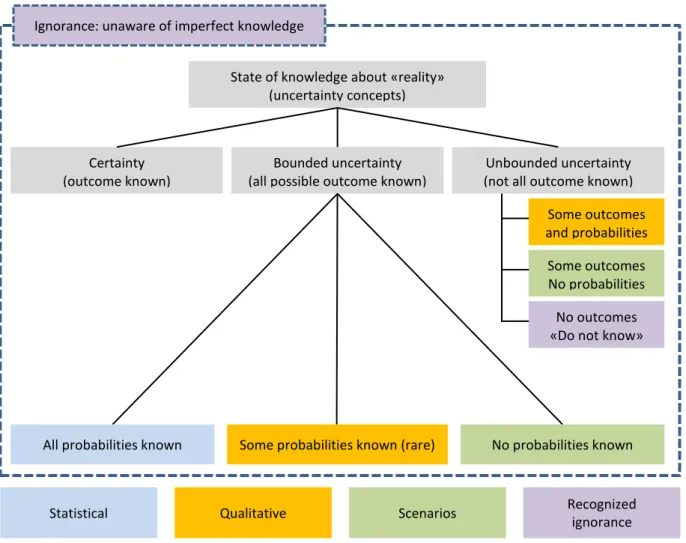
Brown (2004) proposes a similar terminology for uncertainties as Walker et al (2003), but extended by additional criteria, namely if the uncertainties are bounded or unbounded (see Figure 6). For bounded uncertainty all possible outcomes are deemed known, whereas for unbounded uncertainty some or all possible outcomes are deemed unknown. Statistical uncertainties falls into the group of bounded uncertainty, as quantitative probabilities require a knowledge of all possible outcomes. If
Statistical uncertainty Scenario uncertainty Recognised ignorance Total ignorance
Figure 6: Taxonomy of imperfect knowledge resulting in different uncertainty situations (Brown, 2004)
3.3.1 Nature of Uncertainty
Walker et al. (2003) distinguish the nature of uncertainty into the following two categories: Epistemic uncertainty: Uncertainty from imperfect knowledge
Stochastic uncertainty: Uncertainty due to inherent variability
Epistemic uncertainty can be reduced by additional studies, data collection etc., whereas stochastic uncertainty is non-reducible.
An essential point in measures for the exploration and mitigation of uncertainty is whether or not factors can be influenced by the project team. Therefore it is useful to distinguish uncertainty into the following categories:
Exogenous uncertainty stems from factors or events outside of the control of the project team. Political and commercial uncertainties of hydropower projects are typical examples for this category. Typically, this category also includes certain project uncertainties like hydrological uncertainties.
Certainty (outcome known)
Bounded uncertainty (all possible outcome known)
Unbounded uncertainty (not all outcome known) State of knowledge about «reality»
(uncertainty concepts) Ignorance: unaware of imperfect knowledge
All probabilities known Some probabilities known (rare) No probabilities known Some outcomes and probabilities Some outcomes No probabilities Scenarios No outcomes «Do not know»
Statistical Qualitative Recognized
Endogenous uncertainty stems from factors or events that can be influenced by the project team. One example in the hydropower business is inadequate high-risk allocations at the contractor’s site, which might lead to bankruptcy of the contractor. Another example is geological uncertainties some of which can be reduced by additional site investigations.
3.4
Inaccuracy of Forecast – Psychological and Political-Economic Explanations
Flyvbjerg documented in his work (2002, 2006) that large engineering projects have significant inaccuracy in forecast of costs, demand etc. Based on large data samples of projects, he argues that the main reasons for this inaccuracy are optimistic bias and strategic misrepresentation. These psychological and political-economic explanations much better account for inaccurate forecasts than technical explanations.Technical explanations for forecasting errors, such as imperfect techniques, inadequate data, honest mistakes, inherent problems in predicting the future, lack of experience on part of forecasts, are not sufficient to explain biased errors in forecast.
Strategic misrepresentation summarizes the effect when forecasters and planners overestimate benefits and underestimate costs for strategic reasons in order to increase the likelihood of obtaining the necessary approval and funding for their projects.
Optimistic bias is a cognitive predisposition found with most people to judge future events in a more positive light than is warranted by actual experience.
Figure 7: Inaccuracy of forecast
Ansar et al. (2014) applied the “outside view” to data of large hydropower projects and describe systematic cost underestimations. Strategic misrepresentation and optimistic bias are the explanations for these unexpected high cost overruns.
The “outside view” allows an estimation of uncertainties, including also psychological and political-economic effects. Therefore it is based on the assumption that the range of observed data is a reasonable proxy for the future, but this is not true for some of the factors influencing the performance of hydropower projects. Especially for uncertainties in terms of hydrology under the
Strategic misrepresentation Optimistic bias Technical inaccuracy Inaccuracy of forecast
Another disadvantage is that the “outside view” approach limits the possibility of analyzing the underlying causes and the relationships between uncertainties – a crucial condition for the application of exploration or mitigation measures.
3.5
The Project Team
The available knowledge and experience in a project team is an essential criterion for the description of uncertainties for a specific hydropower project. A project team, including developer, owner, owner’s engineer, contractors’ engineers, contractors etc., may not have or represent the full extent and current state of knowledge and experience in the field of hydropower or for a specific project. A gap might exist between the knowledge in the project team and the state of knowledge in relevant disciplines of hydropower projects. There may be a host of factors that are currently unknown in the project team but that would in fact be knowable, if the right resources and analyses were done. Since the available information in a project team has a major influence on the extent of uncertainty, the categories of uncertainties have been extended by the concept of the known known, known unknown, unknown known and unknown unknown. This wording is from the Secretary of State Ronald Rumsfeld and it allows to distinguish the knowledge or competence of a project team. A typical example is the unavailability of information on site-specific issues. Hydropower projects are often developed over several decades. The project team may change over such long periods with only part of the information being documented or otherwise available for the design team in a later design stage. This can lead to a gap between the theoretically available knowledge and the actually available knowledge in the project team and can be best described as the “unknown known”.
This may be an issue not only for projects with a long project development history. Projects with very limited resources can face similar issues. The limited engineering budget does not allow to incorporate all required technical disciplines and site investigation may be avoided, as is often the case at small hydropower projects. For example, an electrical engineer has to prepare the hydrological study which can lead to significant errors in the forecast, as he is not familiar with this discipline. The resulted uncertainties falls into the category of “unknown known”.
3.6
Conclusions
The main points described in this chapter are summarized as follows:
As risk is typically associated with potential adverse effects in the hydropower community, the term of uncertainty is preferred over the term of risk.
Uncertainty in this work covers both tails of the distributions around engineering projects (threat and opportunity) and is defined as lack of certainty (Ward and Chapman, 2003) Psychological and political-economic factors need to be taken into account for the analysis
of inaccuracy forecasts in hydropower projects.
the project team, as they might not match with the state of knowledge in relevant disciplines of engineering.
Uncertainties of Hydrology and
Electricity Price
4.1
Introduction
Uncertainties in hydrology and electricity price are affecting several hydropower projects around the world. This chapter provides a description and outlines the possible magnitude of these uncertainties.
Climate change as one of the driving factors of hydrological uncertainties has been given a lot of attention during the last few decades of research. Therefore, this chapter includes a review and a retrospection on the accuracy of climate change forecasts.
The other factor described in this chapter is electricity price, regarding the current market situation and the main issues for deriving accurate forecasts. Retrospective analyses were carried out to indicate how accurate historical electricity price predictions have been.
4.2
Hydrological Uncertainty
In general, hydrological uncertainties affecting the performance of hydropower projects can be distinguished into the following categories:
Flood damage during construction and operation phase Short-term variation of inflow
Long-term variation of inflow
4.2.1 Flood Damage during Construction and Operation Phase
Flood damage during construction and operation phases can have a significant impact on the performance of a hydropower project. Delays during the construction phase are often related to problems with river diversion. In extreme cases, physical damage during the operation phase can even mean end of operations, i.e. end of asset lifetime. However, the management of these uncertainties is not related to global design parameter choices and thus is not considered in this study.
4.2.2 Short-term Variation of Inflow
The uncertainty of short-term inflow variation has typically two components: epistemic uncertainty and stochastic uncertainty. The epistemic uncertainty can be reduced by additional hydrometric measurements to prolong the available time series and thus improve the hydrological analysis or model. However, there will always remain the stochastic uncertainty, which is related to the stochastic and chaotic nature of rainfall-runoff process and weather phenomena.