Development of Internal Domain-Specific Languages:
Design Principles and Design Patterns
Sebastian Günther
A great part of software development challenges can be solved by one universal tool: Abstraction. Developers solve development challenges by using expressions and concepts that abstract from too technical details. One especially supportive tool for abstraction are domain-specific languages (DSLs). DSLs are specifically crafted languages that support abstraction in two ways. On the one side, they abstract from the (real-world) concepts of the domain by introducing objects with structure and behavior that are representative for the domain. On the other side, they abstract from a programming language and do not depend on hardware-specific details. We focus on internal DSLs, which are build on top of an existing host language. Such DSLs can completely use the development tools of their host, are quick to build because they reuse existing abstractions, and can be easily integrated with other programs, libraries, and DSLs of the same host.
This paper’s contribution is a set of six DSL design principles and a catalog of DSL design patterns. We differentiate into three types of patterns: Foundation patterns, which provide a DSL’s basic objects and operations, notation patterns, which provide the overall layout of the DSL and help to design individual expressions, and abstractions patterns, which help to implement the domain-specific abstractions. Each pattern identifies a development context, design goals that support the design principles, a general solution and a concrete example. To show the applicability of our research results, we document the pattern utilization in 12 other DSLs for the selected host languages Ruby, Python, and Scala. Finally we extend the patterns towards a pattern language by detailing the relationships between the patterns and by showing how other patterns can be incorporated with our patterns.
A Note to the Reader
This paper is a shortened summary of the authors PhD thesis, intended to be self-sufficient. The main focus of the thesis is to provide an extensive amount of syntactic and semantic patterns to develop internal DSLs.
For the workshop, we wish to have a focus on sections 3–5 (around 16 pages) which explain the DSL design principles and three selected syntactic patterns. Sections 2 and 6–7 are illustrating the bigger picture of this work.
We assume our readers to have a basic understanding of what a DSL is. Section 2 can give unfamiliar readers an introduction to this field. Furthermore, to understand the patterns that we suggest, we assume our readers to have at least 1 year programming experience with a dynamic language such as Ruby, Python, or Scala. Helpful, but not required for the patterns explained in this paper, is to understand the metaprogramming concepts of the chosen programming language.
Categories and Subject Descriptors: D.3.3 [Programming Languages]: Language Constructs and Features—Patterns
General Terms: Languages
Additional Key Words and Phrases: domain-specific languages, embedded languages, dynamic programming languages, Ruby
Author’s address: Sebastian Günther, Software Languages Lab, Faculty of Sciences, Vrije Universiteit Brussel, Pleinlaan 2, B-1050 Brussels, Belgium, email: [email protected]
Permission to make digital or hard copies of all or part of this work for personal or classroom use is granted without fee pro-vided that copies are not made or distributed for profit or commercial advantage and that copies bear this notice and the full cita-tion on the first page. To copy otherwise, to republish, to post on servers or to redistribute to lists, requires prior specific permis-sion. A preliminary version of this paper was presented in a writers’ workshop at the 18th Conference on Pattern Languages of Pro-grams (PLoP). PLoP’11, October 21-23, Portland, Oregon, USA. Copyright 2011 is held by the author(s). ACM XXX-X-XXXX-XXXX-X PLoP’11, October 21-23, Portland, Oregon, USA. Copyright 2011 is held by the author(s). ACM XXX-X-XXXX-XXXX-X
1. INTRODUCTION
Domain-specific languages (DSLs) are versatile tools that help to solve one of the biggest challenges in software development: to express development concerns with suitable abstractions. This centralmotivationprovides the start of our research. As we will see, there are two forms of DSLs: External DSLs and internal DSLs. In this paper, we focus on internal DSLs: Because an already known host language can be used by the developers, familiar notations and abstractions can be used to design DSLs, and the embedding and absorption of DSL expressions into application code or into each other is simpler. Based on this observation, we shortly define theknowledge gap
that existing literature and research does not cover. We fill this gap with the contents of this paper, for which we provide an finaloutline.
1.1 Motivation
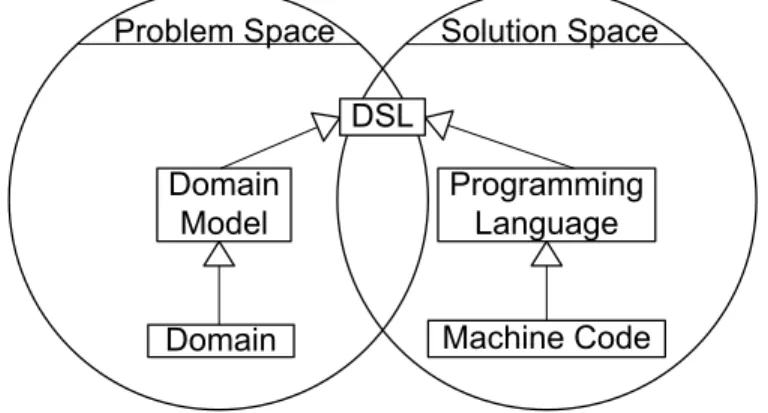
Domain-specific languages (DSLs) are tailored towards a specific application area [84]. They use appropriate abstractions and notations to represent the domain [85]. Abstractions are the essence why DSLs support software development concerns. Software development means to formulate the concepts of the problem space (domain model) as concepts of the solution space (application components) [27]. In the problem space, domain concepts and their relationships are represented as a domain model. In the solution space, domain concepts are typically represented as objects and methods of a programming language, or other suitable constructs. This facilitates to test, build, and deploy applications. DSLs close the gap between the problem space and the solution space by providing abstractions that bridge both spaces (seeFigure 1).
Domain
Model
Domain
Programming
Language
Machine Code
Solution Space
Problem Space
DSL
Fig. 1. DSL’s are abstractions from the problem space and the solution space simultaneously.
DSLs are credited with effects such as increased productivity, efficient code-reuse, reduction of errors and the focus on the problem space [27][37]. Challenges associated with DSLs are the need to combine domain knowledge and language development expertise, which is hard because few developers have both [60]. Also, language support and standardization are missing [60] and the potential maintenance costs [65] can be very high. There are two kinds of DSLs: external and internal ones.External DSLsrequire building the language from scratch, with custom syntax and semantics. This comes at the cost of implementing the needed compilers/inter-preter and other tools by oneself or with the help of a language development environment. On the contrary,internal DSLsare built on top of an existing programming language, also called the host language. This allows to use the complete existing language infrastructure [60], including compiler and interpreter.
In general, DSLs should be developed only if they are expected to have a profound impact on development productivity and are reused in future developments [60]. But in comparing the two types, we see that developing
external DSLs requires much more effort than those of internal DSLs – even if a language development environment is used:
(1) Developers have to learn a new tool that needs to be integrated into the current tool landscape, with all common maintenance burdens.
(2) Developers need to learn at least one formal language to express the syntax and semantics of the DSL. However, most developers have difficulties in applying formal specifications [76].
(3) Since the external DSL gives total freedom, no fixed scheme exists and language creation becomes a strenuous activity that only experienced developers are able to master.
(4) Once finished, the external DSL requires high maintenance. Evolving an external DSL includes modifying its artifacts: surface syntax, the code generator, the generated code and the interaction between the generated code and the application it is used in. Changing one artifact may lead to cascading changes in the others too.
(5) Finally, using the developer’s time just to learn a new language can be a waste if they still have much to learn about the main programming language used to implement most of the program artifacts. Better understanding of the main programming language can lead to better productivity.
If developers sacrifice the total freedom of designing an external DSL, but embrace the challenge to implement an internal DSL, then these problems diminish. Internal DSLs are built by modifying or extending the host language’s semantics and by exploiting syntactic variations. The effects of using an internal DSL compared to an external DSL are:
(1) The DSL gains better acceptance by the developers and is simpler embodied in application development, because it is based on a known host language and uses abstractions familiar to the developers.
(2) The host language provides a familiar frame for designing DSLs. Embracing the restricted syntax and semantics of the host language is a good way to promote language design creativity.
(3) No new tools have to be learned or added. Quite the contrary, because DSL expressions are also expressions of the host language, basic IDE support is given. Extensible IDEs, such as Eclipse, also allow custom syntax highlighting and code completion. This can be exploited to facilitate programming with the DSL.
(4) Using and especially designing DSLs can help the developer to better understand the host language. Under-standing the type system, semantics, and metaprogramming capabilities of a language certainly improve the developer’s skill and productivity for non-DSL usage too.
(5) Finally, because the DSLs are all based on the same host language, the embedding and absorption of DSL expressions into application code or into each other is simpler. This allows building multi-DSL applications which profit from the effective collaboration of several DSLs [41].
In summary, although internal DSLs are restricted in their syntax and semantics, they provide the following benefits: Less expensive to build, more likely to be accepted, and easier to incorporate into proven development techniques, development processes and tools. For these reasons, the dissertation focuses on internal DSLs. If not explicitly mentioned otherwise, we refer to internal DSLs when we speak of DSLs.
1.2 Knowledge Gap
Although internal DSLs can provide several remedies for todays challenges in software development, there are several knowledge gaps that need to be overcome. Despite the question how to develop them with a process, which we do not tackle here in order to provide a clearer focus, the two main gaps are the DSL design principles and the DSL design patterns.
–DSL design principles: DSLs have unique properties that are difficult to express as principles for guiding the DSL development. Most internal and external DSL case studies such as [38][81][9][1][28][11][50] do not discuss design principles or explain their DSL’s design properties. Existing work on principles uses different names and explanations for similar concepts. For example, there are principles about designing notations for
visual constructs [23][63], for building abstractions [53], for programming language design [62], or specifically for DSLs [67]. We propose a set of principles that are originating from the definition of DSLs, and we analyze and compress the principles mentioned in other works. These principles form a coherent vocabulary to discuss the design of DSLs.
–DSL design patterns: Finally the question remains how to actually implement the DSL on top of an existing programming language. Most case studies do not generalize their approach and mix host language characteris-tics, as well as language constructs, metaprogramming and design considerations. The case studies suggest to use host language specific metaprogramming methods [26], internal interpreter objects [28][75], object-oriented programming constructs, in particular methods [18][1], or even the host’s metaobject protocol for implementing a DSL [28][24]. We provide a thorough analysis and description of the different mechanisms in the form of patterns. Our patterns record the context, problem, and solution of DSL design challenges and are used in DSLs based on Ruby, Python, and Scala.
The patterns are the essential contribution in this work. Patterns help to understand recurring design problems and their solutions. Moreover, as we see soon, they are essential to communicate DSL solutions independent of the host language, because existing case studies talk of very language specific techniques and mechanisms they use, which are hard to take to another implementation or host language.
1.3 Outline
This paper is structured as follows. InChapter 2, we provide additional material on the definition of domain-specific languages.Chapter 3 includes our first contribution: the design principles. Following this,Chapter 4 explains how each pattern is defined and gives a short outline to all patterns. In Chapter 5, we explain the patterns that were selected for this paper: The notation patterns BLOCKSCOPE, METHOD CHAINING, and KEYWORDARGUMENTS. To show the applicability and the actual usage of our patterns,Chapter 6 shows several DSL case studies and details where and how the patterns are used.Chapter 7 shows how to evolve the patterns to a pattern language by giving rich information about the relationships of the patterns to each other and by presenting a list of design questions that developers can follow to design a DSL. Finally,Chapter 8 summarizes our paper.
We use the following typeset to distinguish difference concepts:keyword,source code,PATTERN, and subpat-tern.
2. DOMAIN-SPECIFIC LANGUAGES
DSLs are versatile tools that are effective to cope with today’s development challenges. This chapter explores DSLs in more detail. We start to give thehistoric perspective and definition, where we see that the idea to provide custom, specialized languages was and is an ongoing concern in software engineering research. Based on the large amount of research, severalDSL properties and typesneed to be distinguished. We provide a morphological scheme that lists the most important properties and their individual characteristics. Finally, we complete the exploration of DSL utilization by discussing therole of DSLs in software development approaches, such as model-driven development and generative programming.
2.1 Historic Perspective and Definition
The term domain-specific language can be seen from very different perspectives. We think that each perspective is reflected in the different concepts that contribute to today’s understanding of DSL. In a period of about 40 years, the following concepts were introduced in the literature:
–Specific Language: As early as 1966, the idea to separate the appearance of programs from the underlying abstract entities was introduced. This concept facilitates the provision of a family of languages with individual
members called specific languages. The family is described by similar logical structures and categories, while the specific languages have a physical representation that is tailored towards it’s application area [56]. –Domain Language– In correspondence with the discovery of the term domain and it’s fundamental influence on the application development, the term domain language was introduced. By analyzing the domain, developers derive a domain model that is expressed using a domain language. This language has a declarative character and uses the entities and actions of the domain as words. With the help of the domain language, system components are expressed declaratively and in later development steps made executable by transforming the language into another format [66].
–Little Language: These languages point out the importance of a distinguished representation for specific problems. Little languages are focused on the user, they utilize expressions that are clearly expressing the intent of expressions. Such languages are often implemented with suitable preprocessors in order to reduce the effort of writing complex compilers. Therefore, little languages are typically transformed to an intermediate form that is the input to another tool or that is used to generate an executable form [12].
–Domain Specific Language: Finally around 1998, the aspects of forming specific representations for a domain and implementing them as languages merged to the term domain specific language. These languages are defined as a “programming language tailored for a particular application domain” [52]. Through appropriate notations and abstractions, DSLs are directed at their domain [85][51][6] and have a high expressiveness [85][81].
By following all above consideration, and especially emphasizing the importance of domains, we define DSLs as follows:
A domain-specific language is an artificially created language that, through suitable abstractions and notations, embodies syntax and semantic that represents the concepts, attributes, operations, and relationships of a domain as an interpreted or compiled computer language.
Because the DSL is a representation of the domain and executable as well, we also say that a DSL is an executable domain model. Based on this definition, we now explain the different types of DSLs.
2.2 DSL Properties and Types
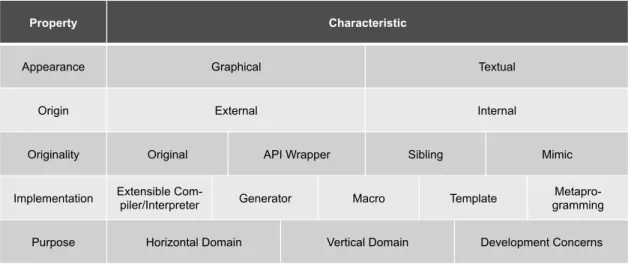
The long history of DSLs leads to a high number of DSLs that can be identified. We studied their properties, and found five defining properties:appearance,origin,originality,implementation, andpurpose. These properties, and their characteristics, form a morphological scheme (Figure 2). Each property is detailed in the following subsections.
2.3 Appearance
A DSL’s appearance determines its surface syntax. Graphical DSLs consist of abstract symbols and drawings to express the relationship between domain concepts. Textual DSLs use mostly literal characters and mathematical symbols to express their meaning [20].
2.4 Origin
The origin of a DSL determines if the language is developed independent from other languages or whether it is based on top of another language. External DSLs require that their interpreter or compiler is written specifically for this language. This means to separately develop the basic syntax, the expressions and tokens, and their semantics. Internal DSLs use an existing host language to build their abstractions and notations. They can reuse the complete host language infrastructure, but are bound to the syntactic and semantic constraints of the host.
Property Characteristic
Appearance Graphical Textual
Origin External Internal
Originality Original API Wrapper Sibling Mimic
Implementation Extensible Com-piler/Interpreter Generator Macro Template gramming
Metapro-Purpose Horizontal Domain Vertical Domain Development Concerns
Fig. 2. Morphologic scheme for identifying DSL types. 2.5 Originality
Originality is the degree to which a DSL uses an existing language or library. At the one hand, it can be a complete original, and on the other hand, it can mimic an existing language.
–Original: An original language encapsulates a domain that is not represented yet by another language or by a library.
–API Wrapper: In software engineering, libraries are written in one concrete programming language and can be reused in accordance with their application programming interface (API). This fixed form can be wrapped by a DSL by combining the methods of the API to a language that is more versatile in its application. This kind of DSL is also called fluent API or liquid API [17].
–Sibling: The DSL copies parts of the syntax and semantics of an existing language. –Mimic: The DSL mimics the concepts and expressions of an existing language. 2.6 Implementation
DSL literature provides a pile of different implementation techniques [27][85][88][78][60][26][28]. We consolidate these techniques1into the following five items ordered according to the required implementation effort.
–(Extensible) Compiler/Interpreter: Compiler and interpreter provide full support for source-to-source transfor-mation. They check the input for several conditions, and either generate machine executable artifacts or create an in-memory representation of the program. For an external DSL, the compiler/interpreter has to be written. In the case of an internal DSL, the existing compiler/interpreter can be extended. In this case, especially the implementation of an interpreter can be modified or in the case of a high-level language like Smalltalk, the internal representation of a program in the form of the abstract syntax tree can be modified [70].
–Generator: A generator is a sophisticated tool that maps an arbitrary input stream to an arbitrary output stream [27]. Generators are implemented external to the programming language and typically use abstract
1We do not explicitly cover two-level languages [27] or multi-level languages [36]. The basic concept of such languages is that the compiler of an earlier stage produces the compiler for the next stage, thereby changing the semantics of statements. This allows optimizing the code with respect to the domain. Each level could use one or several of the presented mechanisms to perform this compiler generation for the next level.
representations of the components. In contrast to compilers and interpreter, generators just produce the code but do not execute them.
–Template: Templates2are used to represent a computation in a form that is independent of the concrete
implementation. Before a template is executed, it needs to be transformed in a target language. There are two options for this transformation. First, using apreprocessor that is external to the target language and which can be realized, for example, by utilizing string processing tools of an existing language [8] or parser combinators [75]. Second, a program can implement the quasi-preprocessing of code as an object that actively transforms the template into the internal format or interprets and reacts according to the input – this technique is called
internal interpreter.
–Macro: Macros are similar to templates, a technique that facilitates the separation of the physical repre-sentation of some source code from its internal form. The difference, however, is that the semantics and transformation of macros is always defined as a part of the programming language they are defined in. In Lisp for example, macros are a set of compiler directions and host language syntax [72]. Macros are often used to extend the host language with new constructs [10], which can be used to build DSLs [83].
–Metaprogramming: The general definition of metaprogramming is that of code that writes code [27]. However, this broad meaning would encompass all above mentioned tools. In the context of this dissertation, we speak of metaprogramming as the capabilities of a programming language. With this narrowing, metaprogramming supports two tasks:Introspection, which is the analysis of a program’s internal structure, for example its classes and methods, andintercession, which is the capability to modify the given behavior [19]. In statically typed languages like C++, metaprogramming can be done via C++ templates3for defining DSLs [27]. In dynamically typed languages like Ruby and Python, metaprogramming even allows to change the behavior of built-in objects and methods. Metaprogramming aims at “the creation of new abstractions that are integrated into the host language" [82].
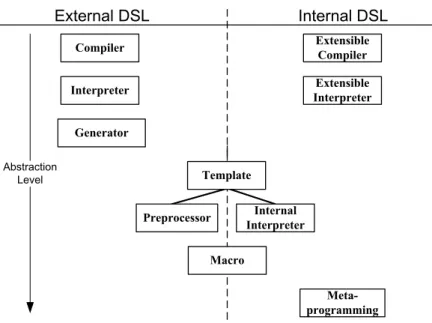
Figure 3 orders the implementation mechanisms along two dimensions: horizontally into whether they support external or internal DSLs, and vertically according to the abstraction level. While modifying the compiler or interpreter involves understanding the complete transformation process, macros, templates, and metaprogramming are more abstract, require less knowledge to use, and thus facilitate DSL development. Metaprogramming is especially powerful, as it can be used as a strategic tool for software composition and evolution [59], because of its high abstraction level. A special type of metaprogramming is to introspect and modify metaobjects that represent classes, functions, and instances of a language. The sum of all functions that access metaobjects is called the metaobject protocol [54], which is the mechanism with the highest abstraction level to modify the behavior of a language. In order to reduce the effort in designing and implementing DSLs and to build upon existing knowledge of developers, we focus our research on metaprogramming mechanisms.
2.7 Purpose
We identify three purposes of a DSL: supporting the implementation of a horizontal domain, a vertical domain, or a development concern.
Domains can be distinguished into horizontal and vertical domains [27].Vertical domainsare business areas like aviation control, portfolio management, and order processing system.Horizontal domainsare system parts or components like the GUI, database, and workflow system. Both domains can have arbitrary subdomains. The horizontal parts can be detailed, such as different database adapters, database schemes, or components like transaction management and more. Vertical domains can be further divided, for example the aviation control into subsystems that track the movement of air cargo, touristic flights, and military vehicles. A DSL can also 2Here, templates are meant in a generic form and not the specific form of C++ templates. In C++, templates are used as class or function template to abstract concrete type information until the code is bound and compiled for a specific type [27].
External DSL
Internal DSL
Compiler Interpreter Extensible Compiler Extensible Interpreter Meta-programming Internal Interpreter Preprocessor Macro Generator Template Abstraction LevelFig. 3. DSL implementation mechanisms.
support generaldevelopment concerns. Considering the development phases, we can use DSLs to support the specification, testing, and deployment of applications. Considering programming paradigms, some DSLs extend the available paradigms that can be used to structure a program. The following lists give some examples for the different DSL purposes. Vertical Domains – Financial products [4] – Video processing [81] – Healthcare systems [64] – Telephone services [57]
– Magnet tests for the Large Hadron Collider at CERN [5] – IT infrastructure management [45]
Horizontal Domains
– Structure of webpages with HTML – Ruby: HAML4and Markaby5 – Python: DAML6
– Layout of webpages with CSS – Ruby: SASS7and LESS8 – Python: CleverCSS9
– Database schema and queries with SQL-like language 4http://haml-lang.com 5http://markaby.rubyforge.org/ 6http://github.com/dasacc22/DAML 7http://sass-lang.org 8http://lesscss.org 9http://pypi.python.org/pypi/CleverCSS/
– Ruby: Active Record10and DataMapper11 – Scala: ScalaQL [77]
Development Support
– Test/Unit (Ruby, test-driven development)12
– Unittest (Python, test-driven development)13 – RSpec (Ruby, behavior-driven development)14 – Capistrano (Ruby, web application deployment)15
– rbFeatures (Ruby, feature-oriented programming) [47][46] – Aquarium (Ruby, aspect-oriented programming)16 – Context-Py (Python, context-oriented programming) [3] – Actor (Scala, built-in, concurrent programming) [48]
– Python-Constraint (Python, constraint-oriented programming)17 2.8 Role of DSLs in Software Development Approaches
One goal of DSLs is to increase the developer productivity and the reusability of source code. These goals are also shared by the following approaches: language-oriented programming, model-driven development, generative programming, and software factories. Each of the approaches is discussed in the following paragraphs, and we explain the (potential) role of DSLs in each approach.
Language-Oriented Programming
Language-oriented programming (LOP) is more of a paradigm than a concrete software development method, which emphasizes the idea to use a custom language for supporting software development or expressing a particular application domain [29]. This makes the connection between LOP and DSL obvious: In order for LOP to express the software in “terms of concepts and notifications of the problem”, DSLs are created and used to develop the application [86][29]. Using DSLs, which are understood here as “domain oriented, very high level [...] languages” [86], leads to better separation of concerns, higher development productivity, and maintainable designs because of fewer lines of code [86].
Model-Driven Development
Representing all concerns and requirements as common source code can get very complex for bigger applications, with possible negative impact on maintenance and evolution. Model-driven development (MDD) engages this problem by providing novel representations that describe and generate software with abstract models [79]. MDD helps to increase the development velocity and quality, to reduce redundant code and to better cope with changes and reusability [79]. Models are not only used for representation, but also for automatizing the build and deployment process of applications [37].
MDD is a transformation-based software development approach that uses graphical and textual models [79]. Graphical models can be based on UML [32], where stereotypes and annotations provide information that is rich
10http://rspec.info 11http://datamapper.org 12http://ruby-doc.org/stdlib/libdoc/test/unit/rdoc/ 13http://docs.python.org/library/unittest.html 14http://rspec.info 15http://github.com/capistrano/ 16http://aquarium.rubyforge.org/ 17http://labix.org/python-constraint
enough to generate concrete source code. For textual models, external DSLs are typically used. A MDD project can combine both graphical and textual models which are ultimately transformed into source code.
Internal DSLs play a neglecting role in MDD: only some case studies report on using internal DSL for the transformation process, such as [25].
Generative Programming
Generative programming is a holistic software development approach that aims to provide and structure a large asset base to form a product line. Three concepts are fundamental in this approach. Theproblem spacedescribes the real-world domain that consists of domain-specific concepts and features. Thesolution spaceis the domain of computer components and other artifacts that implement a program. In developing software, the problem space is mapped to the solution space by usingconfiguration knowledge. This knowledge is based on the structure of the components and how their combination, construction, configuration and optimization can be used to implement the program specified in the solution space [27].
Generative programming is concerned with providing generative components that are accessible for various configuration options. Implementing these components by using DSLs is a viable option. The other use-case for DSLs mentioned in [27] is to provide the mapping of a problem space specification to the solution space.
Software Factories
Software Factories is an approach that strives for a high amount of automization and low costs in creating software [35]. A software factory is defined as a “software product line that configures extensible tools, processes, and content using a software factory template based on a software factory schema to automate the development and maintenance of variants of an archetypical product by adapting, assembling, and configuring framework based components” [37].
Assembling a software factory and producing software requires three steps. At first, various software artifacts are gathered, similar to the collection of assets for a software product line. Then, a factory schema is developed that completely maps requirements and functionality to the software artifacts. Finally, a template for the factory is created and configured for producing a concrete application [37].
DSLs are supportive of the software factories approach: They can be used to express software artifacts, or used to express the requirements to artifacts mapping in the factory schema.
2.9 Summary
This chapter explained important background information about DSLs. We started with a historic perspective where we identified four different conceptual understandings of DSLs. Each concept contributes to our understanding: A DSL is a compiled or interpreted language that represents the domain concepts with suitable abstractions. Over the course of time, various DSL properties were developed, which we compressed into five defining properties: appearance, origin, originality, implementation, and purpose. With the morphological scheme that we introduced, a DSL can be identified along these characteristics. Finally, we explained the role of DSL’s in other software development approaches, where we saw that they are especially supportive for generative programming and software factories. Now, the next chapter details the research need for internal DSLs.
3. DESIGN PRINCIPLES
Design principles provide a structured approach to develop DSLs in a specific manner. In the chapter, we present the following six principles:Abstraction,Generalization,Optimization, andNotation,Absorption,Compression. Although the principles have no fixed order per se, they can be regarded like this: The DSL’s syntax is developed to express domain-specificabstractionswith suitablenotations. First, the necessary concepts aregeneralizedout of similar concepts in the domain, and domain-specificoptimizationare applied for their behavior. Then, the resulting
language can be furthercompressed and obvious expressionsabsorbed into the DSL. Following paragraphs further explain the principles.
Abstraction
Goal: Implement domain concepts as abstractions to deemphasize technical details.
DSLs abstract twofold: From the domain and from their host language. Abstracting from the domain is to include only those entities and operations in the language that are relevant. This means to provide “crisply defined conceptual boundaries” [13] to find entities that “fit the domain closely” [6]. Abstractions from the host language means to combine common, recurring patterns [16][30] in one form. We find abstractions for DSLs at the base level and at the meta-level. On the base level, the host’s basic operational model â ˘A ¸S- expressed by the existing language constructs – is extended with novel expressions. At the meta-level, the existing construct’s behavior is modified or extended. Both forms of abstractions are fundamental for DSLs since they have to step away from the language in order to step towards the domain.
Generalization
Goal: Reduce the amount of concepts by replacing a group of more specific cases with a common case.
Generalization is an important concept in domain engineering and in software engineering. First, the domain is captured in its full scope consisting of multiple concepts and their relationships. They naturally form a hierarchy in which one concept is more general than other specific concepts. Finding such hierarchies helps the developer to understand the domain. Generalization keeps DSLs small as the reduction of the amount of concepts results in a small amount of needed constructs [21]. For the DSL’s syntax, this means to design the language around common concepts. For the DSL’s semantic, the developer then chooses how to prune, reorganize, and combine the concepts in order to express generic and specific cases, using mechanisms such as object-oriented programming. Optimization
Goal: Implement algorithmic optimizations to improve the DSL’s computational performance.
Producing efficient code is an essential characteristic of programming languages. According to [67], DSLs allow two forms of optimization. The first form is the implementation level, for example optimizing the memory allocation. This optimization is included in the DSL that uses the host language. Then, on top of the implementation, domain optimizations can be implemented by choosing suitable abstractions [67]. This means to choose efficient algorithms and data structures [27]. Optimization improves the computational performance by using suitable models and domain-knowledge with an efficient implementation [15].
Notation
Goal: Represent domain-specific concepts with suitable, clear distinguished entities.
A DSL’s syntax is the sum of the host’s syntax and the domain-specific notations. The syntax consists of all language constructs, keywords, structures, and the rules governing their combination. The rules determine the general layout of the language. Thereby, a “trade-off between naturalness of expression and ease of implementation” [12] has to be made. Internal DSLs cannot leave the syntactic frontiers of their host language, but they can chose to combine existing syntactic modifications to achieve a form that has little or no resemblance to the host language. Providing the appropriate notations [85] through defining clear distinguishable and representative entities defines the DSL’s syntax.
Compression
Goal: Remove tokens and keywords that have no meaning in the domain.
The goal of compression is to provide a concise language that is sufficiently verbose for the domain experts. By reducing the amount of expressions or by simplifying their appearance while the semantics are not changed, the
code footprint of DSL programs is reduced. This leads to better understanding the application language and the domain [55][87].
Absorption
Goal: Absorb domain commonalities into the DSL expressions to facilitate DSL usage.
Characteristic properties of domains are commonalities for a broad set of expressions. Users are supported effectively if these commonalities are absorbed by the language, which means that certain assumptions and concerns are not required to be explicitly expressed. DSLs with high absorption support the user by capturing these assumptions implicitly, relieving him of the burden to repeat himself. This is in stark contrast to a traditional library, where functions are dependent on each other, require a manual setup of the context, and have a restricted call order. The best example for an high amount of absorption are declarative DSLs that just describe a desired state, and the DSL’s implementation uses all explicitly and implicitly given information to effectuate this desired state. Absorption provides DSLs implicit focused expressive power [80] by implicitly integrating domain commonalities in the DSL.
4. PATTERN STRUCTURE
In this chapter, we start with explaining thepattern structurewith which each pattern is presented in the following chapters. This structure helps readers to quickly learn the patterns, where one important part is to show the patterns applicability in the context of one of thecommon examples. To let readers quickly browse through the patterns, we conclude this chapter with apattern overview.
4.1 Pattern Structure
The pattern explanation has a structure that is close to the initial introduction of patterns [34] and recent publications [39; 22; 89]. To show the applicability of the patterns, we research how they can be utilized in three different host languages. We select the two dynamic host languages Ruby and Python because of their popularity as listed with the Tiobe language popularity index18and the large number of DSL projects as listed with Github19. As a contrast, we also use the compiled programming language Scala which is not so popular on Tiobe, but has several DSL projects listed on Github, and even includes a DSL in its core contribution.
The following structure is used to explain each pattern: –Name: The name of the pattern.
–Also Known As: Some of our patterns use an existing foreign pattern to put it into the context of domain-specific languages. Such patterns are introduced with “Also known as”. Foreign patterns that are similar to one of our patterns that we published first and earlier in our works [40][43][44] are introduced with “Also defined in”. –Context: Explains a particular design or implementation scenario in which the application of the pattern is beneficial (note that the context follows right after the name, without an additional heading).
–Problem: A question that raises a common challenge in DSLs, and an explanation of how the challenge negatively effects the DSL.
–Design Goals: Explains explicit design goals and DSL design principles that are achieved by applying this pattern. Usually, one pattern can be used to support different principles. In some cases, one pattern can be used in two distinctive ways to support a principle, which we document both.
–Solution: A general advice what to do, followed by a source code example illustrating the patterns application, and than a detailed explanation of the solution and its host-language specific implications.
18http://tionbe.com 19http://github.com
X
define_method :method do ...end
Executed code attached to the respective object using a dashed line Represents the border between two program statuses
Method or symbol pointer Blocked method or symbol pointer Class/instance relationship
Object Objects; changed objects are depicted
as Object’
Class/subclass relationship Module/inclusion relationship
«Module»
Modules; changed modules are depic-ted as Module’
Class
-#local_variable -class_variable
Classes; changed classes are depicted as Class’, and changed methods are depicted as method’
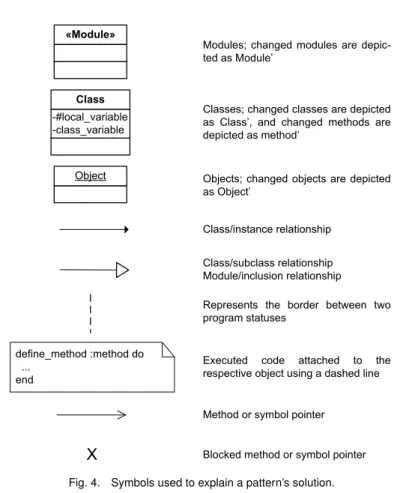
Fig. 4. Symbols used to explain a pattern’s solution.
–Example: Based on the common examples that are explained shortly, a detailed utilization of the pattern using the Ruby programming language is given. Source code examples and sometimes diagrams provide further illustration (seeFigure 4 for the used symbols).
–Liabilities: Explains potential pitfalls and tradeoffs when this pattern is applied.
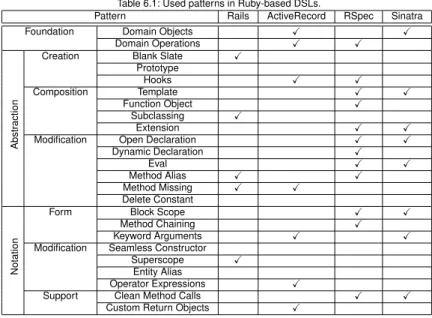
–Known Uses: Explanation of a pattern’s occurrence and the particular meaning it has in the context of a DSL. We list at least one occurrence per host language, as long as the pattern is available in the language (we do not document all pattern occurrences for all DSLs). We choose to analyze the following DSLs:
–Ruby
–Rails(version 2.3.5) – Web-application framework with a strong Model-View-Controller architecture that provides many convenient expressions as a DSL for web applications. Rails is used in several open-source and commercial projects. This version of Rails is closely bundled with other libraries that we also analyzed:ActiveSupport (version 2.3.5) adds helper classes,Actionpack(version 2.3.5) provides request and response objects, andBuilder (version 2.1.2) is used to build configuration objects representing XML-like data structures (http://rubyonrails.com).
–ActiveRecord(version 2.3.5) – Provides database abstraction with the philosophy that an object encapsulates the data of one specific database row. Also it can be used as a standalone DSL, it is often bundled with Rails (http://ar.rubyonrails.org/).
–RSpec(version 1.3.0) – Framework and DSL for behavior-driven development (http://rspec.info). –Sinatra(version 0.9.4) – Lightweight web framework and DSL that uses declarative expressions for specifying request handling (http://sinatrarb.com).
–Python
–Bottle(version 0.8.3) – Similar to Sinatra, a lightweight web framework that uses normal Python function declarations and annotations to specify how queries are responded to in the application
(http://bottle.paws.de/).
–Should DSL(version 1.020) – Supports simple behavior-driven testing by adding expressions like should,be, andbe_greater_thenas expressions in Python (http://github.com/hugobr/should-dsl). –Cryptlang21: A DSL for defining cryptographic algorithms and random number generators [1]. –LCS DSL21– The Constellation Launch Control System DSL, or short LCS DSL, provides a command like language for “programming test, checkout, and launch processing applications for flight and ground systems” [11].
–Scala
–Actors(version 2.7.7final) – Actors is a built-in Scala DSL for asynchronous messaging, and frequently deployed for concurrent programming. It uses concepts like a messaging box and special operators to send and retrieve messages (http://www.scala-lang.org/api/current/scala/actors/package.html).
–Specs(version 1.6.2.1) – DSL for behavior driven development similar to the block-like nature of RSpec (http://code.google.com/p/specs/).
– Apache Camel (version 1.6.4) – Helps to express the configuration of enterprise systems that consist of Java-compliant applications, allowing to define routes and APIs for the components (http:
//camel.apache.org/scala-dsl.html).
–ScalaQL22: Implementation of SQL as a Scala DSL [77]. –Related Pattern: Finally, a list of closely related patterns.
4.2 Common Example
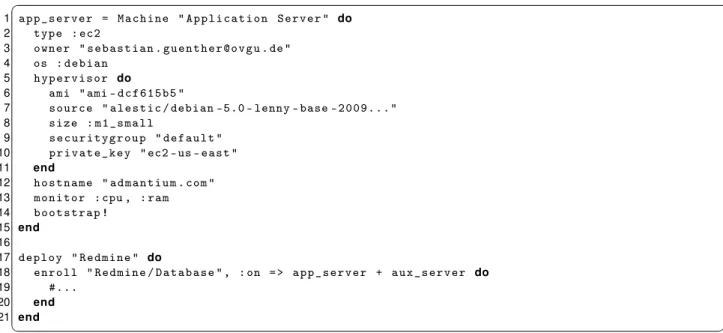
The common example used to illustrate the application of the patterns is the Infrastructure Management DSL. Infrastructure management takes care of the initialization, configuration, and maintenance of several servers forming the infrastructure of a customer. Because of continuously increasing requirements with regard to flexibility, high automatization support that limits the amount of manual involvement becomes crucial. This tasks is supported by a set of three DSLs. We use our developed Machine Description Language (MDL) and the PCML (Package Configuration Management Language) from [49] for examples.Figure 5 shows an example for the MDL and the PCML, with the following meaning:
–Line 1–15: An example of the MDL that opens a constructor, sets the default name, and passes other configuration options in the form of a block.
–Line 2–4: Configures the type, owner, and the operating system of this machine.
–Line 5–11: A nested block that specifies the hypervisor-specific options, like the Amazon23machine image (ami) id and its source, the size, the security group (the security group determines the available services and the open ports of the machine, such as SSH on port 22), and the private key used to access this machine via SSH.
–Line 12: The hostname of the machine which is used inside the network. –Line 13: Expresses to monitor the CPU and RAM usage of this machine.
20The version 1.0 was submitted on June 17th, 2009, we use the more recent commit with the id 1725b62ad30195f578a4, issued on July 15th, 2010.
21For these DSLs, we do not have access to the source code. While we can analyze the expression for notation patterns, foundation patterns and abstraction patterns can only be checked in a limited way.
22For this DSL, we do not have access to the source code. While we can analyze the expression for notation patterns, foundation patterns and abstraction patterns can only be checked in a limited way.
1 a p p _ s e r v e r = M a c h i n e " A p p l i c a t i o n S e r v e r " do 2 t y p e : ec2 3 o w n e r " s e b a s t i a n . g u e n t h e r @ o v g u . de " 4 os : d e b i a n 5 h y p e r v i s o r do 6 ami " ami - d c f 6 1 5 b 5 "
7 s o u r c e " a l e s t i c / debian -5.0 - lenny - base - 2 0 0 9 . . . " 8 s i z e : m 1 _ s m a l l 9 s e c u r i t y g r o u p " d e f a u l t " 10 p r i v a t e _ k e y " ec2 - us - e a s t " 11 end 12 h o s t n a m e " a d m a n t i u m . com " 13 m o n i t o r : cpu , : ram 14 b o o t s t r a p ! 15 end 16 17 d e p l o y " R e d m i n e " do 18 e n r o l l " R e d m i n e / D a t a b a s e " , : on = > a p p _ s e r v e r + a u x _ s e r v e r do 19 # . . . 20 end 21 end
Fig. 5. Example of the MDL and the PCML for configuring a server and for installing software package on it. –Line 14: Finally an expression to install basic software.
–Line 17–21: An example of the PCML to deploy the package Redmine24.
–Line 18: Redmine has several dependencies to satisfy, and in this case the database is configured to be enrolled on the application server as well as an auxiliary server for obtaining a master-slave relationship. Other packages would be implemented likewise.
4.3 Pattern Overview
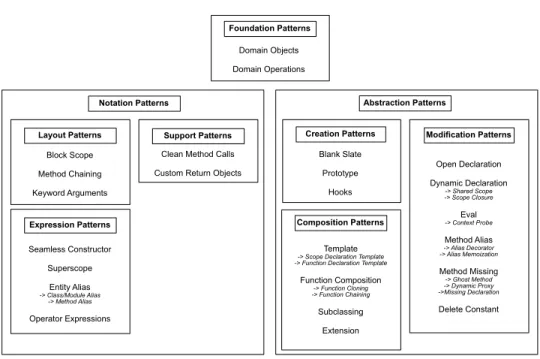
We differentiate the patterns into foundation patterns, notation patterns, and abstraction patterns.Figure 6 gives a graphical overview to the patterns.
To give a complete overview to all patterns, we explain the problem of each pattern in the following list. 4.3.1 Foundation Patterns
Foundation patterns are the very first pattern to apply, they explain how the domain concepts, attributes, and operations are implemented as entities.
– DOMAINOBJECTS: How to implement suitable abstractions of the domain entities and their relationships? – DOMAINOPERATIONS: How to implement suitable representations of the domain operations?
4.3.2 Notation Patterns
The notation patterns structure the host’s syntactic capabilities to form expressions that provide the domain-specific notations. They are structured into three groups.
–Layout Patterns: Provide the general layout of the DSLs, either as vertical blocks or complex, horizontal expressions.
Expression Patterns Seamless Constructor Superscope Entity Alias -> Class/Module Alias -> Method Alias Operator Expressions Support Patterns
Clean Method Calls Custom Return Objects
Notation Patterns Abstraction Patterns Creation Patterns Blank Slate Prototype Hooks Domain Objects Domain Operations Foundation Patterns Modification Patterns Open Declaration Dynamic Declaration -> Shared Scope -> Scope Closure Eval -> Context Probe Method Alias -> Alias Decorator -> Alias Memoization Method Missing -> Ghost Method -> Dynamic Proxy ->Missing Declaration Delete Constant Block Scope Method Chaining Keyword Arguments Layout Patterns Composition Patterns Template
-> Scope Declaration Template -> Function Declaration Template
Function Composition
-> Function Cloning -> Function Chaining
Subclassing Extension
Fig. 6. Pattern Overview
– BLOCKSCOPE: Has your DSL a flat scope where you mangle objects together, or is it difficult to express hierarchies of domain concepts that you create and combine to complex expressions? (Section 5.1, page 18)
– METHODCHAINING: Do you use too much command-like expressions that fail to represent the relation of different domain concepts or do not read fluently enough? Excessive (Section 5.2, page 21)
– KEYWORDARGUMENTS: Does your DSL suffer from passing to many arguments to functions, confusing the user in which order to pass arguments and what their meaning is? (Section 5.3, page 24)
–Expression Patterns: These patterns target the representation of expressions. Their goal is to simplify and straighten the representation of domain concerns through designing DOMAIN OPERATIONS, and optionally through renaming of built-in or library-added objects and methods.
– SEAMLESSCONSTRUCTOR: How to avoid object instantiation when this is not a domain concern? – SUPERSCOPE: How to refer to objects that exist in another scope without introducing cumbersome and cluttering variable references?
– ENTITYALIAS: How to rename built-in classes and external libraries to be consistent with the domain? –Class/Module Alias: Alias a class or module.
–Method Alias: Provide an alias for a method.
– OPERATOREXPRESSIONS: How to use operators like+,*,&in DSL expressions?
– Support Patterns: Further contribute to the efforts of the other patterns with unique effects to simplify expressions.
– CLEANMETHODCALLS: How to eliminate the clutter of parentheses and other literals for method calls in the DSL?
– CUSTOM RETURNOBJECTS: How to overcome the limited vocabulary for accessing data in multiple structured objects?
4.3.3 Abstraction Patterns
Additionally to the foundation and the notation patterns, the abstraction patterns are used too. These patterns help to implement and incorporate the DSL’s semantics and abstractions into the host language. They are structured into three groups too.
–Creation patterns: These patterns explain how to initially create new objects with properties that are different from common objects.
– BLANKSLATE: How to provide objects with a minimal set of methods so that arbitrarily named methods can be added?
– PROTOTYPE: How to create new objects without using the instantiation process to save computing time? – HOOKS: How to introduce more-domain specific behavior at pre-defined program execution places like class, method, and attribute declaration?
–Composition patterns: Are concerned with the declaration and instantiation of new objects and thereby reuse functionality that is already available in the program.
– TEMPLATE: How to form mutable string representations of code that facilitate runtime creation, modifica-tion, and execution?
–Scope Declaration Template: Declaration of modules and classes. –Method Declaration Template: Declaration of method definitions. –Method Call Template: Declaration of method calls.
– FUNCTIONOBJECT: How to represent (defined) application behavior in one uniform, composable form? – SUBCLASSING: How to pass method declarations and variables from one class to another, even at runtime?
– EXTENSION: How to add functionality stemming from different sources into classes, instances, and singletons?
–Modification patterns: Are concerned with taking an existing object and modifying it to provide more domain-specific behavior.
– OPENDECLARATION: How to change a class or module after its initial declaration by using common declarations?
– DYNAMICDECLARATION: How to change a class or module after its initial declaration by using metaobjects or similar techniques?
–Shared Scope: Share the scope of multiple declarations between each other, providing access to local variables for including them in declarations.
–Scope Closure: Conserve local variables in declarations, completely hiding the variables from any outside access.
– EVAL: How to execute declared code, specified in one scope, at any other
scope?
–Context Probe: Execute code in the context of another object to check object properties.
– METHODALIAS: How to transparently change the behavior of an existing method while preserving the old behavior?
–Alias Decorator: Add functionality around an existing method.
–Alias Memoization: Replace a method implementation with a fixed return value to save computational time.
– METHODMISSING: How to enable an object to answer arbitrary method calls and to forward the calls to other methods or define called methods on the fly?
– Ghost Method: Depending on the method’s name, return a value to the caller that simulates a complete method call.
–Missing Declaration: Check the method name and define methods on the fly.
– DELETECONSTANT: How to completely delete modules and classes together with their methods on demand?
5. NOTATION PATTERNS
A clear, distinguished syntax helps a DSL to convey its meaning effectively. While the foundation patterns provide the essential objects and methods, notation patterns provide the syntax. During our research, we were surprised about the syntactic variations the analyzed host languages offer. In some DSLs, we found a combination of notations that can even lead to a syntax that does not at all resemble the host language. This chapter captures these notations as patterns. We distinguish into three groups.Layout patternsprovide the overall structure of the DSL.Expression patternsprovide syntactic alternations for expressions, especially for method calls, in order for a more domain-specific notation.Support patternsfurther help to provide clearer expressions.
As explained to the beginning of this paper, we only explain the three layout patterns BLOCKSCOPE, METHOD CHAINING, and KEYWORDARGUMENTS. Layout patterns are providing the general layout of the DSLs. In these forms, individual expressions are further designed with variation and support patterns. These patterns are also powerful enough to design a language with a resemblance to another programming paradigm than the host uses, like the change from imperative to declarative expressions.
5.1 Block Scope
Also defined as Nested Closure[33].
Many domains have a natural hierarchy of objects. This hierarchy should be reflected in the DSL expressions too. For example, when building a structured document like HTML, the DSL should reflect the document’s structure with syntactic indentation, and at the same time provide a separate lexical scope for its expressions.
Problem
Has your DSL a flat scope where you mangle objects together, or is it difficult to express hierarchies of domain concepts that you create and combine to complex expressions? A flat scope hides the context and natural connections between expressions, making it hard to spot what the expressions actually do.
Design Goals
–Notation: Group related expressions together for a vertical code layout and syntactically express the hierarchy of objects as indented blocks of code.
–Absorption: Absorb the most relevant execution information as a closure and use it later to infer contextual information.
–Compression: Remove fully-qualified method calls inside a block, and let the execution context be determined by the object or method receiving the block.
Solution
Define one object that opens the block, and include all expressions that belong in the object’s context. By defining a visual block, the hierarchy and scope of expressions becomes clear.
1 m a c h i n e = M a c h i n e . new (" A d m a n t i u m . com ") 2 m a c h i n e . o w n e r (" s e b a s t i a n . g u e n t h e r @ o v g u . de ")
3 r e s o u r c e _ b u n d l e = A r r a y . new ( R e s o u r c e . new (" CPU ") , R e s o u r c e . new (" RAM ") ) 4 m a c h i n e . s e t _ m o n i t o r e d _ r e s o u r c e s ( r e s o u r c e _ b u n d l e )
↓
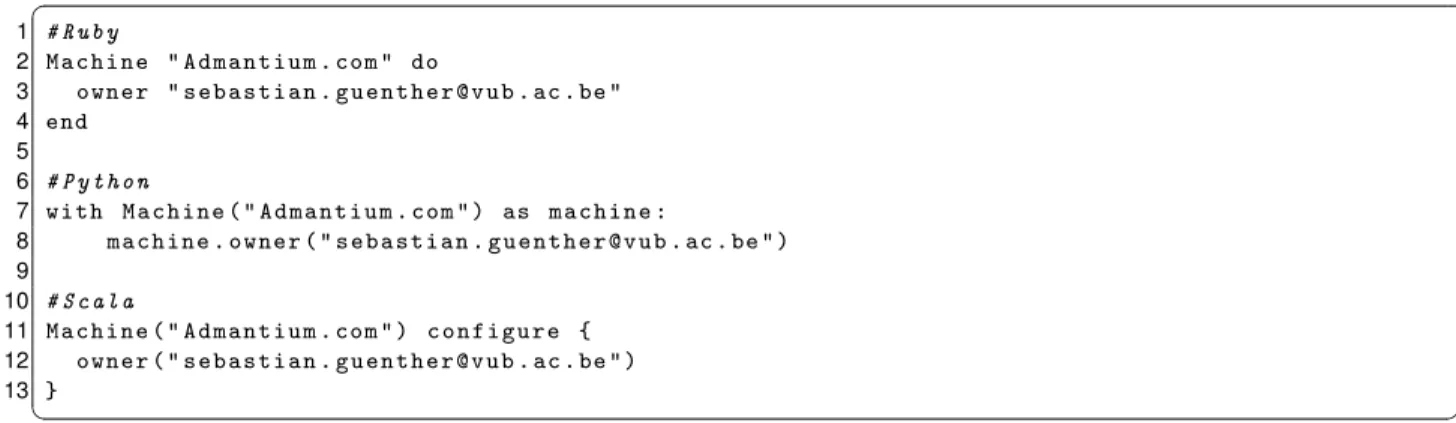
1 M a c h i n e " A d m a n t i u m . com " do 2 o w n e r " s e b a s t i a n . g u e n t h e r @ v u b . ac . be " 3 m o n i t o r " CPU " , " RAM " 4 endA BLOCK SCOPE is defined by the visual arrangement of expressions in the form of an indented block. Semantically, the outer parts of the block provide a context in which the expressions of the inner part are executed. Therefore, the receiver of the inner expressions becomes clear, which allows to implicitly assume information that would otherwise need to be passed as additional arguments to isolated expressions. InFigure 7, we show example expressions for each host language.
1 # R u b y 2 M a c h i n e " A d m a n t i u m . com " do 3 o w n e r " s e b a s t i a n . g u e n t h e r @ v u b . ac . be " 4 end 5 6 # P y t h o n 7 w i t h M a c h i n e ( " A d m a n t i u m . com " ) as m a c h i n e : 8 m a c h i n e . o w n e r ( " s e b a s t i a n . g u e n t h e r @ v u b . ac . be " ) 9 10 # S c a l a 11 M a c h i n e ( " A d m a n t i u m . com " ) c o n f i g u r e { 12 o w n e r ( " s e b a s t i a n . g u e n t h e r @ v u b . ac . be " ) 13 }
Fig. 7. BLOCKSCOPE: example expressions in Ruby, Python, and Scala.
In Ruby, blocks can be built with thedo...endnotation or curly braces. The code contained inside this block has two distinguishing properties. First, it encloses its surrounding scope and can serve as a closure for specific execution states. Second, it can be executed in another context, using the variables from the surrounding lexical scope.
In Python, context managers can be used for introducing blocks with the notationwith...as. Context managers are objects that define the special methods__enter__and__exit__, which are executed upon opening and exiting a block. Opposed to Ruby, fully-qualified method calls still have to be used inside the block.
In Scala, blocks are introduced with curly braces. They are used to group similar expressions, for exam-ple method declarations for classes. They can be applied in method calls too, where the return value of a
block is passed as an argument to the function that “opens” the block. In the following example, the result of owner("sebastian.guenther")is passed toconfigure.
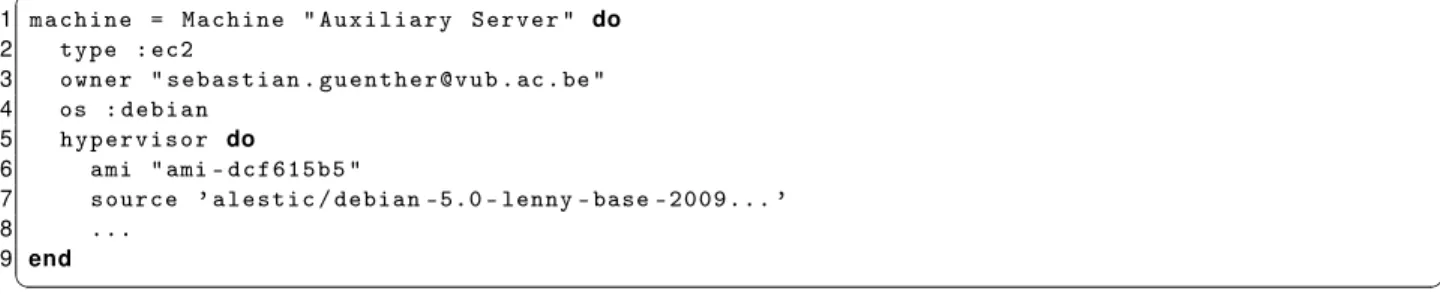
Example 1 m a c h i n e = M a c h i n e " A u x i l i a r y S e r v e r " do 2 t y p e : ec2 3 o w n e r " s e b a s t i a n . g u e n t h e r @ v u b . ac . be " 4 os : d e b i a n 5 h y p e r v i s o r do 6 ami " ami - d c f 6 1 5 b 5 "
7 s o u r c e ’ a l e s t i c / debian -5.0 - lenny - base - 2 0 0 9 . . . ’
8 ...
9 end
Fig. 8. BLOCKSCOPE: example for amachineexpressions.
Using the MDL to configure various virtual machine properties, the BLOCKSCOPEis denoted by thedo...end notation in Line 1 and Line 8. The properties are included as statements inside the block.
The block is passed to theMachinemethod. Its definition is shown below, starting with thedefkeyword. The method receives two parameters. The first is the machine’s hostname, and the second is the block captured in the variable namedblock. Lines 3–6 check whether the machine already exists, and if not creates a new one. Then, Line 7 evaluates the block in the machine’s context.
1 d e f M a c h i n e ( h o s t n a m e , & b l o c k ) 2 m a c h i n e = M a c h i n e . f i r s t : h o s t n a m e = > h o s t n a m e 3 if not m a c h i n e 4 m a c h i n e = new () 5 m a c h i n e . h o s t n a m e = h o s t n a m e 6 end 7 m a c h i n e . i n s t a n c e _ e v a l & b l o c k 8 r e t u r n m a c h i n e 9 end
Fig. 9. BLOCKSCOPE: implementation of theMachinemethod.
Liabilities
– Possibility of code injection: If the block object is dynamically constructed with input from the users, malicious users could exploit detailed knowledge of the application to read its data or perform file system operations. However, Ruby has good support for safe levels, as well as tainted and trusted objects [82], which reduces this threat’s potential.
Known Uses
– Ruby
– UsingSinatra, BLOCKSCOPEis applied with the declaration of request handlers, for exampleget, to obtain a declarative expression how a web application reacts to queried URLs (thegetrequest handler is implemented insinatra-0.9.4/lib/sinatra/base.rb, Lines 752–758).
– Using RSpec, BLOCK SCOPE is applied for the declaration of example groups that begin with the describekeyword and group several test cases (thedescribemethod is implemented inrspec-1.3.0/lib/
spec/dsl/main.rb, Lines 24–29).
– Python
– We could not find this pattern in the analyzed DSLs. In our PyQL DSL [42], we use the context manager construct to introduce a block. The expressionwith Query("sqlite") as querystarts a block where queryis a local variable. Using this object, methods representing SQL-statements are called, but fully-qualified method calls have to be used.
– Scala
– InSpecs, BLOCKSCOPEis used to visualize the structure of complex test cases. Test cases start with a literate string describing the system, followed by theshouldkeyword and a function. Inside the function, examples are specified by using another string description and theinkeyword (theshouldmethod is defined inspecs-1.6.2.1/src/main/scala/org/specs/specification/SpecificationSystems.scala, Lines 45–46, and theinmethod inspecs-1.6.2.1/src/main/scala/org/specs/specification/BaseSpecification.scala, Line 154).
Related Patterns
– KEYWORDARGUMENTS: Alternatively to the vertical code layout provided with BLOCKSCOPE, code can be arranged horizontally by suitable grouping and naming of arguments.
5.2 Method Chaining
Also defined as Method Chaining[33].
In some domains, expressions involve a high number of concepts and operations. For example in financial transactions, accounts, identification numbers, currency information, stock information and more need to be expressed. This complexity should be reflected in the DSL too.
Problem
Do you use too much command-like expressions that fail to represent the relation of different domain concepts or do not read fluently enough? Excessive command-like expressions make programs difficult to read and understand.
Design Goals
–Notation: Express the domain in a more natural language like style by chaining method calls and their return values together, which also gives a horizontal code layout.
–Compression: Use chained methods to transform an input value step-by-step, adopting a more functional-programming oriented style instead of imperative expressions.
Solution
Combine repetitive methods in one sentence-like expression. Improve readability and understandability.
1 app = a p p l i c a t i o n (" R e d m i n e ") 2 app . s e t _ s e r v e r (" A d m a n t i u m ") 3 app . d e p l o y
↓
1 d e p l o y a p p l i c a t i o n R e d m i n e on s e r v e r A d m a n t i u mSentence-like expressions can be designed by chaining methods with appropriate names together in one line. The methods are required to either operate on the same directly passed data or implicit on data visible within the scope where the methods are executed. The readability of the method chain can be enhanced by using methods according to these roles:
–Context provider: Set the objects of the expression by storing them in one or several variables of the surrounding scope.
–Referer: Methods that just refer to concrete objects.
–Glue: Methods that only serve to syntactically ease the expression.
Dependent on the host language, a method chain can take different forms. Because Ruby does not require fully-qualified method calls in the form of “receiver.method”, the “.” can be left out, allowing to chain method calls together that look like language keywords. In Python, chaining method calls both implies to use the dot notation between method calls and to use parentheses, such as inmethod1().method2(). An exception is the usage of symbolic operators, which is shortly presented in the known uses section. In Scala, METHODCHAININGrequires a mix of class and method declarations to work. See the following figure for examples.
1 d e p l o y A p a c h e on s e r v e r " A d m a n t i u m . com " # R u b y 2 d e p l o y ( A p a c h e ) . on () . s e r v e r ( " A d m a n t i u m " ) # P y t h o n 3 d e p l o y A p a c h e on s e r v e r ( " A d m a n t i u m . com " ) # S c a l a
Fig. 10. METHODCHAINING: example expressions in Ruby, Python, and Scala.
Example
An expression that uses METHODCHAINING, and the later explained CLEANMETHODCALLSpattern, is shown in the following figure. It is a contrived example how to alternatively express the roll out of applications.
1 d e p l o y a p p l i c a t i o n R e d m i n e on s e r v e r A d m a n t i u m
Fig. 11. METHODCHAINING: combiningdeployand other methods.
The evaluation of this expression happens from right to left. Following figure shows the implementation of the used methods. At first, we define the referers.Admantium, defined in Line 2, is the only non-method in this
expression – it is a constant in the surrounding scope that represents the admantium server. In Lines 4–7, we implement theRedminemethod to return the corresponding object. Next, we implement the context provides in Lines 10–13 and Lines 15–18. They set the passed application and server values to instance variables. Theon method is a glue method (Lines 21–24). Finally, thedeploymethod in Lines 27–32 commences the deployment of the machine.
In some methods, we implemented explicit checks that prevent to call the chain in an incorrect order. However, as can be seen, this form is very restricted and cumbersome to implement.
1 # r e f e r e r s 2 A d m a n t i u m = S e r v e r . f i n d " A d m a n t i u m " 3 4 d e f R e d m i n e ( on ) 5 r a i s e " M e t h o d C h a i n E x c e p t i o n " u n l e s s on == " on " 6 P a c k a g e . f i n d " R e d m i n e " 7 end 8 9 # c o n t e x t p r o v i d e r s 10 d e f s e r v e r ( s e r v e r ) 11 @ s e r v e r = s e r v e r 12 " s e r v e r " 13 end 14 15 d e f a p p l i c a t i o n ( app ) 16 @ a p p l i c a t i o n = app 17 " a p p l i c a t i o n " 18 end 19 20 # g l u e m e t h o d s 21 d e f on ( s e r v e r ) 22 r a i s e " M e t h o d C h a i n E x c e p t i o n " u n l e s s s e r v e r == " s e r v e r " 23 " on " 24 end 25 26 # d o m a i n o p e r a t i o n s 27 d e f d e p l o y ( a p p l i c a t i o n ) 28 r a i s e " M e t h o d C h a i n E x c e p t i o n " u n l e s s a p p l i c a t i o n == " a p p l i c a t i o n " 29 r e a l _ d e p l o y @ a p p l i c a t i o n . n a m e do 30 e n r o l l "#{ @ a p p l i c a t i o n . n a m e } / # { @ a p p l i c a t i o n . c a t e g o r y }" , : on = > @ s e r v e r 31 end 32 end
Fig. 12. METHODCHAINING: implementation of all required methods for thedeployexample.
Liabilities
– Requires to add several “glue” methods to the surrounding scope, possibly polluting the space with empty methods.
– Limited options to check the correctness of the chain, and especially to check the correct order of called arguments.
– Limited applicability to modify existing libraries because of the required extensive modifications. – If used with an existing library, requires to change method internals.
– The Law of Demeter [58] states that method should have a limited access to other methods and the object in which they are defined. A DSL that uses METHODCHAININGrequires a careful design choice to localize the method declarations in one scope (see DOMAINMETHODS) and should pollute the global namespace that would break the Law of Demeter.
Known Uses
– Ruby
– InRSpec, users chainshouldandshould_notexpression with an expectations statement likeshould_not be_nilorshould have(3).items, combining the statements in a clean and readable way (both men-tioned methods are defined inrspec-1.3.0/lib/spec/expectations/extensions/kernel.rb, Lines 26–28 and Lines 49–51, which extends Ruby’s built-inKernelmodule that defines global available methods).
– Python
– TheShould DSLis a unique extension because it uses OPERATOR EXPRESSIONS(explained later) together with a normal method call to add a new syntactic element to Python. Basically, it allows the same kinds of expressions like RSpec, consisting of an object, ashouldkeyword, and an expectation. Here is a short example:1 |should_not| be(2). Inside this expression, the “|” are actually method calls that receive the left value and the right value, which is then passed to theshould_notmethod. This combination allows METHODCHAINING(the “|” operators are defined inshould-dsl-1.0/src/should_dsl.py, Lines 25–38).
– TheLCS DSLalso uses a form of METHODCHAINING: Methods with boolean return values are used to structure conditional blocks that determine how to react to different status of the monitored applications [11] (we can not give further details because we do not have access to this DSL’s implementation). – Scala
–Specsuses method chaining in an extreme form, because expressions can mirror complete sentences. For example we create a car object with the name “Nissan Primera”. To test whether the car name begins with “Niss” and not “Pors”, this expression can be used:nissan.carname must be matching("Niss*") and not be matching("Pors*").
Similar matchers for non-string objects are included in the Specs library, or can be added for user-specific types (themustmethod is defined inspecs-1.6.2.1/src/main/scala/org/specs/specification/Expectable.scala, Line 172, and the matchersbeandmatchingare defined inspecs-1.6.2.1/src/main/scala/org/specs/matcher/
StringMatchers.scala, Line 36 and 202).
Related Patterns
– KEYWORD ARGUMENTS: Both METHODCHAININGand KEYWORDARGUMENTSprovide a horizontal code layout. KEYWORDARGUMENTSare especially suitable when a complex expression can be refactored to nested subphrases. The additional benefit to METHODCHAININGis that no “glue” methods are needed.
– BLOCKSCOPE: Instead of a horizontal code layout, BLOCKSCOPEprovides a vertical layout that is especially useful to show hierarchies of objects. This pattern is recommended when very complex expressions need to be structured, where the block-like structure helps to disseminate the information. Of course, individual lines in BLOCKSCOPEexpressions can be designed with METHODCHAINING.
5.3 Keyword Arguments
Also defined as Named Arguments[69]and Literal Map[33]. Methods implement the behavior of a DSL and are vital language expressions. However, when passing multiple parameters to a method, two problems might occur. First, a fixed order of multiple passed arguments is difficult to remember when using the method. Second, just passing arguments hampers readers of DSL expression to relate the arguments with their intended meaning and relationship to the method.