High-Performance
Stainless Steels
T
he material presented in this reference book has been prepared for the general information of the reader and should not be used or relied upon for specific applications without first securing competent advice.Nickel Development Institute, its members, staff, and consultants do not represent or warrant its suitability for any general or specific use and assume no liability or responsibility of any kind in connection with the information herein. Drawings and/or photographs of equipment, machinery, and products are for illustrative purposes only, and their inclusion does not constitute or imply any endorsement of the companies that manufacture or distribute them.
This report was prepared by Curtis W. Kovach, Technical Marketing Resources, Inc., Pittsburgh, PA, USA, consultant to the Nickel Development Institute.
The Front Cover shows a heat exchanger with
Introduction
. . . 3Classification of Grades
. . . 4Austenitic High-Performance Stainless Steels . . . 4
Ferritic High-Performance Stainless Steels. . . 7
Duplex High-Performance Stainless Steels. . . 8
Physical Metallurgy
. . . 9Phase Relations in the Iron-Chromium-Nickel System. . . 9
Secondary Phases. . . 13
Kinetics of Phase Precipitation Reactions . . . .15
Austenitic Stainless Steels. . . 16
Ferritic Stainless Steels. . . 17
Duplex Stainless Steels. . . 18
Mechanical Properties
. . . 20Austenitic Stainless Steels. . . 20
Ferritic Stainless Steels. . . 25
Duplex Stainless Steels. . . 27
Physical Properties
. . . 29Corrosion Resistance
. . . 35Resistance to Inorganic Acids. . . 35
Resistance to Organic Acids. . . 40
Resistance to Alkalies and Alkaline Salts. . . 42
Chloride- and Other Halide Ion-Containing Aqueous Environments. . . 44
Near Neutral Environments – Natural Waters and Brines . . . 48
Influence of Microbial Activity . . . 53
Oxidizing Halide Environments – Chlorinated Cooling Waters and Bleach Solutions. . . 53
Acidic Environments Containing Halides – Flue Gas Condensates. . . 56
Stress Corrosion Cracking
. . . 60Water and Brine Environments. . . 62
Sour Oil and Gas Environments. . . 64
Hydrogen Environments . . . 66
Corrosion Acceptance Tests
. . . 67Fabrication
. . . 70 Hot Working. . . 70 Cold Working. . . 71 Annealing. . . 72Machining
. . . 74Welding
. . . 75Austenitic Stainless Steel Grades. . . 75
Ferritic Stainless Steel Grades . . . 79
Duplex Stainless Steel Grades . . . 79
Surface Condition
. . . 82Applications
. . . 83Acknowledgements
. . . 85Works Cited
. . . 85Appendix 1
. . . 89Appendix 2 (A)
. . . 91Appendix 2 (B)
. . . 91Appendix 2 (C)
. . . 92Appendix 3
. . . 92Appendix 4
. . . 93as individual grades, may offer optimum performance for a specific requirement. The higher nickel austenitic grades are generally preferred for severe acid service and for
resistance to chloride pitting and stress corrosion cracking. They are often selected for flue gas cleaning equipment handling acid condensates, or acidic solutions containing strong oxidants such as in paper bleaching. Where field fabrication is an important consideration, the austenitic grades are favoured because of their relative ease of welding; grades from this family have been used extensively in offshore and nuclear piping where weld quality is extremely important. If the requirement is for thin sheet, the ferritic grades will usually be most cost-effective; therefore, they have been used as the tube material in many kinds of heat exchangers. The duplex grades are often selected where strength is advantageous. They have been used in pressure vessels for the chemical process industry, and have seen extensive service in heat exchangers. All three families of the high-performance stainless steels will deliver a wide range of resistance to chloride pitting and stress corrosion cracking superior to that
of Types 304 and 316; so fabrication
considerations often determine the final material choice in the case of chloride service.
The high-performance stainless steels are more technically demanding than Types 304 and 316 with regard to metallurgy and fabrication requirements. This is due to the nature of the steels themselves and the demanding applications in which they are used. A thorough understanding of these stainless steels is necessary to use them successfully. This book provides assistance in making the optimum material selection for a given application, and provides guidance in the fabrication and use of the selected grade. Because of the complexity of applications and large number of grades
available, this book can serve only as an introductory guide. The reader is encouraged to consult with manufacturers to learn more fully the advantages, limitations, and specific
requirements of individual materials.
INTRODUCTION
The “high-performance stainless steels” are a family of stainless steels which have distinctly superior corrosion resistance in a wide variety of aggressive environments when compared with the standard stainless steel grades such as Type* 304L, which contains only 18% chromium and 8% nickel (18-8), and Type 316L, which contains similar chromium and nickel and 2% molybdenum (18-10-2). Their superiority in resisting pitting and stress corrosion cracking is especially evident in environments containing the chloride ion. This performance is obtained by using a high level of chromium, nickel, molybdenum, and nitrogen alloying for corrosion resistance, and by producing these grades with very low carbon contents to preserve this resistance while allowing hot
fabrication and welding. The commercial origins of the high-performance stainless steels came with the advent of steel melting and refining
technologies that made it possible to
economically produce compositions having very low carbon content and close composition control. Among these technologies are vacuum melting, electron beam remelting, electroslag remelting, and, most notably today from a commercial standpoint, vacuum oxygen decarburization (VOD) and argon-oxygen decarburization (AOD). Beginning in the 1970s, these stainless steels have grown in number and in technical and commercial importance. This book provides an introduction to these steels for those whose materials needs extend beyond the capabilities of the standard grades, and for those who will benefit from a discussion of the
engineering and corrosion performance properties of the high-performance stainless steels.
There are three primary classifications within the high-performance stainless steels. They are the austenitic, ferritic, and duplex (austenitic-ferritic) families. The stainless steels in each family have general similarities, but there is also a wide range of corrosion resistance and other characteristics. This allows a broad spectrum of existing and potential applications where each family, as well * Refers to ‘AISI Type’.
CLASSIFICATION
OF GRADES
AUSTENITIC
HIGH-PERFORMANCE
STAINLESS STEELS
The austenitic family of high-performance stainless steels shares many characteristics with its standard grade counterpart. These grades in the annealed condition consist primarily of a single phase, face-centred cubic austenite, and are non-magnetic. This structure is characterized by a relatively low yield strength, high work hardening rate and high tensile strength, good ductility and formability,
especially good low temperature toughness, and the inability to be hardened (or strengthened) by
heat treatment. Besides corrosion resistance, the major difference in comparison with the standard grades is that the high-performance grades rapidly form secondary phases at high temperatures. These phases may be damaging to certain mechanical properties and corrosion resistance, and therefore, the application of these stainless steels at temperatures above 500°C (930°F) is limited. In addition, care must be taken to avoid forming damaging amounts of these phases during high temperature operations such as forging or welding. A list of notable wrought high-performance austenitic stainless steels is given in Table 1. Grades are identified by the name by which they are best known and by their UNS number. Producer names, which in many cases are
trade names, are provided in Appendix 2. Many of these grades were patented when originally developed and, in some cases, the patents may still be in effect. When a range is shown for the chemical composition, it corresponds to the most commonly applicable ASTM standard, usually A 240. When single compositions are shown, this is the “typical” value provided by the producer. The grades in Table 1
are arranged in the order of increasing
molybdenum, chromium, and nitrogen content, or increasing PRE number. The PRE number means the “pitting resistance equivalent” and in this book is defined as PRE = %Cr + 3.3%Mo + 16%N with the percent elements in weight
percent. A higher PRE number relates semi-quantitatively to a higher resistance to localized corrosion in chloride-containing environments. The grades also have been divided into six subgroups based on a similarity in localized corrosion resistance. A description of these subgroups follows:
Subgroup A-1 Austenitic Stainless Steels.
The stainless steels in this subgroup are designed primarily for application in strong, hot, sulphuric acid solutions. The required corrosion resistance is achieved primarily through the use of high nickel content. The 20Cb-3 and Alloy 825 grades, with about the
* taken from ASTM specifications for plate, sheet, and strip when available or from company data sheets ** maximum, unless range or minimum is indicated
*** nominal chemistry
Table 1 Chemical composition* of wrought high-performance austenitic stainless steels (wt. pct.)**
UNS Sub PRE
Name Number Group C N Cr Ni Mo Cu Other Number
Type 316L S31603 0.03 0.10 16.0-18.0 10.0-14.0 2.0-3.0 – – 23
Type 317L S31703 0.03 0.10 18.0-20.0 11.0-15.0 3.0-4.0 – – 28
Alloy 20 N08020 0.07 – 19.0-21.0 32.0-38.0 2.0-3.0 3.00-4.00 (Cb+Ta): 8xC-1.00 26
A-1
Alloy 825 N08825 0.05 – 19.5-23.5 38.0-46.0 2.5-3.5 1.50-3.50 Al: 0.2 max, Ti: 0.6-1.2 28
317LN S31753 0.03 0.10-0.22 18.0-20.0 11.0-15.0 3.0-4.0 – – 30 260 0.03 0.16-0.24 18.5-21.5 13.5-16.5 2.5-3.5 1.00-2.00 – 29 A-2 317LM S31725 0.03 0.10 18.0-20.0 13.2-17.5 4.0-5.0 – – 31 317LMN S31726 0.03 0.10-0.20 17.0-20.0 13.5-17.5 4.0-5.0 – – 32 NAS 204X*** 0.04 – 25.0 25.0 2.75 – Nb: 10xC 34
310MoLN S31050 0.03 0.10-0.16 24.0-26.0 21.0-23.0 2.0-3.0 – Si: 0.50 max 32
700 N08700 0.04 – 19.0-23.0 24.0-26.0 4.3-5.0 – Nb: 8xC-0.40 33
904L N08904 0.02 – 19.0-23.0 23.0-28.0 4.0-5.0 1.00-2.00 – 32
A-3
904LN 0.02 0.04-0.15 19.9-21.0 24.0-26.0 4.0-5.0 1.00-2.00 34
20Mo-4 N08024 0.03 – 22.5-25.0 35.0-40.0 3.5-5.0 0.50-1.50 – 34
20 Mod N08320 0.05 – 21.0-23.0 25.0-27.0 4.0-6.0 – Ti: 4xC min 34
Alloy 28 N08028 0.02 – 26.0-28.0 29.5-32.5 3.0-4.0 0.60-1.40 – 36 20Mo-6 N08026 0.03 0.10-0.16 22.0-26.0 33.0-37.0 5.0-6.7 2.00-4.00 – 40 25-6MO N08925 0.02 0.10-0.20 19.0-21.0 24.0-26.0 6.0-7.5 0.8-1.5 – – 1925hMo 254N*** 0.03 0.20 23.0 25.0 5.50 – – 41 25-6MO N08926 A-4 0.02 0.15-0.25 19.0-21.0 24.0-26.0 6.0-7.0 0.50-1.50 – 41 1925hMo SB8 N08932 0.020 0.17-0.25 24.0-26.0 24.0-26.0 4.7-5.7 1.0-2.0 – 42 254 SMO S31254 0.02 0.18-0.22 19.5-20.5 17.5-18.5 6.0-6.5 0.50-1.00 – 42 AL-6XN N08367 0.03 0.18-0.25 20.0-22.0 23.5-25.5 6.0-7.0 0.75 – 43 YUS 170 0.03 0.25-0.40 23.0-26.0 12.0-16.0 0.50-1.20 – – 29 2419 MoN A-5 0.03 0.30-0.50 23.0-25.0 16.0-18.0 3.5-4.5 0.30-1.00 Mn: 5.5-6.5 Nb: 0.1-0.3 39 4565S S34565 0.03 0.40-0.60 23.0-25.0 16.0-18.0 3.5-5.0 – Mn: 3.5-6.5 41 B66 S31266 0.030 0.35-0.60 23.0-25.0 21.0-24.0 5.0-7.0 0.50-3.00 W: 1.0-3.0 Mn: 2.00-4.00 45 3127 hMo N08031 A-6 0.02 0.15-0.25 26.0-28.0 30.0-32.0 6.0-7.0 1.00-1.40 – 48 654 SMO S32654 0.02 0.45-0.55 24.0-26.0 21.0-23.0 7.0-8.0 0.30-0.60 Mn: 2.0-4.0 54 Cu: 0.3-0.6 AL-6XN® flexible hosing for offshore oil rigs
Subgroup A-2 Austenitic Stainless Steels.
These grades, for example 317LMN, are designed to provide improved localized corrosion resistance in halide environments when compared with Types 316L and 317L. This is accomplished through the use of higher molybdenum and nitrogen contents. Nitrogen, while improving corrosion resistance, also stabilizes the austenite so the nickel can be limited for optimum economy. These grades offer improved performance at a relatively modest cost premium compared with Type 316L. They have been widely used in the absorber towers of flue gas desulphurization (FGD) equipment operating under moderately aggressive pitting conditions.
Subgroup A-3 Austenitic Stainless Steels.
These stainless steels, for example 904L, use about 10% more nickel to provide overall balanced performance with regard to reducing acids and chloride stress corrosion cracking. Their copper additions provide additional resistance to many reducing acids.
Subgroup A-4 Austenitic Stainless Steels.
The subgroup A-4 grades, frequently called the 6% Mo grades and including AL-6XN, 1925 HMo, 25-6MO, and 254 SMO, were
designed originally to resist localized corrosion in seawater at near-ambient temperatures and in pulp bleach plant environments. This is accomplished by the use of relatively high levels of nitrogen, chromium, and molybdenum to give a PRE number in the range of 40 to 43. They contain high nickel to help stabilize austenite, and, therefore, also provide good general acid and chloride stress corrosion cracking resistance. High nitrogen also gives them a substantial strength advantage compared with the alloys in this family that have no nitrogen. They have been widely used in piping and heat exchangers handling seawater, in many pulp bleach plant applications, and in a variety of chemical and power plant applications.
Subgroup A-5 Austenitic Stainless Steels.
High strength is the main attribute of these grades, 4565S for example, and this is accomplished through the solution
strengthening effect of nitrogen in the range of 0.25 to 0.50 percent. Corrosion properties vary considerably depending on the amount of chromium, molybdenum, and nickel. The relatively low nickel content (12-18%) puts their resistance to chloride stress corrosion cracking into the A-2 group.
Wye Piece in Böhler A911 for offshore application
Courtesy Böhler Edelstahl GMbH
same chromium and molybdenum as Type 316, are not superior to Type 316 with respect to localized pitting or crevice corrosion resistance. With increasing nickel content, these grades have progressively increasing resistance to chloride stress corrosion cracking. They have a long history of giving excellent service in many chemical industry applications requiring good
sulphuric acid or stress corrosion cracking resistance.
Group A-6 Austenitic Stainless Steels.
These grades, for example 654 SMO, represent the highest level of performance that has yet been achieved among all the high-performance stainless steels. They combine high strength with outstanding localized corrosion resistance, and have good chloride stress corrosion cracking and acid resistance. They will resist stress corrosion cracking in the boiling 45% MgCl2 test and localized corrosion in seawater under severe crevice conditions and temperatures significantly above ambient. They approach the best of the nickel-base alloys with respect to localized corrosion while providing much higher strength. These newer grades have an excellent potential for solving crevice corrosion problems in gasketed joints, systems handling seawater at elevated temperatures, and in many systems operating at high pressure.
FERRITIC
HIGH-PERFORMANCE
STAINLESS STEELS
The ferritic high-performance stainless steels have an entirely ferritic microstructure except for small amounts of stabilizing carbides and nitrides. This ferritic structure has the unique attribute of being very resistant to chloride stress corrosion cracking, but has limited toughness. The toughness can be further reduced by large section or grain size effects and by the precipitation of embrittling secondary phases. These grades are usually not produced in plate thicknesses because of these toughness limitations. They were
developed to provide superior resistance, compared to the 18-8 stainless steels, to chloride stress corrosion cracking and pitting at a lower cost than the high nickel-containing austenitic alloys. They are generally used only for heat exchanger tubing or thin sheet applications. They are not hardenable by heat treatment, but in the annealed condition they exhibit higher strength than many austenitic grades.Table 2lists the notable wrought ferritic grades in order of increasing resistance to chloride pitting.
Subgroup F-1 Ferritic Stainless Steels.
These grades, for example E-BRITE 26-1, have localized corrosion resistance similar to Type 316, but far superior stress corrosion cracking resistance. This good stress corrosion cracking performance applies to hot, concentrated caustic as well as chloride-containing solutions.
Subgroup F-2 Ferritic Stainless Steels.
The grades in this subgroup, which include SEA-CURE, were designed to resist localized corrosion in ambient temperature seawater. They have been used extensively in seawater-cooled power plant condensers. With their high chromium content and moderate molybdenum and nickel content, they are also very resistant to strong organic acids and oxidizing or moderately reducing inorganic acids. However, the use of nickel in many of these grades reduces chloride stress corrosion cracking resistance and increases susceptibility to the formation of damaging secondary phases. All these ferritic
Name UNS Number Sub Group C N Cr Ni Mo Cu Other PRE Number
Type 444 S44400 0.025 0.035 17.5-19.5 1.00 1.75-2.50 – Ti, Nb 23 26-1S S44626 F - 1 0.060 0.040 25.0-27.0 0.50 0.75-1.50 – Ti 27 E-BRITE 26-1 S44627 0.010 0.015 25.0-27.0 0.50 0.75-1.50 – Nb 27 MONIT S44635 0.025 0.035 24.5-26.0 3.5-4.5 3.5-4.5 – Ti, Nb 36 SEA-CURE S44660 F - 2 0.030 0.040 25.0-28.0 1.0-3.5 3.0-4.0 – Ti, Nb 35 AL 29-4C S44735 0.030 0.045 28.0-30.0 1.00 3.6-4.2 – Ti, Nb 40 AL 29-4-2 S44800 F-3 0.010 0.020 28.0-30.0 2.0-2.5 3.5-4.2 – – 40
* taken from ASTM specifications for plate, sheet, and strip when available or from company data sheets ** maximum, unless range or minimum is indicated
stainless steels resist stress corrosion cracking in sodium chloride tests, but probably not in the magnesium chloride test because of their nickel content (0.5-4.2%).
Subgroup F-3 Ferritic Stainless Steels.
The one grade in this subgroup, AL 29-4-2, as with the A-6 austenitic subgroup, is designed to produce the highest level of overall performance available from the ferritic stainless steels. It combines good localized and acid corrosion resistance.
DUPLEX HIGH-PERFORMANCE
STAINLESS STEELS
The grades in the duplex family are metallurgically designed to have a microstructure in the annealed condition consisting of approximately equal portions of austenite and ferrite. This is achieved by limiting the nickel content to moderately low levels and increasing the chromium content up to 22-26%. The molybdenum content is kept to about the same level as 317L. Therefore, when the PRE numbers are higher than about 30, as for 317L, it is mostly a result of the higher chromium and nitrogen contents. The duplex structure exhibits properties that take
advantage of the better attributes of each of the two phases. Most importantly, these grades
provide very high strength along with useful ductility and toughness. They can deliver a good combination of strength, general corrosion, and stress corrosion cracking resistance at moderate cost because they do not contain a large amount of nickel. As with the austenitic family, these grades cannot be hardened by heat treatment. Duplex stainless steels require careful fabrication procedures to avoid damage from secondary phases and to maintain the balance of about equal amounts of ferrite and austenite. They are more demanding than the austenitic stainless steels in this respect. Table 3lists the notable wrought high-performance duplex stainless steels.
Subgroup D-1 Duplex Stainless Steels.
The only grade in this subgroup is 2304. Although it generally does not have better corrosion resistance than the standard austenitic grades, 2304 is included among the high-performance stainless steels because, as with all the second generation duplex grades, it uses low carbon and high nitrogen to give a better combination of fabrication and corrosion properties than the earlier duplex grades. It can be readily welded and offers higher strength and better stress corrosion cracking resistance than Type 316L or Type 317L.
Subgroup D-2 Duplex Stainless Steels.
The grades in this subgroup, especially 2205, are the most useful of the duplex family because they combine corrosion performance, ease of fabrication and
economical properties. They have great versatility in both fabrication and
* taken from ASTM specifications for plate, sheet, and strip when available or from company data sheets ** maximum, unless range or minimum is indicated
*** nominal chemistry
Table 3 Chemical composition* of wrought high-performance duplex stainless steels (wt. pct.)**
Name UNS Number Sub Group C N Cr Ni Mo Cu Other PRE Number
Type 329 S32900 0.080 – 23.0-28.0 2.5-5.0 1.00-2.00 – – 26 3RE60 S31500 0.030 0.05-0.10 18.0-19.0 4.25-5.25 2.50-3.00 – Si: 1.40-2.00 Mn:1.20-2.00 27 2304 S32304 D - 1 0.030 0.05-0.20 21.5-24.5 3.0-5.5 0.05-0.60 – – 22 45M*** 0.030 0.15 24.3 5.0 1.50 1.00 – 32 44LN S31200 0.030 0.14-0.20 24.0-26.0 5.5-6.5 1.20-2.00 – – 30 2205 S31803 D - 2 0.030 0.08-0.20 21.0-23.0 4.5-6.5 2.5-3.5 – – 31 2205 S32205 0.030 0.14-0.20 22.0-23.0 4.5-6.5 3.0-3.5 – – 34 7-Mo PLUS S32950 0.030 0.15-0.35 26.0-29.0 3.5-5.2 1.00-2.50 – – 32 DP3 S31260 0.030 0.10-0.30 24.0-26.0 5.5-7.5 2.5-3.5 0.20-0.80 W: 0.10-0.50 34 UR 47N D - 3 0.030 0.14-0.20 24.0-26.0 5.5-7.5 2.5-3.5 – – 34 64*** 0.030 0.14 25.0 6.40 3.5 – – 39 255 S32550 0.040 0.10-0.25 24.0-27.0 4.5-6.5 2.9-3.9 1.50-2.50 – 35 DP3W S39274 0.030 0.24-0.32 24.0-26.0 6.0-8.0 2.5-3.5 0.20-0.80 W: 1.50-2.50 36 100 S32760 0.030 0.20-0.30 24.0-26.0 6.0-8.0 3.0-4.0 0.50-1.00 W: 0.50-1.00 37 2507 S32750 D - 4 0.030 0.24-0.32 24.0-26.0 6.0-8.0 3.0-5.0 0.50 – 38 52N+ S32520 0.030 0.20-0.35 24.0-26.0 5.5-8.0 3.0-5.0 0.50-3.00 – 37
corrosion resistance. They are superior to Type 316 in resistance to stress corrosion cracking. Subgroup D-3 Duplex Stainless Steels. These 25Cr duplex grades, such as Ferralium 255, use higher levels of chromium to produce better localized corrosion resistance than the subgroup D-2 grades, but they are
PHYSICAL
METALLURGY
PHASE RELATIONS IN THE
IRON-CHROMIUM-NICKEL
SYSTEM
The high-performance stainless steels are best understood metallurgically by examining the iron-chromium-nickel ternary system and considering modifications introduced by other alloying elements. This ternary system usefully delineates the two primary phases, austenite and ferrite, which distinguish the three structural families. The primary additional elements are molybdenum, nitrogen, and carbon, and, in the case of stabilized ferritic stainless steels, titanium and niobium. These elements, along with chromium, introduce secondary phases that are usually undesirable. A good understanding of the conditions of occurrence and effects of the primary and secondary phases is essential to the successful use of the high-performance stainless steels. A section of the iron-chromium-nickel system at 1100°C (2012°F) is shown in Figure 1. This section provides a reasonably good representation of the primary phase relationships for all these grades at
temperatures from about 1000°C (1832°F) to near their solidus temperatures. In this diagram the region of most interest is that which encompasses iron contents of about 50 to 70 percent and chromium contents (plus
molybdenum) of about 20 to 30 percent. The shaded regions of Figure 1show the general composition range for the three alloy families: austenitic totally within the gamma field (γ), ferritic totally within the alpha field (α), and duplex within the alpha plus gamma field (α+γ). not considered to be seawater-resistant in
critical applications. The chromium provides very good resistance to oxidizing acids. They require higher nickel to balance the higher chromium, which improves resistance to reducing acids as well. The high chromium has the disadvantage of accelerating the kinetics of damaging detrimental phase precipitation; therefore, fabrication involving thermal treatment requires close control of thermal conditions. The rapid precipitation kinetics in some instances may limit usable section sizes.
Subgroup D-4 Duplex Stainless Steels.
This subgroup is the most highly alloyed subgroup of the duplex family. The high chromium, molybdenum, nickel, and nitrogen content produces the best corrosion
resistance of any of the duplex grades, and higher strength than is obtainable in any high-performance stainless steel. For this reason, these alloys are sometimes called super duplex stainless steels. Resistance to pitting and crevice corrosion in ambient temperature seawater is similar to the 6% Mo austenitic grades in Subgroup A-4. They
have yield strengths exceeding 550 MPa (80 ksi). However, their high alloy contents produce restraints on thermal fabricating procedures that are even more stringent than required for the subgroup D-3 grades.
Figure 1 Section of the iron-chromium-nickel
system at 1100°C (2012°F) showing the general composition range of ferritic, duplex and austenitic
high-performance stainless steels1
Cr Fe Ni 10 20 30 40 50 60 70 80 90 High-Performance Austenitic High-Performance Ferritic High-Performance Duplex γ α+γ α 90 80 70 60 50 40 30 20 10 90 80 70 60 50 40 30 20 10
This section indicates relatively simple one- or two-phase alloys and generally applies at high temperature for the commercial grades even though they will contain additional alloying or residual element components. The detrimental secondary phases mentioned previously are stable only at temperatures less than about 1000°C (1832°F). The successful
commercial production of the high-performance stainless steels, and their fabrication and use, require a relatively simple microstructure and avoidance of detrimental secondary phases during exposure to lower temperatures upon cooling after annealing or welding.
Sigma phase is the most often encountered secondary phase and it is often damaging to both mechanical properties and corrosion resistance. Under equilibrium conditions sigma can form at intermediate temperatures in virtually all these alloys. This is illustrated in
Figure 2, a section of the iron-chromium-nickel ternary at 650°C (1202°F). From this section, it can be seen that large quantities of sigma can occur in the higher chromium ferritic and duplex grades, and in most of the austenitic grades as well. Because diffusion rates are faster in ferrite than in austenite, reaction kinetics also favour sigma formation in those compositions which contain ferrite. Sigma phase is particularly damaging to toughness in
Figure 2 Section of the iron-chromium-nickel
system at 650°C (1202°F) showing the stability of sigma phase existing over the composition range of many
high-performance stainless steels1
Cr Fe Ni γ α+γ γ+σ α+σ α+γ σ α α α+σ
AL-6XN®stainless steel
wallpaper for flue gas desulphurization
ductwork
Courtesy Rolled Alloys
10 20 30 40 50 60 70 80 90 90 80 70 60 50 40 30 20 10 90 80 70 60 50 40 30 20 10
the ferrite-containing grades, but also adversely affects toughness and corrosion effects when present in austenite.
The iron-chromium binary phase diagram shown in Figure 3provides a good description of phase relationships in the commercial high-performance ferritic stainless steels. When carbon and nitrogen are stabilized with titanium and niobium, the position of the gamma loop is about as shown in the diagram and these compositions structurally will consist entirely of ferrite at chromium levels above about 11%. In the normal solution annealed condition, particles of titanium and niobium carbonitride will occur randomly throughout the ferrite matrix. Sigma phase can form in these alloys at chromium contents above about 20% and at even lower chromium contents when molybdenum is present.
Evidence of alpha prime formation has been detected at chromium contents as low as 12% in commercial alloys containing titanium after prolonged service exposures at elevated temperature. Alpha prime will form rapidly at
ferrite chromium contents above about 18%. Molybdenum and other alloying elements will affect the stability ranges and the kinetics of formation of these and other secondary phases, generally promoting their formation. From the standpoint of the commercial production and application of these stainless steels, practices are always designed to maintain a ferritic structure containing only titanium or niobium carbonitrides. A review by J. J. Demo and other excellent papers found in “Source Book on Ferritic Stainless Steels”, edited by R. A. Lula3provide a detailed
discussion on the metallurgy of the ferritic stainless steels.
Pseudo-binary sections through the iron-chromium-nickel ternary help illustrate the effect of temperature on regions of phase stability for the duplex and austenitic alloys. For the duplex stainless steels, a section through the ternary at 60% iron as proposed by Pugh (Figure 4) is useful. Duplex alloys characteristically solidify as ferrite. Increasing amounts of austenite then become stable at lower temperatures to about 1000°C (1832°F).
Figure 4 Section through the Fe-Cr-Ni ternary
phase diagram at 60% iron showing the effect of small changes in nickel and chromium on the ferrite and austenite in duplex stainless steels4
0 5 10 15 20 25 30 35 40 T emperatur e (˚C) T emperatur e (˚F) Nickel (weight %) 1600 1400 1200 1000 800 600 400 200 0 2912 2552 2192 1832 1472 1112 752 392 32 α+L γ+L γ α+σ α+γ α+γ+σ α
Figure 3 Iron-chromium phase diagram
showing the stability of sigma (σ)
and alpha prime (α) phases over a
broad chromium range at low temperature1,2 0 10 20 30 40 50 60 70 80 90 100 T emperatur e (˚C) T emperatur e (˚F) Chromium (weight %) 2000 1800 1600 1400 1200 1000 800 600 400 200 0 3632 3272 2912 2552 2192 1832 1472 1112 752 392 32 α α+L L γ α´ α´ α+γ σ α α α+L L
The relative amounts of ferrite and austenite are critically dependent on the chemical composition and its thermal history. Small changes in composition or thermal treatment can have large effects on the relative volume fraction of these two phases in a finished mill product or component after a thermal treatment such as welding. Phase diagrams have not been developed to take into account the many elements that influence phase balance in the duplex alloys. However, the relative phase-forming tendencies of specific elements as they are known for the austenitic grades will also apply reasonably well to the duplex grades. Because ferrite is the primary solidification phase, it is possible to have more than the equilibrium amount of ferrite in a finished mill product after fabrication, but the opposite is not true with respect to austenite. Sigma phase is also a stable phase in the high-performance duplex stainless steels as shown inFigure 4. The upper temperature limit of sigma phase stability is somewhat higher in the duplex grades than it is in the ferritic grades, approaching about 900°C (1652°F). Alpha prime also can precipitate in duplex alloys, forming in the ferrite phase in the same manner as occurs in the fully ferritic alloys. The use of nitrogen as an alloying element in these stainless steels can result in chromium nitrides also being present, especially when the ferrite content is high.
Temperature-dependent phase relations for the austenitic stainless steels are illustrated in
Figures 5 and6with pseudo-binary sections through the Fe-Cr-Ni ternary at 16% and 20% nickel. Depending on composition, these alloys can solidify with austenite phase as the primary dendrites or in a mixed mode of ferrite and austenite. Because austenite grain boundaries are more susceptible to impurity-related phenomena than ferrite or austenite-ferrite boundaries, and because diffusion rates are generally less in austenite, there can be considerable differences in hot cracking, hot working, and segregation behaviour among the
Figure 6 Section through the Fe-Cr-Ni ternary
phase diagram at 20% nickel showing the solidification mode with respect to austenite and ferrite in austenitic stainless steels5 0 10 20 30 40 50 60 70 80 T emperatur e (˚C) T emperatur e (˚F) Chromium (weight %) 2000 1800 1600 1400 1200 1000 800 600 400 200 0 3632 3272 2912 2552 2192 1832 1472 1112 752 392 32 α δ+α L γ α+γ+σ α+γ δ+α+γ δ+γ α+γ γ+σ
Figure 5 Section through the Fe-Cr-Ni ternary
phase diagram at 16% nickel showing the solidification mode with respect to austenite and ferrite in austenitic stainless steels5 0 10 20 30 40 50 60 70 80 T emperatur e (˚C) T emperatur e (˚F) Chromium (weight %) 2000 1800 1600 1400 1200 1000 800 600 400 200 0 3632 3272 2912 2552 2192 1832 1472 1112 752 392 32 α δ+α L γ α+γ+σ α+γ δ+α+γ δ+γ α+γ γ+σ
ferrite existing below the solidus temperature, especially in the lower nickel grades as shown in
Figure 5. As with the other stainless steel families, sigma and other secondary phases become stable at lower temperature. The upper temperature limit of sigma phase stability in the commercial grades is about 1050°C (1922°F), higher than in the ferritic or duplex grades. The extent to which these phases may occur depends on actual chemistry, solidification rate, segregation effects, and thermal-mechanical treatments. The occurrence of at least a small amount of one or more of these phases should be considered typical in many of the commercial austenitic grades.
SECONDARY PHASES
Simple ternary phase diagrams provide only a starting point for understanding the complex metallurgy of these multi-component alloys. It is also important to know what secondary phases can exist and under what circumstances, because their occurrence can have profound effects on corrosion resistance and mechanical properties. Secondary phases that have been found in the high-performance stainless steels are listed in Table 4. They can be classified as either carbides, nitrides, or intermetallic compounds. various high-performance
austenitic stainless steels depending on their mode of solidification.
Compositions which produce some ferrite at the time of solidification are less susceptible to solidification and other hot cracking problems. Depending on
composition, there is the possibility of equilibrium
*Code: A = Austenitic, D = Duplex, F = Ferritic Source: General Literature
Table 4 Secondary phases in high-performance stainless steels
Stainless Phase Symbol Type Formula Temperature Structure Lattice
Steel* Range Constants
D chromium – M7C3 (Cr,Fe,Mo)7C3 950-1050°C orthorhombic a=4.52, b=6.99,
carbide c=12.11
A, D, F chromium – M23C6 (Cr,Fe,Mo)23C6 600-950°C cubic a=10.57-10.68
carbide
A, D, F chromium – M6C (Cr,Fe,Mo,Cb)6C 700-950°C cubic a= 10.93-11.28
carbide
D, F chromium – M2N (Cr,Fe)2N 650-950°C hexagonal a=2.77, c=4.46
nitride D chromium – MN CrN – cubic – nitride D Fe-Mo – M5N Fe7Mo13N4 550-600°C – a = 6.47 nitride A Nb-Cr Ζ MN (NbCr)N 700-1000°C tetragonal a=3.03, c=7.37 nitride
F titanium – MC Ti(CN) 700°C-m.p. cubic a=4.32-4.24
carbo-nitride
F niobium – MC Nb(CN) 700°C-m.p. cubic a=4.42-4.38
carbo-nitride
A, D, F Sigma σ AB (Fe,Cr,Mo,Ni) 550-1050°C tetragonal a=8.79, c=4.54
A, D, F Chi χ A48B10 Fe36Cr12Mo10 600-900°C cubic a=8.86-8.92
(FeNi)36Cr18(TiMo)4
D, F Alpha prime α´ - CrFe(Cr 61-83%) 350-550°C cubic a=2.877
A, D, F Laves η A2B (FeCr)2(Mo,Nb,Ti,Si) 550-900°C hexagonal a=4.73-4.82, c=7.26-7.85
D, F R R – (Fe,Mo,Cr,Ni) 550-650°C rhombohedral a=10.903, c=19.347
precipitates formed at intermediate
temperatures by inadequately rapid cooling from the annealing temperature range or upon cooling after welding. Of the various possible chromium carbides, the M23C6type is by far the most common. It will usually contain some molybdenum, and generally precipitates over the 550-950°C (1020°F-1740°F) temperature range. Other carbides that have been reported are the M7C3and M6C types as described in Table 4. Intergranularly precipitated carbides can produce intergranular corrosion and also reduce the pitting resistance. These effects are primarily a result of chromium depletion adjacent to the carbide, but depend also on carbide morphology and the time available to heal chromium depletion during cooling through the carbide precipitation temperature range.
Titanium and Niobium (Columbium) Carbonitrides.
These carbonitrides occur primarily in the stabilized ferritic grades, but may also occur to a small extent in the austenitic grades because titanium may be included in the deoxidation procedures. They have negligible effects on the properties of the austenitic grades. When titanium or niobium is used to stabilize carbon and nitrogen in the ferritic grades, the resulting carbonitride forms initially as nitride over the solidification temperature range. The nitride then takes on carbon as the temperature drops through about 1050°C (1920°F). Consequently, these phases do not play a major role in the corrosion behaviour of properly annealed ferritic grades. However, if the annealing temperature is too high, carbon and nitrogen can be re-solutionized and produce sensitization by the precipitation of chromium carbide during cooling through the lower temperature sensitization range. Also, the titanium and niobium carbonitrides are attacked by some strong acids and can act as initiation sites for brittle fracture in the ferritic grades.
Chromium Nitrides.
The use of high nitrogen in the duplex and austenitic high-performance stainless steels favours the occurrence of various chromium nitrides of which Cr2N is the most common. Nitrogen is quite soluble in these high chromium grades at hot working and annealing temperatures; so these nitrides generally form upon cooling below these temperature ranges. In the austenitic grades, they can precipitate in the sensitization temperature range and usually appear as fine intergranular precipitates that are difficult to distinguish from carbide and sigma phase. In the duplex grades, the morphology of chromium nitride precipitates is highly dependent on prior thermal history. With proper solution annealing and rapid cooling, the typical forty to sixty percent austenite phase balance is adequate to solutionize all of the available nitrogen; so chromium nitride is not normally a microstructural constituent. However, high annealing or hot working temperatures and welding will reduce the amount of austenite available to solutionize nitrogen. In this case even rapid cooling can result in fine spherical and needle-shaped nitride precipitate within the ferrite phase and on ferrite-ferrite and ferrite-austenite grain boundaries. As with chromium carbide, either slow cooling or heating within an intermediate temperature range of about 650-950°C (1200-1740°F) will produce intergranular nitrides that can be deleterious to corrosion resistance.
Sigma Phase.
Sigma phase can form in virtually all of the high-performance stainless steels and it is probably the most important secondary phase in terms of its effects on corrosion and mechanical properties. Its high rate of formation and potentially large volume fraction is favoured by high chromium and molybdenum content. Because high
chromium and molybdenum are an essential feature, minimizing the occurrence of sigma phase can be a significant factor in the
Chromium Carbides.
Chromium carbides are never a significant structural feature in terms of volume fraction because all these stainless steels are melted with low carbon content. Normal annealing temperatures are adequate to solutionize carbon in the stabilized ferritic grades and in the duplex and austenitic grades where the austenite has high solubility for carbon at annealing temperatures. The occurrence of carbides is usually confined to fine intergranular
successful production and fabrication of the more highly alloyed stainless steels. The upper temperature limit of sigma phase stability is about 1050°C (1920°F). All these grades were developed to be free of sigma phase in the solution annealed condition. However, traces of sigma are not uncommon in solution annealed austenitic grades because of segregation in the starting cast slab or ingot. The rapid precipitation kinetics and high sigma solvus temperature in these highly segregated regions make it almost impossible to produce mill product totally free of sigma. One of the goals in annealing the austenitic grades is to reduce solidification segregation, and thus minimize sigma phase. The duplex and ferritic grades are less prone to solidification segregation, and so any sigma phase that occurs is usually the result of precipitation below the sigma solvus temperature. Precipitation usually occurs on ferrite-ferrite and ferrite-austenite grain boundaries. The formation of sigma phase results in chromium and molybdenum depletion in the surrounding matrix, and this is believed to be the cause of reduced corrosion resistance usually associated with its presence. This effect is most pronounced with sigma produced at low temperature and short times. Homogenization and working treatments can minimize the effect so that small amounts formed during solidification will have little effect in wrought products. Sigma also adversely affects ductility and toughness because it is a hard and brittle phase. These effects are very pronounced in the ferritic and duplex grades and are significant in the austenitic grades as well.
Chi Phase.
Chi phase forms over about the same temperature range and has about the same kinetics of formation as sigma phase. It occurs in the ferritic and duplex grades often concurrent with sigma, but usually in a much smaller volume fraction. If well developed, it can be distinguished optically from sigma by its more blocky morphology and higher
reflectivity. Chi also reduces corrosion resistance and toughness, but these effects have been difficult to quantify because it always occurs as a minor phase with sigma.
Alpha Prime.
Alpha prime is a chromium-rich phase that is responsible for the well known 475°C (885°F) embrittlement that occurs in the ferritic and duplex grades. It precipitates as very fine, submicroscopic particles that are coherent within the ferrite matrix. While it cannot be detected by optical microscope, its presence is usually accompanied by increased
hardness, a loss of corrosion resistance, and reduced toughness. It occurs over the 350-550°C (660°F-1020°F) temperature range. Its kinetics of formation are considerably slower than those of the higher temperature precipitates (sigma and chi), so it is unlikely to form upon cooling from normal welding or annealing operations. However, the ferritic and duplex stainless steels can become severely alpha prime embrittled during service; so the upper service temperature is usually limited to less than about 300°C (570°F) for these grades.
KINETICS OF PHASE
PRECIPITATION REACTIONS
The two principal elements that improve corrosion resistance, chromium and
molybdenum, also participate in the formation of many of the damaging intermetallic phases that may occur in the high-performance stainless steels. The rate of formation of these phases can be very rapid. Consequently, the thermal treatments required for processing and fabrication, as well as service thermal cycles, must take reaction kinetics into account to ensure that anticipated corrosion and mechanical properties are obtained. Most of these grades have been developed on the basis of establishing a compromise between maximizing corrosion resistance and retarding precipitation reactions sufficiently to allow for successful processing. Reducing carbon
content and adding nitrogen retards many of these precipitation reactions.
Most studies of
precipitation kinetics are based on isothermal heat treatments and
metallographic and X-ray determinations of early stages of phase precipitation. Isothermal techniques yield rapid kinetics in transformation diagrams. On the other hand, continuous cooling thermal cycles, as usually encountered
commercially, generally will retard kinetics. While microstructure is important, property alterations due to precipitation will depend on the stage of development of the precipitate and on the property in question. There are cases where some degree of precipitation can be tolerated and still give useful properties. There are other situations where properties can be affected before precipitates are detected in the microstructure.
AUSTENITIC STAINLESS
STEELS
The secondary phase transformation kinetics of a conventional austenitic stainless steel such as Type 316 is characterized by very sluggish chi and sigma transformation (transformation takes hundreds of hours) and carbide kinetics which are highly dependent on the carbon content. In the low carbon grades, the time to initiate carbide precipitation is about thirty minutes to an hour, more than adequate to carry out normal annealing and welding operations without causing sensitization. In the high-performance austenitic stainless steels, the high chromium and molybdenum contents accelerate chi and sigma reactions; this effect is only partially mitigated by the retarding effect of higher nickel and nitrogen. The higher nickel and chromium contents also reduce carbon solubility; so these grades are intolerant of carbon contamination and have very rapid sensitization kinetics. They must be produced with low carbon levels, and many of these grades use a nitrogen addition to further retard carbide precipitation. These grades are a compromise between efforts to obtain better corrosion resistance and to sufficiently delay secondary phase reactions to allow successful processing and fabrication. This has been achieved, but in general, cooling rates must be faster or section sizes must be smaller than they are for the lower alloyed conventional austenitic stainless steel grades.
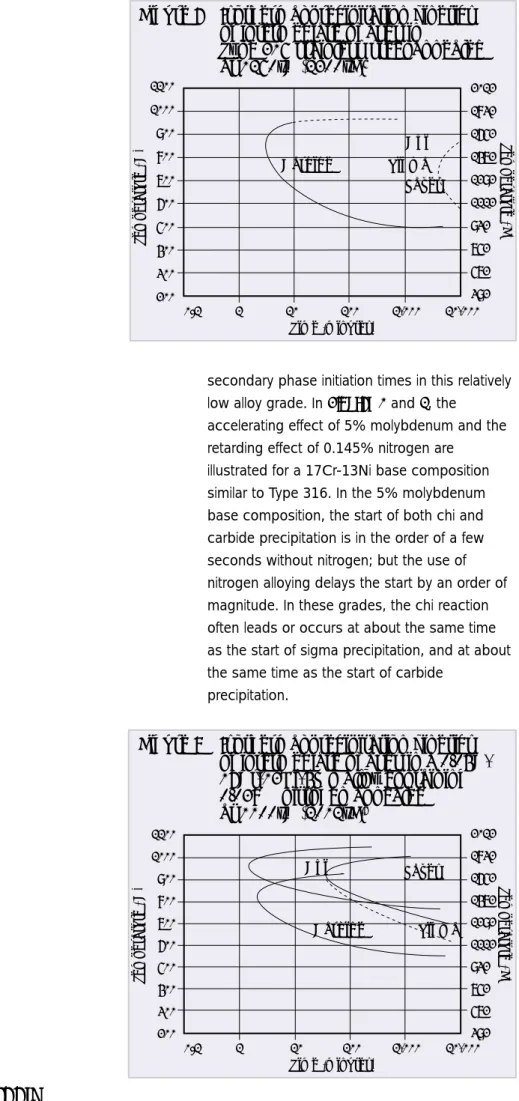
A transformation diagram for Type 316 stainless steel is shown in Figure 7to illustrate the
secondary phase initiation times in this relatively low alloy grade. In Figures 8and9, the
accelerating effect of 5% molybdenum and the retarding effect of 0.145% nitrogen are
illustrated for a 17Cr-13Ni base composition similar to Type 316. In the 5% molybdenum base composition, the start of both chi and carbide precipitation is in the order of a few seconds without nitrogen; but the use of nitrogen alloying delays the start by an order of magnitude. In these grades, the chi reaction often leads or occurs at about the same time as the start of sigma precipitation, and at about the same time as the start of carbide
precipitation.
Figure 7 Isothermal precipitation kinetics
of intermediate phases in
Type 316 stainless steel annealed at 1260°C (2300°F)6 0.1 1 10 100 1,000 10,000 T emperatur e (˚C) T emperatur e (˚F) Time (minutes) 1100 1000 900 800 700 600 500 400 300 200 2012 1832 1652 1472 1292 1112 932 752 572 392 Carbide Chi Sigma Laves
Figure 8 Isothermal precipitation kinetics
of intermediate phases in a 0.05C-17Cr-13Ni-5Mo alloy containing 0.039% nitrogen annealed at 1100°C (2012°F)7 0.1 1 10 100 1,000 10,000 T emperatur e (˚C) T emperatur e (˚F) Time (minutes) 1100 1000 900 800 700 600 500 400 300 200 2012 1832 1652 1472 1292 1112 932 752 572 392 Carbide Chi Sigma Laves
In the high-performance austenitic stainless steels, the volume fraction of intermetallic phases, when they occur, is usually not very large. Precipitation usually occurs on austenite grain boundaries with similar morphological features regardless of the specific phase. Therefore, the various phases are difficult to distinguish among themselves; and because they all have a similar deleterious effect on corrosion properties, it is often convenient to merely identify the start time for “all” precipitates in studies aimed at engineering applications. This has been done for three commercial high-performance grades compared with Type 316 inFigure 10. The temperature at the nose of the precipitation start curve for the high performance grades 254 SMO, 904L, and 317LMN is somewhat higher than that of Type 316. This reflects the higher temperature stability of chi and sigma in the
high-performance stainless steels compared with the lower temperature stability for carbide in Type 316.
FERRITIC STAINLESS STEELS
The ferritic stainless steels are the least tolerant of secondary phases because of the intrinsic low toughness of the ferrite structure and its low solubility for the interstitial elements,
carbon and nitrogen. The commercial high performance ferritic grades listed in Table 2are made with what may be described as low (<600 ppm) or very low (<250 ppm) contents of carbon plus nitrogen. However, stabilization is still required and, in both cases, titanium or niobium additions are used to control the detrimental effects of these interstitial elements. An isothermal transformation diagram for Fe-26Cr alloys with 180 ppm (C+N) is given inFigure 11. Chromium carbide and nitride precipitation can occur and lead to intergranular attack if it occurs in the sensitization
temperature range of about 500-800°C (930-1470°F). This precipitation will occur in the very low interstitial range as well as at higher levels. In these stainless steels, titanium nitride has very low solubility in ferrite and exists as a stable phase at all temperatures below the solidus. However, substantial solubility exists for the titanium carbide and the niobium nitride and carbide above about 1100°C (2010°F). At lower temperatures, titanium, niobium, and chromium carbide and nitride precipitation can occur but will not generally produce sensitization if it occurs above about 800°C (1470°F). Thus, annealing treatments and successful welding are based on this stabilization effect.
Figure 9 Isothermal precipitation kinetics
of intermediate phases in a 0.05C-17Cr-13N-5Mo alloy containing 0.145% nitrogen annealed at 1150°C (2102°F)7 0.1 1 10 100 1,000 10,000 T emperatur e (˚C) T emperatur e (˚F) Time (minutes) 1100 1000 900 800 700 600 500 400 300 200 2012 1832 1652 1472 1292 1112 932 752 572 392 Carbide Chi Laves
Figure 10 Isothermal precipitation kinetics of several high-performance stainless steels compared with Type 316 stainless steel8
0.1 1 10 100 1,000 10,000 T emperatur e (˚C) T emperatur e (˚F) Time (minutes) 1100 1000 900 800 700 600 500 400 300 200 2012 1832 1652 1472 1292 1112 932 752 572 392 Type 316 904L 317 LMN 254 SMO
Stabilization is believed to occur at these temperatures because the diffusion rate of chromium in ferrite is high enough to replenish chromium depletion associated with the precipitation. The kinetics for precipitation in the stabilization range have not been defined for these stainless steels and so are shown by the dashed curve in Figure 11. It is known that water quenching of thin sections can substantially suppress the precipitation. This has been used effectively with the high-performance ferritic family where rapidly cooled thin sections are used in heat exchanger applications. Precipitation in the 500-800°C (930-1470°F) range will produce
sensitization and
subsequent intergranular corrosion in corrosive environments for hold times certainly much shorter than the minimum one minute used by Demo9. It is believed that
the kinetics are similar for the higher interstitial, stabilized alloys, but will depend on the time spent in the high temperature stabilization range before cooling to the sensitization range. The slope of the sensitization C-curve indicates that
some chromium replenishment of the sensitized grain boundaries can occur during prolonged holds at sensitization temperatures.
The nose of the sigma precipitation curve lies at about 820°C (1510°F) and 30 minutes for a stabilized 25Cr-4Mo-4Ni stainless steel as shown in Figure 11. Chi and laves phase precipitation follows the sigma phase kinetics at low temperatures, but their stability range extends to higher temperatures than does sigma phase. Kinetics are considerably slower than shown in Figure 11with the lesser alloyed 26Cr-1Mo versions of these grades. It occurs
after about twenty-five minutes in the 26Cr-3Mo-3Ni grade, and the most rapid time of precipitation can be just a few minutes in the 29Cr alloys.
Alpha prime precipitation cannot be detected by optical metallography but will produce substantial changes in mechanical properties, especially a reduction in toughness accompanied by hardening. The alpha prime initiation kinetics shown in Figure 11were determined based on initial hardening in a 26Cr-3Mo-3Ni stabilized grade. In this work, some hardening occurred after one year at temperatures as low as 315°C (600°F), but no hardening was observed after
three years at temperatures of 300°C (572°F) and 290°C (550°F). The alpha prime transformation kinetics do not appear to vary much with alloy content. This was demonstrated by Nichol et al.12, who found an initiation time of ten hours for
both stabilized 26Cr-1Mo and unstabilized 29Cr-4Mo-2Ni alloys, the same time shown for the 26Cr-3Mo-3Ni grade in Figure 11.
DUPLEX STAINLESS STEELS
The kinetics of intermetallic phase precipitation in the duplex stainless steels are influenced by the often simultaneous transformation of delta
ferrite to austenite upon cooling through the temperature range of about 1100-600°C (2010-1110°F) and by the strong effect of nitrogen. The phase equilibrium relationships discussed earlier imply that these stainless steels are nearly 100% ferrite at the solidus temperature and nearly 50% ferrite at temperatures below about 1000°C (1830°F). Even upon cooling from normal annealing temperatures of about 1050°C (1920°F), some reversion of ferrite to austenite will take place. This austenite is often termed secondary austenite. Three mechanisms of ferrite reversion to austenite
Figure 11 Isothermal precipitation kinetics of intermediate phases in ferritic stainless steels containing 26% chromium, 1-4% molybdenum, and 0-4% nickel9,10,11,12 0.1 1 10 100 1,000 10,000 T emperatur e (˚C) T emperatur e (˚F) Time (minutes) 1100 1000 900 800 700 600 500 400 300 200 2012 1832 1652 1472 1292 1112 932 752 572 392
Carbide and Nitride (Ti, Nb, Cr)
(no sensitization)
Chromium
Carbide and Nitride
(sensitization)
Sigma
Alpha Prime Titanium
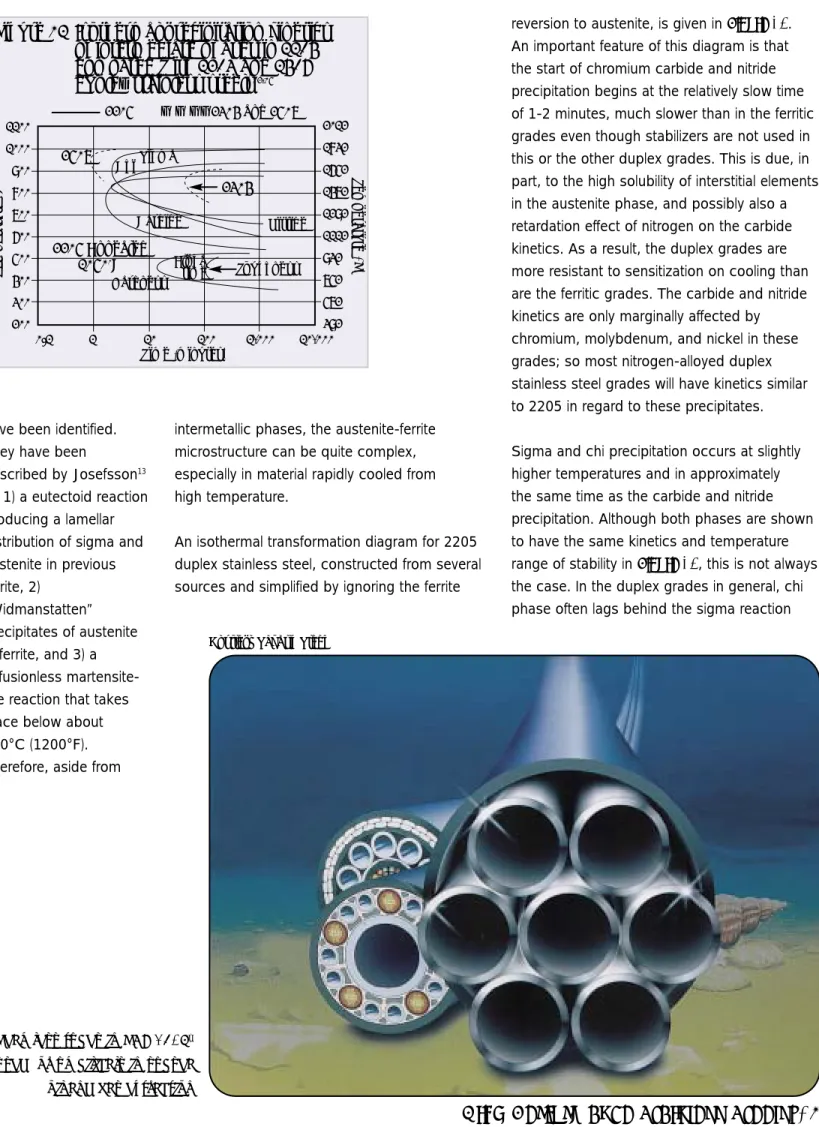
reversion to austenite, is given in Figure 12. An important feature of this diagram is that the start of chromium carbide and nitride precipitation begins at the relatively slow time of 1-2 minutes, much slower than in the ferritic grades even though stabilizers are not used in this or the other duplex grades. This is due, in part, to the high solubility of interstitial elements in the austenite phase, and possibly also a retardation effect of nitrogen on the carbide kinetics. As a result, the duplex grades are more resistant to sensitization on cooling than are the ferritic grades. The carbide and nitride kinetics are only marginally affected by chromium, molybdenum, and nickel in these grades; so most nitrogen-alloyed duplex stainless steel grades will have kinetics similar to 2205 in regard to these precipitates. Sigma and chi precipitation occurs at slightly higher temperatures and in approximately the same time as the carbide and nitride precipitation. Although both phases are shown to have the same kinetics and temperature range of stability in Figure 12, this is not always the case. In the duplex grades in general, chi phase often lags behind the sigma reaction intermetallic phases, the austenite-ferrite
microstructure can be quite complex, especially in material rapidly cooled from high temperature.
An isothermal transformation diagram for 2205 duplex stainless steel, constructed from several sources and simplified by ignoring the ferrite
Seamless tubes in SAF 2507®
used for umbilicals in subsea oil and gas extraction
Courtesy Sandvik Steel
have been identified. They have been
described by Josefsson13
as 1) a eutectoid reaction producing a lamellar distribution of sigma and austenite in previous ferrite, 2) “Widmanstatten” precipitates of austenite in ferrite, and 3) a diffusionless martensite-like reaction that takes place below about 650°C (1200°F). Therefore, aside from
Figure 12 Isothermal precipitation kinetics of intermediate phases in 2205 compared with 2304 and 2507 duplex stainless steels13,16
0.1 1 10 100 1,000 10,000 T emperatur e (˚C) T emperatur e (˚F) Time (minutes) 1100 1000 900 800 700 600 500 400 300 200 2012 1832 1652 1472 1292 1112 932 752 572 392 2507 2205 Annealed 10500C 2304 – – – – 2304 and 2507 2205 ChiSigma Carbide Nitride Alpha Prime Toughness Hardness
and is stable at slightly lower temperatures. Sigma phase usually occurs in greater
amounts than chi. Because it precedes the chi reaction, and because the two phases have similar effects on properties and are difficult to distinguish metallographically, it is often convenient to describe effects of “sigma phase” when dealing with the duplex stainless steels. Duplex grades that are more highly alloyed in chromium, molybdenum, and nickel will have more rapid sigma and chi kinetics than 2205, and the converse exists for the lower alloyed grades. This is illustrated by the dashed curves in Figure 12showing the start of sigma and chi formation in grades 2304 and 2507, and occurs because chromium and molybdenum and possibly manganese
accelerate the precipitation kinetics. Nickel has a similar accelerating effect, but the effect may be a result of nickel promoting austenite formation with resultant increased chromium and molybdenum partitioning to the ferrite phase. High solution annealing temperatures and continuous cooling tend to reduce the rate of formation of sigma phase.
Alpha prime hardening occurs quite rapidly in the ferrite phase, but not in austenite. Therefore, the effect of alpha prime precipitation on the bulk properties of the duplex stainless steels lags behind the initial formation of alpha prime in ferrite by a substantial margin. This is shown by the two alpha prime initiation curves in Figure 12, with one based on hardness and the other on toughness.
MECHANICAL
PROPERTIES
While the main driving force for the
development of the high-performance stainless steels has been corrosion resistance,
enhanced mechanical properties have also been obtained in many instances. This is especially true for the metallurgically more complex duplex grades that have a good combination of strength and toughness when their structures are carefully controlled. It pertains also to the nitrogen-enhanced austenitic grades, which have excellent toughness at strength levels well above the standard grades. This is significant from the standpoint of cost, because thinner sections often can help offset the higher cost
associated with higher alloy content. This benefit has been used to advantage in all product forms to reduce the cost of large piping installations, large process units, pressure vessels, and pressure piping, and to reduce the weight of topside structures on offshore platforms.
Because temperature and metallurgical effects on mechanical properties are quite different for each of the three grade groups, they are discussed separately in the following sections. Each section begins with a description of basic mechanical properties for the solution annealed condition as would be provided in
mill-produced product. Property changes related to metallurgical effects produced by fabrication, heat treatment, and service are then
considered.
AUSTENITIC STAINLESS
STEELS
The mechanical properties of the high-performance austenitic grades provide an excellent combination of good strength, ductility, and toughness over a broad temperature range. Their good impact
“God and the Rainbow” sculpture from an original idea by Carl Milles in 254 SMO® stainless steel Courtesy Avesta Sheffield AB
strengths at low temperatures are unique for such high-strength materials. These grades are stronger than the standard austenitic grades because strength gradually increases as alloy content increases. Most of the alloying
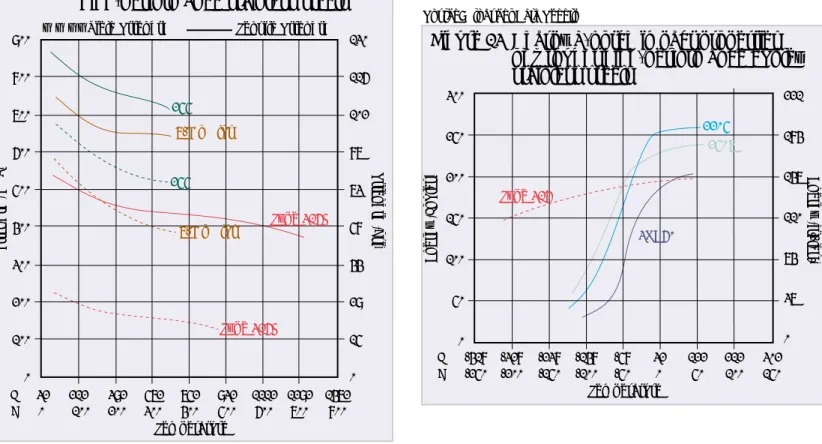
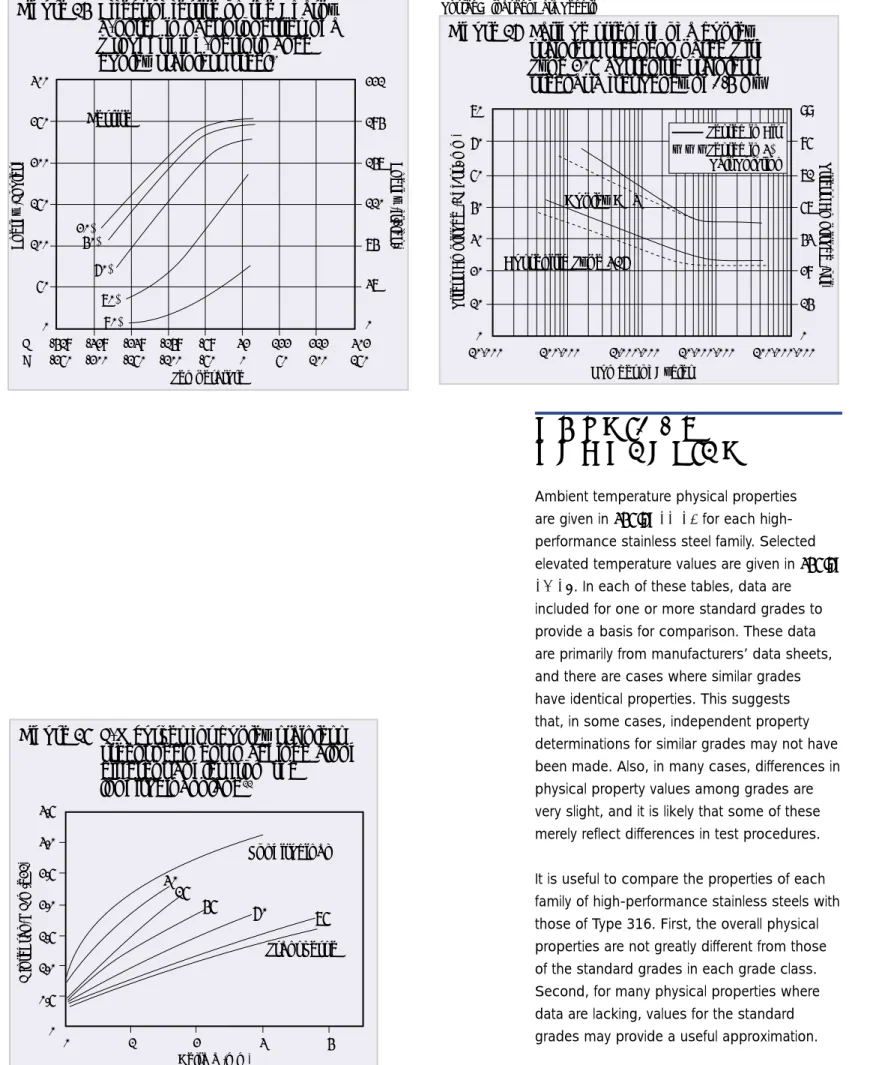
elements used to improve corrosion resistance or control phase balance are also solution strengtheners as shown in Figure 13. The most potent strengthener in these steels is nitrogen, which is also beneficial to corrosion resistance and for retarding the formation of some intermetallic phases. The effect of nitrogen on strength is shown in Figure 14, where a near 50% yield strength increase over Type 304 stainless steel is indicated for a nitrogen content of 0.20%. This strengthening effect diminishes somewhat at higher nitrogen contents, but commercial grades are available containing a nominal 0.50% nitrogen which will meet minimum yield strength specifications of 420-460 MPa (61-67 ksi). While nitrogen and other strengthening elements diminish ductility somewhat as shown in Figure 14, these grades still have sufficient ductility to handle most cold forming operations.
A list of the minimum ambient temperature mechanical property requirements for these grades as defined by the ASTM Standard Specification for plate, sheet and strip (A 240) is provided in Table 5. A comparison of this table to the grade chemistries given in Table 1
shows that the specified minimum strengths also increase with substitutional alloy content and nitrogen content. This is illustrated in
Figure 15, where the minimum specification strengths of representative grades with increasing alloy content are compared with strength data for Type 316L. The ASME Code allowable design stress values given in Table 6
also reflect these strengthening effects. The allowable stress values for some high-performance grades are more than two times that of Type 316L.
Strength increases at low temperatures as shown in Figure 16, and this is accompanied by little loss in ductility. The rate of
strengthening at low temperatures is not as great as for Type 316 and most other standard grades because the high performance grades are very stable with regard to martensite transformation. This is an advantage with regard to ductility and toughness, and in applications where low magnetic permeability is required.
These grades also have very good toughness at room temperature, even those that contain substantial nitrogen additions. This is illustrated inFigure 17, with fracture toughness and impact data for a group of austenitic stainless
Figure 13 Solid solution strengthening effects by alloying in austenitic stainless steels17 0 2 4 6 8 10 12 14 16 18 Change in Y ield Str ess (MPa) Change in Y ield Str ess (ksi)
Alloying Element (atomic %)
300 250 200 150 100 50 0 -50 44 36 29 22 15 7 0 -7 N Mn Ni Cu Si V Mo W B C Co
Figure 14 Effect of nitrogen on the strength and ductility of Type 304 stainless steel18
0 0.1 0.2 0.3 0.4
Str
ength (MPa)
Str
ength (ksi)
Carbon (0.018-0.090%) plus Nitrogen (wt%)
116 101 87 73 58 44 29 15 0 800 700 600 500 400 300 200 100 0 Tensile Strength Ductility Yield Strength Elongation 80% 70% 60% 50%
UNS ASTM Tensile Strength Yield Strength Elongation Hardness Name Number Specification (minimum) (minimum) (minimum) (maximum)
ksi MPa ksi MPa % Brinell HRB
Type 316L S31603 A 240 70 485 25 170 40 217 96 Type 317L S31703 A 240 75 515 30 205 40 217 96 Alloy 20 N08020 A 240/B 463 80 551 35 241 30 217 96 Alloy 825 N08825 B 424 85 586 35 241 30 – – 317LN S31753 A 240 80 550 35 240 40 217 96 260 – – 80 550 40 275 35 217 – 317LM S31725 A 240 75 515 30 205 40 217 96 317LMN S31726 A 240 80 550 35 240 40 223 97 204X – – 73 500 30 210 35 187 90 310MoLN S31050 A 240 80 550 35 240 30 217 96 700 N08700 B 599 80 550 35 240 30 – 90 904L N08904 A 240/B 625 71 490 31 220 35 – – 20Mo-4 N08024 B 463 80 551 35 241 30 217 96 20 Mod N08320 B 620 75 517 28 193 35 – 95 Alloy 28 N08028 B 709 73 500 31 214 40 – – 20Mo-6 N08026 B 463 80 551 35 251 30 217 96 25-6MO 1925 hMo N08925/NO8926 A 240/B 625 94 650 43 295 35 – – 254N – – 94 650 43 300 35 217 96 SB8 – – 79 550 37 250 35 – – 254 SMO S31254 A 240 94 650 44 300 35 223 97 AL-6XN N08367 A 240/B 688 100 690 45 310 30 240 – YUS 170 – – 100 690 43 300 35 217 97 2419 MoN – – 120 820 67 460 30 – – 4565S S34565 – 115 800 61 420 35 – – 3127 hMo N08031 B 625 94 650 40 276 40 – – 654 SMO S32654 A 240 109 740 62 425 35 250 –
Table 5 Minimum mechanical properties in basic ASTM specifications
for high-performance austenitic stainless steels
Figure 16 Low temperature strength of high-performance austenitic stainless steels ˚F -418 -328 -238 -148 -58 32 122 212 ˚C -250 -200 -150 -100 -50 0 50 100 Str ength (MPa) Str ength (ksi) Temperature 1800 1600 1400 1200 1000 800 600 400 200 0 261 229 203 174 145 116 87 58 29 0 AL-6XN AL-6XN 20 Cb-3 Type 316 20 Cb-3 Type 316 Source: Producer Data Sheets
– – – – Yield Strength Tensile Strength
Figure 15 Strengthening effect of nitrogen in high-performance austenitic stainless steels as manifested in ASTM A 240 minimum strength requirements T316L 0.07% N T317LMN0.15% N 0.20% N25-6MO 654 SMO0.50% N Minimum Specification Str ength (MPa) Minimum Specification Str ength (ksi) 965 827 689 552 414 276 138 0 140 120 100 80 60 40 20 0
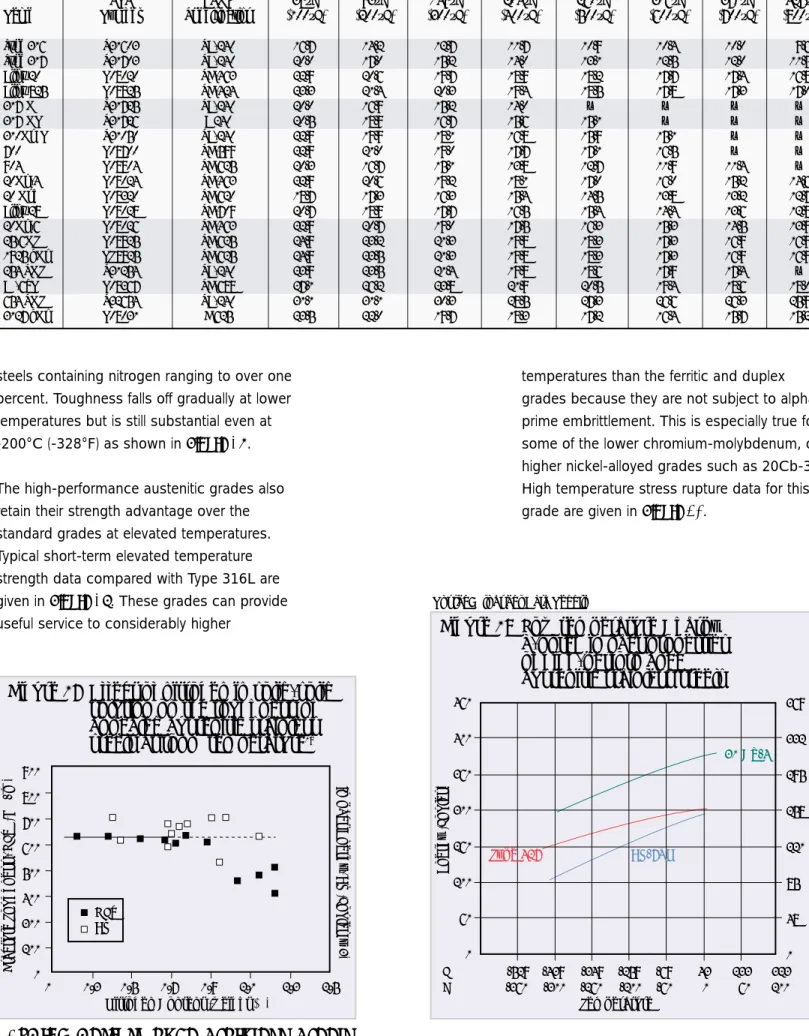
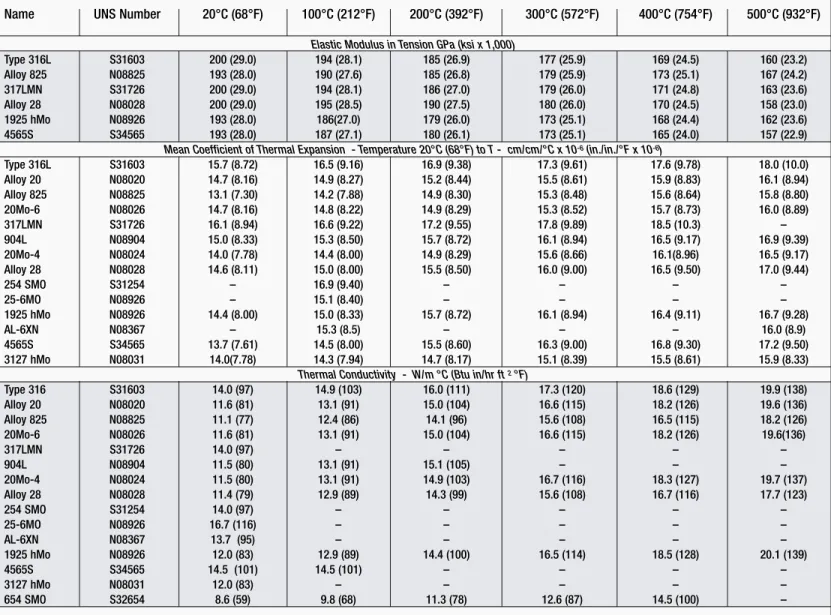
steels containing nitrogen ranging to over one percent. Toughness falls off gradually at lower temperatures but is still substantial even at -200°C (-328°F) as shown in Figure 18. The high-performance austenitic grades also retain their strength advantage over the standard grades at elevated temperatures. Typical short-term elevated temperature strength data compared with Type 316L are given in Figure 19. These grades can provide useful service to considerably higher
temperatures than the ferritic and duplex grades because they are not subject to alpha prime embrittlement. This is especially true for some of the lower chromium-molybdenum, or higher nickel-alloyed grades such as 20Cb-3. High temperature stress rupture data for this grade are given in Figure 20.
Figure 17 Effect of nitrogen in solid-solid solution on the toughness of annealed austenitic stainless
steels at room temperature19
0 0.2 0.4 0.6 0.8 1.0 1.2 1.4 Fractur e T oughness, KJc (MP √ m) Impact Energy , A v (Joules x 2)
Nitrogen Content (weight %)
800 700 600 500 400 300 200 100 0 KJc Av
Figure 18 Low temperature Charpy V-notch impact properties of high-performance austenitic stainless steels
˚F -418 -328 -238 -148 -58 32 122 212 ˚C -250 -200 -150 -100 -50 0 50 100 Energy (Joules) Energy (ft.-lbs.) Temperature 350 300 250 200 150 100 50 0 258 221 184 147 110 74 37 0 AL-6XN 20 Cb-3 Type 316 Source: Producer Data Sheets
Table 6 High-performance austenitic stainless steels ASME allowable design stress values (ksi)
Boiler Pressure Vessel Code, Section VIII, Division I, 1999 Addenda (lowest values for sheet, plate or tube)
UNS ASME 38°C 93°C 149°C 204°C 260°C 316°C 371°C 427°C
Name Number Specification (100°F) (200°F) (300°F) (400°F) (500°F) (600°F) (