An Ontological Framework
for Representing Clinical Knowledge
in Decision Support Systems
Marco Iannaccone and Massimo Esposito
National Research Council of Italy, Institute for High Performance Computing and Networking, Naples, Italy
Abstract—In the last decades, clinical evidence and expert consensus have been encoded into advanced Decision Sup-port Systems (DSSs) in order to promote a better integration into the clinical workflow and facilitate the automatic provi-sion of patient specific advice at the time and place where decisions are made. However, clinical knowledge, typically expressed as unstructured and free text guidelines, requires to be encoded into a computer interpretable form suitable for being interpreted and processed by DSSs. For this rea-son, this paper proposes an ontological framework, which en-ables the encoding of clinical guidelines from text to a formal representation, in order to allow querying, advanced reason-ing and management in a well defined and rigorous way. In particular, it jointly manages declarative and procedural as-pects of a standards based verifiable guideline model, named GLM-CDS (GuideLine Model for Clinical Decision Support), and expresses reasoning tasks that exploit such a represented knowledge in order to formalize integrity constraints, business rules and complex inference rules.
Keywords—Clinical Practice Guidelines, Decision Support Sys-tems, Ontology, Rules, Unstructured Data.
1. Introduction
In the last years, healthcare has been more and more charac-terized by an extensive practice variation and overuse, un-deruse, and misuse of medical resources. To address these issues, both clinical evidence and expert consensus have been systematically captured and joined to encode Clinical Practice Guidelines (CPGs), aimed at supporting general practitioners in making clinical decisions and managing medical actions about appropriate healthcare for specific clinical circumstances [1], [2].
Most CPGs, however, are expressed in a text-based format and, thus, are not easily accessible to care providers, who need to apply them either at the time and place where clin-ical decisions are made, or to assess the quality of their application, retrospectively.
Even if, recently, CPGs have been published also in elec-tronic formats, such as HTML or PDF files, they are poorly adopted and examined by care providers [3], who rarely have the time to utilize the valuable knowledge, encoded in the guidelines, during the treatment of their patients. Therefore, there is a need to facilitate automated guide-line specification, dissemination, application, and quality
assessment in order to realize the actual potential of CPGs in improving health outcomes.
Several recent studies have suggested that automation might be realized by encoding CPGs into advanced Decision Support Systems (DSSs), i.e., computer-based systems de-signed to promote a better integration into the clinical work-flow and to facilitate the automatic provision of patient-specific advice at the time and place where decisions are made [2], [4]. However, this requires clinical knowledge, expressed into an unstructured and free-text format, to be encoded as computer-interpretable guidelines (CIGs), suit-able for being interpreted and processed by DSSs.
Even if, in the recent past, many knowledge representation formalisms have been developed to address this issue, it remains strongly critical, since a mismatch exists between the unstructured narrative form of published CPGs and the formality that is necessary for the operationalization of clin-ical knowledge in CIGs for DSSs. Moreover, the poverty of the methodological rigor typically used to computerize guideline knowledge further complicates this operational-ization, which might generate malformed, incomplete, or even inconsistent CIGs.
For this reason, this paper proposes an ontological frame-work, which enables the encoding of CPGs from text to a formal representation, where domain knowledge, clinical process structures and data, and the behavioral semantics of such processes are encoded in order to allow querying, advanced reasoning and management in a well-defined and rigorous way.
In particular, it jointly manages declarative and procedu-ral aspects of a standards-based verifiable guideline model, named GuideLine Model for Clinical Decision Support (GLM-CDS) [5], and expresses reasoning tasks that ex-ploit such a represented knowledge in order to formalize integrity constraints, business rules and complex inference rules.
The solution here proposed is particularly relevant for the design and development of a CIG, enabling the possibility of inferring implicit knowledge not expressly formulated or verifying the consistency and coherency of the knowledge explicitly modeled.
The rest of the paper is organized as follows. Section 2 outlines an overview of the state-of-the-art solutions. In Section 3, the proposed framework is described by refer-ring to the guideline model used, i.e. GLM-CDS. Section 4
depicts an example application in order to highlight how the proposed framework can be used to formalize an ex-isting guideline defined in GLM-CDS. Finally, Section 5 concludes the work.
2. Related Work
To date, the effort in defining new solutions for computer-izing CPGs has produced many process-flow-like models, such as SAGE [6], GLIF [7], Asbru [8], EON [9] and PRO-forma [10], which are characterized by different coverage and particularities in order to represent both the structure of the domain-specific knowledge, named declarative knowl-edge, and the process-oriented knowlknowl-edge, named procedu-ral knowledge.
In particular, declarative knowledge concerns the domain compositional elements, such as raw and abstract concepts, their properties and inter-relations explicitly expressed in the CPGs.
On the other hand, procedural knowledge captures the control-flow logic to be modelled by providing sugges-tions about the acsugges-tions to be taken or conclusions to be drawn from declarative knowledge, as well as constraints between tasks, temporal constraints in a global plan, and so on [11].
All the above-mentioned models are process-flow-like and share same basic procedural elements: some kind of ac-tion/decision tasks, some implicit or explicit mechanisms for coordination or synchronicity of actions, the ability to create sub-plans or sub-guidelines, the possibility of stor-ing the state of a guideline which is bestor-ing executed and synchronizing the management of a patient with the corre-sponding parts of a guideline by means of some entry/exit points [11].
Various types of actions can be supported, such as medically-oriented (e.g., recommending the administration of a particular substance) or programming-oriented (e.g., notifying a message to a care provider).
Moreover, two basic types of decisions are mainly fined: decisions in the form of if-then-else choices and de-cisions requiring a heuristic choice from a set of rule-in and rule-out conditions that support or oppose alterna-tives [12].
A drawback common to all these proposals is represented by the lack of a seamless integration of both declarative and procedural knowledge expressed in a CPG by means of a highly expressive and formal framework able to jointly manage control-flow and domain-specific aspects and ex-press reasoning tasks to automatically infer implicit knowl-edge or verify a number of desired properties of correct-ness, coherency and well-formedness of a CIG, also with respect to the time perspective.
The solution here proposed has been conceived to face these issues by expressing in a combined way domain ontolo-gies, clinical processes, related decision and inference rules, and integrity constraints, as described in the following sections.
3. The Ontological Framework for
Computerizing CPGs
The formal framework here proposed is aimed at comput-erizing CPGs by defining a guideline model, named GLM-CDS, and by encoding such a model through a hybridiza-tion of the theoretic semantics of ontology and rule lan-guages.
Deeply speaking, the proposed model GLM-CDS consists of a control-flow part, which is based on a formal Task-Network Model (TNM) for codifying CPGs in terms of structured tasks connected with transition dependencies be-tween them from an initial state of the patient.
Domain-specific knowledge is coded through an infor-mation model built on the top of the Domain Analy-sis Model, Release 1 of the HL7 Virtual Medical Re-cord [13] (HL7 vMR-DAM) issued by HL7 Clinical De-cision Support-Working Group. This information model is populated by using existing standard terminological re-sources, such as Logical Observation Identifiers Names and Codes (LOINC) [14] and Systematized NOmenclature of MEDicine (SNOMED) [15].
Data types used in GLM-CDS resemble the ones defined in the HL7 vMR DAM, which gives a simplified/constrained version of ISO 21090 data types, based on the abstract HL7 version 3 data types specification, release 2 [16]. The control flow part is formally defined as the following 8-tuple:
Cf =hG,En,Ex,T,C,Dr,Ir,Csi, (1) where:
• G indicates the set of sub-guidelines included into a CPG,
• EnandExrepresent theentry pointand theexit point of the TNM modeling a CPG,
• T represents the set oftaskscomposing a CPG,
• C is the set of connections between the nodes of a TNM,
• Dr is the set ofdecision rules, which relate a deci-sion node to a task node and are used at runtime to automatically control the execution flow of a process,
• Ir is the set ofinference rules, which combine known knowledge to produce (“infer”) new information,
• Csis the set ofconstraints, which have to be verified in order to preserve the correctness, coherency and consistency of the CPG modeled.
Moreover,T is partitioned into the following sub-sets:
• D is the set of decision nodes for directing the control-flow from a point into the TNM to various alternatives,
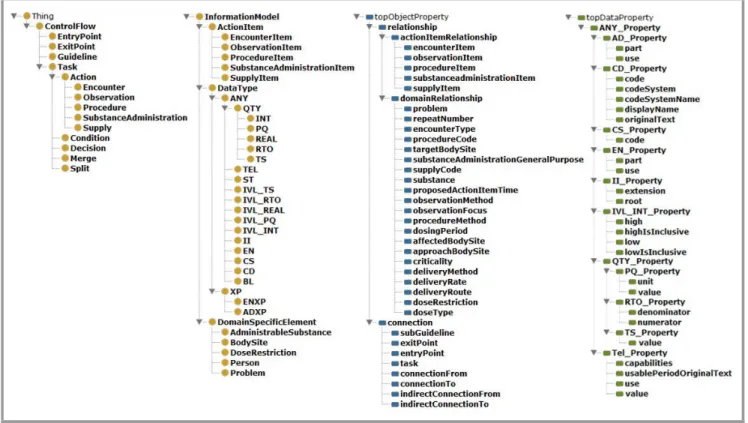
Fig. 1. A compacted perspective of both ontology concepts and roles formalized in GLM-CDS.
• Cn is the set of conditions, defined as observable states of the patient that persist over time and tend to require intervention or management,
• S indicates the set of split nodes, which enable to branch the guideline flow to multiple parallel tasks,
• M indicates the set ofmerge nodes, which enable to synchronize parallel tasks by making them converg-ing into a sconverg-ingle point,
• Amodels the set of high levelactionsto be performed and is further specialized into the following sub-sets: – AOis the set ofobservations, which are used to determine a measurement, a laboratory test or a user input value,
– ASmodels the set ofsupplies, which are aimed at providing some clinical material or equip-ment to a patient,
– AE is the set ofencounters, which are applied to request an appointment between a patient and healthcare participants for assessing his health status,
– APrepresents the set ofprocedures, whose out-come is the alteration of the patient’s physical condition,
– ASA refers to the set of substance administra-tions, which allow giving a substance to a pa-tient for enabling a clinical effect.
Furthermore,Cis also composed by the following sub-sets:
• Cd indicates the set of direct connections between pairs of nodes of a TNM without other intermediary nodes,
• Ci indicates the set of indirect connectionsbetween pairs of nodes of a TNM with other intermediary nodes.
Finally,Cs is partitioned into:
• ICsindicates the set ofintegrity constraintsdevised to detect violations, errors and/or missing information in the TNM encoding a CPG,
• TCs represents the set of temporal constraints for-mulated according to some time patterns, i.e. task duration, periodicity, deadline, scheduling and time lags.
On the other hand, the information model is formalized as the following 5-tuple:
Im=hAI,ED,RD,PD,DTi, (2) where:
• AImodels the set of elementary and repeatableaction items, associated to each action and specialized into:
– IO the set ofobservation items, – IS the set ofsupply items, – IE the set ofencounter items, – IP the set ofprocedure items,
Condition Condition Suspected hypertension Normotensive Condition Normotensive Condition Stage 1 Hypertension Condition Stage 2 Hypertension Observation Observation
Check clinic blood pressure
Observation
Check blood pressure with ABPM (or HBPM if
ABPM not tolerated) Check accelerated hypertension/suspected phaeochromocytoma Evaluate accelerated hypertension/suspected phaeochromocytoma Observation
Check target organ damage
Observation
Check cardiovascular risk and target organ
damage Evaluate blood
pressure
Decision
Evaluate evidence of target organ damage
Decision
Evaluate age, cardiovascular risk and
target organ damage
Decision Decision Decision Evaluate ABPM/HBPM Encounter Encounter Guideline Consider specialist referral Guideline Consider alternative causes for target organ
damage
Offer annual review care
Check blood pressure at least every 5 years
Guideline
Offer lifestyle interventions
Guideline
Refer same day for specialist care Guideline Consider starting antihypertensive drug treatment immediately Guideline Offer antihypertensive drug treatment Guideline Offer patient education to support adherence to treatment
Fig. 2. A fragment of the NICE guideline for hypertension in adults encoded in GLM-CDS.
• EDmodels the set ofdomain-specific elements, such as Administrable Substance, Dose Restriction or Body Site, which are linkable to the action items,
• RDindicates the set of relationships existing between: – action itemsanddomain specificconcepts, – action itemsanddata types,
– domain-specific conceptsanddata types,
– elements belonging to the subsetG∪En∪Ex∪T of the control flow part anddata types.
• PDrepresents the set of properties used for specifying values a data type can assume,
• DT models the set of data types used in GLM-CDS. This guideline model has been encoded by exploiting the theoretic semantics of ontology and rule languages.
In detail, ontology languages rely on decidable fragments of first order logic and are based on the notions of concepts (unary predicates, classes), individuals (instances of con-cepts), abstract roles (binary predicates between concepts) and concrete roles (binary predicates between concepts and data values).
On the other hand, rule languages are widely considered in literature as a syntactic and semantic extension to on-tology languages. Indeed, rules have been widely used as a new kind of axiom to define abstract roles as well as arithmetic relationships between data values assumed by concrete roles.
As a result, a subset of the control flow partCf of GLM-CDS, i.e.G∪En∪Ex∪T, as well as a subset of its infor-mation model Im, i.e. AI∪ED∪DT, have been encoded as ontology concepts. Furthermore, the setsC ofCf and
RDofImhave been encoded by means of ontology abstract roles, whereas the setPDofImhas been formalized by using ontology concrete roles.
Figure 1 reports a compacted perspective of ontology con-cepts and abstract roles formalized in GLM-CDS.
The setsDr andIr of decision and inference rules are for-mulated by using the Horn Clause Logic. In particular, decision and inference rules are expressed as definite Horn clauses, in the form:
h1(X1)←b1(Y1)∧ · · · ∧bk(Yk), (3) where the clause h1(X1) is named head, the clauses
b1(Y1). . .bk(Yk) (with k≥0) are called body, h1,b1. . .bk are rule predicates andX1,Y1. . .Yk are tuples of variables or constants. Rule predicates are built by using ontology concepts and roles and by using ontology individuals as constants. Moreover, each variable in the head is obliged to appear also in the body of a rule, so granting soundness and completeness of the reasoning process.
Finally, the sets ICs and TCs of integrity and temporal constraints are expressed as negative Horn clauses, in the form:
←b1(Y1)∧ · · · ∧bk(Yk), (4) where no clause is reported in the head. For the sake of uni-formity with decision and inference rules, each constraint is associated with a special predicateCs , which indicates whether it is violated, as formulated in (5):
Cs←b1(Y1)∧ · · · ∧bk(Yk). (5)
4. An Example Application: a CIG for
Hypertension in Adults
This section reports, as an example, the application of GLM-CDS to the CPG for the “Clinical management of primary hypertension in adults”, issued by the National In-stitute for Health and Care Excellence (NICE).
A fragment of this CPG, containing recommendations on blood pressure measurement, the use of ambulatory/home blood pressure monitoring (ABPM/HBPM) and the man-agement of hypertension, has been encoded according to the GLM-CDS as shown in Fig. 2.
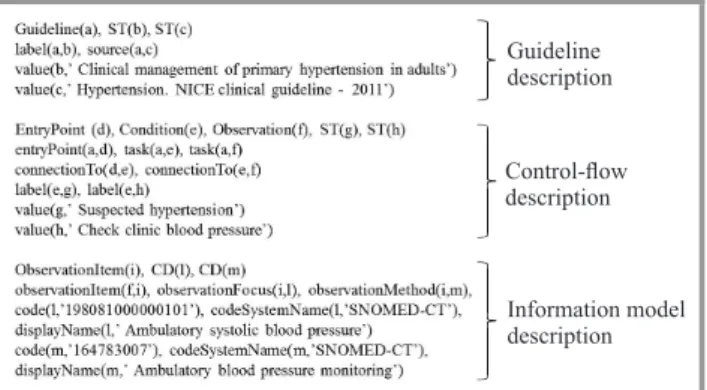
A partial translation of this fragment of CPG into its onto-logical representation is given in Fig. 3.
Guideline description Control-flow description Information model description
Fig. 3. A partial translation of a fragment of the guideline into its ontological representation.
In detail, the CPG is first described, by listing some relevant information, such as its name and source. Next, the first three nodes, i.e. the Entry Point, the Condition named “Sus-pected hypertension” and the Observation named “Check clinic blood pressure”, of the control-flow part reported in Fig. 2 are formalized as ontology concepts and roles. Finally, with respect to Observation named “Check clinic blood pressure”, a specific Observation Item is codi-fied, whose rolesobservationFocusandobservationMethod are valued according to the data type CD of the HL7 vMR-DAM.
An example of decision rule, associated to the Decision node named “Evaluate blood pressure”, is reported in Fig. 4. It evaluates whether the systolic blood pressure is less than 140 mmHg.
Decision rule
Inference rule Integrity constraint
Fig. 4. Some examples of decision rules, inference rules and integrity constraints.
Moreover, an inference rule, which defines the role indi-rectConnectionTo starting from the role connectionTo, is also reported.
Finally, an example of integrity constraint is also codi-fied, which states that each Entry Point node of a CPG is not admissible to have a direct connection from any other node.
5. Conclusion
To date, the different attempts proposed for encoding CPGs in a computer interpretable form suitable for DSSs are not fully concerned with enabling an intuitive and, contextually, formal representation of CPGs, in terms of their logic, the clinical processes involved and the different types of clinical knowledge represented.
For this reason, this paper proposed an ontological frame-work for encoding CPGs from text to a formal repre-sentation, by jointly managing declarative and procedural aspects of a standards based verifiable guideline model, named GLM-CDS, and expressing reasoning tasks that ex-ploit such a represented knowledge in order to formalize integrity and temporal constraints, business rules and com-plex inference rules.
The strength of this solution relies on the support to design and develop a CIG, by enabling the possibility of inferring implicit knowledge not expressly formulated or verifying the consistency and coherency of the knowledge explicitly modelled.
In order to promote and facilitate the widespread use of this framework, ongoing activities are being carried out to design and realize an ad hoc, intuitive and user friendly authoring tool for encoding CPGs graphically and, suc-cessively, translating them into a formal representation ex-pressed in terms of ontology concepts and roles, as well as decision/inference rules and integrity/temporal constraints.
Acknowledgements
This work has been partially supported by the Italian project “ASK-Health” Advanced system for the interpretation and sharing of knowledge in the healthcare sector.
References
[1] B. S. Bloom, “Crossing the quality chasm: a new health system for the 21st century”, JAMA: The J. Amer. Medical Assoc., vol. 287, no. 5, pp. 646–647, 2002.
[2] M. J. Field and K. N. Lohr,Guidelines for Clinical Practice: From Development to Use. Washington: National Academy Press, 1992. [3] F. A. Sonnenberg and C. G. Hagerty, “Computer-interpretable
clin-ical practice guidelines: Where are we and where are we going?”,
Methods Infor. Med., vol. 45, no. 1, pp. 145–158, 2006.
[4] F. Moscato, V. Vittorini, F. Amato, A. Mazzeo, and N. Mazzocca, “Solution workflows for model-based analysis of complex systems”.
IEEE Trans. Autom. Sci. Engin., vol. 9, no. 1, pp. 83–95, 2012. [5] M. Iannaccone, M. Esposito, and G. De Pietro, “A standards-based
verifiable guideline model for decision support in clinical applica-tions”, inProcess Support and Knowledge Representation in Health Care, D. Riano, R. Lenz, S. Miksch, M. Peleg, M. Reichert, and A. Teije, Eds. Springer, 2013, pp. 143–157.
[6] S. W. Tuet al., “The SAGE guideline model: Achievements and overview”,J. Am. Med. Inform. Assoc., vol. 14, pp. 589–598, 2007. [7] A. A. Boxwalaet al., “GLIF3: a representation format for sharable computer-interpretable clinical practice guidelines”,J. Biomed. In-form., vol. 37, no. 3, pp. 147–161, 2004.
[8] A. Seyfang, S. Miksch, and M. Marcos, “Combining diagnosis and treatment using Asbru”,Int. J. Med. Inform., vol. 68, no. 1, pp. 49–57, 2002.
[9] S. W. Tu and M. A. Musen, “Modeling data and knowledge in the EON guideline architecture”,Stud. Health. Technol. Inform., vol. 84, no. 1, pp. 280–284, 2001.
[10] J. Fox and N. Johns, “Rahmanzadeh A. Disseminating medical knowledge: the PROforma approach”, Artif. Intell. Med., vol. 14, pp. 157–181, 1998.
[11] D. Isern and A. Moreno, “Computer-based execution of clinical guidelines: a review”, Int. J. Med. Inform., vol. 77, pp. 787–808, 2008.
[12] P. De Clercq, K. Kaiser, and A. Hasman, “Computer-interpretable guideline formalisms”, Stud. Health. Technol. Inform., vol. 139, pp. 22–43, 2008.
[13] “HL7 Virtual Medical Record (vMR) Project Wiki”, Health Level 7 [Online]. Available:
http://wiki.hl7.org/index.php?title=Virtual Medical Record (vMR) [14] “Logical Observation Identifiers Names and Codes (LOINC)”,
Re-genstrief Institute, Inc and the LOINC Committee [Online]. Avail-able: http://loinc.org/
[15] “Systematized Nomenclature of Medicine (SNOMED)”, Interna-tional Health Terminology Standards Development Organisation [Online]. Available: http://www.ihtsdo.org/snomed-ct/
[16] “HL7 Reference Information Model, Version 3”, Health Level 7 [On-line]. Available: http://www.hl7.org/implement/standards/rim.cfm
Marco Iannaccone is a re-search assistant at the Institute for High Performance Comput-ing and NetworkComput-ing (ICAR) of the National Research Council of Italy (CNR). He received his M.Sc. in Computer Science Engineering from University of Naples Federico II in 2004. Since July 2012, he has been a member of the iHealthLab – Intelligent Healthcare laboratory. His research interests cover knowledge representation and ontologies for health-care processes, process modeling, interoperability and stan-dards in healthcare, workflow management in healthcare. His research is described in scientific articles published in international conferences.
E-mail: [email protected] National Research Council of Italy (CNR) Institute for High Performance Computing and Networking (ICAR)
Via Pietro Castellino, 111 80131, Naples, Italy
Massimo Esposito is a scien-tific researcher at the Institute for High Performance Comput-ing and NetworkComput-ing (ICAR) of the National Research Council of Italy (CNR). He received his M.Sc. in Computer Science Engineering (Cum Laude) from University of Naples Fed-erico II in 2004. He received a University 1st level Master
degree, named European Master on Critical Networked Systems in 2007, and a Ph.D. degree in Information Technology Engineering in 2011 from the University of Naples Parthenope. Since 2007, he has been a member of the Advanced Medical Imaging and Computing labOra-tory (AMICO), developed from a cooperation agreement between the Institute of Biostructure and Bioimaging (IBB) and ICAR of CNR. Since 2011, he has been a member of the iHealthLab – Intelligent Healthcare laboratory. His research interests cover pervasive comput-ing, knowledge-based medical decision support systems, knowledge discovery in biomedical databases, workflow
management in healthcare. His research is described in many scientific articles published in international con-ferences and journals. He participates in the editorial boards of many international journals and has been on the program committee of many international con-ferences.
E-mail: [email protected] National Research Council of Italy (CNR) Institute for High Performance Computing and Networking (ICAR)
Via Pietro Castellino, 111 80131, Naples, Italy