D
EPARTMENT OF
E
CONOMICS
M
ODEL
U
NCERTAINTY AND
B
AYESIAN
M
ODEL
A
VERAGING IN
V
ECTOR
A
UTOREGRESSIVE
P
ROCESSES
Rodney W. Strachan, University of Leicester, UK
Herman K. van Dijk, Erasmus University, The Netherlands
Working Paper No. 06/5
February 2006
Model Uncertainty and Bayesian Model
Averaging in Vector Autoregressive Processes
Rodney W. Strachan
1Herman K. van Dijk
21
Department of Economics, University of Leicester,
Leicester LE1 7RH UK.
email: [email protected]2
Econometric Institute,
Erasmus University Rotterdam,
Rotterdam, The Netherlands
email: [email protected]
February 6, 2006
ABSTRACT
Economic forecasts and policy decisions are often informed by empiri-cal analysis based on econometric models. However, inference based upon a single model, when several viable models exist, limits its usefulness. Tak-ing account of model uncertainty, a Bayesian model averagTak-ing procedure is presented which allows for unconditional inference within the class of vector autoregressive (VAR) processes. Several features of VAR process are investi-gated. Measures on manifolds are employed in order to elicit uniform priors on subspaces de…ned by particular structural features of VARs. The features considered are the number and form of the equilibrium economic relations and deterministic processes. Posterior probabilities of these features are used in a model averaging approach for forecasting and impulse response analysis. The methods are applied to investigate stability of the “Great Ratios” in U.S. consumption, investment and income, and the presence and e¤ects of permanent shocks in these series. The results obtained indicate the feasibility of the proposed method.
Key Words:Posterior probability; Grassman manifold; Orthogonal group;
Cointegration; Model averaging; Stochastic trend; Impulse response; Vector autoregressive model.
1
Introduction.
In this paper we take account of model uncertainty and introduce a method of using Bayesian model averaging in the class of vector autoregressive processes. We demonstrate the operational implications of our approach by investigat-ing the stability of the “Great Ratios”in U.S. consumption, investment and income, and analysing the presence and e¤ects of permanent shocks for the duration of the business cycle in these series.
The idea underlying Bayesian model averaging is relatively straightfor-ward. Model speci…c estimates are weighted by the corresponding posterior model probability and then averaged over the set of models considered. Al-though many statistical arguments have been made in the literature to sup-port model averaging (e.g., Leamer, 1978, Hodges, 1987, Draper, 1995, Min and Zellner, 1993 and Raftery, Madigan and Hoeting, 1997), recent applica-tions suggest its relevance for macroeconometrics (Fernández, Ley and Steel, 2001 and Sala-i-Martin, Doppelho¤er and Miller, 2004). Here we mention three reasons for this relevance.
The …rst reason is relevance for forecasting and policy analysis. An im-portant function of empirical economic analysis is to provide accurate information for decision making. For example, there is evidence that permanent -possibly productivity - shocks account for most ‡uctuations in consumption (King, Plosser, Stock and Watson, 1991, and Lettau and Ludvigson, 2004) and information may be required on the form of the response in consumption to such a permanent shock. Centoni and Cubadda (2003), however, focus upon business cycle ‡uctuations and …nd permanent shocks are not very im-portant. While the decision maker is not directly interested in the underlying model used to estimate the response, it is, however, the econometrician’s re-sponsibility to detail the model upon which these estimates rely. If there is any uncertainty about the veracity of the model, the expected loss (from choosing a policy action) from that single model cannot equal the expected loss that accurately accounts for model uncertainty.
A second reason for considering model averaging is methodological. There are well known issues relating to the complexity of the model set and the sequences used to select a model. The standard approach to providing in-ference is to select a single model and present empirical results based upon this model. The usual strategy of model selection using sequential testing procedures, however, introduces problems of model uncertainty. In the con-text of sequential hypothesis testing, the pre-test problem is well understood
(see, for example, Poirier, 1995, pp. 519-523) and has received considerable attention in the statistical and econometric literature. We do not intend (nor are able) to survey the literature here, but mention that just within the unit root and cointegration testing there have been several studies such as Elliott and Stock (1994), Elliott (1998), Phillips (1996), Chang and Phillips (1995) and Chang (2000) (see for useful discussion, Maddala and Kim, 1998, pp. 139-140 and 229-231).
The problem is self evident. Whether we accept or do not accept an hypothesis, the veracity of the adopted hypothesis is uncertain. Subsequent tests condition upon that uncertain outcome and have their own uncertain outcomes. This process can lead to signi…cant size distortions and inappro-priate reported standard errors. Generally, the resulting standard errors will not fully re‡ect the uncertainty associated with the estimates. The longer the sequence of tests the more the problem compounds, and the sequence can become very long if, for example, we consider: lag length; the type of deterministic processes present; the number of cointegrating relations; overi-dentifying restrictions on the cointegrating space; and even whether certain variables are in some sense (weakly or strongly) exogenous for the inference in question. Despite the extensive concern shown in the literature for the pretest problem, however, a generally applicable strategy for dealing with this issue does not appear to be available. It would seem the usual (implicit) approach is to “. . . entirely ignore the problems caused by pretesting, not because they are unimportant, but because, in practice, they are generally intractable” (Davidson and MacKinnon, 1993, pp. 97-98).
An additional, related, problem due to the complexity of the model, is the con‡icting inferences that may arise depending upon which sequence of tests is employed. For example, using the Johansen trace test and data on consumption, investment and income from Paap and van Dijk (2003), we …nd that the chosen cointegrating rank depends upon the chosen determin-istic term1 and the rank may be zero or one. This suggests it is important to determine the correct deterministic process before investigating the coin-tegrating rank. However, the range of deterministic process that can occur di¤ers if cointegration occurs or not. To take this example further, let us assume a rank of one for these variables and we are now interested in 1)
1As the deterministic processes enter the error correction term, testing for presence of a
trend in a VAR in levels, when cointegration is present, does not identify the deterministic process.
whether the error correction term, zt; has a trend and 2) if the Great Ratios
of consumption to income and investment to income enter zt.2 Depending
upon whether we test stability of the Great Ratios …rst or test the presence of various deterministic terms …rst, we …nd either we have no trend inzt and
that the Great Ratios do not enter zt; or that the Great Ratios do enter zt
and zt has a linear trend.
A third reason for considering Bayesian model averaging is a pragmatic one. The support in the data is in many cases not clear or dogmatically for or against a restriction, and researchers often do not have strong prior belief in particular restrictions. The strategy of testing hypotheses on restrictions and conditioning upon the outcome, e¤ectively assigns a weight of one to the model implied by the restriction and zero to all other plausible models. Even if the support is strongly for or against a particular restriction, with only slight support for the alternative unrestricted model, imposing the restric-tion ignores informarestric-tion from that less likely model which, if appropriately weighted, could improve inference.
Thus, there is a con‡ict between the analyst’s need to obtain the best model and the decision-maker’s need for the least restrictive interpretation of the information provided by the analyst. As an alternative to conditioning on structural features, it is possible to improve policy analysis by present-ing unconditional or averaged information. Gains in forecastpresent-ing accuracy by simple averaging have been pioneered by Bates and Granger (1969) and dis-cussed recently by Diebold and Lopez (1996), Newbold and Harvey (2001) and Terui and van Dijk (2002). Some explanation for this phenomenon in particular cases was provided by Hendry and Clements (2002). Alternatively, the averaging weights can be determined to re‡ect the support for the model from which each estimate derives. This requires accurate re‡ection of the uncertainty associated with the structural features de…ning the model.
We present a Bayesian approach for conducting unconditional inference from the vector autoregressive model. Speci…cally, we focus on three con-tributions. First, a general operational procedure is presented for specify-ing di¤use prior information on structural features of interest which implies well-de…ned posteriors and existence of moments. Given the prior, the infor-mation in the likelihood function is supposed to dominate. As a result one can evaluate the relative weights or probabilities of such structural features as the number of stable equilibrium relationships among economic variables,
the forms of those equilibrium relationships, the dynamic responses to dis-equilibria, and the type of deterministic processes that may be present. In order to obtain these results we make of use manifolds and orthogonal groups and their measures. Then we can elicit uniform prior measures on relevant subspaces of the parameter space. From these measures we develop prior distributions for elements of these subspaces as the parameter of interest.
Second, using this methodology we show in this paper how to obtain pos-terior inference and forecasts from model averages in which the economically and econometrically important structural features may have weights other than zero or one.
Third, we brie‡y demonstrate the proposed methodology with an inves-tigation of the stability of the ‘Great Ratios’as discussed in King, Plosser, Stock and Watson (1991) (hereafter KPSW), and the relative weights of permanent and transitory components in US consumption, investment and income, and, …nally, the credibility of alternative paths of responses to a possible productivity shock.
There exist several Bayesian analyses of VAR processes in the literature. A complete survey is outside the scope of our paper, although we mention the following approaches. Using so-called “Minnesota”priors, which are of a random walk nature, Doan, Litterman and Sims (1984) investigate Bayesian forecasting and impulse response analysis using unrestricted VARs. Sims and Zha (1999) investigate con…dence bands of impulse responses using un-restricted VARs. Other papers using unun-restricted VARs include Koop (1991 and 1994) and Canova and Matteo (2004). Structural features in VAR mod-els, like cointegration, are investigated by Kleibergen and Van Dijk (1994), Strachan (2003), Villani (2005) using di¤use type of priors. We extend the analysis of these two approaches by considering priors on structural fea-tures and by investigating the implied forecasts and impulse responses using Bayesian model averaging.
The structure of the paper is as follows. In the Section 2 we introduce the models of interest in this paper - the vector autoregressive models, the general structural features of interest, and the restrictions they imply. In Section 3 we present the priors, the likelihood and useful expressions for the posterior. The tools for inference in this paper, posterior probabilities, are introduced and general expressions are derived for estimators of features of interest like impulse responses. Our approach is a signi…cant divergence from much of the earlier work. This section therefore provides a discussion of the advantages of this approach in the context of model averaging. We
demon-strate the approach in Section 4 with an investigation of the responses of consumption, investment and income to a permanent shock allowing for sta-bility of consumption to income and investment to income ratios. In Section 5 we summarize conclusions and discuss possibilities for further research.
2
A Set of Vector Autoregressive Models.
Since the in‡uential work by Sims (1980), the vector autoregressive model has enjoyed much success in macroeconometrics. These models can incorporate a wide range of short and long run dynamic, equilibrium and deterministic behaviours. Further, it has been observed in empirical studies, that many economic variables of interest are not stationary, yet economic theory, or empirical evidence, suggests stable long run relationships to exist among these variables.
The statistical theory of cointegration (Granger, 1983, and Engle and Granger, 1987), in which a set of nonstationary variables combine linearly to form stationary relationships, and the attendant Granger’s representation theorem provide a useful speci…cation to incorporate this economic behaviour into the error correction model and allows the separation of long run and short run behaviour. We work with the vector autoregressive model in the error correction form to simplify expressions of restrictions. For more details on a likelihood analysis of VAR models with cointegration restrictions we refer to Johansen (1995).
When a VAR process cointegrates, the model may be written in the vector error correction model (VECM) form. The VECM of the 1 n vector time series process yt; t = 1; : : : ; T; conditioning on the l observations t = l+
1; : : : ;0; is yt = d1;t 1+yt 1 + +d2;t 2+ yt 1 1+: : :+ yt l l+"t (1) = z1;t +z2;t +"t (2) where yt = yt yt 1; z1;t = (d1;t; yt 1); z2;t = (d2;t; yt 1; : : : ; yt l); = ( 02; 0 1; : : : ; 0l) 0 and = 0 1; +0 0. The matrices i are n n and +
and 0 aren r and assumed to have rank r;and if r=n then + =In: We
de…ne the deterministic terms di;t i formally below.
Here we de…ne the restrictions of interest, combinations of which de…ne di¤erent model features of interest which we may compare or weight using
posterior probabilities. The restrictions refer to the number of equilibrium relations, to the form of these relations, the lag length and to particular types of deterministic processes.
We denote the number of stable equilibrium relationships or, more pre-cisely, the cointegrating rank by r, where r = 0;1; : : : ; n: For cointegration analysis of (1), the parameters of interest are the coe¢ cient matrices + and which are of rank r n. Of particular interest then, is r which implies there are(n r)common stochastic trends inyt, andr is the number ofI(0)
combinations of the element of yt extant. In the case r < n and assuming
for simplicity 1 = 0; + is the matrix of cointegration coe¢ cients, yt + = 0
are the stationary relations towards which the elements of yt are attracted,
and is the matrix of factor loading coe¢ cients or adjustment coe¢ cients determining the rate of adjustment of yt towardsyt += 0:
A second feature of interest is the particular identifying restrictions placed upon : These will be denoted byo; whereo = 0;1; : : : ;J and o = 0 will be understood to refer to the just identi…ed model. A range of restrictions commonly investigated are presented in Johansen (1995, Chapter 5). We restrict ourselvest to two cases: no restriction on (o = 0); and = H (o = 1) where is an s r matrix such that the cointegrating space is either completely determined (ifr =s) or is restricted to be within the space spanned by H.
The deterministic processes in the level,yt, and the equilibrium relations,
yt +, are given respectively by the termsd1;t 1 andd2;t 2 in (1). The contents
and dimensions of thedi;t and the i depend upon the particular deterministic
process that occur inyt + and yt (and thereforeyt):In the discussion that
follows, 1 and 1 are1 rvectors, while 2 and 2 are1 n vectors. These
processes can be linear trends, non-zero means or zero mean foryt +, and no
drift, linear drift and quadratic drift inyt:For example, if 2 = ( 02 02)
0 then
d2;t = (1; t) and this implies yt will have a quadratic drift. If 2 = 2 then
d2;t = (1) and this implies yt will have a linear drift. We consider the …ve
commonly used combinations in the table below (see, for example, Johansen, 1995):
d d1;t 1 d1;t yt + d2;t 2 d2;t yt
1 1+ 1t (1; t) linear trend 2+ 2t (1; t) quadratic drift
2 1+ 1t (1; t) linear trend 2 (1) linear drift
3 1 (1) non-zero mean 2 (1) linear drift
4 1 (1) non-zero mean 0 fg no drift
5 0 fg zero mean 0 fg no drift
Each model will be identi…ed byM! where! = (r; o; d)and !2 where
is the set of all! we consider. For example, the least restricted model will beM(n;0;1);while the most restricted model will beM(0;1;5):As an example of
models we consider, KPSW begin their investigation with results using two VAR models with six lags: the …rst having only a constant,M(n;0;3), and the
second having a constant and a trend, M(n;0;1). From these models they …nd
evidence that suggests support for two equilibrium relations of known form and a linear drift which within our model set is M(2;1;3):3
Thus, withn= 3 in our application, we deal with a case of4 2 5 = 40
models4. We also allow for a range of lags of di¤erences, however as these have little economic importance for the studies we look at, and for space considerations, we do not discuss these further except to note here that this increases the number of models to 40 times the number of lags we consider.
3
Priors and Posteriors.
In this section the forms of the priors and resultant posterior are presented. We begin with discussion of the distribution of the prior probabilities over the model space which contains some models that are impossible and others that are observationally equivalent. Next we consider the priors for the parameters
( ; B): Conditional upon the model in (2) is linear. This fact makes it relatively straightforward to elicit priors on these parameters. We next give careful consideration to the prior for before presenting the method of posterior analysis.
3Interestingly, they later report results on responses to permanent (productivity) shocks
usingM(2;1;3)but with eight lags of di¤erences:
4This reduces to 26 models when we account for impossible models and observationally
3.1
The Prior for
(
; B; M
!)
:
In this paper we wish to treat all models as a priori equally likely, however this is not a straightforward issue5. The priors for the individual elements of ! = (r; o; d)are not independent, as certain combinations are either impossi-ble, meaningless (such as, for example, r= 0 with o = 2) or observationally equivalent to another combination (such as the models withr =nand d= 1
or 2). The natural prior probability to assign to impossible models is zero6. However, the researcher must carefully consider how she wishes to treat ob-servationally equivalent models.
It would seem sensible to regard observationally equivalent models as one model and then assign equal prior probabilities to all models. For example, at r = 0the models with d = 2and d= 3 are observationally equivalent. If we were to treat these two as one model, they would receive half the prior probability of other models with rank 0 < r < n. Systematic employment of this principle, however, would bias the prior weight in favour of models with 0 < r < n: This could shift the posterior weight of evidence in favour of some economic theories for which we wish to determine the support.
Alternatively we could specify all possible combinations of the indices in ! be equally likely to avoid biasing the evidence in favour of other classes of models. However, any bias towards some models can be viewed as sim-ply a result of Bayes Theorem. This is the view we take and we imple-ment the …rst approach (treating observationally equivalent models as one model) in the following way. We …rst assign probabilities to various values of the model features such as di¤erent cointegrating ranks, p(r); or deter-ministic processes, p(d). We then set the prior weighting for each model as k(M!) = p(r)p(o)p(d): Next, set k(M!) = 0 for impossible combinations
and for each set of combinations of ! that imply observationally equivalent models, we set k(M!) = 0 for all but one of the combinations. Finally we
compute the prior model probabilities as p(M!) = k(!)= !k(!) where in
the denominator we have summed k(M!) over all !.
To demonstrate these prior probabilities we use the application in this paper. As we have n = 3, r 2 [0;1;2;3] so we use p(r) = (n+ 1) 1 = 0:25 5The authors are grateful to Geert Dhaene and an anonymous referee for useful
com-ments on this issue.
6Although the actual prior probability we assign to impossible models - provided it is
less than one - is irrelevant as the marginal likelihood for these models will be zero, such that the posterior probability will be zero by design.
and with d 2 [1;2;3;4;5] we set p(d) = 0:2: In our application we consider two states of overidenti…cation of :In the …rst state is unrestricted (o = 0) and in the second we have = H (o = 1) and so we set p(o) = 1=2 for o 2[0;1]:
For each model implied by a particular value of !; we need to specify a prior for the parameters in the model. We use the standard di¤use prior for
; p( ) _j j (n+1)=2.
As B changes dimensions across the di¤erent versions of ! implied by di¤erent models and each element of the matrix B has the real line as its support, the Bayes factors for di¤erent models will not be well de…ned if an improper prior onB;such asp(Bj ; M!)_1were used. For the original
dis-cussion on this point see Bartlett (1957) and more recently O’Hagan (1995), Strachan and van Dijk (2003) and Strachan and van Dijk (2005). For this reason a weakly informative proper prior for B must be used. We take the prior for b=vec(B)conditional upon ( ; ; M!)as Normal with zero mean
and covariance V = 1I (r+ki).
7 We choose the value of = 10 as this provides a mild degree of shrinkage towards zero which has been shown to im-prove estimation (See Ni and Sun, 2003). Further evidence on the in‡uence of this choice can be found in Strachan and Inder (2004).
3.2
Eliciting a Prior on
:
As and appear as a product in (2), r2 restrictions need to be imposed
on the elements of and to just identify these elements. Much of the work to date in Bayesian cointegration analysis has used linear identifying restrictions. That is, by assuming c is invertible for known (r n) matrix c and the restricted to be estimated is = (c ) 1: The free elements are collected in 2 = c? where c?c0 = 0: For example, if c = [Ir 0] then
= hIr
0
2
i0
: A prior is then speci…ed for 2 which is then estimated and often its value is interpreted.8
7If an informative prior is used on for the cointegrating space then we recommend the
prior for B in Koop, León-González and Strachan (2005), of which the prior presented here is a speci…c case.
8There exist practical problems with incorrectly selecting c:The implications for
clas-sical analysis of this issue are discussed in Boswijk (1996) and Luukkonen, Ripatti and Saikkonen (1999) and in Bayesian analysis by Strachan (2003). In each of these papers examples are provided which demonstrate the importance of correctly determining c:
Assuming thatcis known, Kleibergen and van Dijk (1994 & 1998) demon-strate how a ‡at prior on 2 can result in, at best, nonexistence of moments
of 2; and, at worst, an improper posterior distribution thus precluding in-ference. They also outline how local nonidenti…cation precludes the use of MCMC due to reducibility of the Markov chain. As a solution they propose using the Je¤reys prior as the behaviour of this prior in problem areas of the support o¤sets the problematic behaviour of the likelihood, and a related solution is proposed in Kleibergen and Paap (2002) and Paap and Van Dijk (2003). Using these approaches avoids the issue of local nonidenti…cation, results in proper posteriors and allows use of MCMC, however the posterior again has no moments of 2:
Bauwens and Lubrano (1996) provide a study of the posterior distribution of 2 using the results for the 1-1 poly t density of Drèze (1978). They
show the posterior has no moments due to a de…ciency of degrees of freedom. Nonexistence of moments is not commonly a concern for estimation as modal estimates exist as alternative measures of location. However, as the kernel of the 1-1 poly t is a ratio of the kernels of two Student t densities, the posterior may be bimodal - with the modes sometimes well apart from each other - making it di¢ cult to both locate the global mode and bringing into question the interpretation of the mode as a measure of location.
For the model averaging we require posterior probabilities, however, as is well known, a ‡at prior on 2 cannot be employed to obtain posterior
probabilities for M! since the dimensions of 2 depend upon !: It would
appear, then, that we need to be informative to obtain inference.
Denoting the space spanned by byp=sp( ), we can say it isp, and not , that is the primary object of interest and this space is in fact all we are able to uniquely estimate. The parameterpis anr-dimensional hyperplane inRn
containing the origin and as such is an element of the Grassman manifold9 Gr;n r(James, 1954),p2Gr;n r. A requirement to employ linear restrictions
is that we know enough about the cointegrating space to be able to choose c such that c is nonsingular such that 2 = c? (c ) 1 exists. Making use of this assumption to impose these linear restrictions, however, has the unexpected and undesirable result that it makes this assumption a priori
impossible (see the Appendix, Theorem 3).
9The authors would like to thank Soren Johansen for making this point to one of the
author’s while visiting the EUI in Florence in 1998. Villani (2005) also makes use of a prior on p:
To employ uninformative priors, to simplify the application and estima-tion, and as we do not see 2 (but rather p) as the parameter of interest, we
diverge at this point from much of the earlier literature in both specifying our parameter of interest and eliciting an uninformative prior on that parameter. As we have claimed the cointegrating space to be the parameter of in-terest, rather than 2, we propose working directly with p=sp( )avoiding the linear restrictions and normalisation. We save the technical discussion for the Appendix, but to implement this approach, we specify to be semi-orthogonal, i.e., 0 =Ir;and specify a Uniform distribution for (for details
see Strachan and Inder (2004) and Strachan and van Dijk (2003)).
A Uniform prior forpoverGr;n r is implied by a Uniform prior for over
Vr;n. This prior has the form
p( jM!) =
1
c (3)
where c =RG
r;n rd
10 and is ther-frame with …xed orientation inp. The measure onGr;n rused in the above expression is derived from its relationship
with the spaces Vr;n and O(r) in the proof of Theorem 2 in the Appendix.
This proof also provides an expression for c .
For the cases in which we impose identifying restrictions discussed in Section 2 of the form = H (o = 2), we impose 2 Vr;s and impose
the Uniform prior on Vr;s: This implies that we are unformative about the
orientation of the vectors in sp( ):For computational and mathematical simplicity we also convert H to be semiorthogonal by the transformation H ! H(H0H) 1=2
: This transformation is innocuous since the space of H; which is the important parameter, is unchanged by this transformation.
Thus, contrary to the situation when using linear identifying restrictions, we are able to employ innocuous identifying restrictions, place a prior directly on the parameter of interest and, as we show below, we achieve a better be-haved posterior about which we know much more. We note at this point that Strachan and Inder (2004) extend this approach to informative distributions on the cointegrating space.
The full prior distribution for the parameters in a given model is then given by p( ; B; jM!) =p(Bj ; ; M!)p( jM!)p( jM!):
10We acknowledge that this notation is not technically correct. If we were to denote the
measure for the Grassman manifold asdgrn;then we should really writec =RG
r;n rdg
n r:
3.3
Posterior Analysis.
An expression for posterior distribution of the parameters for any model given the data,p( ; B; jM!; y), is obtained by combining the prior,p( ; B; jM!);
with the likelihood for the data L(yj ; B; ; M!). That is,
p( ; B; jM!; y)_p( ; B; jM!)L(yj ; B; ; M!) = k(B; ; ; M!jy):
(4) As we will be using a Gibbs sampling scheme we need to present the con-ditional posterior for each parameter. To simplify the presentation of the posteriors, we use the following two facts. First, conditional upon the model is linear. Second, the matrices and always occur in a product form as such that we can introduce any full rank square r r matrix (unidenti…ed) D such that = DD 1 = . Note that the matrices and have the same support. However, is semiorthogonal with the Stiefel manifold as its support while has as its support thenr dimensional real space. The approach we use follows that of Koop, León-González and Strachan (2005). Development of the sampling scheme and further details may be found in that paper.
To further simplify the expressions of the posteriors we introduce the following notation. For the model in (2), assume the rows of the T n matrix E = ("0
1; "02; : : : ; "0T)0 are "tsiidN(0; ) and de…ne the T n matrix
Z0 = ( y10; y20; : : : ; y0T) 0and theT (r+k i)matrixZ = (Z1 Z2)where Z1 = z10;1; z10;2; : : : ; z10;T 0 andZ2 = z02;1; z02;2; : : : ; z20;T 0
:Finally, letB be the
(r+ki) n matrix B = [ 0 0]0. We may now write the model, given in
equation (1) as
Z0 =Z1 +Z2 =ZB+E:
Vectorising this expression we have
z0 =zb+e (5)
where z0 = vec(Z0); z = (In Z); b =vec(B) and e =vec(E): The form
of the likelihood is then
L(yj ; B; ; M!)/ j j T 2 exp 1 2tr 1 E0E :
Combining the likelihood with the prior p( ); we can see the covariance matrix has a posterior distribution conditional upon(B; )that is inverted Wishart with scale matrix E0E and degrees of freedom T:
We can now use standard algebraic operations (see e.g., Zellner, 1971) to show tr 1E0E = e0 1 IT e = s2+ b bb 0V 1 b bb wheres2 =z0 0MVz0; MV = 1 IT Z(Z0Z) 1Z0 ;bb = In (Z0Z) 1Z z0 and V = (Z0Z) 1
. The likelihood can then be written as L(yj ; B; ; M!)/ j j
T
2 exp 1
2 s
2+ b bb 0V 1 b bb : (6)
Thus we can see that conditional upon ; if we were to use a ‡at prior for B; the conditional posterior distribution would be Normal with meanbb and covariance matrix V: Combining this form with the informative prior given in the previous subsection, we obtain the conditional posterior with mean b = V V 1bb = I
n (Z0Z + I) 1Z0 z0 and covariance matrix V =
V 1+V 1 1 = (Z0Z+ I) 1
:
As is semiorthogonal, it is clear that the posterior distribution will be nonstandard regardless of the form we choose for the prior. Therefore, to obtain a useful expression for the posterior for obtaining draws of ; we make use of the transformation to and . We give a Normal prior with zero mean and covariance matrix n 1Inr. We can easily transform back
to the parameters of interest via = D 1 and = D: The prior for
implicitly speci…es a proper prior for D and that the marginal prior for
= D 1 is Uniform as speci…ed in the above subsection.
Next we vectorise Z1 to obtain vec(Z1 ) = xb where b =
vec( ) and z1 = ( 0 Z1): Thus we can rewrite the expression in (5) as
vec(Z0 Z2 ) = vec(Z1 ) +vec(E) or
e
z0 = z1b +e
where ez0 =vec(Z0 Z2 ): Thus the likelihood can be written as
L(yj ; B; ; M!)/ j j T 2 exp 1 2tr 1 s2 + b bb 0V 1 b bb wheres2 =ez0 0MV ze0; MV = ( 1 IT) 1( 1 0) 1 1 (Z0 1Z1) 1 ; bb =V ( 0 1 Z1)ez0; and V = ( 1 0) 1 (Z10Z1) 1 . In this case
if we were to use a ‡at prior for we see the posterior distribution of b ; conditional upon ( ; B); would be Normal with mean bb and covariance matrix V : Combining this form with the informative prior given above, we obtain the conditional posterior with mean b =V V 1bb and covariance matrix V =hV 1+V 1i 1 = [( 1 0 Z0 1Z1) +nInr] 1 :
An important component of Bayesian inference is the posterior probability of each model,p(M!jy). These can be derived from the marginal likelihoods
for each model via the expression p(Mijy) =
mip(Mi)
X
!2
m!p(M!)
where the summation in the denominator is over all elements of : The marginal likelihood for a model will be m! where
mi = Z R(ki+r)n Z >0 Z Gr;n r k(B; ; ; M!jy) (d ) (d ) (dB); (7)
where B 2 R(ki+r)n, is positive de…nite (denoted > 0). To integrate
(7) with respect to (B; ; ) we …rst analytically integrate (4) with respect to (B; ) as these parameters have conditional posteriors of standard form. This integration gives us the following.
Theorem 1 The marginal posterior for ( ; M!) is
p( ; M!jy)_g!j 0D0 j
T =2
j 0D1 j (T n)=2
(8)
where in this case
g! =jS00j T =2jM22j n=2T n(ki+r)=2 n(ki+r)=2 c 1: The expressions for D0 and D1 are
D1 = (Z10Z1+ Ir) Z10Z2(Z20Z2+ Iki) 1 Z20Z1 and D0 = D1 S01S111S10 where S10 = Z10Z0 Z10Z2(Z20Z2+ Iki) 1 Z20Z0, S00 = Z00Z0 Z00Z2(Z20Z2+ Iki) 1 Z20Z0,
Proof. See, for example, Zellner (1971) or Bauwens and van Dijk (1990)11. Next we need to integrate (8) with respect to to obtain the posterior for M!: Here we …nd one of the advantages of our approach over previous
approaches in that for all model speci…cations we consider, the posterior will be proper and all …nite moments of exist (see the Appendix for proof). The importance of this statement becomes evident when we consider that economic objects of interest to decision-makers are often linear or convex functions of the cointegrating vectors. As we wish to report expectations of these objects, we require the existence of moments of .
To obtain the posterior distribution of ! = (r; o; d); p(M!jy); it is
nec-essary to integrate (8) with respect to and so obtain an expression for p(M!jy) =
Z
p( ; M!jy)d : (9)
The marginal density of conditional on ! implied by (3) and (8) is p( jM!; y) = j 0D0 j
T =2
j 0D1 j (T n)=2
=c! (10)
and is not of standard form. Although one may exist, we do not currently know of a simple, general analytical solution for
c! = Z Gr;n r j 0D0 j T =2 j 0D1 j (T n)=2 d (11)
and so we estimate c! and obtain our estimate ofmi frommi =c!g!.
Two possible approaches to estimatingc! are either to use Markov Chain
Monte Carlo (MCMC) methods or to use deterministic methods to approxi-mate the integral. Kleibergen and van Dijk (1998) develop a MCMC scheme in the simultaneous equations model and Kleibergen and Paap (2002) ex-tend this to the cointegrating error correction model. Bauwens and Lubrano (1996) demonstrate an alternative approach. In each of these applications a method is presented to evaluate integrals using MCMC when has been identi…ed using linear restrictions rather than those used in this paper. Stra-chan (2003) demonstrates the MCMC approach when has been identi…ed
11Remark: From the expression (8) that we see that not only isd invariant to ! C
for C 2O(r), but so is the kernel of the marginal density for given M!; k( jM!; y);
using restrictions related to those of the ML estimator of Johansen (1992). An approach commonly used in classical work to approximate integrals over Vr;n;and thereforeGr;n r, is to use the Laplace approximation (see Strachan
and Inder, 2004) which is computationally much faster than MCMC but the accuracy depends upon the sample size. An additional contribution of this paper is the development of an MCMC method to estimate the integral (11).
3.4
Bayesian Model Averaging with MCMC.
In this section we outline how we implement Bayesian model averaging to provide unconditional inference. We then present the steps in the sampling scheme and, …nally, we discuss how we obtain estimates of the marginal likelihoods.
Suppose we have an economic object of interest which is a function of the parameters for a given model(B; ; jM!), = (B; ; jM!). We wish
to report the unconditional (upon any particular model) expectation of this object. That is, we wish to report an estimate of
E( jy) = X
!2
E( jy; M!)p(M!jy)
where E( jy; M!) is the expectation of from model !: To obtain this
estimate, denote the ith draw of the parameters from the posterior
dis-tribution for model M! as B(i); (i); (i) and so the ith draw of as
(i) = B(i); (i); (i)
jM! . Next suppose we havei= 1; : : : ; J draws of the
parameters from the posterior distribution for each model. To approximate E( jy), we …rst obtain estimates ofE( jy; M!)from each model by
b E( jy; M!) = 1 M M i=1 (i) for each!: These estimates are then averaged as
b E( jy) = J X j=1 b E( jy; M!)pb(M!jy)
in which pb(M!jy) is an estimate ofp(M!jy):Therefore we require draws of
the parameters B(i); (i); (i) for each model and estimates of the posterior
model probabilities,pb(M!jy). We use the following scheme at each stepito
1. Initialize (b; ; b ) = b(0); (0); b(0) .
2. Draw jb; b fromIW(E0E; T)
3. Drawbj ; b fromN b; V 4. Drawb j ; b fromN b ; V .
5. Repeat steps 2 to 4 for a suitable number of replications.
For the computation of the posterior probabilities, we need only draws of to approximate the integral in (11). If the model set becomes large then computation times for the above strategy may become rather large. A sensible strategy then would be to include the model in the sampling scheme. This could be achieved using a method such as the reversible jump methodology of Greene (1995).
To estimate the marginal likelihood, we must estimate the term
c! = Z j 0D0 j T =2 j 0D1 j (T n)=2 d = Z k( )d where k( ) = j 0D0 j T =2 j 0D1 j (T n)=2
: We approximate this integral us-ing the method proposed by Gelfand and Dey (1994) which uses the relation
1 c! = Z q( ) k( ) k( ) c! d :
in which q( ) is a proper known density. As we have we have a sequence of draws (i); i= 1; :::; J;from the posterior distribution for , we can estimate
c! by b c! =J 0 @ J i=1 q (i) k (i) 1 A 1 :
As our choice for q( ), we use a Matrix Angular Central Gaussian dis-tribution of Chikuse (1990). We …nd that if we locate q( ) reasonably close to the mode of the posterior e, the method works well.
To developq( );we begin by constructing the matrixP =ee0+ e?e0?
where e0?e = 0 and e0?e? = In r; and is small (we use = 0:1)12. Then
we take
q( ) = 0P 1 n=2
(n r)r=2
c (12)
where c is de…ned in (3). Note that we could use a Uniform distribution such as the prior for q( ) by setting = 1, but we …nd the estimates of cb!
are less stable in this case.
4
Empirical Application
In this section we provide empirical evidence on the role of permanent shocks in U.S. consumption (ct), investment (it) and income (inct) as studied by
KPSW. The KPSW study proposes these variables are subject to a single common permanent productivity shock and that the consumption/income and investment/income ratios are stable. They also report evidence that the bulk of the ‡uctuations in these variables is due to the permanent shock. Us-ing an extended data set up to and includUs-ing July 200513, we report evidence upon the number of common permanent shocks, the support for the stability of the consumption/income and investment/income ratios as implied by the KPSW model, and the proportion of variability in the three variables in the system yt = (ct; it; inct) over the business cycle that is due to permanent
shocks. Finally, we report full densities of impulse responses to permanent shocks to demonstrate the importance of model uncertainty.
4.1
Evidence on Permanent Shocks and the ‘Great
Ra-tios’.
KPSW translate the above features of the system of variables into restrictions upon a VECM and investigate the support for these restrictions. These model restrictions are that there is one common stochastic trend and ct inct and
12In earlier work we used drawn fromN 0; 2 with small :This placed the location
of q( ) on the posterior mode. However, this added a step to the sampling scheme that did not markedly improve estimation.
13The data are quarterly covering the period from the …rst quarter 1951 to the second
quarter of 2005, on Personal Consumption Expenditures, Gross Private Domestic Invest-ment, and GDP (Source: Bureau of Economic Analysis).
it inct will both be stationary I(0) processes. We therefore allow the
rank, r; to vary over all possible values, r 2 [0;1; : : : ; n] and for the log di¤erences ct inct and it inct to either form the cointegrating relations
(if r = 2) or the variables will enter the cointegrating relations via these relations (if r = 1). Finally we also allow for the range of …ve combinations of deterministic processes suggested in Section 2. An additional feature of the model of KPSW is that ifct inct andit inct are stationary, we would
not expect them to contain trends. Thus we would expect the evidence to suggest d < 2: The set of 120 models may be summarised as r 2 [0;1;2;3], o 2[0;1], d2[1;2;3;4;5] and l2[5;6;7;8].14
Beginning with the support for the alternative models in the model set, the modal model with posterior probability of78%, has six lags of di¤erences, one stochastic trend (r = 2), the great ratios do not form the cointegrating relations, o = 0, and the equilibrium relations and the levels contain deter-ministic trends (d = 2). The posterior probabilities of the models (averaged over lags) are given in Table 1. These results show that both with and with-out the overidentifying restrictions, the weight of support is upon there being one common stochastic trend in yt (p(r = 2jy) = 91%), with some support
for a second stochastic trend (p(r = 1jy) = 8:2%). This result gives substan-tial support to the …rst feature suggested by the model proposed in KPSW, that these variables share a single permanent shock. The second feature, that ct inct and it inct are cointegrating relations, however, has a
poste-rior probability of only 9:1%:These two conclusions agree with the …ndings of Centoni and Cubadda (2003) (hereafter CC) who use an extended data set to April 2001. Finally, we also …nd strong evidence that the equilibrium relations are I(0) with linear deterministic trends as p(d= 2jy) = 87:9%:15
Table 1: Posterior probabilities of structural features for real business cycle
model. Note that the cells for observationally equivalent models have been merged.
14Simply multiplying up the cardinality of each set of(r; o; d; l)would produce 160
mod-els. However, several models are impossible and so excluded, or observationally equivalent to another and so we count these as one model. See Section 3.1 for discussion on this point.
15The resultsp(o= 1
jy) = 0:91andp(d= 2jy) = 0:789most likely re‡ect the (probably temporary) fall in the savings ratio and the rise in the investment ratio towards the end of the 1990s which is very evident in the data. Thus these conclusions are possibly sample dependent. The issue of structural breaks are not considered in this demonstration, but we note it as a possible direction for a more serious investigation of this issue.
Just Identi…ed Models (o= 0) r d= 1 d= 2 d= 3 d= 4 d= 5 0 0:001 0:001 0:001 1 0:016 0:012 0:002 0:009 0:014 2 0:005 0:808 0:013 0:009 0:013 3 0:001 0:001 0:001
Over Identi…ed Models (o= 1)
1 0:013 0:005 0:004 0:003 0:004
2 0:001 0:055 0:001 0:003 0:001
4.2
E¤ects on Permanent Shocks.
Next we consider the importance of the permanent shocks in the business cycle. Decomposing the variance into the components due to transitory and permanent shocks, we gain an impression of the relative importance of these e¤ects for the variability of the consumption, investment and income. KPSW derive an identi…cation scheme for this decomposition based upon a partic-ular economic theory. In our data there is uncertainty associated with this theory. Therefore, we use the approach of CC which produces a decomposi-tion without the need for a particular identi…cadecomposi-tion scheme.
KPSW estimate the proportion of variance of due to permanent shocks in the time domain for the model M(2;1;3) with 8 lags of di¤erences. For ; it
and inct they report proportions varying from 0.88 (ct), 0.12 (it) and 0.45
(inct) at one quarter after the shock to 0.89 (ct), 0.47 (it) and 0.81 (inct)
respectively at 24 quarters after the shock. Our interest is in the proportion of business cycle ‡uctuations due to permanent shocks and so follow CC who consider the variance decomposition within the frequency domain.
With their slightly shorter sample, CC found proportions of variability over an 8-32 quarter period of 0.574 for ct, 0.139 for it and 0.181 for inct.
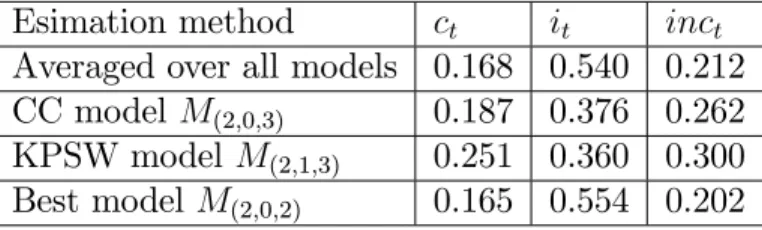
Table 2 reports the proportions of ‡uctuations over 8 to 32 quarters that are due to permanent shocks for the three variables using our updated data set and extended model set. We see from these results that the KPSW model assigns a larger proportion of the variability in consumption and investment to the permanent (productivity) shock than the other models. The remaining models generally agree with each other, at least in the relative sizes if not the exact values. Thus, using our Bayesian model averaging approach we …nd support for the conclusion of CC that the single permanent shock is not the main determinant of business cycle ‡uctuations.
Table 2: Estimated variance decompositions into permanent components in the frequency domain.
Esimation method ct it inct
Averaged over all models 0.168 0.540 0.212 CC model M(2;0;3) 0.187 0.376 0.262
KPSW model M(2;1;3) 0.251 0.360 0.300
Best model M(2;0;2) 0.165 0.554 0.202
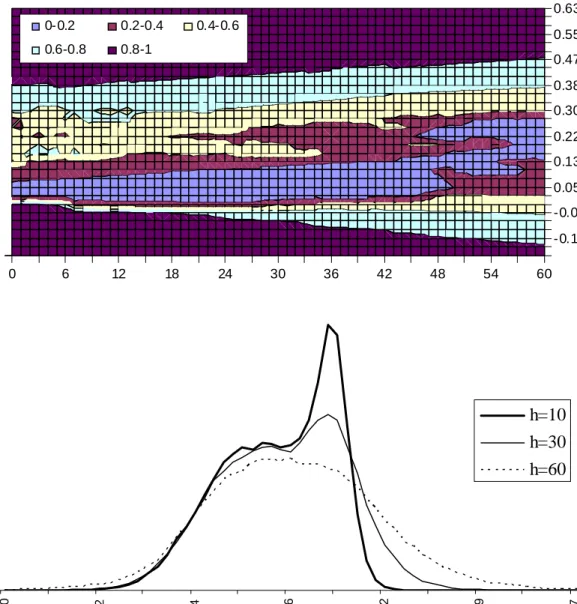
We conclude by reporting for each variable the impulse response path from a permanent shock. We assume there is only one permanent shock (and so condition upon r = 2), but average over the other model features. The impulses for ct; it and inct are shown in Figures 1, 2 and 3 respectively.
The upper panel in each …gure shows the full density over all 60 periods. The bands represent the boundaries of 20%, 40%, 60% and 80% highest posterior density regions (HPDs). These are contours of the density that de…ne the smallest possible regions containing the stated mass. To aid with the interpretation of these …gures we have included in the lower panels the pro…les of the density of the impulses at three points in time after the shock. These are at h= 10; h= 30 and h= 60 periods after the shock.
We see that the 20% and 40% HPDs are very sensitive to changes in the shape of the density and so re‡ect small movements in the bulk of the mass. The 60% and 80% HPDs are less sensitive and tend to show the general direction of the response. The lower panels show the changes in the shape of the densities that cause the movements in these HPDs. In each case there are two or more paths that in‡uence the densities at di¤erent intervals.
For consumption, the peak near zero slowly loses prominence to the more disperse, higher mass as the period increases. For investment, there are three paths at early stages, with the higher path dominating. Over time, however the central path becomes the only important path. Looking at the response path of income, we see there are two separate paths that compete immediately after the shock, and they both remain important as we move out along the time horizon. The higher path, however, moves slightly down toward zero and becomes more signi…cant.
The form of these densities are important for giving a full account of the uncertainty associated with the responses. In each case the secondary (or more) paths derive from models with low posterior probabilities. However, neglecting these models and only using the best model (e¤ectively assuming
model certainty) would produce very di¤erent estimates of, say, expected loss from a particular action.
5
Conclusion.
In this paper we have presented a Bayesian approach to obtaining uncondi-tional inference on structural features of the vector autoregressive model by means of evaluating posterior probabilities of alternative model speci…cations using a di¤use prior on the features of interest. The output produced this way allows forecasts and policy recommendations to be made that are not condi-tional on a particular model. Thus this model averaging approach provides an alternative to the more commonly used model selection approach. Specif-ically we provide techniques for estimating marginal likelihoods for models of cointegration, deterministic processes, short-run dynamics and overiden-tifying restrictions upon the cointegrating space. The estimates are derived using a mixture of analytical integration and MCMC. We apply the method-ology to investigating the importance and e¤ect of permanent shocks in US macroeconomic variables, with a focus upon the support for the behaviour implied by the model KPSW.
The method presented in this paper has already found applications in sev-eral areas. Koop, Potter and Strachan (2005) investigate the support for the hypothesis that variability in US wealth is largely due to transitory shocks. They demonstrate the sensitivity of this conclusion to model incertainty. Koop, León-González and Strachan (2006) develop methods of Bayesian in-ference in a ‡exible form of cointegrating VECM panel data model. These methods are applied to a monetary model of the exchange rate commonly employed in international …nance. Other current work includes investigating the impact of oil prices on the probability of encountering the liquidity trap in the UK and stability of the money demand relation for Australia.
More recent work is looking to develop methods of inference in very large model sets (as occurs in, say, models with the additional dimension of an unknown number of regime shifts) using the reversible jump methodology proposed by Greene (1995).
We end with mentioning two topics for further research. First, there exists the issue of the robustness of the results with respect to prior and model speci…cation. Very natural extensions of our approach are to include prior inequality conditions in the parameter space of structural VARs and consider
forms of nonlinearity and time variation in the model itself. For instance, in using a SVAR for business cycle analysis one may use prior information on the length and amplitude of the period of oscillation. An example of a possible nonlinear time varying structure that may prove useful is presented in Paap and van Dijk (2003). Systematic use of inequality conditions and nonlinearity implies a more intense use of MCMC algorithms. Second, one may use the results of our approach in explicit decision problems in international and …nancial markets like hedging currency risk or evaluation of option prices.
6
Acknowledgements
Preliminary versions of this paper have been presented at, among others, the ESEM-2002, the EC2 2002, Tokyo University, CORE, the Swedish cen-tral bank, University of Leuven. We would like to thank Luc Bauwens, Geert Dhaene, David Hendry, Soren Johansen, Helmut Lutkepohl, Christo-pher Sims, and Mattias Villani for helpful discussions on the topic of this paper. We are heavily indebted to the editor and two anonymous referees for several constructive suggestions on an earlier version (Strachan and van Dijk, 2004) that have greatly improved the paper. Of course, any remaining errors remain the responsibility of the authors. Strachan acknowledges the assistance of funding from the University of Liverpool grant number 4128 and study leave from the University of Leicester, van Dijk acknowledges …nancial support from the Erasmus Research Institute for Management.
7
References.
Bauwens, L. and M. Lubrano (1996): “Identi…cation Restrictions and Pos-terior Densities in Cointegrated Gaussian VAR Systems,” in: T.B. Fomby, ed., Advances in Econometrics, Vol. 11B, Bayesian methods applied to time series data. JAI Press 3-28.
Bauwens, L. and H.K. van Dijk (1990): “Bayesian limited information analy-sis revisited,” in: J. Gabszewicz, J.F. Richard and L. Wolsey, eds., Eco-nomic decision-making: Games, Econometrics, and Decision-making, Con-tributions in honour of Jacques Drèze, North-Holland, Amsterdam, 385-424. Billingsley, P. (1979): Probability and Measure. New York: Wiley.
Boswijk, H.P. (1996): “Testing Identi…ability of Cointegrating Vectors,” Jour-nal of Business and Economic Statistics 14, 153-160.
Bartlett, M, S. (1957): “A Comment on D. V. Lindley’s Statistical Paradox,”
Biometrika 44, 533–534.
Bates, J. M., and C. W. J. Granger (1969): “The Combination of Forecasts,”
Operational Research Quarterly 20, 451–468.
Canova, F. and C. Matteo (2004): “Forecasting and turning point predictions in a Bayesian panel VAR model,”Journal of Econometrics 120, 327-359. Centoni, M. and Cubbada, G. (2003): “Measuring the business cycle e¤ects of permanent and transitory shocks in cointegrated time series,” Economics Letters 80, 45-51.
Chang, Y. (2000): “Vector Autoregressions with Unknown Mixtures of I(0), I(1), and I(2) Components,”Econometric Theory 16, 905-26.
Chang, Y. and P. C. P. Phillips (1995): “Time Series Regression with Mix-tures of Integrated Processes,”Econometric Theory 11, 1033-94.
Chikuse, Y. (1990): “The Matrix Angular Central Gaussian distribution,”
Journal of Multivariate Analysis 33, 265-274.
Chikuse, Y. (1998): “Density Estimation on the Stiefel Manifold,”Journal of Multivariate Analysis 66, 188-206.
Davidson, R. and J. G. MacKinnon (1993): Estimation and Inference in Econometrics, , New York, Oxford University Press.
Diebold, F.X. and J. Lopez (1996): “Forecast Evaluation and Combination,” in G.S. Maddala and C.R. Rao (eds.), Handbook of Statistics. Amsterdam: North-Holland, 241-268.
Doan, T. ,R. Litterman, and C Sims (1984): “Forecasting and conditional projections using realistic prior distributions,”Econometric Reviews 3(1) :1-100.
Draper, D. (1995): “Assessment and propagation of model uncertainty (with discussion),”Journal of the Royal Statistical Society Series B 56, 45-98. Drèze, J.H. (1977): “Bayesian Regression Analysis using Poly-t Densities,”
Journal of Econometrics 6, 329-354.
Elliott, G. (1998): “On the Robustness of Cointegration Methods when Re-gressors Almost Have Unit Roots,”Econometrica 66, 149-158.
Elliott, G. and J. H. Stock (1994): “Inference in Time Series Regression When the Order of Integration of a Regressor Is Unknown,”Econometric Theory 10, 672-700.
Engle, R.F. and C.W.J. Granger (1987): “Co-Integration and Error Correc-tion: Representation, Estimation and Testing,”Econometrica 55, 251-276. Fernández, C., E. Ley, and M. Steel (2001): “Model uncertainty in cross-country growth regressions,”Journal of Applied Econometrics 16, 563-576. Gelfand, A.E., and D. K. Dey (1994): “Bayesian model choice: asymptotics and exact calculations,”Journal of the Royal Statistical Society Series B 56, 501–504.
Granger, C.W.J. (1983): “Cointegrated Variables and Error Correction Mod-els,” unpublished USCD Discussion Paper 83-13.
Greene, Peter J. (1995): “Reversible Jump Markov Chain Monte Carlo Com-putation and Bayesian Model Determination,”Biometrika 82, 711-732. Hendry, D. F. & M. P. Clements (2002): “Pooling of Forecasts,” Economet-rics Journal 5, 1-26.
Hodges, J. (1987): “Uncertainty, policy analysis and statistics,”Statistical Science 2, 259-291.
James, A.T. (1954): “Normal Multivariate Analysis and the Orthogonal Group,”Annals of Mathematical Statistics 25, 40-75.
Je¤reys, H. (1961): Theory of Probability. London: Oxford University Press. Johansen, S. (1992): “Cointegration in Partial Systems and the E¢ ciency of Single Equation Analysis,”Journal of Econometrics 52, 389-402.
Johansen, S. (1995): Likelihood-based Inference in Cointegrated Vector Au-toregressive Models. New York: Oxford University Press.
King, R.G., C.I. Plosser, J.H. Stock, and M.W. Watson (1991): “Stochastic trends and economic ‡uctuations.”The American Economic Review, 81, 819-840.
Kleibergen, F. and R. Paap (2002): “Priors, Posteriors and Bayes Factors for a Bayesian Analysis of Cointegration,”Journal of Econometrics 111, 223-249.
Kleibergen, F. and H.K. van Dijk (1994): “On the Shape of the Likeli-hood/Posterior in Cointegration Models,”Econometric Theory 10, 514-551.
Kleibergen, F. and H.K. van Dijk (1998): “Bayesian Simultaneous Equations Analysis Using Reduced Rank Structures,”Econometric Theory14, 701-743. Koop, G. (1991): “Cointegration tests in present value relationships: A Bayesian look at the bivariate properties of stock prices and dividends,”
Journal of Econometrics 49, 105-140.
Koop, G. (1994): “An objective Bayesian analysis of common stochastic trends in international stock prices and exchange rates,”Journal of Empirical Finance 1, 343-364.
Koop G., R. León-González and R. Strachan (2006): “Bayesian Inference in a Cointegrating Panel Data Model,” Department of Economics Working Paper 06/02, University of Leicester.
Koop G., R., S. Potter and R. Strachan (2005): “Re-examining the Consumption-Wealth Relationship: The Role of Model Uncertainty,” Department of Eco-nomics Working Paper 05/03, University of Leicester.
Leamer, E. (1978): Speci…cation Searches. New York: Wiley.
Lettau, M. and S. Ludvigson (2004): “Understanding Trend and Cycle in Asset Values: Reevaluating the Wealth E¤ect on Consumption,”American Economic Review 94, 276-299.
Luukkonen, R., A. Ripatti and P. Saikkonen (1999): “Testing for a Valid Normalisation of Cointegrating Vectors in Vector Autoregressive Processes,”
Journal of Business and Economic Statistics 17, 195-204.
Maddala, G.S. and I.M.Kim (1998): Unit roots, Cointegration and Structural Change, Cambridge: Cambridge University Press.
Min, C. and A. Zellner (1993): “Bayesian and non-Bayesian methods for combining models and forecasts with applications to forecasting international growth rates,”Journal of Econometrics 56, 89-118.
Muirhead, R.J. (1982): Aspects of Multivariate Statistical Theory. New York: Wiley.
Newbold P. & D. Harvey (2001): “Tests for Multiple Forecast Encompass-ing,”Journal of Applied Econometrics 15, 471–482.
Ni, S. X. and D. Sun (2003): “Noninformative Priors and Frequentist Risks of Bayesian Estimators of Vector-Autoregressive Models,”Journal of Econo-metrics 115, 159-197.
O’Hagan, A. (1995): “Fractional Bayes Factors for Model Comparison,”
Journal of the Royal Statistical Society, Series B (Methodological) 57, 1, 99-138.
Paap, R. and H. K. van Dijk (2003): “Bayes Estimates of Markov Trends in Possibly Cointegrated Series: An Application to US Consumption and Income,”Journal of Business and Economic Statistics 21, 547-563.
Phillips, P. C. B. (1989): “Spherical matrix distributions and cauchy quo-tients,”Statistics and Probability Letters 8, 51–53.
Phillips, P. C. B. (1994): “Some Exact Distribution Theory for Maximum Likelihood Estimators of Cointegrating Coe¢ cients in Error Correction Mod-els,”Econometrica 62, 73-93.
Phillips, P. C. B. (1996): “Econometric Model Determination,”Econometrica
64, 763–812
Poirier, D. (1995): Intermediate Statistics and Econometrics: A Comparative Approach. Cambridge: The MIT Press.
Raftery, A. E., D. Madigan, and J. Hoeting (1997): “Bayesian model aver-aging for linear regressionmodels,”Journal of the American Statistical Asso-ciation 92, 179–191.
Sala-i-Martin, X., G. Doppelho¤er, and R. Miller (2004): “Determinants of long-term growth: A Bayesian averaging of classical estimates (BACE) approach,”American Economic Review 94, 813-835.
Sims, C. A. (1980): “Macroeconomics and Reality,”Econometrica 48, 1-48. Sims, C. A. and T. Zha (1999) “Error Bands for Impulse Responses,” Econo-metrica 67, 1113-1156.
Strachan, R. (2003): “Valid Bayesian Estimation of the Cointegrating Error Correction Model,”Journal of Business and Economic Statistics21, 185-195. Strachan, R. W. and B. Inder (2004): “Bayesian Analysis of The Error Cor-rection Model,”Journal of Econometrics 123, 307-325.
Strachan, R and H. K. van Dijk (2003): “Bayesian Model Selection with an Uninformative Prior,”Oxford Bulletin of Economics and Statistics 65, 863-876.
Strachan, R. and H.K. van Dijk (2004) “Valuing structure, Model Uncer-tainty and Model Averaging in Vector Autoregressive Processes,”Economet-ric Institute Report EI 2004-23, Erasmus University Rotterdam.
Strachan, R and H. K. van Dijk (2005): “Weakly informative priors and well behaved Bayes Factors,”Econometric Institute Report EI 2005-40, Erasmus University Rotterdam.
Terui, N. and H. K. van Dijk (2002): “Combined forecasts from linear and nonlinear time series models,”International Journal of Forecasting 18(3), 421-438.
Villani, M. (2005): “Bayesian reference analysis of cointegration,” Econo-metric Theory 21, 326-357.
Zellner, A. (1971): An Introduction to Bayesian Inference in Econometrics.
New York: Wiley.
8
Appendix
In this appendix we provide the technical details for statements in the paper. First we must introduce some notation for matrix spaces and measures on these spaces. For an introduction to these concepts see Muirhead (1982) and for a more intuitive discussion see Strachan and Inder (2004). We assume throughout this appendix that d1;t =fg such that += :
The r r orthogonal matrix C is an element of the orthogonal group of r r orthogonal matrices denoted by O(r) = fC(r r) :C0C =I
rg, that
is C 2 O(r): The n r semi-orthogonal matrix V is an element of the Stiefel manifold denoted by Vr;n = fV (n r) :V0V =Irg, that isV 2 Vr;n:
As the vectors of anyV are linearly independent (since they are orthogonal) the columns of V de…ne a plane, p, which is an element of the (n r)r dimensional Grassman manifold,16 Gr;n r: That is p = sp(V) 2 Gr;n r and
all of the vectors in V will lie in only one r dimensional plane, p. The cointegrating space for an ndimensional system with cointegrating rankr is an example of an element of Gr;n r: Finally, let the jth largest eigenvalue of
the matrix A be denoted j(A).
As discussed in James (1954), the invariant measures on the orthogonal group, the Stiefel manifold and the Grassman manifold are de…ned in exte-rior product di¤erential forms (for measures on the orthogonal group and the Stiefel manifold, see also Muirhead 1982, Ch. 2). For brevity we denote these
16The Grassman manifold,G
r;n r, is the collection of all possibler dimensional planes
measures as follows. For a (n n) orthogonal matrix [b1; b2; : : : ; bn] 2O(n)
wherebi is a unitn-vector such that[b1; b2; : : : ; br]2Vr;n; r < n, the measure
on the orthogonal groupO(n)is denoteddvn
n ni=1 nj=i+1b0jdbi, the measure
on the Stiefel manifold Vr;n is denoteddvnr ri=1 nj=i+1b0jdbi, and the
mea-sure on the Grassman manifold Gr;n r is denoted dgnr ri=1 nj=n r+1b0jdbi.
These measures are invariant to left and right orthogonal translations. The underscore denotes the normalised measure such that RG
r;n rdg
n r = 1:
Theorem 2 The Jacobian for the transformation fromp2Gr;n rtovec 2 2
R(n r)r is de…ned by dgrn= (n r)r jr=1 [(n+ 1 j)=2] [(r+ 1 j)=2] Ir+ 0 2 2 n=2 d 2 (13) where (q) =R01uq 1e udu for q > 0:
Proof. In deriving the invariant measure on the Grassman manifold,
James (1954) presents a relationship between an element of the Stiefel man-ifold, V 2 Vr;n; and an element of the Grassman manifold, p = sp( ) 2
Gr;n r where the r-frame 2 Vr;n and an element of the orthogonal group,
C 2 O(r). has a particular (…xed) orientation in p such that it has only
(n r)r free elements. Thus as p is permitted to vary over all of Gr;n r,
is not free to vary over all of Vr;n: For p=sp(V), V is determined uniquely
givenpand orientation ofV inpbyC 2O(r), such thatV = C:Note that as p is permitted to vary over all ofGr;n r,V is free to vary over all of Vr;n:
The resulting relationship between the measures is dvnr = dgnrdvrr
ordvnr = dgnr dvrr: (14)
James17 obtains the volume of Gr;n r as
c = Z Gr;n r dgrn= R Vr;ndv n r R O(r)dvrr = (n r)r rj=1 [(r+ 1 j)=2] [(n+ 1 j)=2]: (15)
Since the polynomial term accompanying the exterior product of the dif-ferential forms is equivalent to the Jacobian for the transformation (Muirhead 1982, Theorem 2.1.1), we can see from the expression (14) that the Jacobian for the transformation V to( ; C)is one.
Next consider the transformation from V 2 Vr;n; to 2 2 R(n r)r and
C 2 O(r) presented by Phillips (1989 and 1994, Lemma 5.2 and see also Chikuse, 1998) and reproduced here:
V = c0+c0? 2 hIr+
0
2 2
i 1=2
C:
The di¤erential form for this transformation is dvrn= (n r)r jr=1 [(n+ 1 j)=2] [(r+ 1 j)=2] Ir+ 0 2 2 n=2 d 2 dvrr (16) (Phillips, 1989, 1994).
Equating (14) and (16) gives the result. Another, slightly more general proof for the same result is presented in Chikuse (1998).
To avoid using linear restrictions with a normalisation to identify it is necessary to …nd an alternative set of restrictions that do not require knowledge of c and which avoid the issues associated with the posterior for
2: Fortunately the de…nition (14) and the discussion in the proof of
The-orem 2 provides a natural solution to this question. That is use 2 Vr;n
which implies r(r+ 1)=2restrictions. The dimension of the Grassman man-ifold is only (n r)r while the dimension of the Stiefel manifold Vr;n is
nr r(r+ 1)=2, which exceeds that of Gr;n r by r(r 1)=2: In (14), these
remaining restrictions come from the orientation of inpbyC 2O(r). The prior, the posterior (as is made clear later) and the di¤erential form for are all invariant to translations of the form ! H; H 2O(r): Therefore it is possible to work directly with as an element of the Stiefel manifold and adjust the integrals with respect to by RO(r)dvrr
1
. Note that these identifying restrictions do not distort the weight on the space of the parame-ter of inparame-terest, p, and it is never necessary to actually specify the orientation of in p.
Next we provide a proof that linear identifying restrictions with a ‡at prior give zero weight to the chosen linear restrictions. The Jacobian de…ned by (13) implies that a ‡at prior on p is informative with respect to 2 and vice versa. This leads us to consider the implications of a ‡at prior on 2 for the prior on p.
Theorem 3 The Jacobian for the transformation from 2 2 R(n r)r to p2 Gr;n r is de…ned by d 2 = (n r)r jr=1 [(r+ 1 j)=2] [(n+ 1 j)=2] Ir+ (c ) 0 1 0 c0?c? (c ) 1 n=2(dgnr) = J dgnr: (17)
Proof. Invert (16) and replace 2 byc? (c )
1
.
The following proof demonstrates the claim in Section 3.2 that assuming we know which rows of are linearly independent so as to impose linear identifying restrictions makes this assumption a priori impossible.
Theorem 4 Given r; use of the normalisation 2 = c? (c )
1
results in a transformation of measures for the transformation 2 2 R(n r)r
! p 2
Gr;n r that places in…nite mass in the region of null space of crelative to the
complement of this region.
Proof. Let c? be the plane de…ned by the null space of c. De…ne
a ball, B, of …xed diameter, d, around c
? and let N0 = B\Gr;n r and
N =Gr;n r N0. Since for d > 0, R NJ dg n r is …nite whereas R N0J dg n r =1, we have R N0J dg n r R NJ dgrn =1:
Discussion: Essentially, the Jacobian for 2 !p places in…nitely more
weight in the direction where c is singular. Thus, normalisation of by choice of c with a ‡at prior on 2 implies in…nite prior odds against this normalisation.
To demonstrate this result, consider a n dimensional system for y = (x0; z0)0wherexis arvector. To implement linear restrictions a normalisation
must begin by …rst choosing c. Suppose it is believed that if a cointegrating relationship exists then it will most likely involve the elements ofxin linearly independent relations:That is iny =x 1+z 2 vI(0),det ( 1)is believed far from zero making it safe to normalise on 1;and so choosec= [Ir 0]and
estimate 2 =c? (c )
1
:
From (17) we see asp=sp( )!sp(c); c? !0(n r) r and c !O(r)
and J ! 1. However, as vectors in approach the null space of c, that is
will more heavily weight regions where det (c ) = det ( 1) t 0; contrary to the intention of the economist. As a trivial example, consider our money demand study with r = 1 and t = 1mt+ 2inct: If we believe money is
most likely to enter the cointegrating relation, we would choose c = (1;0)
as we believe 1 6= 0: Yet the Jacobian places in…nite weight in the region 1 = 0 excludingmt from the cointegrating relation.
To support the use of model averaging in this application, we provide here proofs that the posterior will be proper and all …nite moments of exist. Since g! (in (8)) is …nite for the class of priors considered, for the
Bayes factor to be …