Hardware-in-the-Loop Testing of Wireless Sensor Networks
Kenneth G. LeSueur
Subsystem Test and Analysis Branch,
U.S. Army Redstone Technical Test Center, Huntsville, Alabama
Emil Jovanov, Ph.D.
Electrical and Computer Engineering Department,
The University of Alabama in Huntsville, Huntsville, Alabama
The addition of network interfaces and fusion algorithms to sensor systems results in an increase in the complexity of the required test and evaluation technologies and methods. Existing testing capabilities are not adequate for testing of tactical networked sensor hardware in complex battlefield configurations. We are developing a system for testing the wireless sensor networks that support tactical hardware interacting in real time with emulated network nodes in an augmented reality test scenario. The test bed provides a realistic simulated representation of a tactical network that allows faithful testing of networked systems focusing on hardware-in-the-loop testing of sensors and sensor fusion systems. Systems can be tested using this method in a controlled, repeatable environment not feasible in field testing. The system design combines dedicated high performance computing resources with a scalable, high fidelity network emulation and a computer generated forces model to virtually represent the tactical network, force movement, interactions, and communication loads to systems under test. This article presents the test bed design framework, preliminary performance results, and a concept for determining the requirement and performance envelope for test bed utilization.
Key words: Real-time network emulation; wireless tactical sensor test bed; high performance computing; hardware-in-the-loop.
R
ealistic testing of tactical wireless sensornetworks requires enhanced techno-logies and techniques utilizing real-time hardware-in-the-loop (HWIL) test methods. A mixture of live and simu-lated network nodes operating in real time and immersed in an augmented virtual environment is the optimal approach to obtaining highly accurate test data with the ability to scale the network size to tactical force levels. Performing a fully live field test is impractical because of the size and variations of the terrain required and the sheer number of tactical network nodes needed to completely represent the full force structure and equipment (i.e., networks, radios, sensors, and weapon-ry). The HWIL test bed approach described in this article combines dedicated high performance computing (HPC) resources with a scalable, high fidelity network simulation and a computer generated forces (CGF) model to virtually represent the tactical network, force movement, interactions, and communication loads tosystems under test. The network emulation and CGF models are required to interoperate and scale to the size of an Army brigade combat team that will have thousands of network nodes. The use of this test method allows testers to interface a small number of real hardware nodes with virtual components to produce an operationally realistic environment.
HWIL testing background
Sensor and missile systems have historically relied on HWIL testing methods to determine many aspects of networked system under test (NSUT) performance. The technique of HWIL testing is based on using actual tactical hardware and software interfaced to a suite of stimulus and measurement systems including modeling and simulation tools. Laboratory HWIL test methods are considered the highest fidelity alternative to live field testing because of the inclusion of the actual hardware and software in the test, as opposed to pure simulation or mathematical models (Almendinger
TechNotes
ITEA Journal2009; 30: 333–338
Copyright’2009 by the International Test and Evaluation Association
Public reporting burden for the collection of information is estimated to average 1 hour per response, including the time for reviewing instructions, searching existing data sources, gathering and maintaining the data needed, and completing and reviewing the collection of information. Send comments regarding this burden estimate or any other aspect of this collection of information, including suggestions for reducing this burden, to Washington Headquarters Services, Directorate for Information Operations and Reports, 1215 Jefferson Davis Highway, Suite 1204, Arlington VA 22202-4302. Respondents should be aware that notwithstanding any other provision of law, no person shall be subject to a penalty for failing to comply with a collection of information if it does not display a currently valid OMB control number.
1. REPORT DATE
SEP 2009
2. REPORT TYPE3. DATES COVERED
00-00-2009 to 00-00-2009
4. TITLE AND SUBTITLE
Hardware-in-the-Loop Testing of Wireless Sensor Networks
5a. CONTRACT NUMBER 5b. GRANT NUMBER
5c. PROGRAM ELEMENT NUMBER
6. AUTHOR(S) 5d. PROJECT NUMBER
5e. TASK NUMBER 5f. WORK UNIT NUMBER 7. PERFORMING ORGANIZATION NAME(S) AND ADDRESS(ES)
U.S. Army Redstone Technical Test Center,Huntsville,AL,35898-8052
8. PERFORMING ORGANIZATION REPORT NUMBER
9. SPONSORING/MONITORING AGENCY NAME(S) AND ADDRESS(ES) 10. SPONSOR/MONITOR’S ACRONYM(S) 11. SPONSOR/MONITOR’S REPORT NUMBER(S)
12. DISTRIBUTION/AVAILABILITY STATEMENT
Approved for public release; distribution unlimited
13. SUPPLEMENTARY NOTES 14. ABSTRACT
15. SUBJECT TERMS
16. SECURITY CLASSIFICATION OF: 17. LIMITATION OF ABSTRACT
Same as
Report (SAR)
18. NUMBER OF PAGES6
19a. NAME OF RESPONSIBLE PERSON a. REPORTunclassified
b. ABSTRACTunclassified
c. THIS PAGEunclassified
Standard Form 298 (Rev. 8-98)
and LeSueur, 2007). To realize the benefit of HWIL, we must ensure that the NSUT interacts with a virtual environment that completely replicates the real world if the NSUT is to perceive and respond as it would in an actual fielded situation.
In-band stimulation of sensor and missile systems with visible, infrared, acoustic, and seismic sensors has become common place in the test and evaluation (T&E) community. Other forms of stimulation of the NSUT to complete the virtual environment include physical motion (pitch, yaw, and roll of the platform), launcher or vehicle electric interfaces, and Global Positioning System (GPS) to name a few.
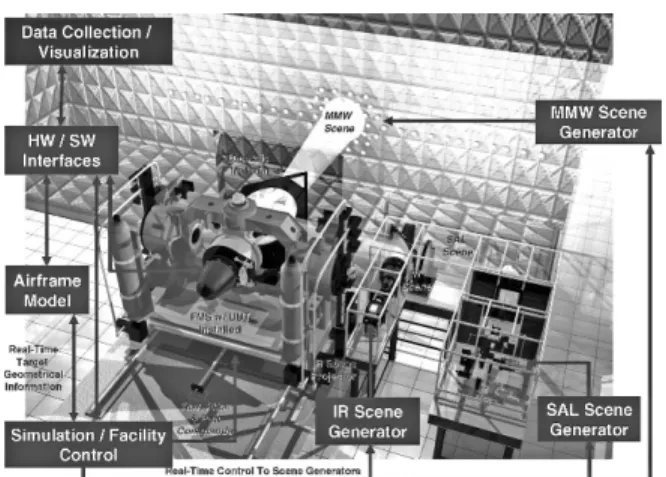
An example of this type of HWIL capability is the Advanced Multispectral Simulation Test Acceptance Resource (AMSTAR) (Almendinger and LeSueur 2007). The AMSTAR is unique in the ability to perform real-time multispectral scene generation and projection into a common missile seeker aperture mounted on a multiaxis flight motion simulator. The AMSTAR is equipped with a dynamic infrared scene projector, millimeter wave projection, and a semiactive laser return simulator. The three project-ed beams are combinproject-ed to provide simultaneous in-band stimulation into a single sensor aperture
(Figure 1).
With the increase in complexity of sensors systems that include network interfaces, the HWIL test methods must be enhanced. The network addition to the test item is another aperture whose input must be properly stimulated and output accurately measured. Often other networked systems receive and respond to sensor traffic and changing conditions in the network environment. Therefore, simply playing back recorded network traffic cannot be used to comprehensively test the functionality of a NSUT.
The real-time sharing of information from multiple sensors across a wireless network coupled with the use of sensor fusion creates a ‘‘system of systems’’ where the combined performance has the potential to be greater than the sum of the individual system capabilities. The T&E of the system of systems must take into account the performance difference when sensors share infor-mation such as detections, identifications, moving object tracks, photos, and live video across the sensor network. The performance of the system of systems depends greatly on the performance of the network linking the individual nodes.
The software emulation approach to network testing is more cost effective, scalable, and adaptable than hardware emulation (Werner-Allen, Swieskowski, and Welsh 2009). The network simulation provides the background traffic present in tactical situations and transports sensor data to consuming applications, with
realistic representation of radio frequency propagation and terrain effects, delivery time, packet loss, collisions, and bandwidth availability. By providing interfaces to actual tactical hardware, the wireless sensors can be tested in a reliable and repeatable way not available through typical field level test methods.
Proposed testing method
The core of the wireless tactical sensor test bed is the high fidelity, real-time, network simulation made possible by a parallel computing platform upon which the simulation runs. The system is implemented using EXata network emulation and OneSAF CGF running on a parallel Linux blade system. The test system integrates sensors to the simulated virtual environment through wireless gateways and Ethernet connections.
EXata is a wireless network emulator that connects to live networks and supports real-time operations (SNT 2009). EXata creates a simulated network that interfaces with real networks allowing for software, hardware, and human-in-the-loop test applications to communicate over all layers of the network.
Network emulation with HWIL interfaces
The need for having real wireless sensor hardware connected with the simulated network drives the requirement for operating in real time. As the size and complexity of the modeled network increases, the test bed computing resources must continue to perform all required calculations in real time to allow system testing (Hamida, Chelius, and Gorce 2008). When real-time performance cannot be maintained, the test and simulation results are considered invalid and adjustments to the test bed, such as the size of the simulated environment or simulation fidelity, must be performed until real-time performance can be reliably maintained.
Figure 1. HWIL to simulation interface.
LeSueur & Jovanov
Each HWIL device under test will have a corre-sponding virtual node in the network simulation engine. This connection approach is illustrated in
Figure 2where the example of a HWIL network node is an unmanned aerial system (UAS) supplying video to a network of simulated nodes, and a second HWIL command system is receiving the UAS video. The light-colored nodes correspond to HWIL items in the real environment and provide the interface to the emulated network represented by the black nodes. The video quality and latency are affected by operations of the emulated nodes just as they would be tactically.
Parallel processing of simulation environment
Network emulation allows interfacing and testing of a few samples of real hardware with virtual components to produce operationally realistic numbers of network nodes. The Army brigade combat team is the target size for the development of the tactical wireless sensor network test bed. The brigade combat team will have
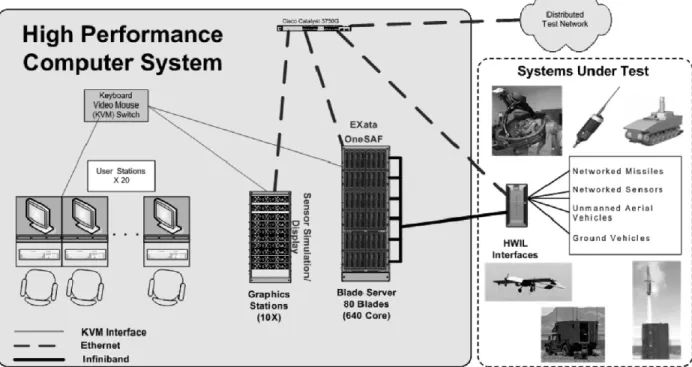
thousands of heterogeneous networked nodes with a wide range of processing power and network bandwidth requirements. Both the network simulation code and the CGF model are required to scale to this magnitude. The system architecture with the major interfaces between the HPC and the HWIL interfaces is presented in Figure 3. The HWIL interface supports operation of different wireless network configurations including wireless sensors, network missile systems, vehicles, and UAS.
EXata can operate in a shared memory or message passing interface parallel processing environment. There are manual and automatic parallel workload distribution methods. The manual method allows the simulation operator to assign the workload associated with simulated nodes to computational cores as desired. The automatic method assigns network nodes to computational cores in sequential order as the emulated nodes are defined in the environment. After all cores have one node assigned, the process repeats starting from the first core until all of the emulated nodes have been assigned.
Test bed performance results
The test bed HPC system is scheduled to integrate at the Redstone Technical Test Center in early fall 2009. To establish performance expectations of the completed test bed, we executed initial test cases on an existing parallel computing platform with an early release of EXata 2.0. For these preliminary test cases, the Figure 2. HWIL to simulation interface.
simulation is executed on a Silicon Graphics Inc. (Freemont, California) Altix XE 320 cluster with gigabit Ethernet connections. One connection is designated for administrative function, and another one is for data transfers. The cluster nodes consisted of two Intel Xeon 2.5 GHz E5420 four-quad-core processors (total of eight cores/node) and 8 GB of RAM per node. The system has a total of 32 processors or 128 cores.
Experimentation scenario description
Two existing representative scenarios were chosen to be used in the test bed evaluation tests. The two scenarios were selected based on differences in the simulated node count and the complexity and fidelity of the environment model. The first scenario has a node count of 500 radios. Each radio is mobile and travels according to a group mobility model that limits the movement of nodes to an area around an established group location. The propagation path loss model used was the irregular terrain model, and an associated terrain file was loaded for use by the irregular terrain model.
The second test scenario has 800 radios simulated and 68% of the nodes are mobile with their movement defined by an input mobility file. A two-ray propaga-tion path loss model is used in this scenario.
The two test scenarios were selected because of their size, variations in computational load, and tactical relevance. The second scenario has a larger node count but uses a more simplistic two-ray propagation model. Because only a subset of the nodes is moving, the number of path loss calcula-tions that need to be performed during the test is limited.
Preliminary results
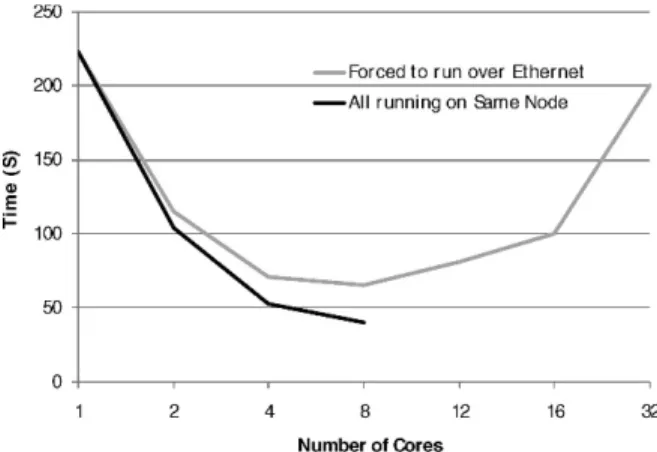
The first scenario was executed and the simulation run time was measured for a section of the scenario
(Figure 4). The real-time threshold for this scenario
section was 360 seconds. The simulation run time is plotted with the number of computer cores inFigure 3. The gray line shows the measured performance from 1 to 32 processing cores when the interprocessor communications occur over the Ethernet interconnect. The black line shows the measured performance when the computational node is allowed to use a shared memory interface. Note that this data stops at eight cores, the number of cores on a node. There is slight improvement in performance when using the shared memory communication versus the Ethernet.
The test results from the second scenario are shown inFigure 5 in a similar format. In both scenarios, the optimum performance occurs when operating on eight computer cores for the given size, scenario complexity, and modeled environment fidelity.
The parallel efficiency of the two scenarios using eight processing cores and communicating across the Ethernet interconnection is:
Scenario1 Efficiency~ 313s 88s 8Cores100~44:5% Scenario2 Efficiency~ 223s 65s 8Cores100~42:9%
Concept of a performance and requirement
envelope
As seen in the preliminary results section, the real-time performance of network emulation capabilities is a multidimensional problem that includes the size (number of nodes) of the scenario, the amount of computing resources available, and the fidelity or complexity of the simulation environment. There is a need to establish a wireless sensor network perfor-mance or requirement envelope to aid in NSUT test planning and resource allocation. This performance or Figure 4. Parallel execution time for scenario 1.
Figure 5. Parallel execution time for scenario 2.
LeSueur & Jovanov
requirement envelope can be established through the collection of a set of empirical test data and the development of a functional model of the test bed.
Figure 6 shows a three-dimensional plot from a notional test bed configuration and set of scenarios. The notional test scenario real-time threshold is 100 seconds. These data are used only to describe the utility in establishing the envelope.
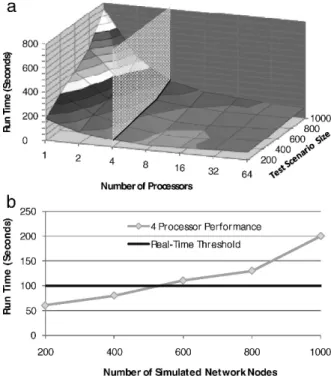
For the notional case, the fidelity or complexity of the scenario is held constant while the number of radio nodes and number of test bed processors are changed. The resulting simulation runtime is ploted on the vertical axis. Once the envelope is developed, test configurations can be determined based on several limitations or requirements. For example, Figure 7a
shows a notional case where the number of computa-tion cores is limited to four (potentially a field test where access to an HPC is not available). A plane is drawn across the envelope corresponding to this test limitation.
Figure 7b shows an associated graph where the processor count is limited to four and the scenario size is plotted against the simulation run time. The point where the runtime crosses the 100-second real-time threshold establishes that a maximum of 500 nodes, at the given fidelity or complexity, can be emulated on a four-processor machine while maintaining real-time performance.
Another use of the performance or requirement envelope is shown in Figure 8a. In this case the test application demands a scenario that simulates 800 radios. A plane is drawn to show where this requirement intersects with the envelope.
Figure 8b shows the companion graph where the scenario size is set to 800 and the simulaiton run time is plotted against the number of processing cores. The point where the runtime crosses the real-time thresh-old (100 seconds) shows that 16 or more processors are necessary to maintain real-time performance for the 800-node scenario.
A different three-dimensional graph is necessary for each of the various levels of simulation fidelity and scenario complexity desired for a set of test applica-tions. The development of a test bed performance model validated with samples of empirical test data will Figure 6. Test bed performance or requirement envelope.
Figure 7. (a) Performance envelope with four-processor plane. (b) Performance plot using four cores.
Figure 8. (a) Performance envelope with 800-node scenario plane. (b) Performance plot for 800-node scenario.
allow the complete suite of graphs to be generated. The performance or requirement envelope provides an estimation tool useful for many functions including test planning, experiment design, and resource alloca-tion.
Conclusion
Current test methods are not adequate for testing tactical wireless network hardware in realistic battle-field environments (LeSueur and Jovanov 2009). The use of an augmented wireless sensor test bed operating in a real-time HWIL configuration is a viable solution to the T&E challenges associated with tactical networked sensors operating in complex battlefield configurations. It is established that real-time perfor-mance improvements can be realized when operating on parallel computer cores for a given test scenario. Through this evaluation, it is determined that general performance thresholds can be measured, but the results are highly scenario dependent. A performance or requirement envelope is needed to accurately predict wireless sensor test bed performance based on multi-dimensional setup parameters.
Follow-on research and testing are needed in several areas to fully realize the benefits of the test bed.
N
Future performance enhancements will bereal-ized when the simulation engine is transferred to the new HPC cluster with Infiniband intercon-nections. The new system will have increased computing performance, and the interconnect architecture will have lower latency.
N
Interfaces to the CGF model must be completedto provide more realistic platform movements and tactically appropriate network loads.
N
Development and validation of a test bedperfor-mance model is needed to aid in the generation of the performance or requirement envelope. The implementation of the tactical wireless sensor network test bed enhances the test and analysis of system performance in a realistic real-time, high-fidelity simulated environment not achievable through standard test processes. The test bed allows the community to evaluate large tactical NSUT perfor-mance parameters such as throughput, latency, jitter, dropped packets, message completion rate, channel interference, jamming, bottlenecks, power consump-tion, and reliability just to name a few. The primary advantage of this architecture is the inclusion of live hardware in the test, which will be immersed in an augmented environment that allows the item under test to perceive and respond to stimulus just as it would in the real world. Each layer of the network can be tested because of the high fidelity simulation made
possible by utilizing parallel processing to maintain
real-time performance. %
KENNETHG. LESUEURserves as the chief technologist in
the Subsystem Test and Analysis Branch at Redstone Technical Test Center. His work and research have been concentrated in HWIL testing, distributed testing, modeling and simulation, and high performance comput-ing. He received his master’s degree in computer engineering at the University of Alabama in Huntsville and is currently working on his doctoral dissertation. E-mail: [email protected]
EMIL JOVANOV, Ph.D., is an associate professor in the
Electrical and Computer Engineering Department at the University of Alabama in Huntsville, with more than 25 years of experience in the design of application specific hardware and software system. He is recognized as the originator of the concept of wireless body area networks for health monitoring and one of the leaders in the field of wearable health monitoring. Dr. Jovanov is a senior member of IEEE, associate editor of the IEEE Transac-tions on Information Technology in Biomedicineand
IEEE Transactions on Biomedical Circuits and Systems, member of IEEE EMBS Technical Committee on Wearable Biomedical Sensors and Systems, and serves on the editorial board of Applied Psychophysiology and Biofeedback. E-mail: [email protected]
References
Almendinger, F., and K. LeSueur. 2007. Design tradeoffs in the development of the advanced multi-spectral simulation test acceptance resource (AMSTAR) HWIL facilities. In Proceedings of the SPIE 6544, Orlando, FL: SPIE Conference Proceedings, April.
Hamida, B., G. Chelius, and J. Gorce. 2008. Scalable versus accurate physical layer modeling in wireless network simulations. In 22nd Workshop on Principles of Advanced and Distributed Simulation. Rome, Italy: IEEE Computer Society (ACM Portal), pp. 127–134, June.
LeSueur, K. G., and E. Jovanov. 2009. Performance analysis of the augmented wireless sensor network testbed.41st Southeastern Symposium on System Theory. Tullahoma, Tennesee: University of Tennessee Space Institute, pp. 319–323.
SNT (Scalable Networks Technologies). March 16, 2009. SNT Knowledge Base. Exata. http://www. scalable-networks.com/pdf/exata.pdf (accessed June 2009).
Werner-Allen, G., P. Swieskowski, and M. Welsh. 2005. MoteLab: a wireless sensor network testbed. In
IPSN 2005 Fourth International Symposium on Infor-mation Processing in Sensor Networks. Los Angeles, CA: IEEE, pp. 483–488, April.
LeSueur & Jovanov