Electronic Thesis and Dissertation Repository
9-12-2014 12:00 AM
A Software Design Pattern Based Approach to Auto Dynamic
A Software Design Pattern Based Approach to Auto Dynamic
Difficulty in Video Games
Difficulty in Video Games
Muhammad Iftekher Chowdhury The University of Western Ontario Supervisor
Dr. Michael Katchabaw
The University of Western Ontario Graduate Program in Computer Science
A thesis submitted in partial fulfillment of the requirements for the degree in Doctor of Philosophy
© Muhammad Iftekher Chowdhury 2014
Follow this and additional works at: https://ir.lib.uwo.ca/etd
Part of the Graphics and Human Computer Interfaces Commons, and the Software Engineering Commons
Recommended Citation Recommended Citation
Chowdhury, Muhammad Iftekher, "A Software Design Pattern Based Approach to Auto Dynamic Difficulty in Video Games" (2014). Electronic Thesis and Dissertation Repository. 2522.
https://ir.lib.uwo.ca/etd/2522
This Dissertation/Thesis is brought to you for free and open access by Scholarship@Western. It has been accepted for inclusion in Electronic Thesis and Dissertation Repository by an authorized administrator of
(Thesis format: Monograph)
by
Muhammad Iftekher Chowdhury
Graduate Program in Computer Science
A thesis submitted in partial fulfillment of the requirements for the degree of
Doctor of Philosophy
The School of Graduate and Postdoctoral Studies The University of Western Ontario
London, Ontario, Canada
© Muhammad Iftekher Chowdhury 2014
ii
Abstract
From the point of view of skill levels, reflex speeds, hand-‐eye coordination, tolerance for frustration, and motivations, video game players may vary drastically. Auto dynamic difficulty (ADD) in video games refers to the technique of automatically adjusting different aspects of a video game in real time, based on the player’s ability and emergence factors in order to provide the optimal experience to users from such a large demography and increase replay value. In this thesis, we describe a collection of software design patterns for enabling auto dynamic difficulty in video games. We also discuss the benefits of a design pattern based approach in terms of software quality factors and process improvements based on our experience of applying it in three different video games. Additionally, we present a semi-‐automatic framework to assist in applying our design pattern based approach in video games. Finally, we conducted a preliminary user study where a Post-‐Degree Diploma student at the University of Western Ontario applied the design pattern based approach to create ADD in two arcade style games.
Keywords
Video game, software design pattern, reusability, case study, empirical studies, auto dynamic difficulty, adaptive games
iii
Dedication
First and foremost, I want to thank Almighty Allah for His blessings and mercy upon me. He gave me the strength, knowledge, enthusiasm, determination, persistence, and patience to finish this work.
I would like to thank my supervisor, Dr. Michael Katchabaw, for his guiding support in the carrying out of this research. It has been an honor to work under his supervision, and I am truly indebted for his encouragement during this time.
I am particularly thankful to James Anderson for voluntarily participating in the study related to my research. In the study, he applied the design pattern based approach to two different video games and kept track of the effort spent and provided a useful thorough critical analysis of the design patterns. I greatly appreciate his participation and feedback, and hope that the experience will be helpful for him as well.
To my parents, brother, mother and father in law, brother in laws, sister in law and other family members, I appreciate the support and encouragement you have given to me. I would like to thank our friends who have always been there for encouragement.
Last but not the least; I would like to thank my wife, Sharmin, and my daughter, Raaha, for all their support and sacrifices.
v
Table of Contents
Abstract ... ii
Dedication ... iii
Acknowledgments ... iv
Table of Contents ... v
List of Tables ... viii
List of Figures ... ix
List of Appendices ... x
Chapter 1 ... 1
Introduction ... 1
1.1 Motivation ... 3
1.2 Type of Research ... 4
1.3 Organization of Thesis ... 4
Chapter 2 ... 6
Related Work ... 6
2.1 Auto Dynamic Difficulty ... 6
2.2 Software Design Patterns in Video Games ... 17
2.3 Research Gap ... 18
Chapter 3 ... 20
Research Organization ... 20
3.1 Research Goals ... 20
3.2 Research Studies ... 21
vi
4.1 Monitoring Pattern ... 25
4.2 Decision Making Patterns ... 28
4.3 Reconfiguration Pattern ... 31
4.4 Integration of Patterns ... 34
Chapter 5 ... 36
Games Studied ... 36
5.1 Pac-‐Man ... 37
5.2 TileGame ... 39
5.3 Minecraft ... 40
5.4 Space Invaders ... 41
5.5 Tetris ... 42
5.6 Adaptations Implemented ... 44
5.7 Reusable Solution across Multiple Games ... 45
Chapter 6 ... 47
Source Code and Process Reusability ... 47
6.1 Process ... 48
6.2 Source Code ... 53
6.3 Summary ... 57
Chapter 7 ... 58
Automation Framework ... 58
7.1 Automation Framework ... 59
7.2 Proof-‐of-‐concept Prototype ... 63
7.3 Prototype Usage ... 71
7.4 Summary ... 74
vii
8.1 Study Artifacts ... 75
8.2 Participant ... 77
8.3 Adaptations Implemented ... 77
8.4 Analysis Conducted ... 80
8.5 Results and Interpretations ... 81
8.6 Summary ... 88
Chapter 9 ... 89
Conclusions ... 89
9.1 Key Contributions ... 89
9.2 Implications ... 90
9.3 Future Directions ... 93
9.4 Concluding Remarks ... 96
Appendices ... 103
viii
List of Tables
Table 1: Decomposed executable studies from research goals ... 21
Table 2: Creating sensors using Java reflection ... 27
Table 3: Bypassing access modifier using Java reflection ... 27
Table 4: Summary of ADD design patterns ... 34
Table 5: Examples of adaptation implemented ... 44
Table 6: Example of artifacts produced through the ADD process activities ... 52
Table 7: Source code analysis of ADD design pattern implementation ... 56
Table 8: Categorization of the ADD source code ... 59
Table 9 : Interaction between each tables and other framework components ... 64
Table 10 : Pseudo code for generating sensor class in Java ... 69
Table 11: Custom source coded to integrate the framework generated source code to an existing game ... 73
Table 12: Demography of the preliminary user study participant ... 77
Table 13 : Average clearance rate based scenario in the Tetris game ... 78
Table 14 : Stack height based scenario in the Tetris game ... 79
Table 15 : Combination of scenarios in the Space Invaders game ... 80
Table 16 : Ease of usage of each of the design patterns on the Tetris Game ... 81
Table 17 : Ease of usage of each of the design patterns on the Space Invaders game ... 82
Table 18 : Effort spent of implementing ADD in the Tetris and the Space Invaders games ... 82
ix
List of Figures
Figure 1: Sensor factory design pattern ... 26
Figure 2: Adaptation Detector design pattern ... 28
Figure 3: Case based reasoning design pattern ... 30
Figure 4: Game reconfiguration design pattern ... 32
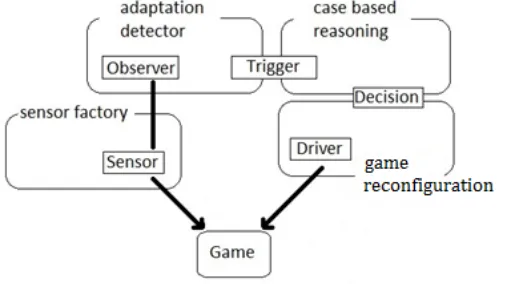
Figure 5: ADD design patterns working together ... 34
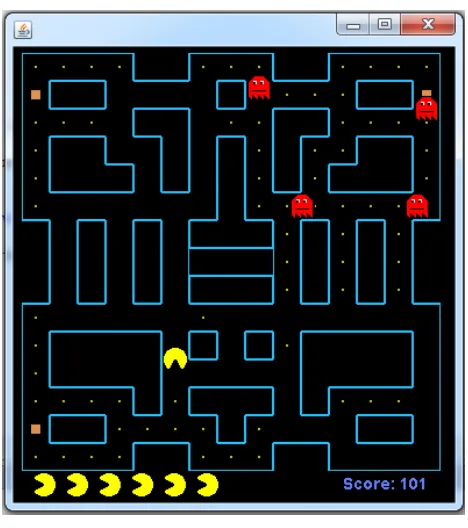
Figure 6: Screen captured from the Pac-‐Man game ... 38
Figure 7: Screen captured from the TileGame game ... 38
Figure 8: Screen captured from the Minecraft game ... 41
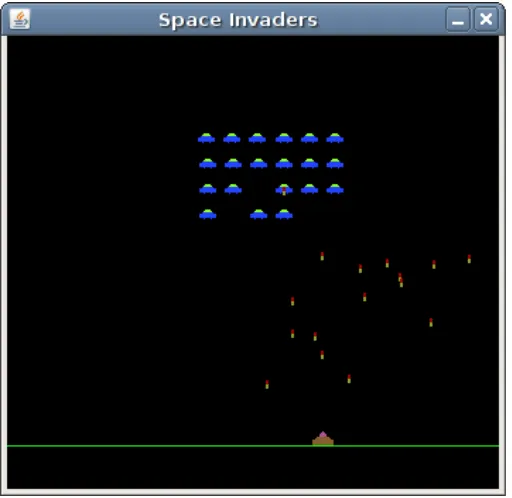
Figure 9: Screen captured from the Space Invaders game ... 42
Figure 10: 7 Tetriminos (top) and Screen captured from the Tetris game (bottom) ... 43
Figure 11: Components of the semi-‐automatic framework ... 60
Figure 12: Schema of the MySQL database for the relational model ... 64
Figure 13 : Number of attributes at different depths on the Tetris game ... 67
Figure 14 : Screenshot of attribute tree visualization for the Tetris game ... 68
Figure 15 : Screenshot of a sample session timeline visualization ... 68
Figure 16 : Summary of participant’s feedback about the design patterns and base level implementation ... 85
x
List of Appendices
Appendix A: Programmer’s Manual for the Usage of the Base Level Implementations of the Design Patterns ... 103
Appendix B: User’s Manual for the Proof-‐of-‐concept Automation Tool ... 112
Appendix C: PHP Source Code for the Translator Component ... 126
Appendix D: Example Source Code from the Base Level Implementation of the Design Patterns ... 132
Chapter 1
Introduction
Building dynamic video games is surprisingly complex; so much of the existing research and development in this area has led to the creation of games that are largely deterministic in nature. What occurs in the virtual game worlds and how this is presented to the player is for the most part fixed, and quite unable to adequately react to the interactions of the player [1]. While interesting in their own ways, these games are often too inflexible and rigid to be able to effectively meet the needs and expectations of a large and diverse player population [1], especially as these needs and expectations change as players mature, refine their skills, and form new experiences [2]. In the end, this leads to a loss of engagement, a break of immersion, and an overall disappointing player experience [3][4].
vary drastically [7]. These factors together make it very challenging for video game designers to set an appropriate level of difficulty in a video game. Traditional static difficulty levels (e.g., easy, medium, hard) often fail in this context as they expect the players to judge their ability themselves appropriately before playing the game and also try to classify them in broad clusters (e.g., what if easy is too easy and medium is too difficult for a particular player?).
expensive and time consuming, ultimately limiting its usefulness. For this reason, we were motivated to leverage the benefits of software design patterns1 [10][11] to construct an ADD framework and system [12] that is reusable, portable, flexible, and maintainable.
1.1
Motivation
The concept of auto dynamic difficulty is used in variety of games from commercially successful third person shooter games (i.e., “Max Payne”) to research based therapeutic games [13]. In terms of genre, their applicability is shown in prey and predator (e.g., Pac-‐Man) [6], cognitive (e.g., Pong) [14], first-‐person shooter (e.g., Half-‐life) [15], and platform (e.g., Super Mario Bros) [16] games. Also, the nearly universal presence of different difficulty levels in video games suggests the broader applicability of auto dynamic difficulty research. As we have mentioned earlier, unfortunately, from a software design perspective, there is no information publicly available about how ADD is implemented in commercial games. Furthermore, research in this area has largely been done in an ad-‐hoc fashion and is therefore not reusable or applicable to other games. As we have prior expertise in empirical software engineering research, we quickly identified our opportunity to contribute in this broader area by bringing knowledge from similar adjacent domain
such as self-‐adaptive systems (please see Chapter 4 for details), and applying it in video games, and gaining further knowledge through empirical study.
1.2
Type of Research
Our research has both knowledge seeking and solution building components. Examples of our solution building research include deriving software design patterns from other domains in the context of video games, applying those design patterns in different games, implementing a source code generation based proof-‐of-‐ concept tool to assist in applying those design patterns, and so on. Examples of knowledge seeking research include collecting metrics through source code analysis of our implementation, textual content analysis of feedback from a preliminary user study, and so on. In Chapter 3, we will provide a more detailed overview of the organization of our research.
1.3
Organization of Thesis
Chapter 2
Related Work
Considering the variety of contexts and the focus of related research, we divide our related work discussion into three sub-‐sections. First we highlight the research that explores the use of ADD in video games. Afterwards, we discuss the literature on using software design patterns in video games. Finally, we discuss the research gap and put our work in the context of this other work.
2.1
Auto Dynamic Difficulty
In [17], Demasi and Cruz explored the potential of co-‐evolutionary algorithms2 to create a user-‐driven evolution of agents in an ANSI C based online action game. Here user-‐driven evolution means the enemies evolve and get smarter by the same proportion as the player gets better by playing the game. The game scenario is a square room (480 x 480 pixels) where the player character needs to survive against some 16 little monsters (a touch from any monster kills the player character). The player character has a gun to fight the monsters. When the player character kills a monster, another one enters the room, so that there are always 16 enemies alive. The player character starts with 20 shots in the gun and every 15 seconds a new cartridge with 20 shots appears in a random location in the game. The player character can teleport once in every 30 seconds from its local position to a random location. The player character and the enemies have the same speed. The enemies can move only in four directions (up, down, left, right), but the player character can walk or shoot in any one of the eight directions including diagonals. The player character has three lives; once all lives are lost the game is over. The final score is the number of enemies killed. These 16 non-‐player characters (NPC) are monitored and evolved when they die or reach their “time to live”. The authors proposed four different methods for the online evolution of the agents: (i) using game specific information; (ii) online evolution using offline-‐evolved data; (iii) using online data
only; and (iv) using method-‐iii after method-‐i or ii. The authors used a heuristic fitness function for agent evolution and analyzed different game based values. The results indicated that method-‐iii (i.e., using online data only) can yield good results for online games which require real-‐time interaction and are unpredictable to some degree.
such an ADD approach is validated trough a study where the movements of the NPCs were monitored based on data from the simulation of the MCTS. Attributes that indicate the states of Pan-‐Man and the two ghosts, as well as the environment in each move are selected as inputs of the ANN for the two ghosts. Similar inputs are selected for the two ghosts except one more input (i.e., the first ghost’s direction) for the second ghost so as to control cooperative behavior. The direction of each ghost is the output of the ANN.
In [13], Hocine and Gouaïch described a generic ADD approach for pointing tasks in therapeutic games. They have explained how this approach can meet therapeutic requirements such as:
(i) The ability assessment: by proposing an in-‐game kinematic evaluation mechanism taken from traditional rehabilitation practices,
(ii) The variability: by introducing a game abstract level which provides various ambiances and task themes with the same therapeutic objective behind,
(iii) The difficulty adjustment and continuity: by introducing a dynamic difficulty adaptation technique founded on a motivation model and the assessment of player’s capabilities, which aims to overcome the playability challenge.
technique and the other using a random task difficulty. For the ADD approach, the player’s profile containing his/her ability data as well as general information about the player such as age, gender, and whether he/she is right or left handed, is used to choose the appropriate adaptation strategy according to the proposed game goal associated with the therapeutic objective. The difficulty of a task is considered to be related with its probability of success. According to the player’s profile and motivation, the difficulty adaptation module makes one of the following decisions: increase, decrease, or maintain the current difficulty level of the training session. Three criteria are taken into account when adjusting the difficulty level: the first two criteria S +local (n), S -‐local (n) measure the local instability of the motivation in both increase and decrease directions respectively. The third criterion measures the overall trend of motivation, T global. A least squares method is used to calculate this trend on the cumulative motivation. With these elements, the algorithm makes the following decisions:
(i) S-‐local (n)∧ ¬T global (n): decrease the difficulty. This is interpreted as a local decrease in motivation and a global trend indicating demotivation.
(ii) S +local (n)∧ T global (n): increase the difficulty. This is interpreted as a local and global increase in motivation: the patient is succeeding too easily. The difficulty is increased to keep an acceptable level of challenge.
Results from statistical analysis such as the Chi-‐square goodness of fit test and a t-‐ test indicate that ADD influences the player’s motivation not only by challenging him/her but also by maintaining his/her success rate and influencing his/her perceived difficulty.
In [18], Hunicke and Chapman explored the computational and design requirements for an ADD system. They named the system “Hamlet” which was developed using Valve’s Half Life game engine. Using techniques drawn from Inventory Theory and Operations Research, it analyzes and adjusts the supply and demand of game inventory in order to control the overall game difficulty. As the player moves throughout the game world, the system uses statistical metrics to monitor incoming game data. Over time, it estimates the player’s future state from this data. When an undesirable but avoidable state is predicted, the system intervenes and adjusts the game settings as necessary. The system is designed to keep the player in the flow channel by encouraging certain states, and discouraging others. The authors proposed two types of adjustment actions:
(i) Reactive actions will adjust elements that are “in play” or “on stage” (i.e. entities that have noticed the player and are attacking). This includes directly manipulating the accuracy or damage of attacks, strength of weapons, and level of health, amongst others.
type, spawning order, health, accuracy, damage and packing properties of entities that have not yet appeared on screen.
both rated the game as somewhat to extremely difficult (3-‐5 on a scale of 1-‐5), however, trends indicate that expert players report elevated levels of enjoyment.
six rounds in a game represented three types of change directions under an easy or hard level of game difficulty. Every participant played one experimental game. The results indicate that the players have better immersion when the difficulty changes up and down and the changes happen at a medium rate.
In [20], Missura formalized the problem of an adaptive agent in the context of the popular strategy game Connect Four. Connect Four is a game for two players each having 21 identical stones. One set of stones is white and the other is black. The game is played on a rectangular board consisting of 7 vertical columns of 6 squares each. If a stone is “dropped" in one of the columns, it will “fall down" to the lowest unoccupied square. The players make their moves in turn consisting of placing one stone in one of the columns. The goal of the game for each player is to get four of her own stones connected either vertically, or horizontally, or diagonally. If all 42 stones are placed on the board and no such group was created, the game is a draw. Missura described four Connect Four playing agents: Naive, Simple, Mini-‐Max, and Optimal. Then, in [21], Missura and Gartner presented “Adaptive Mini-‐Max” (AMM), an adaptive agent for playing Connect Four. AMM is a modified version of a pre-‐ existent algorithm known as Mini-‐Max3. Instead of always taking the optimal move
based on its investigation of the game tree, AMM first evaluates the moves that were
available to its opponent. AMM does this by investigating a sub-‐tree of the game tree of choices that their opponent could have made, just as it would do for itself on its turn. The actions available to the opponent are ranked in terms of optimality, and the actual move that they made is noted. AMM does this throughout the game, and, at each turn, calculates an average of the ranking of all of the moves made by their opponent. This ranking enables AMM to determine the ability of their opponent. Then, at each of AMM’s turns, AMM will choose to make not the optimal move, but rather the available move whose ranking is closest to the average ranking of the opposition’s moves.
In order to evaluate AMM’s adaptive mechanism, AMM was used to play against all the other Connect Four playing agents. AMM won approximately 50 percent of the time when playing against all but the optimal agent. The reason that AMM was not able to adapt to the ability of the optimal agent is that AMM is fundamentally based on Mini-‐Max, and so cannot perform any better than Mini-‐Max, which is a weaker agent than optimal. Finally, an evaluation of AMM’s “fun-‐factor” and ability to adapt against human players was performed. The study found that users preferred playing against AMM over the non-‐adaptive agents. Additionally, no significant correlation between the players' skill levels calculated and their winning rate against AMM was found which means AMM successfully adapted to the players’ skill levels.
A) Game Engine Core: The game engine core is used to provide all of the fundamental technologies including graphics, audio, animation, artificial intelligence, networking, and physics required to drive a game or gameplay scenario. It allows developers to create new gameplay logic and content on top of this engine to have a complete game, without developing all of the underlying technologies.
B) Monitoring, Analysis, and Control: Monitoring, analysis, and control services are used in the test bed to support both ADD experimentation and software developed to implement new ADD algorithms and methodologies. These services are used by gameplay scenarios, and directly make use of the game engine core. To conduct experimentation within a particular gameplay scenario, the experimental environment must monitor and collect the appropriate player and progression data. The analysis service is used to provide support in the aggregation and correlation of data collected through monitoring. The control service is used to manipulate the experiment in the gameplay scenario, including starting, suspending, resuming, and halting a particular experiment.
They have also implemented a variety of mini-‐game gameplay scenarios using UnrealScript and UnrealEd for preliminary validation of the test bed. These include two jumping mini-‐games, a timed maze navigation mini-‐game, a turret mini-‐game requiring the player to navigate a short hallway lined with automated, indestructible gun turrets, and a fighting mini-‐game requiring the player to make their way through a room full of heavily armed enemy non-‐player characters.
Rani et al. [14] suggested a method to use real-‐time feedback, by measuring the anxiety level of the player using wearable biofeedback sensors, to modify game difficulty. They conducted an experiment on a Pong-‐like game to show that physiological feedback based difficulty levels were more effective than performance feedback to provide an appropriate level of challenge. Physiological signal data was collected from 15 participants each spending six hours in cognitive tasks (i.e., anagram and Pong tasks) and these were analyzed offline to train the system.
Orvis et al. [22], from an experiment involving 26 participants, found that across all difficulty levels, completion of the game resulted in an improvement in performance and motivation. Prior gaming experience was found to be an important influence factor. Their findings suggested that for inexperienced gamers, the method of manipulating difficulty level would influence performance.
2.2
Software Design Patterns in Video Games
software design patterns is relatively rare. Here we discuss examples of both types of research.
Gestwicki and Sun [23] presented a video game based approach to teach software design patterns to computer science students. They developed an arcade style game, EEClone, which consists of six key design patterns and then used these patterns in their case study. Student participants analyzed the game to learn the usage of those patterns.
Antonio et al. [24] described their experience in teaching software design patterns using a number of incremental abstract strategy game design assignments. In their approach, each assignment was completed by refactoring and using design patterns on previous assignments.
Narsoo et al. [25] described the usage of software design patterns to implement a single player Sudoku game for the J2ME platform. They found that through the use of design patterns, new requirements could be accommodated by making changes to fewer classes than otherwise possible.
2.3
Research Gap
Chapter 3
Research Organization
In this chapter, we discuss the overall research goals and how these goals are devised into a number of incremental studies, and provide a brief description of each study.
3.1
Research Goals
Our primary research goal is:
Research goal, G: To develop a set of software design patterns, a process for applying those design patterns, a tool for using these design patterns effectively, for
implementing auto dynamic difficulty in video games, and to empirically validate the
overall approach.
We decompose this high level overall research goal to following atomic sub-‐goals:
G1: To develop a set of software design patterns for implementing ADD in video games.
G3: To analyze the source code reusability achieved through the usage of these design patterns to implement ADD in video games.
G4: To define a concrete set of activities (possibly step-‐by-‐step) needed for applying our design pattern based approach in video games.
G5: To develop a source code generation based semi-‐automatic framework that will assist in applying the ADD approach in video games.
3.2
Research Studies
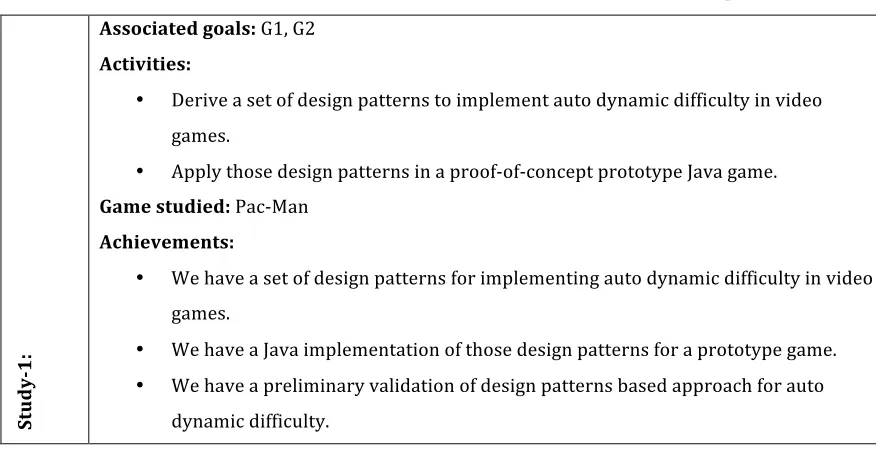
We have organized four different studies to achieve the above research goal. Our intention for each study is to address one or more sub-‐goals discussed in Section 3.1. Each study involves some development and empirical study around a specific game. Here, in Table 1, we briefly describe each of these studies:
Table 1: Decomposed executable studies from research goals
St
u
d
y-‐
1:
Associated goals: G1, G2 Activities:
• Derive a set of design patterns to implement auto dynamic difficulty in video games.
• Apply those design patterns in a proof-‐of-‐concept prototype Java game.
Game studied: Pac-‐Man
Achievements:
• We have a set of design patterns for implementing auto dynamic difficulty in video games.
• We have a Java implementation of those design patterns for a prototype game.
• We have a preliminary validation of design patterns based approach for auto dynamic difficulty.
St u d y-‐ 2:
Associated goals: G2, G3
Activities:
• Generalize the implementation from Study-‐1, so that it can be applied to other games.
• Apply the generalized implementation to a third party game developed in Java with minimal modifications.
• Based on the implementations from Study-‐1 and Study-‐2, measure and discuss how different software qualities (e.g., reusability, maintainability etc.) are impacted by the design pattern approach.
Game Studied: TileGame
Achievement:
• We have a more generic Java implementation of the design patterns.
• We have validated that the design patterns based approach for auto dynamic difficulty can easily be applied to games that were not implemented with any such prior motivation.
• We, based on empirical grounds, have discussed how different software qualities are positively impacted by the usage of the proposed approach.
St u d y-‐ 3:
Associated goals: G2, G3, G4
Activities:
• Based on the experience from Study-‐1 and Study-‐2, describe a step-‐by-‐step process to use the design patterns in a game.
• Follow the described process to apply the generalized implementation to a commercial Java game with minimal modifications.
• Based on the implementations from Study-‐1, Study-‐2 and Study-‐3, measure and discuss to what extend the implemented source code are reusable.
Game Studied: Minecraft
Achievement:
• We have described a step-‐by-‐step process to apply the design patterns.
• We have validated that on following the process, the design patterns based approach for auto dynamic difficulty can easily be applied to large-‐scale commercial game such as Minecraft.
St
u
d
y
4
:
Associated goal: G5
Activities:
• Analyze the instantiation and specialization related artifacts (i.e., source code) that were identified as not reusable in prior studies.
• Define a relational model to represent the dynamic information necessary to implement those artifacts.
• Develop a framework, which will allow collecting required information from a game, create instance of the model based on that information, and provide an effective way for managing and fine tuning the model and finally generating source code based on the model.
Game Studied: TileGame
Achievement:
• We have a semi-‐automatic tool, which with the help of code generation allows us to implement the design pattern based approach on a video game with minimum effort.
St
u
d
y
5
:
Associated goal: G2
Activities:
• Conduct a case study where an external developer uses our design pattern based approach to implement ADD.
• Analyze the data collected from this case study to understand the ease of usage and effort associated in applying our design pattern based approach.
• Identify potential issues from the critical feedback from the developer about the design patterns and/or the base level implementations provided to the developer and plan to address the issues.
Games Studied: Tetris and Space Invaders
Achievement:
• From a preliminary user study, we have verified that a developer with no prior knowledge of our research can learn and apply our design pattern based approach to develop ADD in games with minimal effort.
Chapter 4
Design Patterns
As we discussed earlier in Chapter 2, related work on ADD in video games has focused on tool building (e.g., framework (Bailey and Katchabaw [7]), algorithms (Hunicke [15]; Hao et al. [6]) etc.) and empirical studies (e.g., Rani et al. [14]; Orvis et al. [22] etc.), but they all use an ad-‐hoc approach from a software design point of view. On the other hand, research on using software design patterns in video games is mostly limited to using video games as a means for teaching design patterns in undergraduate computer science courses (e.g., Gestwicki and Sun [23]; Antonio et al. [24]). In contrast, much work has been done towards game design patterns, such as the foundational work of (Björk and Holopainen [26]) and many others, but the focus has generally been on game design and not software design, which is a subtle, yet important distinction. Relying on the success of software design patterns in different software domains, we can say that game developers could benefit from both game design patterns and software patterns for games.
the generalization of design solutions found in the self-‐adaptive system literature. We found four of these 12 design patterns to be necessary for enabling ADD in video games. In this chapter, we derive these design patterns in the context of ADD in video games to achieve our first sub-‐goal “G1: To develop a set of software design patterns for implementing ADD in video games”. We used the same classification scheme of adaptive design patterns as Ramirez and Cheng (i.e., monitoring, decision making, and reconfiguration patterns). Bailey and Katchabaw also used synonymous component names for their framework [7]. In Sections 4.1, 4.2, and 4.3, we discuss monitoring, decision making, and reconfiguration patterns respectively. In Section 4.4, we discuss how these design patterns work together to enable the implementation of ADD in a game.
4.1
Monitoring Pattern
player’s life level, time spent on activities, inventory, number of enemies killed, amongst others.
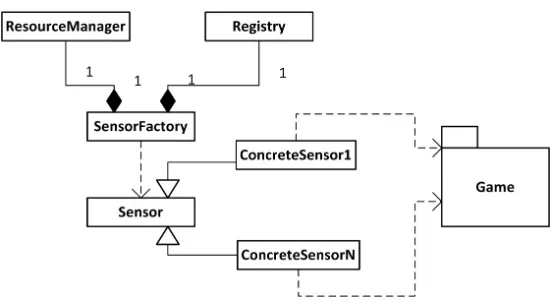
Figure 1: Sensor factory design pattern
Sensor factory: Sensors are objects that periodically read data from the game4 and notify the rest of the ADD system. Sensor (please see Figure 1) is an abstract class which encapsulates the periodical collection and notification mechanism. It has the abstract method refreshValue() which child classes need to define. A concrete sensor realizes the Sensor and defines data collection and calculation inside the
refreshValue() method. A concrete sensor may also override other attributes of the
Sensor class. An example of a concrete sensor can be AverageScorePerLifeSensor, which reads score and number of life attributes from the game and divides the score by the number of lives. An example of overriding an attribute from the base Sensor class can be redefining the default monitoring interval. The SensorFactory class uses
the “factory method” pattern to provide a unified way of creating any sensors. It takes the sensorName and the object to be monitored as input and creates the sensor. If the object is not specified, then it uses the default game object. In Table 2, we provide a code snippet that demonstrates how Java reflection can be used to create a sensor without using the constructor directly. As we can see, unlike traditional implementations of the factory method pattern, this implementation does not require modification when new ConcreteSensor classes are created.
Table 2: Creating sensors using Java reflection
Class sensorClass = Class.forName(sensorName);
Constructor sensorConstructor = sensorClass.getConstructor( new Class[]{ Object.class } );
Sensor sensor = (Sensor)sensorConstructor.newInstance( new Object[]{ object } );
It is good practice that the object will provide an appropriate interface so that it can be queried by the ConcreteSensor for the required attribute. If for some reason the object does not provide the required interface, then reflection can be used to bypass the access modifier (please see Table 3).
Table 3: Bypassing access modifier using Java reflection
Class objectClass = object.getClass();
Field field = objectClass.getDeclaredField(“fieldName”); field.setaccessible(true);
Object fieldValue = field.get(object);
resource constraints. Usually, the underlying platform and/or development environment provides wrappers for resource monitoring. For example, the java.lang.Runtime class and java.lang.management package provide such functionality.
4.2
Decision Making Patterns
After collecting raw data using the monitoring pattern (i.e., sensor factory), the ADD system must interpret what that information means in the context of a particular game and which game elements need to be adjusted to what degree to provide the player with an appropriate level of difficulty. Two decision making patterns: adaptation detector and case based reasoning are discussed below, encapsulating the tasks of “when to adjust the game” and “what to adjust in the game and how to adjust?” respectively.
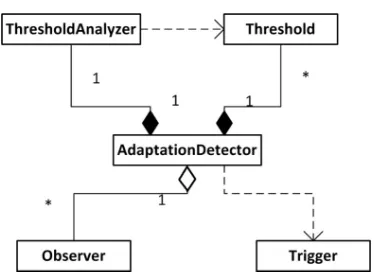
Figure 2: Adaptation Detector design pattern
Adaptation detector: With the help of the sensor factory pattern, the
and attaches observers5 to each sensor. Observer encapsulates the data collected from sensors, the unit of data, and whether the data is up-‐to-‐date or not. The unit of data represents the degree of precision necessary for each particular type of sensor data. For example, in a particular game, every tenth change in the player’s inventory might be worth noticing, compared to changes in the player’s remaining number of lives, which should be noted on each change. AdaptationDetector periodically compares the updated values found from Observers with specific Threshold values with the help of the ThresholdAnalyzer. Each Threshold contains one or more boundary values as well as the type of the boundary (e.g., less than, greater than, not equal to, etc.). Once the ThresholdAnalyzer indicates a situation when adaptation might be needed, the AdaptationDetector creates a Trigger with the information the rest of the ADD process might need. Trigger also holds book-‐keeping attributes such as the trigger creation time and so on. For example, if the average score per life is less than a particular threshold, then it might indicate that an adaptation is necessary. Now to give a bigger picture, the Trigger may include contextual information, such as the number of enemies left, their average speed, etc.
AdaptationDetector needs to make sure that it does not repeatedly create the same
Trigger.
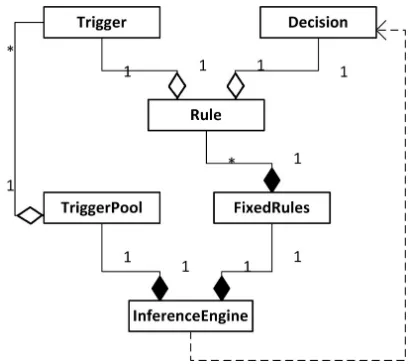
Figure 3: Case based reasoning design pattern
Case based reasoning: While the adaptation detector determines the situation when a difficulty-‐adjustment is required by creating a Trigger, case based reasoning (please see Figure 3) formulates the Decision that contains the adjustment plan. As the name of the pattern suggests, this pattern is best suited to games where the difficulty adjustment logic can be defined as a finite number of cases.
The InferenceEngine has two data structures: the TriggerPool and the FixedRules.
FixedRules contains a number of Rules6. Each Rule is a combination of a Trigger and a Decision. The Triggers created by the adaptation detector will be stored in the
TriggerPool. To address the Triggers in the sequence they were raised in, the
TriggerPool should be a FIFO data structure. The FixedRules data structure should support search functionality so that when the InferenceEngine takes a Trigger from the TriggerPool, it can scan through the Rules held by FixedRules and find a Decision
that appropriately responds to the Trigger. Note that all the attributes of two
Triggers need not be the same for them to match. For example, depending on the game, a “player’s life value is below 20%” trigger created at two different time points might be considered the same trigger. Thus, a Trigger should provide the method (e.g., overriding the equalsTo() method in Java) to compare it with another one so that the InferenceEngine can find and take the appropriate Decision. Another optional component (not shown in Figure 3) for the case based reasoning pattern is a learner attached to the inference engine, which can learn new rules based on monitoring the sequence and effectiveness of different rule executions on the game.
4.3
Reconfiguration Pattern
Similarly, in a video game, the game logic continuously checks in a loop (i.e., the game loop) for inputs from input devices (such as the keyboard, mouse, gamepad, sensors, etc.) and behaves according to those inputs.
Game reconfiguration: This pattern is based on the server reconfiguration pattern described in [11]. The server reconfiguration pattern assumes that the object that needs to be configured will implement a specific interface. With the help of the adapter design pattern, this assumption can be eliminated (as we show in Figure 4 and discuss hereafter). The AdaptationDriver receives a Decision selected by the
InferenceEngine (please see case based reasoning in Section 4.2) and executes it with the help of the Driver. Driver implements the algorithm to make any attribute change in an object that implements the State interface (i.e., that the object can be in active or inactive states, and outside objects can request state changes). As the name suggests, in the active state, the object shows its usual behavior whereas in the inactive state, the object stops its regular tasks and is open to changes.
The Driver takes the object to be reconfigured (default object used if not specified), the attribute path (i.e., the attribute that needs to be changed, specified according to a predefined protocol7) and the changed attribute value as inputs. The Driver requests the object that needs to be reconfigured to be inactive and waits for the inactivation. When the object becomes inactive, it reconfigures the object as specified. After that, it requests the object to be active and informs the
AdaptationDriver when the object becomes active. When the game is in an inactive state, it will not be able to respond to the inputs it receives from the player through the input devices, but it should not discard those requests either because that might expose an unexpected behavior to the player. The GameState maintains a
RequestBuffer data structure to temporarily store the inputs received during the inactive state of the game. The GameState overrides Game’s event handling methods and game-‐loop to implement the State interface. When the GameState is requested to be INACTIVE, it is transferred to BEING_INACTIVE. While in the BEING_INACTIVE state, the game-‐loop finishes its current execution and then goes to the INACTIVE state. In the INACTIVE state, the game-‐loop does not get executed. If the game is not in the ACTIVE state, inputs are stored in the RequestBuffer instead of being processed. When the game is requested to be ACTIVE, it is transferred to the
BEING_ACTIVE state first. In the BEING_ACTIVE state, the inputs stored in the
RequestBuffer are retrieved and processed. The game goes to the ACTIVE state from the BEING_ACTIVE state only after the RequestBuffer becomes empty. The game can
7 Example can be: object oriented dot notation like,
be requested to go to the INACTIVE state only at a time when it is in the ACTIVE state, and vice versa. It is important to note that in a reasonable implementation, all these changes can be done in less time than the game loop’s sleeping period after each execution and, consequently, these changes are not noticeable to the player.
4.4
Integration of Patterns
In this Section, we briefly re-‐discuss how the four design patterns discussed in Sections 4.1, 4.2, and 4.3 work together to create a complete ADD system (please see Figure 5 and Table 4).
Figure 5: ADD design patterns working together
Table 4: Summary of ADD design patterns
Design Pattern Role Interacts With
Sensor factory Collecting data from the game Game, Adaptation detector Adaptation detector Deciding when to adjust the game Sensor factory, Case based
reasoning Case based reasoning Deciding what to adjust in the game and
how to adjust
Adaptation detector, Game reconfiguration
Game reconfiguration Implementing the adjustment Case based reasoning, Game
The sensor factory pattern uses Sensors to collect data from the game so that the player’s perceived level of difficulty can be measured. The adaptation detector pattern observes Sensor data using Observers. When the adaptation detector finds situations where difficulty needs to be adjusted, it creates Triggers with appropriate additional information. Case based reasoning gets notified about required adjustments by means of Triggers. It finds appropriate Decisions associated with the
Chapter 5
Games Studied
To date, we have used five games developed in Java for studying the design patterns described in Chapter 4. In our early work (please see studies 1 and 2; also reported in[12] and[27]), two casual prototypical games were used. The first game is a variant of Pac-‐Man and was developed specifically for the purposes of our research. The second game, TileGame, is a slightly modified version of a platform game described in [28]. Even though we were successful in using the design pattern based approach in these two games, the code for these games was either written by ourselves or well documented and simple enough to be easily understood and reshaped accordingly. Thus, in a later study (please see Study 3; also reported in[29]) we have selected a commercially successful sandbox game – Minecraft8 [30] to extend our study. Also, we designed a class project, where a student used our designed pattern based approach to implement ADD in open source variants of two popular arcade games: Space Invaders and Tetris. In sections 5.1 to 5.6 below we
briefly describe each of the games and examples of adaptations that were implemented. In sub-‐section 5.7, we discuss the second sub-‐goal “G2: To validate that the proposed design patterns provides a reusable solution for implementing ADD in video games”.
5.1
Pac-‐Man
Figure 6: Screen captured from the Pac-‐Man game