
Chiral nuclear forces: Recent developments
Evgeny Epelbaum1,a
1Institut für Theoretische Physik II, Ruhr-Universität Bochum, D-44780 Bochum, Germany
Abstract.In this talk, I review recent progress towards developing accurate and precise nuclear forces in the framework of chiral effective field theory. The new generation of NN potentials up to fifth order in the chiral expansion is shown to provide excellent de-scription of phase shifts and to yield a convergent pattern for low-energy NN observables. I also address the issue of uncertainty quantification and discuss some recent results in nucleon-deuteron scattering.
1 Introduction
Chiral effective field theory (EFT) provides a well established and nowadays most commonly used approach to low-energy nuclear reactions and light nuclei, see [1, 2] for recent review articles. It relies on the symmetries of QCD and allows one to derive nuclear forces and the corresponding current operators within a systematically improvable perturbative expansion, the so-called chiral expansion [3]. In the standard formulation based on pions and nucleons as the only explicit degrees of freedom, the expansion parameterQis defined asQ ∈ {Mπ/Λb, |p|/Λb}withMπ, p andΛb referring to the pion mass, typical three-momenta of the nucleons and the breakdown scale to be specified below, respectively.
In the past two and a half decades, this approach was employed by different groups to derive nuclear forces up to fourth orderQ4 in the chiral expansion (N3LO) [4–8] and to performab initio calculations of few-nucleon reactions and light nuclei. For a related recent work on the electromag-netic currents see [9–12]. Given that the numerical implementation of the N3LO three-nucleon force (3NF) contributions represents a non-trivial task, which could be accomplished only recently [13, 14], most of the availableab initiocalculations utilized the nuclear Hamiltonian consisting of the N3LO nucleon-nucleon (NN) potentials of [4, 5] accompanied by the leading, i.e. order-Q3 (N2LO), 3NF. These studies have revealed the important role of the chiral 3NF yielding many promising results, see [15] and references therein. For a progress report on the discretized formulation of nuclear chiral EFT see [16]. Still, the well-known discrepancies between state-of-the-art theoretical calculations and ex-perimental data in the three-nucleon continuum at intermediate energies ofEN∼50. . .100 MeV and higher [17] could so far not be resolved. Further developments are needed to tackle the long-standing 3NF problem in the framework of chiral EFT. First, given that the 3NF is itself a small correction to the dominant NN force,accurateandprecisechiral NN potentials are required to pin down the 3NF effects. Secondly, it was argued that the chiral expansion of the 3NF is not yet converged at N3LO [18] and should, therefore, be pushed to at least N4LO (i.e.Q5) in the standard approach [19–21] or
to N3LO in the formulation with explicitΔ(1232) degrees of freedom. Last but not least, it is crucial to be able to reliably quantify the theoretical uncertainty due to truncation of the chiral expansion for all calculated observables, see [22] for a general discussion. In this talk I discuss recent developments along these lines focusing mainly on the first and the last topics.
2 A new generation of chiral NN forces up to N
4LO
Given that the chiral expansion of the 3NF is not yet converged at N3LO, the expansion for the nuclear Hamiltonian needs to be pushed to N4LO. For the NN force, the pertinent long-range contributions due to 2π- and 3π-exchange have been derived and applied to peripheral NN scattering in Ref. [23]. Notice that no new isospin-conserving NN contact interactions appear at this order in the chiral expansion.
In [24, 25], we have introduced a new generation of NN potentials up to N4LO in the chiral expansion. In addition to pushing the chiral expansion to a higher order, these new potentials feature a number of important improvements as compared to the first-generation chiral N3LO NN forces. First, we used a coordinate-space regularization procedure for the long-range componentsVlong,
Vlong(r)→VlongReg.(r)=Vlong(r)F r
R
with F(x)=1−exp(−x2)6, (1)
where the short-range cutoff Ris chosen in the range ofR = 0.8. . .1.2 fm in agreement with the estimated breakdown distance of∼0.8 fm of the chiral expansion for the pion-exchange potential [26]. The new regulator maintains, per construction, the analytic structure of the amplitude at low momenta and allowed us to substantially reduce the amount of finite-cutoffartefacts. Moreover, since the new regulator cuts offprecisely the undesiredshort-rangecomponents of the pion exchange contributions instead of their large-momentum parts as the old non-local regulator does, no additional spectral-function regularization (SFR) [27] used e.g. in [4] is required. This is a particularly welcome feature in view of the ongoing and upcoming 3NF studies, in which the implementation of the SFR would be highly non-trivial. Notice that while the authors of [5] have managed to avoid the introduction of the SFR at N3LO, this was achieved at the cost of employing a nonlocal regulator, whose functional form was adjusted from partial wave to partial wave, see Table F.2 of [2].
Secondly, the new potentials of [24, 25] adopt the values of theπNlow-energy constants (LECs) determined inπNscattering without any fine tuning. In particular, at N4LO, we used the LECs taken from the order-Q4 fit to the Karlsruhe-Helsinki partial wave analysis (PWA) of [19], see [28] for a recent extraction from the subthreshold parameters and [29] for a related work.
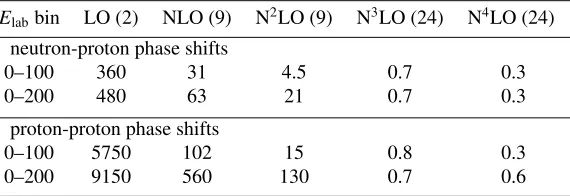
With the short-range contact interactions being determined from a fit to the Nijmegen PWA (NPWA) of neutron-proton (np) and proton-proton (pp) scattering [30], see [24, 25] for more details, our results for S-, P- and D-waves and the mixing angles1,2at different chiral orders are visualized in Fig. 1 forR=0.9 fm. One observes a very good convergence pattern of the chiral expansion in the whole energy range up toElab=300 MeV. To get more quantitative insights, we show in Table 1 the
χ2/datum for the description of the Nijmegen np and pp phase shifts. Here, we estimated the uncer-tainty of the NPWA for a given phase shift and mixing angle from the deviations to the results of the Nijmegen I, II and Reid93 potentials [31], which are regarded as alternative PWA. Notice, however, that such an estimation doesnotallow for a statistical interpretation of theχ2values shown in table 1. Still, theχ2defined as described above is a useful tool to quantify the accuracy of the fits.
Figure 1. Chiral expansion of the NN phase shifts in comparison with the NPWA (solid dots) and the GWU single-energy np partial wave analysis (open triangles). Dotted (black), dashed (brown), dotted (blue), dash-double-dotted (red) and solid (violet) lines show the results at LO, NLO, N2LO, N3LO and N4LO, respectively, calculated using the cutoffR=0.9 fm
Table 1.χ2/datum for the description of the Nijmegen np and pp phase shifts [30] at different orders in the chiral expansion for the cutoffR=0.9 fm. The numbers in the brackets give the number of adjustable isospin-invariant contact interactions at the corresponding order. Only those channels are included which have
been used in the N3LO/N4LO fits, namely the S-, P- and D-waves and the mixing angles 1and2.
Elabbin LO (2) NLO (9) N2LO (9) N3LO (24) N4LO (24) neutron-proton phase shifts
0–100 360 31 4.5 0.7 0.3
0–200 480 63 21 0.7 0.3
proton-proton phase shifts
0–100 5750 102 15 0.8 0.3
0–200 9150 560 130 0.7 0.6
corresponding two-pion exchange components without invoking new parameters.1 These results con-stitute an important consistency check of the theoretical approach and provide a nice illustration of the importance of the chiral 2π-exchange potential, which is determined entirely by the chiral symmetry of QCD and experimental information onπN scattering. Furthermore, the obtained results suggest – fully in line with the Weinberg power counting [3] – that the theoretical uncertainties at NLO and N3LO are dominated by the neglected 2π-exchange contributions at orders N2LO and N4LO, respec-tively. Indeed, if certain order-Q4 and order-Q6 contact interactions would have to be promoted to lower orders in violation with naive dimensional analysis, see e.g. [32–34], the inclusion of the 2π
exchange contributions alone at N2LO and N3LO would not result in the improved accuracy of the fits.
We have also tested the convergence of the chiral expansion for various observables. For example, for the np total cross section at various energies, we obtain usingR=0.9 fm
σtot(50 MeV) = 183.6LO−17.1NLO+0.5N2LO−0.2N3LO+0.7N4LO=167.5 mb,
σtot(96 MeV) = 84.8LO−9.7NLO+3.2N2LO−0.8N3LO+0.5N4LO=78.0 mb,
σtot(143 MeV) = 52.5LO−3.4NLO+5.1N2LO−0.5N3LO+0.2N4LO=53.9 mb,
σtot(200 MeV) = 34.9LO+1.0NLO+6.7N2LO+0.6N3LO−0.5N4LO=42.7 mb. (2)
Notice that the natural size of the N2LO, N3LO and N4LO contributions atE=50 MeV is estimated to be∼3 mb,∼0.8 mb and∼0.2 mb, respectively [24]. The somewhat large N4LO contribution at this energy reflects, in fact, the adopted fitting protocol, see [25] for more details. Similarly, the NLO contributions at the two highest energies come our rather small compared with their expected size of ∼10 mb. Generally, the convergence pattern of the chiral expansion for the np cross section is very satisfactory. We also found rapid convergence for the deuteron properties [24, 25].
3 Uncertainty quantification
Uncertainty quantification is key for performing a meaningful comparison between theory and data. In the past, theoretical uncertainty of nuclear chiral EFT due to truncation of the chiral expansion was, at best, estimated via a variation of the cutoffin a certain range. As pointed out already in [4], such an approach suffers from certain drawbacks. First, the residual cutoffdependence of a calculated observable measures the impact of neglected contact interactions which contribute only atevenorders Q2n,n = 0,1,2, . . .. Secondly, the available cutoffrange appears, in practice, to be rather limited. As a result, such “cutoffbands” can generally not be expected to provide a realistic estimation of the theoretical uncertainty, see [4, 24, 25] for more detail.
In [24], we proposed an alternative approach to quantify the uncertainty of a chiral EFT prediction by directly estimating the size of neglected higher-order contributions to a given observable. To this aim, we assume the expansion parameterQto beQ=max{Mπ/Λb, |p|/Λb}. The breakdown scale of the chiral expansionΛbwas estimated in [24] to beΛb ∼ 600 MeV forR =0.8. . .1.0 fm,Λb ∼ 500 MeV forR=1.1 fm andΛb ∼400 MeV forR=1.2 fm. The accuracy of a chiral EFT prediction for the observable of interest can then be estimated by multiplying the leading-order result with the appropriate power ofQ. In order to have as reliable as possible estimation of the uncertainty, we proposed to also employ the information on the actual size of higher-order contributions (if available). The precise description of the suggested algorithm for error analysis can be found in [24, 25], see also [35] for a related discussion. Here we just mention that our new approach can be straightforwardly applied (i) to any observable of interest and (ii) for any specific choice of the regulatorR.
As a representative example, consider the chiral EFT predictions for the np total cross section in Eq. (2). Performing the error analysis as described above, our final predictions forR = 0.9 fm at N4LO take the formσtot(50 MeV)=167.5±0.2 mb,σtot(96 MeV)=78.0±0.2 mb,σtot(143 MeV)= 53.9±0.4 mb andσtot(200 MeV) = 42.7±0.9 mb. These predictions are in excellent agreement with the NPWA results ofσNPWA(50 MeV) = 167.8±0.2 mb, σNPWA(96 MeV) = 78.1±0.5 mb,
Figure 2.Predictions for Nd total cross section at laboratory energies of 10, 70, 135 and 200 MeV based on the NN potentials of [24, 25] forR=0.9 fm without including the 3NF.
4 Beyond the NN system
With all the necessary tools being developed as described in the previous sections, one is now well equipped for testing chiral EFT and especially the novel chiral 3NFs in three- and more-nucleon systems. As a first step along this line, the new generation of the chiral NN potentials has been recently applied to nucleon-deuteron scattering and selected low-energy observables in3H,4He and4Li [35]. With a detailed account of this study being given in the talks by Maris [37] and Skibinski [38], I only briefly address here the results for nucleon-deuteron (Nd) total cross section visualized in Fig. 2. While these calculations can, starting from N2LO, not be regarded as complete due to the missing 3NFs, they do reveal a number of interesting insights. First, one observes a convergent pattern at all considered energies in spite of the fact that the calculations are actually incomplete. The predicted results for the cross section at N4LO are in a clear disagreement with experimental values with the discrepancies being much larger than the experimental and estimated theoretical uncertainties. This provides truly unambiguous evidence for missing 3NF within the employed theoretical framework. The estimated accuracy of the chiral EFT results at N4LO suggests that Nd scattering at intermediate and even higher energies will be a very promising testing ground for the chiral 3NF. Furthermore, it is comforting to see that the deviations between our N3,4LO predictions and experimental data are similar in size to the NLO (i.e.Q2) error bars, which give the estimated size of N2LO contributions. Indeed, this is precisely the chiral order at which the first nonvanishing 3NF appear according to the Weinberg power counting.
To summarize, the newly developed improved chiral NN potentials up to N4LO, along with a new analysis of the theoretical uncertainties, open the way for precision tests of chiral 3NFs in few-nucleon systems. Work along these lines is in progress by the LENPIC collaboration [39].
Acknowledgements
References
[1] E. Epelbaum, H. W. Hammer and U.-G. Meißner, Rev. Mod. Phys.81, 1773 (2009). [2] R. Machleidt and D. R. Entem, Phys. Rept.503, 1 (2011).
[3] S. Weinberg, Phys. Lett. B251, 288 (1990).
[4] E. Epelbaum, W. Glockle and U.-G. Meißner, Nucl. Phys. A747, 362 (2005). [5] D. R. Entem and R. Machleidt, Phys. Rev. C68, 041001 (2003).
[6] V. Bernard, E. Epelbaum, H. Krebs and U.-G. Meißner, Phys. Rev. C77, 064004 (2008). [7] V. Bernard, E. Epelbaum, H. Krebs and U.-G. Meißner, Phys. Rev. C84, 054001 (2011). [8] E. Epelbaum, Eur. Phys. J. A34, 197 (2007).
[9] S. Kölling, E. Epelbaum, H. Krebs and U.-G. Meißner, Phys. Rev. C80, 045502 (2009). [10] S. Kölling, E. Epelbaum, H. Krebs and U.-G. Meißner, Phys. Rev. C84, 054008 (2011). [11] S. Pastore, R. Schiavilla and J. L. Goity, Phys. Rev. C78, 064002 (2008).
[12] S. Pastoreet al., Phys. Rev. C80, 034004 (2009). [13] J. Golaket al., Eur. Phys. J. A43, 241 (2010).
[14] K. Hebeleret al., Phys. Rev. C91, no. 4, 044001 (2015).
[15] H. W. Hammer, A. Nogga and A. Schwenk, Rev. Mod. Phys.85, 197 (2013). [16] D. Lee, these proceedings.
[17] N. Kalantar-Nayestanakiet al., Rept. Prog. Phys.75, 016301 (2012). [18] R. Machleidt and D. R. Entem, J. Phys. G37, 064041 (2010).
[19] H. Krebs, A. Gasparyan and E. Epelbaum, Phys. Rev. C85, 054006 (2012). [20] H. Krebs, A. Gasparyan and E. Epelbaum, Phys. Rev. C87, no. 5, 054007 (2013).
[21] E. Epelbaum, A. M. Gasparyan, H. Krebs and C. Schat, Eur. Phys. J. A51, no. 3, 26 (2015). [22] R. J. Furnstahl, D. R. Phillips and S. Wesolowski, J. Phys. G42, no. 3, 034028 (2015). [23] D. R. Entem, N. Kaiser, R. Machleidt and Y. Nosyk, Phys. Rev. C91, no. 1, 014002 (2015). [24] E. Epelbaum, H. Krebs and U.-G. Meißner, Eur. Phys. J. A51, no. 5, 53 (2015).
[25] E. Epelbaum, H. Krebs and U.-G. Meißner, arXiv:1412.4623 [nucl-th]. [26] V. Baruet al., Eur. Phys. J. A48, 69 (2012).
[27] E. Epelbaum, W. Glöckle and U.-G. Meißner, Eur. Phys. J. A19, 125 (2004).
[28] M. Hoferichter, J. R. de Elvira, B. Kubis and U.-G. Meißner, arXiv:1507.07552 [nucl-th]. [29] K. A. Wendt, B. D. Carlsson and A. Ekström, arXiv:1410.0646 [nucl-th].
[30] V. G. J. Stokset al., Phys. Rev. C48, 792 (1993). [31] V. G. J. Stokset al., Phys. Rev. C49, 2950 (1994).
[32] A. Nogga, R. G. E. Timmermans and U. van Kolck, Phys. Rev. C72, 054006 (2005). [33] M. C. Birse, PoS CD09, 078 (2009).
[34] B. Long and C. J. Yang, Phys. Rev. C85, 034002 (2012). [35] S. Binderet al., arXiv:1505.07218 [nucl-th].
[36] R. J. Furnstahlet al., Phys. Rev. C92, no. 2, 024005 (2015). [37] P. Maris, these proceedings.
[38] R. Skibinski, these proceedings.
![Figure 2. Predictions for Nd total cross section at laboratory energies of 10, 70, 135 and 200 MeV based on theNN potentials of [24, 25] for R = 0.9 fm without including the 3NF.](https://thumb-us.123doks.com/thumbv2/123dok_us/8165214.1362582/5.482.46.441.81.245/figure-predictions-total-section-laboratory-energies-potentials-including.webp)
