STUDY OF STRUCTURAL, ELASTIC, MECHANICAL
AND THERMAL BEHAVIOR OF LUPT
3
COMPOUND:
A FP-LAPW STUDY
Veena Thakur
1, Gitanjali Pagare
2, S.P. Sanyal
31,2
Department of Physics, Sarojini Naidu Government Girls P. G. Autonomous College,
Bhopal (India)
3
Department of Physics, Barkatullah University, Bhopal (India)
ABSTRACT
The structural, electronic, elastic, mechanical and thermal properties of isostructural and isoelectronic
nonmagnetic LuPt3 compound, which crystallize in AuCu3-type structure, are studied using first principles
density functional theory based on full potential linearized augmented plane wave (FP-LAPW) method. The
calculations are carried out within PBE-GGA, WC-GGA and PBE-sol GGA for the exchange correlation
potential. Our calculated ground state properties such as lattice constant (a0), bulk modulus (B) and its pressure
derivative (B') are in good agreement with the available experimental and other theoretical results. We first
time predict the elastic constants for this compound using GGA approximations. This compound is found to be
ductile in nature in accordance with Pugh’s criteria. The computed electronic band structures show metallic
character of LuPt3 compound. The charge density plot and density of states (DOS) reveals that the chemical
bond between Lu and Pt is mainly ionic. The elastic properties including Poisson’s ratio (σ), Young’s modulus
(E), shear modulus (GH) and anisotropy factor (A) are also determined using the Voigt-Reuss-Hill (VRH)
averaging scheme. The average sound velocities (vm), density (ρ) and Debye temperature (θD) of LuPt3
compound are also estimated from the elastic constants for the first time.
Keywords: Density functional theory, Density of states, Charge density plot, Elastic constants,
Electronic band structure
I. INTRODUCTION
In recent decades the intermetallic compounds with the formula AB3 are currently under intense investigations
due to their structural and physical properties. These compounds have interesting mechanical properties. They
are used for ultra high temperature applications and generally they have high melting points and good corrosion
resistance Platinum and its alloys readily form intermetallics, therefore the platinum group metal based
intermetallics are of particular interest due to high temperature stability, better oxidation or corrosive resistance
than refractory metals.
Arikan et.al. [1] have reported the structural, electronic and elastic properties of scandium based compound
ScX3 (X= Ir, Pd,Pt and Rh) using ab-initio calculations. Meddar et.al. [2] have studied the structure and
594 | P a g e
structural stability and enthalpies of formation of refractory intermetallics TM and TM3(T = Ti, Zr, Hf; M = Ru,
Rh, Pd, Os, Ir, Pt). Kumar et al. [4] studied the electronic structure and magneto-optical properties of XPt3 (X=
V, Cr, Mn, Fe, Co, Ni)compounds. Archarya et. al [5] have reported the structure and electronic properties of
ScPt3 and YPt3 compounds. LuPt3 compound is binary intermetallics compounds with AuCu3 structure, which
belongs to Pm-3m space group. It is known that the elastic properties of a solid are closely associated with
various fundamental solid-state properties, such as interatomic potentials, equation of state and phonon spectra.
These parameters provide a link between the mechanical and dynamic behavior of a crystal. To understand the
physical properties of this compound and provide significant information on the application and design of
platinum based compounds, it is necessary to study further the electronic structure and elastic constants of LuPt3
compounds. Hence in the present paper, we have made efforts to shed more light on structural, electronic,
elastic, mechanical and thermal behavior of LuPt3 compound using three different approaches under generalized
gradient approximation (GGA) at ambient pressure. The paper is organized as follows: “Computational method” section is devoted to the description of our methods of calculation. In “Result and discussion” section, the
results are presented including comparison with experimental and theoretical data, followed by discussion.
Conclusions are given in “conclusion section”.
II.
COMPUTATIONAL METHOD
The structural, electronic, elastic, mechanical and thermal properties of LuPt3 compound is investigated using
first principle full potential-linearized augmented plane wave method within the density functional theory. We
used Perdew and Wang-generalized gradient approximation, which is based on exchange correlation energy
[6].The wave vector cut-off for the plane wave expansion of the wave function in the interstitial region was
chosen, RMT*Kmax= 7 where RMT is the smallest muffin-tin radius in the unit cell and Kmax is the maximum of
reciprocal lattice vector. A dense mesh of 10×10×10 k points is used and tetrahedral method [7] has been used
for the Brillouin Zone integration. The calculations are iterated until the total energies are converged below 10-4
Ry. The total energies are calculated as a function of volume and fitted to Birch-Murnagan equation of state [8]
to obtain the ground state properties like zero-pressure equilibrium volume. Information on the influences of
pressure and temperature on the elastic moduli and related aggregate properties of single crystals plays an
essential role in predicting and understanding the interatomic interactions, strength, mechanical stability, phase
transition mechanisms and dynamical response of materials. For a cubic crystal, the three elastic moduli C11, C12
and C44 fully describe its elastic behavior. The elastic moduli required knowledge of the derivative of the energy
as a function of the lattice strain. The symmetry of the cubic lattice reduced 21 elastic constants to three
independent elastic constants, namely C11, C12 and C44. The elastic stability criteria for a cubic crystal at ambient
conditions are C11 + 2C12>0, C44>0, C11- C12>0 and C12<B<C11. In the present work, the elastic constants were
calculated using the tetrahedral and rhombohedral distortions on the cubic structure using the method developed
by Charpin and integrated it in theWIEN2k package [9]. The systems were fully relaxed after each distortion in
order to reach the equilibrium state.C44 is proportional to the shear modulus and could be used as a measure of
shear resistance. The longitudinal and transverse sound velocities (vl andvt) were obtained by using these elastic
11 44 12 112
5
2
C
C
C
C
v
l (1)
ρ
C
C
+
C
=
v
12 t
11 44 442C
5
1
(2)Where C11, C12 and C44 are second-order elastic constants and ρ is mass density per unit volume, and the average
sound velocity vm was approximately calculated from [10, 11]:
3 1 3 3
1
2
3
1
l t mv
v
v
(3)One of the standard methods to calculate the Debye temperature was from elastic constants, since θD may be
estimated from vm by the following equation [10, 12]:
m a B D
v
V
n
k
h
3 14
3
(4)where h is Planck’s constant, kB is Boltzmann’s constant and Va is the average atomic volume.
III. RESULT AND DISCUSSION
3.1 Ground state properties
In order to calculate the ground state properties, the total energies are calculated in AuCu3 type structure for
different volumes around the equilibrium cell volume V0. The variation of total energy as a function of volume
for this compound is shown in Fig.1The calculated total energies are fitted to the Birch- Murnaghan equation of
state [8] to determine the ground state properties like lattice constant (a0), bulk modulus (B) and its pressure
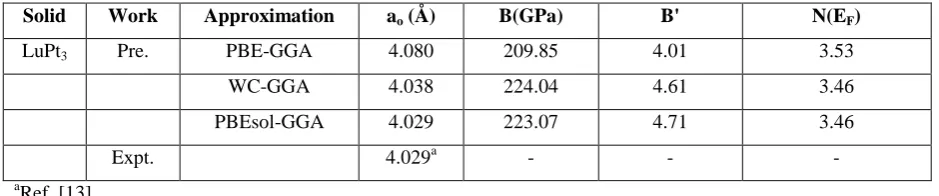
Table 1: Calculated lattice constant (a0), bulk modulus (B), its pressure derivative (B’) of LuPt3 compound at
ambient pressure
a
Ref. [13]
derivative (B') at minimum equilibrium volume V0 using exchange correlation as PBE-GGA, Wu–Cohen (WC)
GGA and PBE-sol GGA. It is seen from Table 1 that our calculated values of lattice parameter ao is found to be
Solid Work Approximation ao (Å) B(GPa) B' N(EF)
LuPt3 Pre. PBE-GGA 4.080 209.85 4.01 3.53
WC-GGA 4.038 224.04 4.61 3.46
PBEsol-GGA 4.029 223.07 4.71 3.46
596 | P a g e
in close agreement with the available experimental data. We could not compare the calculated value of bulk
modulus of LuPt3 due to the lack of availability of experimental as well as theoretical data. The further
calculations have been carried out using only PBE-GGA.
Fig. 1 Variation of total energy with volume of LuPt3 compound in AuCu3 structure
3.2 Electronic properties
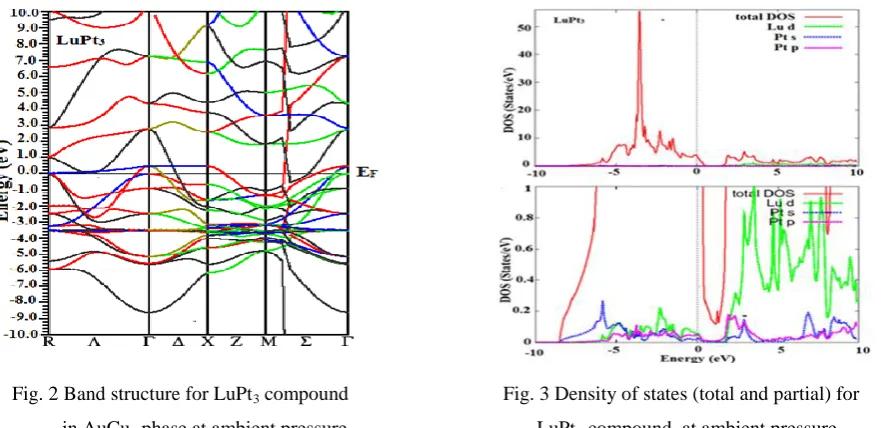
The calculated electronic band structure of LuPt3 compound, along with the higher symmetry directions in the
Brillouin zone using (GGA) approach is shown in Fig. 2. It is seen that there is no band gap at the Fermi level
which shows that LuPt3 compound exhibit a metallic behavior. The Fermi level is considered at zero. In the
band structure of LuPt3 compound, the main contribution to the total DOS comes from the ‘d’ like states of Lu
respectively with significant contribution of ‘s’ and ‘p’ like states of Pt. The lowest lying bands originate from
-6eV is mainly due to
Fig. 2 Band structure for LuPt3 compound Fig. 3 Density of states (total and partial) for
in AuCu3 phase at ambient pressure LuPt3 compound at ambient pressure
‘s’ like states of Pt. The flat bands are obtained in LuPt3 around -3.6eV which is mainly due to ‘f’ like states of
Lu. The bands spread above the Fermi level is due to ‘d’ like states of Lu respectively. The valence band and
conduction bands overlap considerably, and there is no band gap at the Fermi level which confirms the metallic
nature of this compound. The density of states (DOS) plot provides an even more comprehensive picture of the
compound at ambient pressure is presented in Fig. 3. The metallic character is clearly seen from the finite DOS
at the Fermi level. Traditionally the stability in compounds is associated with low density of states (DOS) at the
Fermi level EF [14]. We have calculated the density of states at the Fermi level N(EF). The value of this
parameter is 3.53states/eV for LuPt3 respectively, seen in Table 1.
3.3 Electronic charge density
The charge density distribution is an important property of solid materials and provides good information about
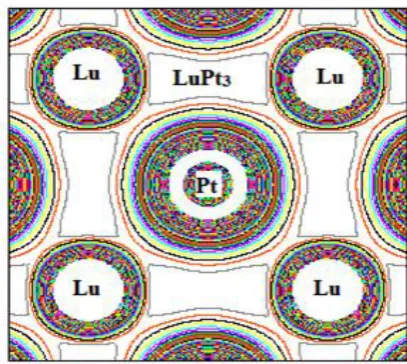
the chemical bonding. Fig. 4 shows the contour plots of the distribution of the electron charge densities in the
(100) plane for LuPt3 compounds. The corner atoms are Lu, and the central atom is Pt respectively. The
obtained charge density plots reveal the spherically symmetric concentration [15] centered on Lu and Pt atoms
with some distortions near the region of contact with neighbouring atoms which indicates the possibility of the
presence of ionic bonding along with weak covalent bonding in this compound. Large difference in
electronegativity is responsible for charge
Fig. 4 Electronic charge density plots of LuPt3 at ambient conditions
transfer among different atoms resulting in ionic bonding nature whereas small electronegativity difference
results in charge sharing and responsible for covalent bonding nature. Electronegative values for Lu and Pt are
1.27 and 2.28 respectively. We found the electronegativity differences are large, indicating the presence of ionic
bonding. For covalent and ionic materials, the typical relations between bulk and shear moduli are GH = 1.1B
and GH = 0.6B [16] respectively. In our case, the ratio for LuPt3 is 0.32 respectively, which confirm the ionic
nature of bonding. All the evidence for the bonding charge densities indicates the ionic characteristics of LuPt3
compound
.
3.4 Elastic properties
The elastic properties play an important role in providing valuable information about the binding characteristic
between adjacent atomic planes and provide the important information on the mechanical and dynamical
properties, such as interatomic potentials, equation of state and phonon spectra. The second order elastic
constants (SOECs) fo
598 | P a g e
Table 2: Calculated elastic constants and mechanical properties of LuPt3
LuPt3 compound have been calculated with PBE-GGA as exchange correlation functional in their AuCu3
structure at ambient pressure. The calculated values of elastic constants are given in Table 2. It can be noted that
our calculated elastic constants satisfy the elastic stability criteria for a cubic crystal at ambient conditions. To
the best of our knowledge, no experimental as well as theoretical values for the elastic constants of LuPt3
compound have been appeared in the literature, so our results can serve as a prediction for future investigations
3.5 Mechanical Properties
Mechanical stability has been analyzed in terms of their elastic constants. In order to investigate the mechanical
properties of LuPt3 compound, we determine the Young’s modulus (E), shear modulus (G
H), Poisson’s ratio (σ)
and anisotropic ratio (A) for useful applications. These are fundamental parameters which are closely related to
many physical properties like internal strain, thermo elastic stress, sound velocity, fracture, toughness. We have
calculated these properties of LuPt3 compound and presented them in Table 2. The shear modulus G
H describes
the material’s response to shearing strain using the Voigt-Reuss-Hill (VRH) method [17-19]; the effective
modulus for the polycrystals could be approximated by the arithmetic mean of the two well known bounds for
monocrystals.
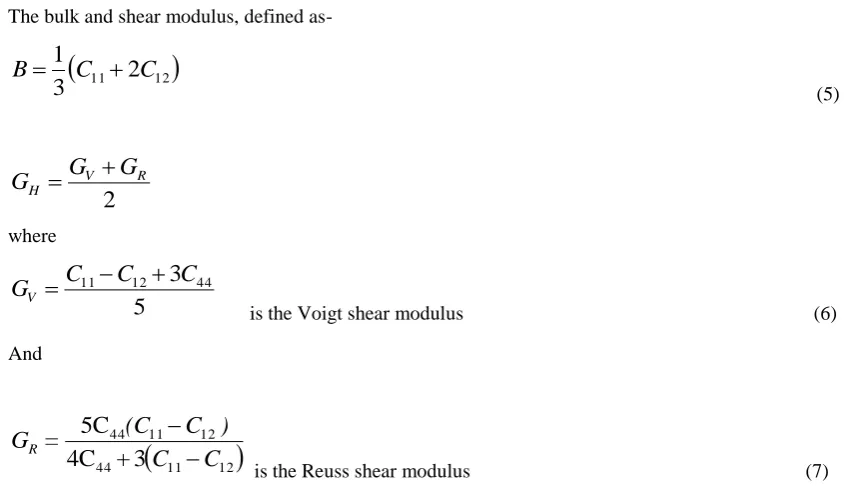
The bulk and shear modulus, defined as-
112
12
3
1
C
C
B
(5)
2
R V HG
G
G
where
5
3
44 1211
C
C
C
G
V
is the Voigt shear modulus (6)
And
11 12
44 12 11 44
3
4C
5C
C
C
+
)
C
(C
=
G
R
is the Reuss shear modulus (7)
Anisotropy factor of a material is another important parameter, which gives a measure of the anisotropy of the
elastic wave velocity in a crystal and it is given as:
12 11 44
2C
C
C
=
A
(8)and used to determine whether the structural properties remain the same in all directions or not. For A= 1, the
material is isotropic otherwise it shows different properties along the different directions.
The calculated elastic anisotropic factor for LuPt3 compound is found to be far from1, so we conclude that the
compound under consideration in this work is strongly anisotropic elastically. The bulk modulus is usually
assumed to be a measure of resistance to volume change by applied pressure [20]. The ratio of the bulk modulus
to shear modulus of crystalline phases can predict the brittle and ductile behavior of materials.
As suggested by Pugh [21], if B/G
H > 1.75; a material behaves in a ductile manner otherwise, the material
behaves in a brittle manner. In the present work, the value of B/GH ratio indicates that the studied compound is
ductile in nature. Ganeshan et.al. [22] have established a correlation between the bonding properties and
ductility. Pettifor [23] has suggested that the angular character of atomic bonding in metals and compounds,
which also relates to the brittle or ductile characteristics, can be described by the Cauchy's pressure (C12 – C44).
Compounds having more positive Cauchy’s pressure tend to form bonds which are primarily metallic in nature
where as for directional bonding with angular character, the Cauchy pressure is negative, with larger negative
pressure representing a more directional character. Based on the calculated equilibrium Cauchy pressure (see
Table 2), we may conclude that this compound belongs to class of ductile materials. The Young’s modulus (E)
is important for technological and engineering application. Young’s modulus is defined as the ratio of stress and
strain, and is used to provide a measure of the stiffness of the solid, i.e., the larger value of E, the stiffer is the
material. And the stiffer solids have covalent bonds [24].
Young’s Modulus (E) is given by
H H
G
+
BG
=
E
3B
9
(9) .
Bulk modulus is still used as a preliminary measure of the hardness of material but in order to confirm it, other
properties must also be taken into account. A high bulk modulus does not mean that a material is hard. Elastic
characteristics must be considered as well, and shear modulus might even provide a better correlation with
hardness than bulk modulus. Covalent materials generally have a high shear modulus. The nature of bond can be
predicted using Poisson’s ratio and reflect the stability of a crystal against shear [25]. The Poisson’s ratio (σ) is given by-
H
H
G
+
=
σ
3B
2
2G
3B
(10)
The value of Poisson’s ratio is found to be ≈ 0.1 for covalent materials and ≈ 0.33 for metallic materials [26,
27]. It is observed from Table 2 that the value of Poisson's ratio is 0.35 for this intermetallic compound,
signifying metallic bonding of LuPt3 compounds. Frantsevich et al. [28] devised a rule on the base of Poisson's
ratio 'σ' to make a distinction between ductile and brittle materials. With respect to his criterion, the critical value of 'σ' is 0.26. For brittle materials the value of 'σ' should be less than 0.26. The value of Poisson's ratio 'σ'
600 | P a g e
3.6 Thermal properties
As an important thermodynamic index, the Debye temperature is closely related to many fundamental solid-state
properties, such as elastic modulus, expansion thermal coefficient and melting point. At low temperature, the
vibrational excitation arises solely from acoustic mode. Hence, at low temperature Debye temperature calculated
from elastic constants. There are various methods to obtain the values of Debye temperature. A usual method for
Table-3 Calculated density (ρ), Longitudinal (vl), transverse (vt), average elastic wave velocities (vm) and Debye
temperature (θD) of RPt3 compounds at ambient pressure estimating the θD value can be obtained from the
values of the elastic constants and the wave velocities such as average wave velocity, transverse and
longitudinal elastic wave velocities. We first time predicted sound velocities, Debye temperature and density are
given in Table 3. Because of the lack of availability of experimental as well as theoretical data of this
compound, we could not compare them. Hence, our results can be considered as a prediction for these properties
and it will testify future experimental work.
IV. CONCLUSION
The structural, electronic, elastic, mechanical and thermal properties of states of LuPt3 compound have been
studied by using FP-LAPW method based on density functional theory as the exchange correlation energy. The
calculated value of lattice constants is in good agreement with the available experimental data. We have also
studied the mechanical properties of this compound. The elastic constants have been calculated using the
approach, the energy-strain method. The calculated elastic constants satisfy the mechanical stability criterion
and the ductility of LuPt3 is predicted by Pugh’s criterion. The band structure and densities of states DOS for
this compound are analyzed and compared. They showed that the studied materials exhibit metallic character.
We have also calculated thermal properties for this compound. For the lack of experimental as well as other
theoretical results, we could not compare them. Hence our results can be considered as a prediction for these
properties, which would be tested in the future both by experimentally and theoretically.
V. ACKNOWLEDGEMENTS
The authors are thankful to MPCST for the financial support.
REFERENCES
[1.] N. Arıkan; A. İyigör; A. Candan; Ş. Uğur; Z. Charifi; H. Baaziz; G. Uğur, Computational Materials
Science, 79, 2013, 703–709.
[2.] Lynda Meddar, Sébastien Garbarino, Mo.hsen Danaie, Gianluigi A. Botton, Daniel Guay Thin Solid
Films, 524, 2012, 127–132.
[3.] W W Xing, X Q Chen, D Z Li, Y Y Li, C L Fu, S V Meschel, X Y Ding, First-principles studies of
structural stabilities and enthalpies of formation of refractory intermetallics: TM and TM3 (T= Ti, Zr, Hf;
M=Ru, Rh, Pd, Os, Ir, Pt) [J]. Intermetallics, 28, 2012, 16−24.
Solids p*103 (kg/m3) vl(m/s) vt (m/s) vm (m/s) θD (K)
[4.] Manish Kumar, Tashi Nautiyal, Sushil Auluck, J. Alloys Compd, 486, 2009, 60.
[5.] N. Acharya, B. Fatima and S.P Sanyal, Journal of Metastable and Nanocrystalline Materials, 28, 2015,
12-15.
[6.] J P. Perdew, K Burke, M.Ernzerhof, Physical Review Letter 77, 1996, 3865-3866.
[7.] H.J.Monkhorst&J.D. Pack, Physical Review B, 13, 1976, 5188.
[8.] F.Birch, Journal of Applied. Physics, 9, 1938, 279.
[9.] P.Blaha, K.Schwarz, G.K.H.Madsen, D.J.Kuasnicka, & Luitz, WIEN2K, An Augmented Plane Wave
Wave+ Local Orbitals Program for Calculating Crystal Properties, 2001. K. Schwarz Technical
Universitat, Wien, Austria, ISBN 3-9501031-1-2.
[10.]Z Sun, S Li, R Ahuja and J M Schneider, Solid State Communications, 129, 2004, 589.
[11.]C. Jasiukiewicz and V. Karpus, Solid State Communications, 128, 2003, 167.
[12.]P Wachter, M Filzmoser and J Rebizant, Physica. B, 293, 2001, 199.
[13.]A.landelli, A. Palenzona, “Crystal chemistry of compounds”, in “Handbook of the Physics and Chemistry
of Rare Earths”, eds K.A. Gschneidner and L. Eyring, 2 North-Holand, 1984, 1-53.
[14.]N.F Mott. H. Jones. The Theory of the Properties of Metals and Alloys Clarenden Press, Oxford, 1936.
[15.]C Kittel 9 1996) Introduction to Solid State Physics 7th edition, p 66 ISBN 9971-51-180-0.
[16.]A Bouhemadou, R Khenata, M Kharoubi, T Seddik, AH Reshak, YA Douri FP-LAPW+lo calculations of
the elastic properties in zinc-blende III-P compounds under pressure effects, Comput Mat Sci 45, 2009
,474-479.
[17.]R. Hill, Proceedings of Physical Society, London A, 65, 1952, 349.
[18.]W. Voigt, Annals of Physics, 38, 1889, 573.
A. Reuss and Z. Angew, Journal of Mathematical Physics, 9, 1929, 49.
[19.]P. Wachter, Handbook on the Physics and Chemistry of Rare Earths (North-Holland Amsterdam, 1993) 19
Chap. 132
[20.]S. F. Pugh, Philosophical Magazine, 45, 1954, 823.
[21.]S. Ganeshan, S. L. Shang, H. Zhang, Y. Wang, M. Mantina and Z. K. Liu, Intermetallics, 17, 2009, 313.
[22.]D.G Pettifor, Journal of Materials Science & Technology, 8, 1992, 345.
[23.]C H Jenkins and S K Khanna, A Modern Integration of Mechanics and Materials in Structural Design.
Mechanics of Materials. ISBN: 0-12-383852-5, 2005, 62-72.
[24.]W Feng et. al. Physica. B, 405, 2010, 4294.
[25.]J B Levine, S H Tolbert and R B Kaner, Advanced Functional. Materials, 19, 2009, 3519.
[26.]J. Haines, J. M. Leger and G. Bocquillon, Annual Review of Materials Research, 11, 2001.
[27.]I.N. Frantsevich, F.F. Voronov, S.A. Bokuta, in: I.N. Frantsevich (Ed), Elastic Constants and Elastic