Progress on the TRIPOLI-4
-Geant4 coupling
Davide Mancusi1,, Olivier Bringer2, and Pascal Monot3
1CEA, Centre de Saclay, DEN/DANS/DM2S/SERMA/LTSD, 91191 Gif-sur-Yvette CEDEX, France 2CEA, Centre de Saclay, DEN/DANS/DM2S/SERMA/LPEC, 91191 Gif-sur-Yvette CEDEX, France 3CEA, Centre de Saclay, DSM/IRAMIS/LIDYL/PHI, 91191 Gif-sur-Yvette CEDEX, France
Abstract.The capability to simulate the transport of charged and/or high-energy hadrons (especially protons) is indispensable for a number of applications. This includes, among others, simulation studies concerned with radiation protection and decommissioning around accelerators and high-intensity laser facilities, as well as beam characterisation in spallation neutron sources. In the context of Monte-Carlo particle transport codes, solving these problems often requires the use of advanced variance-reduction techniques.
TRIPOLI-4is a reference Monte-Carlo particle transport code for the simulation of low-energy (20 MeV) neutrons and photons and offers a wide range of sophisticated variance-reduction schemes; however, it cannot be applied to the problems mentioned above because it lacks the capability to transport charged, high-energy hadrons.
This limitation can be circumvented by coupling TRIPOLI-4with the Geant4 particle-transport toolkit. We present here the first results of this coupling.
1 Introduction
The TRIPOLI-4Monte-Carlo particle-transport code [1] is capable of simulating the transport of neutrons, photons, electrons and positrons in matter. The code is accurately validated for neutron energies between thermal and ap-proximately 20 MeV, which is the common upper limit on the availability of evaluated nuclear data. Electron and positron transport, on the other hand, is less reliant on the availability of nuclear data libraries. For this reason, the upper energy limit for TRIPOLI-4’s electromagnetic cas-cade (e+/e−/γ) is of the order of 1 GeV [2], although sys-tematic and extensive validation has been performed only up to about 10 MeV.
For some applications, the validity ranges indicated above are insufficient. For instance, radiation protection and commissioning/decommissioning of accelerator facil-ities may require the simulation of other particles (e.g. pro-tons, deuterons, heavy ions. . . ) and/or higher energies. This is the case, for instance, of proton accelerators de-voted to cancer therapy, which typically employ proton energies of the order of 250 MeV [3]. Another example is given by facilities studying particle acceleration by high-intensity laser beams. At the time of writing, this promis-ing technique can accelerate particles (mostly protons and electrons) up to energies of the order of 1 GeV on a mi-crometric length scale, which is orders of magnitude more efficient than any other existing acceleration technique. As far as radiation protection is concerned, particle energies
e-mail: [email protected]
below about 200 MeV are again often responsible for most of the dosimetry.
Therefore, it appears that a number of applications re-lated to decommissioning and radiation protection require the ability to simulate the transport of electrons, positrons, photons, protons, neutrons and perhaps heavier ions up to some 250 MeV. This list can also be extended to include spallation neutron sources [4] and accelerator-driven sys-tems (ADS) [5], both of which use spallation reactions in-duced by high-energy hadron beams (mostly protons) to abundantly produce energetic neutrons. The typical beam energies are slightly higher than the above and range from several hundred MeV to a few GeV. Finally, the ability to transport charged particles is also an essential stepping stone towards the simulation of many types of particle detectors, including (but not limited to) those involved in nuclear-reactor-core instrumentation. At present, the TRIPOLI-4 code is unable to meet the requirements spec-ified by these applications.
However, although a few variance-reduction schemes have recently been added to Geant4 [8], the toolkit re-mains mostly focused on analogue transport, which is an inefficient way of estimating e.g. the response of a heavily shielded detector or dosimeter. A large number of histo-ries must be generated in order to obtain an accurate esti-mate of the desired response. TRIPOLI-4, on the other hand, offers a wide, well-established array of sophisti-cated variance-reduction solutions for neutron and photon transport that help mitigate this problem. Nevertheless, if one wishes to use TRIPOLI-4 and apply these techniques to the simulation of a Geant4 particle-detector model, one first needs to remodel the detector using TRIPOLI-4, which is inconvenient and error-prone.
In this work, we explore the possibility to couple TRIPOLI-4 to Geant4 in order to treat applications re-lated to radiation protection, decommissioning around ac-celerators and high-intensity lasers, and spallation neutron sources. This coupled solution essentially allows users to benefit from “the best of both worlds”. We briefly describe the implementation of the TRIPOLI-4/Geant4 coupling in Sec. 2. Section 3 presents the first verification results for coupled codes and serves as an illustration of the possi-ble applications. Finally, Sec. 4 lays out the developments which are envisioned to upgrade the coupled code to pro-duction and collects our conclusions.
2 Description of the coupling
Geant4 is not a monolithic transport code, but rather a toolkit, i.e. a set of C++shared libraries. Users are re-quired to write their own C++code to describe the prob-lem geometry, the sources, the scores they are interested in, etc. From the developer’s point of view, this situation is very practical. The toolkit approach offers a very large number of entry points for further development. This is an essential quality for the coupling because it frees devel-opers from the history-loop straitjacket (source-transport-score-repeat).
The strategy of our development is to extend TRIPOLI-4 and provide new capabilities to TRIPOLI-4 users in a transparent way. For particles which are outside the native scope of TRIPOLI-4, the coupling should dele-gate the simulation task to Geant4. On the other hand, par-ticles that are produced during the Geant4 transport phase but that can be handled by TRIPOLI-4 should be handed back to the latter.
In the framework of the standard Geant4 transport, one has the possibility to define hooks (actions in the Geant4 parlance), i.e. code snippets that are executed at specific stages of the transport simulation (e.g. before/after the loop, before/after each history, after each event, etc.). The TRIPOLI-4/Geant4 coupling relies heavily on actions for shuffling information back and forth between the two codes. One could say that the actions are actually the back-bone of the coupling.
Additionally, the coupling requires carefully synchro-nised initialisation stages on both sides. This is because there are intra-code module dependencies (e.g. Geant4 pri-mary generator actions must be instantiated after physics
lists), as well as inter-code dependencies (e.g. we cannot set the Geant4 pseudo-random-number generator until we are finished with parsing the TRIPOLI-4 input file). In the following, we illustrate a few chosen technical aspects of the coupling.
2.1 Pseudo-random number generation
For the sake of reproducibility, it is important that Geant4 and TRIPOLI-4 share a common pseudo-random-number generator (PRNG). Both codes offer an abstract PRNG interface; we chose to write an adapter class that wraps TRIPOLI-4’s PRNG within the Geant4 API. The reason for this is that the user directly interacts with TRIPOLI-4 through its input file, where they can modify the TRIPOLI-4 PRNG settings.
2.2 Geometry
In Geant4, the calculation geometry is typically described by a C++class with a specific interface. The methods of this class define the volumes and materials used for trans-port. The source code for the class, along with the rest of the code describing the specific simulation problem the user is interested in (sources, scores, etc.), is compiled and linked with the Geant4 library.
In the context of the coupling, TRIPOLI-4 is able to read and interrogate a Geant4 geometry in the form of a compiled shared library. We have developed a small tool1to automate compilation and wrapping of the Geant4 geometry classes. Geometries parametrised by UI com-mands are also supported. Parallel geometries are cur-rently not supported.
2.3 Sources (primary generator actions)
Particle sources (called primary generator actions in Geant4) can also be imported in a TRIPOLI-4/Geant4 sim-ulation. Just like in the case of geometries, the source files describing the source are compiled into a shared li-brary and imported by TRIPOLI-4. As for geometries, UI-parametrised Geant4 sources are supported.
2.4 Physics list
A Geant4physics list is an organised collection of mod-els that specifies which particles are to be transported and how transport should be simulated, as a function of parti-cle type and energy. Although physics lists are outside the scope of the TRIPOLI-4/Geant4 coupling, they still play an important role for the user because they essentially de-termine the accuracy of the Geant4 transport.
The Geant4 user is in principle free to construct their own physics list from scratch. However, for the moment, the TRIPOLI-4/Geant4 coupling only supports the choice of one of the “stock” Geant4 physics lists, the default be-ingFTFP_INCLXX.
2.5 Physics
In its most basic use, the TRIPOLI-4/Geant4 coupling can perform particle transport with TRIPOLI-4 in a Geant4 ge-ometry. In this case, only the Geant4 geometry package is involved. However, it is also possible to activate physics-couplingmode. In this mode, Geant4 will transport all par-ticles that are not within the scope of TRIPOLI-4. This in-cludes protons and heavy ions, but also neutrons, photons, electrons and positrons above and below the TRIPOLI-4 energy range. When Geant4 produces particles within the TRIPOLI-4 range, it hands them over to TRIPOLI-4 for further transport.
2.6 Scores
Users of the TRIPOLI-4/Geant4 coupling are not be ex-pected to define separate scores for particles treated on ei-ther side of the coupling. Instead, they define scores in a normal TRIPOLI-4 input file, and the coupling ensures that TRIPOLI-4 scores are correctly and seamlessly fed from particles from either code.
Yet, it is impossible to feed some score types from the Geant4 side; this is the case, for instance, of point fluxes, which requires knowledge of the double-differential cross section for particle scattering, which is sometimes unavail-able. In other cases, it is technically possible to feed the score, but care must be exercised. Consider energy depo-sition, for instance. Particles that are currently not trans-ported by TRIPOLI-4 (such as nuclei) are assumed to lo-cally depose their kinetic energy. If transport is enabled for these particles via the Geant4 coupling, their contri-bution must be properly subtracted from the local energy deposition, in order to avoid double counting.
3 Verification
We now turn to the verification of TRIPOLI-4/Geant4. A rather direct way to verify the coupling is to perform a coupled calculation with a minimal energy range for TRIPOLI-4 and compare the results with a pure Geant4 calculation. If low-energy particles never lead to the pro-duction of higher-energy particles, then the two calcula-tion results are expected to be equal (up to statistical fluc-tuations) above TRIPOLI-4’s high cutoff. This “trick” puts rather strict constraints on much of the coupling: for in-stance, one is led to conclude that scores must be correctly fed if the test passes. We have performed a number of checks using this approach and perfect statistical agree-ment was found in all cases.
As usual, it is useful to compare the results of the cou-pled code to some reference calculation code, which can be taken to be MCNP6 [9] or Geant4 itself. However, this is not necessarily a stringent test, because the physics im-plemented in different transport codes may be different. It is difficult to prove that any observed difference in the final result arises exclusively from the physics and are not due to some bug in the coupling. This is especially pertinent for calculations involving nuclear reactions without eval-uated nuclear data. In this case, nuclear-reaction models
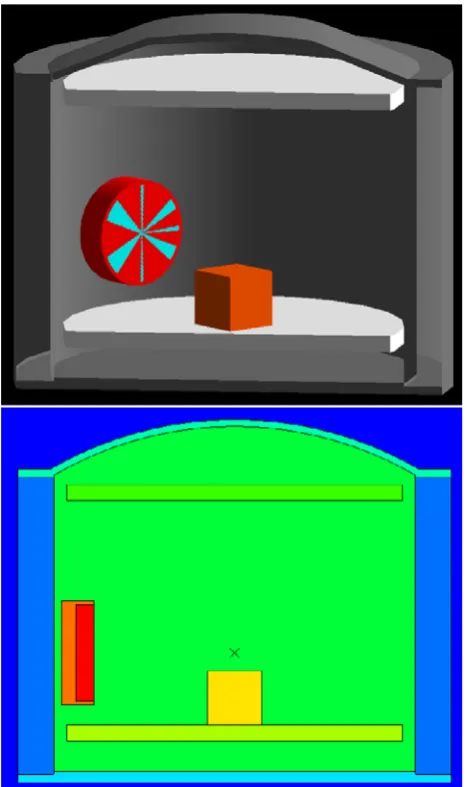
Figure 1.Views of the APOLLON enclosure geometry. The 3D view (top) was generated by the Geant4 OpenGL visualisation driver; the 2D view (bottom) was made with T4g, TRIPOLI-4’s native visualisation tool. The cross on the 2D view indicates the source position.
must be employed to generate the final state of the reac-tion. The uncertainties here are much larger than for eval-uated nuclear data; a factor of two between calculations performed with two different models is not uncommon.
3.1 Test case 1: APOLLON laser enclosure
Geant4 geometry was used for all the TRIPOLI-4 calcula-tions.
The energy distributions of the source particles (pro-tons and electrons) are most intense at low energy, with a long exponential tail that extends up to about 1 GeV. Both distributions are sharply anisotropic. As far as radiation protection outside the enclosure is concerned, low-energy protons and electrons are unimportant, because they are usually stopped without any secondary production. On the other hand, high-energy protons and electrons can yield large dose contributions, but are suppressed by the shape of the source spectrum. This argument suggests that the largest dose contributions come from intermediate ener-gies; quantitative calculations show that energies up to ∼ 250 MeV are responsible for most of the dosimetry. These energies are clearly outside TRIPOLI-4’s native ap-plicability range, at least as far as neutrons are concerned; therefore, the APOLLON enclosure is a good test case for the TRIPOLI-4/Geant4 coupling. For this paper, we only present calculations of neutron fluxes leaving the enclo-sure and generated by the proton source, but extensive cal-culations have actually been performed for in-enclosure and out-enclosure fluxes of photons and neutrons gener-ated by both proton and electron sources.
An important remark is due at this point. Protons above a few MeV are quite efficient at inducing nuclear reactions in matter, which often result in the production of neutrons. Above about 150 MeV, evaluated nuclear data are typically not available and reaction events must be simulated using nuclear-reaction models (pre-equilibrium and intra-nuclear cascade models, coupled to statistical de-excitation models). Unfortunately, this comes at a price: large differences among models are to be expected. This makes it quite difficult to compare calculations performed with different transport codes, which do not necessarily employ the same physics models.
Fortunately, the high-energy transport codes we are considering here (Geant4 and MCNP6) do share one nu-clear reaction model, namely INCL-ABLA. The version that is shipped with MCNP6 (INCL4.2), however, dates back to 2002 [11]; Geant4, on the other hand, contains the latest C++version, INCL++[12]. By default, the two model versions behave rather differently, but it is possible to adjust INCL++’s internal parameters to mimic INCL4.2 to some extent. This is the closest we can get to a compar-ison using the same model.
Figure 2 shows the result of calculations performed with TRIPOLI-4/Geant4, pure Geant4 and MCNP6. Geant4 uses the FTFP_INCLXX_HP physics list, with INCL++in “ INCL4.2 mode”, both in stand-alone mode and within TRIPOLI-4. The MCNP6 calculations use the INCL4.2/ABLA model.
By comparing the pure Geant4 and the TRIPOLI-4/Geant4 calculations, an interesting ob-servation can be made. The results are statistically compatible, despite the fact that the two codes use inde-pendent treatments of neutron transport below 20 MeV (handled by TRIPOLI-4 within the coupled calculation, and by NeutronHP within the Geant4 calculation). This
can be interpreted as a verification of the NeutronHP sector against TRIPOLI-4’s low-energy neutron transport. Note however that the cross sections used by the two codes are not identical: Geant4 uses the G4NDL library, which is essentially based on ENDF/B-VI, while the TRIPOLI-4 data library is based on JEFF-3.1.1. However, for the purpose of our fixed-source calculations, and for the precision we are seeking, the difference appears to be negligible.
Figure 2 also shows the result of a calculation per-formed with MCNP6, whose results are very similar to those obtained with TRIPOLI-4/Geant4 below 10 MeV. It is perhaps worth emphasising that MCNP6 cannot be con-sidered as a reference code for these calculations insofar as the choice of the nuclear-reaction model induces an un-certainty on the calculated neutron flux that can be as large as a factor of two.
3.2 Test case 2: background estimation in Nucifer at Osiris
Nucifer [13] is a neutrino detector that was deployed near the compact Osiris research reactor core (70 MW). The Nucifer detector is well-suited for the detection of short-baseline neutrino oscillations due to its short distance (∼ 7.2 m) from the reactor core. However, due to the extreme smallness of neutrino signal (about 1 neutrino event every 5 minutes), it is of capital importance to precisely esti-mate and possibly suppress any detection background. In the case at hand, one of the sources of background noise is represented by fast neutrons ( 2 MeV) coming from Osiris, which may mimic genuine neutrino events by in-ducing elastic scattering on nuclei contained in Nucifer’s liquid scintillator.
These fast neutrons originate from fission events in Osiris’s core. They can reach Nucifer after traversing about 3.5 m water (the reactor pool) and 2 m concrete. Figure 3 shows a schematic drawing of the geometry. Ex-tremely few neutrons manage to traverse such enormous thicknesses without losing energy and dropping below the 2 MeV threshold energy, or without being absorbed. For this reason, the calculation of the background rate is presently impossible in Geant4.
It is however possible to tackle this problem using TRIPOLI-4’s variance-reduction techniques. First, we performed a criticality simulation of the Osiris reactor core and stored neutrons leaving the core with energy larger than 2 MeV. Since the geometry of the Nucifer detector and its surroundings is modelled with Geant4, we im-ported the geometry using the TRIPOLI-4/Geant4 cou-pling and simulated the transport of the stored neutrons with a pure TRIPOLI-4 calculation. The exponential-transform method was applied, based on an importance map calculated by TRIPOLI-4’s INIPOND module and subsequently adjusted by hand.
energy [MeV] 102
103 104 105 106 107
neutron
fl
ux
[1/(source
cm
2MeV)]
T4
MCNP6 (INCL-ABLA)
G4
10−3 10−2 10−1 100 101 102
energy [MeV] 0.0
0.5 1.0 1.5 2.0
ratio
T4/MCNP6
T4/G4
Figure 2. Top: energy-differential neutron flux generated by the proton source and leaving the enclosure, as calculated by TRIPOLI-4/Geant4, pure Geant4 and MCNP6.
Osiris reactor
core
Nucifer sensitive
volume concrete
water (reactor pool)
1 m
Figure 3.Cross section of the setup of the Nucifer-Osiris calcu-lation.
Figure 4. Cross-sectional colour map of neutron flux in the 8– 20 MeV group, as calculated by TRIPOLI-4 in the Geant4 Nu-cifer geometry.
that the background noise induced by fast neutrons in Nu-cifer can safely be neglected.
3.3 Test case 3: n_TOF spallation source
The n_TOF facility [14] is a spallation neutron source lo-cated at CERN, which operates with a 20-GeV/cpulsed proton beam and which provides time-of-flight tagging of the neutron energy. One of the foremost advantages of n_TOF is that the energy of the produced neutrons spans more than twelve orders of magnitude, from thermal ener-gies to the GeV range, allowing measurements for a wide range of applications. Accurate characterisation of the neutron source is crucial for these purposes, and some fea-tures of the neutron beam must be inevitably determined via numerical simulations.
Recently [15, 16], Geant4 simulations of the n_TOF spallation target were published. The studies focus on characterising the neutron beam (energy spectrum, reso-lution function, etc.) and the inevitable photon contamina-tion. In order to show that the coupling is a suitable tool for this kind of studies, we have redone these simulations using TRIPOLI-4/Geant4.
10−210−1100 101 102 103 104 105 106 107 108
energy [eV] 1010
1011
1012
neutrons
per
pulse
[1/lethar
gy]
Geant4 (no molecular effects) Geant4
TRIPOLI-4
10−2 10−1
0.0 0.2 0.4 0.6 0.8 1.0 1.2 1.4×10¹¹
106 107
energy [eV] 0.0
0.5 1.0 1.5 2.0 2.5×
1012
Figure 5.Energy spectrum of the spallation neutrons emerging from the n_TOF target in a 10◦-cone directed towards the first experi-mental area (EAR1). Left: full spectrum in log-log scale; top right: zoom on the thermal region in log-linear scale; bottom right: zoom on the resolved-resonance region in log-linear scale.
hydrogen was correctly accounted for. Finally, the red line is the result of the TRIPOLI-4/Geant4 coupling. The same Geant4 physics list was used for all the calculations.
The zoom panels on the right of Fig. 5 highlight that the most relevant differences appear in the thermal and in the resolved-resonance ranges. As far as thermal scatter-ing is concerned, we remark that the original Geant4 calcu-lation overestimates the thermal flux by as much as 40%, while the other two calculations are statistically compat-ible. In the 1–10-MeV range, the shape of the spectrum in TRIPOLI-4/Geant4 is different from either Geant4 cal-culation. This might be due to differences in the nuclear data: as mentioned above, Geant4 uses the G4NDL li-brary, which is essentially based on ENDF/B-VI, while the TRIPOLI-4 data library is based on JEFF-3.1.1.
Another interesting aspect that is not visible from Fig. 5 concerns CPU time. The TRIPOLI-4/Geant4 cal-culation is about 2.5 times faster than the Geant4 calcu-lation. This is the ratio of CPU times for the whole cal-culation, and therefore includes the common high-energy transport phase. Moreover, the TRIPOLI-4/Geant4 calcu-lation was run with a low-energy photon cutoffof 1 keV, while the Geant4 calculations used a photon production cut of 1 mm, which corresponds to 101.8 keV in lead. Therefore, we conclude that low-energy neutron transport is sensibly more efficient in TRIPOLI-4 than in Geant4’s
NeutronHP module. Part of this may be due to the use of implicit capture in TRIPOLI-4, which is unavailable in Geant4.
4 Perspectives and conclusions
We have described the progress made on the coupling between TRIPOLI-4 and the Geant4 particle-transport toolkit. The coupling allows TRIPOLI-4 to navigate in-side Geant4 geometries. Geant4 particle sources can also be imported in TRIPOLI-4. Finally, and most impor-tantly, Geant4 can be used to extend TRIPOLI-4’s appli-cation scope by adding the capability to transport many additional particles. The coupling is driven from the TRIPOLI-4 side and it is designed in such a way that a TRIPOLI-4 user should be able to run an existing Geant4 calculation through the coupling with minimal additional effort.
or-der to verify a limited subset of the new features. The TRIPOLI-4/Geant4 results are found to be comparable to those of the other codes, and sensibly faster than equiva-lent calculations in Geant4.
Finally, we wish to trace the way for the future de-velopment of the TRIPOLI-4/Geant4 coupling. First, we need to consolidate the coupling. A sizeable body of V&V work remains to be done if one wished to cover all ex-pected use cases. Further, minor features may need to be added to the code in order to satisfy particular user needs. Moreover, it is possible to boost the usefulness of the cou-pling by having TRIPOLI-4 feed particles to the Geant4 side of the coupling, which is almost never the case today. In particular, one could implement transport of charged particles produced in reactions which are of common in-terest for neutron detection, such as (n,f) and (n, α). This precious capability would pave the way to the detailed simulation of the response of several types of detectors which are outside TRIPOLI-4’s scope today.
One limitation of the present version of the TRIPOLI-4/Geant4 coupling is that the user needs to be familiar with Geant4 to define the problem geometry in Geant4’s native format. Alternatively, if a ROOT geome-try is available, one may attempt conversion to the Geant4 format via GDML export/import. However, no simple so-lution exists for geometries described in TRIPOLI-4’s na-tive format, which is intrinsically different from ROOT’s and Geant4’s hierarchical geometry representations. One possible way to add support for native TRIPOLI-4 geome-tries would be to refactor Geant4’s navigation behind an abstract interface, into which we could subsequently plug any one of TRIPOLI-4’s existing geometry navigation sys-tems. The bottleneck here is represented by the fact that the Geant4 geometry-navigation interface is quite dense. It is unclear to us whether the interface can be adapted to a non-hierarchical geometry engine.
The authors wish to acknowledge J. Gaffiot’s collaboration for the simulation of the Nucifer/Osiris setup. We also wish to thank S. Lo Meo, C. Massimi and N. Colonna for kindly providing the geometry of the n_TOF spallation source and for contribut-ing with discussions about the interpretation of the simulation results.
References
[1] E. Brun, F. Damian, C.M. Diop, E. Dumonteil, F.X. Hugot, C. Jouanne, Y.K. Lee, F. Malvagi, A. Maz-zolo, O. Petit et al., Ann. Nucl. Energy 82, 151 (2015)
[2] Y. Peneliau, DM2S report SERMA/LEPP/RT/ 02-3186/A, CEA-Saclay, France (2002)
[3] M. Goitein, A. Lomax, E. Pedroni, Phys. Today55, 45 (2002)
[4] D. Filges, F. Goldenbaum, Handbook of spalla-tion research. Theory, experiments and applicaspalla-tions (Wiley-VCH, Berlin, 2009)
[5] H. Aït Abderrahim, P. Baeten, D.D. Bruyn, J. Heyse, P. Schuurmans, J. Wagemans, Nucl. Phys. News20, 24 (2010)
[6] S. Agostinelli et al., Nucl. Instrum. Meth. A506, 250 (2003), official web site: http://geant4.cern.ch/. [7] J. Allison et al., IEEE T. Nucl. Sci.53, 270 (2006) [8] J. Allison, K. Amako, J. Apostolakis et al., Nucl.
In-strum. Meth. Phys. Res. A (2016), in press
[9] T. Goorley, M. James, T. Booth et al., Nucl. Technol. 180, 298 (2012)
[10] J. Zou, C. Le Blanc, D. Papadopoulos et al., High Power Laser Sci. Eng.3, e2 (2015)
[11] A. Boudard, J. Cugnon, S. Leray, C. Volant, Phys. Rev. C66, 044615 (2002)
[12] D. Mancusi, A. Boudard, J. Cugnon, J.C. David, P. Kaitaniemi, S. Leray, Phys. Rev. C (2014), sub-mitted
[13] G. Boireau, L. Bouvet, A.P. Collin et al. (Nucifer Collaboration), Phys. Rev. D93, 112006 (2016) [14] n_TOF website, https://ntof-exp.web.cern.ch/
ntof-exp/
[15] S. Lo Meo, M.A. Cortès-Giraldo, C. Massimi, et al., Eur. Phys. J. A51, 160 (2015)